
Life, 1920-06-17 · page 20 of 45
Life — June 17, 1920 — page 20: what you’re looking at
What you’re looking at
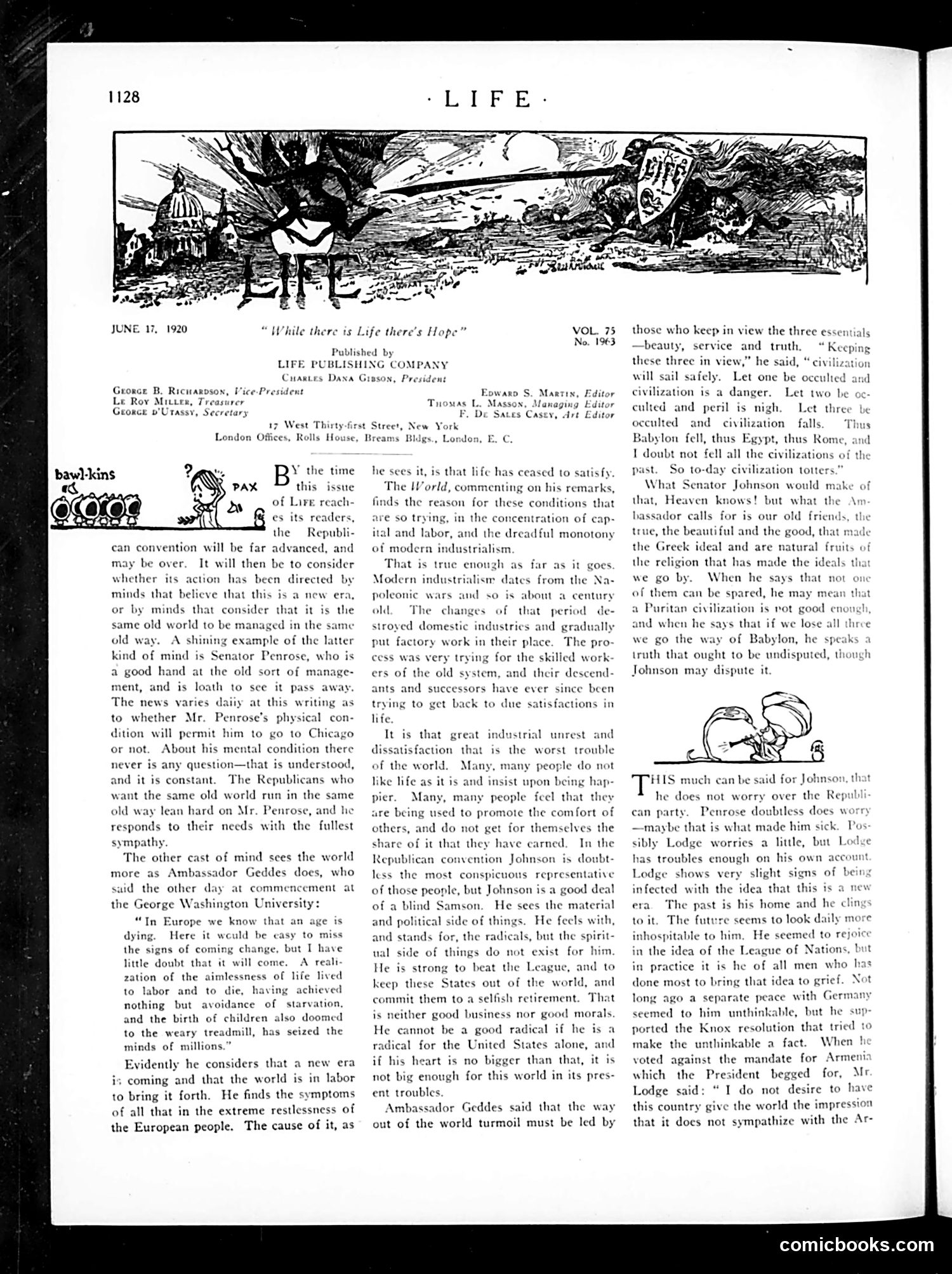
This editorial page discusses the 1920 Republican National Convention, contrasting two philosophical approaches represented by Senator Boies Penrose (an "old guard" conservative seeking continuity) and Ambassador Geddes (representing progressive change). The central debate concerns modern industrialism's effects: factory systems destroyed traditional crafts, leaving workers dissatisfied and fueling labor unrest across Europe. The editorial criticizes those (like convention delegate Johnson, apparently a "blind Samson") who see only material/political dimensions of radicalism without spiritual commitment to genuine reform. Ambassador Geddes's George Washington University speech warned that European civilization faces collapse due to workers' loss of life satisfaction—seeing only "aimless" labor and survival. The editorial frames this as symptomatic of necessary global transformation, implicitly arguing the Republican Party must acknowledge this reality rather than retreat into nationalist isolationism. The cartoon's allegorical figures (partially visible) likely satirize these competing worldviews during this pivotal election year.
📄 Transcribed text from this page (OCR, searchable)
Machine-transcribed from the original scan — historical spelling and the odd misread are preserved.
“While there is Life there’s Hope” shed by LIFE PUBLISHING COMPANY Cuartes Dana Gisson, Pi ¢ Groxce B. Riciarvsox Le Roy Mitire, 7 Geoxce b'Urassy 17 West Thirty London Offices, Rolls Ho Y the time this of Lire reach- isste es its readers, the — Republi- n convention will be far advanced, and may be over. It will then be to consider whether its action has been directed minds that believe that this is a new era or by minds that consider that it is the same old world to be managed in the same old way. A shining example of the latter kind of mind is Senator Penrose, who is a good hand at the old sort of manage- ment, and is loath to see it pass away, The news va to whether Mr. s daiiy at this writing as Penrose’s physical con- dition will permit him to go to Chicago or not. About his mental condition there never is any question—that is understood, and it is constant. The Republicans who want the same old world run in the same old way lean hard on Mr. Penrose, and he responds to their needs with the fullest sympathy The other cast of mind sees the world more as Ambassador Geddes does, who said the other day at commencement at the George Washington University: In Europe we know that an dying. Here it weuld be easy to m the signs of coming change, but I have little doubt that it will come. A reali zation of the aimlessness of life lived to labor and to die, having achieved nothing but avoidance of starvation, and the birth of children also doomed to the weary treadmill, has zed the minds of millions. Evidently he considers that a new era is coming and that the world is in labor to bring it forth. He finds the symptoms of all that in the extreme restlessness of the European people. The cause of it, as Breams waro S. Martix, Edit. Tuomas L. sox, Managing Editor F. De s Casey, drt Editor Street, New York Bldgs, London. he sees it, is that life has ceased to satisfy. The World, commenting on his remarks, finds the reason for these conditions that are so trying, in the concentration of cap- and labor, and the dreadful monotony of modern industrialism That is true enough as far as it goes. Modern industrialism dates from the Na- poleonic wars and so is about a century old. The stroyed domestic industries and gradual The pro- cess was very trying for the skilied work changes of that’ period put factory work in their place. ers of the old system, and their descend- ants and successors have ever since been trying to get back to due satisfactions in life It is that dissatisfaction of the world. like life as it is Many, great industrial unrest and that is the Many, n nd insist upon being hap- worst trouble ny people do not pier. ny people feel that they ure being used to promote the comfort of and do not get for themselves the In the others, share of it that they have earned. Republican convention Johnson is doubt- less the most consp of those people, but Johnson is a good deal of a blind He sees the material and political side of things. He feels with, nds for, the radicals, but the spirit- cuous representative mson and sta ual side of things do not exist for him He is strong to beat the League, and to keep these States out of the world, and Phat is neither good business nor good morals. commit them to a selfish retirement. He cannot be a good radi if he is a radical for the United States alone, and if his heart is no bigger than that, it is not big enough for this world in its pres- ent troubles. Ambassador Geddes said that the out of the world turmoil must be led by those who keep in view the three ¢ beauty, service and truth, these three in view,” he said, Let one be o civilization is a danger. will sail safely. Let two be oc- culted and peril is nigh. Let occulted and civilization Babylon fell, thus Egypt 1 doubt not fell all the civilizations of th three be falls. Thus thus Rome, and past. So to-day civilization totter What Senator Johnson would make of that, Heaven knows! but what the A hassador calls for is our old friends. e, the beautiful and the good, that made the Greek ideal and are natural fruits of the religion that has made the ideals that we go by. When he says that not onc of them can be spared, he may mean that a Puritan civilization is vot good enong! nd when he says that if we lose we go the way of Babylon, he sp truth that ought to be undisputed, though Johnson may dispute it I HIS much can be said for Johnso: he does not worry over the Repul can party. Penrose doubtless does w —maybe that is what made him sick sibly Lodge worries a little, bu has troubles enough on his own ace Lodge shows very slight signs of be infected with the idea that this is 4 era. The past is his home and he clin The fut inhospitable to him in the idea of the League of Nations, in practice it is he of all men who has Not to it seems to look daily more He seemed to re t done most to bring that idea to grief. a separate peace with Ger seemed to him unthinkable, but he ported the Knox resolution that tried ¢ make the unthinkable a fact. When ! voted against the mandate for Armeni the President begged for, Mr * 1 do not desire to have long ag which Lodge said: this country give the world the impression that it does not sympathize with the Ar- comicbooks.com