
Life, 1920-06-17 · page 21 of 45
Life — June 17, 1920 — page 21: what you’re looking at
What you’re looking at
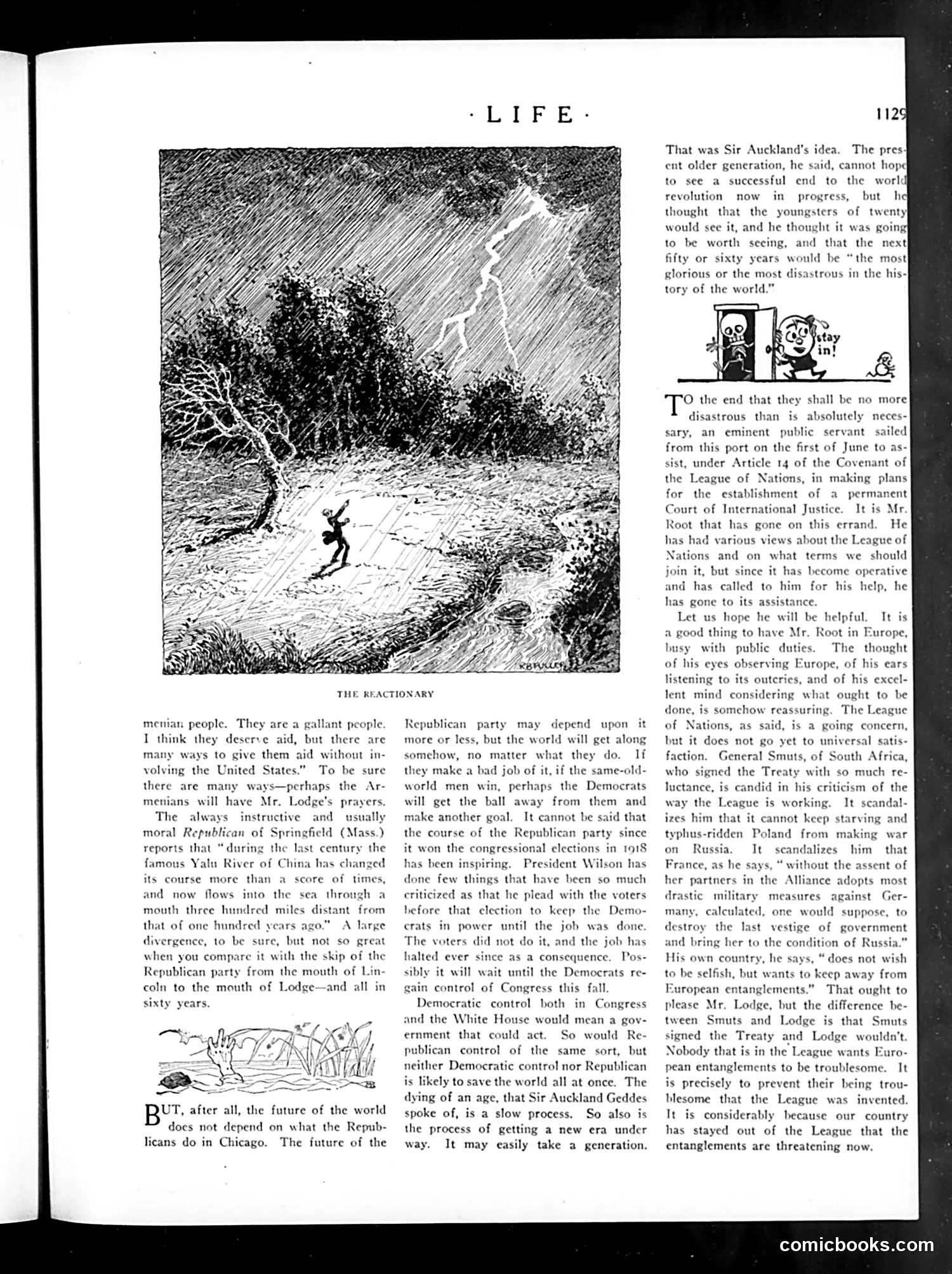
This page satirizes Republican Party inconsistency and inaction, particularly targeting Senator Henry Cabot Lodge. The main cartoon depicts a figure running downhill in a storm, illustrating the editorial's central metaphor: the Republican Party's political "course" has shifted as dramatically as China's Yalu River changed direction—"from the mouth of Lincoln to the mouth of Lodge—and all in sixty years." The text criticizes Republicans for blocking President Wilson's post-WWI agenda, particularly regarding the League of Nations and Armenian aid. It praises diplomat Elihu Root for assisting the League despite his earlier reservations, contrasting principled flexibility with stubborn partisan obstruction. The small cartoon vignette (skull and cheerful figure) appears to be a generic Life magazine mascot or recurring element unrelated to the main political argument. The piece argues that neither party alone can solve world problems; effective governance requires coherent action—something the divided Republican Party fails to provide.
📄 Transcribed text from this page (OCR, searchable)
Machine-transcribed from the original scan — historical spelling and the odd misread are preserved.
THE REACTIONARY menian people. They I think they deserve aid, but there are many ways to give them aid without in- volving the United State: To be sure there are many ways—perhaps the Ar- i . Lodge's prayers. The always instructive and usually moral Republican of Springfield (Mass.) reports that “during the last century the are a gallant people. famous Yalu River of China has changed its course more than a score of and now flows into the sea through a times, mouth three hundred miles distant from that of one hundred years ago.” A large divergence, to be sure, but not so great when you compare it with the skip of the Republican party from the mouth of Lin- coln to the mouth of Lodge—and all in sixty years. , after all, the future of the world does not depend on what the Repub- licans do in Chicago. The future of the Republican party depend upon it more or less, but the world will get along somehow, no matter what they do. If may they make a bad job of it, if the same-old- world men win, perhaps the Democrats will get the ball away from them and make another goal. It cannot be said that the course of the Republican party since it won the congressional elections in 1o1S President Wilson has done few things that have been so much criticized as that he plead with the voters hefore that election to keep the Demo- has been inspiring. crats in power until the job was done. The voters did not do it, and the job has halted ever since as a consequence. Pos- sibly it will wait until the Democrats re- gain control of Congress this fall Democratic control both in Congress and the White House would mean a gov- ernment that could act. So would Re- publican control of the same sort, but neither Democratic control nor Republican is likely to save the world all at once. The dying of an age, that Sir Auckland Geddes spoke of, is a slow process. So also is the process of getting a new era under way. It may easily take a generation. That was Sir Auckland's idea. The pres} ent older generation, he said, cannot hope to see a successful end to the world revolution now in progress, but h thought that the youngsters of twenty; would see it, and he thought it was going worth secing, and that the next fifty or sixty years would be “the most to be glorious or the most disastrous in the his- tory of the world.” 'O the end that they shall be no more disastrous than is absolutely neces- sary, an eminent public servant. sailed from this port on the first of June to as- sist, under Article 14 of the Covenant of the League of Nations, in making plans for the establishment of a Court of International Justice. permanent It is Mr Root that has gone on this errand. He has had various views about the League of Nations and on what terms we join it, but since it has bee and has called to him for his help, he has gone to its assistance. should me operative Let us hope he will be helpful. It is Root in Europe, The thought of his eyes observing Europe, of his ears good thing to have Mr. busy with public duties. and of his excel- lent mind considering what ought to be done, is somchow reassuring listening to its outeries, he League of Nations, as said, is a going concern, but it does not go yet to universal sati faction. General Smuts, of South Africa, who signed the Treaty with so much re- luctance, is candid in his criticism of the way the League is working. izes him It scandal- t it cannot keep starving and typhus-ridden Poland from making war on Russia. It izes him that France, as he says, “ without the assent of her partners in the Alliance adopts most sean drastic measures against Ger- many, calculated, one would suppose, to military destroy the last vestige of government and bring her to the condition of Russi His own country, he says, “does not wish to be selfish, but wants to keep away from European entanglements.” That ought to please Mr. Lodge, but the difference be- tween Smuts and Lodge is that Smuts signed the Tre: and Lodge wouldn't Nobody that is in the League wants Euro- pean entanglements to be troublesome. It is precisely to prevent their being trou- blesome that the League was invented. It is considerably because our country has stayed out of the League that the entanglements are threatening now. comicbooks.com