
Life, 1920-06-17 · page 24 of 45
Life — June 17, 1920 — page 24: what you’re looking at
What you’re looking at
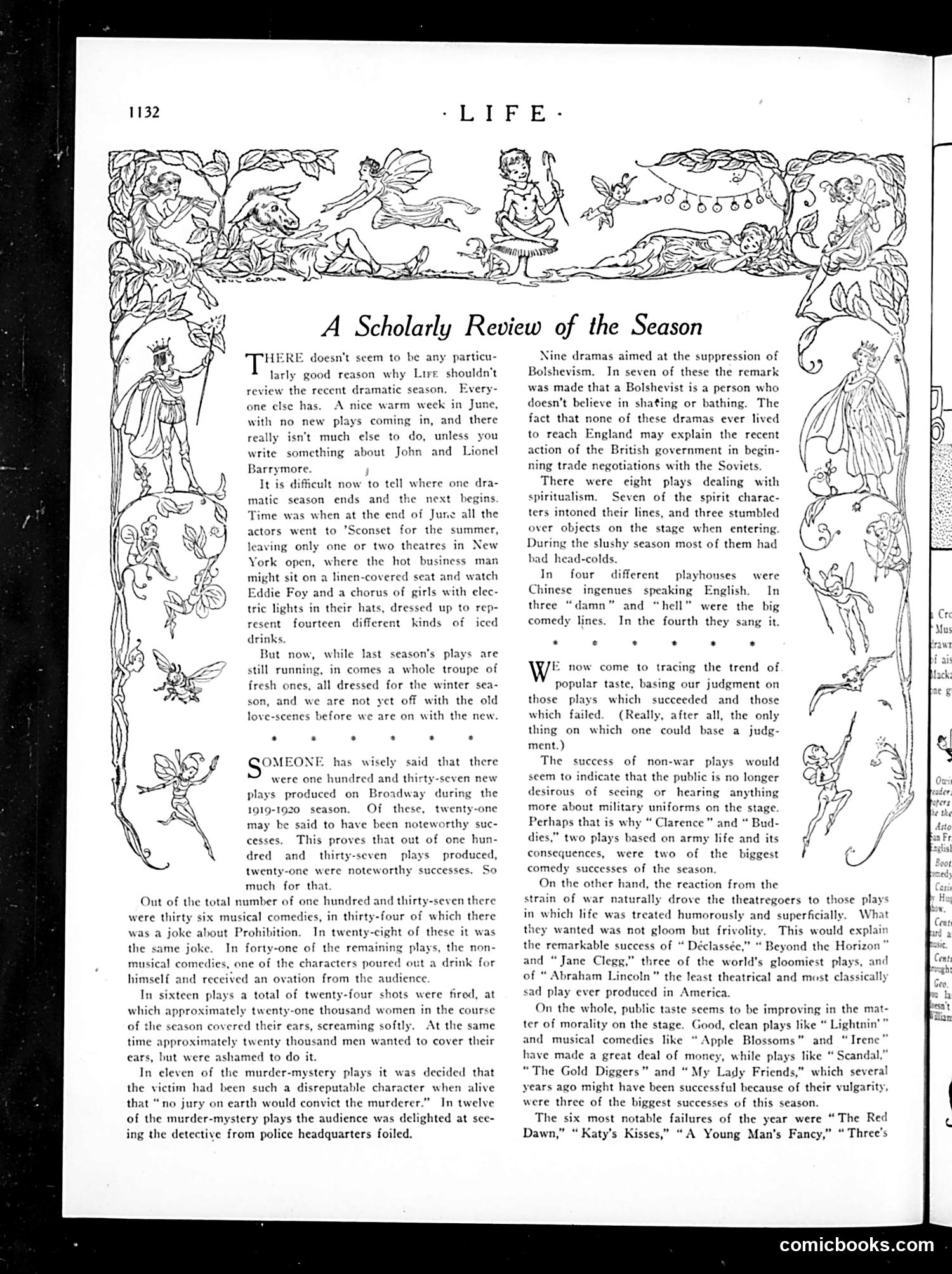
This is a humorous critical essay reviewing Broadway's 1919-1920 dramatic season. The decorative border features cherubs and theatrical figures typical of Life's ornamental style. The author satirizes theatrical trends by presenting absurd statistics: of 137 new plays produced, only 21 were noteworthy successes. Life mocks recurring jokes—36 musical comedies featured Prohibition humor, often the identical gag repeated. The piece ridicules anti-Bolshevik propaganda plays (portraying communists as people "who doesn't believe in shating or bathing"), spiritualist dramas with bumbling ghosts, and Chinese actresses speaking English delivering only "damn" and "hell" as comedy. The satire's core: despite audiences supposedly tiring of military themes after WWI, plays about army life like "Clarence" and "Buddies" were major successes—an obvious contradiction the author highlights to mock both predictable public taste and theatrical producers' inability to read audiences.
📄 Transcribed text from this page (OCR, searchable)
Machine-transcribed from the original scan — historical spelling and the odd misread are preserved.
cS f) Dien A Scholarly Review of the Season HERE doesn't seem to be any particu- larly good reason why Lire shouldn't review the recent dramatic season. Eve one else has. A nice warm week in June, with no new plays coming in, and there really isn't. much to unless you write something about John and Lionel Barrymor ' It is difficult now to tell where one dra- the next begins. else do, matic season ends and Time was when at the end of June all the for the tres in New actors went to ’Sconset summe: leaving only one or two th York open, where the hot business ma might sit on a linen-covered seat and watch Eddie Foy and a chorus of girls with elec- tric lights in their hats, dressed up to rep- resent fourteen different kinds of iced drinks. But now, while last season's plays are still running, in comes a whole troupe of fresh ones, all dressed for the winter sea- son, and we are not yet off with the old love-scenes before we are on with the new. . . * . wis said that there OMEONE y were one hundred and thirty-seven new Broadway during the Of these, has S plays produced on 1919-1920 may be said to have been noteworthy suc- This proves that out of one hun- produced, season. twenty-one cesses. dred and thirty-seven plays. twenty-one were noteworthy successes. So much for that Out of the total number of one hundred and thirty-seven there were thirty six musical comedies, in thirty-four of which there was a joke about Prohibition. In twenty-cight of these it was the same joke. In forty-one of the remaining plays, the non- one of the characters poured out a drink for ed an ovation from the audience. musical come: himself and rece teen plays a total of twenty which approximately twenty-one thousand women in the course of the season covered their ears, screaming softly. At the same time approximately twenty thousand men wanted to cover their In six our shots were fired, at ears, but were ashamed to do it. In eleven of the murder-mystery plays it was decided that the victim had been such a disreputable character when alive that “no jury on earth would convict the murderer.” In twelve of the murder-mystery plays the audience was delighted at sce- ing the detective from police headquarters foiled. Nine dramas aimed at the suppression of Bolshevism. In seven of these the remark was made that a Bolshevist is a person who doesn’t believe in shating or bathing. The fact that none of these dramas ever lived to reach Englar action of the British government in begin- may explain the recent ning trade negotiations with the Soviets. There were eight plays dealing with spiritualism. Seven of the spirit charac- ters intoned their lines, and three stumbled over objects on the stage when entering. During the slushy season most of them had bad head-colds. In four different playhouses Chinese ingenues speaking English, three “damn” and “hell” were the big comedy lines. In the fourth they sang it. were In . e . * . . W now come to tracing the trend of popular taste, basing our judgment on those plays which succeeded and those which failed. (Really, after all, the only thing on which one could base a judg- ment.) The of would seem to indicate that the public is no longer desirous seeing or hearing anything more about military uniforms on the stage. Perhaps that is why “ Clarence” and “ Bud- dies,” two plays based on army life and its consequences, were two of the biggest comedy successes of the season. On the other hand, the reaction from the strain of war naturally drove the theatregoers to those plays in which life was treated humorously and superficially. WI they wanted was not gloom but frivolity. This would explain the remarkable success of “ Dé Beyond the Horizon” and “Jane Clegg,” three of the world’s gloomiest plays, and of “Abraham Lincoln” the least theatrical and most classically sad play ever produced in America. success non-war plays of jassée,” On the whole, public taste seems to be improving in the mat- ter of morality on the stage. Good, clean plays like “ Lightnin’ ” and musical comedies like “Apple Blossoms” and “Irene” ave made a great deal of money, while plays like “ Scandal, The Gold Diggers" and “ My Lady Friends,” which several years ago might have been successful because of their vulgarity, were three of the biggest successes of this season. The six most notable failures of the year were “The Red Dawn,” “ Katy’s Kisses,” “A Young Man's Fancy,” “ Three's comicbooks.com