
A complete issue · 40 pages · 1920
Life — March 25, 1920
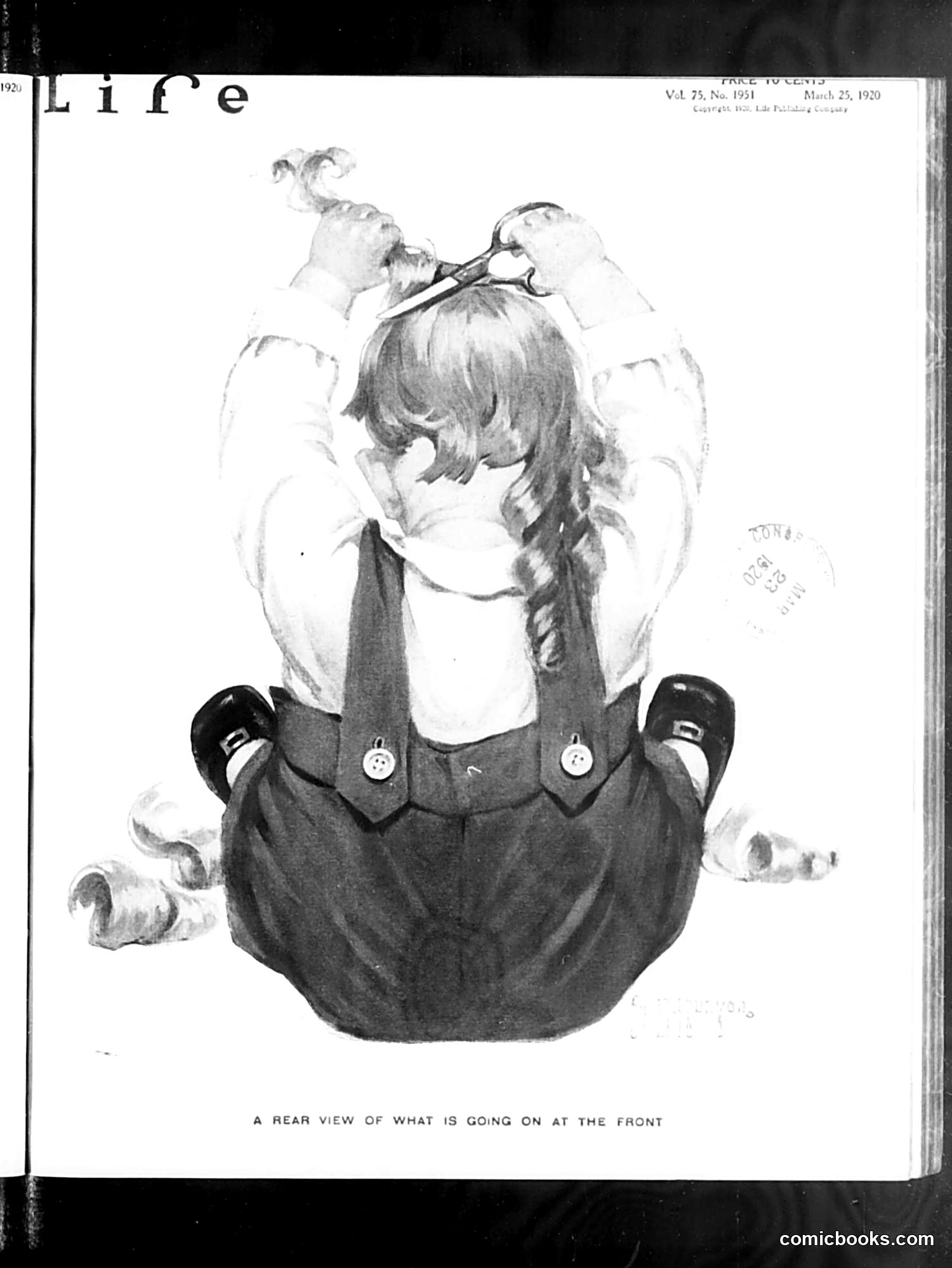
This page from *Life* magazine (March 25, 1920) presents a rear-view cartoon showing a woman from behind, her hair in braids, wearing a dark dress with a white collar and button earrings. Multiple cherub-like figures appear to be working on her hair or head. The caption reads: "A REAR VIEW OF WHAT IS GOING ON AT THE FRONT." This is a visual pun playing on the double meaning of "front"—referring both to a woman's hairstyle (the front of her hair) and military warfare (the "front" of combat). The cherubs represent the elaborate effort required to create fashionable 1920s hairstyles. The satire mocks women's fashion practices by suggesting that achieving fashionable hair requires as much coordinated effort as a military operation.
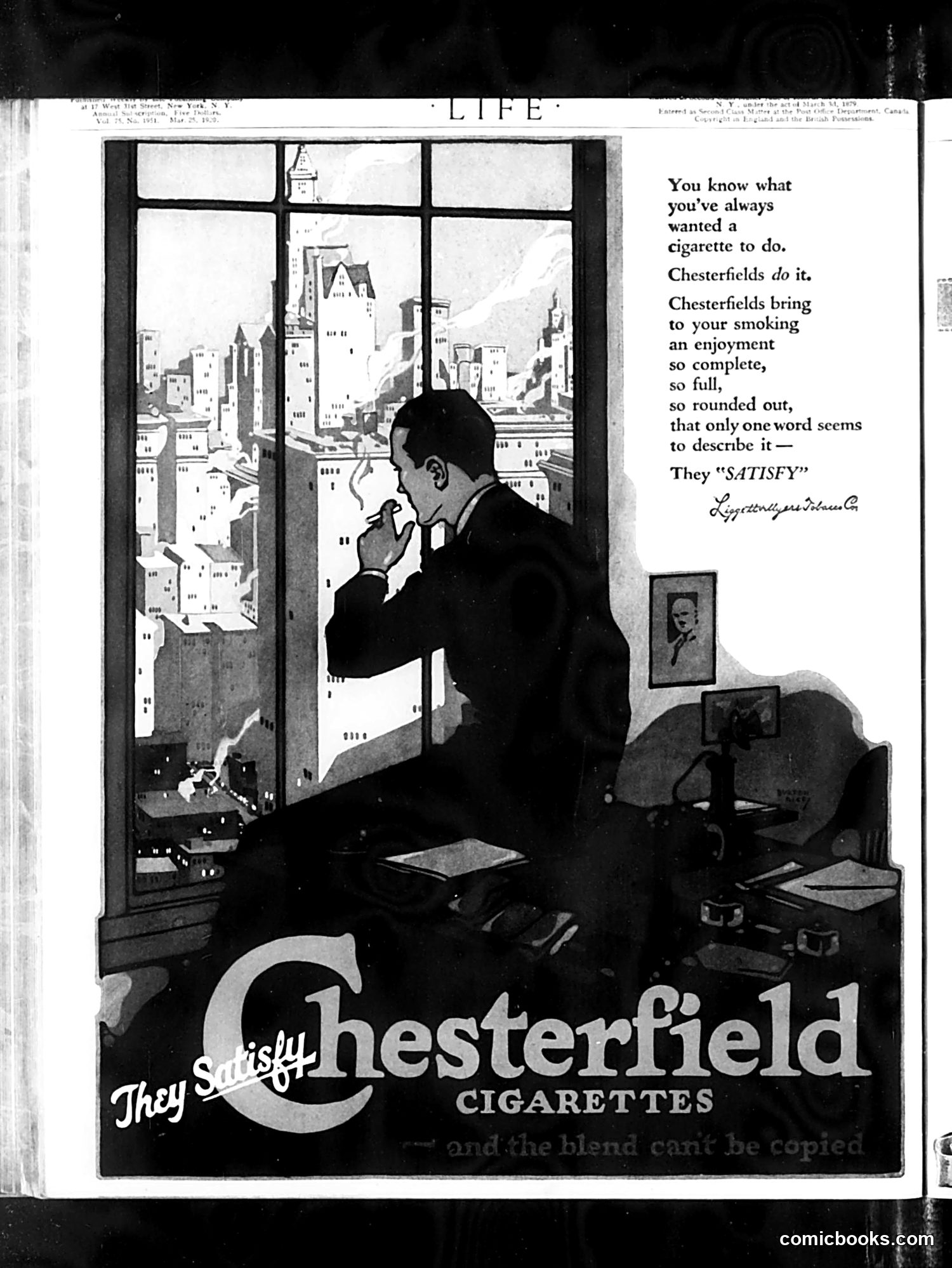
This is a **cigarette advertisement**, not political satire. It depicts a man in an office overlooking a cityscape, smoking a Chesterfield cigarette. The ad copy claims that Chesterfields provide complete smoking enjoyment, using the word "SATISFY" as the key selling point. The phrase "and the blend can't be copied" suggests competitive advantage through a proprietary tobacco blend. **Context for modern readers:** This represents mid-20th century advertising before cigarette health warnings were required. The aspirational imagery—successful businessman, urban prosperity—was typical marketing strategy linking cigarettes to achievement and sophistication. Such advertisements are now heavily restricted due to tobacco's documented health risks.
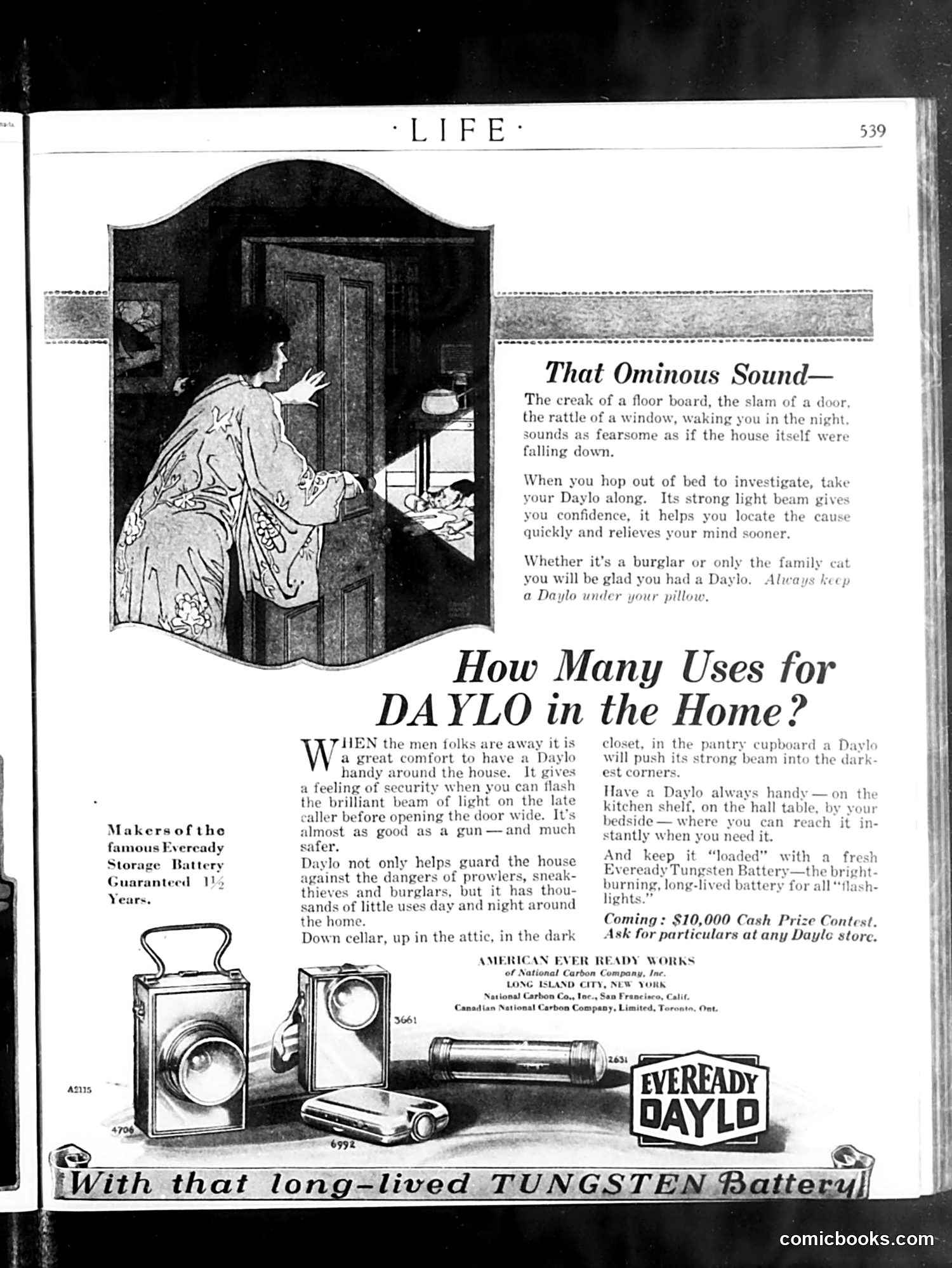
This page is primarily an **advertisement for Eveready Daylo flashlights**, not political satire. The illustration shows a woman in bed startled by nighttime noises, a relatable domestic scenario used to market the product. The ad's appeal is straightforward: flashlights provide security and peace of mind during the anxieties of home ownership—investigating mysterious sounds, locating burglars or household problems, or simply keeping one handy for emergencies. The tagline emphasizes the Tungsten Battery's longevity ("long-lived"). The phrase "Always keep a Daylo under your pillow" positions the flashlight as essential home security equipment. This reflects early-20th-century consumer anxiety about household safety, which advertisers skillfully weaponized to drive sales. There is no political commentary—purely commercial messaging.
This page is primarily **advertising copy**, not editorial content or satire. It promotes Life magazine's upcoming Easter Number issue. The text announces that next week's edition will be extraordinary: a double issue with 64 pages, yet maintaining the standard 10-cent price despite increased production costs. The advertisement emphasizes that this Easter Number will feature work by "the best artists and writers in America." The decorative illustrations flanking the text show stylized female figures in Easter-themed clothing, likely representing spring fashions. These serve as visual embellishment rather than satirical commentary. The small print at bottom lists subscription rates for Canadian and foreign readers. This is essentially a promotional piece encouraging newsstand purchases and subscriptions ahead of the special Easter edition.
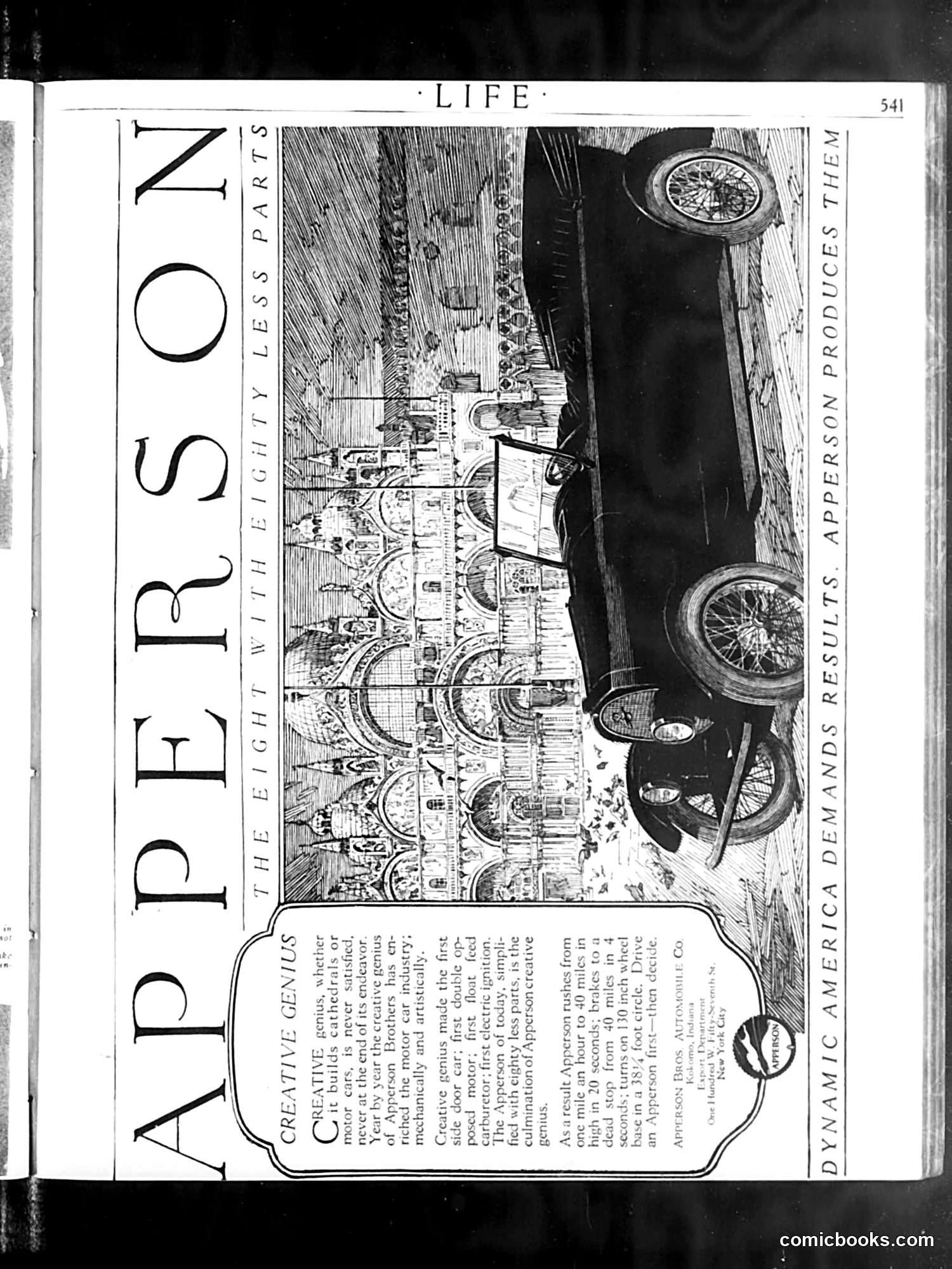
This is a **car advertisement**, not a political cartoon. The page shows an automobile photographed from above, displayed on an ornate street or building setting. The "Creative Genius" section praises the vehicle's engineering and design. The headline "A PERE ISON" appears to be a pun or wordplay (possibly "A Precision" or similar, though OCR may have garbled it). The advertisement emphasizes the car's mechanical superiority and reliability, listing specific performance metrics and engineering achievements. The text promises that buyers will experience "Dynamic American results" and superior craftsmanship. This represents typical early-20th-century automotive advertising that emphasized engineering prowess and American manufacturing excellence to appeal to consumers.
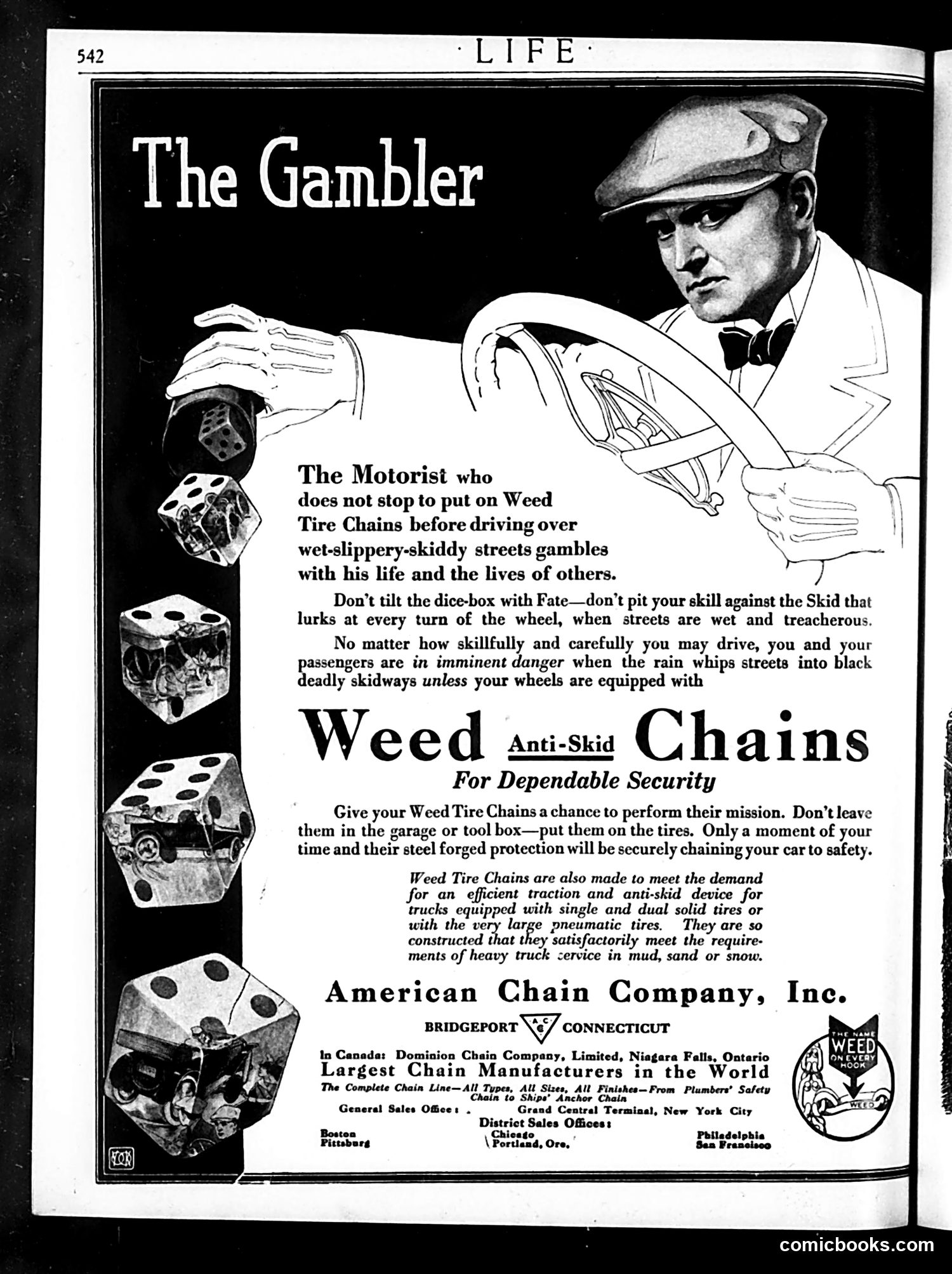
This is primarily a **product advertisement** for Weed Anti-Skid Tire Chains, not political satire. The "gambler" metaphor compares a motorist driving on wet streets *without* tire chains to someone gambling with dice—risking lives through reckless chance-taking. The illustration shows a well-dressed man in a flat cap and bow tie, depicted as a "gambler" because he's metaphorically "rolling dice" with safety. The dice imagery reinforces the dangerous gamble of driving without proper winter traction equipment. The ad uses moral persuasion rather than humor: driving without chains on slippery roads is presented as irresponsible gambling that endangers both the driver and passengers. This was serious safety messaging during an era when winter driving hazards were significant.
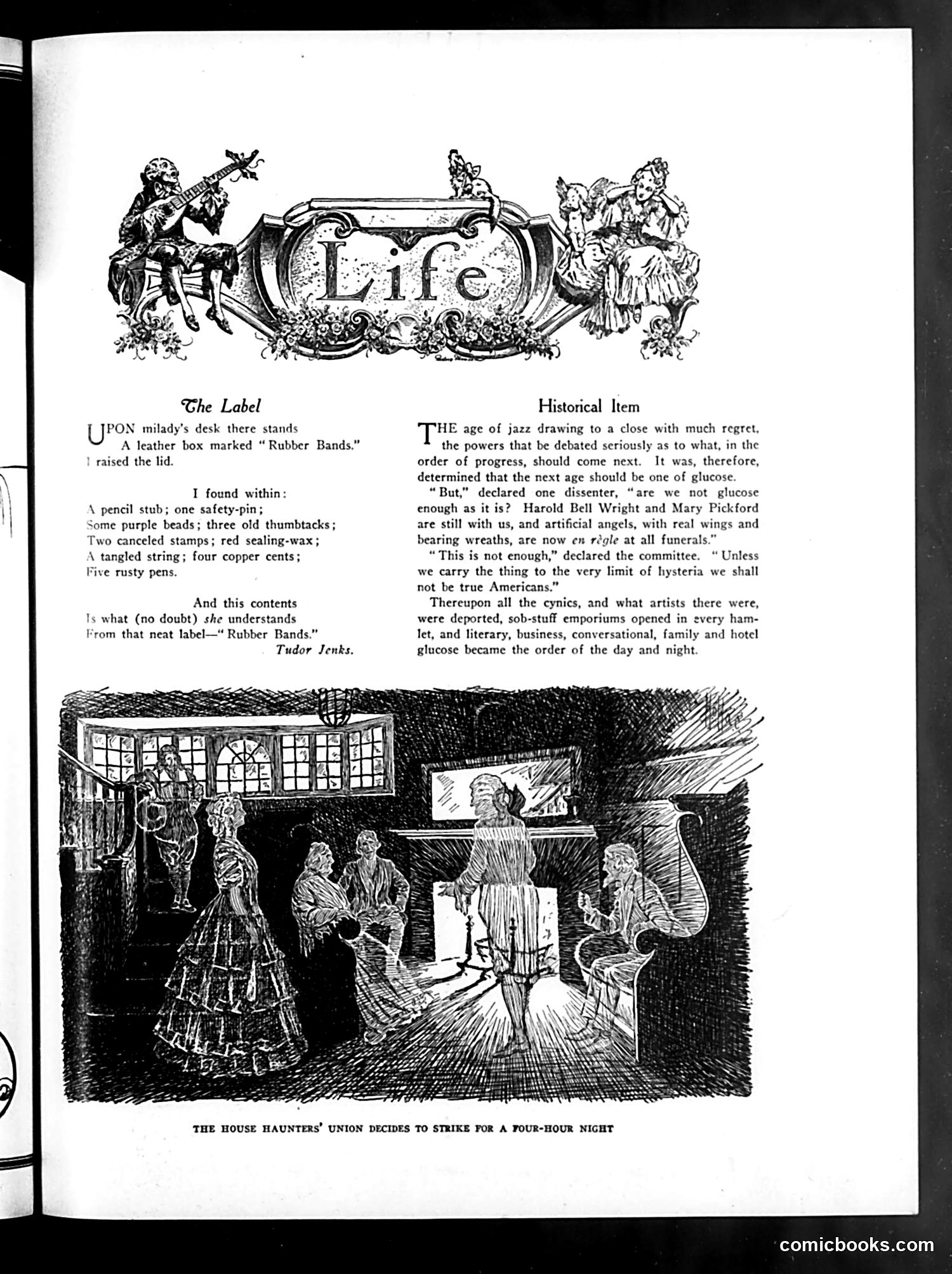
This page from *Life* magazine contains two distinct items: **"The Label"** (left): A humorous poem by Tudor Jenks describing the contents of a leather box labeled "Rubber Bands"—listing mundane items like pencils, safety pins, and old thumbtacks. The joke satirizes how such boxes mysteriously accumulate worthless junk over time. **"Historical Item"** (right): Social satire mourning the decline of jazz-age culture. The text laments that artistic cynicism has replaced genuine bohemian spirit, mentioning Harold Bell Wright and Mary Pickford as symbols of mainstream mediocrity. It suggests American culture has devolved into superficial "glucose"—suggesting saccharine, mass-market entertainment replacing authentic artistic expression. **The illustration** depicts a haunted house scene, likely accompanying the "House Haunters' Union" reference, though the connection to the text above is unclear.
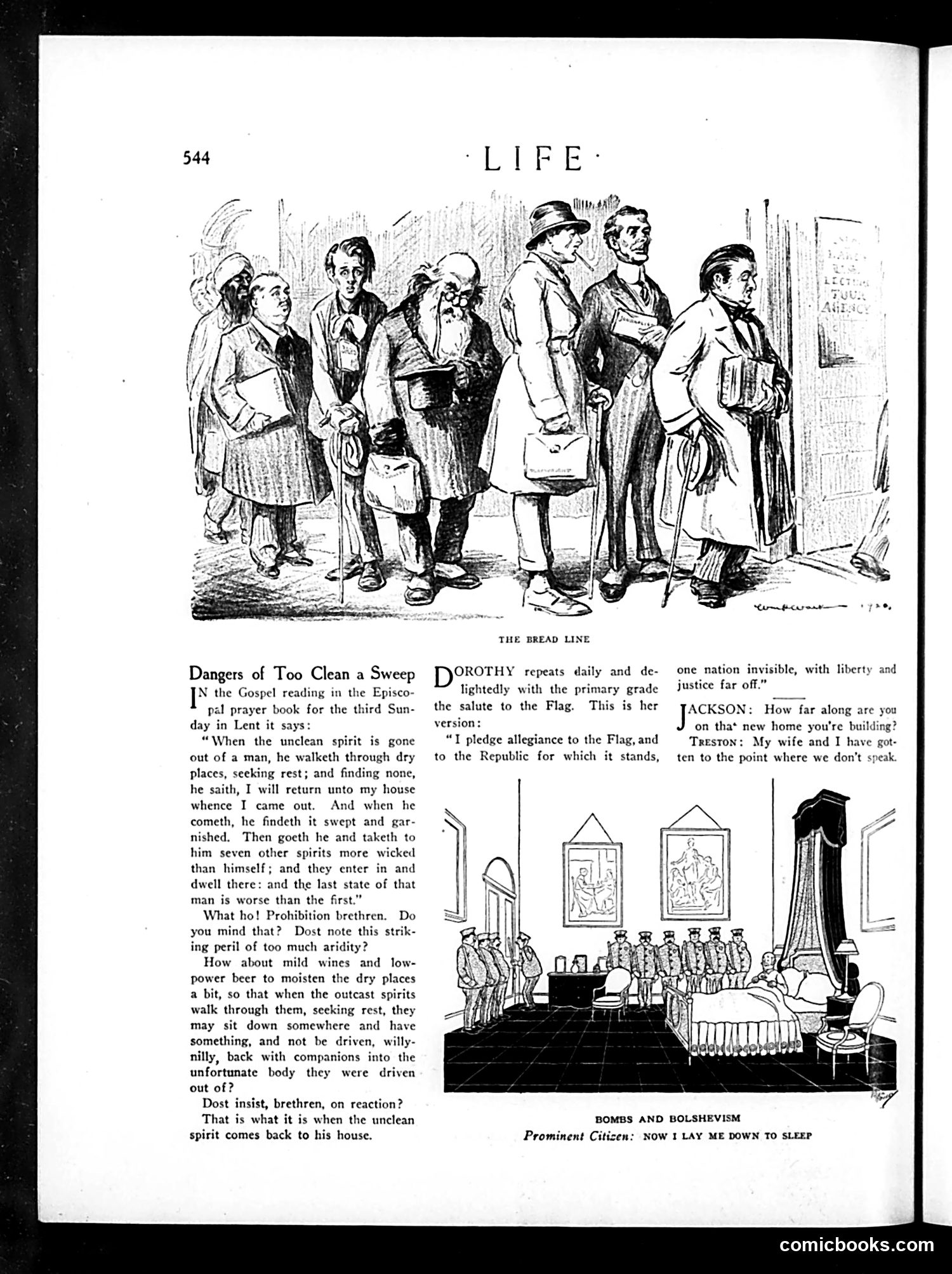
This page contains two satirical cartoons addressing early 20th-century American anxieties. **"The Bread Line"** (top) depicts unemployed men waiting for charity, illustrating economic hardship. The accompanying text mocks overly strict Prohibition advocates, suggesting their zealotry creates spiritual emptiness comparable to destitution—a critique of Prohibition's social costs. **"Bombs and Bolshevism"** (bottom) shows a formal gathering disrupted by violent revolution. The caption's reference to laying down to sleep suggests complacency among the prosperous elite toward growing radical movements. The cartoon satirizes wealthy citizens ignoring or dismissing the threat of communist/anarchist revolution, implying their indifference to social inequality fuels radicalism. Both cartoons critique American responses to poverty and social unrest during the post-WWI era.
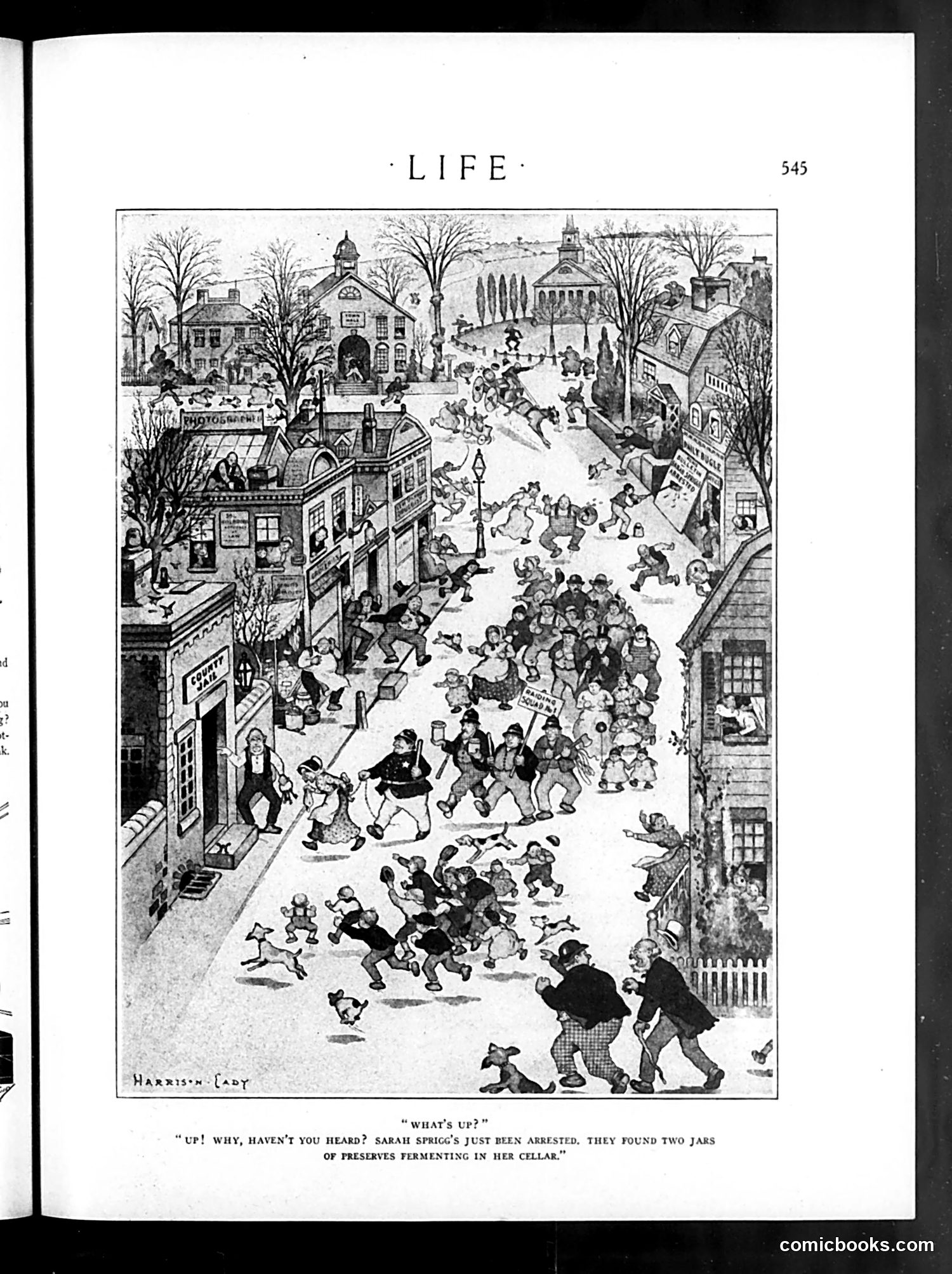
This is a satirical cartoon by Harrison Cady depicting a chaotic winter street scene in an American town. The caption references "Sarah Sprigg's" arrest for possessing fermenting preserves in her cellar—a pointed jab at Prohibition enforcement (1920-1933). The joke satirizes overzealous police raids on private homes during Prohibition. Finding jars of fermenting fruit preserves and mistaking them for illegal alcohol was a real absurdity of the era. The crowded, frantic street scene shows townspeople gossiping about the arrest, capturing how such raids created public spectacle and social disruption. The cartoon mocks both the ridiculousness of confusing food preservation with bootlegging and the invasive nature of Prohibition policing that searched private cellars for contraband.
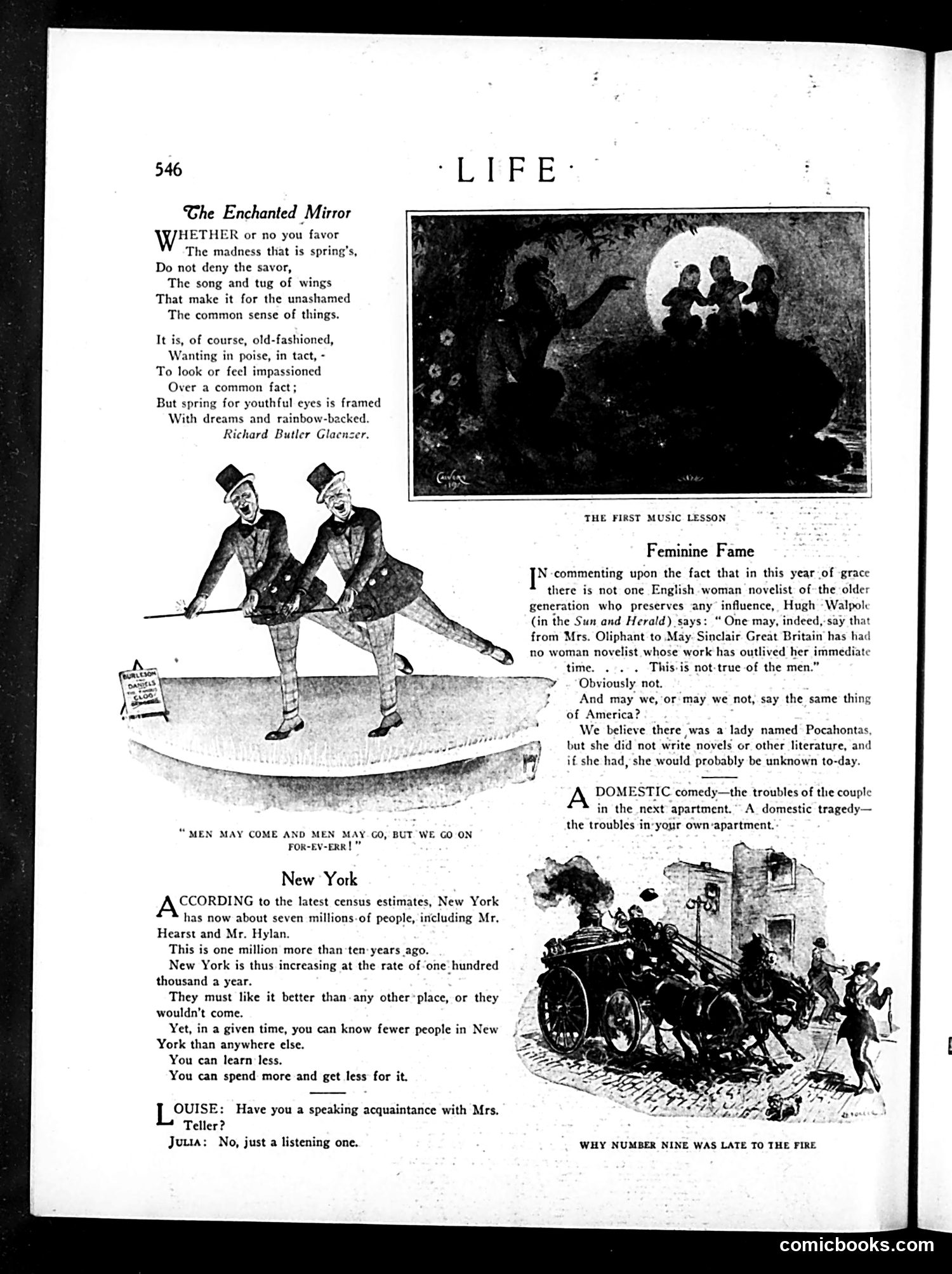
The page features a poem by Richard Butler Glaenzer about romantic idealism versus practicality, accompanied by an illustration of two identical figures in top hats on a mirror—likely satirizing how people see themselves versus reality. The "New York" section comments on the city's rapid population growth (seven million people, increasing at one thousand yearly), suggesting people come for better economic opportunities despite crowded conditions and high costs. "Feminine Fame" discusses whether American women writers match British literary achievements, referencing Mrs. Oliphant and speculating about historical figures like Pocahontas. The bottom illustrations appear to be unrelated comedic vignettes about domestic life and city incidents, typical of Life's satirical humor format.
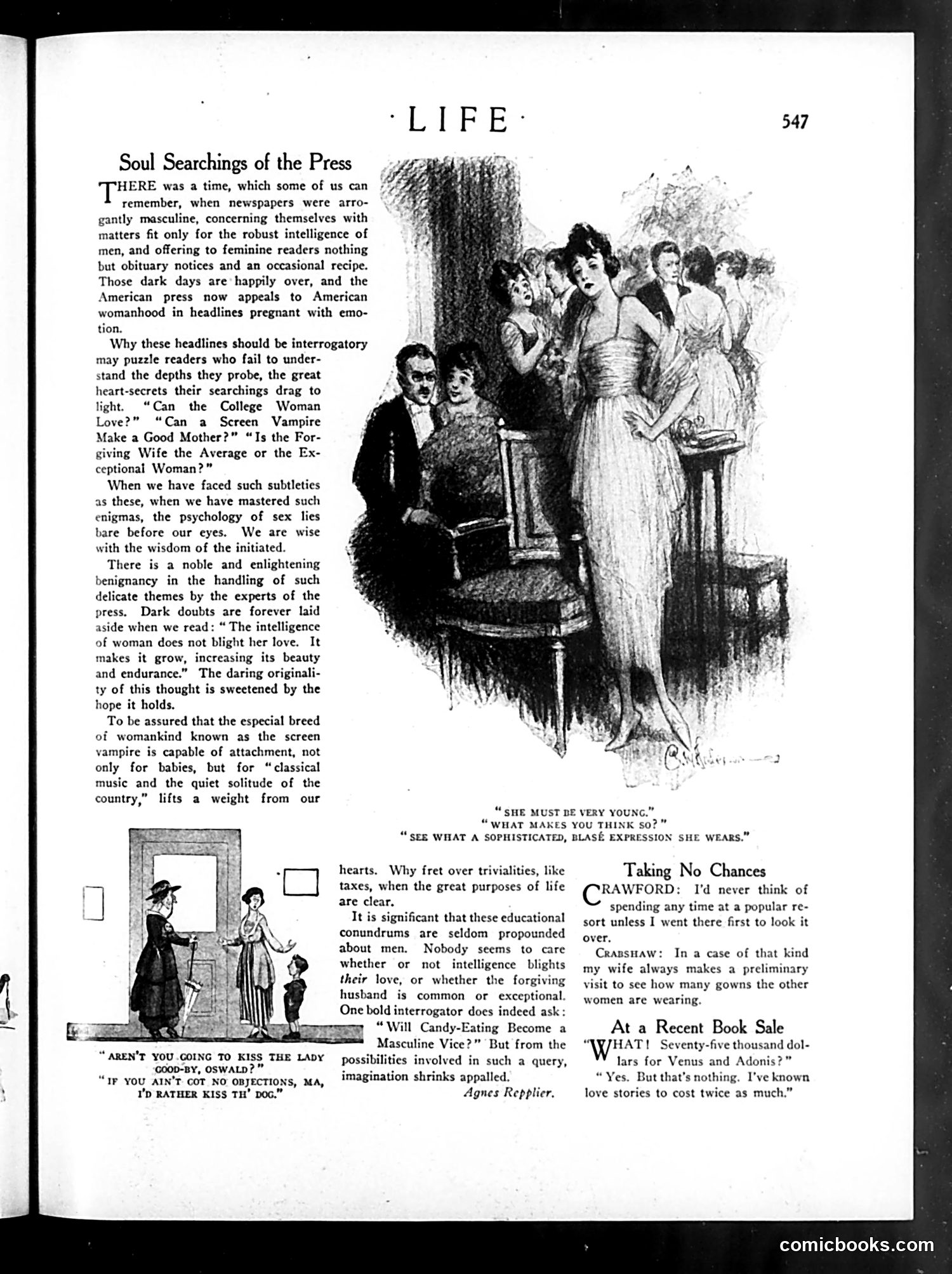
This page contains two distinct satirical pieces about gender and social expectations: **"Soul Searchings of the Press"** (left column) critiques sensationalist newspaper headlines targeting women with questions like "Can the College Woman Love?" and "Can a Screen Vampire Make a Good Mother?" The author argues these headlines exploit feminine readers with trivial content, but acknowledges improvement in modern American press coverage. **The two cartoon illustrations** depict domestic scenes. The upper sketch shows a young woman with two men; the lower shows a man and woman at a doorway with the caption "AREN'T YOU GOING TO KISS THE LADY GOOD-BY, OSWALD?" / "IF YOU AIN'T GOT NO OBJECTIONS, MA, I'D RATHER KISS TH' DOG." These mock Victorian propriety and social courtesies around romance and leave-taking.
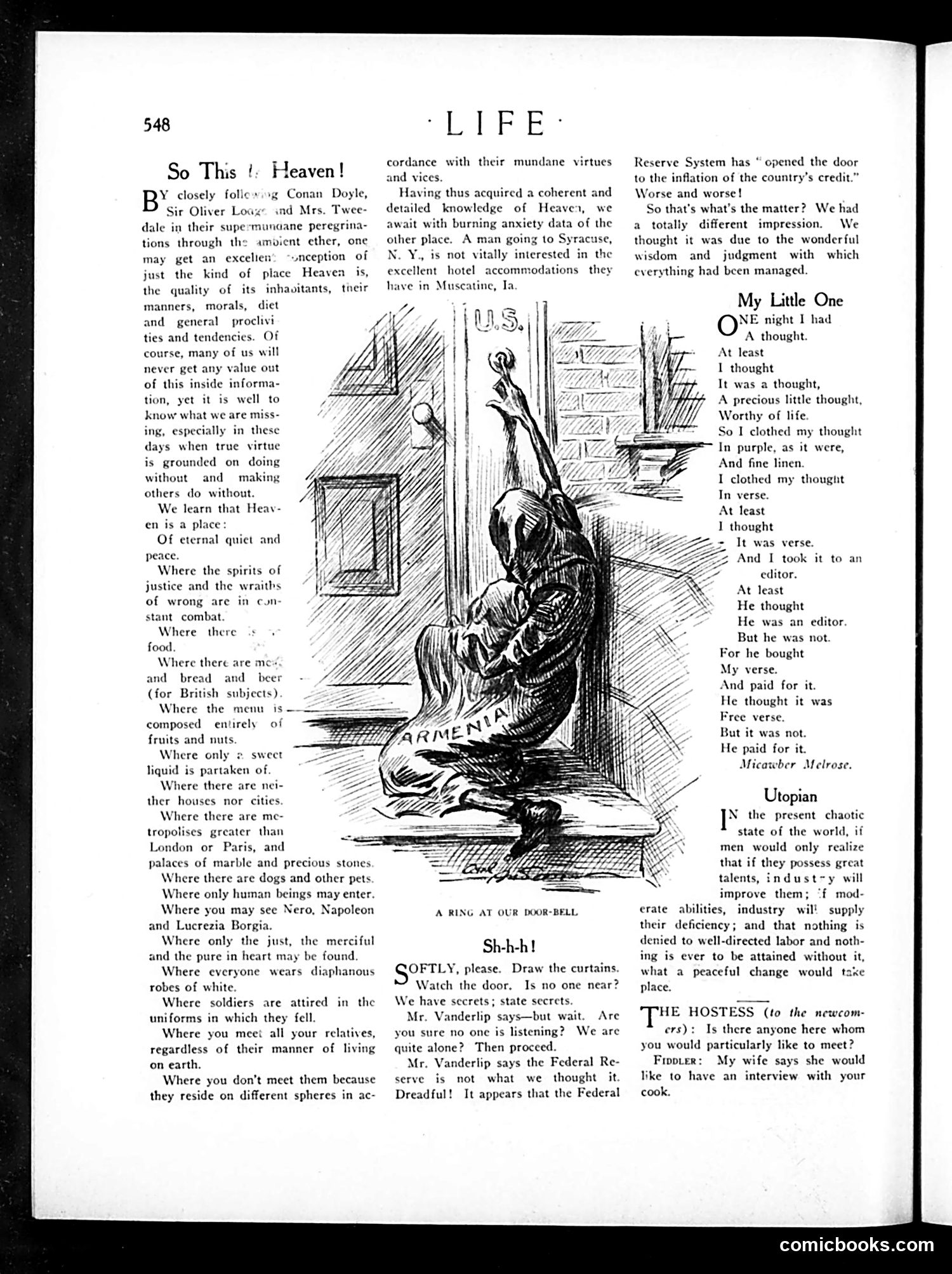
The main illustration titled "A Ring at Our Door-Bell" depicts a figure labeled "ARMENIA" kneeling or collapsed at a doorway, appearing to be in distress or seeking aid. This references the Armenian genocide and humanitarian crisis of the early 1920s, when Armenia faced severe suffering following World War I. The surrounding text consists of satirical pieces: "So This Is Heaven!" discusses heaven's qualities; "My Little One" is a poem about submitting verse to an editor; and "Utopian" discusses labor reform. A dialogue scene labeled "Sh-h-h!" involves characters discussing Federal Reserve secrets. The cartoon's point appears to be an appeal to American readers' conscience regarding Armenia's desperate plight, using the metaphor of someone literally at the door seeking help.
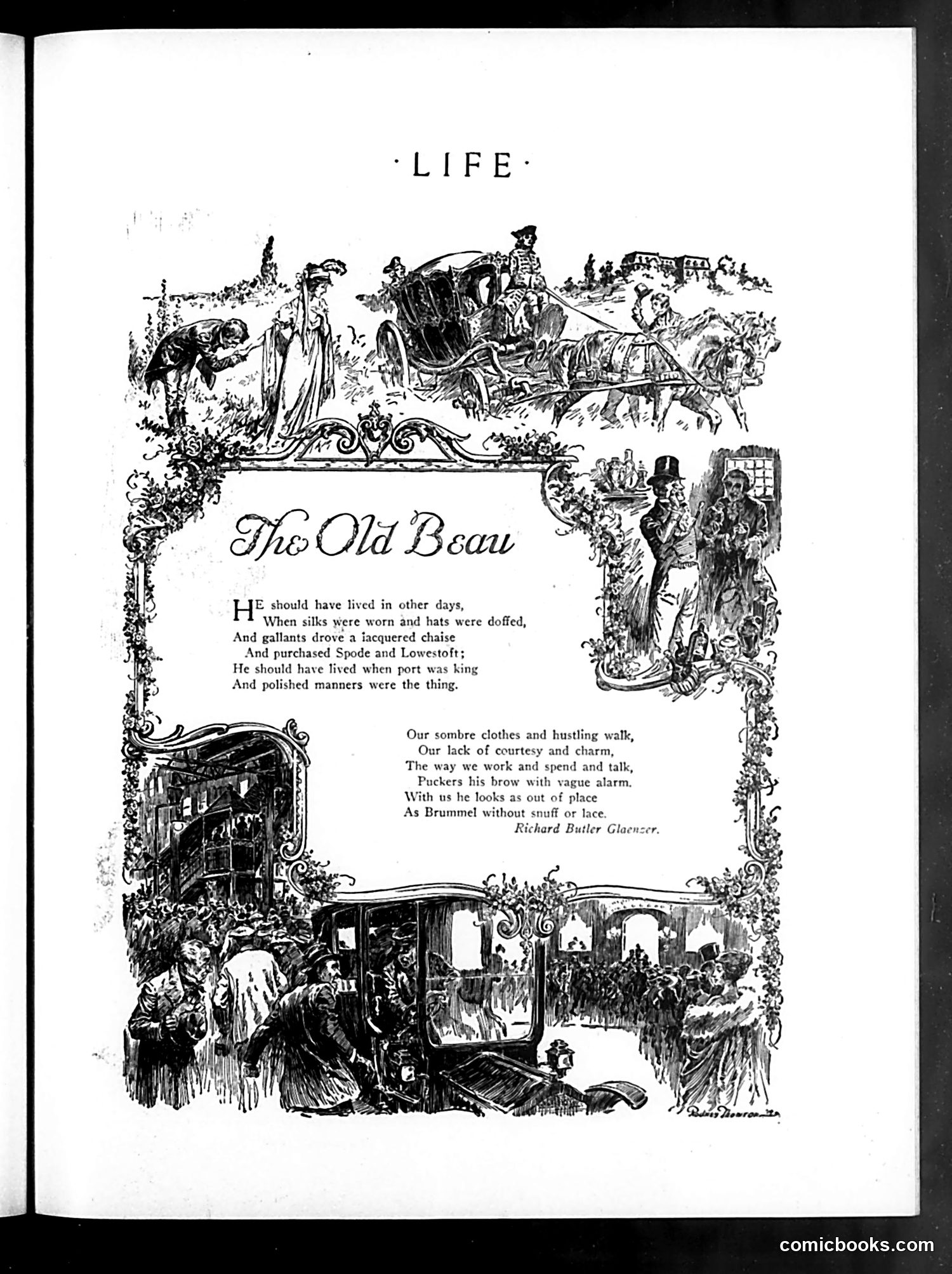
This page satirizes modern manners and social decline. The poem, attributed to Richard Butler Glaenzer, contrasts an idealized past ("when silks were worn and hats were doffed") with the present day's shabby behavior—poor clothing, rude conduct, and lack of courtesy. The illustrations depict contemporary urban scenes: fashionable people in carriages and crowded streets. The satire criticizes how modern life has supposedly coarsened society: people now "work and spend and talk," appearing "out of place" and lacking refinement. The "Old Beau" represents nostalgic yearning for Victorian-era politeness and elegance, mocking contemporary Americans as crude by comparison. This reflects early 20th-century anxiety about declining social standards.
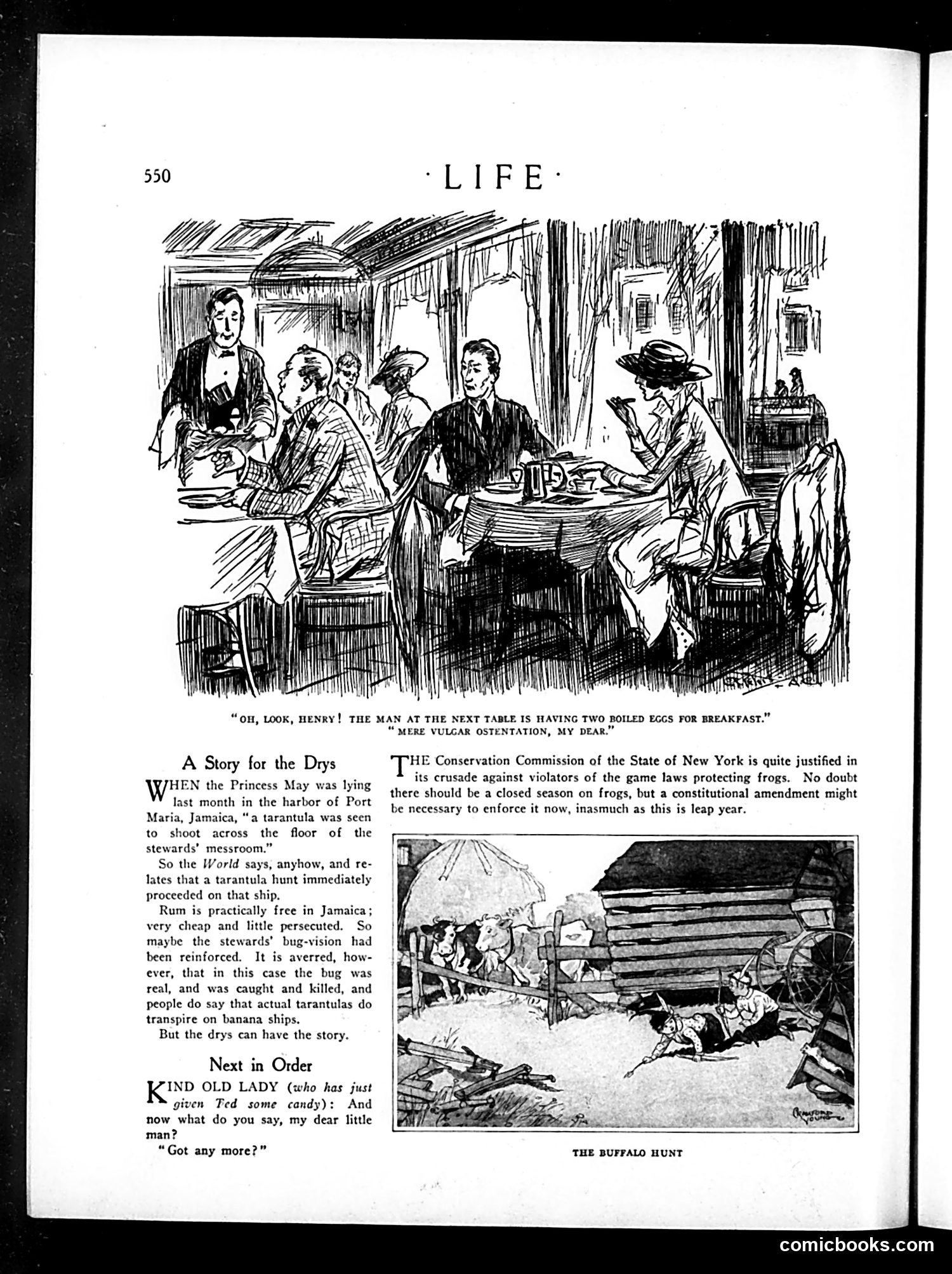
The top cartoon depicts a restaurant scene where diners observe someone eating boiled eggs for breakfast. The caption indicates this is meant as social commentary—eating boiled eggs is characterized as "vulgar ostentation," suggesting the joke targets nouveau riche or working-class pretension about what constitutes refined dining. Below are two brief text sections: "A Story for the Drys" references Prohibition-era humor (the "drys" being anti-alcohol activists), joking about tarantulas aboard banana ships from Jamaica. "Next in Order" presents a dialogue between an old lady and a child about candy, likely a gentle humor piece. The page also includes an illustration titled "The Buffalo Hunt," depicting what appears to be a historical frontier scene—unrelated to the other content.
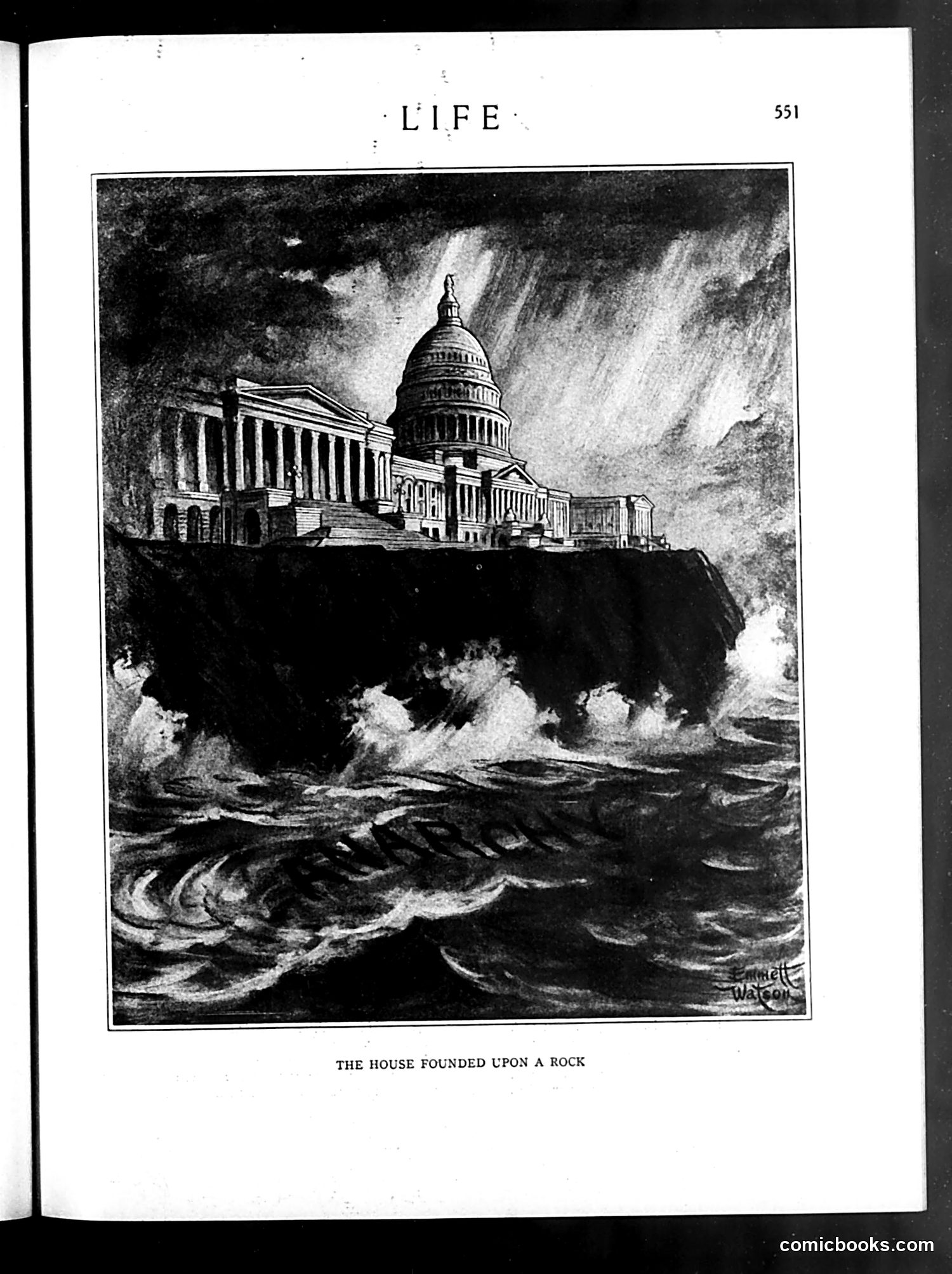
This illustration depicts the U.S. Capitol Building perched precariously atop a crumbling rock foundation amid turbulent, crashing waves. The metaphor is biblical—referencing Jesus's teaching about building one's house upon rock versus sand (Matthew 7:24-25). The satire suggests American democratic institutions are unstable and threatened by turbulent forces (represented by the stormy seas). The precarious positioning and dramatic lighting convey anxiety about governmental durability. Without a visible date, the specific crisis referenced remains unclear—though Life magazine frequently used such imagery during periods of political instability or constitutional crisis. The cartoon warns that even seemingly permanent institutions require solid foundational principles to survive external threats.
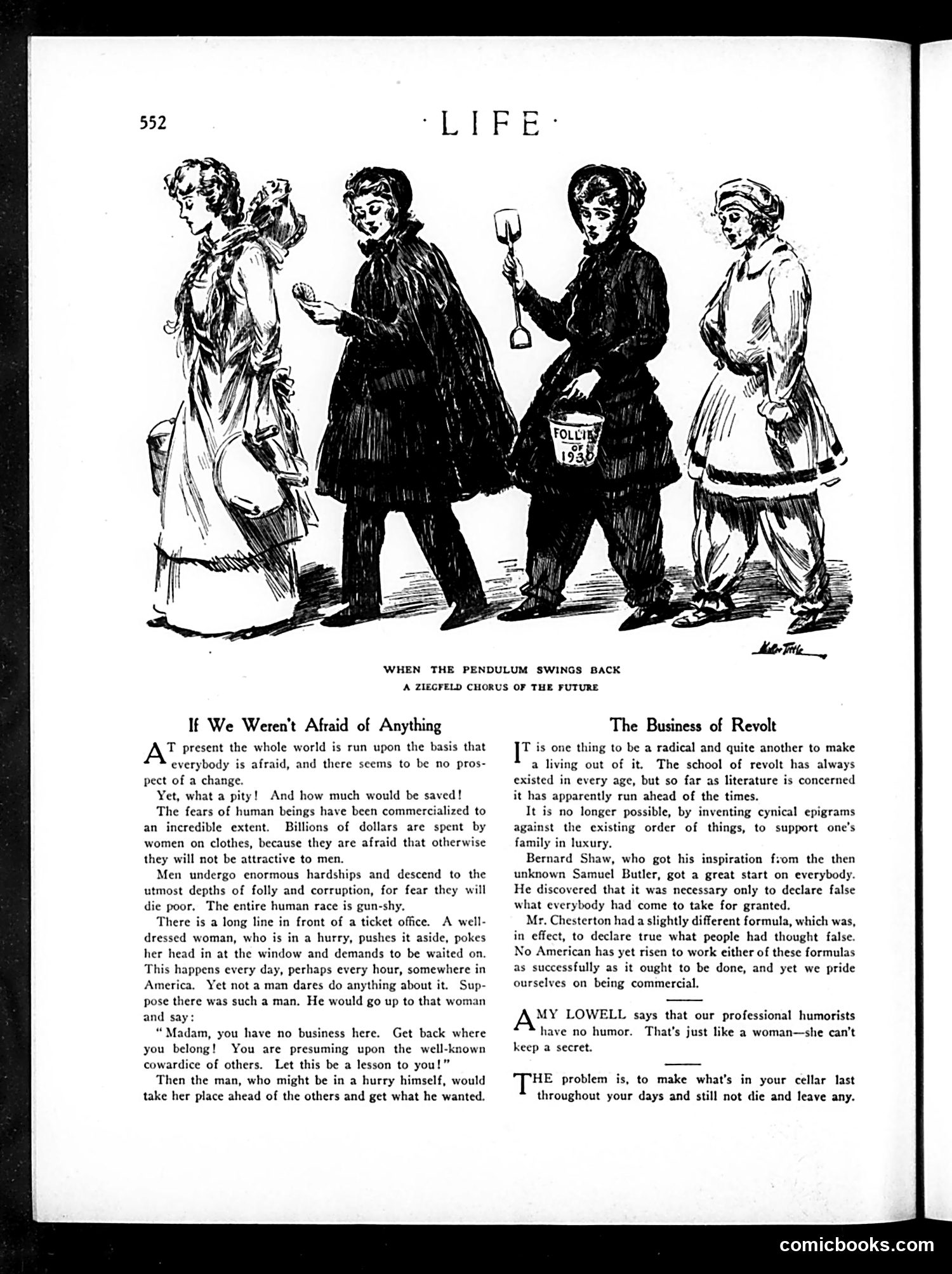
The top illustration shows five figures in early 20th-century dress, captioned "WHEN THE PENDULUM SWINGS BACK / A ZIEGFELD CHORUS OF THE FUTURE." This satirizes concerns about women's changing roles—suggesting that if social pendulum swings toward women's liberation, the glamorous chorus girls of the Ziegfeld Follies theater would be replaced by less conventionally feminine women (depicted in more masculine or androgynous clothing). The two articles below discuss social anxiety about radical change. "If We Weren't Afraid of Anything" critiques how fear paralyzes society and commercializes human suffering. "The Business of Revolt" argues that revolutionary rhetoric has become commodified and predictable. Together, the page reflects 1920s-era anxieties about feminism, social upheaval, and whether radical movements represent genuine change or mere fashionable posturing.
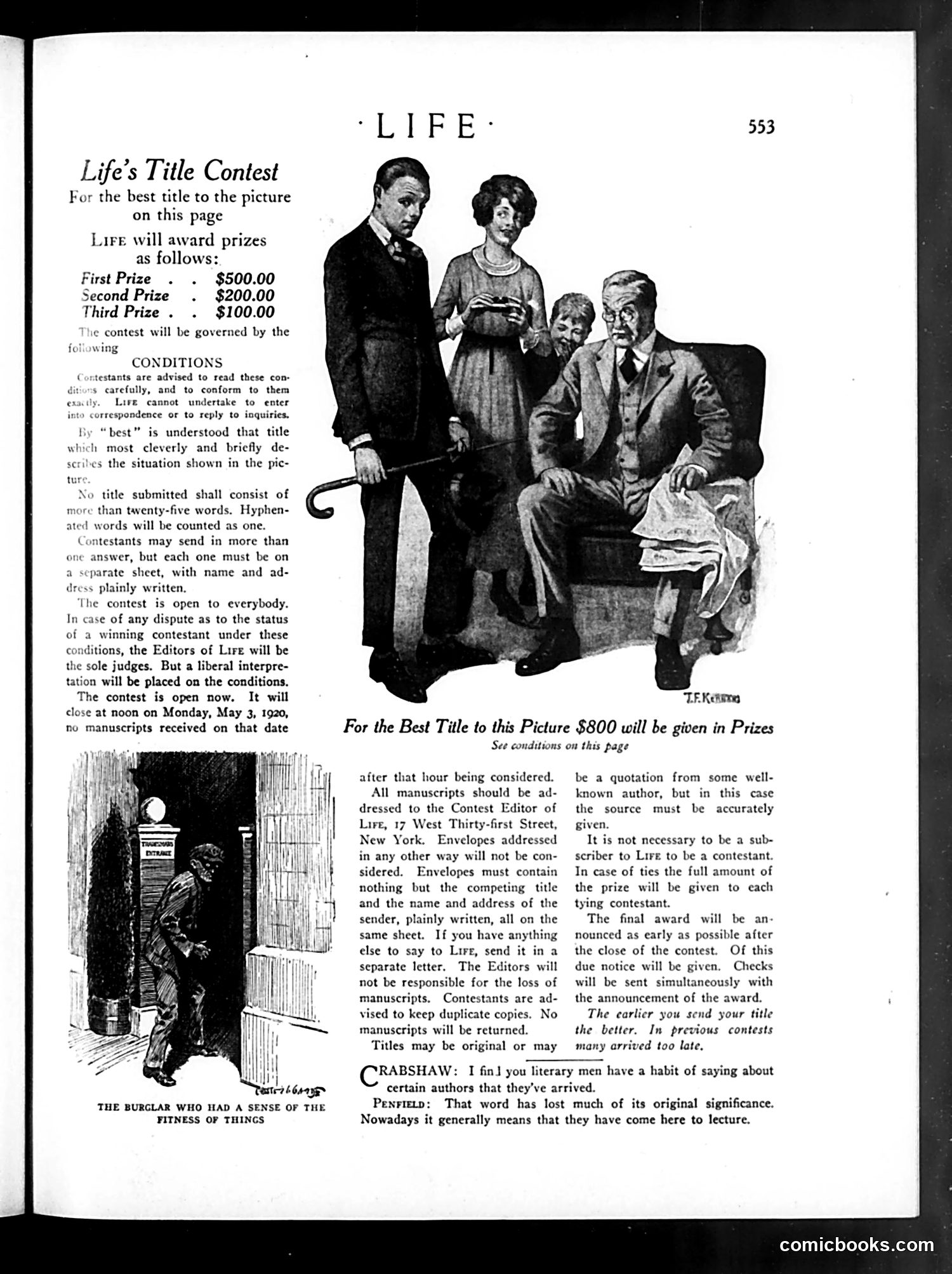
This page features two cartoons seeking reader-submitted titles. The main image shows a burglar interrupting a wealthy family's gathering—a man, woman, and two other figures examining documents. The cartoon's title, "The Burglar Who Had a Sense of the Fitness of Things," suggests ironic humor: the burglar demonstrates unexpected propriety or restraint in this criminal situation. A smaller cartoon below depicts a burglar at a window, captioned "The Burglar Who Had a Sense of the Fitness of Things." The page also includes a dialogue between characters Crabshaw and Penfield discussing how "arrived" (meaning successful) has become corrupted to simply mean visiting authors who lecture—a jab at literary pretension. Life offered $800 in prize money for the best alternative titles, reflecting the magazine's satirical approach to social commentary and reader engagement during the early 1920s.
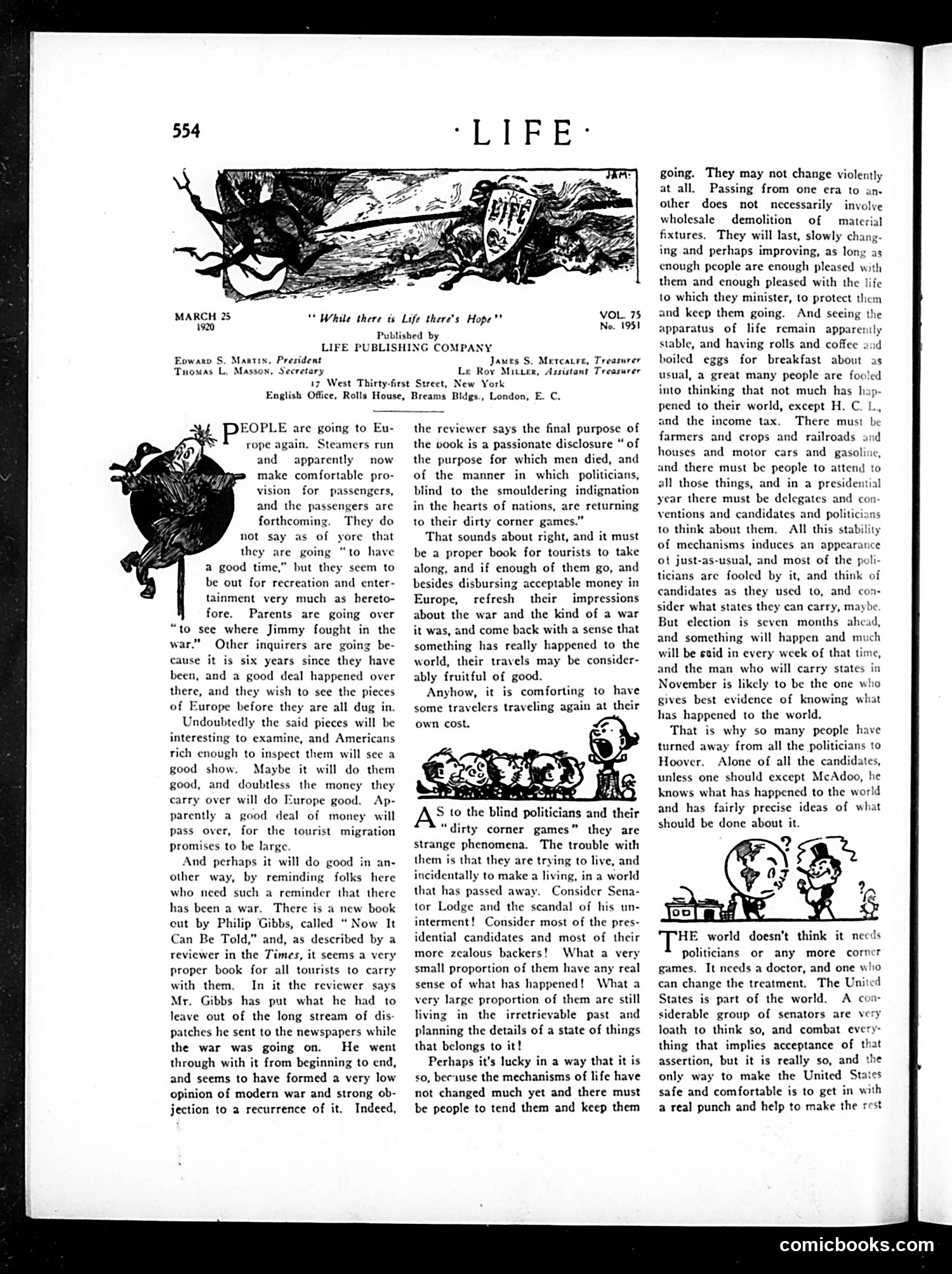
This editorial attacks post-WWI politicians for being disconnected from reality. The piece criticizes "blind politicians" playing "dirty corner games"—likely referring to Senator Lodge and presidential candidates who, despite the war's massive upheaval, continue operating as if the old world still exists. The cartoons (though small and difficult to parse precisely) appear to depict politicians obliviously going about their business while the world has fundamentally changed around them. The text contrasts tourists traveling to Europe to witness war's devastation firsthand with politicians who seem willfully ignorant of what the conflict revealed about governmental incompetence and indifference to public suffering. The satire's core point: American political leaders remain trapped in pre-war thinking and petty partisan maneuvering, unable or unwilling to acknowledge that their old methods no longer serve a transformed nation.
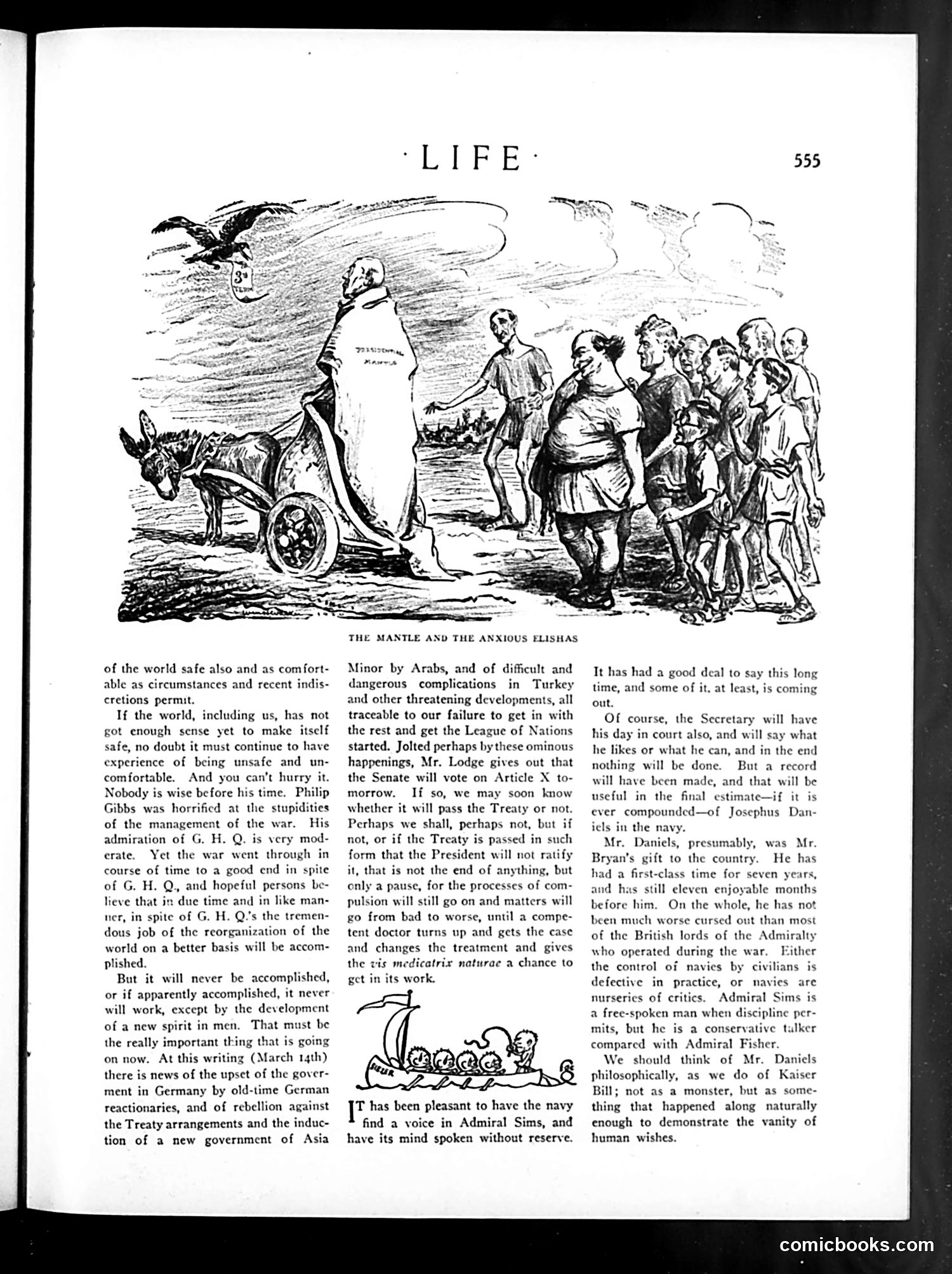
The cartoon depicts a biblical succession scene—likely referencing the prophet Elisha receiving Elijah's mantle. The figure on the left (possibly representing outgoing leadership) passes authority to anxious figures on the right, suggesting a transfer of power or responsibility. The text discusses post-WWI political turmoil: Senate debates over League of Nations ratification (Article X), unrest in Germany and Turkey, and tensions between Navy officials. It critiques Josephus Daniels (Secretary of the Navy under Wilson) and praises Admiral Sims for speaking frankly about naval mismanagement. The piece sardonically suggests new leaders inherit problems without solutions, comparing Daniels philosophically to Kaiser Wilhelm—not as evil, but as inevitable human failure demonstrating "the vanity of human wishes." The satire targets America's inability to forge lasting peace despite good intentions.
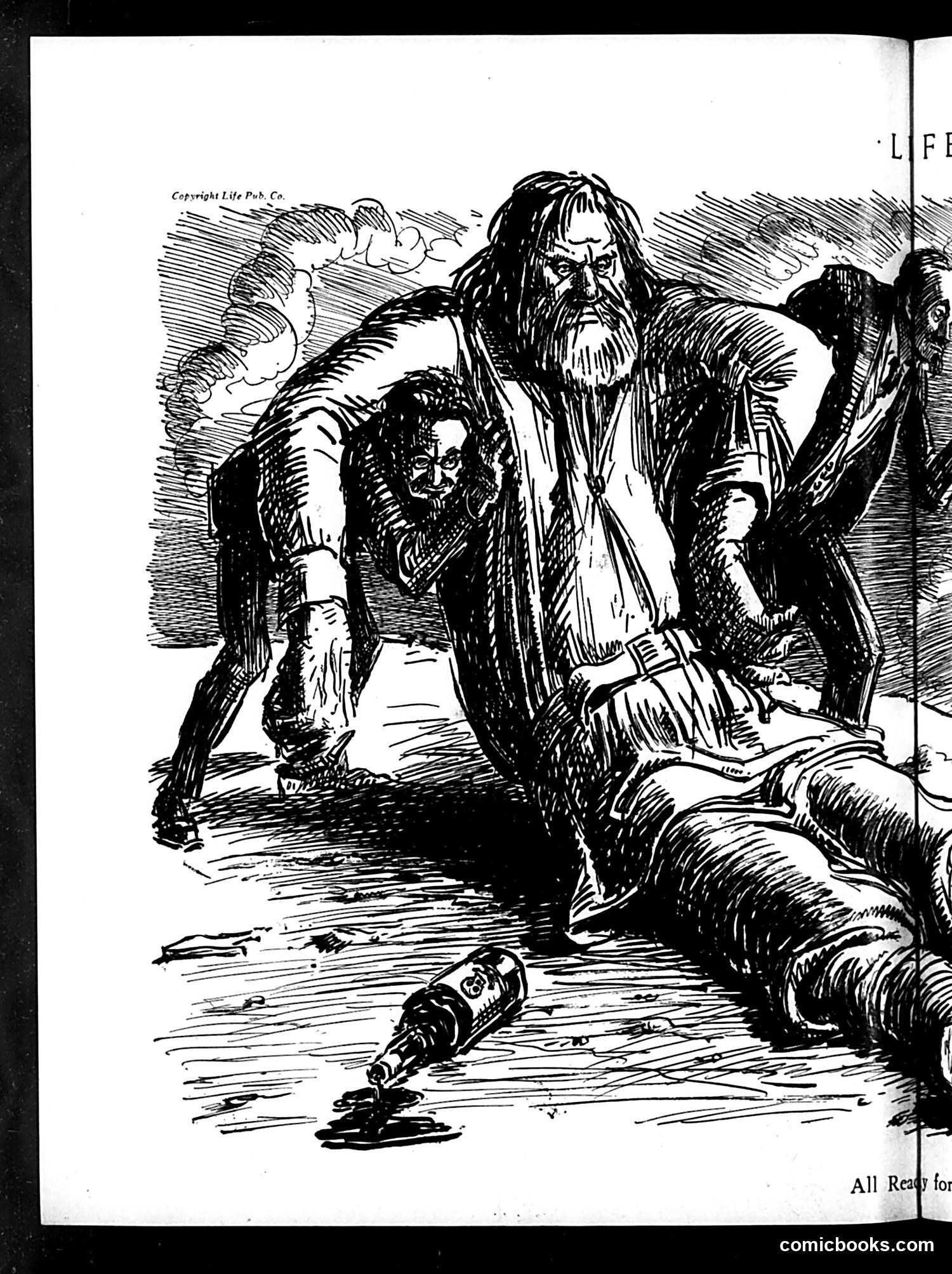
This appears to be a satirical illustration from *Life* magazine depicting a bearded man in period clothing (possibly representing a political or historical figure) confronting or examining a bottle on the ground, while other figures lurk in the background. The style suggests early-to-mid 20th century commentary. Without clearer OCR text or visible caption, I cannot definitively identify the specific figures or political incident being satirized. The bottle likely symbolizes alcohol or some vice, and the scene suggests a moral or political scandal. The composition implies accusation or exposure of wrongdoing. The crude, expressionistic engraving style was typical of *Life's* satirical approach to social and political criticism during this era.
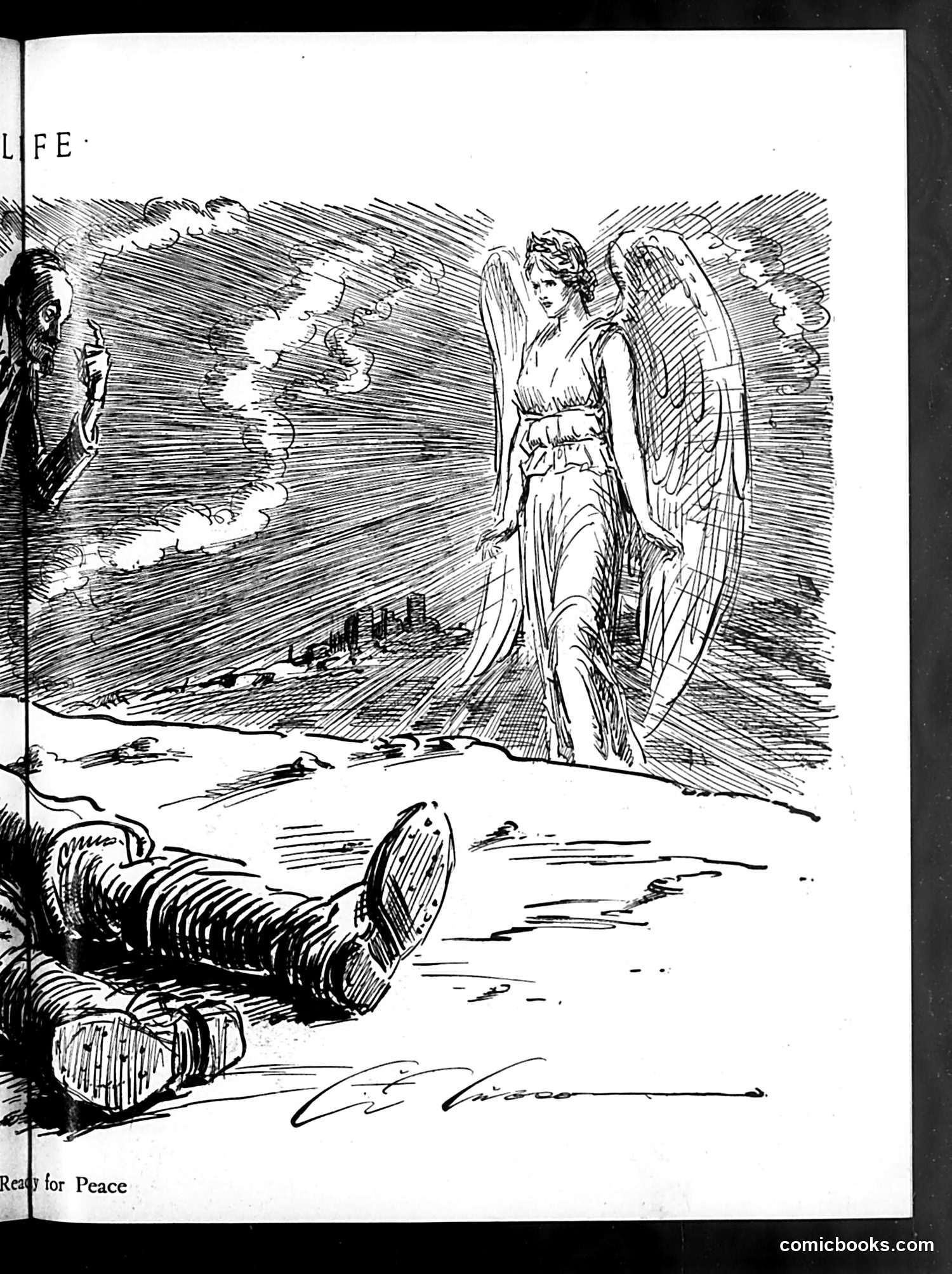
This political cartoon depicts an allegorical scene titled "Ready for Peace." An angelic winged female figure (representing Peace or Victory) stands centrally, gazing toward a distant cityscape. In the foreground lie fallen soldiers or casualties of war, shown as prone figures with military equipment. On the left, a dark shadowy figure (likely representing Death or War) observes the scene. The cartoon's message appears satirical: despite the angelic promise of peace, the battlefield remains strewn with human cost. The juxtaposition suggests that "readiness for peace" comes only after significant bloodshed and loss. This likely references post-World War I sentiment, when Americans grappled with the war's devastating human toll and questions about whether peace justified the sacrifice. The artwork critiques the romanticization of war's end.
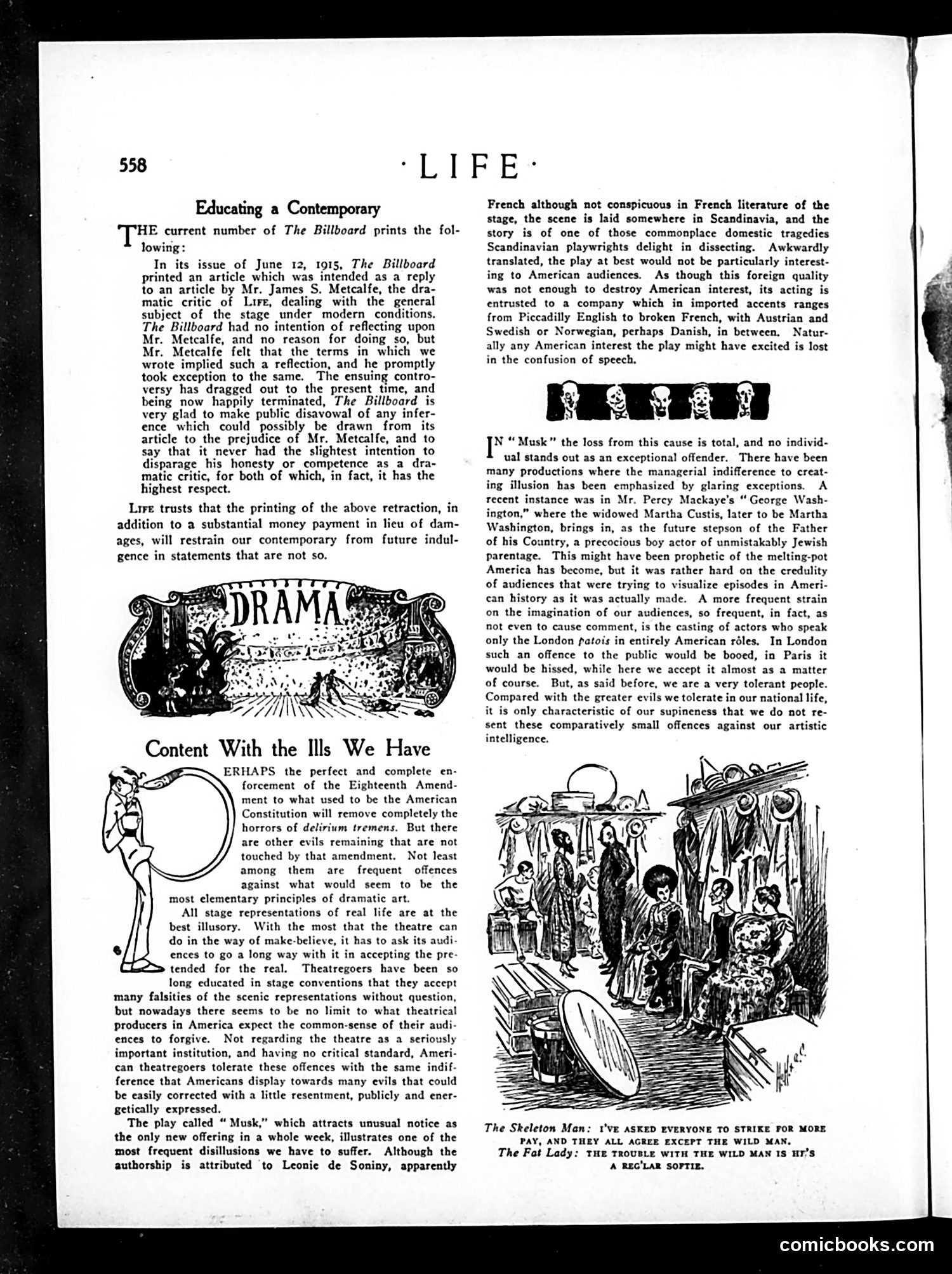
This page critiques American theatrical producers' indifference to basic dramatic standards. The author attacks the play "Musk," a Scandinavian domestic tragedy with a French attribution, for its fundamental flaws: weak translation, culturally irrelevant subject matter, and—most egregiously—a cast speaking in a bewildering mixture of accents (Piccadilly English, broken French, Austrian, Swedish, Danish). The satire's point: American audiences have become so accustomed to accepting theatrical conventions uncritically that producers face no consequences for offensive negligence. The author notes Americans tolerate these theatrical offenses with the same apathy they show toward broader social evils—suggesting lazy citizenship extends from entertainment to civic life. The opening section references the Eighteenth Amendment (Prohibition), implying that even eliminating obvious social problems leaves subtler evils unchecked. The joke is that Americans' passive tolerance reflects a broader cultural complacency.
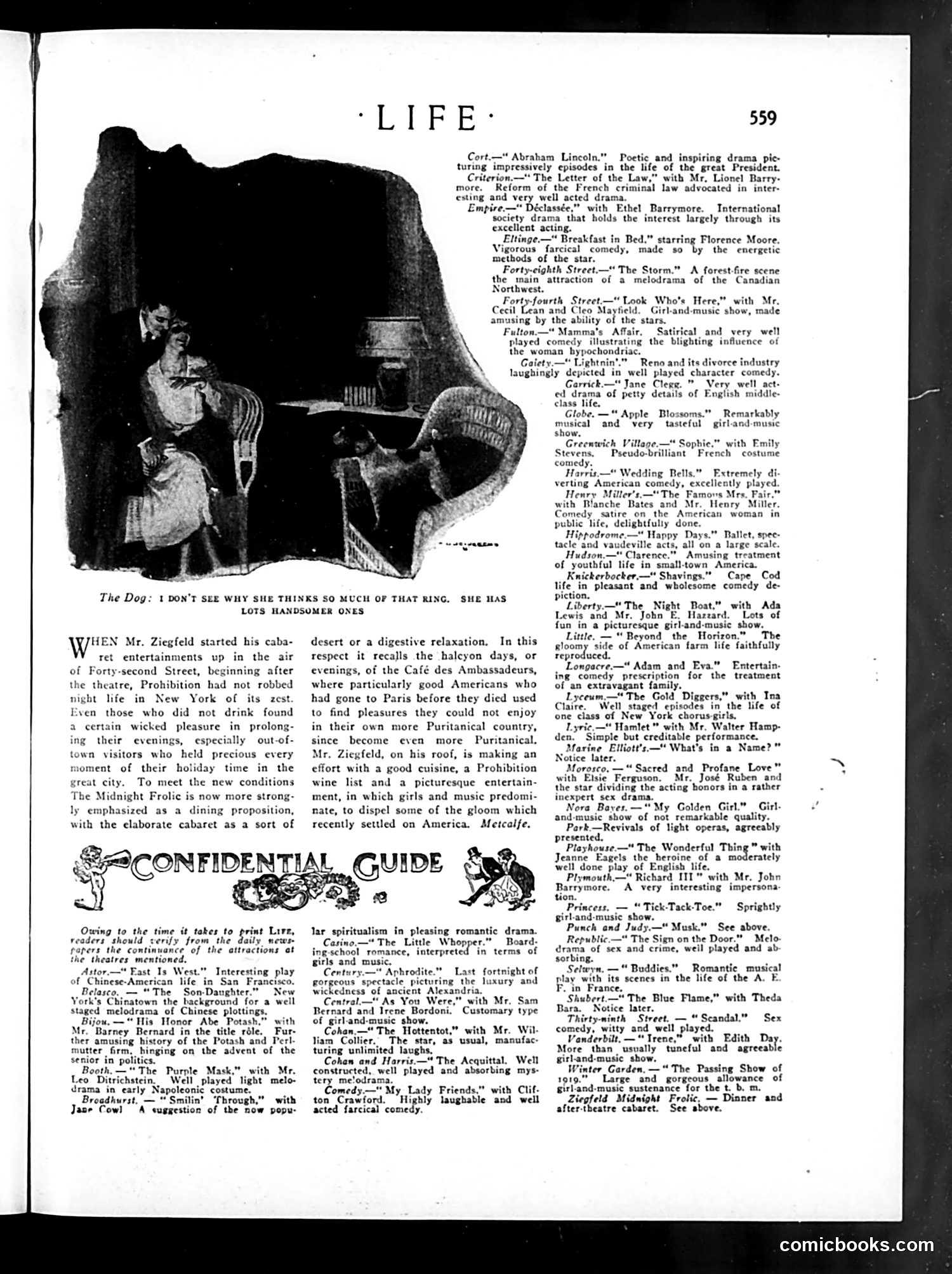
This page from *Life* magazine contains a single cartoon captioned "The Dog: 'I DON'T SEE WHY SHE THINKS SO MUCH OF THAT RING. SHE HAS LOTS HANDSOMER ONES.'" The cartoon depicts a domestic scene: a woman admiring a ring while a dog observes skeptically. The joke is a simple visual gag playing on the dog's perspective—the humor lies in the absurdity of a dog commenting on jewelry aesthetics and comparing multiple rings. It's a mild, domesticated humor typical of early 20th-century magazine comics. The rest of the page is a theater guide by drama critic Metcalfe, reviewing New York stage productions including shows with popular performers like Ethel Barrymore and Florenz Ziegfeld's Midnight Frolic cabaret. This reflects post-Prohibition New York nightlife when such entertainments became increasingly meal-focused dining experiences.
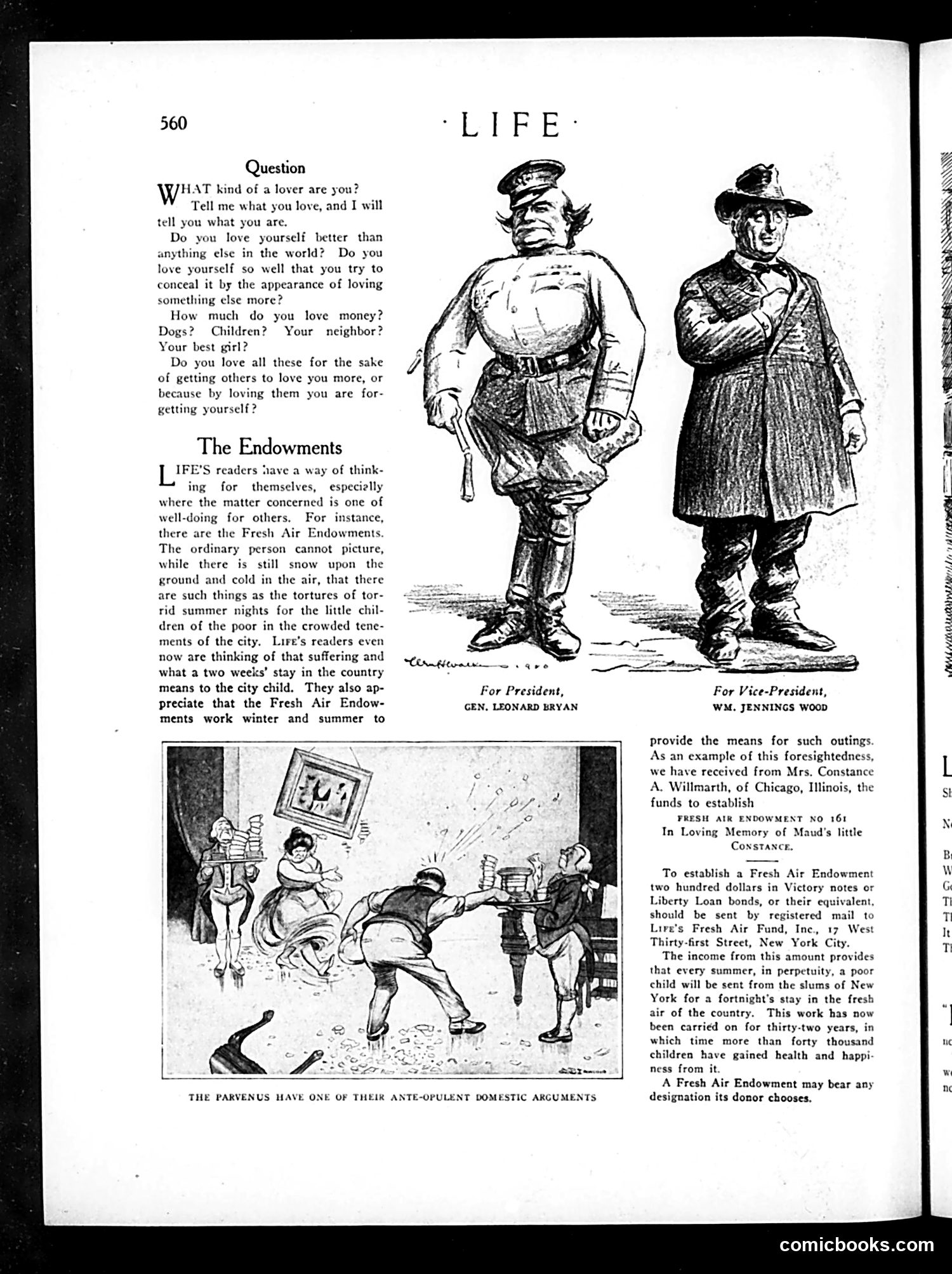
This page combines two distinct elements: political caricature and charitable advocacy. **Political Cartoon (Top):** The two illustrated figures labeled "For President, GEN. LEONARD BRYAN" and "For Vice-President, WM. JENNINGS WOOD" appear to be satirical caricatures of political candidates. The exaggerated, unflattering depictions—particularly the prominent features and crude styling—suggest mockery of these figures, likely from an early 20th-century election. **Lower Cartoon:** "The Parvenus Have One of Their Ante-Opulent Domestic Arguments" satirizes nouveau-riche behavior, showing quarreling figures amid domestic chaos. "Parvenus" (newly wealthy people) were frequent targets of Life's satire for their ostentatious vulgarity. **Editorial Content:** The essay "The Endowments" promotes the Fresh Air Fund, a genuine charity sending poor urban children to the countryside. It contrasts genuine charitable concern with self-serving love, critiquing hypocrisy—a typical Life editorial stance. The page reflects Life's dual mission: political satire and progressive social advocacy.
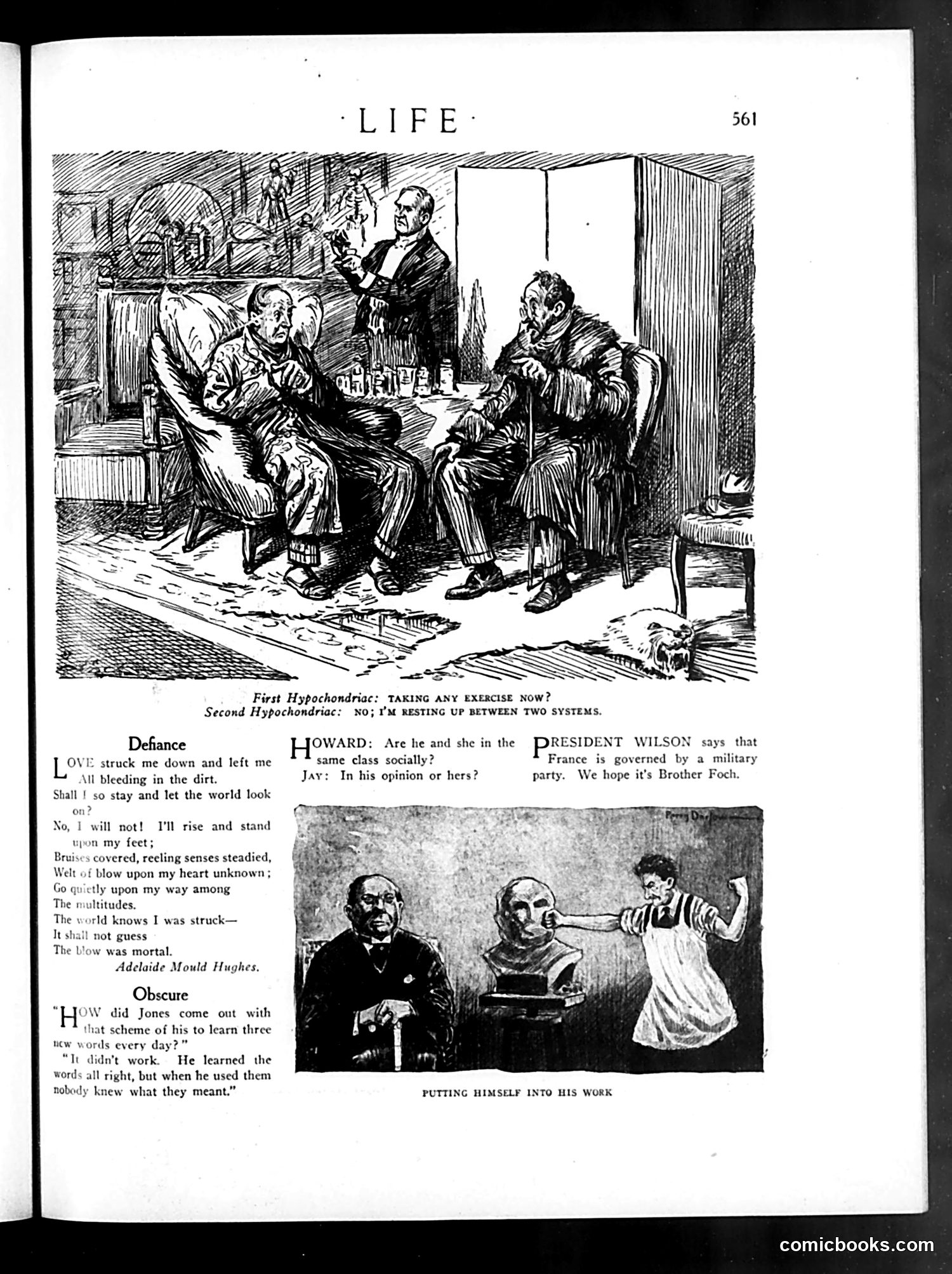
This page contains three separate satirical pieces from Life magazine: **Top cartoon**: Two hypochondriacs discuss health routines. The joke mocks people obsessed with medical fads—one claims he's "resting between two systems," satirizing those who constantly switch between competing health trends or treatments. **Middle section**: Brief news commentary. References President Wilson's statement that France is governed by a military party, with a hope it's led by "Brother Foch" (French general Ferdinand Foch). This appears to be post-WWI commentary on French governance. A separate joke about social class: Howard asks Jay whether two people are in the same social class—"in his opinion or hers?"—mocking how subjective and contested class distinctions were. **Bottom cartoon**: Titled "Putting Himself Into His Work," shows a sculptor actively working into/merging with his clay sculpture, likely commenting on artistic obsession or the blurred line between creator and creation. The "Defiance" poem by Adelaide Mould Hughes is unrelated political/philosophical verse about resilience.
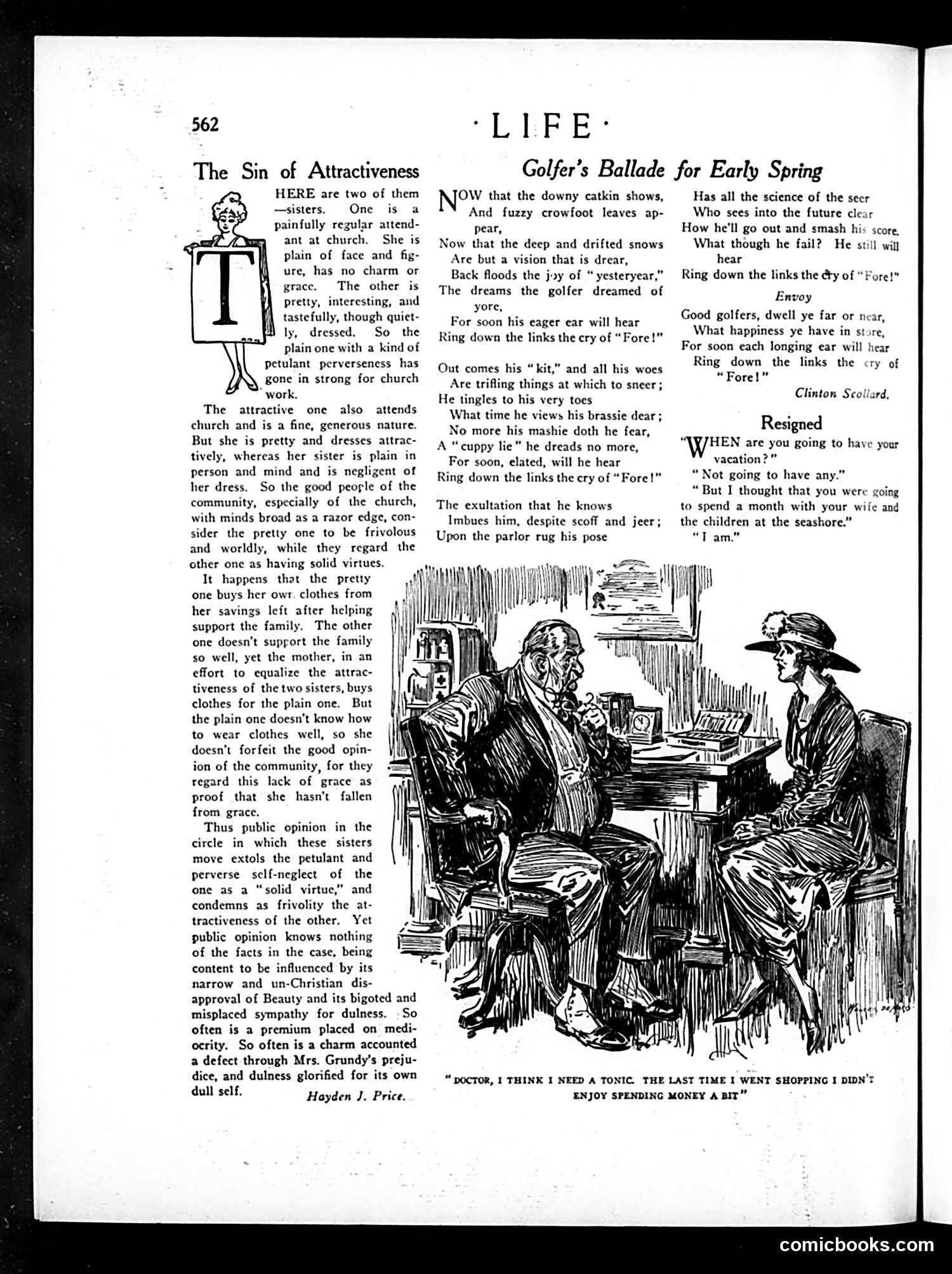
**"The Sin of Attractiveness"** (left column): This essay by Hayden J. Price critiques religious hypocrisy and social prejudice. Two sisters attend church—one plain and dowdy who performs conspicuous church work; one attractive and well-dressed who is genuinely generous. The community condemns the pretty sister as "frivolous" while praising the plain sister's "solid virtue," ignorant of the facts: the attractive sister buys her own clothes while supporting the family; the plain sister's mother subsidizes her wardrobe. Price argues that society falsely equates beauty with moral weakness and mediocrity with virtue, blaming "Mrs. Grundy's prejudice" (a term for narrow-minded social convention) for rewarding dullness. **"Golfer's Ballade for Early Spring"** (right): A whimsical poem by Clinton Scollard celebrating spring's arrival and golfers' renewed enthusiasm for the sport. **"Resigned"** (bottom right): A joke cartoon showing a man telling his doctor he needs a tonic because shopping no longer brings him pleasure—likely satirizing wives' spending habits and marital resignation.
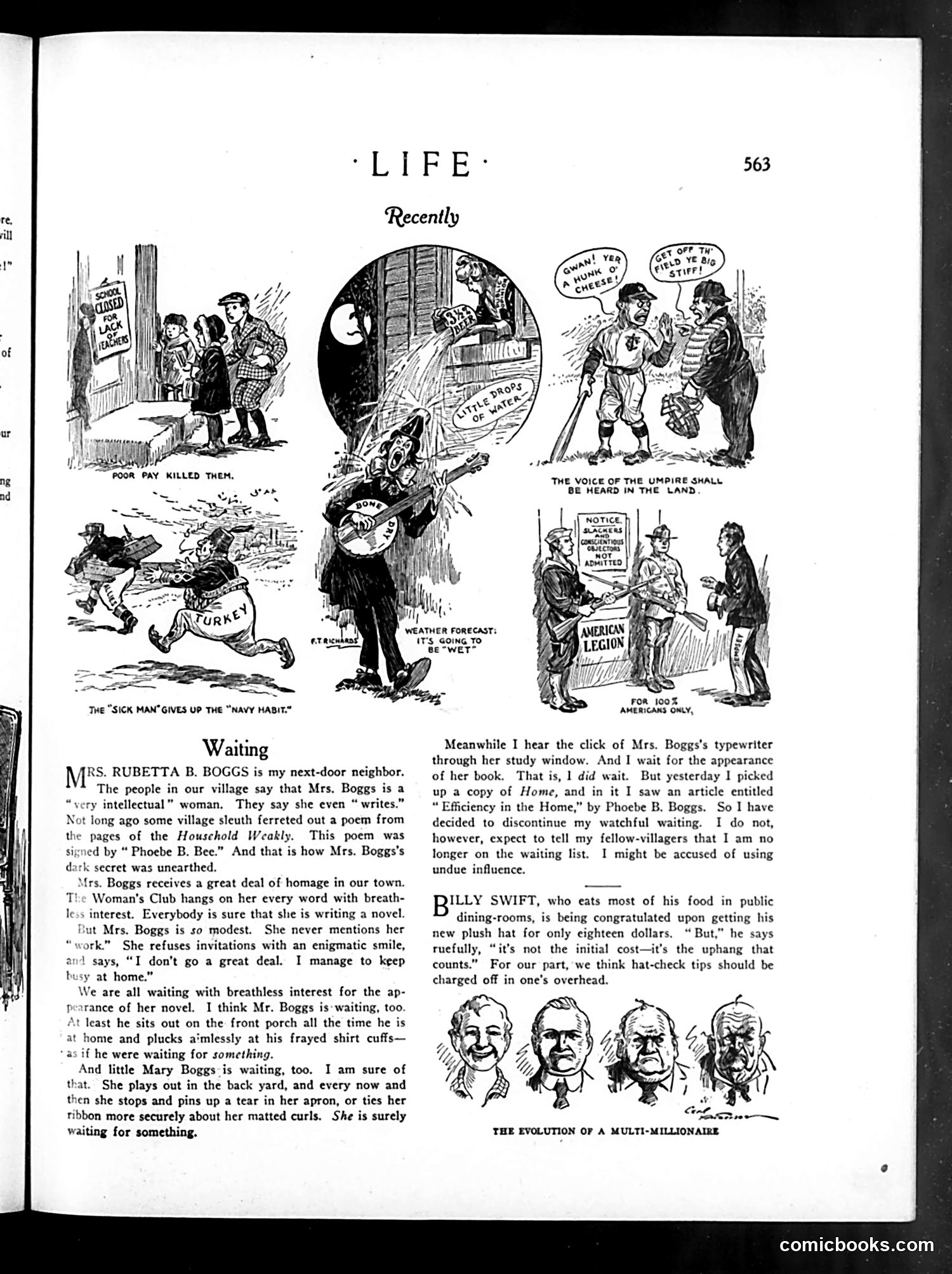
This page contains satirical cartoons and humorous commentary on American society, likely from the 1920s. The "Recently" cartoons mock contemporary issues: one depicts poverty ("Poor Pay Killed Them"), another shows a weather forecaster predicting "wet" weather, and a third references baseball ("The Voice of the Umpire Shall Be Heard in the Land"). The "Sick Man" cartoon appears to reference abandoning naval habits or spending. The main article "Waiting" satirizes small-town pretension. Mrs. Rubetta B. Boggs is a village woman who secretly publishes under the pseudonym "Phoebe B. Bee." Her family—husband, child, and neighbors—wait expectantly for her novel, but she only publishes mundane household advice articles. The satire targets both her modest affectations and the village's misplaced literary reverence. The "Billy Swift" section mocks wealth and expense, joking that hat-check tips cost more than the hat itself. "The Evolution of a Multi-Millionaire" shows four faces, likely depicting stages of wealth accumulation.
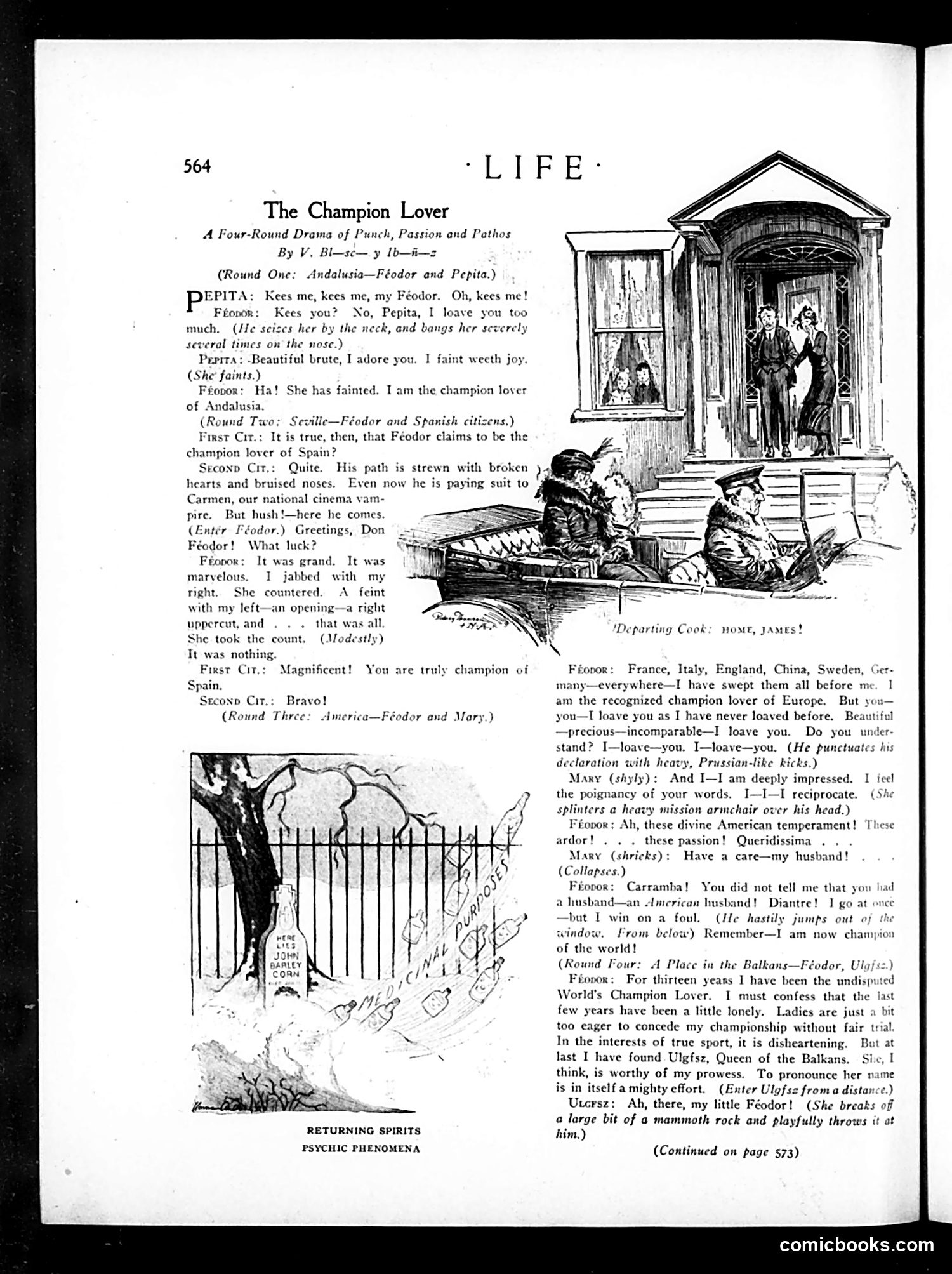
This four-act comedy mocks the stereotype of the passionate Latin lover through exaggerated violence and cultural contrasts. Féodor, a Spanish lothario, claims to be Europe's greatest lover—yet his "courtship" consists entirely of physical brutality: he bangs Pepita's head, "jabs" with his right hand during a fight with Carmen, and describes romance as boxing matches. The satire escalates when Féodor reaches America. Mary reciprocates his "passionate" declarations by smashing furniture over his head with a hammer, and her husband chases him out a window—yet Féodor still declares himself "champion of the world." The final scene shows him courting an Ulgfsz (likely a Balkan woman), who responds to his declarations by hurling a mammoth rock at him. The joke: Féodor never recognizes that his victims aren't actually responding to romance—they're retaliating with violence. The satire targets both exaggerated "continental lover" mythology and suggests that aggressive domination masquerades as passion.
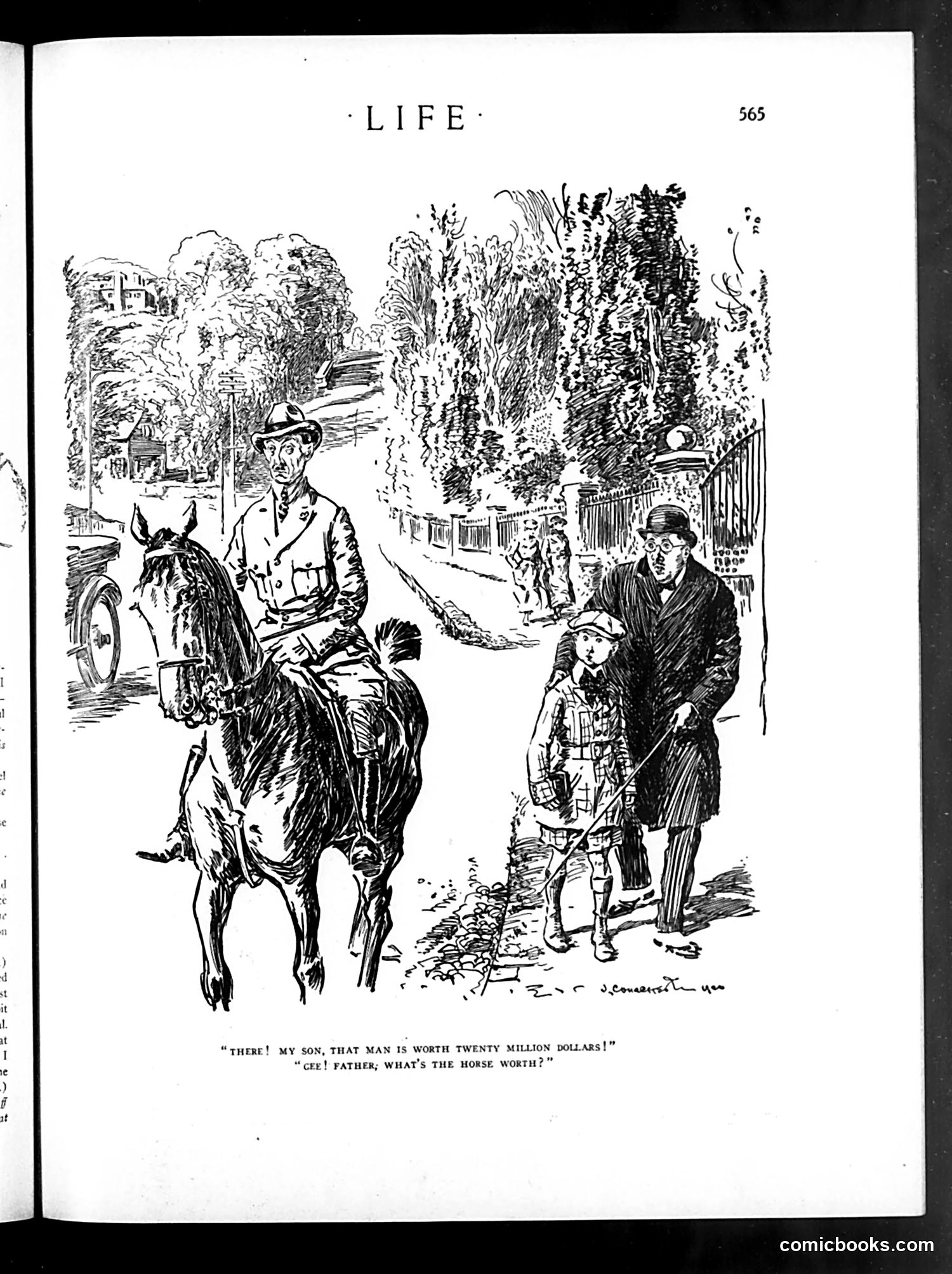
This cartoon satirizes wealthy parents' values and their influence on children. A father on horseback points out a rich man to his young son, proudly declaring the stranger's twenty-million-dollar worth. The son, however, innocently asks what the *horse* is worth—suggesting he either doesn't understand his father's materialistic lesson or finds the animal more interesting than human wealth. The joke critiques the era's plutocracy: the father's attempt to teach his son to admire money and wealthy individuals backfires when the child's natural, unpretentious curiosity deflates the moment. It's satire on how ridiculous parental obsession with wealth appears when confronted with childlike logic, and implicit commentary on how such values corrupt society.
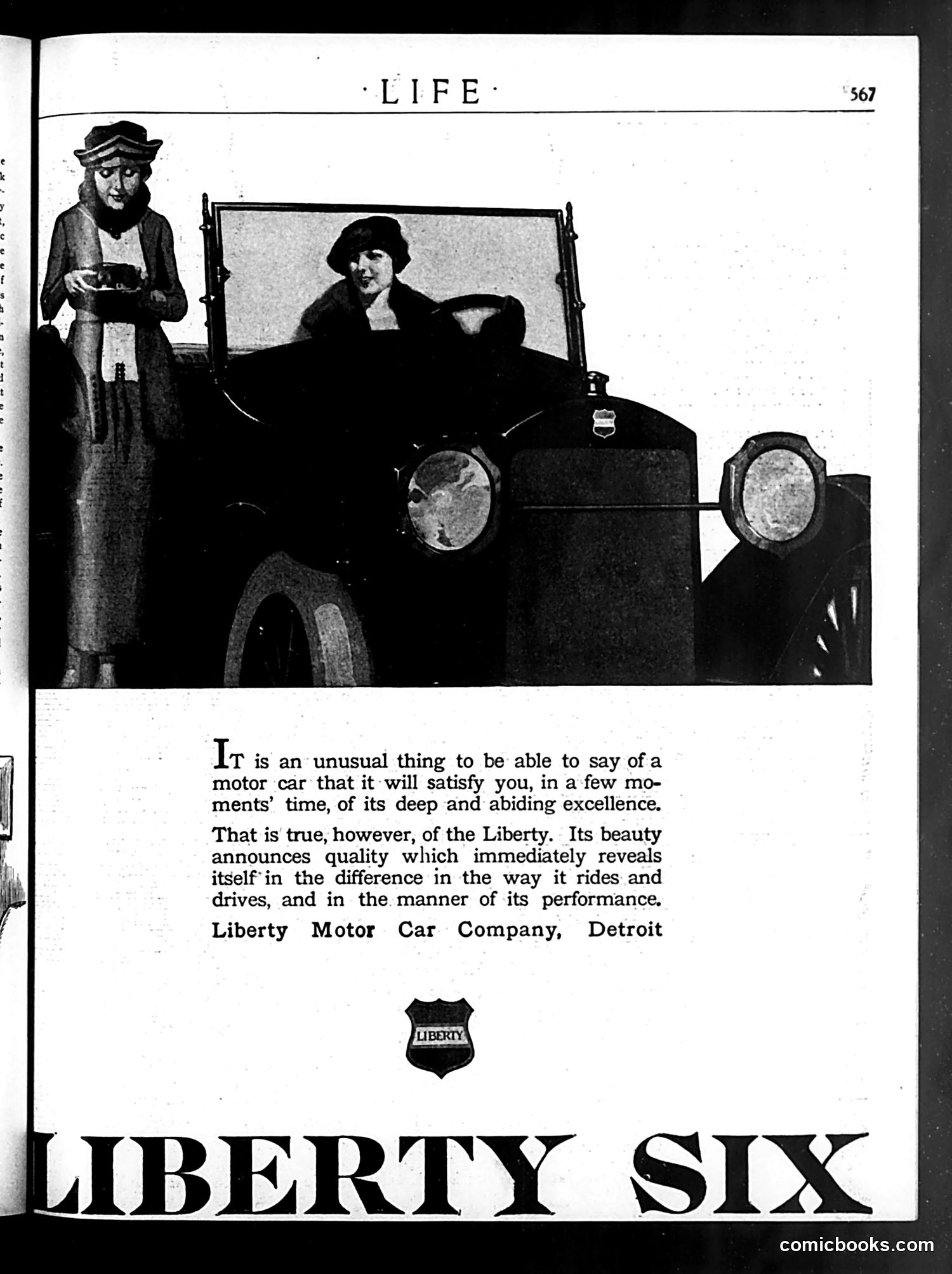
This is a **Liberty automobile advertisement**, not a political cartoon. The page features a vintage car ad from the Liberty Motor Car Company in Detroit, showcasing their "Liberty Six" model. The image depicts two well-dressed figures with a Liberty Six automobile—a woman seated in the car and an older woman (possibly a servant or attendant) standing beside it holding what appears to be a serving tray. The advertisement emphasizes quality and performance, claiming the car's excellence becomes apparent immediately upon driving it. The ad uses the aspirational imagery typical of 1920s automobile marketing—suggesting luxury, comfort, and refined taste to potential buyers. There is no apparent satire or political commentary; this is straightforward commercial advertising from Life magazine's advertising pages.
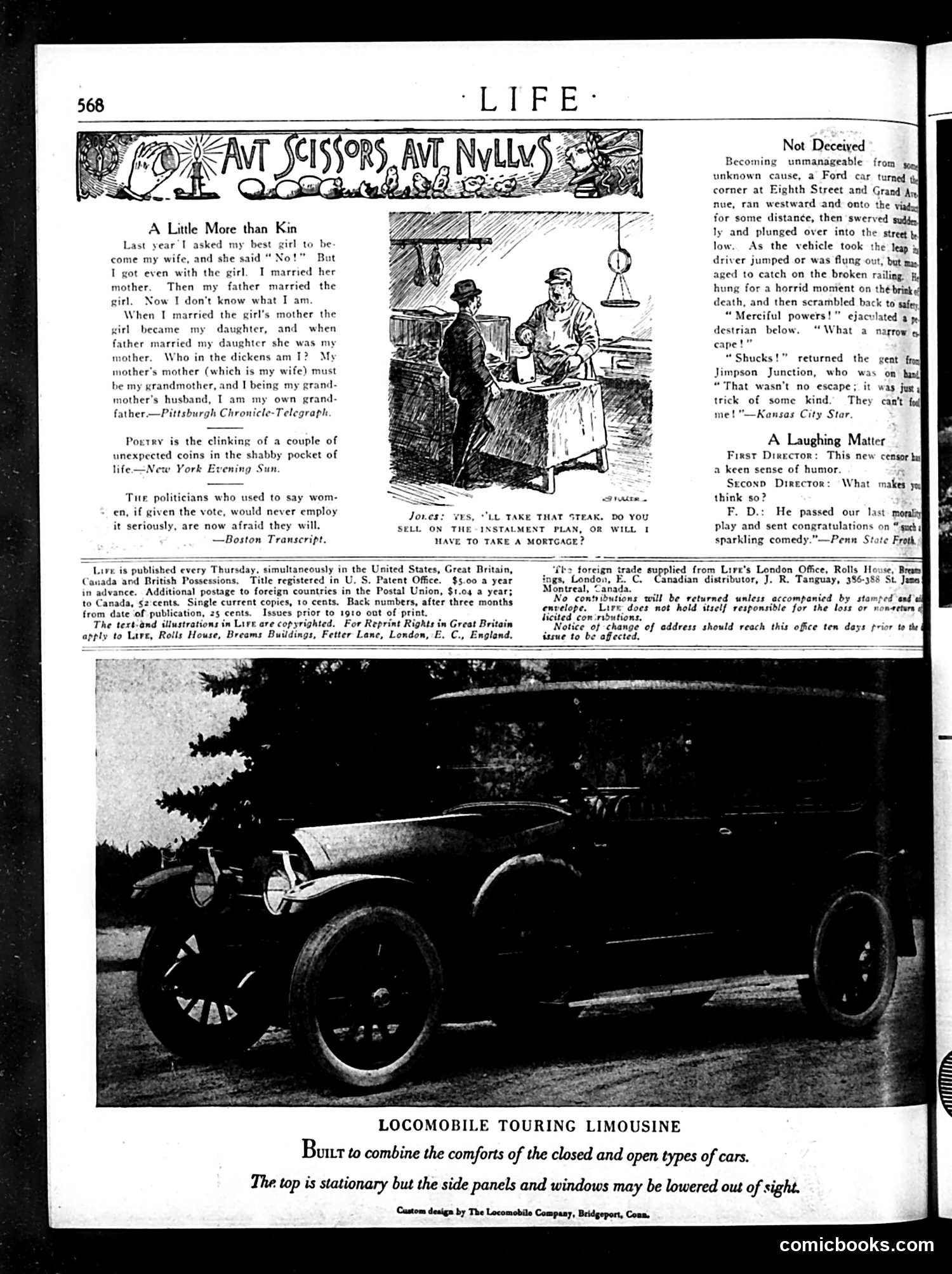
This page contains several satirical humor pieces typical of early 20th-century Life magazine: **"A Little More than Kin"** is a comedic logic puzzle about tangled family relationships. A man marries his girlfriend's mother, then his father marries the girlfriend. The narrator humorously traces the resulting absurd kinship connections (his wife becomes his mother-in-law, etc.), concluding he's become his own grandfather. It's wordplay satire exploiting confusion over modern remarriage scenarios. **The cartoon below** depicts two men discussing a butcher's pricing; one asks if meat is sold "on the installment plan, or will I have to take a mortgage?"—satirizing the high cost of living and suggesting even basic groceries require financing. Other brief satirical items mock politicians who underestimated women voters, and praise a film censor's "sense of humor" for passing a morality play. The page primarily advertises a **Locomobile automobile**, featuring its hybrid design combining closed and open-car features—not satirical content but commercial messaging typical of Life's mixed editorial-advertising format.
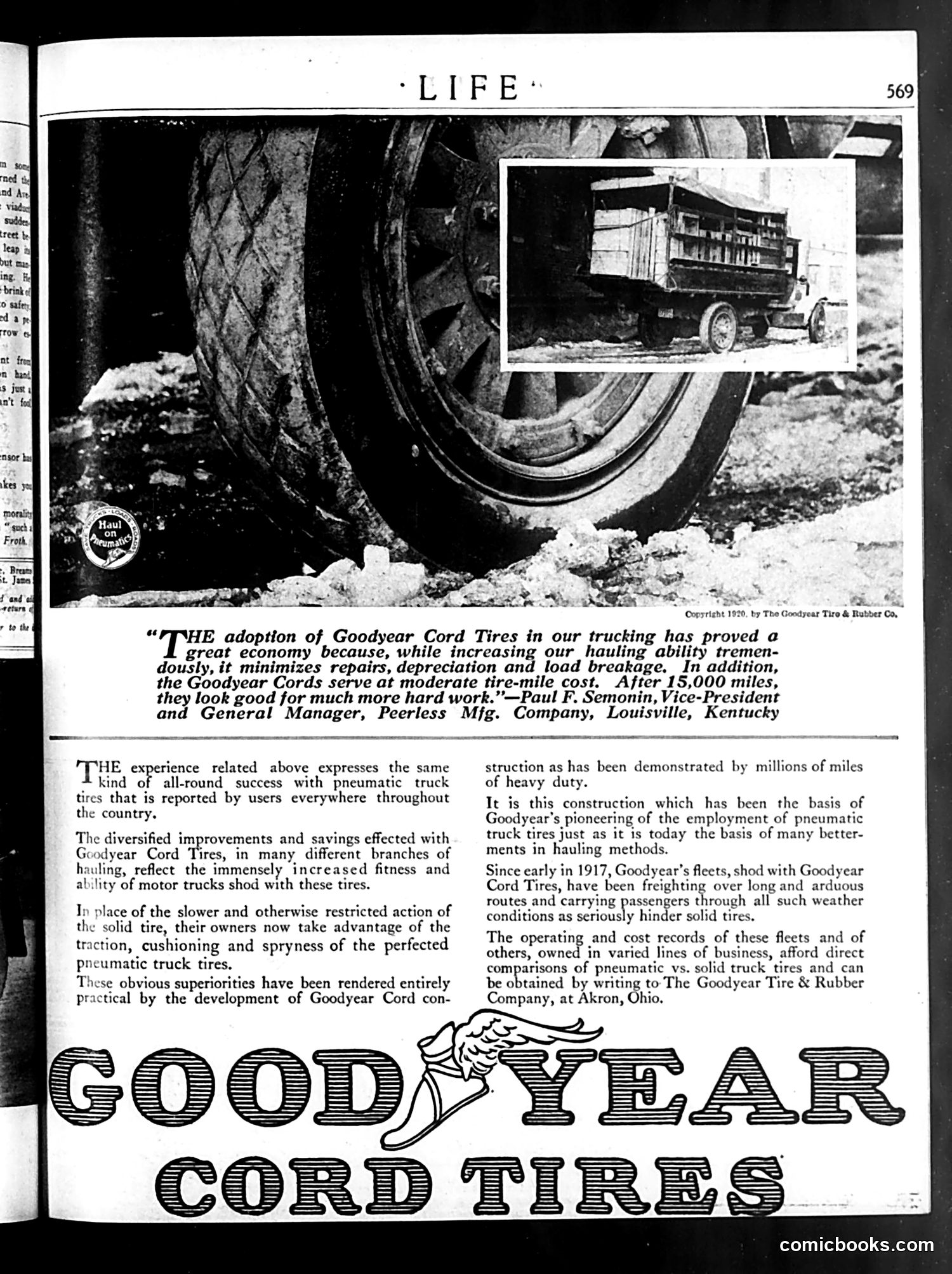
This is **not a cartoon or satire page**—it's a straightforward **advertisement for Goodyear Cord Tires** from 1920. The page features a testimonial from Paul F. Semonin, vice-president of Peerless Manufacturing Company in Louisville, Kentucky, praising Goodyear's pneumatic (air-filled) truck tires for their economy and durability after 15,000 miles of hauling. The large photograph shows the tire's superior cushioning compared to older solid tires. The accompanying text explains that pneumatic cord tires offer better traction and performance than solid rubber tires, especially in harsh weather conditions. This represents early automotive advertising in a prestige magazine, targeting business fleet managers by citing real company endorsements and operational cost comparisons. The appeal is practical efficiency rather than humor or political commentary.
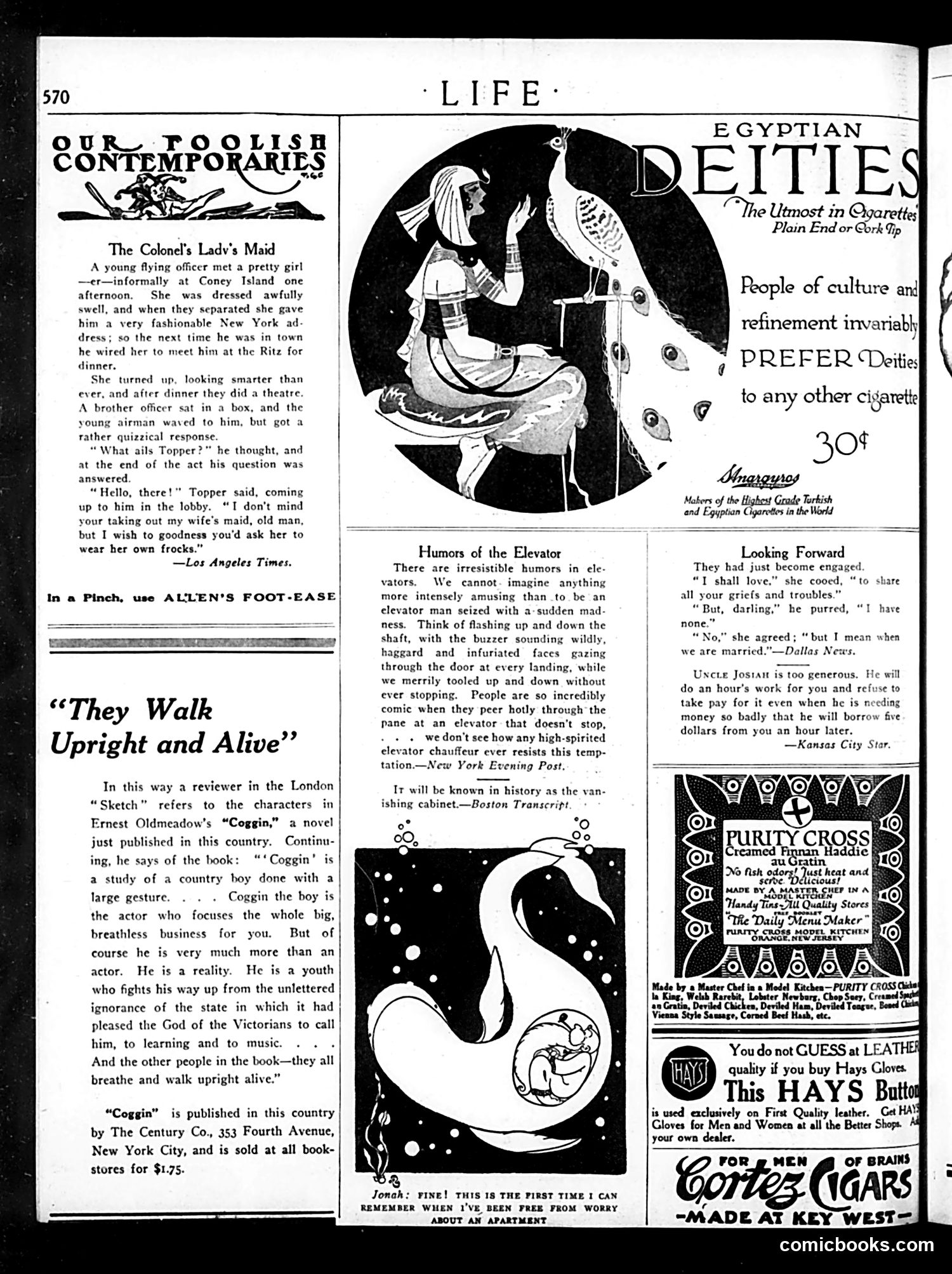
This page from *Life* magazine contains several short humorous pieces mocking contemporary social situations. **"The Colonel's Lady's Maid"** satirizes class pretension: a young officer meets a woman at Coney Island (a working-class resort) who dresses well and gives him a fashionable New York address. He takes her to the Ritz, but his friend reveals she's actually a servant—the officer unwittingly dated his friend's maid. The joke ridicules both the woman's attempt to pass as upper-class and the officer's gullibility. **"Humors of the Elevator"** humorously imagines an elevator operator going mad, deliberately stopping and starting erratically while passengers peer anxiously through doors—satirizing the absurdity of modern urban life and mechanical service. The remaining vignettes mock courtship conventions and marital expectations through brief, cynical quips—typical of *Life*'s satirical approach to contemporary American social habits.

This page is primarily a **product advertisement**, not political satire or cartoon content. It advertises the Ruud Automatic Gas Water Heater from the Ruud Manufacturing Company (Pittsburgh, PA, with a Canadian branch in Toronto). The advertisement uses visual appeals typical of early-to-mid 20th century marketing: a cloud of steam emerging from a bathroom sink faucet, emphasizing the convenience of instant hot water. The accompanying heater unit is shown as a sleek, modern appliance. The sales pitch emphasizes modern domesticity—particularly appealing to homemakers on laundry day—and highlights practical benefits: no waste, no waiting, temperature control. The tagline "Hot Water All Over the House" promises unprecedented household convenience. There is no political commentary or satire present. This represents straightforward consumer advertising from the industrial/manufacturing era, before modern skepticism about advertising claims became commonplace.
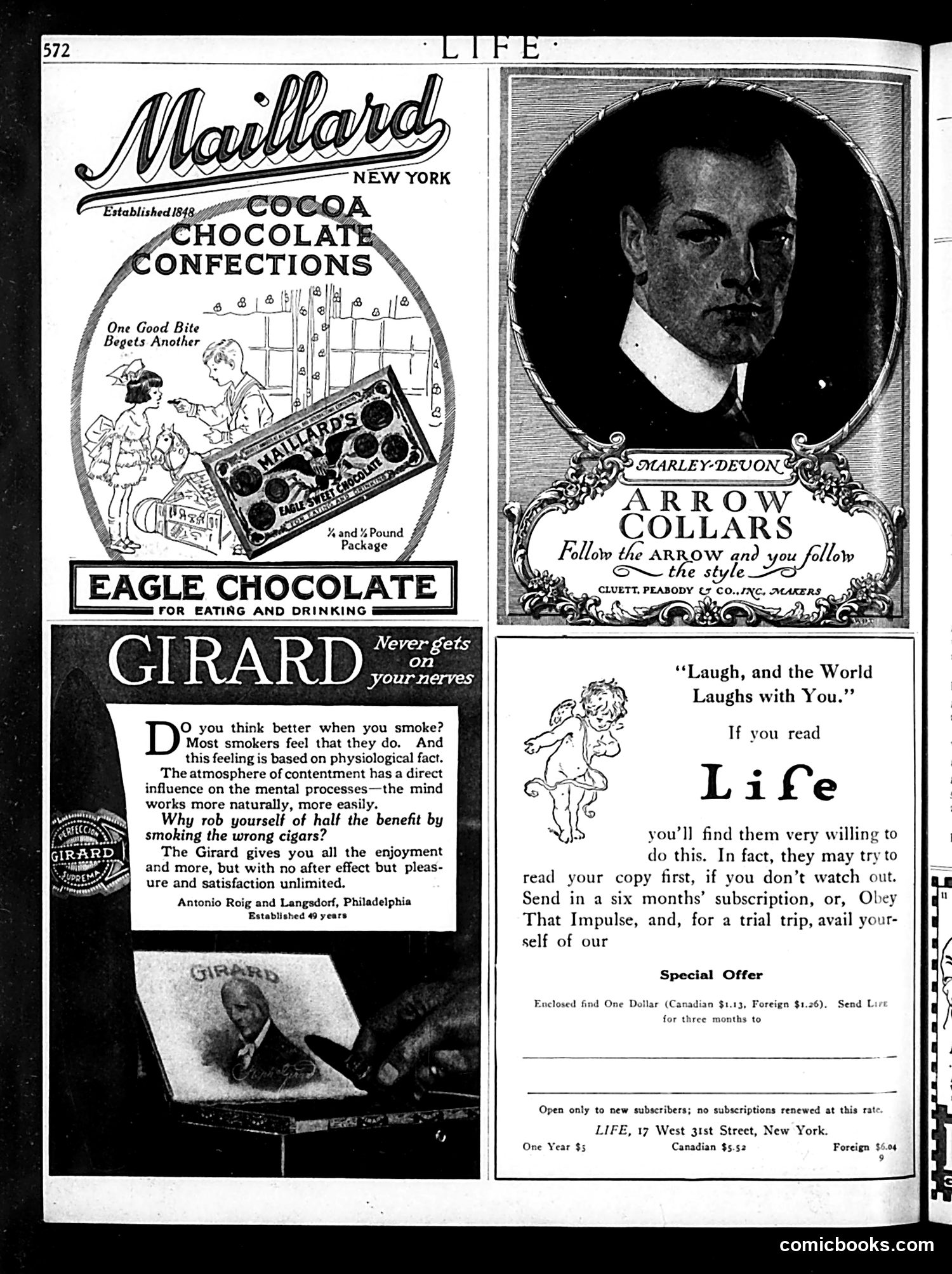
This page is primarily **advertising**, not political satire. It contains four advertisements: 1. **Maillard Cocoa Chocolate** (top left): A vintage candy ad featuring children and the slogan "One Good Bite Begets Another"—standard consumer marketing. 2. **Arrow Collars** (top right): Features a portrait of a man in formal dress, advertising collar styles with the phrase "Follow the Arrow and you follow the style." 3. **Girard Cigars** (bottom left): Makes pseudo-scientific claims that smoking improves mental clarity due to "contentment," arguing Girard cigars provide pleasure without negative effects—a health claim typical of early 20th-century tobacco advertising before regulation. 4. **Life Magazine Subscription** (bottom right): A self-promotional ad using humor ("they may try to read your copy first") to encourage subscriptions at $5/year. There is **no political cartoon or satire** on this page. It's a straightforward advertising section from the magazine.
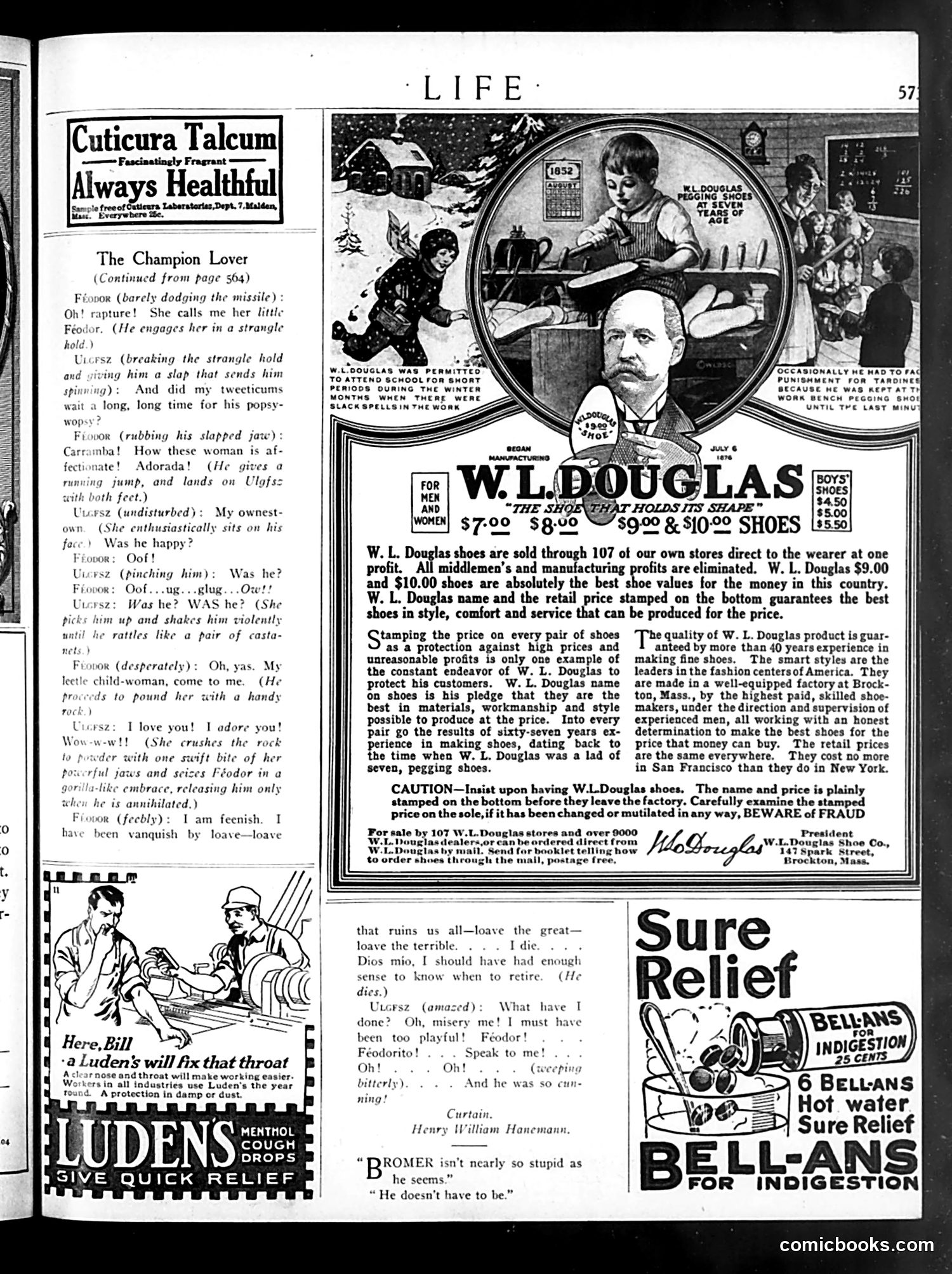
This page features a comedic play excerpt titled "The Champion Lover," a slapstick domestic scene between two characters—Féodor (a man) and Ulersz (a woman)—engaged in exaggerated, violent "expressions of affection." She strangles, slaps, and sits on him; he pounds her with a rock; she crushes the rock with her teeth. The humor relies on physical comedy and role-reversal: the woman is portrayed as grotesquely strong and aggressive, while the man is victimized. The satire appears to mock contemporary romantic ideals and perhaps gender dynamics of the era, presenting an absurdist inversion where the traditionally "weaker" sex dominates. The characters' broken English and foreign names (suggesting Eastern European or immigrant stereotypes) add to the satirical effect. The scene culminates in Féodor's death from her excessive "love," positioning the joke as a dark commentary on destructive relationships. The rest of the page is dominated by period advertisements for W.L. Douglas shoes, Ludens throat drops, and Bell-Ans indigestion remedy.
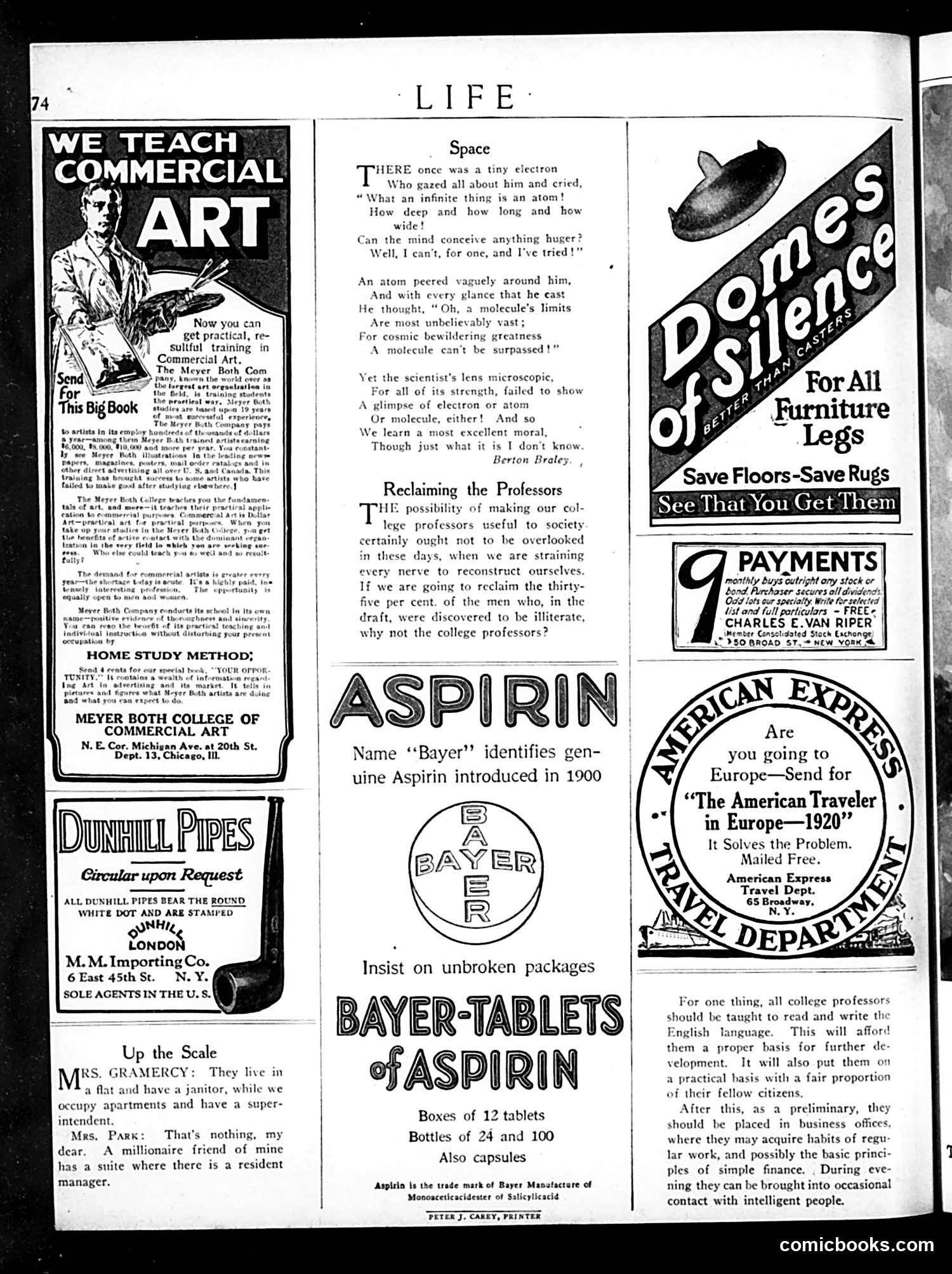
This page mixes advertisements with satirical content typical of Life magazine's format. The **"Reclaiming the Professors"** section is satire targeting college professors, suggesting they're impractical and disconnected from society. Written during the post-WWI reconstruction period, it mocks academics for being illiterate in practical matters. The author sarcastically proposes "solutions": teach professors basic English, place them in business offices to learn work habits, and expose them to "intelligent people" during evenings. The joke assumes professors are so removed from reality that they need remedial training in everyday competence—a common early-20th-century critique of academic elitism. The **"Space"** poem by Berton Braley humorously illustrates relative perspective: an electron finds atoms huge, atoms find molecules vast, yet scientists cannot observe any of them. The "moral" is deliberately vague—the humor lies in the infinite regress of scale and our inability to truly comprehend size. The remainder consists primarily of period advertisements for commercial art schools, pipes, Aspirin, furniture polish, travel services, and stock brokerage—typical of Life's revenue model.
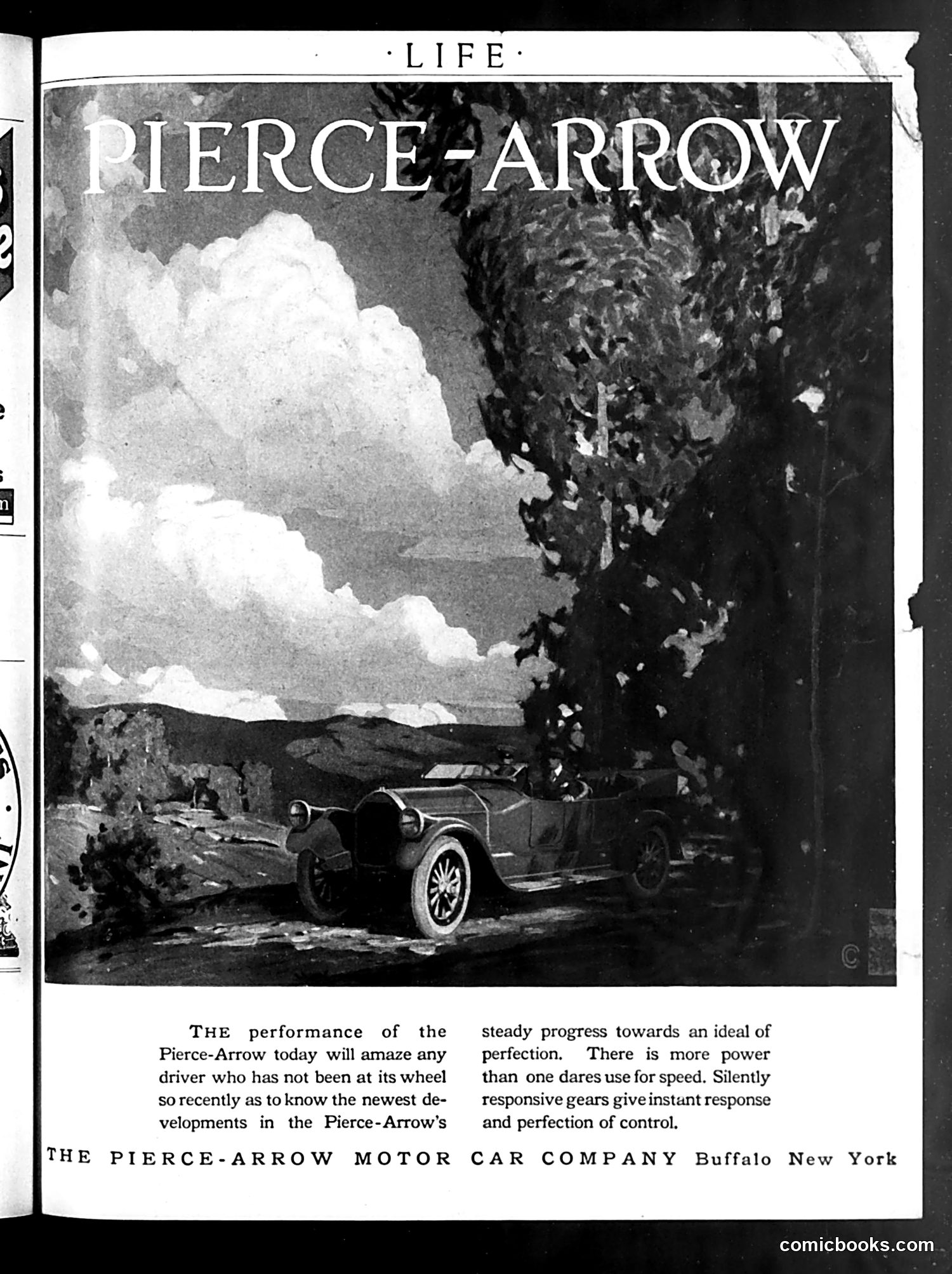
This is a **Pierce-Arrow automobile advertisement**, not a political cartoon. It appears in *Life* magazine's advertising section. The page promotes the Pierce-Arrow motor car through aspirational imagery: a vintage touring car positioned dramatically beneath towering cliffs and clouds, suggesting power, reliability, and impressive performance. The accompanying text emphasizes technical advances—responsive gears, instant control, and steady progress toward "perfection"—appealing to early 20th-century automotive buyers who valued engineering innovation. The phrase "more power than one dares use for speed" suggests safety and restraint alongside capability. This reflects the era when automobiles were luxury goods marketed to affluent drivers, emphasizing mechanical sophistication rather than mass-market affordability. The Buffalo, New York company location anchors this as period advertising for a real manufacturer.
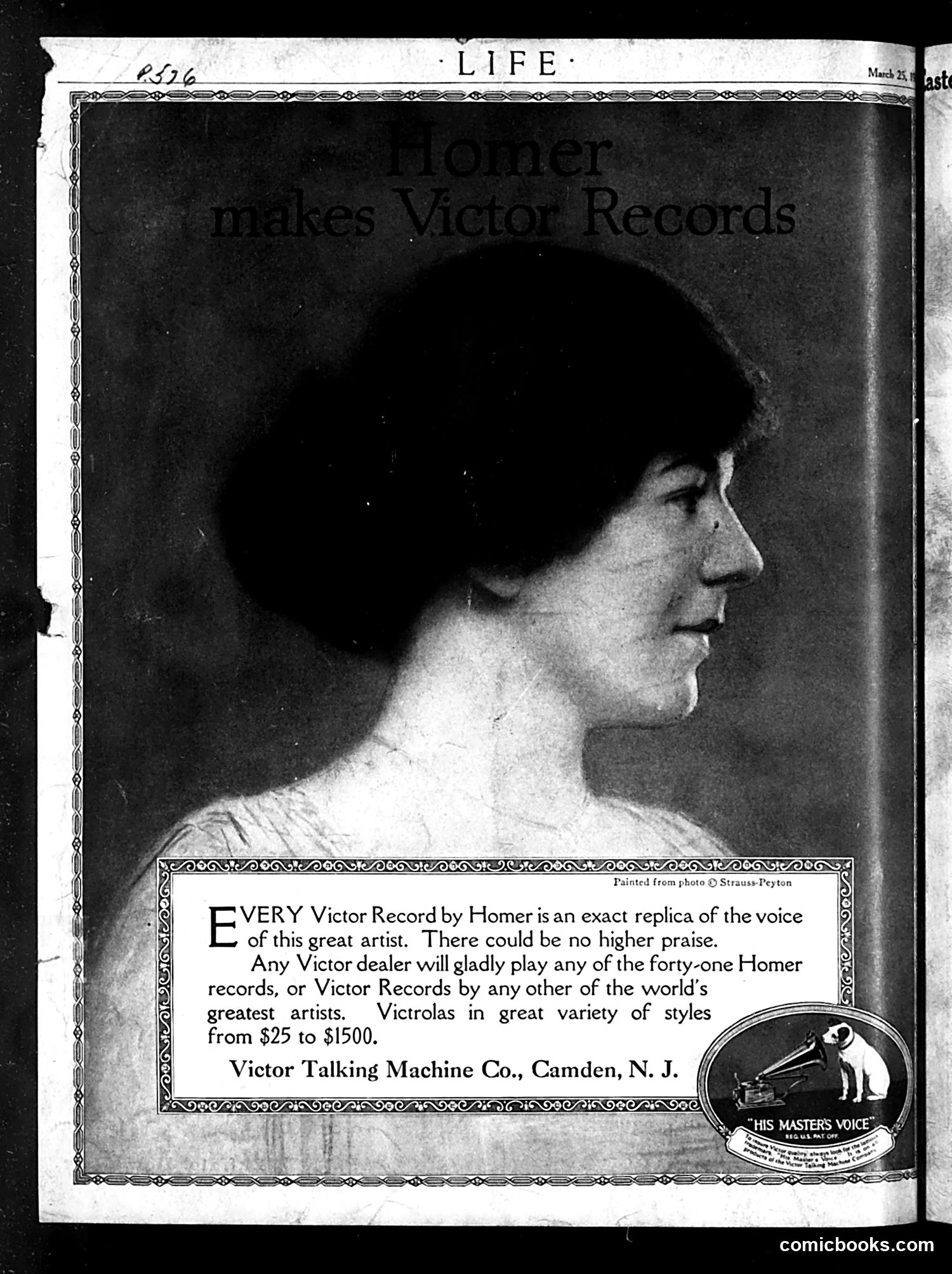
This is primarily a **Victor Talking Machine Company advertisement**, not a political cartoon. It features a profile portrait of a woman (identified in the heading as "Homer") promoting Victor Records and Victrola phonographs. The ad claims that Homer's Victor Records are "exact replicas" of her voice—a selling point emphasizing recording quality. The text mentions forty-one Homer records available and Victrolas priced from $25 to $1500. The "His Master's Voice" logo (dog listening to phonograph) appears in the bottom right corner. This represents early 20th-century marketing for recorded music and phonograph technology, targeting consumers interested in owning recordings of celebrated performers.