
Life, 1920-03-25 · page 19 of 40
Life — March 25, 1920 — page 19: what you’re looking at
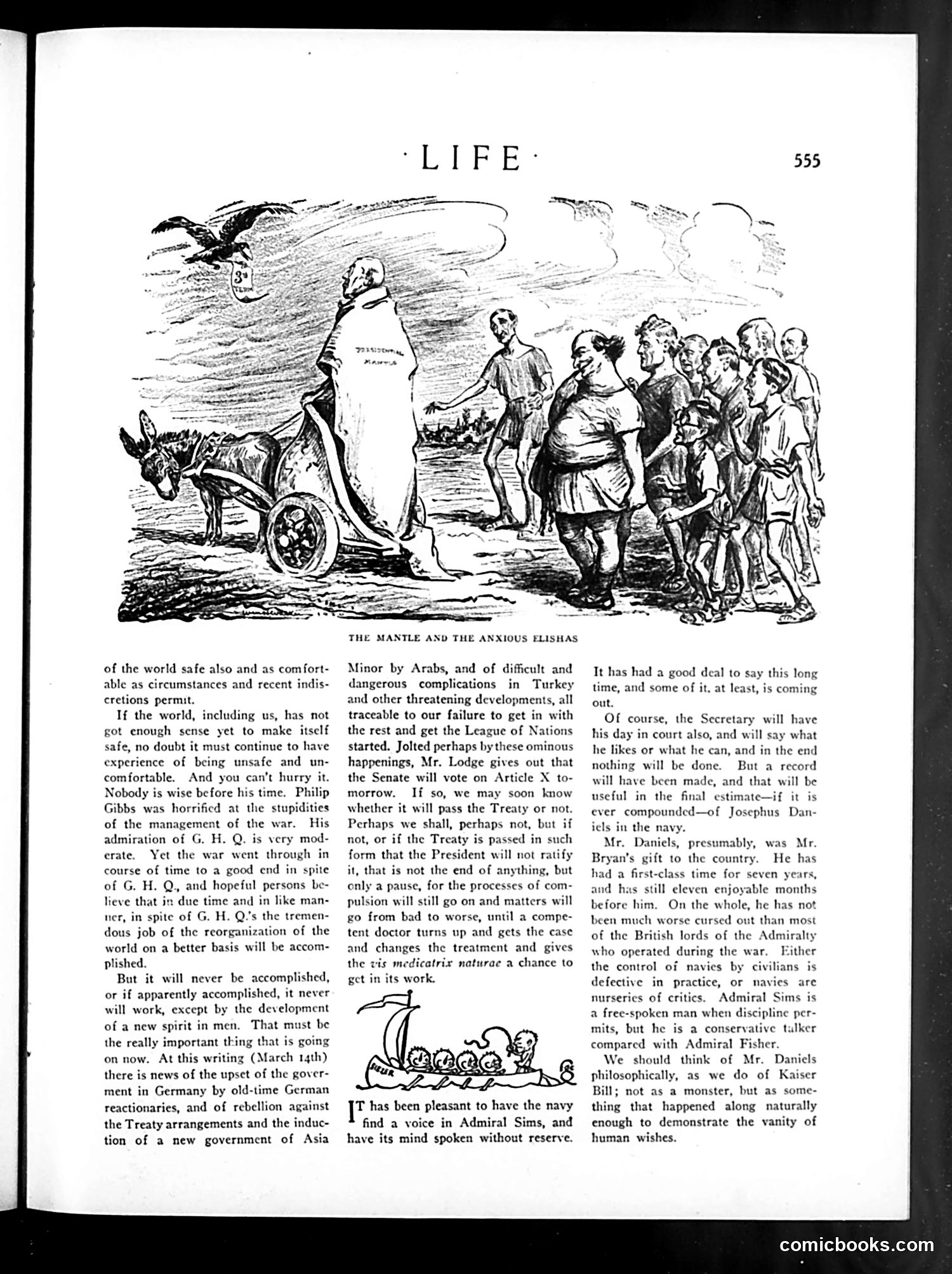
What you’re looking at
The cartoon depicts a biblical succession scene—likely referencing the prophet Elisha receiving Elijah's mantle. The figure on the left (possibly representing outgoing leadership) passes authority to anxious figures on the right, suggesting a transfer of power or responsibility. The text discusses post-WWI political turmoil: Senate debates over League of Nations ratification (Article X), unrest in Germany and Turkey, and tensions between Navy officials. It critiques Josephus Daniels (Secretary of the Navy under Wilson) and praises Admiral Sims for speaking frankly about naval mismanagement. The piece sardonically suggests new leaders inherit problems without solutions, comparing Daniels philosophically to Kaiser Wilhelm—not as evil, but as inevitable human failure demonstrating "the vanity of human wishes." The satire targets America's inability to forge lasting peace despite good intentions.
📄 Transcribed text from this page (OCR, searchable)
Machine-transcribed from the original scan — historical spelling and the odd misread are preserved.
of the world safe also and as comfort- able as circumstances and recent indis- cretions permit. If the world, including us, has not got enough sense yet to make itself safe, no doubt it must continue to have experience of being unsafe and un- comfortable. And you can’t hurry it. Nobody is wise before his time. Philip Gibbs was horrified at the stupidities of the management of the war. His admiration of G. H. Q. is very mod- erate. Yet the war went through in course of time to a good end in spite of G. H. Q, and hopeful persons be- lieve that in due time and in like man- ner, in spite of G. H. Q.’s the tremen- dous job of the reorganization of the world on a better basis will be accom- plished. But it will never be accomplished, or if apparently accomplished, it never will work, except by the development of a new spirit in men. That must be the really important thing that is going on now. At this writing (March 14th) there is news of the upset of the gover- ment in Germany by old-time German reactionaries, and of rebellion against the Treaty arrangements and the induc- tion of a new government of Asia THE MANTLE AND THE ANXIOUS ELISHAS Minor by Arabs, and of difficult and dangerous complications in Turkey and other threatening developments, all traceable to our failure to get in with the rest and get the League of Nations started. Jolted perhaps by these ominous happenings, Mr. Lodge gives out that the Senate will vote on Article X to- morrow. If so, we may soon know whether it will pass the Treaty or not. Perhaps we shall, perhaps not, but if not, or if the Treaty is passed in such form that the President will not ratify it, that is not the end of anything, but only a pause, for the processes of com- pulsion will still go on and matters will go from bad to worse, until a compe- tent doctor turns up and gets the case and changes the treatment and gives the vis medicatrix naturae a chance to get in its work. " has been pleasant to have the navy find a voice in Admiral Sims, and have its mind spoken without reserve. It has had a good deal to say this long time, and some of it, at least, is coming out. Of course, the Secretary will have his day in court also, and will say what he likes or what he can, and in the end nothing will be done. But a record will have been made, and that will be useful in the final estimate—if it is ever compounded—of Josephus Dan- iels in the navy. Mr. Daniels, presumably, was Mr. Bryan's gift to the country. He has had a first-class time for seven years, and has still eleven enjoyable months before him. On the whole, he has not been much worse cursed out than most of the British lords of the Admiralty who operated during the war. Either the control of navies by civilians is defective in practice, or navies are nurseries of critics. Admiral Sims is a free-spoken man when discipline per- mits, but he is a conservative talker compared with Admiral Fisher. We should think of Mr. Daniels philosophically, as we do of Kaiser Bill; not as a monster, but as some- thing that happened along naturally enough to demonstrate the vanity of human wishes. comicbooks.com