
Life, 1920-03-25 · page 30 of 40
Life — March 25, 1920 — page 30: what you’re looking at
A restored page from Life, 1920-03-25. Page through the whole issue in the reader above.
📄 Transcribed text from this page (OCR, searchable)
Machine-transcribed from the original scan — historical spelling and the odd misread are preserved.
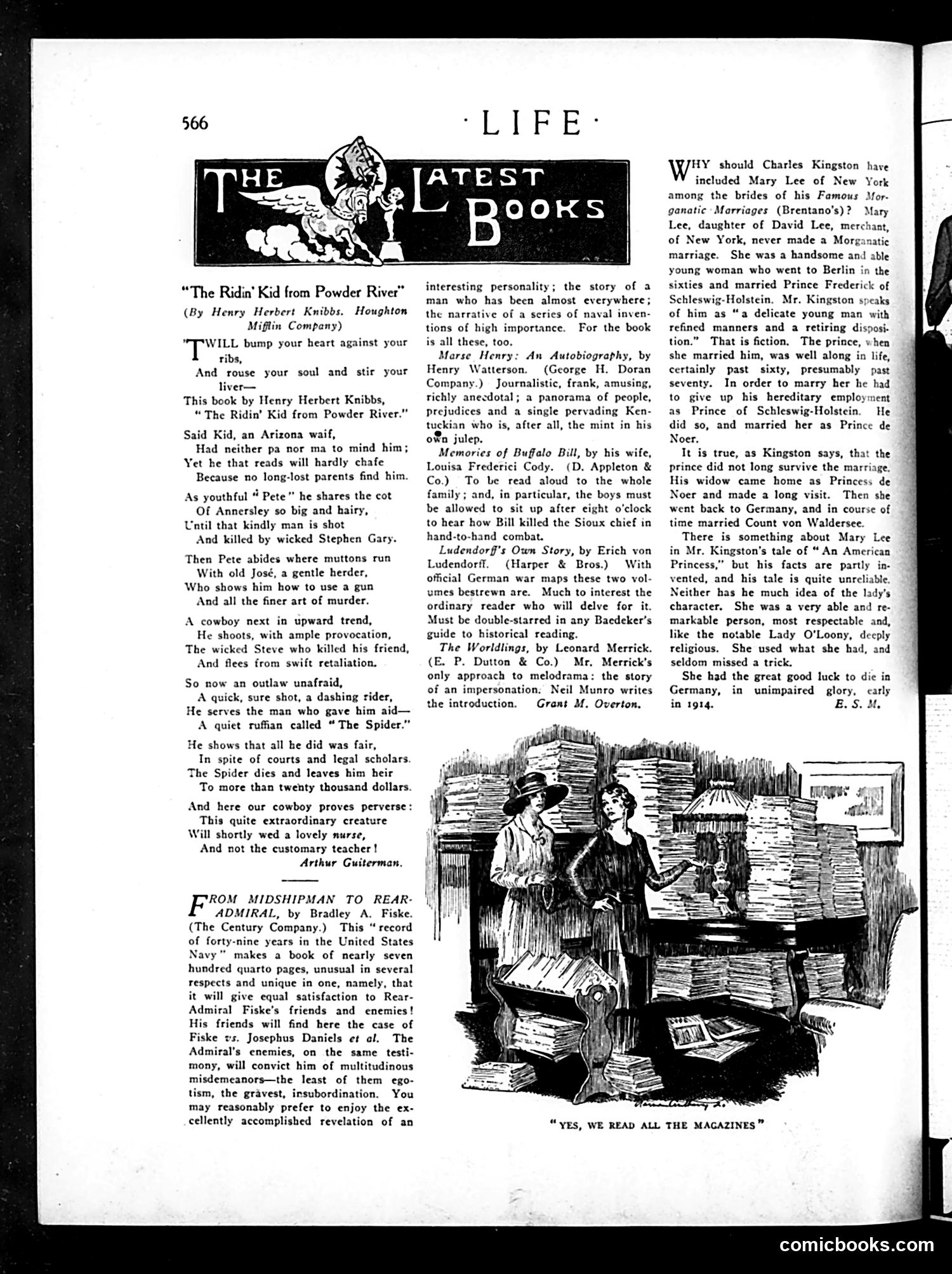
“The Ridin’ Kid from Powder River” (By Henry Herbert Knibbs. Houghton Mifflin Company) Te bump your heart against your ribs, And rouse your soul and stir your liver— This book by Henry Herbert Knibbs, “The Ridin’ Kid from Powder River.” Said Kid, an Arizona waif, Had neither pa nor ma to mind him; Yet he that reads will hardly chafe Because no long-lost parents find him. As youthful “ Pete” he shares the cot Of Annersley so big and hairy, Until that kindly man is shot And killed by wicked Stephen Gary. Then Pete abides where muttons run With old José, a gentle herder, Who shows him how to use a gun And all the finer art of murder. A cowboy next in upward trend, He shoots, with ample provocation, The wicked Steve who killed his friend, And flees from swift retaliation, So now an outlaw unafraid, A quick, sure shot, a dashing rider, He serves the man who gave him aid— A quiet ruffian called “The Spider.” He shows that all he did was fair, In spite of courts and legal scholars. The Spider dies and leaves him heir To more than twenty thousand dollars. And here our cowboy proves perverse: This quite extraordinary creature Will shortly wed a lovely nurse, And not the customary teacher! Arthur Guiterman. ROM MIDSHIPMAN TO REAR- ADMIRAL, by Bradley A. Fiske. (The Century Company.) This “ record of forty-nine years in the United States Navy" makes a book of nearly seven hundred quarto pages, unusual in several respects and unique in one, namely, that it will give equal satisfaction to Rear- Admiral Fiske’s friends and enemies! His friends will find here the case of Fiske Josephus Daniels et af. The Admiral’s enemies, on the same testi- mony, will convict him of multitudinous misdemeanors—the least of them ego- tism, the gravest, insubordination. You may reasonably prefer to enjoy the ex- cellently accomplished revelation of an interesting personality; the story of a man who has been almost everywhere; the narrative of a series of naval inven- tions of high importance. For the book is all these, too. Marse Henry: An Autobiography, by Henry Watterson. (George H. Doran Company.) Journalistic, frank, amusing, richly anecdotal; a panorama of people, Prejudices and a single pervading Ken- tuckian who is, after all, the mint in his ofn julep. Memories of Buffalo Bill, by his wife, Louisa Frederici Cody. (D. Appleton & Co.) To be read aloud to the whole family; and, in particular, the boys must be allowed to sit up after eight o'clock to hear how Bill killed the Sioux chief in hand-to-hand combat. Ludendorf's Own Story, by Erich von Ludendorff. (Harper & Bros.) With official German war maps these two vol- umes bestrewn are. Much to interest the ordinary reader who will delve for it. Must be double-starred in any Baedeker’s guide to historical reading. The Worldlings, by Leonard Merrick. (E. P. Dutton & Co.) Mr, Merrick’s only approach to melodrama: the story of an impersonation. Neil Munro writes the introduction. Grant M. Overton, HY should Charles Kingston have included Mary Lee of New York among the brides of his Famous Mor- ganatic Marriages (Brentano's)? Mary Lee, daughter of David Lee, merchant, of New York, never made a Morganatic marriage. She was a handsome and able young woman who went to Berlin in the sixties and married Prince Frederick of Schleswig-Holstein, Mr. Kingston speaks of him as “a delicate young man with refined manners and a retiring disposi- tion.” That is fiction, The prince, when she married him, was well along in life, certainly past sixty, presumably past seventy. In order to marry her he had to give up his hereditary employment as Prince of Schleswig-Holstein. He did so, and married her as Prince de Noer. It is true, as Kingston says, that the prince did not long survive the marriage. His widow came home as Princess de Noer and made a long visit. Then she went back to Germany, and in course of time married Count von Waldersee. There is something about Mary Lee in Mr. Kingston's tale of “An American Princess,” but his facts are partly in- vented, and his tale is quite unreliable, Neither has he much idea of the lady's character, She was a very able and re- markable person, most respectable and, like the notable Lady O'Loony, deeply religious. She used what she had, and seldom missed a trick. She had the great good luck to die in Germany, in unimpaired glory, carly in 1914. B.S. M. “YES, WE READ ALL THE MAGAZINES” comicbooks.com