
Life, 1920-03-25 · page 22 of 40
Life — March 25, 1920 — page 22: what you’re looking at
What you’re looking at
This page critiques American theatrical producers' indifference to basic dramatic standards. The author attacks the play "Musk," a Scandinavian domestic tragedy with a French attribution, for its fundamental flaws: weak translation, culturally irrelevant subject matter, and—most egregiously—a cast speaking in a bewildering mixture of accents (Piccadilly English, broken French, Austrian, Swedish, Danish). The satire's point: American audiences have become so accustomed to accepting theatrical conventions uncritically that producers face no consequences for offensive negligence. The author notes Americans tolerate these theatrical offenses with the same apathy they show toward broader social evils—suggesting lazy citizenship extends from entertainment to civic life. The opening section references the Eighteenth Amendment (Prohibition), implying that even eliminating obvious social problems leaves subtler evils unchecked. The joke is that Americans' passive tolerance reflects a broader cultural complacency.
📄 Transcribed text from this page (OCR, searchable)
Machine-transcribed from the original scan — historical spelling and the odd misread are preserved.
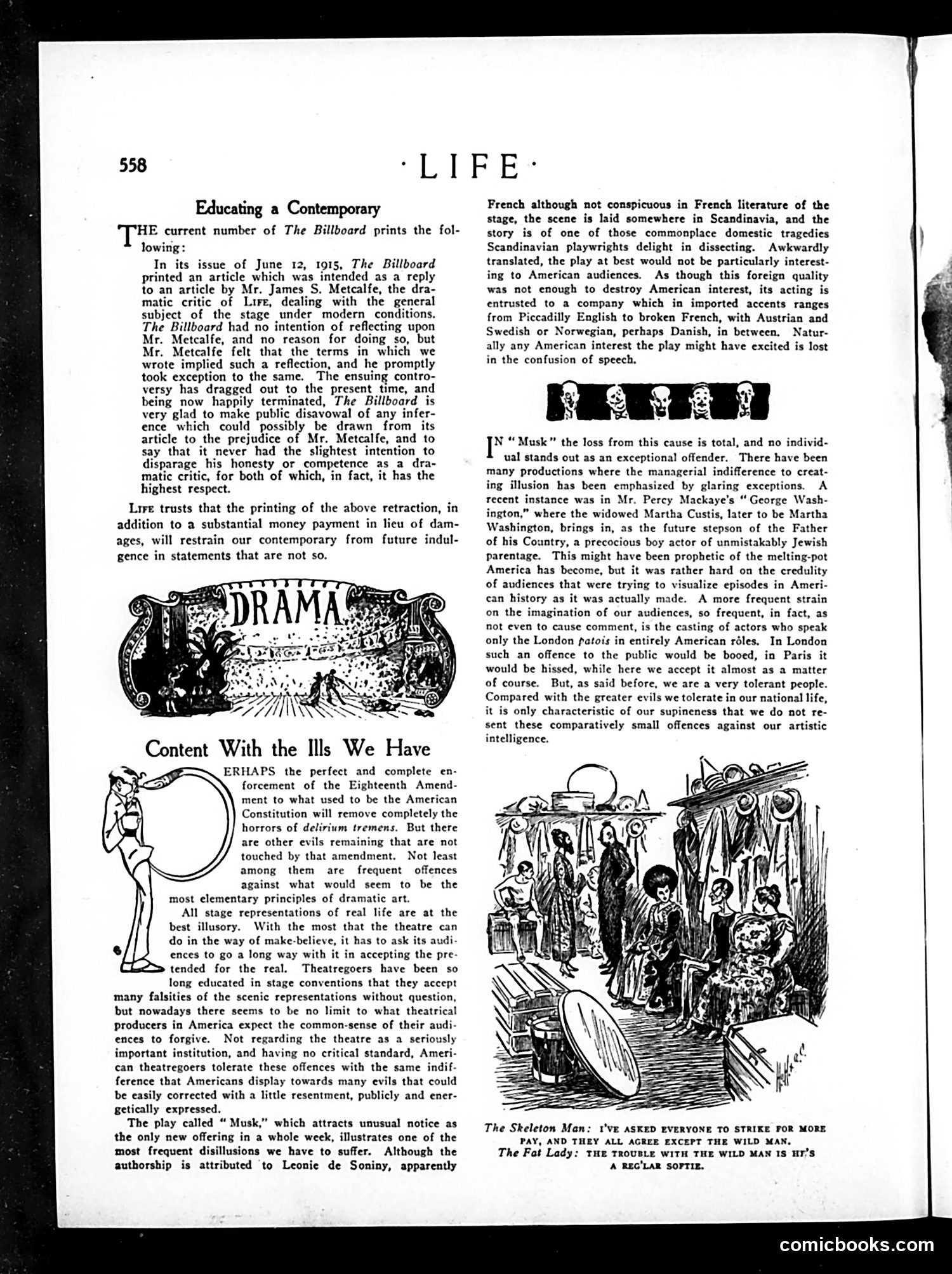
558 Educating a Contemporary E current number of The Billboard prints the fol- lowing: In its issue of June 12, 1915, The Billboard printed an article which was intended as a reply to an article by Mr. James S. Metcalfe, the dra- matic critic of Lire, dealing with the general subject of the stage under modern conditions. The Billboard had no intention of reflecting upon Mr. Metcalfe, and no reason for doing so, but Mr. Metcalfe felt that the terms in which we wrote implied such a reflection, and he promptly took exception to the same. The ensuing contro- versy has dragged out to the present time, and being now happily terminated, The Billboard is very glad to make public disavowal of any infer- ence which could possibly be drawn from its article to the prejudice of Mr. Metcalfe, and to say that it never had the slightest intention to disparage his honesty or competence as a dra- matic critic, for both of which, in fact, it has the highest respect. Lire trusts that the printing of the above retraction, in addition to a substantial money payment in lieu of dam- ages, will restrain our contemporary from future indul- gence in statements that are not so. Content With the Ills We Have ERHAPS the perfect and complete en- forcement of the Eighteenth Amend- ment to what used to be the American Constitution will remove completely the horrors of delirium tremens. But there are other evils remaining that are not touched by that amendment. Not least among them are frequent offences against what would seem to be the most elementary principles of dramatic art. All stage representations of real life are at the best illusory. With the most that the theatre can do in the way of make-believe, it has to ask its audi- ences to go a long way with it in accepting the pre- tended for the real. Theatregoers have been so long educated in stage conventions that they accept many falsities of the scenic representations without question, but nowadays there seems to be no limit to what theatrical producers in America expect the common-sense of their audi- ences to forgive. Not regarding the theatre as a seriously important institution, and having no critical standard, Ameri- can theatregoers tolerate these offences with the same indif- ference that Americans display towards many evils that could be easily corrected with a little resentment, publicly and ener- getically expressed. The play called “ Musk,” which attracts unusual notice as the only new offering in a whole week, illustrates one of the most frequent disillusions we have to suffer. Although the authorship is attributed to Leonie de Soniny, apparently “LIFE: French although not conspicuous in French literature of the stage, the scene is laid somewhere in Scandinavia, and the story is of one of those commonplace domestic tragedies Scandinavian playwrights delight in dissecting. Awkwardly translated, the play at best would not be particularly interest- ing to American audiences. As though this foreign quality was not enough to destroy American interest, its acting is entrusted to a company which in imported accents ranges from Piccadilly English to broken French, with Austrian and Swedish or Norwegian, perhaps Danish, in between, Natur- ally any American interest the play might have excited is lost in the confusion of speech, ne ‘4 “Musk” the loss from this cause is total, and no indiv ual stands out as an exceptional offender. There have been many productions where the managerial indifference to creat- ing illusion has been emphasized by glaring exceptions. A recent instance was in Mr. Percy Mackaye’s “George Wash- ington,” where the widowed Martha Custis, later to be Martha Washington, brings in, as the future stepson of the Father of his Country, a precocious boy actor of unmistakably Jewish parentage. This might have been prophetic of the melting-pot America has become, but it was rather hard on the credulity of audiences that were trying to visualize episodes in Ameri- can history as it was actually made. A more frequent strain on the imagination of our audiences, so frequent, in fact, as not even to cause comment, is the casting of actors who speak only the London patois in entirely American réles, In London such an offence to the public would be booed, in Paris it would be hissed, while here we accept it almost as a matter of course. But, as said before, we are a very tolerant people. Compared with the greater evils we tolerate in our national life, it is only characteristic of our supineness that we do not re- sent these comparatively small offences against our artistic intelligence. The Skeleton Man: I'VE ASKED EVERYONE TO STRIKE FOR MORE PAY, AND THEY ALL AGREE EXCEPT THE WILD MAN, The Fat Lady: tHe TROUBLE WITH THE WILD MAN IS HT’S ‘A REG'LAR SOPTIE. comicbooks.com