
Life, 1920-03-25 · page 12 of 40
Life — March 25, 1920 — page 12: what you’re looking at
What you’re looking at
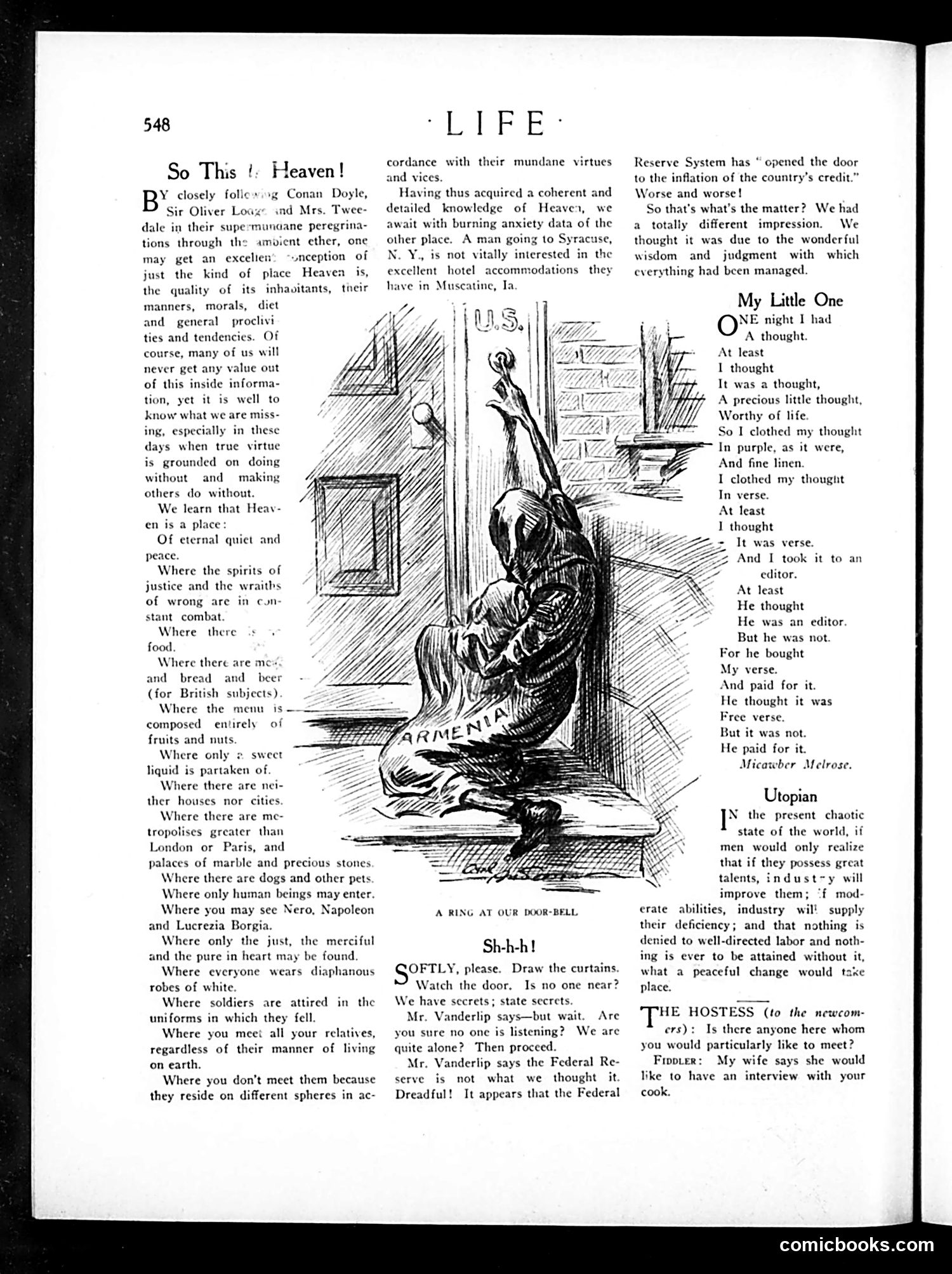
The main illustration titled "A Ring at Our Door-Bell" depicts a figure labeled "ARMENIA" kneeling or collapsed at a doorway, appearing to be in distress or seeking aid. This references the Armenian genocide and humanitarian crisis of the early 1920s, when Armenia faced severe suffering following World War I. The surrounding text consists of satirical pieces: "So This Is Heaven!" discusses heaven's qualities; "My Little One" is a poem about submitting verse to an editor; and "Utopian" discusses labor reform. A dialogue scene labeled "Sh-h-h!" involves characters discussing Federal Reserve secrets. The cartoon's point appears to be an appeal to American readers' conscience regarding Armenia's desperate plight, using the metaphor of someone literally at the door seeking help.
📄 Transcribed text from this page (OCR, searchable)
Machine-transcribed from the original scan — historical spelling and the odd misread are preserved.
548 So This !: Heaven! Y closely folle»..g Conan Doyle, Sir Oliver Loag: ind Mrs. Twe dale in their supermunaane peregrina- tions through the ambient ether, one may get an excelien ~unception of just the kind of place Heaven is, the quality of its inhavitants, their manners, morals, diet and general proclivi ties and tendencies. Of course, many of us will never get any value out of this inside informa- tion, yet it is well to know what we are miss- ing, especially in these days when true virtue is grounded on doing without and making others do without. We learn that Heav- en is a place: Of eternal quiet and peace. Where the spirits of justice and the wraiths of wrong are in con- stant combat. Where there food Where there are mex and bread and beer (for British subjects) Where the menu is composed entirely of fruits and nuts. Where only 2 iquid is partaken of. Where there are nei- ther houses nor cities: Where there are me- tropolises greater than London or Paris, and palaces of marble and precious stones. Where there are dogs and other pets. Where only human beings may enter. Where you may see Nero, Napoleon and Lucrezia Borgia. Where only the just, the merciful and the pure in heart may be found. Where everyone wears diaphanous robes of white. Where soldiers are attired in the uniforms in which they fell. Where you meet all your relatives, regardless of their manner of living on earth. Where you don’t meet them because they reside on different spheres in ac- sweet ‘LIFE: cordance with their mundane virtues and vices. Having thus acquired a coherent and detailed knowledge of Heaven, we await with burning anxiety data of the other place. A man going to Syracuse, N. Y., is not vitally interested in the excellent hotel accommodations they have in Muscatine, Ia A RING AT OUR DOOR-BELL, Sh-h-h! OFTLY, please. Draw the curtains. Watch the door. Is no one near? We have secrets; state secrets. Mr. Vanderlip says—but wait. Are you sure no one is listening? We are quite alone? Then proceed. Mr. Vanderlip says the Federal Re- serve is not what we thought it. Dreadful! It appears that the Federal Reserve System has “ opened the door to the inflation of the country’s credit.” Worse and worse! So that's what's the matter? We had a totally different impression. We thought it was due to the wonderful wisdom and judgment with which everything had been managed. My Little One NE night I had A thought. At least I thought It was a thought, A precious little thought, Worthy of life. So I clothed my thought In purple, as it were, And fine linen. I clothed my thought In verse. At least 1 thought > It was verse. 2 And I took it to an editor. At least He thought He was an editor. But he was not. For he bought My verse. And paid for it. He thought it was Free verse. But it was not. He paid for it. Micawber Melrose. Utopian ]s the present chaotic state of the world, if men would only realize that if they possess great talents, indust~y will improve them; “f mod- abilities, industry wil! supply their deficiency; and that nothing is denied to well-directed labor and noth- ing is ever to be attained without it what a peaceful change would ta’ place. erate HE HOSTESS (to the newcom- ers): Is there anyone here whom you would particularly like to meet? Fiopter: My wife says she would like to have an interview with your cook. comicbooks.com