
Life, 1920-03-25 · page 16 of 40
Life — March 25, 1920 — page 16: what you’re looking at
What you’re looking at
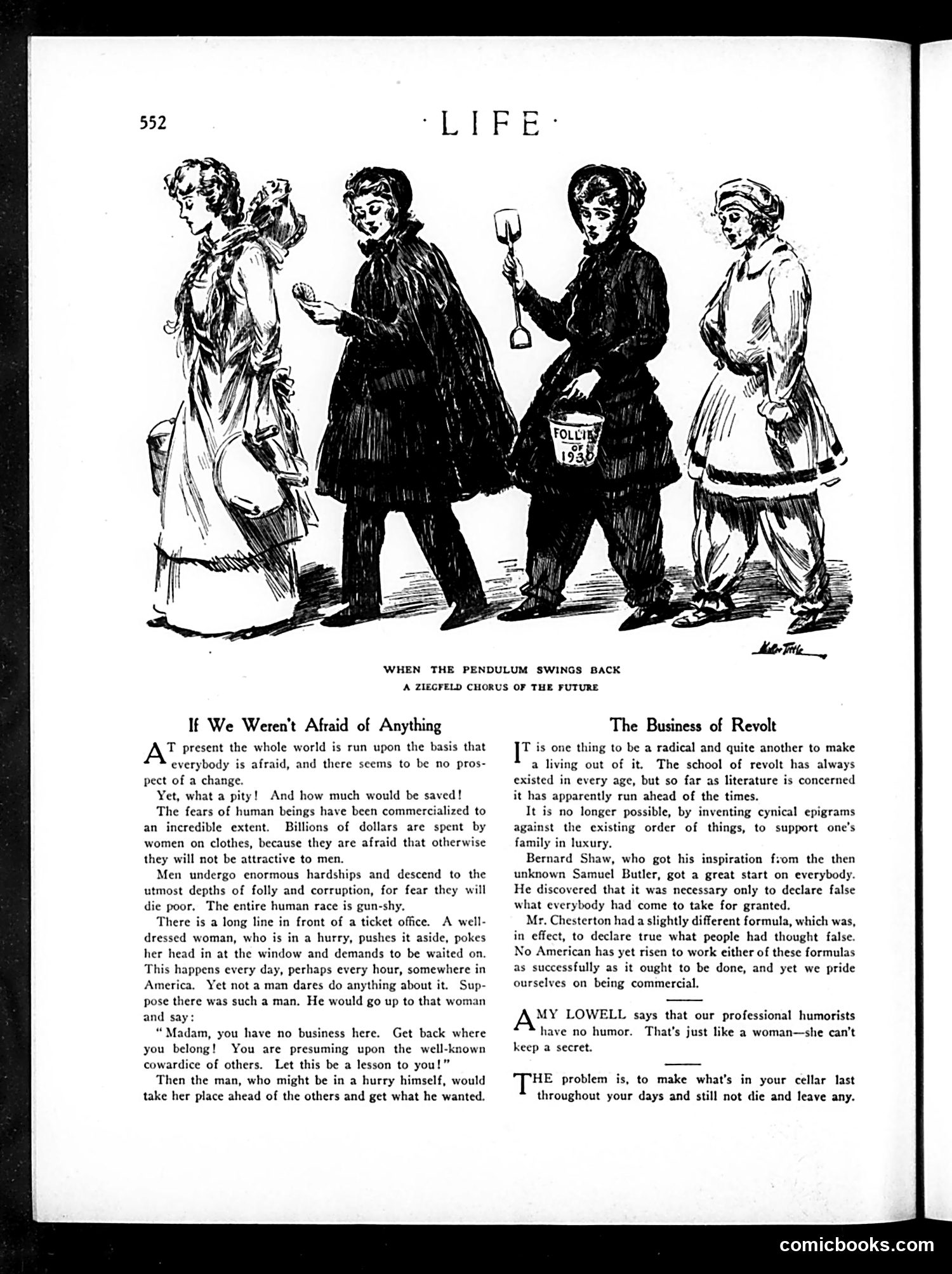
The top illustration shows five figures in early 20th-century dress, captioned "WHEN THE PENDULUM SWINGS BACK / A ZIEGFELD CHORUS OF THE FUTURE." This satirizes concerns about women's changing roles—suggesting that if social pendulum swings toward women's liberation, the glamorous chorus girls of the Ziegfeld Follies theater would be replaced by less conventionally feminine women (depicted in more masculine or androgynous clothing). The two articles below discuss social anxiety about radical change. "If We Weren't Afraid of Anything" critiques how fear paralyzes society and commercializes human suffering. "The Business of Revolt" argues that revolutionary rhetoric has become commodified and predictable. Together, the page reflects 1920s-era anxieties about feminism, social upheaval, and whether radical movements represent genuine change or mere fashionable posturing.
📄 Transcribed text from this page (OCR, searchable)
Machine-transcribed from the original scan — historical spelling and the odd misread are preserved.
WHEN THE PENDULUM SWINGS BACK A ZIEGFELD CHORUS OF THE FUTURE If We Weren't Afraid of Anything At present the whole world is run upon the basis that everybody is afraid, and there seems to be no pros- pect of a change. Yet, what a pity! And how much would be saved! The fears of human beings have been commercialized to an incredible extent. Billions of dollars are spent by women on clothes, because they are afraid that otherwise they will not be attractive to men. Men undergo enormous hardships and descend to the utmost depths of folly and corruption, for fear they will die poor, The entire human race is gun-shy, There is a long line in front of a ticket office. A well- dressed woman, who is in a hurry, pushes it aside, pokes her head in at the window and demands to be waited on. This happens every day, perhaps every hour, somewhere in America. Yet not a man dares do anything about it. Sup- pose there was such a man. He would go up to that wo: and say: “Madam, you have no business here. Get back where you belong! You are presuming upon the well-known cowardice of others. Let this be a lesson to you!” Then the man, who might be in a hurry himself, would take her place ahead of the others and get what he wanted. The Business of Revolt T is one thing to be a radical and quite another to make a living out of it. The school of revolt has always existed in every age, but so far as literature is concerned it has apparently run ahead of the times. It is no longer possible, by inventing cynical epigrams against the existing order of things, to support one’s family in luxury, Bernard Shaw, who got his inspiration fom the then unknown Samuel Butler, got a great start on everybody. He discovered that it was necessary only to declare false what everybody had come to take for granted. Mr. Chesterton had a slightly different formula, which was, in effect, to declare true what people had thought false. No American has yet risen to work either of these formulas as successfully as it ought to be done, and yet we pride ourselves on being commercial. MY LOWELL says that our professional humorists have no humor. That's just like a woman—she can’t keep a secret. 'HE problem is, to make what's in your cellar last throughout your days and still not die and leave any. comicbooks.com