
A complete issue · 36 pages · 1919
Life — November 13, 1919
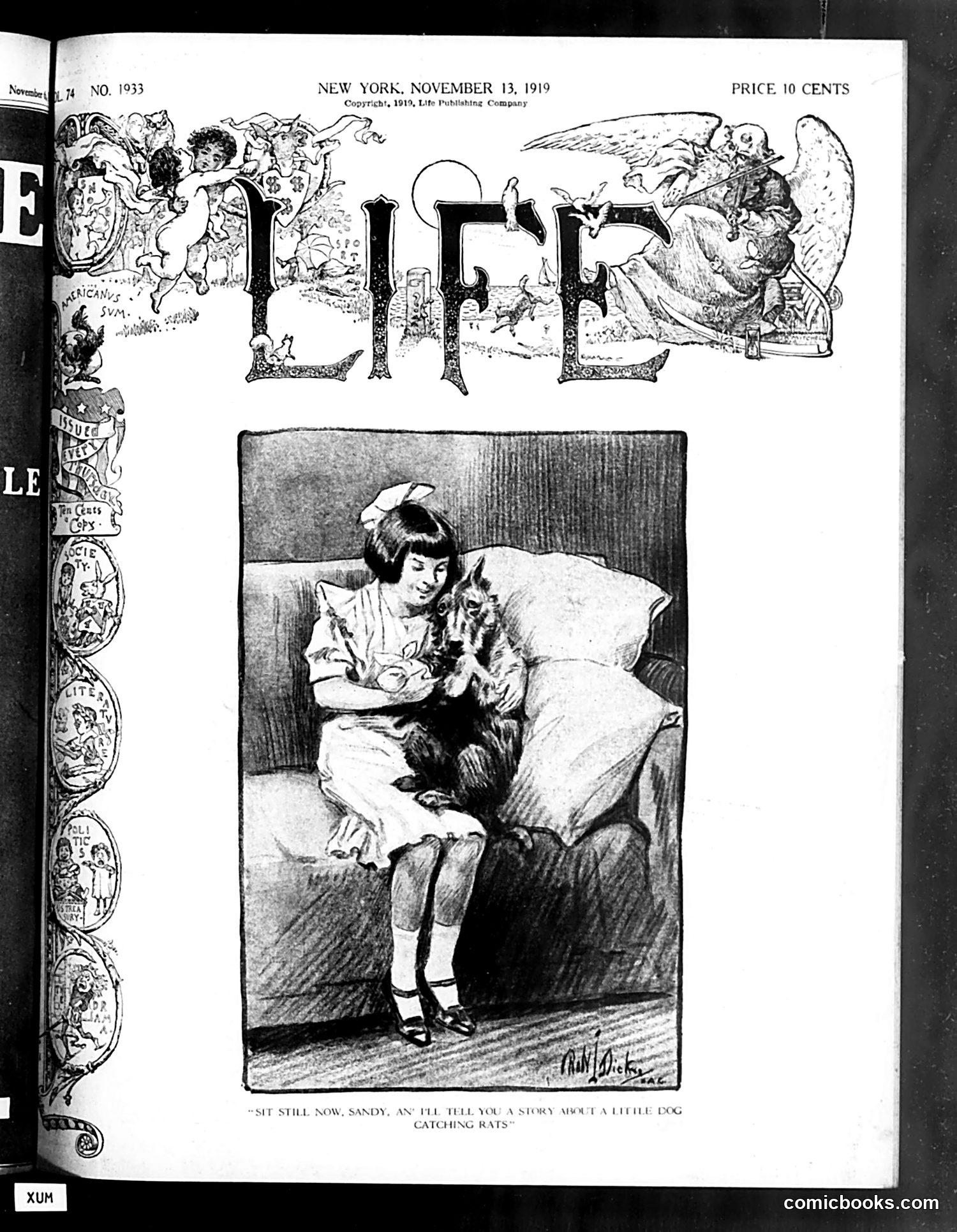
The main illustration shows a young girl sitting with a dog on her lap, preparing to tell a story. The caption reads: "SIT STILL NOW, SANDY, AN' I'LL TELL YOU A STORY ABOUT A LITTLE DOG CATCHING RATS." This appears to be a gentle, domestic humor piece rather than political satire. The joke seems to be simple: a child is about to tell her pet dog a story about—ironically—a dog catching rats, suggesting the innocent circularity of children's storytelling. The decorative header artwork contains whimsical cherubs and fantastical imagery typical of Life's artistic style from this era. The ornamental left border features small vignettes in medallions, characteristic of the magazine's decorative design.
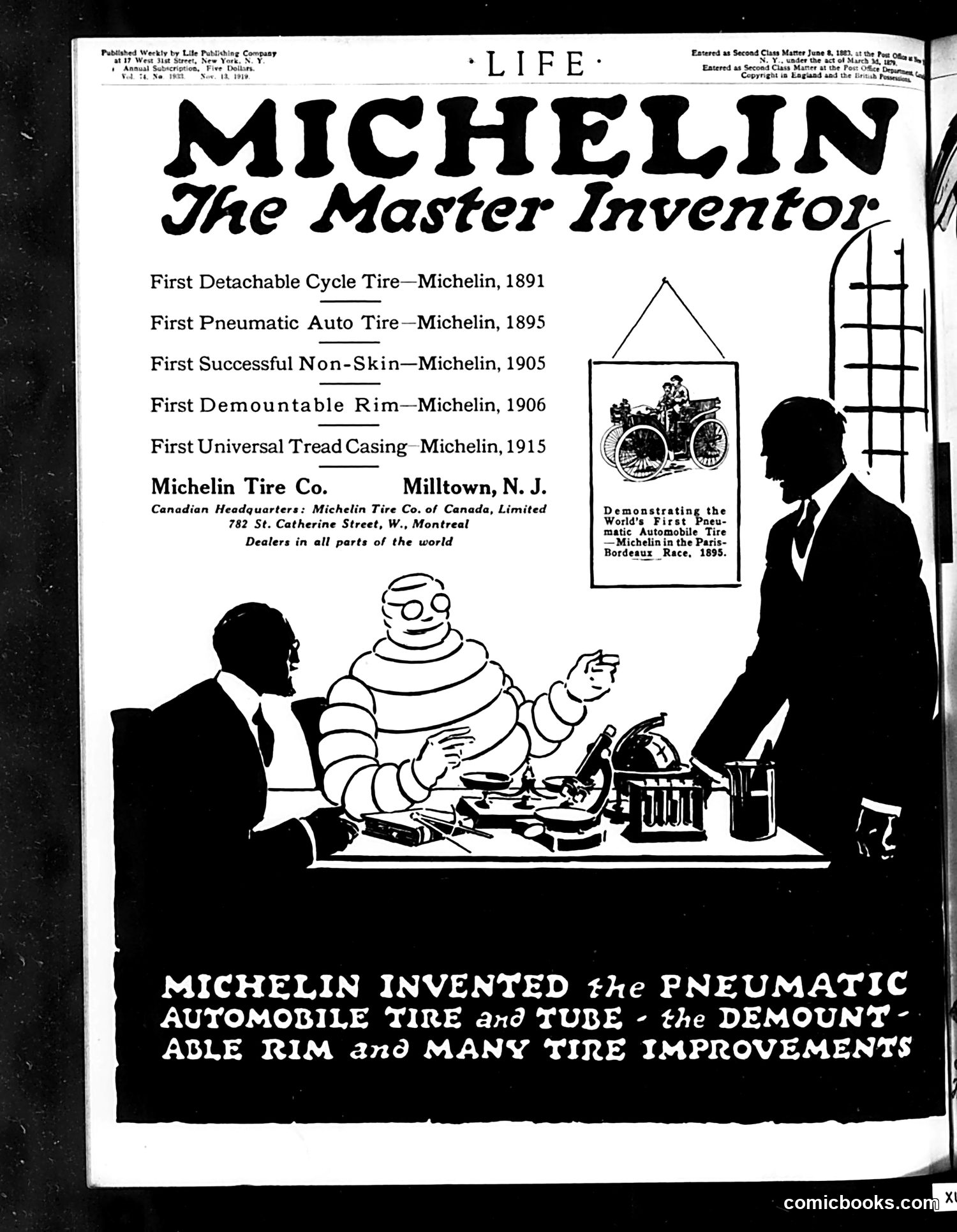
This is primarily **advertising**, not satire or political commentary. The Michelin Tire Company advertisement celebrates their inventor's achievements, featuring: - A list of Michelin's "firsts": detachable cycle tire (1891), pneumatic auto tire (1895), non-skid tire (1905), demountable rim (1906), and universal tread casing (1915) - An illustration of the famous "Michelin Man" (the Bibendum character, made of tire rings) seated at a table with two businessmen, gesturing expansively - A framed image showing the world's first pneumatic tire demonstration at an 1895 Paris-Bordeaux race The cartoon serves as **brand storytelling**—positioning Michelin as an innovative leader in automotive technology during the early automobile era. The Michelin Man's prominent placement reinforces brand recognition. This represents early corporate advertising that uses visual character branding to build consumer trust and company prestige.
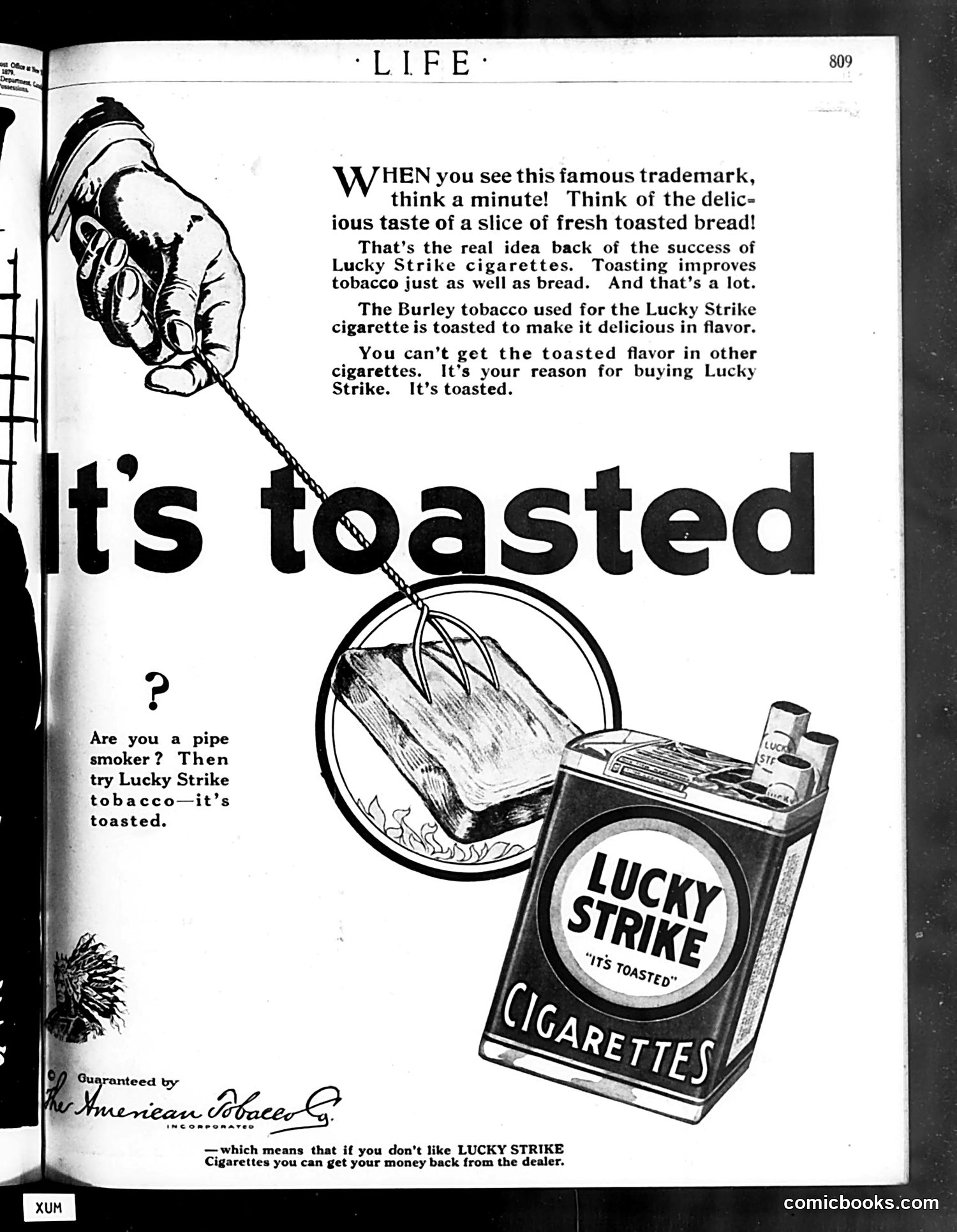
This is a **commercial advertisement**, not political satire. Lucky Strike cigarettes uses the "It's Toasted" slogan to market their product by comparing the toasting process to fresh-baked bread—claiming superior flavor. The ad features a hand holding toasted bread over a flame and a Lucky Strike cigarette package. The copy emphasizes that toasting distinguishes their tobacco from competitors and appeals to pipe smokers. At the bottom, the American Tobacco Company's guarantee promises money-back satisfaction to consumers. This represents 1920s-era advertising before widespread health warnings about cigarettes. The "toasting" claim was the brand's primary marketing distinction during this period.
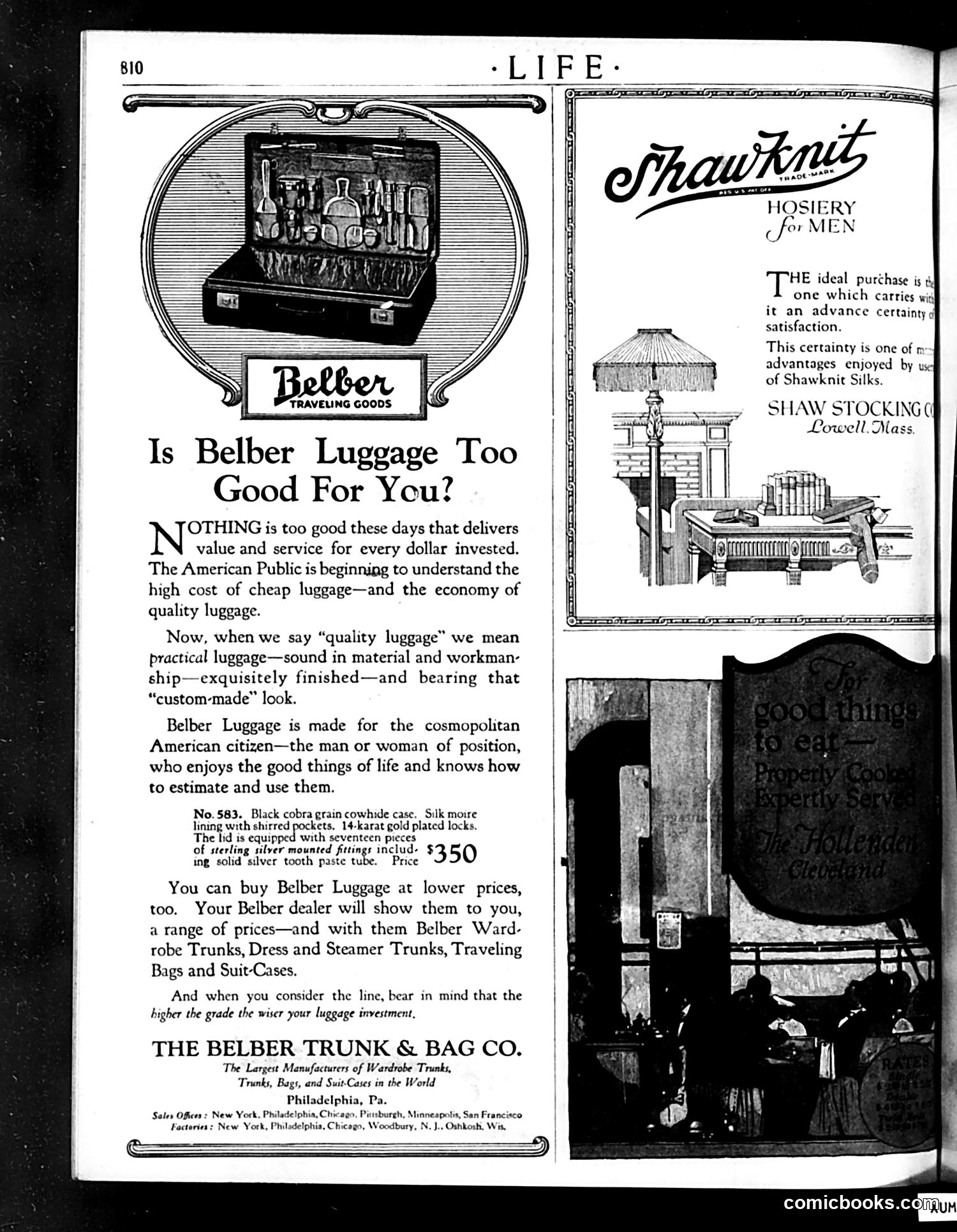
This page contains two advertisements with no political cartoons or satire. The **left advertisement** promotes Belber Luggage, a high-end trunk and traveling bag manufacturer based in Philadelphia. It targets affluent travelers, positioning quality luggage as a worthwhile investment. The ad emphasizes craftsmanship and durability over cheap alternatives, appealing to "the cosmopolitan American citizen—the man or woman of position." The **right side** features two unrelated advertisements: one for Shawknit hosiery for men (from Powell, Mass.) and another for what appears to be a clothing or cleaning service in Cleveland. This is purely commercial advertising with no satirical or political content. The page represents typical Life magazine filler advertising from the early 20th century, not editorial commentary.
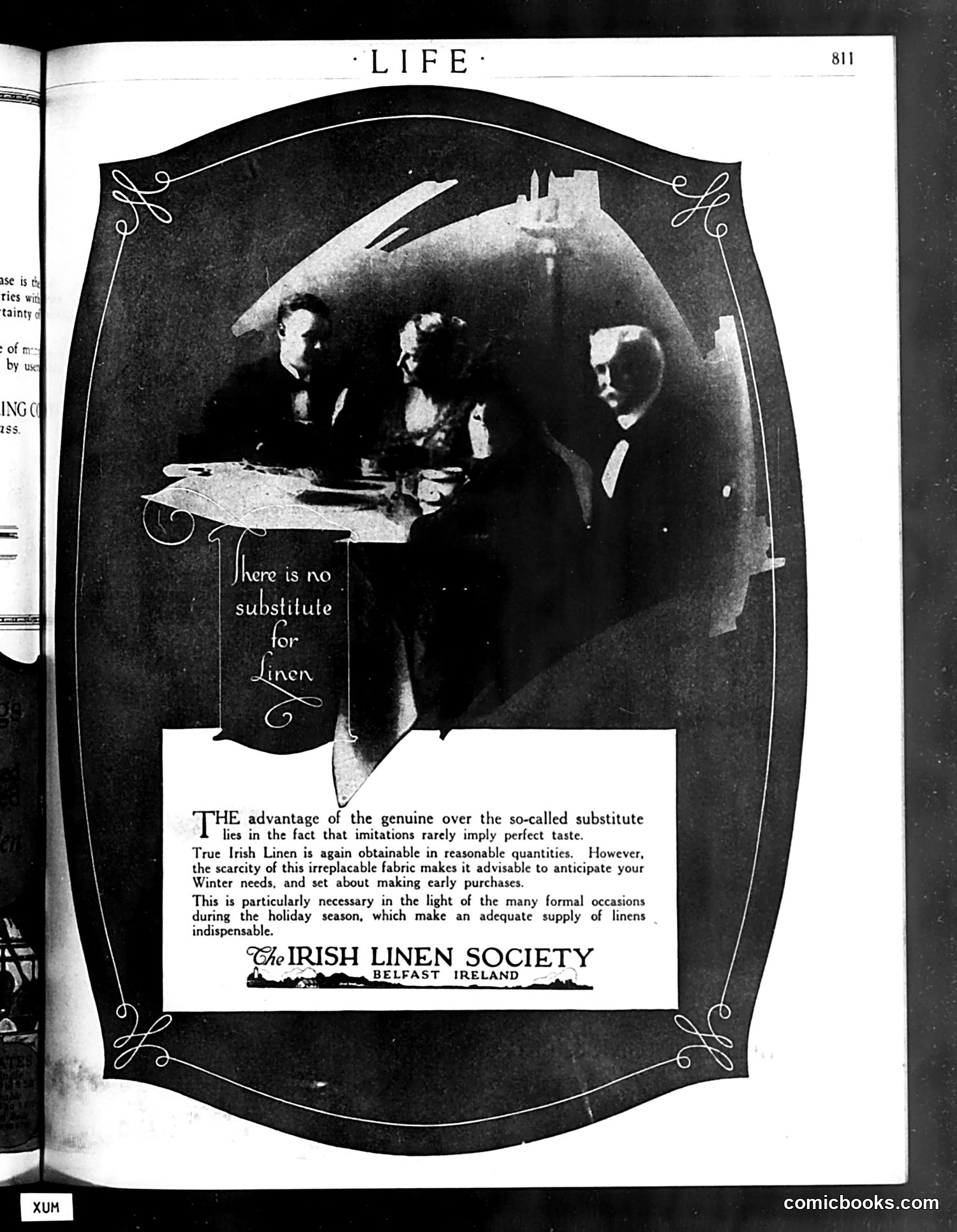
This page is primarily **advertising rather than satire or political cartoon**. It's a full-page ad for the Irish Linen Society (Belfast, Ireland) from Life magazine. The image shows four formally dressed figures examining linen fabric, with the tagline "There is no substitute for Linen." The advertisement argues that genuine Irish linen is superior to imitation fabrics, and advises consumers to purchase early due to scarcity—particularly important given the many formal occasions during the holiday season when adequate linens are "indispensable." The ad uses the prestige of authentic Irish craftsmanship as a selling point, appealing to middle and upper-class readers of Life magazine who valued quality goods and formal occasions.
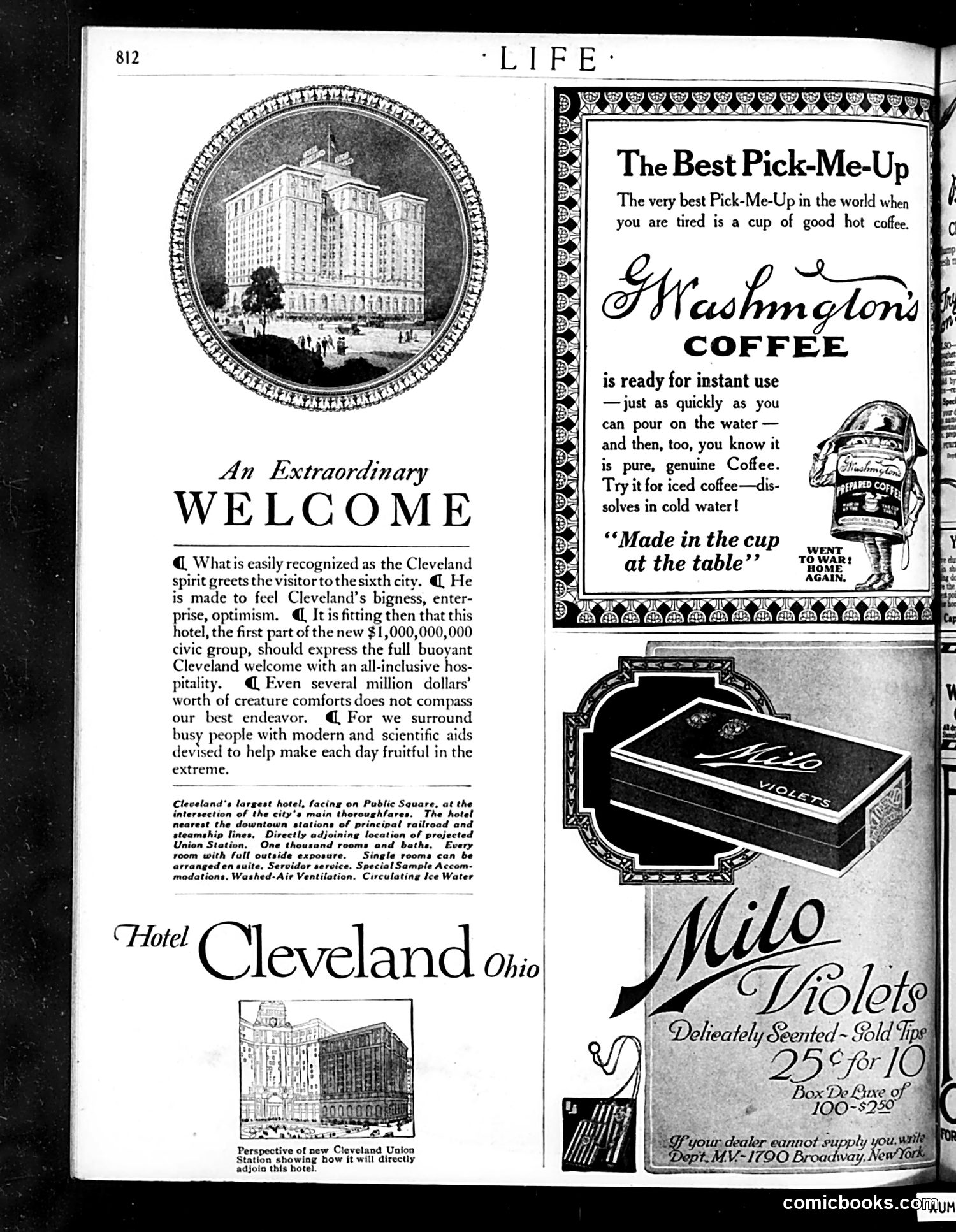
This page is primarily **advertising**, not satirical content. The left side features a Hotel Cleveland advertisement welcoming visitors, emphasizing the hotel's $1,000,000 construction cost and modern amenities for the "sixth city." It includes building illustrations and describes downtown location near railroad stations. The right side contains two product advertisements: Washington's Coffee (instant coffee marketed as a "pick-me-up") and Milo Violets (scented candies). There is **no political cartoon or satire present**. The page represents typical Life magazine advertising from approximately the 1920s-1930s, showcasing consumer products and commercial establishments rather than social or political commentary. The magazine was not exclusively satirical—advertising was a major revenue source.
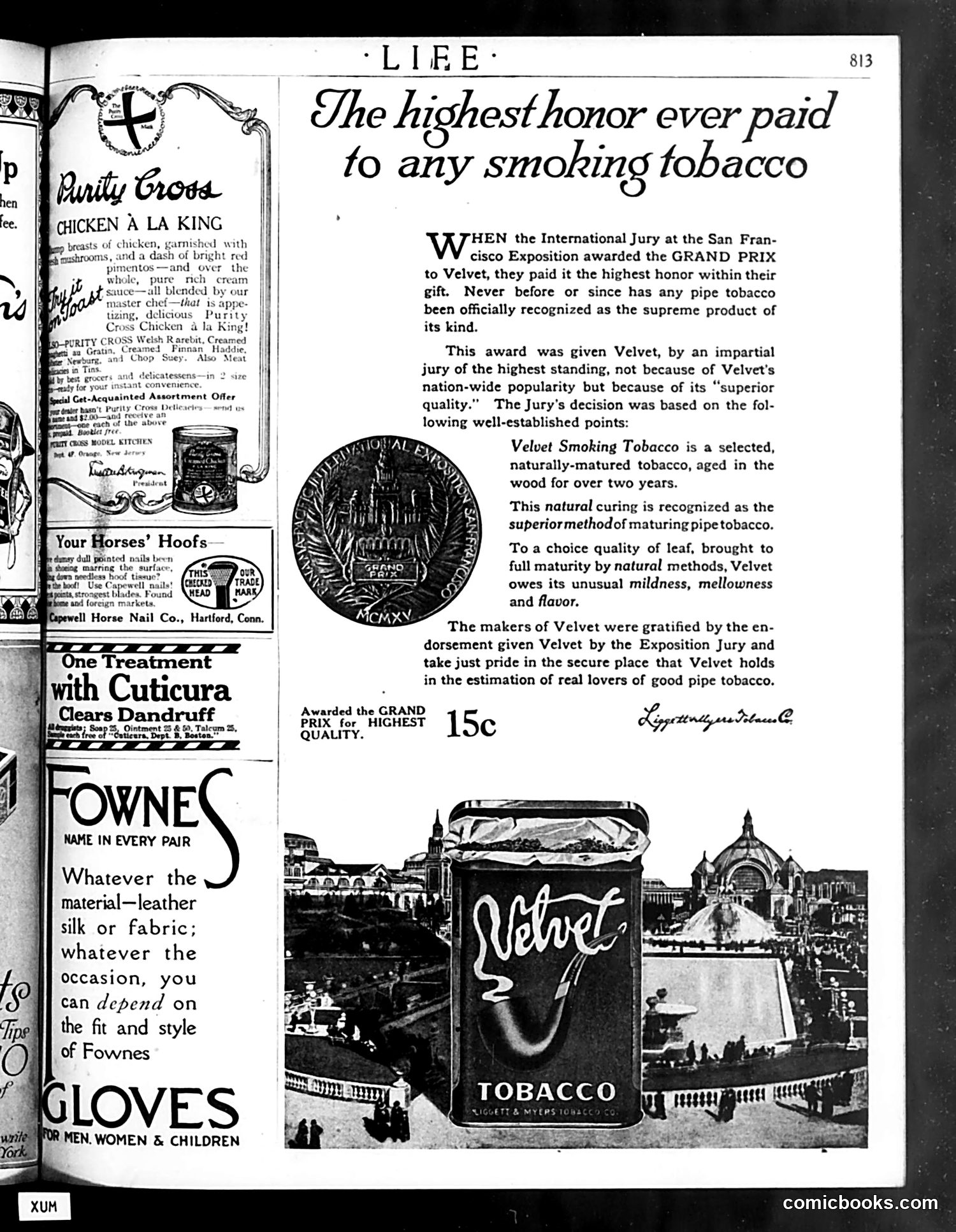
This page is primarily **advertising, not satire or political commentary**. The main content is a full-page advertisement for Velvet Smoking Tobacco (15¢), emphasizing that it won a "Grand Prix" award at the San Francisco Exposition for "highest quality." The ad highlights Velvet's natural curing process and aging in wood. An illustrated medal and images of the exposition grounds accompany the marketing claims. The left side contains unrelated advertisements for other products: Purity Cross Chicken à la King, horse hoof care, dandruff treatment, and Fownes Gloves. There is no political cartoon or satirical commentary visible. This is straightforward early 20th-century commercial advertising typical of Life magazine's revenue model during this period.
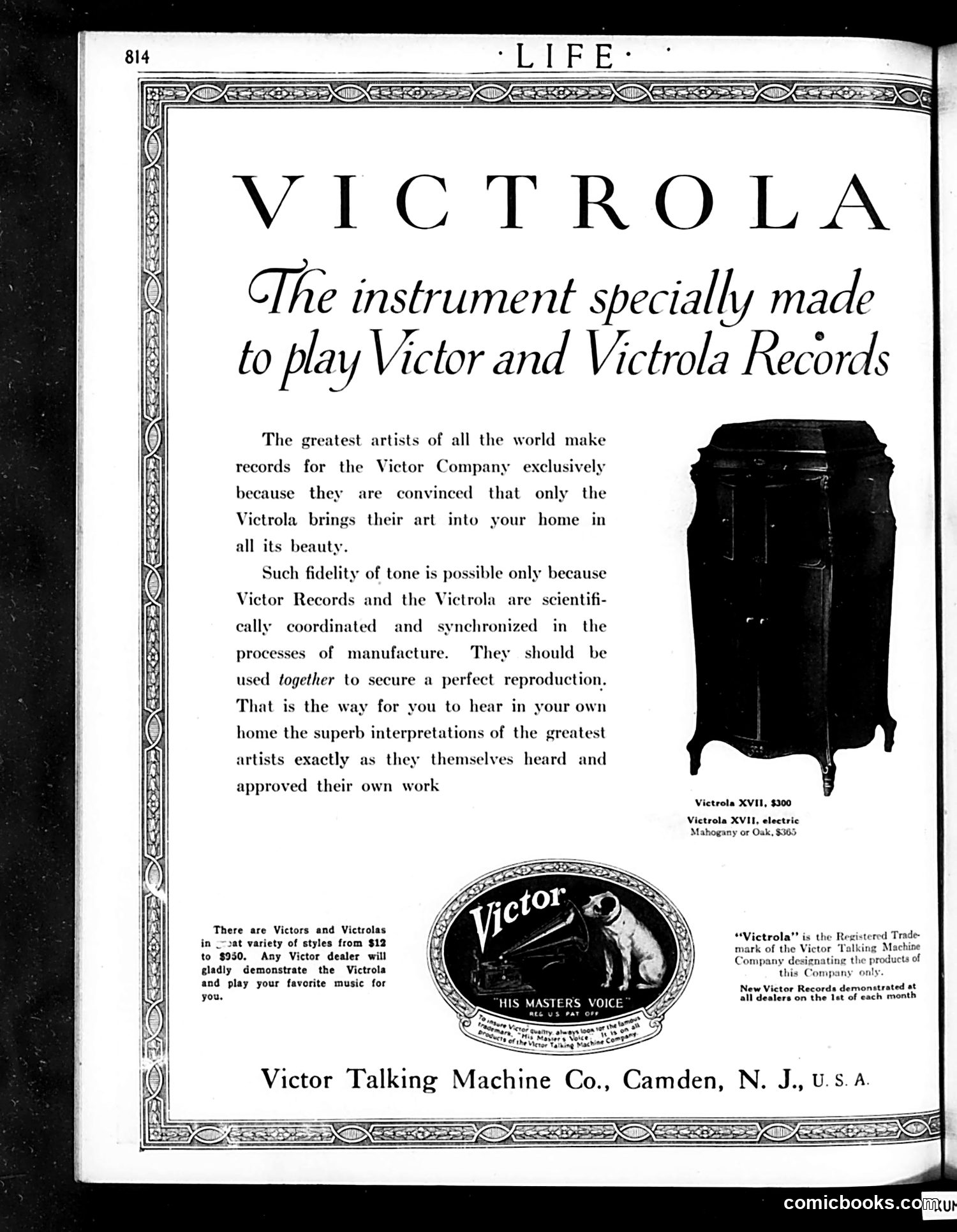
This is a **full-page advertisement**, not a cartoon or satirical content. It promotes the Victrola, a phonograph manufactured by the Victor Talking Machine Company of Camden, New Jersey. The ad emphasizes that major recording artists of the era recorded exclusively for Victor Records, and argues that only the Victrola could properly reproduce those recordings due to scientific coordination between the machine and records. The advertisement includes an image of the "Victrola XVII" model ($300, or $365 for the electric mahogany/oak version) and the famous Victor trademark—"His Master's Voice"—showing a dog listening to a phonograph. This represents early-20th-century consumer marketing emphasizing both artistic prestige and technological superiority as selling points.
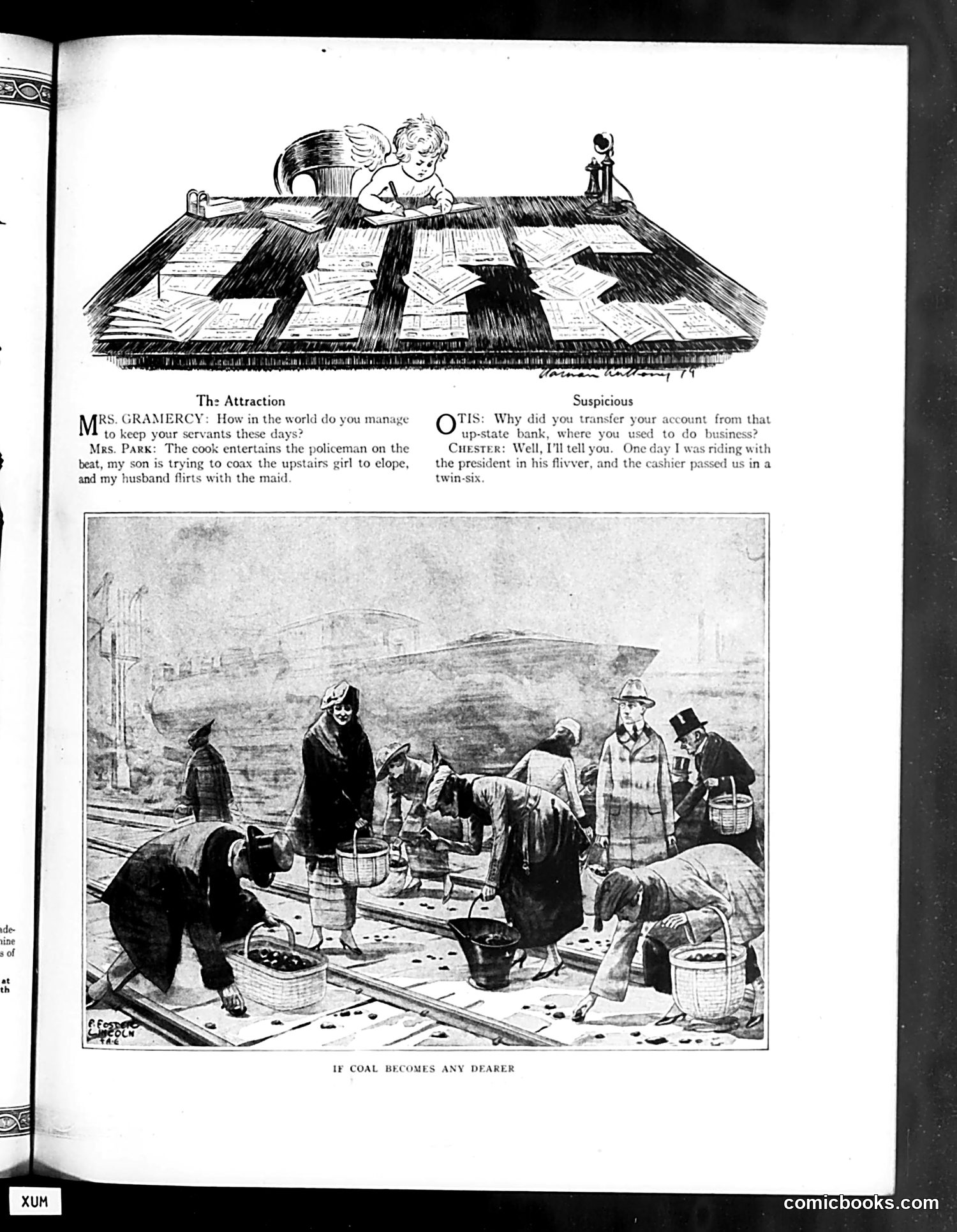
This page contains two satirical pieces from Life magazine: **"The Attraction"** (top): A sketch-based joke where Mrs. Gramercy complains to Mrs. Park about managing household chaos—her cook entertains the policeman on the beat, her son tries to coax the upstairs cat to elope, and her husband flirts with the maid. The humor targets domestic disorder and servant management anxieties among wealthy households. **"Suspicious"** (below): Otis questions Chester about transferring his bank account, suspecting financial impropriety. Chester's response—he saw the bank president in a fancy car with a cashier—suggests banks themselves are untrustworthy, playing on early-20th-century concerns about banking integrity. **"If Coal Becomes Any Dearer"** (bottom illustration): Shows working-class people mining coal while ships wait at dock, satirizing coal price inflation and its economic impact on workers and shipping industries.
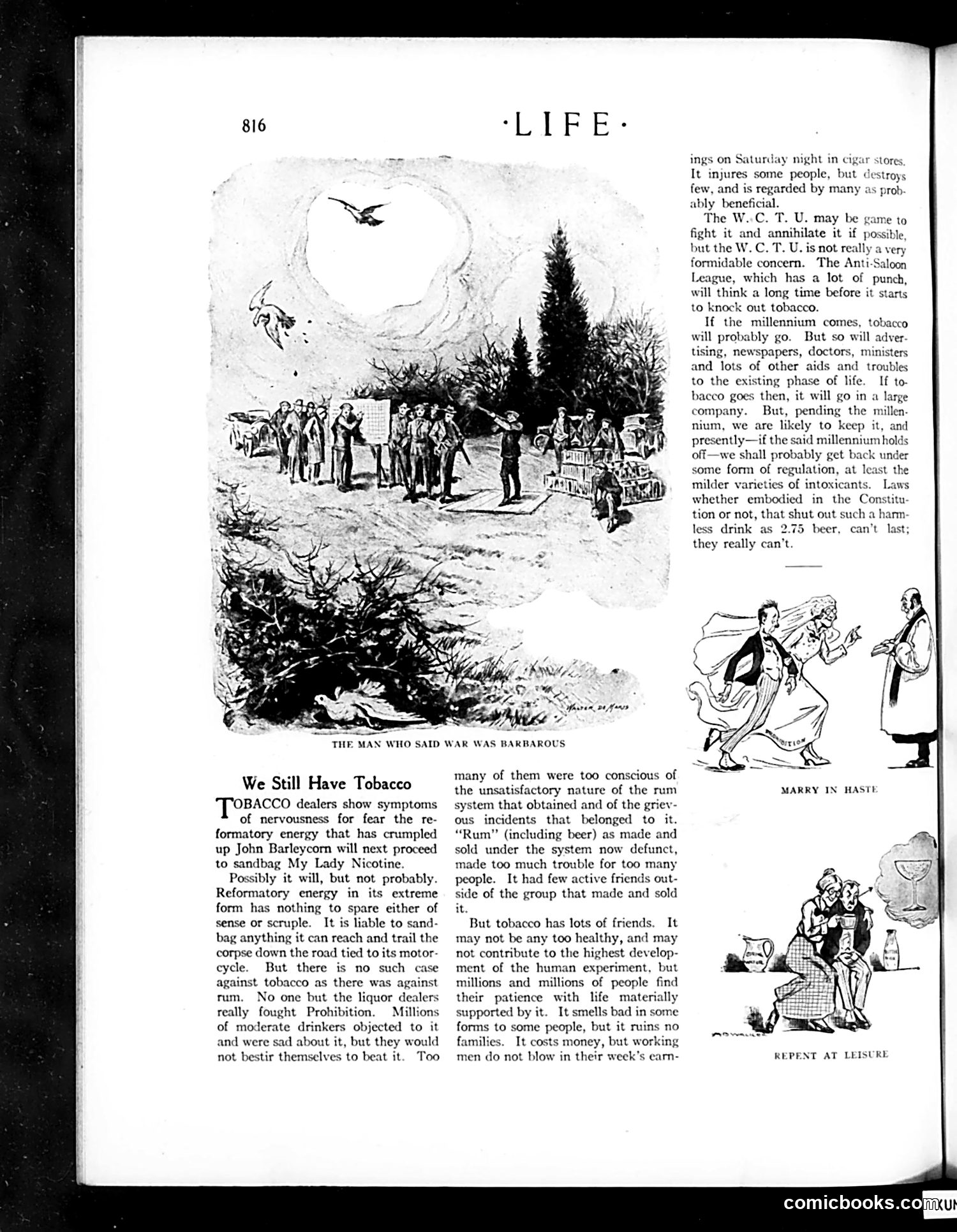
The main illustration, titled "The Man Who Said War Was Barbarous," depicts a large gathering of civilians beneath a dramatic sky with circling birds. This appears to be satirizing pacifist sentiment during or after World War I—specifically mocking someone (likely a public figure) who opposed war while the conflict continued or its consequences unfolded. The article "We Still Have Tobacco" argues that tobacco, unlike alcohol (prohibited by Prohibition), will survive reform efforts. It defends tobacco's social utility despite health concerns, noting millions depend on it economically. The piece presents tobacco as relatively harmless compared to rum, suggesting reformers should accept tobacco's permanence. The smaller illustrations on the right ("Marry in Haste" and "Repent at Leisure") appear to be unrelated satirical vignettes about marriage.
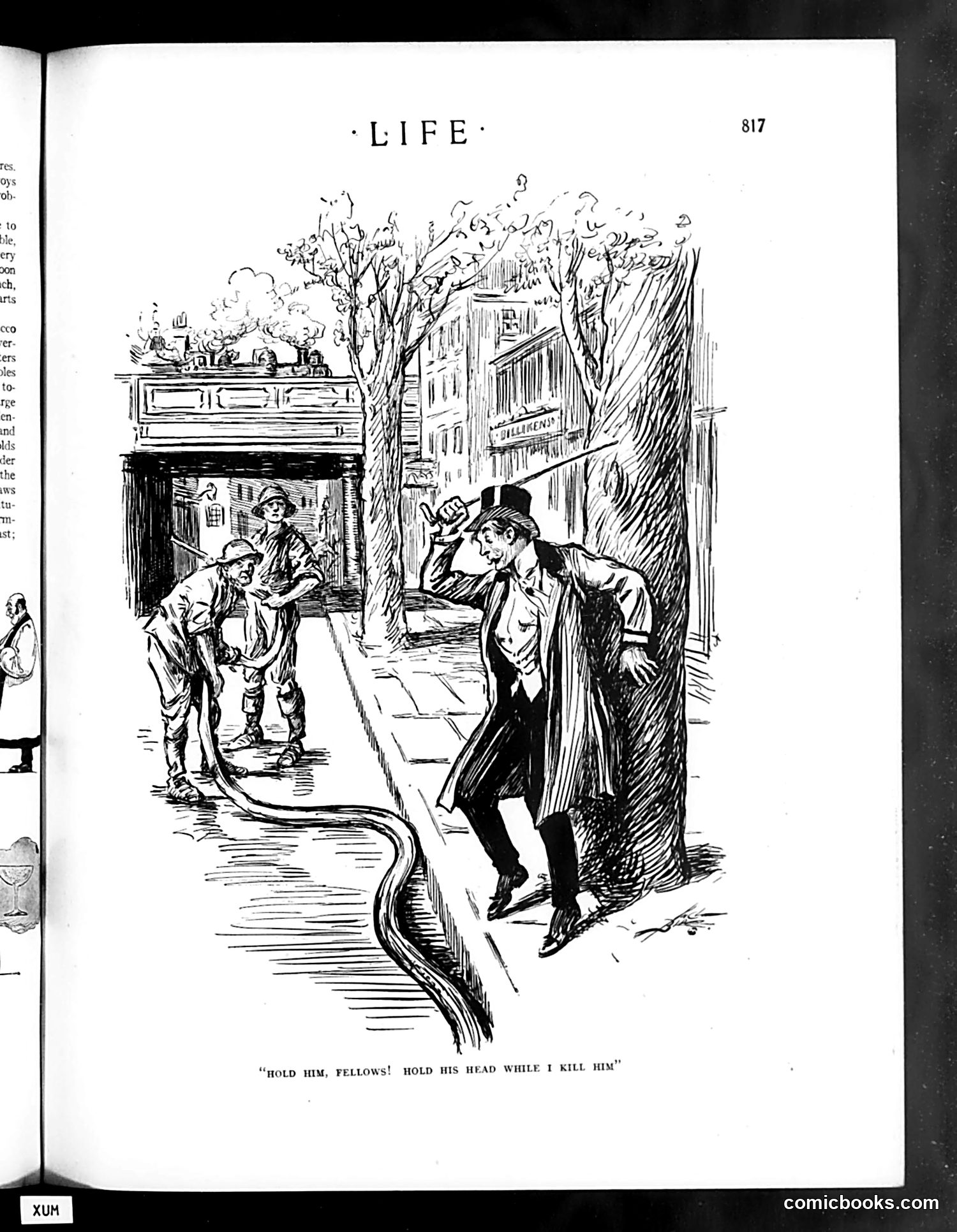
This is a street scene illustration depicting violence. A man in a hat and coat crouches beside a tree, wielding what appears to be a club or bat raised overhead. Other figures stand nearby on an urban street with buildings and storefronts visible. The caption reads: "HOLD HIM, FELLOWS! HOLD HIS HEAD WHILE I KILL HIM" Without additional context about the specific issue date or accompanying article text, the exact satirical target is unclear. The violent imagery suggests commentary on street crime, mob violence, or possibly labor disputes—common subjects for Life magazine's social satire. The illustration's style and setting appear consistent with early-to-mid 20th century urban social commentary, but the specific political or social reference requires the original article context to interpret accurately.
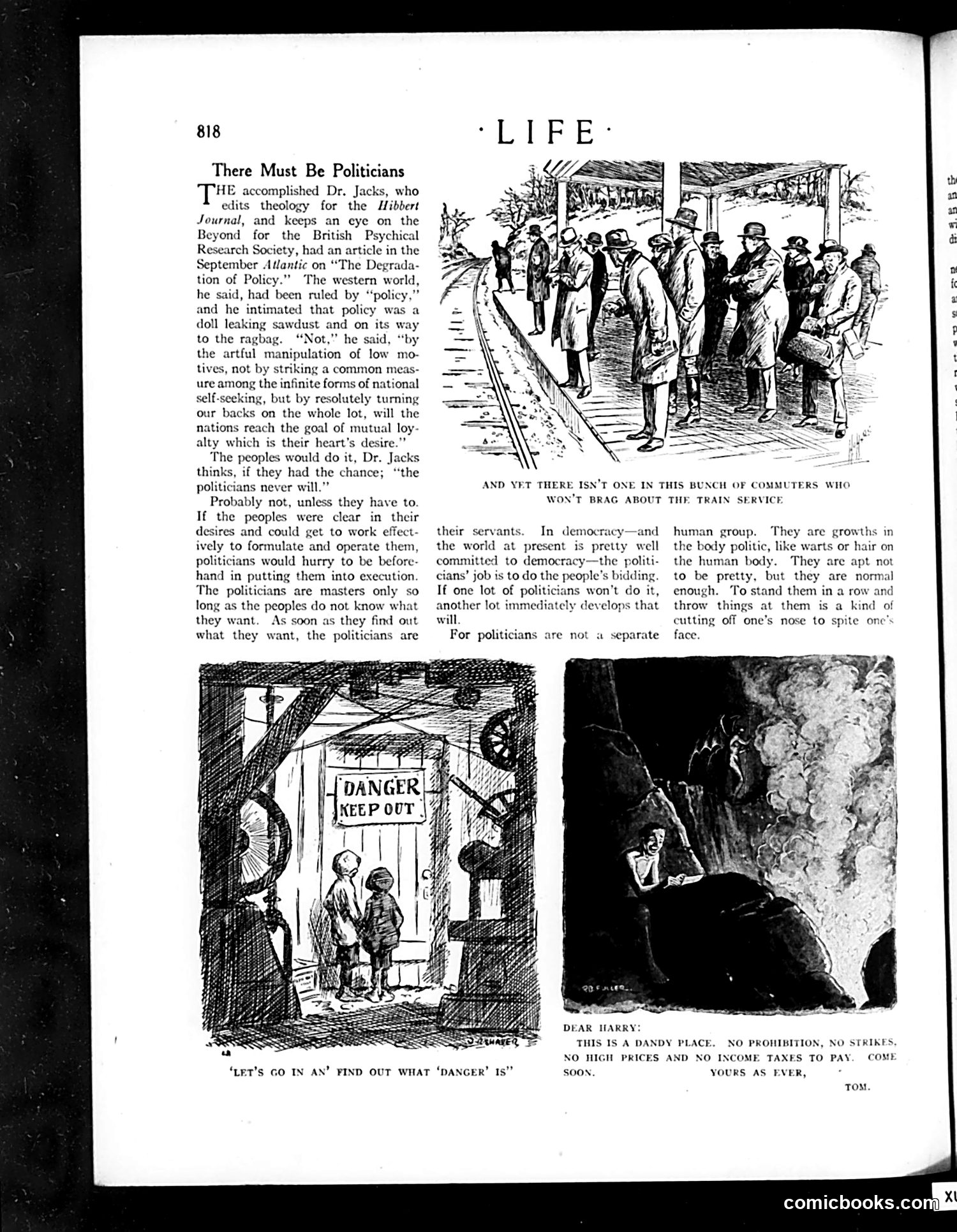
This page from *Life* magazine satirizes the necessity of politicians in democratic governance. The headline "There Must Be Politicians" references an article by Dr. Jacks arguing that manipulating national self-interest—rather than striking compromises—will achieve mutual loyalty among nations. The top cartoon depicts commuters on a train platform, with the caption noting that none complain about train service delays, implying apathy toward governance. The bottom-left cartoon shows children entering a door marked "DANGER KEEP OUT," captioned "LET'S GO IN AN' FIND OUT WHAT 'DANGER' IS"—satirizing how people disregard warnings and rules. The bottom-right cartoon, from "TOM," depicts someone in what appears to be a bar or tavern, promoting an idealized place with "no prohibition, no strikes, no high prices." Together, these images critique public indifference toward political participation and governance.
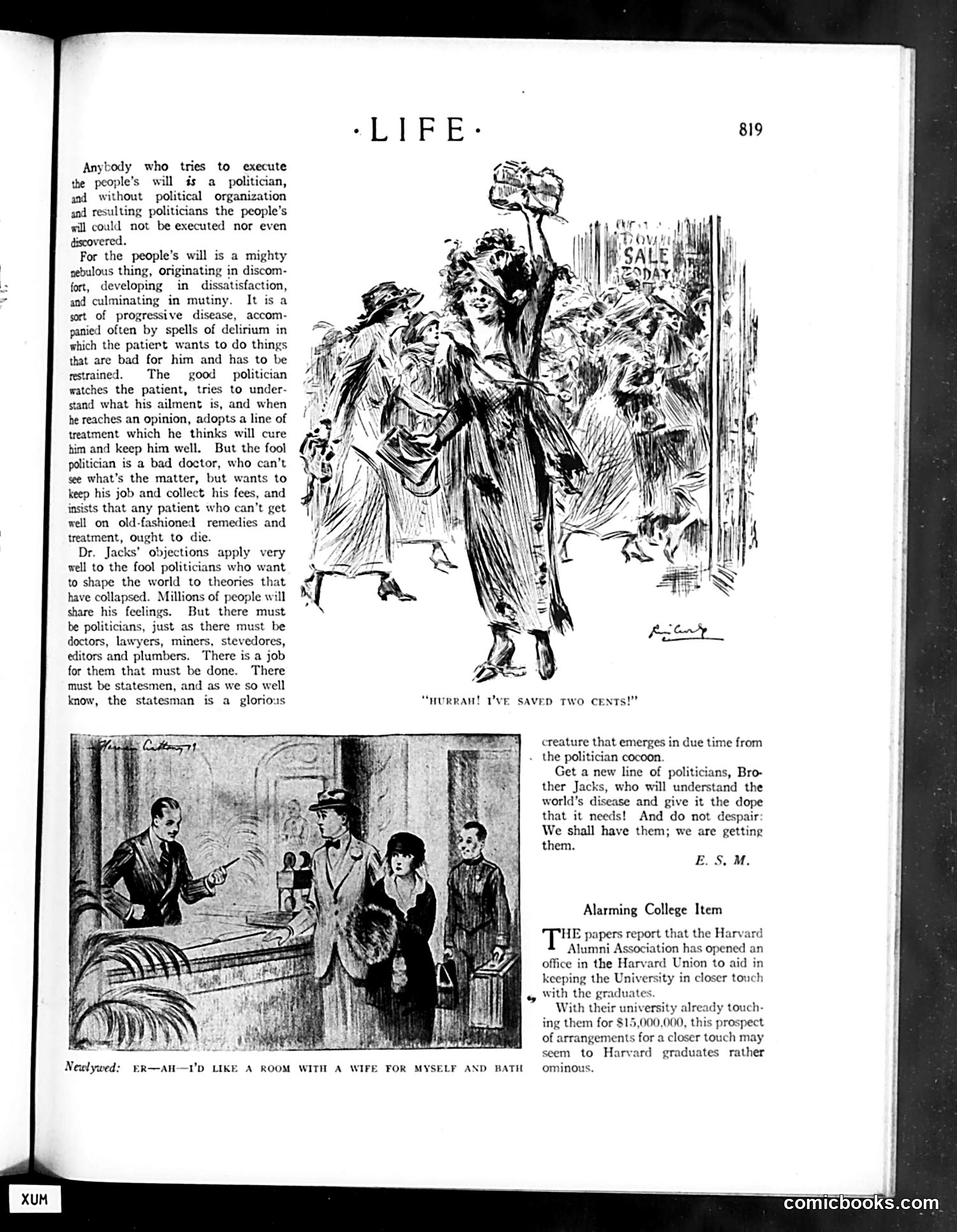
**Top Cartoon ("Hurrah! I've Saved Two Cents!"):** A woman clutches flowers while exiting what appears to be a store with a "CLOSING SALE" sign. The satire mocks penny-pinching consumers—she's celebrating saving a trivial amount (two cents) while presumably spending money on flowers, missing the irony entirely. This critiques misguided consumer behavior and false economy. **Bottom Cartoon ("Needed: Er—Ah—I'd Like a Room with a Wife for Myself and Bath"):** A man at what appears to be a hotel desk mangles his request, accidentally asking for a "room with a wife" instead of a proper room. The joke relies on the verbal confusion and suggests either desperation or the absurdity of boarding-house accommodations. **Article Section:** Discusses Harvard Alumni Association opening an office to maintain graduate connections, noting some concern about institutional overreach.
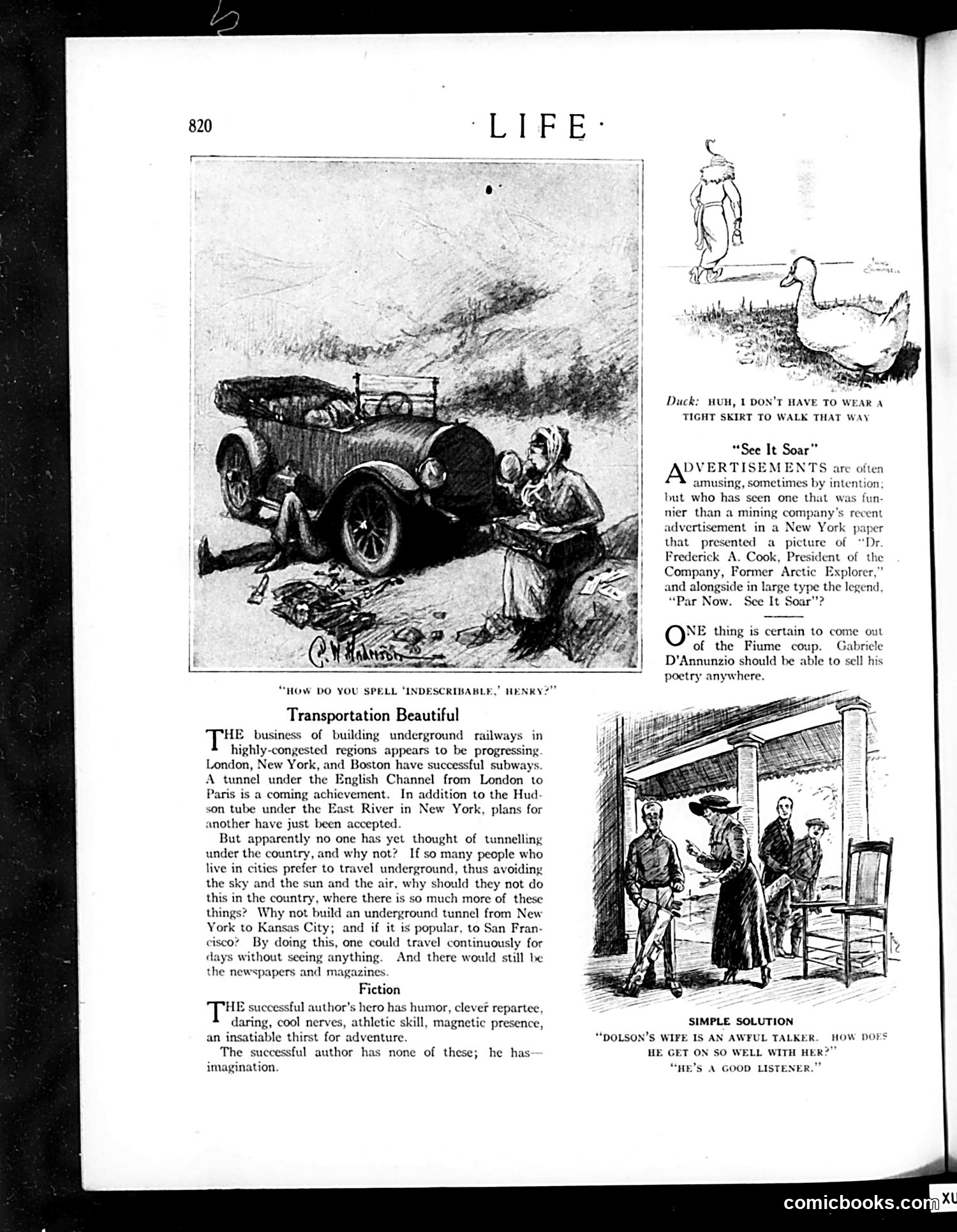
**Main Cartoon ("How Do You Spell 'Indescribable, Henry?"):** Shows a broken-down automobile with two women in distress on a rural road. The humor stems from the vehicle's decrepit condition making it literally "indescribable"—beyond words. This satirizes early automobiles' unreliability and the challenges of motoring in that era. **"Simple Solution" Cartoon:** Depicts a man confidently stating "He's a good listener" as the solution to a wife's talkativeness. This is straightforward domestic humor mocking male stereotypes—the implication being that tolerating excessive talking is a passive, rather than active, marital strategy. Both cartoons use visual humor to comment on contemporary frustrations: automobile failures and gender dynamics in marriage.
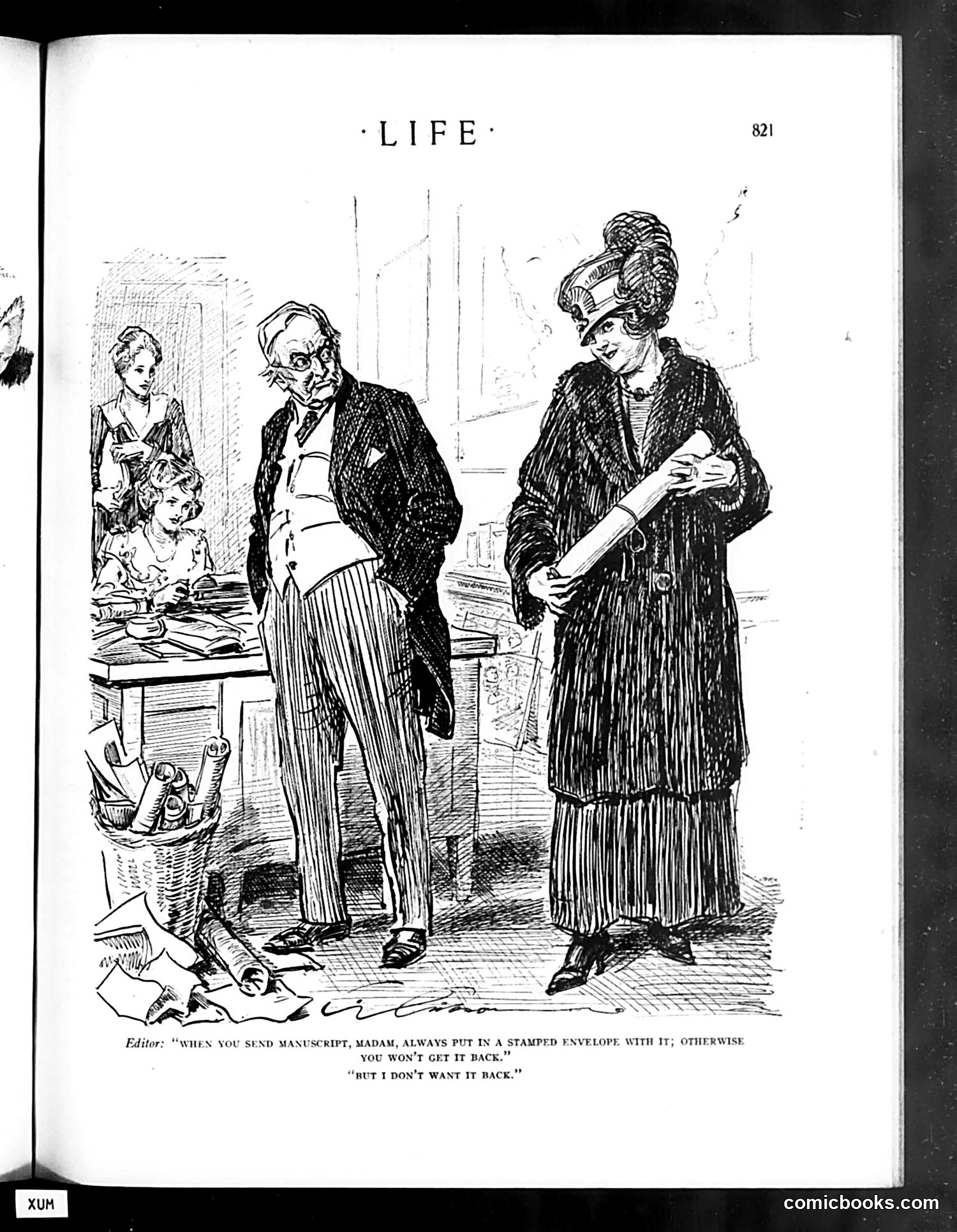
This single-panel cartoon depicts an editor (center, portly gentleman) advising a female writer on manuscript submission practices. The woman holds a rolled manuscript while the editor instructs her to always use a stamped, self-addressed envelope when submitting work—otherwise she won't get her manuscript back. The woman's deadpan response—"But I don't want it back"—delivers the joke: she's so unconfident in her writing that she'd prefer the editor simply reject it without returning the pages. The cartoon satirizes the publishing world's submission process and, implicitly, women writers' self-doubt about their work. The figures in the background (appearing to be family members) suggest domestic life interrupting professional ambitions. The humor relies on early-20th-century publishing norms now largely obsolete.
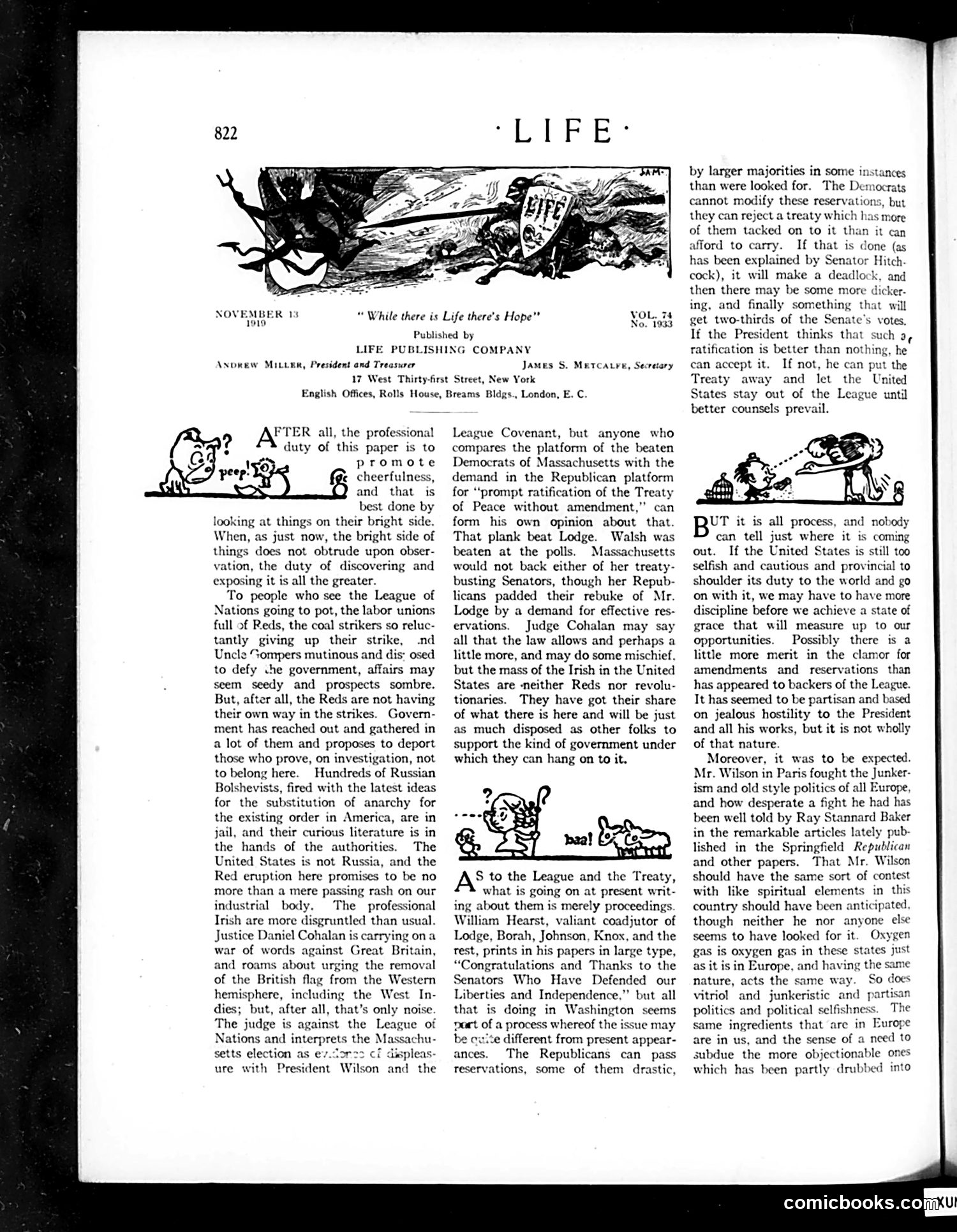
This Life magazine editorial addresses post-WWI American politics, specifically the contentious League of Nations treaty ratification. The piece defends President Wilson's position against Republican senators (Lodge, Borah, Johnson, Knox) who demanded reservations to the treaty before ratification. The editorial dismisses contemporary anxieties: Red Bolshevik threats are exaggerated, Irish-American agitation (led by Justice Cohalan) is "only noise," and labor unrest will prove temporary. The core argument: Massachusetts voters rejected anti-League senators at the polls, showing public support for Wilson's position. The cartoons (barely visible in reproduction) likely lampoon the political figures obstructing treaty ratification. The overall tone is optimistic that despite Republican resistance and various amendments, a version of the treaty will eventually pass—though the editor acknowledges a political "deadlock" remains possible if too many reservations are appended.
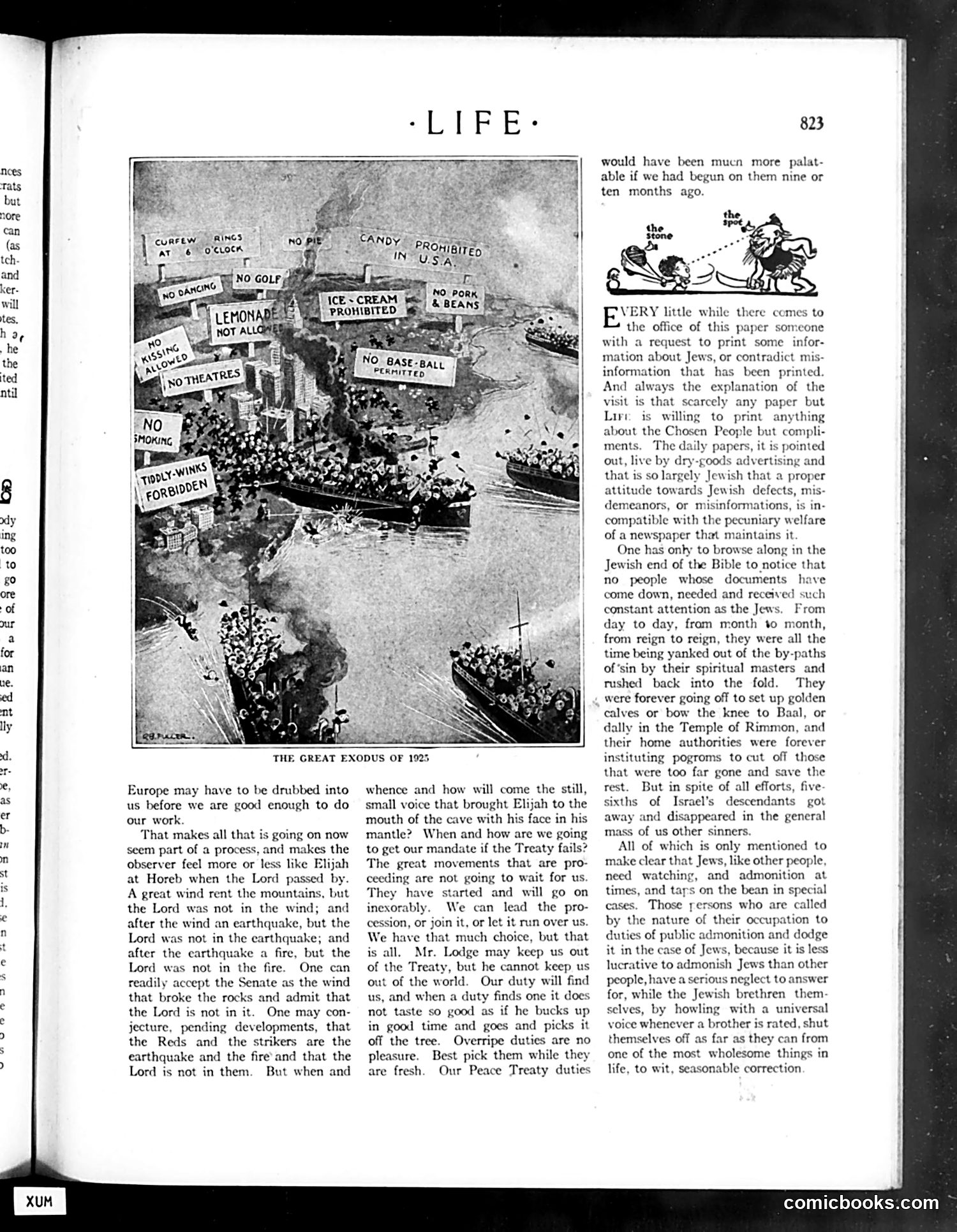
This cartoon depicts a crowded ship departing America laden with prohibition-era restrictions. Signs reading "NO DANCING," "NO GOLF," "NO THEATERS," "CURFEW AT 6 O'CLOCK," and similar prohibitions cover the vessel—visualizing the escape of pleasures under Prohibition (enacted 1920). The accompanying article discusses broader social upheaval: it references Senate opposition to the League of Nations Treaty, labor strikes, and Bolshevik activity ("the Reds"), invoking biblical imagery to suggest America faces transformative forces beyond its control. The secondary article addresses Jewish representation in newspapers, arguing that publications avoid criticizing Jewish people due to reliance on Jewish-owned dry-goods advertising. The author claims this silence parallels biblical patterns where Jewish authorities disciplined their own wayward community, and suggests modern Jews similarly resist outside criticism. **For modern readers:** This reflects 1920s Prohibition backlash and antisemitic attitudes common in that era's ostensibly "sophisticated" magazines.
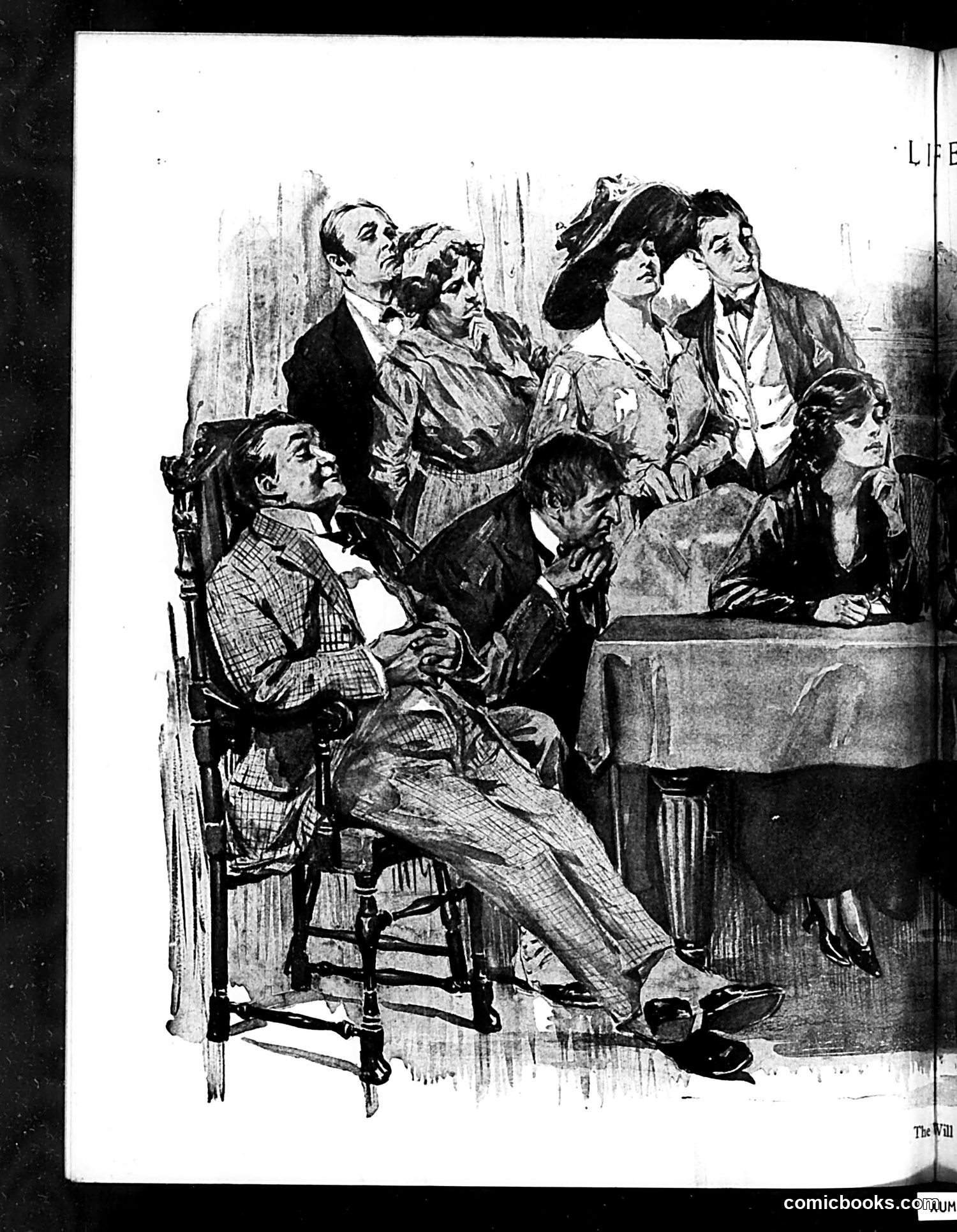
This appears to be a satirical illustration from *Life* magazine depicting a courtroom or legal proceeding scene. The image shows multiple figures in period dress (likely late 19th or early 20th century) observing what appears to be testimony or judgment. The central focus is a man in a checkered suit sitting in a chair, appearing to be under scrutiny or on trial. His posture and the attention directed toward him by the standing figures suggests he's the subject of legal examination or public judgment. Without clearer text identifying specific individuals or the particular case referenced, I cannot definitively name the figures or pinpoint the exact political/social controversy being satirized. The composition suggests commentary on justice, public accountability, or a specific notable trial of that era, but the precise target remains unclear from the visible elements alone.
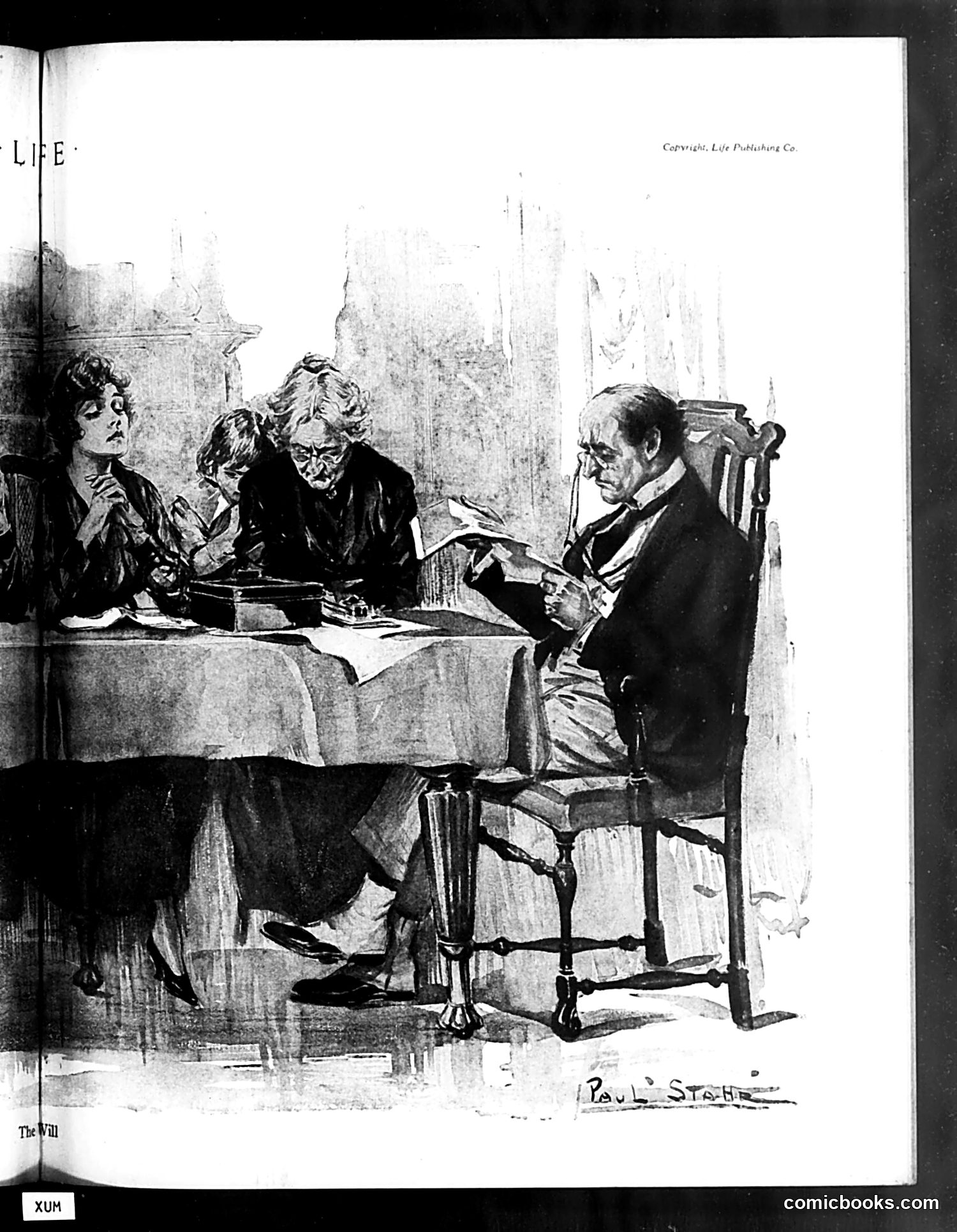
This is a sketch by Paul Stähr from *Life* magazine showing four figures in formal dress seated around a table with papers. The composition suggests a formal meeting or negotiation scene—possibly a business deal, legal proceeding, or diplomatic discussion. Without visible text identifying the specific figures or event, I cannot definitively state who these individuals represent or what particular political/social issue is being satirized. The formal setting and serious expressions suggest commentary on a contemporary (to the magazine's era) matter of public importance, likely involving negotiations or agreement-making among the depicted parties. To accurately explain the satire's specific target and meaning would require additional context about the publication date and any accompanying article text.
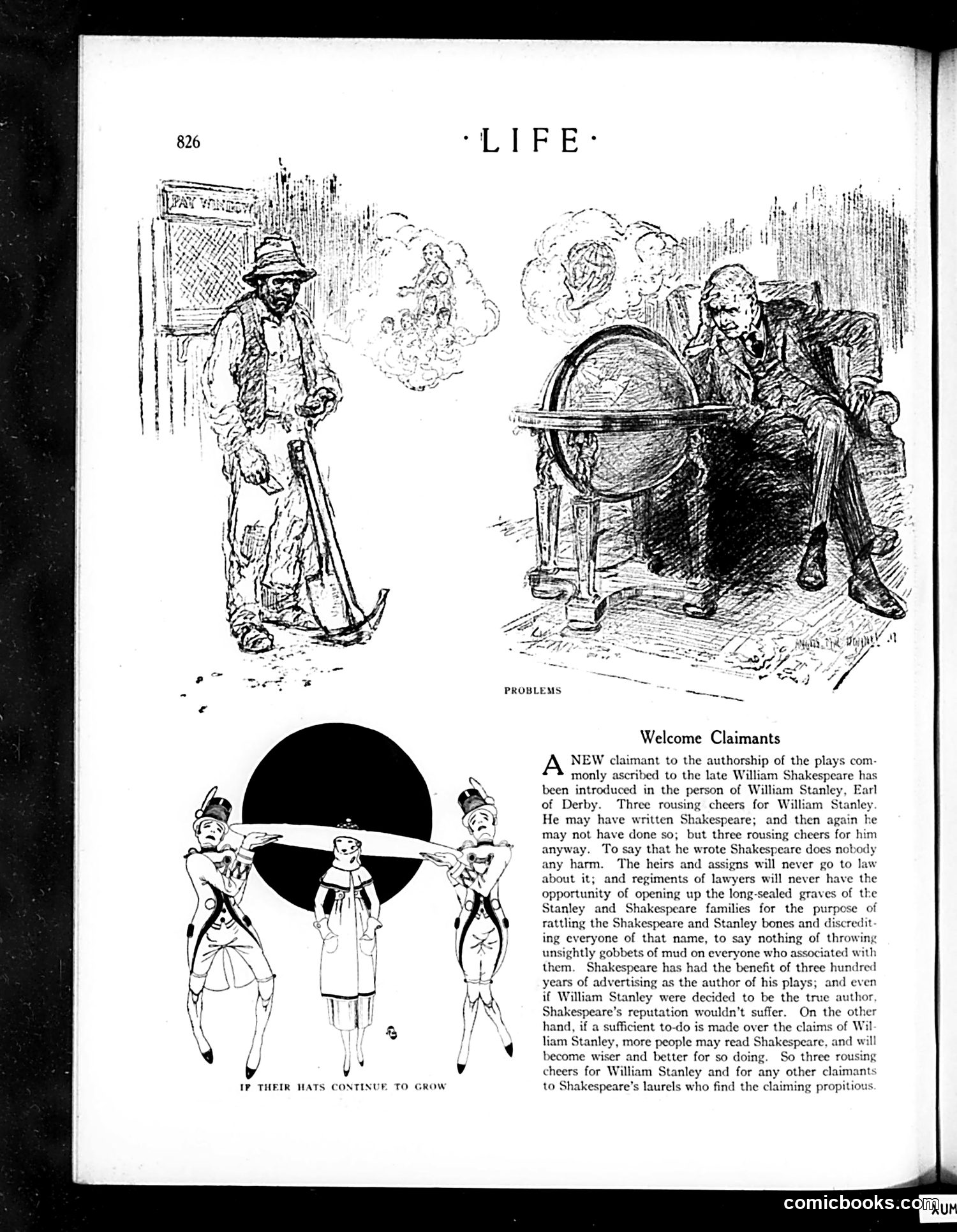
This page mocks the emerging "Shakespeare Authorship Question" — specifically a new claim that William Stanley, Earl of Derby, wrote Shakespeare's plays rather than the man from Stratford-upon-Avon. The cartoons illustrate the absurdity: the top sketches show a bewildered figure and scholars examining a globe, representing the scholarly chaos these competing claims create. The bottom cartoon depicts three figures with ever-growing hats labeled "IF THEIR HATS CONTINUE TO GROW," satirizing how inflated and ridiculous these alternative-authorship theories become. The text's tone is deliberately tongue-in-cheek: the author gives "three rousing cheers" to Stanley's claim while acknowledging it's likely false, suggesting that harmless speculation beats actual legal warfare between the families. The satire's real point: these authorship debates are comical exercises that ultimately serve only to generate more publicity for Shakespeare anyway.
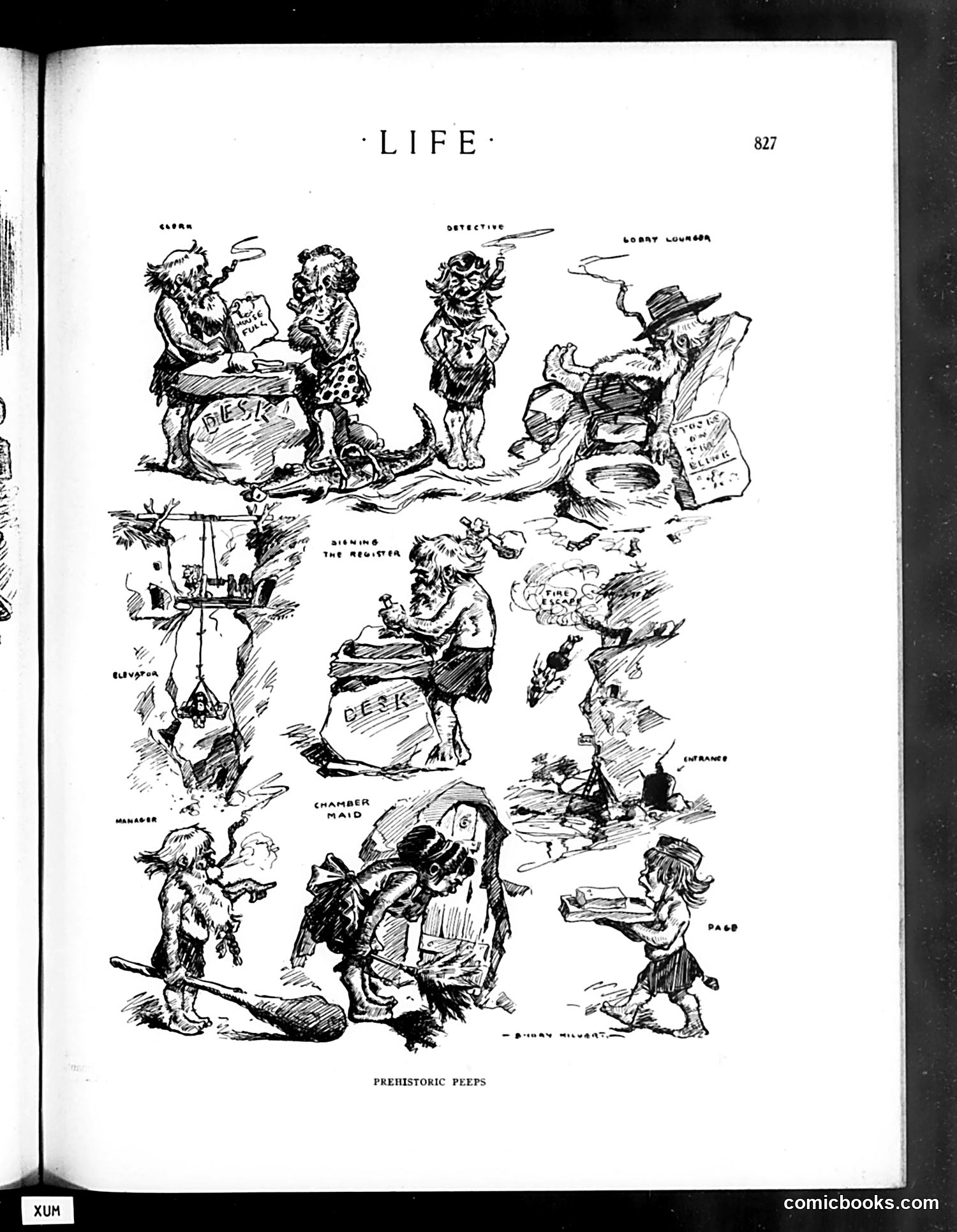
This satirical cartoon page depicts various office and household workers portrayed as primitive cavemen, humorously suggesting they're stuck in prehistoric working conditions. Labeled figures include a "Clerk," "Detective," "Lobby Lounger," "Chamber Maid," "Manager," and others engaged in recognizable modern activities (desk work, investigations, lounging) but rendered as crude, ape-like creatures. The satire criticizes contemporary working life by equating it with primitive, backward existence—suggesting these jobs are menial, degrading, or offer no progress despite modern civilization. The "Billing the Register" and similar scenes mock the monotony and lack of advancement in service and clerical work. This reflects early 20th-century social commentary about labor conditions and class hierarchy in industrial America.
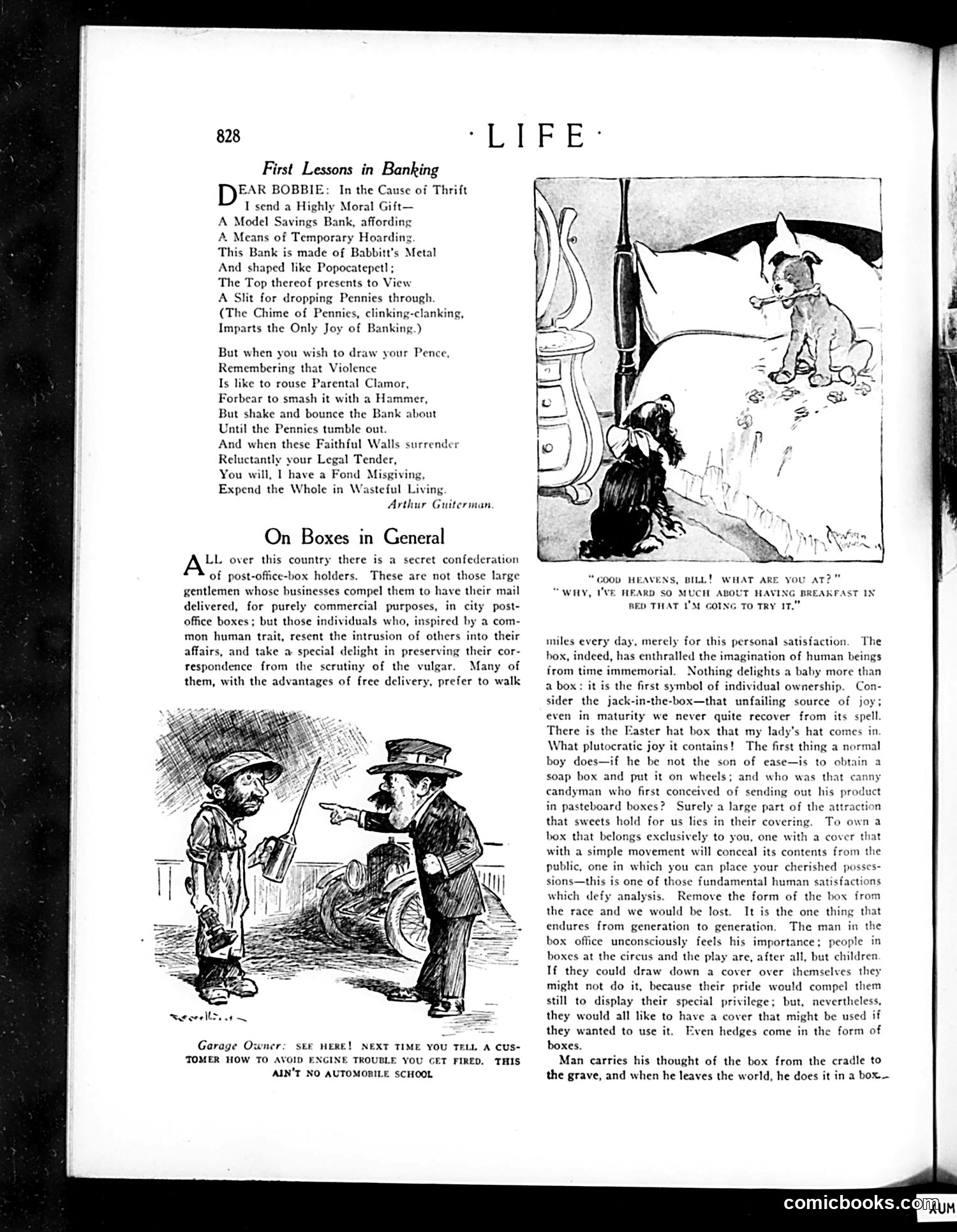
This page contains three distinct pieces of satire: **"First Lessons in Banking"** (poem by Arthur Guiterman): A mock-serious letter to a child about a toy savings bank shaped like Popocatépetl volcano. The humor lies in the contradiction between the "highly moral" gift meant to teach thrift and the poet's cynical prediction that the child will spend all saved pennies on "wasteful living" anyway. It's satirizing both sanctimonious gift-giving and children's inevitable failure to save. **"On Boxes in General"**: An essay mocking the psychological human obsession with boxes—from jack-in-the-boxes to Easter hat boxes to post office boxes. The point is that people value boxes not for practical reasons but as symbols of privacy, ownership, and status, carrying this fixation "from cradle to grave." **"Garage Owner"** (bottom cartoon): A mechanic fires an employee for giving honest car maintenance advice to customers, because the garage profits from repeat business caused by poor repairs. It satirizes corrupt business practices.
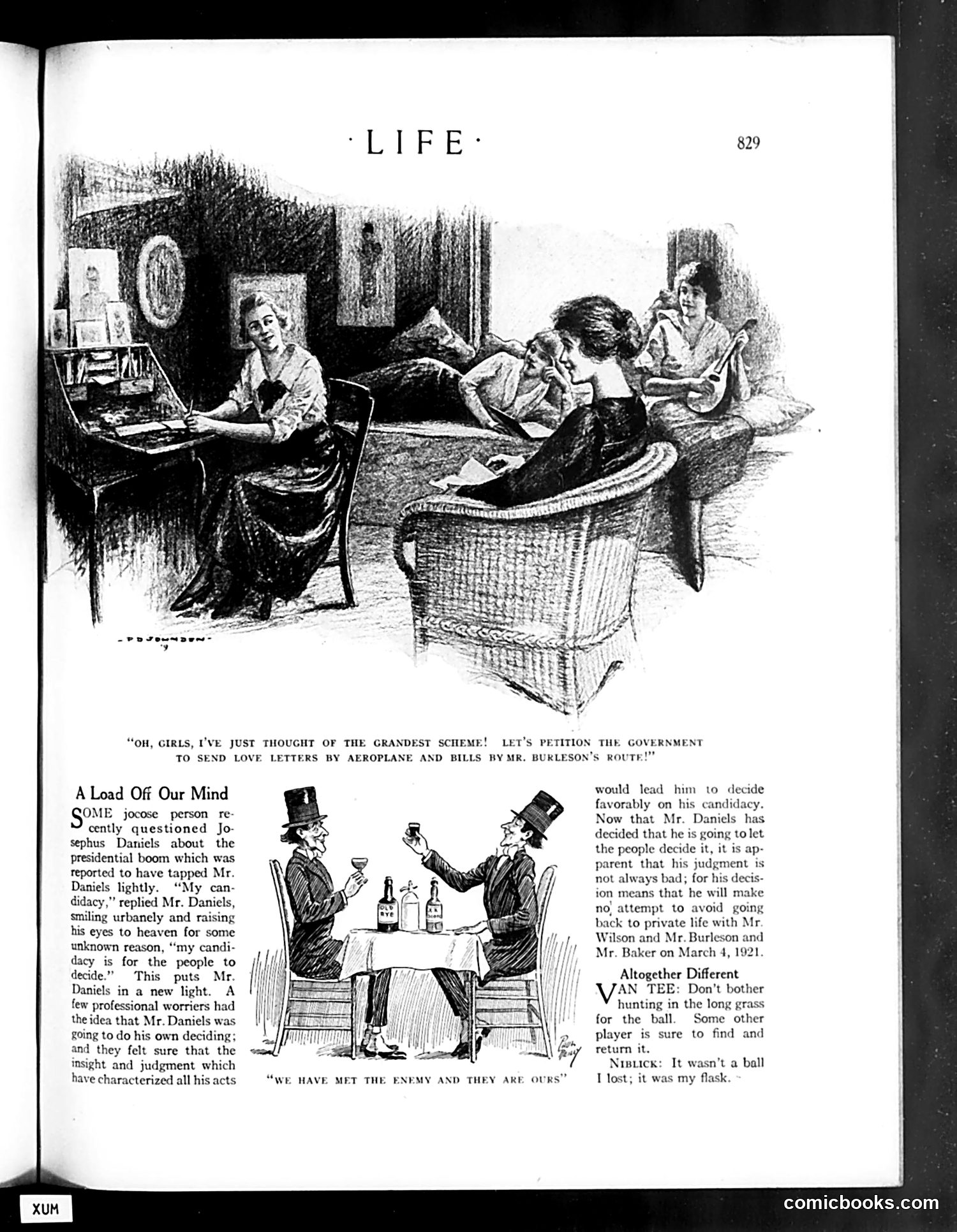
**Top Cartoon:** Women discuss sending "love letters by aeroplane and bills by Mr. Burleson's route"—a joke mocking the U.S. postal service under Postmaster General Albert Burleson. The contrast suggests Burleson's mail delivery was so slow or unreliable that people would prefer airmail for important correspondence but expect bills to arrive via his infamously inefficient system. This satirizes widespread frustration with his administration. **"A Load Off Our Mind" article:** Mocks Secretary of the Navy Josephus Daniels regarding presidential ambitions. The satire suggests Daniels claimed to let "the people decide" his candidacy—a transparent political dodge. The article ironically praises this as "new light," implying his past decisions had been poor. The reference to March 4, 1921 suggests this concerns the end of Wilson's presidency and concerns Daniels might remain in government. **Bottom cartoon:** Likely contemporary social humor about hunting or golf, unrelated to the political content above.
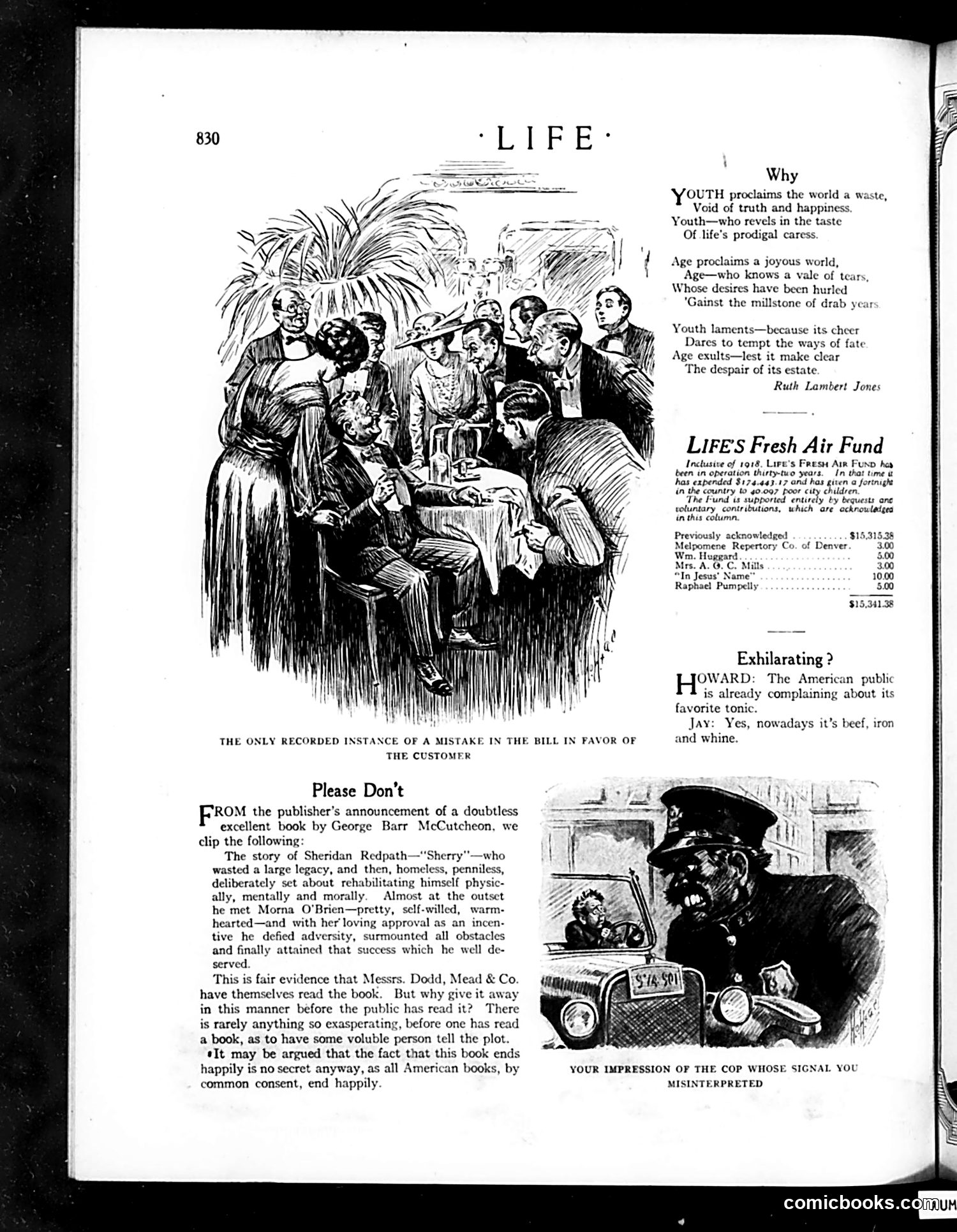
This page contains three distinct pieces of satire: **"Why" (poem by Ruth Lambert Jones):** A philosophical comparison contrasting youth's pessimism with age's forced optimism. The satire suggests youth complains life is meaningless, while age—having endured decades of disappointment—must pretend contentment to mask despair. **"Please Don't" (book review critique):** Life satirizes publisher Dodd, Mead & Co. for revealing the entire plot of a George Barr McCutcheon novel in promotional materials before readers experience it themselves. The joke: they spoil that the hero succeeds (which is obvious anyway since "all American books, by common consent, end happily"). **"Exhilarating?" (joke):** A brief pun where "Howard" notes Americans complain about their "favorite tonic," and "Jay" responds that nowadays people consume "beef, iron and whine"—a play on actual tonic ingredients versus complaining. The cartoons illustrate these pieces with period sketches showing social gatherings and a traffic cop, reinforcing Life's satirical commentary on American life, literature, and society.
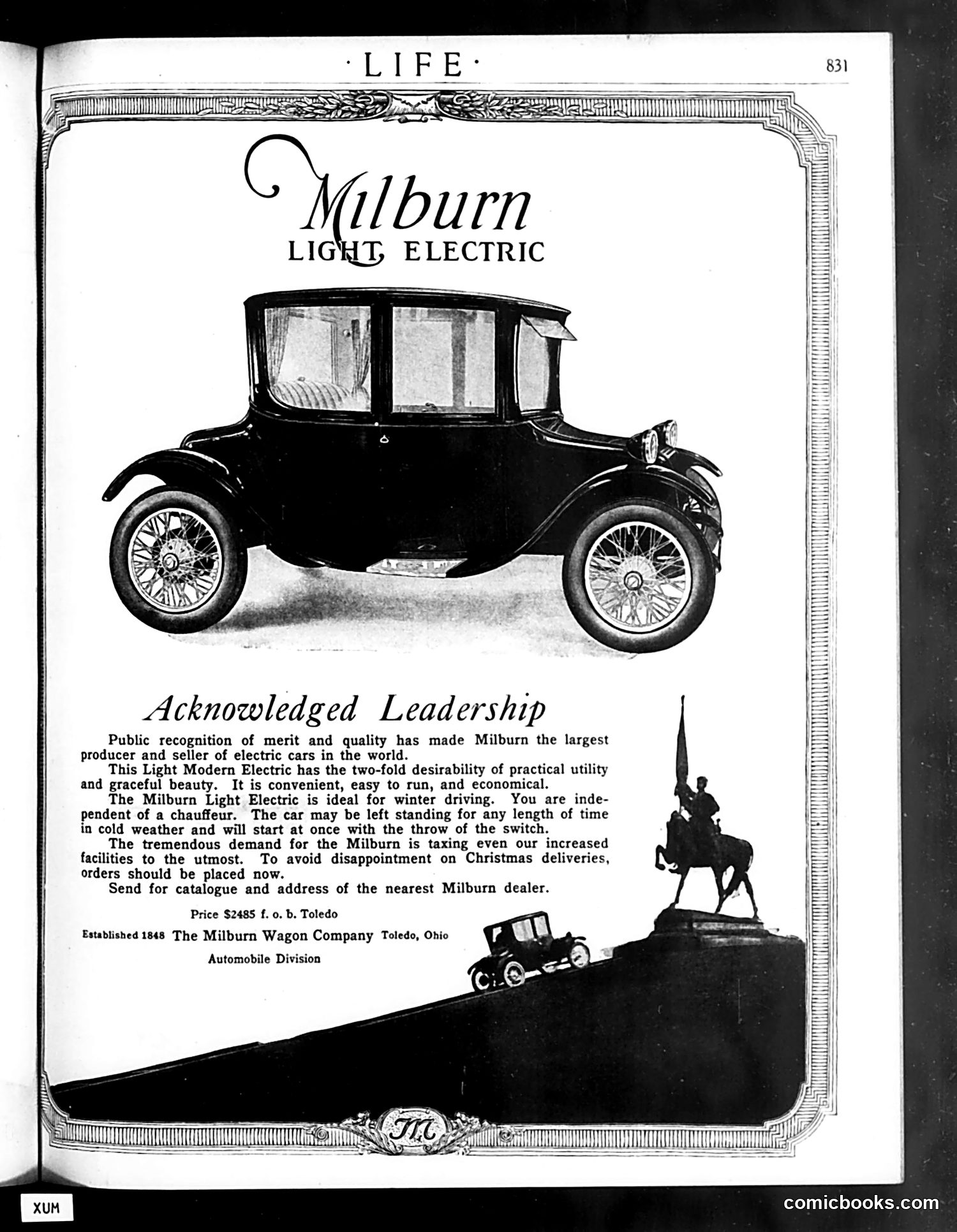
This page is primarily a **product advertisement** for the Milburn Light Electric automobile, not satire or political commentary. It appears in *Life* magazine (page 831), which published both humor and advertisements. The ad promotes an electric car as practical, convenient, and economical—particularly suited for winter driving since it requires no chauffeur and starts instantly. The manufacturer claims market leadership as "the largest producer and seller of electric cars in the world." The decorative illustration at bottom shows a silhouetted figure on horseback overlooking a tiny Milburn car—a visual metaphor suggesting the car's impressive capabilities or dominance. The urgent marketing language ("tremendous demand," "to avoid disappointment on Christmas deliveries, orders should be placed now") reflects pre-holiday sales pressure, a timeless retail tactic. This represents a historical moment when **electric vehicles were serious commercial competitors** to gasoline cars, before gasoline engines dominated the market in the early 20th century.
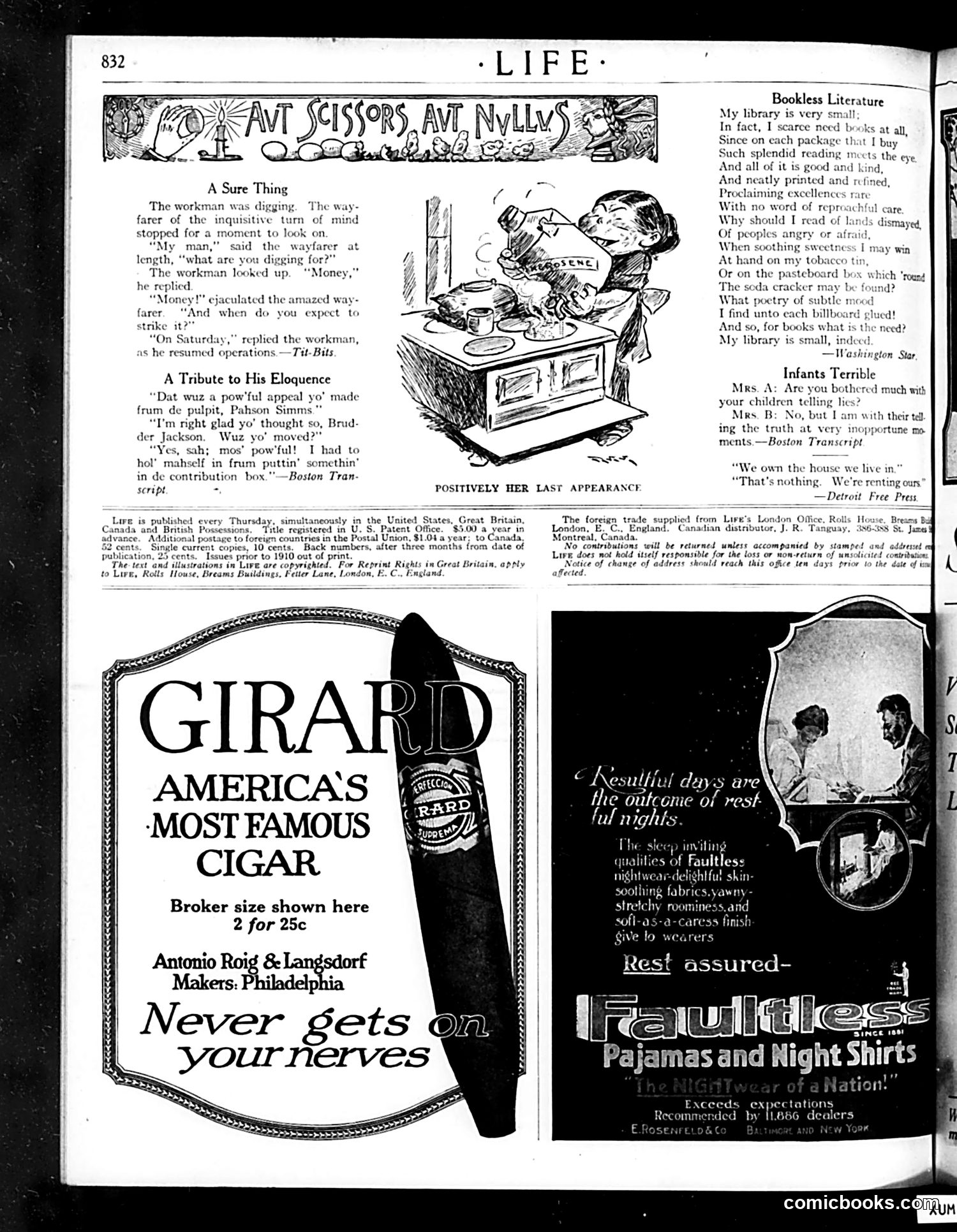
This page contains **short humorous anecdotes and advertisements** rather than political cartoons. **The humor pieces** rely on period-specific comedy: - "A Sure Thing" plays on working-class stereotypes—a laborer promises to find money by Saturday (payday), a simple joke about wage expectation. - "A Tribute to His Eloquence" uses dialect humor (common in early 20th-century magazines) about a church sermon so moving the listener can't afford to donate—social satire about poverty. - "Bookless Literature" mocks consumerism: advertising on product packaging has replaced reading books. - "Infants Terrible" is domestic humor about children's brutal honesty. **The advertisements** promote Girard cigars ("Never gets on your nerves") and Faultless pajamas/nightshirts, using period marketing language emphasizing rest and nervousness relief—common selling points of the era. The main illustration shows someone eating at a desk, captioned "POSITIVELY HER LAST APPEARANCE"—likely referring to a theatrical performer, though context is unclear.
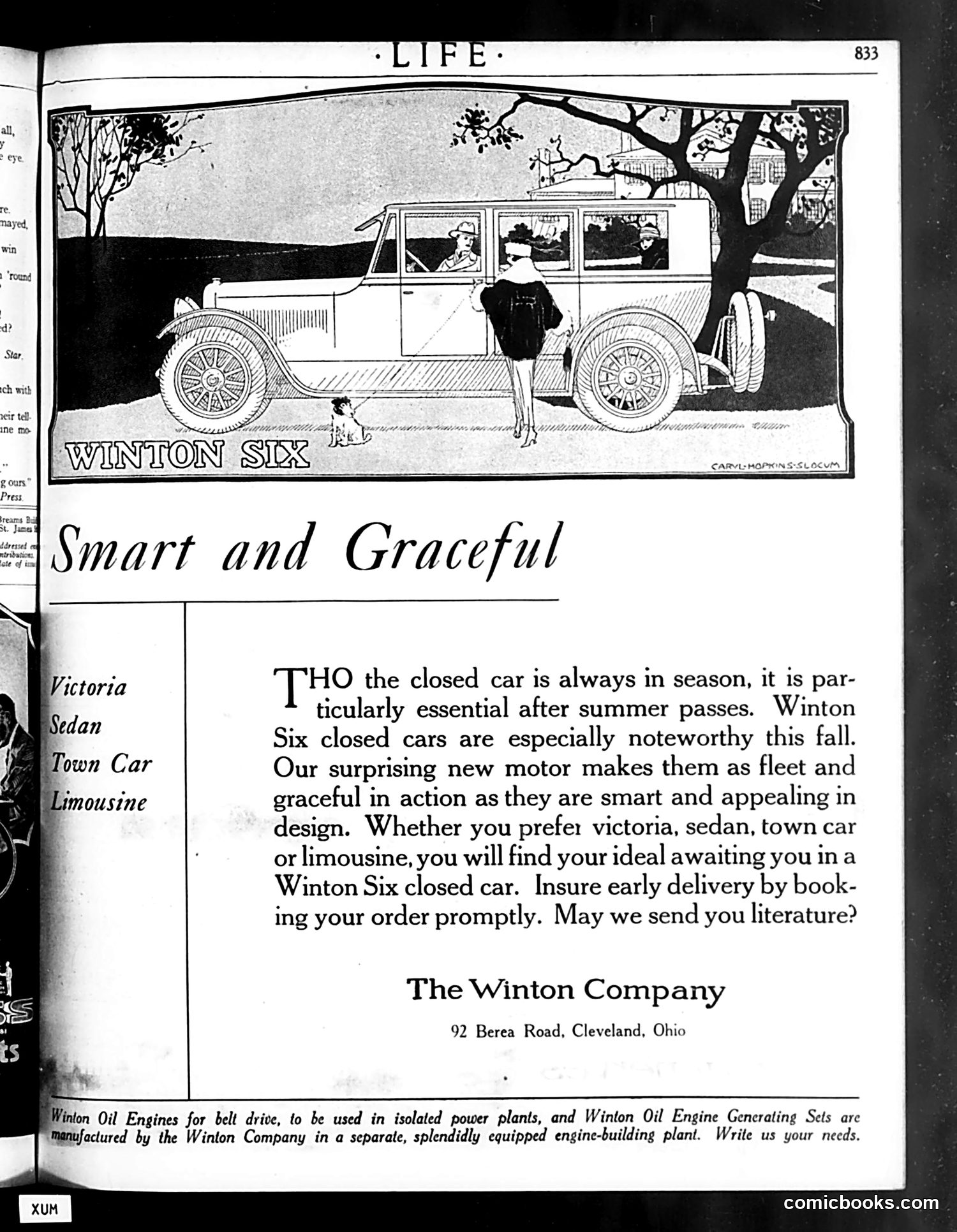
This page is primarily **advertising**, not satire or political commentary. It's a Winton Company automobile advertisement from an early 20th-century issue of *Life* magazine. The illustration shows a stylized closed-body automobile with passengers, accompanied by the marketing headline "Smart and Graceful." The ad emphasizes that closed cars (as opposed to open vehicles) are practical for fall and winter seasons. The copy lists available models—victoria, sedan, town car, and limousine—and pitches the car's new motor for performance and design appeal. It concludes with a sales pitch encouraging prompt orders for timely delivery. A secondary note promotes Winton Oil Engines for industrial power applications, indicating the company's broader manufacturing scope beyond automobiles. There is **no evident satire or political content** on this page; it's straightforward early automotive marketing.
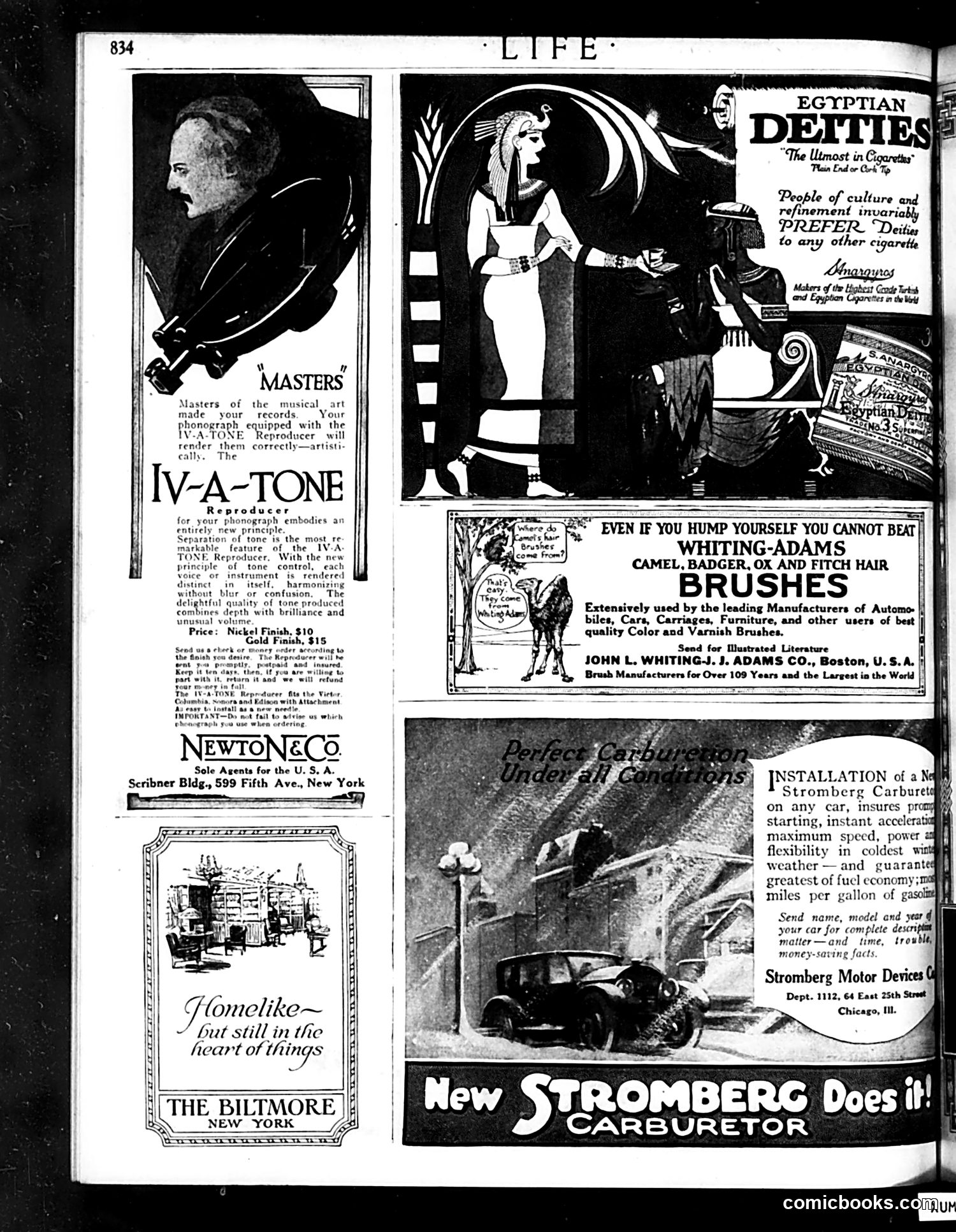
This is primarily an **advertising page** from Life magazine, not a political cartoon. It contains four distinct advertisements: 1. **IV-A-Tone Reproducer** (top left): A phonograph component claiming superior sound reproduction through "tone separation," allowing each musical voice/instrument to be heard distinctly. 2. **Egyptian Deities Cigarettes** (top right): An Art Deco-styled ad featuring an Egyptian woman, appealing to "people of culture and refinement" — a common luxury marketing strategy of the era. 3. **Whiting-Adams Brushes** (center): Promotes animal-hair brushes for automotive and furniture finishing, with crude humor in the headline about physical exertion. 4. **Stromberg Carburetor** (bottom): Features a car in snowy conditions, emphasizing cold-weather performance and fuel economy. The page reflects 1920s consumer culture and advertising aesthetics rather than satire or political commentary.
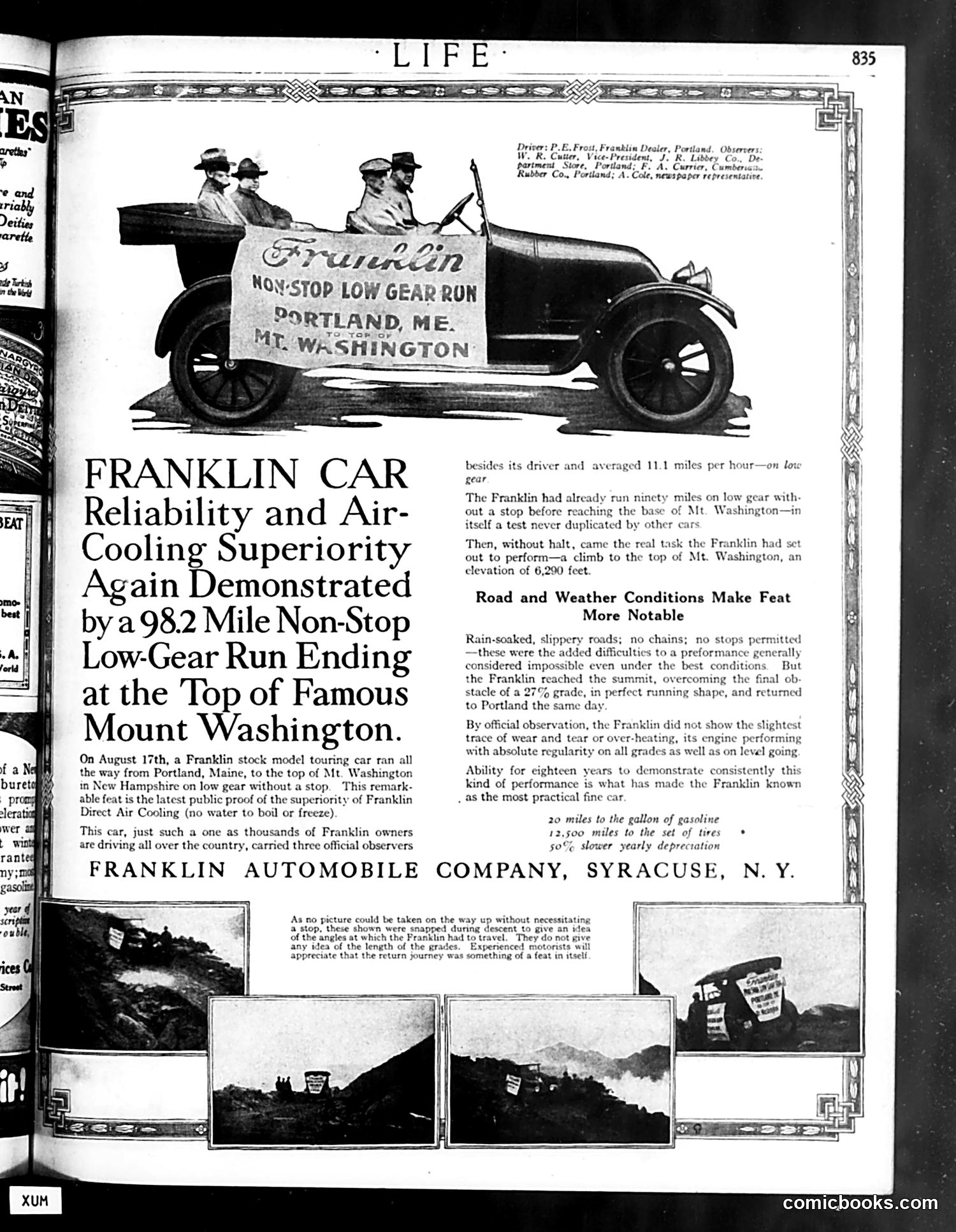
This is not satire or political commentary—it's a **straightforward automobile advertisement** from Life magazine's advertising section. The page promotes the Franklin automobile company by documenting an August 17th endurance test: a Franklin touring car drove 98.2 miles non-stop from Portland, Maine to the summit of Mount Washington on low gear. The achievement is presented as proof of the car's superior reliability and air-cooling system (which didn't require water that could boil or freeze—a significant advantage over competing water-cooled engines of the era). Three official observers witnessed the feat. The ad emphasizes challenging conditions: rain-soaked roads, steep grades (27% near summit), and no stops permitted. The bottom section lists performance specs: 20 miles per gallon, 12,500 miles per tire set, and slower depreciation. This represents early automotive marketing using dramatic endurance tests to demonstrate mechanical superiority to potential buyers.
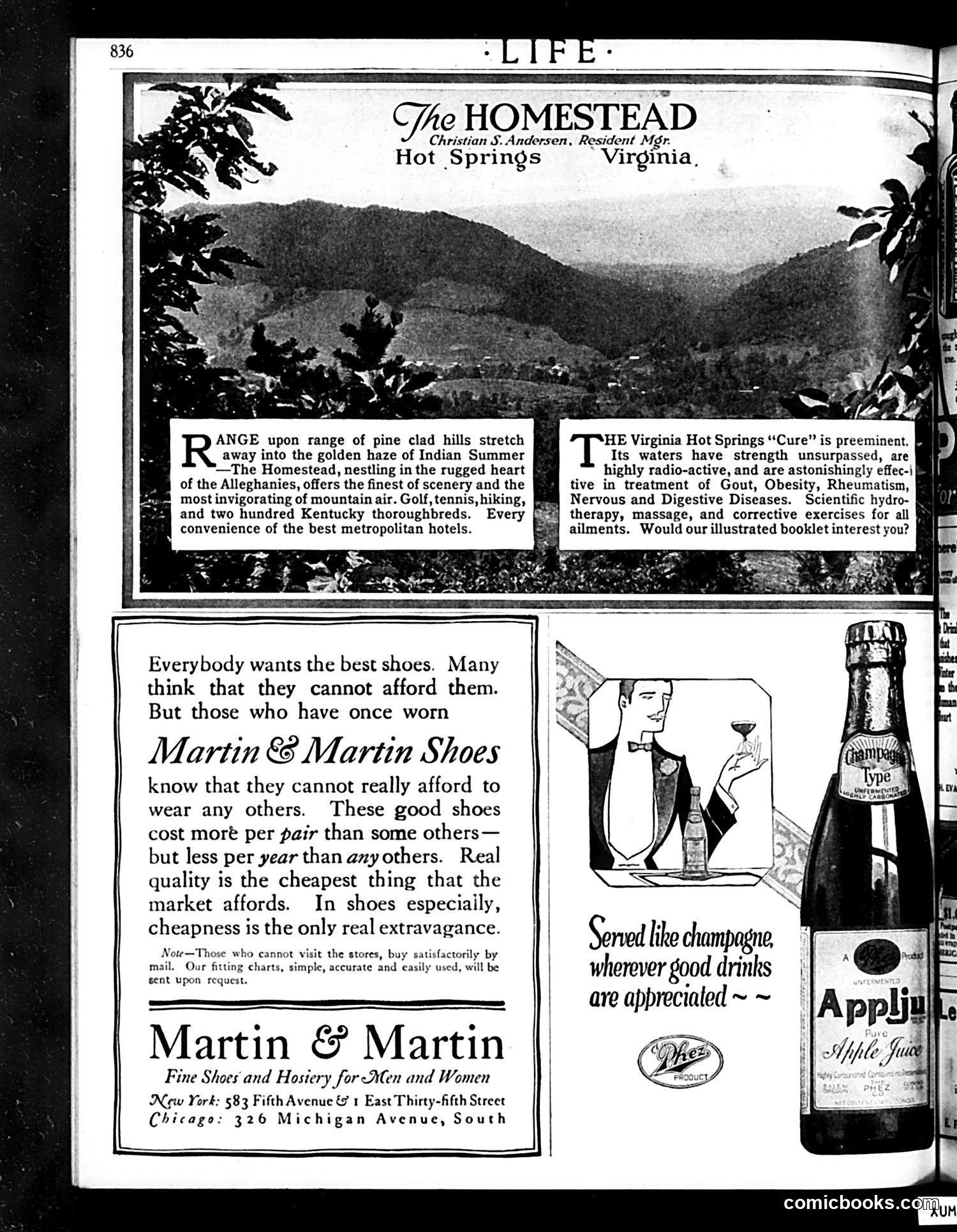
This page is primarily **advertising**, not political satire. It contains three distinct advertisements from the 1910s-1920s era: 1. **The Homestead** (Hot Springs, Virginia): Promotes a luxury resort featuring mountain scenery, golf, tennis, hiking, and thoroughbred horses. The "cure" references the era's belief that mineral springs had medicinal properties for gout, obesity, and rheumatism—treatments now recognized as pseudoscience. 2. **Martin & Martin Shoes**: Argues that quality shoes, though initially expensive, cost less annually than cheaper alternatives. This reflects early 20th-century consumerism and the "buy quality once" marketing philosophy. 3. **Applin Apple Juice**: A beverage advertisement positioning the product as suitable for refined occasions, "served like champagne." The page reflects period attitudes toward health (mineral water cures), luxury leisure travel, consumer economics, and marketing rhetoric. There is no political cartoon or satire present—this is a straightforward commercial advertising page from Life magazine's revenue model.
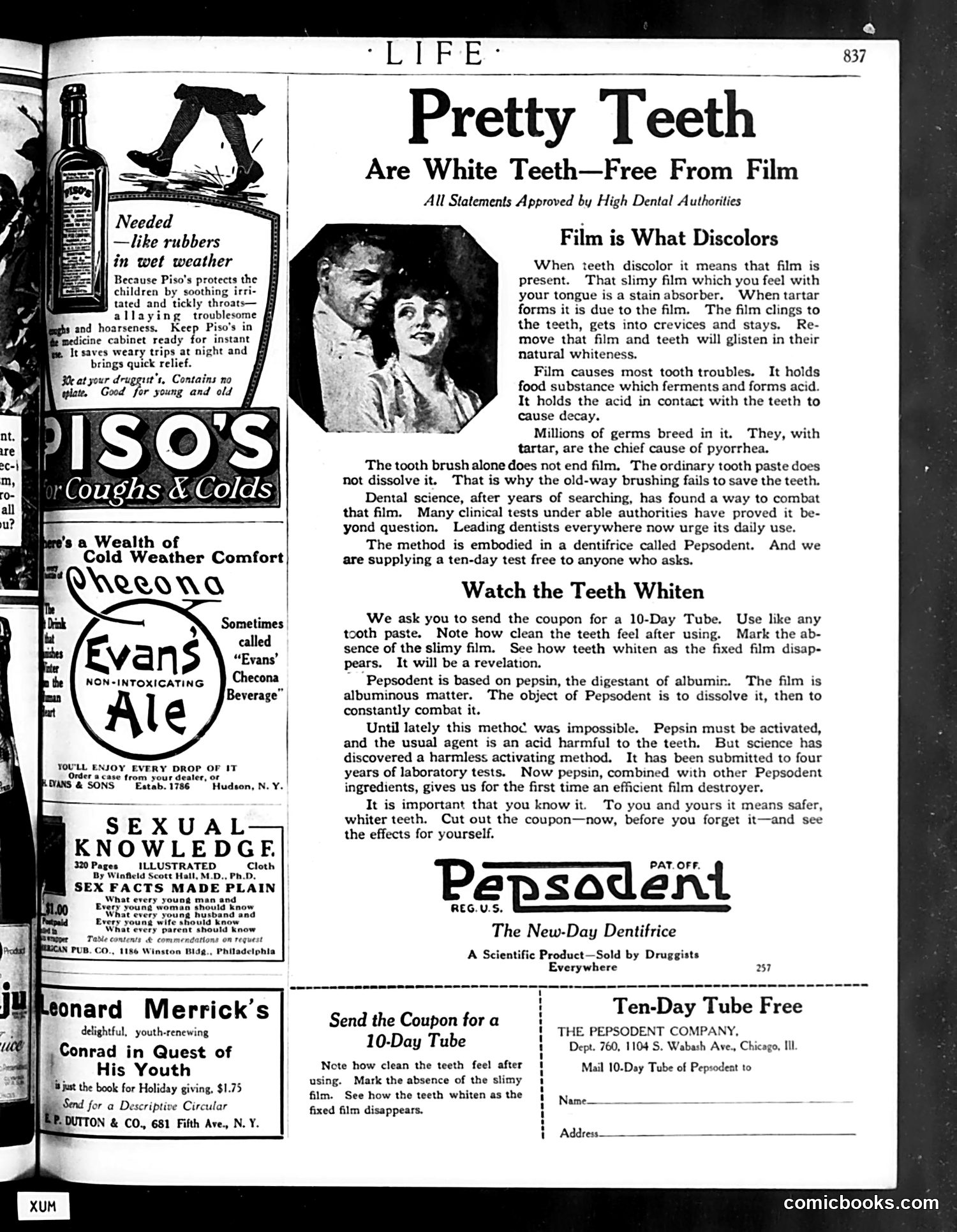
This page is primarily a **product advertisement**, not satire or political commentary. The main feature is a Pepsodent toothpaste ad claiming their dentifrice uniquely dissolves tooth film through pepsin—a digestive enzyme. **Key claims (by modern standards, mostly unfounded):** - Tooth "film" causes discoloration, decay, and gum disease - Regular toothpaste cannot remove film; only Pepsodent can - Pepsin, when "activated" harmlessly, dissolves this film **Context for modern readers:** This represents early 20th-century *pseudoscientific marketing*. The "film" concept was exaggerated to justify a premium product. While plaque does exist, Pepsodent's claims about pepsin's special film-dissolving properties were largely marketing invention. The ad's repeated emphasis on "dental authorities" approving claims reflects advertising conventions designed to build credibility for unproven benefits. The surrounding ads (cough medicine, sexual knowledge books) are typical period advertising with similar credibility strategies.
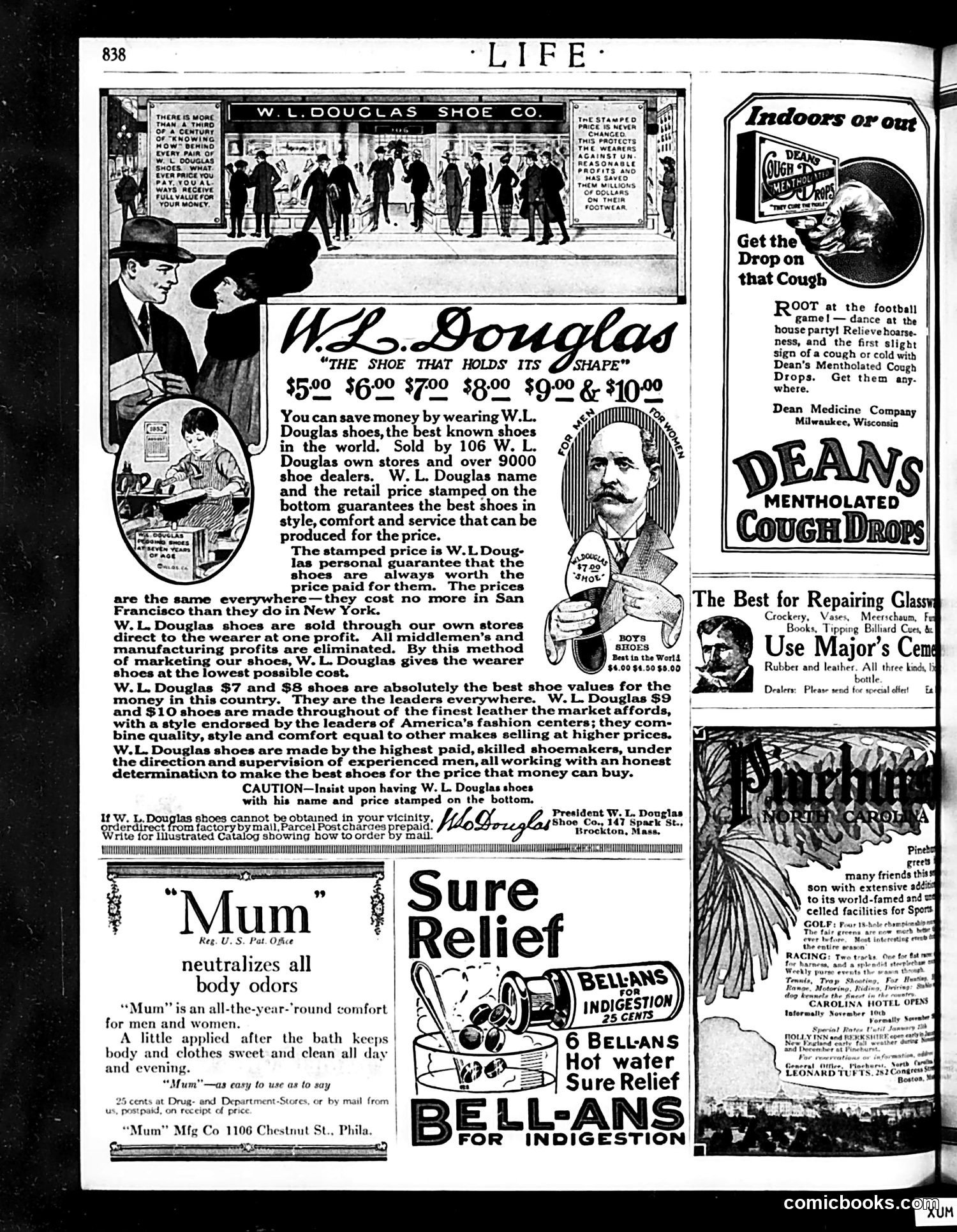
This page is **primarily advertising**, not satirical content. It features multiple product advertisements from the early 20th century. The dominant advertisement promotes **W.L. Douglas shoes**, emphasizing their affordability and quality through direct factory-to-consumer sales that eliminate middlemen markups. The copy claims shoes cost the same nationwide and promises durability at various price points ($5–$10). Additional ads include: - **Dean's Mentholated Cough Drops** (positioned for athletic/social contexts) - **"Mum" deodorant** (marketed as all-season body odor control) - **Bellan's indigestion relief** (hot water remedy) - **Major's Cement** (for glass/leather repair) The small illustrative vignettes depict typical consumer scenarios—shopping, social activities, athletic events—to contextualize product use. There is no identifiable political satire or caricature on this page; it represents straightforward commercial advertising typical of early 20th-century magazine content.
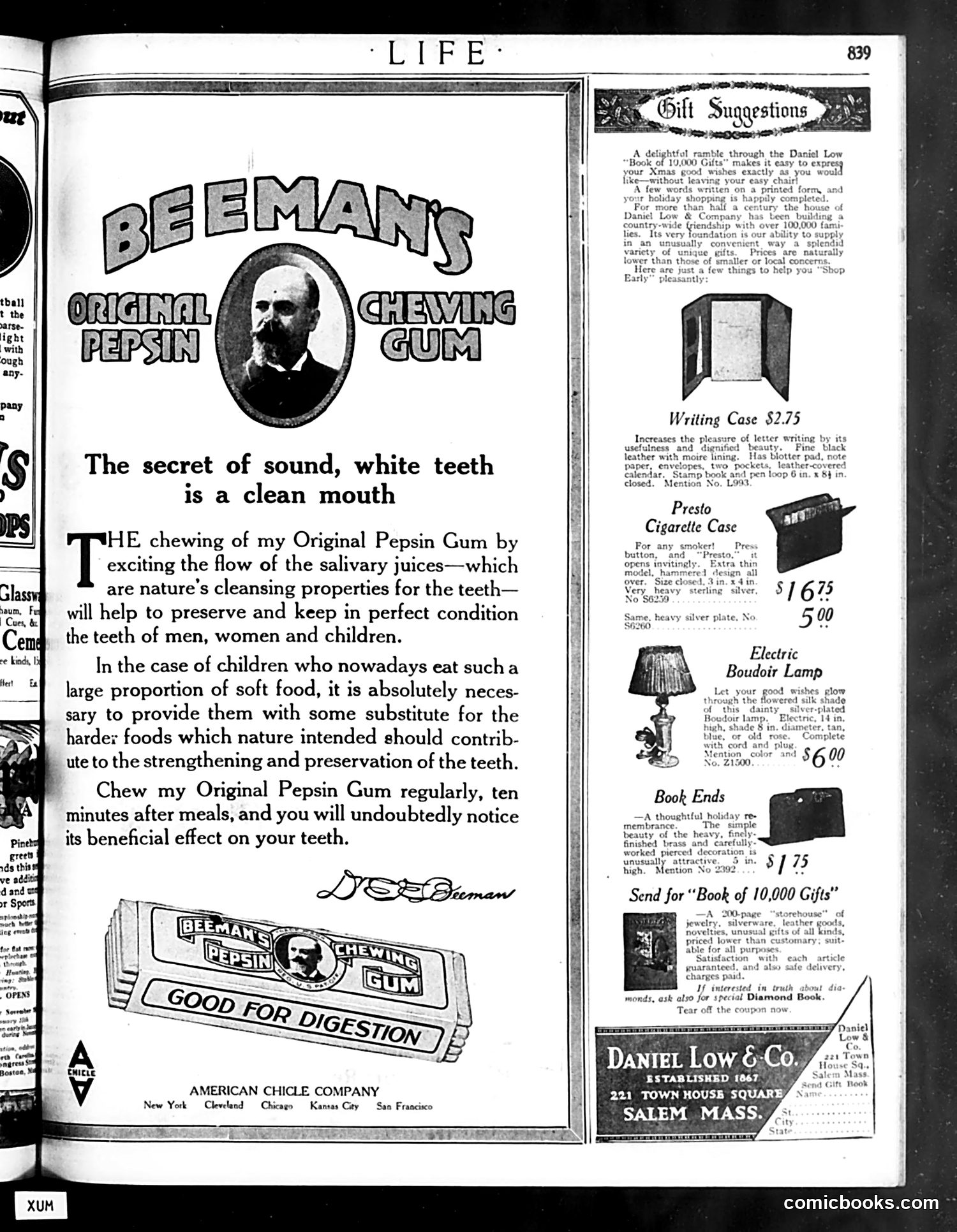
This is a straightforward **product advertisement**, not political satire. The left page promotes Beeman's chewing gum with a portrait of the (apparent) founder or spokesman endorsing the product. The ad makes **health claims typical of early 20th-century marketing**: that chewing gum stimulates saliva flow, which naturally cleanses teeth. It specifically addresses children eating "soft food" nowadays, arguing gum provides a substitute for harder foods that would naturally strengthen teeth. The right page shows **gift suggestions** from Daniel Low & Co., including a writing case, cigarette case, electric lamp, and book ends—typical upscale merchandise for holiday shopping. There is **no satire or political content** here. This represents genuine period advertising before modern FDA regulations restricted health claims on consumer products. The claims about gum's dental benefits would be considered misleading today.
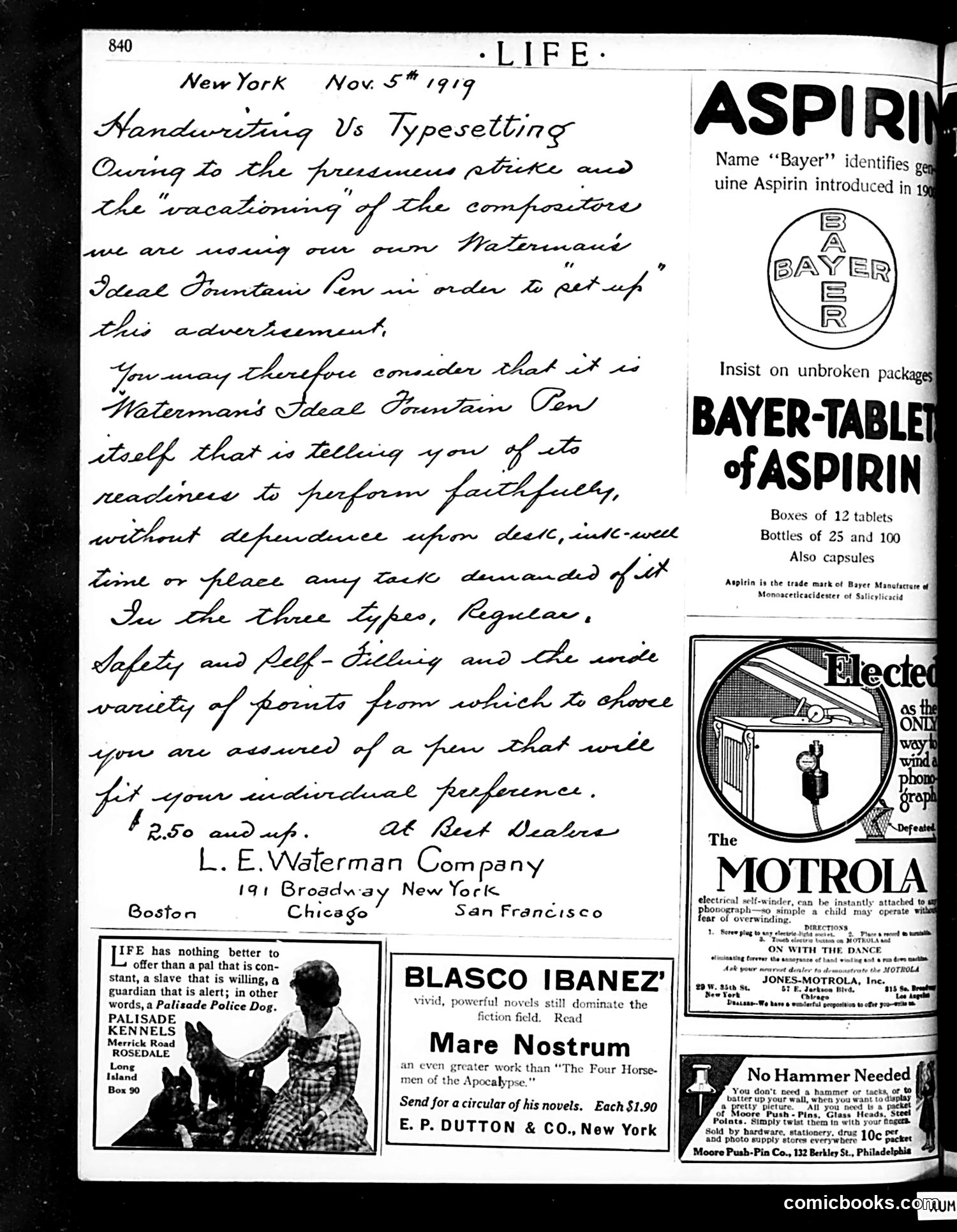
This page is primarily **advertising**, not satire or political commentary. It contains: 1. **Handwritten editorial note** (top left): Discusses whether to use typewritten or handwritten text for advertisements during a printers' strike and composer vacation, promoting Waterman fountain pens as the solution. 2. **Product advertisements**: - **Bayer Aspirin**: Standard pharmaceutical ad emphasizing authentic branded tablets - **Palisade Kennels**: Police dog breeding advertisement - **Blasco Ibáñez novels**: Promoting the Spanish author's books - **Motrola**: Electrical self-winder device - **No Hammer Needed**: Hardware tool advertisement The page reflects 1919 consumer culture and commercial messaging rather than political satire. The only editorial content is the brief note about labor disputes affecting production—a timely reference to post-WWI labor tensions—but it's presented matter-of-factly, not satirically.
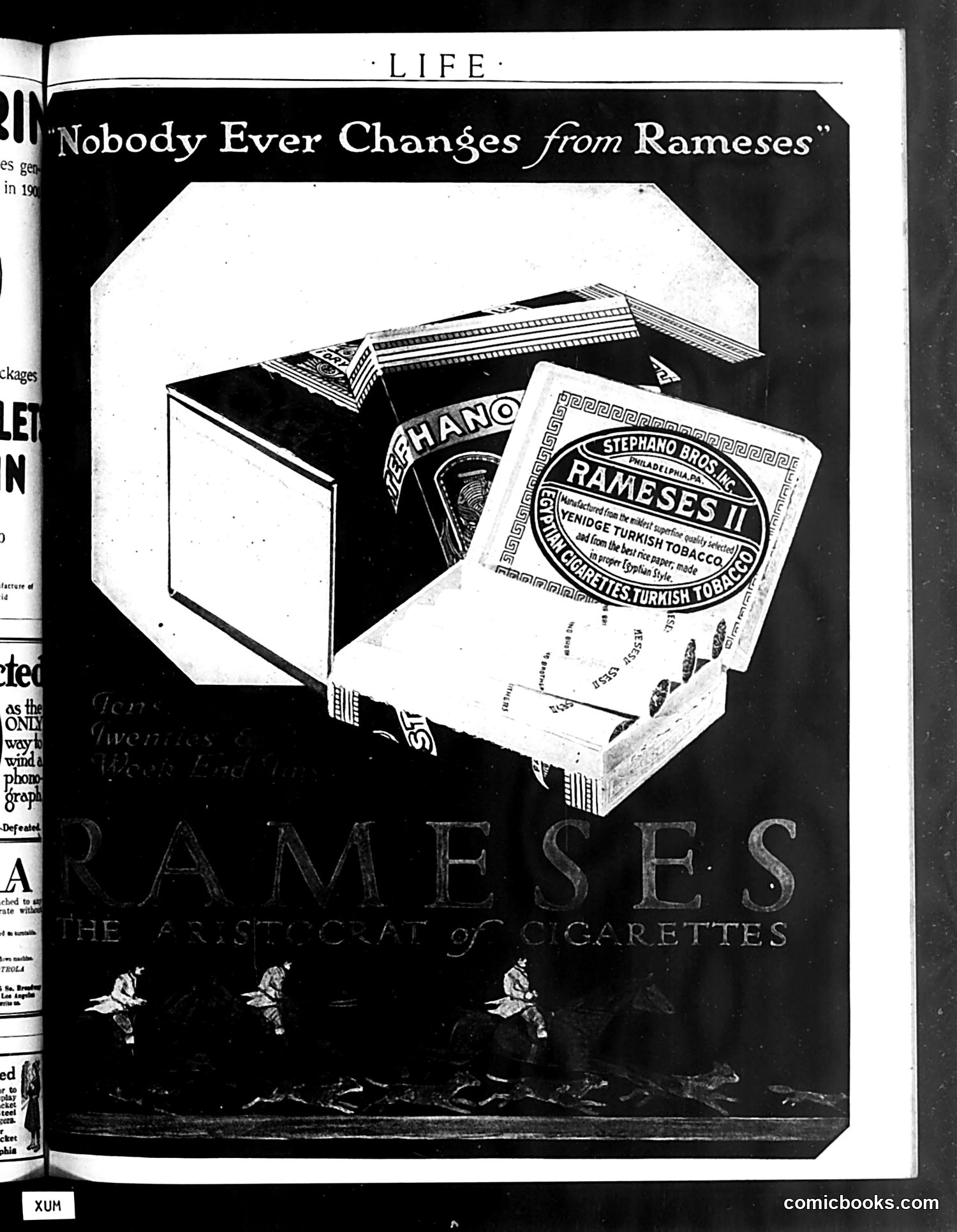
This is a **cigarette advertisement**, not political satire. The headline "Nobody Ever Changes from Rameses" promotes Rameses II Turkish tobacco cigarettes by Stephano Bros. The tagline emphasizes brand loyalty—once smokers choose Rameses, they supposedly never switch brands. The visual shows an open box of Rameses cigarettes with packaging displayed. The phrase "The Aristocrat of Cigarettes" claims premium quality. The Egyptian imagery (Rameses reference, decorative borders) leverages exotic appeal common in early 20th-century marketing. For modern readers: this represents an era when cigarette companies advertised openly in mainstream magazines without health warnings, using aspirational messaging to encourage brand consistency among consumers.
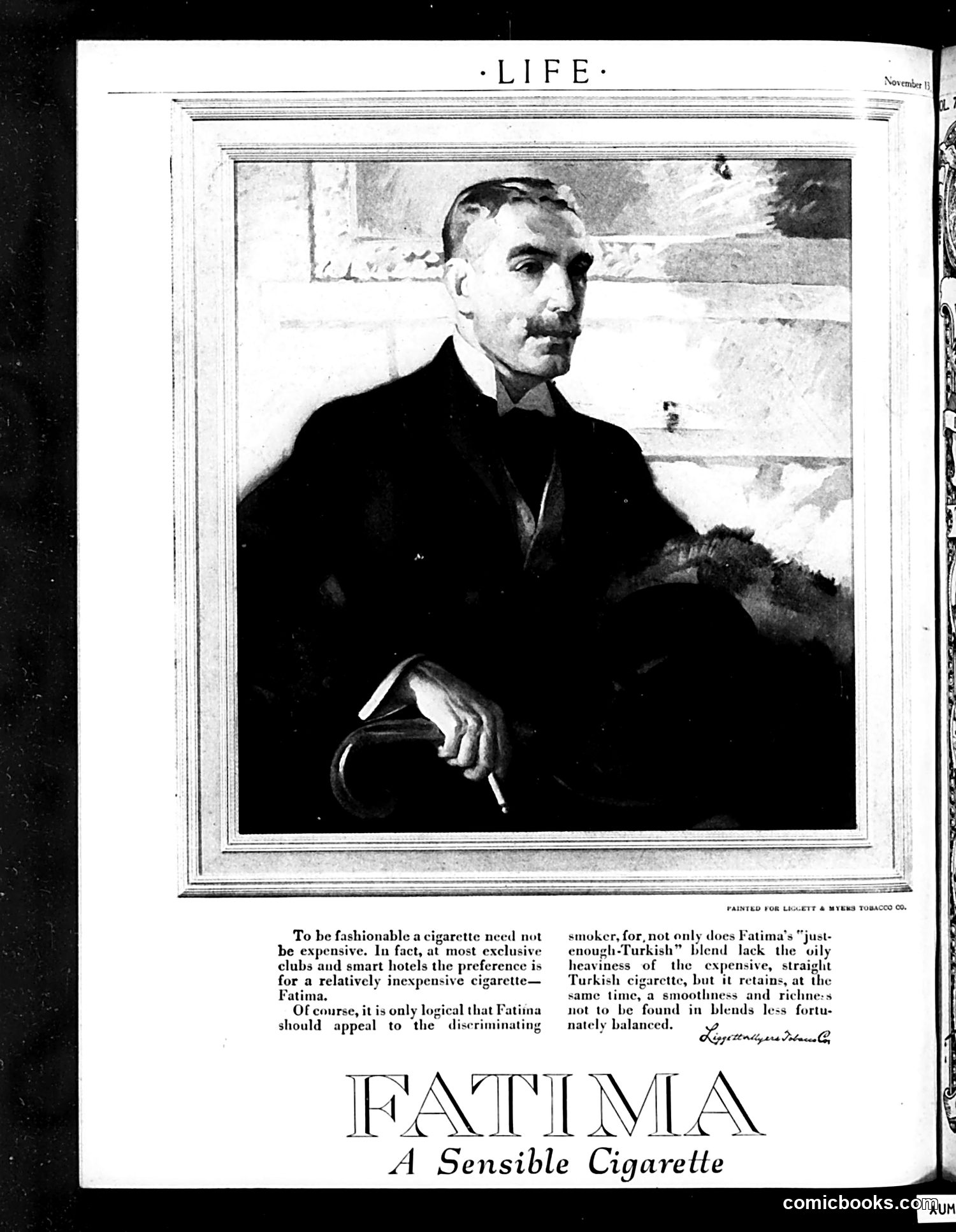
This is a **cigarette advertisement**, not a political cartoon. It appears in *Life* magazine and promotes Fatima brand cigarettes by Liggett & Myers Tobacco Co. The ad features a portrait of a well-dressed man in formal attire, presented as a refined, discriminating smoker. The copy argues that fashionable cigarettes need not be expensive—Fatima offers quality at moderate cost, appealing to "exclusive clubs and smart hotels." The marketing angle emphasizes Fatima's "just-enough-Turkish" blend as superior to both expensive straight Turkish cigarettes (too heavy) and cheaper blends (poorly balanced). The tagline "A Sensible Cigarette" frames the product as the rational choice for sophisticated consumers. This reflects early 20th-century tobacco advertising before health warnings, when cigarettes were marketed as status symbols and lifestyle products to affluent audiences.