
Life, 1919-11-13 · page 10 of 36
Life — November 13, 1919 — page 10: what you’re looking at
What you’re looking at
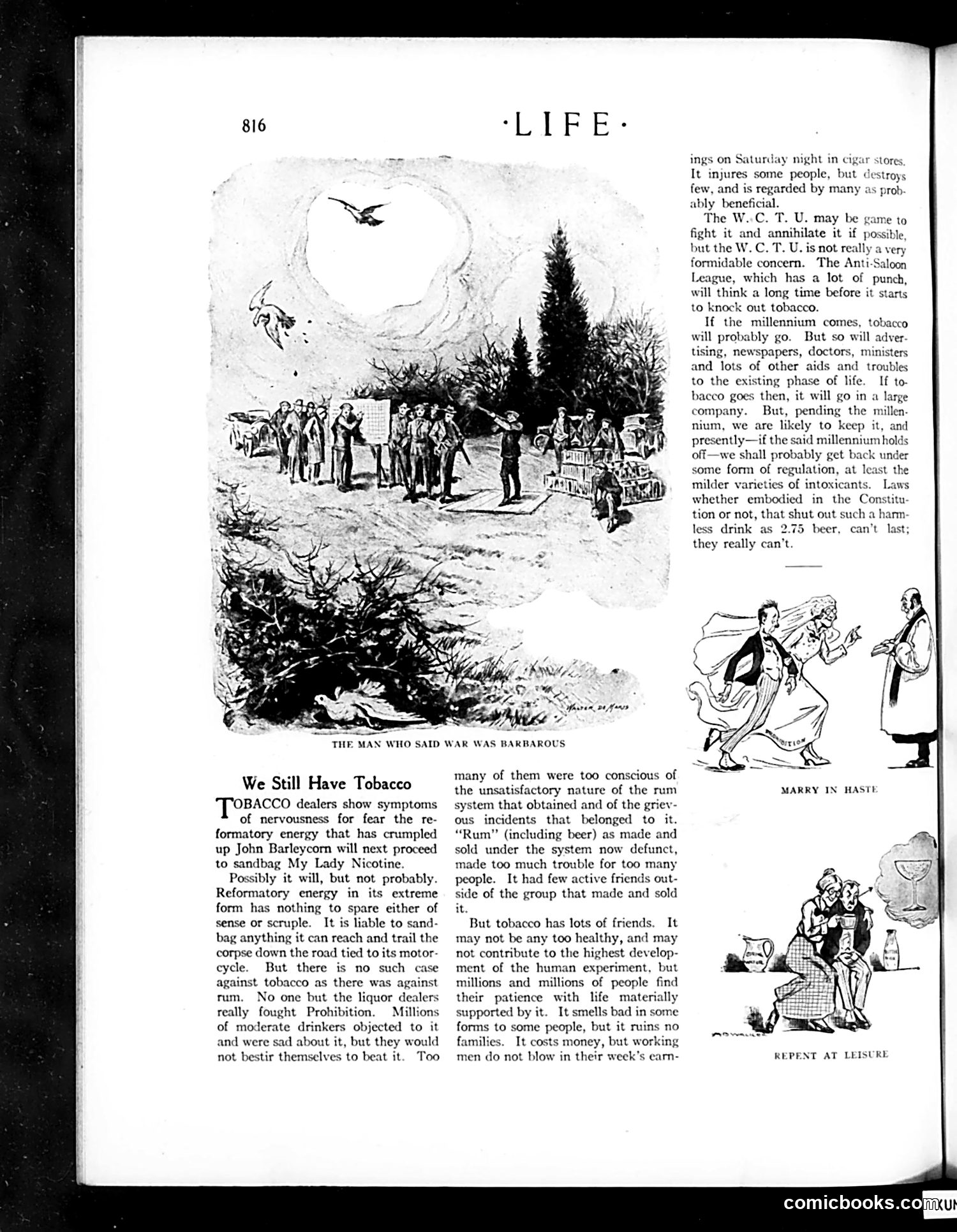
The main illustration, titled "The Man Who Said War Was Barbarous," depicts a large gathering of civilians beneath a dramatic sky with circling birds. This appears to be satirizing pacifist sentiment during or after World War I—specifically mocking someone (likely a public figure) who opposed war while the conflict continued or its consequences unfolded. The article "We Still Have Tobacco" argues that tobacco, unlike alcohol (prohibited by Prohibition), will survive reform efforts. It defends tobacco's social utility despite health concerns, noting millions depend on it economically. The piece presents tobacco as relatively harmless compared to rum, suggesting reformers should accept tobacco's permanence. The smaller illustrations on the right ("Marry in Haste" and "Repent at Leisure") appear to be unrelated satirical vignettes about marriage.
📄 Transcribed text from this page (OCR, searchable)
Machine-transcribed from the original scan — historical spelling and the odd misread are preserved.
THE MAN WHO SAID WAR WAS BARBAROUS. We Still Have Tobacco ‘Tosacco dealers show symptoms of nervousness for fear the re- formatory energy that has crumpled up John Barleycorn will next proceed to sandbag My Lady Nicotine. Possibly it will, but not probably. Reformatory energy in its extreme form has nothing to spare either of sense or scruple. It is liable to sand- bag anything it can reach and trail the corpse down the road tied to its motor- cycle. But there is no such case against tobacco as there was against rum. No one but the liquor dealers really fought Prohibition. Millions of moderate drinkers objected to it and were sad about it, but they would not bestir themselves to beat it. Too many of them were too conscious of the unsatisfactory nature of the rum system that obtained and of the griev- ous incidents that belonged to it. “Rum” (including beer) as made and sold under the system now defunct, made too much trouble for too many people. It had few active friends out- side of the group that made and sold it. But tobacco has lots of friends. It may not be any too healthy, and may not contribute to the highest develop- ment of the human experiment, but millions and millions of people find their patience with life materially supported by it. It smells bad in some forms to some people, but it ruins no families. It costs money, but working men do not blow in their week’s cam- ings on Saturday night in cigar stores, It injures some people, but destroys few, and is regarded by many as prob. ably beneficial. The W..C. T. U. may be game to fight it and annihilate it if possible, but the W. C. T. U. is not really a very formidable concern. The Anti-Saloon League, which has a lot of punch, will think a long time before it starts to knock out tobacco. If the millennium comes, tobacco will probably go. But so will adver- tising, newspapers, doctors, ministers and lots of other aids and troubles to the existing phase of life. If to- bacco goes then, it will go in a large company. But, pending the millen nium, we are likely to keep it, and presently—if the said millennium holds off—we shall probably get back under some form of regulation milder varieties of intoxicants. whether embodied in the Con tion or not, that shut out such a he less drink as 2.75 beer, can’t last; they really can’t. MARRY IN HASTE REPENT AT LEISURE comicbooks.comay