
Life, 1919-11-13 · page 16 of 36
Life — November 13, 1919 — page 16: what you’re looking at
What you’re looking at
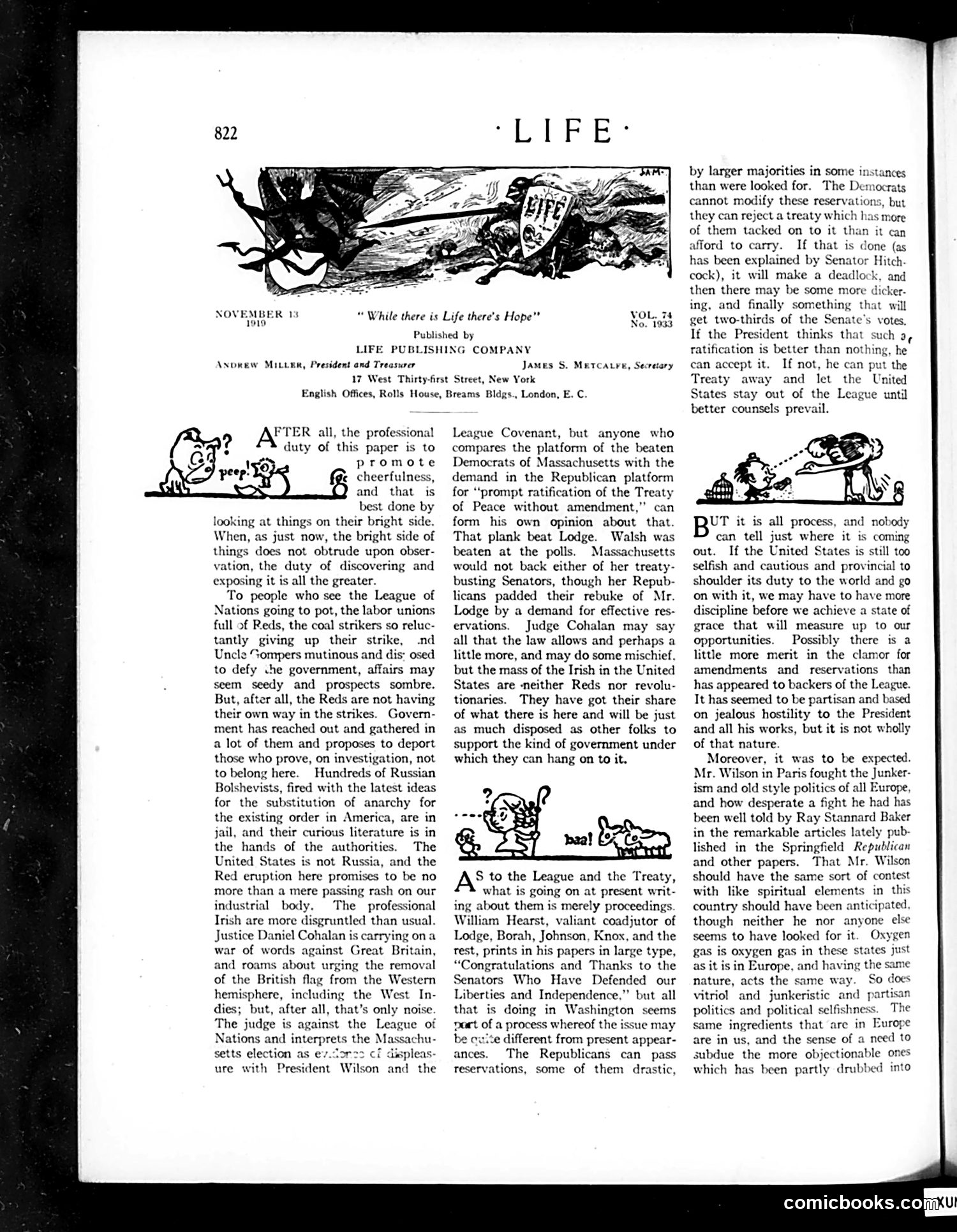
This Life magazine editorial addresses post-WWI American politics, specifically the contentious League of Nations treaty ratification. The piece defends President Wilson's position against Republican senators (Lodge, Borah, Johnson, Knox) who demanded reservations to the treaty before ratification. The editorial dismisses contemporary anxieties: Red Bolshevik threats are exaggerated, Irish-American agitation (led by Justice Cohalan) is "only noise," and labor unrest will prove temporary. The core argument: Massachusetts voters rejected anti-League senators at the polls, showing public support for Wilson's position. The cartoons (barely visible in reproduction) likely lampoon the political figures obstructing treaty ratification. The overall tone is optimistic that despite Republican resistance and various amendments, a version of the treaty will eventually pass—though the editor acknowledges a political "deadlock" remains possible if too many reservations are appended.
📄 Transcribed text from this page (OCR, searchable)
Machine-transcribed from the original scan — historical spelling and the odd misread are preserved.
“ While there is Life there's Hope" Published by LIFE PUBLISHING ANDREW MILLER, President and Treasurer COMPANY James S. MeTCatre, Secretary 17 West Thirty-first Street, New York English Offices, Rolls House, Breams Bldgs., London, E. C. duty of this paper is to promote cheerfulness, and that is best done by looking at things on their bright side. When, as just now, the bright side of things does not obtrude upon obser- vation, the duty of discovering and exposing it is all the greater. To people who see the League of Nations going to pot, the labor unions full of Reds, the coal strikers so reluc- tantly giving up their strike, .nd Uncle Sompers mutinous and dis: osed to defy che government, affairs may seem seedy and prospects sombre. But, after all, the Reds are not having their own way in the strikes. Govern- ment has reached out and gathered in a lot of them and proposes to deport those who prove, on investigation, not to belong here. Hundreds of Russian Bolshevists, fired with the latest ideas for the substitution of anarchy for the existing order in America, are in jail, and their curious literature is in the hands of the authorities. The United States is not Russia, and the Red eruption here promises to be no more than a mere passing rash on our industrial body. The _ professional Irish are more disgruntled than usual. Justice Daniel Cohalan is carrying ona war of words against Great Britain, and roams about urging the removal of the British flag from the Western hemisphere, including the West In- dies; but, after all, that’s only noise. The judge is against the League of Nations and interp: setts election as ure with President Wilson and AYTER all, the professional 35, the League Covenant, but anyone who compares the platform of the beaten Democrats of Massachusetts with the demand in the Republican platform for ‘‘prompt ratification of the Treaty of Peace without amendment,” can form his own opinion about that. That plank beat Lodge. Walsh was beaten at the polls. Massachusetts would not back either of her treaty- busting Senators, though her Repub- licans padded their rebuke of Mr. Lodge by a demand for effective res- ervations. Judge Cohalan may say all that the law allows and perhaps a little more, and may do some mischief. but the mass of the Irish in the United States are neither Reds nor revolu- tionaries. They have got their share of what there is here and will be just as much disposed as other folks to support the kind of government under which they can hang on to it. AS to the League and the Treaty, what is going on at present writ- ing about them is merely proceedings. William Hearst, valiant coadjutor of Lodge, Borah, Johnson, Knox, and the rest, prints in his papers in large type, “Congratulations and Thanks to the Senators Who Have Defended our Liberties and Independence.” but all that is doing in Washington seems part of a process whereof the issue may be cuite different from present appear- ances. The Republicans can pass teservations, some of them drastic, by larger majorities in some in. than were looked for. The D. cannot modify these reservations, but they can reject a treaty which has more of them tacked on to it than it can afford to carry. If that is done (as has been explained by Senator Hitch- cock), it will make a deadlock, and then there may be some more dicker- ing, and finally something that will get two-thirds of the Ser ‘Ss votes, If the President thinks that such 9 ratification is better than nothing, he can accept it. If not, he can put the Treaty away and let the United States stay out of the League until better counsels prevail. € BUT it is all process, and nobody can tell just where it is coming out. If the United States is still too selfish and cautious and provincial to shoulder its duty to the world and go on with it, we may have to have more discipline before we achieve a state of grace that will measure up to our opportunities. Possibly there is a little more merit in the clamor for amendments and reservations than has appeared to backers of the League. It has seemed to be partisan and based on jealous hostility to the President and all his works, but it is not wholly of that nature. Moreover, it was to be expected. Mr. Wilson in Paris fought the Junker- ism and old style politics of all Europe, and how desperate a fight he had has been well told by Ray Stannard Baker in the remarkable articles lately pub- lished in the Springfield Republican and other papers. That Mr. Wilson should have the same sort of contest with like spiritual elements in this country should have been anticipated, though neither he nor anyone else seems to have looked for it. Oxygen gas is oxygen gas in these states just as it is in Europe, and having the same nature, acts the same way. So does vitriol and junkeristic and partisan politics and political selfishness. The same ingredients that are in Europe are in us, and the sense of a need to subdue the more objectionable ones which has been partly drubbed into comicbooks.comal