
A complete issue · 36 pages · 1919
Life — October 16, 1919
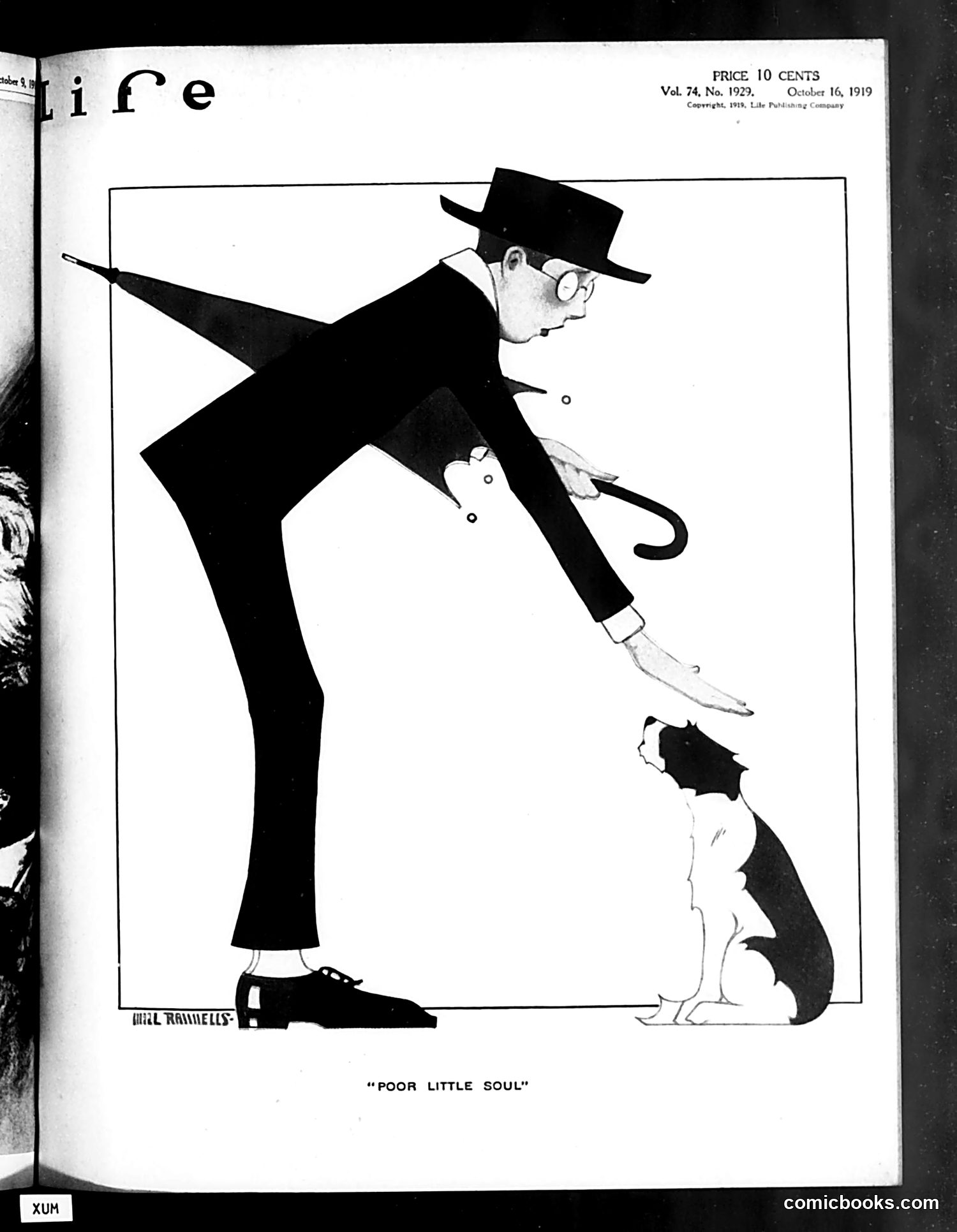
This cartoon by Willi Ranwell depicts a well-dressed gentleman in formal attire kicking a small dog. The title "Poor Little Soul" suggests the dog represents something vulnerable being mistreated. Given the 1919 publication date, this likely satirizes post-WWI conditions or contemporary social issues. The exaggerated formal dress and dismissive posture of the man suggest criticism of authority figures or the wealthy treating the powerless with contempt. The small dog's pleading expression contrasts sharply with the man's callous gesture, emphasizing the cartoon's moral critique. However, without additional context from surrounding articles, the specific target of satire—whether labor disputes, class conflict, or another contemporary issue—cannot be definitively determined from the image alone.
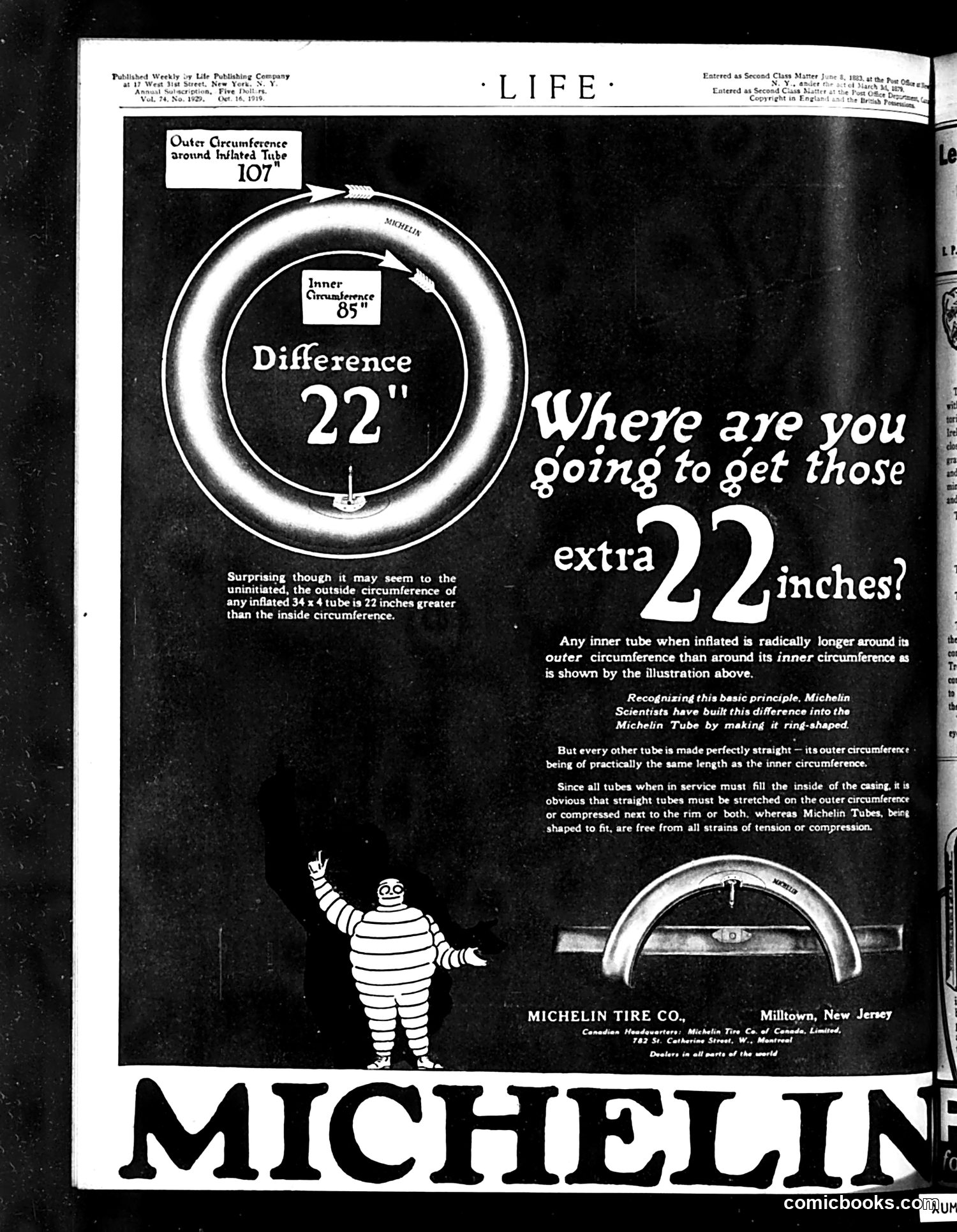
This is primarily a **Michelin Tire Company advertisement**, not political satire. The page explains a technical innovation in tire design. The advertisement highlights that Michelin's ring-shaped inflated tubes have a 22-inch difference between outer circumference (107") and inner circumference (85")—a larger differential than competitors' straight tubes. The Michelin Man mascot (visible at bottom left) celebrates this engineering advantage. The text emphasizes that Michelin's ring-shaped design prevents strain and compression issues that occur with straight tubes, which must stretch to fit the tire's outer circumference. The advertisement positions this as a superior solution for tire durability and performance. This is straightforward product marketing rather than social or political commentary.
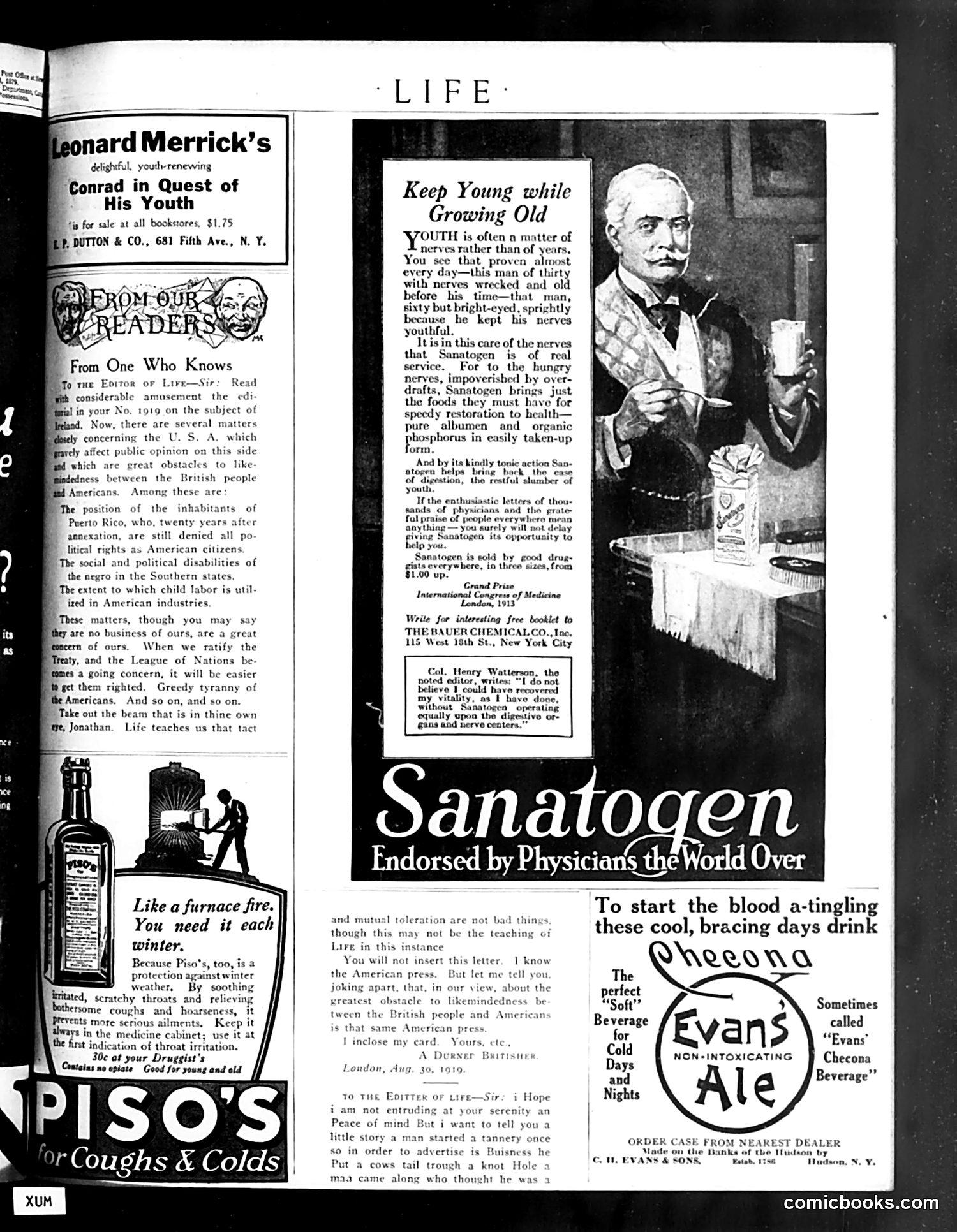
This page is primarily **advertising rather than political satire**. The main content includes: 1. **Sanatogen advertisement** (center-right): Features a distinguished older gentleman endorsing a nerve tonic. The ad claims it keeps one "young while growing old" by restoring nerves through "pure albumen and organic phosphorus." 2. **Piso's cough remedy ad** (lower left): A patent medicine advertisement. 3. **Evans Ale advertisement** (lower right): Promotes a beverage for "cold days and nights." 4. **Reader letters section** (left): Discussion of U.S.-British relations and American politics, dated August 1919. These are typical early-20th-century patent medicine and beverage ads making health claims now considered dubious or false. The page reflects the era's largely unregulated advertising landscape.
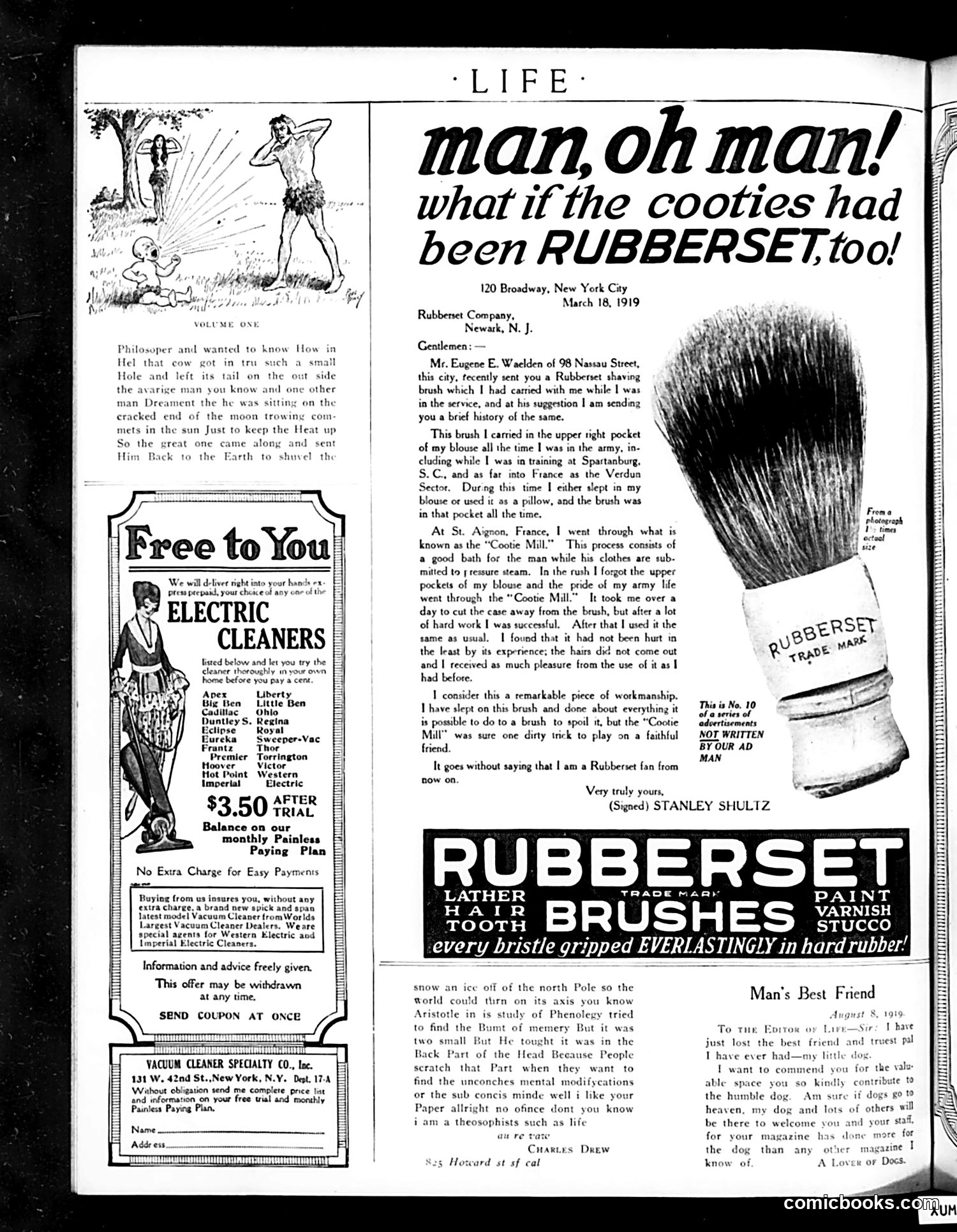
This page is primarily **advertising and reader letters**, not political satire. The main content features: 1. **"Rubberset" advertisement** (right side): A humorous ad for hairbrushes with the tagline "man, oh man! what if the cooties had been RUBBERSET, too!" This references **WWI soldiers' widespread louse infestations**—a genuine wartime problem. The joke suggests Rubberset brushes are so durable they could even survive delousing procedures. The accompanying letter from a soldier (Stanley Shultz) describes using the brush in a "Cootie Mill" process for cleaning clothes. 2. **Left side**: An "Electric Cleaners" advertisement offering various vacuum cleaner brands. 3. **Bottom**: Reader letters about unrelated topics (philosophy, dogs). The humor relies on readers' familiarity with the unglamorous reality of WWI trench warfare—specifically the persistent parasite problem that plagued soldiers.
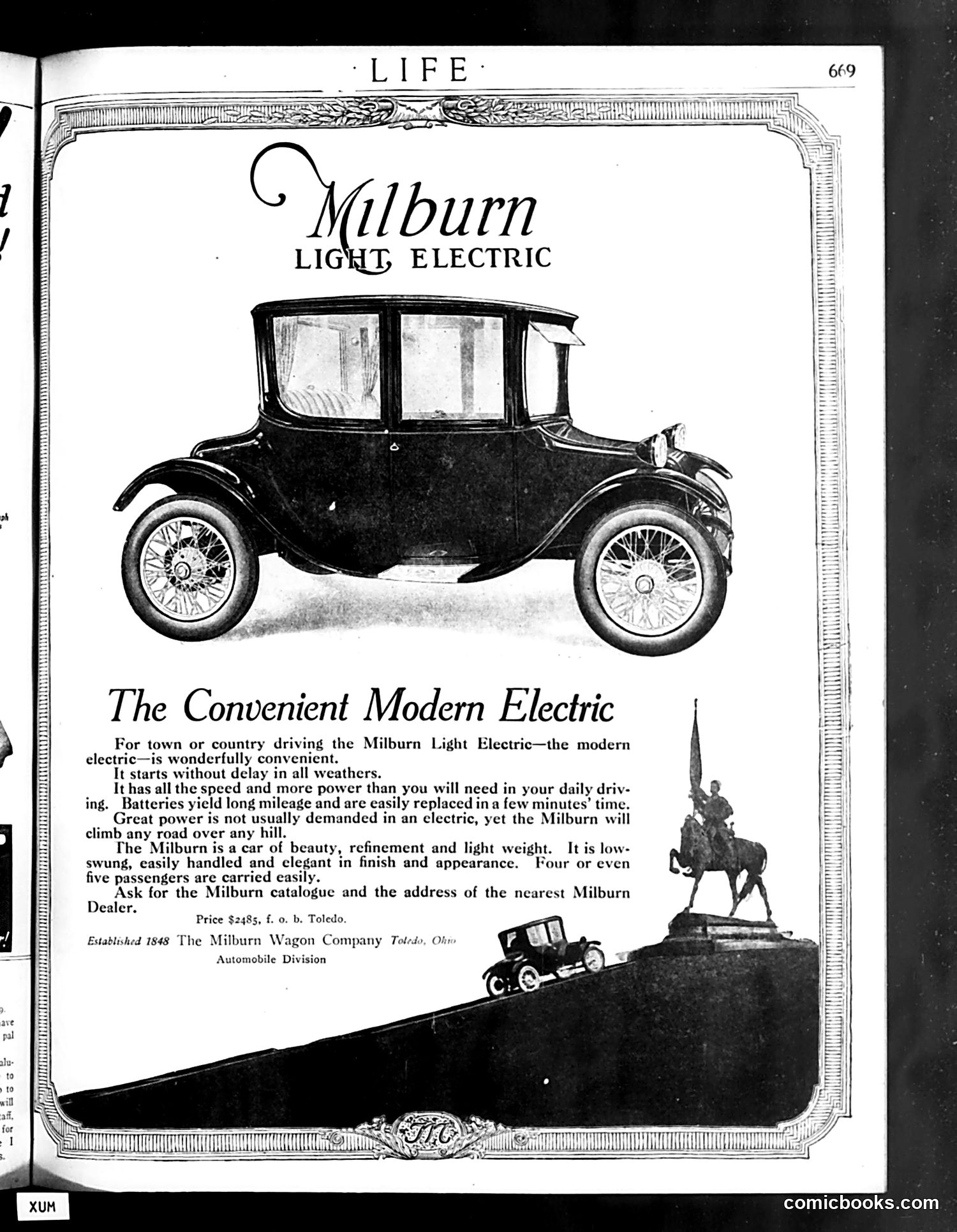
This is not a satirical cartoon but rather a **straightforward automobile advertisement** for the Milburn Light Electric car, published in Life magazine's advertising section (page 669). The ad promotes the Milburn as "The Convenient Modern Electric" vehicle suitable for town and country driving. Key selling points emphasized include: reliable starts in all weather, adequate speed and power for daily use, long battery range (100 miles), and elegant design accommodating up to five passengers. The illustration shows the boxy, enclosed electric vehicle in profile. A smaller vignette depicts the car climbing a steep hill, symbolizing its power and capability—directly refuting skepticism about electric vehicles' performance. The price ($2,485 f.o.b. Toledo) and manufacturer information are provided. This represents early-1900s electric vehicle marketing before gasoline engines dominated the market.
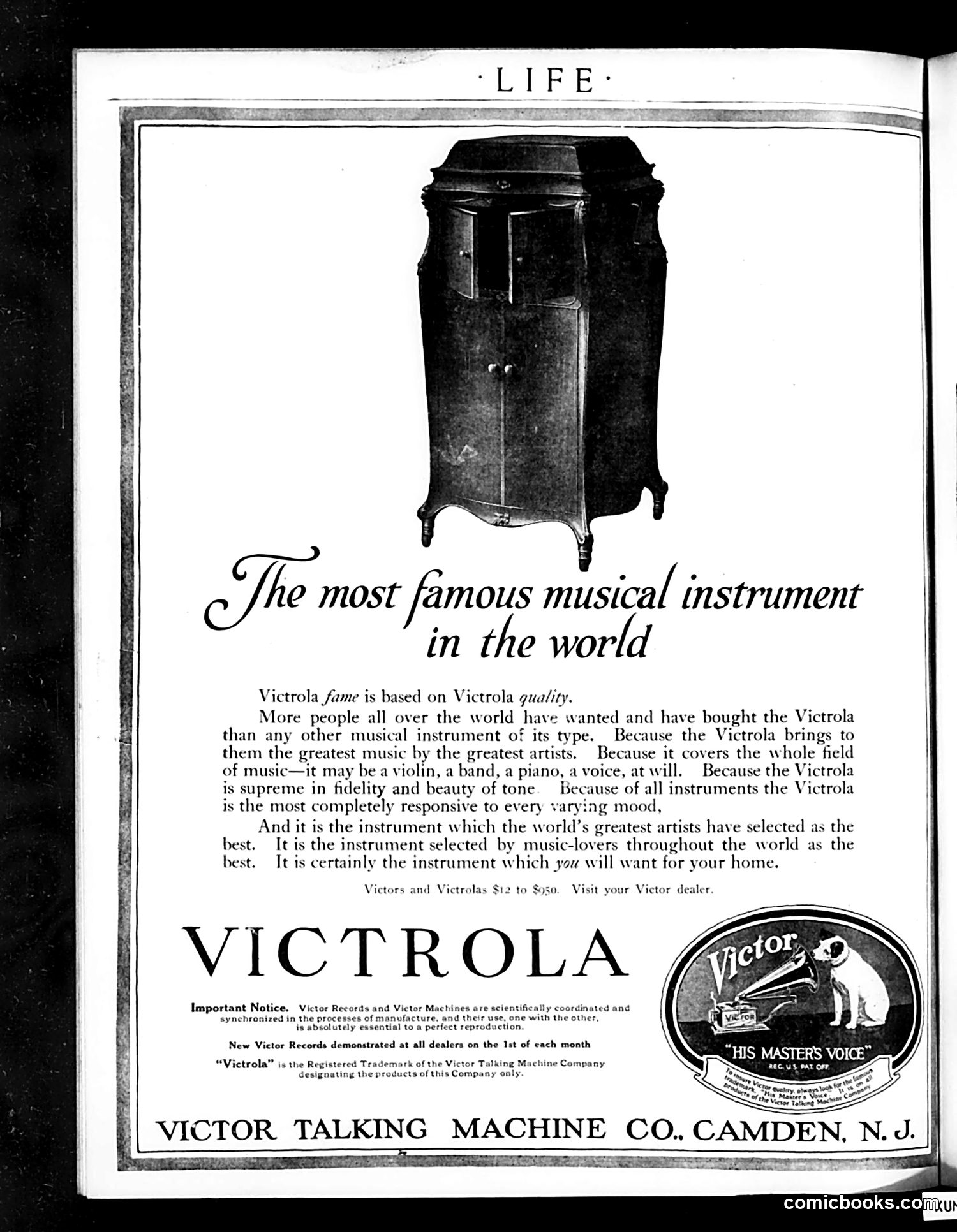
This page is primarily a **Victrola advertisement**, not satirical content. It shows a wooden cabinet phonograph and claims it as "the most famous musical instrument in the world." The ad emphasizes that more people worldwide have purchased Victrolas than any other musical instrument of its type, and that it's endorsed by "the world's greatest artists." It highlights the device's versatility—capable of reproducing violins, bands, pianos, voices—and promises superior fidelity and tone responsiveness. The famous "His Master's Voice" logo (showing a dog listening to a phonograph) appears in the bottom right corner, identifying this as Victor Talking Machine Company's product. This represents early 20th-century advertising that used prestige and mass-appeal claims rather than satire or humor to sell consumer technology.
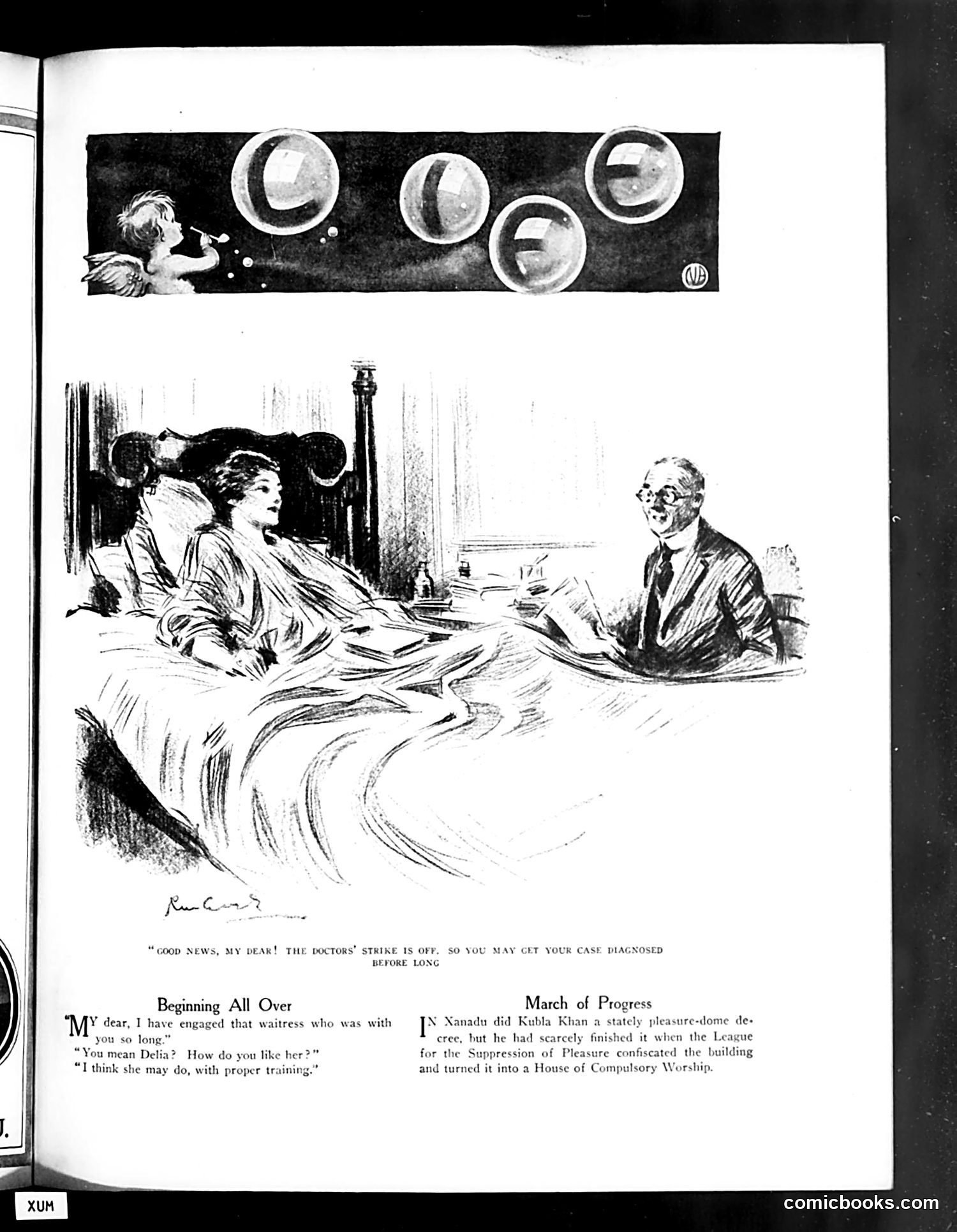
The main cartoon depicts a man in bed with a woman, speaking to a doctor. The caption reads: "Good news, my dear! The doctors' strike is off, so you may get your case diagnosed before long." **The satire:** This jokes about a doctors' strike that had made medical care unavailable. The humor is dark—the patient's condition is so serious that even with the strike ending, there's doubt he'll survive long enough to actually receive diagnosis and treatment. **The context:** The reference to "the doctors' strike" suggests this reflects a real labor action by physicians, likely early 20th century based on Life magazine's era and the illustration style. The secondary items appear to be advertisement panels (the cherub blowing bubbles) and an unrelated story titled "March of Progress" about Nanadu and Kubla Khan.
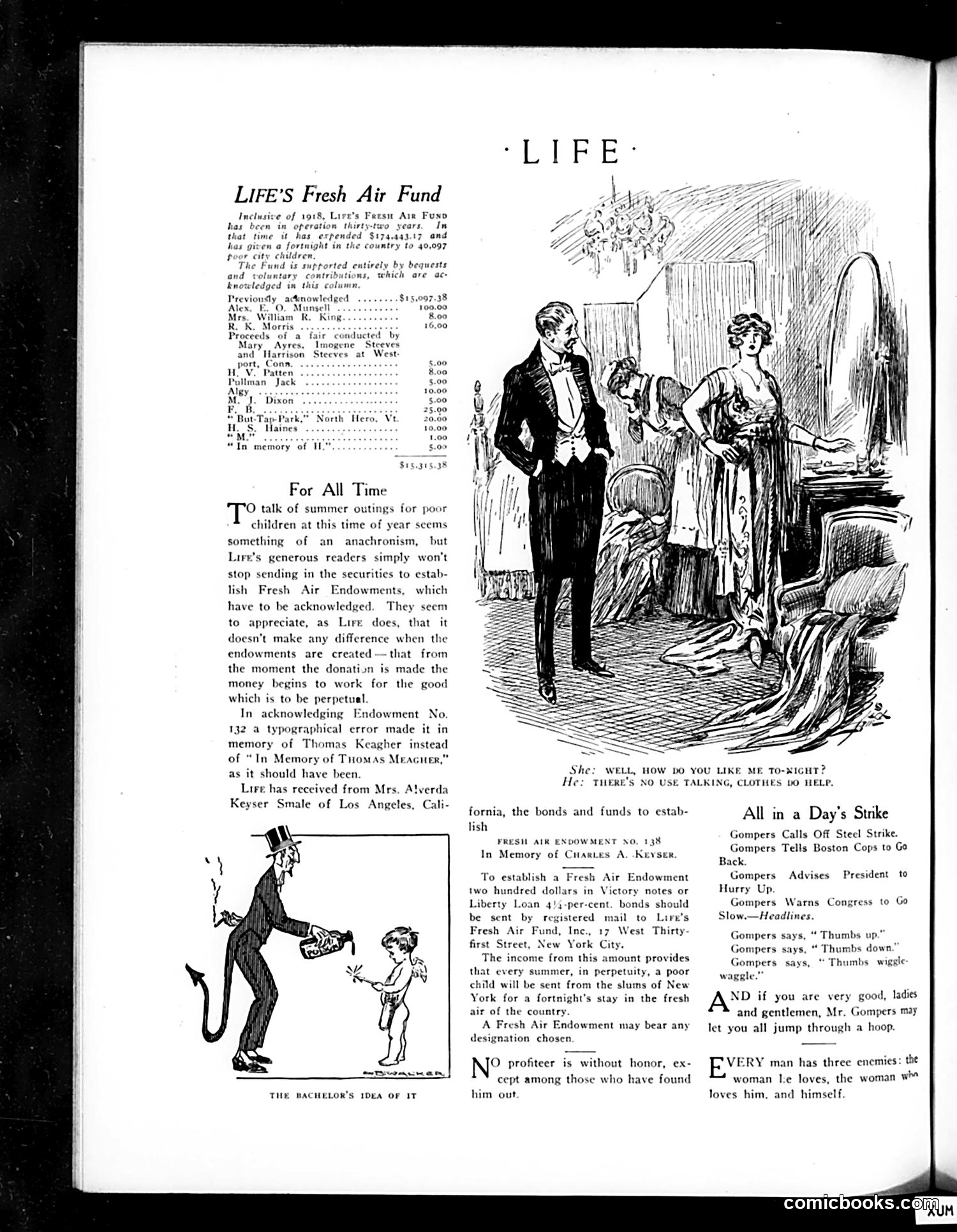
This page documents **Life's Fresh Air Fund**, a charitable endowment providing summer outings for poor urban children. The left column lists donors and contributions (totaling $13,197.28). The illustration captioned "THE BACHELOR'S IDEA OF IT" shows a man juggling a child, satirizing wealthy bachelors' impractical notions of childcare—suggesting they have no genuine understanding of children's needs. The main illustration depicts an elegantly-dressed couple receiving a poor child visitor, with the caption "SHE: WELL, HOW DO YOU LIKE ME TO-NIGHT? / HE: THERE'S NO USE TALKING, CLOTHES DO HELP." This mocks shallow materialism: the wealthy care only about appearances while claiming charitable impulses. The satire critiques how wealthy donors congratulate themselves for charity while remaining disconnected from actual poverty and children's welfare.
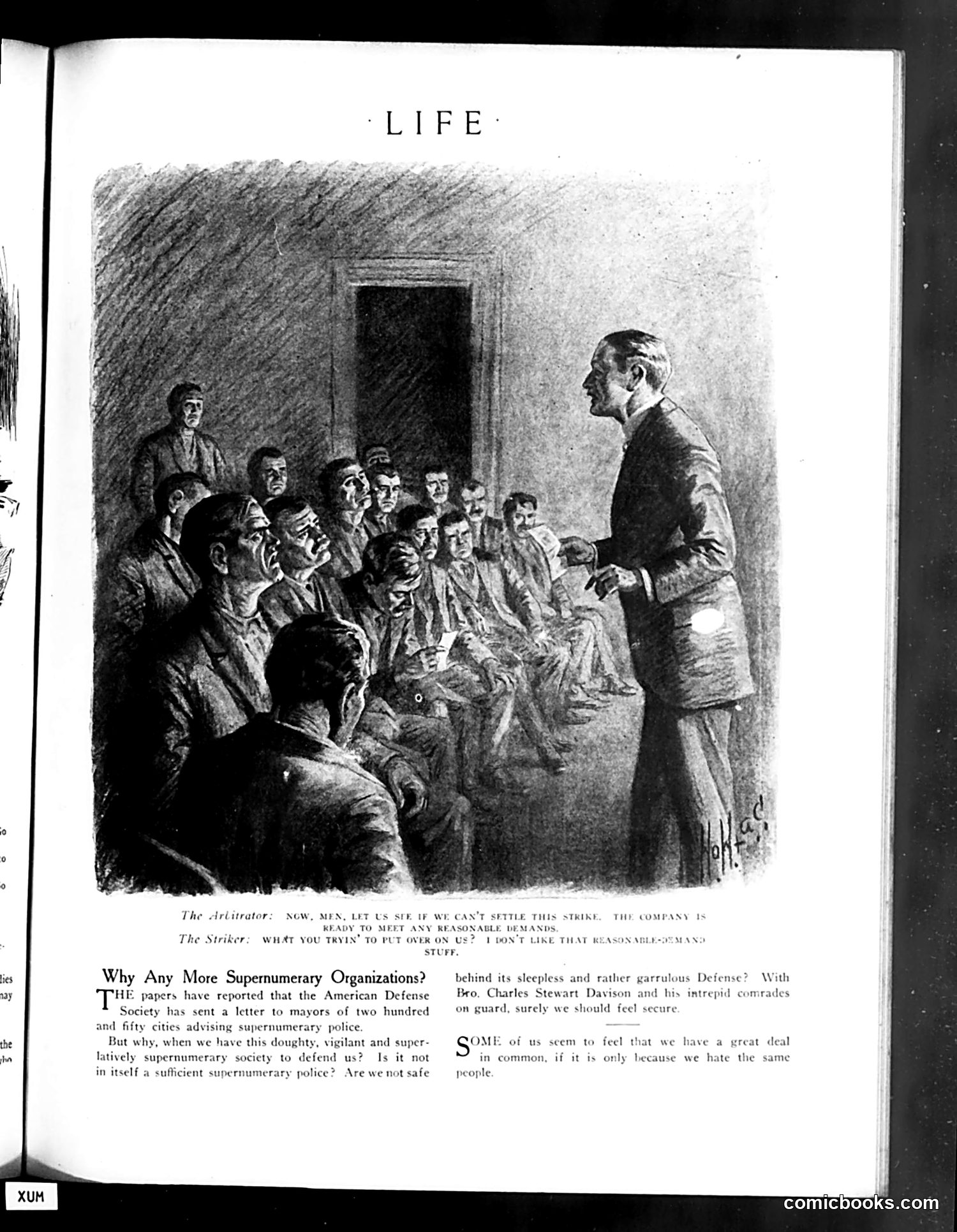
This page critiques the proliferation of "supernumerary" (extra, unnecessary) police organizations in American cities. The cartoon depicts an arbitrator addressing striking workers, proposing compromise while a company representative objects to labor demands. The accompanying article questions whether cities truly need multiple overlapping police forces for defense, or if one sufficient police force suffices. The author argues that redundant security organizations may themselves be problematic. The satire suggests that just as the strike involves conflicting parties, American cities face confusion from too many competing police agencies—a waste of resources and coordination. The piece advocates consolidation rather than expansion of law enforcement, reflecting Progressive Era concerns about governmental efficiency and bureaucratic bloat.
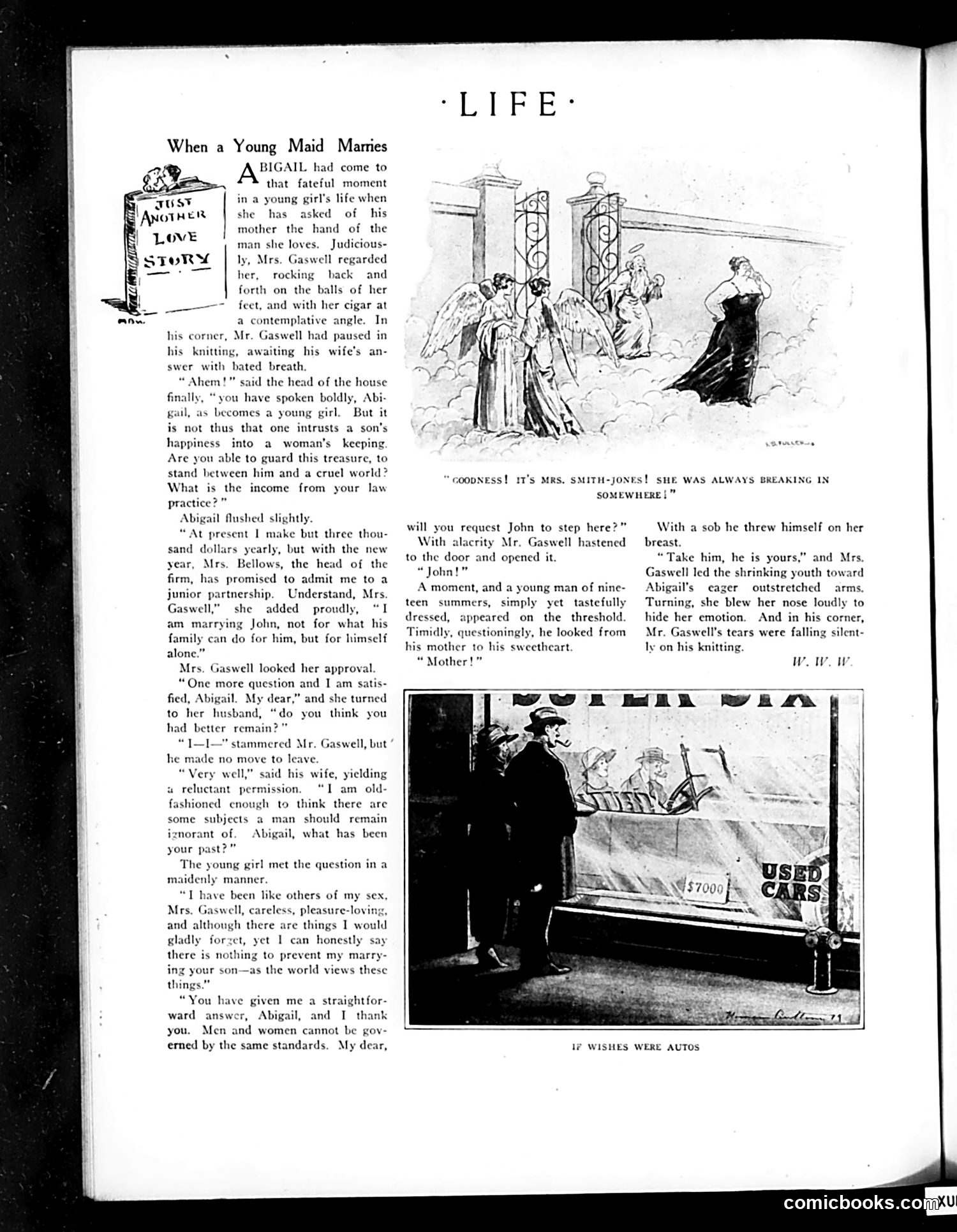
This page presents a satirical short story about marriage and women's autonomy. The narrative mocks Victorian-era anxieties about wives' independence by depicting a conversation between Abigail and her father-in-law, Mr. Gaswell, who challenges her right to guard her own happiness and asks about her income. The accompanying illustration shows a woman with wings (appearing angelic or idealized) among classical columns, while the lower cartoon depicts a used-car lot—likely satirizing the commodification of women in marriage, equating wives to consumer goods being "shopped for." The story's resolution suggests critique of traditional male authority: Abigail confidently asserts her right to marry for love, and Mr. Gaswell ultimately accepts this modern view, acknowledging that "Men and women cannot be governed by the same standards."
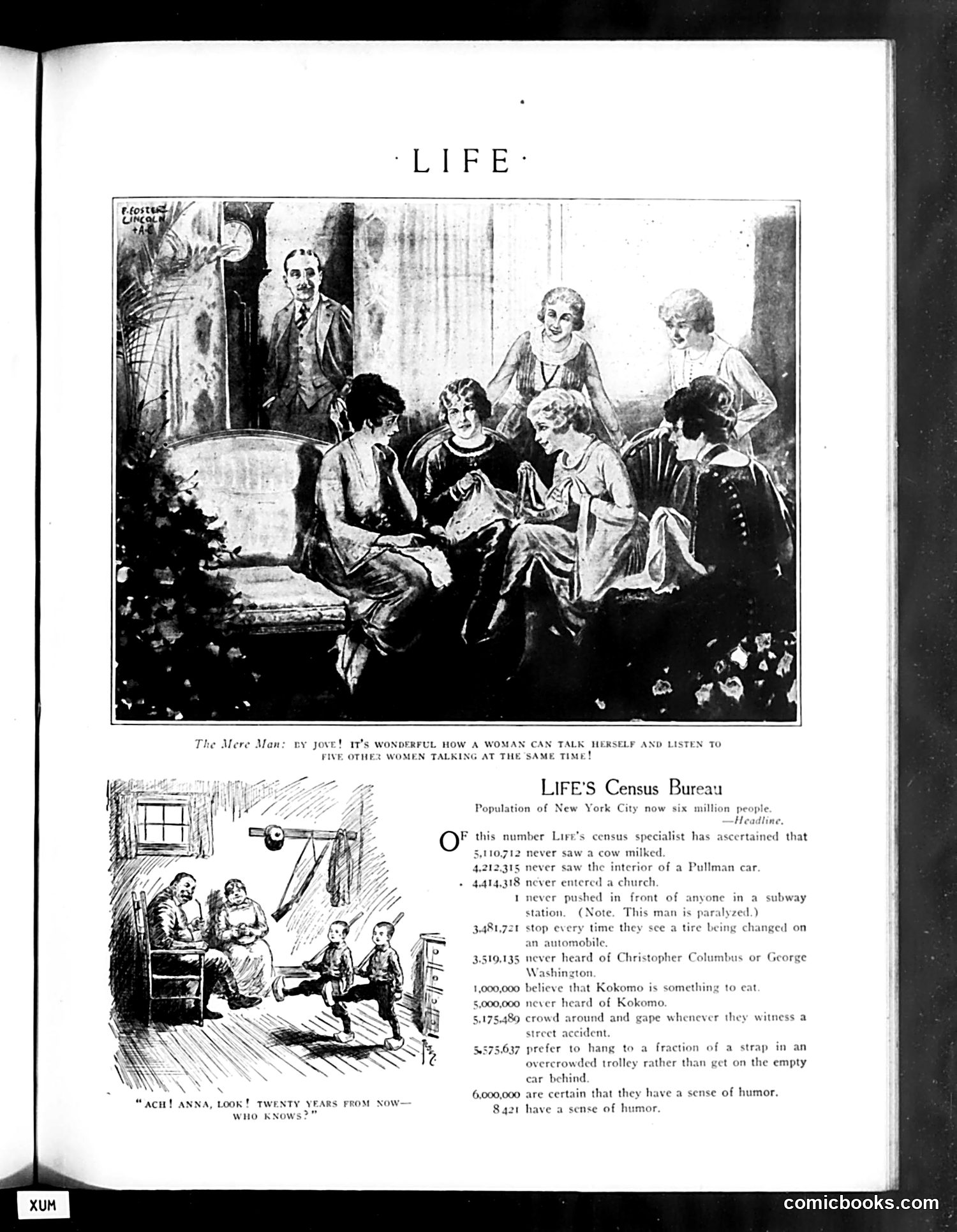
This page contains two satirical cartoons about gender and social observation: **Top cartoon**: Shows a woman speaking while five other women listen. The caption jokes that "it's wonderful how a woman can talk herself and listen to five other women talking at the same time"—mocking women's supposed chattiness and multitasking abilities. **Bottom cartoon**: Depicts a tenement family scene with the caption "Ach! Anna, look! twenty years from now—who knows?"—suggesting uncertainty about the future and poking fun at working-class immigrant aspirations. **"Life's Census Bureau" section**: Lists statistical absurdities about New York City residents (people who've never seen trains, churches, or heard of Columbus), satirizing urban life and social disconnection in the modern city. The overall tone reflects early 20th-century American humor mixing gender stereotypes with class-based urban satire.
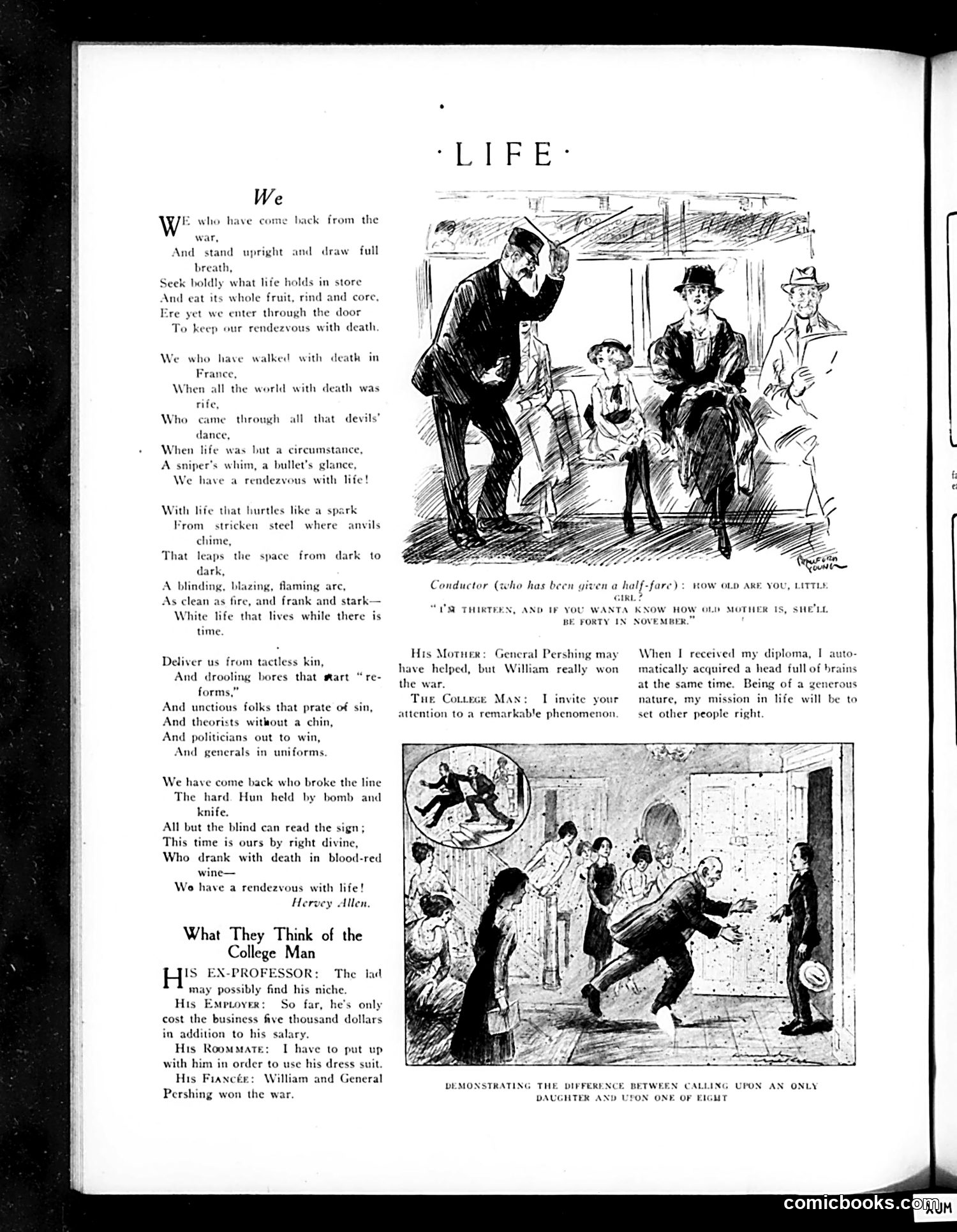
This page presents post-WWI reflections and social commentary. The top poem "We" celebrates soldiers returning from France, emphasizing their newfound appreciation for life after experiencing death in combat. The lower cartoon satirizes college men's postwar prospects. It mocks how an "Ex-Professor" struggles to find his niche despite education, while his "Fiancée" complains the business world demands thousands in additional salary beyond his teaching pay. His "Roommate" notes General Pershing won the war—implying military figures, not educated civilians, gained prestige and advantage. The bottom illustration shows chaotic domestic life, captioned as demonstrating the difference between "calling upon an only daughter" versus "calling upon one of eight"—satirizing how men court differently based on family size.
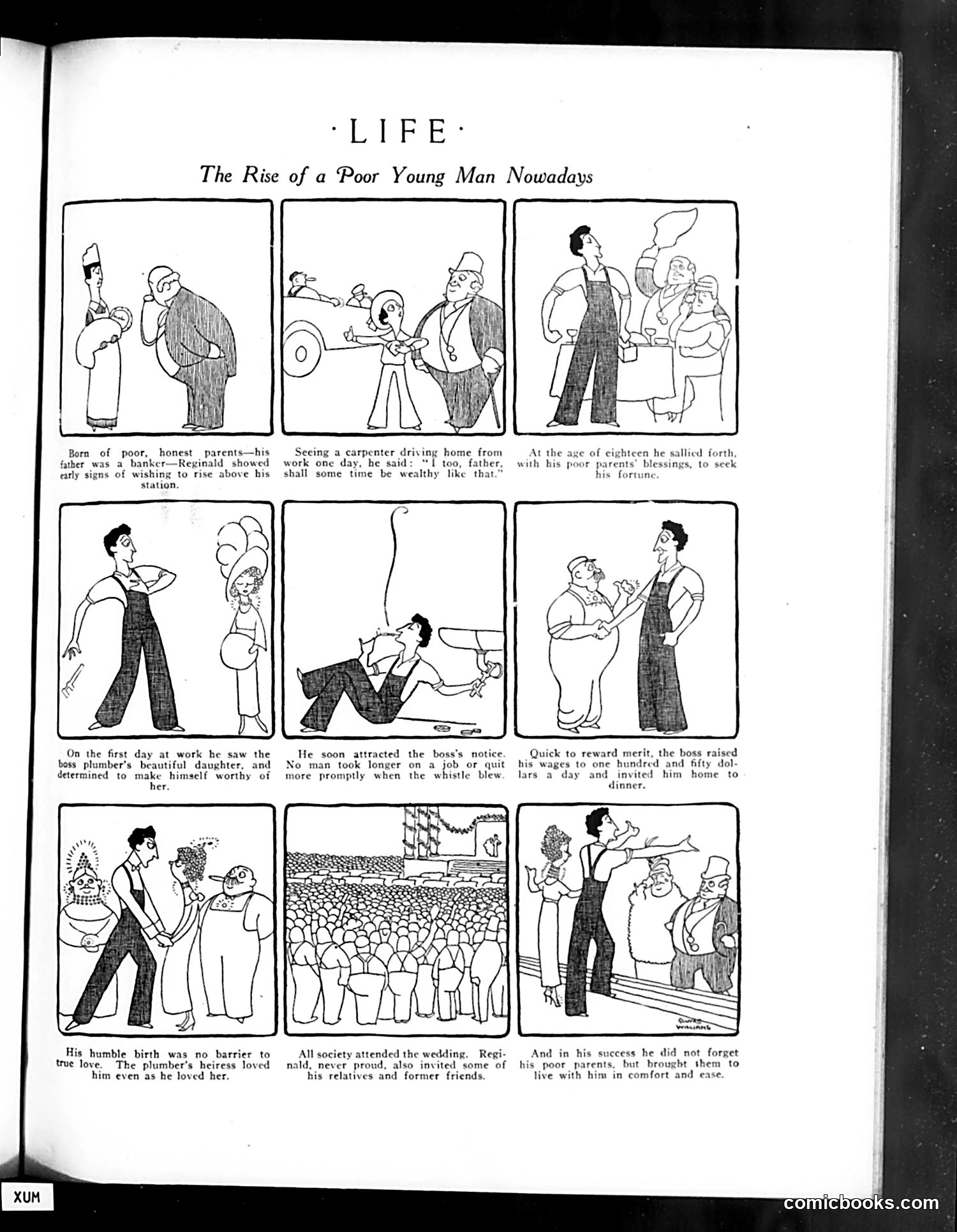
This nine-panel comic strip depicts a satirical rags-to-riches narrative. A poor boy with honest barber parents aspires to wealth after seeing a carpenter's success. At eighteen, he leaves home seeking fortune. The comic follows his rise: he works hard, catches the eye of a plumber's wealthy daughter, marries her (before a massive crowd), and achieves financial success, earning "$150 a day." The satire targets early 20th-century American social mobility myths. The exaggerated narrative—poor origins, marrying into wealth, instant prosperity—mocks the "self-made man" ideology. By showing this unlikely trajectory as a crowd-pleasing fantasy rather than realistic expectation, the comic suggests such dramatic upward mobility is more fairy tale than achievable goal for ordinary working-class youth.
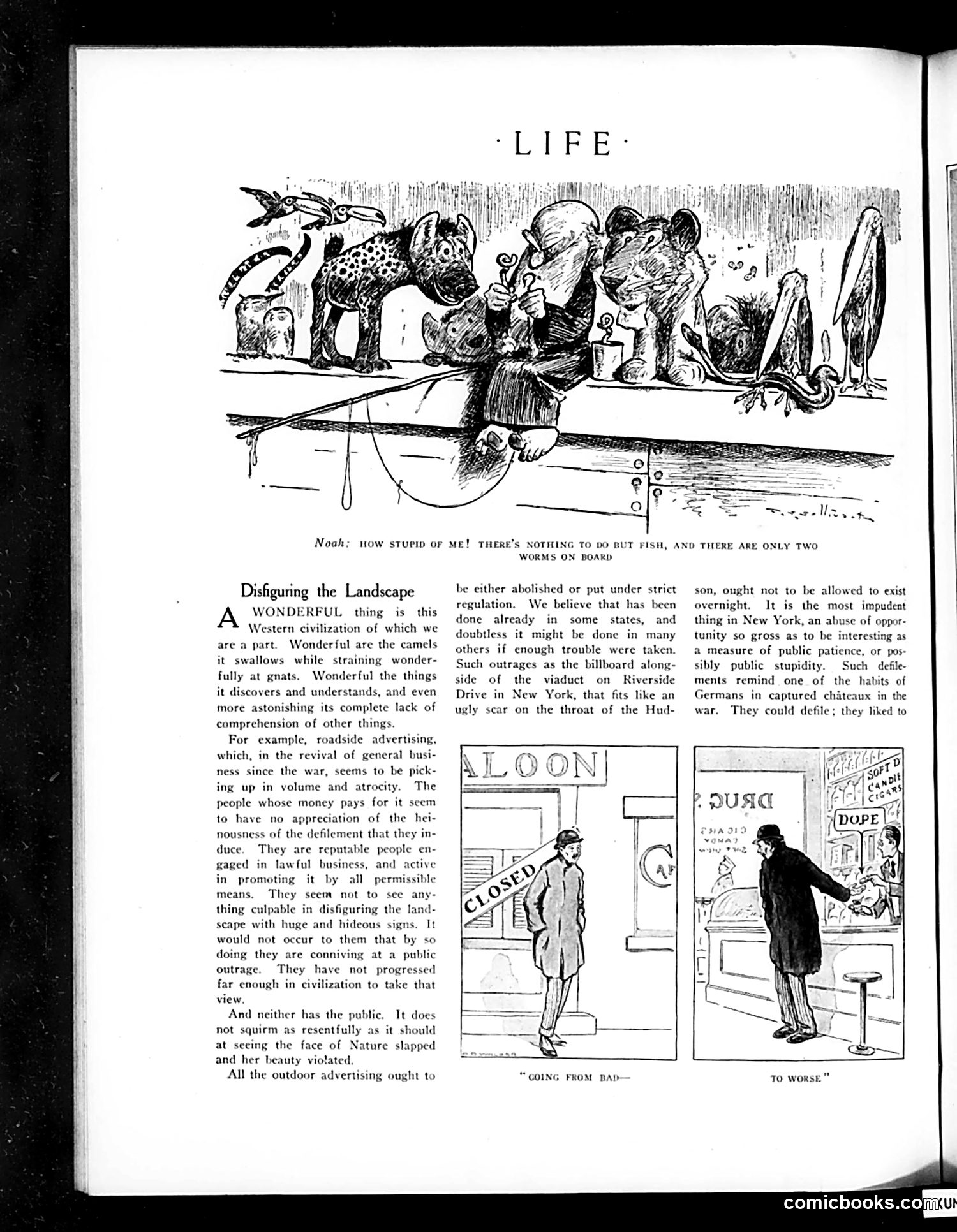
This page critiques **roadside advertising billboards** that were proliferating in early 20th-century America, particularly along highways like New York's Riverside Drive. The article argues such advertisements constitute visual pollution that defaces natural landscapes and indicates public apathy toward environmental degradation. The top cartoon shows a frustrated fisherman complaining there's "nothing to do but fish" with only "two worms on board"—a darkly comic reference to billboards as parasitic "worms" infesting the countryside. The two lower cartoons titled "Going from Bad—to Worse" depict a man discovering successive storefront signs (CLOSED, then a DOPE pharmacy). This sequence illustrates how tawdry commercial signage progressively worsens the urban/rural aesthetic. The satire targets both irresponsible advertisers and an indifferent public failing to oppose landscape desecration.
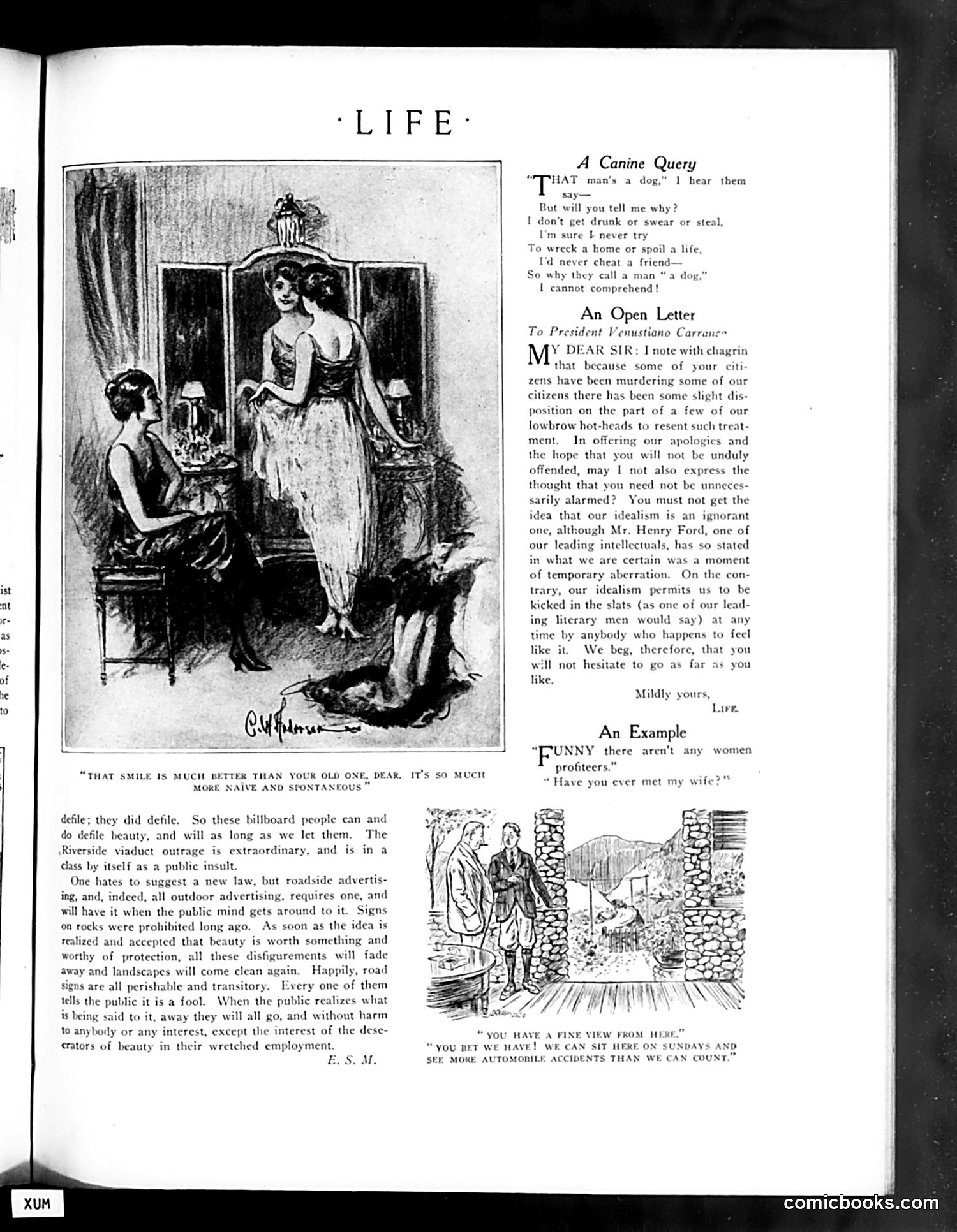
This page contains three satirical pieces: 1. **"A Canine Query"** (top right): A poem questioning why dogs are called "man's best friend" when they're loyal, honest, and trustworthy—traits the speaker ironically suggests humans lack. 2. **Main illustration** (left): Shows a woman admiring herself in a mirror with the caption about her smile being "naïve and spontaneous." This satirizes artificial beauty standards and the performative nature of femininity. 3. **"An Open Letter to President [unclear]"**: Defends idealism against critics who call it ignorant, citing Henry Ford as evidence that idealism has merit. The letter suggests some citizens resent this idealism but shouldn't dismiss it. 4. **"An Example"** (bottom): A brief joke about women profiteers, likely referencing wartime or business profiteering. The overall theme critiques hypocrisy in American society—artificiality, greed, and cynicism masquerading as realism.
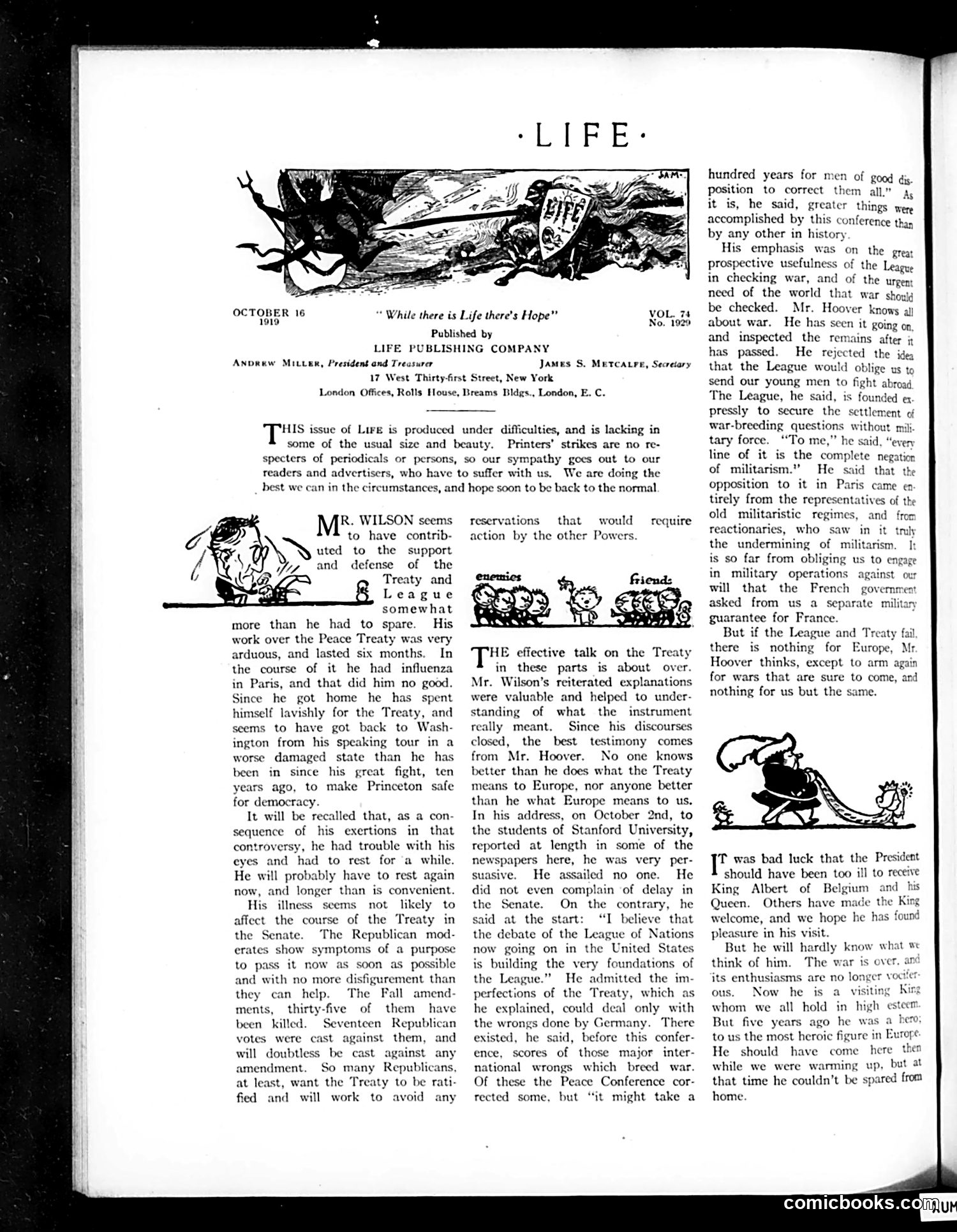
This page discusses President Woodrow Wilson's health crisis and the League of Nations treaty debate. The editorial notes Wilson has exhausted himself campaigning for the Treaty after his Paris Peace Conference work, suffering influenza and now apparent physical collapse—he "seems to have got back to Washington from his speaking tour in a worse damaged state than he has been in since his great fight...to make Princeton safe for democracy." The cartoons (showing figures labeled "enemies" and "friends") appear to illustrate the Treaty's political divisions. The page praises Herbert Hoover's measured October 2nd Stanford address supporting the League, noting he "assailed no one" while acknowledging the Treaty's imperfections. The text suggests Republican moderates may ratify the Treaty with minimal amendments, though seventeen Fall amendments were killed with Republican support. The satire implicitly critiques Wilson's self-destructive devotion to the Treaty cause while praising Hoover's diplomatic reasonableness—contrasting approaches to post-war internationalism.
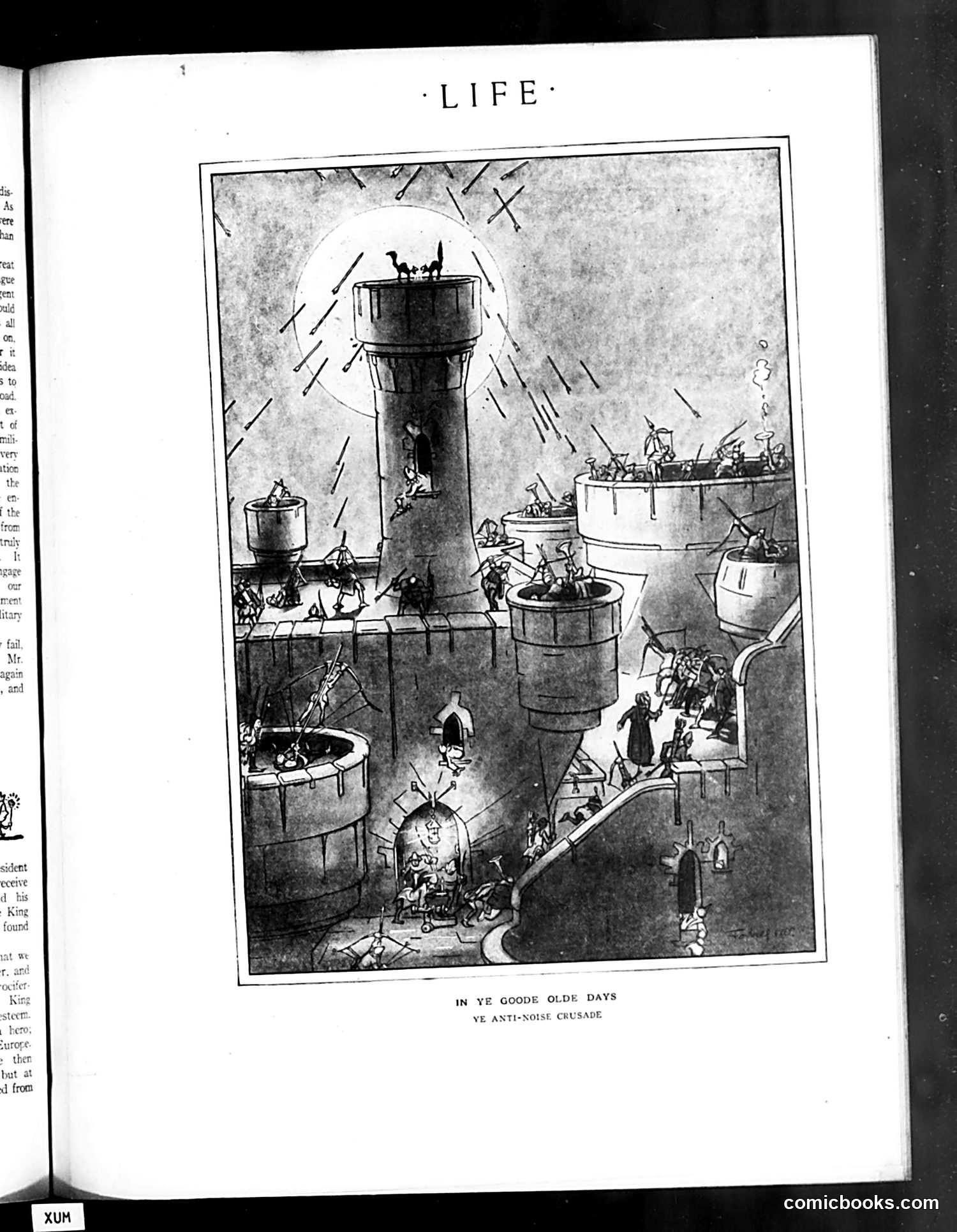
This satirical cartoon from *Life* magazine depicts "Ye Anti-Noise Crusade" as an elaborate medieval fantasy. The illustration shows a fortress-like structure with towers, catapults, and armed figures engaged in what appears to be a battle against noise itself—represented abstractly through the various weapons, siege equipment, and chaotic activity. The satire mocks anti-noise crusades (likely early 20th-century reform movements) by treating noise reduction as a quixotic, overwrought "crusade" requiring military-scale intervention. The "good olde days" title sarcastically suggests nostalgia while the medieval imagery implies such efforts are hopelessly outdated or fantastical. The cartoon ridicules the earnestness and impracticality of noise-abatement advocates by presenting their campaign as absurdly elaborate and ultimately futile.
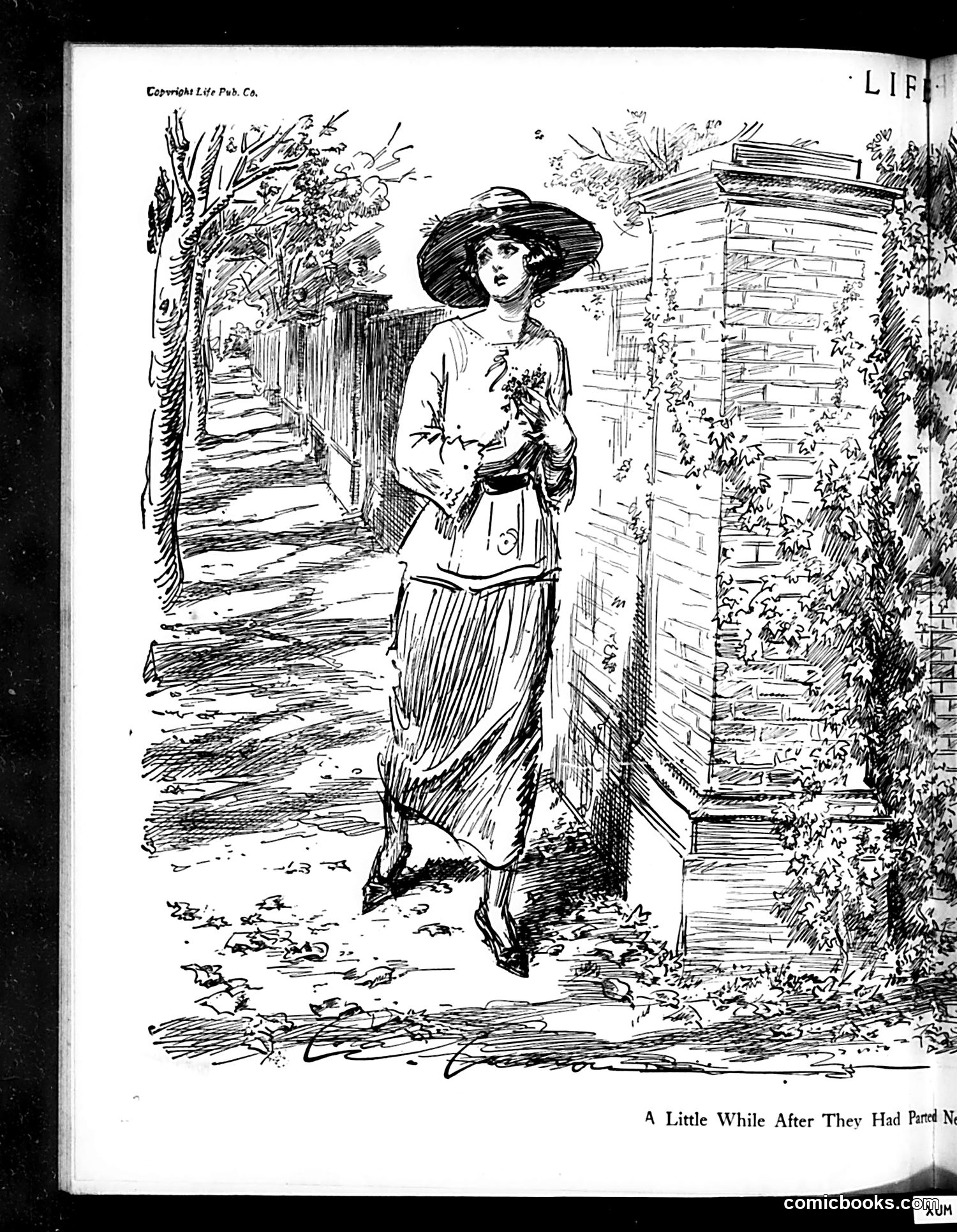
This appears to be an illustration from *Life* magazine showing a woman in early 20th-century dress standing in a garden or ivy-covered pathway. She wears a wide-brimmed hat, long skirt, and blouse typical of the Edwardian era. The caption reads "A Little While After They Had Part[ed] No[...]" (text is cut off), suggesting this illustrates a romantic or sentimental moment—likely depicting a woman alone after saying goodbye to someone, possibly a suitor or loved one. Without the complete caption and additional context, the specific satire is unclear. The image appears to be either a sentimental illustration accompanying a story or poem, or possibly gentle social commentary on romance and courtship conventions of the period. The incomplete text prevents definitive interpretation of the intended joke or point.
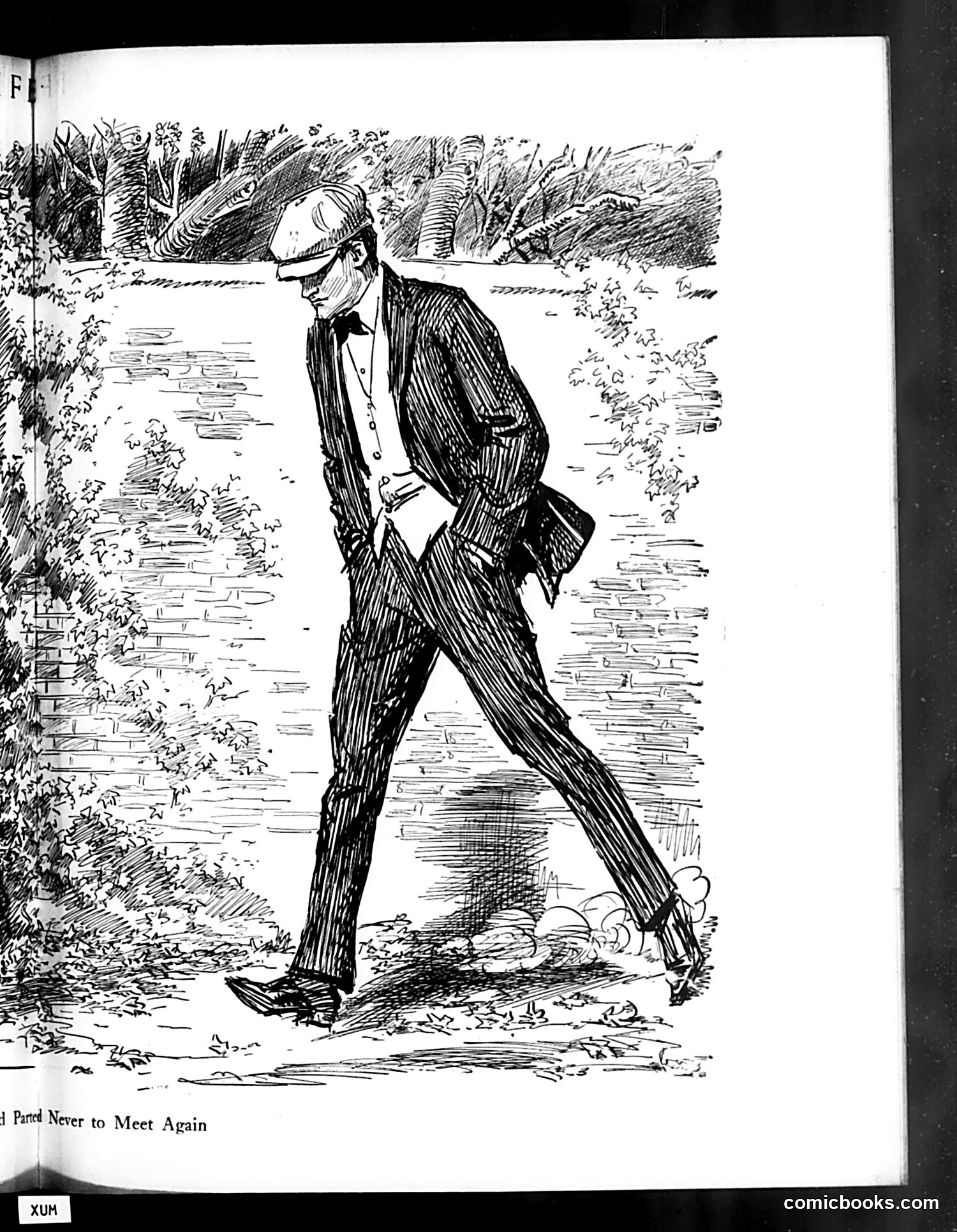
This political cartoon depicts a well-dressed gentleman in a suit and cap walking away from what appears to be a body of water or riverbank, with vegetation visible on both sides. The title reads "Parted Never to Meet Again." Without additional context from the magazine's date or surrounding articles, the specific political reference is unclear. However, the image suggests a figure departing from someone or something permanently—possibly referencing a broken relationship, political split, or ended association. The formal dress and deliberate body language suggest this concerns a significant public or political figure. The satirical point likely critiques a notable separation or break that Life's readers would have recognized, but identifying the specific individuals or event requires the publication date and surrounding content.
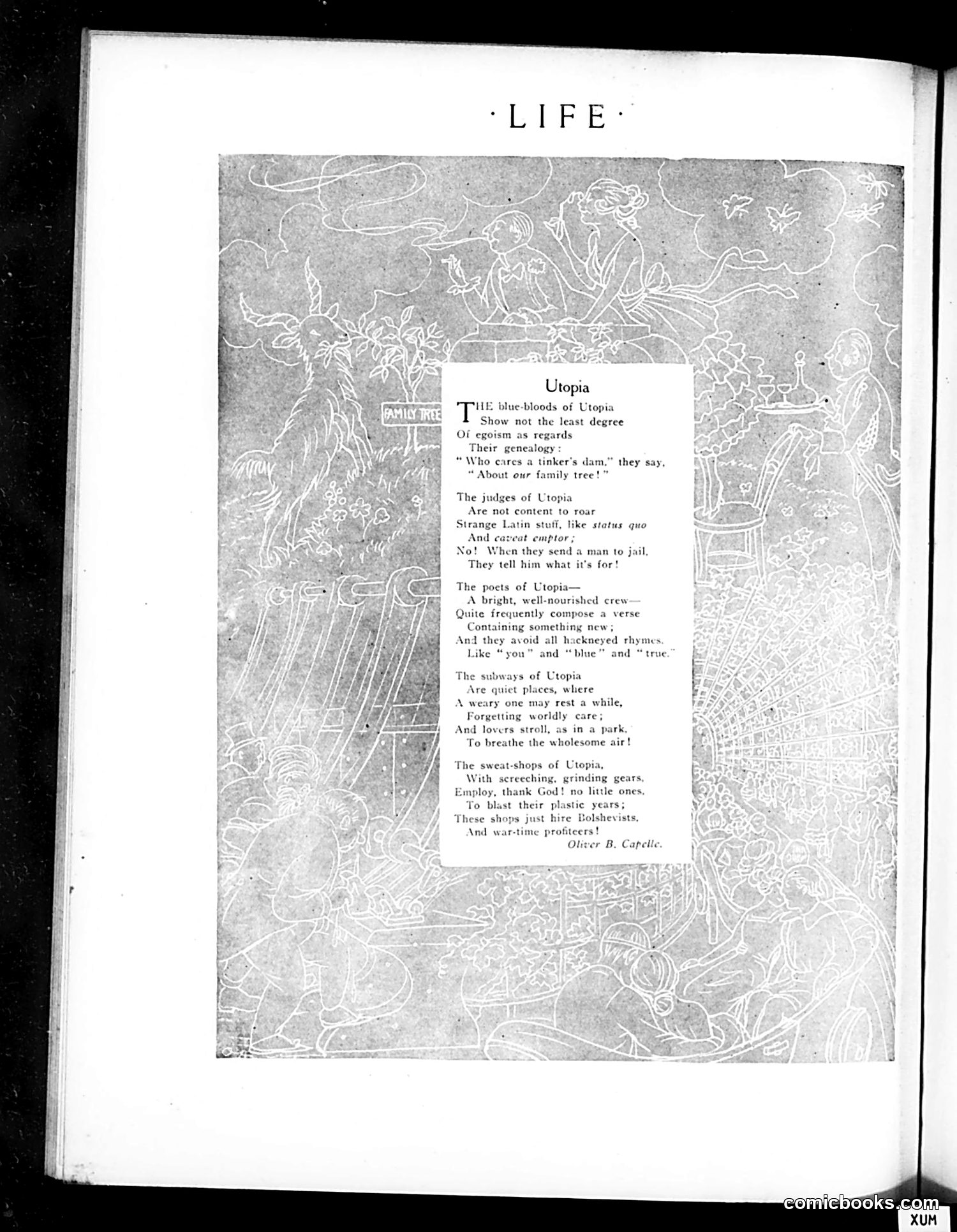
This satirical poem uses an idealized society called "Utopia" to critique contemporary American institutions and social problems. The satire works by describing what Utopia *does right*, thereby exposing what America does *wrong*: **Key targets:** - **Aristocratic pretension**: Utopian blue-bloods don't obsess over genealogy, contrasting with American social climbing - **Judicial opacity**: Utopian judges explain why they jail people; American courts apparently don't - **Literary mediocrity**: Utopian poets avoid clichés and hackneyed rhymes (like "you/blue/true") - **Urban pollution**: Utopian subways are peaceful; American ones are presumably noisy and crowded - **Child labor**: Utopian sweatshops don't employ children—implying American ones did The accompanying ornate illustration (likely a fantastical cityscape) provides visual contrast to the poem's social commentary. This is classic early-20th-century American satirical critique of labor conditions, class structures, and judicial transparency.
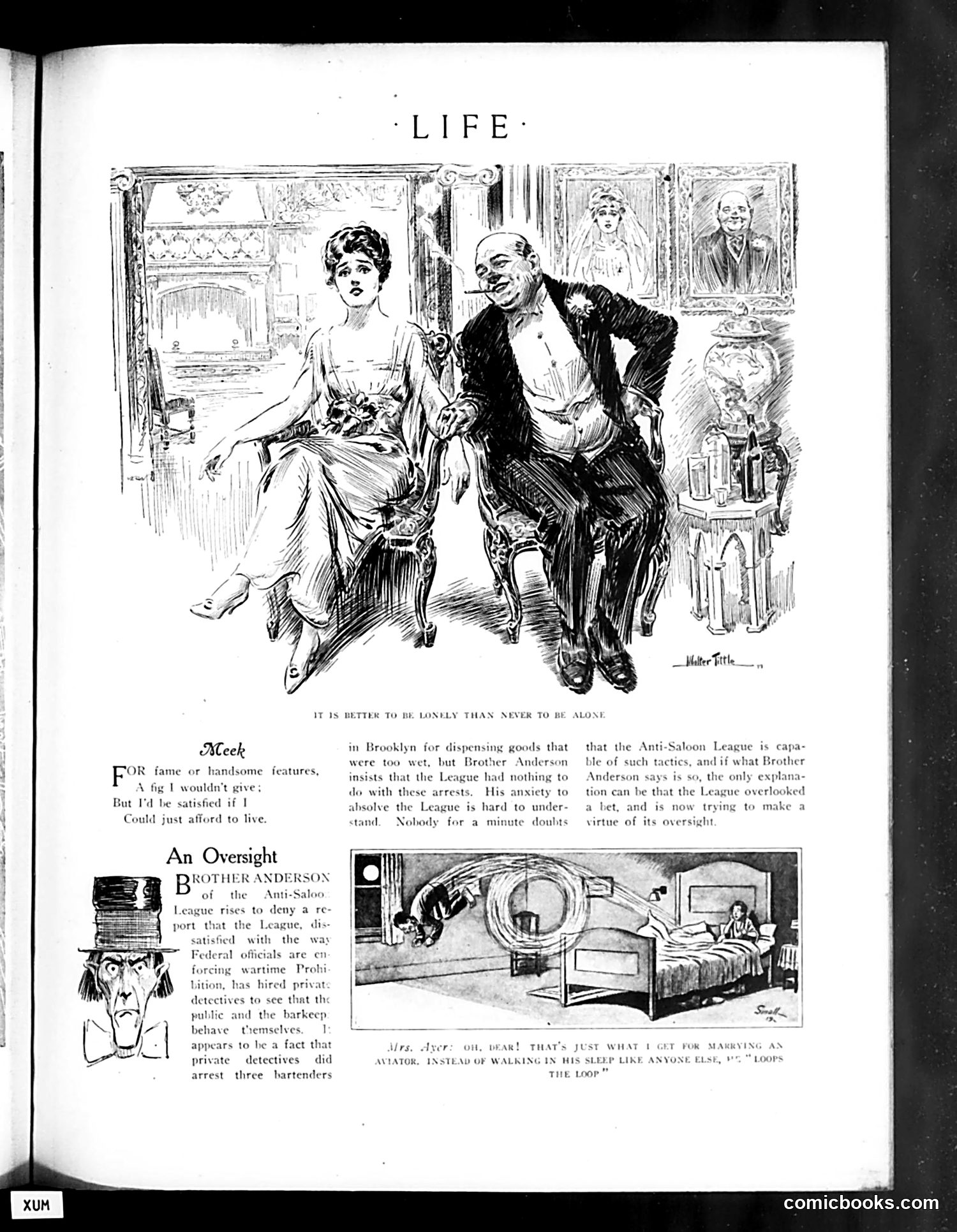
This page satirizes the **Anti-Saloon League** during Prohibition. The main article, "An Oversight," mocks the League's claimed innocence in enforcement activities. The League denies involvement in arrests of Brooklyn bartenders for selling alcohol ("goods that were too wet"), but the text suggests their denial is unconvincing—they hired private detectives to police compliance, yet claim ignorance when arrests occur. The cartoon caption at bottom appears to joke about Prohibition's absurdity: a man complains that instead of sleeping peacefully like others, he's forced to "walk in his sleep like anyone else" while looping—likely referring to the desperate measures people took during alcohol prohibition (possibly illicit distilling or drinking). The satirical poem "Meek" expresses working-class anxiety about economic survival rather than pursuing fame—a commentary on Depression-era concerns. The overall message: the Anti-Saloon League's self-righteous denial of its enforcement tactics was transparent hypocrisy.
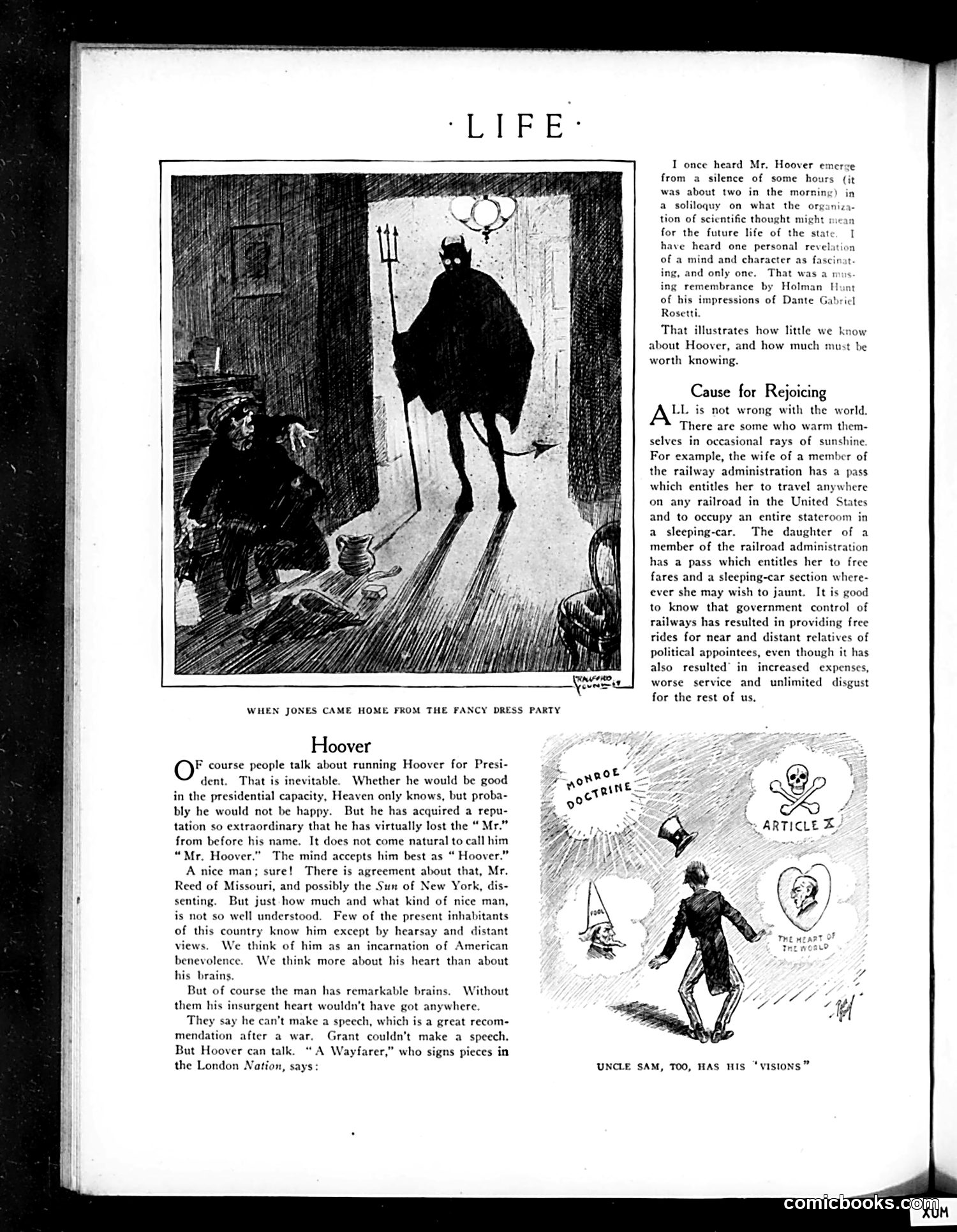
This page satirizes Herbert Hoover ahead of potential presidential candidacy. The main article acknowledges Hoover's reputation for kindness and intelligence but argues Americans know little about him substantively—only hearsay and distant impressions. The top illustration shows a demonic figure ("When Jones Came Home from the Fancy Dress Party"), likely commenting on Hoover's public mystique versus reality. Below, a section titled "Cause for Rejoicing" uses biting irony to mock government railroad administration, criticizing how political appointees' family members receive free passes and preferential treatment while service deteriorates for ordinary citizens—contradicting promises that government control would improve efficiency. The bottom cartoon labeled "Uncle Sam, Too, Has His 'Visions'" depicts Uncle Sam with various ideological symbols, suggesting competing visions of America's future direction. Overall, the page expresses skepticism about Hoover's suitability for high office and criticizes contemporary government patronage practices.
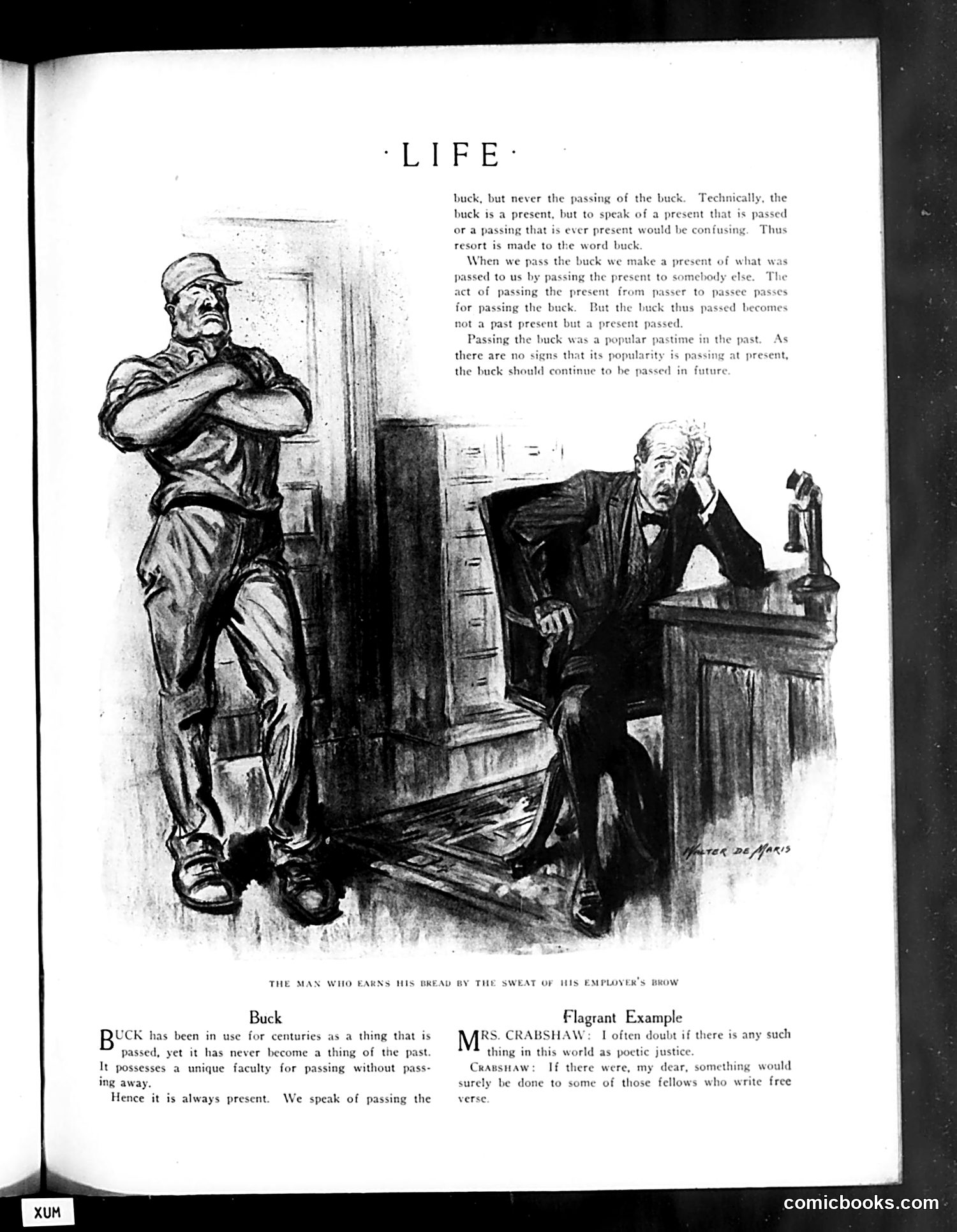
This page satirizes the phrase "passing the buck"—evading responsibility by shifting it to someone else. **Main Cartoon:** Shows a working-man (left, muscular, wearing a cap) standing with arms crossed, while a well-dressed businessman (right) sits anxiously at a desk. The caption reads "THE MAN WHO EARNS HIS BREAD BY THE SWEAT OF HIS EMPLOYER'S BROW"—inverting the Biblical phrase to mock how employers profit from workers' labor while the worker bears the actual burden. **The Point:** The visual joke critiques class inequality and the buck-passing culture of business. The worker physically embodies the work, while the nervous employer takes credit (and profit). **Secondary Dialogue ("Flagrant Example"):** Two characters discuss "poetic justice," with one sarcastically noting free-verse poets deserve punishment—a separate literary jab at modernist poetry trends. The article's wordplay on "buck" (the object passed, the responsibility dodged, the present that's always present) supports the cartoon's theme: those in power avoid accountability by passing blame downward.
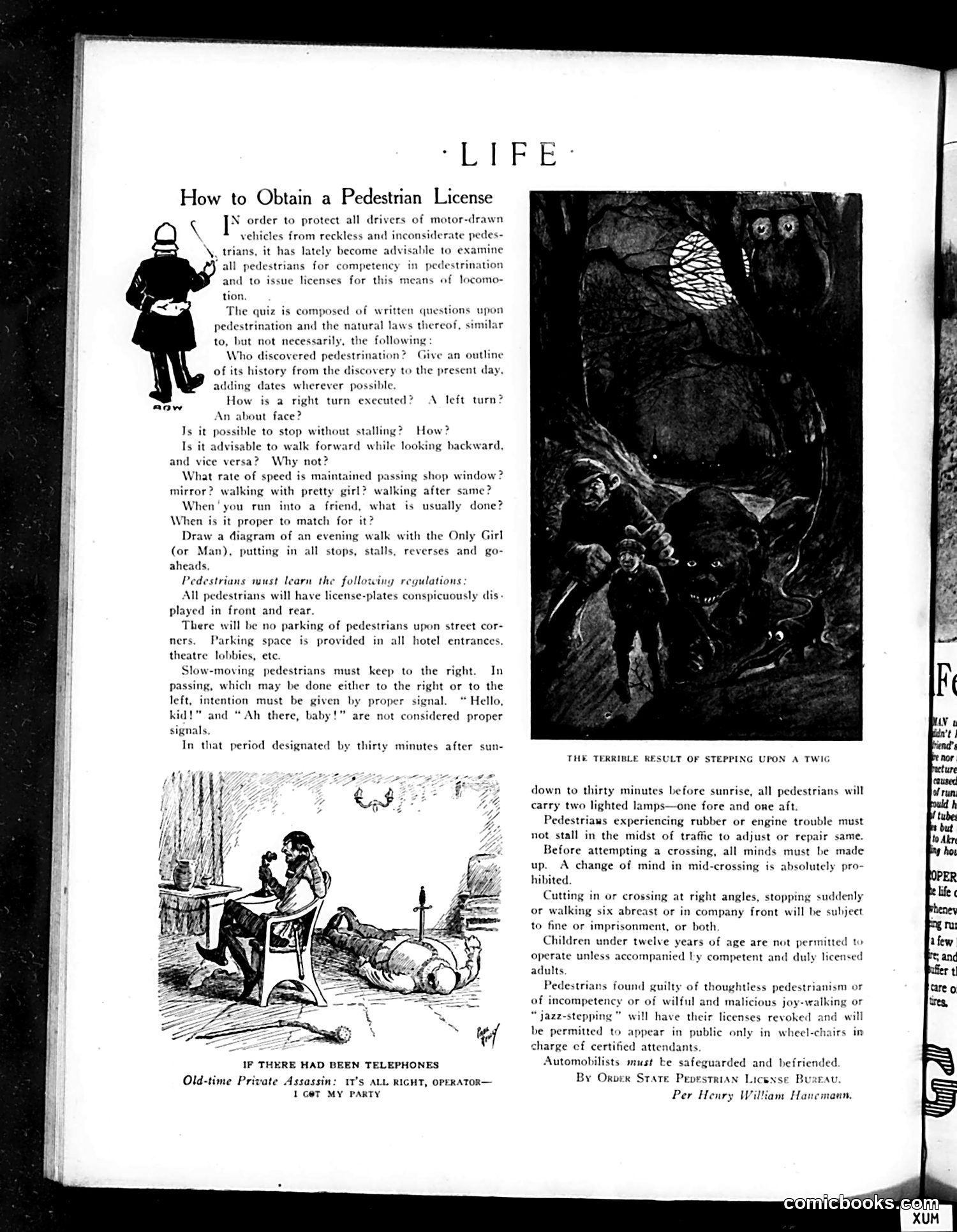
This satire inverts contemporary driving regulations—treating pedestrians as the dangerous menaces requiring licensing and regulation. The joke addresses the era's tension between rapidly increasing automobile traffic and pedestrians, who historically had street priority. The text absurdly applies motor-vehicle rules to walkers: license plates, speed zones, stopping restrictions, and revoking privileges for "joy-walking" and "jazz-stepping" (reference to modern youth culture). The mock-exam questions ridicule automobile licensing itself through exaggeration. The accompanying cartoons mock the violence of early car-pedestrian encounters: one shows a woman horrified after stepping on a twig (titled "The Terrible Result"), and another depicts an assassin casually killing someone, joking that telephones would improve murder coordination. **The underlying message:** pedestrians face genuine danger from automobiles, yet get blamed. The satire criticizes auto-centric attitudes that treated walkers as obstacles rather than legitimate street users.
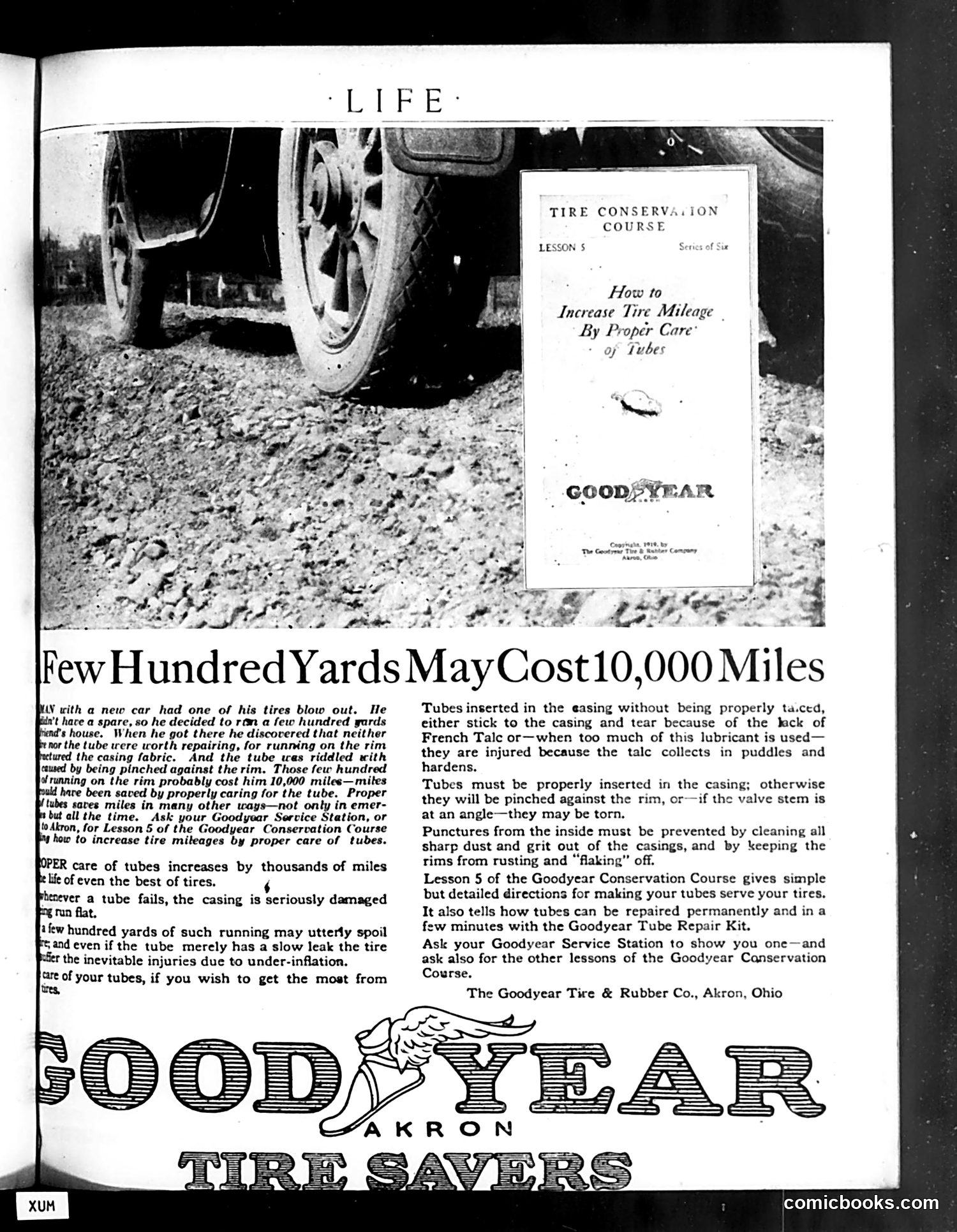
This is **not a cartoon or satire**—it's a straightforward **Goodyear Tire advertisement** disguised as educational content in *Life* magazine. The page presents "Lesson 5" of a "Tire Conservation Course," using a cautionary anecdote: a man with a new car drives several hundred yards on a flat tire without a spare, destroying both the casing and tube. The punch line warns that this brief run "probably cost him 10,000 miles" of potential tire life. The advertisement's actual purpose is to promote **proper tire tube maintenance** and Goodyear's tube repair kit. It explains common failures—improper installation, inadequate lubrication, punctures—and directs readers to Goodyear Service Stations for guidance. This represents **early automotive consumer education marketing**, presented during an era when tire care was critical and blowouts frequent. The "few hundred yards may cost 10,000 miles" framing is designed to scare consumers into proper maintenance, indirectly endorsing Goodyear products and services as the solution.
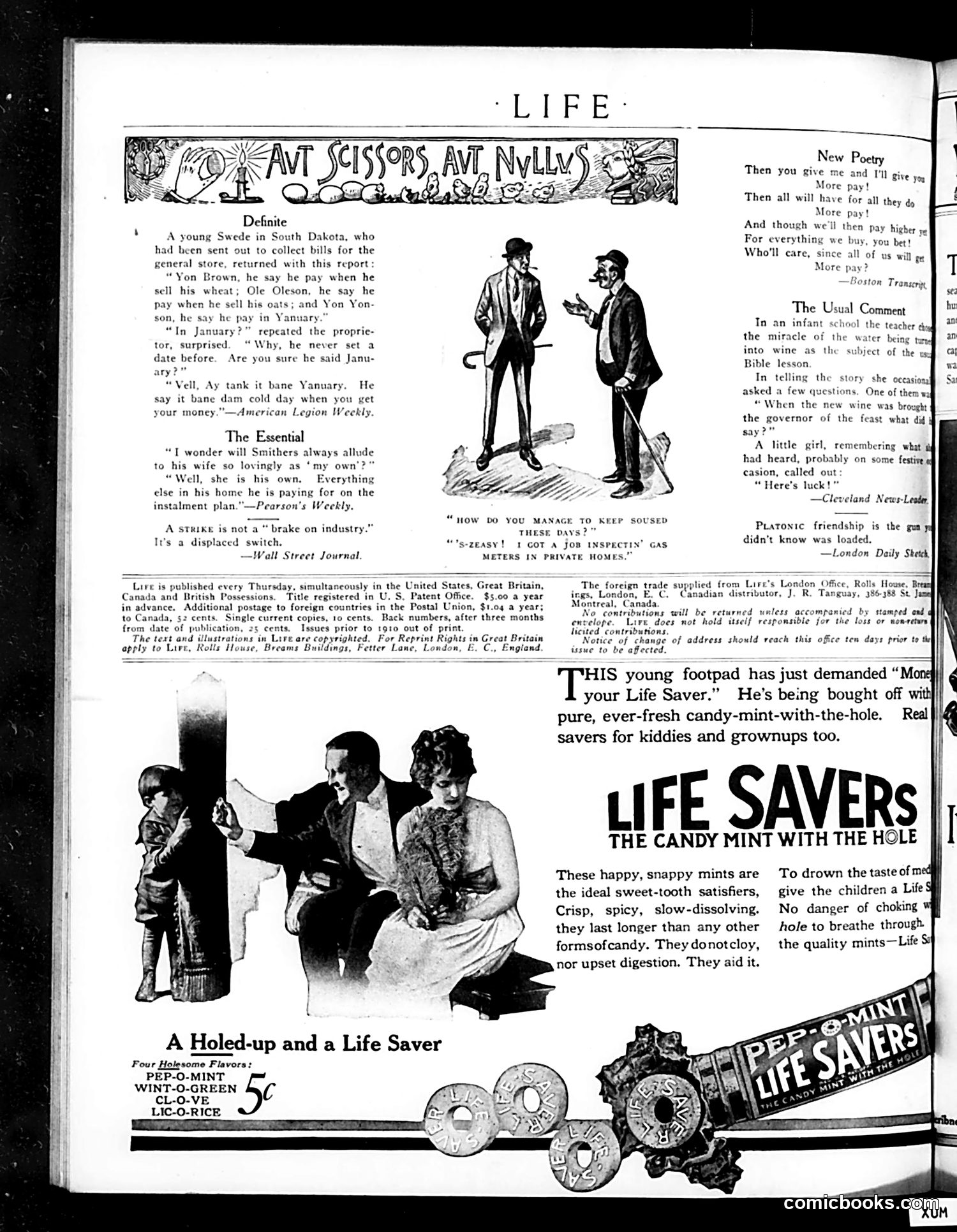
The page contains three unrelated humorous pieces typical of *Life* magazine's satirical format: 1. **"Definite"**: A joke about a Swedish immigrant bill collector in South Dakota who misunderstands "January" as "Yanuary" due to his accent. The humor relies on ethnic dialect comedy, common in early 20th-century American humor—poking fun at Scandinavian immigrants' English pronunciation. 2. **"The Essential"**: A one-liner about a man named Smithers who calls his wife "my own" because, unlike everything else in their home, she isn't being purchased on an installment plan. This satirizes consumer debt culture and suggests wives are possessions. 3. **"A Holed-up and a Life Saver"**: An advertisement for Life Savers candy, featuring a pun on "holed-up" (cornered) and the candy's distinctive hole. The ad copy emphasizes safety for children. The page is primarily **advertising and light humor** rather than serious political commentary. The ethnic jokes and gender attitudes reflect attitudes typical of the era but would be considered offensive today.
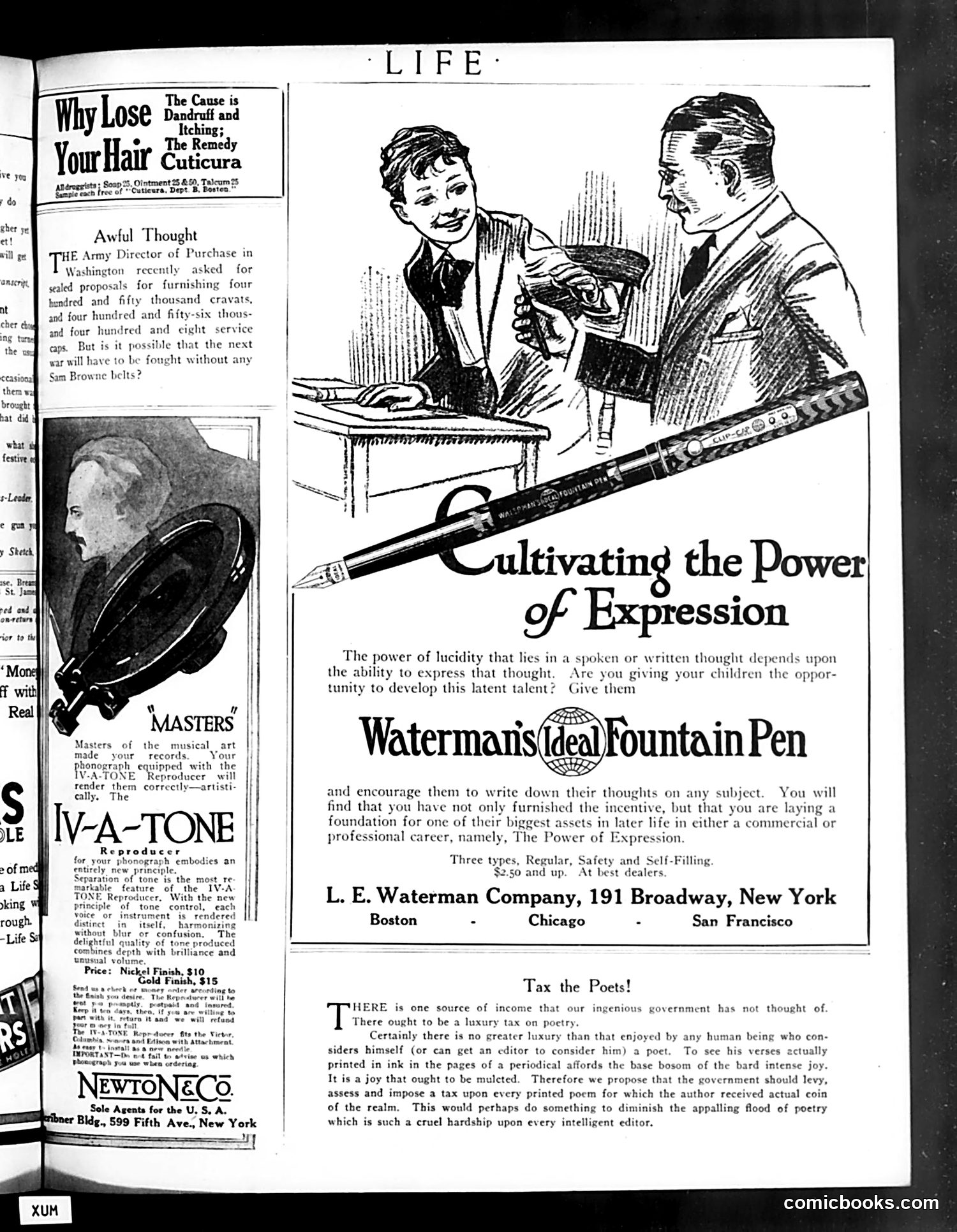
This page contains three distinct elements: **"Awful Thought" (top left):** A brief satirical commentary on military procurement. It jokes absurdly about the Army purchasing hundreds of thousands of cravats and service caps for an upcoming war, then poses the darkly humorous question: what if the next war must be fought without Sam Browne belts (the leather belt and shoulder strap worn by military officers)? The satire mocks bureaucratic excess and the arbitrariness of military supply planning. **"Tax the Poets!" (bottom):** A humorous editorial proposal to impose a luxury tax on published poetry. It argues that having one's verses printed in magazines is such a pleasure that poets should be taxed on this "luxury." The piece satirizes both poets' self-regard and editors' frustration with the flood of mediocre submissions they receive. The rest consists of period advertisements for fountain pens and phonograph equipment—typical commercial content for this era's magazine.
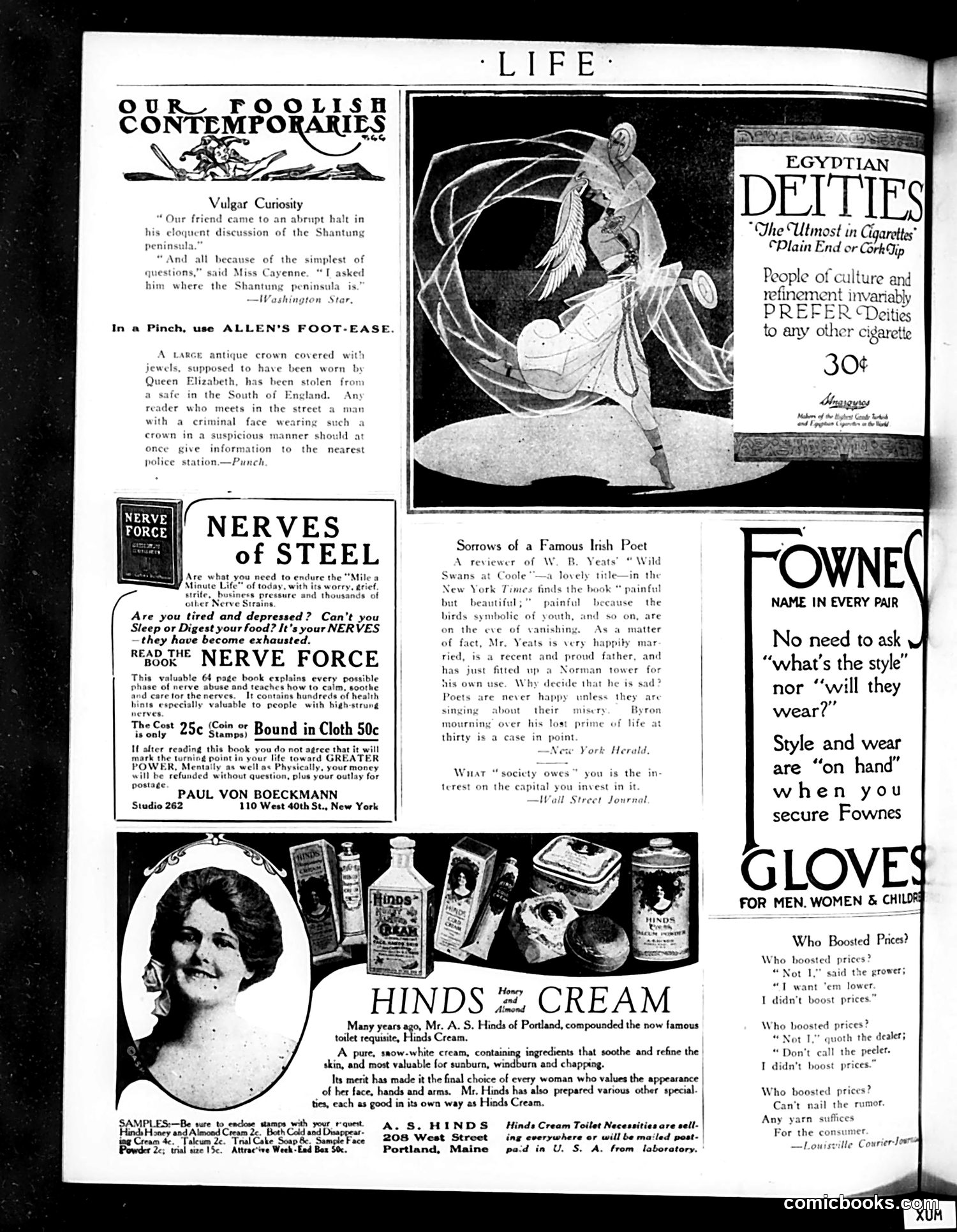
This page from *Life* magazine (date unclear from image) mixes satirical content with period advertisements. **"Our Foolish Contemporaries" section** satirizes someone who embarrassingly didn't know where the Shantung Peninsula is—mocking educated people's pretensions about geography, particularly relevant during discussions of international affairs (Shantung was a contested Chinese region). **"Sorrows of a Famous Irish Poet"** mocks W.B. Yeats, suggesting reviewers claim his work is "painful" simply because he writes melancholically about youth and loss. The satire notes Yeats is actually happily married and a proud new father—the point being that poets *perform* sadness regardless of personal circumstances, and critics accept this as artistic authenticity. **The "Who Boosted Prices?" verse** is economic satire, listing various parties (growers, dealers, etc.) each denying responsibility for price inflation while blaming unnamed others. It reflects post-WWI economic frustration. The remaining content consists of period product advertisements (nerve tonics, cream, cigarettes, gloves), typical for *Life*'s revenue model.
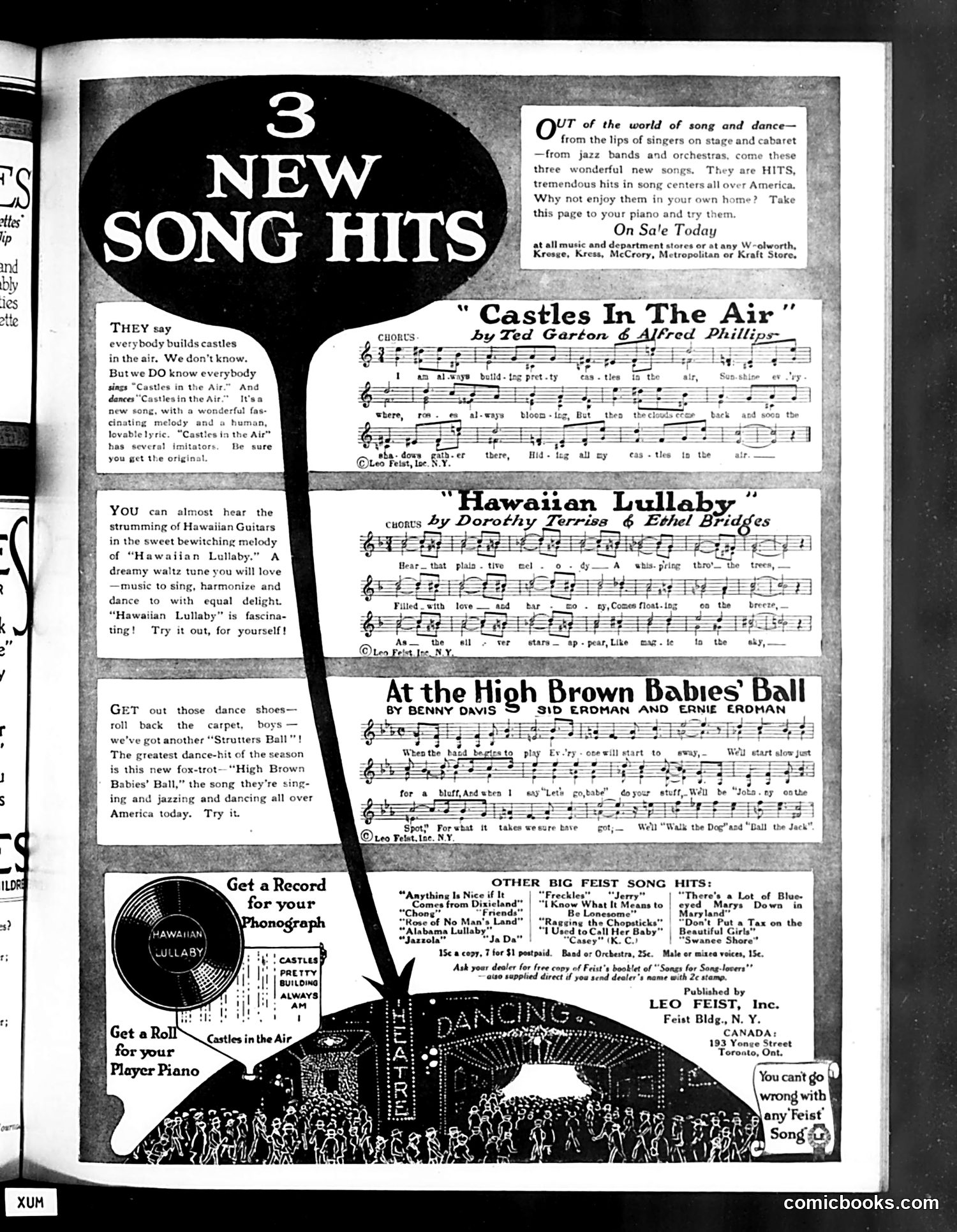
This is **not a cartoon or satire**—it's a music advertisement page from Life magazine. The layout promotes three popular songs of the era as sheet music for home pianists: 1. **"Castles in the Air"** (by Ted Garton & Alfred Phillips) 2. **"Hawaiian Lullaby"** (by Dorothy Terriss & Ethel Bridges) 3. **"At the High Brown Babies' Ball"** (by Benny Davis, Sid Erdman & Ernie Erdman) The "jokes" are light promotional copy: calling "Castles in the Air" a "wonderful" dance tune, describing the Hawaiian piece's "sweet bewitching melody," and hailing the fox-trot as "the greatest dance-hit of the season." The page encourages readers to buy sheet music at Woolworth, Kresge, and similar stores, or phonograph records. This reflects 1920s-era home entertainment culture before radio dominated—middle-class Americans purchased sheet music to play themselves or listen to on gramophones.
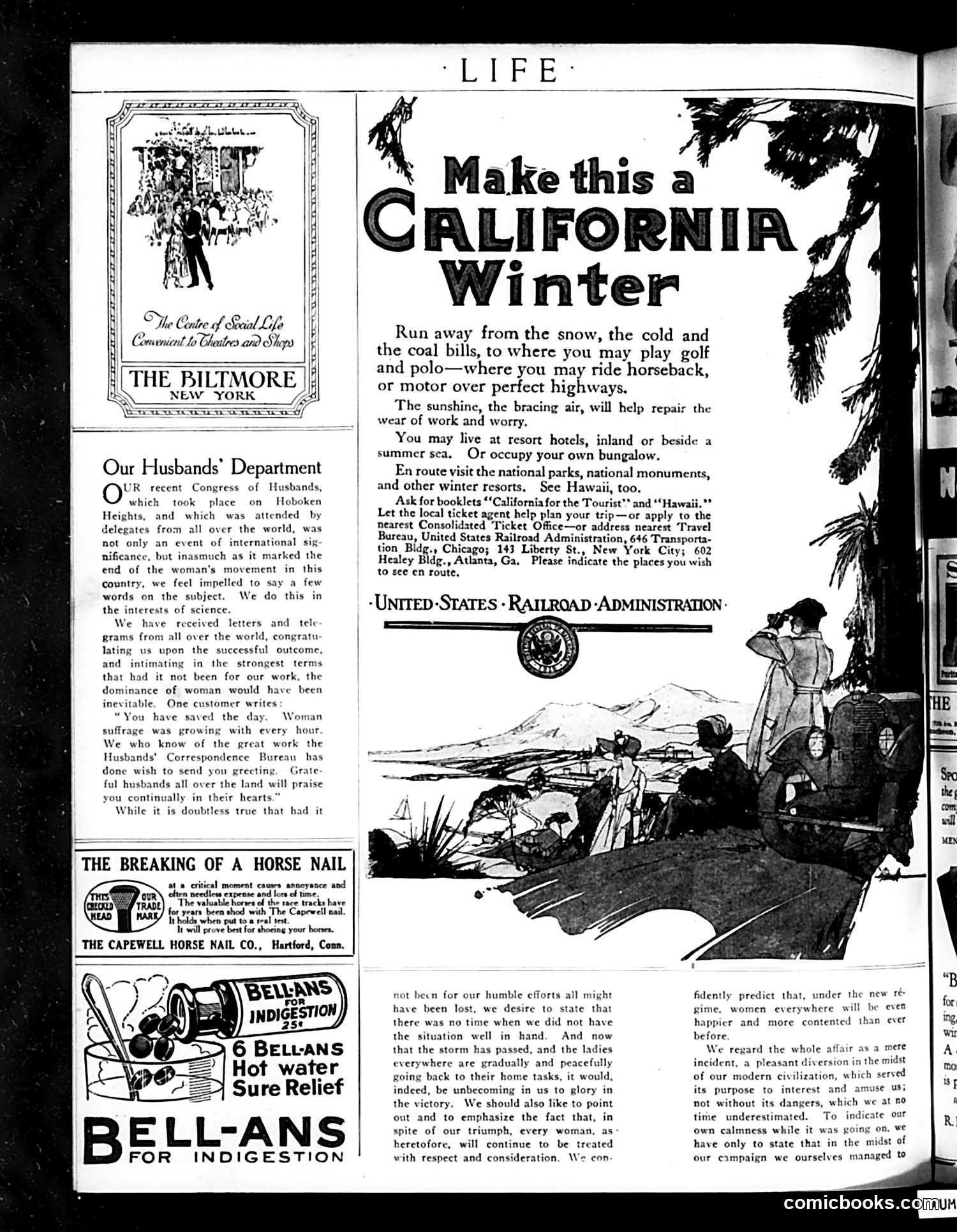
This page from *Life* magazine combines advertisements with satirical editorial content mocking the women's suffrage movement. The main text, "Our Husbands' Department," is written in mock-serious tone from a "Congress of Husbands" perspective. It satirizes anti-suffrage arguments by presenting husbands congratulating themselves for supposedly stopping women's dominance through their organization. The piece uses heavy irony—claiming husbands "saved the day" from inevitable female control—to ridicule the fear-mongering rhetoric actual opponents used against suffrage. The joke targets male anxieties about gender equality. By having husbands boast about preventing a female takeover that was never actually imminent, the satire exposes how exaggerated and absurd such fears were. The California winter travel advertisement and patent medicine ads (horse nails, Bell-Ans indigestion remedy, Biltmore hotel) are standard period advertising, contrasting with the editorial mockery. Overall, this represents *Life*'s support for women's rights through satirizing those who opposed them.
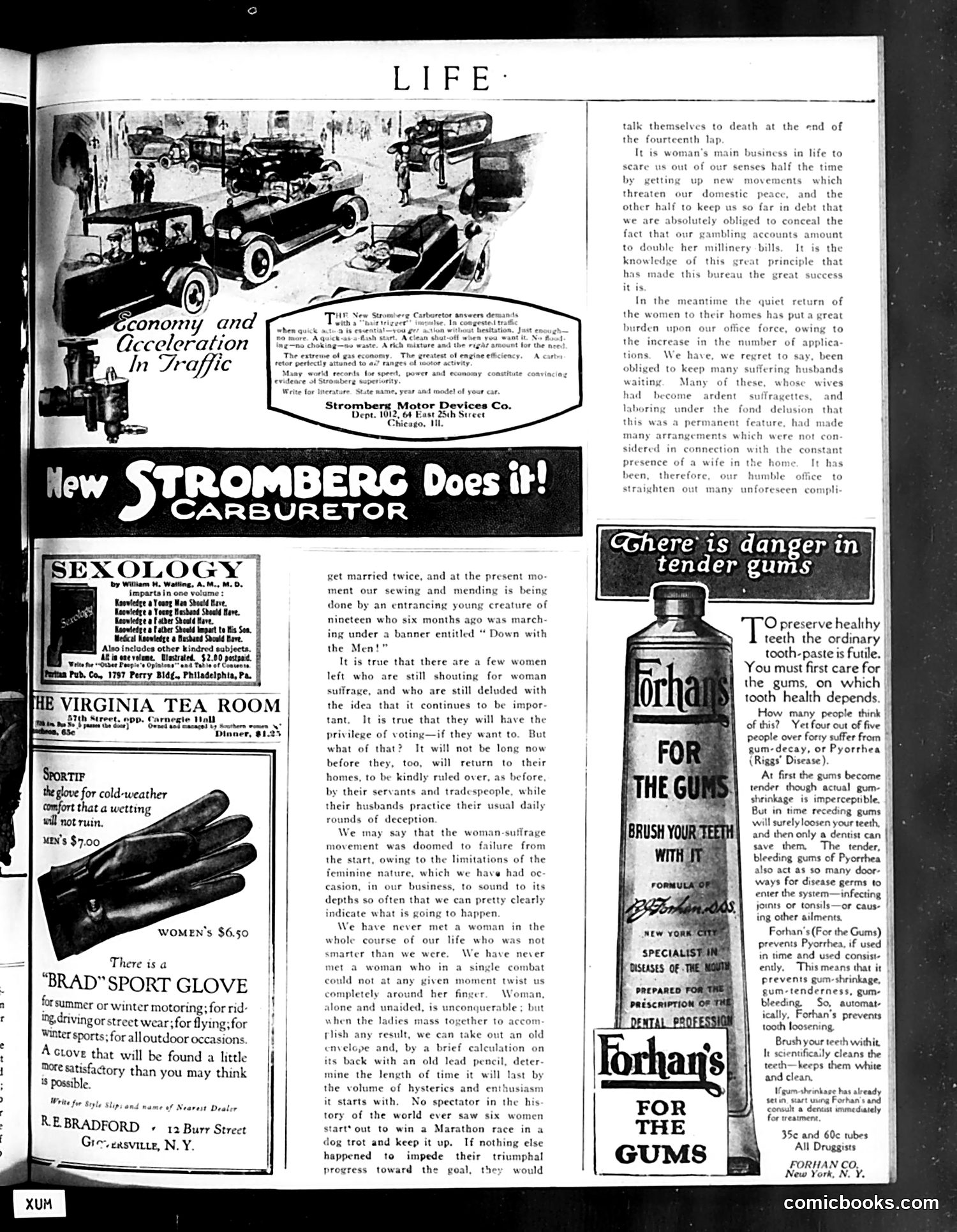
This page is primarily **advertising** with a satirical article embedded within it. The main content is a misogynistic essay attacking the women's suffrage movement. Written after women gained voting rights (likely post-1920), it mocks feminists by claiming women are naturally incapable of sustained collective action—the author absurdly argues that six women attempting a marathon would fail due to "hysterics and enthusiasm." The piece sarcastically "celebrates" women returning to domestic servitude, suggesting this outcome proves suffrage was a doomed failure caused by "limitations of the feminine nature." The author attempts humor by claiming women are individually clever but collectively incompetent. The surrounding ads (Stromberg carburetors, "Sexology" books, sport gloves, tooth powder) are period-typical. The essay reflects genuine anti-feminist sentiment of the era, though presented in Life's characteristic sardonic tone. For modern readers, this represents the backlash against women's political gains in the early 20th century.
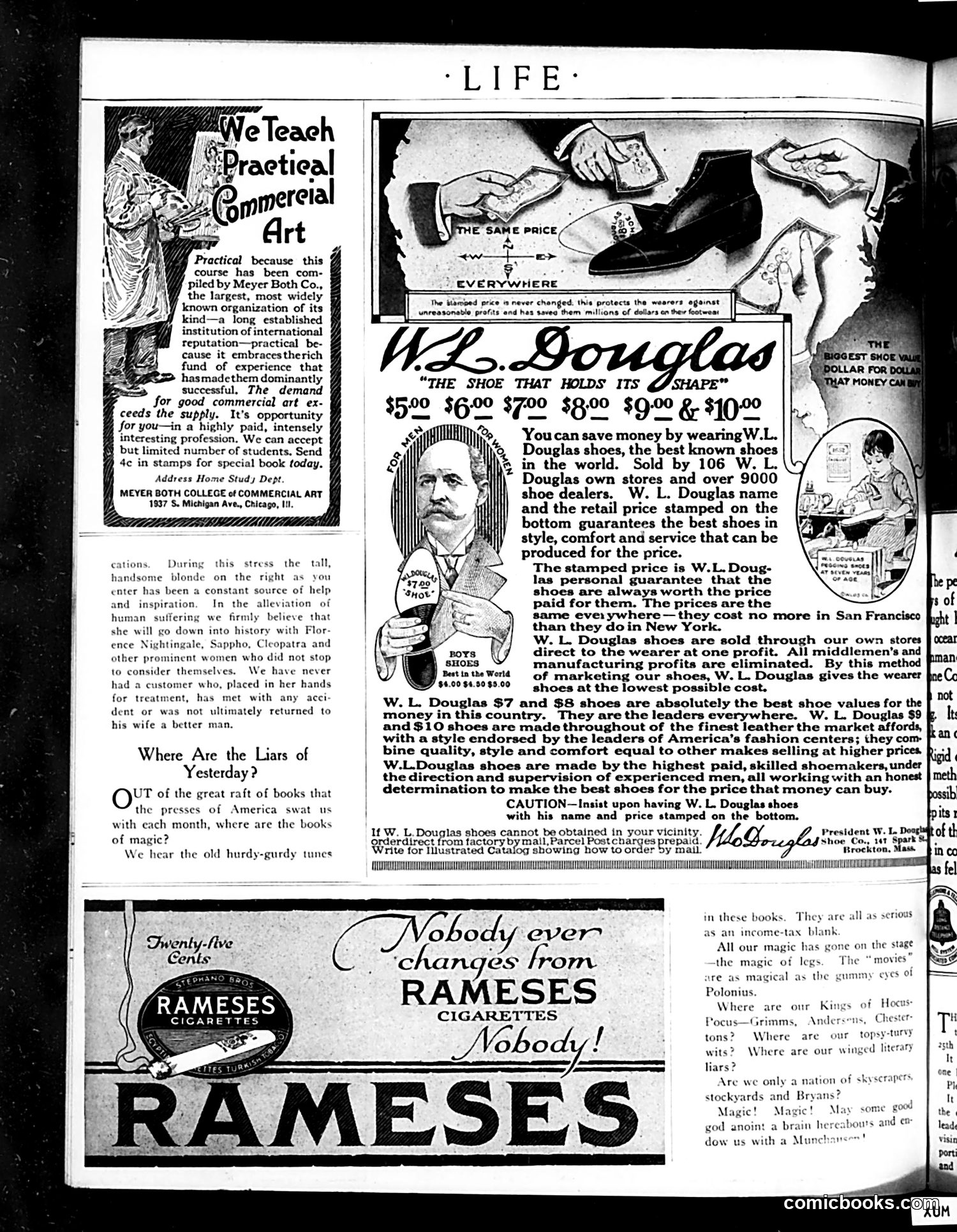
This page is primarily **advertising**, not editorial cartoon content. It features three major ads: 1. **Meyer Both College of Commercial Art** (upper left): An educational advertisement promoting practical training in commercial art design, targeting aspiring professionals. 2. **W.L. Douglas Shoes** (center/right): The dominant ad showcases a portrait of W.L. Douglas himself, emphasizing the brand's direct-to-consumer sales model that eliminates middlemen markups. The repeated claim—"The stamped price is never changed"—highlights price consistency as a guarantee of value. This reflects early 20th-century consumer concerns about fair pricing and manufacturing transparency. 3. **Rameses Cigarettes** (bottom): A brief advertisement claiming "Nobody ever changes from Rameses—Nobody!" promoting cigarette brand loyalty. The page contains fragmentary text discussing historical figures and literary references ("Where Are the Liars of Yesterday?"), but this appears to be editorial content bleeding from adjacent pages rather than cohesive satire.
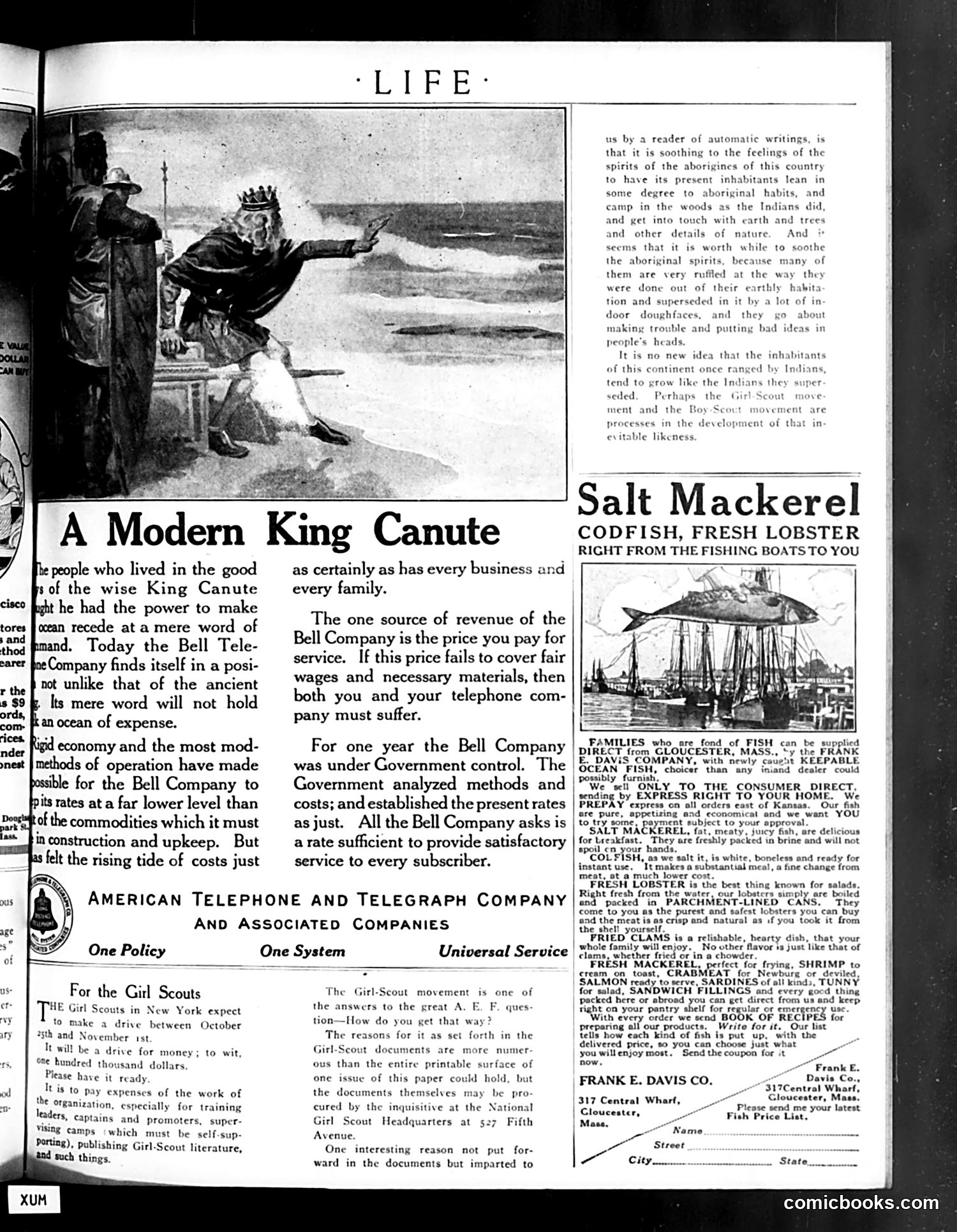
This editorial cartoon uses the legend of King Canute (who supposedly commanded the ocean to recede) to mock the Bell Telephone Company's position on rising costs. The text argues that just as Canute couldn't hold back the sea with mere words, Bell cannot hold back mounting expenses through efficiency alone—despite their efficiency, costs keep rising like an unstoppable tide. The satire criticizes Bell's implicit request for rate increases, comparing their predicament to an ancient king defying natural forces. The cartoon suggests Bell's management, however competent, faces economic forces beyond their control, much like Canute faced the ocean. The piece presents this sympathetically, arguing rate increases are necessary to maintain service quality—a regulatory defense of utility pricing from this era.
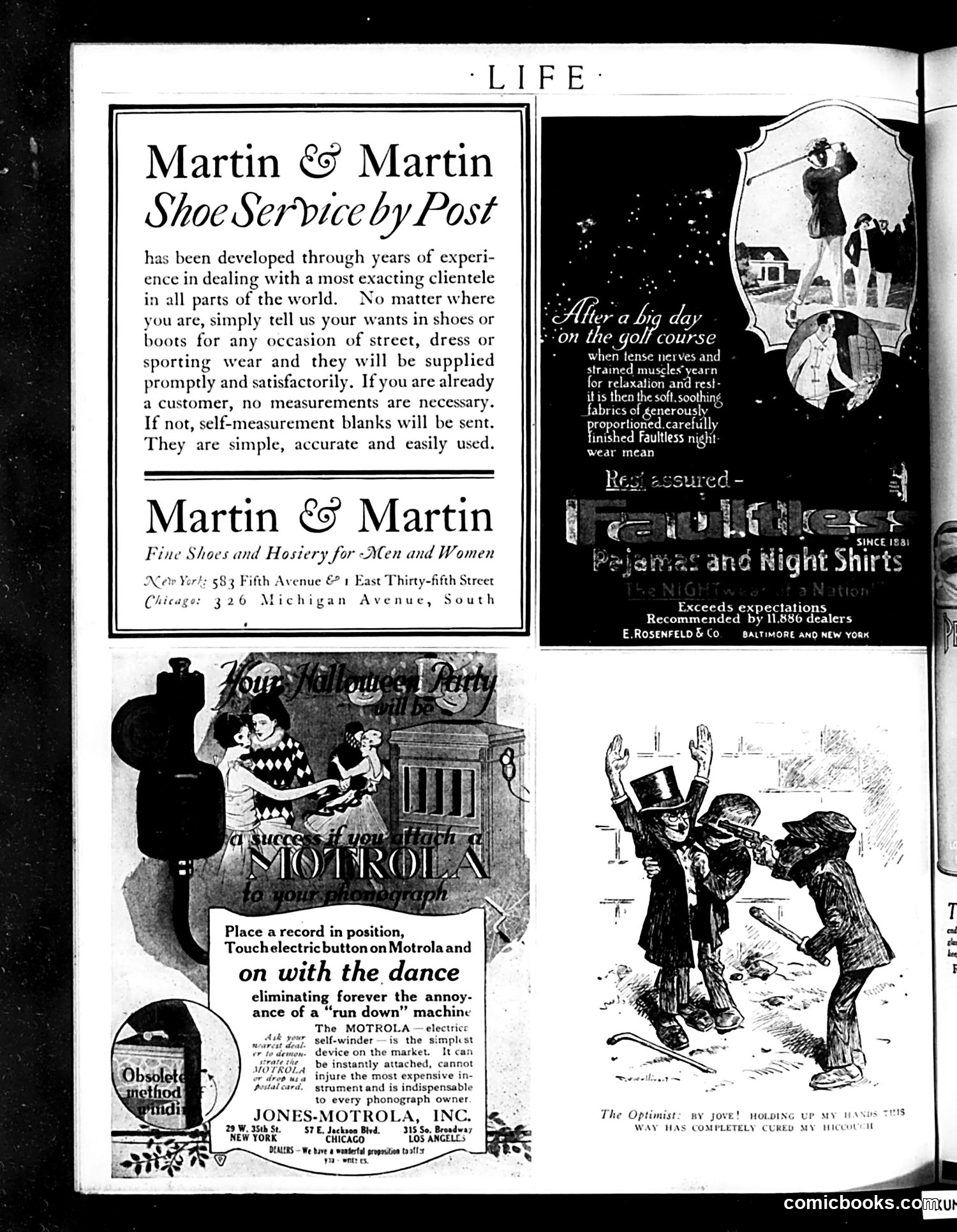
This page is primarily **advertising**, not political satire. It contains four commercial advertisements from the early 20th century: 1. **Martin & Martin**: Mail-order shoe service offering custom footwear worldwide 2. **Motrola**: An electric self-winding device for phonographs, eliminating manual winding 3. **Faultless Night Wear**: Pajamas and nightshirts marketed for post-golf relaxation and muscle recovery 4. **"The Optimist"**: A small cartoon showing a man claiming his hiccups are cured—a humorous endorsement for the nightwear product The only satirical element is the tiny cartoon at bottom right, which uses gentle humor to sell the nightwear by joking that relaxation in quality clothing has therapeutic benefits. The page reflects early 1900s consumer culture: mail delivery services, emerging electrical conveniences, and leisure activities like golf as markers of modern life.
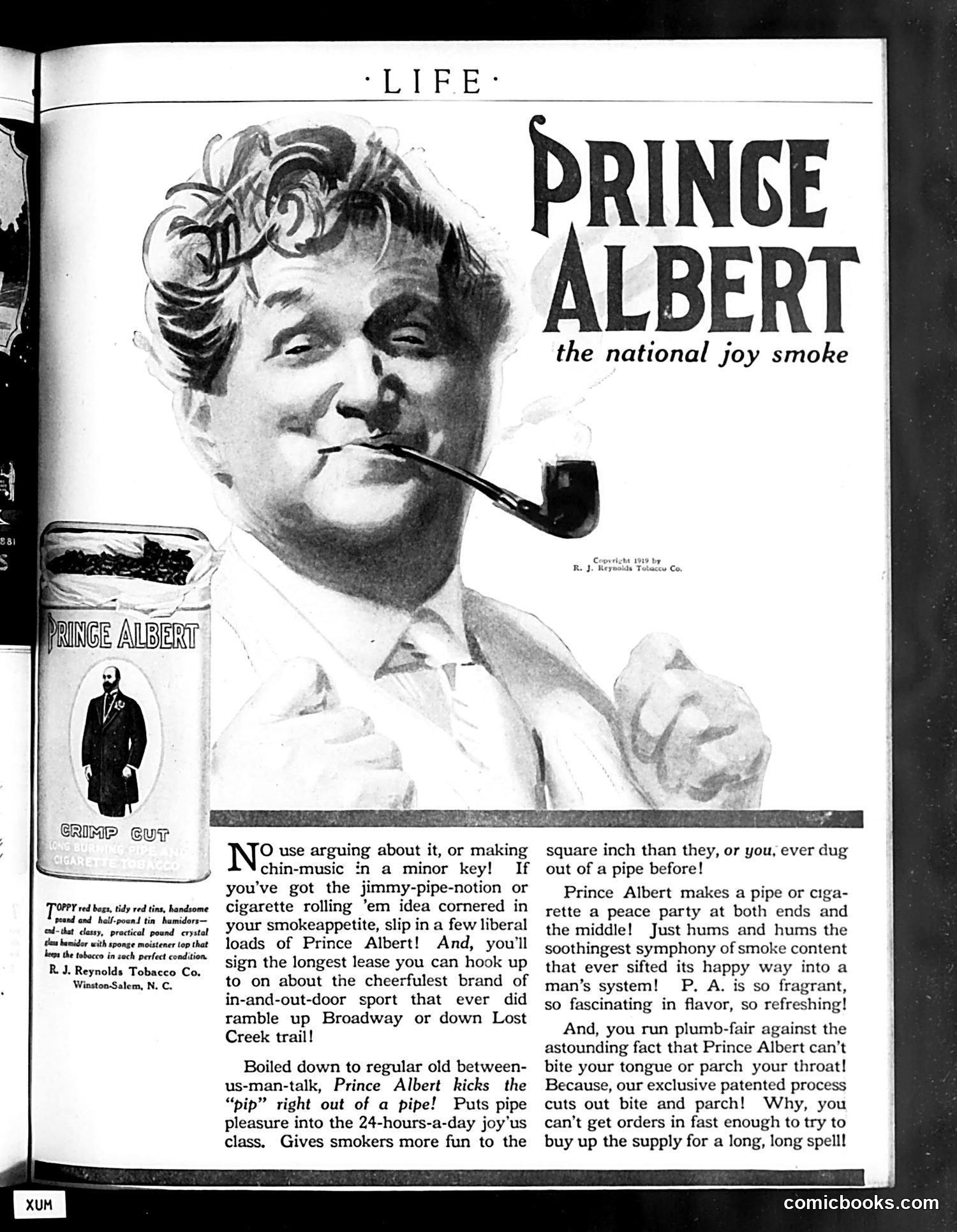
This is a full-page advertisement for Prince Albert pipe tobacco, not political satire. The image shows a man smoking a pipe, promoting the product as "the national joy smoke." The ad uses exaggerated, colloquial language ("between-us-man-talk," "jimmy-pipe-notion") to market tobacco to male smokers. Key claims include that Prince Albert eliminates tongue-bite and throat-parch through a "patented process," and that it provides superior smoking pleasure in both pipes and cigarettes. The ad also includes a product shot of the Prince Albert tin on the left side. This represents early 20th-century American advertising before tobacco health warnings—when smoking was openly marketed as a pleasurable, normal activity without regulatory restrictions. The emphasis on quality, flavor, and lack of harsh effects reflects contemporary marketing strategies for tobacco products.
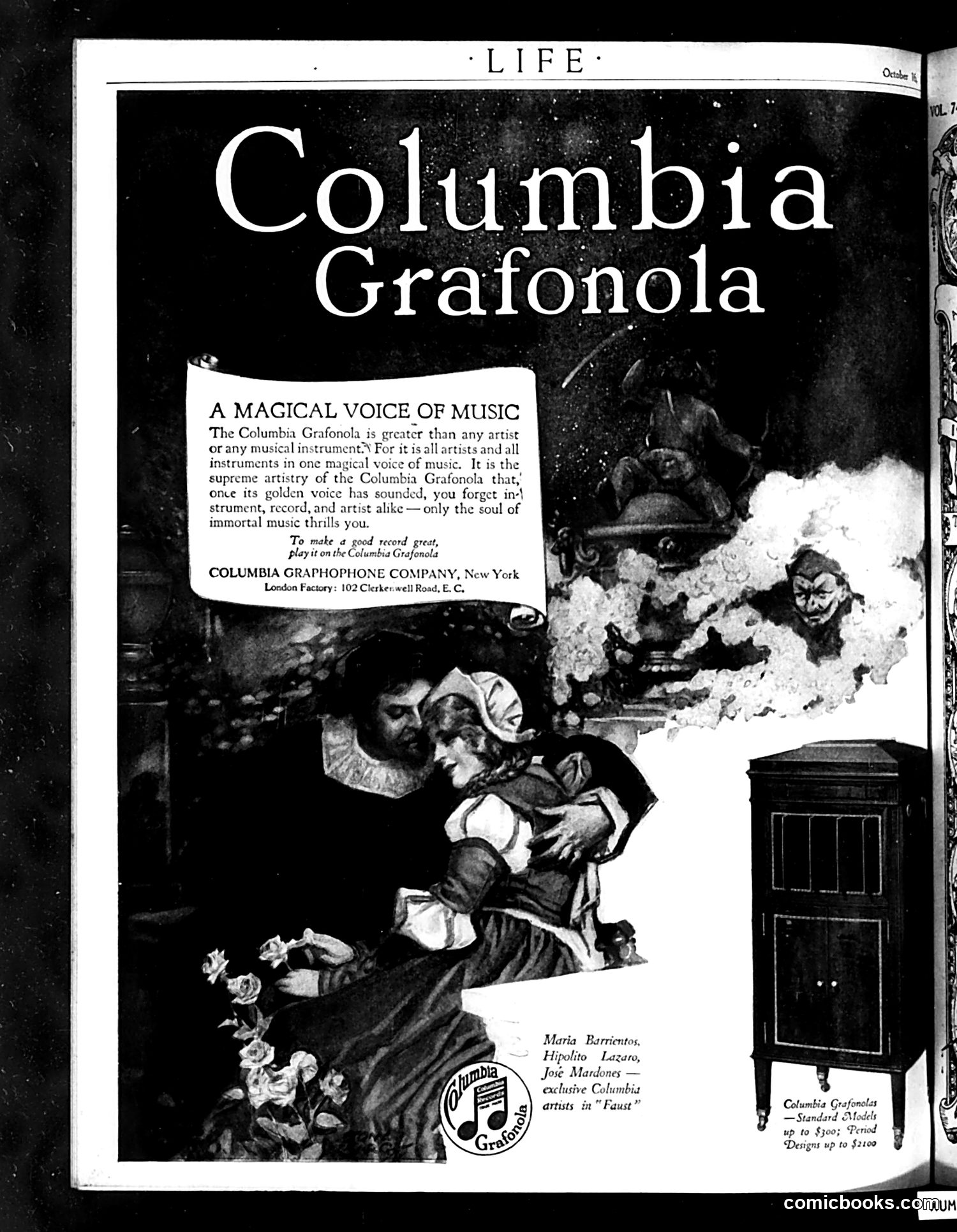
This is primarily a **product advertisement**, not political satire. It promotes the Columbia Grafonola phonograph, positioning it as a device that transcends mere mechanical reproduction—the text claims it delivers "immortal music" rather than just recordings or artists. The imagery depicts a romantic, operatic scene (likely from the opera *Faust*, as mentioned in the text), with figures in period costume. The ad names three "exclusive Columbia artists"—Maria Barrientos, Hipolito Lazaro, and José Mardones—performing in *Faust* to establish the device's cultural prestige. The right side shows the actual product: an ornate wooden cabinet-style phonograph priced between $75-$2,100. For modern readers: this reflects early 20th-century marketing strategy—associating a consumer product with high art and celebrity performers to justify premium pricing. The grandiose language ("magical voice," "immortal music") exemplifies period advertising hyperbole.