
Life, 1919-10-16 · page 24 of 36
Life — October 16, 1919 — page 24: what you’re looking at
What you’re looking at
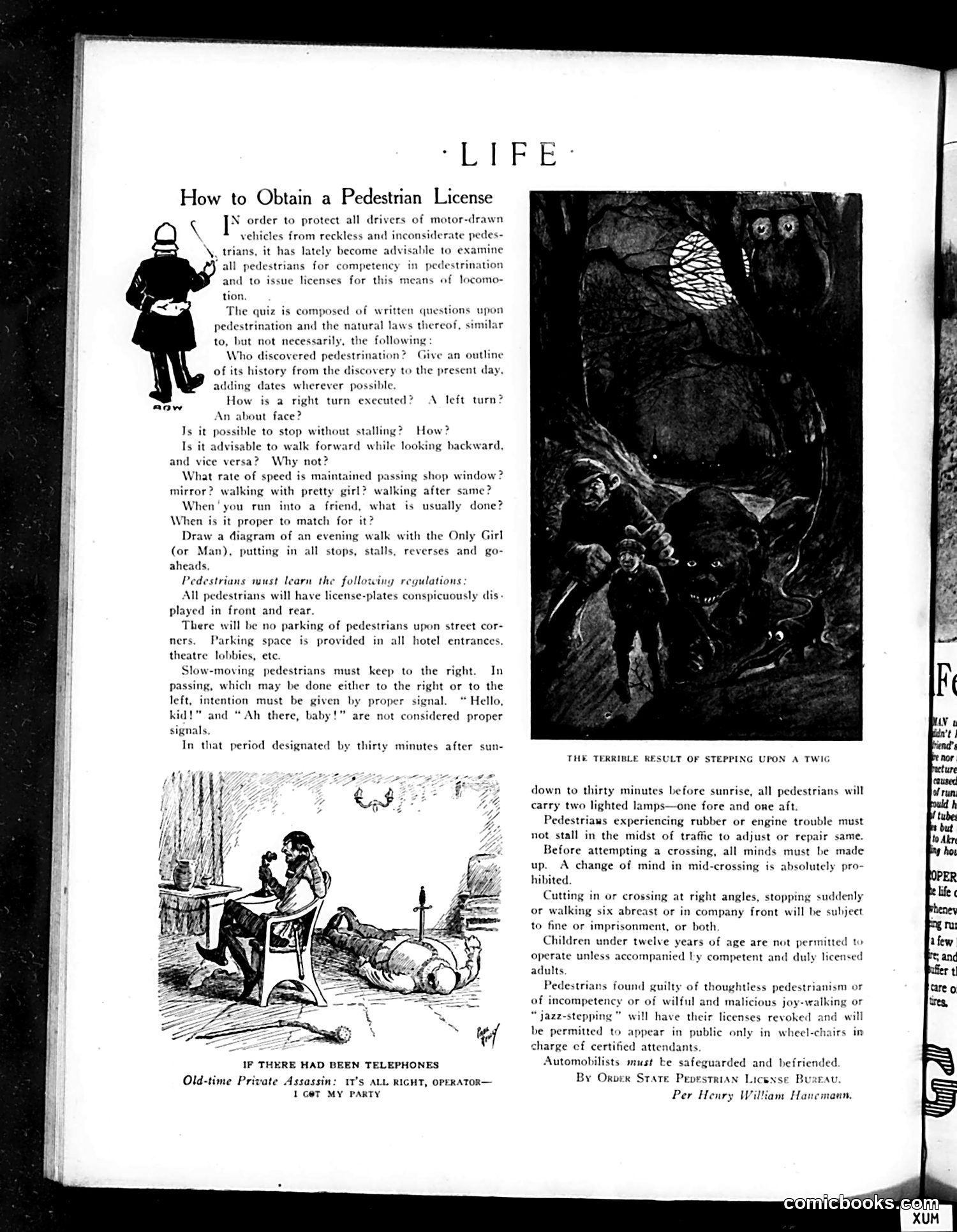
This satire inverts contemporary driving regulations—treating pedestrians as the dangerous menaces requiring licensing and regulation. The joke addresses the era's tension between rapidly increasing automobile traffic and pedestrians, who historically had street priority. The text absurdly applies motor-vehicle rules to walkers: license plates, speed zones, stopping restrictions, and revoking privileges for "joy-walking" and "jazz-stepping" (reference to modern youth culture). The mock-exam questions ridicule automobile licensing itself through exaggeration. The accompanying cartoons mock the violence of early car-pedestrian encounters: one shows a woman horrified after stepping on a twig (titled "The Terrible Result"), and another depicts an assassin casually killing someone, joking that telephones would improve murder coordination. **The underlying message:** pedestrians face genuine danger from automobiles, yet get blamed. The satire criticizes auto-centric attitudes that treated walkers as obstacles rather than legitimate street users.
📄 Transcribed text from this page (OCR, searchable)
Machine-transcribed from the original scan — historical spelling and the odd misread are preserved.
* LIF E * How to Obtain a Pedestrian License order to protect all drivers of motor-drawn vehicles from reckless and inconsiderate pedes- \, trians, it has lately become advisable to examine all pedestrians for competency in pedestrination and to issue licenses for this means of locomo- tion The quiz is composed of written questions upon pedestrination and the natural laws thereof, similar to, but not necessarily, the following Who discovered pedestrination? Give an outline of its history from the discovery to the present day, adding dates wherever possible How is a right turn executed? A left turn? An about face? Is it possible to stop without stalling? How? Is it advisable to walk forward while looking backward, and vice versa? Why not? What rate of speed is maintained passing shop window? mirror? walking with pretty girl? walking after same? When‘ you run into a friend, what is usually done? When is it proper to match for it? Draw a diagram of an evening walk with the Only Girl (or Man), putting in all stops, aheads, Pedestrians must learn the following regulations All pedestrians will have license-plates conspicuously dis- played in front and rear. There will be no parking of pedestrians upon street cor- ners. Parking space is provided in all hotel entrances, theatre lobbies, ete. Slow-moving pedestrians must keep to the right. In passing, which may be done either to the right or to the left, intention must be given by proper signal. “ Hello, kid!" and “Ah there, baby!” are not considered proper signals. In that period designated by thirty minutes after sun- Is, reverses and go- IF THERE HAD BEEN TELEPHONES. Old-time Private Assassin: 11'S ALL RIGHT, OPERATOR— 1 GOT MY PARTY THE TERRIBLE RESULT OF STEPPING UPON A TWIG down to thirty minutes before sunrise, all pedestrians will carry two lighted lamps—one fore and one aft. Pedestriaws experiencing rubber or engine trouble must not stall in the midst of traffic to adjust or repair same. Before attempting a crossing, all minds must be made up. A change of mind in mid-crossing is absolutely pro- hibited. Cutting in or crossing at right angles, stopping suddenly or walking six abreast or in company front will be subject to fine or imprisonment, or both. Children under twelve years of age are not permite operate unless accompanied Ly competent and duly licensed adults. Pedestrians found guilty of thoughtless pedestrianism or of incompetency or of wilful and malicious joy-walking or “ jazz-stepping " will have their licenses revoked ani be permitted to appear in public only in. wheel- charge cf certified attendants. Automobilists must ke safeguarded and befriended. By Orver State Pevestrian License Bureau. Per Henry William He mann,