
Life, 1919-10-16 · page 16 of 36
Life — October 16, 1919 — page 16: what you’re looking at
What you’re looking at
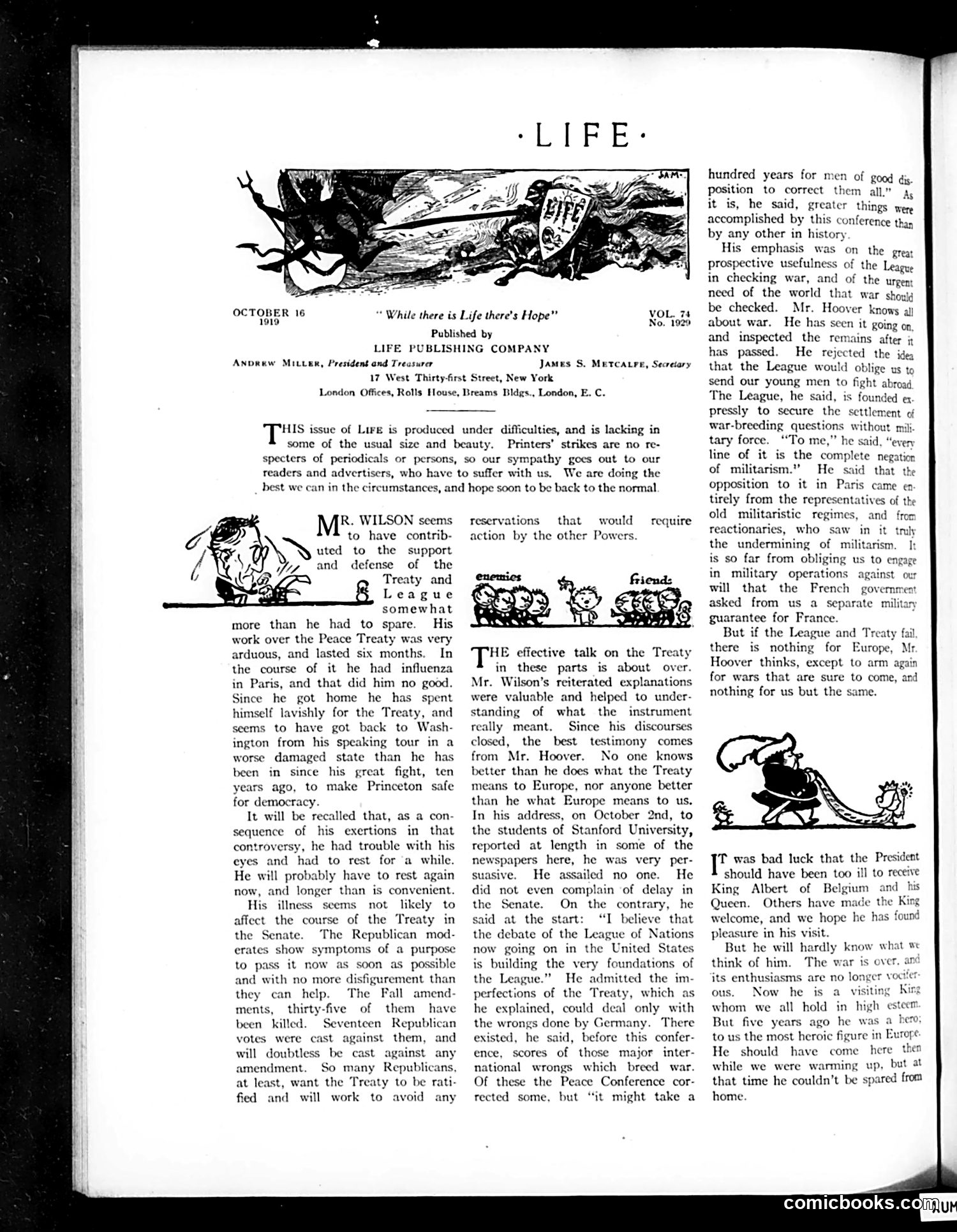
This page discusses President Woodrow Wilson's health crisis and the League of Nations treaty debate. The editorial notes Wilson has exhausted himself campaigning for the Treaty after his Paris Peace Conference work, suffering influenza and now apparent physical collapse—he "seems to have got back to Washington from his speaking tour in a worse damaged state than he has been in since his great fight...to make Princeton safe for democracy." The cartoons (showing figures labeled "enemies" and "friends") appear to illustrate the Treaty's political divisions. The page praises Herbert Hoover's measured October 2nd Stanford address supporting the League, noting he "assailed no one" while acknowledging the Treaty's imperfections. The text suggests Republican moderates may ratify the Treaty with minimal amendments, though seventeen Fall amendments were killed with Republican support. The satire implicitly critiques Wilson's self-destructive devotion to the Treaty cause while praising Hoover's diplomatic reasonableness—contrasting approaches to post-war internationalism.
📄 Transcribed text from this page (OCR, searchable)
Machine-transcribed from the original scan — historical spelling and the odd misread are preserved.
OCTOBER 16 1919 * While there is Life there’s Hope” Published by LIFE PUBLISHING COMPANY ANDREW MILLER, President and Treasurer James S. METCALFE, Secretary 17 West Thirty-first Street, New York London Offices, Rolls House, Breams Bldgs., London, E. C. 'HIS issue of Lire is produced under difficulties, and is lacking in some of the usual size and beauty. specters of periodicals readers and advertise Printers’ strikes are no re- or persons, so our sympathy gocs out to our , who have to suffer with us, We are doing the best we can in the circumstances, and hope soon to be back to the normal. R. WILSON seems to have contrib- to the support defense of the Treaty and League somewhat more than he had to spare. His work over the Peace Treaty was very arduous, and lasted six months. In the course of it he had influenza in Paris, and that did him no good. Since he got home he has spent himself lavishly for the Treaty, and seems to have got back to Wash- ington from his speaking tour in a worse damaged state than he has been in since his great fight, ten years ago, to make Princeton safe for democracy. It will be recalled that, as a con- sequence of his exertions in that controversy, he had trouble with his and had to rest for a while. He will probably have to rest again now, and longer than is convenient. His illness seems not likely to affect the course of the Treaty in the Senate. The Republican mod- erates show symptoms of a purpose to pass it now as soon as possible and with no more disfigurement than they can help. The Fall amend- ments, thirty-five of them have been killed. Seventeen Republican votes were cast against them, and will doubtless be cast against amendment. So many Republicans at least, want the Treaty to be rati- fied and will work to avoid any uted fz ona reservations that would action by the other Pow require HE effective talk on the Treaty in these parts is about over. Mr. Wilson’s reiterated explanations were valuable and helped to under- standing of what the instrument really meant. Since his discourses closed, the best testimony comes from Mr. Hoover. No one knows better than he does what the Treaty means to Europe, nor anyone better than he what Europe means to us. In his address, on October 2nd, to the students of Stanford University, reported at length in some of the newspapers here, he was very per- suasive. He assailed no one. He did not even complain of delay in the Senate. On the contrary, he said at the start: “I believe that the debate of the League of Nations now going on in the United States is building the very foundations of the League.” He admitted the im- perfections of the Treaty, which as he explained, could deal only with the wrongs done by Germany. There existed, he , before this confer- ence, scores of those major inter- national wrongs which breed war. Of these the Peace Conference cor- rected some, but “it might take a hundred years for men of good dis. position to correct them all,” As it is, he said, greater things were accomplished by this conference than by any other in history zs " i on the great prospective usefulness of the Leagye in checking war, and of the urgent need of the world that war sh id be checked. Mr. Hoover knows al about war. He has seen it going on and inspected the remains after it has passed. He rejected the idea that the League would oblige us to send our young men to fight abroad The League, he said, is founded ex pressly to secure the settlement of war-breeding questions without mil. tary force. ‘To me,” he said, “every line of it is the complete negation of militarism.” He said that opposition to it in Paris came en tirely from the representatives of the old militaristic regimes, and from reactionaries, who saw in it truly the undermining of militarism. It is so far from obliging us to en in military operations agains will that the French government asked from us a separate mili guarantee for France. But if the League and y there is nothing for Europe, Mr. Hoover thinks, except to arm for wars that are sure to come, and nothing for us but the same. 'T was bad luck that the President should have been too ill to re King Albert of Belgium Queen. Others have made t welcome, and we hope he ha pleasure in his visit. But he will hardly know wh think of him. The war is over. 3 its enthusiasms are no | ous. Now he is a visit whom we all hold in high But five years ago he was a | to us the most heroic figure in Europe He should have come here while we were warming up, but at that time he couldn’t be spared from home. esteem. comicbooks.comyf