
A complete issue · 40 pages · 1919
Life — August 21, 1919
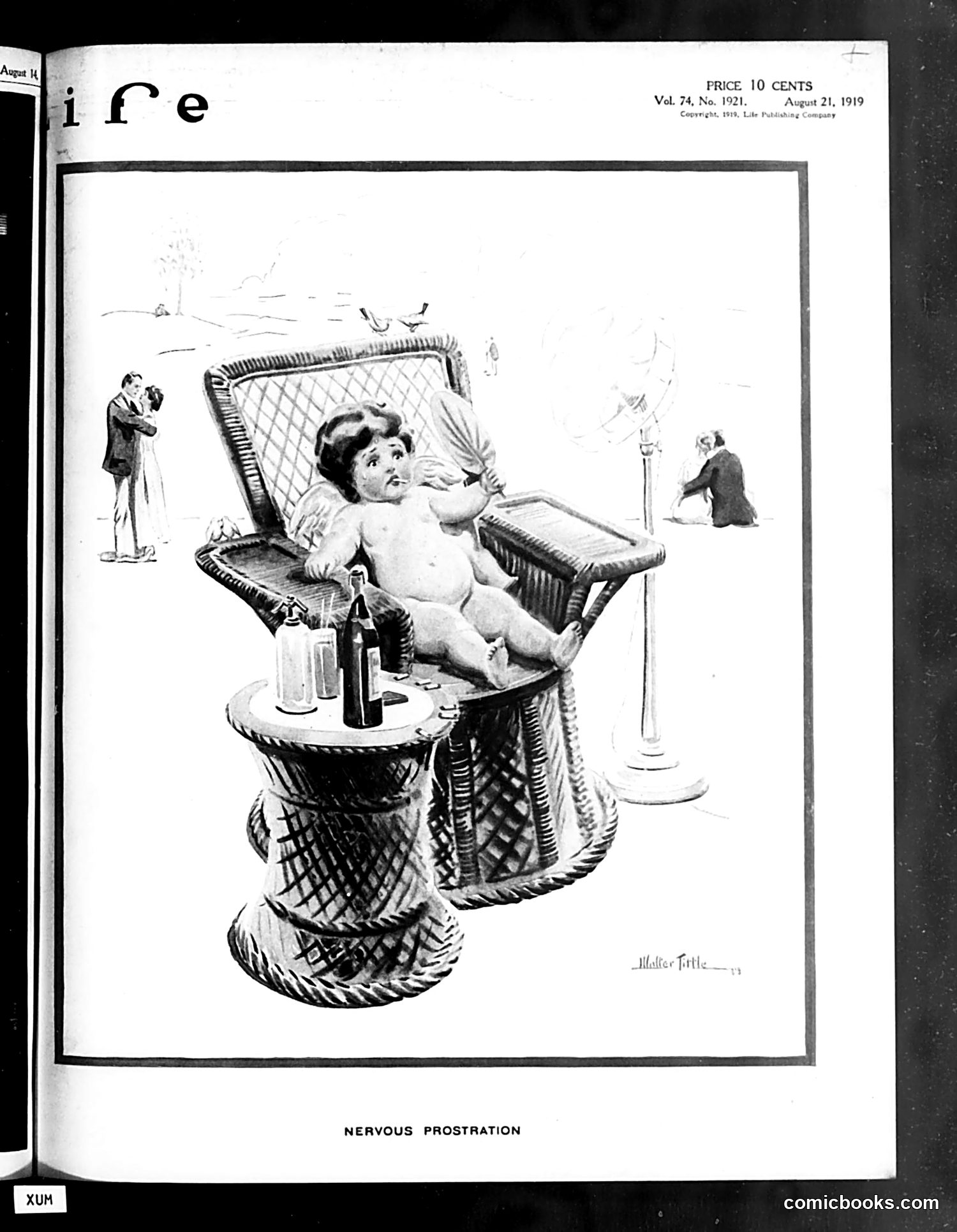
This cartoon satirizes "nervous prostration"—a Victorian-era diagnosis for exhaustion and anxiety, often attributed to overindulgence or stress. The image depicts a cherub-like figure lounging in a wicker chair with bottles of alcohol nearby, suggesting excessive drinking as the cause of the condition. The background figures appear to be concerned observers or doctors, reinforcing the medical pretense. The satirical point likely critiques either: - The fashionable hypochondria of wealthy people claiming "nervous exhaustion" - Post-WWI anxiety and excess among the affluent - The absurdity of diagnosing overindulgence as illness rather than moral failing The cherub's contented expression undercuts the "illness" claim, suggesting the real problem is self-indulgent behavior masquerading as legitimate medical concern.
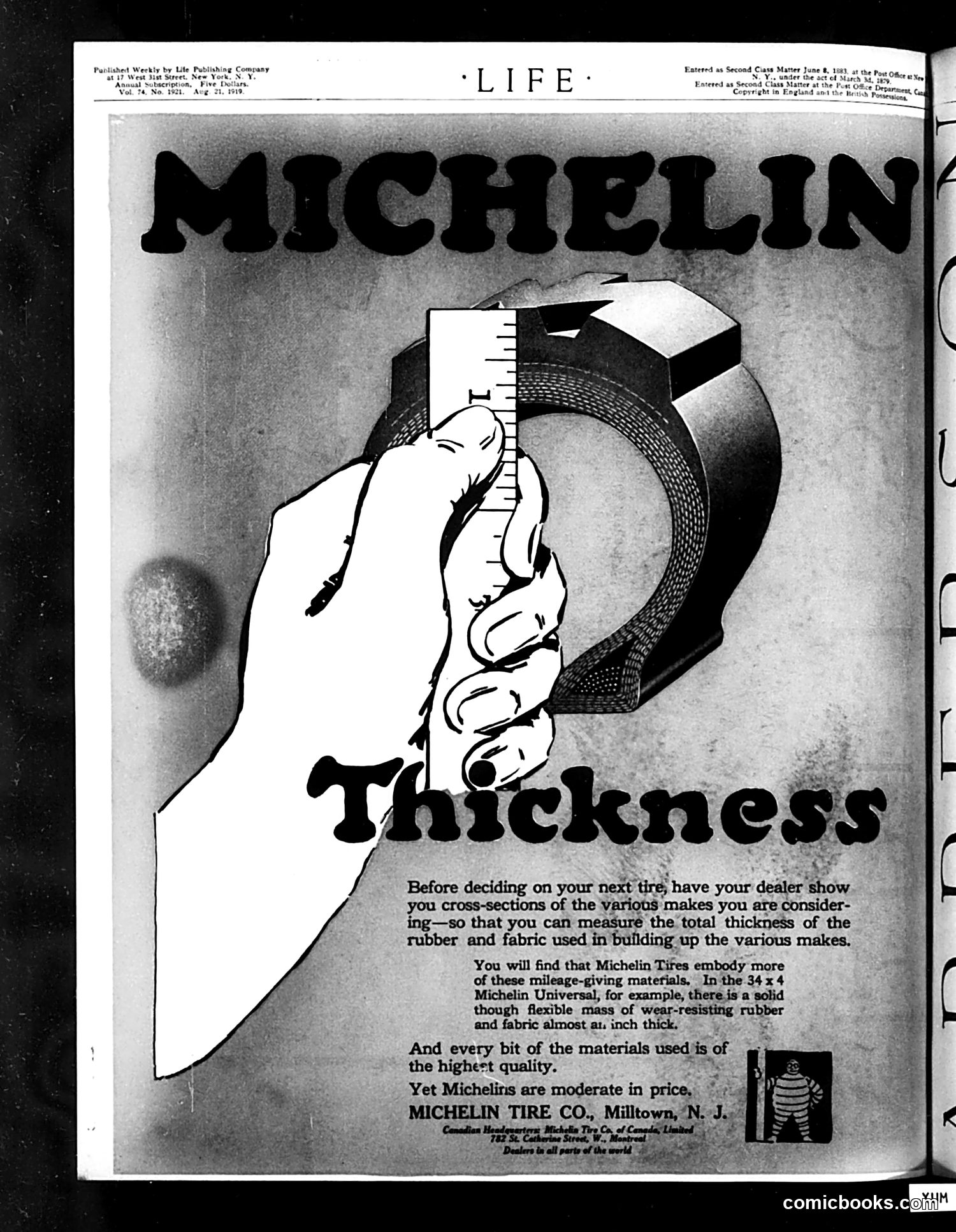
This is primarily a **Michelin Tire advertisement**, not political satire. The page features a large illustration of a hand holding a tire cross-section, with measurement markings visible on a ruler the hand is using. The ad's message is straightforward commercial persuasion: consumers should ask their tire dealers to show cross-sections of different tire brands so they can compare the thickness of rubber and fabric materials. Michelin claims their tires contain more wear-resistant materials than competitors—specifically noting their 34x4 Universal model has "a solid though flexible mass of wear-resisting rubber and fabric almost an inch thick." The appeal emphasizes quality materials and reasonable pricing. The Michelin Man mascot appears in a small logo at bottom right. This represents typical early 20th-century tire advertising strategy.
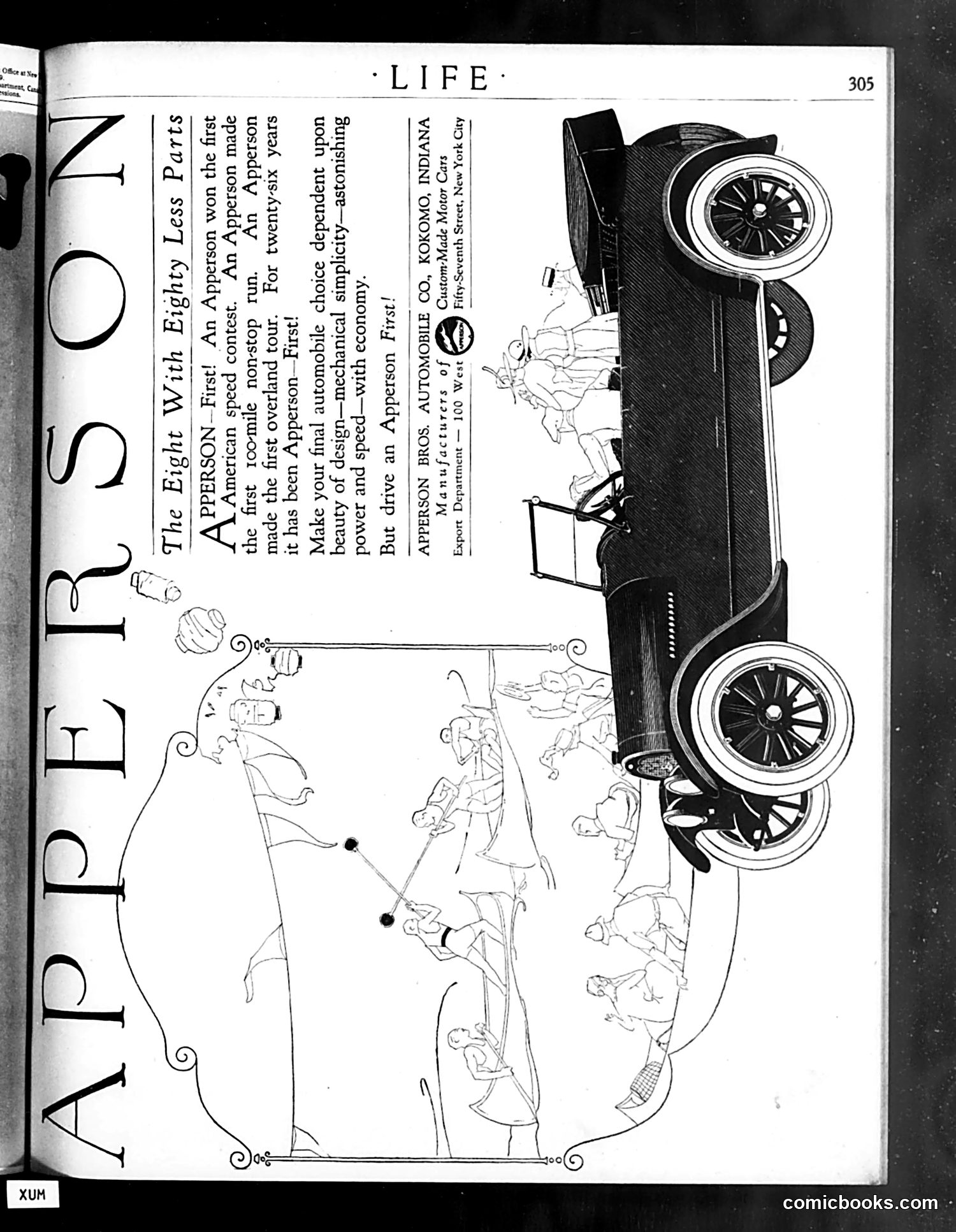
This page features an Apperson automobile advertisement alongside satirical commentary about early automotive adoption. The text mocks the "Eight With Eighty Loss Parts"—likely referencing a specific car model's reliability issues. It sarcastically suggests the vehicle offers "An Apparent Apperson won the first non-stop cross-country run" and criticizes its poor dependability, stating it has "been an unfavorable choice" despite "simplicity-assuring power and speed-with-First Apperson Bros. Automobile Co., Kokomo, Indiana" manufacturer claims. The illustration shows people being ejected from or struggling with the early automobile, humorously depicting the vehicle's unreliability and mechanical failures. This reflects early 1900s skepticism about automobiles' practicality—common themes in period satire before cars became mainstream.
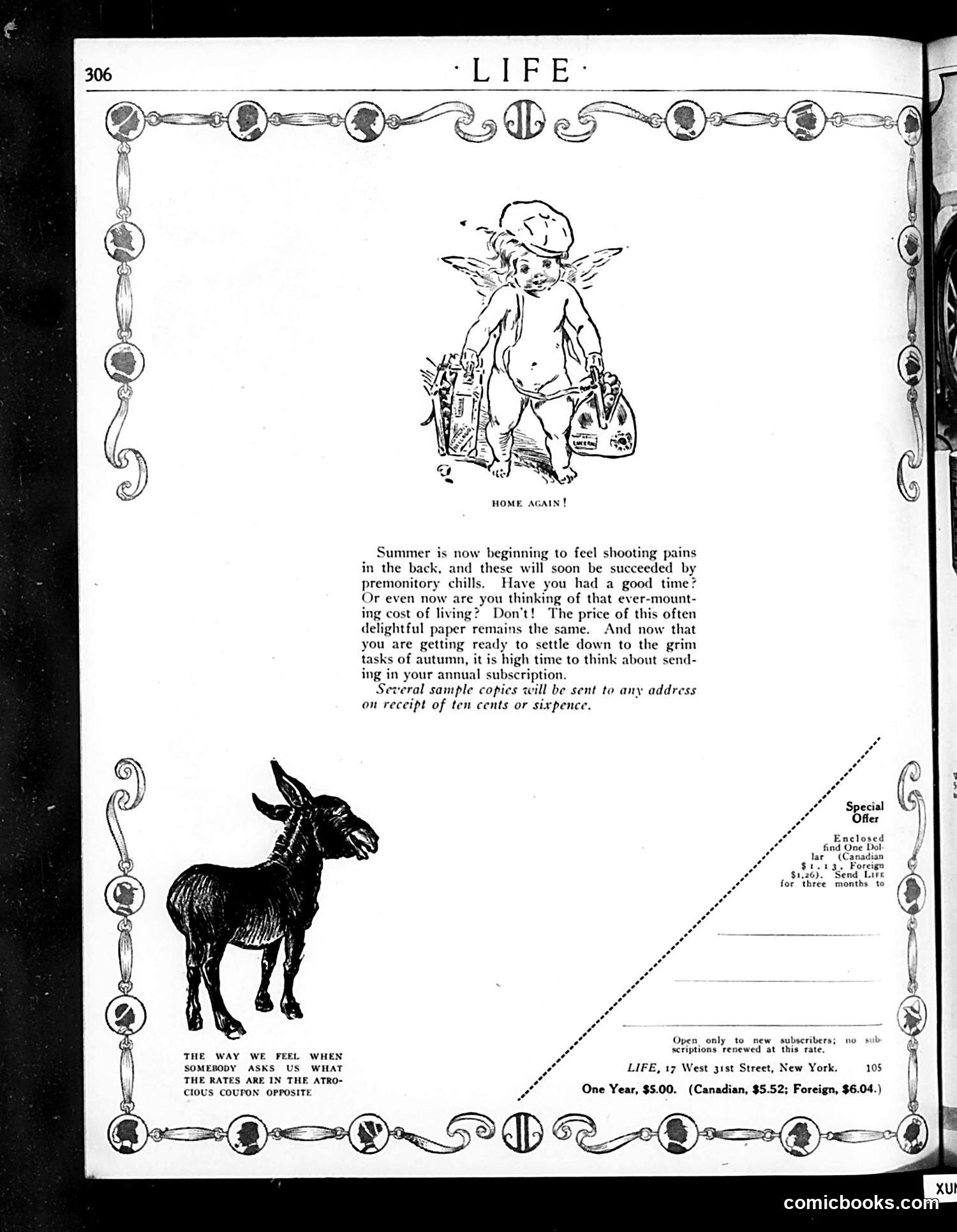
This page is primarily a **subscription advertisement** for *Life* magazine, not political satire. The central image shows a cherubic Cupid figure labeled "HOME AGAIN!" carrying shopping bags, suggesting the return to domestic life and spending after summer vacation. Below is an illustration of a **donkey** with the caption: "THE WAY WE FEEL WHEN SOMEBODY ASKS US WHAT THE RATES ARE IN THE ATROCIOUS COUPON OPPOSITE." This is self-deprecating humor—the magazine jokes that readers feel stubborn and obstinate when asked about subscription pricing shown in the coupon section. The text encourages autumn subscriptions, emphasizing the magazine's affordability. The overall tone is lighthearted commercial promotion rather than political commentary, using humor to make the subscription pitch more engaging.
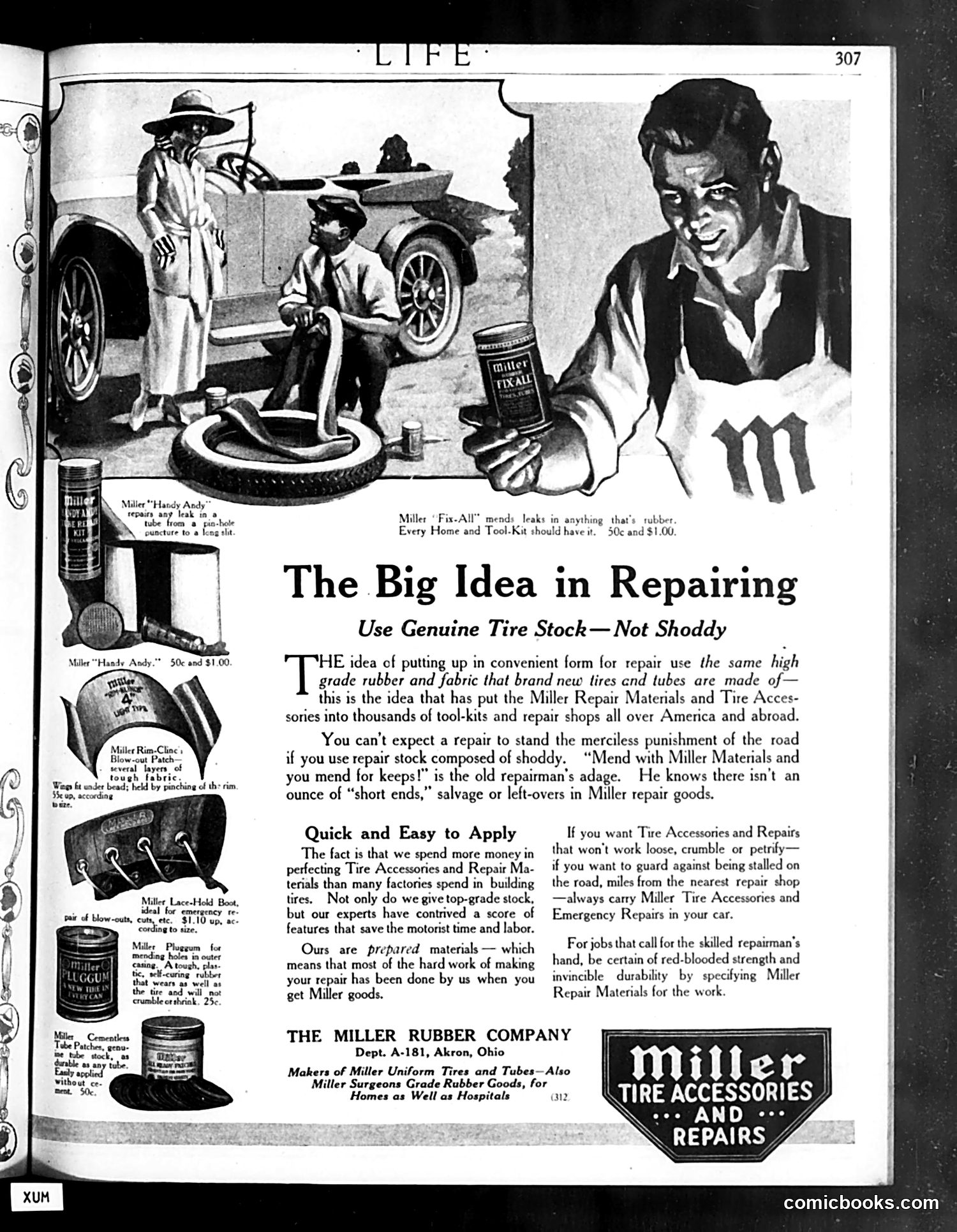
This is primarily a **product advertisement** for Miller Tire Accessories and Repairs, not political satire. The page showcases Miller brand tire repair materials through illustrated scenes of automobile maintenance. The imagery depicts early 20th-century tire repair work: mechanics and car owners dealing with punctures and worn tires. The advertisement emphasizes that Miller products use "genuine tire stock—not shoddy" materials, positioning them as premium versus inferior alternatives. The cartoon-style illustrations are commercial rather than satirical—they're meant to demonstrate practical repair scenarios and build consumer confidence. The text argues that proper repair materials prevent roadside failures. There is **no political content or satire** on this page. It is straightforward consumer advertising from the automobile era.
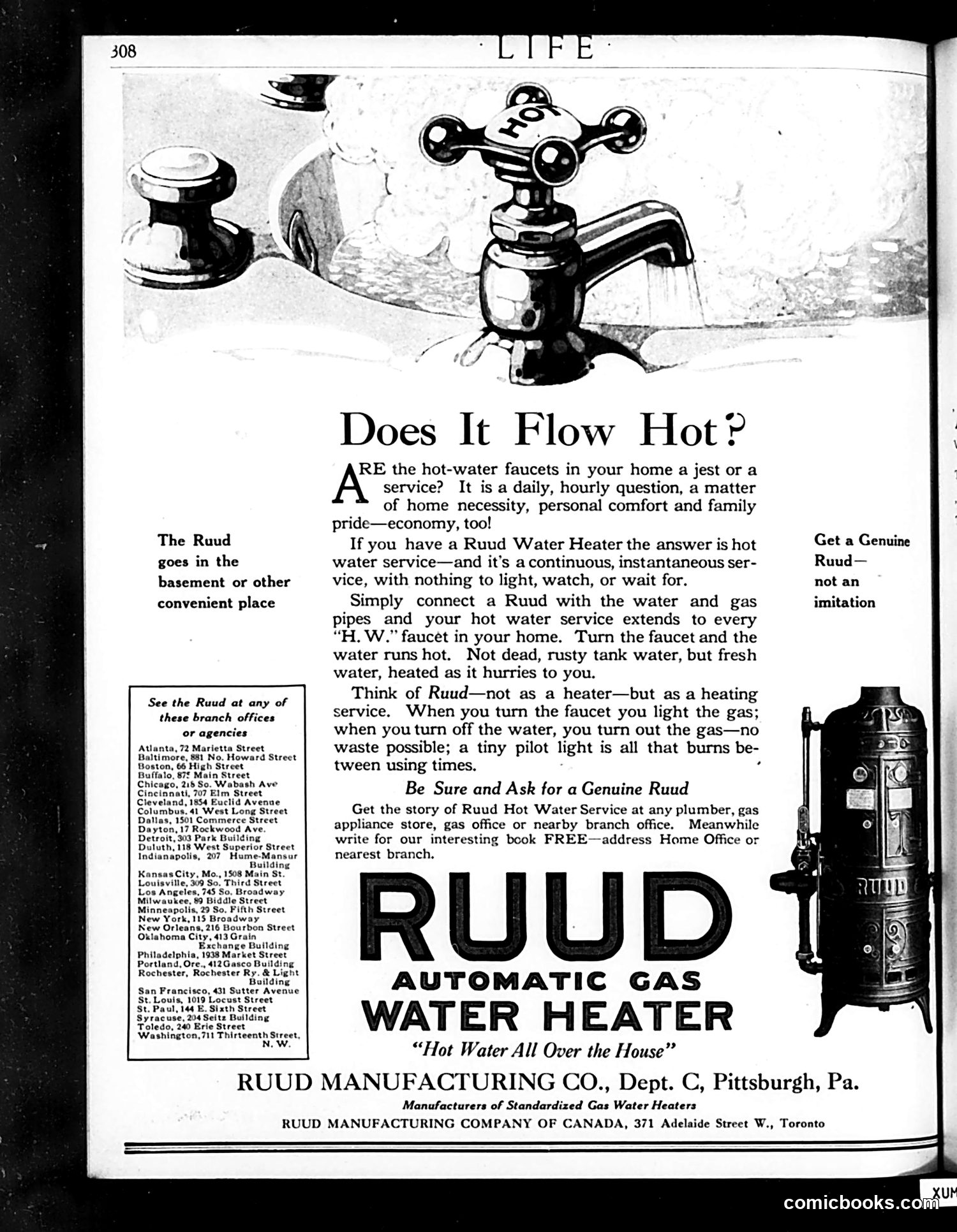
This page is **primarily an advertisement**, not satirical content. It's a full-page ad for the Ruud Automatic Gas Water Heater, published in *Life* magazine (page 308). The ad uses a simple visual joke: the headline "Does It Flow Hot?" is accompanied by illustrations of old-fashioned faucet designs, contrasting them with the modern Ruud water heater shown on the right. The humor is gentle—playing on the everyday frustration of unreliable hot water service before instant gas heating became common. The ad emphasizes the product's key selling point: continuous, instantaneous hot water throughout the home without waiting for tank water to heat. The copy stresses convenience and family comfort. A list of dealer locations spans the left margin. This reflects early-20th-century consumer advertising focused on modern domestic convenience.
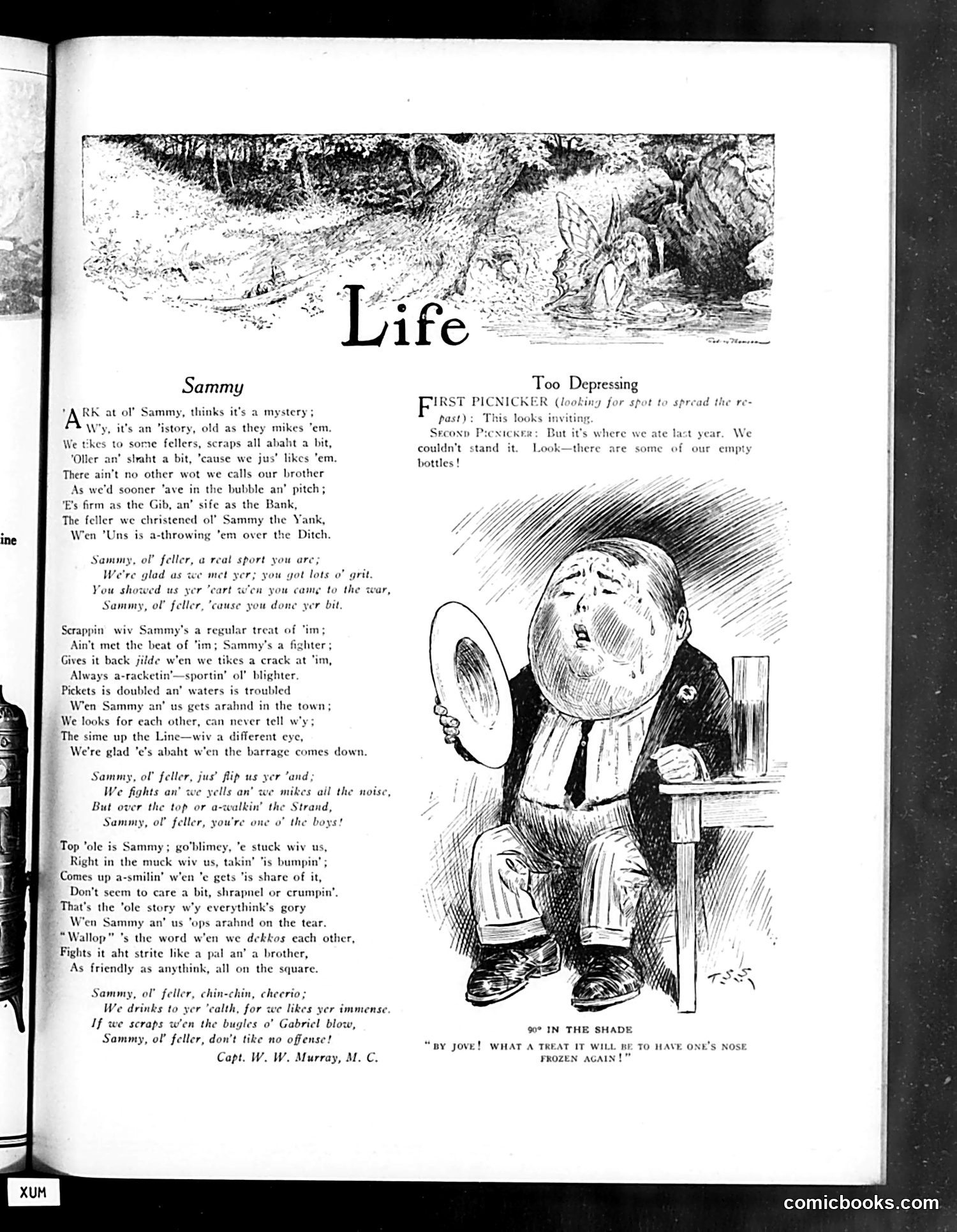
This page from *Life* magazine contains two distinct pieces: **Left side:** A poem titled "Sammy" by Captain W. W. Murray, celebrating a character named Sammy—apparently a working-class or military man known for toughness, fighting ability, and camaraderie. The verses use dialect and slang to humorously catalog his exploits and fearless personality. **Right side:** A cartoon titled "Too Depressing" showing a dejected figure sitting in shade during hot weather (90° indicated). Two picnickers discuss finding their previous picnic spot ruined by empty bottles—suggesting littering or past overindulgence. The man responds with exasperation about his frozen nose, implying either past frostbite or dark humor about winter hardships. The satire criticizes messy outdoor behavior and contrasts leisure activities with discomfort.
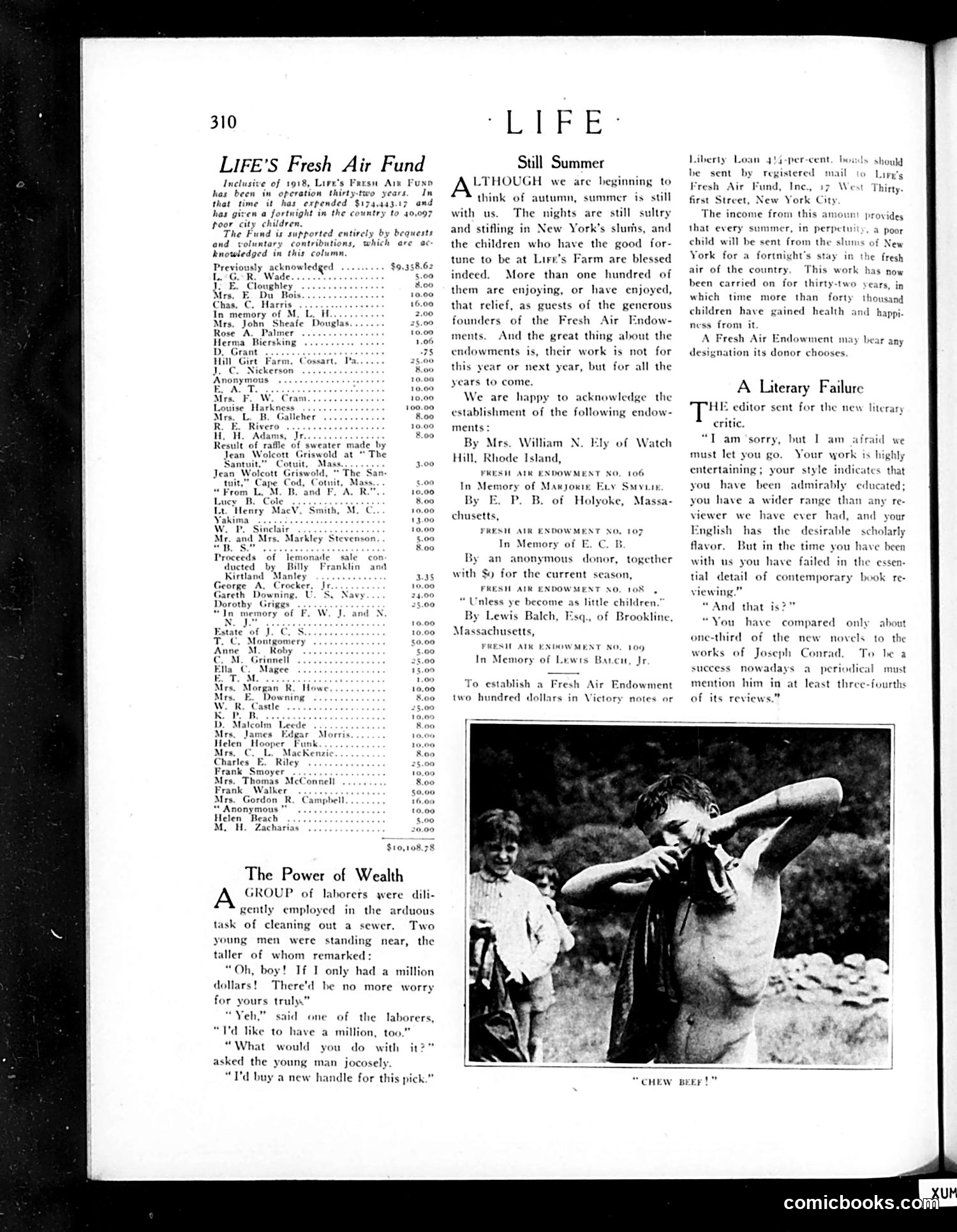
This page contains three distinct sections: 1. **"LIFE'S Fresh Air Fund"** - A fundraising list documenting donations to send poor children from New York City slums to the countryside for summer relief. The detailed donor roll shows this was a genuine charitable initiative. 2. **"Still Summer"** - An editorial essay acknowledging that despite autumn's approach, summer conditions persist in urban areas, emphasizing the ongoing need for the Fresh Air Fund's work. 3. **"A Literary Failure"** - A rejection letter to an unnamed author, critiquing their novel as derivative of Joseph Conrad's work and suggesting their English, while scholarly, lacks authentic contemporary book-reviewing voice. 4. **"The Power of Wealth"** - A brief satirical anecdote about laborers discussing hypothetical wealth, mocking naive assumptions about money's transformative power. The page includes a photograph labeled "CHEW BEEF!" showing what appears to be outdoor activity, likely related to Fresh Air Fund themes.
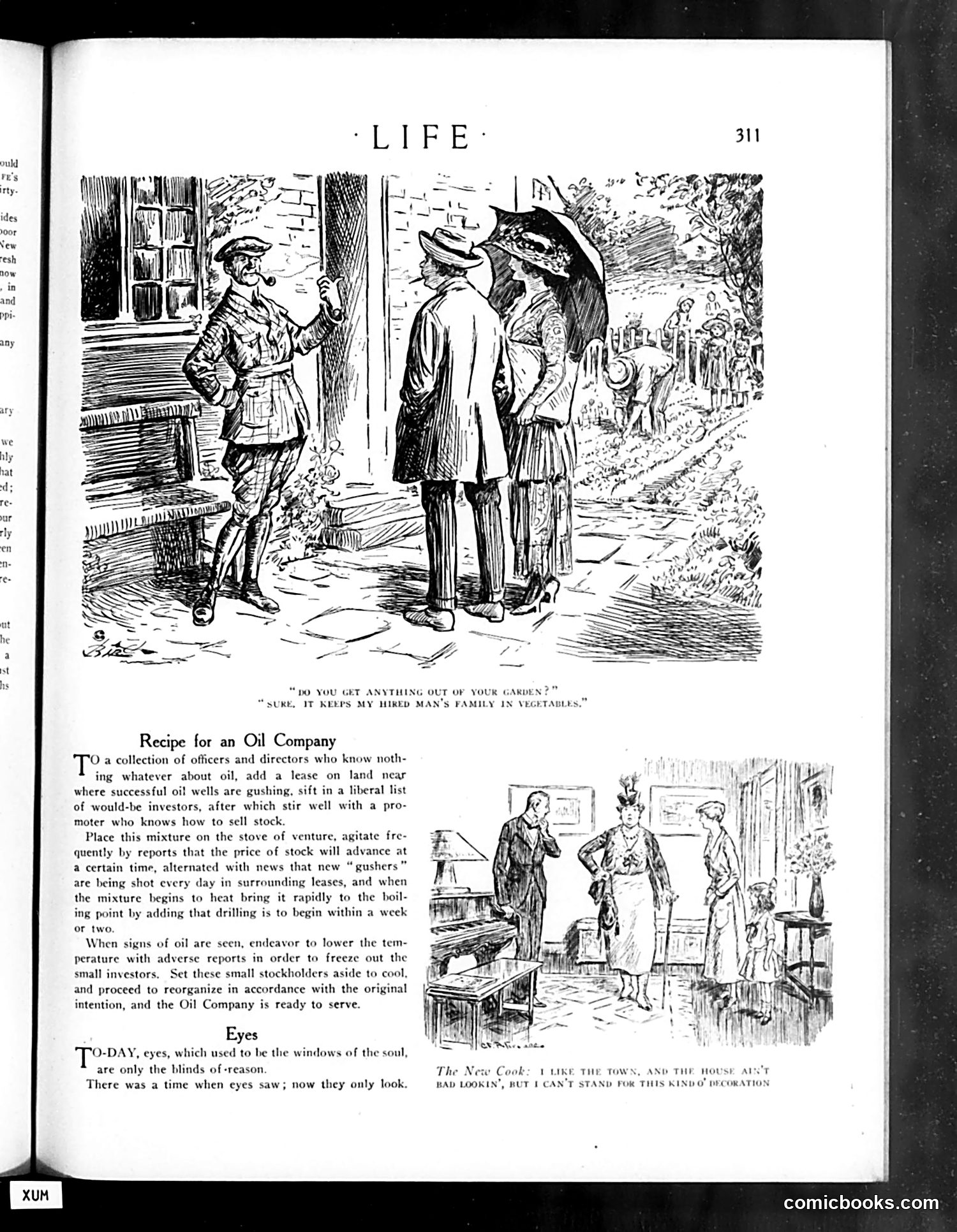
The top cartoon depicts a garden conversation, with one man telling another: "Do you get anything out of your garden?" The response: "Sure, it keeps my hired man's family in vegetables." This satirizes wealthy people who hired gardeners—the joke being that the employer gained nothing while the employee's family benefited from produce. Below is a satirical article titled "Recipe for an Oil Company," which mocks stock manipulation and corporate fraud. It describes mixing officers and directors "who know nothing whatever about oil," adding false reports of successful wells, then heating the mixture of insider trading and false news to defraud small investors. The satire targets early 20th-century oil industry speculation and dishonest promotion practices.
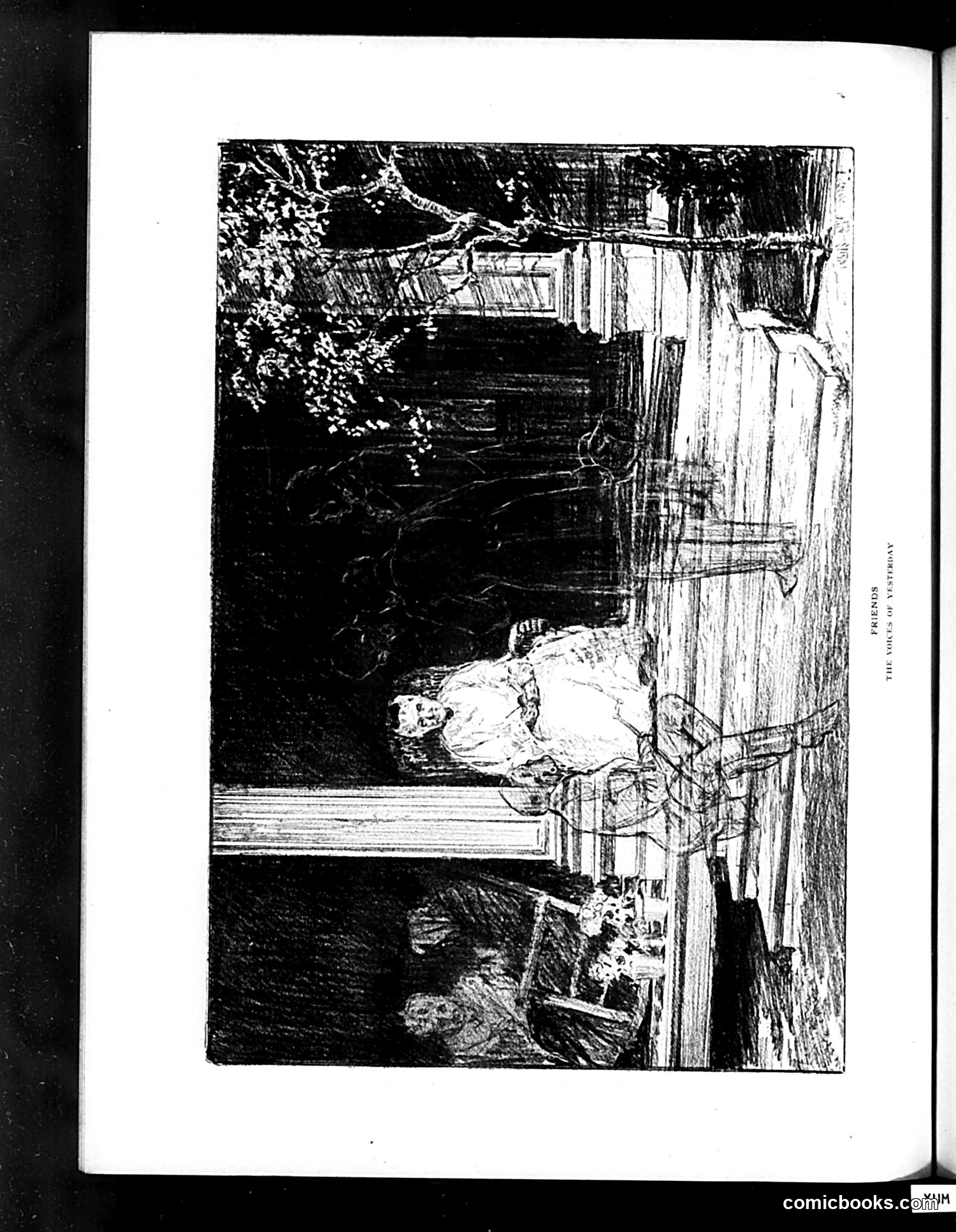
I can see this is a black and white etching or engraving showing an interior domestic scene, oriented sideways on the page. A woman in a light-colored dress appears to be reclining or lying down, with what seems to be period furnishings and architectural details visible. There's text on the right margin that reads "FISCHER" and "THE WOES OF POVERTY." However, the image quality and sideways orientation make it difficult to identify specific figures or read any accompanying satirical text clearly. Without being able to discern the precise details or confirm the OCR text, I cannot reliably explain the cartoon's political or social commentary for a modern reader. The title suggests commentary on poverty, but I cannot assert specific claims about the satire's intended meaning.
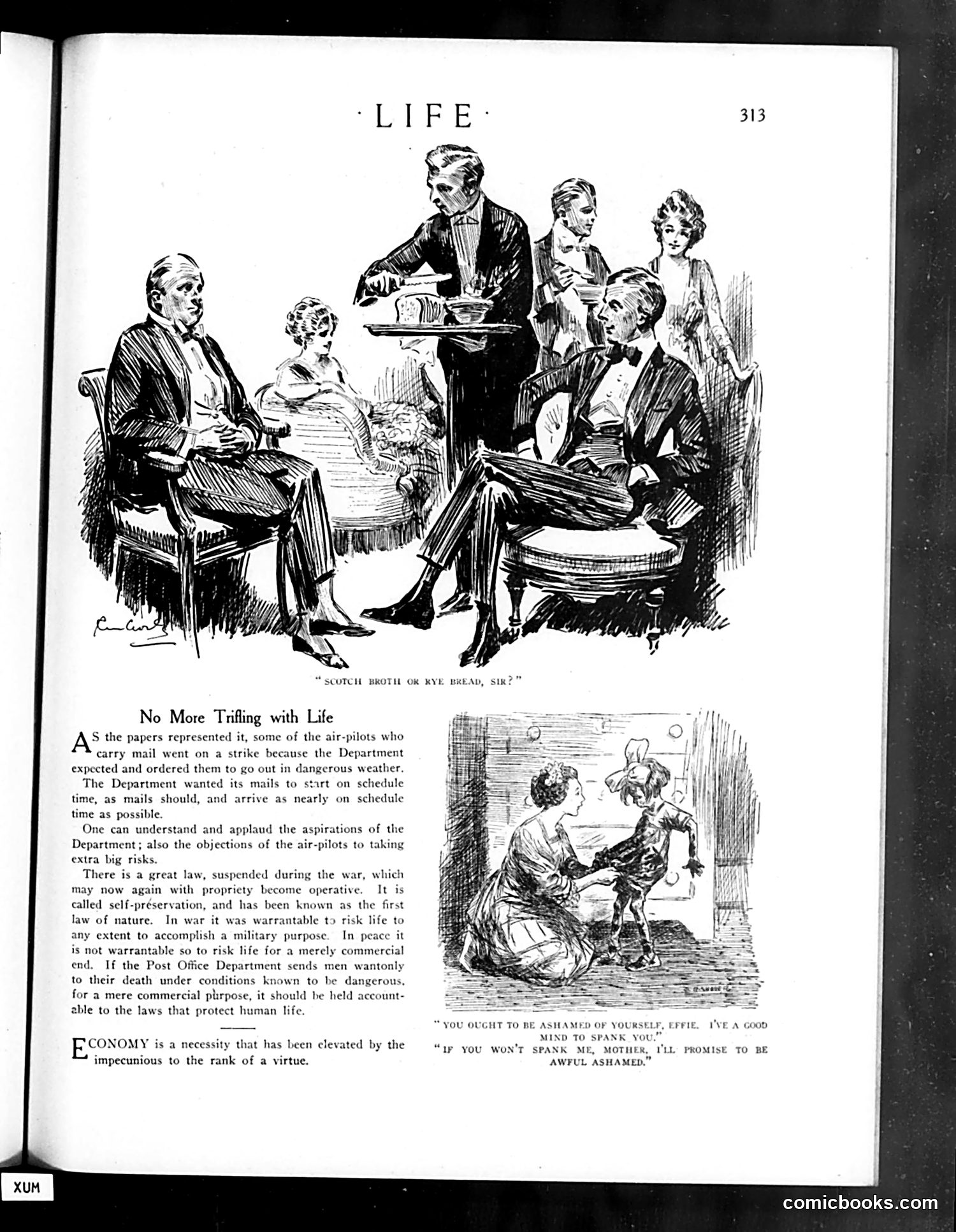
**Top Cartoon:** A domestic dinner scene where a servant offers the host options ("Scotch broth or rye bread, sir?"), satirizing wartime food rationing and scarcity. The joke plays on limited, unappealing meal choices during what appears to be WWI or WWII. **Article "No More Trifling with Life":** Discusses air-mail pilots refusing to fly in dangerous weather conditions. The Post Office Department wanted mail delivered on schedule regardless of danger, but pilots invoked self-preservation rights—a wartime labor dispute about balancing commercial obligations against human safety. **Bottom Cartoon:** A child named Effie refuses spanking, claiming moral superiority. This satirizes how the child has learned to weaponize ethical arguments against parental discipline. The page reflects wartime anxieties about duty, sacrifice, and civilian expectations.
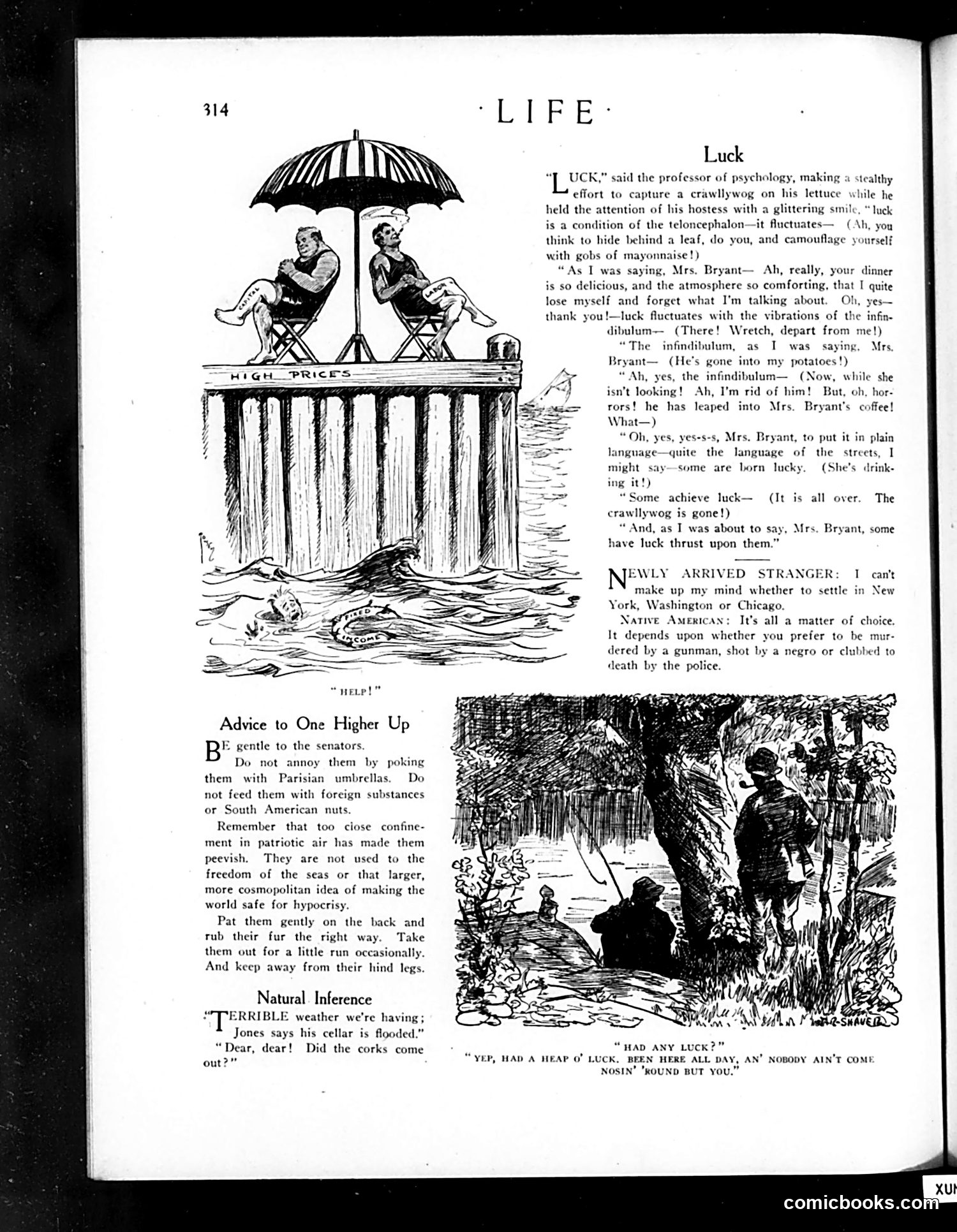
The main cartoon depicts two wealthy people sheltering under an umbrella labeled "HIGH PRICES" while standing on a platform above floodwaters—a visual metaphor for how the rich insulate themselves from economic hardship during inflation or economic crisis. The accompanying text satirizes luck and social mobility, featuring exchanges between characters discussing whether success depends on fortune or individual effort. A "Native American" character makes a dark joke about survival options in corrupt American cities, while a "Newly Arrived Stranger" debates settling in different cities. The section "Advice to One Higher Up" mocks senators with condescending tips about handling them, suggesting political corruption or senators' perceived incompetence. "Natural Inference" presents a domestic joke about flooded cellars and cork bottles—mundane humor unrelated to the economic commentary above.
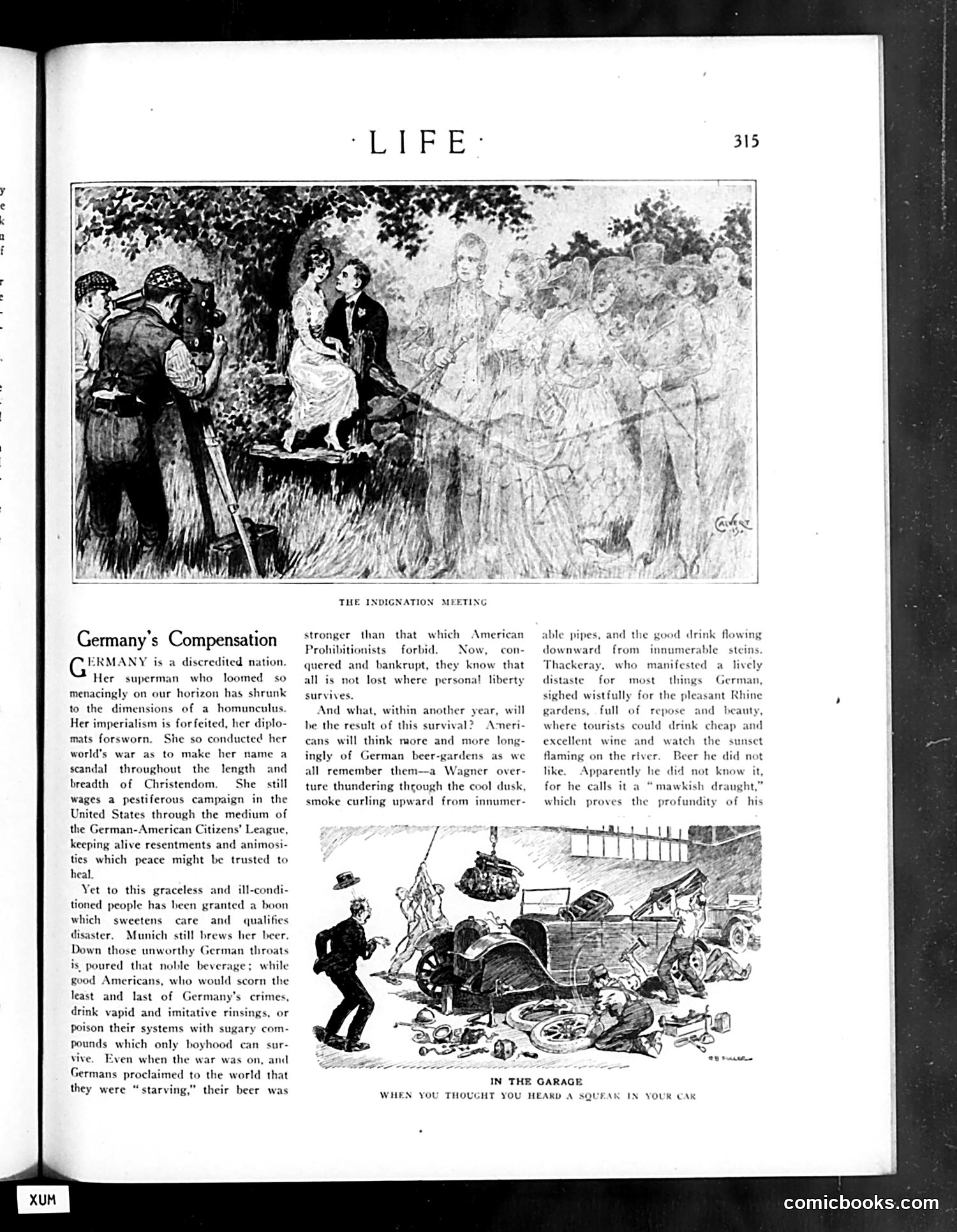
This page satirizes post-WWI Germany, mocking its claims of hardship while celebrating beer culture. The article argues that despite Germany's wartime suffering and prohibition movements (compared to American Prohibition), Germans have been "granted a boon" through access to beer—presented as compensation for their losses. The top cartoon, "The Indignation Meeting," appears to show a formal gathering, likely depicting German officials or citizens protesting reparations or conditions. The bottom cartoon, "In the Garage," jokes about mechanical problems ("a squeak in your car"), satirizing Germany's industrial capacity or automotive industry alongside broader commentary on German resilience and material recovery. The piece uses alcohol and industrial themes to ridicule German grievances while suggesting their actual circumstances weren't as dire as claimed.
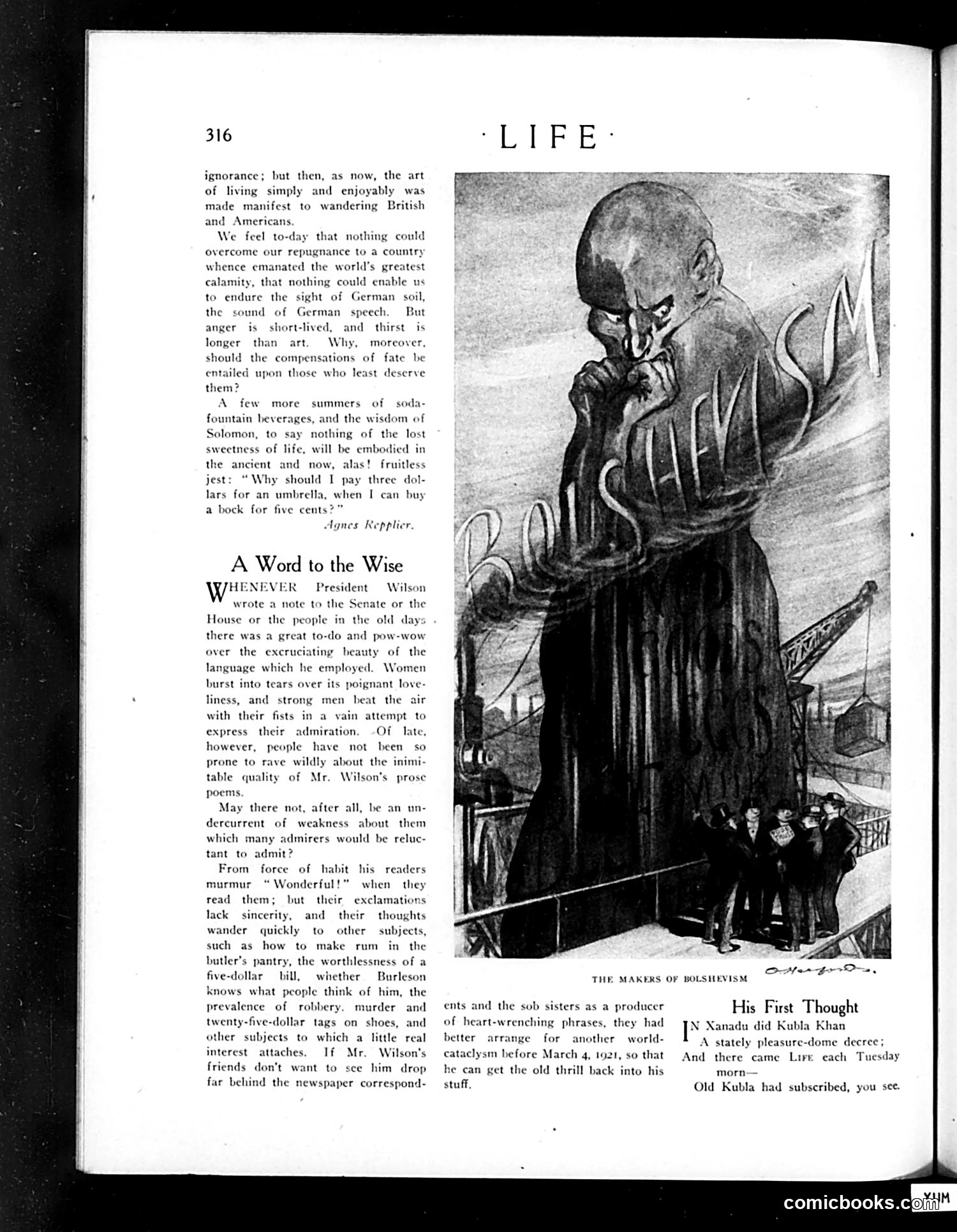
This page contains two distinct articles: the first critiques post-WWI attitudes toward Germany, and the second, titled "A Word to the Wise," defends President Wilson's prose style against recent criticism. The illustration labeled "THE MAKERS OF BOLSHEVISM" depicts a menacing figure (likely representing Bolshevik leadership) looming over smaller figures below, apparently ordinary people or revolutionaries. This reflects 1920s American anti-communist anxiety—Bolshevism was widely feared as a destabilizing force. The accompanying story "His First Thought" references Kubla Khan and appears to be satirical fiction, though its full context is unclear from this excerpt. The overall page reflects post-WWI American political debate: resentment toward Germany, defense of Wilson's rhetoric, and deep anxiety about communist revolution—major preoccupations of the early 1920s.
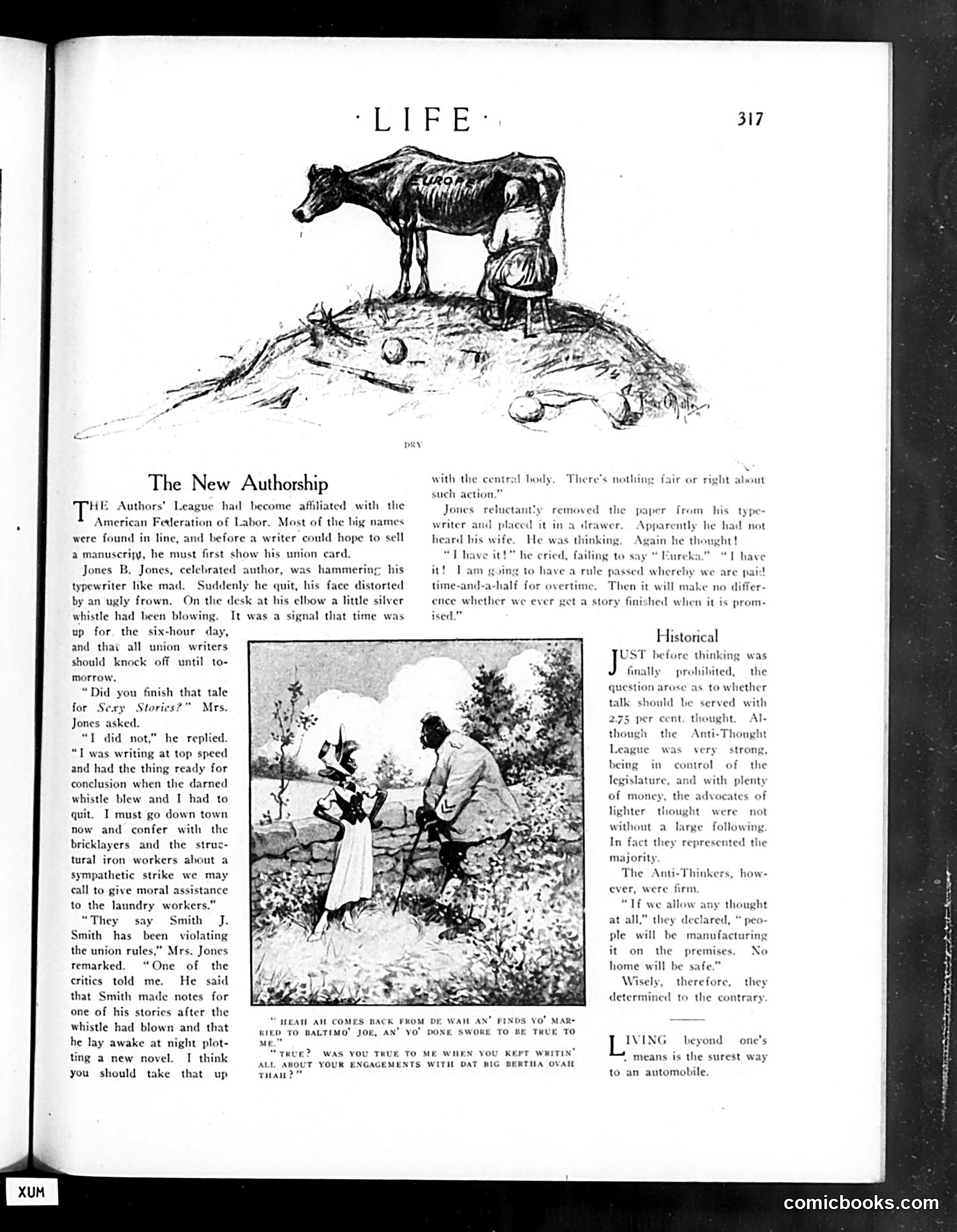
This satirical piece mocks the **Authors' League** and **union labor organizing** in the 1920s-1930s. The story ridicules writer **James B. Jones**, who abandons his typewriter over labor disputes, declaring writers should "knock off until tomorrow" in solidarity with striking workers. The top cartoon shows a cow being milked—likely representing publishers extracting profit from writers' labor. The central photograph illustrates the narrative: a woman confronts a man outdoors, visualizing the domestic conflict over Jones's union activism. The satire targets **intellectual workers joining labor unions**, presenting unionization as absurd for authors and attacking the "Anti-Thought League"—suggesting that prioritizing labor rights over literary output is foolish and counterproductive to society.
This satirical piece mocks early 20th-century courtship rituals and parental control. A young man seeks to marry a wealthy father's daughter but lacks financial means. The father refuses, lecturing him that love cannot pay bills or rent—a practical objection reflecting post-Industrial anxieties about class and marriage. The satire's twist: the daughter manipulates her father by *appearing* reluctant to marry, making him believe she's being jilted. This reverses his position entirely, and he now *insists* on the marriage to protect his daughter's honor. The irony is that her "camouflage"—feigning disinterest—succeeds where the young man's honest declarations failed. The story critiques both parental presumption (fathers controlling daughters' marriages through economic leverage) and feminine cunning as the only available counter-strategy. It's simultaneously sympathetic to young love and cynical about how it actually operates within rigid class structures.
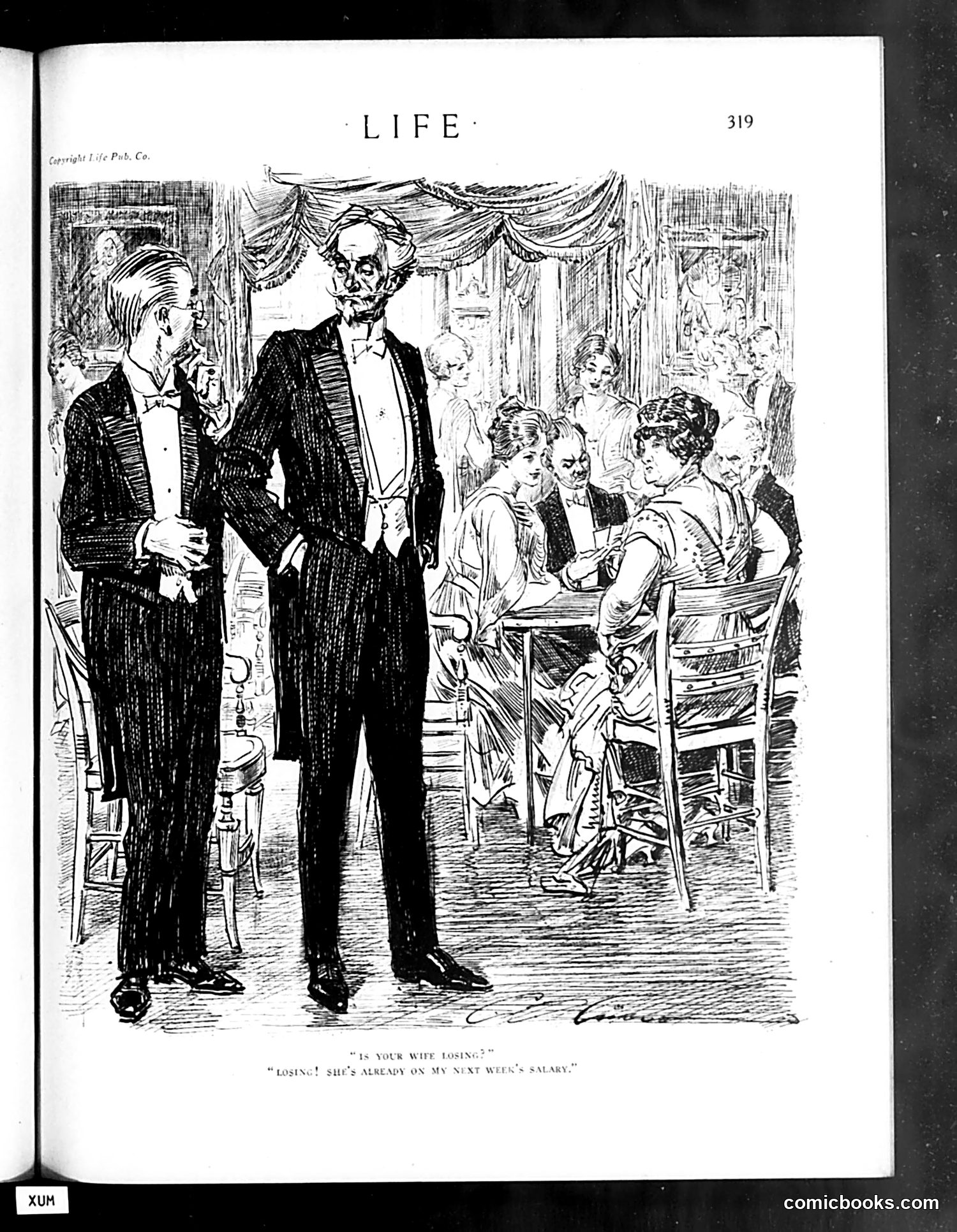
This single-panel cartoon depicts a formal dinner party scene. Two well-dressed men in tuxedos stand conversing in the foreground, while seated guests dine in the background. The caption reads: "Is your wife losing?" with the response "Losing! She's already on my next week's salary." The satire targets wives' extravagant spending habits—a common theme in early-to-mid 20th century humor. The joke plays on "losing" as both gambling and financial loss, suggesting the man's wife spends money so recklessly at social events that her expenditures already exceed his future earnings. This reflects period anxieties about consumer culture, women's independence in spending, and domestic finances. The formal setting emphasizes the social pretension fueling such excess.
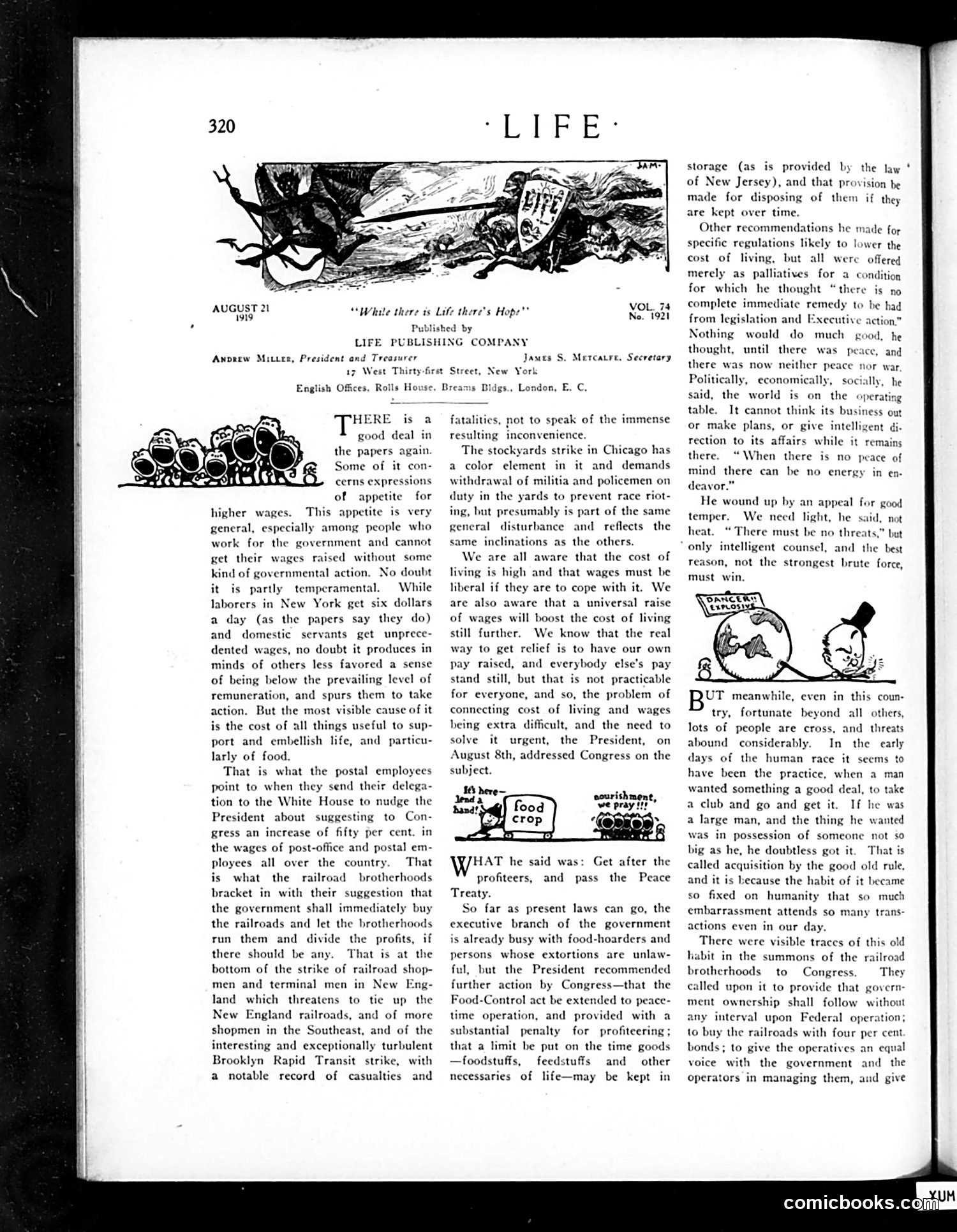
This editorial addresses post-WWI labor unrest and inflation. The author discusses widespread strikes—postal workers, railroad brotherhoods, New England rail shops, Brooklyn transit, and Chicago stockyards—all demanding wage increases to offset rising living costs. The cartoons illustrate the wage-inflation paradox: workers demand higher pay due to expensive food, yet universal wage increases would further boost prices. One cartoon shows a figure labeled "food crop" being squeezed, another depicts profiteers. President Wilson's August 8th Congressional address is analyzed. The author summarizes his recommendations: extend food-control laws to peacetime, penalize profiteering, limit storage time for foodstuffs, and address hoarders. However, Wilson acknowledged no "complete immediate remedy" existed through legislation alone. The satire criticizes the circular problem: workers need relief, but the proposed solutions are merely "palliatives" that won't solve the fundamental economic imbalance. The implied message: no easy political fix exists for postwar economic chaos.
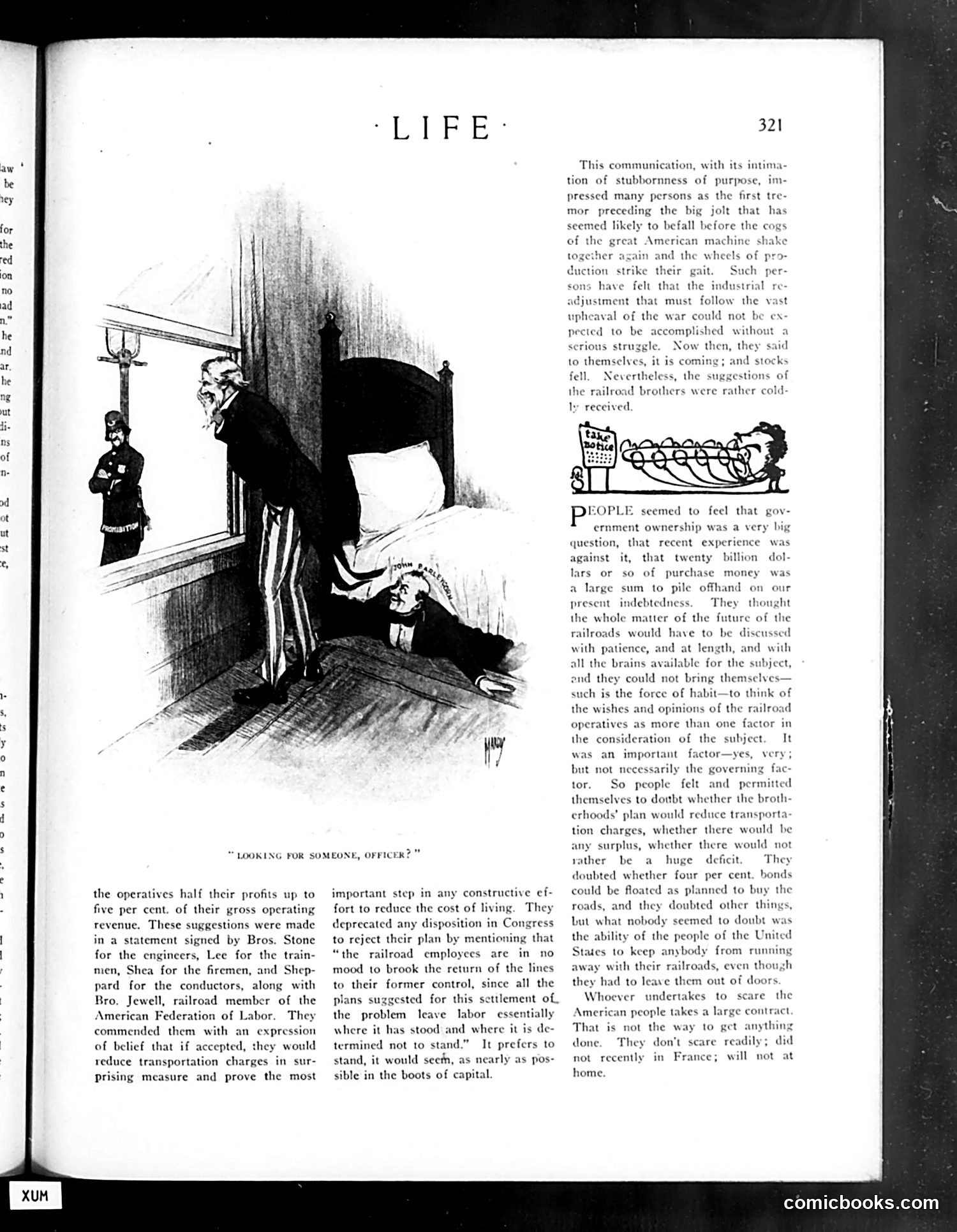
This cartoon depicts a bedroom scene where an officer peers through a window at a couple in bed, with the caption asking if he's "looking for someone." The satire concerns **railroad labor negotiations** during the post-WWI period. The cartoon illustrates the tension between railroad unions and the government over nationalization. Union leaders had proposed accepting reduced profits to lower transportation costs, but threatened labor unrest if their demands weren't met. The text describes this as an implicit threat—workers essentially "in the boots of capital," refusing to return lines to private control. The bedroom intrusion metaphor suggests the **awkward, invasive nature of government involvement** in labor disputes. The officer represents the state caught between competing interests. The cartoon satirizes how both labor and the public viewed government ownership skeptically, preferring to keep the uncomfortable relationship at arm's length rather than commit to either solution. The joke: everyone prefers distance from the actual problem.
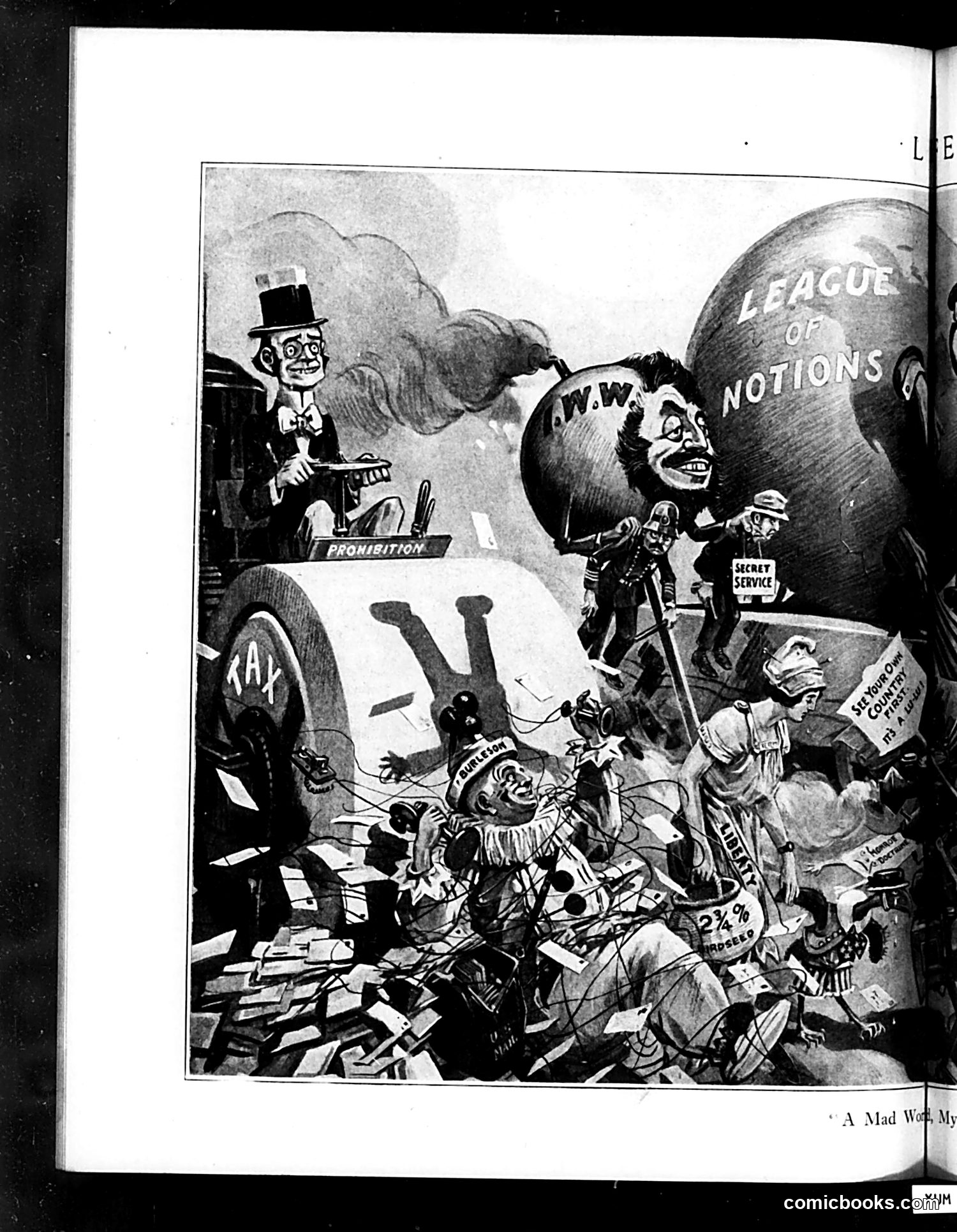
This is a satirical cartoon criticizing prohibition and related social issues. The left figure in top hat labeled "PROHIBITION" operates machinery, while a large balloon labeled "LEAGUE OF NOTIONS" looms on the right. Various caricatured figures below represent different groups or interests affected by prohibition policy. Visible labels include "W.W." (unclear reference), "SECRET SERVICE," and what appears to be references to smuggling, corruption, and organized crime elements—all consequences of prohibition enforcement during the 1920s-early 1930s. The cartoon satirizes how prohibition generated unintended consequences: criminal enterprises, government hypocrisy, and social chaos. The "League of Notions" balloon likely mocks idealistic but impractical reformist thinking. The exaggerated, grotesque caricatures are typical of period satirical cartooning style.
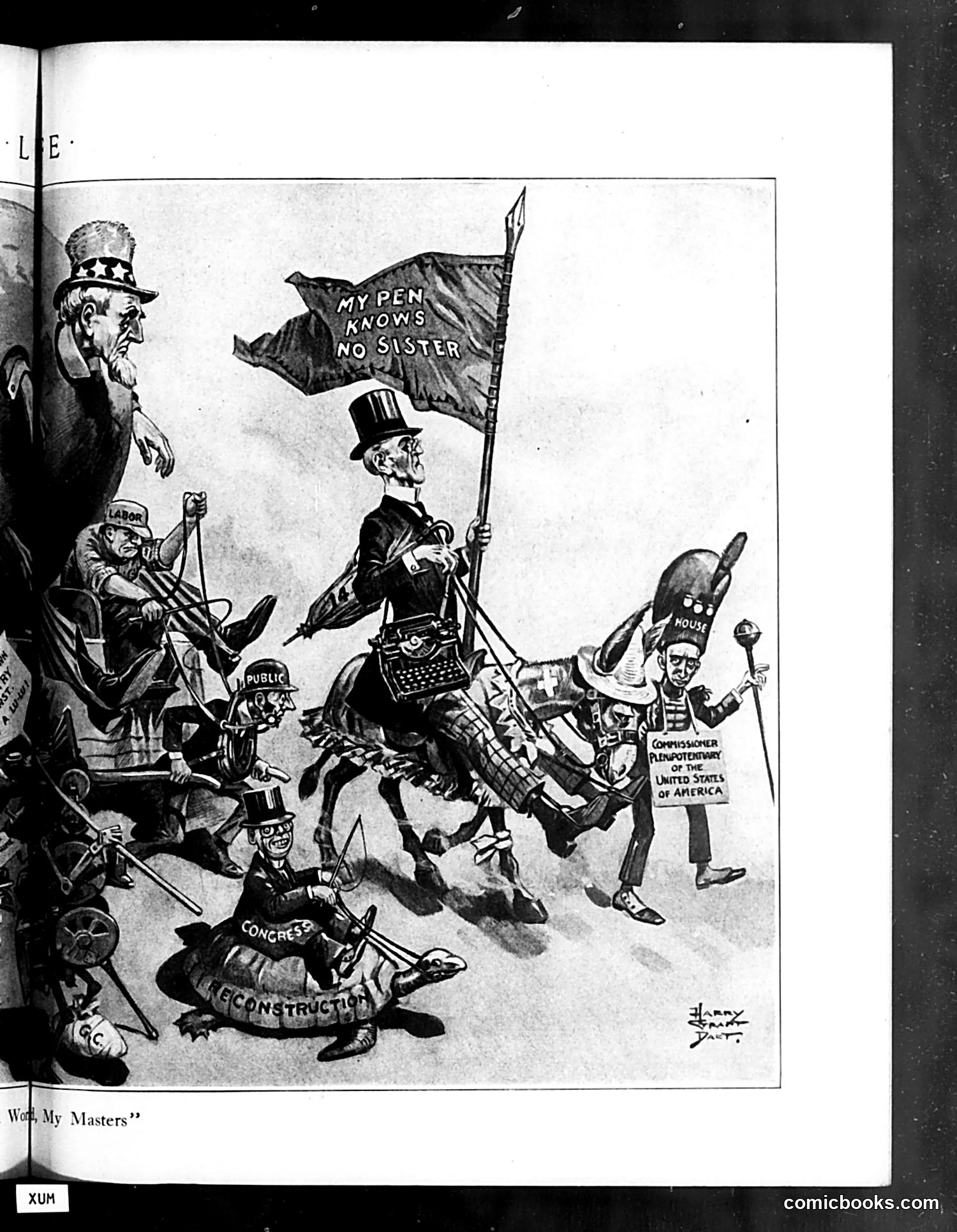
This political cartoon satirizes competing interests vying for control during Reconstruction (post-Civil War era). A tall figure wearing a top hat—likely representing **wealth or Northern capital**—holds a flag reading "My Pen Knows No Sister," commanding smaller figures labeled **Labor, Public, Congress, and Reconstruction**. On the right, a figure labeled **House** and another identified as "Commissioner Plenipotentiary of the United States of America" appear to follow obsequiously. The cartoon's point: powerful economic interests are manipulating government institutions and public bodies like puppets during Reconstruction, treating them as subordinates rather than equals. The flag's cryptic message suggests these masters operate without accountability or transparency.
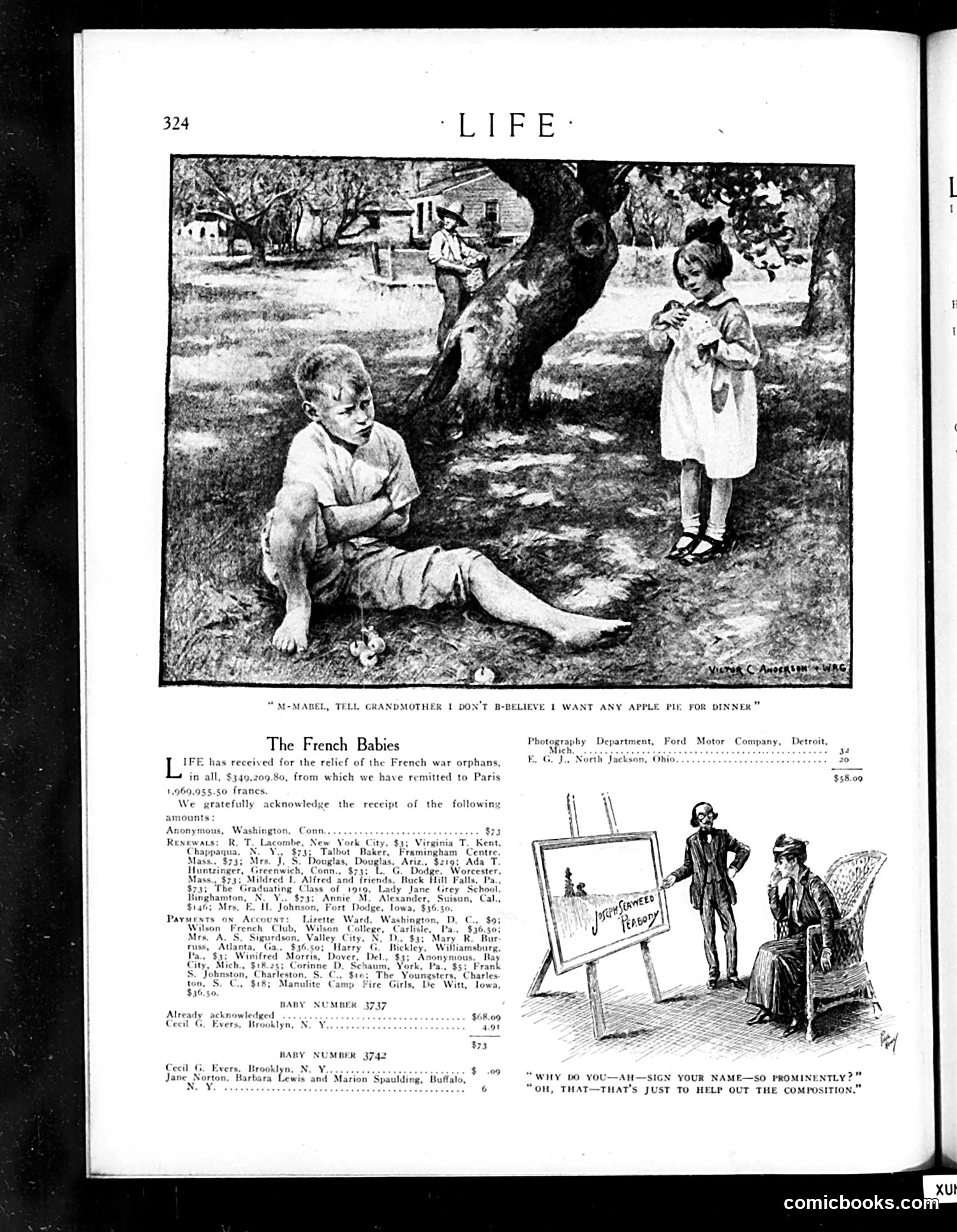
**Main Image:** A photograph of children outdoors, captioned with dialogue where a child named Mabel tells his grandmother he doesn't want apple pie for dinner—an unusual refusal suggesting wartime rationing or food scarcity affecting even children's appetites. **"The French Babies" Section:** This documents LIFE magazine's charitable fundraising campaign for French war orphans during World War I. The text lists donations received (totaling approximately $149,209.80 remitted to Paris) and acknowledges individual contributors by name and amount. It appears to be a public accounting of charitable donations. **Right-side Cartoon:** Two men stand before an easel displaying a poster for "Aid Frances Relief." The caption jokes that one signs his name "prominently" to "help out the composition"—satirizing donors who contribute primarily for public recognition and credit rather than genuine charitable impulse. **Overall Context:** The page contrasts genuine wartime humanitarian need (orphans, rationing) with the satirical observation that charitable giving often serves donors' vanity as much as victims' welfare.
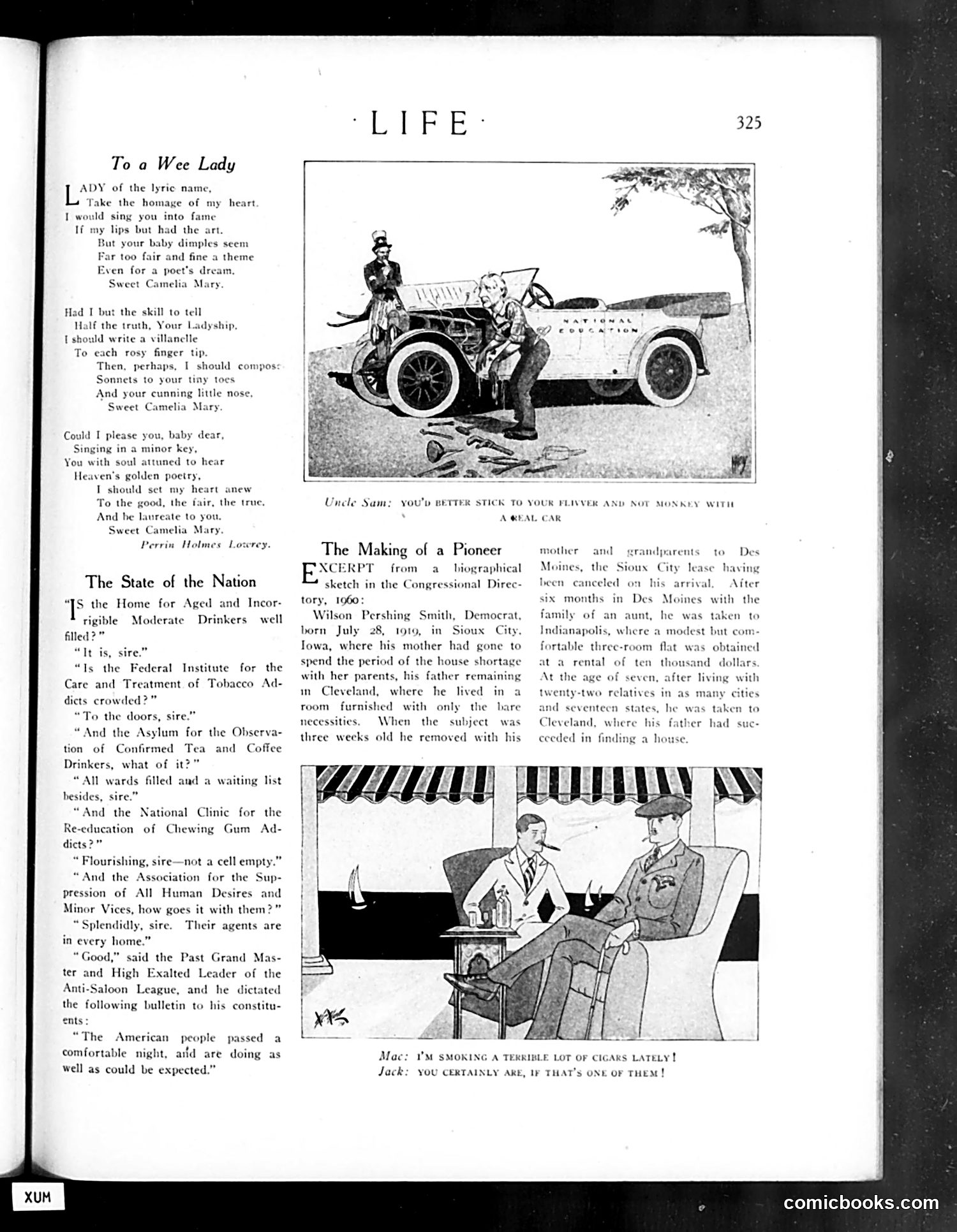
This page contains satirical content mocking Prohibition-era social reforms: **"The State of the Nation"** dialogue satirizes the overzealous regulatory movement of the 1920s. It presents a fictional bureaucratic expansion where government agencies exist for increasingly absurd purposes—homes for "moderate drinkers," asylums for coffee drinkers, clinics for chewing gum addiction, and an "Association for the Suppression of All Human Desires." The Anti-Saloon League leader's cheerful bulletin mocking such institutions suggests satire of Prohibition's zealotry and social control ambitions. **The lower cartoon** shows two men discussing cigars, with the joke being that one's cigars are so terrible, the other questions whether they're actually cigars at all—likely a jab at wartime substitutes or black-market quality. **"The Making of a Pioneer"** biographical excerpt humorously traces a man's constant relocation across America, emphasizing post-WWI housing shortages and domestic instability as defining characteristics of modern American life.
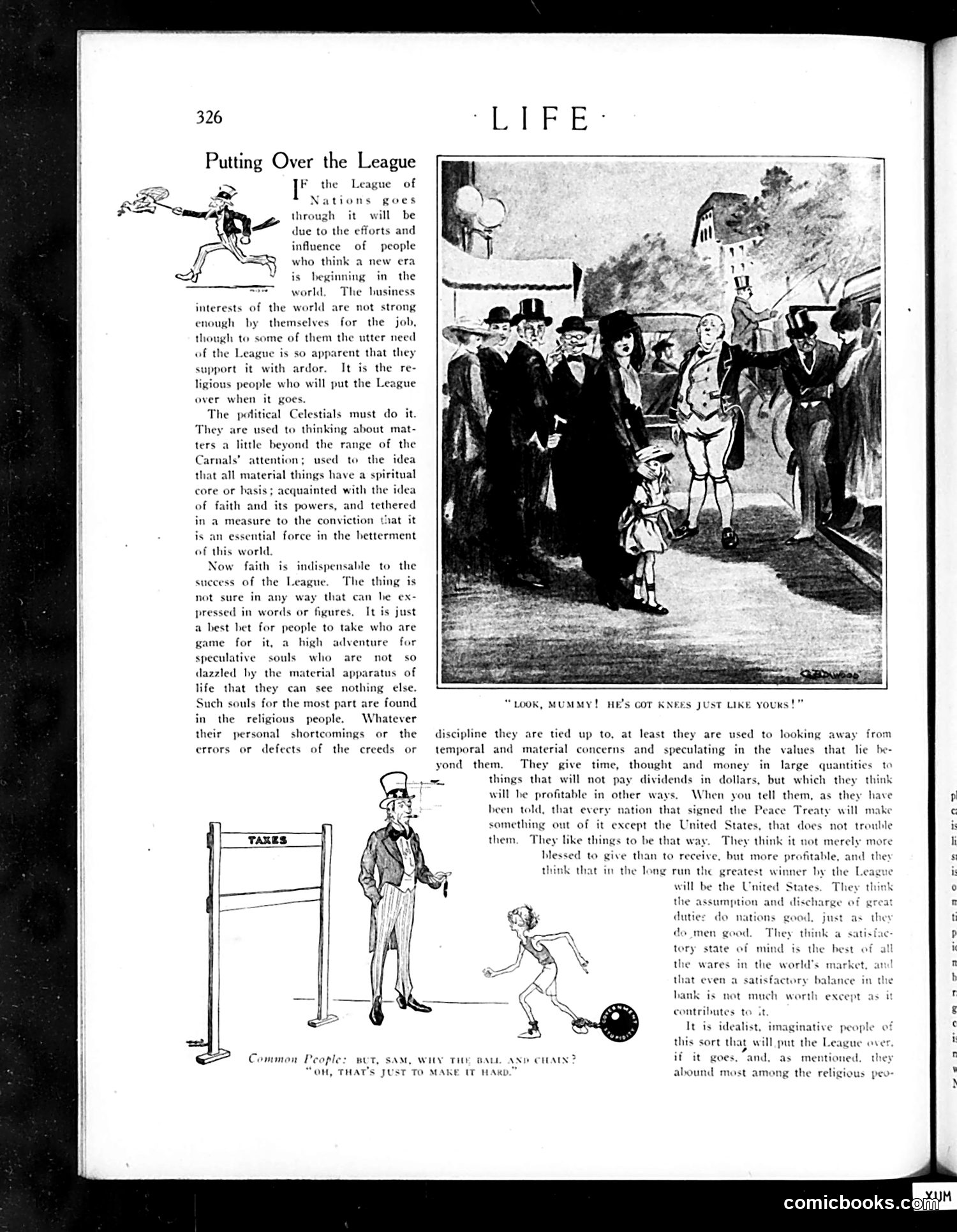
This page advocates for the League of Nations (the post-WWI international organization) through satirical commentary. The text argues that the League's success depends not on business interests but on "religious people"—idealists with faith in abstract principles beyond material concerns. The top cartoon shows a child with adult-like knees, captioned "Look, mummy! He's got knees just like yours!"—likely mocking how the League tries to present foreign nations as equals to America while expecting unequal sacrifice from the U.S. The lower cartoon depicts "Common People" asking "Sam" (Uncle Sam, America) why he adds chains and a ball to make things hard—a visual metaphor suggesting the League imposes unnecessary burdens on ordinary Americans for idealistic goals. The satire is ambiguous: it may genuinely praise religious idealism, or mock it as naïve, depending on the reader's perspective on League membership.
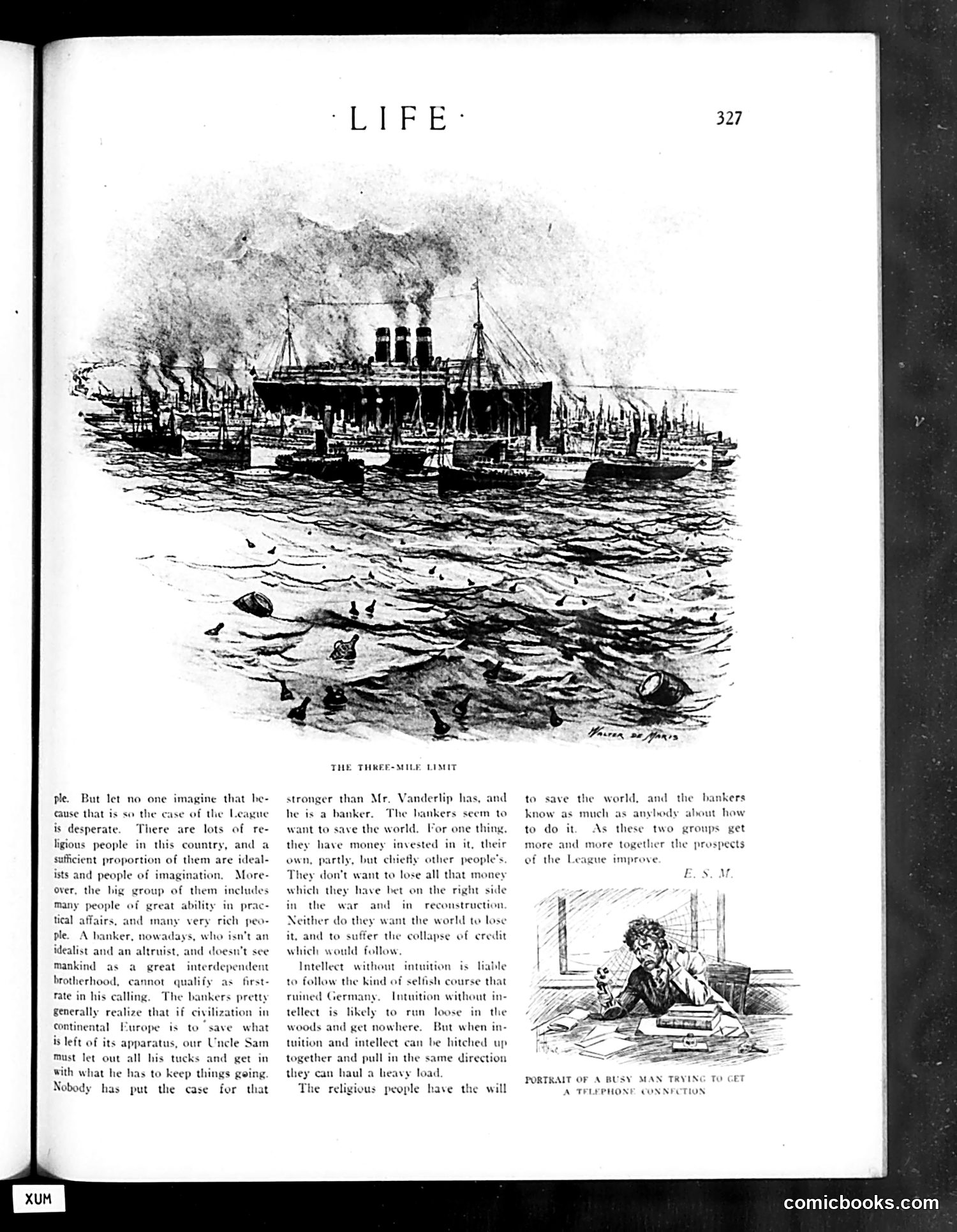
This page from *Life* magazine presents an editorial argument about post-WWI reconstruction, likely from the early 1920s during League of Nations debates. **The Main Illustration** ("The Three-Mile Limit") depicts a large ocean liner surrounded by smaller vessels—a visual metaphor for America's economic dominance and responsibility in a war-damaged world. **The Political Argument**: The text argues that American bankers (citing Frank Vanderlip as an example) and religious idealists share common cause in supporting international reconstruction. The piece contends that bankers have financial incentives to stabilize the world economy, while religious groups have moral motivations. Together, it suggests, their combined "intuition and intellect" can support efforts like the League of Nations. **The Satire**: The editorial is essentially making a pragmatic case that self-interest and idealism align—bankers want to protect their investments abroad while idealists want to save civilization. This reflects broader 1920s debates about American isolationism versus international engagement. **The Secondary Cartoon** shows a businessman struggling with a telephone connection—likely satirizing communication difficulties or bureaucratic frustration during this period of complex international negotiations.
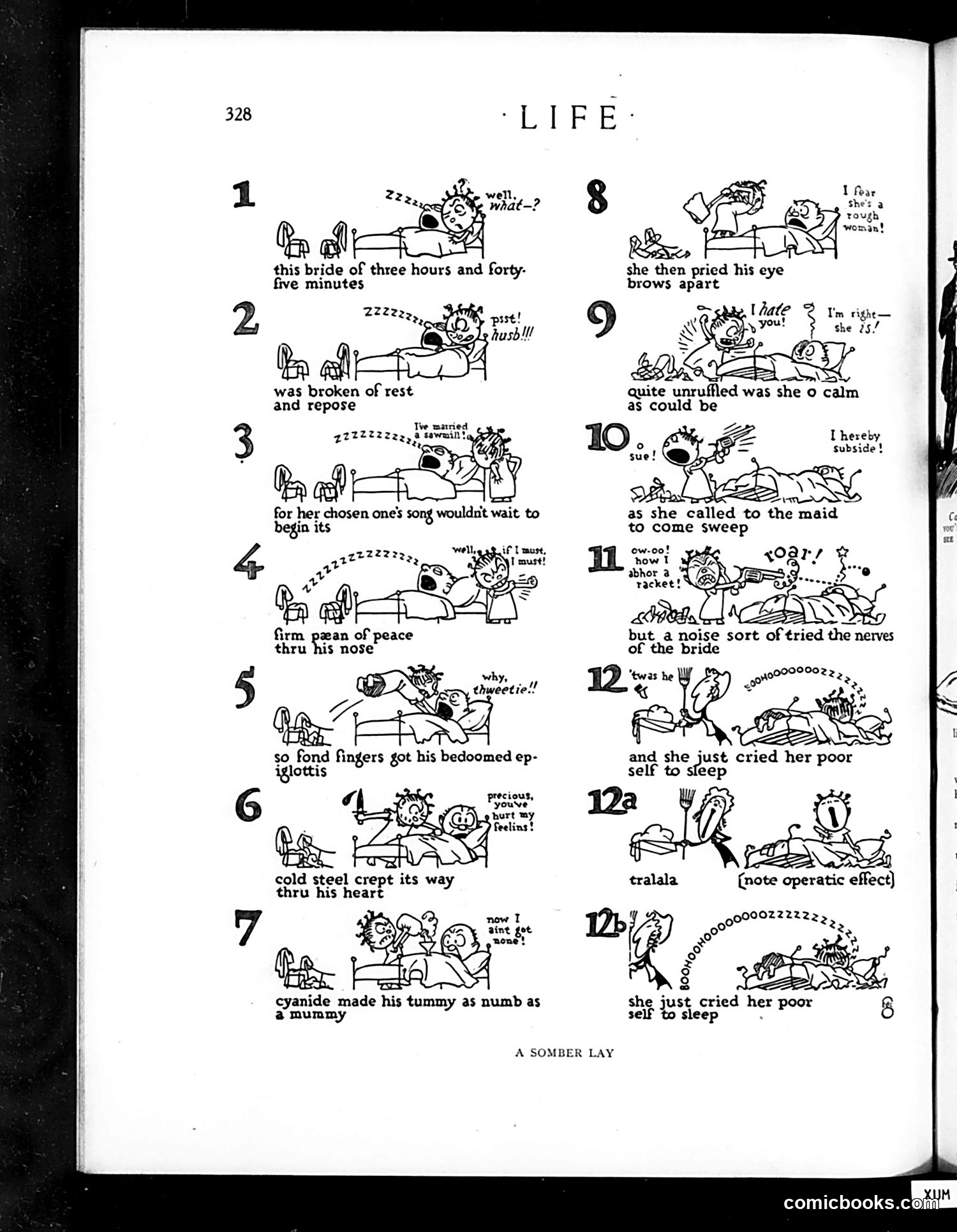
This is a macabre 12-panel cartoon satirizing the brutality of the wedding night, presented as a mock-tragic narrative. The humor derives from extreme exaggeration: a new bride of just hours subjects her groom to increasingly violent abuse—prying his eyebrows apart, causing his "fond fingers" to swell, inducing cyanide poisoning, and stabbing him through the heart—yet she remains "quite unruffled...as calm as could be." The satire targets Victorian-era attitudes about marriage and gender relations, where women were expected to be docile while husbands maintained authority. Here, the newlywed wife becomes the aggressor, her violence absurdly casual. The groom's suffering ends in his death; the bride simply "cried her poor self to sleep." The cartoon mocks both marital violence's normalization and rigid gender roles through grotesque inversion, using melodramatic language ("A Somber Lay") and operatic-style effects to amplify the dark comedy.
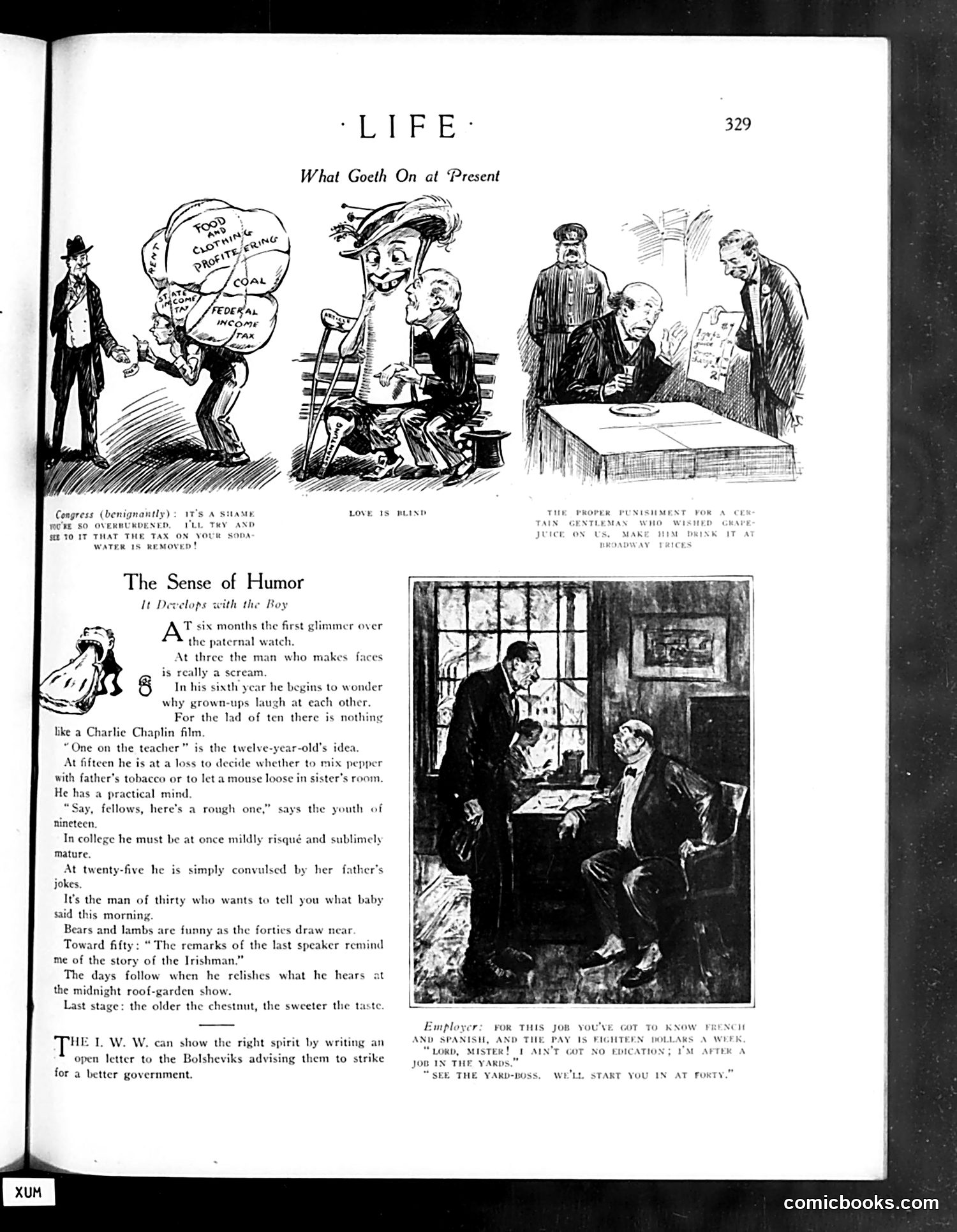
**Top Section ("What Goeth On at Present"):** Three cartoons satirizing contemporary issues: 1. **Congress cartoon**: A congressman, labeled "benignantly," tells someone burdened with taxes that he'll "try" to remove the soda-water tax—mocking Congress's ineffectual response to taxpayer complaints. 2. **"Love is Blind"**: Two figures on a ladder; likely mocking romantic naïveté or foolish infatuation. 3. **"Proper Punishment"**: References forcing someone to pay inflated "Broadway prices" as punishment—satirizing wartime price gouging or theater profiteering. **"The Sense of Humor" essay**: Humorous commentary on how humor appreciation evolves with age, from infants finding faces funny through old age, when people repeat tired jokes ("chestnuts"). **Bottom cartoon**: An employer offering someone $40/week for a yard job requiring French and Spanish language skills—satirizing either unrealistic job expectations or exploitative hiring practices paying minimal wages for demanding positions. **Context**: References to I.W.W. (Industrial Workers of the World) and Bolsheviks suggest this is WWI or immediate post-war era satire addressing labor disputes, government inefficiency, and economic hardship.
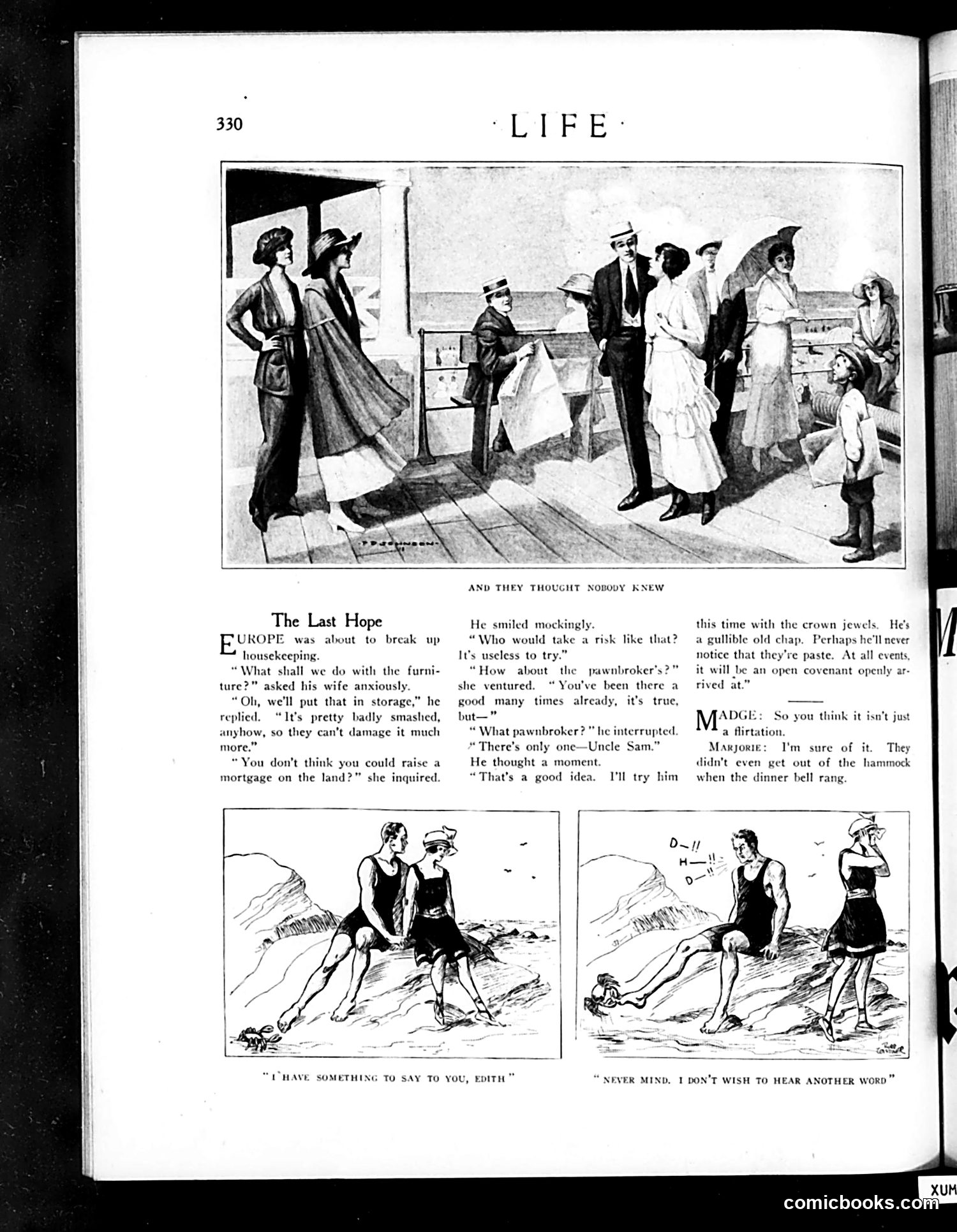
This page satirizes post-WWI European financial desperation. The main story depicts a European couple (likely French or Belgian, given references to war damage) discussing their ruined finances. Unable to mortgage land or borrow from private pawnbrokers, the husband proposes pawning "crown jewels" to "Uncle Sam"—the United States government—expecting America to be naive enough not to notice the jewels are fake paste. The satire targets American generosity toward war-devastated Europe and suggests European nations view U.S. aid as an opportunity for deception. The phrase "gullible old chap" reinforces the stereotype of America as wealthy but unsophisticated. The beach comics below are unrelated domestic humor about romantic misunderstandings. The overall message: Europe, financially desperate after WWI, assumes it can trick America into funding reconstruction.
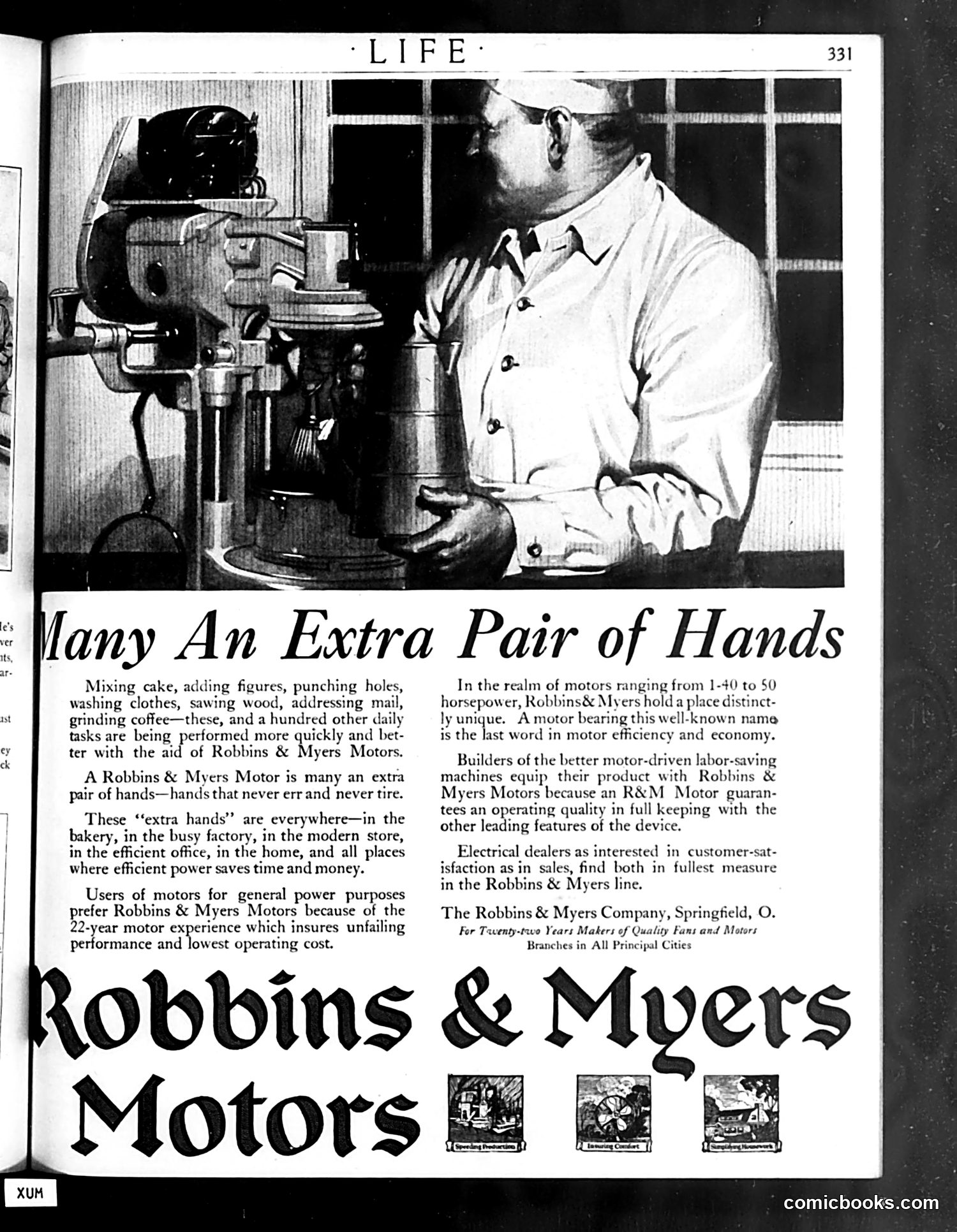
This is a **full-page advertisement**, not satire or political commentary. It promotes electric motors manufactured by Robbins & Myers Company of Springfield, Ohio. The image shows a man operating an industrial motor-driven machine, illustrating the ad's central concept: electric motors as "an extra pair of hands" that perform repetitive tasks faster and more reliably than manual labor. The copy emphasizes the motors' versatility across bakeries, factories, stores, offices, and homes—appealing to early-20th-century anxieties and enthusiasm about mechanization and labor-saving technology. The ad stresses reliability (22 years of experience), efficiency, and low operating costs. This reflects the era's optimistic view of electrification and automation as solutions to industrial productivity. The "extra hands" metaphor was a common marketing trope for motorized machinery during this period.
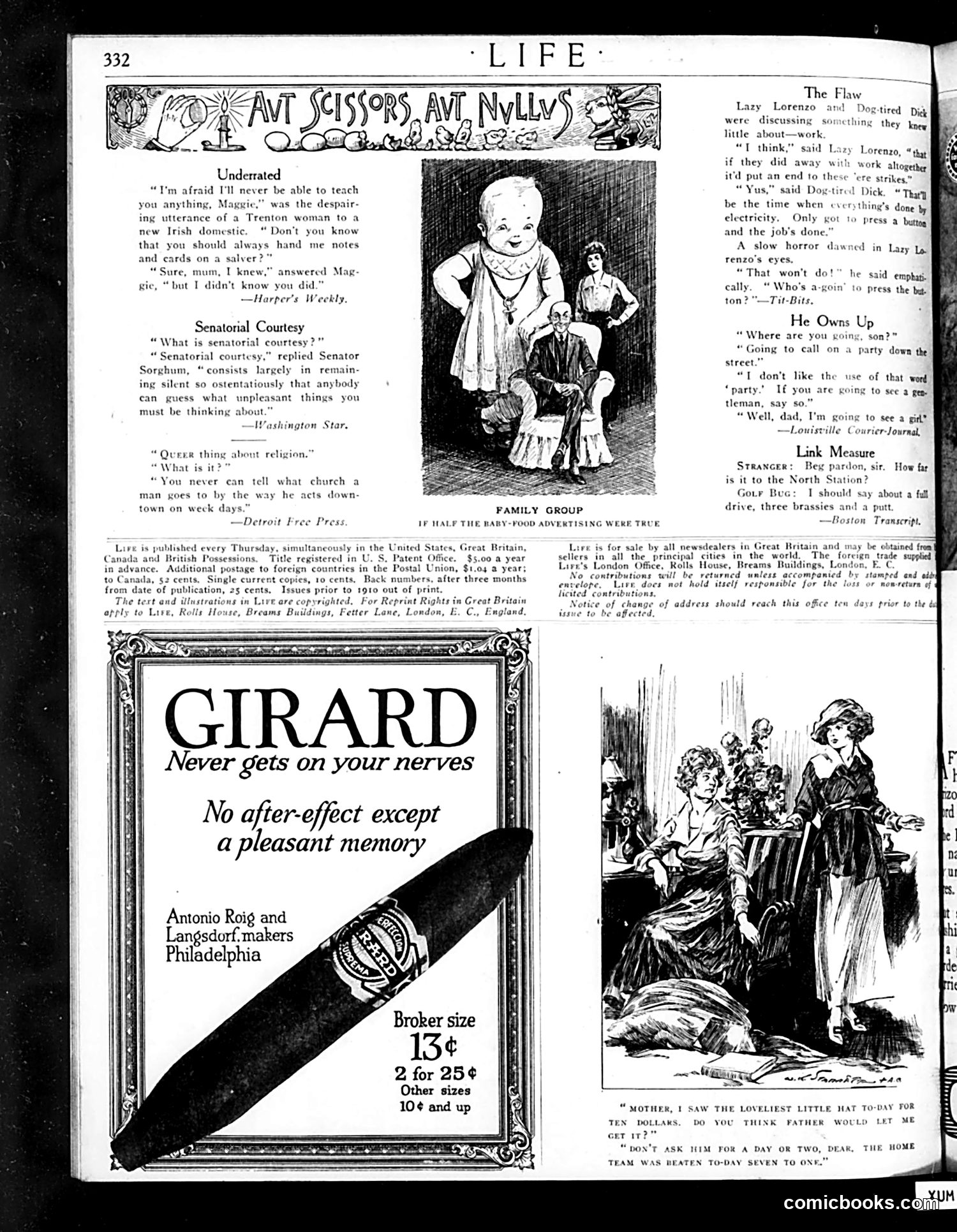
This page contains several brief satirical pieces typical of early 20th-century *Life* magazine's humor: **"Underrated"** mocks class pretension: an Irish domestic servant doesn't understand her employer's expectation to serve notes and cards on a silver salver, exposing how the employer herself learned this "refined" behavior only recently. **"Senatorial Courtesy"** satirizes political hypocrisy—senators remain pointedly silent about uncomfortable topics, making their disapproval obvious through ostentatious quiet. **"The Flaw"** depicts working-class anxiety about automation replacing jobs: two laborers discuss how if strikes ended, everything would be done by electricity, then one realizes with horror this means he'd be unemployed. The **Girard cigar advertisement** and other comic vignettes round out the page. The humor targets class pretense, political duplicity, and labor concerns—standard satirical targets for this era's *Life* magazine.
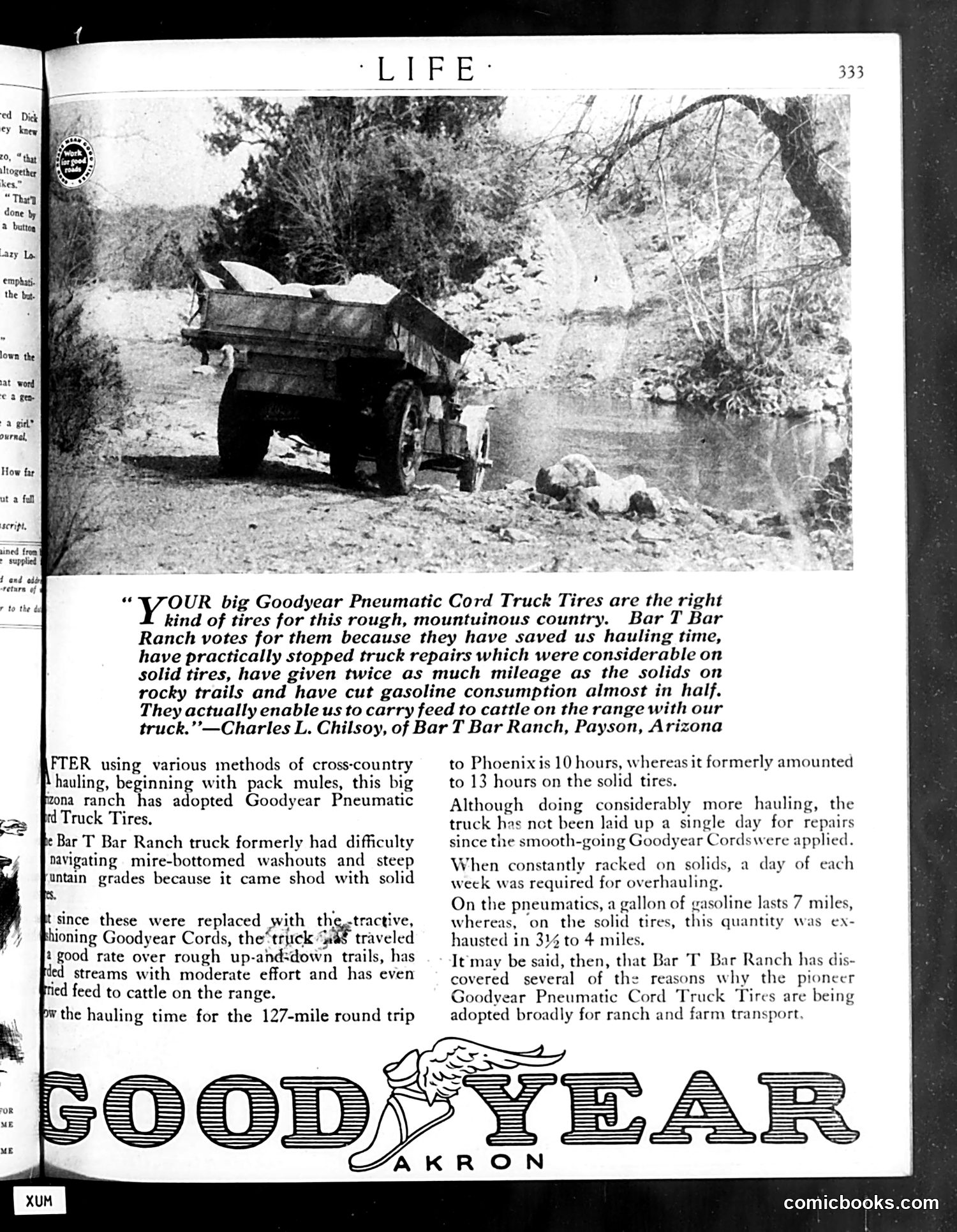
This is a **full-page advertisement**, not satire or political commentary. It promotes Goodyear Pneumatic Cord Truck Tires through a testimonial from Charles L. Chilsoy of Bar T Bar Ranch in Payson, Arizona. The photograph shows a truck loaded with supplies parked beside a rural stream, illustrating the "rough, mountainous country" where these tires operate. The ad contrasts pneumatic (air-filled) tires against the solid tires previously used by ranches. The claimed benefits are practical: reduced repair time, doubled mileage on rocky terrain, 50% better fuel efficiency, and faster hauling times (10 hours vs. 13 hours on a 127-mile trip). The endorsement emphasizes how pneumatic tires enabled the ranch to transport cattle feed more reliably. For modern readers, this reflects early 20th-century agricultural commerce and represents how truck tires revolutionized rural transportation and ranch operations before modern highways existed.
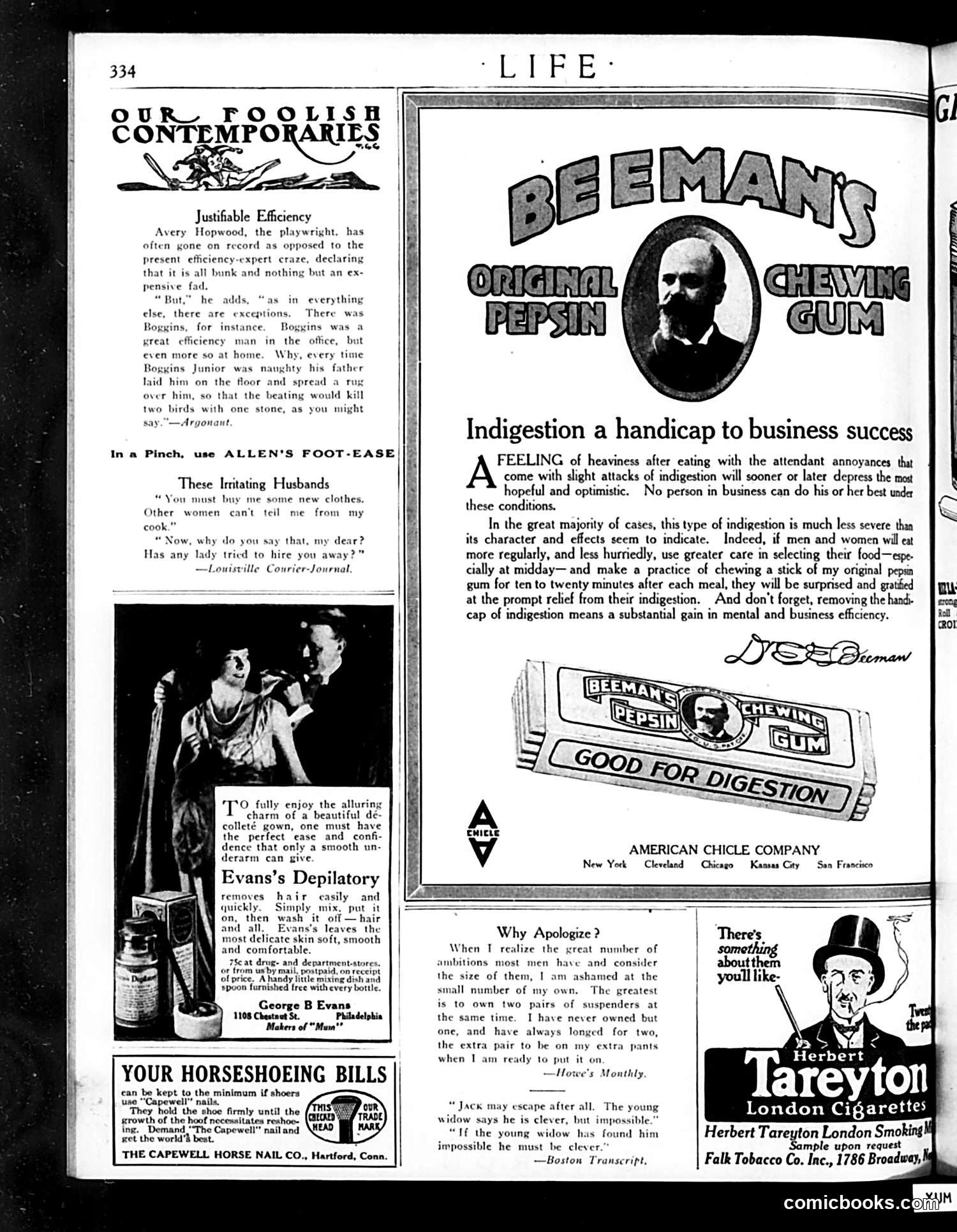
This page mixes satirical commentary with period advertisements (typical for Life magazine). **The "Our Foolish Contemporaries" section** lampoons playwright Avery Hopwood's contradiction: he publicly opposes "efficiency experts" (a 1920s management fad he saw as wasteful), yet admits his acquaintance Boggins perfectly exemplified practical efficiency—by beating his son on a rug to simultaneously punish the child and clean the floor. The satire mocks both the efficiency craze itself and Hopwood's hypocrisy in denouncing it. The remaining content is primarily **vintage advertising**: Beeman's Pepsin Gum (claiming to aid digestion and business success), Evans's Depilatory (hair removal), Allen's Foot-Ease (shoe comfort), and Herbert Tareyton cigarettes. Smaller **humorous quotations** appear throughout, including a Louisville newspaper exchange about "irritating husbands" and a Boston Transcript quip about a widow finding a clever-but-impossible suitor. The page reflects early-20th-century consumer culture and satirical magazine conventions of mixing editorial humor with commercial endorsements.
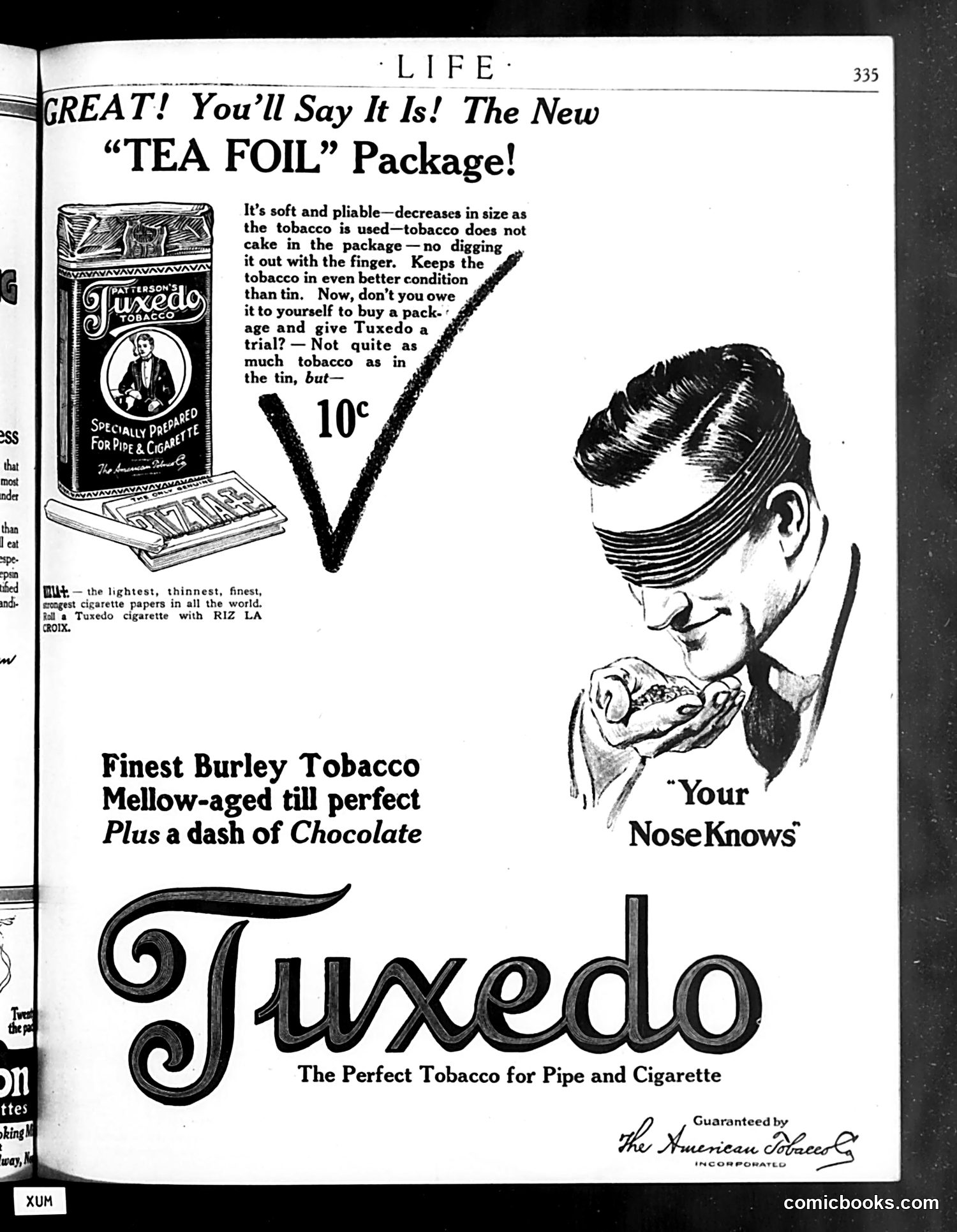
This page is primarily **advertising, not satire or political commentary**. It contains two tobacco product ads from Life magazine (likely early 20th century). The top section advertises "Tea Foil" packaging for Tuxedo tobacco—a soft, flexible wrapper alternative to tin cans. The pitch emphasizes practical benefits: it's pliable, prevents tobacco from drying out, and takes up less space. Below is a full-page Tuxedo tobacco advertisement featuring a man with a blindfold and the tagline "Your Nose Knows," apparently suggesting the product's quality is recognizable by smell alone. The copy emphasizes "Finest Burley Tobacco / Mellow-aged till perfect / Plus a dash of Chocolate." These ads reflect an era when tobacco advertising in mainstream magazines was routine and unregulated. The blindfold imagery, while unusual by modern standards, simply aims to highlight sensory appeal rather than making any deeper point.
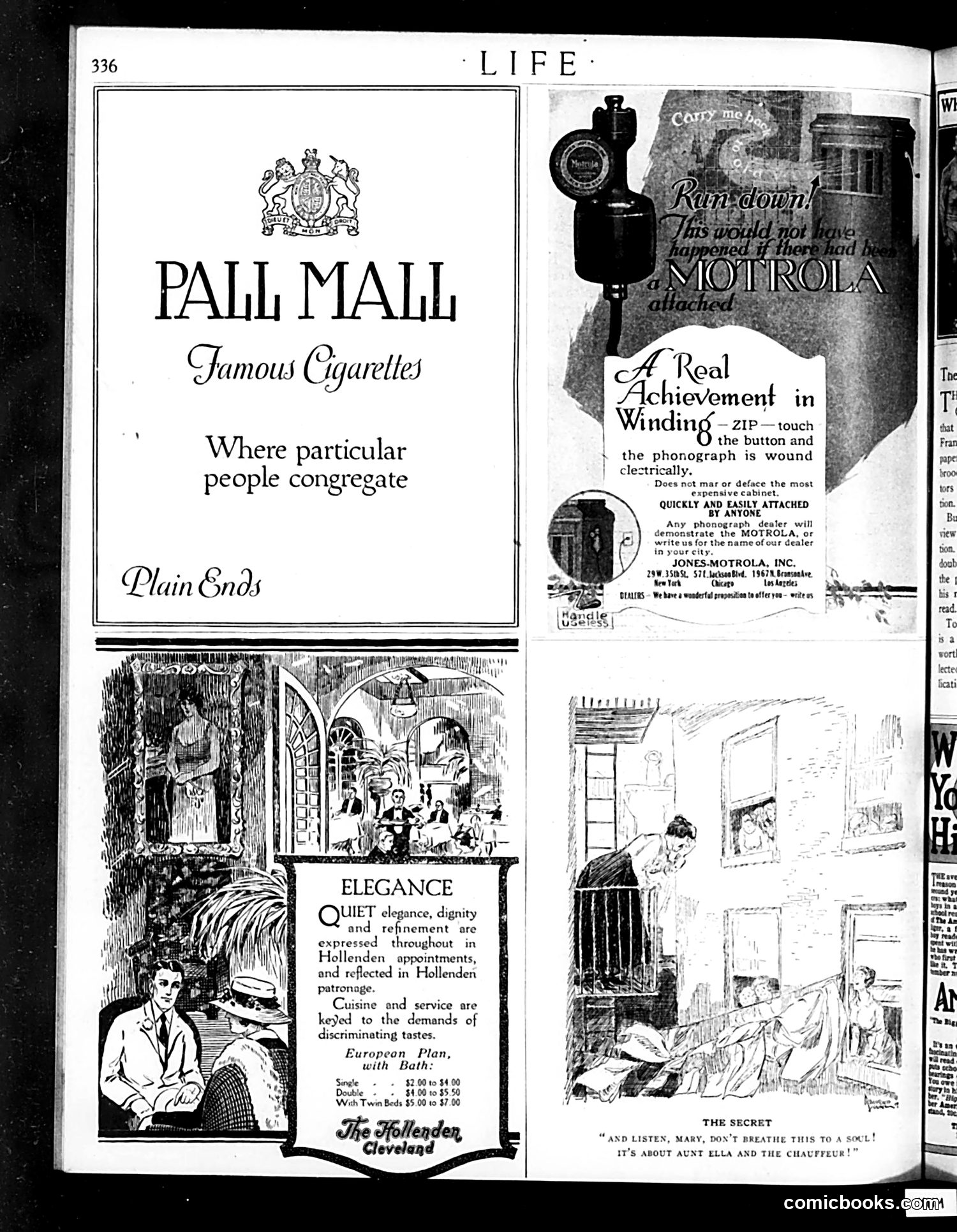
This page is primarily **advertising**, not satire or political commentary. It contains three distinct ads: 1. **Pall Mall Cigarettes** — positioned as a luxury brand for "particular people," emphasizing exclusivity and refinement. 2. **Motrola Phonograph Winder** — a mechanical device allowing electric winding of phonographs "without marring" expensive cabinets, marketed as easy installation by dealers. 3. **The Hollenden Hotel (Cleveland)** — advertising "quiet elegance, dignity and refinement" with European Plan pricing, targeting discriminating clientele. The bottom illustration appears to be unrelated editorial content—a cartoon scene captioned "THE SECRET," depicting gossip about "Aunt Ella and the chauffeur," likely a humorous social commentary on domestic scandal-mongering. The overall page reflects 1920s-era consumer marketing emphasizing class distinction, technological convenience, and refined taste.
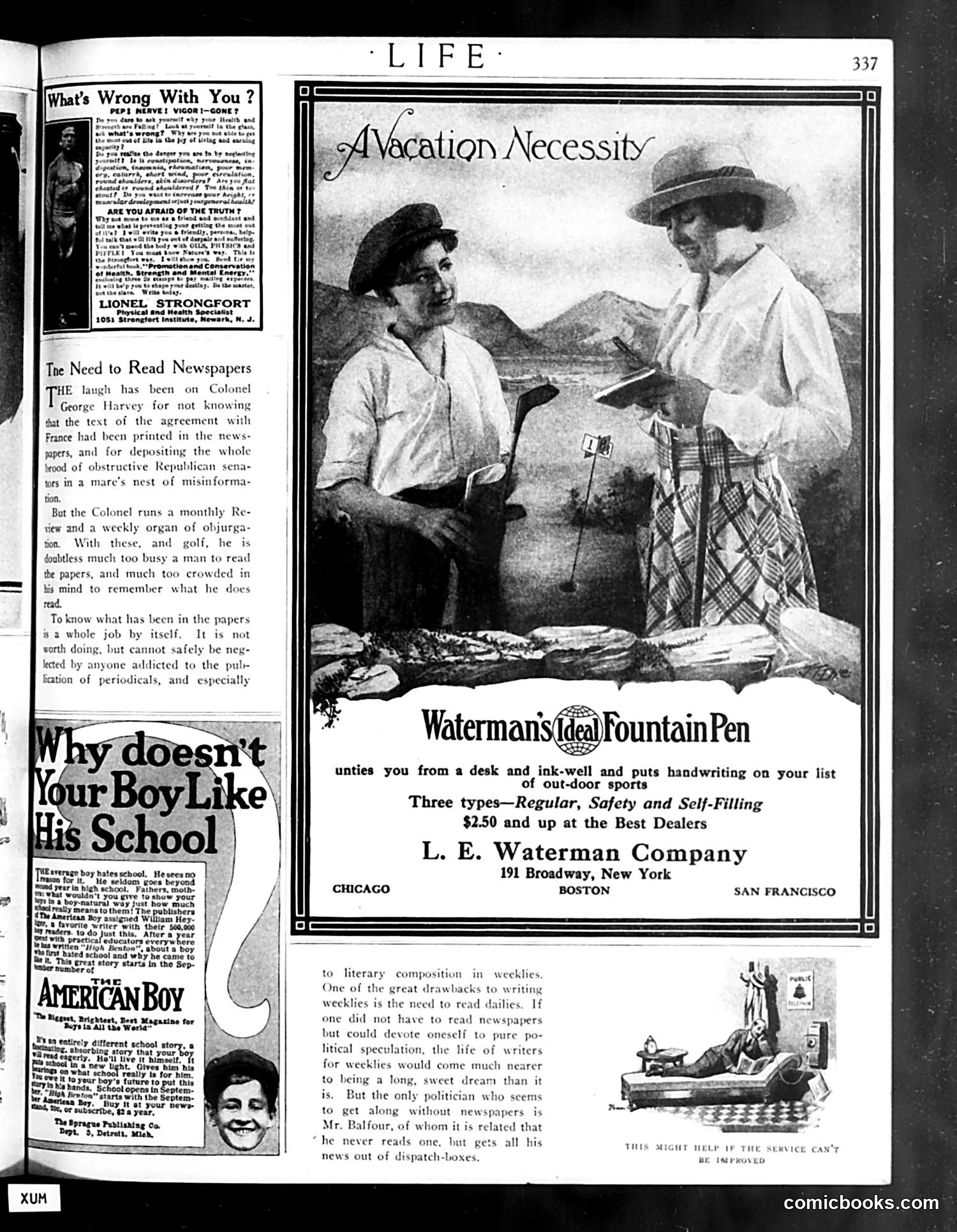
This page satirizes **Colonel George Harvey**, a prominent Republican politician and publisher, for being ignorant of a major diplomatic agreement with France—despite it being printed in newspapers. The joke is that Harvey runs his own monthly *Review* and weekly publication yet is too busy (with golf and other pursuits) to actually read the news, leaving him embarrassed and misinformed. The broader satire targets the absurdity of a newspaper publisher being uninformed about current events. The text extends this mockery to politicians generally, noting that even the British statesman **Arthur Balfour** allegedly never reads newspapers, relying instead on information filtered through dispatch-boxes. The main advertisement is for **Waterman's Ideal Fountain Pen**, marketed as freeing people from desks to pursue outdoor activities—ironically positioned alongside an article about the necessity of staying informed through reading.
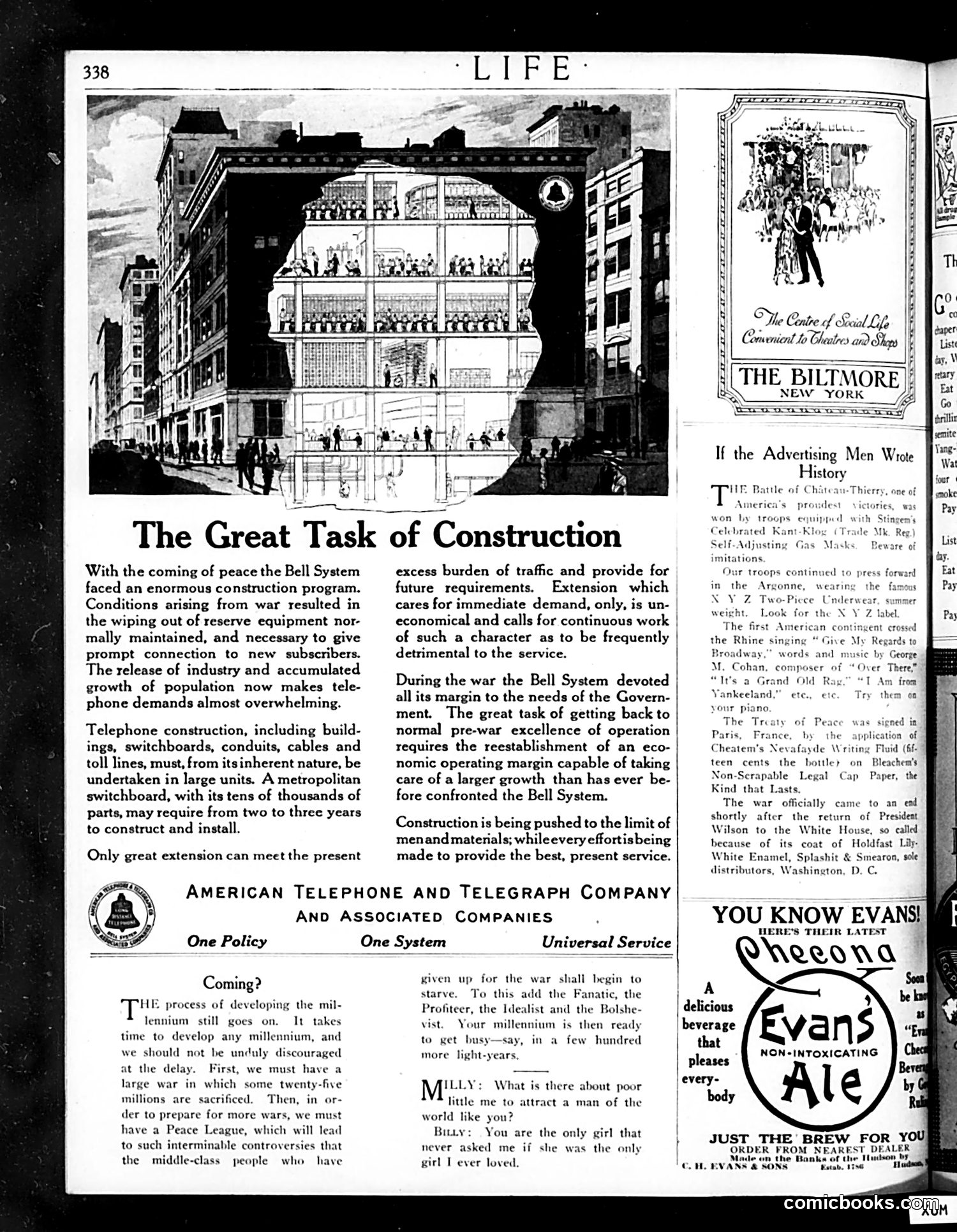
This page contains **two distinct pieces of satirical content**: **"The Great Task of Construction"** is a Bell Telephone System advertisement framed as public service messaging about post-WWI telephone infrastructure expansion. The accompanying cartoon imagines a dystopian future where achieving utopia requires: massive war (sacrificing 25 million), then a Peace League causing endless controversy, plus added chaos from fanatics, war profiteers, idealists, and Bolshevists. The satire targets post-war optimism—suggesting that achieving peace and progress is nearly impossible given competing interests and ideological conflicts. **"If the Advertising Men Wrote History"** mocks corporate advertising by reimagining major WWI events (the Battle of Château-Thierry, the Treaty of Paris, President Wilson's return) as product endorsements. Each historical moment becomes a sales pitch for branded goods like "Kant-Klog" or "Holdfast Livy-White Enamel." This satirizes how aggressively advertisers were colonizing American culture and consciousness in the post-war era. The page also includes unrelated advertisements (Evans Ale, Oneona beverage) and a brief romantic dialogue.
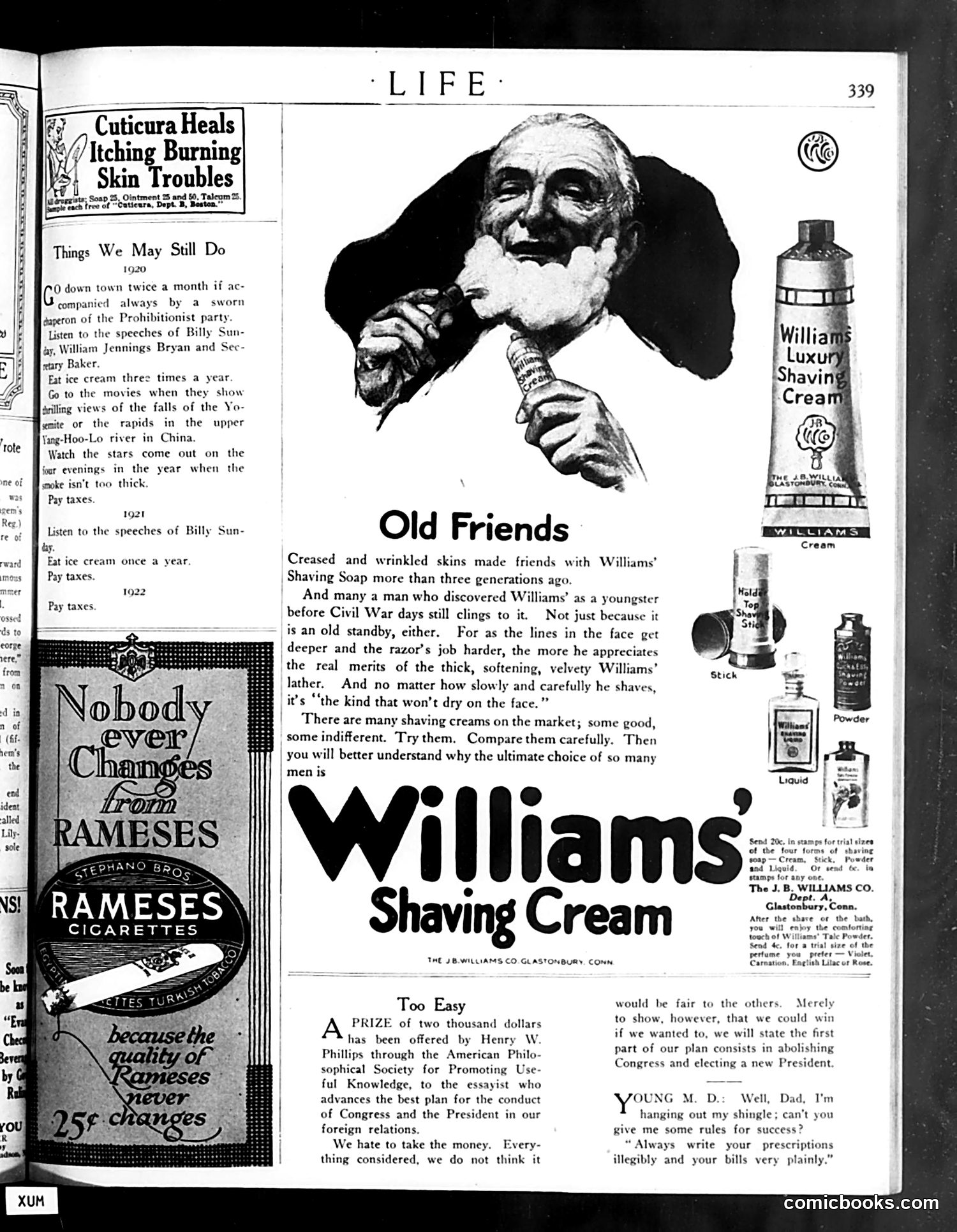
This page mixes **satirical social commentary with period advertising**. The main satire, "Things We May Still Do," tracks **progressive restrictions on American life** across three years (1920-1922), likely referencing **Prohibition's passage (1920)** and growing government regulation. The joke shows freedoms shrinking annually—from visiting town twice monthly to eating ice cream three times yearly to eventually just "Pay taxes"—mocking how intrusive regulation feels. The "Old Friends" section is a **Williams' Shaving Cream advertisement** using nostalgic appeal, claiming the product has served "more than three generations" and referencing pre-Civil War customers. This was common period marketing targeting older, conservative male consumers. The lower section satirizes a **prize contest for improving Congress and Presidential governance**, with Life cynically suggesting it's easier to abolish Congress and elect a new president than reform them—political commentary on government dysfunction. The final joke about a young doctor prescribing illegibly but billing clearly is **period satire on medical profession ethics**.
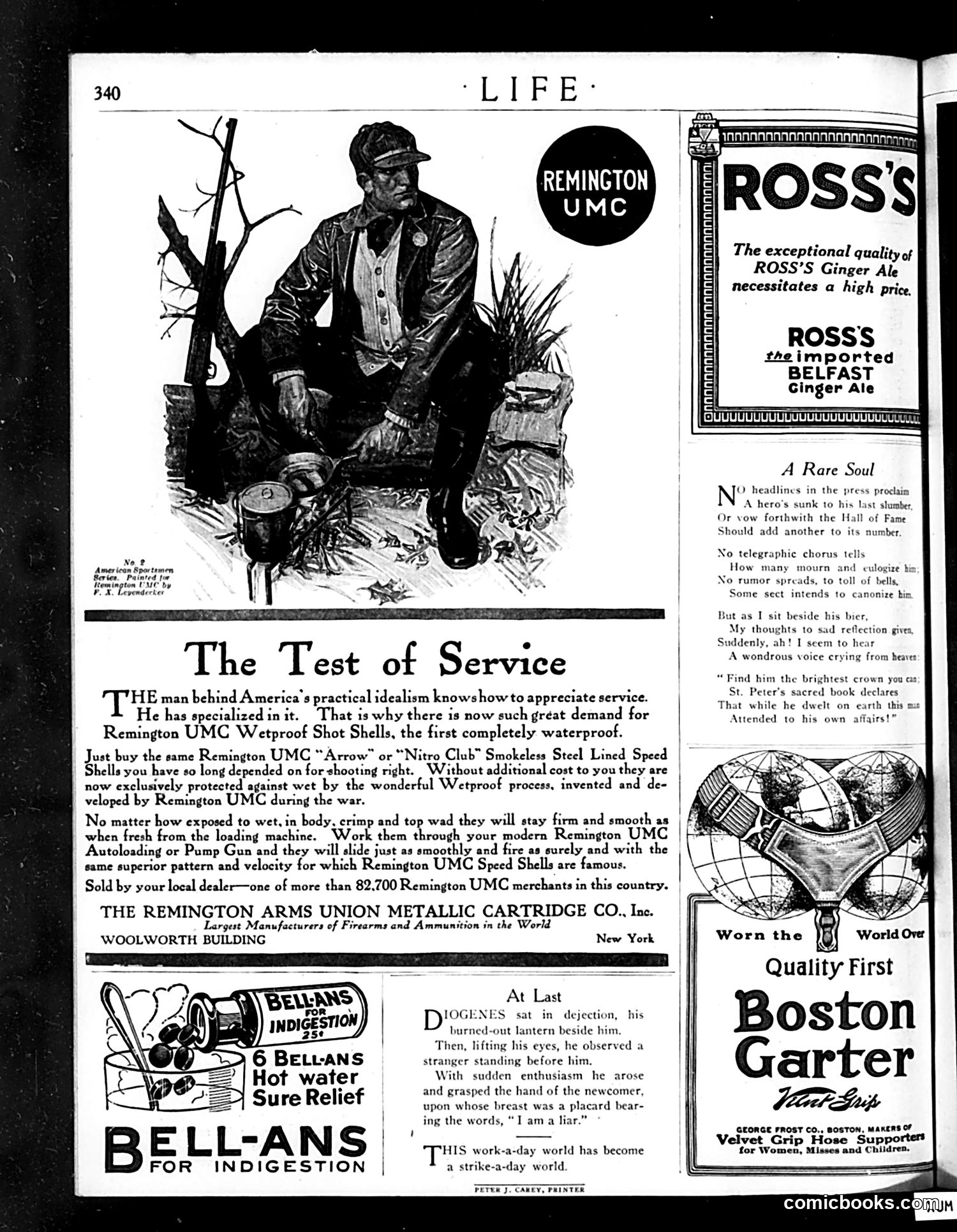
This page mixes advertisements with a short satirical story called "A Rare Soul." The main narrative concerns a destitute man ("Diogenes," referencing the ancient Greek philosopher) sitting by a lantern in dejection. A stranger approaches and asks who he is; the man replies, "I am a liar." The joke appears to reference Diogenes's famous quest to find an honest man—a classical allusion suggesting that in the modern world, finding such a person is impossible. The final text block comments that "this work-a-day world has become a strike-a-day world," indicating labor unrest of the era (likely post-WWI). The surrounding advertisements (Remington ammunition, Bell-ans indigestion remedy, Ross's ginger ale, Boston Garter) are period commercial content. The page reflects Life's blend of social commentary with commercial promotion typical of early 20th-century American magazines.
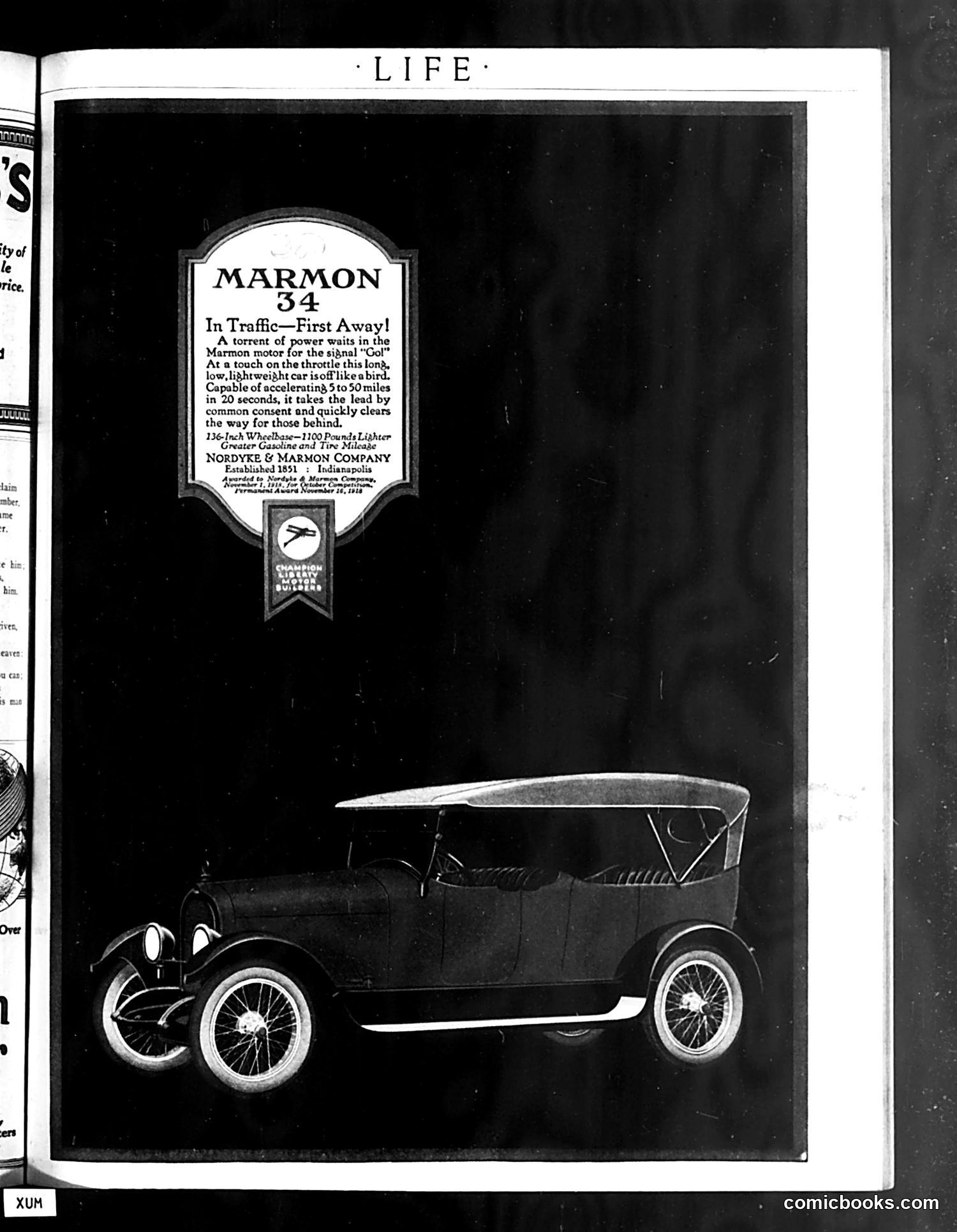
This is **not a political cartoon or satire**, but rather a **car advertisement** for the Marmon automobile, appearing in *Life* magazine. The page promotes the Marmon 54, a luxury car manufactured by Nordyke & Marmon Company in Indianapolis. The ad uses a competitive metaphor—describing the car's acceleration and traffic performance using racing language ("First Away!"). The image shows a side-view illustration of an early 1900s open-air touring car. The selling points emphasized are: rapid acceleration (0-50 mph in 20 seconds), lightweight construction (1100 pounds lighter than competitors), fuel efficiency, and tire mileage. The ad appeals to wealthy buyers seeking performance and status. This represents typical early automotive advertising, targeting affluent readers of *Life* magazine with technical specifications presented as lifestyle advantages.
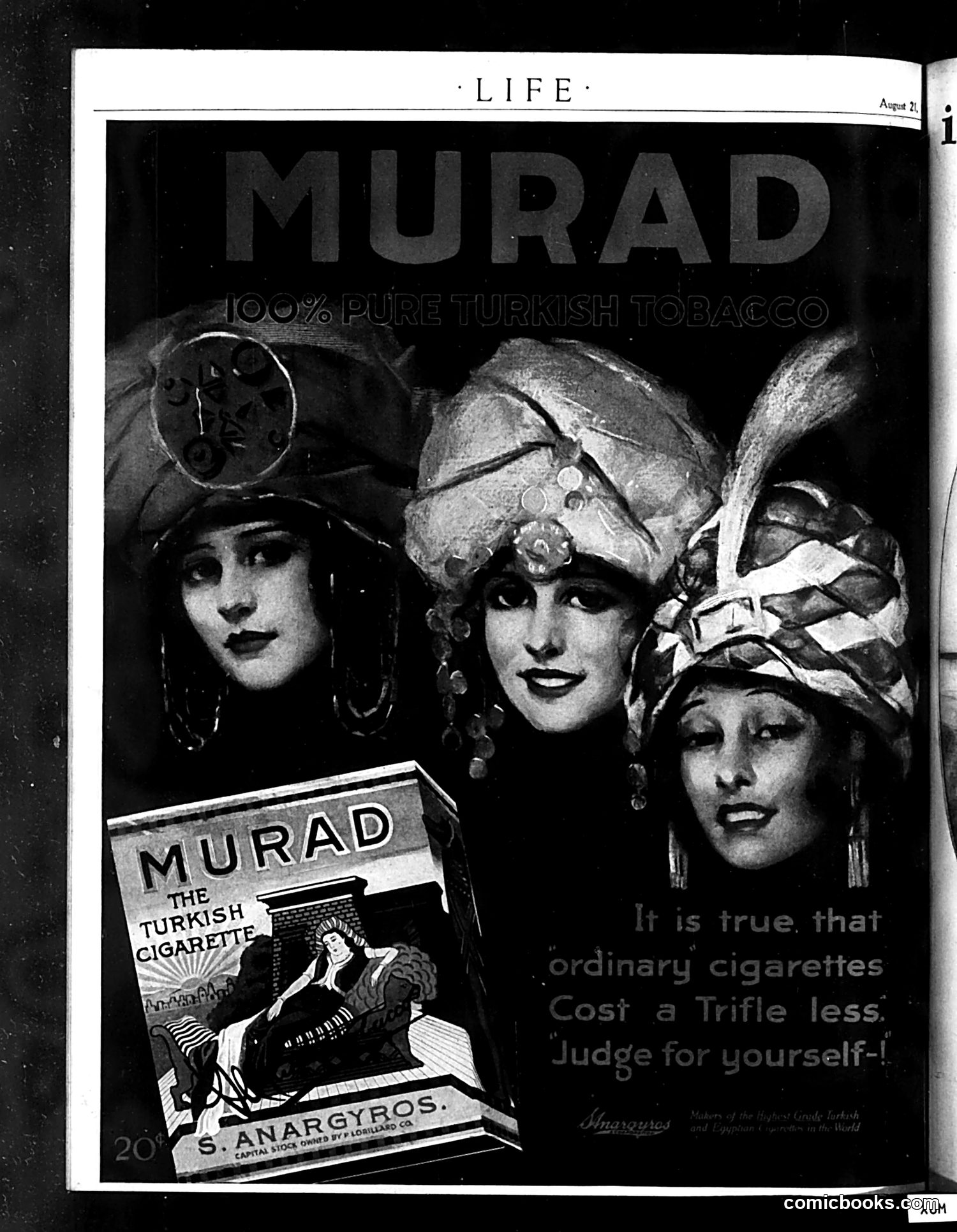
This is a **cigarette advertisement**, not satirical content. The page promotes Murad brand Turkish tobacco cigarettes, manufactured by S. Anargyros (visible on the package). The ad features three women in exotic, ornate headpieces and theatrical styling—likely referencing "Oriental" fashion trends popular in 1920s entertainment. This exoticized imagery was common in period advertising. The sales pitch emphasizes price: "It is true that ordinary cigarettes Cost a Trifle less. Judge for yourself!" The implication is that Murad's premium quality justifies higher cost. The date visible is August 21, suggesting this ran in Life magazine during that period. The ad reflects early 20th-century marketing strategies using glamorous female imagery and appeals to sophistication over economy.