
Life, 1919-08-21 · page 19 of 40
Life — August 21, 1919 — page 19: what you’re looking at
What you’re looking at
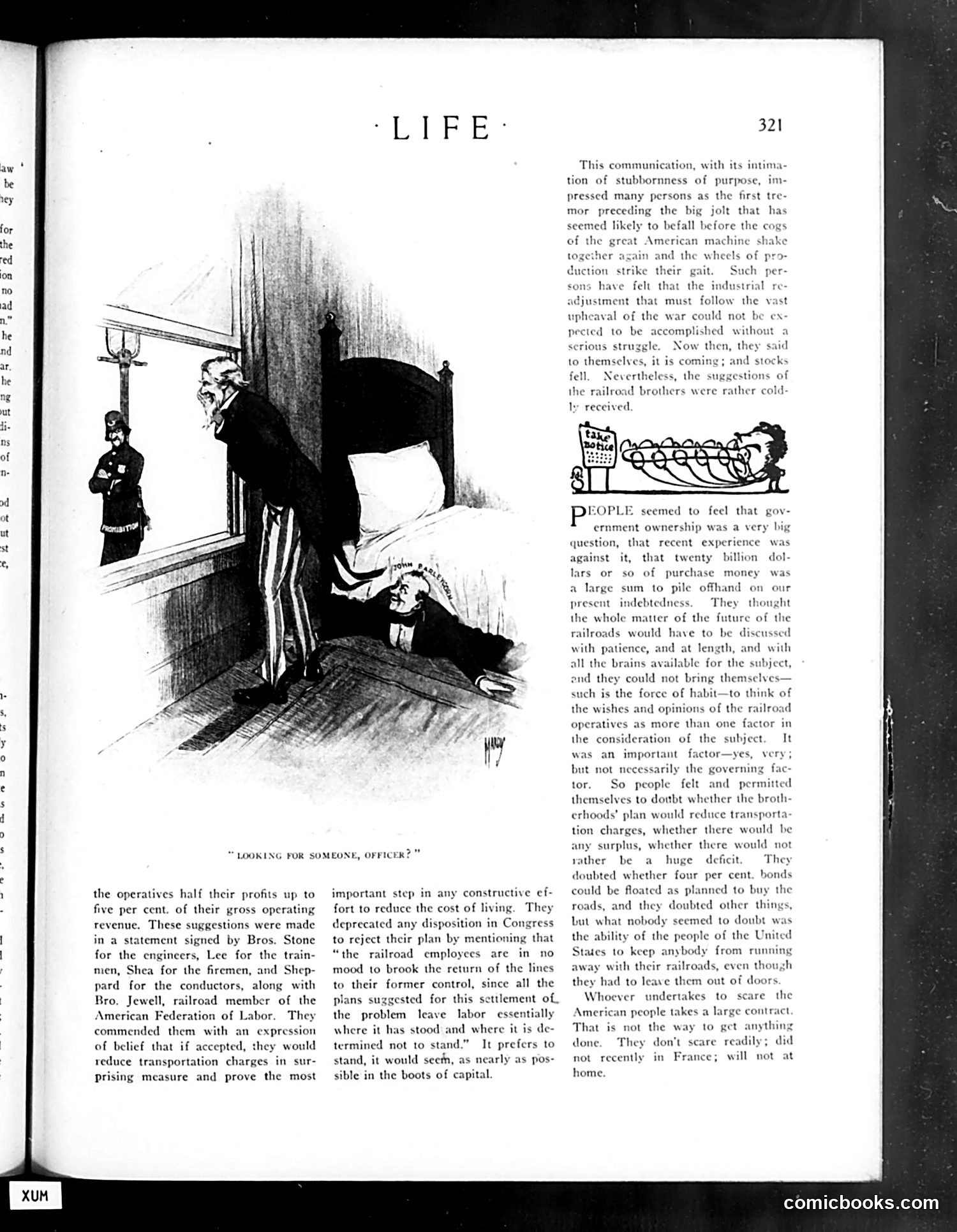
This cartoon depicts a bedroom scene where an officer peers through a window at a couple in bed, with the caption asking if he's "looking for someone." The satire concerns **railroad labor negotiations** during the post-WWI period. The cartoon illustrates the tension between railroad unions and the government over nationalization. Union leaders had proposed accepting reduced profits to lower transportation costs, but threatened labor unrest if their demands weren't met. The text describes this as an implicit threat—workers essentially "in the boots of capital," refusing to return lines to private control. The bedroom intrusion metaphor suggests the **awkward, invasive nature of government involvement** in labor disputes. The officer represents the state caught between competing interests. The cartoon satirizes how both labor and the public viewed government ownership skeptically, preferring to keep the uncomfortable relationship at arm's length rather than commit to either solution. The joke: everyone prefers distance from the actual problem.
📄 Transcribed text from this page (OCR, searchable)
Machine-transcribed from the original scan — historical spelling and the odd misread are preserved.
“ LOOKING FOR SOMEONE, OFFICER?" the operatives half their profits up to five per cent. of their gross operating revenue, These suggestions were made in a statement signed by Bros. Stone for the engineers, Lee for the train- men, Shea for the firemen, and Shep- pard for the conductors, along with Bro. Jewell, railroad member of the American Federation of Labor. They commended them with an expression of belief that if accepted, they would reduce transportation charges in sur- Prising measure and prove the most important step in any constructive ef- fort to reduce the cost of living. They deprecated any disposition in Congress to reject their plan by mentioning that “the railroad employees are in no mood to brook the return of the lines to their former control, since all the plans suggested for this settlement of, the problem leave labor essentially where it has stood and where it is de- termined not to stand It prefers to stand, it would seefn, as nearly as pos- sible in the boots of capital 321 This communication, with its intima- tion of stubbornness of purpose, im- pressed many persons as the first tre- mor preceding the big jolt that has seemed likely to befall before the cogs of the great American machine shake together a strike felt and the wheels of pro- their Such that adjustment that must follow the vast duction gait. the industrial re- sons have upheaval of the war could not be ex- pected to be accomplished without a »w then, they said gj and stocks serious strug, to themselves, it is comi fell the railroad brothers were rather cold- Nevertheless, the suggestions of ly received. EOPLE. seemed to feel that gov- ernment ownership was a very big question, that recent experience was against it, that billion dol- lars or so of was a large sum to pile offhand on our present thought the whole matter of the future of the railroads would have to be twenty purchase money indebtedness. They iscussed with patience, and at length, and with all the brains available for the subject, and they could not bring themselves— such is the force of habit—to think of the wishes and opinions of the railroad operatives as more than one factor in the consideration of the subject It was an important but not necessarily the governing fac- tor. So people felt and permitted themselves to doubt whether the broth- factor—yes, very; erhoods’ plan would reduce transporta tion charges, whether there would be any surplus, whether there would not huge deficit. They doubted whether four per cent. bonds could be floated as planned to buy the roads, and they doubted other things, rather be a but what nobody seemed to doubt was the ability of the people of the United States to keep a away with their railroads, even though they had to leave them out of doors Whoever American people takes a larg That is not the way to get anything nybody from running undertakes to scare the ¢ contract done. They don’t scare readily; did not recently in France; will not at home. comicbooks.com