
Life, 1919-08-21 · page 16 of 40
Life — August 21, 1919 — page 16: what you’re looking at
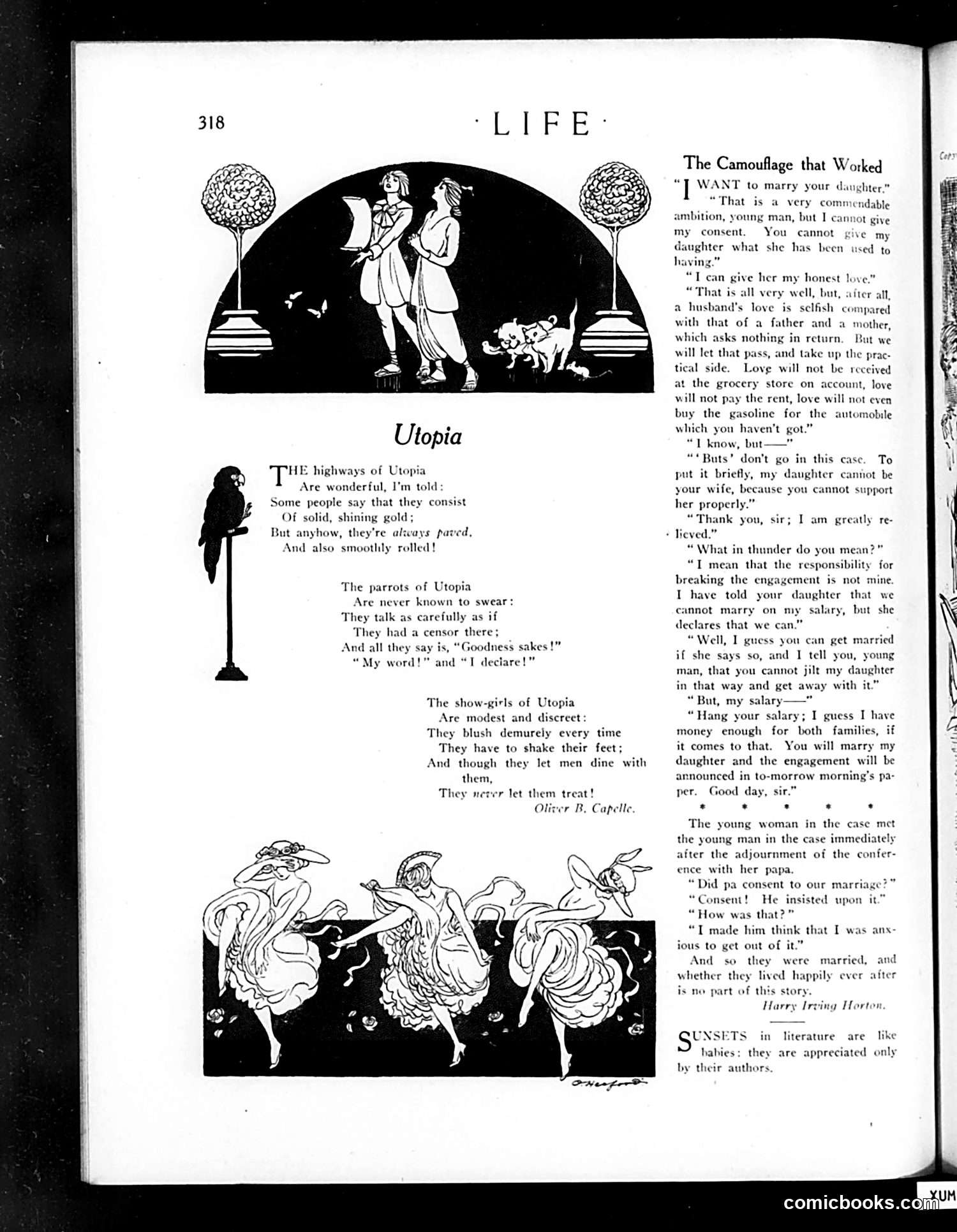
What you’re looking at
This satirical piece mocks early 20th-century courtship rituals and parental control. A young man seeks to marry a wealthy father's daughter but lacks financial means. The father refuses, lecturing him that love cannot pay bills or rent—a practical objection reflecting post-Industrial anxieties about class and marriage. The satire's twist: the daughter manipulates her father by *appearing* reluctant to marry, making him believe she's being jilted. This reverses his position entirely, and he now *insists* on the marriage to protect his daughter's honor. The irony is that her "camouflage"—feigning disinterest—succeeds where the young man's honest declarations failed. The story critiques both parental presumption (fathers controlling daughters' marriages through economic leverage) and feminine cunning as the only available counter-strategy. It's simultaneously sympathetic to young love and cynical about how it actually operates within rigid class structures.
📄 Transcribed text from this page (OCR, searchable)
Machine-transcribed from the original scan — historical spelling and the odd misread are preserved.
T! 2 highways of Utopia Are wonderful, I'm told: y that they consist Of solid, shining gol But anyhow, they're always paved, And also smoothly rolled! Some people The parrots of Utopia Are never known to swear: They talk 3 They had a censor there; carefully as if And all they say is, “Goodness sakes!” “My word!” and “I deciare!"” The show-girls of Utopia Are modest and discreet: They blush demurely every time They have to shake their fect; And though they let men dine with them, r let them trea Oliver RB. Capelle. The Camouflage that Worked “T WANT “That is a very commendable ambition, young man, but I cannot give my consent. You cannot give my daughter what she has been used to having.” to marry your daughter,” “T can give her my honest loy “That is all very well, but, after all, a husband's love is selfish compared with that of a father and a which asks nothing in return. But we will let that pass, and take up the prac- tical side. other, Love will not be received at the grocery store on account, love will not pay the rent, love will not even buy the gasoline for the automobile which you haven't got.” “TL know, but——” “*Buts’ don't go in this case. To put it briefly, my daughter caniot be your wife, bi properly, Thank you, sir; I am greatly re- use you cannot support “What in thunder do you mean?” “T mean that the responsibility for breaking the engagement is not mine, I have told your daughter that we cannot marry on my salary, but she declares that we can.” “Well, I guess you get married if she says so, and I tell you, young man, that you cannot jilt my daughter in that way and get away with it.” But, my salar “Hang your sala I guess I have money enough for both families, if it comes to that. You will marry my daughter and the engagement will be announced in to-morrow morning’s pa- per. Good day, sir.” * . * * . The young woman in the case met the young man in the case immediately after the adjournment of the conf ence with her papa. “Did pa consent to our marriage?” Consent! “How was that?” He insisted upon it.” “T made him think that I was anx- ious to get out of it.” And so they were married, and whether they lived happily ever after is no part of this story. Harry Irving Horton Sst SSETS in literature are like habies: they are appreciated only by their authors. comicbooks.com