
Life, 1919-08-21 · page 18 of 40
Life — August 21, 1919 — page 18: what you’re looking at
What you’re looking at
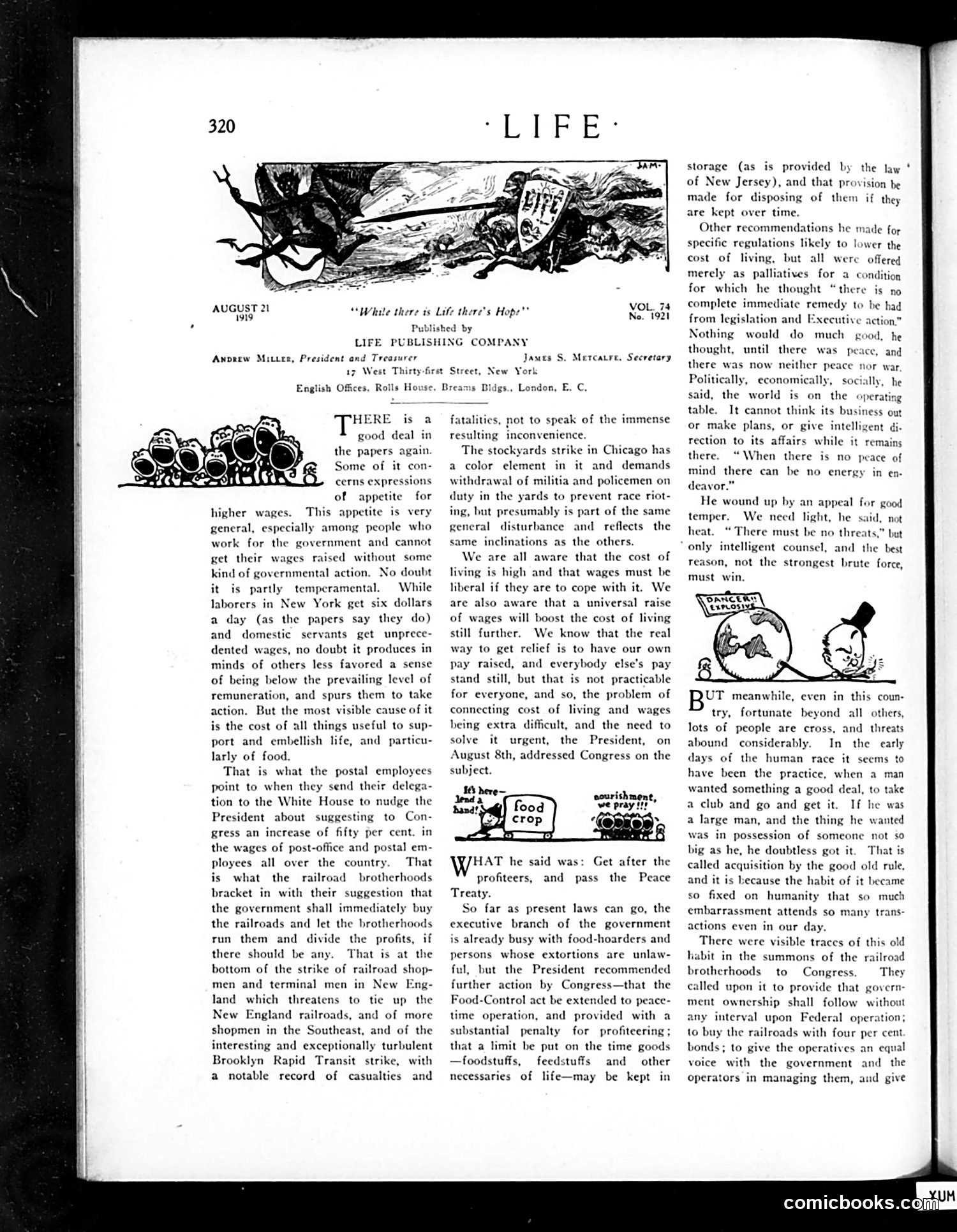
This editorial addresses post-WWI labor unrest and inflation. The author discusses widespread strikes—postal workers, railroad brotherhoods, New England rail shops, Brooklyn transit, and Chicago stockyards—all demanding wage increases to offset rising living costs. The cartoons illustrate the wage-inflation paradox: workers demand higher pay due to expensive food, yet universal wage increases would further boost prices. One cartoon shows a figure labeled "food crop" being squeezed, another depicts profiteers. President Wilson's August 8th Congressional address is analyzed. The author summarizes his recommendations: extend food-control laws to peacetime, penalize profiteering, limit storage time for foodstuffs, and address hoarders. However, Wilson acknowledged no "complete immediate remedy" existed through legislation alone. The satire criticizes the circular problem: workers need relief, but the proposed solutions are merely "palliatives" that won't solve the fundamental economic imbalance. The implied message: no easy political fix exists for postwar economic chaos.
📄 Transcribed text from this page (OCR, searchable)
Machine-transcribed from the original scan — historical spelling and the odd misread are preserved.
AUGUST 21 19 “While there ts Pu LIFE Awprew Mittee, President and Treasurer 17 West Th English Offices, Rolls House HERE is a good deal in the papers again. Some of it con- cerns expressions of appetite for This appetite is very le who higher wages. general, especially among pe work for the government and cannot get their wages raised without some kind of governmental action. No doubt it is partly temperamental. While laborers in New York get six dollars a day (as the papers say they do) and domestic servants get unprece- dented wages, no doubt it produces in minds of others less favored a sense of being below the prevailing level of remuneration, and spurs them to take action. But the most visible cause of it is the cost of all things useful to sup- port and embellish life, and particu- larly of food. That is what the postal employees point to when they send their delega- tion to the White House to nudge the President about suggesting to Con- gress an increase of fifty per cent. in the wages of post-office and postal em- ployees all over the country. That is what the railroad brotherhoods bracket in with their suggestion that the government shall immediately buy the railroads and let the brotherhoods run them and divide the profits, if there should be any. That is at the bottom of the strike of railroad shop- men and terminal men in New Eng- land which threatens to tie up the New England railroads, and of more shopmen in the Southeast, and of the interesting and exceptionally turbulent Brooklyn Rapid Transit strike, with a notable record of casualties and PUBLISHING Life there's Hi hed by COMPA: Janes S. Mercatre. Secretary first Street, New York . Breams Bidgs., London, E. C. fatalities, not to speak of the immense resulting inconvenience. The stockyards strike in Chicago has a color element in it and demands withdrawal of militia and policemen on duty in the yards to prevent race riot- ing, but presumably is part of the same general disturbance and reflects the same inclinations as the others. We are all aware that the cost of living is high and that wages must be liberal if they are to cope with it. We are also aware that a universal raise of wages will boost the cost of living still further. We know that the real way to get relief is to have our own pay raised, and everybody else’s pay stand still, but that is not practicable for everyone, and so, the problem of connecting cost of living and wages being extra difficult, and the need to solve it urgent, the President, on August 8th, addressed Congress on the subject. sourishment, we pray!!! HAT he said was: profiteers, and Treaty. So far as present laws can go, the executive branch of the government is already busy with food-hoarders and persons whose extortions are unlaw- ful, but the President recommended further action by Congress—that the Food-Control act be extended to peace- time operation, and provided with a substantial penalty for profiteering; that a limit be put on the time goods —foodstuffs, feedstuffs and other necessaries of life—may be kept in Get after the pass the Peace storage (as is provided by the law of New Jersey), and that provision be made for disposing of them if they are kept over time. Other recommendations he made for specific regulations likely to lower the cost of living, but all were offered merely palliatives for a condition for which he thought “there is no complete immeiliate remedy to be had from legislation and Executive action,” Nothing would much good, he thought, until there was peace, and there was now neither peace nor war, Politically, economically, socially, he said, the world is the table. It cannot think its business or make plans, or give intelligent di- rection to its affairs while i there. do on operat mains “When there is no peace of mind there can be no energy in en- deavor. He wound up by an appeal for good temper. We need light, he said, not heat. “There must be no threats,” but only intelligent counsel, and the best reason, not the strongest brute force, must win. UT meanwhile, even in this coun- try, fortunate beyond all others, lots of people are cross, and threats abound considerably. In the early days of the human race it seems to have been the practice, when a man wanted something a good deal, to take a club and go and get it. If he a large man, and the thing he wanted was in possession of someone not so big as he, he doubtless got it. That is called acquisition by the good old rule, and it is because the habit of it became so fixed on humanity that so much embarrassment attends so many trans- actions even in our day. There were visible traces of this old habit in the summons of the railroad brotherhoods to Congress. — They called upon it to provide that govern- ment ownership shall follow without any interval upon Federal operation; to buy the railroads with four per cent bonds; to give the operatives an equal voice with the government and the operators in managing them, and give was comicbooks.com