
Life, 1919-08-21 · page 15 of 40
Life — August 21, 1919 — page 15: what you’re looking at
What you’re looking at
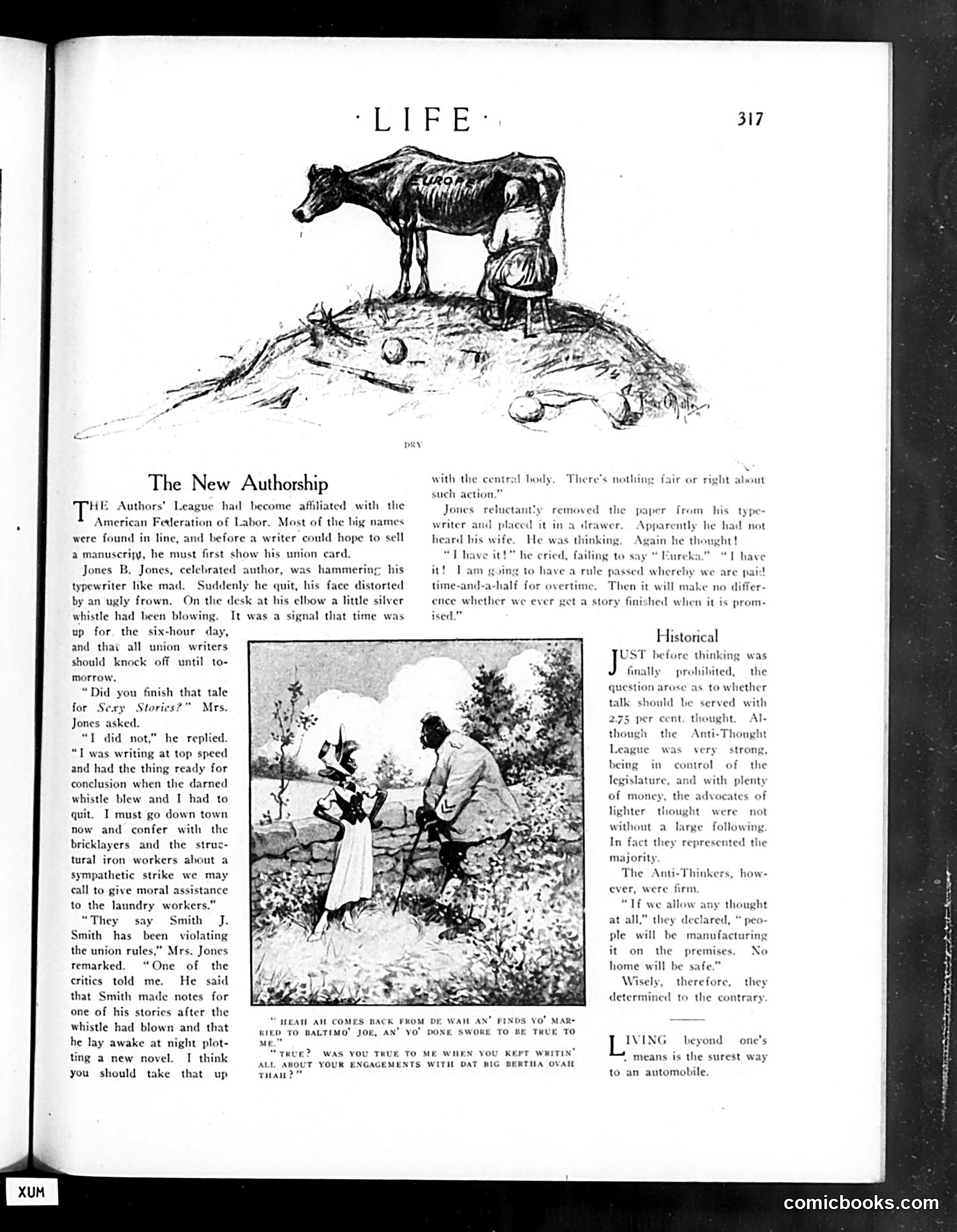
This satirical piece mocks the **Authors' League** and **union labor organizing** in the 1920s-1930s. The story ridicules writer **James B. Jones**, who abandons his typewriter over labor disputes, declaring writers should "knock off until tomorrow" in solidarity with striking workers. The top cartoon shows a cow being milked—likely representing publishers extracting profit from writers' labor. The central photograph illustrates the narrative: a woman confronts a man outdoors, visualizing the domestic conflict over Jones's union activism. The satire targets **intellectual workers joining labor unions**, presenting unionization as absurd for authors and attacking the "Anti-Thought League"—suggesting that prioritizing labor rights over literary output is foolish and counterproductive to society.
📄 Transcribed text from this page (OCR, searchable)
Machine-transcribed from the original scan — historical spelling and the odd misread are preserved.
The New Authorship Authors’ League had become affiliated with the Th American Federation of Labor. Most of the big names were found in line, and before a writer could hope to sell a manuscript, he must first show his union card. Jones B. Jones, celebrated author, was hammering his typewriter like mad. Suddenly he quit, his face distorted by an ugly frown. On the desk at his elbow a little silver whistle had been blowing. It was a signal that time was up for the six-hour day, and thai all union writers should knock off until to- morrow. “Did you finish that tale for Se Stories?” Mrs. Jones asked. “I did not,” he replied. “T was writing at top speed and had the thing ready for conclusion when the darned whistle blew and I had to quit. I must go down town now and confer with the bricklayers and the struc- tural iron workers about a sympathetic strike we may call to give me to the laundry workers.” “They say Smith J. Smith has been violating the union rules,” Mrs. Jones remarked. “One of the critics told me. He said that Smith made notes for one of his stories after the whistle had blown and that al assistance Am eeey fe TRUE? WAS YOU TRUE i a new novel. I think ALL ABOUT YOUR ENGAGEMENTS WIT DAT BIG you should take that up Titau?" “ MEAM AM COMES BACK FROM DE TO ME WHEN You 317 with the central body. There's nothing At about such action.” Jones re tly removed the his writer a heard his wife. “T have it!” it! 1 time-and-a-half f ta nd placed it in a drawer. paper from type- Apparently he had not He was thinking. Ai he cried, failing to say ain he thought! “ Eureka.” sing to have a rule passed where “T have ' am ¢ y we are pa overtime, Then it will make no differ- ence whether we ever get a story finished when it is prom- ised.” Historical UST before thinking was finally question arose as to whether talk prohibited, — the served with ht. Ale Anti-Thought very should be per cent the ague strong being in was control of the legislature, and with plenty . the advocates of of mon lighter thought were not without a large following. In fact they represented the majority The Anti-Thinkers, ever, were firm owe “Tf we allow any thought at all,” they declared, “ pec ple will be manufacturir it on the premises. home will be safe.” Wisely, determined to the contrary therefore, they WAH AN’ FINDS YO" MAR KIED TO BALTIMO’ JOE, AN’ YO’ DONE SWOKE TO BE TRUE TO he lay awake at night plot- wr.” IVING means is the surest way heyond — one’s KEPT WRITIN" BERTHA OVAIL to an automobile. Mee comicbooks.com eto