
Life, 1919-08-21 · page 25 of 40
Life — August 21, 1919 — page 25: what you’re looking at
What you’re looking at
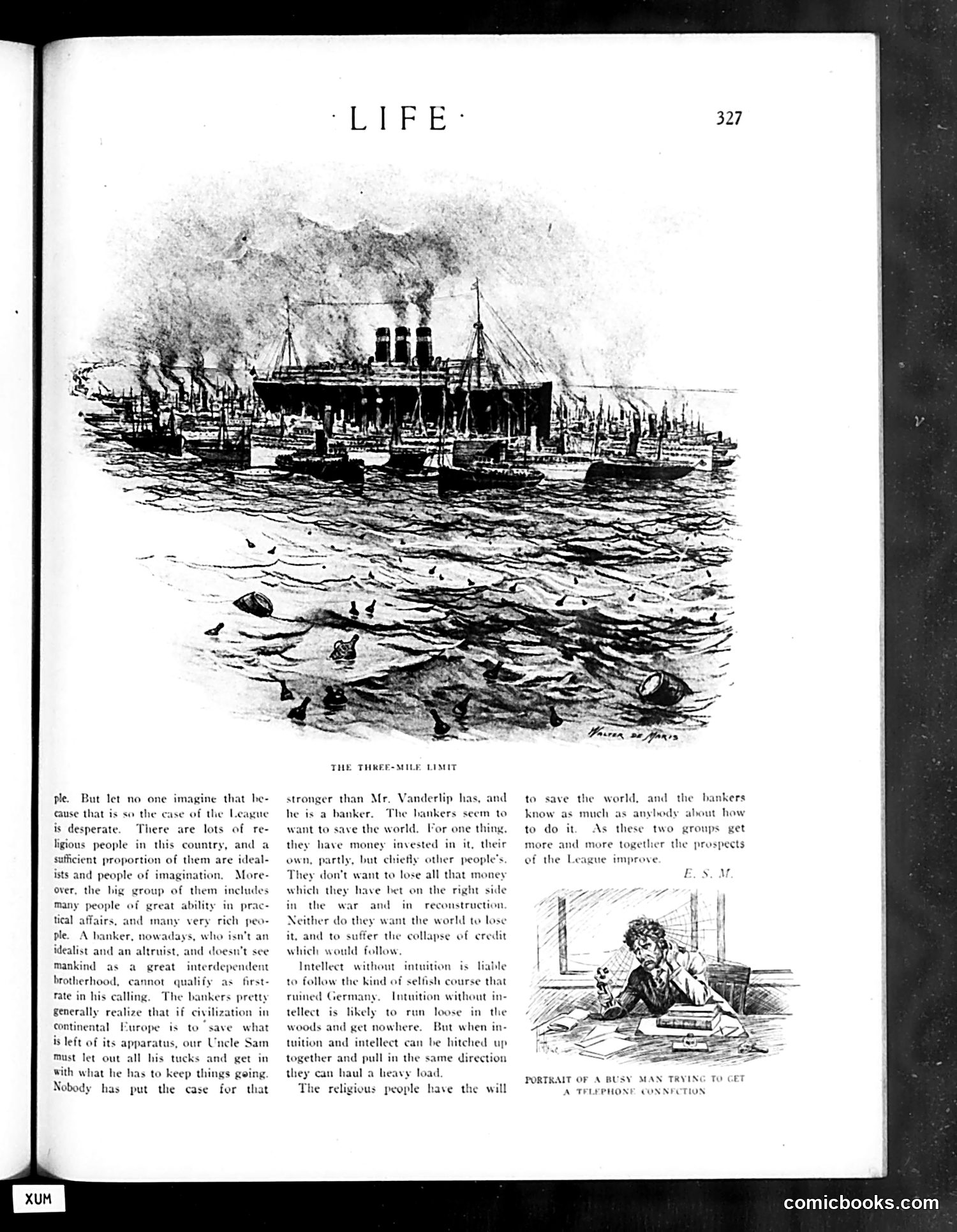
This page from *Life* magazine presents an editorial argument about post-WWI reconstruction, likely from the early 1920s during League of Nations debates. **The Main Illustration** ("The Three-Mile Limit") depicts a large ocean liner surrounded by smaller vessels—a visual metaphor for America's economic dominance and responsibility in a war-damaged world. **The Political Argument**: The text argues that American bankers (citing Frank Vanderlip as an example) and religious idealists share common cause in supporting international reconstruction. The piece contends that bankers have financial incentives to stabilize the world economy, while religious groups have moral motivations. Together, it suggests, their combined "intuition and intellect" can support efforts like the League of Nations. **The Satire**: The editorial is essentially making a pragmatic case that self-interest and idealism align—bankers want to protect their investments abroad while idealists want to save civilization. This reflects broader 1920s debates about American isolationism versus international engagement. **The Secondary Cartoon** shows a businessman struggling with a telephone connection—likely satirizing communication difficulties or bureaucratic frustration during this period of complex international negotiations.
📄 Transcribed text from this page (OCR, searchable)
Machine-transcribed from the original scan — historical spelling and the odd misread are preserved.
ple. But let no one imagine that he- cause that is so the case of the League is desperate. There are lots of re- ligious people in this country, and a sufficient proportion of them are ideal- ists and people of imagination, More- over, the big group of them includes many people tical aff ple. A banker, nowadays, who isn't an idealist and an altruist, and doesn’t see mankind as a great brotherhood, cannot qualify as first- rate in his calling. The bankers pretty i great ability in. prac- and many very rich peo- interdependent generally realize that if civilization in continental is left of its apparatus, our Uncle Sam must let out all his tucks and get in with what he has to keep things geing. Nobody has put the case for that Europe is to save what THE THREE-MILE LIMIT stronger than Mr, Vanderlip has, and he is a banker. The bankers seem to want to save the world. For one thing. they have money invested in it, their own, partly, but chiefly other people's They don't want to lose all that money which they have het on the right side in the war and in Neither do they want the world to lose it, and to suffer the collapse of credit which would follow reconstruction. Intellect’ without intuition is liable to follow the kind of selfish course that ruined Germany. Intuition without in- tellect is likely to run loose in’ the woods and get nowhere. But when in- tuition and intellect can be hitched up together and pull in the same direction they can haul a heavy load. The religious people have the will mayrsy to save the world, and the bankers know as much as anybody about how As these more and more together the prospects to do it two groups get of the League improve. PORTRAIT OF A BUSY MAN TRYIN: A TELEPHONE CONNFCTION comicbooks.com