
A complete issue · 43 pages · 1919
Life — June 26, 1919
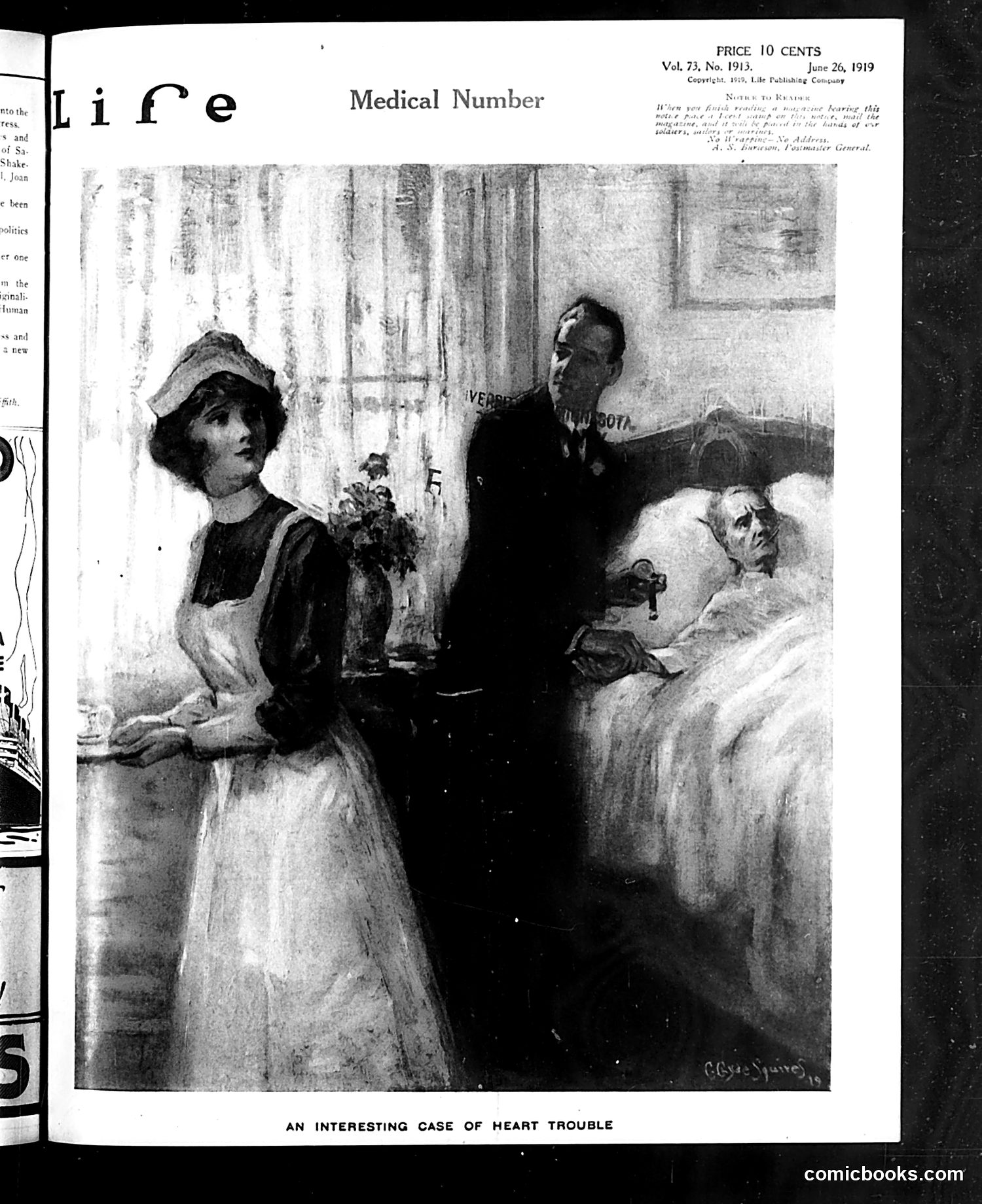
This medical illustration depicts a doctor examining a bedridden patient while a nurse attends. The caption's ironic title suggests the "heart trouble" is emotional or romantic rather than purely physical—a common satirical subject in Life magazine's humor. The image appears to be a social commentary on medical practice and perhaps the vulnerability of patients, or possibly a gentle joke about lovesickness being treated as a medical condition. The nurse's presence and the patient's distressed expression support a romantic or emotional interpretation of the "trouble." Without additional context from the issue's other content or articles, the precise satirical target remains unclear, though it likely mocked either medical pretension or sentimental romantic concerns of the era.
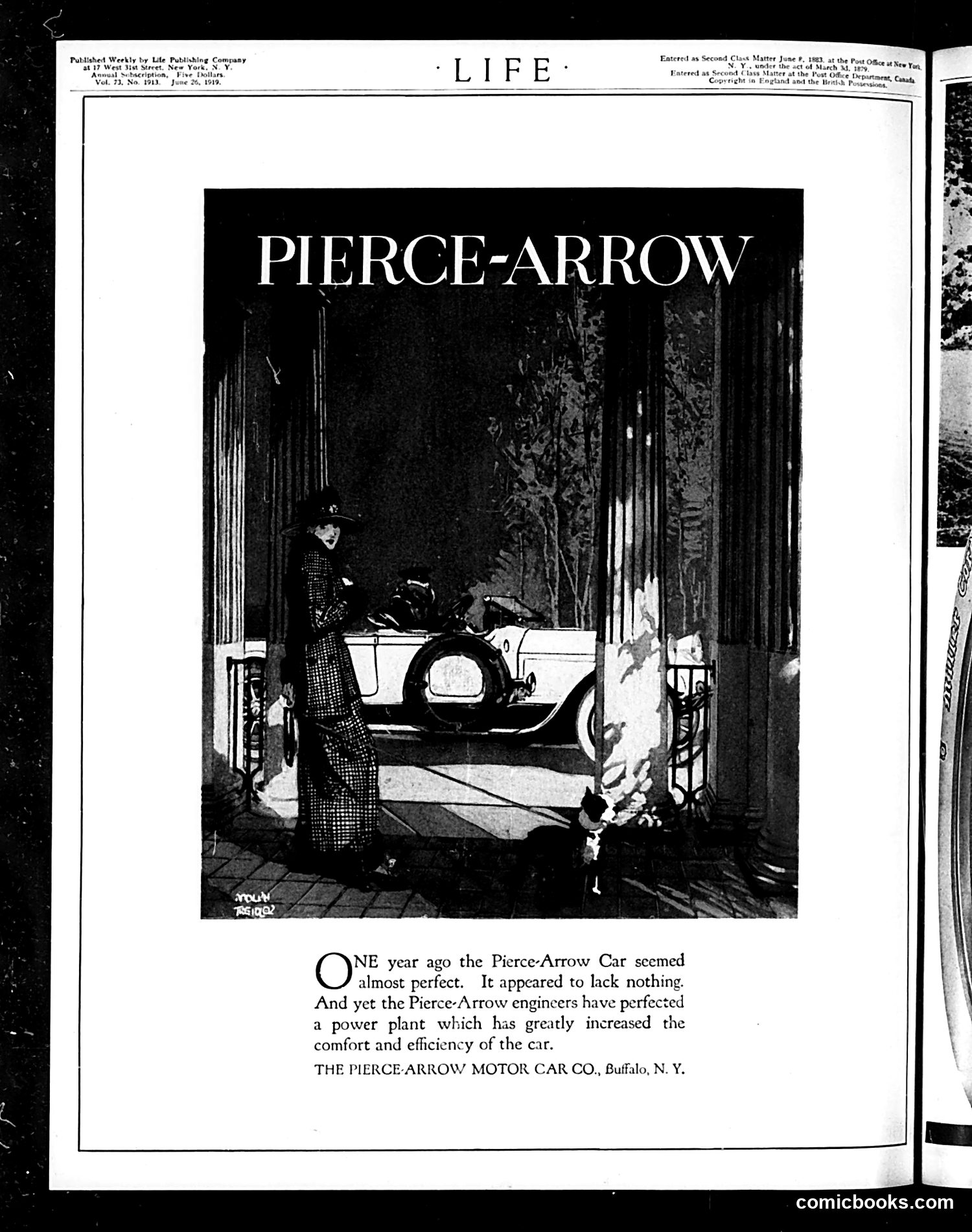
This is a **automobile advertisement**, not political satire. The page features a Pierce-Arrow Motor Car Company ad from their Buffalo, New York headquarters. The ad shows a woman in 1920s attire standing beside a Pierce-Arrow vehicle in what appears to be a garage or showroom with tall curtains. The accompanying text states that while the Pierce-Arrow seemed "almost perfect" a year ago, company engineers have since improved the power plant, increasing the car's "comfort and efficiency." This is essentially a marketing message emphasizing continuous product improvement—a common advertising strategy suggesting the brand stays current with technological advances. The photograph-style image was typical of early 20th-century automotive advertising in magazines like *Life*.
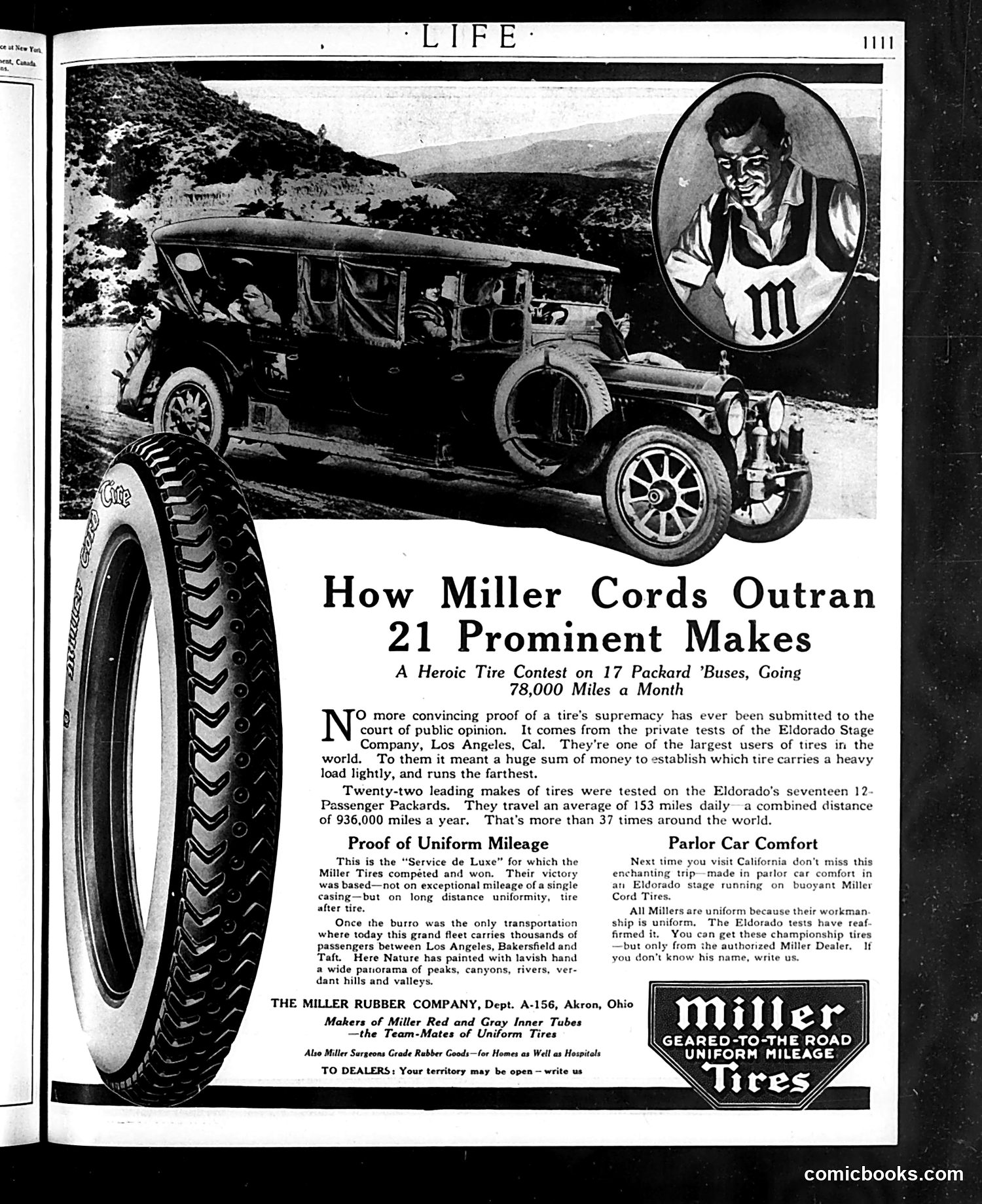
This is primarily a **Miller Tire Company advertisement**, not political satire. The page features: **Main Content:** An ad for Miller Cords tires, claiming they "outran 21 prominent makes" in a tire durability test conducted by the Eldorado Stage Company in California. The test involved seventeen 12-passenger buses traveling 153 miles daily, covering 936,000 miles yearly. **Visual Elements:** A vintage touring car with passengers, a close-up of a Miller tire showing its tread pattern, and a circular portrait of a man (likely a company representative or driver) in the upper right. **Marketing Claim:** The ad emphasizes "uniform mileage" and positions Miller as the superior choice for heavy-duty vehicle use, offering dealers territory opportunities. This is commercial advertising dressed in the language of scientific proof, typical of early 20th-century tire marketing.
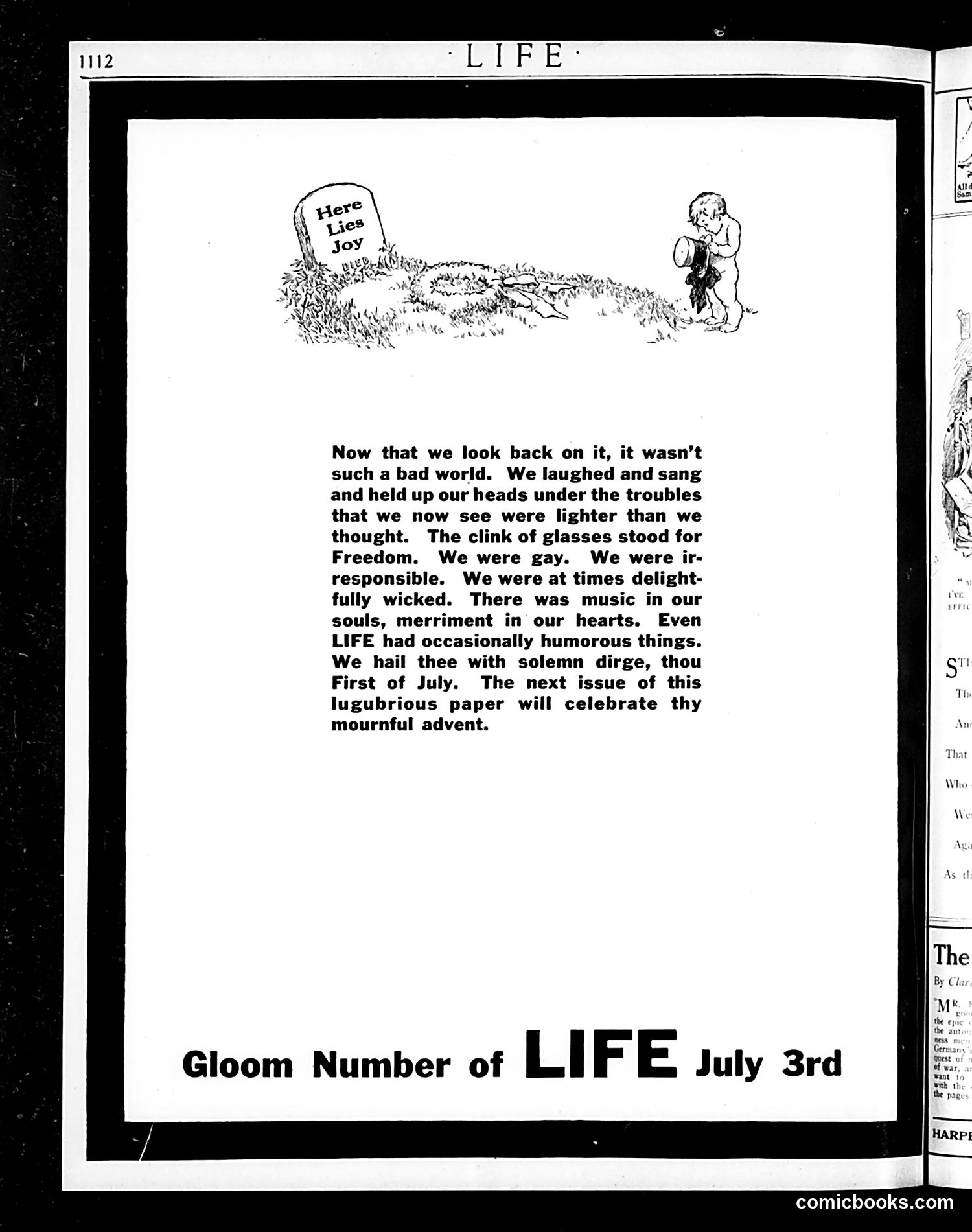
This is the "Gloom Number" of LIFE magazine for July 3rd—a satirical issue published around American Independence Day. The cartoon shows a figure mourning at a grave marked "Here Lies Joy," carrying what appears to be a coffin or funeral item. The accompanying text is ironic: it nostalgically recalls better times when people "laughed and sang" and "held up our heads," describing a freer, more carefree world with "music in our souls." The text promises the *next* issue will "celebrate thy mournful advent"—referring to the Fourth of July itself. The satire appears to mourn the loss of American joy and freedom, suggesting contemporary circumstances (likely related to WWI era based on the magazine's publication period) have extinguished the nation's spirit. The "Gloom Number" deliberately counterpoints patriotic holiday expectations with pessimistic commentary.
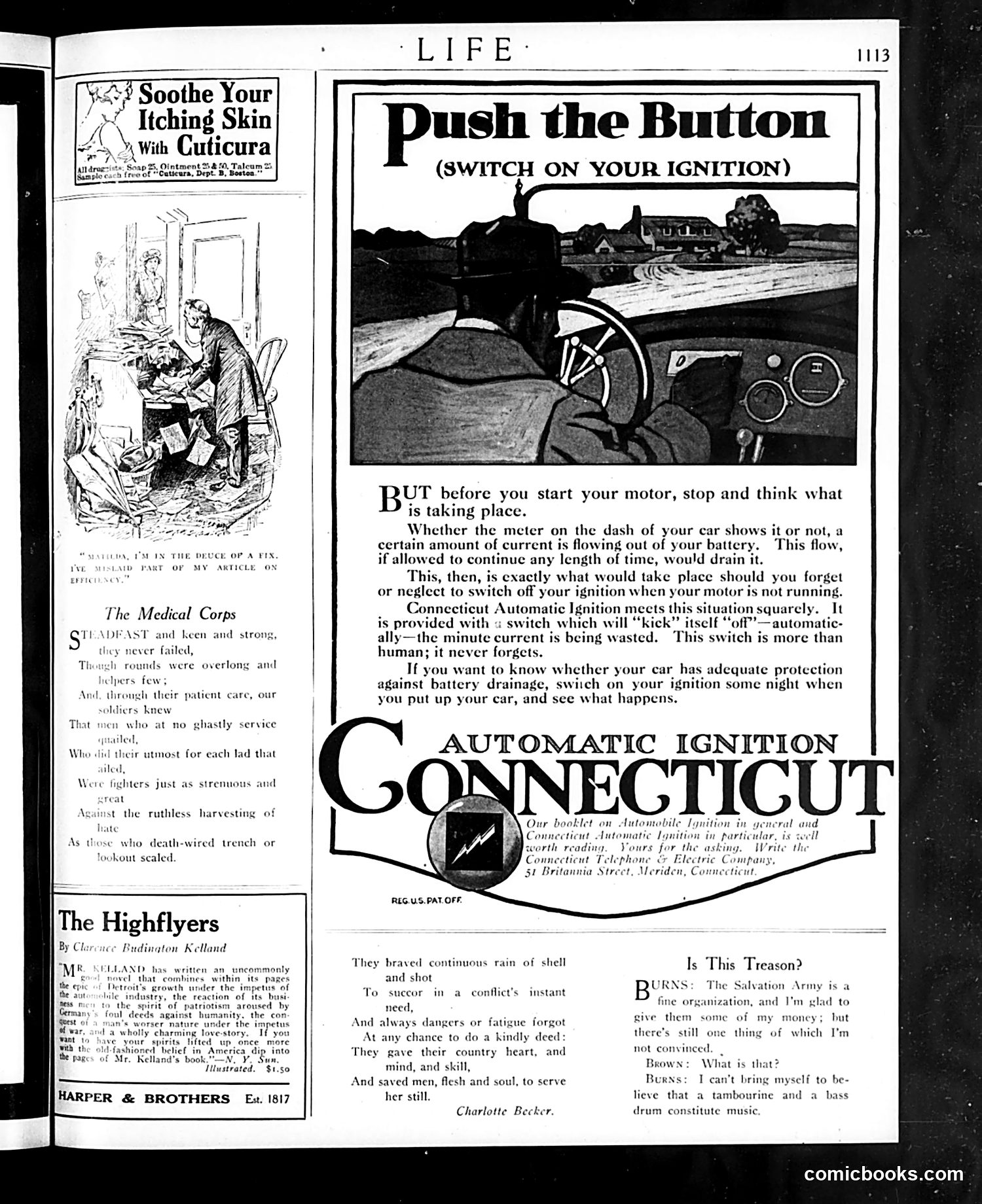
This page is primarily **advertising and literary content** rather than political satire. The main features are: 1. **Cuticura ointment ad** (left): A standard medical advertisement with illustration 2. **Connecticut Automatic Ignition ad** (center/right): The dominant piece, promoting an automatic ignition switch for automobiles. The ad argues this safety feature prevents battery drain by automatically shutting off the ignition when the engine stops—a convenience that "never forgets," unlike human drivers 3. **"The Medical Corps" and "The Highfliers"** (left): Appear to be literary pieces, possibly WWI-related based on references to "trench" and "shell" 4. **"Is This Treason?" dialogue** (bottom right): A brief conversational exchange about tambourines and bass drums The page reflects early 1900s magazine conventions mixing ads, poetry, and social commentary without overt political cartoons.
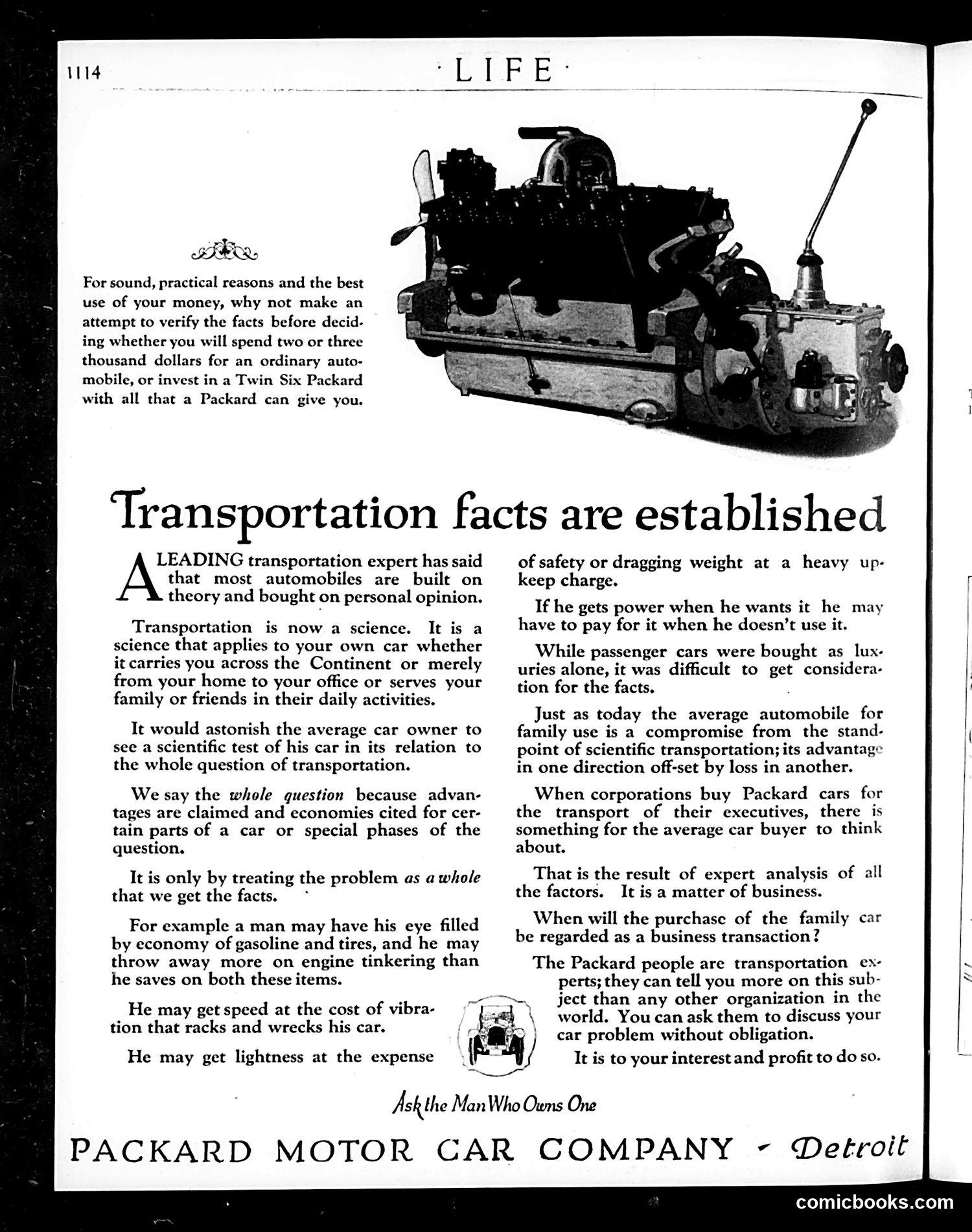
This is primarily **advertising content**, not satire or political commentary. It's a Packard Motor Car Company advertisement from *Life* magazine promoting their automobiles. The page argues that car-buying should be based on scientific analysis of "transportation facts" rather than emotion or partial claims. The ad emphasizes that Packard vehicles offer comprehensive value—addressing the whole transportation problem rather than isolated features. Key selling points include reliability for both personal and corporate use, and suggesting potential buyers consult actual Packard owners ("Ask the Man Who Owns One") rather than relying on marketing claims alone. The accompanying engine illustration showcases mechanical sophistication. This represents early 20th-century automotive advertising's shift toward rational, data-driven consumer persuasion.
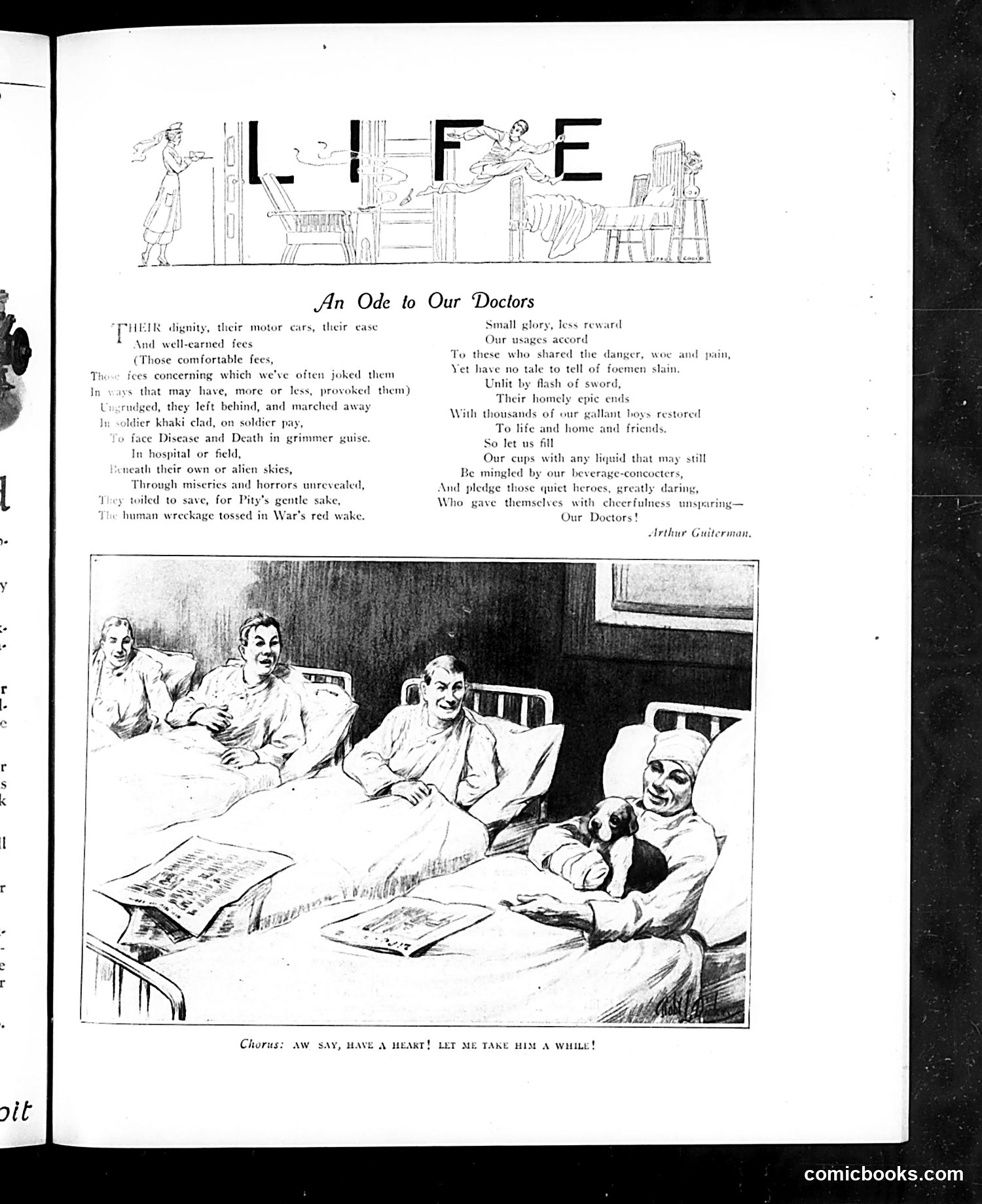
This page contains a poem by Arthur Guiterman honoring doctors during World War I, paired with a humorous illustration. The poem praises physicians for their service treating wounded soldiers—facing "disease and Death in grimmer guise" in hospitals and on battlefields, working through "miseries and horrors unrevealed." The cartoon below depicts wounded soldiers in hospital beds reading comics or newspapers, appearing cheerful despite their injuries. The caption reads "AW SAY, HAVE A HEART! LET ME TAKE HIM A WHILE!"—apparently showing doctors providing comfort and entertainment to boost patients' morale. The overall message combines sincere gratitude for medical personnel's wartime sacrifice with gentle humor about maintaining soldiers' spirits during recovery.
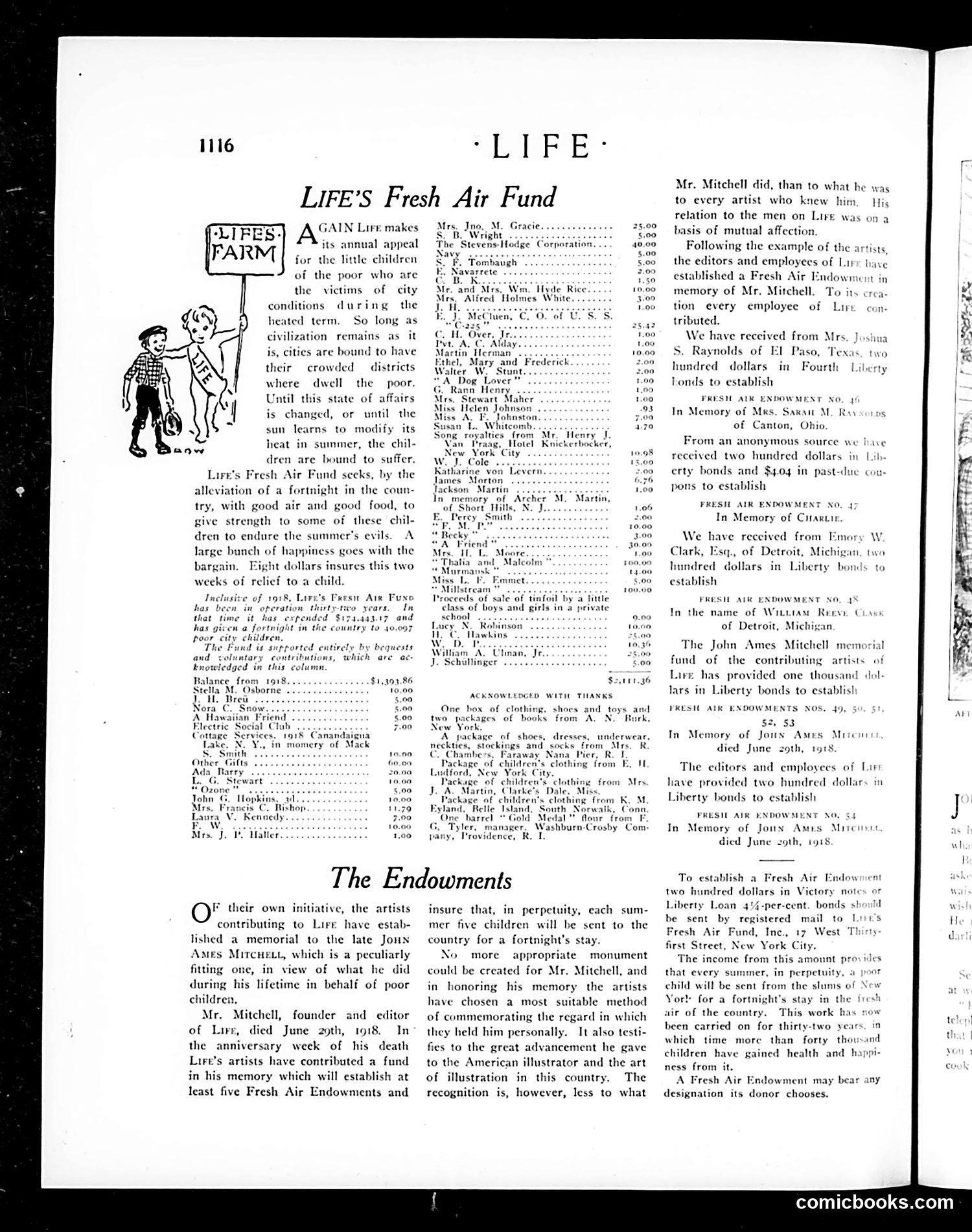
This page primarily documents charitable fundraising rather than satire. The **"Life's Farm" illustration** (upper left) shows two children with a sign, representing the Fresh Air Fund—a real charitable program that sent poor urban children to the countryside during summer to escape city heat and disease. The page lists donors and donation amounts to the fund, along with descriptions of contributions (clothing, shoes, food packages). The text explains that Life magazine artists, particularly in memory of **John Ames Mitchell** (Life's founder, recently deceased), established Fresh Air Endowments to ensure the program's perpetual support. This represents the magazine's civic responsibility initiatives rather than political satire—a earnest charitable appeal to readers to support poor children's welfare.
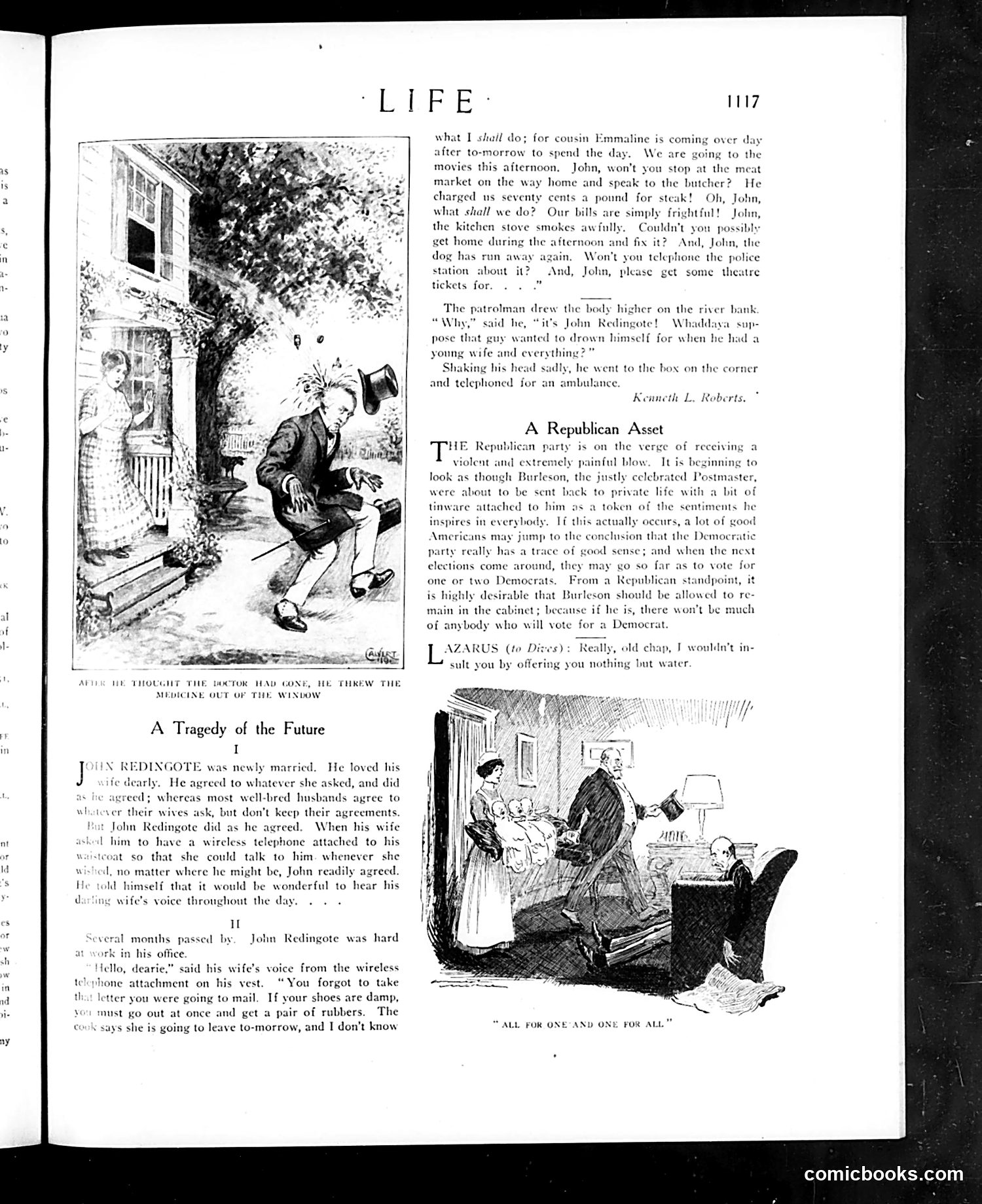
This page contains two satirical pieces: **"A Republican Asset"** criticizes James C. Blurlesson (likely a fictional stand-in), newly appointed Postmaster. The piece suggests Democrats worry he represents Republican strength and may attract Democratic voters, particularly if he remains in the cabinet. **"A Tragedy of the Future"** satirizes newfangled wireless telephone technology. John Redingote agrees to install a wireless telephone on his vest so his wife can contact him anywhere. The joke unfolds as she immediately uses it to micromanage his day—demanding he buy rubbers, post letters, and run errands—turning the convenience into marital tyranny. The accompanying illustration shows him frustrated while she manages him remotely. The satire mocks both technological optimism and gender dynamics of the era.
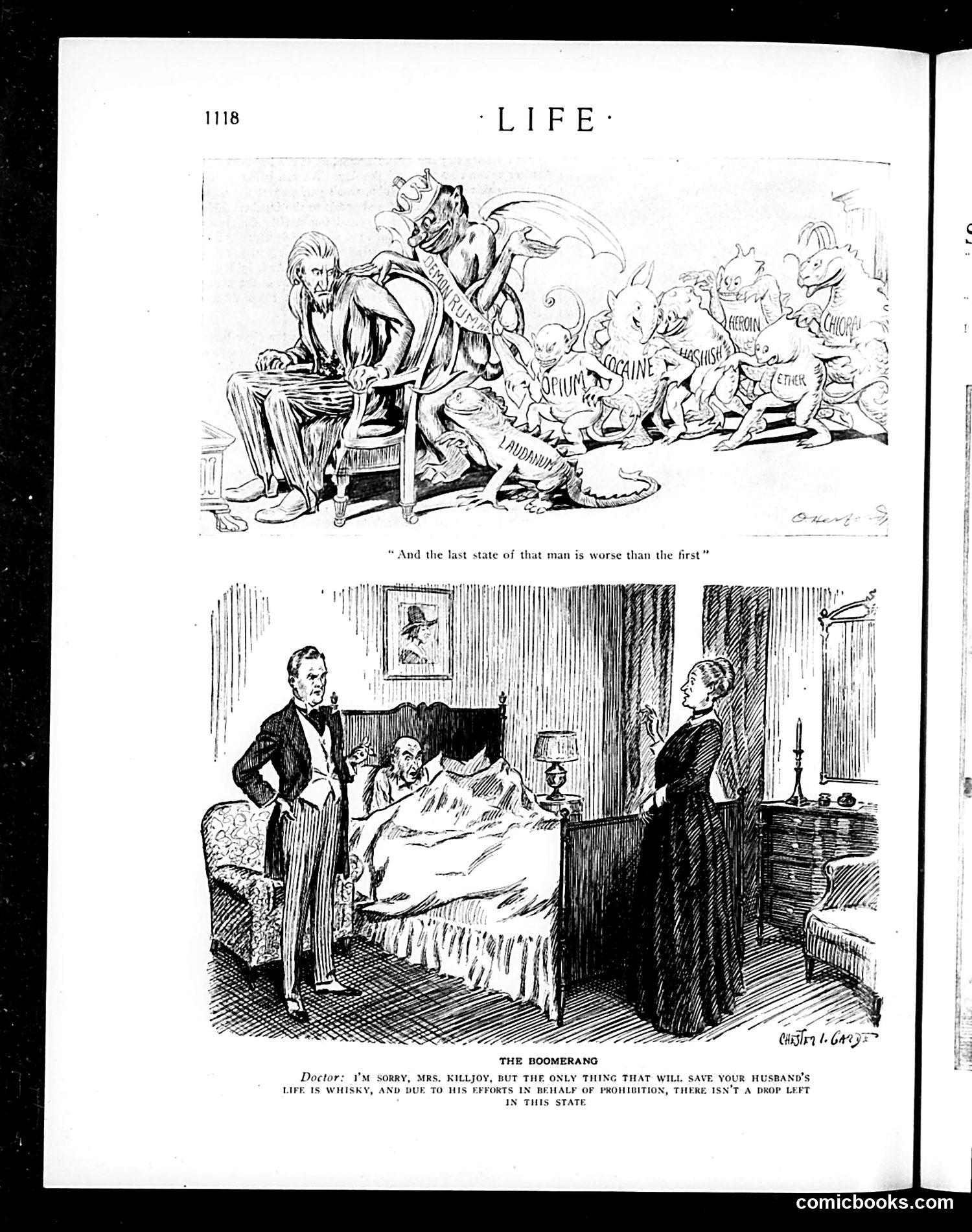
This page contains two cartoons addressing **Prohibition-era concerns**. **Top cartoon:** Depicts a skeletal "Death" figure seated with various demons labeled with vices (cocaine, hashish, ether, etc.) swarming around. The caption "And the last state of that man is worse than the first" suggests that while prohibition aimed to eliminate alcohol, it instead created worse drug problems. **Bottom cartoon ("The Boomerang"):** A doctor tells a dying man's wife that whiskey is the only thing that will save her husband's life, but prohibition prevents its use. This satirizes the paradox that alcohol was legally prohibited while simultaneously recognized as medically necessary—highlighting prohibition's practical failures and unintended consequences for public health. Both cartoons critique Prohibition's ineffectiveness.
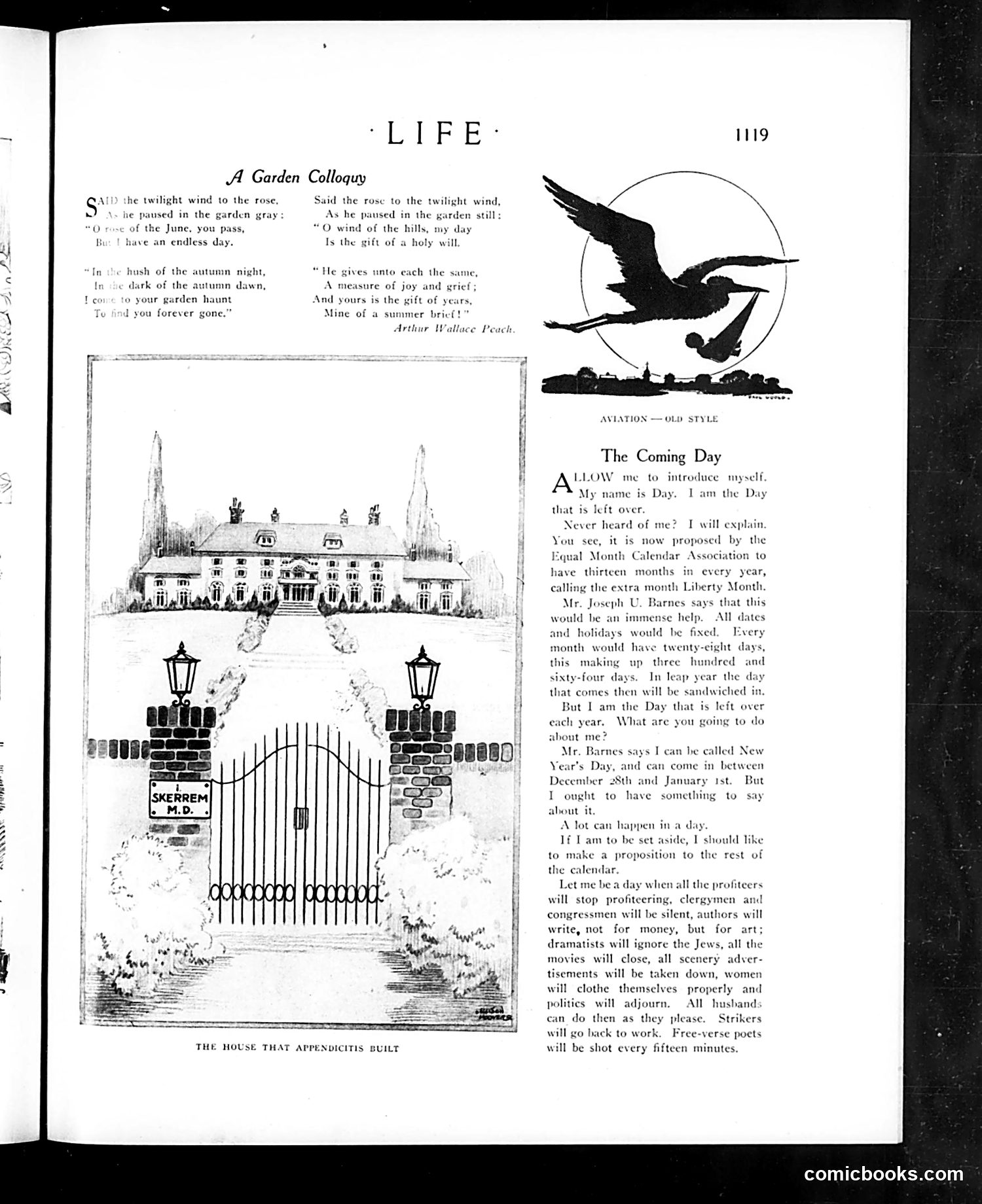
This page contains three distinct pieces: 1. **"A Garden Colloquy"** - A poem by Arthur Wallace Peach about wind and roses, presented in verse format. 2. **"Aviation—Old Style"** - A silhouette illustration of an early airplane against a moon, labeled as such. This appears to be a humorous nostalgic reference to primitive aviation. 3. **"The Coming Day"** - A satirical essay where "Day" (the leftover day in the calendar) introduces itself. It proposes a 13-month calendar system called "Liberty Month," attributing the idea to Joseph U. Barnes. The satire mocks this proposal by imagining radical social changes: fixed holidays, free-verse poets performing constantly, closed movie theaters, and husbands doing housework. It's social commentary on calendar reform and modern life anxieties. **"The House That Appendicitis Built"** - An architectural illustration showing an elaborate estate, likely satirizing wealth or medical procedures.
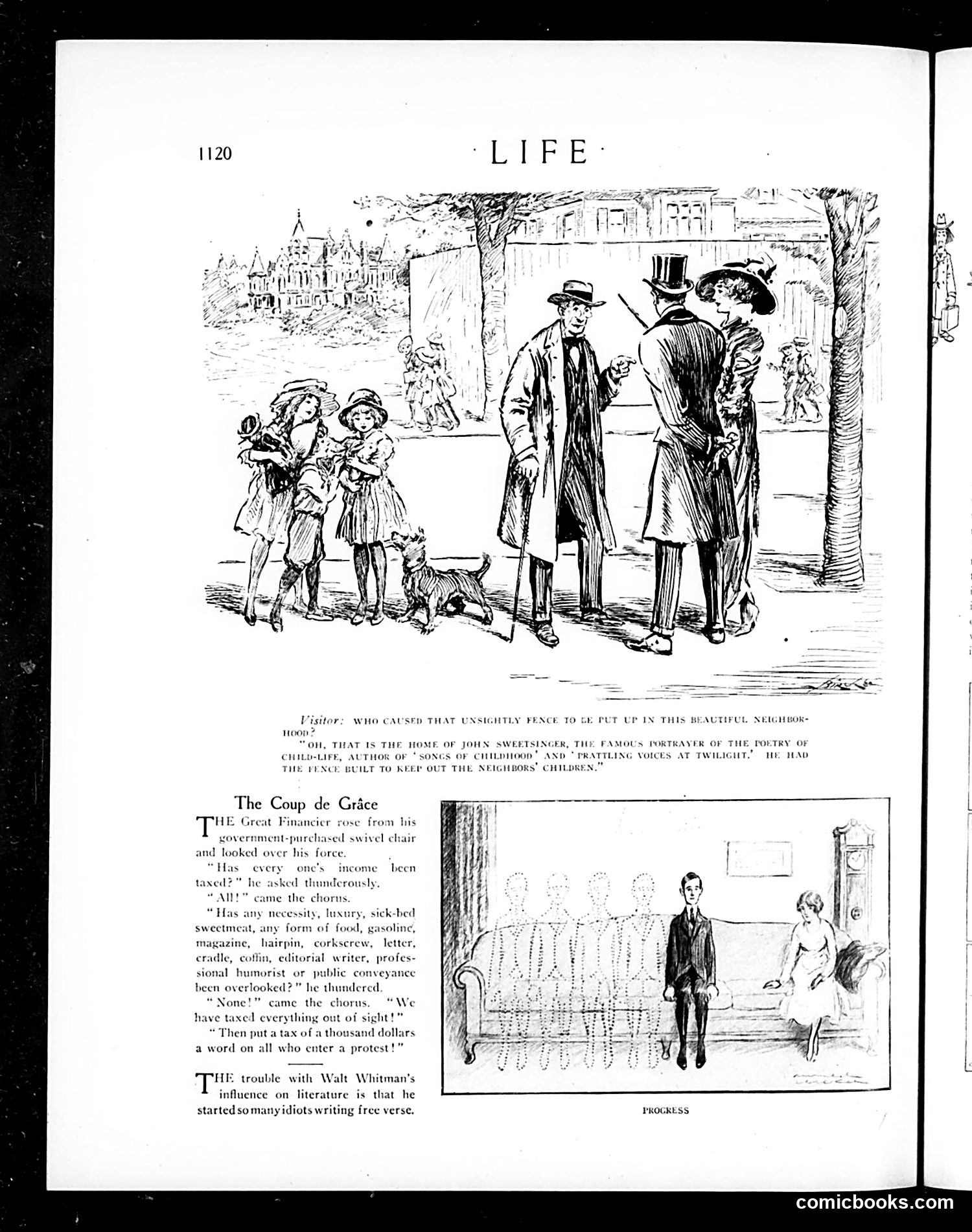
The top cartoon satirizes wealthy homeowners' anxieties about neighborhood character. A visitor questions an unsightly fence, which the homeowner identifies as belonging to John Greenleaf Whittier's home—a famous 19th-century poet known for children's literature and antislavery activism. The joke: the homeowner uses Whittier's cultural prestige to justify tolerating an eyesore, essentially name-dropping to excuse poor aesthetics. "The Coup de Grâce" below mocks a wealthy financier's tax avoidance strategy. He boasts of exempting his income from taxation by claiming everything—food, fuel, magazines, writing supplies—as business expenses. The satire targets wealthy tax-dodging through creative deductions, a common progressive-era complaint about the wealthy manipulating tax law.
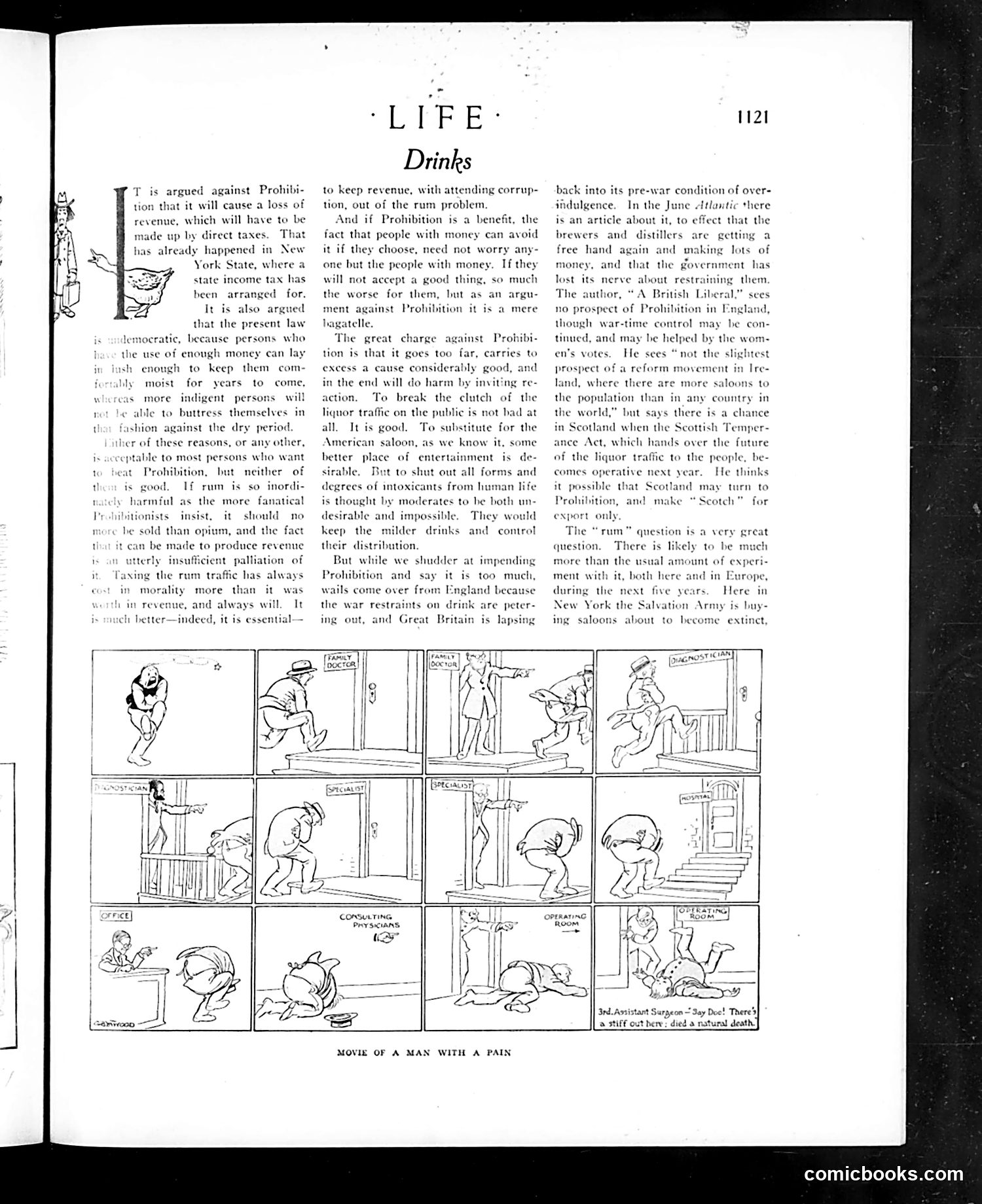
This comic strip satirizes Prohibition-era drinking culture. The title references silent film comedy, a popular entertainment form. The sequential panels show a man progressively deteriorating through various physical ailments and comic mishaps—falling, contorting, visiting doctors—all apparently related to excessive drinking or its aftermath. The accompanying article debates Prohibition's effects on revenue and public morality. The cartoon illustrates the physical comedy tradition of slapstick while commenting on alcohol's real consequences. The final panel's reference to a "refund death" suggests dark humor about the situation's severity. This page reflects the heated 1920s Prohibition debate: the article presents arguments both for and against the alcohol ban, while the visual humor mocks the bodily chaos caused by drinking.
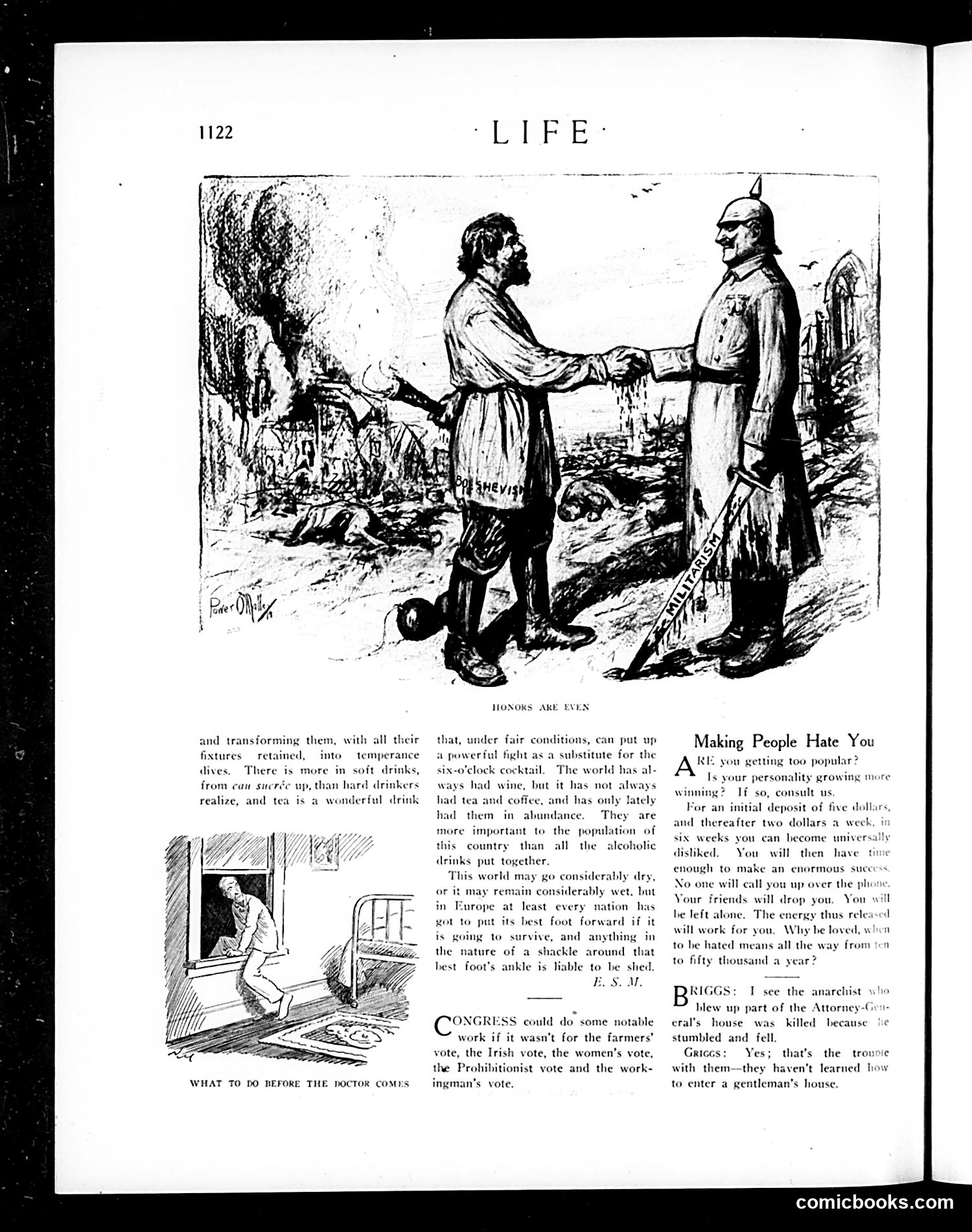
**Top Cartoon ("Honors Are Even"):** Two men in military uniforms shake hands over a devastated battlefield with burning buildings and casualties. This appears to satirize WWI peace negotiations or armistice discussions, suggesting that despite the horrific carnage, both sides claim victory—a cynical commentary on the hollow nature of military "honors" when countless soldiers have died. **Bottom Cartoon ("What To Do Before The Doctor Comes"):** Shows a person at a window, apparently illustrating domestic medical advice. The caption likely offers humorous or ironic suggestions for home remedies. **Text sections** discuss alcohol prohibition, Congressional voting patterns, and "Making People Hate You"—typical early 20th-century American satirical commentary on social and political issues of the era.
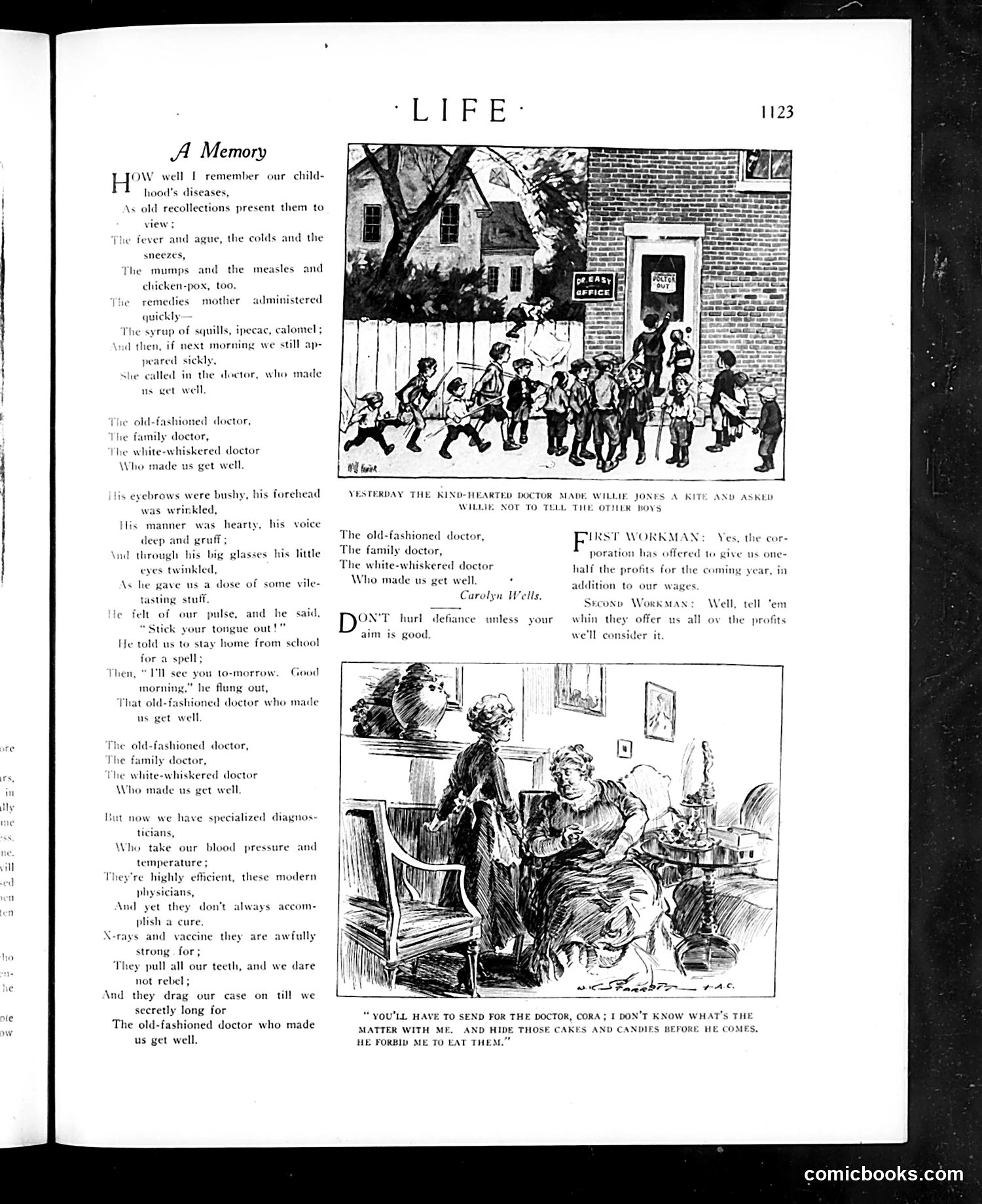
This page presents a poem and illustrations contrasting old-fashioned family doctors with modern specialists. The text, attributed to Carolyn Wells, nostalgically celebrates "the old-fashioned doctor" who knew families personally and provided holistic care—making house calls, offering comfort alongside medicine. The top illustration shows children gathering around a brick building (likely a doctor's office) to watch Dr. Willie Jones make a kite. The bottom illustration depicts a mother hiding cakes and candies before the doctor's visit, suggesting the old family doctor's personal knowledge of his patients' lives. The satire critiques contemporary medicine's shift toward impersonal specialization and technological diagnostics ("X-rays and vaccine"), implying modern doctors are efficient but emotionally distant compared to their predecessors' personal touch.
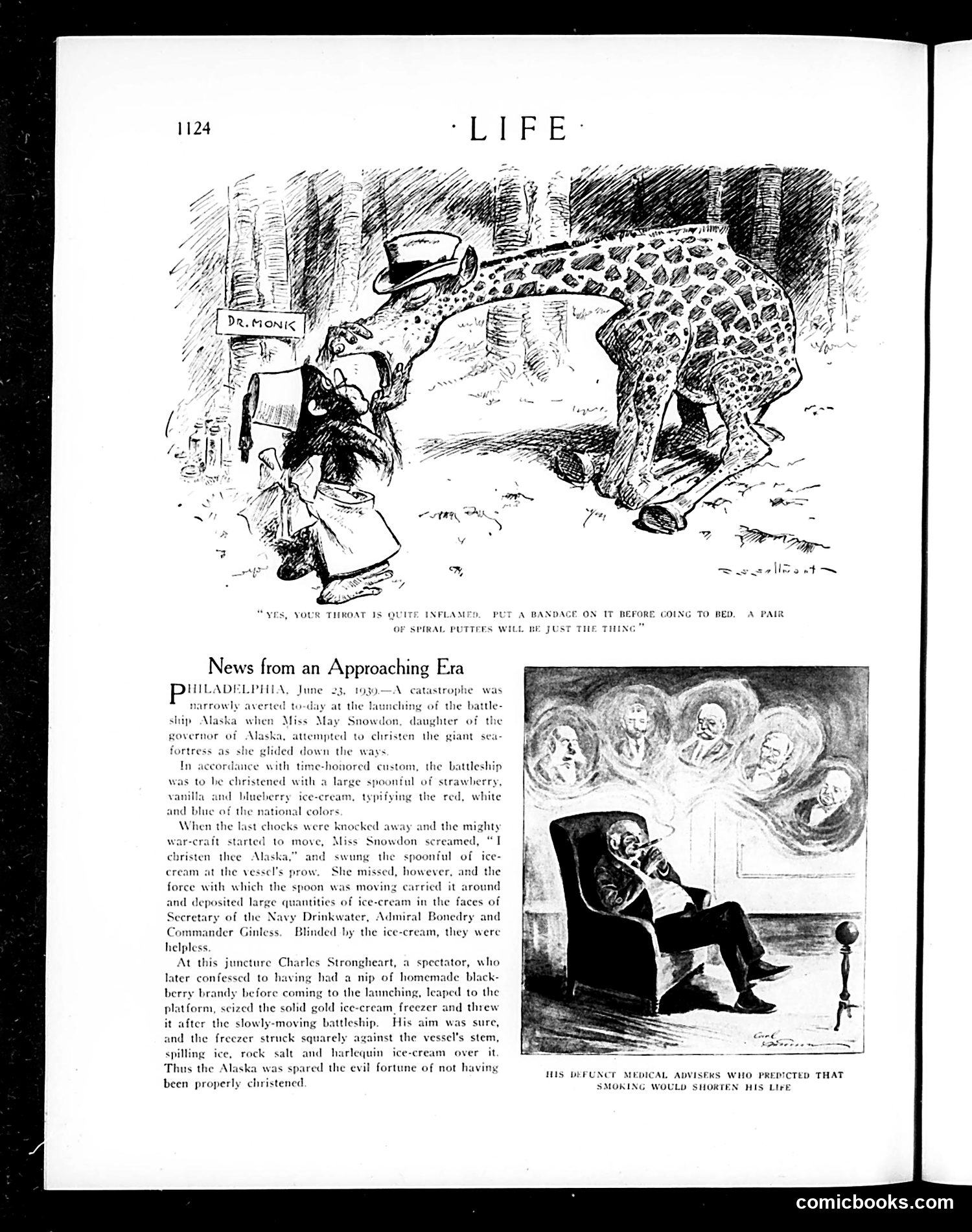
This is a humorous satirical piece from *Life* magazine (June 23, 1930) imagining a futuristic ship christening gone comically wrong. **The Setup:** The battleship Alaska's christening ceremony uses ice cream instead of traditional champagne—a modernist twist on an old custom. Miss May Snowdon (daughter of Alaska's governor) is tasked with breaking the ice cream against the ship's bow. **The Joke:** The christening disaster escalates absurdly: Snowdon misses, coating naval officials with ice cream instead. A bystander named Charles Strongheart, intoxicated on "homemade blackberry brandy," "saves" the situation by throwing the entire gold ice-cream freezer at the ship, creating further chaos. **The Satire:** This mocks early-20th-century American modernity—the notion that tradition can simply be "updated" with silly substitutions (ice cream for champagne), and that incompetence masked as progress might still somehow work out. The accompanying cartoon above depicts a doctor and patient; its caption suggests medical advice about smoking, though context is unclear.
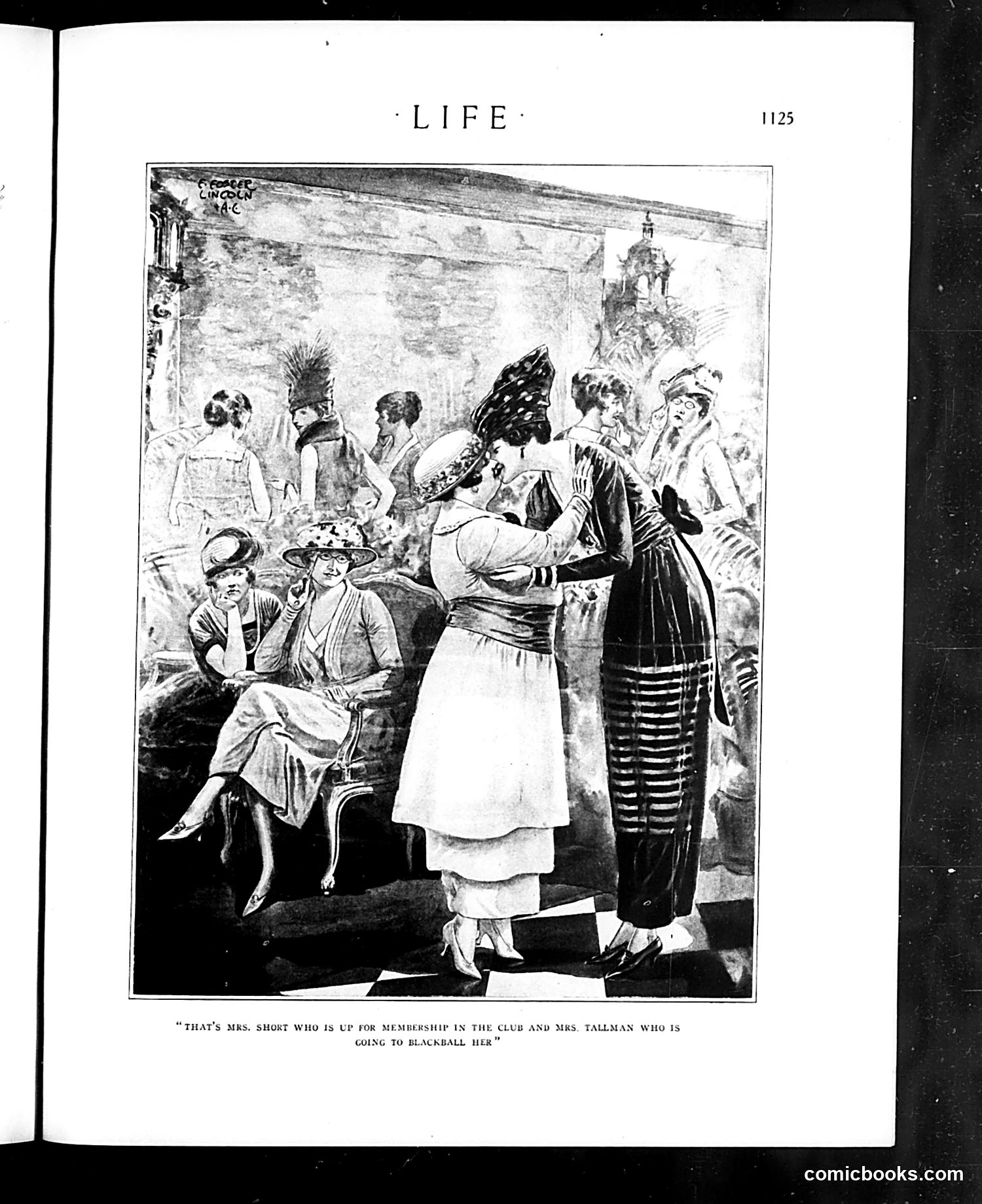
This single-panel cartoon satirizes the exclusionary practices of women's social clubs. The caption identifies two women: Mrs. Short, who is seeking membership, and Mrs. Tallman, who intends to blackball (reject) her application. The humor derives from an ironic visual gag—Mrs. Short appears notably tall while Mrs. Tallman appears short, inverting their names. The crowded social gathering setting emphasizes the club's exclusivity and the arbitrary nature of membership decisions. The cartoon mocks both the pretentiousness of such organizations and the personal animosities that could determine acceptance, suggesting that club membership determinations were often based on individual whims rather than merit or fair criteria.
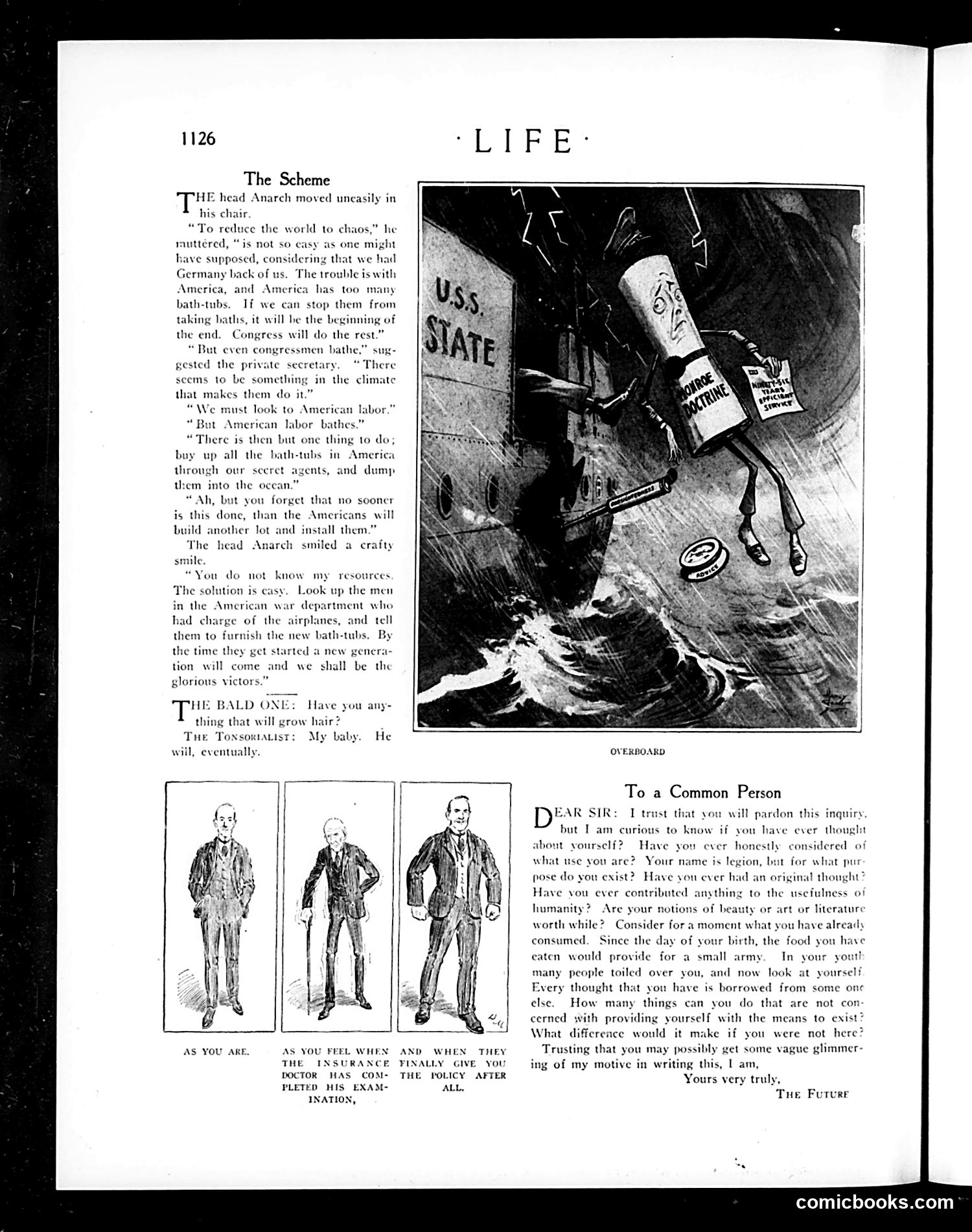
This page contains two satirical pieces from Life magazine: **"The Scheme"** mocks anarchist plots to destabilize America. An "head Anarch" proposes destroying the nation by eliminating bathtubs—a absurdist critique suggesting anarchists' plans are both sinister and laughably ineffective. The joke escalates when he realizes Americans will simply rebuild, then proposes infiltrating the War Department to sabotage production—satirizing fears of foreign agents undermining American institutions from within. The humor lies in the contradiction: a civilization supposedly threatened by bathtubs. **"To a Common Person"** is a sardonic open letter questioning an ordinary person's worth and original contribution to society. It catalogs their consumption, borrowed thoughts, and lack of utility—darkly comedic nihilism common in 1920s intellectual humor. The three medical cartoon panels use visual progression to show how a man's appearance changes based on his psychological state. The satire reflects post-WWI anxiety about radical foreign threats to American stability and capitalist values.
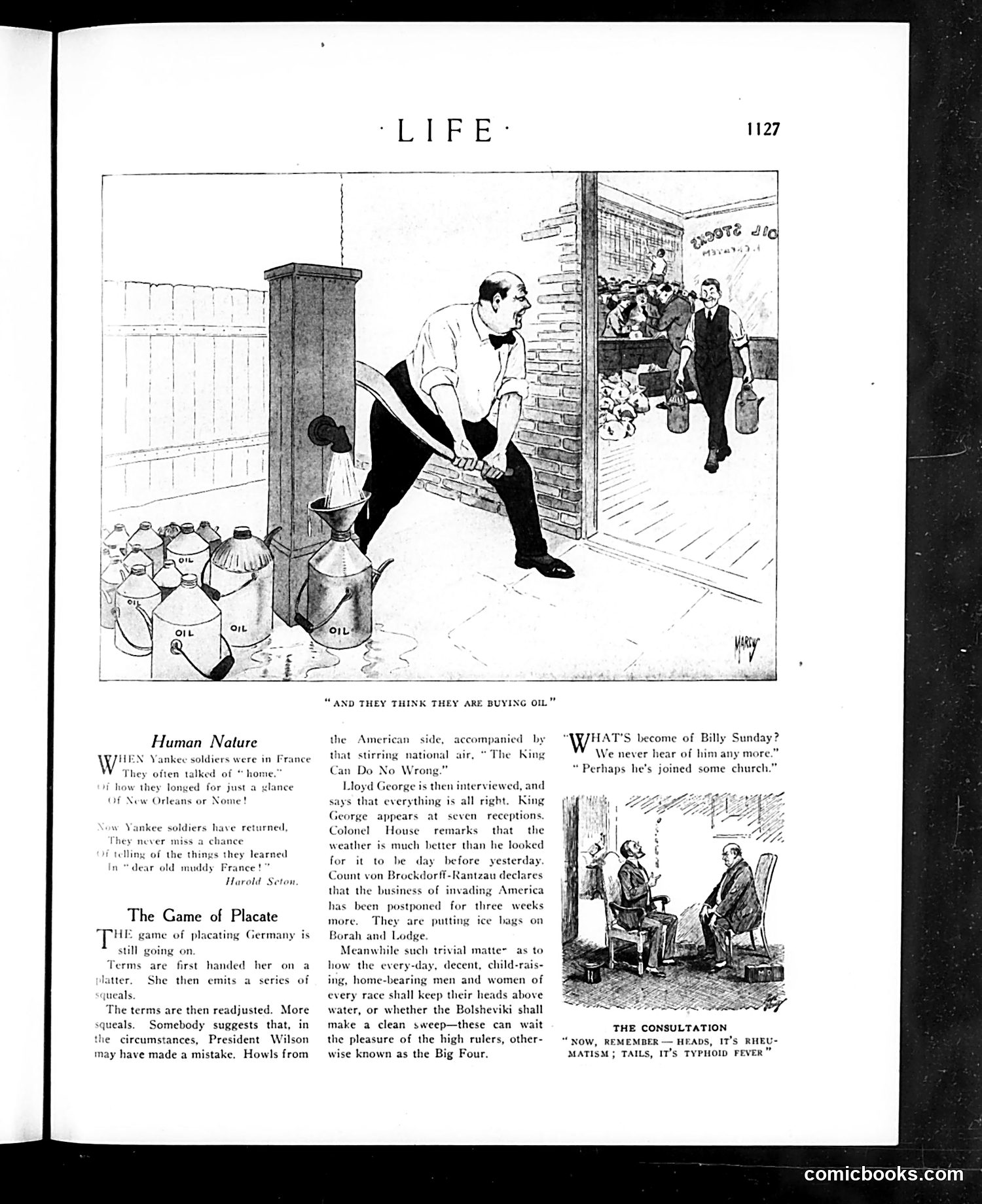
**Main Cartoon ("And They Think They Are Buying Oil"):** Depicts a man guarding oil cans while well-dressed officials enter a building labeled "EXPORTS." The satire suggests that post-WWI Germany is being sold oil (or other resources) under the guise of legitimate commerce, when the transaction is actually a deception or trick. **"The Game of Placate":** Satirizes post-war peace negotiations, likely regarding German reparations/terms. Germany repeatedly "squeals" in protest; terms get repeatedly adjusted. The piece mocks the endless back-and-forth between Wilson, Lloyd George, King George, and others ("the Big Four"), suggesting their diplomacy is performative while ignoring real human suffering—how ordinary people will survive economically and whether Bolshevism will spread. **"The Consultation":** Two figures debate whether someone's symptoms indicate rheumatism or typhoid fever—a medical joke reflecting post-war uncertainty about diagnosis/solutions. **Context:** This appears from the post-WWI period (1919-1920), criticizing Allied leadership's negotiation strategy with defeated Germany as both ineffective and indifferent to ordinary citizens' welfare.
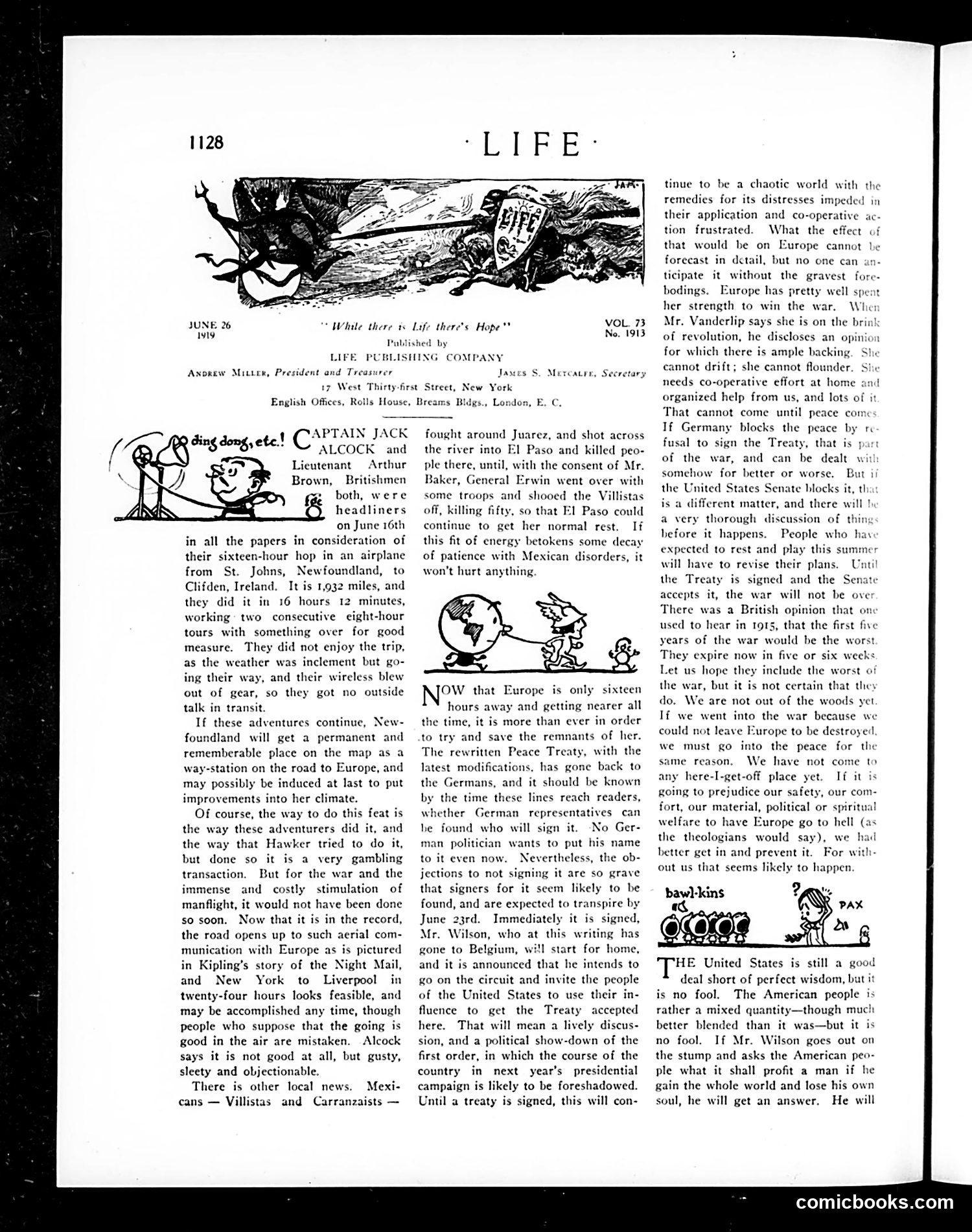
This page celebrates British aviators **Captain Jack Alcock and Lieutenant Arthur Brown**, who completed the first nonstop transatlantic flight from Newfoundland to Ireland on June 16—a 1,932-mile journey in 16 hours. The article marvels at this achievement as proof that regular air service between North America and Europe is now feasible. The main cartoon (top left) depicts a skeletal figure labeled "While there is Life there's Hope," likely satirizing the precarious nature of such dangerous flights. The page also addresses contemporary politics: the **Treaty of Versailles** negotiations with Germany, Mexican border violence (Villistas vs. Carranzaists), and **President Wilson's** planned speaking tour to build American support for the treaty. The writer expresses concern about Europe's post-war fragility and revolutionary instability, emphasizing that swift treaty ratification is crucial to global stability. The tone is one of cautious optimism about technological progress tempered by anxiety about political chaos.
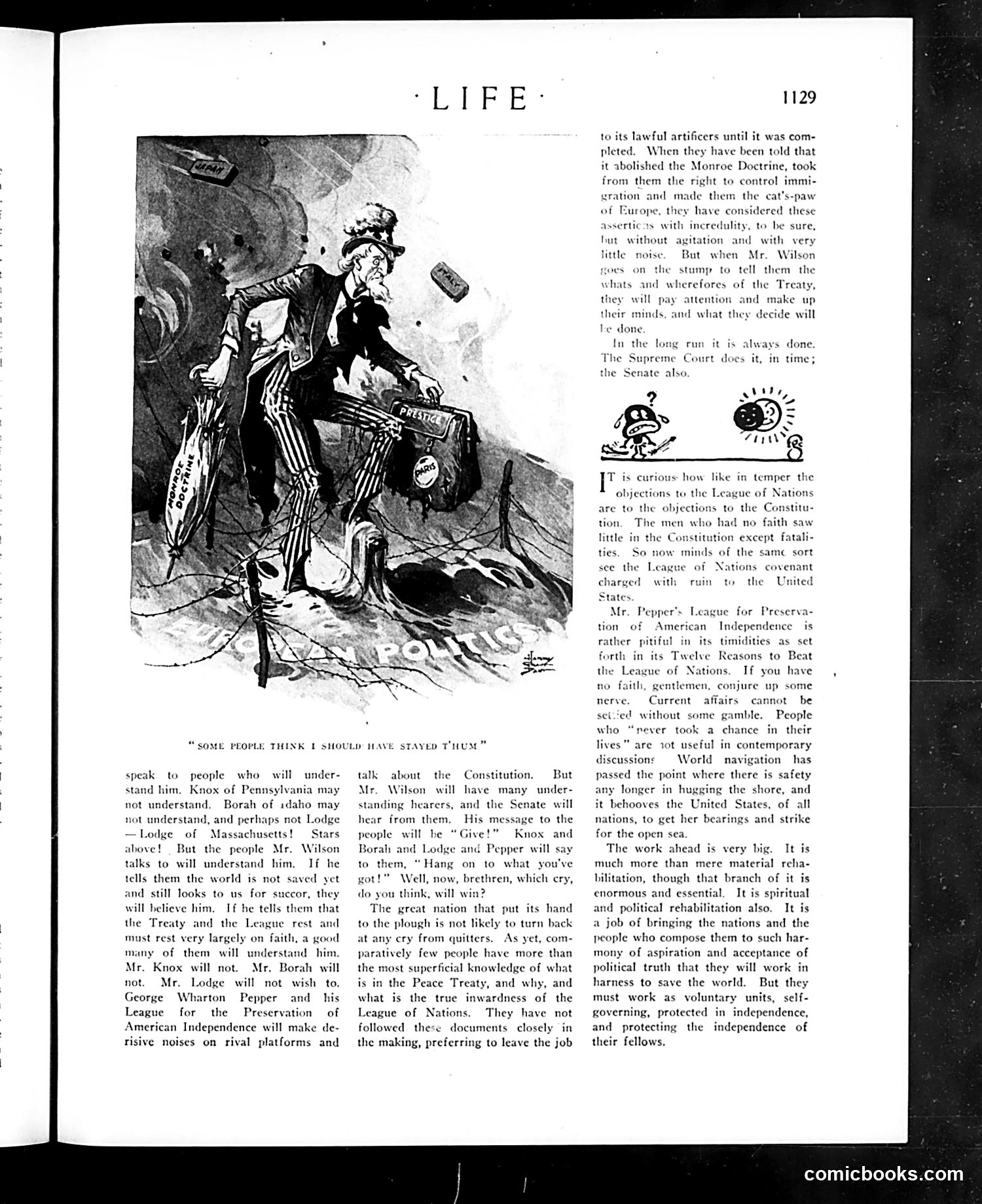
This page critiques opponents of the League of Nations Treaty following World War I. The central cartoon depicts Uncle Sam as a tired farmer, with the caption "Some People Think I Should Have Stayed T'Home"—satirizing isolationist politicians who want America to retreat from international involvement. The editorial identifies specific Republican senators opposing President Wilson's League proposal: Knox (Pennsylvania), Borah (Idaho), Lodge (Massachusetts), and George Wharton Pepper. The text argues these men lack faith in the League, while common Americans—once informed by Wilson's speeches—will support it. The satire's point: isolationist politicians are out of touch with the people's better judgment. The cartoonist presents Wilson as addressing ordinary citizens who will understand the necessity of international cooperation, contrasting them against cynical politicians protecting narrow interests. The farmer figure represents America itself, exhausted but recognizing global responsibilities cannot be abandoned.
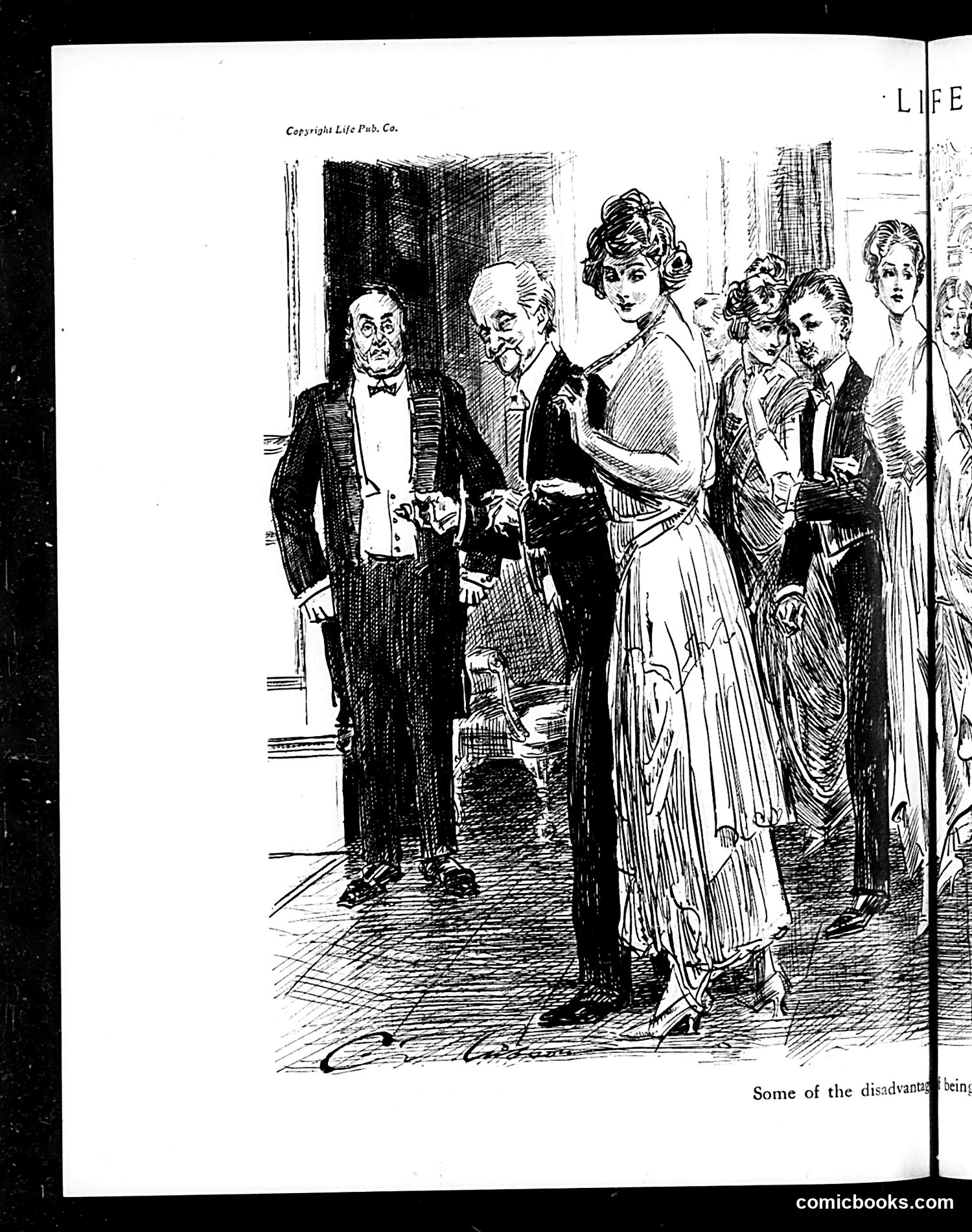
This is a satirical illustration from *Life* magazine showing a formal social gathering. The caption reads "Some of the disadvantages being..." (text cuts off), suggesting the cartoon critiques drawbacks of upper-class social life. The scene depicts well-dressed men in tuxedos and women in evening gowns at what appears to be a formal event or party. The composition—with figures clustered together in formal attire—suggests crowding, stuffiness, or social discomfort despite the supposedly prestigious setting. Without the complete caption, the specific "disadvantages" aren't entirely clear, but the satire likely mocks the artificiality, constraints, or social awkwardness inherent in high-society gatherings. The formal dress and poses contrast with the apparent discomfort of the figures, making a commentary on elite social pretension.
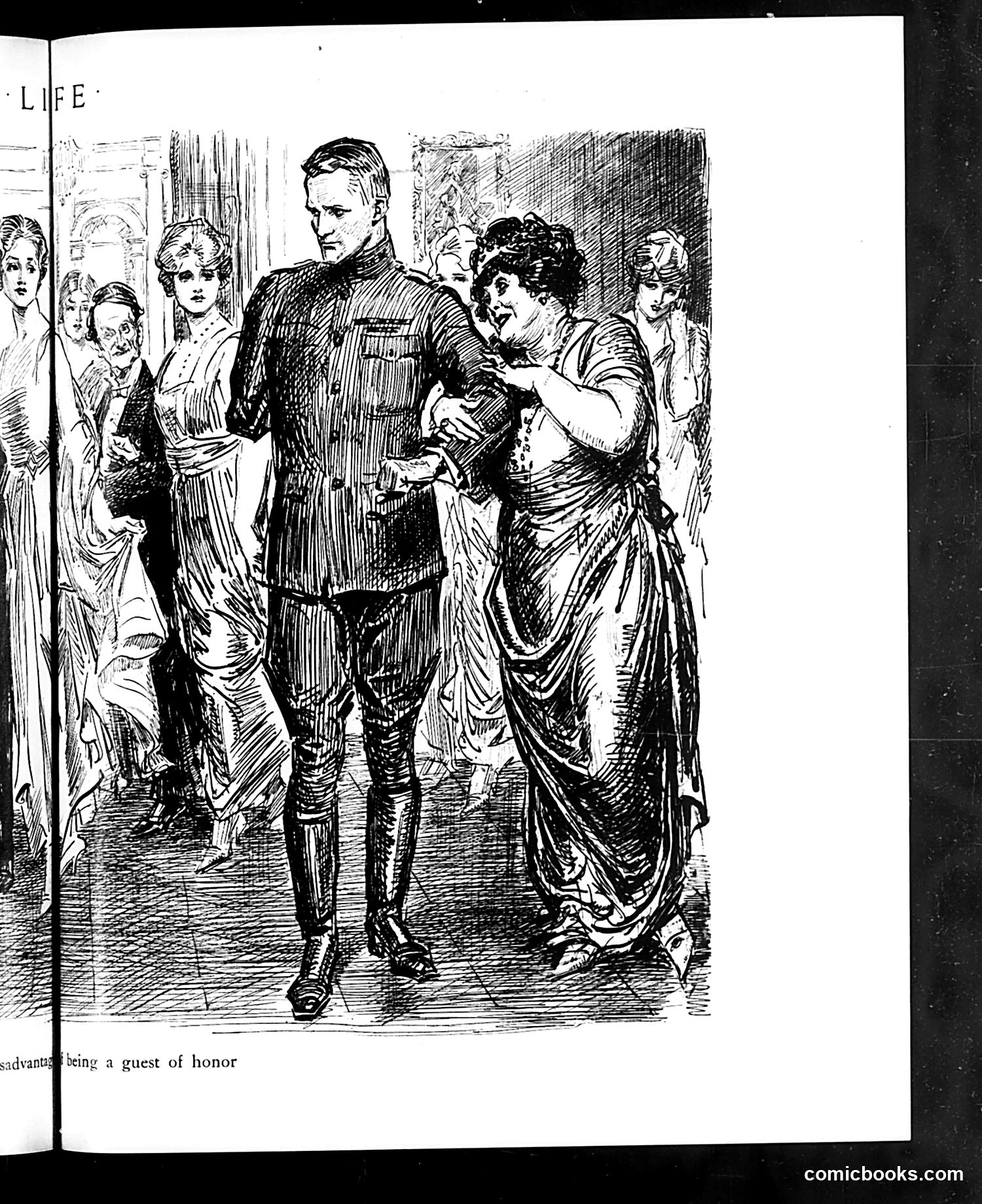
This illustration depicts a military officer in uniform (center) surrounded by admiring women in an interior setting. The partial caption reads "advantage being a guest of honor," suggesting the cartoon satirizes the social perks of military rank or status. The satire appears to mock how military officers—particularly those of high rank—receive special social treatment and romantic attention when attending formal gatherings. The women's fawning behavior and the officer's central, prominent positioning emphasize this advantage. Without the full caption or publication date visible, I cannot identify the specific officer or historical context. However, the artwork style and "LIFE" magazine branding indicate this is early-to-mid 20th century American satirical commentary on military prestige and its social benefits.
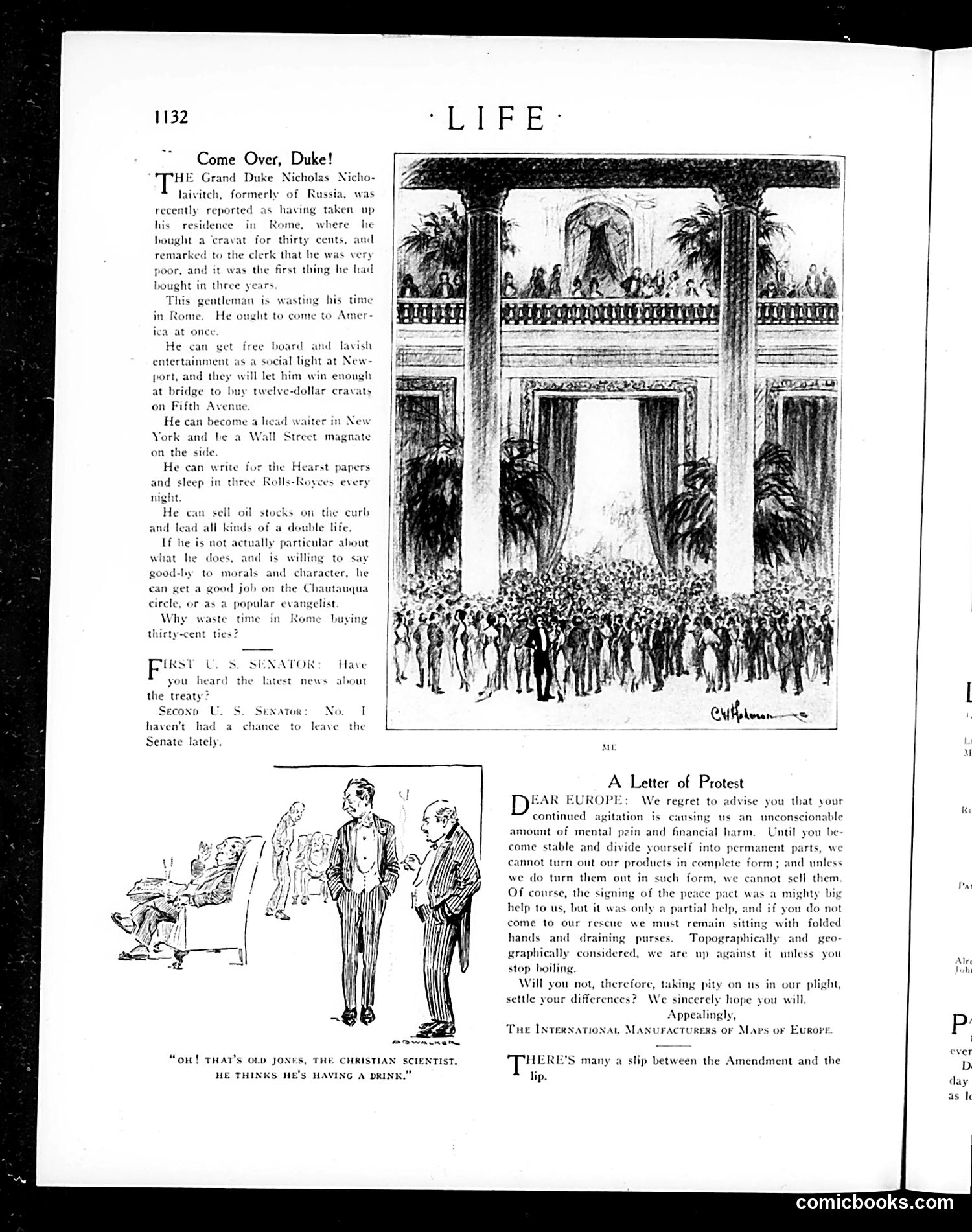
**Top Cartoon — "Come Over, Duke!"** This satirizes Grand Duke Nicholas Nikolaievitch of Russia, reportedly impoverished in Rome after the Russian Revolution. The article mockingly suggests he relocate to America where he could easily profit through various schemes: free entertainment at Newport, gambling winnings, working as a waiter while pretending to be a Wall Street figure, writing for Hearst newspapers, or selling oil stocks on the curb. The joke targets both the displaced Russian aristocrat's poverty and the ease of social fraud in America—anyone can reinvent themselves and become wealthy through deception. **Bottom Cartoon — "That's Old Jones, the Christian Scientist"** This jokes about Christian Science's doctrine that illness is illusion. The figure appears intoxicated, yet a Christian Scientist observer claims he's merely experiencing an illusion of drunkenness rather than actually drinking. **"Letter of Protest"** European manufacturers protest continent-wide instability is preventing them from producing complete goods for export. They plead for Europe to "stop boiling" and stabilize politically.
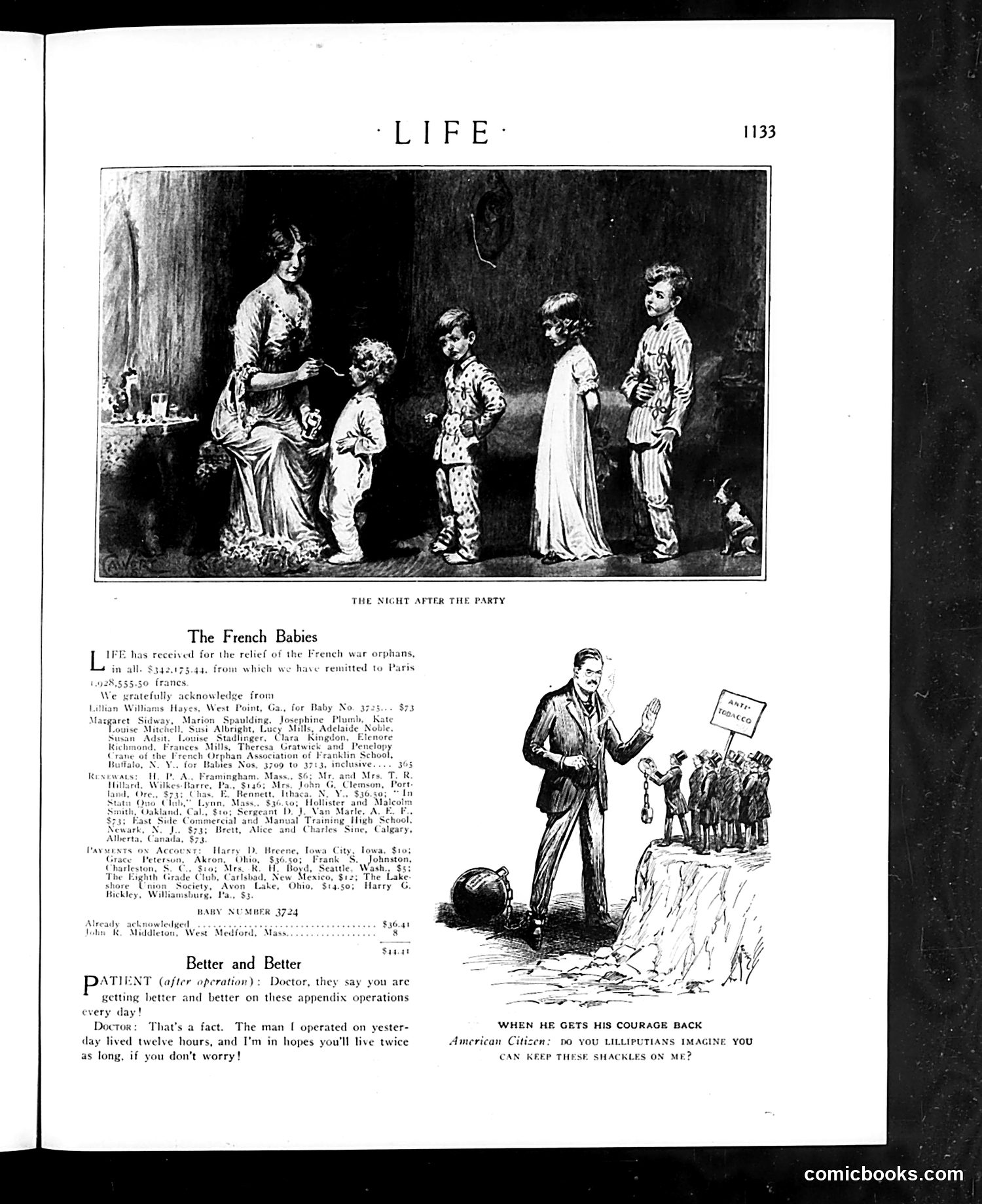
This page contains two distinct pieces of satire: **"The French Babies"** section documents Life magazine's charitable relief campaign for French war orphans (likely WWI), listing donor contributions. The accompanying illustration "The Night After the Party" shows a mother with children in nightclothes, apparently depicting the domestic scene of beneficiaries. **"Better and Better"** is a dark humor joke about a surgeon's dubious success rate. The doctor boasts that his appendix operation patients are "getting better and better"—meaning they're living progressively longer after surgery. His patient yesterday lived twelve hours; he hopes today's patient survives twice as long. The satire mocks both the surgeon's incompetence and his delusional optimism about poor outcomes. **"When He Gets His Courage Back"** shows a tall figure addressing tiny people (Lilliputians, referencing Gulliver's Travels). The American citizen declares he won't accept their "shackles"—likely satirizing post-war isolationism or resistance to international obligations, depicting Americans as giants unbound by smaller nations' constraints.
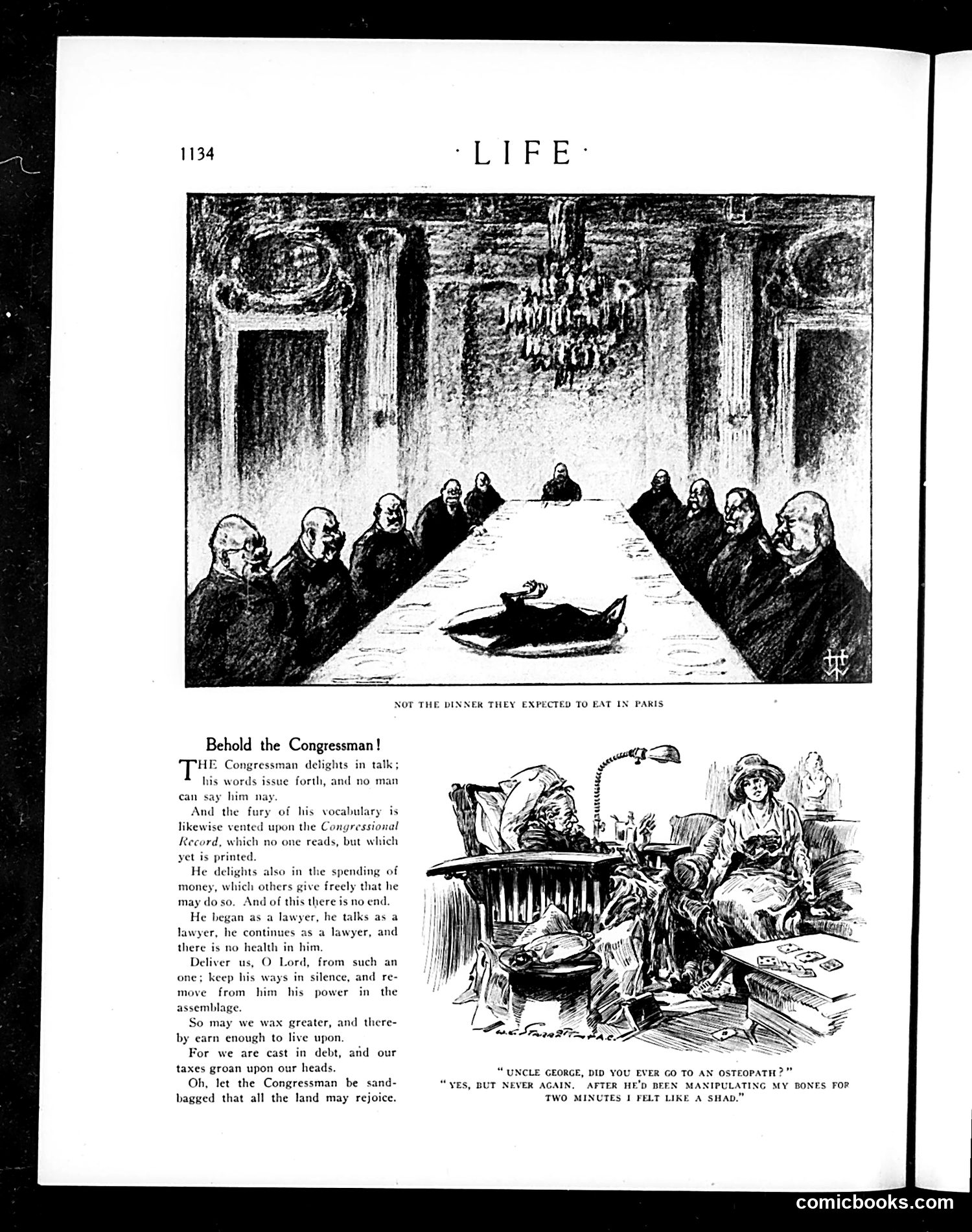
This page contains two separate satirical pieces criticizing American government and professionals. **Top cartoon**: "Not the Dinner They Expected to Eat in Paris" depicts congressmen gathered around a dead shark in an elegant dining hall—a dark joke suggesting that instead of enjoying fine French cuisine during what appears to be an official visit, they encounter something grotesque and inedible. This mocks congressional extravagance and foreign travel at taxpayer expense. **Bottom section**: "Behold the Congressman!" is a scathing prose-poem attacking congressmen for: excessive talking and printing worthless Congressional Records; wasteful spending of public money; and being perpetually lawyer-like with "no health in him." It reads almost like a prayer for deliverance from their power and financial burden. **Right cartoon**: A domestic joke where "Uncle George" compares an osteopath's treatment to being manipulated like a shad (fish)—implying the physician was rough and left him feeling battered. The overall theme: government waste, ineffectual representation, and professional incompetence draining ordinary citizens.
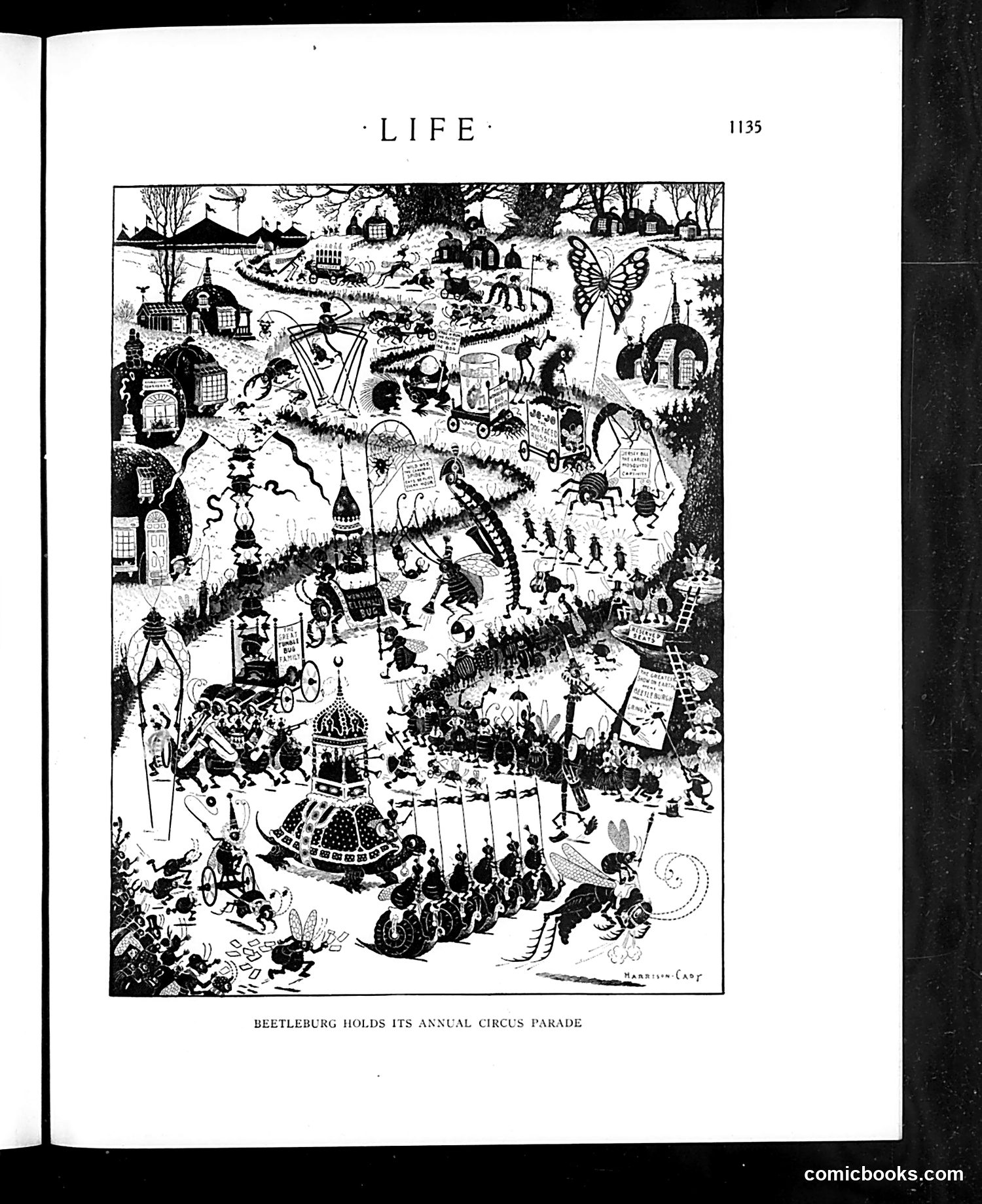
This is a whimsical illustrated cartoon depicting an imaginary town called "Beetleburg" holding a circus parade. The densely detailed black-and-white drawing shows a fantastical scene filled with circus elements—elephants, performers, acrobats, decorated structures, and marching crowds—integrated into a surreal landscape with buildings and trees. The humor appears to derive from the *scale and chaos* of the composition: the parade is absurdly elaborate and chaotic, with countless figures and activities crammed together in a busy, bewildering manner. Rather than satirizing specific political figures or events, this seems to be gentle, imaginative satire of small-town Americana—poking fun at the earnest, over-the-top spectacle of a small community's grand civic celebration. The work is signed by what appears to be "Hamilton Carp" (the artist's signature visible in the lower right).
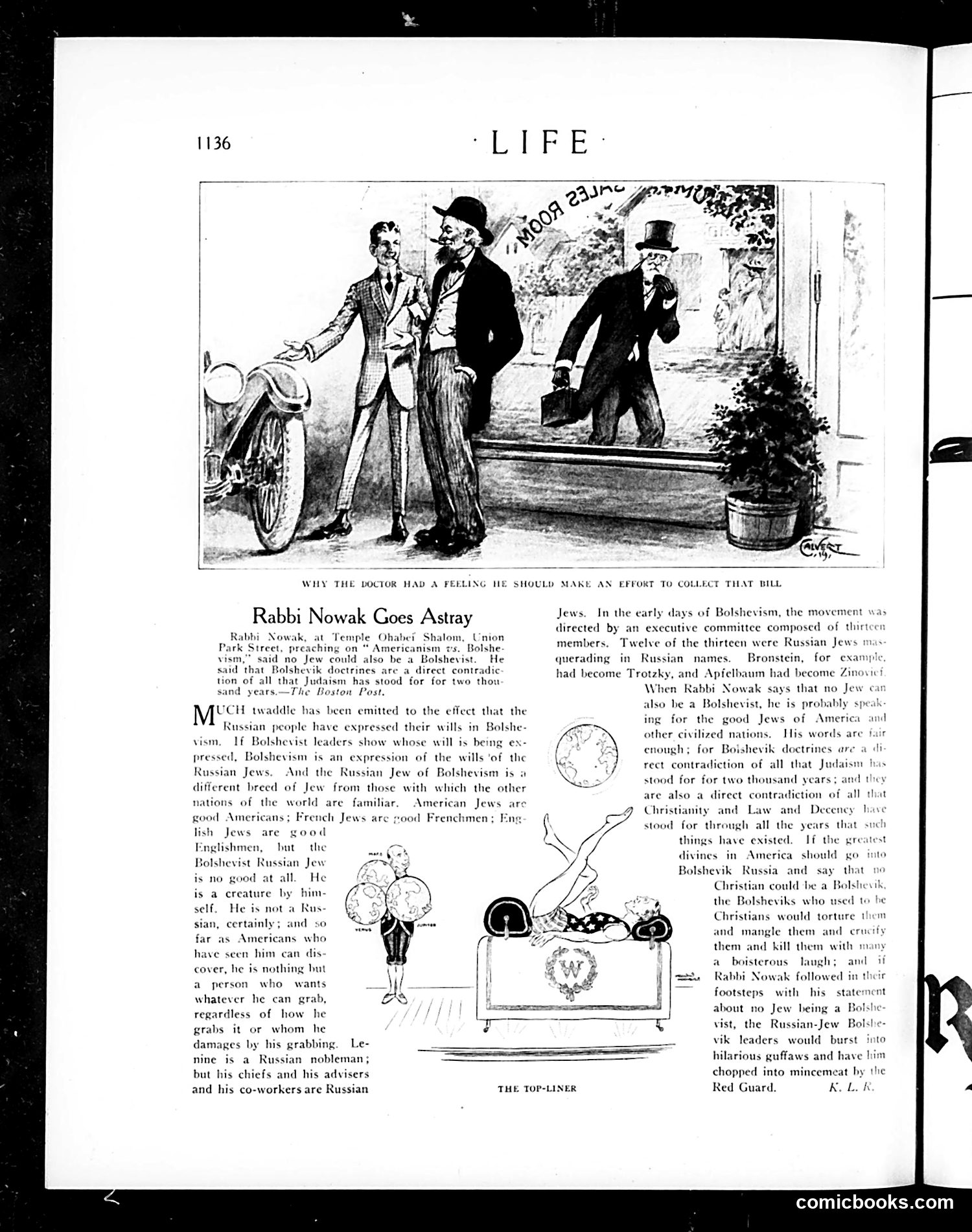
This page attacks Rabbi Nowak of Boston, who claimed no Jew could be a Bolshevik because Bolshevism contradicts Jewish doctrine. The article sarcastically refutes him, arguing that Russian Bolshevism *is* Jewish-led: twelve of thirteen early Bolshevik executive committee members were Russian Jews (naming figures like Trotsky and Zinoviev). The cartoons mock the rabbi's naïveté. The top cartoon shows a doctor frustrated collecting payment—implying the rabbi is oblivious to obvious realities, like unpaid bills. This reflects 1920s American antisemitic conspiracy theories blaming Jews for Bolshevism and communism. The text, dripping with sarcasm, weaponizes Bolshevik violence ("chopped into mincemeat by the Red Guard") against the rabbi's statement, suggesting he's dangerous if followed. The satire is deeply bigoted, using antisemitic tropes to discredit both the rabbi and Jewish-Bolshevik associations.
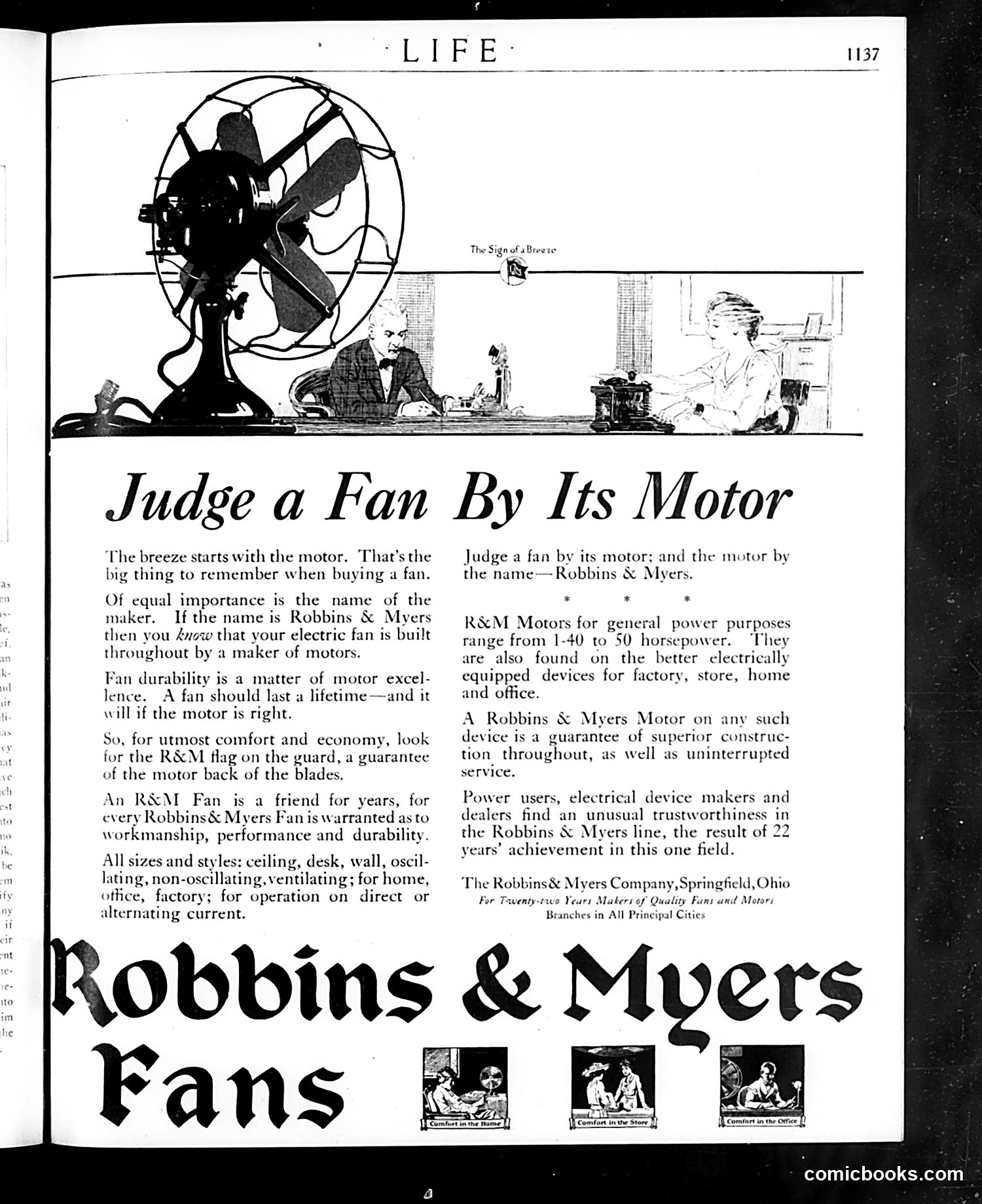
This is a **full-page advertisement**, not satire or editorial content. There is no political cartoon or social commentary to decode. The page promotes **Robbins & Myers electric fans and motors** through text and illustrations. The top illustration shows a businessman and woman at a desk with a large desk fan—presenting fans as practical appliances for modern offices and homes. The sales pitch emphasizes that a fan's quality depends entirely on its motor manufacturer. By repeatedly stating "Judge a fan by its motor; and the motor by the name—Robbins & Myers," the ad argues that choosing the right *brand* guarantees durability and reliability. The company claims 22 years of expertise in motor manufacturing. For modern readers: this reflects early 20th-century consumer advertising strategy—establishing brand trust through claims of technical expertise and durability, before electric fans were standard household items. The formal business setting suggests fans were still somewhat upscale purchases.
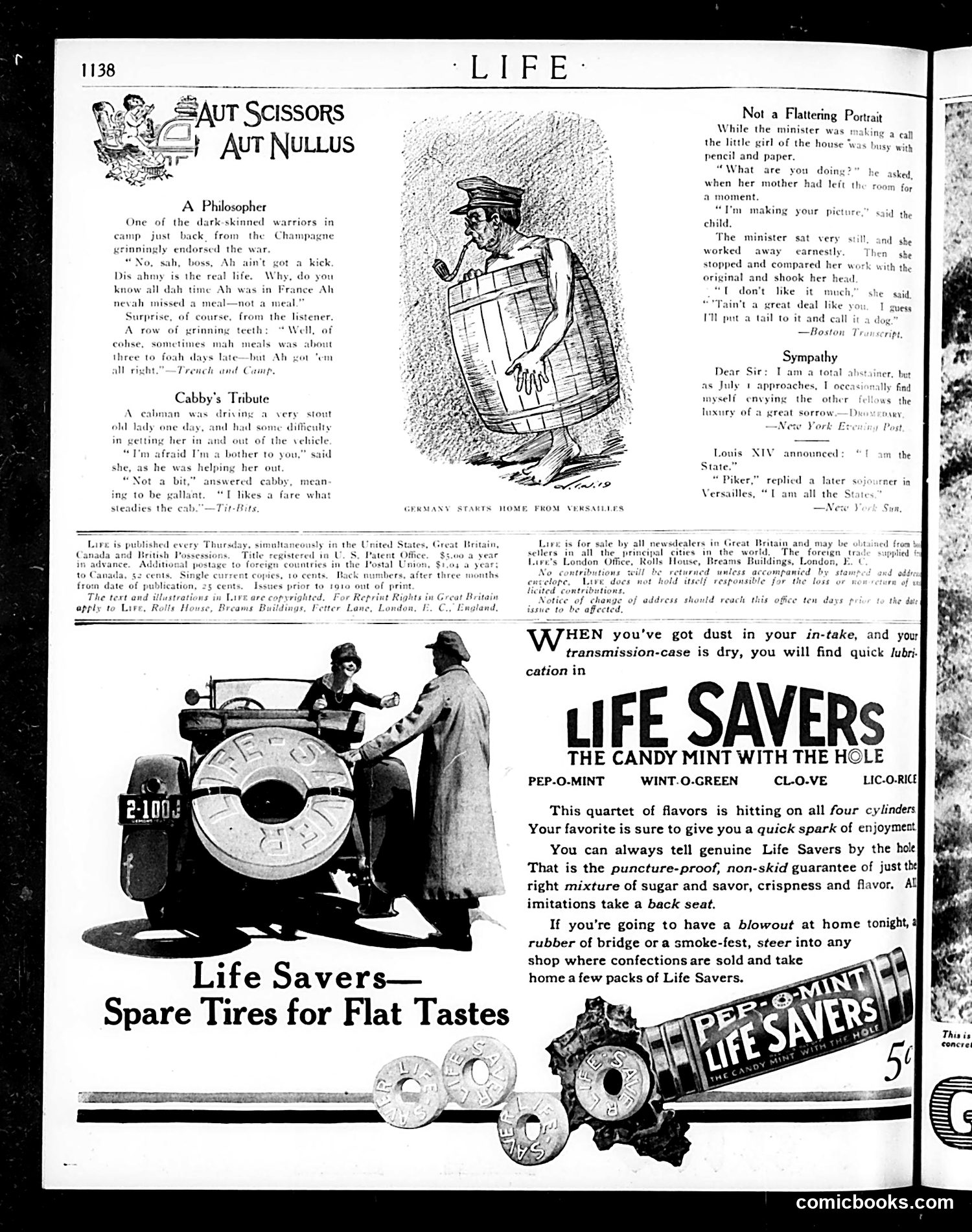
This page contains multiple satirical pieces and advertisements from early 20th-century Life magazine. **"Aut Scissors/Aut Nullus"** features three brief humorous anecdotes: a story about a French soldier's philosophy on meals, a cabman's tribute to steady fares, and a minister's unflattering portrait drawn by a child. **The main cartoon** depicts a WWI soldier returning home, likely referencing post-war repatriation. The "Germany Starts Home from Versailles" caption suggests commentary on post-Treaty of Versailles conditions. **"Life Savers" advertisement** dominates the lower half, using automobile repair metaphors ("dust in your in-take," "transmission-case," "blowout") to market the candy's hole design as practical and distinctive. This clever copywriting equates the candy's puncture-proof hole with automotive durability—a modern, relatable reference for readers of that era. The page blends satire with consumer messaging typical of Life's editorial-advertising mix.
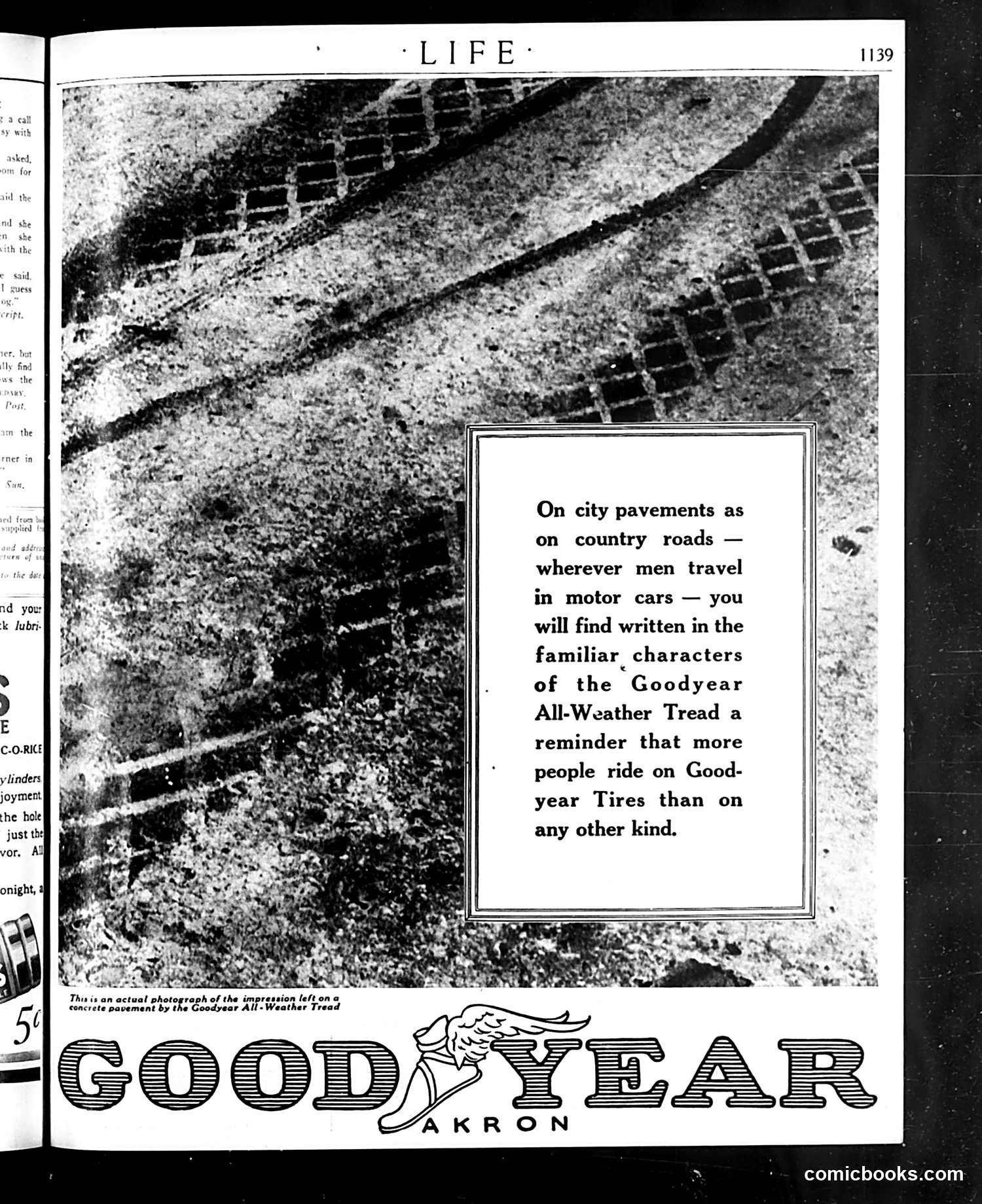
This is a **Goodyear tire advertisement**, not a political cartoon. The page shows an actual photograph of tire tread marks impressed into concrete pavement. The ad claims that Goodyear All-Weather Tread marks are so distinctive and ubiquitous that motorists will recognize them everywhere—on city streets and country roads alike—as proof of the brand's market dominance. The advertisement uses the visual evidence (the photograph) as marketing: the tread pattern itself becomes a brand identifier, and the claim that "more people ride on Goodyear Tires than on any other kind" turns the tire marks into testimonial evidence. This appeals to consumer psychology—choosing the popular choice. **No satire or political content is present.** This is straightforward early automotive advertising exploiting the novelty of mass motor travel.
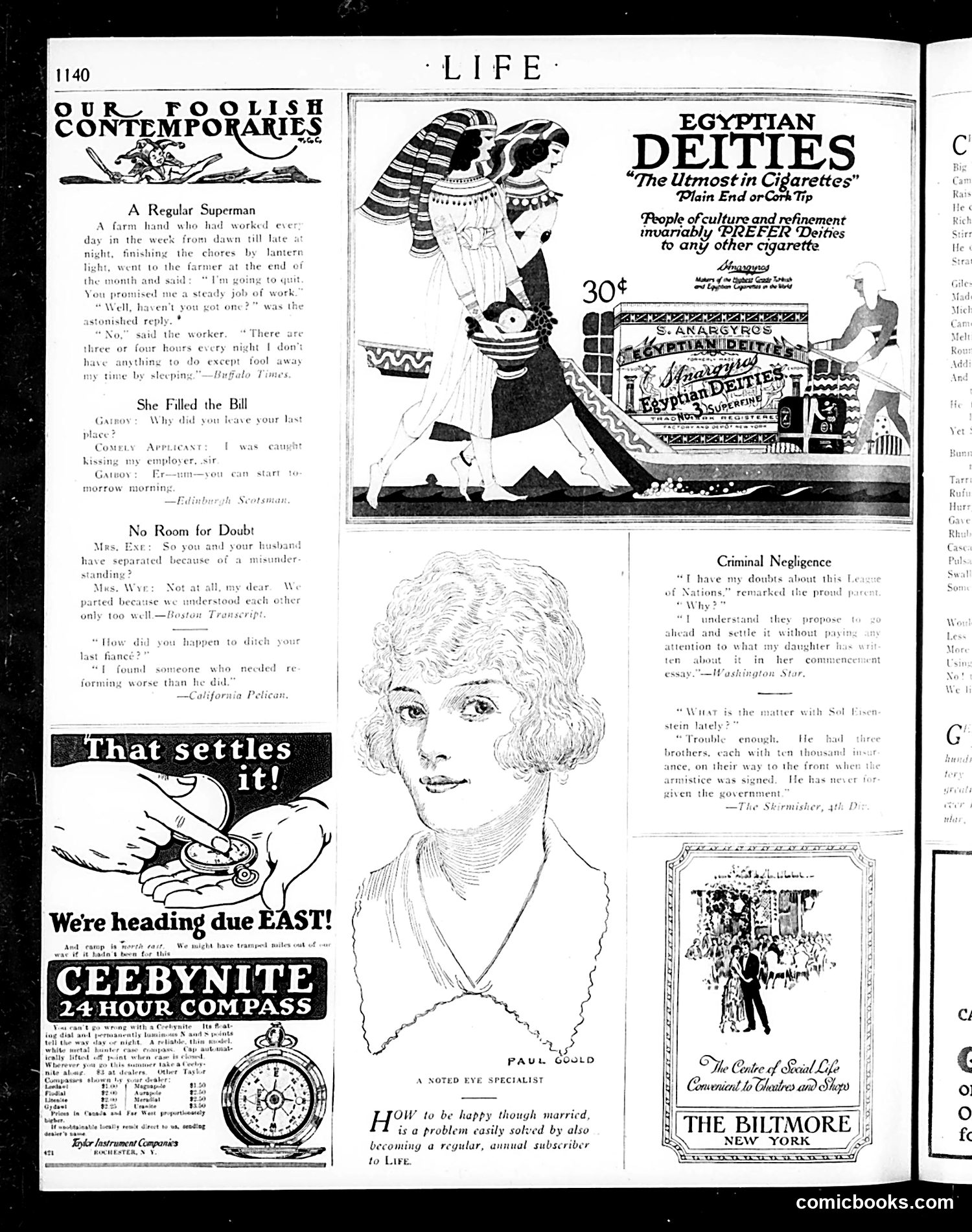
This page combines humor columns with advertisements typical of 1920s Life magazine. **"Our Foolish Contemporaries"** presents brief satirical anecdotes mocking modern behavior: a farm worker quitting because he's tired of work; a domestic servant caught kissing her employer; a couple separating over a trivial misunderstanding. These vignettes ridicule ordinary people's foolishness and relationship drama. **The advertisements** are period-specific: Egyptian Deities cigarettes (using pharaoh imagery as a marketing gimmick); a Ceebynite compass; and the Biltmore Hotel. The cigarette ad's claim that "people of culture and refinement invariably PREFER Deities" is itself satirical—advertising's absurd status claims. **"A Noted Eye Specialist"** portrait appears to illustrate one of the anecdotes about marital happiness being solved by subscribing to Life magazine. The overall tone is gentle mockery of contemporary consumer culture, romantic mishaps, and advertising pretension—typical of Life's satirical voice during this era.
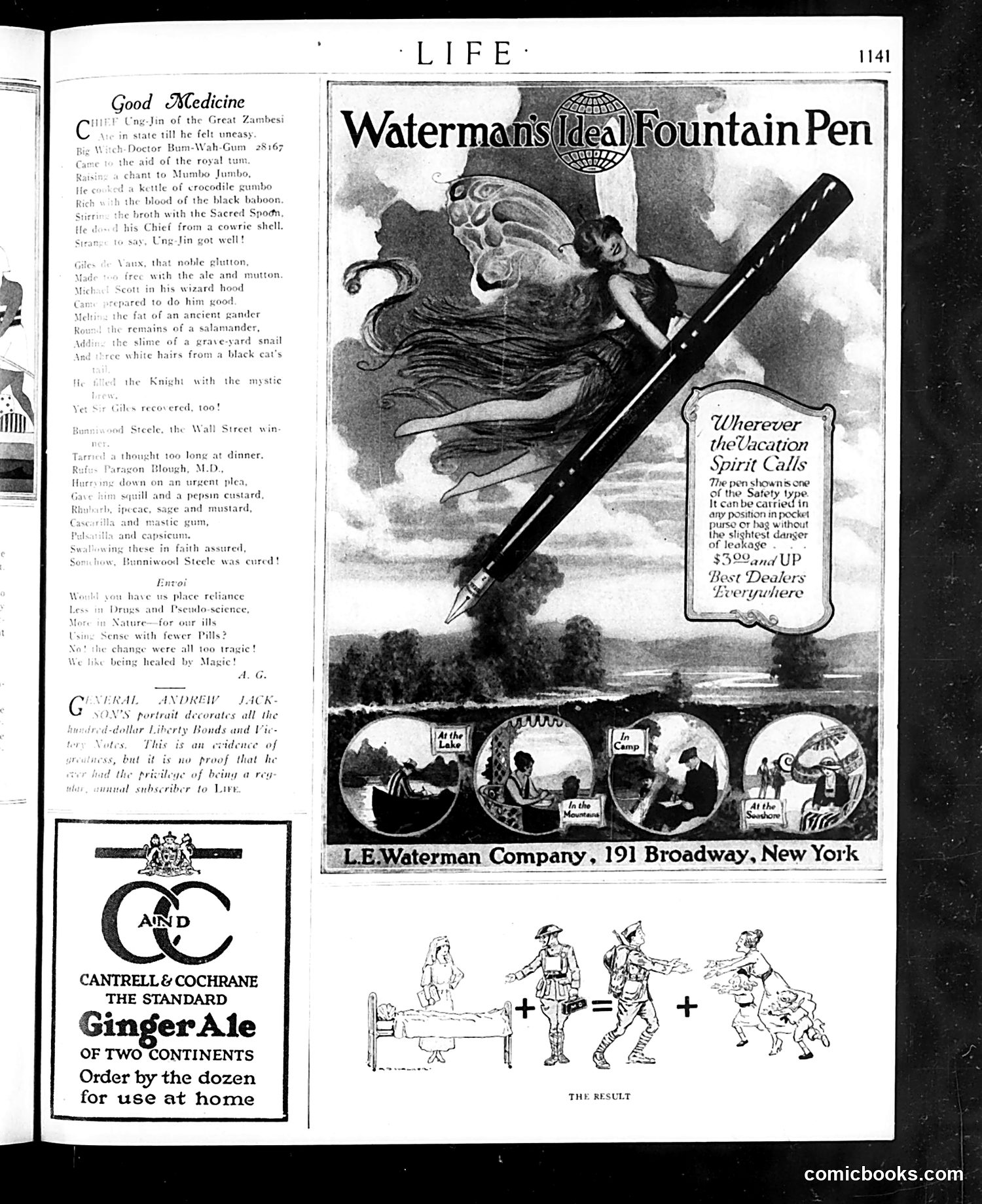
This page mixes editorial content with advertisements typical of early 20th-century Life magazine. **Left side:** "Good Medicine" is a humorous poem about medical remedies from African sources (references to "Great Zambesi" and indigenous practitioners). It satirizes both folk medicine and conventional treatments—the joke being that various bizarre ingredients and approaches all supposedly worked. The poem mocks the era's confusion between genuine medicine and quackery. **Right side:** A Waterman's Ideal fountain pen advertisement dominates, featuring decorative artwork of a classical figure. The marketing copy emphasizes portability for vacationers ("Wherever the Vacation Spirit Calls"), highlighting the pen's leak-proof design—a genuine selling point for fountain pens of this era. **Bottom:** A crude mathematical equation showing furniture + soldier + dancer = dancing/celebration illustrates a simple joke about recreation or morale. **Also shown:** A Cantrell & Cochrane Ginger Ale advertisement. The page is primarily commercial, mixing light satire with period product marketing.
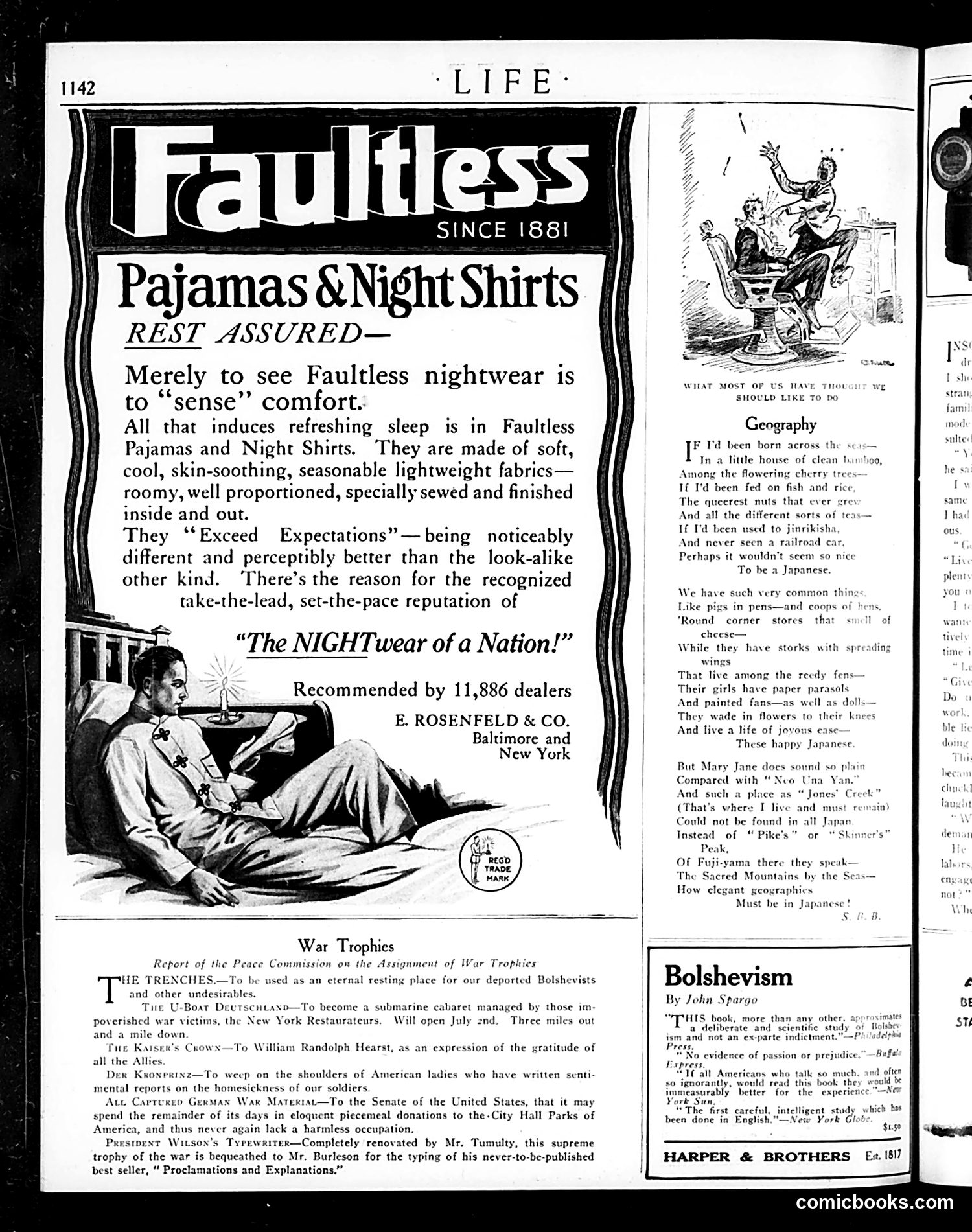
This page combines commercial advertising with post-WWI political satire. The main content is a **Faultless Pajamas advertisement** (left side) promoting comfort and sleep quality, featuring an illustration of a relaxed man in bed. The satire appears in the **"War Trophies"** section, which mocks the Peace Commission's proposed disposition of German war spoils. The jokes target American political figures and events: the Kaiser's crown is mockingly offered to **William Randolph Hearst** (the powerful newspaper publisher); captured German war material goes to the Senate for "piecemeal donations" to parks; and **President Wilson's typewriter** is jestingly bequeathed to Postmaster General **Burleson** for his "never-to-be-published" proclamations. The right side includes a poem called **"Geography"** romanticizing Japan, and an advertisement for a **Bolshevism book by John Spargo**—reflecting post-WWI anxieties about communist threats and the "Red Scare." Overall, this reflects 1920s American concerns: political leadership, war's aftermath, and ideological threats.
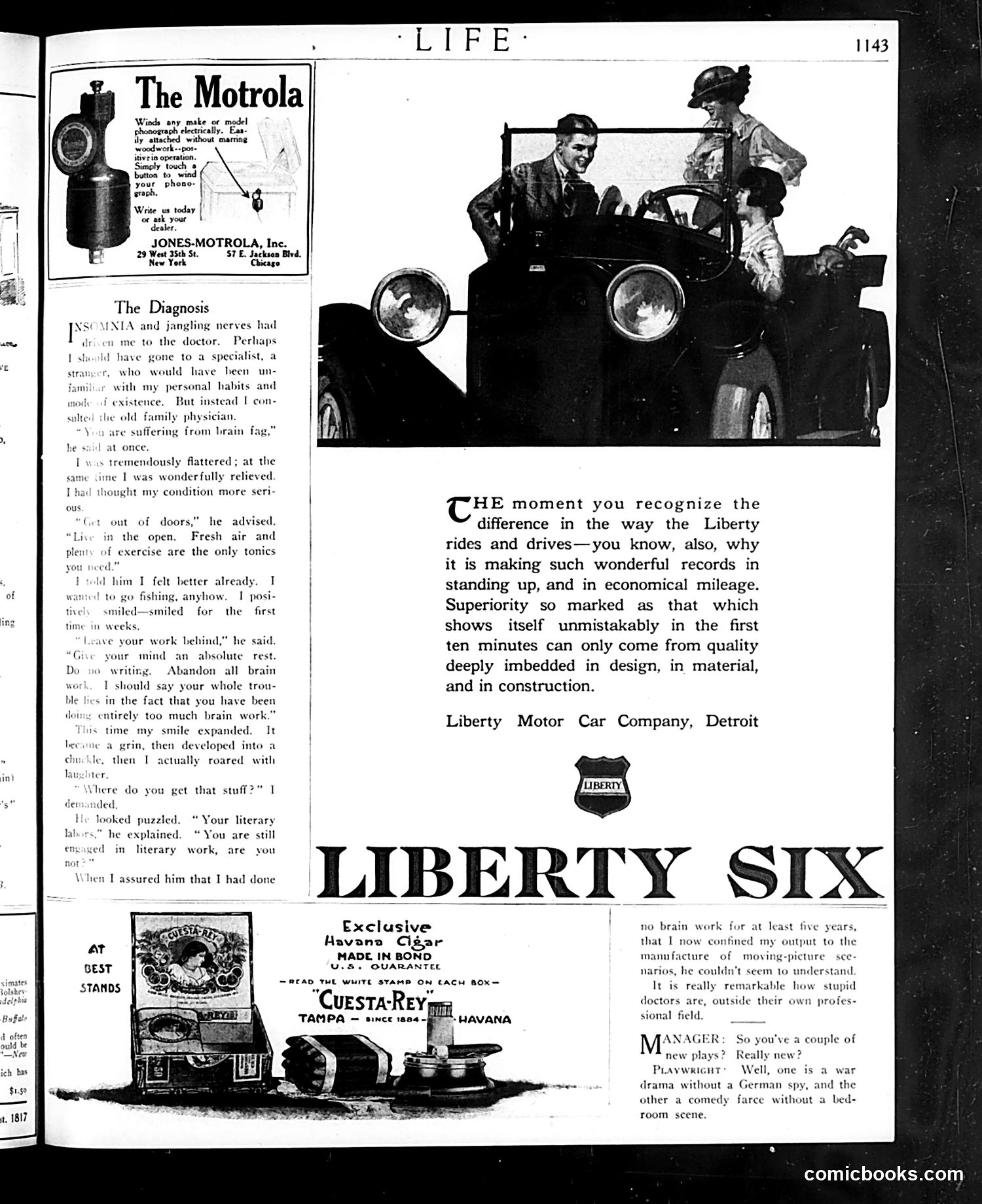
This page combines advertisements with a satirical short story titled "The Diagnosis." The humor centers on a doctor's outdated prescription for a patient's "brain fag" (mental exhaustion)—advice to abandon all mental work and get fresh air. The joke's payoff comes when the doctor learns the patient hasn't done serious intellectual work in five years; instead, he writes movie scenarios. The doctor's bafflement that screenwriting doesn't count as "brain work" satirizes the cultural hierarchy of the 1920s, where literary work was considered intellectually legitimate while popular entertainment (cinema) was dismissed as frivolous. The accompanying Liberty Six automobile ad then offers a gentle counterpoint: quality and superiority reveal themselves unmistakably in the first ten minutes—a subtle jab at the doctor's inability to recognize the intellectual merit in modern popular culture. The page otherwise features period advertisements: the Motrola phonograph, Cuesta-Rey cigars, and brief theatrical gossip about new plays.
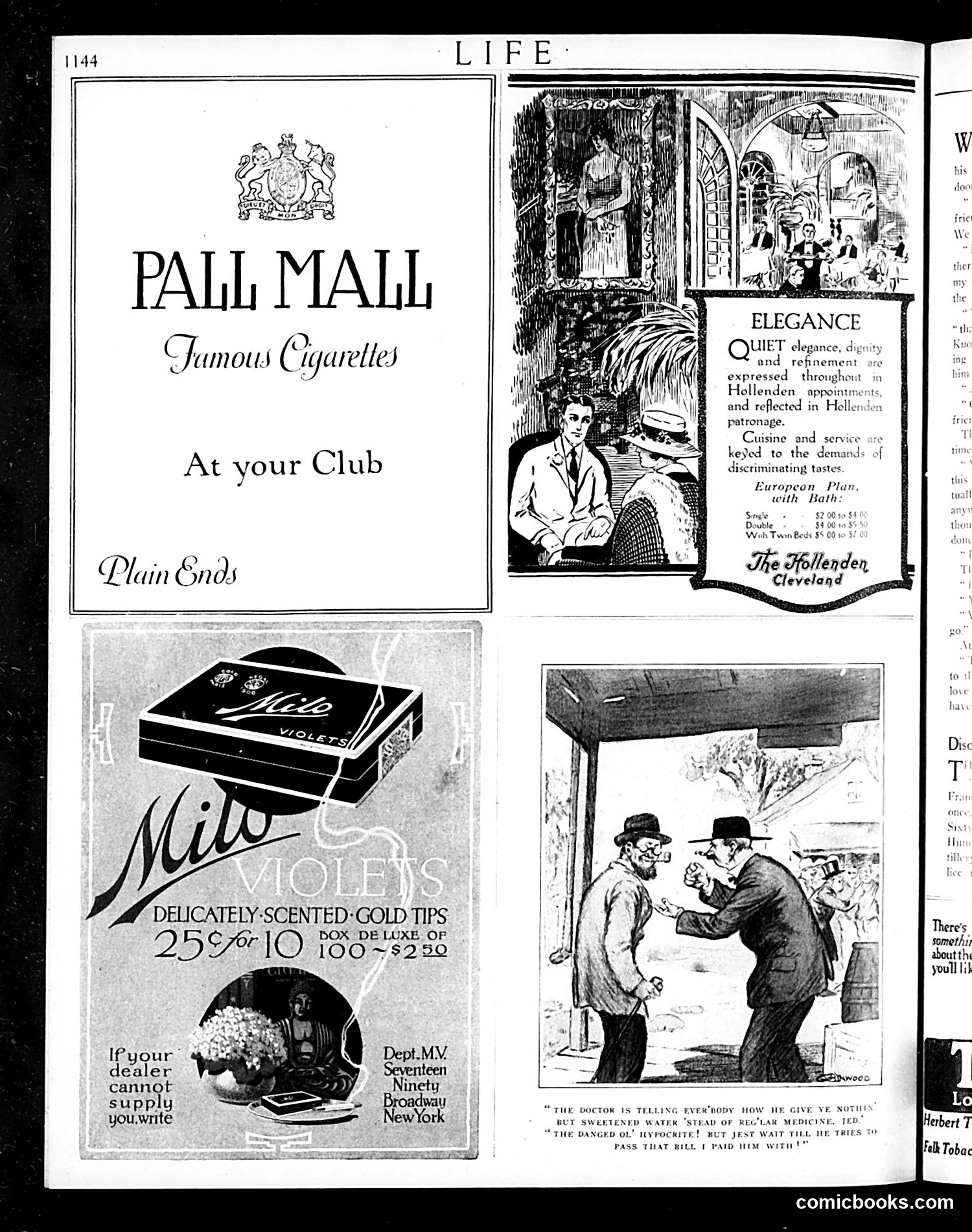
This page is primarily **advertising**, not political satire. It contains three ads: Pall Mall cigarettes, Milo Violets candy, and The Hollenden hotel in Cleveland. The only cartoon is a small humorous illustration at the bottom right, captioned with dialogue about a doctor recommending sweetened water instead of regular medicine. A man warns that once a bill is passed that he paid for, the doctor will change his tune. **The joke**: This appears to be commentary on **patent medicine fraud**—a common Progressive Era concern. Doctors who profited from selling ineffective or harmful "medicines" would lose business if regulations (the bill) required honest ingredients. The cartoon satirizes their self-interest: they oppose reform because it threatens their profits, not because they believe in their products. This reflects early 20th-century muckraking about quack remedies and the eventual push toward the Pure Food and Drug Act.
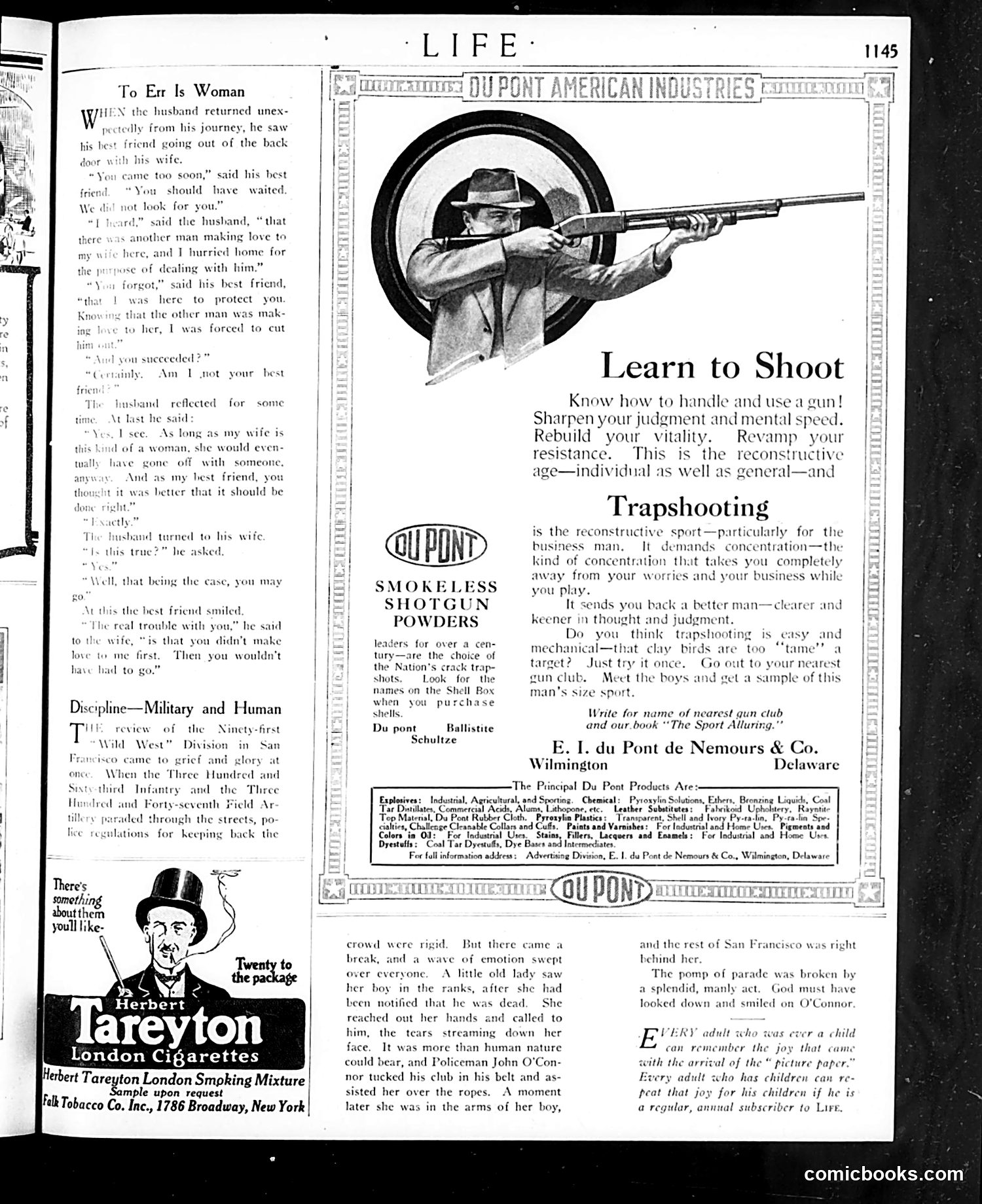
This page contains two distinct elements: **"To Err Is Woman" Story:** A satirical marital anecdote about a husband who discovers his best friend leaving with his wife. Rather than fight, the husband reasons that since his wife would have "gone off with someone anyway," it's better she stayed with his best friend than a stranger. The story mocks both masculine insecurity and the era's assumptions about female infidelity as inevitable. **DuPont Advertisement:** The dominant content is a full-page ad for DuPont smokeless shotgun powders, promoting "trapshooting" as a reconstructive post-war sport for businessmen. It emphasizes mental discipline and vitality—typical 1920s-era messaging about shooting sports as character-building. The juxtaposition is jarring by modern standards: a crude sexual joke beside aspirational advertising about manly self-improvement, reflecting the era's contradictory attitudes toward masculinity and domesticity.
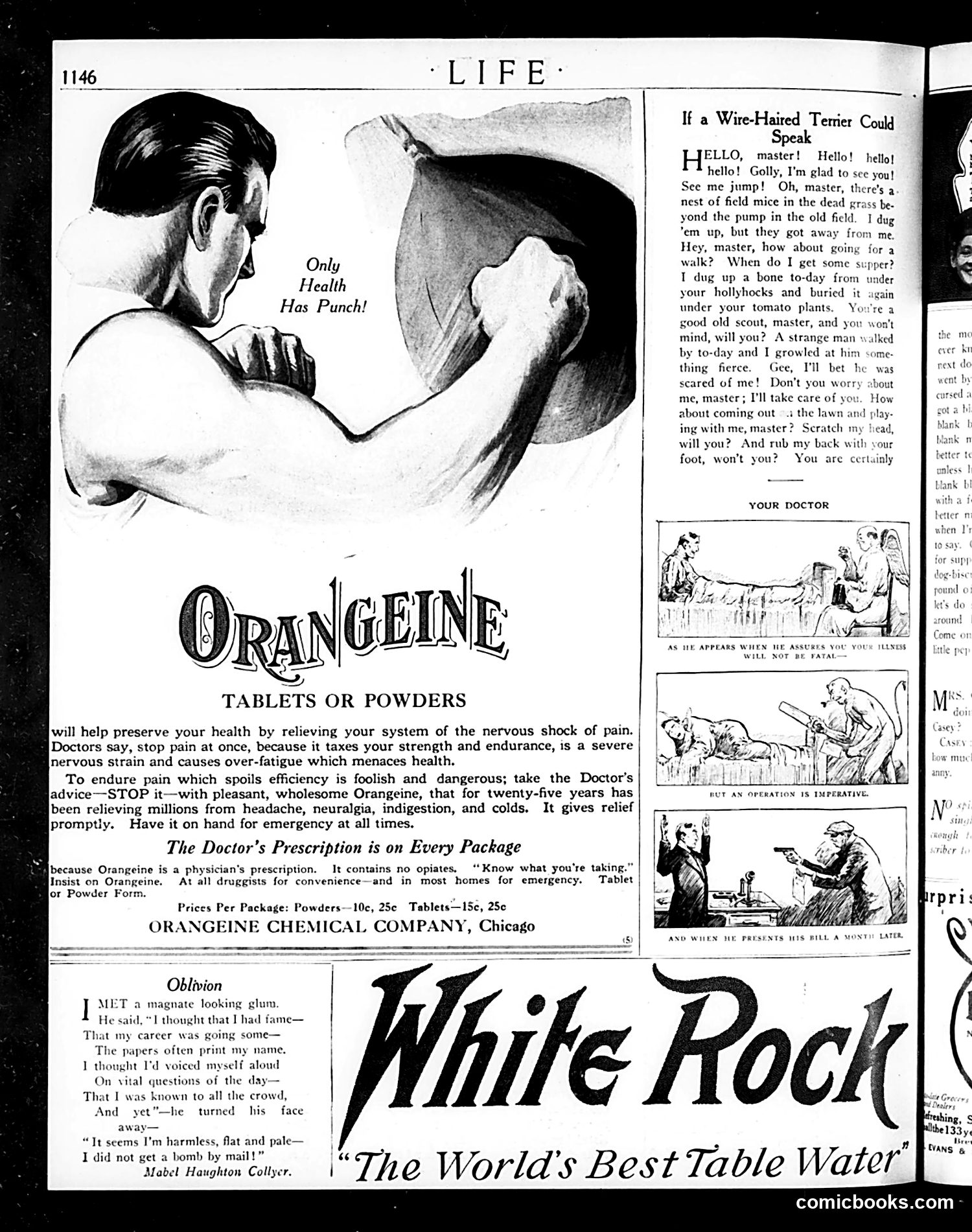
This page contains three distinct elements: **Main Cartoon ("If a Wire-Haired Terrier Could Speak"):** A humorous monologue imagining what a dog would say to its master. The terrier chatters about hunting mice, burying bones, growling at strangers, and seeking affection—satirizing how pet owners project human thoughts onto their animals' simple behaviors. The joke targets sentimental anthropomorphism. **Advertisements:** Two product ads (Orangeine pain tablets and White Rock table water) typical of early 20th-century patent medicine marketing, claiming curative powers with minimal regulation. **"Oblivion" Poem by Mabel Haughton Collyer:** A brief satirical verse about a wealthy magnate lamenting his invisibility despite fame and newspaper coverage. The punchline—that he's upset he "did not get a bomb by mail"—darkly jokes that even violent notoriety would prove his existence. This likely references contemporary anarchist threats or radical violence concerns of the era. The page demonstrates Life magazine's mix of social satire, domestic humor, and period advertising.
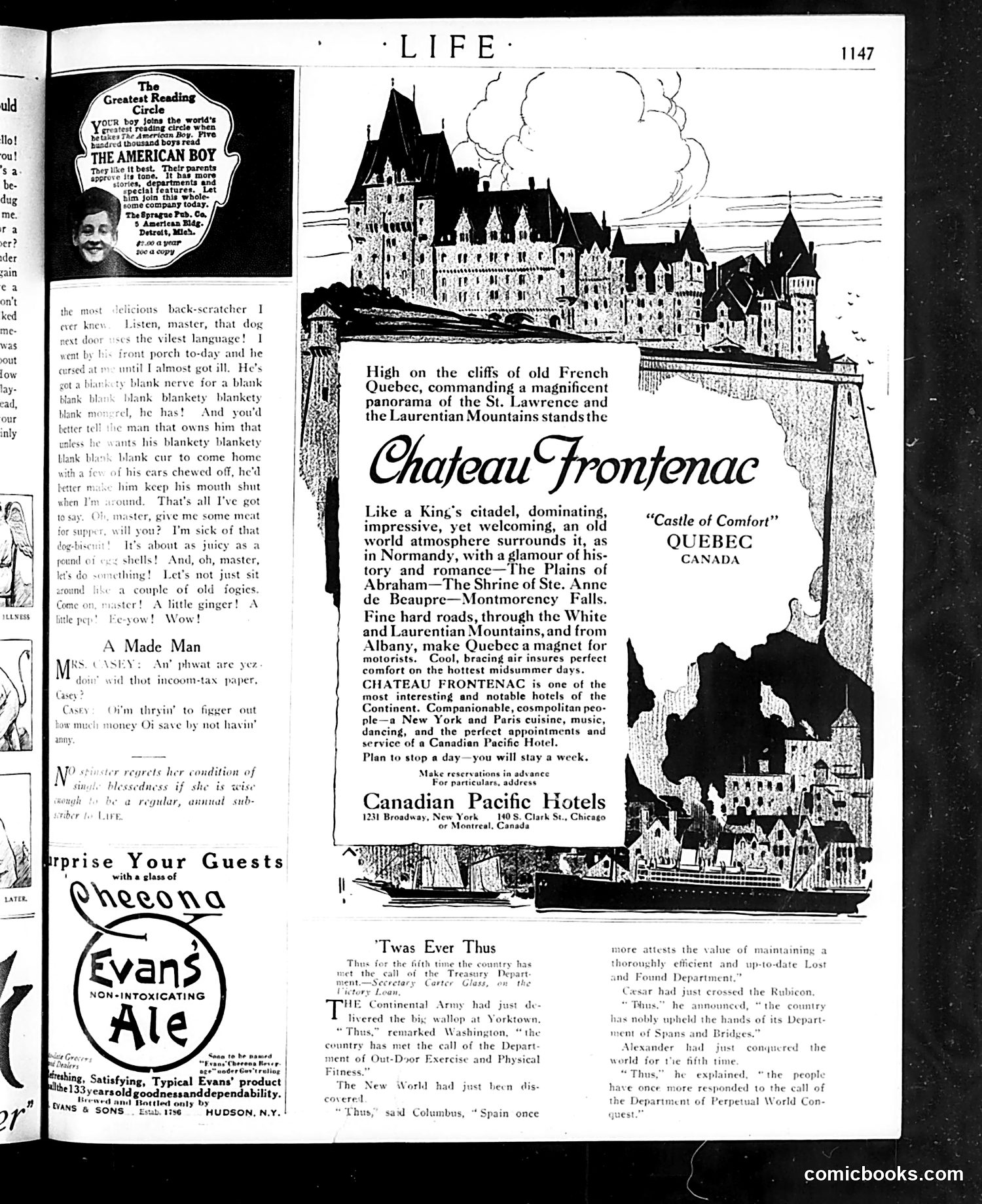
This page contains **satirical cartoons and period advertisements** (circa 1920s): **Left column cartoons:** - "A Made Man" mocks Irish-American working-class speech patterns and immigrant struggles with income tax - An untitled cartoon depicts a dog using profane language, satirizing how even animals in modern society adopt crude behavior **Central/right content:** The large middle section is primarily a **Chateau Frontenac hotel advertisement** for Quebec, Canada—not satire. It uses romantic imagery (castle illustration) to market the luxury hotel to American motorists. **"Twas Ever Thus" section** (bottom) is genuine satire: It uses historical figures (Columbus, Washington, Caesar, Alexander) to mock American bureaucratic bloat. Each historical figure's accomplishment is undercut by the joke that what modern America really celebrates is establishing a new government department—satirizing how contemporary society creates administrative bloat for everything, even "Perpetual World Conquest." **The Cheeona Evans' Ale ad** (bottom left) is straightforward period advertising.
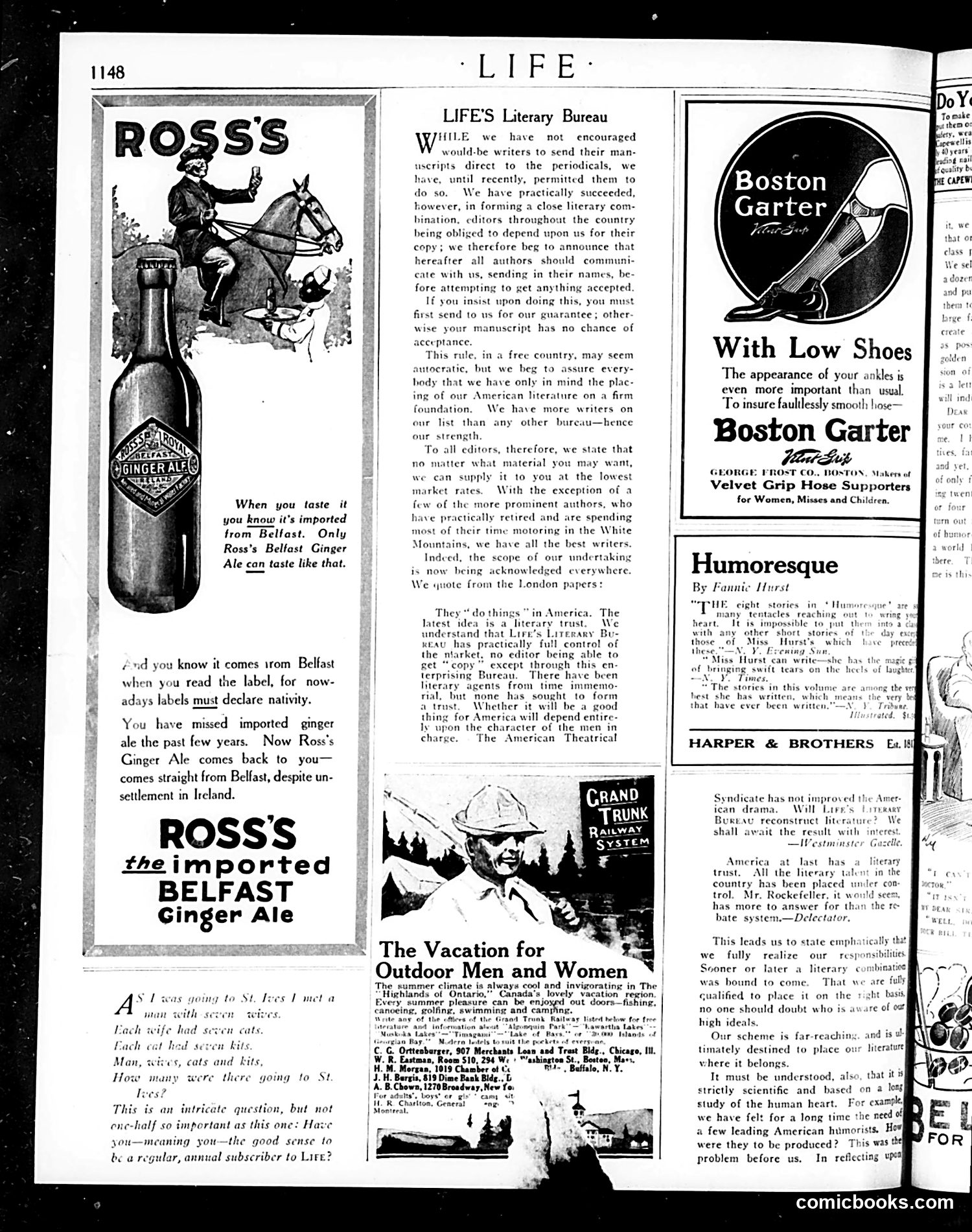
This page is primarily **satirical advertising** mixed with publisher's announcements, not political cartooning. **The Main Satire:** Life's "Literary Bureau" mock-announcement satirizes publishing industry consolidation and literary gatekeeping. Life humorously claims to have established a monopoly over American literature—authors must now obtain "guarantees" from Life before approaching editors, and all editors must source copy exclusively through Life's bureau at "lowest market rates." **The Joke:** The announcement parodies the era's real concern about literary trusts and monopolistic control (comparing Life's scheme to Rockefeller's oil monopoly). Life presents this absurdly autocratic arrangement as reasonable, even patriotic, claiming to protect American literature's "firm foundation." **Supporting Text** explicitly references "Lire's Literary Bureau has practically full control of the market" and compares it to contemporary concerns about theatrical syndicates harming American drama. The page also contains genuine advertisements (Ross's Ginger Ale, Boston Garter hose supporters) and a book review for *Humoresque* by Fannie Hurst.
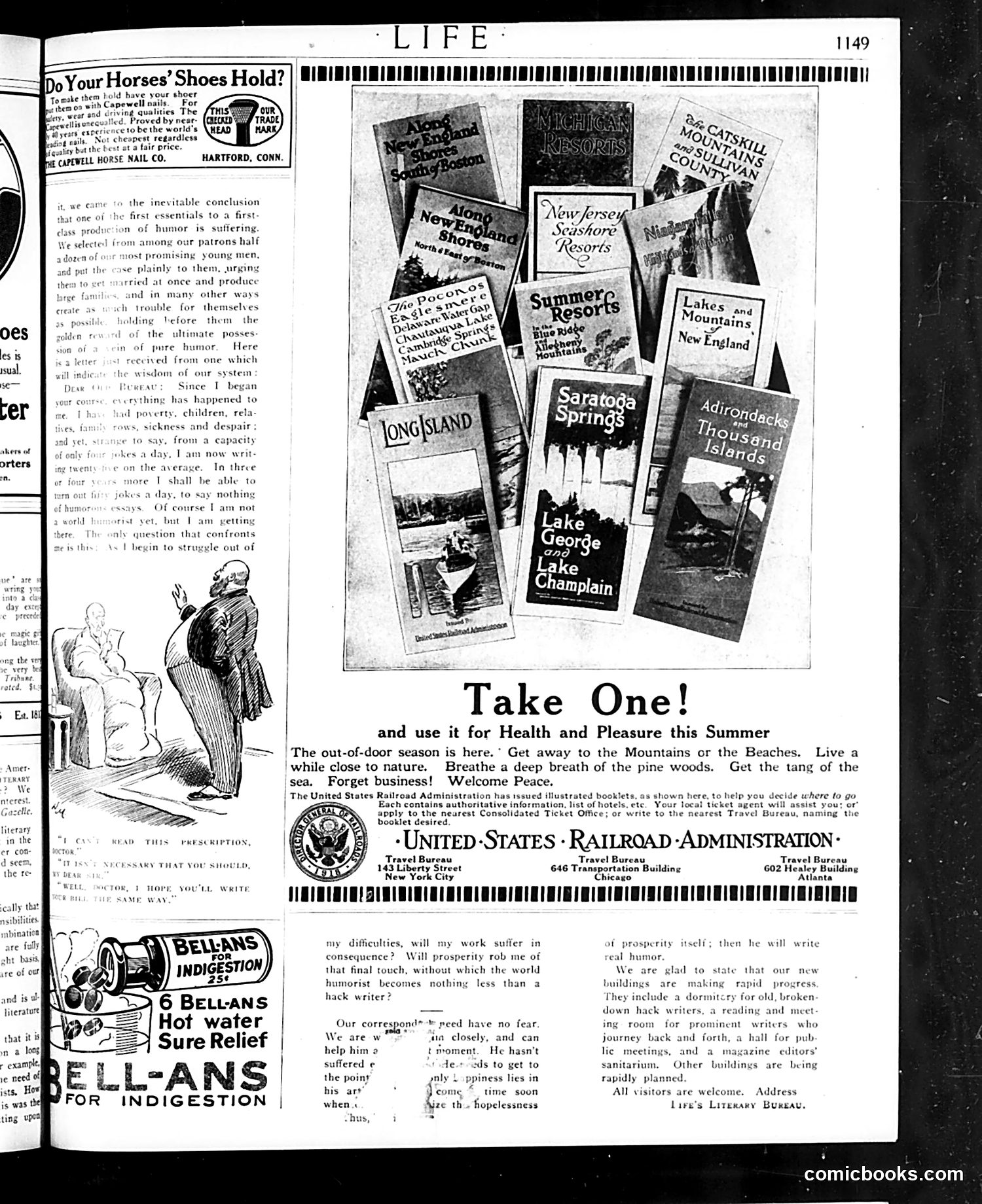
This page combines editorial content with advertising and a major promotional campaign by the U.S. Railroad Administration. **The Main Feature:** The large central advertisement uses vacation travel guides fanned out artistically, promoting summer travel to American destinations (Saratoga Springs, Adirondacks, New England resorts, etc.). The headline "Take One!" treats these travel brochures as a prescription—echoing the medicinal language of the adjacent Bell-ans indigestion remedy ad below. **The Satire:** This reflects post-WWI American optimism and the newly created Railroad Administration's push to normalize leisure travel. The prescription metaphor suggests vacationing is necessary medicine for tired urban workers—a humorous but pointed commentary on industrial exhaustion. **Side Content:** The left column discusses American humor and writers' productivity, appearing disconnected. The Capewell Horse Nail advertisement (top-left) is straightforward product marketing. **Context for Modern Readers:** This represents government-sponsored tourism promotion during the 1920s, when railroads dominated American travel. The "medical prescription" framing humorously medicalized vacation as essential health care.
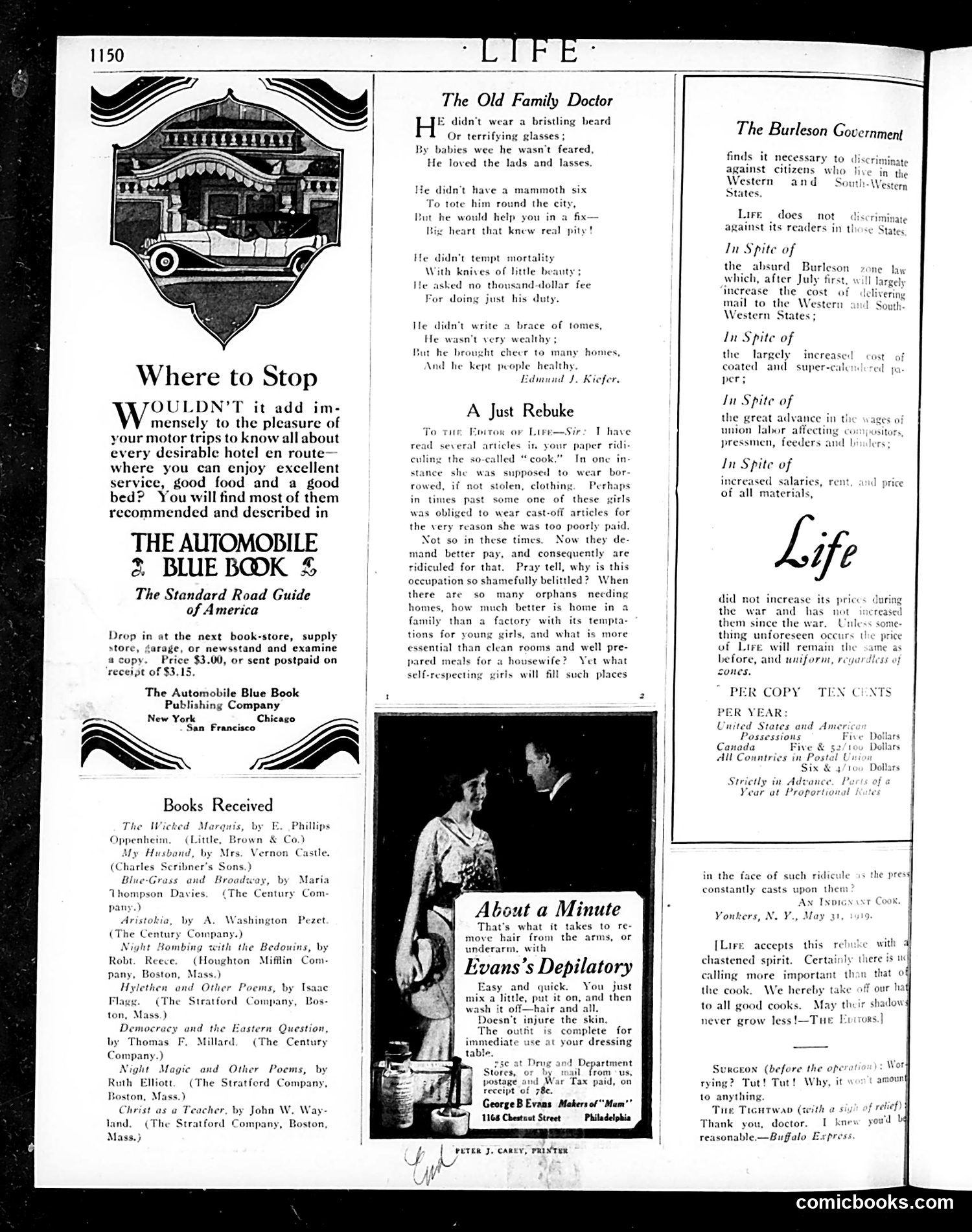
This page is primarily **advertising and editorial content** rather than political satire. Key elements: **"The Old Family Doctor"** (poem by Edmund J. Kiefer): A nostalgic tribute to the traditional small-town physician—humble, affordable, beloved by patients—contrasting implicitly with the modern medical establishment's higher costs and pretensions. **"A Just Rebuke"** (letter to editor): Defends domestic servants and housemaids against social ridicule, arguing their work is essential and their demand for better wages is justified, not shameful. **"The Burleson Government"** (editorial note): References Postmaster General Albert Burleson's discrimination against Western/Southwestern mail subscribers (likely higher postage rates). *Life* magazine emphasizes it doesn't similarly discriminate, maintaining stable prices despite wartime inflation and increased labor costs. **Evans's Depilatory** (advertisement): Period hair-removal product ad. The page reflects post-WWI economic concerns: inflation, labor disputes, and regional inequities in government services.
This appears to be a mostly blank page from Life magazine with minimal visible content. The OCR'd text at the bottom ("dollars / Jollars / you'd by / comicbooks.com") is fragmented and unclear—it may be a watermark, artifact, or partial text from page margins rather than actual magazine content. The page itself shows no discernible cartoon, illustration, or satirical content that would allow for meaningful political or social interpretation. Without visible imagery or coherent text, I cannot identify figures, references, or the intended point of any satire. This may be a blank advertising page, separator page, or a scanning artifact from the original publication.