
Life, 1919-06-26 · page 20 of 43
Life — June 26, 1919 — page 20: what you’re looking at
What you’re looking at
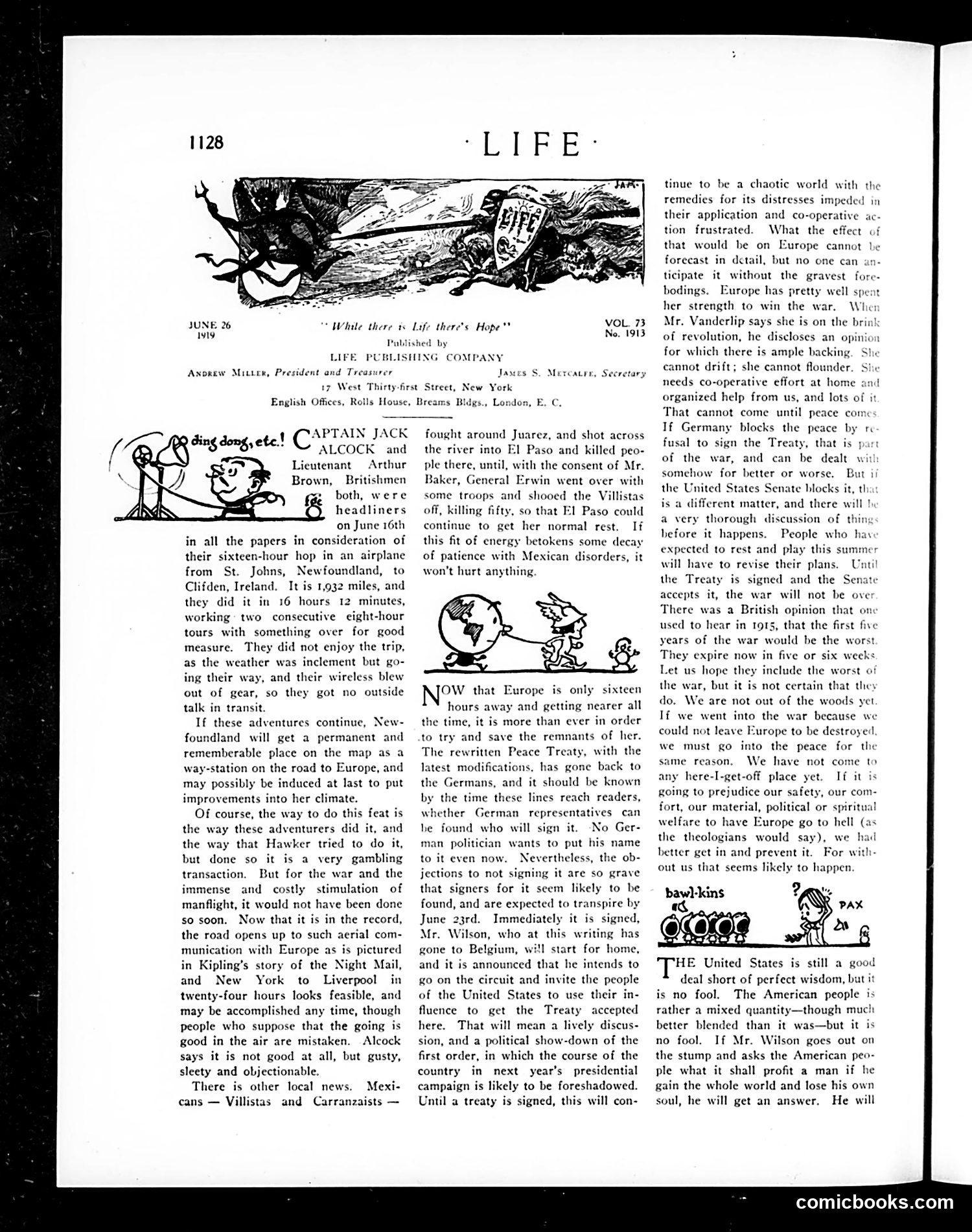
This page celebrates British aviators **Captain Jack Alcock and Lieutenant Arthur Brown**, who completed the first nonstop transatlantic flight from Newfoundland to Ireland on June 16—a 1,932-mile journey in 16 hours. The article marvels at this achievement as proof that regular air service between North America and Europe is now feasible. The main cartoon (top left) depicts a skeletal figure labeled "While there is Life there's Hope," likely satirizing the precarious nature of such dangerous flights. The page also addresses contemporary politics: the **Treaty of Versailles** negotiations with Germany, Mexican border violence (Villistas vs. Carranzaists), and **President Wilson's** planned speaking tour to build American support for the treaty. The writer expresses concern about Europe's post-war fragility and revolutionary instability, emphasizing that swift treaty ratification is crucial to global stability. The tone is one of cautious optimism about technological progress tempered by anxiety about political chaos.
📄 Transcribed text from this page (OCR, searchable)
Machine-transcribed from the original scan — historical spelling and the odd misread are preserved.
JUNE 26 wy Pabi LIFE Axorgw Mutter, President and Treasurer “While there is Life there's Hope"* hed by PUBLISHING COMPANY Janes S. Mereatrr, 17 West Thirty-first. Street, New York English Offices, Rolls House, APTAIN JACK ALCOCK and Lieutenant Arthur Brown, Britishmen & both, were headliners on June 16th in all the papers in consideration of their sixteen-hour hop in an airplane from St. Johns, Newfoundland, to Clifden, Ireland. It is 1,932 miles, and they did it in 16 hours 12 minutes, working two consecutive eight-hour tours with something over for good measure. They did not enjoy the trip, as the weather was inclement but go- ing their way, and their wireless blew out of gear, so they got no outside talk in transit. If these adventures continue, New- foundland will get a permanent and rememberable place on the map as a way-station on the road to Europe, and may possibly be induced at last to put improvements into her climate. Of course, the way to do this feat is the way these adventurers did it, and the way that Hawker tried to do it, but done so it is a very gambling transaction. But for the war and the immense and costly stimulation of manflight, it would not have been done so soon. Now that it is in the record, the road opens up to such aerial com- munication with Europe as is pictured in Kipling’s story of the Night Mail, and New York to Liverpool in twenty-four hours looks feasible, and may be accomplished any time, though people who suppose that the going is good in the air are mistaken. Alcock says it is not good at all, but gusty, sleety and objectionable. There is other local news. Mexi- cans — Villistas and Carranzaists — Breams Bldgs., London fought around Juarez, and shot across the river into El Paso and killed peo- ple there, until, with the consent of Mr. Baker, General Erwin went over with some troops and shooed the Villistas off, killing fifty, so that El Paso could continue to get her normal rest. If this fit of energy betokens some decay of patience with Mexican disorders, it won't hurt anything. OW that Europe is only si hours away and getting nearer all the time, it is more than ever in order to try and save the remnants of her. The rewritten Peace Treaty, with the latest modifica s, has gone back to the Germans, and it should be known by the time these lines reach readers, whether German representatives can he found who will sign it. No Ger- man politician wants to put his name to it even now. Nevertheless, the ob- jections to not signing it are so grave that signers for it seem likely to be found, and are expected to transpire by June 23rd. Immediately it is signed, Mr. Wilson, who at this writing has gone to Belgium, will start for home, and it is announced that he intends to go on the circuit and invite the people of the United States to use their in- fluence to get the Treaty accepted here. That will mean a lively discus- sion, and a political show-down of the first order, in which the course of the country in next year’s presidential campaign is likely to be foreshadowed. Until a treaty is signed, this will con- tinue to be a chaotic world with the remedies for its distresse: their application and co-operative ac- tion frustrated. What the effect of that would be on Europe cannot | forecast in detail, but no one can ticipate it without the gravest fore- bodings. Europe has pretty well spent her strength to win the war. Wher Mr. Vanderlip says she is on the brin! of revolution, he discloses an opinion for which there is ample backing. She cannot drift; she cannot flounder needs co-operative effort at home and organized help from us, and lots of it That cannot come until peace com: If Germany blocks the peace by rc fusal to sign the Treaty, that is of the war, and can be dealt impeded in But ii somehow for better or worse. the United States Senate blocks it, tl is a different matter, and there will ! a very thorough discussion of hefore it happens. People who h expected to rest and play this summe will have to revise their plans. U the Treaty is signed and the Sen: accepts it, the war will not be over There was a British opinion that on used to hear in 1915, that the first five years of the war would be the worst They expire now in five or six weeks Let us hope they include the worst of the war, but it is not certain that they do. We are not out of the woods yet If we went into the war because we could not leave Europe to be destroyed. we must go into the peace for the same reason. We have not come to any here-I-get-off place yet. If it i going to prejudice our safety, our co fort, our material, political or spiritua welfare to have Europe go to hell the theologians would say), we | better get in and prevent it. For with- out us that seems likely to happen baw)-kins HE United States is still a good deal short of perfect wisdom, but it is no fool. The American people is rather a mixed quantity—though mui better blended than it was—but it is no fool. If Mr. Wilson goes out on the stump and asks the American peo- ple what it shall profit a man if he gain the whole world and lose his own soul, he will get an answer. He will comicbooks.com