
Life, 1919-06-26 · page 6 of 43
Life — June 26, 1919 — page 6: what you’re looking at
What you’re looking at
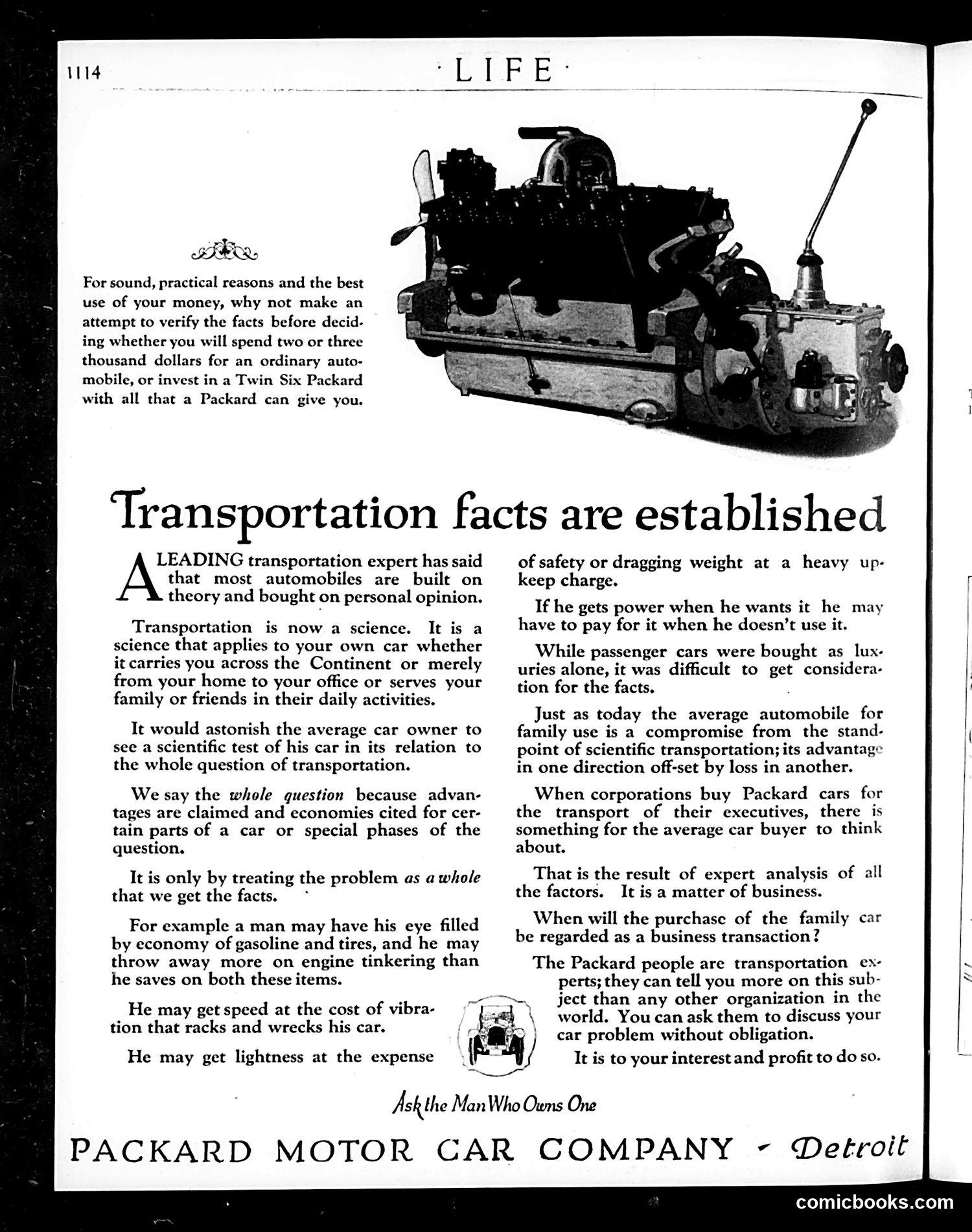
This is primarily **advertising content**, not satire or political commentary. It's a Packard Motor Car Company advertisement from *Life* magazine promoting their automobiles. The page argues that car-buying should be based on scientific analysis of "transportation facts" rather than emotion or partial claims. The ad emphasizes that Packard vehicles offer comprehensive value—addressing the whole transportation problem rather than isolated features. Key selling points include reliability for both personal and corporate use, and suggesting potential buyers consult actual Packard owners ("Ask the Man Who Owns One") rather than relying on marketing claims alone. The accompanying engine illustration showcases mechanical sophistication. This represents early 20th-century automotive advertising's shift toward rational, data-driven consumer persuasion.
📄 Transcribed text from this page (OCR, searchable)
Machine-transcribed from the original scan — historical spelling and the odd misread are preserved.
STR. For sound, practical reasons and the best use of your money, why not make an attempt to verify the facts before decid- ing whether you will spend two or three thousand dollars for an ordinary auto- mobile, or invest in a Twin Six Packard with all that a Packard can give you. Transportation facts are established A LEADING transportation expert has said that most automobiles are built on theory and bought on personal opinion. Transportation is now a science. It is a science that applies to your own car whether it carries you across the Continent or merely from your home to your office or serves your family or friends in their daily activities. It would astonish the average car owner to see a scientific test of his car in its relation to the whole question of transportation. We say the whole question because advan- tages are claimed and economies cited for cer- tain parts of a car or special phases of the question. It is only by treating the problem as a whole that we get the facts. For example a man may have his eye filled by economy of gasoline and tires, and he may throw away more on engine tinkering than he saves on both these items. He may get speed at the cost of vibra- He may get lightness at the expense of safety or dragging weight at a heavy up- keep charge. If he gets power when he wants it he may have to pay for it when he doesn’t use it. While passenger cars were bought as lux- uries alone, it was difficult to get considera- tion for the facts. Just as today the average automobile for family use is a compromise from the stand- point of scientific transportation; its advantage in one direction off-set by loss in another. When corporations buy Packard cars for the transport of their executives, there is something for the average car buyer to think about. That is the result of expert analysis of all the factors. It is a matter of business. When will the purchase of the family car be regarded as a business transaction? The Packard people are transportation ex- perts; they can tell you more on this sub- ject than any other organization in the world. You can ask them to discuss your It is to your interest and profit to do so. . < i \ tion that racks and wrecks his car. ry car problem without obligation. Askthe ManWho Owns One PACKARD MOTOR CAR COMPANY - @Detcoit comicbooks.com Wr