
A complete issue · 44 pages · 1919
Life — May 1, 1919
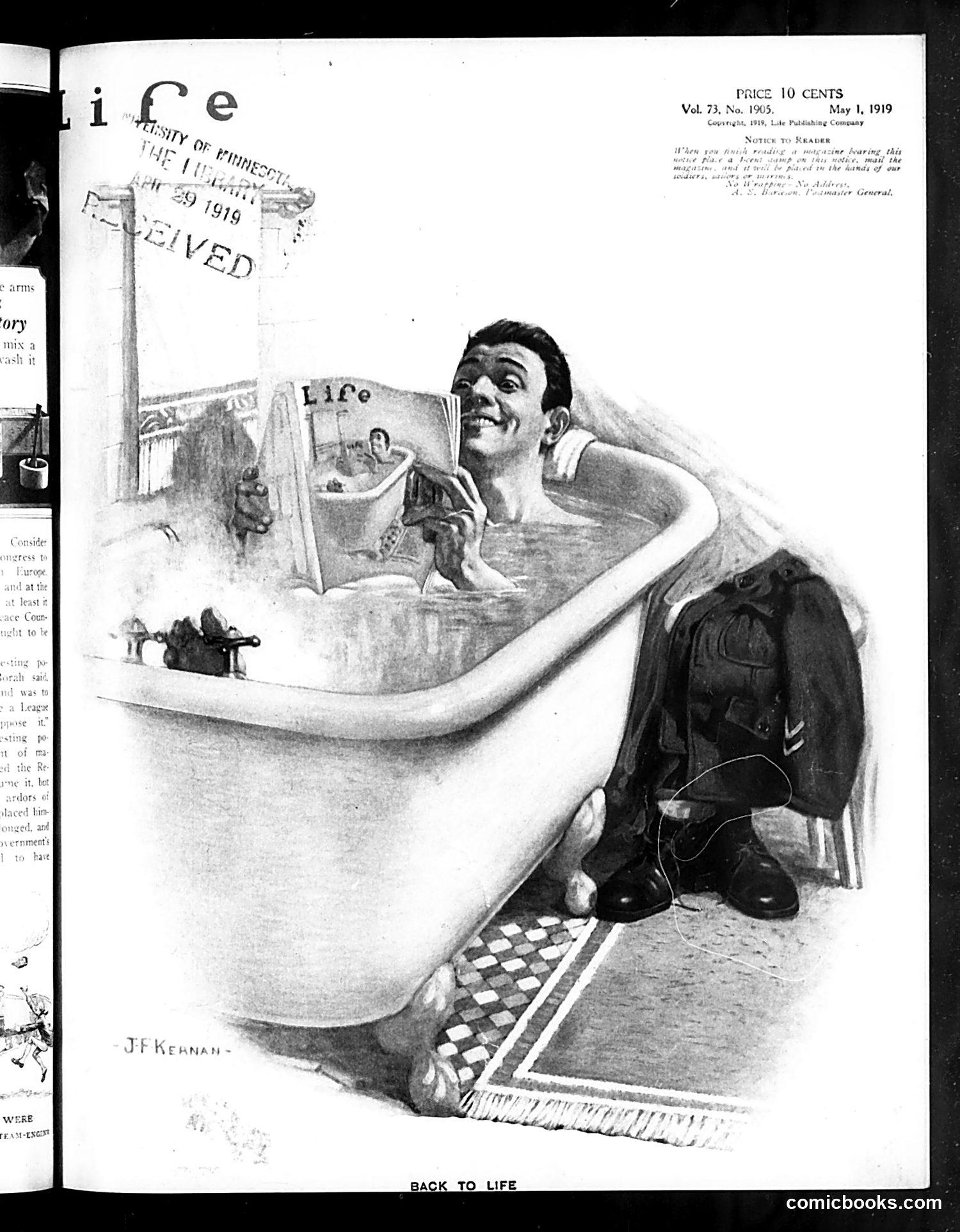
This cartoon by J.F. Kennan depicts a man emerging from a bathtub labeled "LIFE," suggesting renewal or rebirth. The title "Back to Life" likely references the post-World War I period—the magazine's May 1919 date places this just after the armistice (November 1918). The man's exaggerated expression of joy and relief suggests soldiers or citizens returning to civilian life after the war. The bathtub as a symbol of cleansing implies washing away the trauma and hardship of the conflict. The discarded military uniform at the bathtub's edge reinforces this interpretation of transitioning from wartime to peacetime existence. This reflects contemporary themes of veterans' homecoming and national recovery during 1919.
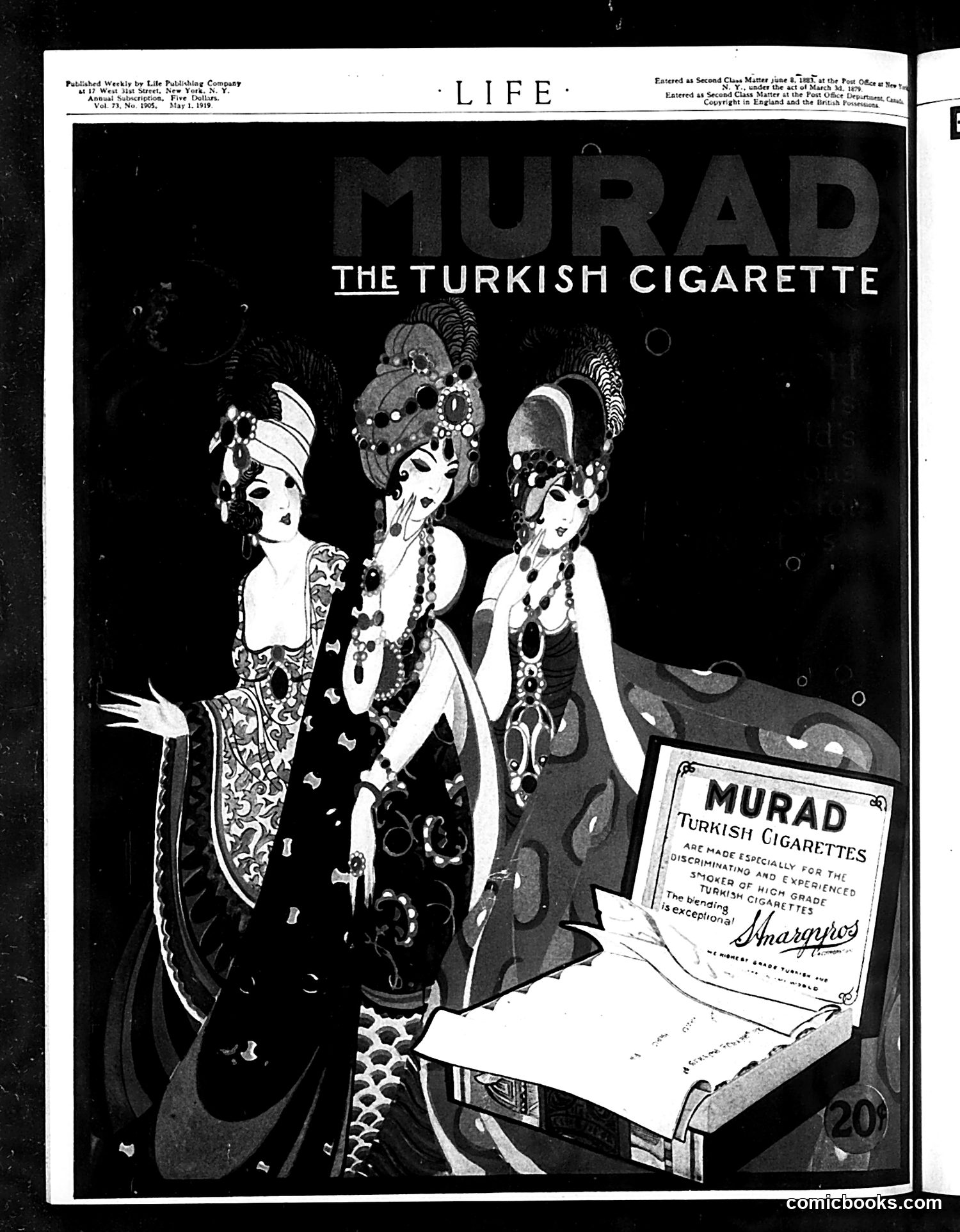
This is a **cigarette advertisement**, not political satire. It appears in *Life* magazine and promotes "Murad Turkish Cigarettes." The image depicts three elaborately costumed women in exotic, orientalist styling—turbans, jewelry, and ornate clothing suggesting a vague "Turkish" or Middle Eastern aesthetic. The accompanying text box claims these cigarettes are "made especially for the discriminating and experienced smoker of high grade Turkish cigarettes" and promises "a genuine exceptional" product. This represents **orientalist marketing** common in early 20th-century American advertising, which used romanticized, stereotypical imagery of non-Western cultures to sell luxury goods. The exotic costumes and styling were meant to suggest sophistication and worldliness to consumers.
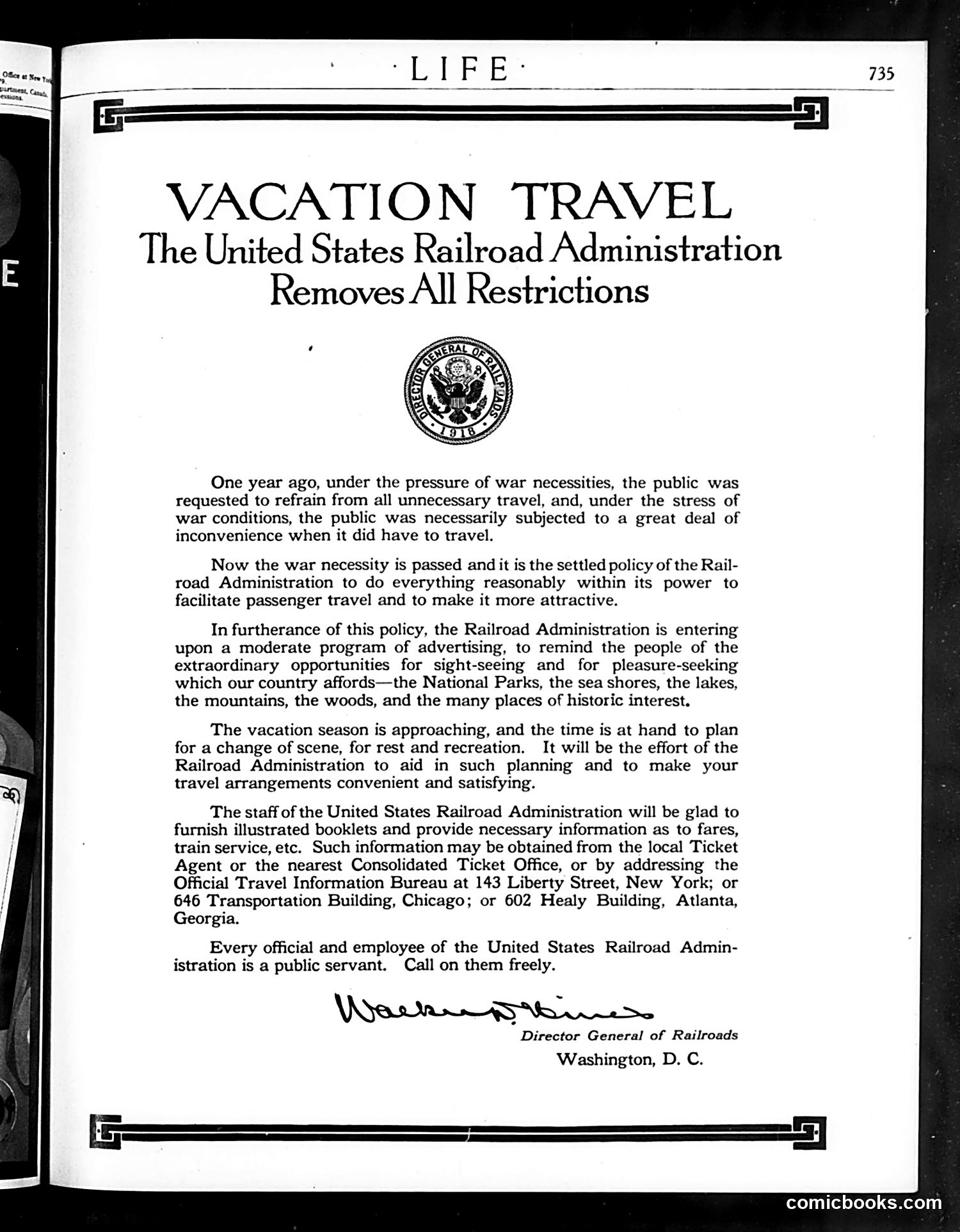
This is **not a cartoon or satire** — it's a straightforward government announcement published in *Life* magazine (page 735). The United States Railroad Administration announces the lifting of wartime travel restrictions. The text explains that one year prior, the public was asked to avoid unnecessary rail travel due to World War I demands. Now that "war necessity is passed," the administration is removing these restrictions and launching an advertising campaign to encourage vacation travel. The announcement promotes American tourism to national parks, beaches, mountains, and historic sites. It provides contact information for travel planning assistance and is signed by the Director General of Railroads in Washington, D.C. This represents a return to peacetime normalcy following WWI's conclusion.
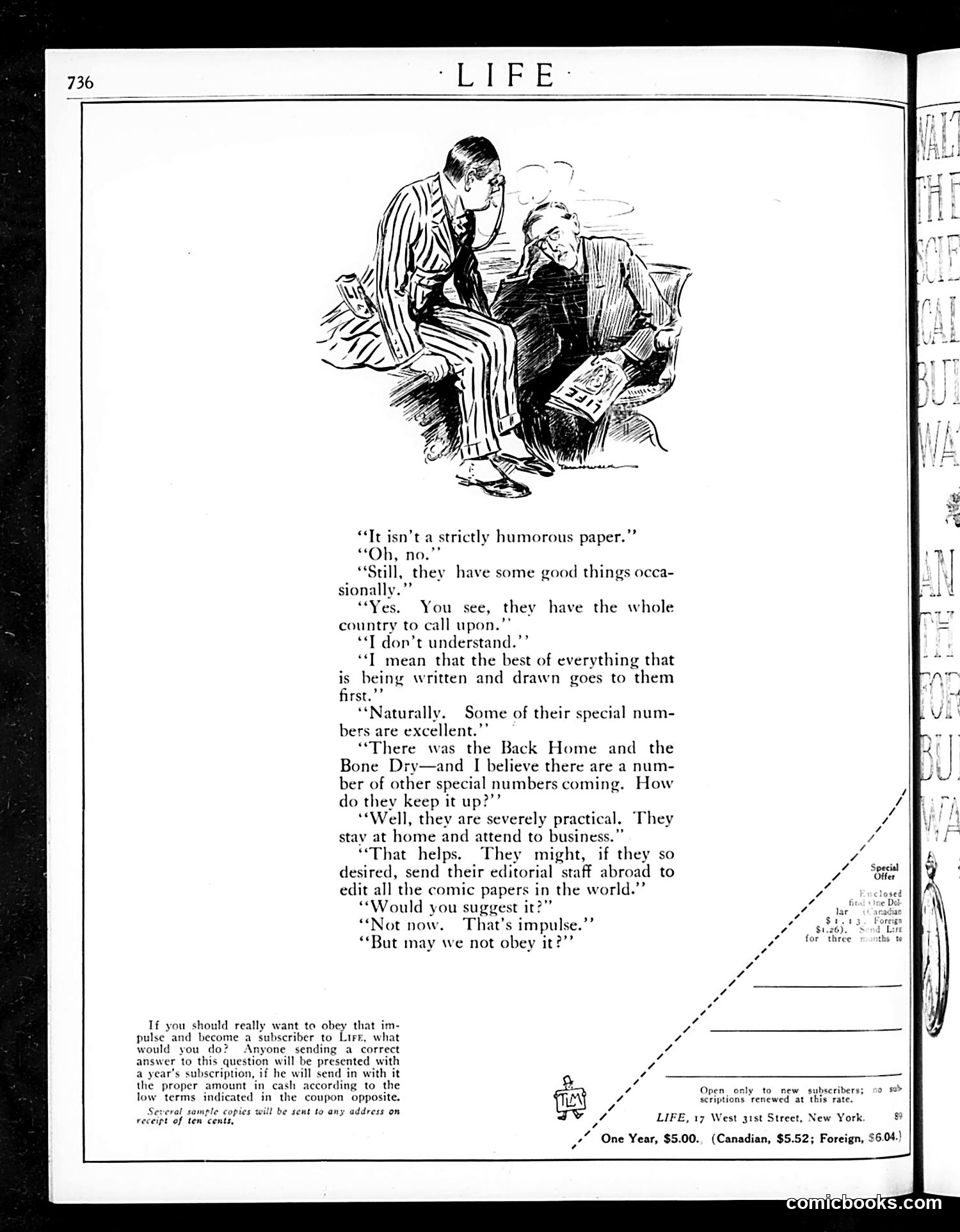
This page is primarily **advertising for Life magazine subscriptions**, not editorial content. The small cartoon at top shows two men in conversation about the magazine's editorial approach. The dialogue indicates Life is **not strictly humorous**—it publishes serious material alongside comedy. One speaker notes Life has "the whole country to call upon" for content and mentions special numbered issues like "Back Home" and "Bone Dry" (likely Prohibition-era references). The discussion about potentially sending editorial staff abroad to "edit all the comic papers in the world" appears satirical, with one character calling this "impulse" rather than practical. The main purpose is promoting subscriptions at $5.00/year ($5.52 Canadian; 56¢ foreign), with instructions for ordering below.
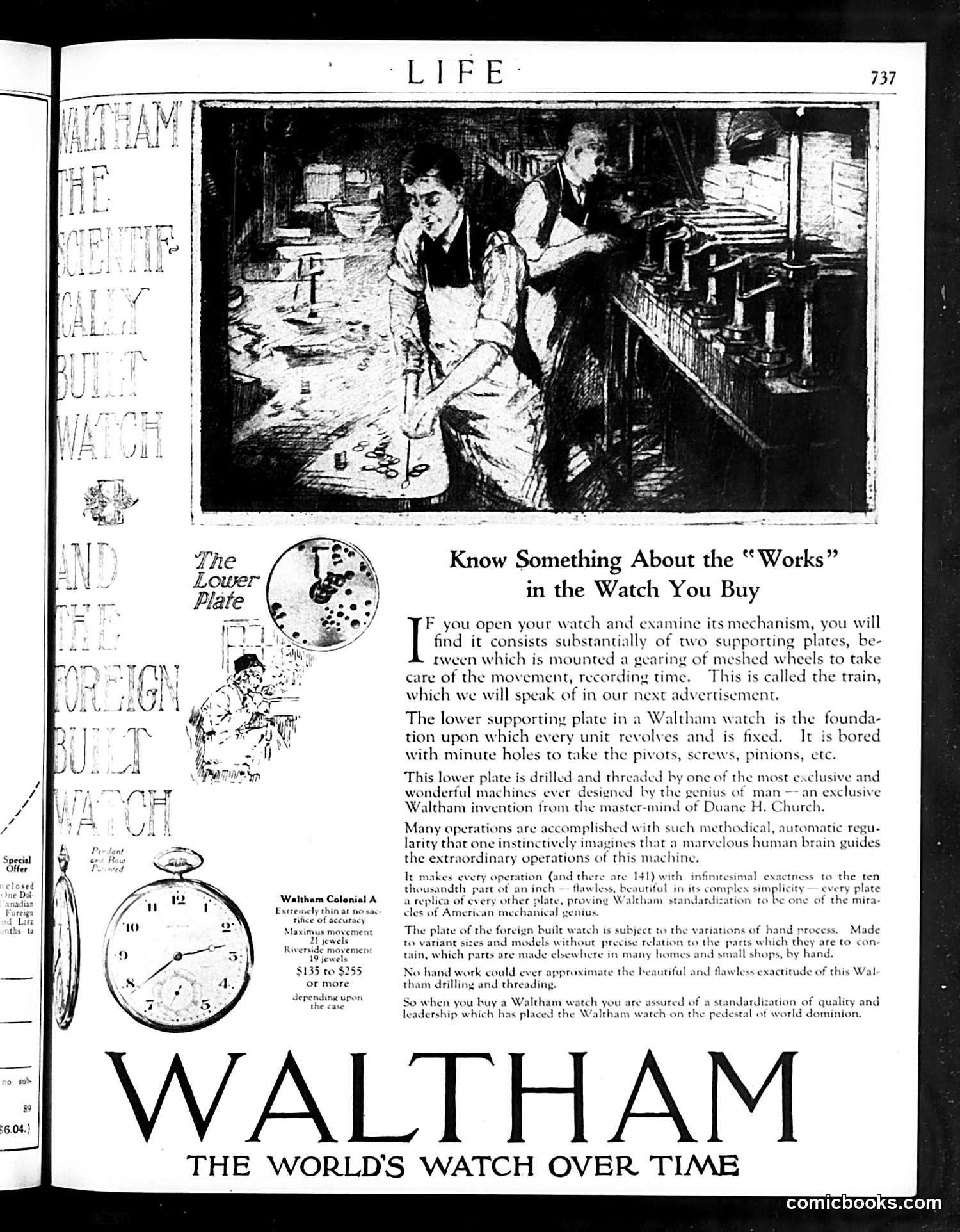
This page is primarily a **Waltham watch advertisement**, not political satire. The top illustration shows a watchmaker or jeweler at work in a workshop, depicting the craftsmanship involved in watch manufacturing. The text educates readers about watch mechanisms—specifically the "lower plate," which the ad describes as engineered with precision comparable to human ingenuity. The advertisement emphasizes Waltham's standardization and quality control, contrasting handmade work done "elsewhere in many homes and small shops" with Waltham's mechanized reliability. The smaller watch face illustrations on the left show product examples. The tagline "The World's Watch Over Time" positions Waltham as a trustworthy timekeeping authority. This is straightforward commercial messaging rather than political commentary or satire.
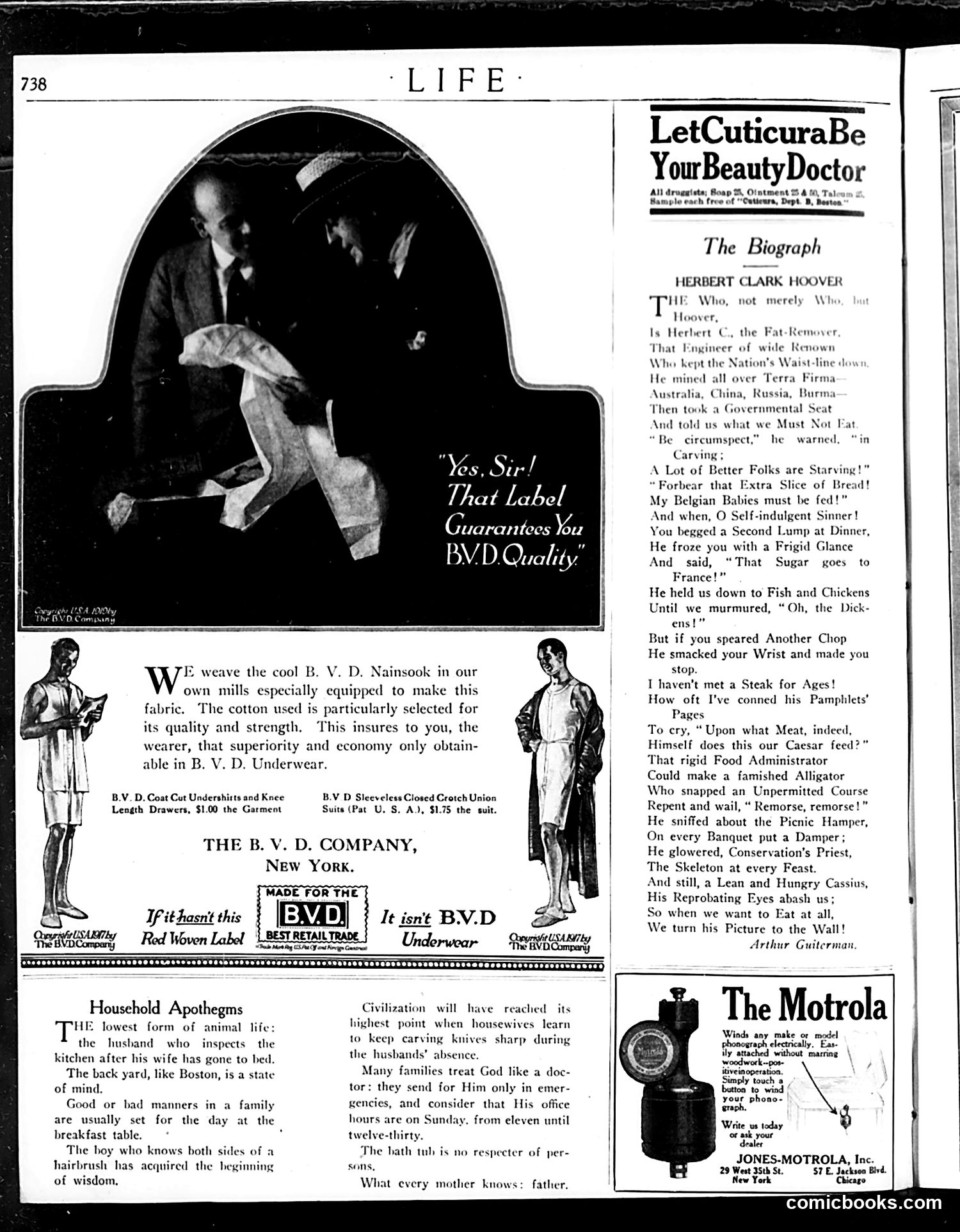
This page is primarily **advertising and filler content** rather than political satire. The main image shows two men examining a fabric label, advertising B.V.D. brand underwear—a prominent early 20th-century manufacturer. The accompanying text emphasizes quality cotton and "B.V.D. Nainsook" fabric. Below are product illustrations for B.V.D. undergarments with pricing. The right side contains "The Biograph" section—a humorous biographical poem about **Herbert Clark Hoover**, who appears to be the target of mild satirical mockery. The verse critiques his public moralizing about food restrictions and government dietary advice, sarcastically presenting him as an insufferable food-policy enforcer. This suggests the page dates from Hoover's presidency (1929-1933) when food regulation was politically contentious. The remaining content includes brief household advice and a Motorola phonograph advertisement.
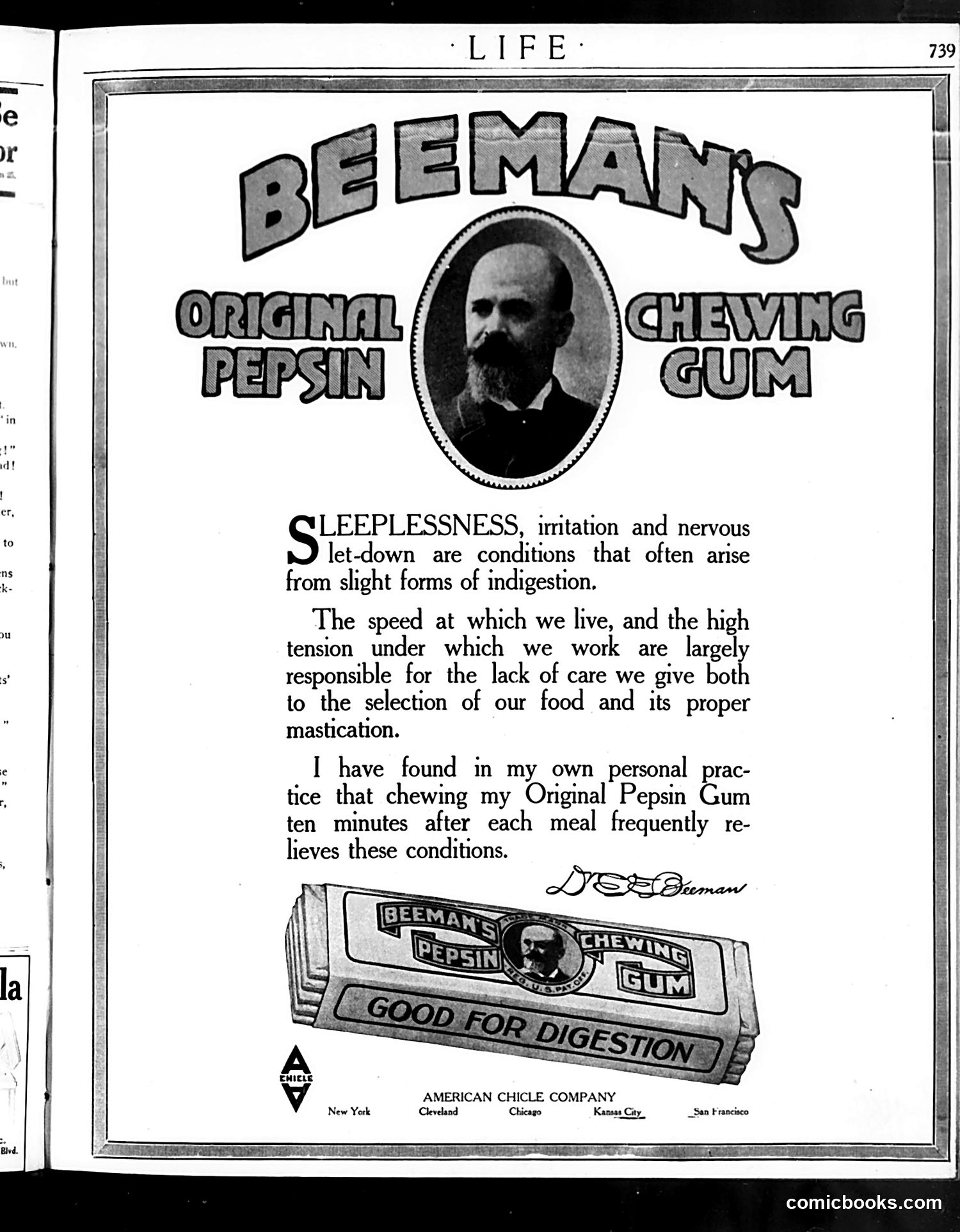
This is a vintage advertisement, not satire. It promotes Beeman's Original Pepsin Chewing Gum as a digestive aid. The ad features a testimonial from someone named "Beeman" (shown in the portrait) claiming that chewing the gum for ten minutes after meals relieves indigestion, sleeplessness, and nervousness. The pitch reflects early 20th-century medical thinking that attributed modern ailments like nervousness to poor digestion caused by rushed eating and inadequate chewing. The gum, containing pepsin (a digestive enzyme), was marketed as a convenient solution for busy professionals. The American Chicle Company produced this gum, with offices listed in major U.S. cities.
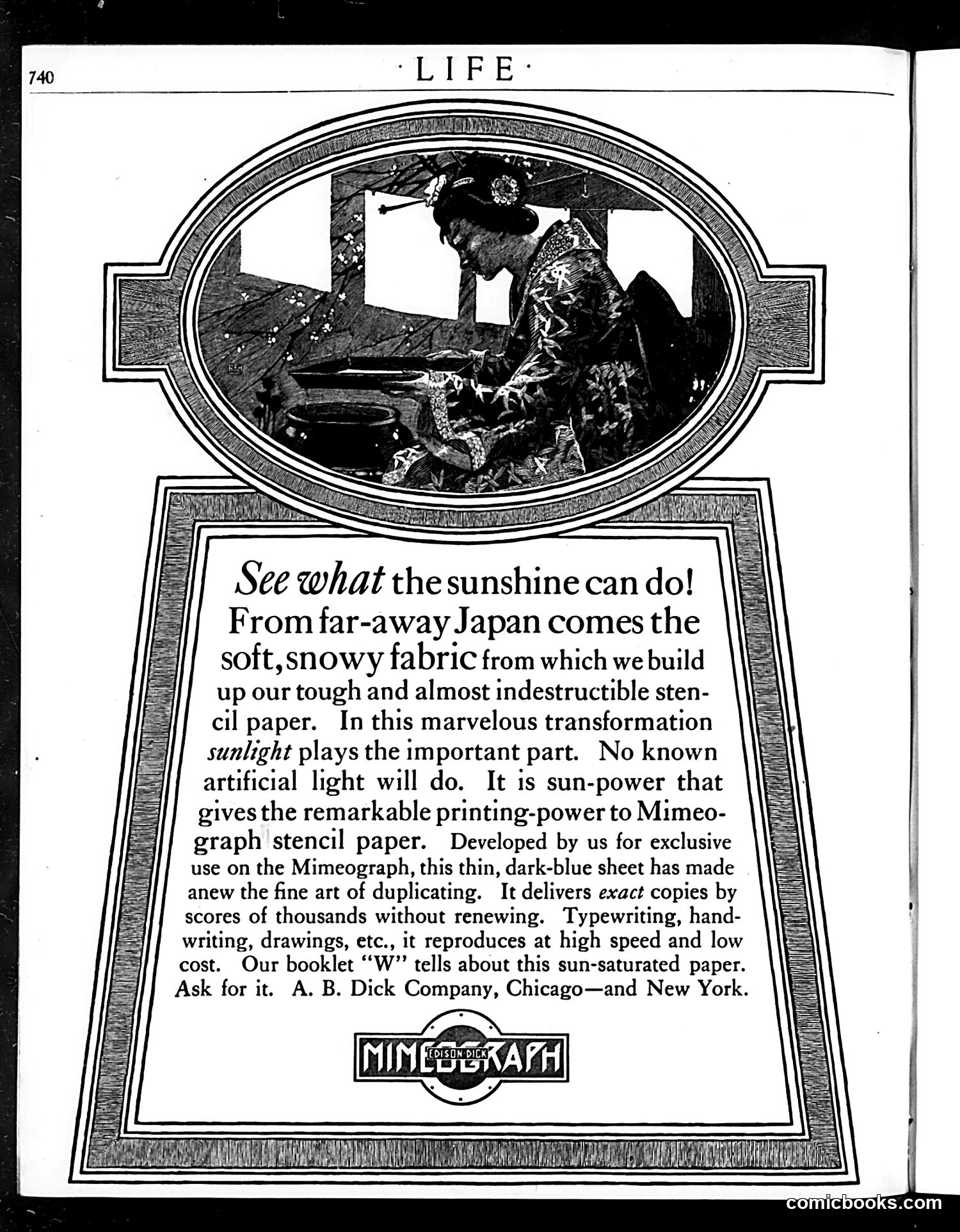
This is a **product advertisement**, not political satire. It promotes Mimeograph stencil paper made by the A.B. Dick Company (Chicago and New York). The ad features an illustration of a woman using what appears to be a mimeograph machine. The copy emphasizes that Japanese-manufactured stencil paper, when exposed to sunlight, gains special printing properties that enable high-speed, low-cost document duplication. The ad's appeal to "see what sunshine can do" highlights the paper's light-sensitive quality as a technological marvel. The text stresses reliability ("exact copies") and industrial efficiency—key selling points for early 20th-century office equipment. There is **no political cartoon or satire present** on this page—only commercial advertising for office technology.
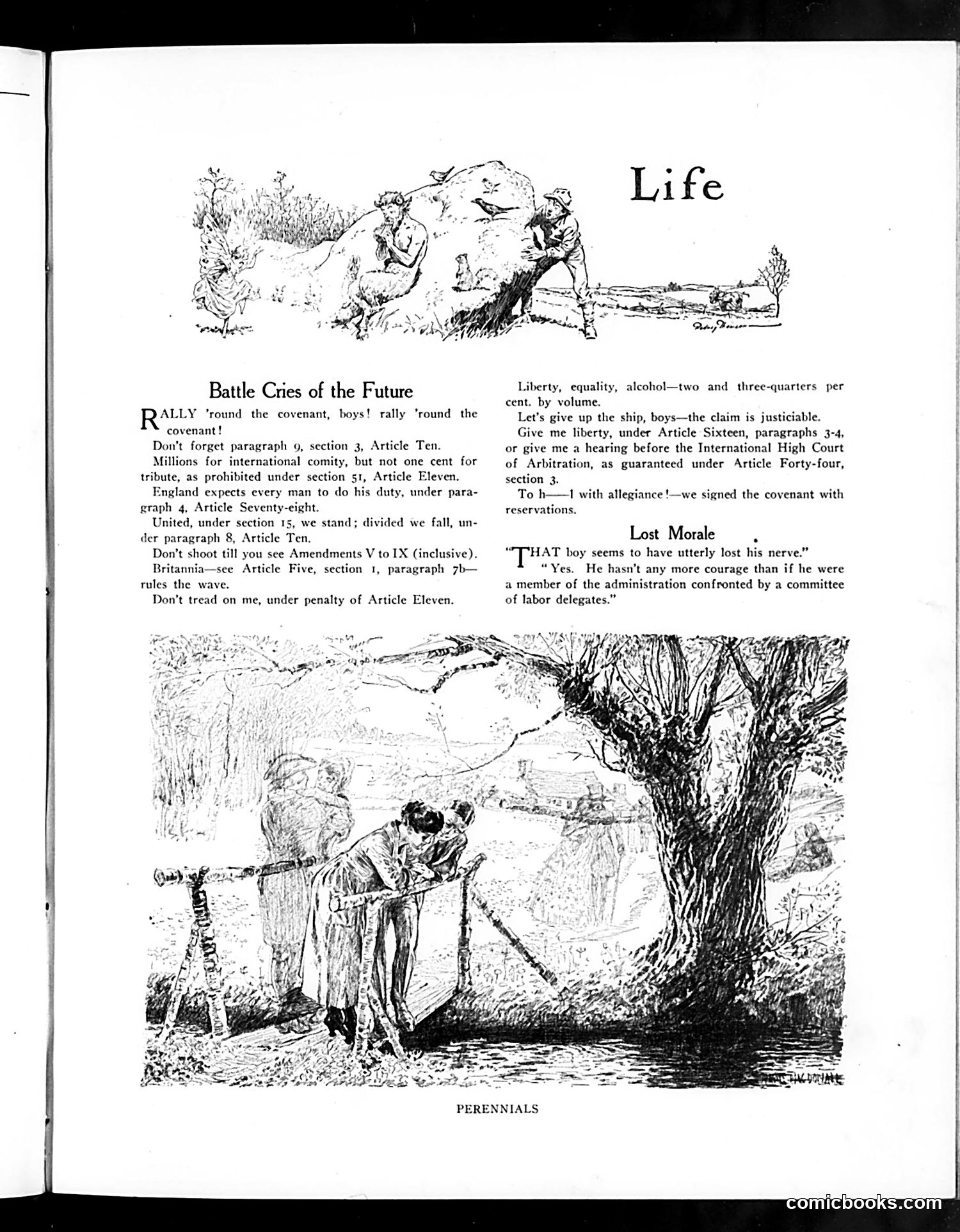
This page satirizes post-WWI political rhetoric and idealism. The top section mocks various international agreements and legal frameworks—referencing the League of Nations Covenant, Articles Ten and Eleven, and international arbitration—by suggesting these lofty principles are contradicted by nations' actual behavior (like shooting, standing divided, and treading on others). The lower cartoon depicts a couple gazing through a telescope or surveying instrument, captioned "Lost Morale." The accompanying dialogue mocks a young man's cowardice, comparing him unfavorably to labor activists. The satire suggests disillusionment with post-war idealism and questions about masculine courage in the new political order. The overall message critiques the gap between high-minded international principles and cynical realpolitik.
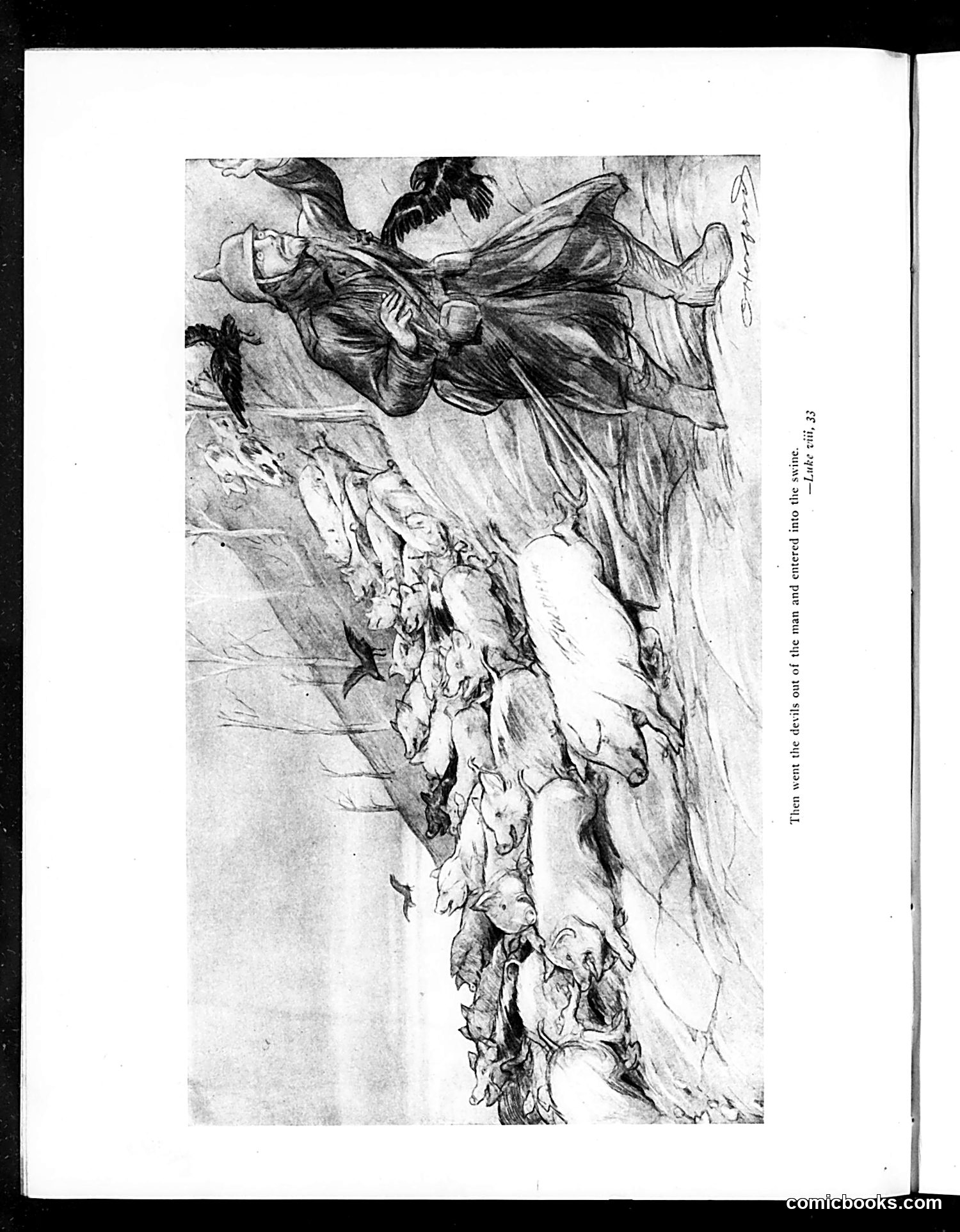
This page contains a single satirical illustration, rotated 90 degrees. The caption reads: "Then went the death coil of the man and entered into the swine.—Luke xi, 33." The cartoon depicts a demonic or devilish figure (shown with wings and dark features) descending toward a group of pigs below. The biblical reference is to the Gospel account of Jesus casting demons out of a possessed man, sending them into a herd of swine. The satire appears to target a contemporary political figure or group by comparing them to demons being cast into animals—suggesting they are demonic, base, or bestial. However, **without clearer identification of the specific figure caricatured or the date of publication, I cannot definitively identify the intended target or historical context** this cartoon references.
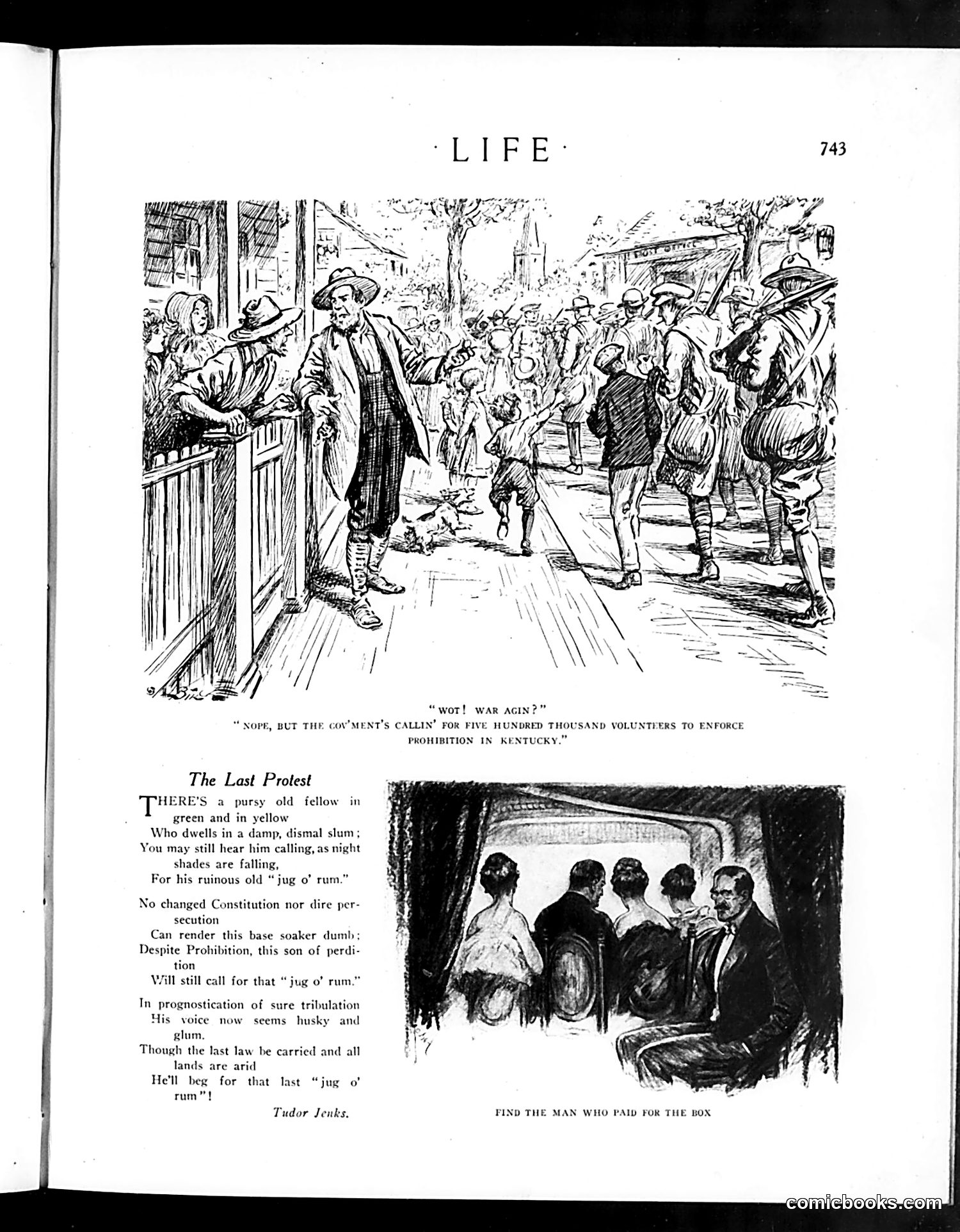
**Top Cartoon:** Depicts Prohibition enforcement in Kentucky. The caption quotes someone saying "Nope, but the gov'ment's callin' for five hundred thousand volunteers to enforce prohibition in Kentucky." The scene shows a town gathering with armed men, suggesting the massive enforcement effort required—and the absurdity of relying on volunteers to police alcohol consumption in a state culturally resistant to the ban. **Bottom Poem & Illustration:** "The Last Protest" by Tudor Jenks laments Prohibition's impact on a working man who cannot obtain his customary rum. The accompanying sketch shows men in what appears to be a speakeasy or illegal drinking establishment. The satire critiques Prohibition as ineffective—laws cannot eliminate demand for alcohol or the "base soaker" determined to drink despite legal bans.
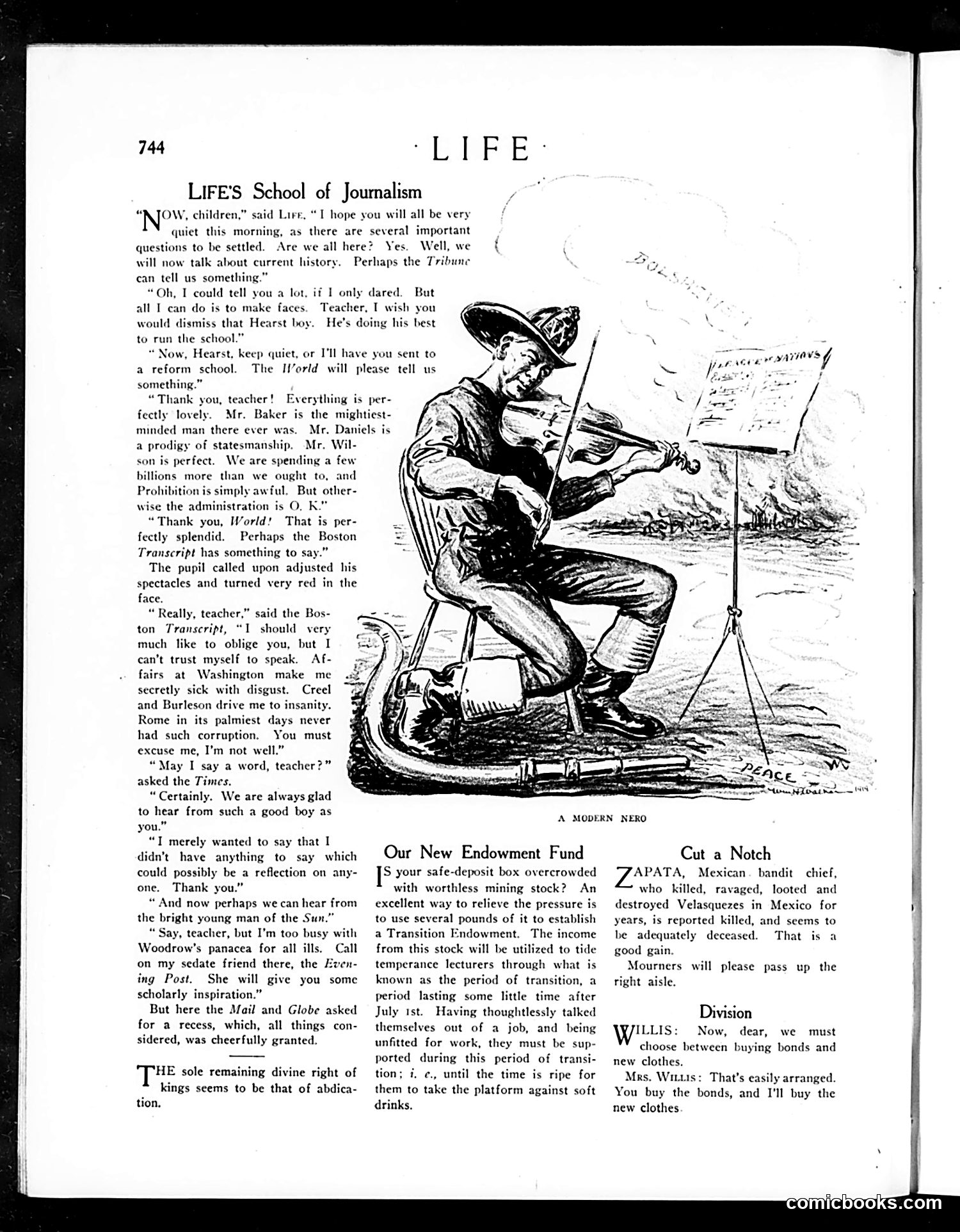
The central cartoon depicts a figure (labeled "A Modern Need") sitting and reading newspapers labeled with various publications (*Tribune*, *World*, *Post*, *Globe*). The character appears to be a working-class man or "Uncle Sam" type figure, struggling to absorb conflicting information from multiple news sources. The satire criticizes the **confusing and contradictory nature of contemporary journalism** circa the 1910s-1920s. Different major newspapers presented conflicting accounts of current events, leaving ordinary citizens bewildered about what was actually true. The cartoon mocks both the proliferation of competing narratives and readers' difficulty discerning fact from editorial bias—a concern that resonates surprisingly well today.
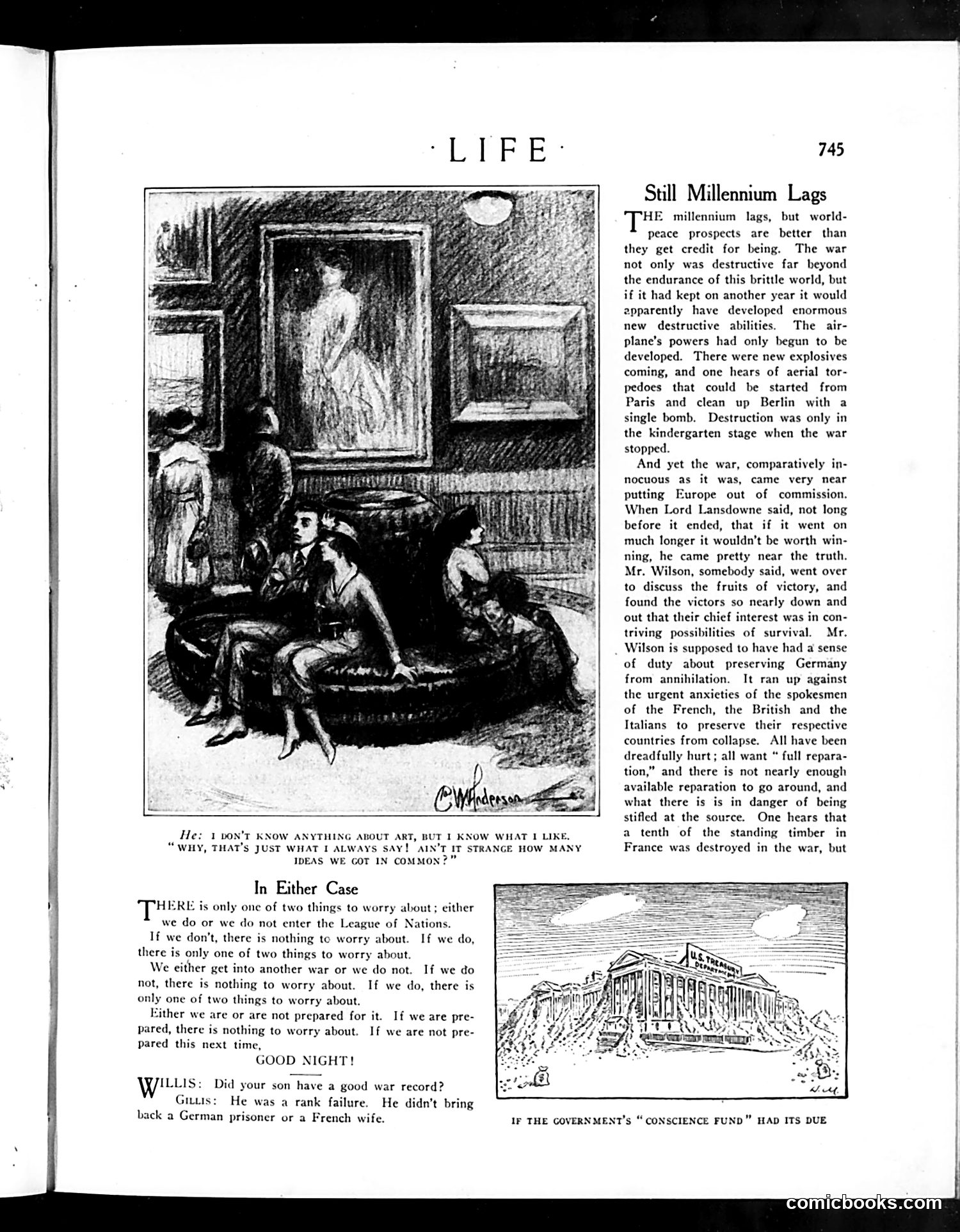
This page contains post-WWI satirical commentary. The top article, "Still Millennium Lags," critiques peace negotiations following World War I, discussing concerns about Germany's potential resurgence and European reparations disputes among French, British, and Italian leaders. The main cartoon depicts two figures examining artwork, with dialogue: "I don't know anything about art, but I know what I like. Why, that's just what I always say! Ain't it strange how many ideas we have in common?" This satirizes people who lack artistic knowledge yet form confident opinions. Below, "In Either Case" humorously presents a logical paradox about League of Nations membership—worrying occurs regardless of joining or not. The final joke features characters Willis and Gillis discussing a soldier's poor war record, mocking military incompetence.
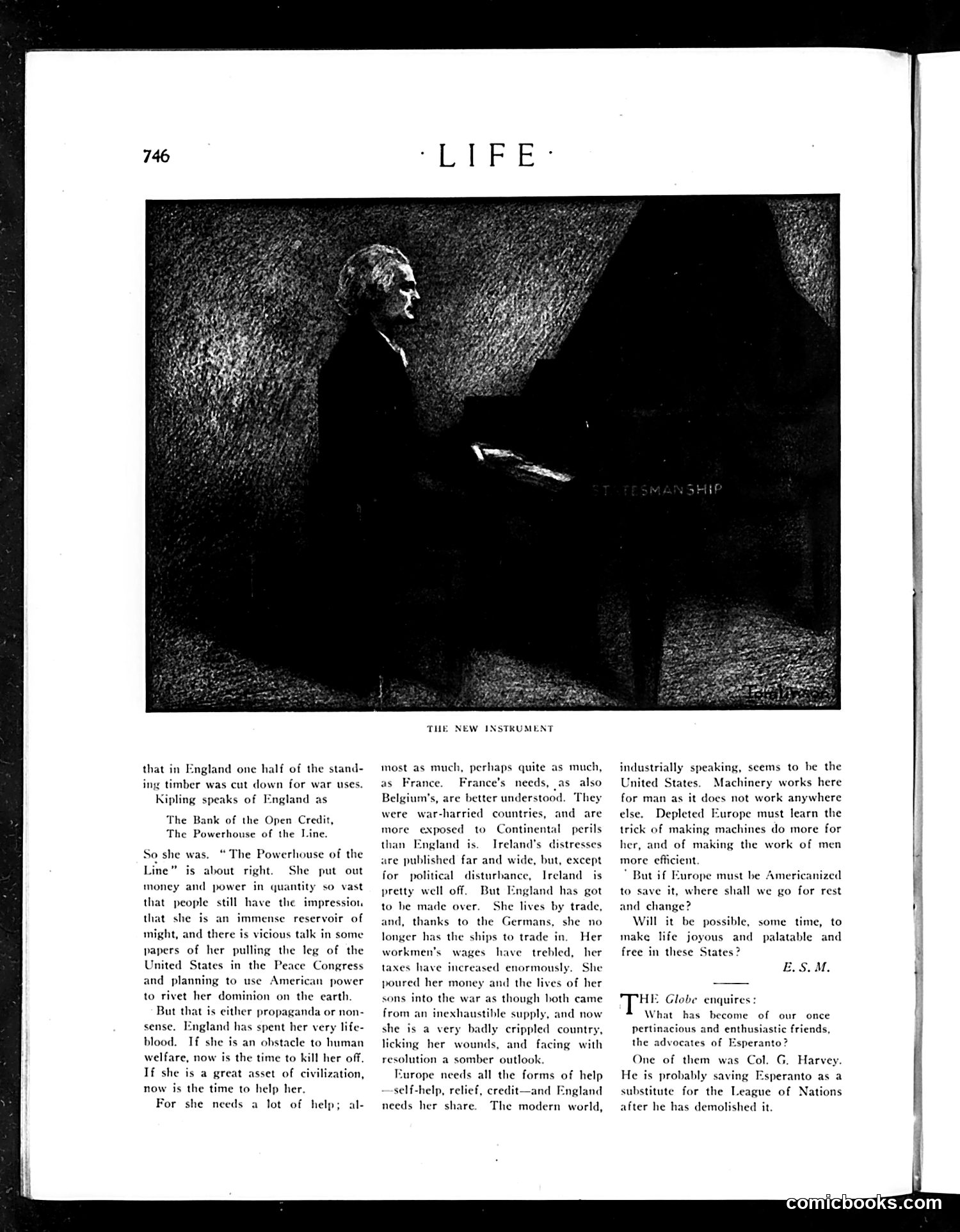
The image shows a darkly rendered figure at a piano labeled "STATESMANSHIP," suggesting this is an editorial cartoon about post-World War I diplomacy. The accompanying text discusses England's post-war economic struggles and need for American assistance. The article critiques how England depleted resources fighting Germany while France received more sympathy. It argues England must now be "made over" and suggests the modern world—"industrially speaking"—belongs to America. The piano metaphor likely satirizes diplomatic negotiations as an instrument requiring skillful "playing." The dark, shadowy treatment suggests cynicism about post-war political maneuvering and suggests that statesmanship has become a mere performance or calculated tool rather than principled governance. The overall tone criticizes how nations must now navigate American economic dominance.
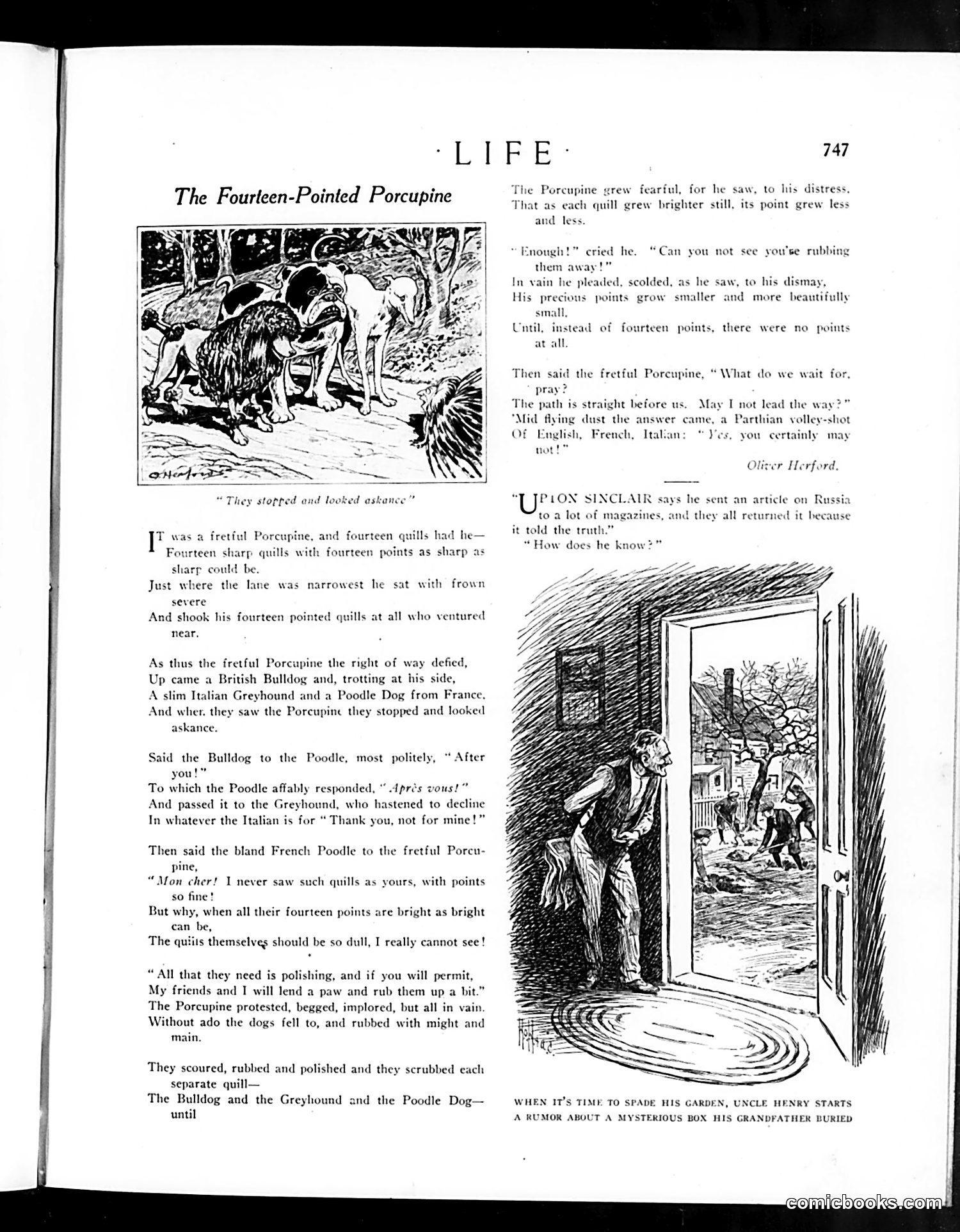
This is a humorous fable illustrated with two woodcut-style drawings. The main narrative concerns a porcupine with fourteen quills who encounters various dogs (a British Bulldog, Irish Greyhound, French Poodle, and Italian dog). The porcupine represents a defensive position, while the dogs appear to represent different nationalities—likely a satirical commentary on international relations or tensions between nations portrayed as animal characters. The dogs attempt to "polish" the porcupine's quills, which serves as metaphor for some form of negotiation or conflict resolution. The second illustration shows an unrelated domestic scene about a mysterious box and a garden. The content is primarily literary/fable-based rather than explicitly political, appearing aimed at general amusement.
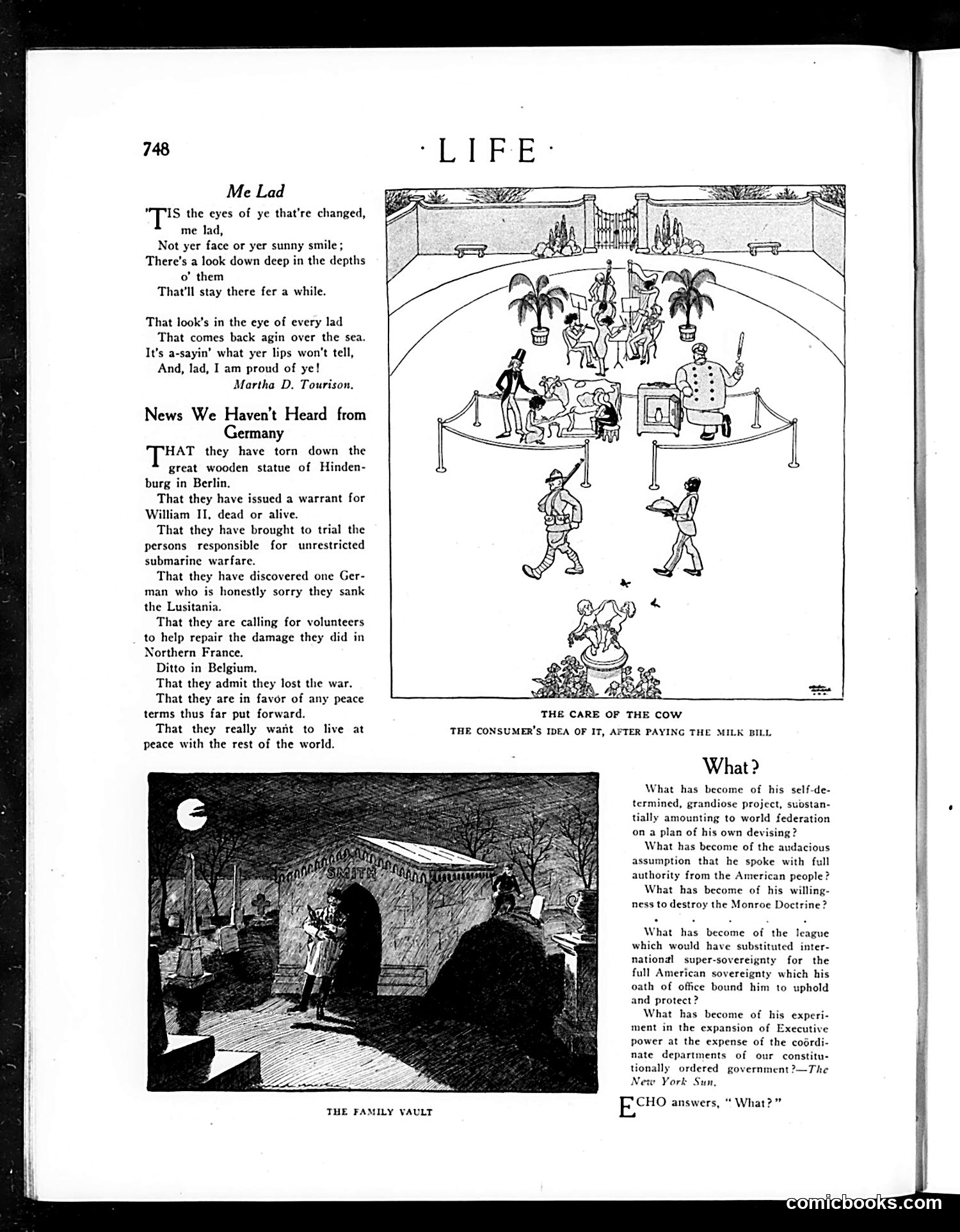
This page contains post-WWI American satire, likely from 1919-1920. The "News We Haven't Heard from Germany" section mockingly lists things Germany will *never* admit or do—including dismantling Hindenburg monuments, prosecuting submarine warfare criminals, or genuinely seeking peace. It's satirizing German refusal to accept responsibility for wartime atrocities and losses. The "What?" section, attributed to *The New York Sun*, critiques President Woodrow Wilson's apparent retreat from his ambitious postwar goals: world federation through the League of Nations, self-determination for nations, and expanded executive power. The rhetorical questions sarcastically ask what happened to Wilson's grand plans—implying he compromised or abandoned them during treaty negotiations. The illustrations show: a domestic scene (possibly representing postwar American normalcy) and "The Family Vault" (unclear reference). "The Care of the Cow" satirizes consumers' frustration with milk costs after wartime inflation.
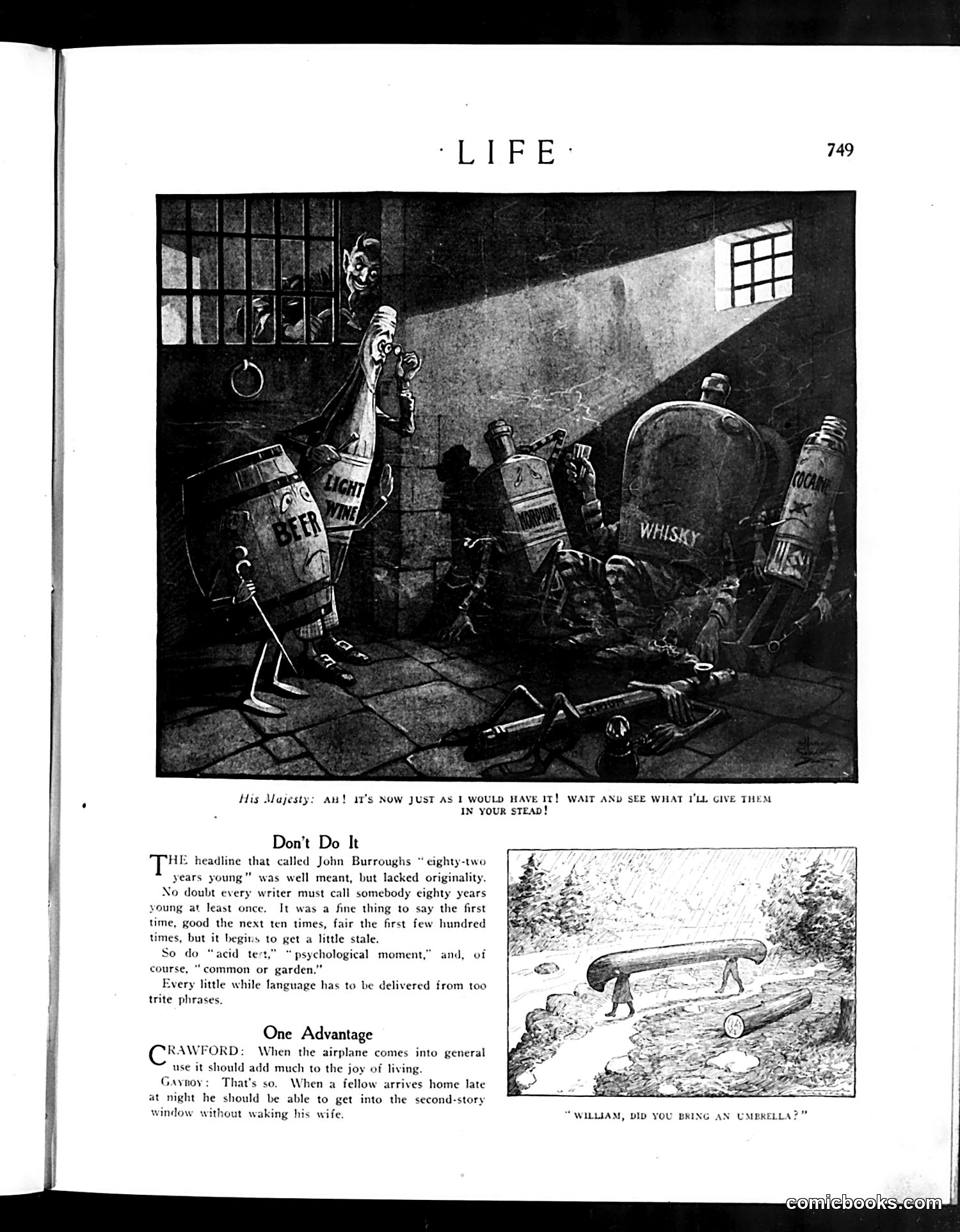
**Top Cartoon:** An anthropomorphized alcohol bottle ("His Majesty") presides over imprisoned figures in what appears to be a jail cell. The bottle gloats about punishing inmates, suggesting this is Prohibition-era satire. The cartoon depicts alcohol personified as a tyrannical ruler, likely mocking either Prohibition's supporters (who saw alcohol as an enemy to be jailed) or its enforcers. The labeled bottles (beer, whiskey) and prisoners suggest the absurdity of criminalizing alcohol consumption. **Bottom Section:** Two brief humor pieces criticize overused language ("eighty years young," "acid test") and joke about airplanes enabling marital deception—a man entering his home via second-story window to avoid his wife's notice after a late night out. This reflects early aviation novelty and period gender dynamics regarding marriage and accountability. The page satirizes contemporary language clichés and social anxieties around Prohibition and domestic life.
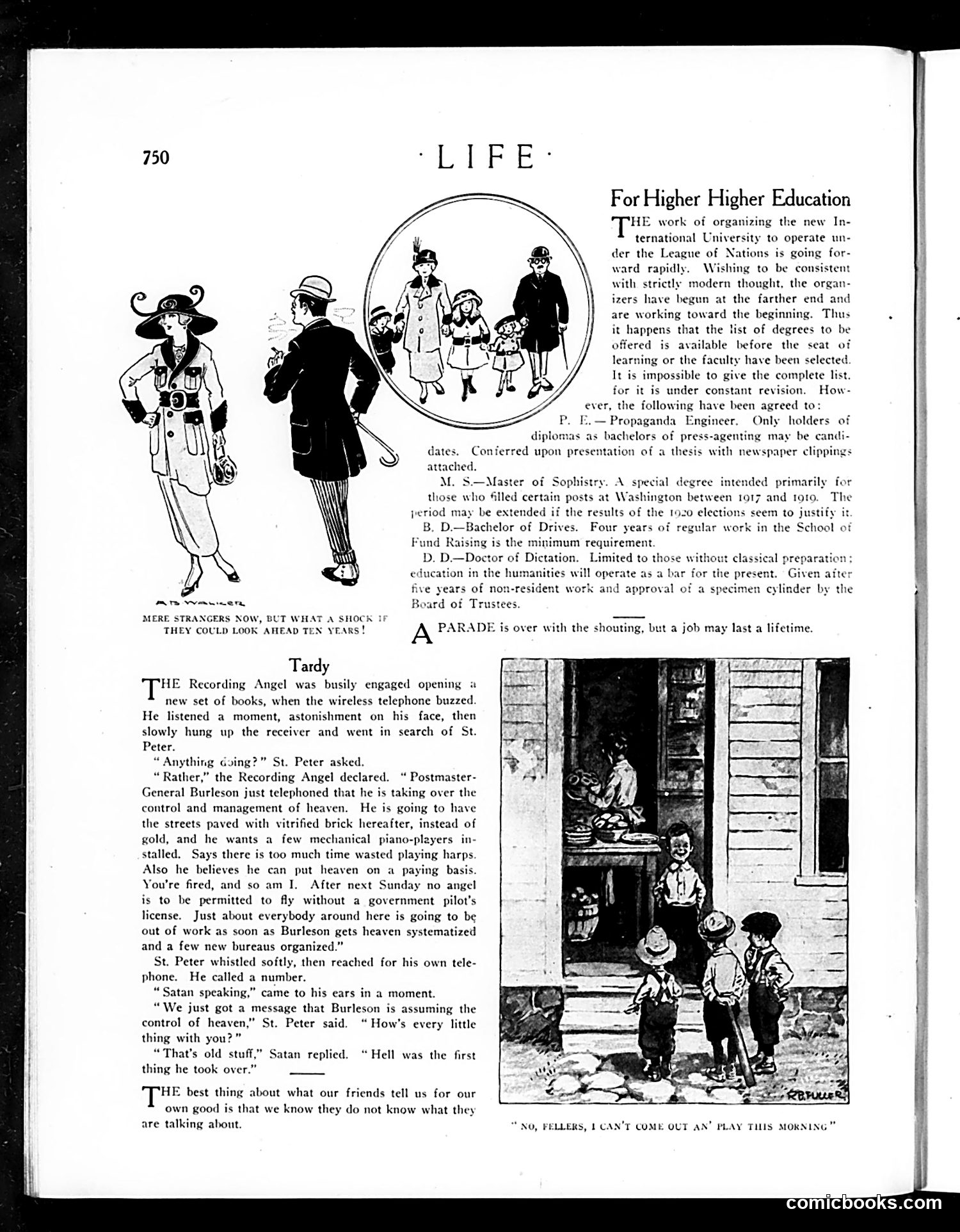
This page contains two distinct satirical pieces mocking American bureaucracy and government overreach post-WWI. **"For Higher Higher Education"** ridicules the League of Nations' proposed International University by listing absurd degree programs: "Propaganda Engineer," "Master of Sophistry" (for Washington officials 1917-1920), and "Doctor of Dictation." The satire suggests modern institutions prioritize credentials before substance, and that wartime government positions qualify as academic credentials. **"Tardy"** targets Postmaster-General Albert Burleson, who actually controlled telephone/telegraph during WWI. The cartoon imagines him taking over heaven itself, replacing gold streets with "vitrified brick" and installing player pianos instead of harps—mocking his obsession with bureaucratic "efficiency" and cost-cutting. When St. Peter protests, Satan reveals Burleson already controls hell. The joke: Burleson's government expansion is so totalizing that even the afterlife can't escape his reach. Both pieces satirize wartime government growth and the prioritization of bureaucratic control over substance.
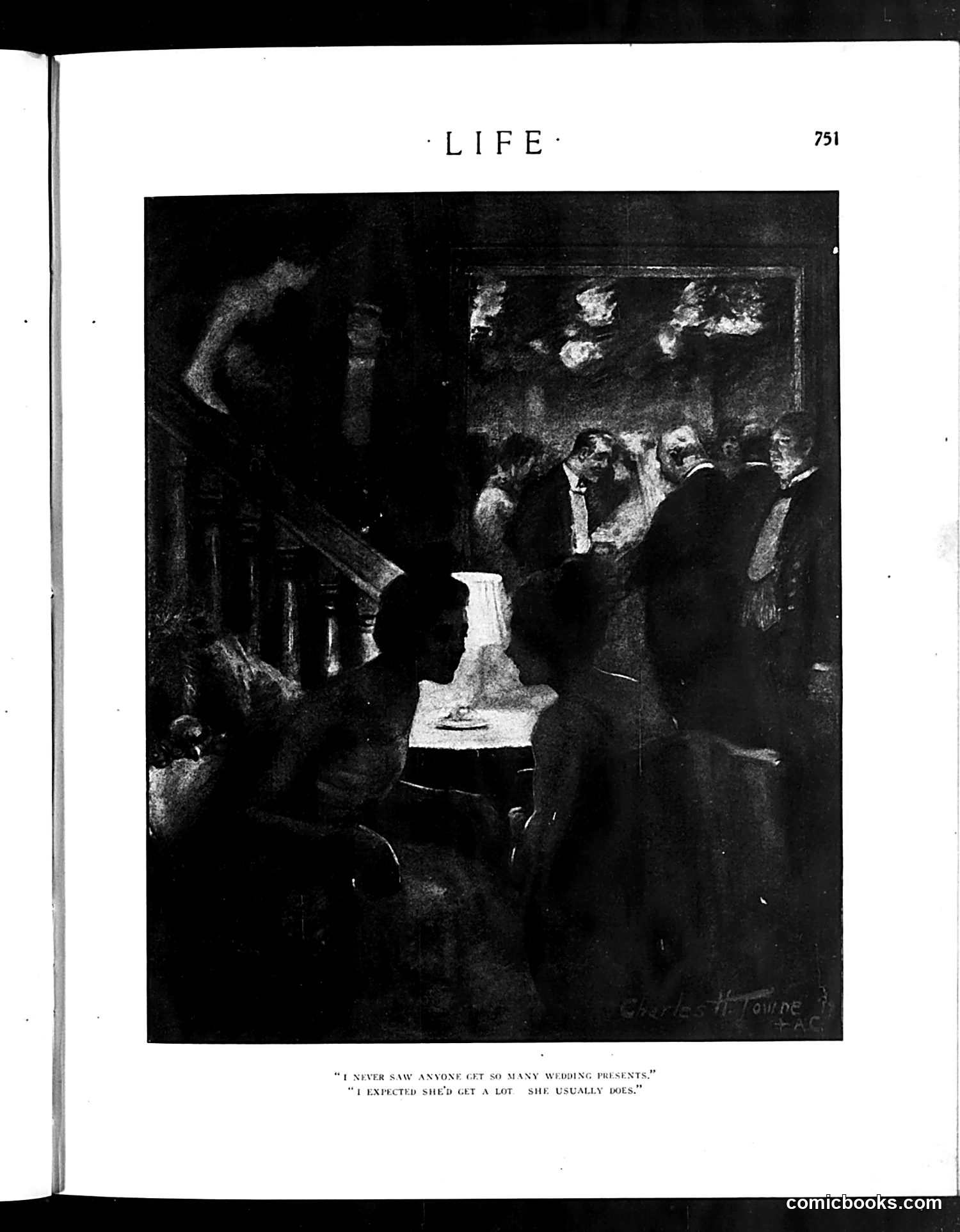
This is a social satire cartoon depicting a wedding reception scene. The caption reads: "I never saw anyone get so many wedding presents" / "I expected she'd get a lot. She usually does." The joke appears to mock a woman (likely a bride) with an implication about her promiscuity or dubious moral character—the humor suggesting she receives gifts from multiple men, not merely wedding guests. This reflects period attitudes about women's sexuality through crude insinuation. The darkly-lit interior scene shows well-dressed guests gathered around what appears to be a gift display, rendered in the illustrative style typical of early-to-mid 20th century *Life* magazine satire. The specific bride is not identified on this page. The cartoon exemplifies the magazine's approach to social commentary through pointed, often ribald humor aimed at contemporary attitudes and behaviors.
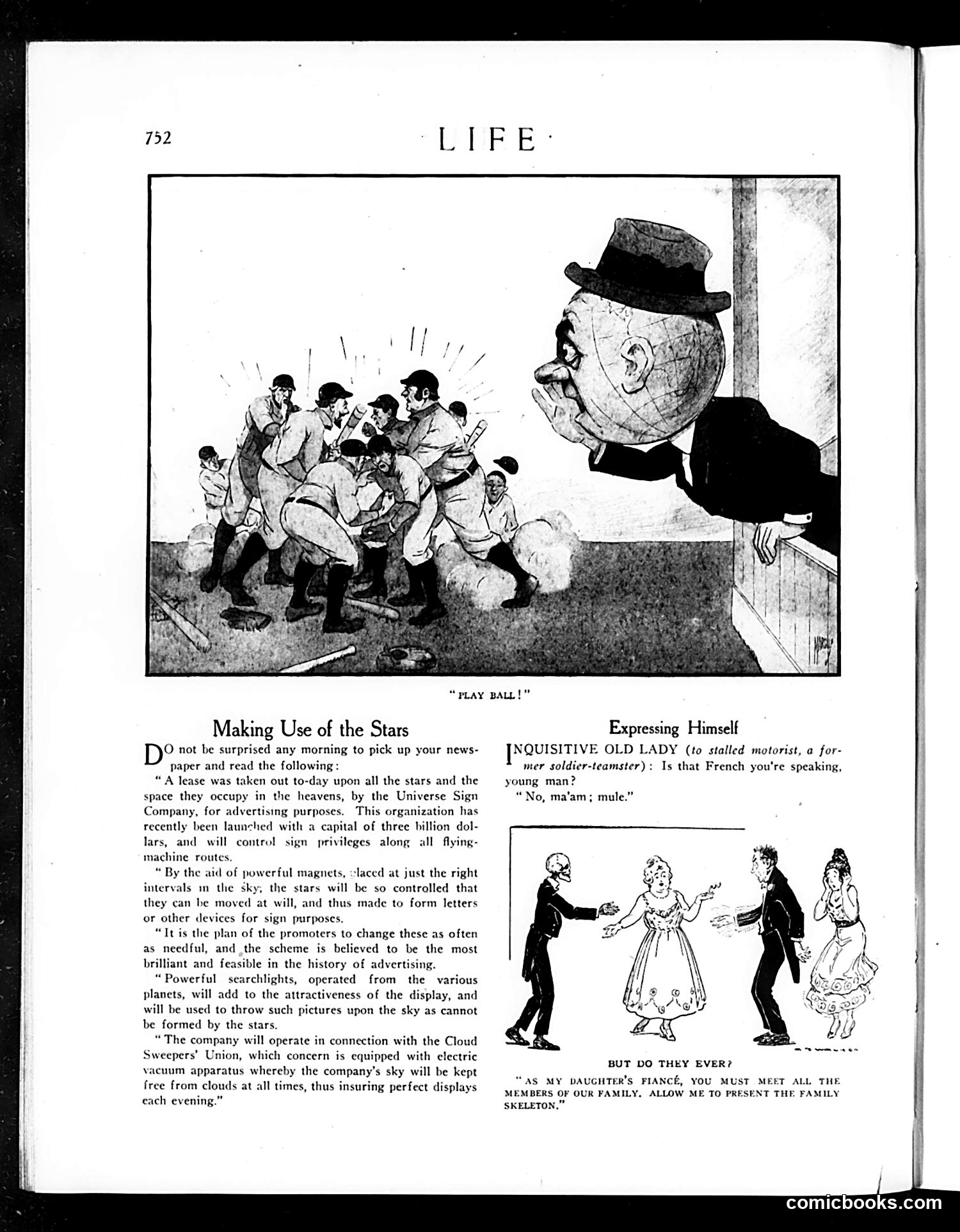
**"Making Use of the Stars"** mocks the era's aggressive commercialization and advertising expansion. The text proposes absurdly controlling celestial bodies themselves for ads—a dystopian vision of capitalism run amok. It satirizes the belief that advertising could and should colonize every space, even the sky. The "Universe Sign Company" and its billion-dollar budget parody real advertising firms' grandiose ambitions in the early 20th century. **"Play Ball!"** (top cartoon) shows a large man's head observing children playing. The satirical caption likely references how powerful figures manipulate ordinary people, though the specific reference is unclear without fuller context. **"Expressing Himself"** jokes about a former soldier-teamster whose profanity-laden speech (represented as "mule"—donkey cursing) shocks an elderly lady. **"But Do They Ever?"** depicts introducing a fiancé to the "family skeleton"—an idiom meaning hidden family shame or scandal. The humor lies in the rhetorical question: families rarely voluntarily reveal their embarrassments.
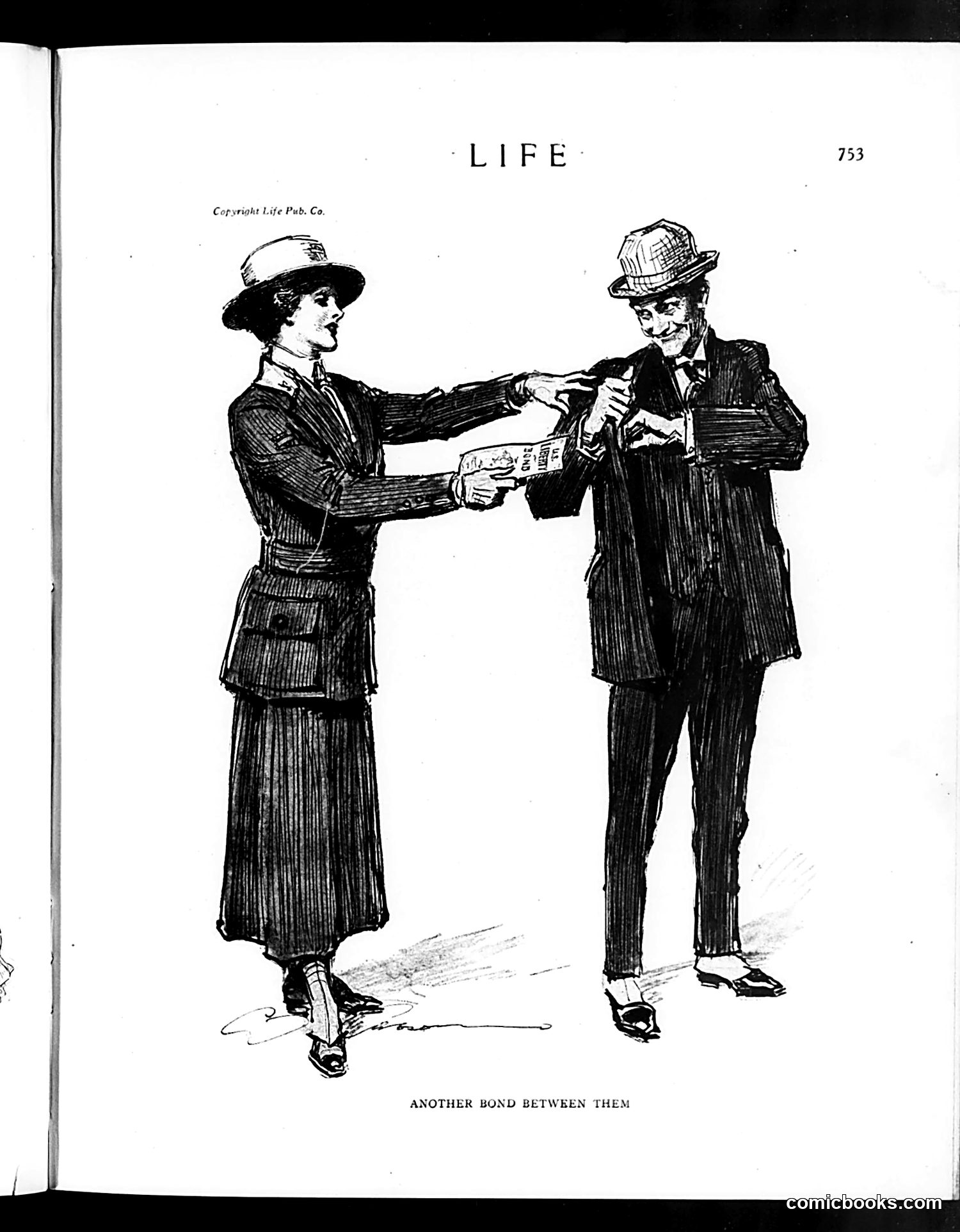
This satirical illustration from *Life* magazine depicts two figures exchanging what appears to be money or a financial document, captioned "Another Bond Between Them." The drawing style and formal attire suggest early 20th-century subjects, though the specific identities aren't labeled. The satire likely comments on a financial or political relationship—possibly involving corruption, bribery, or illicit dealing, given the covert nature of the exchange. The phrase "bond between them" plays on the double meaning of "bond" (financial instrument vs. connection/relationship), suggesting that money or debt creates corrupt ties between otherwise unrelated parties. Without additional context or publication date, the specific figures and event referenced remain unclear, though the cartoon's message critiques financial impropriety or backroom deals.
This page analyzes criticism of Albert Burleson, Postmaster-General under President Wilson. Multiple newspapers—both Republican and Democratic—demanded his removal due to his aggressive management of postal workers and his control of telephones and telegraphs during WWI. The article notes Burleson faced accusations of: exploiting convict labor, driving postal employees into unions, suppressing independent telephone companies, and enforcing Prohibition. However, the author argues farmers and rural areas likely appreciated his parcel post and rural free delivery expansion, even if cities despised him. The conclusion suggests Wilson won't fire Burleson soon, viewing him as necessary "discipline" for the nation's postwar adjustment. The satire implies Burleson's unpopularity stems from conflicting interests: urban workers versus rural beneficiaries of his policies.
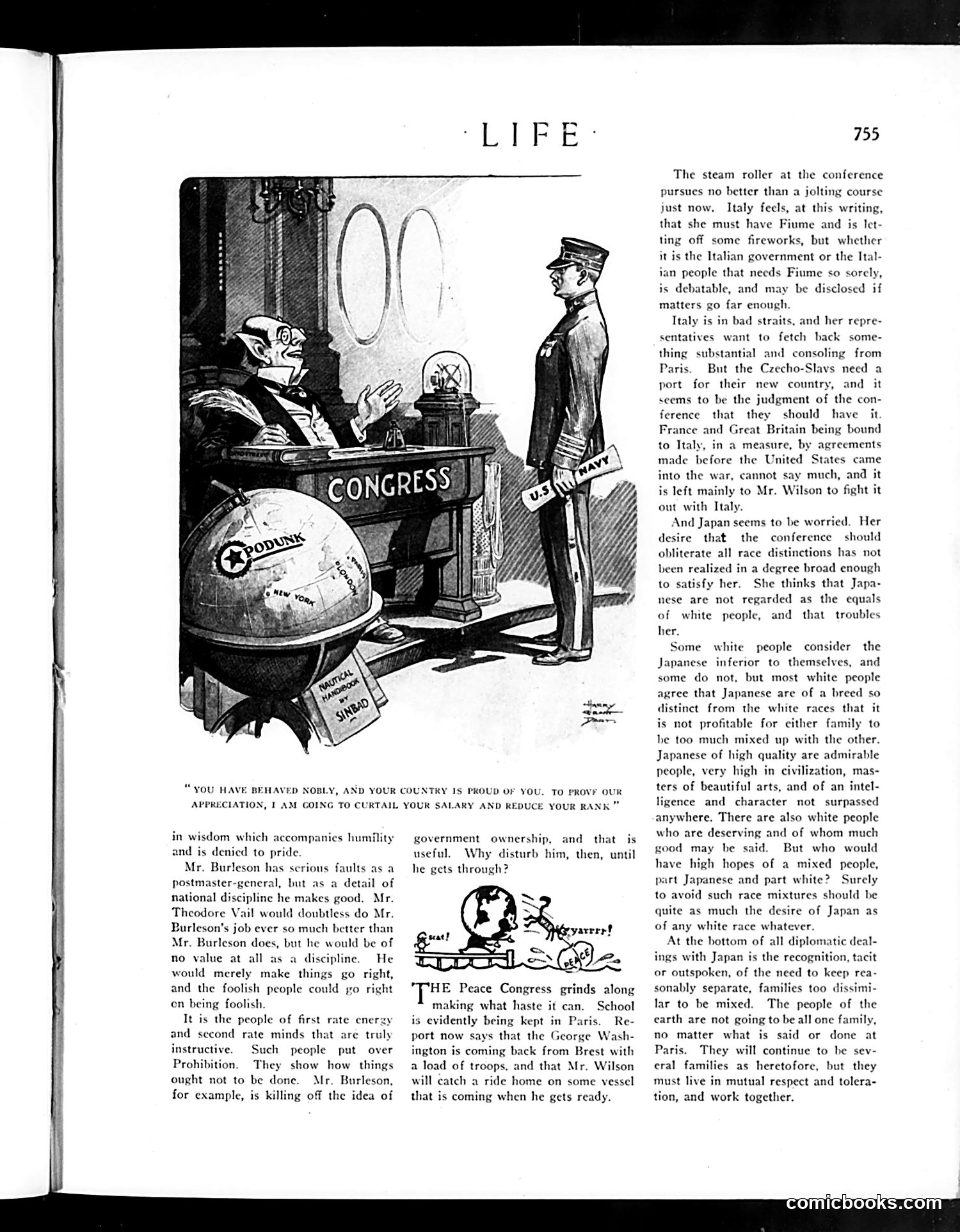
The main cartoon depicts the **Peace Congress** (Paris Peace Conference, 1919) as a steam roller grinding ineffectually forward. A figure sits at a desk labeled "CONGRESS" while a military officer stands nearby. The satire mocks the conference's slow, clumsy progress in post-WWI negotiations. The accompanying text discusses specific diplomatic tensions: **Italy's demands for Fiume**, **Japan's frustration** that racial equality wasn't adequately addressed in conference agreements, and the broader challenge of managing competing national interests. The author argues these tensions are natural and that distinct racial/national "families" cannot be truly merged, despite good intentions. The caption quotes someone praising noble behavior while cutting salaries and rank—likely satirizing how nations reward wartime sacrifice inadequately. The page critiques both the conference's ineffectiveness and contemporary attitudes about race and national identity that would have been mainstream in 1919.
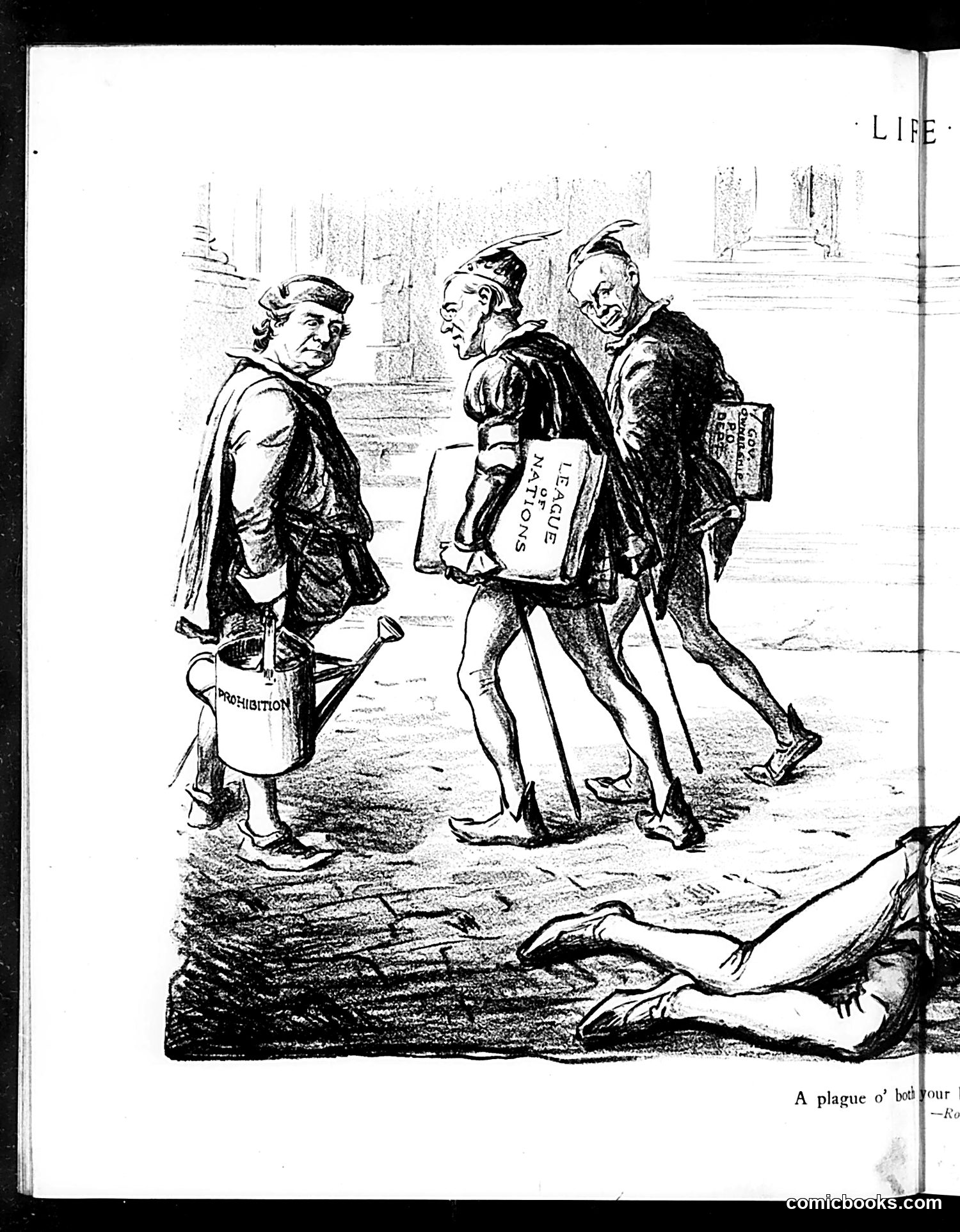
This is a satirical cartoon from *Life* magazine depicting three figures carrying large books labeled "LAWS" approaching a person lying on the ground labeled "PROHIBITION." The figure on the left wears a band marked "PROHIBITION" and appears weakened or defeated. The satire targets Prohibition-era lawmaking. The three figures—likely representing legislators or government officials—are shown burdened by the weight of new laws, while Prohibition itself lies prostrate, suggesting the policy has failed or is dying despite legislative efforts to sustain it. The caption "A plague o' both your houses" references Shakespeare's *Romeo and Juliet*, implying the proliferation of laws is itself a curse. This mocks the contradictions and failures of Prohibition enforcement through excessive legislation.
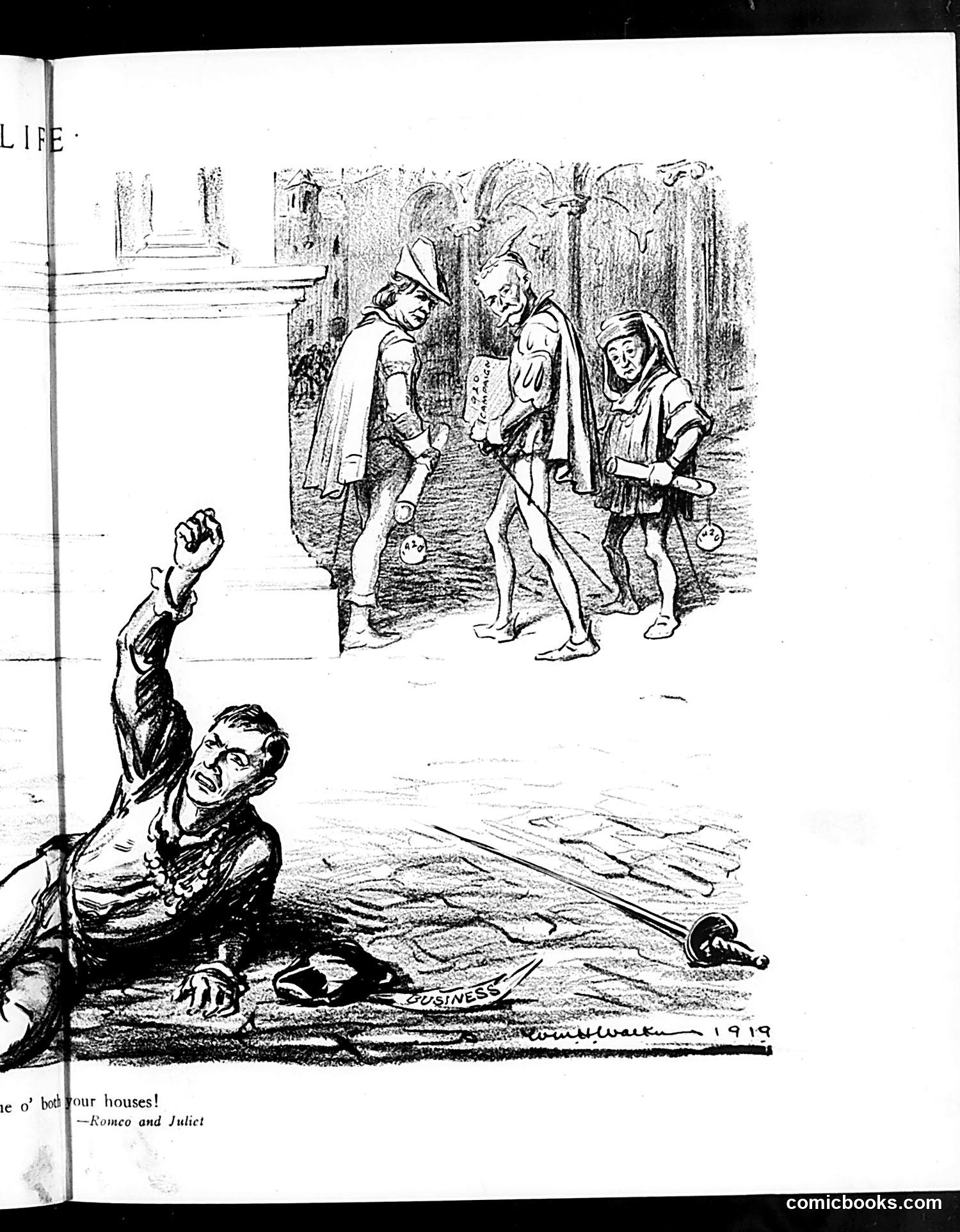
This cartoon satirizes business and labor conflict, likely from the World War I era (suggested by the 1918 date visible). A businessman labeled "BUSINESS" lies defeated on the ground with his fist raised, while children in the background appear to represent competing interests or factions (possibly labor, government, or opposing business groups). The Shakespeare quote "O' bot four houses!"—a misquote of Romeo and Juliet's feuding families—suggests the cartoon compares destructive business conflict to the tragic Montague-Capulet feud. The implication is that warring factions within the economy are destroying themselves through conflict, much as Shakespeare's rival families destroyed themselves through vendetta.
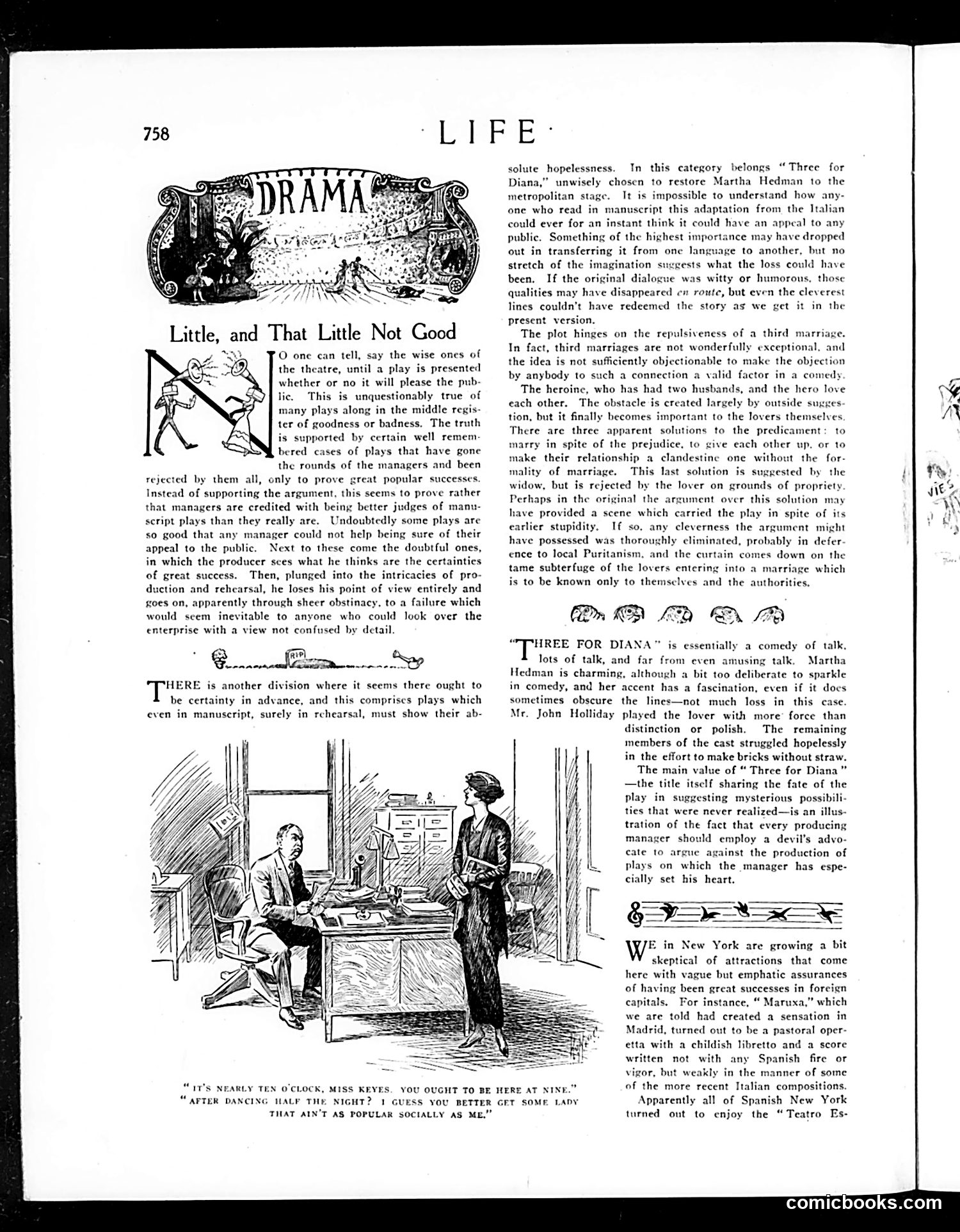
This is a theater review critiquing two plays. The main illustration shows a man and woman in an office—likely depicting a scene from "Three for Diana," the play being reviewed. The article argues that theatrical managers cannot reliably judge whether a script will succeed until it's produced. The author divides plays into categories: those clearly excellent, those clearly hopeless, and a middle group where judgment is uncertain. "Three for Diana" falls into the "hopeless" category. It's an Italian adaptation meant to revive actress Martha Hedman on the New York stage. The plot concerns a widow and her lover facing objections to their third marriage—a premise the critic finds insufficiently compelling for comedy. Though Hedman is charming, the dialogue is tedious. The critic suggests that something crucial was lost in translation from Italian, or that the script was altered to appease American "Puritanism," eliminating whatever merit the original possessed. The caption joke mocks a woman's social popularity interfering with her evening plans.
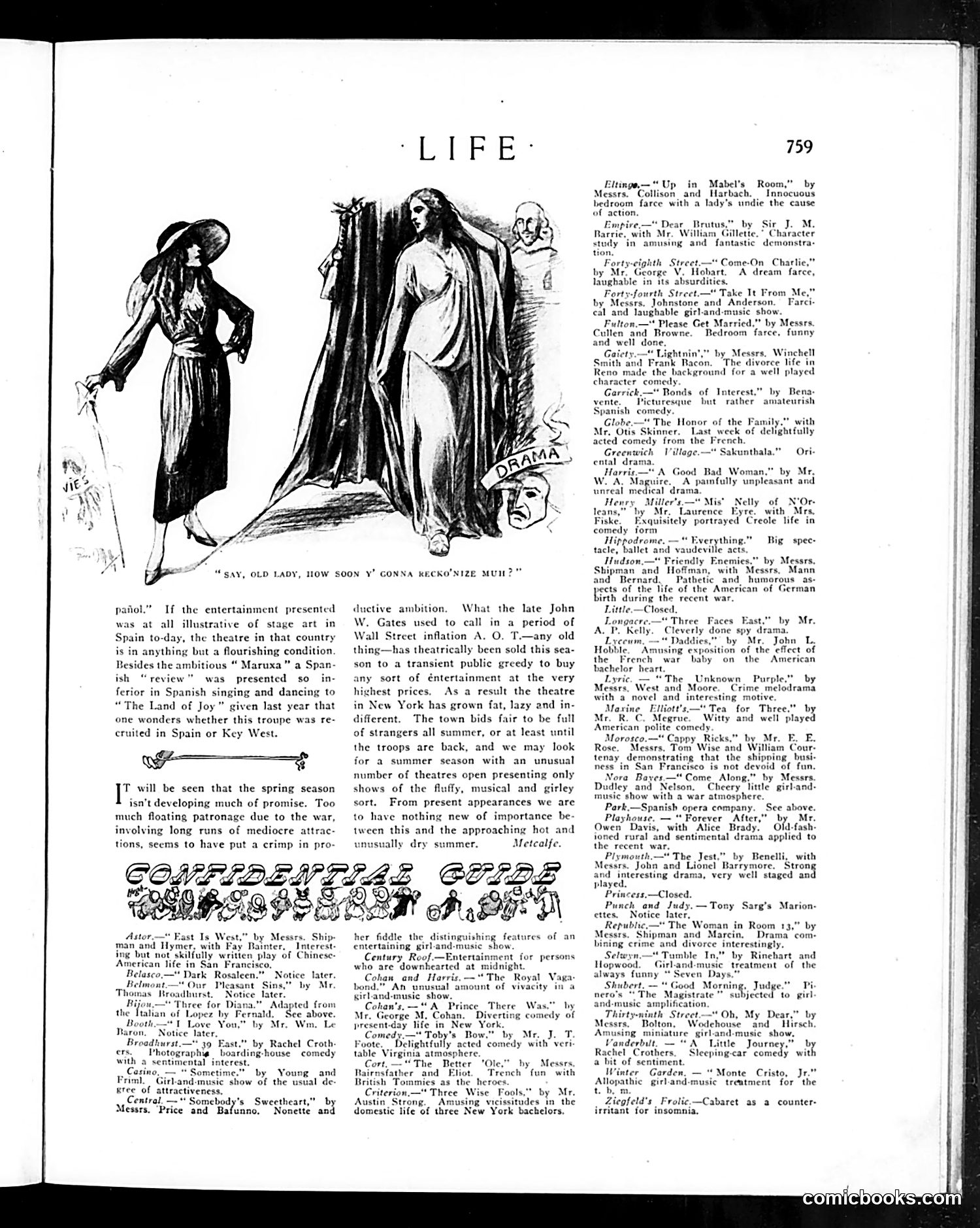
This page is primarily **theater criticism and reviews**, not a political cartoon. The single illustration at the top shows a woman in an elegant cloak speaking to an older woman, with the caption "Say, old lady, how soon y'gonna reckonize mul?" The cartoon appears to be a **racial or ethnic humor sketch** — likely mocking dialect speech and social class difference. The "old lady" seems to be a servant or working-class character, while the other is wealthier. This type of dialect humor was common in early 20th-century American entertainment but would be considered offensive today. The bulk of the page comprises theater **reviews of Broadway shows**, criticizing the current spring season (likely 1918-1919, given mention of "the war" and troops). The critic **Metcalf** argues New York theater has become lazy and mediocre, catering to war-displaced audiences buying cheap entertainment at high prices rather than serious drama.
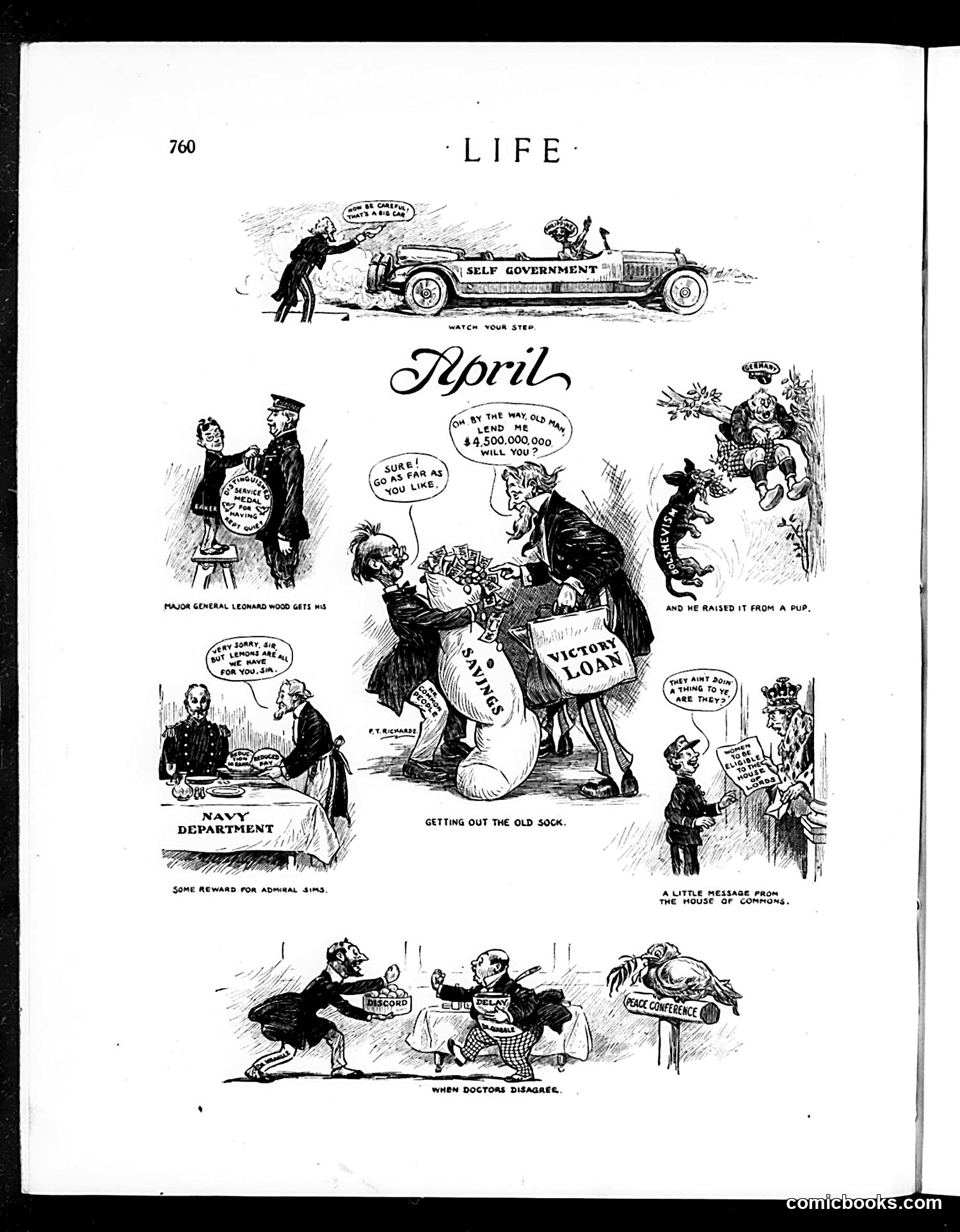
This page collects British political cartoons satirizing WWI-era governance. The top cartoon mocks "Self Government" as a precarious vehicle requiring careful navigation. Central scenes ridicule war financing: a figure asks for a $4.5 billion loan while another promises rewards for admirals. "Getting Out the Old Sock" depicts politicians extracting resources from a Victory Loan. The "Navy Department" sketch and "House of Commons" message lampoon bureaucratic inefficiency and conflicting authority. The bottom panel, "When Doctors Disagree," shows quarreling figures labeled with war-related terms, suggesting government leadership at odds over policy. Overall, the cartoons critique British wartime administration—excessive spending, inter-departmental confusion, and political disagreement—while citizens bear the costs. The tone is sharply satirical toward those managing the war effort.
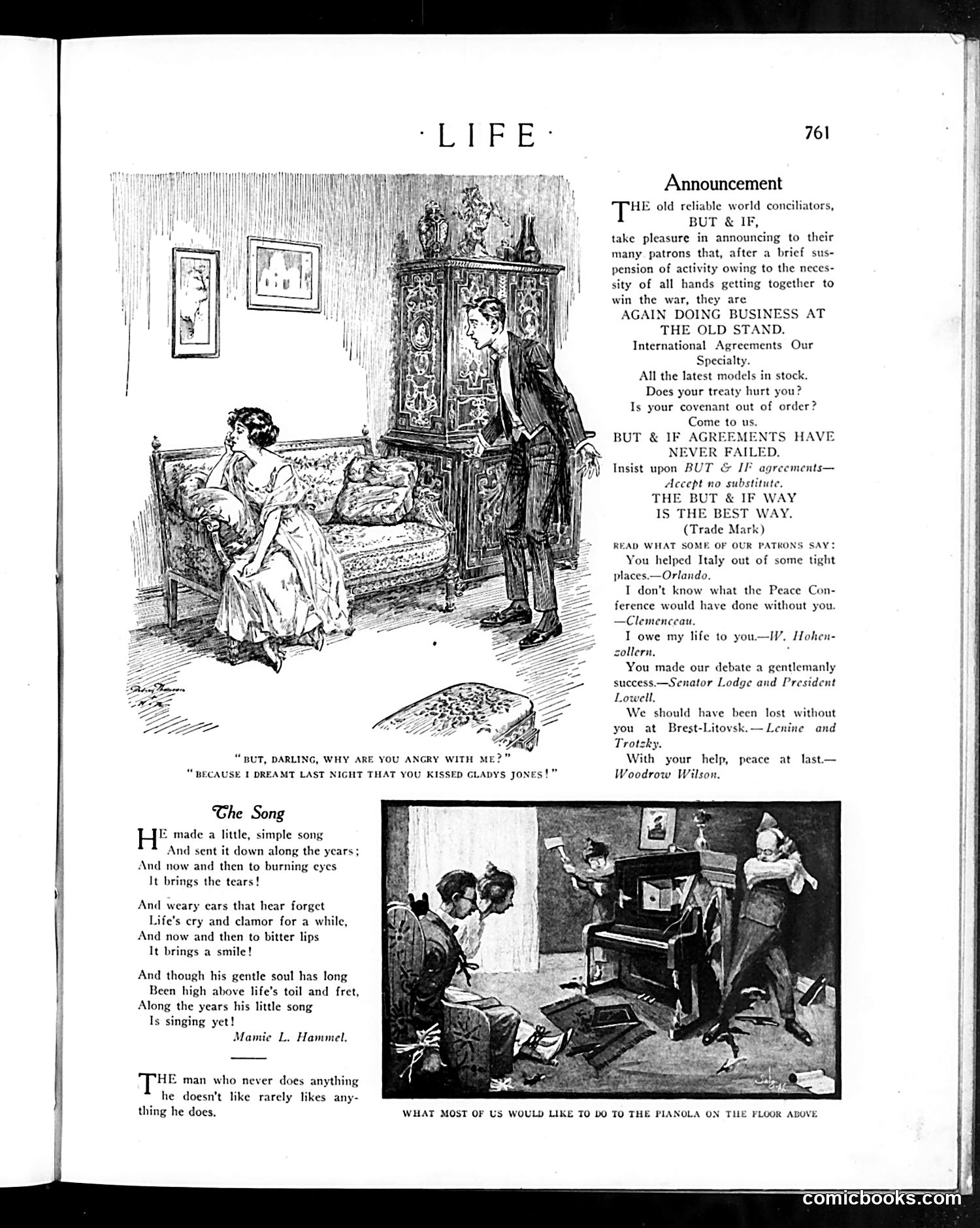
This page contains post-WWI satirical content. The central "Announcement" mocks international peace negotiations by presenting "BUT & IF" as comedic "world conciliators"—a fake firm offering treaty-fixing services. The joke references actual WWI peace figures: Orlando (Italy), Clemenceau (France), Hohenzollern (Germany's Kaiser), Lodge and Lowell (American politicians), Lenin and Trotsky (Russia), and Woodrow Wilson (U.S. President). These leaders are humorously portrayed as clients needing diplomatic help, satirizing how fragile and contentious post-war agreements were. The firm's slogan—"BUT & IF agreements have never failed"—ironically undercuts real peace efforts by suggesting all treaties require endless qualifications and exceptions. The cartoon above shows a domestic marital dispute over a dream, providing lighter humor contrasting the serious international tensions discussed below.
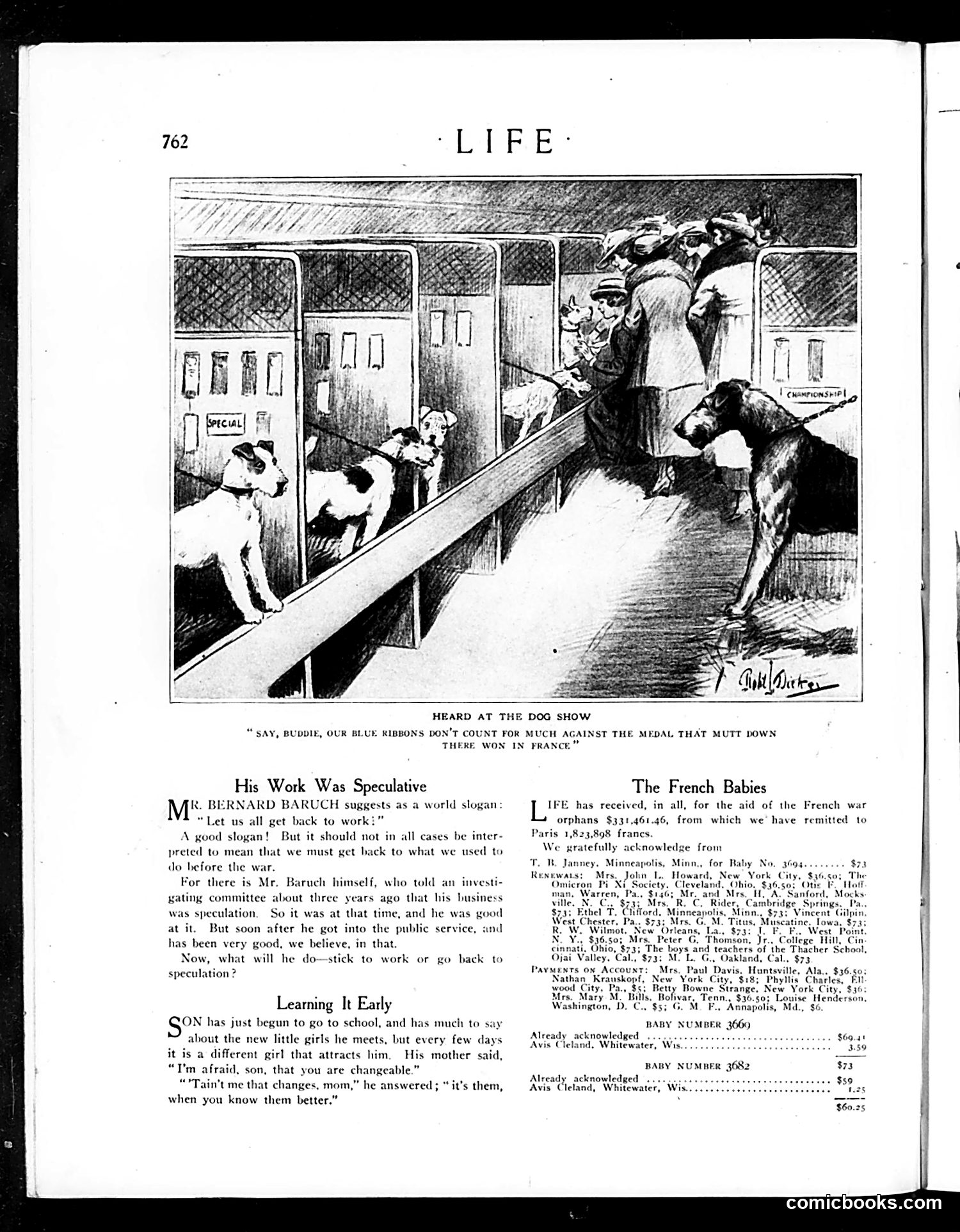
**The Cartoon ("Heard at the Dog Show"):** This satirical cartoon depicts dogs at a dog show. One dog with a blue ribbon tells another that their ribbons "don't count for much against the medal that mutt down there won in France." The joke mocks competitive pride by suggesting a dog's wartime service medal outranks show ribbons—a post-WWI commentary on how military sacrifice overshadows peacetime accomplishments. **The Text Articles:** - **"His Work Was Speculative"**: Critiques Bernard Baruch (a prominent financier/government advisor) for advocating "get back to work" while his own pre-war career was speculation. The piece questions whether he'll return to speculation after public service. - **"Learning It Early"**: A humorous anecdote about a boy claiming girls are "changeable," not him—satirizing male fickleness disguised as female inconstancy. - **"The French Babies"**: Acknowledgment of donations to French war orphans, totaling over $331,000 raised. The page reflects immediate post-WWI American culture: questioning whether society should return to pre-war practices, honoring wartime sacrifice, and addressing European humanitarian needs.
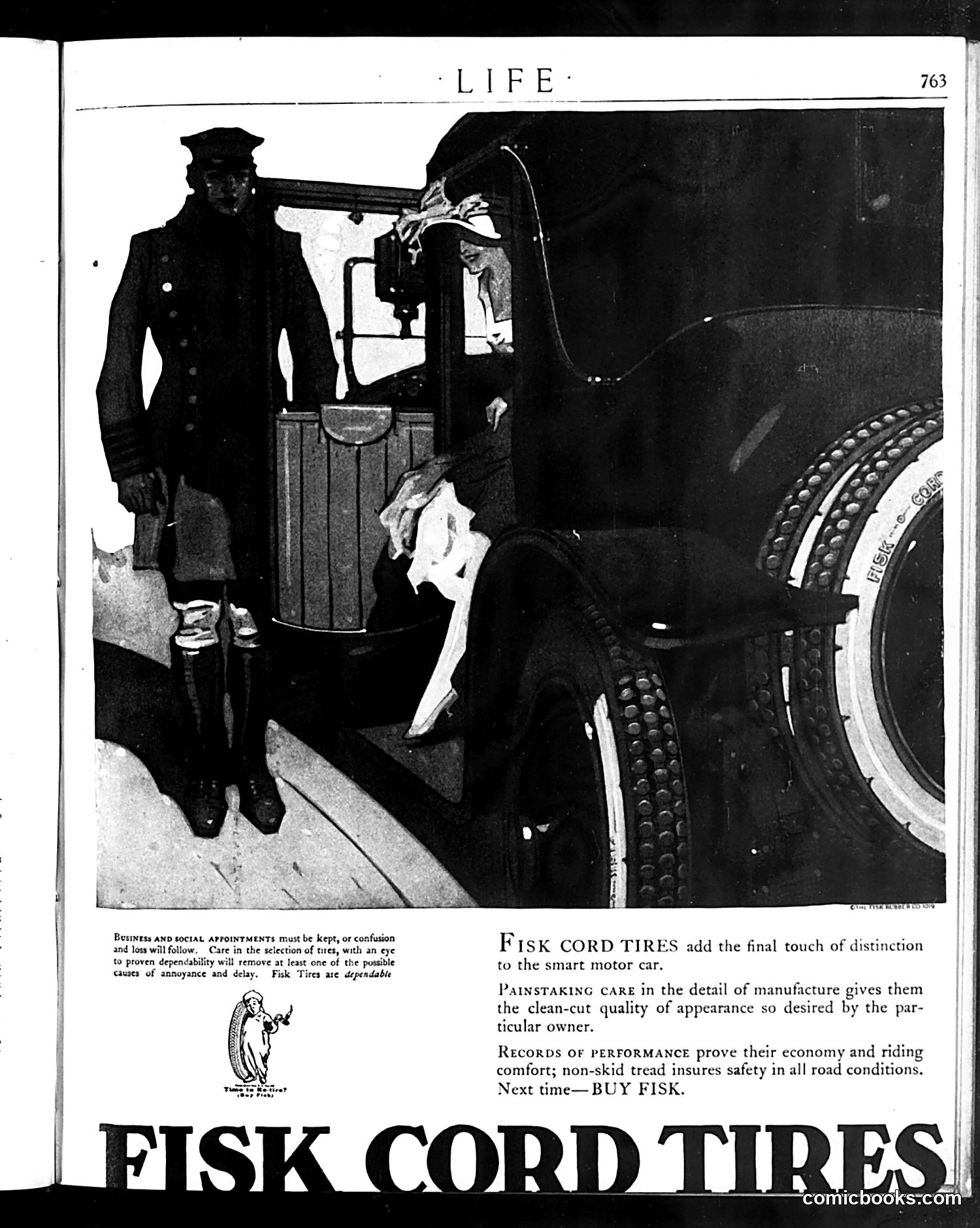
This is primarily a **tire advertisement**, not political satire. The page features a photograph of a chauffeur and elegantly dressed woman beside an early automobile, promoting Fisk Cord Tires. The ad's appeal targets **upper-class motorists** concerned with maintaining social respectability. The text emphasizes that tire reliability prevents "annoyance and delay" to important "business and social appointments"—suggesting that a flat tire would be socially embarrassing for the affluent. The imagery—a uniformed chauffeur attending to passengers—reinforces that this product serves the wealthy. The copy stresses "clean-cut quality of appearance" and "records of performance," marketing reliability as a mark of distinction and dependability. The small Fisk company logo (a cherub figure) appears at bottom left. This is straightforward commercial messaging exploiting early-20th-century anxieties about automobile reliability and class status, with no satirical intent.
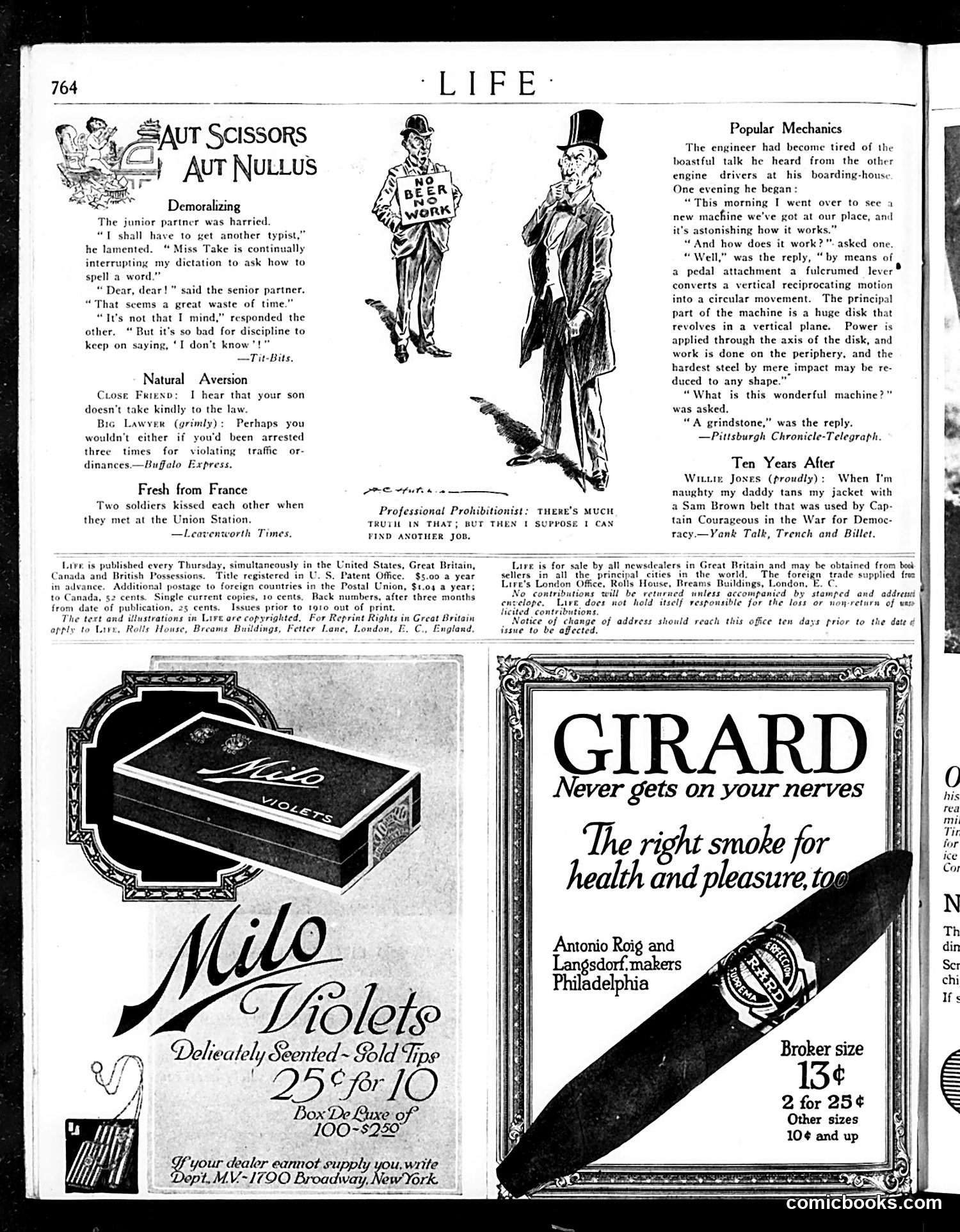
This page contains several short humorous anecdotes typical of *Life* magazine's satirical humor: **"Demoralizing"** mocks office inefficiency: a junior partner complains his typist constantly interrupts work asking how to spell words, wasting time. **"Natural Aversion"** jokes about a lawyer's son refusing to study law—the father grimly notes the boy was arrested three times for traffic violations, so he's already experienced legal consequences firsthand. **"Fresh from France"** is a brief WWI-era joke about soldiers kissing upon reunion at Union Station. **"Professional Prohibitionist"** references Prohibition-era attitudes: a prohibitionist admits he'd encourage someone to find "another job" rather than continue drinking, implying people will simply shift vices. **"Ten Years After"** presents a father proudly recounting using a military Sam Brown belt (officer's equipment) to discipline his son—reflecting period attitudes toward corporal punishment. The page also contains period advertisements for Milo Violets candy and Girard cigars. These anecdotes reflect early 20th-century workplace dynamics, WWI context, Prohibition debates, and parenting norms now considered outdated.
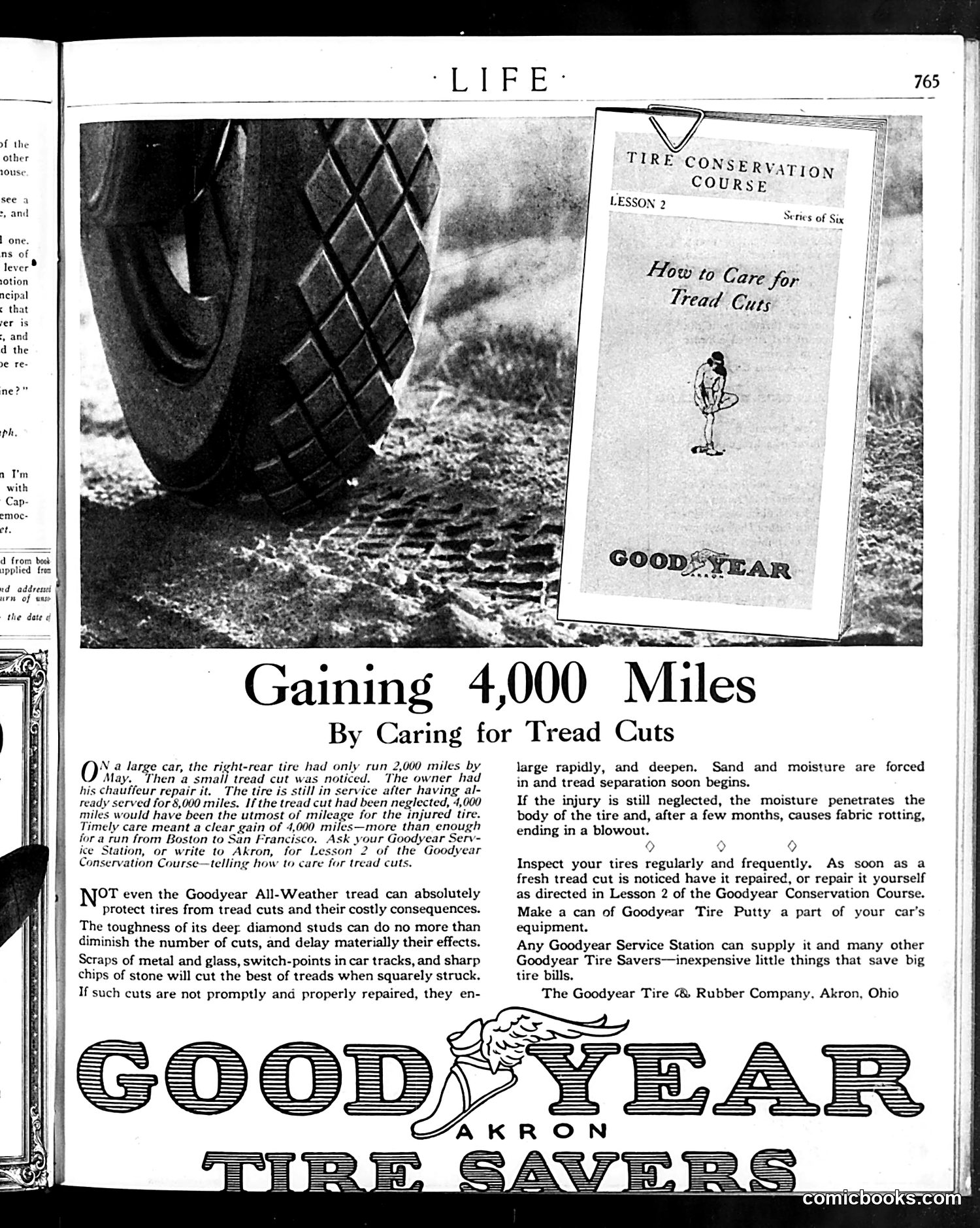
This is a **Goodyear tire advertisement**, not political satire. It appears in *Life* magazine's advertising section (page 765). The content promotes tire maintenance and Goodyear's conservation products during what was likely a period of tire rationing or concern about tire longevity (possibly WWI or WWII era, given the emphasis on extending tire life). The advertisement uses a concrete example: a car owner's right-rear tire, cut at 2,000 miles, was repaired and then ran an additional 8,000 miles—a 4,000-mile gain. The comparison to a Boston-to-San Francisco journey emphasizes the practical value. The "Tire Conservation Course" (Lesson 2 advertised here) teaches proper tread-cut repair. Goodyear promotes "Tire Putty" and other inexpensive maintenance products as ways to prevent costly blowouts from neglected cuts. There is no satire or political commentary—this is straightforward commercial messaging about practical tire care and product sales.
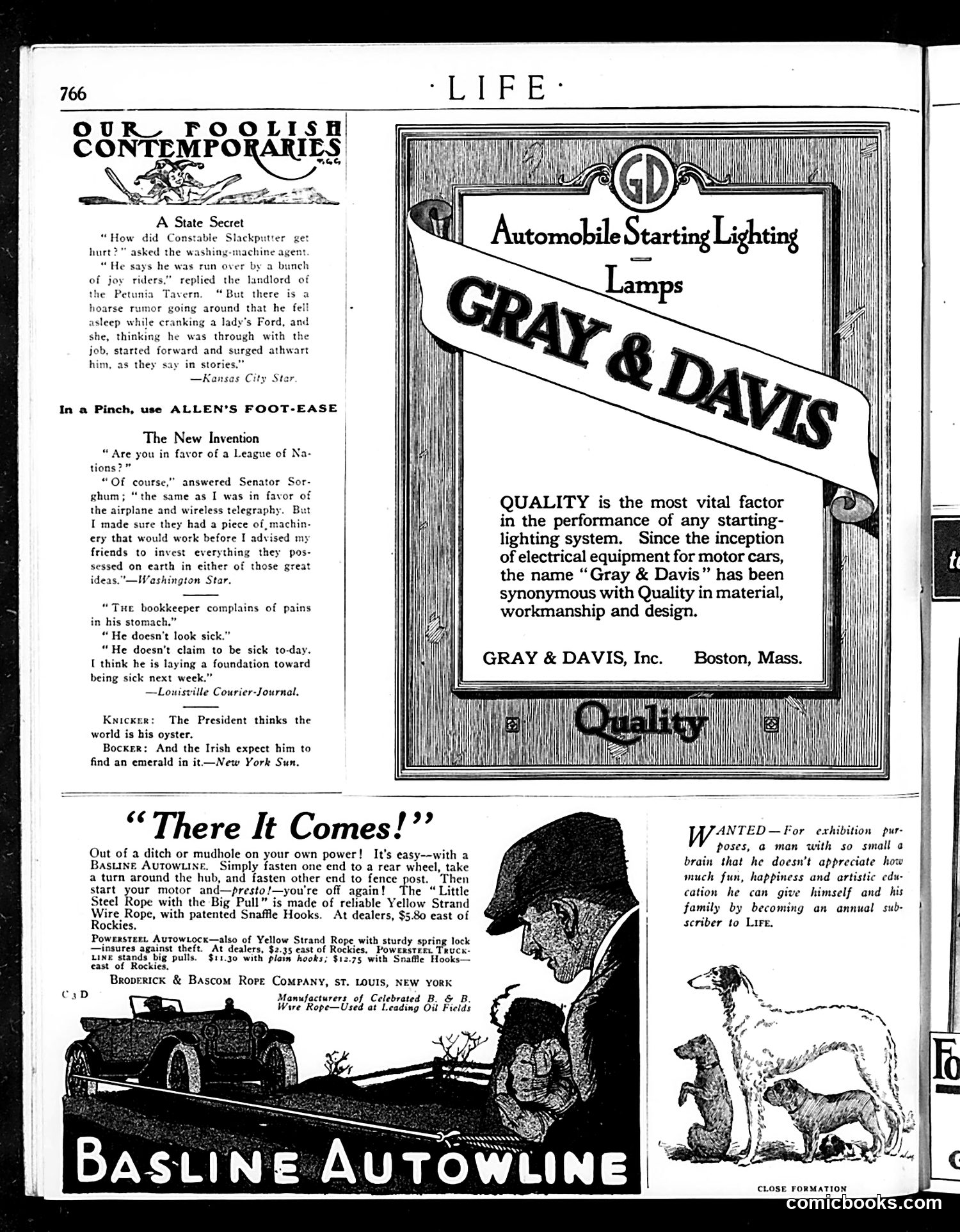
This page is primarily **advertising with satirical humor sections** rather than traditional editorial cartoons. The "Our Foolish Contemporaries" section mocks contemporary absurdities through brief anecdotes: 1. **The Ford cranking incident**: Satirizes early automobile dangers—a man is run over by a lady's Ford while hand-cranking it (the manual starting method for early cars). The joke ridicules both careless drivers and the hazards of primitive automobile operation. 2. **Senator Sorghum's "New Invention"**: Mocks politicians' reflexive support for trendy innovations (League of Nations, airplanes, wireless) without understanding them—Sorghum admits he backed inventions before ensuring they actually worked. 3. **The President's "oyster" joke**: A political quip suggesting President Wilson treats the world as his possession, while the Irish expect him to solve their independence ("find an emerald"). The rest of the page contains product advertisements (Gray & Davis lamps, Basline Autowinch rope, Allen's Foot-Ease) and a humorous recruitment ad for Life magazine subscribers mocking people with small brains. The humor reflects post-WWI American anxieties about technology, political leadership, and Irish-American concerns.
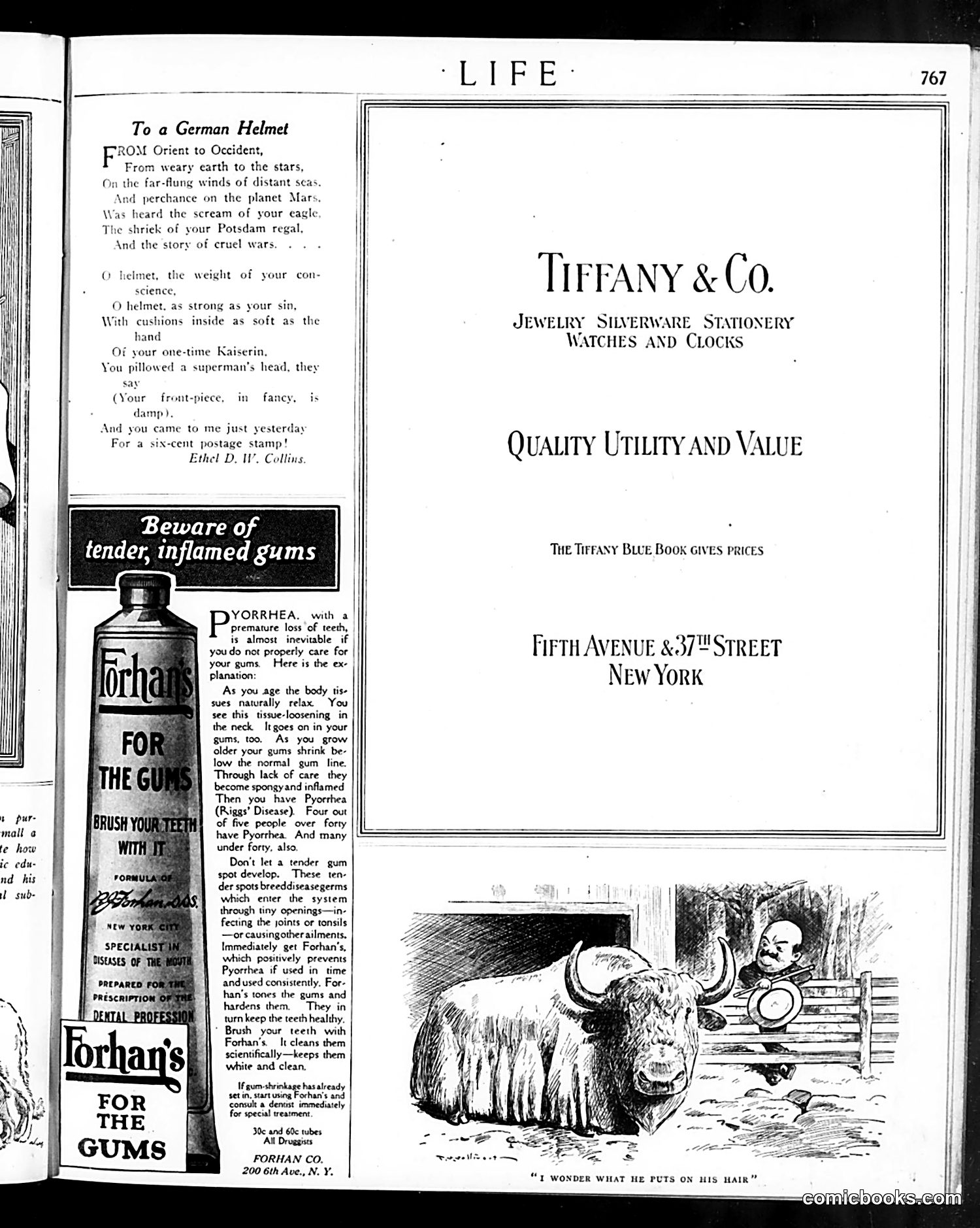
This page contains a satirical poem "To a German Helmet" by Ethel D. W. Collins, likely published during or shortly after World War I. The poem mocks a defeated Germany by imagining a German military helmet—symbol of Prussian militarism and the Kaiser's power—reduced to such poverty that it arrives at the poet's door seeking a six-cent postage stamp. References to "Potsdam regal" and "superman's head" evoke German imperial pretensions, while the damp front-piece suggests humiliation. The cartoon below (captioned "I wonder what he puts on his hair") shows a baby riding a cow, a visual non-sequitur that appears unrelated to the poem's anti-German sentiment. The remainder is commercial advertising for Tiffany & Co. jewelry and Forhan's toothpaste—standard magazine content of the era.
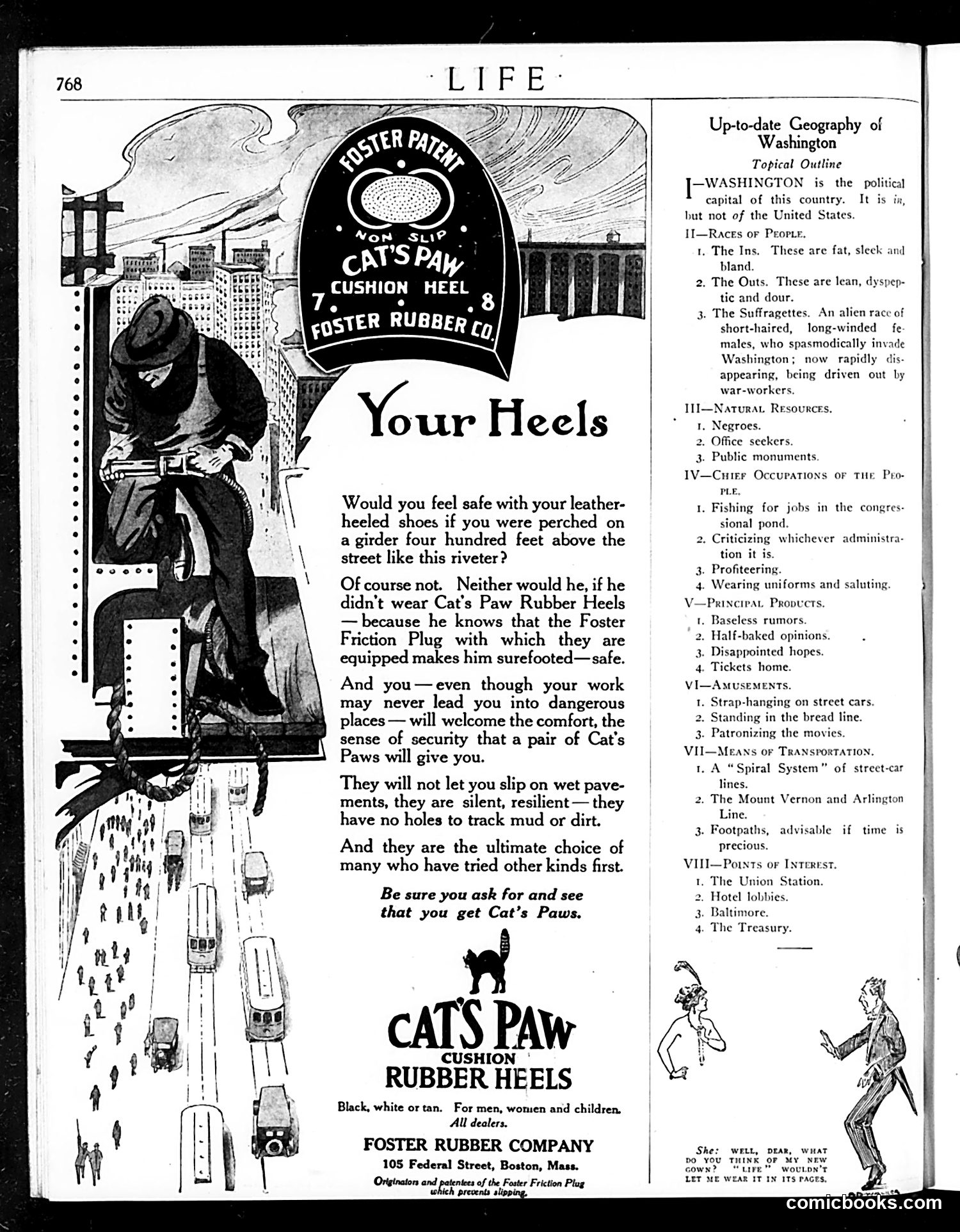
**Main Advertisement:** This page is dominated by a Foster Rubber Company ad for "Cat's Paw Cushion Rubber Heels," featuring an illustration of a worker perched on a high steel girder. The ad uses industrial safety and sure-footedness as its selling point—the visual metaphor being that if rubber heels keep a riveter safe at dangerous heights, they'll provide security for everyday pedestrians on wet pavements. **Satirical Content (Right Column):** Below the ad is a humorous "Up-to-date Geography of Washington," a topical outline that mocks Washington D.C. as a separate entity ("in, but not of the United States"). It catalogs the city's inhabitants—"The Ins" (fat politicians in power), "The Outs" (lean opposition), and "Suffragettes" (characterized as an "alien race" being displaced by war-workers). The piece satirizes Washington occupations (congressional job-hunting, profiteering, criticizing administrations) and "amusements" (bread lines, movies). **Context:** This reflects WWI-era American politics and attitudes toward women's suffrage, which was still contentious.
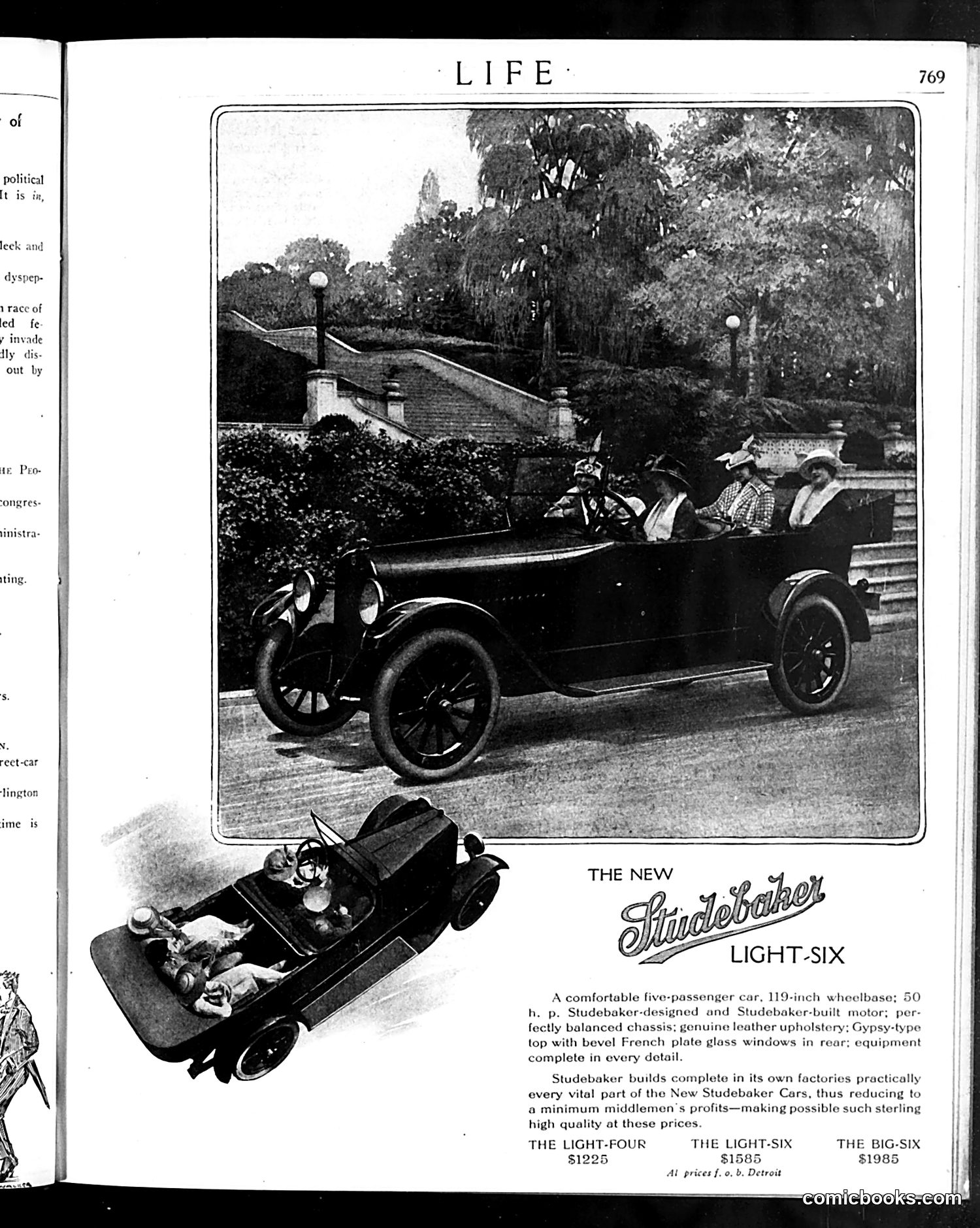
This page is **primarily an automobile advertisement**, not political satire. It promotes the new Studebaker Light-Six car through two images: a photograph of the vehicle in an elegant park setting with well-dressed passengers, and an illustrated diagram showing the car's mechanical components. The ad emphasizes quality and value—Studebaker's vertical integration (building "complete in its own factories practically every vital part") supposedly reduces middlemen's profits, allowing "sterling high quality at these prices." The three price points ($1,225–$1,985) suggest different models. The fragmentary text on the left margin appears to be from an unrelated article about politics or social issues, but it's too incomplete to interpret meaningfully. There is **no cartoon or satire evident** on this page—it is straightforward commercial advertising typical of early 20th-century magazines like Life, which regularly mixed editorial content with paid advertisements.
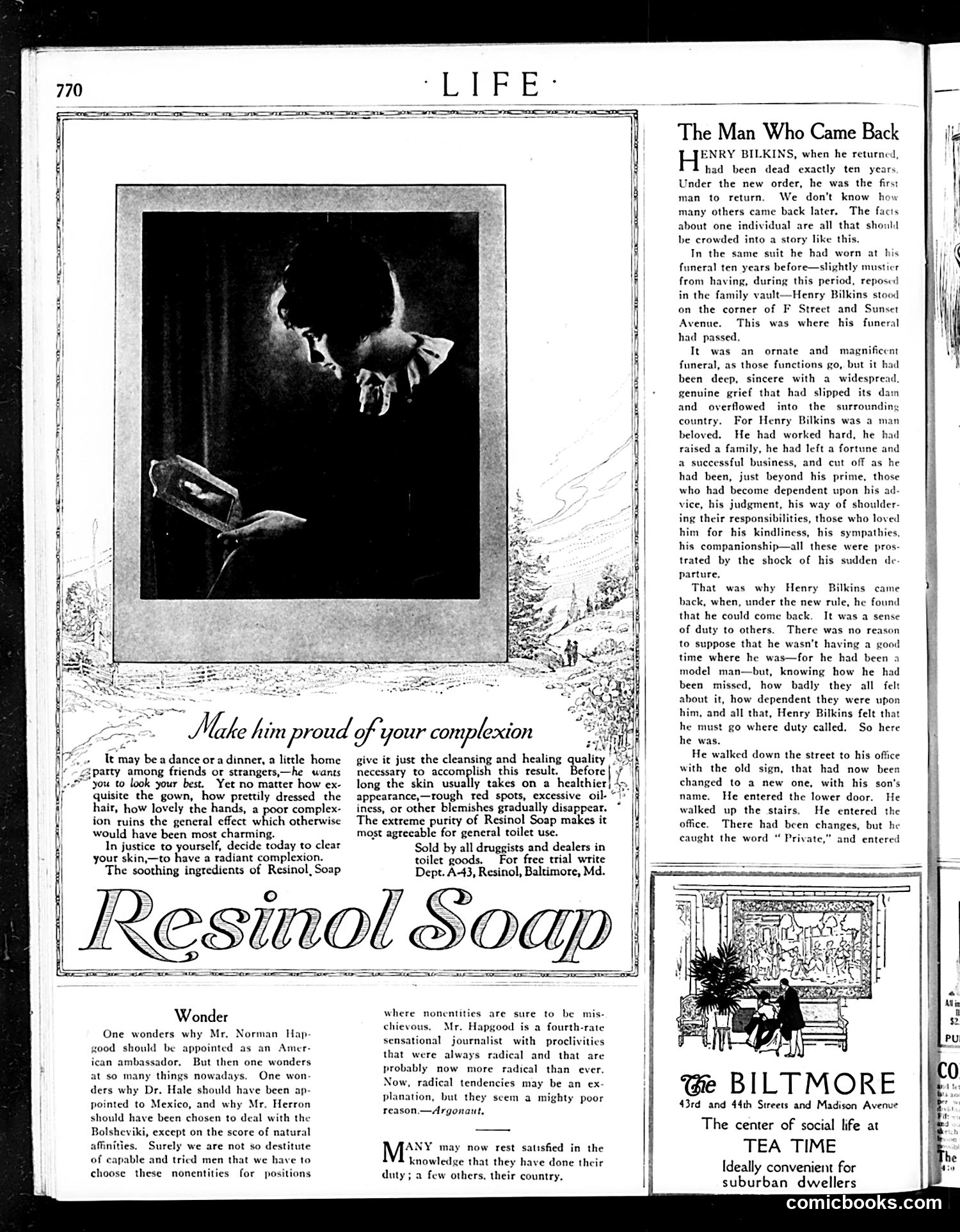
This page contains two distinct elements: **The Resinol Soap Advertisement** dominates the left side, featuring a dramatic photograph of a woman's face in profile. The ad uses typical early-20th-century beauty marketing: it promises that good complexion makes one presentable at social events and that Resinol Soap will cure skin blemishes. This reflects period beauty standards and consumer advertising conventions. **"Wonder" Editorial** (center-bottom) mocks recent American diplomatic appointments, naming Norman Hapgood, Dr. Hale, and Mr. Herron as unqualified "nonentities" appointed to ambassador and diplomatic posts. The author sarcastically questions why capable men weren't chosen instead, suggesting these appointees' radical political leanings made them poor choices for sensitive diplomatic roles. **"The Man Who Came Back" Story** (right) begins a fictional narrative about Henry Bilkins, who returns from death after ten years under some unspecified "new order," driven by duty to his grieving family and dependents. The page reflects Progressive-Era political criticism and early consumer culture conventions.
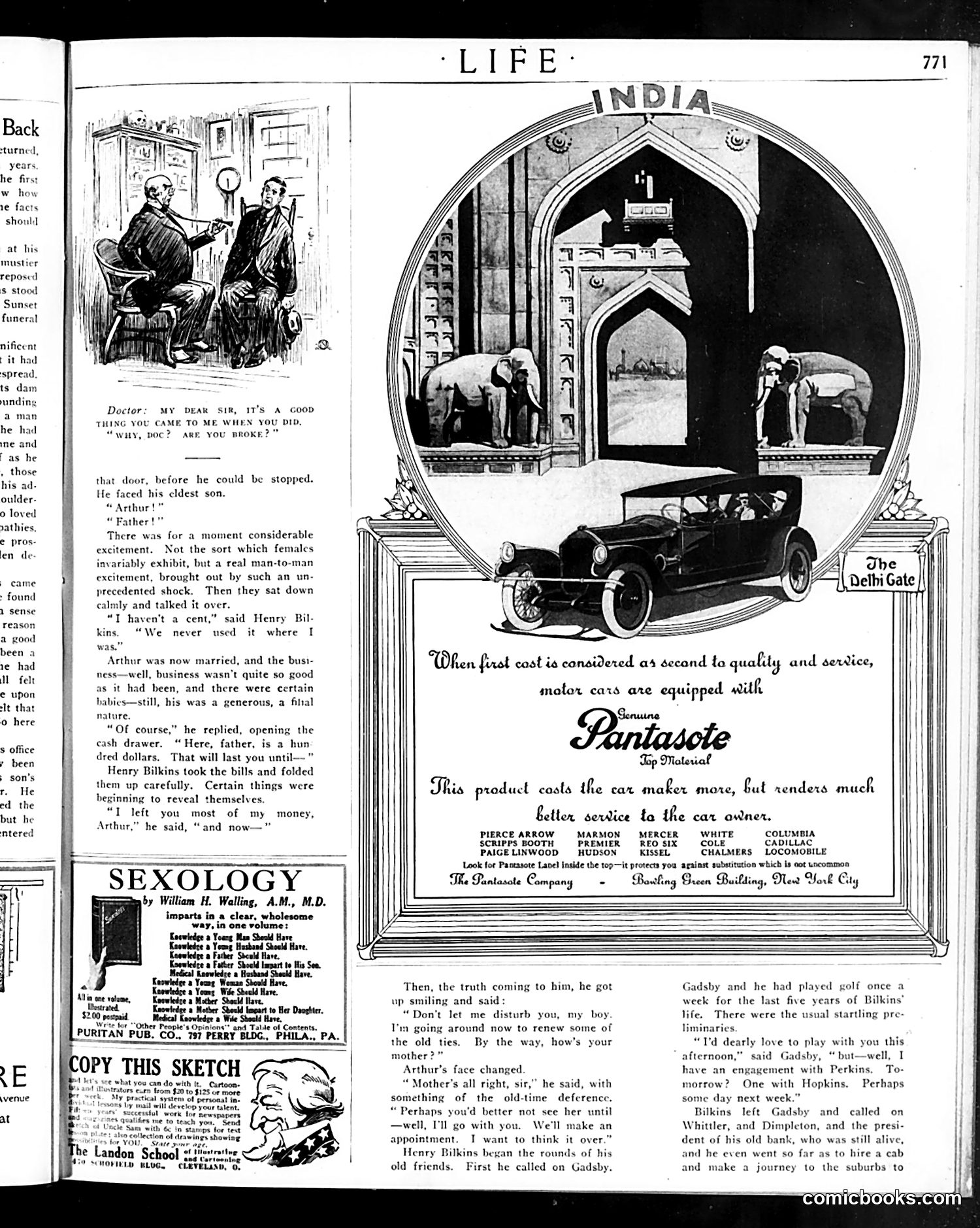
This page contains a serialized short story about Henry Bilkins, an estranged father reconnecting with his adult son Arthur after years of absence. The narrative centers on a poignant domestic moment: Bilkins returns home unexpectedly, discovers his son's financial struggles, and begins quietly reconnecting with old friends from his past life. The left-side cartoon shows a doctor's office scene illustrating the story's opening, where Bilkins seeks medical advice—a setup for his personal revelations. The dominant right-side element is a **Pantasote automobile advertisement** featuring India's Delhi Gate architecture, promoting a car upholstery product as evidence of quality and service. This juxtaposes commercial messaging with the serialized fiction—typical of Life's editorial layout during this era. The page reflects early 20th-century magazine format: literary fiction, comic illustrations, and full-page advertisements integrated together. The story emphasizes reconciliation and nostalgia rather than explicit satire or political commentary.
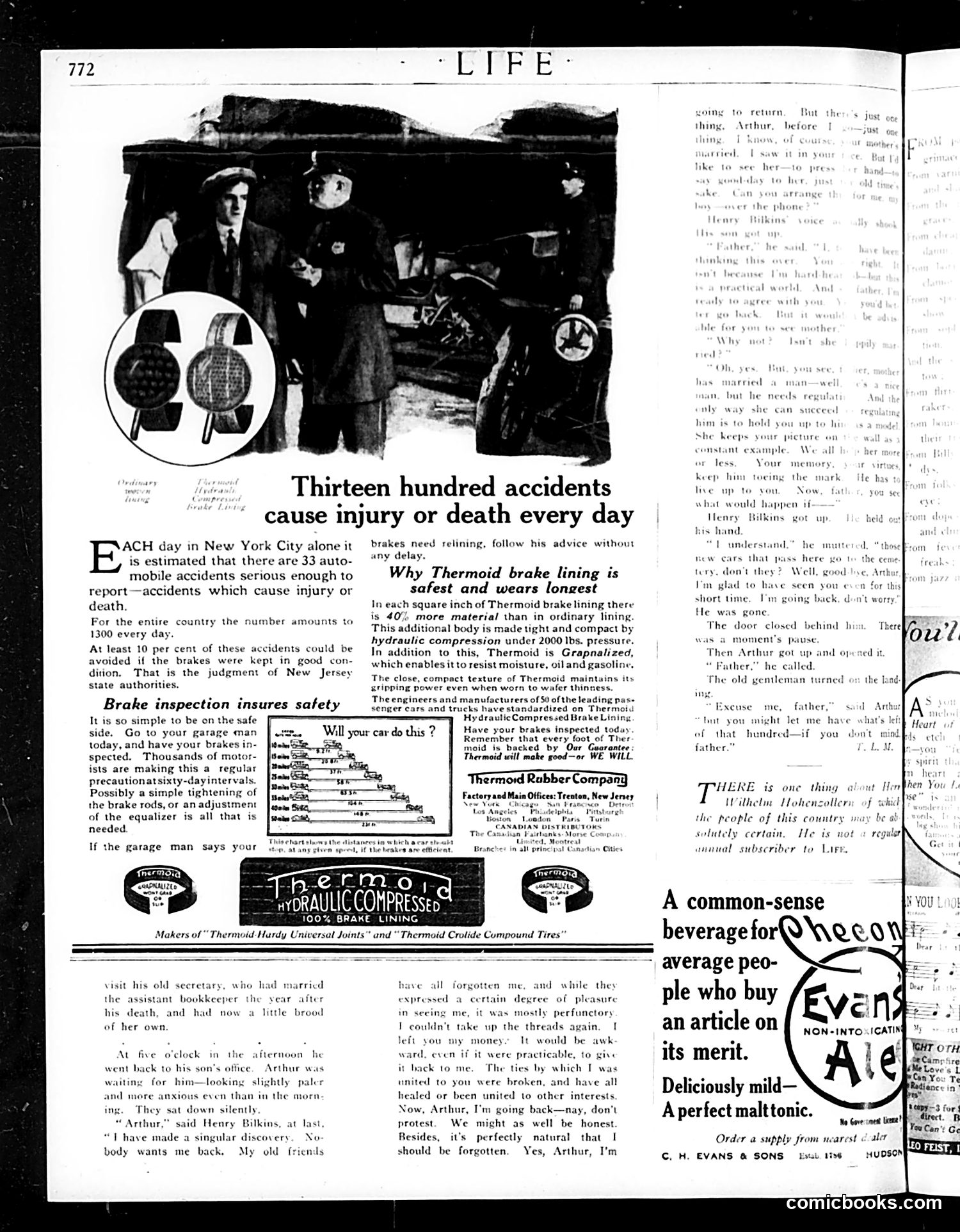
This page combines a **serious public safety campaign** with period advertising and serialized fiction. The dominant content is a Thermoid brake lining advertisement addressing a genuine 1920s-30s crisis: 1,300 automobile accidents daily in America, with 10% preventable through proper brake maintenance. The ad uses efficiency-focused messaging ("brake inspection insures safely") typical of the era's industrial safety movement, promoting Thermoid's hydraulic-compressed lining as superior. The accompanying fiction narrative depicts an elderly man (appears to be a returning figure from earlier in the serialized story) reconciling with his estranged son Arthur regarding inheritance and family obligations—a melodramatic domestic plot common to Life's serialized content. Bottom advertisements include "Even" (a malted beverage marketed as "common-sense" for ordinary consumers) and Evans & Sons liquor. The overall page reflects 1920s-30s American concerns: automotive safety consciousness, paternalistic corporate messaging, and sentimental family narratives alongside consumer goods marketing.
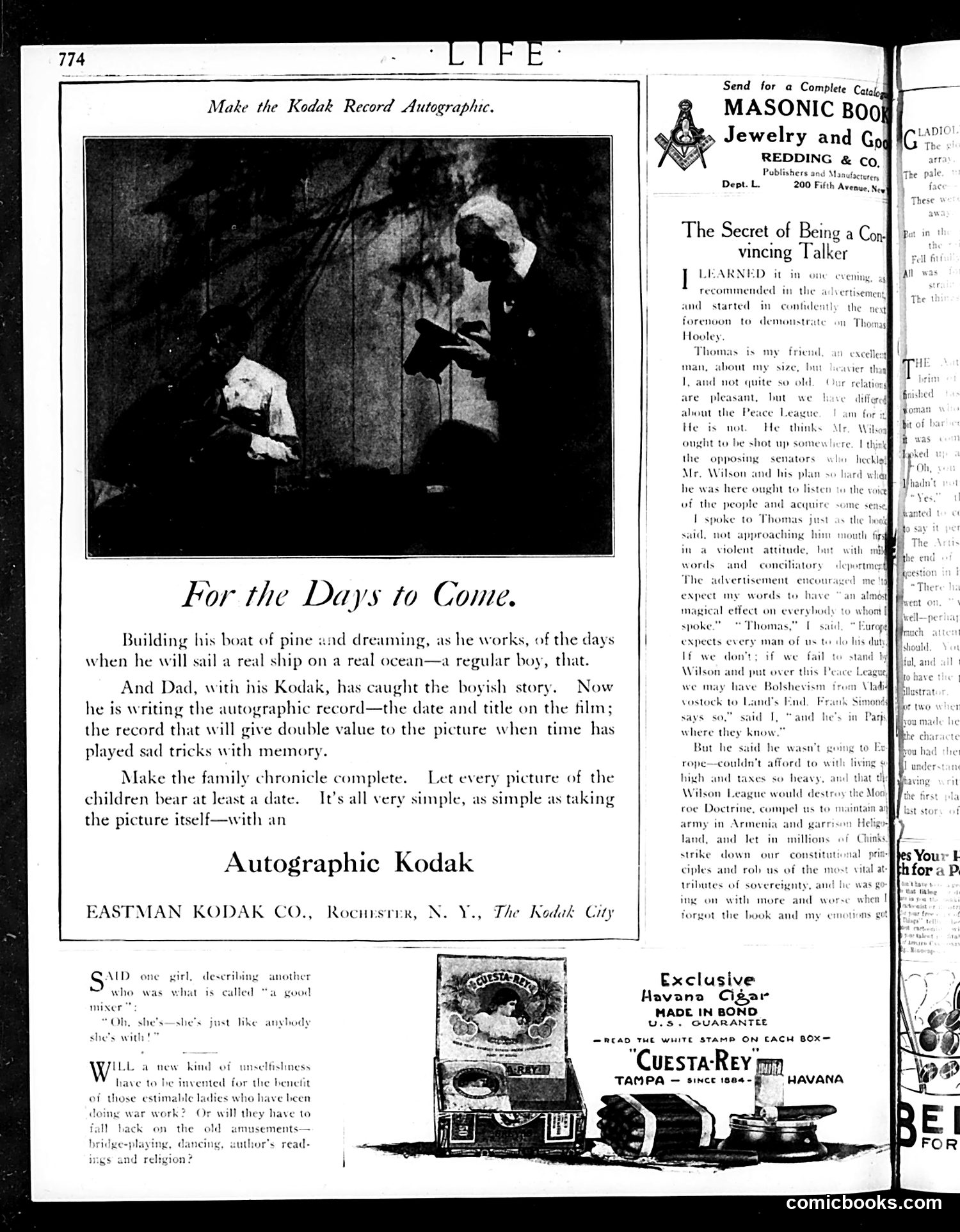
This page mixes advertising with social commentary on post-World War I America. **Main Content:** The left side features a Kodak advertisement encouraging families to document everyday moments with autographic cameras—creating "family chronicles" with dates recorded on film. The accompanying photo shows a father and son building a boat, illustrating nostalgia for simple domestic life. **The Political Satire:** The right side contains "The Secret of Being a Convincing Talker"—a commentary on political persuasion during the contentious post-war period. It references debates over Wilson's Peace League and concerns about Bolshevism (Soviet communism). The narrator describes attempting to convince his friend Thomas, a Peace League opponent, through mild rhetoric rather than confrontation, reflecting real divisions over America's post-war foreign policy. **The Subtext:** The juxtaposition suggests Life's anxiety: while families should preserve innocent moments with cameras, serious political divisions threaten the nation—stemming from war's aftermath and competing ideologies about America's global role. The bottom section's brief joke about women adjusting to peacetime implies concern that wartime social disruptions were becoming permanent.
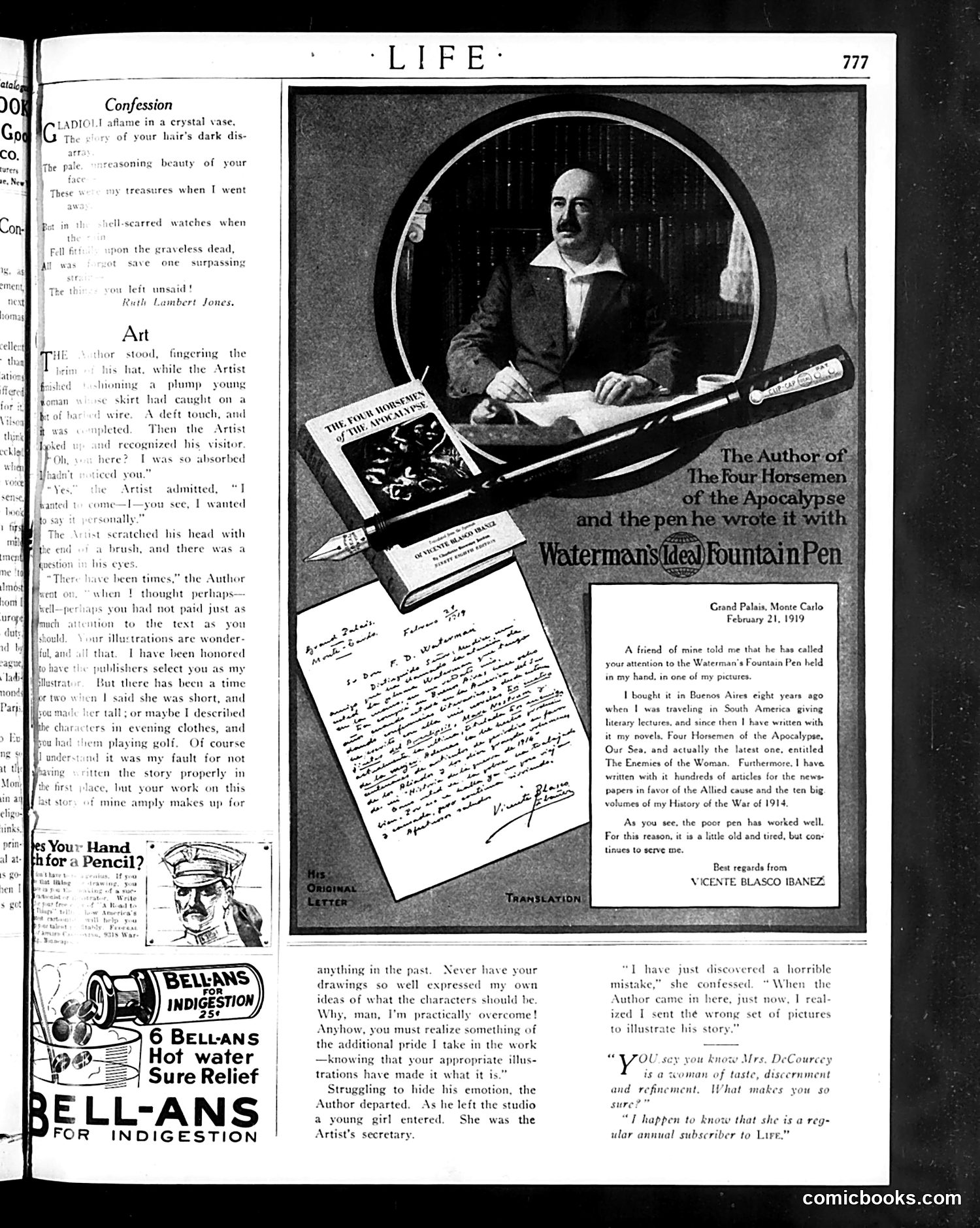
This page contains two distinct pieces of content: **The "Art" Story (left column):** A brief humorous narrative about an Author complimenting an Artist for perfectly illustrating his characters and story, unaware that the Artist's secretary has just revealed she sent the *wrong* set of illustrations to the publisher. The joke plays on the contrast between the Author's effusive praise and the actual mistake—suggesting that sometimes success masks incompetence. **The Advertisement (center/right):** A testimonial from Vicente Blasco Ibáñez, a Spanish author of popular novels like *The Four Horsemen of the Apocalypse*, endorsing a Waterman's Ideal Fountain Pen. Dated February 1919, he claims to have used the same pen for eight years while writing his novels and journalism supporting the Allied cause in WWI. This is vintage advertising leveraging a famous author's endorsement to sell fountain pens—a premium writing instrument essential before ballpoint pens existed. The page also includes a small advertisement for Bell-Ans antacid at the bottom left.
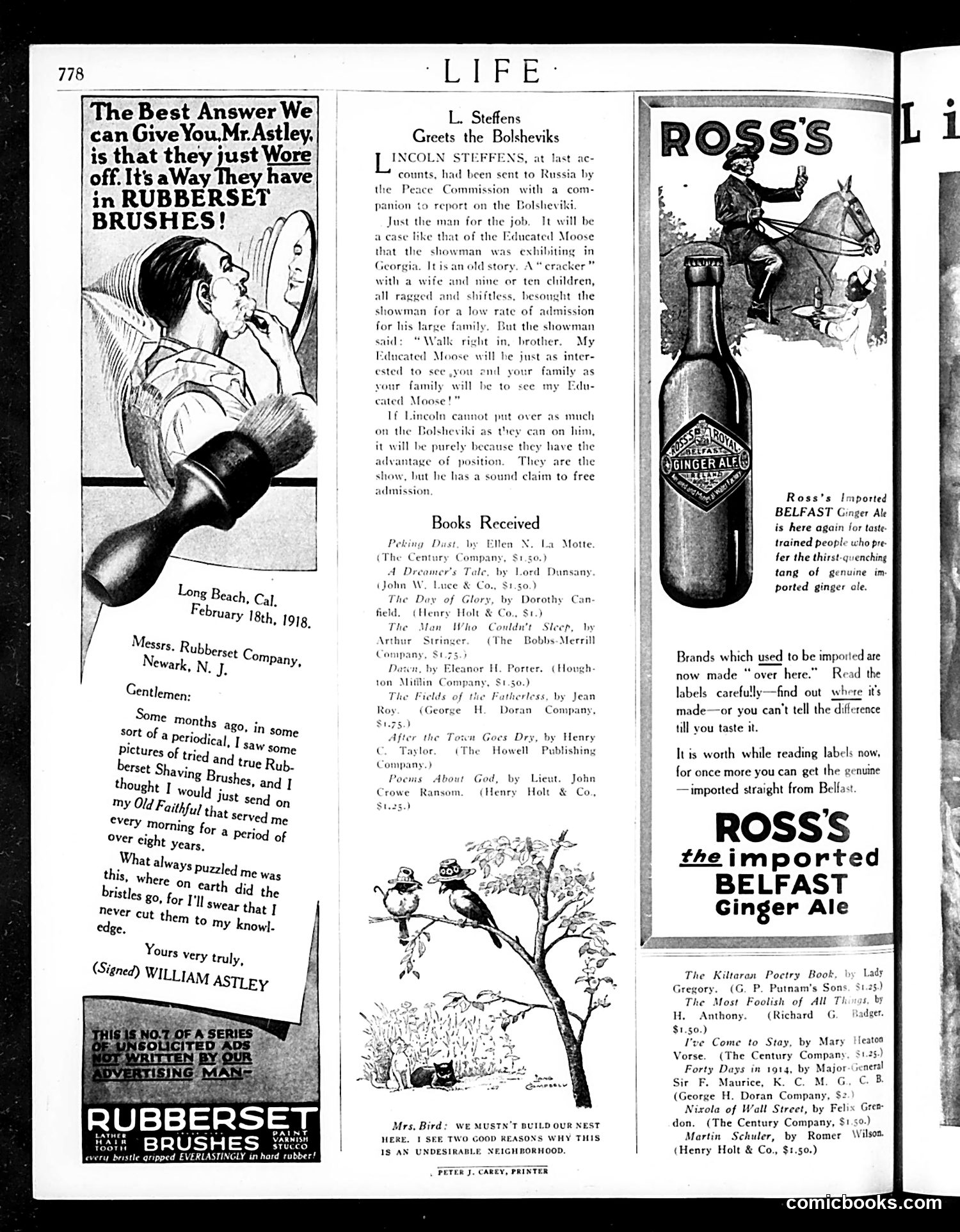
**The Rubberset Brushes Advertisement (Left):** This is a testimonial ad from a satisfied customer praising brush durability. William Astley claims his brushes lasted eight years without wearing out at the bristles—unusual for the era. The humor relies on the product's longevity; Astley puzzled over how the bristles never frayed, making the advertisement's claim of "everlasting" brushes seem genuinely remarkable for 1918. **"L. Steffens Greets the Bolsheviks" (Center):** This satirizes Lincoln Steffens (the famous muckraking journalist) being sent to Russia by the Peace Commission to observe the Bolsheviks. The satire compares this to exhibiting an "Educated Moose" in Georgia—suggesting Steffens will be used as a curiosity while the Bolsheviks (positioned as the superior "show") maintain the advantage. The joke mocks American naiveté about Soviet communism and Steffens' credibility as an observer. **Ross's Ginger Ale (Right):** A wartime advertisement promoting domestically-produced ginger ale as equivalent to imported Belfast brands, capitalizing on WWI-era "Buy American" sentiment.