
Life, 1919-05-01 · page 14 of 44
Life — May 1, 1919 — page 14: what you’re looking at
What you’re looking at
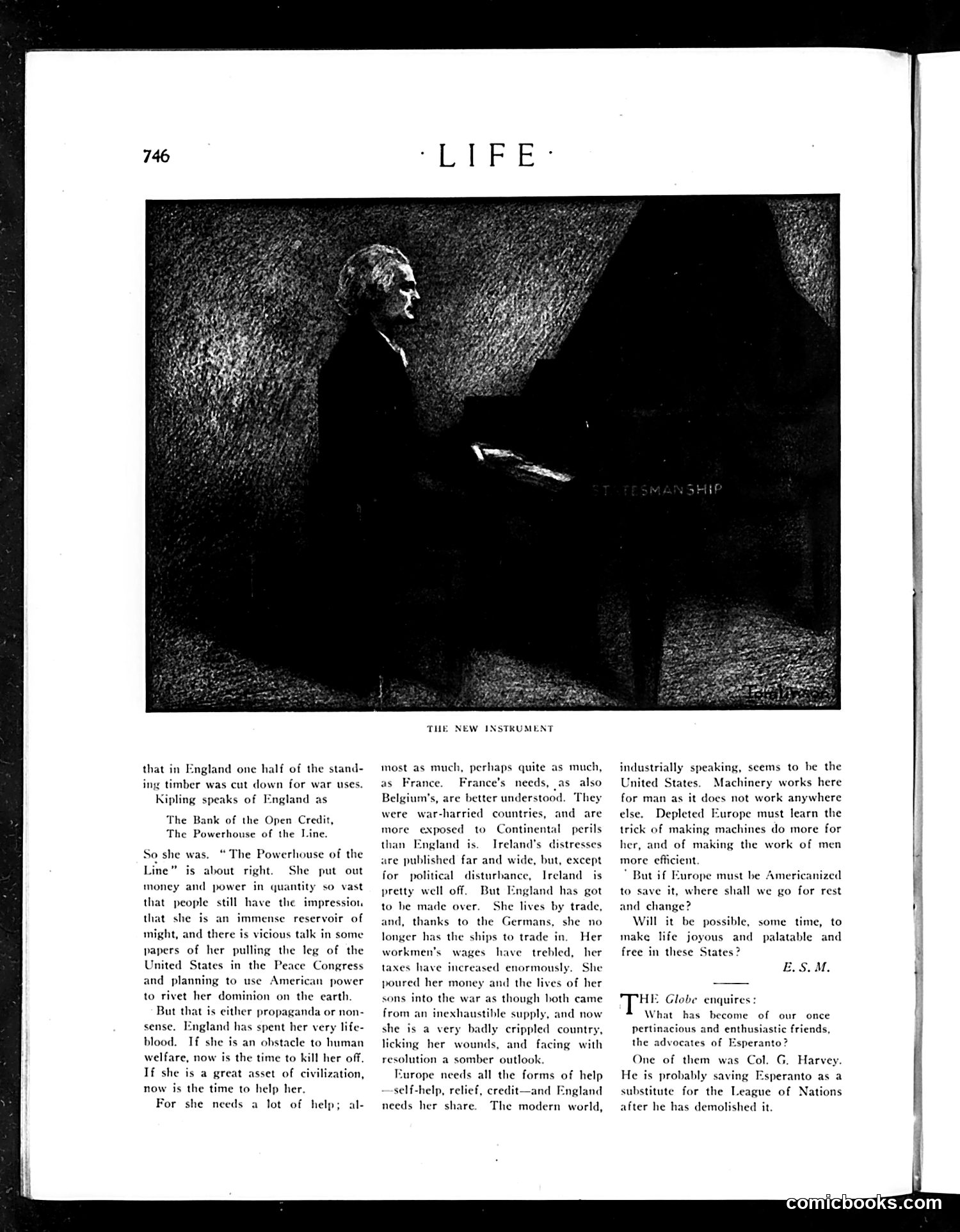
The image shows a darkly rendered figure at a piano labeled "STATESMANSHIP," suggesting this is an editorial cartoon about post-World War I diplomacy. The accompanying text discusses England's post-war economic struggles and need for American assistance. The article critiques how England depleted resources fighting Germany while France received more sympathy. It argues England must now be "made over" and suggests the modern world—"industrially speaking"—belongs to America. The piano metaphor likely satirizes diplomatic negotiations as an instrument requiring skillful "playing." The dark, shadowy treatment suggests cynicism about post-war political maneuvering and suggests that statesmanship has become a mere performance or calculated tool rather than principled governance. The overall tone criticizes how nations must now navigate American economic dominance.
📄 Transcribed text from this page (OCR, searchable)
Machine-transcribed from the original scan — historical spelling and the odd misread are preserved.
that in England one half of the stand- ing timber was cut down for war uses. Kipling speaks of England as The Bank of the Open Credit, The Powerhouse of the Line. So she was. “The Powerhouse of the Line” is about right. She put out money and power in quantity so vast that people still have the impression that she is an immense reservoir of might, and there is vicious talk in some papers of her pulling the leg of the United States in the Peace Congress and planning to use American power to rivet her dominion on the earth. But that is either propaganda or non- sense. England has spent her very life- blood. If she is an obstacle to human welfare, now is the time to kill her off. If she is a great asset of civilization, now is the time to help her. For she needs a lot of help; al- THE NEW INSTRUMENT most as much, perhaps quite as much, as France. rance’s ni Belgium's, are better understood. They were war-harried countries, and are more exposed to Continental perils than England is. Ireland's distresses. ure published far and wide, but, except for political disturbance, Ireland is pretty well off. But England has got to he made over. She lives by trade, and, thanks to the Germans, she no longer has the ships to trade in. Her workmen's wages have trebled, her taxes have increased enormously. She ds, as also poured her money and the lives of her sons into the war as though both came from she is a very badly crippled country, licking her wounds, and facing with resolution a somber outlook. Europe needs all the forms of help 1 inexhaustible supply, and now self-help, relief, credit—and England needs her share. The modern world, industrially speaking, seems to be the United States. Machinery works here for man as it does not work anywhere else. Depleted Europe must learn the trick of making machines do more for her, and of making the work of men more efficient * But if Europe must be to save it, where shall we go for rest Americanized and change? Will it be possible, some time, to make life joyous and palatable and free in these States? S.M. HE Globe enquires: What has become of our once Pertinacious and enthusiastic friends, the advocates of Esperanto? One of them was Col. G. Harvey. He is probably saving Esperanto as a substitute for the League of Nations after he has demolished it.