
Life, 1919-05-01 · page 26 of 44
Life — May 1, 1919 — page 26: what you’re looking at
What you’re looking at
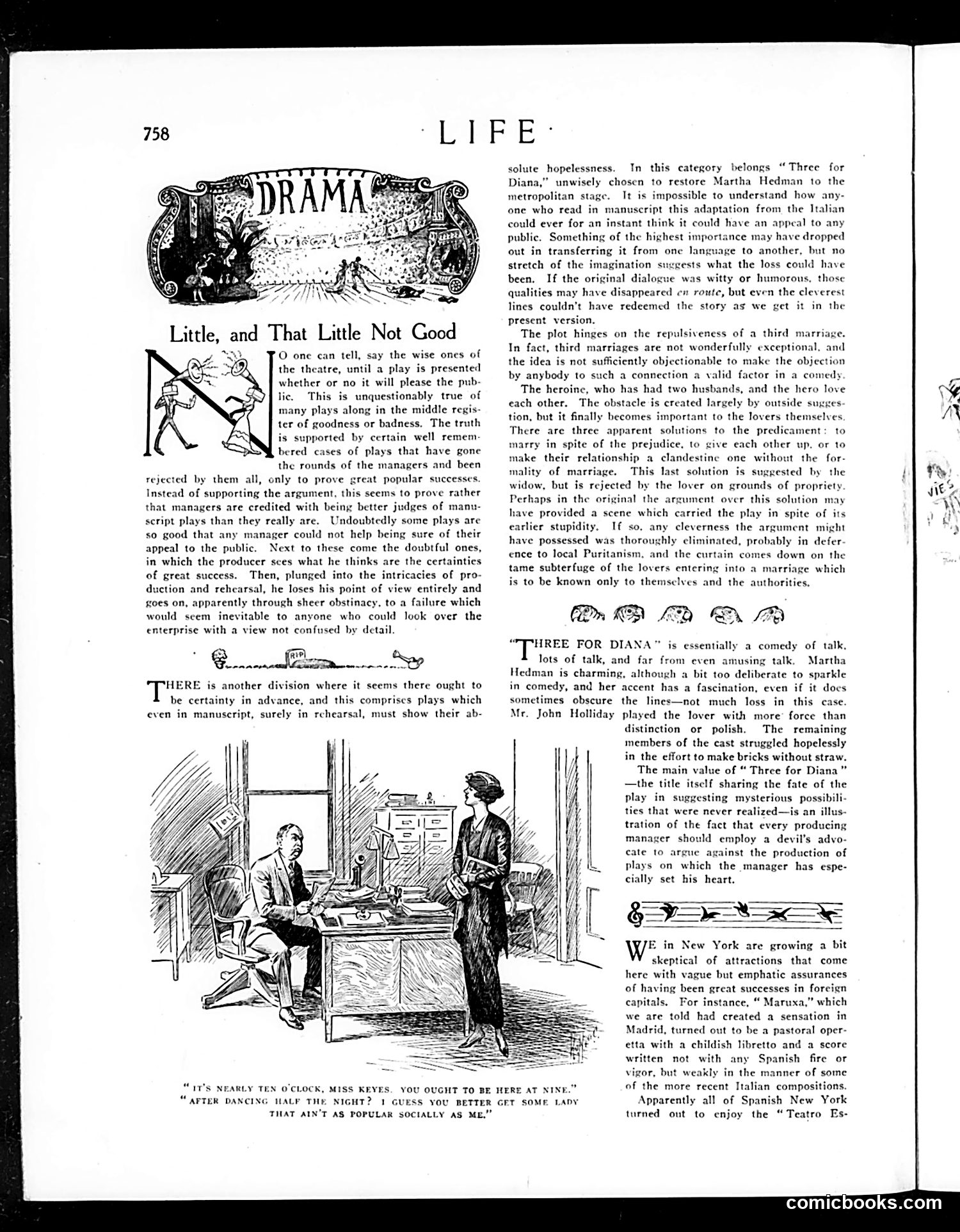
This is a theater review critiquing two plays. The main illustration shows a man and woman in an office—likely depicting a scene from "Three for Diana," the play being reviewed. The article argues that theatrical managers cannot reliably judge whether a script will succeed until it's produced. The author divides plays into categories: those clearly excellent, those clearly hopeless, and a middle group where judgment is uncertain. "Three for Diana" falls into the "hopeless" category. It's an Italian adaptation meant to revive actress Martha Hedman on the New York stage. The plot concerns a widow and her lover facing objections to their third marriage—a premise the critic finds insufficiently compelling for comedy. Though Hedman is charming, the dialogue is tedious. The critic suggests that something crucial was lost in translation from Italian, or that the script was altered to appease American "Puritanism," eliminating whatever merit the original possessed. The caption joke mocks a woman's social popularity interfering with her evening plans.
📄 Transcribed text from this page (OCR, searchable)
Machine-transcribed from the original scan — historical spelling and the odd misread are preserved.
“LAE * That Little Not Good O one can tell, say the wise ones of the theatre, until a play is presented whether or no it will please the pub- lic. This is unquestionably true of many plays along in the middle regis- ter of goodness or badness. The truth is supported by certain well remem- bered cases of plays that have gone the rounds of the managers and been rejected by them all, only to prove great popular successes. Instead of supporting the argument, this seems to prove rather that managers are credited with being better judges of manu- script plays than they really are. Undoubtedly some plays are so good that any manager could not help being sure of their appeal to the public, Next to these come the doubtful ones, in which the producer sces what he thinks are the certainties of great success. Then, plunged into the intricacies of pro- duction and rehearsal, he loses his point of view entirely and goes on, apparently through sheer obstinacy, to a failure which would seem inevitable to anyone who could look over the enterprise with a view not confused by detail. i nn 2-2 HERE is another division where it seems there ought to be certainty in advance, and this comprises plays which even in manuscript, surely in rchearsal, must show their ab- “IT'S NEARLY TEN O'CLOCK, MISS KEYES. YOU OUGHT TO Bi “AFTER DANCING HALF THE NIGHT? 1 GUESS YOU BETTER GFT SOME LADY THAT AIN'T AS POPULAR SOCIALLY AS ME,’ solute hopelessness. In this category belongs “Three for Diana,” unwisely chosen to restore Martha Hedman to the metropolitan s It is impossible to understand how any- one who read in manuscript this adaptation from the Italian could ever for an i t think it could have an appeal to any public. Something of the highest importance may have dropped out in transferring it from one language to another, but no stretch of the imagination suggests what the loss could have been. If the original dialogue was witty or humorous, those qualities may have disappeared en route, but even the cleverest lines couldn’t have redeemed the story as we get it in the Present version. The plot hinges on the repulsiveness of a third marriag In fact, third marriages are not wonderfully exceptional, and the idea is not sufficiently objectionable to make the objection by anybody to such a connection a valid factor in a comedy The heroine, who has had two husbands, and the hero love each other. The obstacle is created largely by outside suxees tion, but it finally becomes important to the lovers themselves. There are three apparent solutions to the predicament: to marry in spite of the prejudice, to give each other up. or to ke their relationship a clandestine one without the for- mality of marriage. This last solution is suggested by the widow, but is rejected by the lover on grounds of propriety Perhaps in the original the argument over this solution may have provided a scene which carried the play in spite of earlier stupidity. If so, any cleverness the argument might have possessed was thoroughly eliminated, probably in defer- ence to local Puritanism, and the curt comes down on the tame subterfuge of the lovers entering into a marriage which is to be known only to themselves and the authorities. HHREE FOR DIA) * is essentially a comedy of talk, lots of talk, and far from even amusing talk. Martha Hedman is charming, although a bit too deliberate to sparkle in comedy, and her accent has a fascination, even if it docs sometimes obscure the lines—not much loss in this case. Mr. John Holliday played the lover with more’ force than distinction or polish. The remaining members of the cast struggled hopelessly in the effort to make bricks without straw. The main value of “ Three for Dian —the title itself sharing the fate of the y in suggesting mysterious possibili- ties that were never realized—is an illus- tration of the fact that every producing ‘+ should employ a devil’s advo- cate to argue against the production of plays on which the manager has espe- cially set his heart. §3S2Se= in New York are growing a bit skeptical of attractions that come here with vague but emphatic assurances of having been great successes in foreign capitals. For instance, “ Maruxa,” which we are told had created a sensation in Madrid, turned out to be a pastoral oper- etta with a childish libretto and a score written not with any Spanish fire or vigor, but weakly in the manner of some of the more recent Italian compositions. Apparently all of Spanish New York turned ont to enjoy the “Teatro Es- WERE AT NINE.” comicbooks.com