
Life, 1919-05-01 · page 38 of 44
Life — May 1, 1919 — page 38: what you’re looking at
What you’re looking at
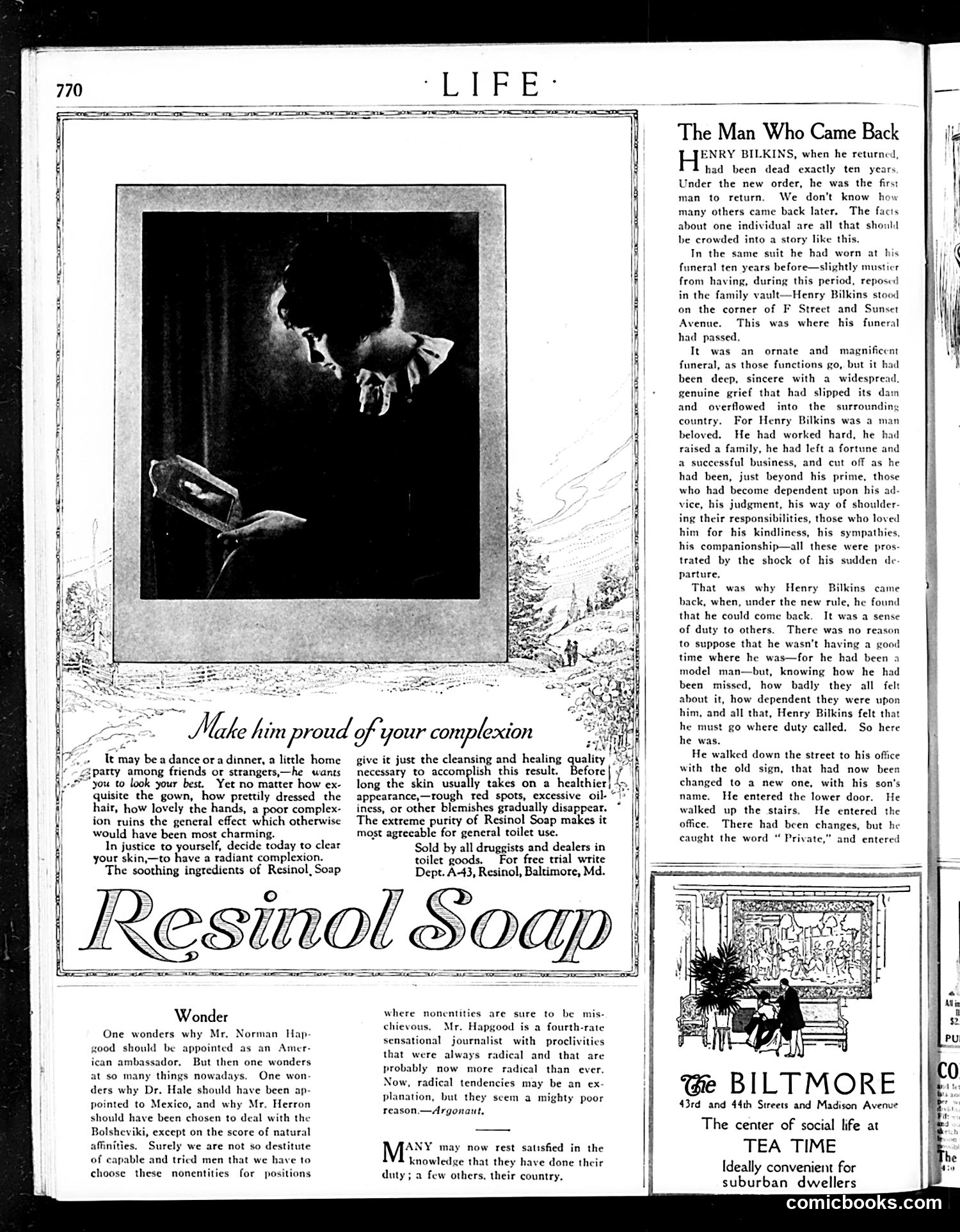
This page contains two distinct elements: **The Resinol Soap Advertisement** dominates the left side, featuring a dramatic photograph of a woman's face in profile. The ad uses typical early-20th-century beauty marketing: it promises that good complexion makes one presentable at social events and that Resinol Soap will cure skin blemishes. This reflects period beauty standards and consumer advertising conventions. **"Wonder" Editorial** (center-bottom) mocks recent American diplomatic appointments, naming Norman Hapgood, Dr. Hale, and Mr. Herron as unqualified "nonentities" appointed to ambassador and diplomatic posts. The author sarcastically questions why capable men weren't chosen instead, suggesting these appointees' radical political leanings made them poor choices for sensitive diplomatic roles. **"The Man Who Came Back" Story** (right) begins a fictional narrative about Henry Bilkins, who returns from death after ten years under some unspecified "new order," driven by duty to his grieving family and dependents. The page reflects Progressive-Era political criticism and early consumer culture conventions.
📄 Transcribed text from this page (OCR, searchable)
Machine-transcribed from the original scan — historical spelling and the odd misread are preserved.
Te may bea dance ora dinner, a little home party among friends or strangets,—he wants you to look your best. Yet no matter how ex- quisite the gown, how prettily dressed the hair, how lovely the hands, a poor complex- ion ruins the general effect which otherwise would have been most charming. In justice to yourself, decide today to clear your skin,—to have a radiant complexion. The soothing ingredients of Resinol, Soap See Sa ee Wonder One wonders why Mr. Norman Hap good should be appointed as an Amer- ican ambassador. But then one wonders at so many things nowadays. One won ders why Dr. Hale should have been ap- pointed to Mexico, and why Mr. Herron should have been chosen to deal with the Bolsheviki, except on the score of natural affinities. Surely we are not so destitute of capable and tried men that we have to choose these nonentities for positions we : a : Make him proud. of? your complexion 18 give it just the cleansing and healing quality |; necessaty to accomplish this result. Before | ¥ long the skin usually takes on a healthier) 4 appearance,—rough red spots, excessive oi iness, or other blemishes gradually disappear. The extreme purity of Resinol Soap makes it most agrecable for general toilet use. Sold by all druggists and dealers in toilet goods. For free trial write Dept. A-43, Resinol, Baltimore, Md. JResinol Soap ——— SS SSE — where nonentities are sure to be mis- chievous. Mr. Hapgood is a fourth-rate sensational journalist with proclivities that were always radical and that are probably now more radical than ever. Now, radical tendencies may be an ex planation, but they seem a mighty poor reason.— Argonaut, now rest satisfied in the knowledge that they have done their duty ; a few others, their country. The Man Who Came Back ENRY BILKINS, when he returned, had been dead exactly ten years Under the new order, he was the first man to return, We don’t know how many others came back later. The facts about one individual are all that should be crowded into a story like this. In the same suit he had worn at his funeral ten years before—stightly mus: from having, during this period, repose in the family vault—Henry Bilkins stood on the corner of F Street and Sunset Avenue. This was where his funeral had passed. It was an ornate and magnificent funeral, as those functions go, but it had been deep, sincere with a widespread. genuine grief that had slipped its d and overflowed into the surrounding country. For Henry Bilkins was a man beloved. He had worked hard, he had raised a family, he had left a fortune and a successful business, and cut off as he had been, just beyond his prime, those who had become dependent upon his ad- vice, his judgment, his way of shoulder- ing their responsibilities, those who loved him for his kindliness, his sympathies, his companionship—all these were pros- trated by the shock of his sudden de. parture, That was why Henry Bilkins came back, when, under the new rule, he found that he could come back. It was a sense of duty to others. There was no reason to suppose that he wasn’t having a good time where he was—for he had been a model man—but, knowing how he had been missed, how badly they all felt about it, how dependent they were upon him, and all that, Henry Bilkins felt that he must go where duty called. So here he was. He walked down the street to his office with the old sign, that had now been changed to a new one, with his son's name, He entered the lower door. He walked up the stairs. He entered the office. There had been changes, but he caught the word “ Private,” and entered Ge BILTMORE 43rd and 44th Streets and Madison Avenue The center of social life at TEA TIME Ideally convenient for suburban dwellers comicbooks.com