
A complete issue · 46 pages · 1919
Life — April 24, 1919
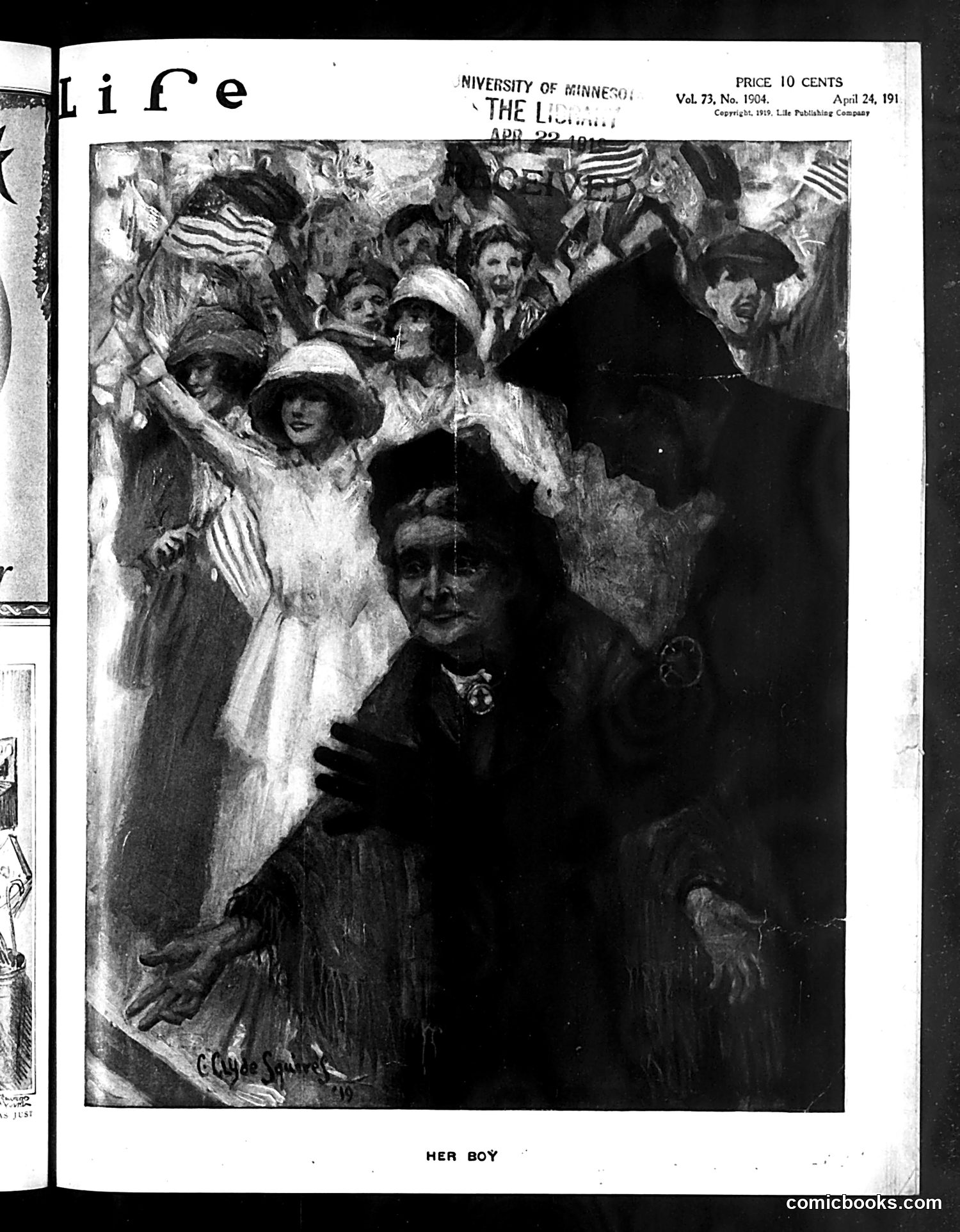
This Life magazine cover from April 24, 1911 depicts a patriotic scene titled "Her Boy." The image shows a woman in white (likely representing America or Liberty) surrounded by cheering crowds waving American flags. In the foreground stands a uniformed soldier or military figure in dark clothing. The illustration appears to celebrate American militarism or patriotism, possibly referencing military preparedness, conscription, or a son's duty to serve. The contrast between the idealized feminine figure representing the nation and the serious military figure suggests themes of maternal pride in military service, or perhaps commentary on how nations glorify war through emotional appeals to family loyalty. Without additional context, the specific historical event referenced remains unclear.
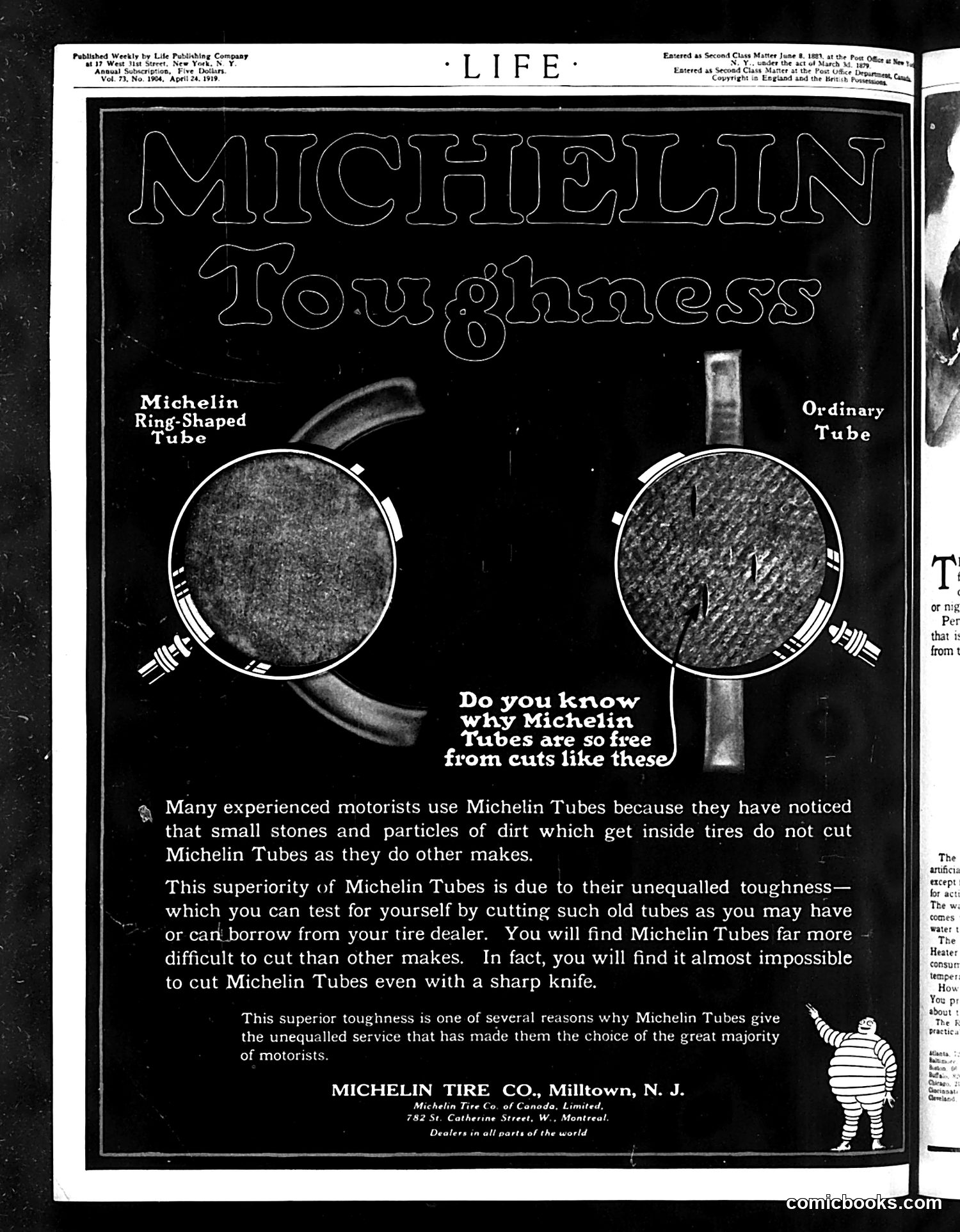
This is a **Michelin Tire advertisement**, not political satire. The page promotes Michelin's "Ring-Shaped Tube" design by claiming superior toughness compared to ordinary tubes. The advertisement uses a comparative visual demonstration: two cross-section images showing a Michelin tube (left, smooth surface) versus an ordinary tube (right, visibly cut/damaged). The text challenges readers to test this themselves—attempting to cut old Michelin tubes with a knife, claiming they'll find it "almost impossible." The small Michelin mascot (Bibendum) appears at bottom right. This is straightforward product marketing emphasizing durability as a selling point to "experienced motorists," not satire or political commentary.
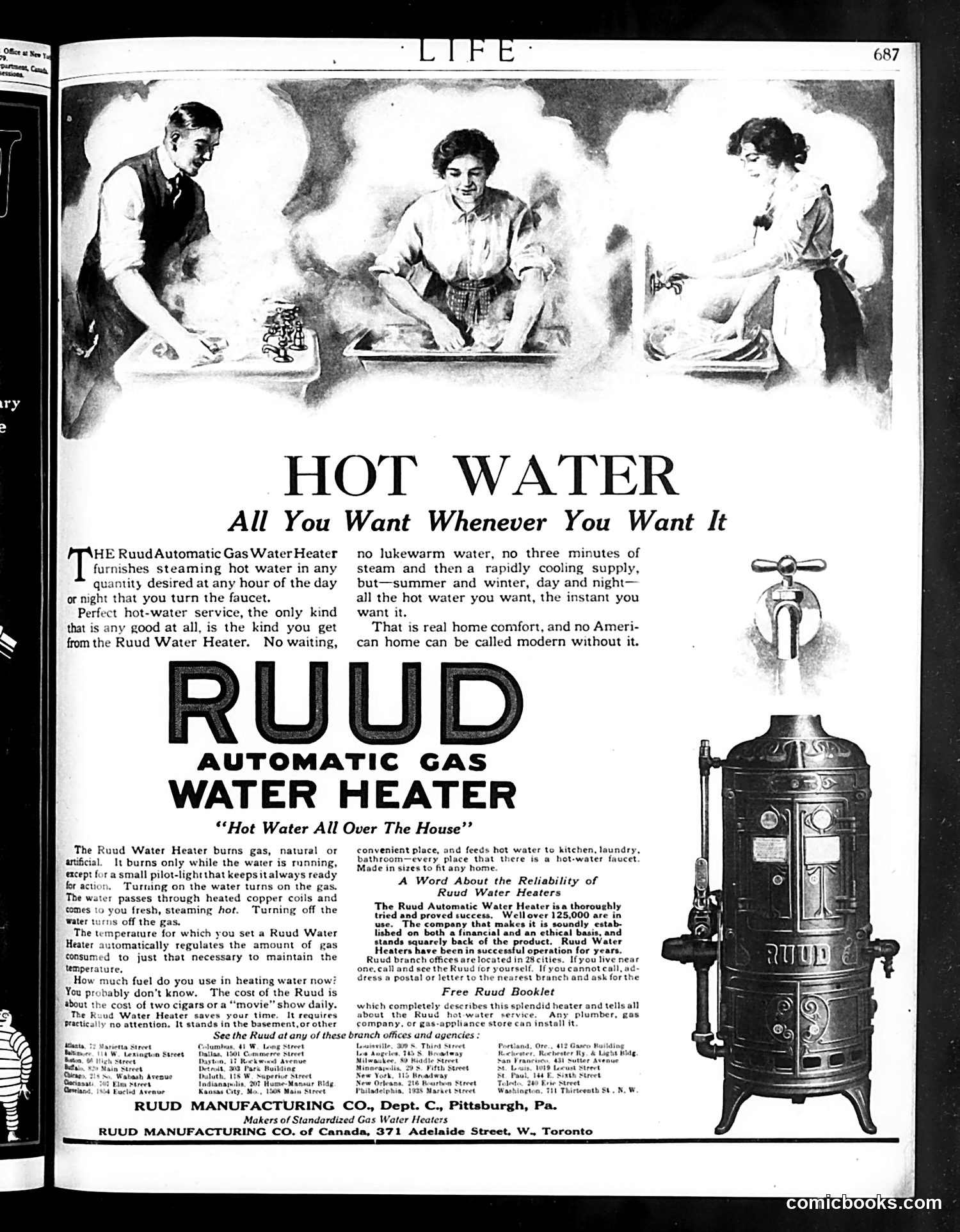
This page is **primarily an advertisement**, not satirical content. It promotes the Ruud Automatic Gas Water Heater, marketed as providing "Hot Water All Over The House" on demand. The illustration shows three women performing household tasks (laundry, dish washing, ironing) surrounded by steam, depicting the product's benefit: instant hot water for domestic work. The ad emphasizes modern home comfort and convenience—key selling points for early 20th-century appliances. The accompanying product image shows the heater's decorative cylindrical design. The text highlights reliability, availability in multiple cities, and positions the product as essential to a "modern" home. This reflects the era's marketing strategy: associating new technology with domestic efficiency and elevated social status.
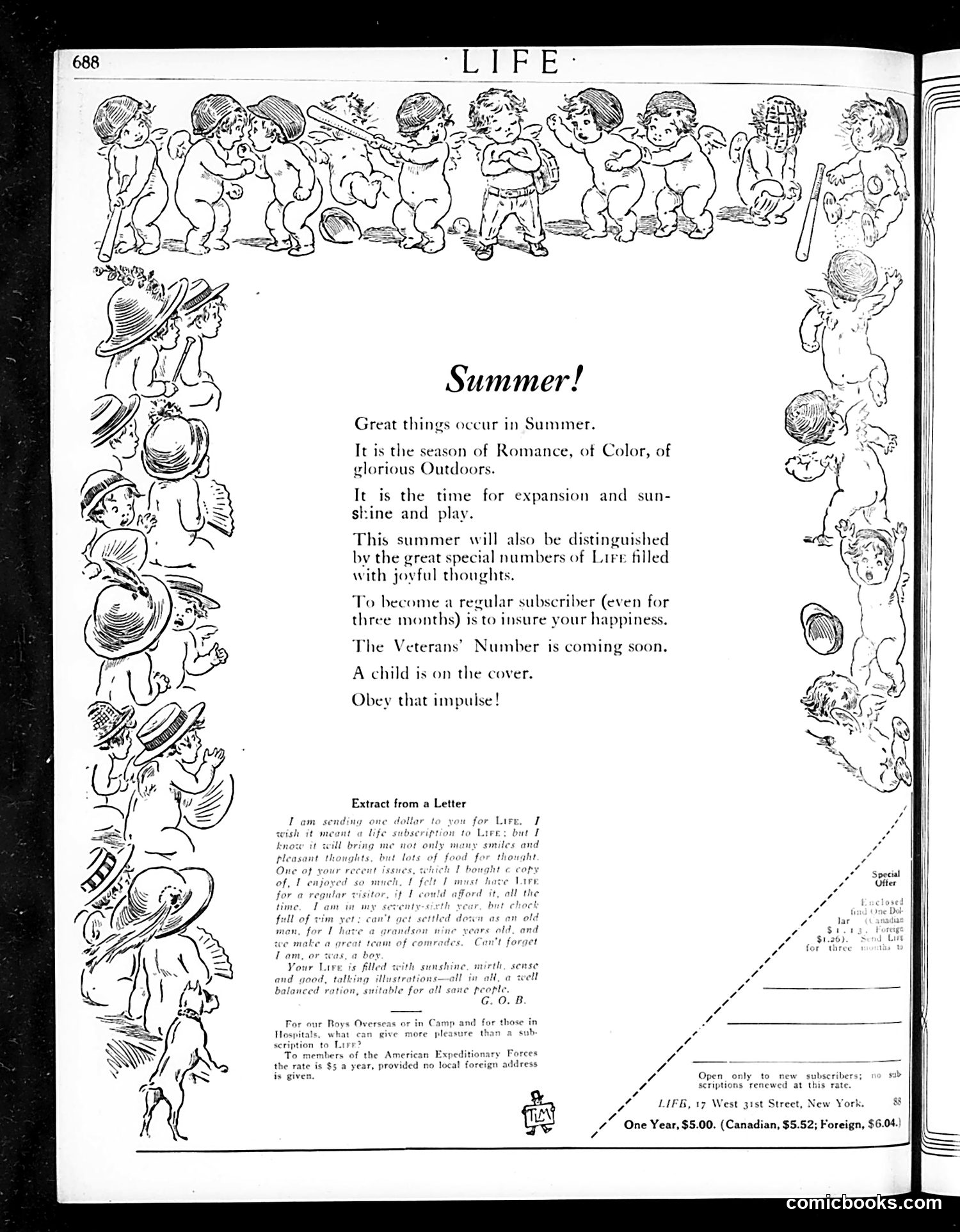
This page is primarily **advertising and editorial promotion** rather than political satire. The central content advertises Life magazine's summer issues, decorated with illustrations of cherubic children and adults wearing summer hats and enjoying outdoor activities. The text promotes Life's "special numbers" and encourages subscriptions. It mentions an upcoming "Veterans' Number" with a child on the cover—likely referencing post-WWI veteran issues, given the historical period. The "Extract from a Letter" section shows reader testimonials praising Life's content. The left and right margins feature playful line drawings of figures in summer scenes. **No clear political cartoon or satire** is present; this is straightforward magazine promotion using seasonal imagery to encourage subscriptions.
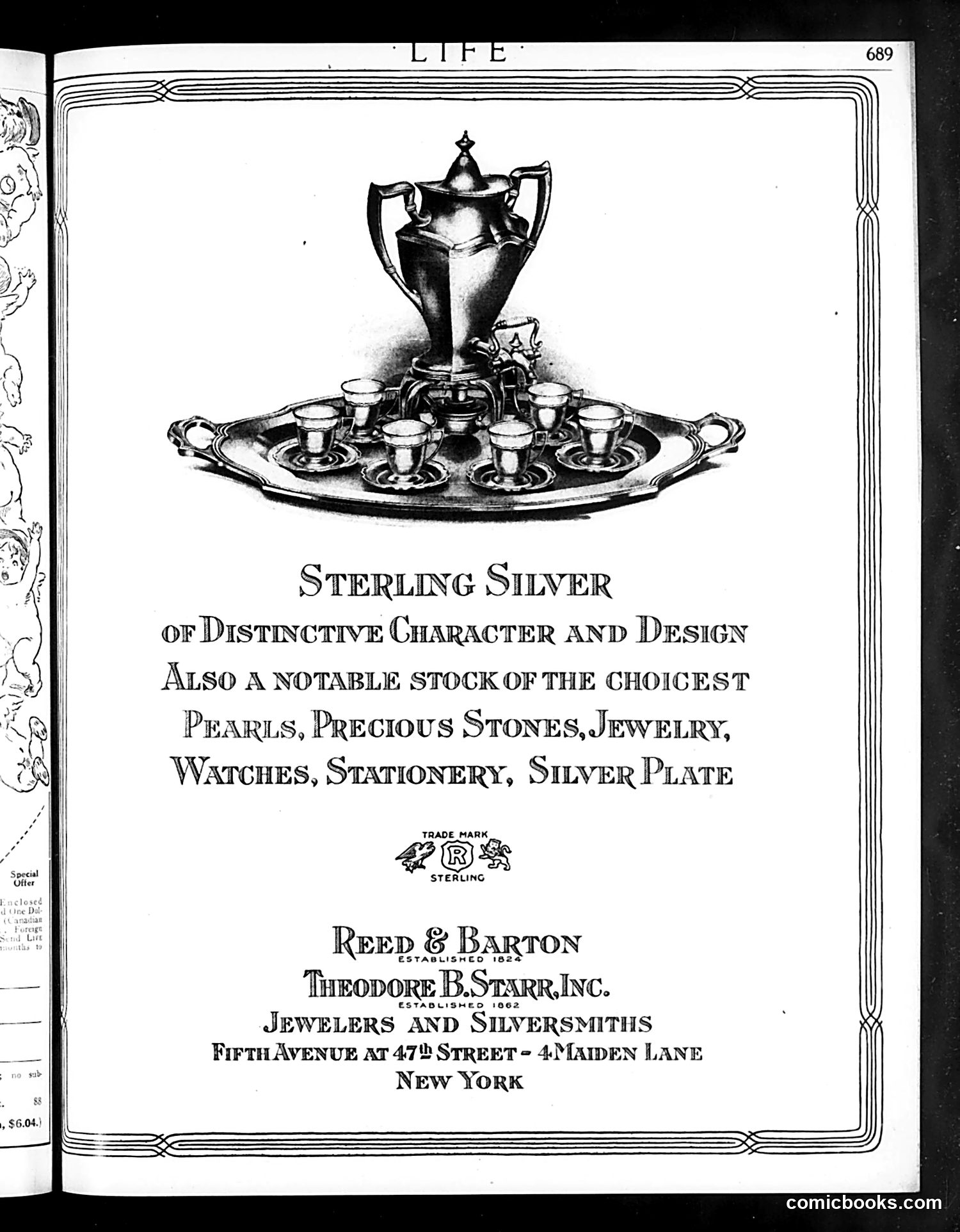
This page is **entirely an advertisement**, not satire or political content. It promotes Reed & Barton (established 1822) and Theodore B. Starr, Inc.—New York jewelers and silversmiths located at Fifth Avenue and 47th Street. The ad showcases sterling silver serving pieces: a large lidded urn or coffee/tea pot as the centerpiece, surrounded by matching cups and saucers on an ornate tray. The visual emphasizes the "distinctive character and design" of their silver goods. The ad also advertises their stock of pearls, precious stones, jewelry, watches, stationery, and silver plate. The Sterling trademark appears prominently. There is no political or satirical content on this page—it's a luxury goods advertisement from Life magazine's advertising section.
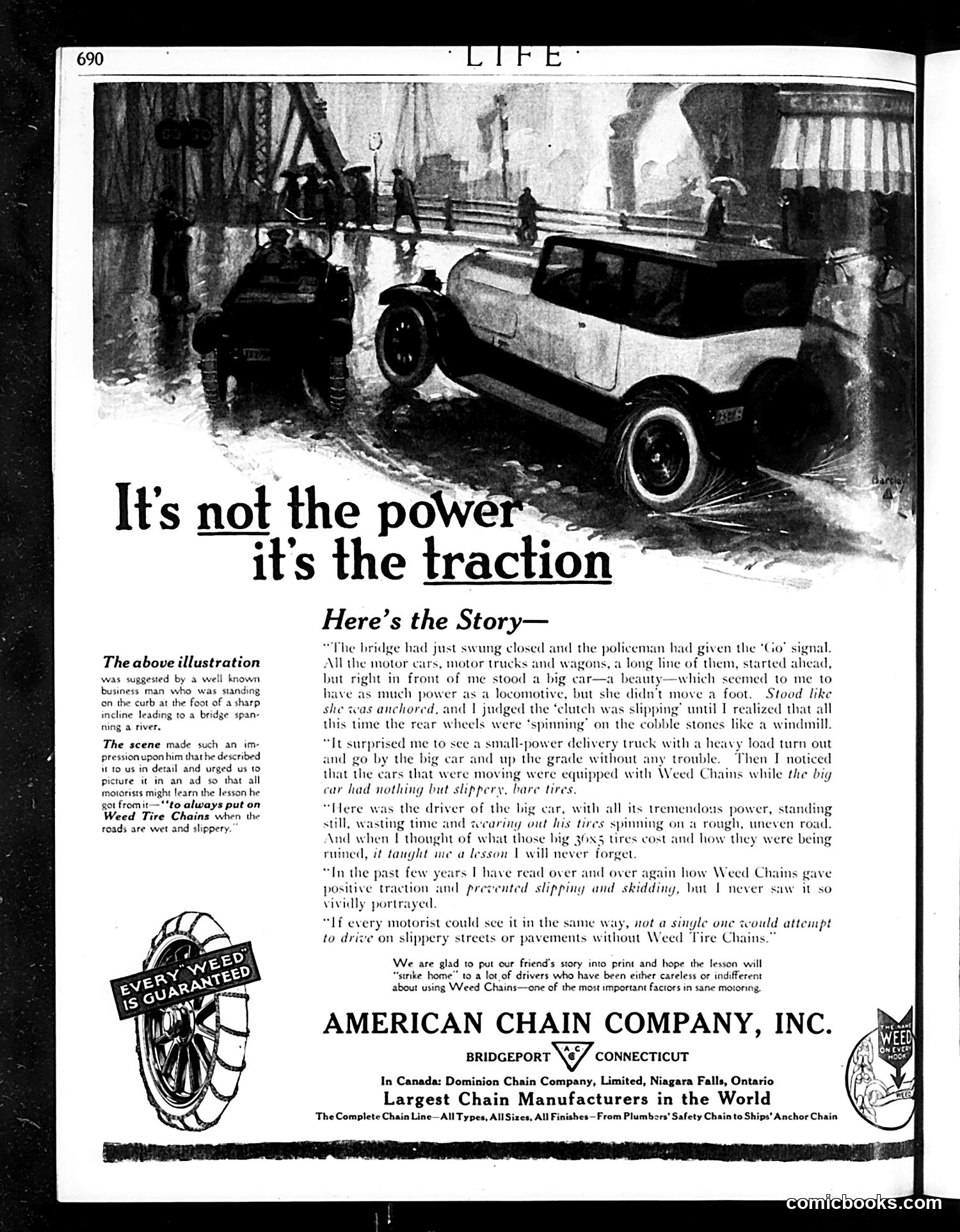
This is primarily a **Weed Tire Chains advertisement**, not satire or political commentary. The page illustrates a practical automotive safety message from the early automobile era. The image shows two cars navigating a snowy bridge—one struggling with slipping wheels, while the larger car equipped with Weed Chains maintains traction and climbs the grade easily. The headline "It's not the power—it's the traction" emphasizes that tire chains, not engine power, determine winter driving capability. The accompanying narrative recounts an anecdote where a motorist observed this performance difference, leading to an endorsement of Weed Chains' effectiveness on slippery roads. The advertisement targets safety-conscious drivers by demonstrating how chains prevent dangerous skidding and sliding during winter conditions. This reflects early 20th-century automotive concerns before modern tire technology.
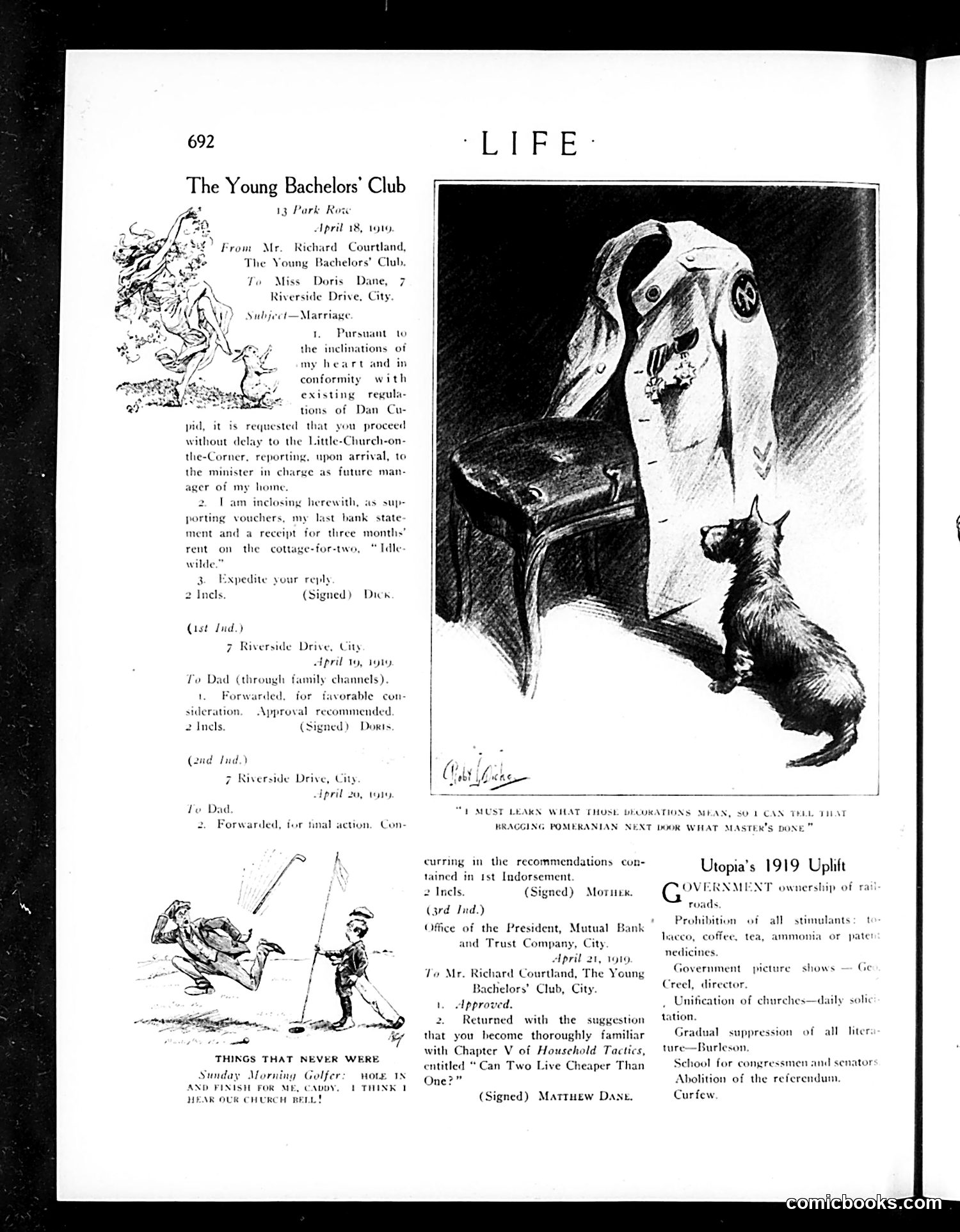
This page contains two distinct elements: **Left side:** "The Young Bachelors' Club" - a humorous advice column featuring correspondence about marriage etiquette and household matters. The accompanying sketch shows a golfer mid-swing, illustrating the caption "Things that never were: Sunday Morning Golfer—hole in and finish for me, caddy. I think I hear our church bell!" **Right side:** A sketch of a well-dressed man examining what appears to be a decorative object while a small dog looks on. The caption reads: "I must learn what those decorations mean, so I can the treat bragging horseman next door what's new." Below is a section on "Utopia's 1919 Uplift" covering government policies on prohibition and religious matters. The humor relies on domestic satire and social commentary typical of 1919 Life magazine—poking fun at bachelor life, golf culture, and newly married men's pretensions.
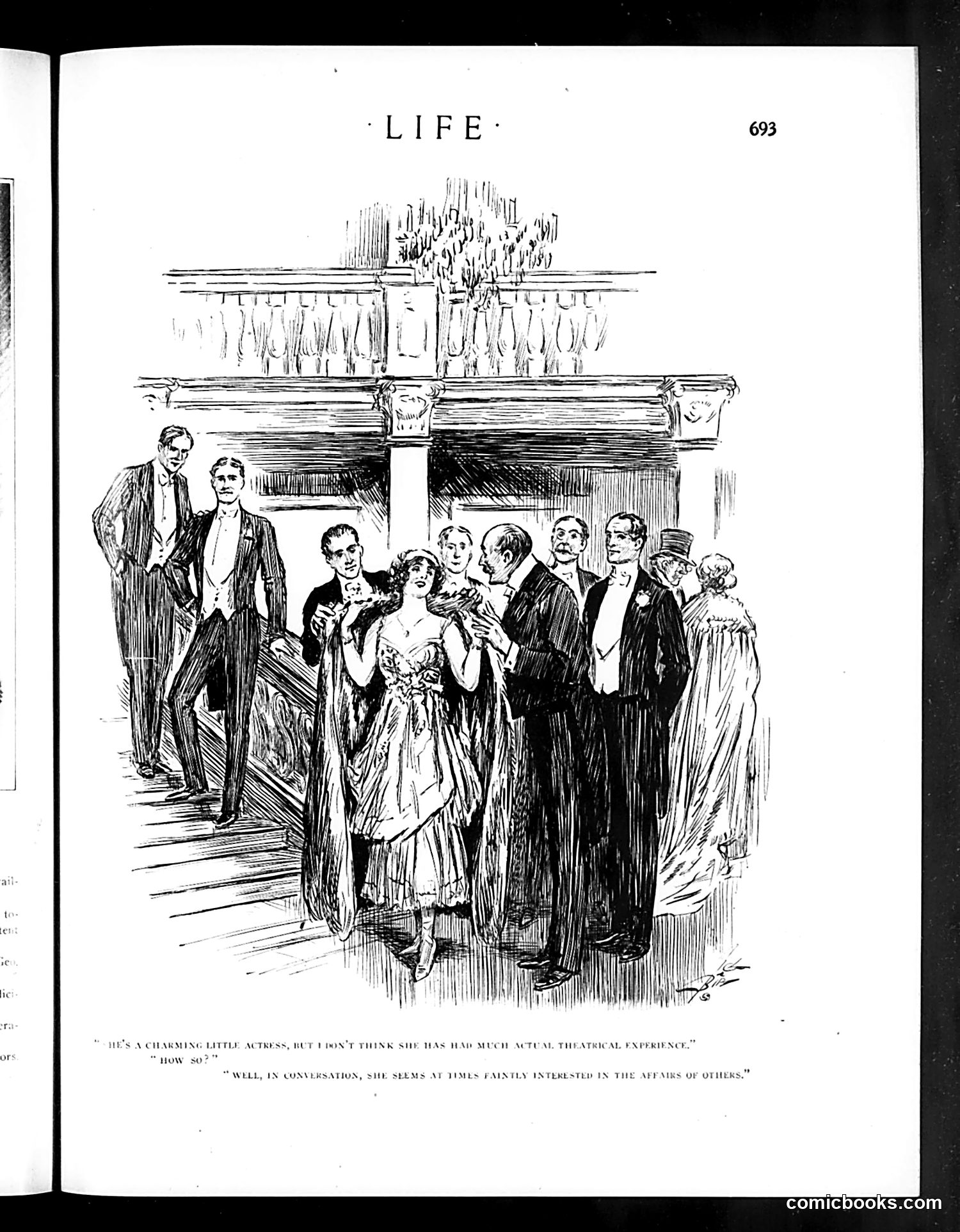
This is a single illustration from *Life* magazine (page 693) depicting a social scene at what appears to be an elegant indoor gathering or party. The sketch shows well-dressed men in formal attire surrounding a woman in an evening gown, all beneath ornate architectural details. The caption provides dialogue: one man describes a "charming little actress" who lacks "much actual theatrical experience," while another responds that "in conversation, she seems at times fairly interested in the affairs of others." The satire targets a young actress of apparently limited talent or experience who has gained social prominence through connections rather than skill. The gentlemen's backhanded compliments—praising her charm and conversational ability while implicitly criticizing her lack of theatrical credentials—mock both the actress and the social circles that elevate such figures regardless of actual merit.
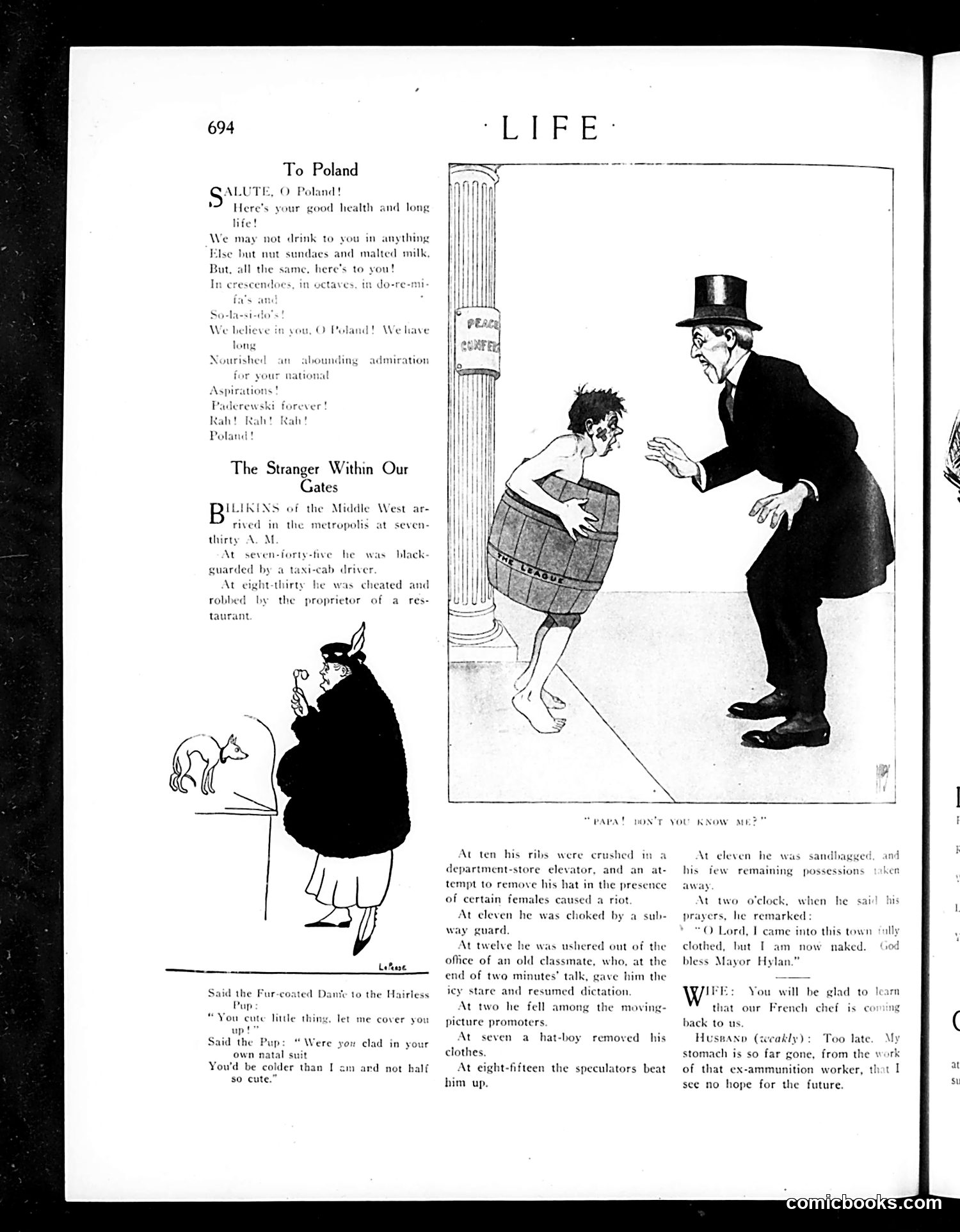
This page contains two distinct pieces of satirical content: **"To Poland"** (top left): A humorous toast poem celebrating Poland, likely referencing Polish immigration or diplomatic relations during the early 20th century. The verse employs mock-formal language typical of Life's satirical style. **"The Stranger Within Our Gates"** (main narrative): A story about Bilikins of the Midwest arriving in the city and suffering a series of indignities—being cheated, robbed, stripped in an elevator, and beaten by spectators. The accompanying illustrations show a poorly-dressed man being harassed by a well-dressed gentleman. The satire appears to mock xenophobia and urban cruelty toward immigrants or outsiders ("the stranger within our gates"), while the crude illustrations and unfortunate protagonist suggest commentary on prejudice and the harsh treatment of vulnerable newcomers to American cities.
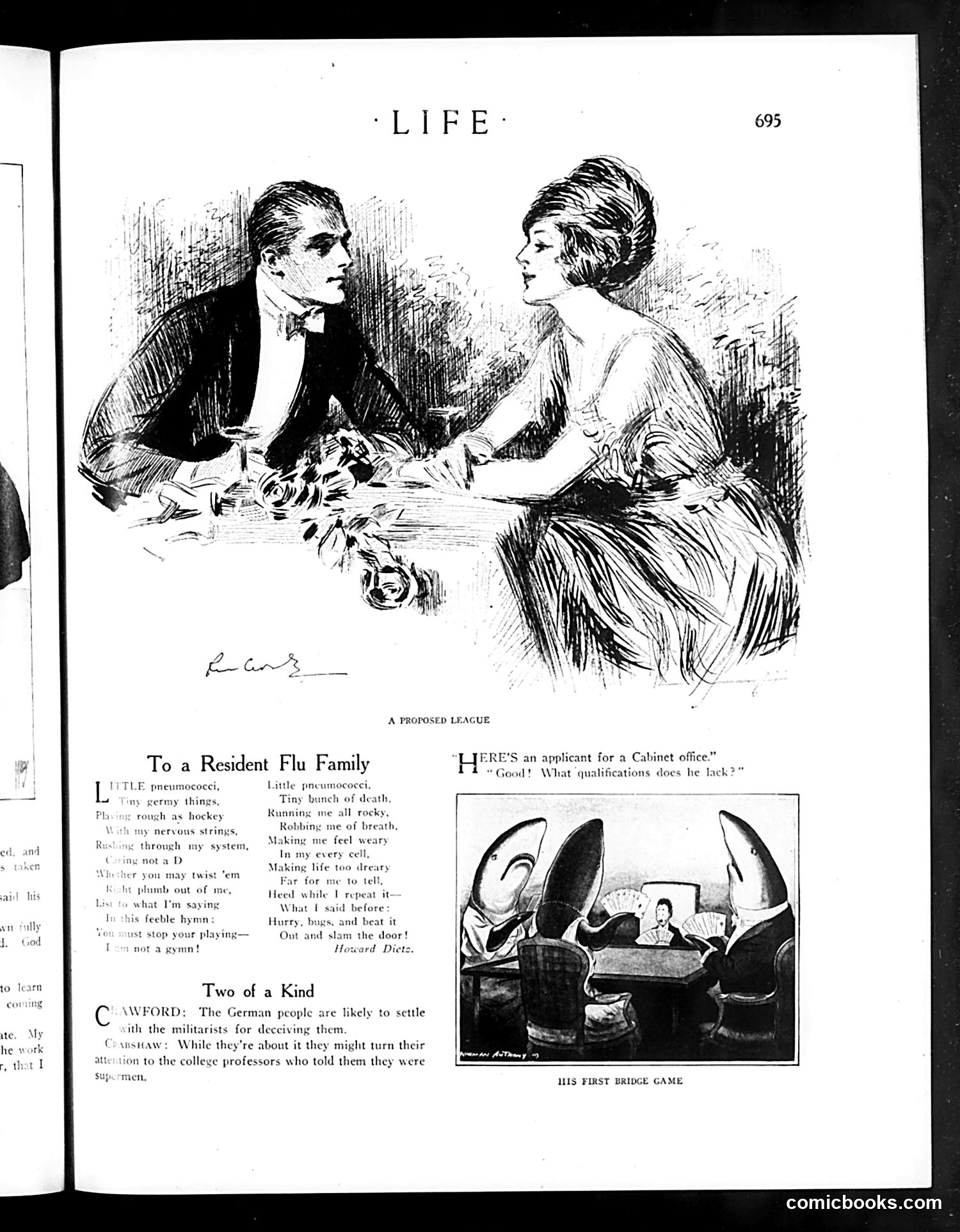
This page contains social satire about early 20th-century life: **Top illustration**: A gentleman and woman at dinner, captioned "A Proposed League," with the woman asking about his Cabinet office qualifications. The satire mocks political ambition and perhaps marriage dynamics. **"To a Resident Flu Family"**: Humorous poem by Howard Dietz about influenza symptoms—treating illness as an unwelcome houseguest. References the flu's disruptive effects on daily life. **"Two of a Kind"**: A brief exchange between characters named Cawford and Culshaw discussing Germans and militarists, likely referencing post-WWI tensions and concerns about German resurgence. **"His First Bridge Game"**: A cartoon showing someone playing bridge, depicting the popular card game's cultural prominence. The page reflects post-war American social concerns and leisure culture.
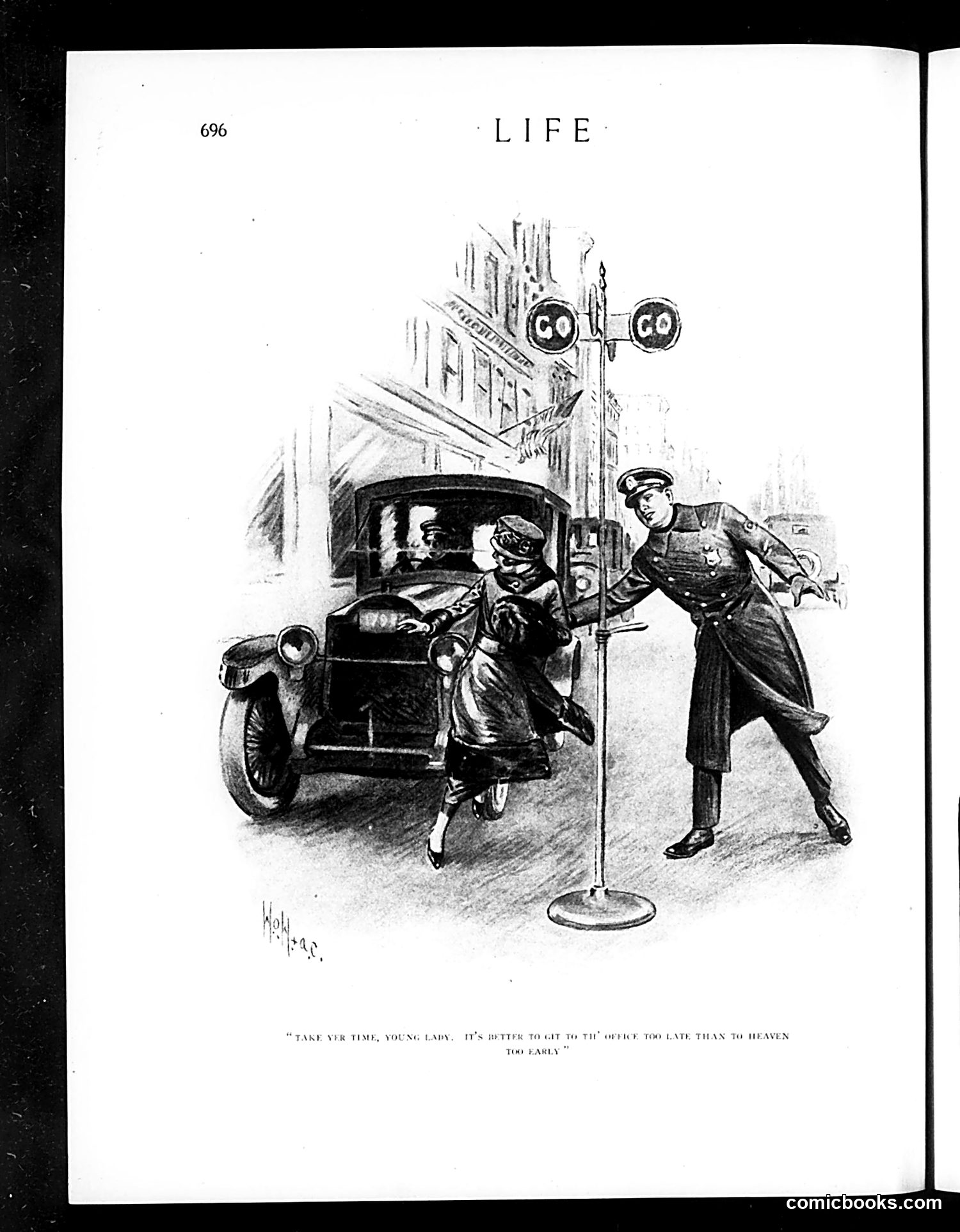
This cartoon depicts a traffic cop directing a young woman toward a car, with the caption: "Take yer time, young lady. It's better to get to the office too late than to heaven too early." The satire targets reckless driving and the era's dangerous roads. The "GO" traffic signals above reinforce the speed-obsessed culture. The joke warns against prioritizing punctuality over safety—arriving late to work is preferable to fatal accidents. This reflects early 20th-century concerns about automobile danger and cultural anxieties about modern speed, combined with period gender attitudes (addressing a "young lady" specifically, suggesting concerns about women drivers).
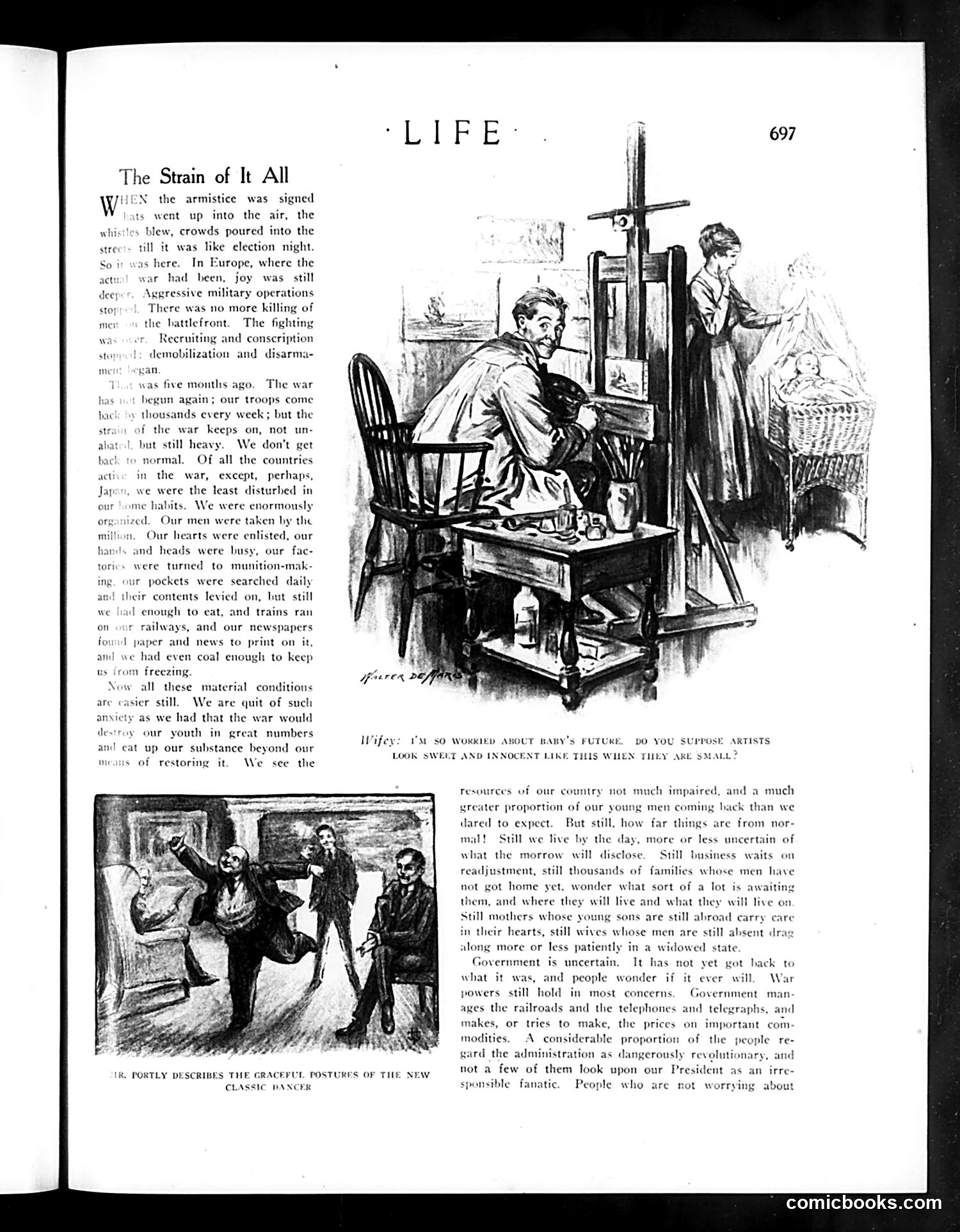
This page addresses post-WWI American anxiety. The main illustration shows a worried man at a desk, apparently handling correspondence or paperwork—likely representing the burden of wartime administrative and social strain. The caption beneath the lower cartoon reads: "Wife: I'm so worried about baby's future. Do you suppose artists look sweet and innocent like this when they are small?"—a dark joke about whether artistic temperament emerges early. The text discusses how the armistice brought relief but not normalcy. Americans face uncertainty: troops returning slowly, family separations continuing, economic strain persisting, and government inefficiency causing frustration. The satire targets the lingering psychological and administrative exhaustion following WWI's conclusion, when citizens expected immediate return to peace but instead faced prolonged hardship and bureaucratic confusion.
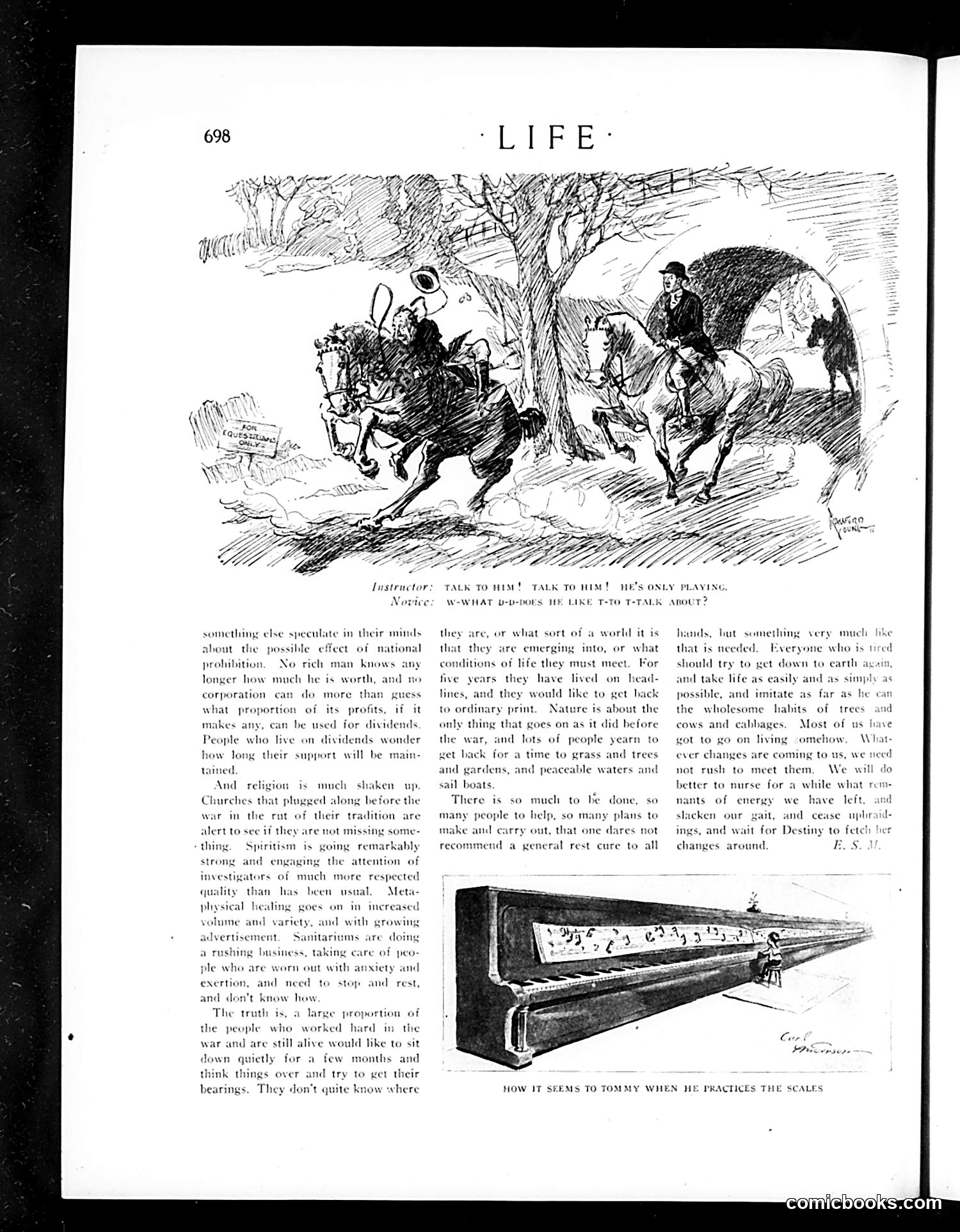
The top cartoon depicts two riders on horseback encountering each other on a country road. The caption reads: "Talk to him! Talk to him! He's only playing. 'What d'does he like t-t-t-talk about?'" This appears to be satirizing post-WWI social anxiety. The nervous dialogue suggests one rider is warning another about approaching a shell-shocked war veteran. The stammer and hesitant speech pattern indicate difficulty communicating with traumatized soldiers returning home. The joke centers on the awkwardness civilians faced when encountering visibly disturbed veterans—not knowing what topics were safe or how to interact with them. The lower illustration shows a musical scale and is captioned "How it seems to Tommy when he practices the scales," humorously depicting a musician's perspective.
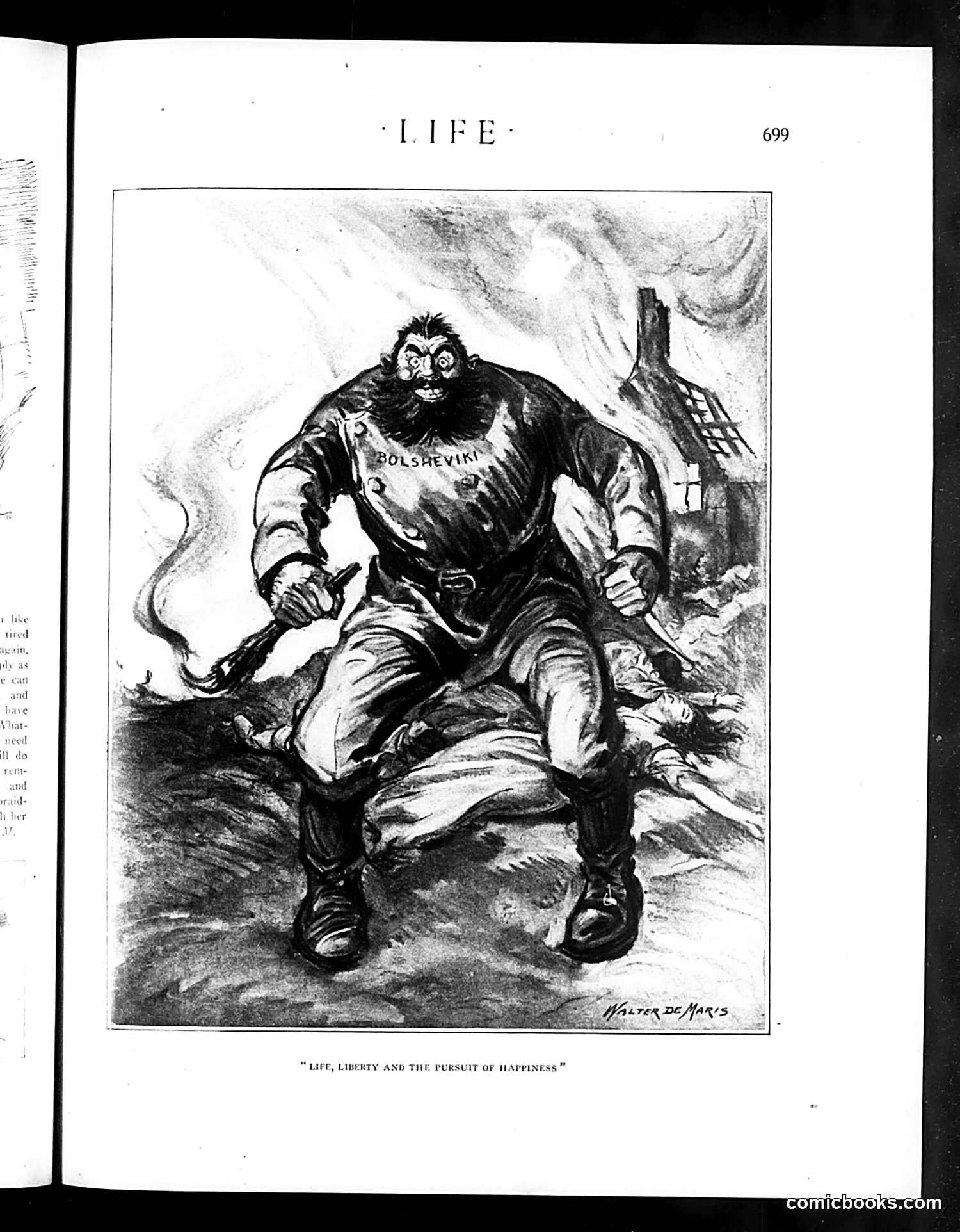
This is a satirical cartoon titled "Life, Liberty and the Pursuit of Happiness" — ironically referencing the American Declaration of Independence. The figure is labeled "BOLSHEVIKI" on his chest, depicting a menacing ape-like creature in revolutionary garb. The caricature appears to be anti-Bolshevik propaganda, likely from the post-WWI Red Scare era (1917-1920s) when American publications expressed fears about communist revolution spreading from Russia. The grotesque ape-man imagery draws on dehumanizing stereotypes common in period political cartoons. The artist, Walter de Maris, uses this monstrous depiction to suggest Bolsheviks represented a bestial threat to American ideals and civilization itself. The cartoon reflects widespread American anxiety about communist ideology during this turbulent historical period.
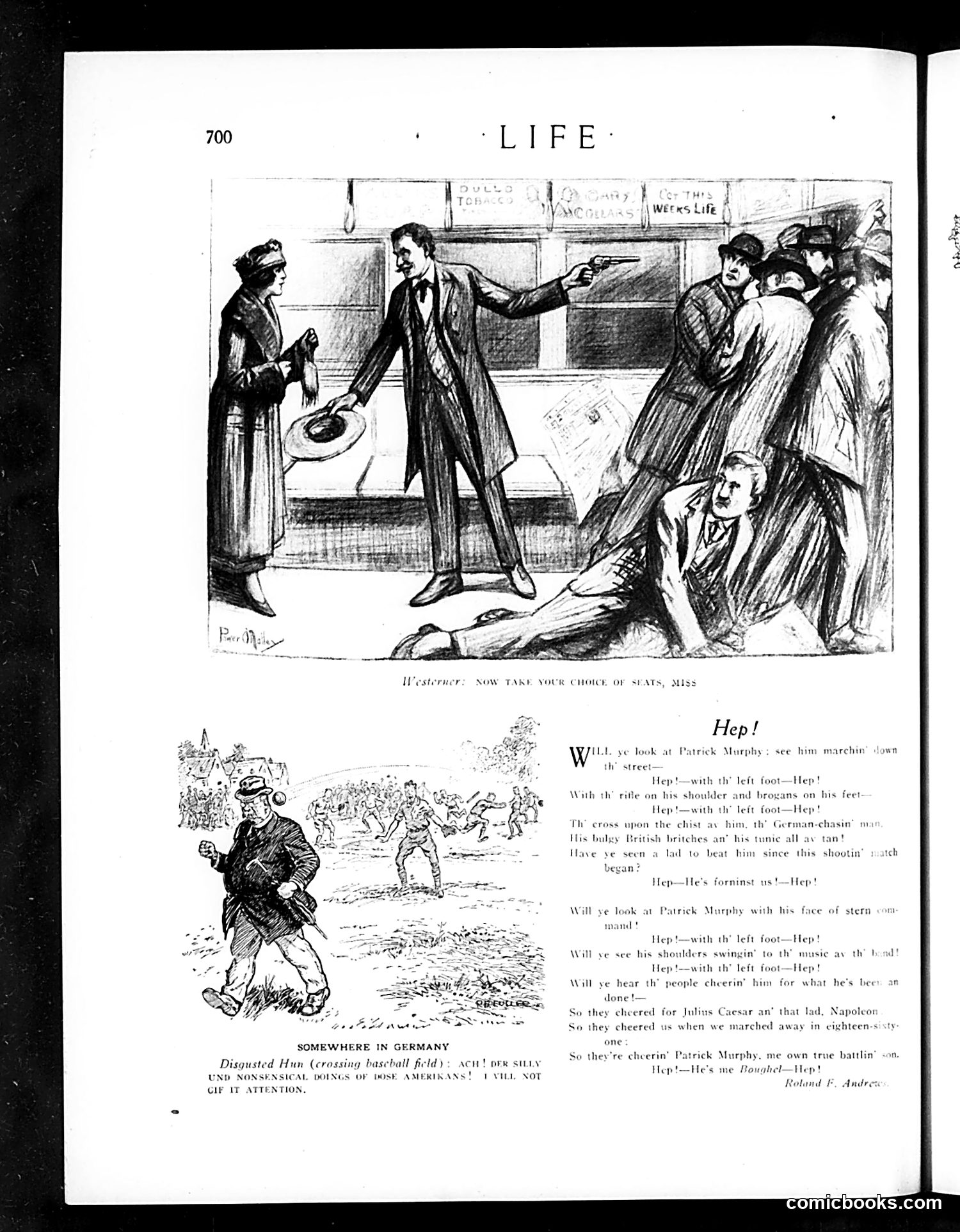
**Top Cartoon**: A Western saloon scene where a male ticket seller offers seating choices to a woman—satirizing the novelty of women gaining public independence and agency, particularly regarding where they sit in public spaces. This reflects early 20th-century social changes around women's freedom. **Bottom Content**: A poem celebrating Irish-American soldier Patrick Murphy marching to war, with a German soldier ("Hun") dismissing American military activities as ridiculous. The piece mocks German contempt for American military tradition while celebrating Irish-American patriotic service. **Historical Context**: This appears WWI-era, when German forces dismissed American soldiers as inexperienced and America's involvement as absurd. The satire inverts this: Germany's dismissal becomes the joke. The Irish-American angle reflects how immigrant communities, particularly Irish-Americans, proved their American loyalty through military service. The dual-cartoon structure contrasts domestic social progress (women's autonomy) with patriotic military themes.
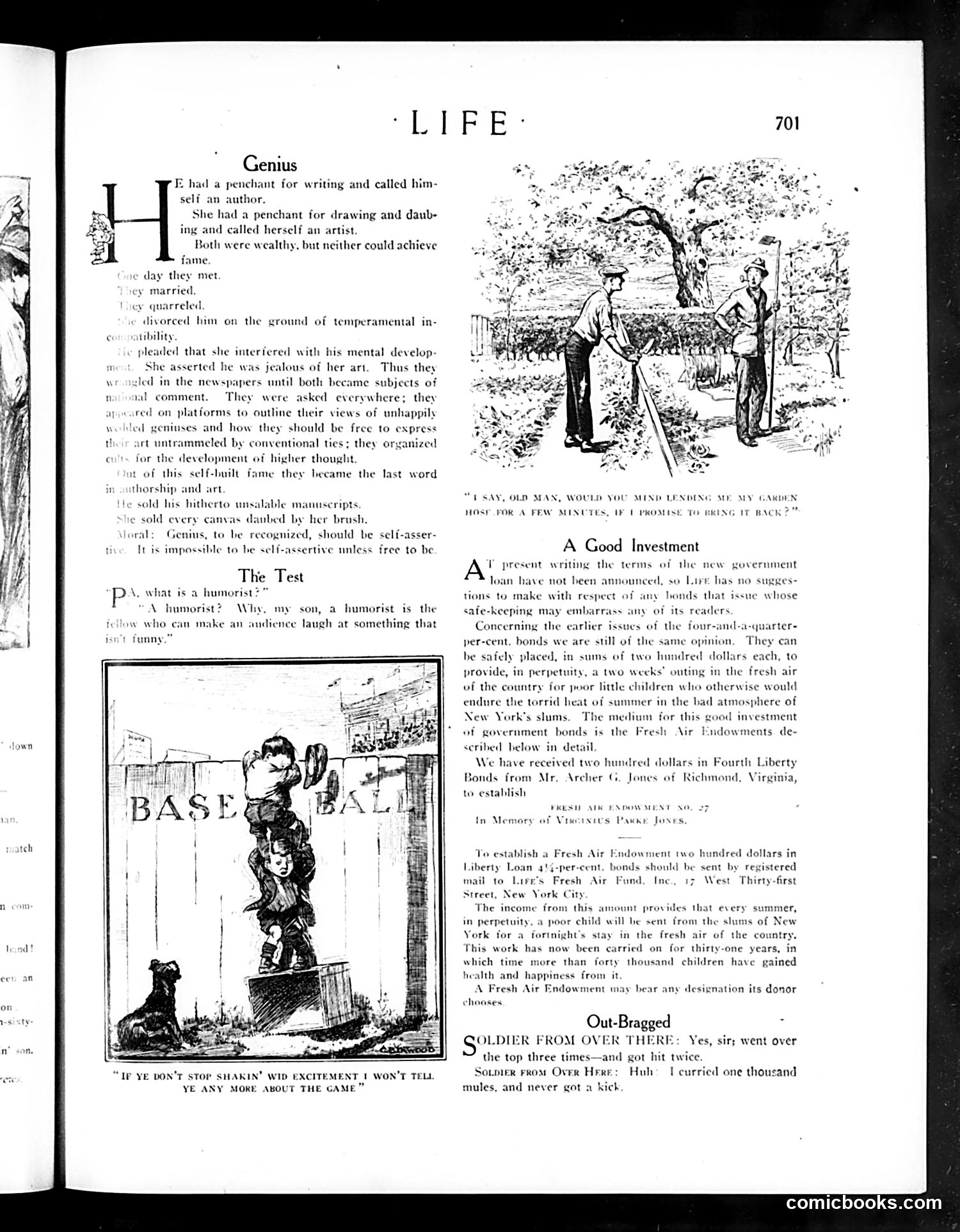
## Main Cartoons/Content: **"Genius" Story**: Satirizes pretentious bohemians. A wealthy man and woman, both failed at writing and art, marry and quarrel publicly. Their "temperamental incompatibility" becomes fashionable—newspapers cover them, they lecture about artistic freedom, and suddenly their previously unsalable work sells. The moral: Self-assertion and notoriety can create false fame; being controversial becomes profitable regardless of actual talent. **"The Test"**: A baseball cartoon showing children debating what a "humorist" is—someone who makes people laugh at things that aren't funny. The accompanying comic strip illustration depicts this absurdist humor. **"Out-Bragged"**: A brief dialogue contrasting a WWI soldier's genuine combat experience (went over the top three times, got hit twice) with a home-front soldier's exaggerated tale (curried 1,000 mules, never injured). Satirizes stateside soldiers inflating their service records. **"A Good Investment"**: Announces Fresh Air Endowment bonds—charitable bonds funding summer country outings for poor NYC slum children.
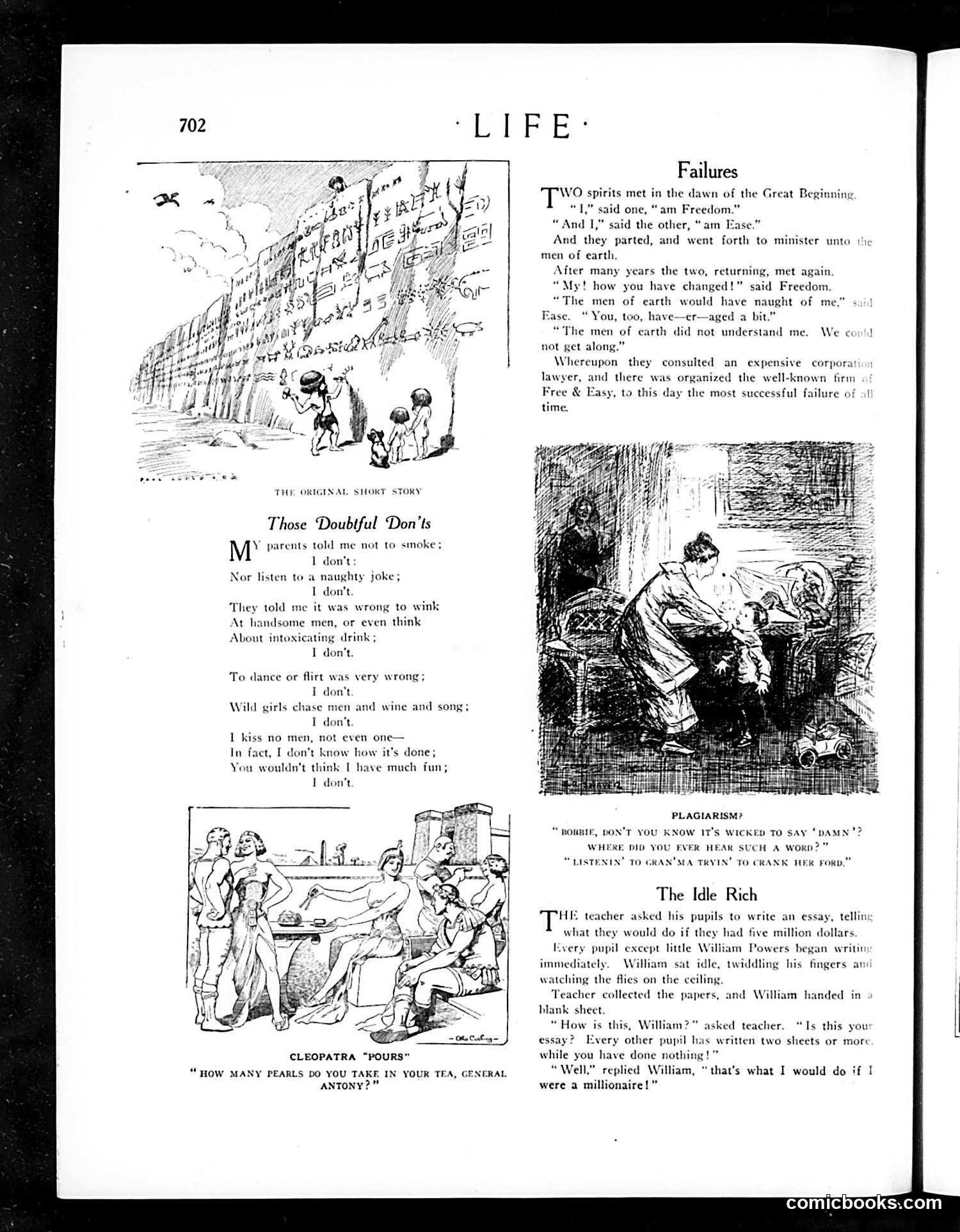
This page contains three satirical pieces typical of early-20th-century American humor: **"Those Doubtful Don'ts"**: A poem mocking overly restrictive Victorian morality imposed on young women—prohibitions against smoking, flirting, drinking, dancing, and kissing. The satire lies in the speaker's dutiful compliance while implying these restrictions are absurdly repressive. **"Failures"**: An allegory where the abstract concepts "Freedom" and "Ease" meet, attempt to help humanity, fail because humans "did not understand" them, then successfully merge into "Free & Easy"—satirizing how idealistic concepts become compromised corporate products through lawyers and business. **"The Idle Rich"**: A joke about wealth and idleness. When asked what he'd do with five million dollars, student William Powers submits a blank essay, explaining that *doing nothing* is exactly what he'd do as a millionaire—mocking the wealthy leisure class as fundamentally unproductive. The cartoons accompanying these texts reinforce social satire common to the era: critiquing restrictive morality, commercialized idealism, and the idle rich.
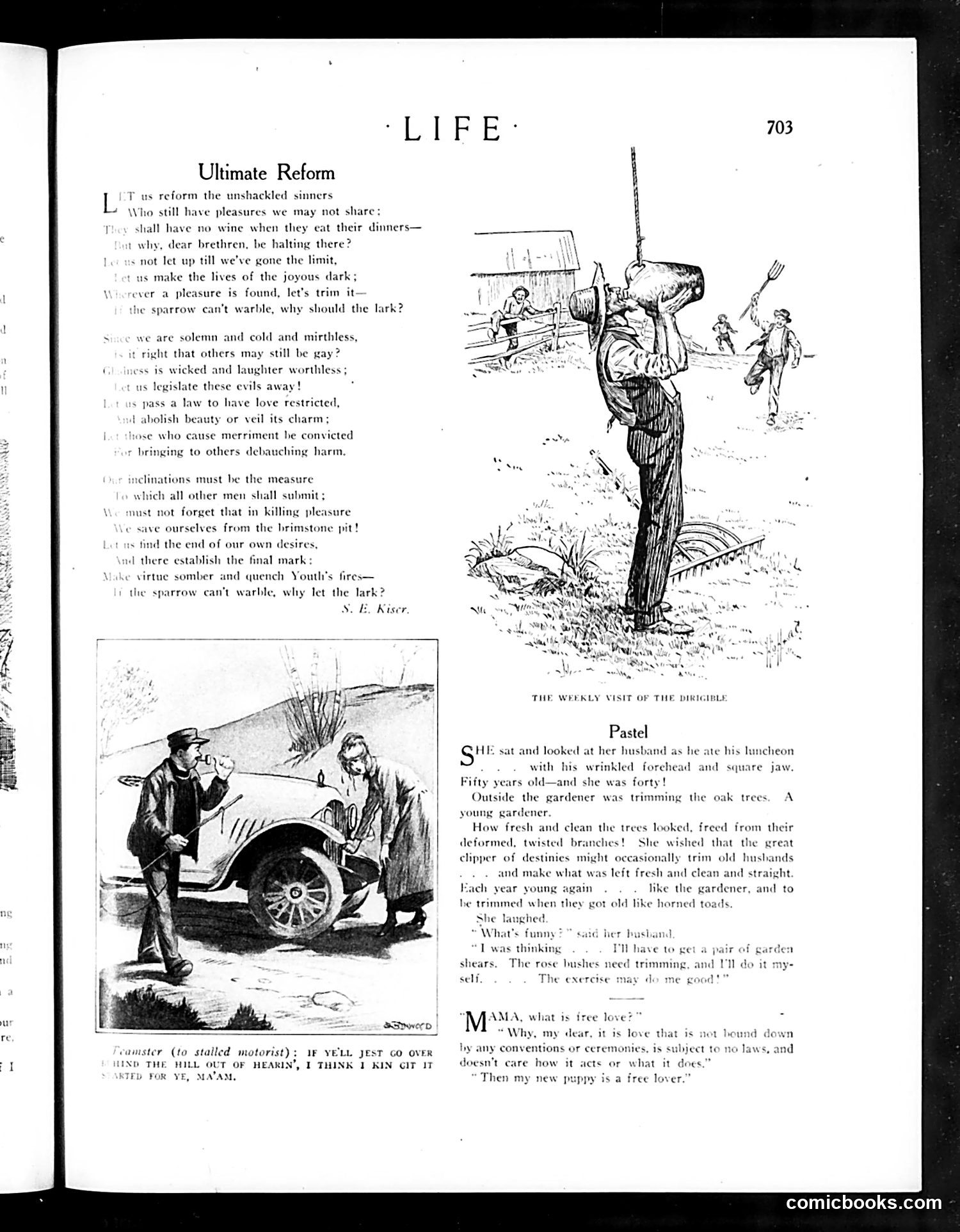
**"Ultimate Reform"** is a satirical poem mocking Prohibition advocates and moral reformers. The poem uses ironic exaggeration to expose the hypocrisy of self-righteous busybodies who want to eliminate *others'* pleasures (wine, laughter, beauty, love) while claiming moral superiority. The repeated refrain "if the sparrow can't warble, why should the lark?" suggests that restricting joy for some while permitting it for others is absurd. This likely reflects pre-Prohibition debates (early 1900s) about government overreach in regulating personal behavior. **"Pastel"** is a domestic story about a restless wife, fifty, married to a dull husband, fifty-five. She admires the young gardener trimming trees and fantasizes about rejuvenation and beauty. The joke concludes with her husband joking that their new puppy is a "free lover"—a reference to 1920s sexual liberation rhetoric, used here for comic contrast with her mundane marriage. The **cartoon** shows a motorist-and-mechanic exchange using dialect humor (common to the era), illustrating working-class comedic vernacular popular in Life's humor sections.
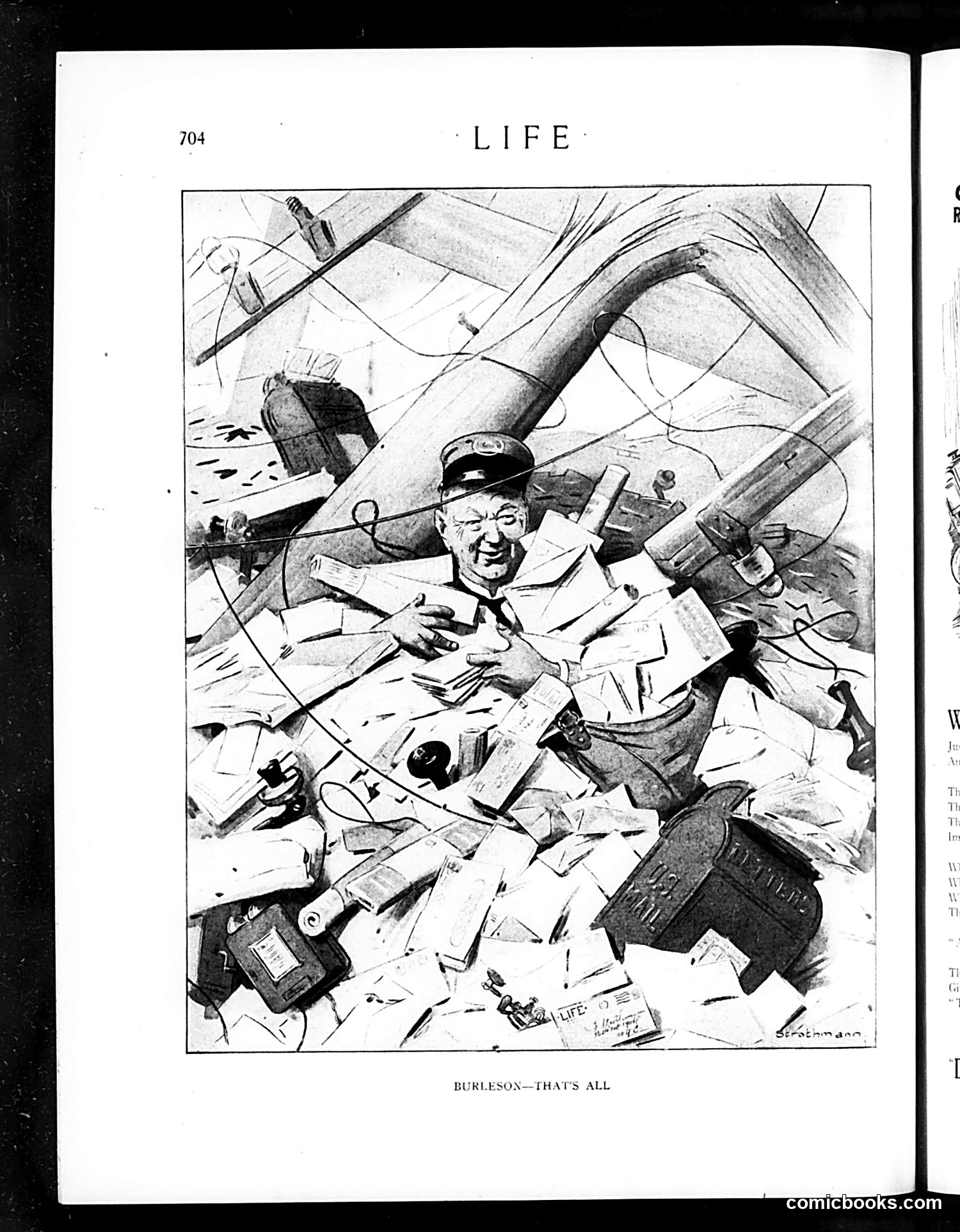
This cartoon depicts a man (identified by the caption as Burleson) buried under an avalanche of papers, mail, and documents. He's smiling amid the chaos, surrounded by what appears to be correspondence, official paperwork, and bureaucratic materials. The satire likely mocks Albert S. Burleson, Postmaster General under President Woodrow Wilson (1913-1921). The cartoon suggests he was overwhelmed by the volume of mail and administrative work his office handled, or possibly satirizes his management of postal operations during WWI—a period when the Post Office faced significant scrutiny over mail delays and censorship. The phrase "That's All" suggests resigned acceptance of an impossible workload or administrative burden.
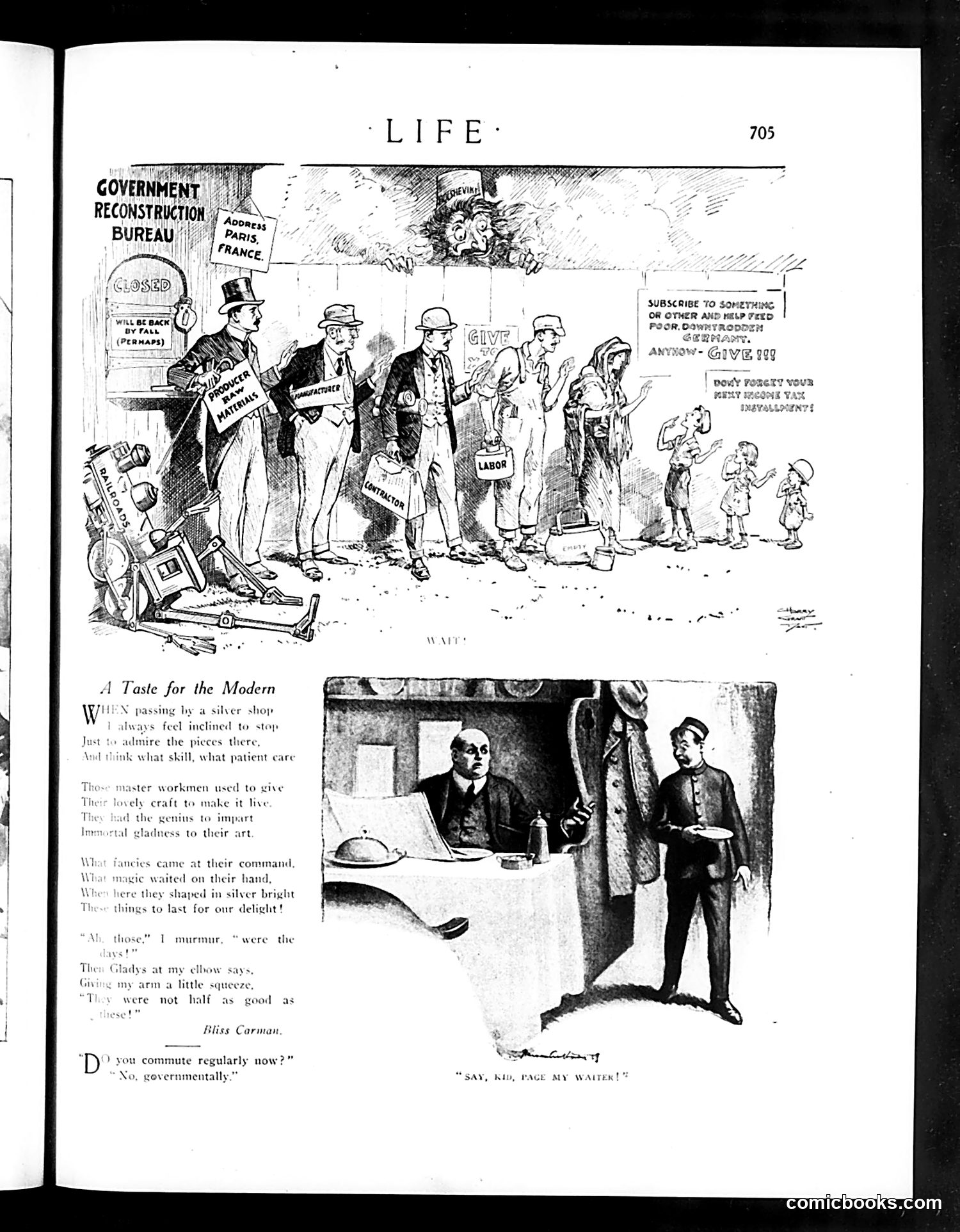
**Top Cartoon**: This satirizes post-WWI American bureaucracy and charity overreach. Figures labeled "Government Reconstruction Bureau," "Paris, France," and various charitable causes stand in a line soliciting donations from ordinary citizens. Starving children appear on the right. The joke critiques the proliferation of charitable appeals and government reconstruction efforts (likely related to post-war European relief), suggesting donors are overwhelmed by constant solicitations for causes beyond America's borders. **Lower Section**: "A Taste for the Modern" is a poem celebrating handcrafted silverware from an earlier era, contrasting artistic mastery with modern industrial production. The accompanying illustrations show an antique dealer and a restaurant scene, reinforcing nostalgia for superior craftsmanship. The brief joke about "governmentally" commuting appears unrelated wordplay. Overall, the page reflects post-WWI American ambivalence about foreign aid, governmental expansion, and anxiety about lost artistic standards.
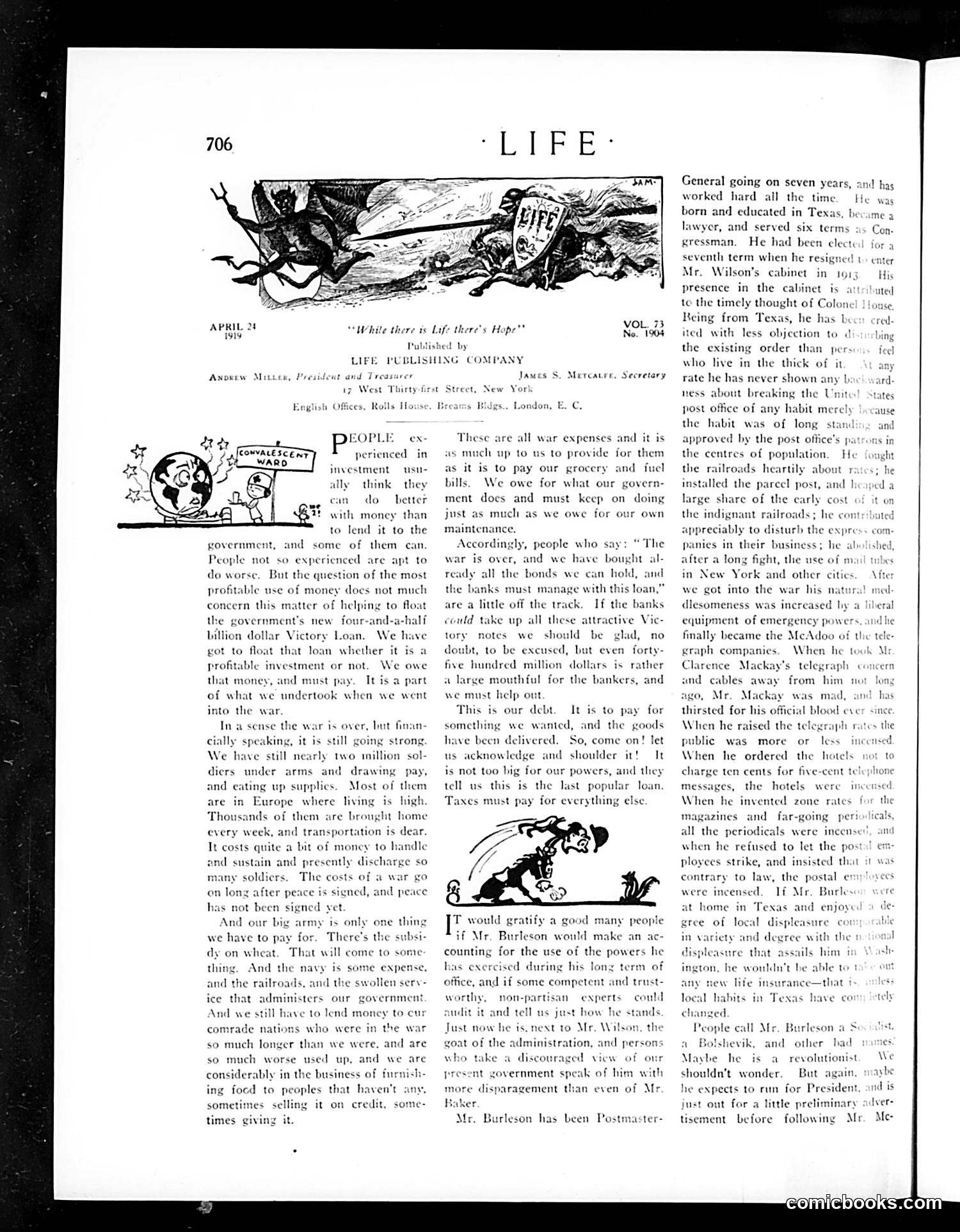
This page discusses post-WWI financial obligations, particularly a proposed "Victory Loan" (likely the Fourth Liberty Loan). The main article argues that Americans must acknowledge the government's massive war debts and help float this loan, rather than claiming "the war is over." The piece critiques Albert Sidney Burleson, Postmaster General under Wilson since 1913. While acknowledging his hard work, the author suggests Burleson has become a scapegoat for government mismanagement. The cartoon (left) appears to show a figure labeled "Convalescing" struggling with financial weight—likely satirizing the strain of post-war economic burden on citizens. The text argues that citizens must accept responsibility for war expenses through taxation and loans, as this is the cost of their government's decisions. The commentary is relatively patriotic rather than anti-government, accepting war debt as inevitable while calling for transparency in how resources were used.
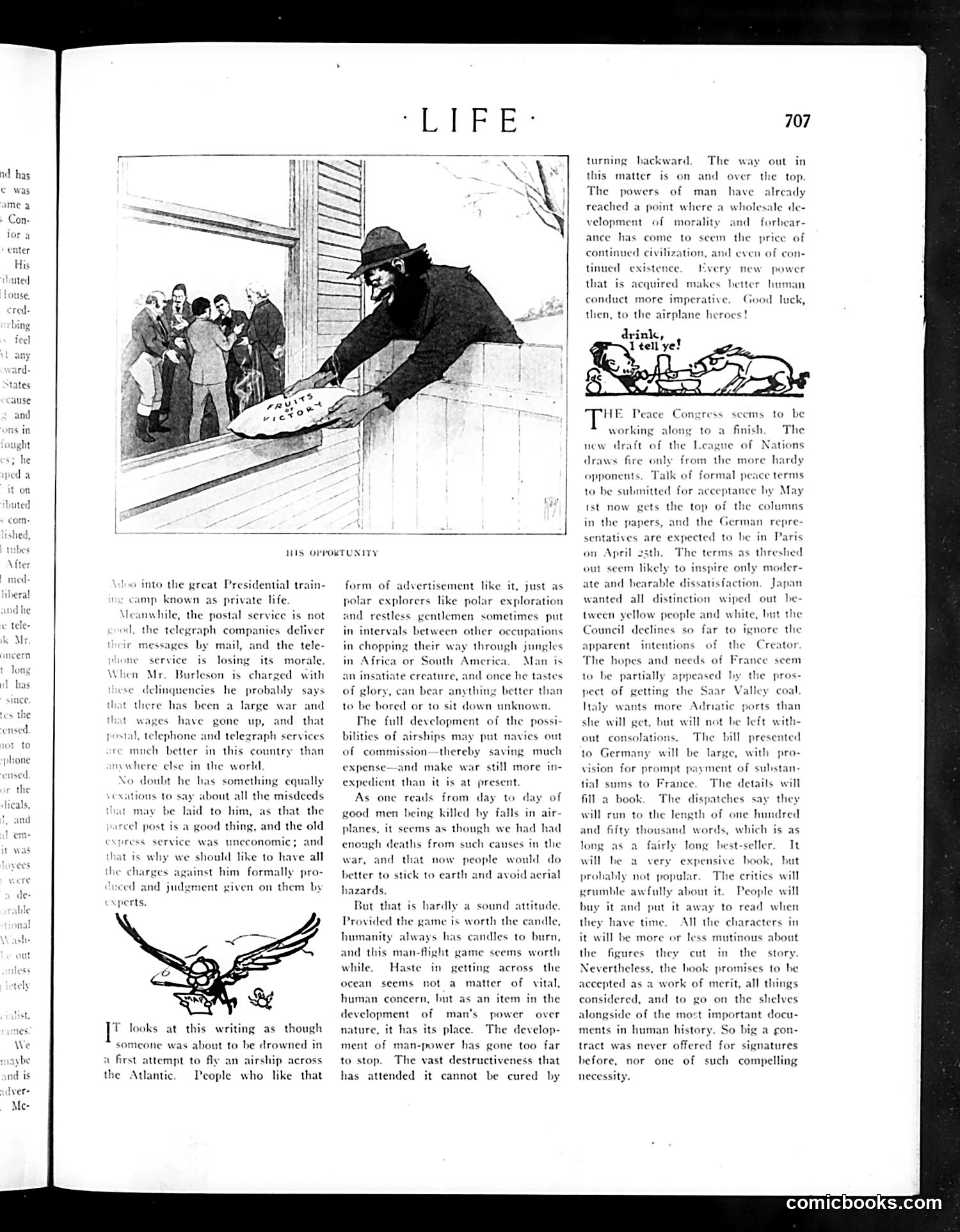
This page contains two distinct editorial cartoons addressing post-WWI issues: **"His Opportunity"** (main cartoon): Shows a man in a hat appearing to distribute or display something to a group of onlookers. The accompanying text discusses postal and telegraph service failures under Postmaster General Albert Burleson, implying he's using wartime conditions as an excuse for poor performance. The cartoon satirizes how officials blame external circumstances rather than taking responsibility. **Secondary commentary**: The text critiques the Peace Congress negotiations occurring in Paris (April 1919), discussing proposed terms for Germany and territorial disputes involving Japan, Italy, and France. It also defends aviation development despite fatal crashes, arguing humanity's advancement requires accepting risk. The page reflects immediate post-WWI concerns: government accountability, peace treaty negotiations, and technological progress. The satire targets bureaucratic excuse-making and the complex, often unsatisfying compromises emerging from Versailles negotiations.
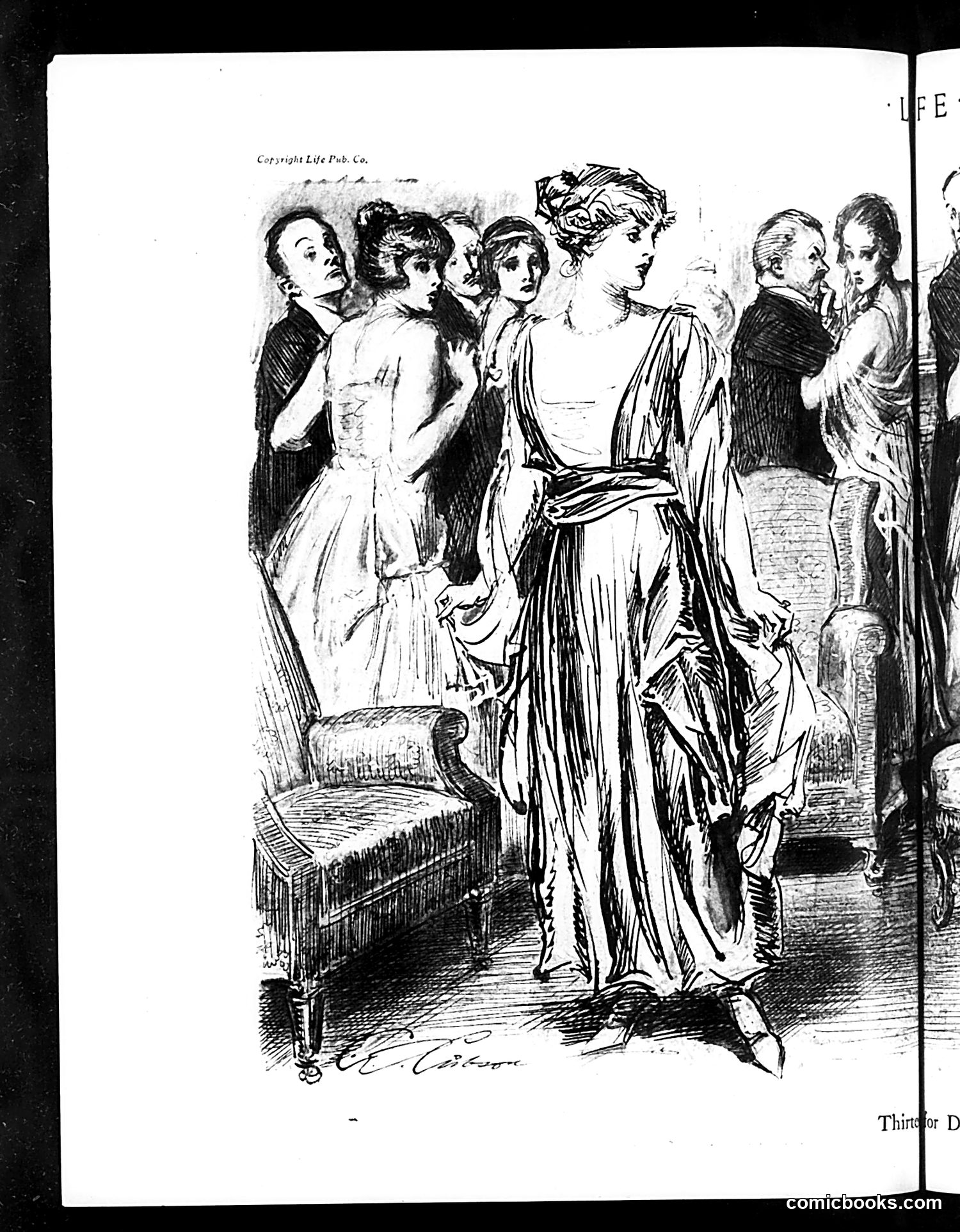
This appears to be a social satire illustration from *Life* magazine, likely from the early 20th century, depicting a formal social gathering or reception. The sketch shows elegantly dressed women in flowing gowns alongside men in formal attire, suggesting a high-society event. The satire likely targets social pretension or the performative nature of upper-class gatherings. The artist's exaggerated linework emphasizes affected postures and expressions, a typical *Life* magazine approach to mocking fashionable society. However, without visible caption text or clearer contextual clues in the OCR'd text, the specific social commentary—whether aimed at particular social figures, fashions, or behaviors—remains unclear. The page's top credit line confirms copyright by *Life Publishing Co.*, identifying it as legitimate period content.
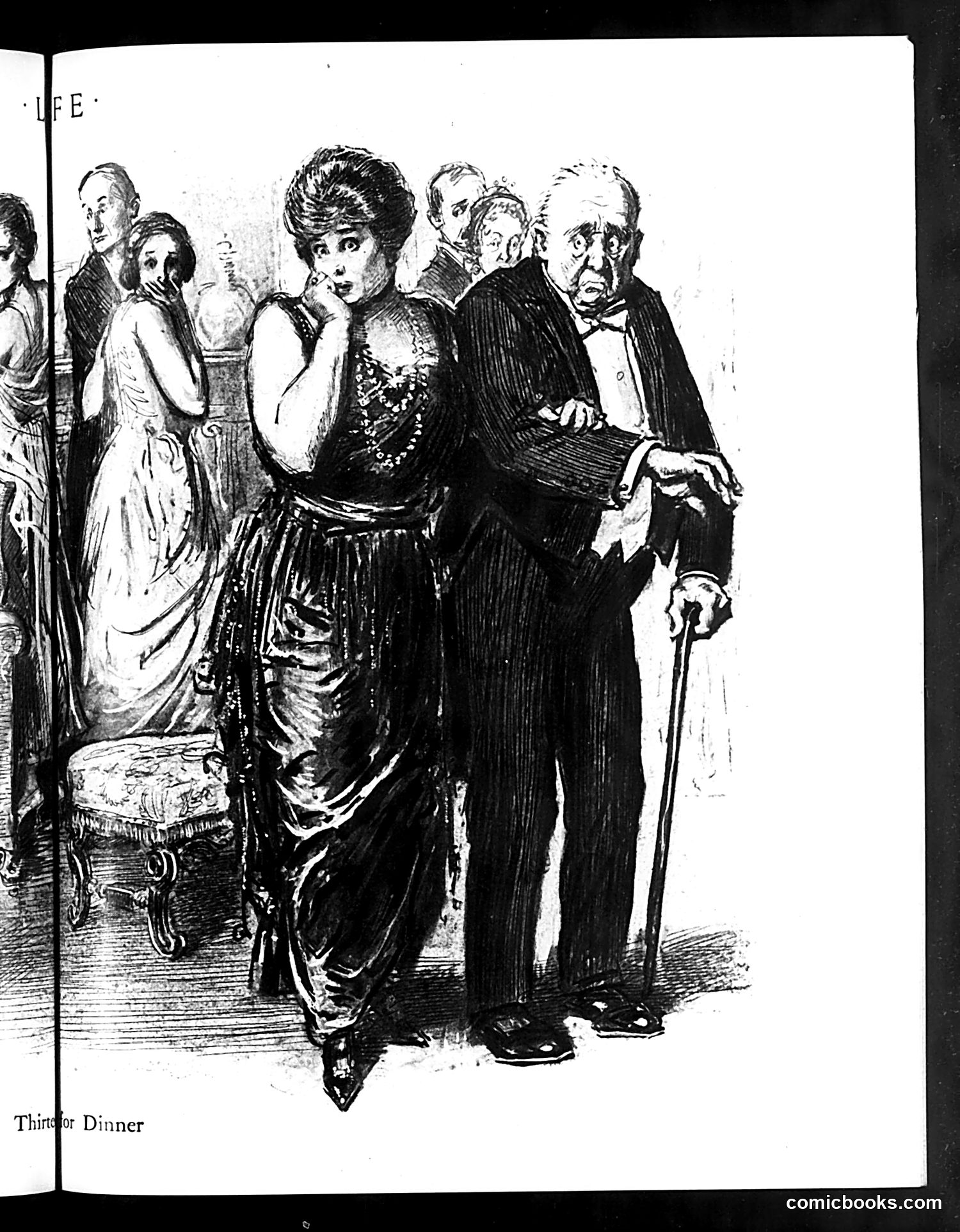
This satirical illustration depicts a formal dinner scene with elegantly dressed guests, but the title's apparent misspelling or pun—"Thirst for Dinner" rather than "Thirst *for* Dinner"—suggests social commentary on upper-class excess and alcohol consumption. The well-dressed figures, particularly the prominent woman in an ornate dark gown and the distinguished gentleman with a cane, embody Gilded Age high society. The cartoon likely mocks the pretensions and priorities of wealthy diners, implying their primary motivation is drinking rather than dining. The exaggerated expressions and formal attire emphasize the satirical intent. Without additional context about specific individuals or events from *Life* magazine's publication date, the broader satire targets upper-class hypocrisy and the disconnect between refined appearances and baser appetites.
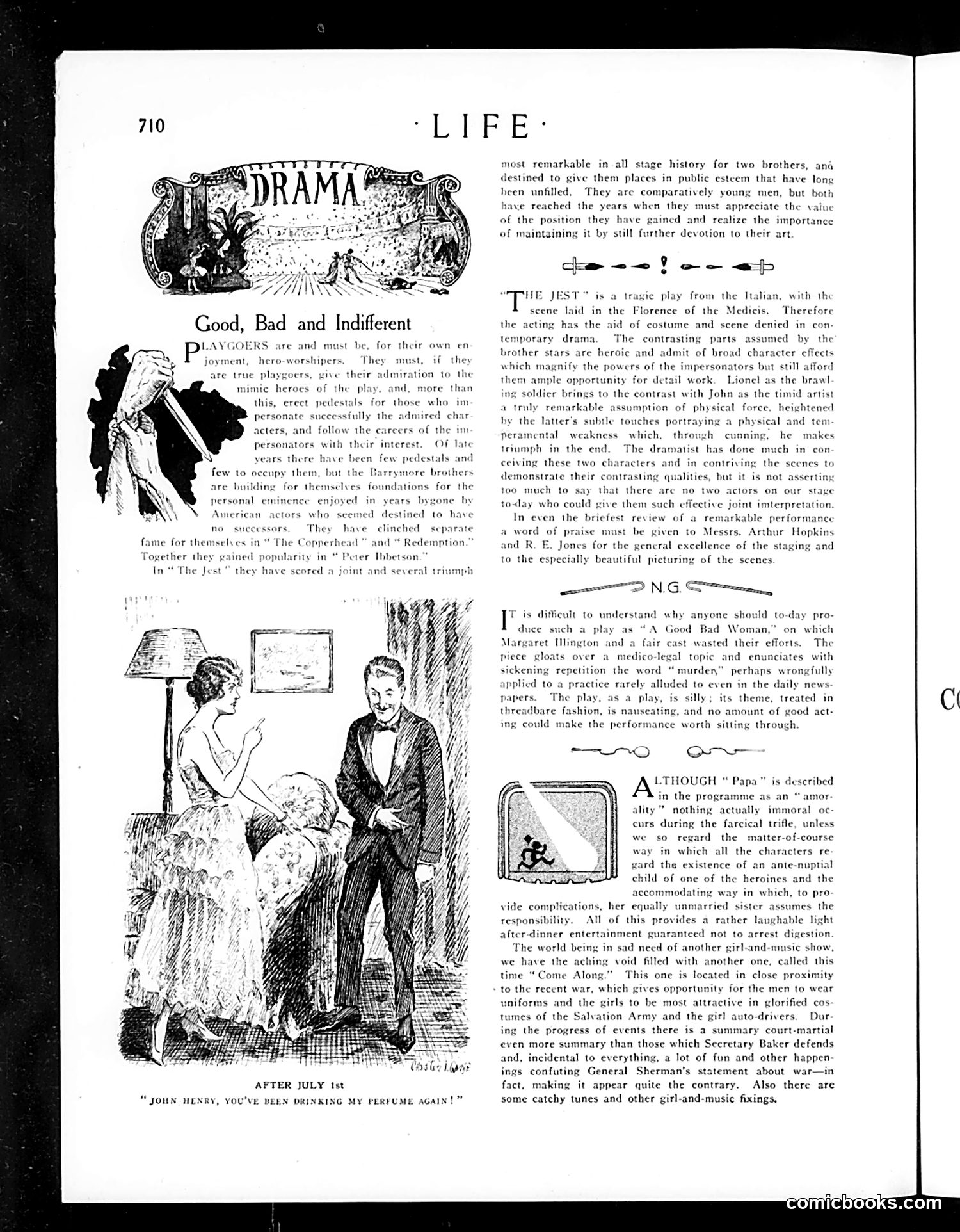
This page reviews several Broadway plays, focusing primarily on **"The Jest,"** a tragic Italian play set in Renaissance Florence starring **the Barrymore brothers** (Lionel and John). The review praises their "remarkable" joint performance, with Lionel playing a "brawling soldier" and John a "timid artist," showcasing contrasting physical and emotional acting styles. The page criticizes two other plays: **"A Good Bad Woman"** (with Margaret Illington), which the reviewer finds morally objectionable for its repeated use of the word "murder" in discussing a medical-legal topic, and **"Papa,"** dismissed as silly farce with forgettable music. The cartoon illustration shows a domestic scene with the caption "JOHN HENRY, YOU'VE BEEN DRINKING MY PERFUME AGAIN!"—likely satirizing frivolous theater content or advertising perfume to readers.
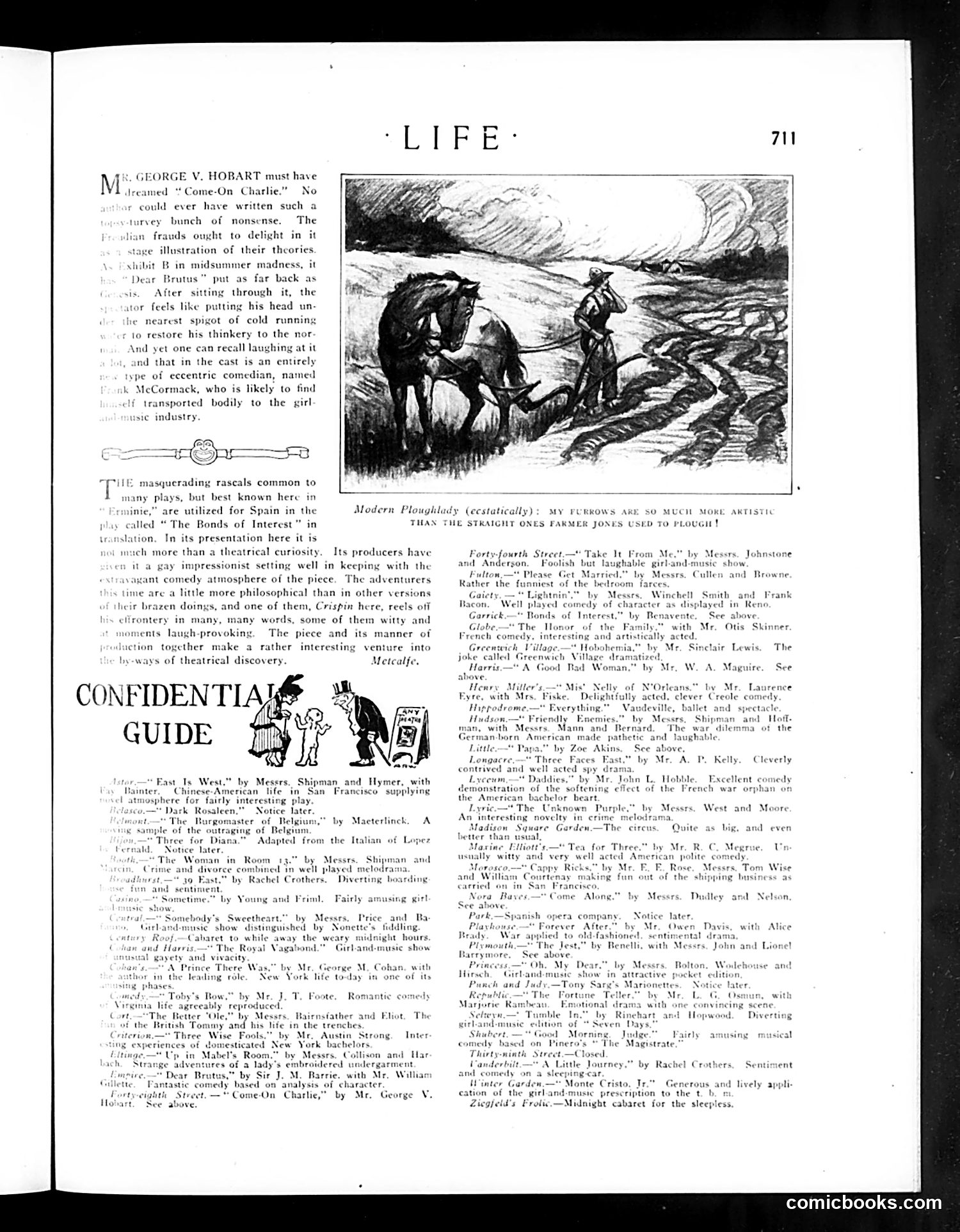
The main illustration shows a farmer with a plow being pulled by a horse, with another figure helping guide it—a scene of agricultural labor. The caption reads "Modern Ploughboy (ecstatically): MY FURROWS ARE SO MUCH MORE ARTISTIC THAN THE STRAIGHT ONES FARMER JOHN DOES!" This is satirical commentary on artistic pretension. The joke mocks someone applying fine-art aesthetics ("artistic") to mundane farm work, suggesting an absurd elevation of manual labor through pseudo-intellectual artistic claims. The "ecstatic" farmer character represents the ridiculous pride someone might take in making functional work conform to artistic principles rather than practical efficiency. The surrounding text discusses theatrical productions and shows, not directly related to this cartoon's satire on artistic affectation in everyday labor.
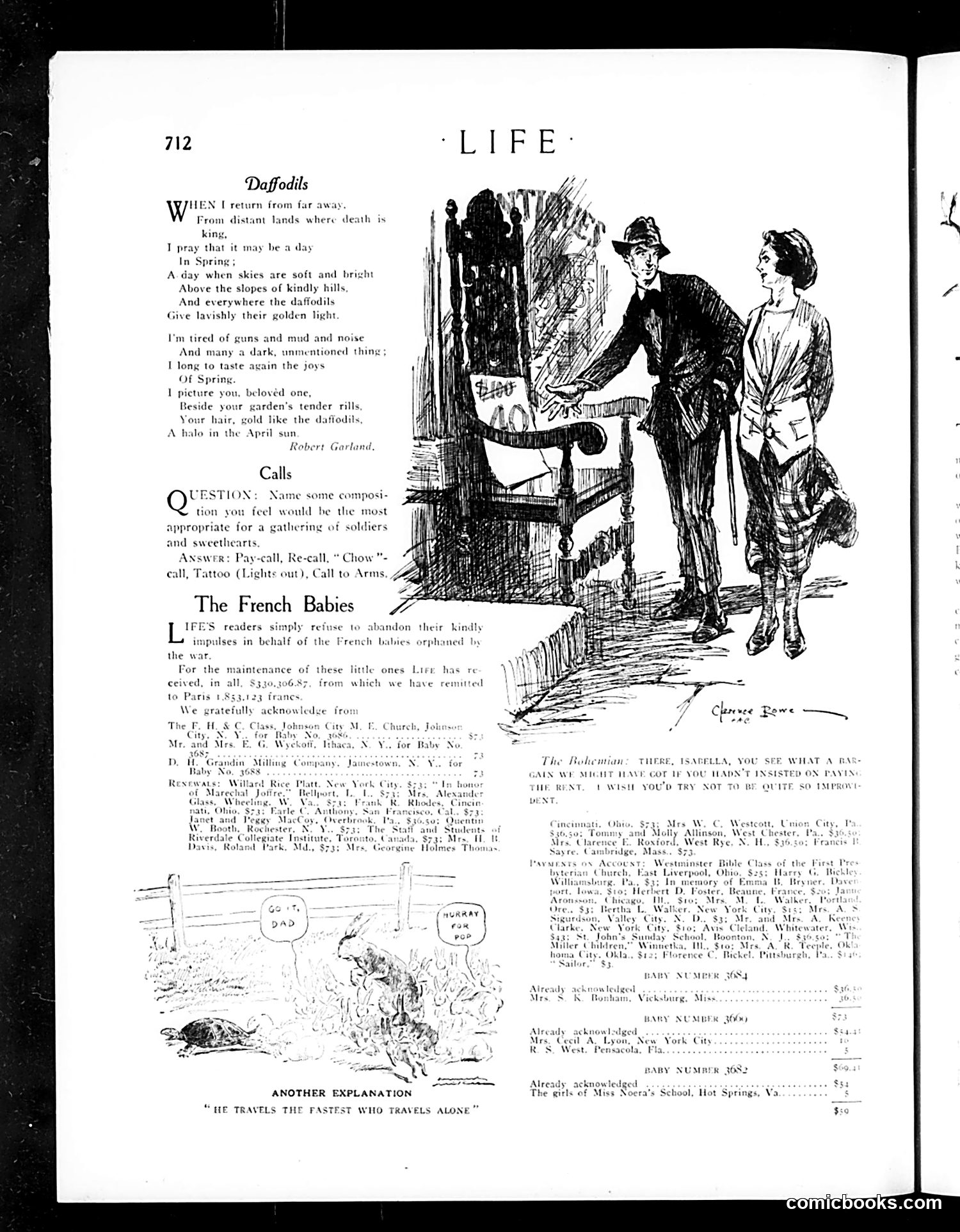
This page combines war-related content with satire typical of Life magazine's WWI-era output. **"Daffodils" poem**: A sentimental piece by Robert Garland expressing a soldier's longing to return home to peaceful spring scenes and a beloved woman. It contrasts the horrors of war ("guns and mud and noise," "dark, unmentioned thing") with pastoral domesticity—reflecting common wartime homesickness themes. **"Calls" section**: A humorous Q&A making military wordplay. The question asks which musical composition suits soldiers and sweethearts together; the answer plays on military bugle calls ("Pay-call," "Chow-call," "Tattoo") that would be familiar to soldiers—light satire on military life. **"The French Babies"**: A fundraising notice for orphans of the war, asking Life readers to sponsor French war orphans' care in Paris. This reflects actual WWI charitable efforts. **Bottom cartoon**: Shows a "Bohemian" character and "Isabella," apparently commenting on domestic marital conflict, with the caption suggesting someone regrets not being more insistent about something (text unclear, likely marital/domestic satire). The page mixes patriotic sentiment, war weariness, and domestic humor typical of American magazines during World War I.
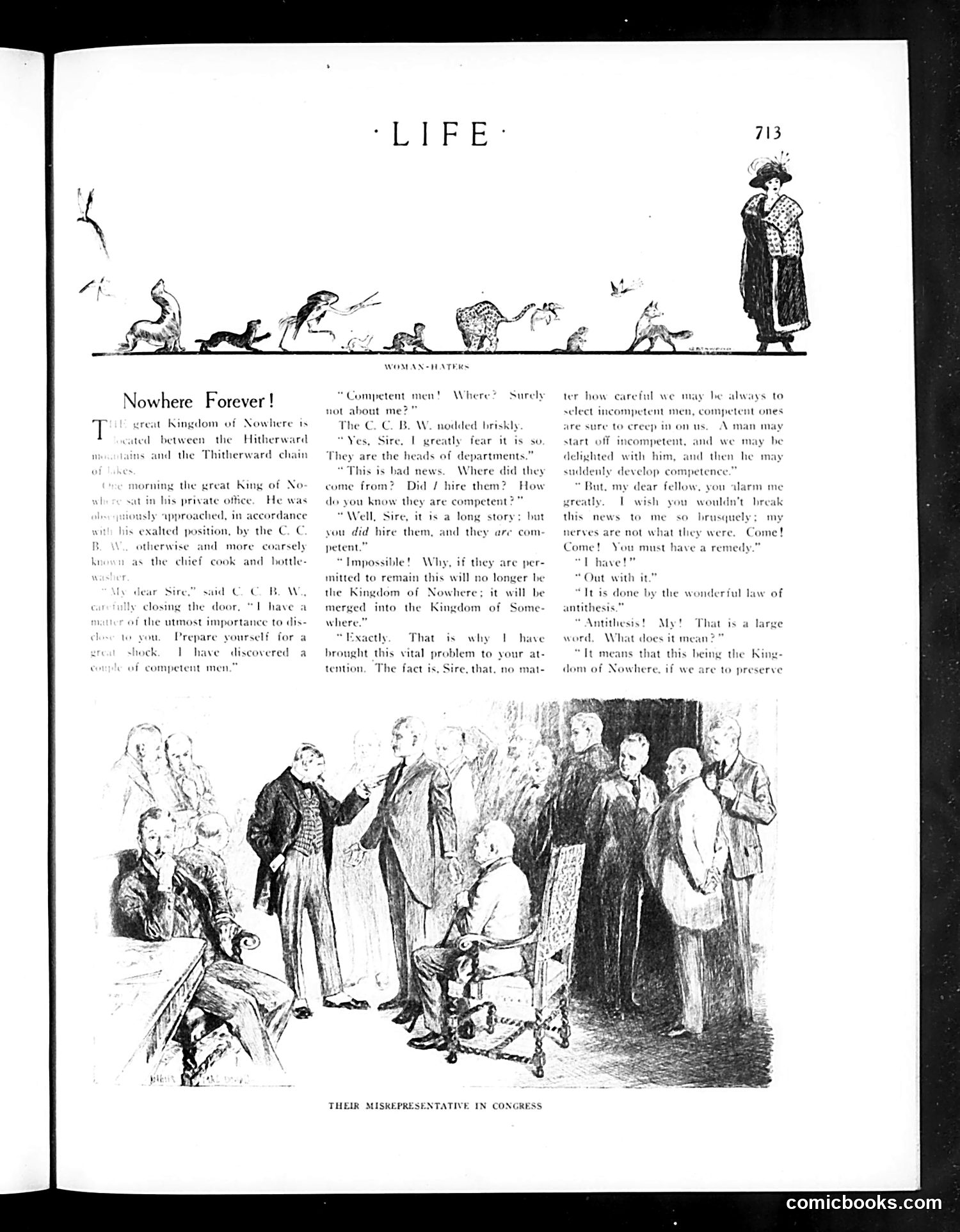
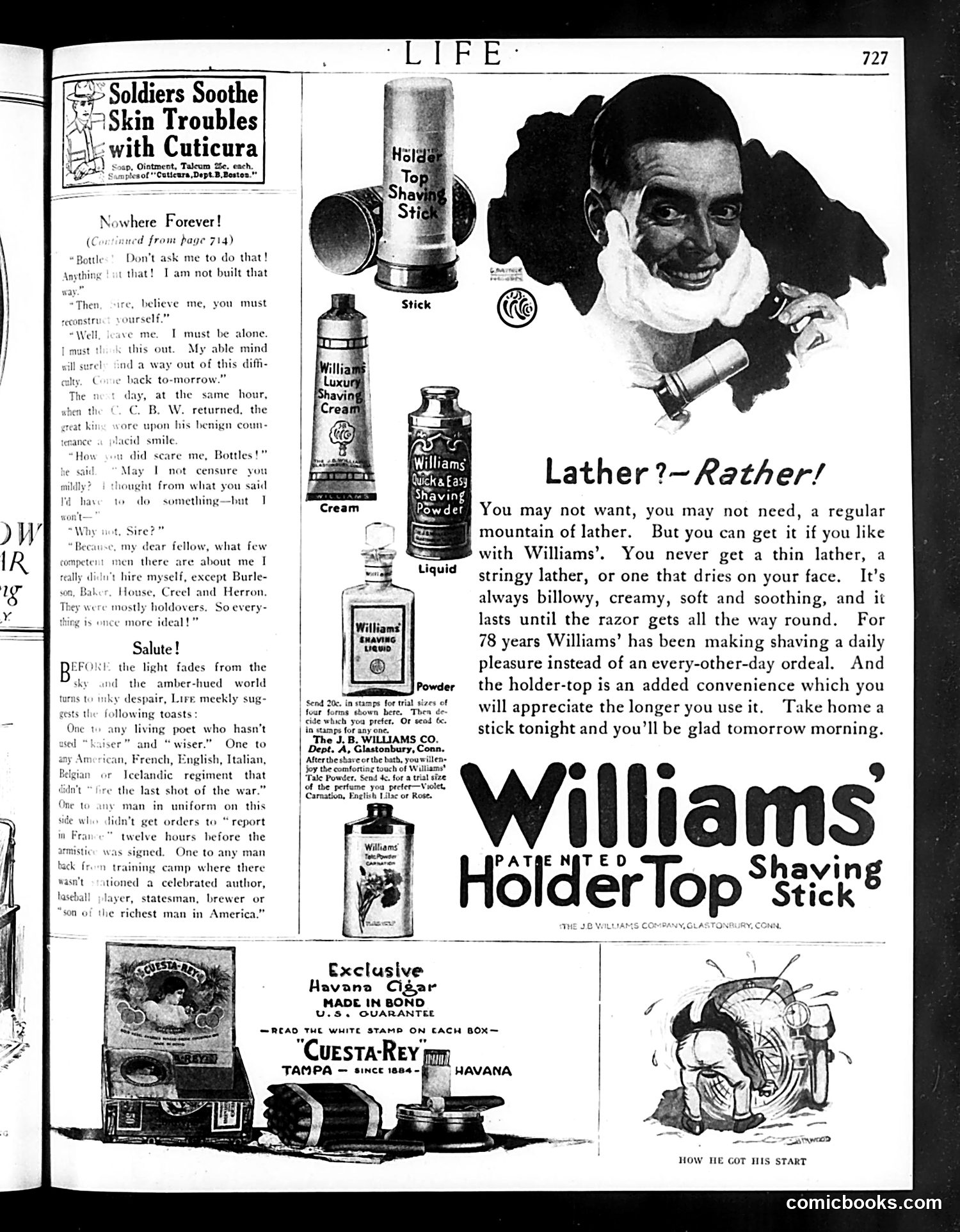
This is a satirical political fantasy titled "Nowhere Forever!" The premise mocks bureaucratic incompetence: the fictional Kingdom of Nowhere is built on selecting *incompetent* officials, but competent men keep accidentally getting hired anyway, threatening the kingdom's entire identity. The top illustration shows a "Woman-Haters" parade—likely referencing a contemporary club or social organization. The bottom illustration, captioned "Their Misrepresentative in Congress," depicts what appears to be a Congressional scene with a single figure (presumably a woman) among male politicians. This satirizes the absurdity of women's representation in government—treating a woman in Congress as a comedic anomaly, much like competent people in the "Kingdom of Nowhere." The satire targets both governmental inefficiency and, likely, resistance to women's political participation, presenting both as laughably contradictory to institutional expectations.
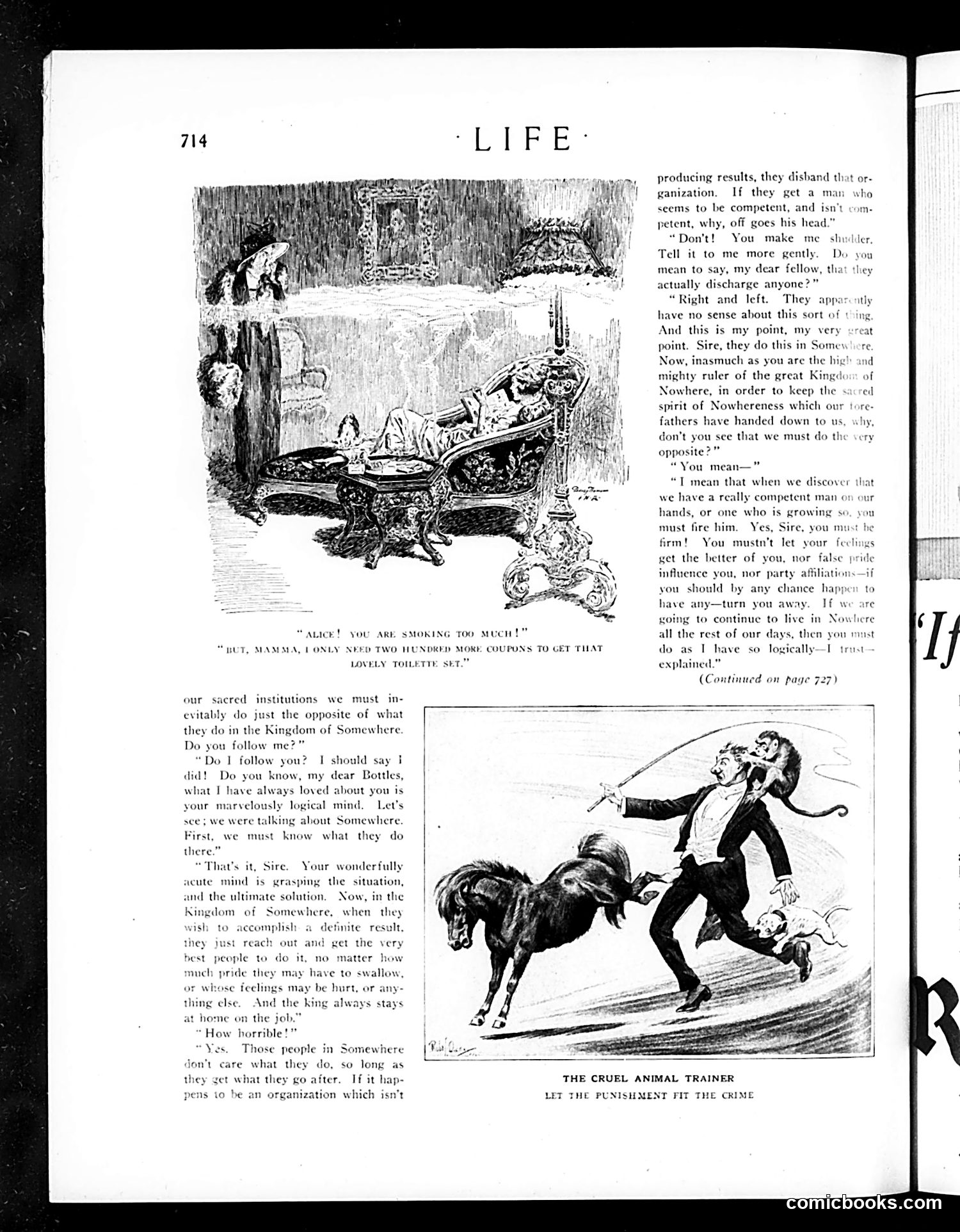
This *Life* magazine page satirizes bureaucratic absurdity and governance by the "opposite principle." A courtier advises the "mighty ruler of the great Kingdom of Nowhere" that to maintain their national character, they must do the *opposite* of what sensible kingdoms do. Specifically: fire competent employees rather than hire them—because Somewhere (an obvious stand-in for rational governance) does the opposite. The humor targets political leaders who prioritize ideology or tradition over competence, making deliberately poor decisions to assert national distinctiveness. The lower cartoon, "The Cruel Animal Trainer," shows a man beating a donkey, illustrating the theme that illogical punishment doesn't fit the crime—mirroring the dialogue's absurd logic. The side-dialogue about smoking coupons provides contrasting domestic absurdity, suggesting irrationality pervades all levels.
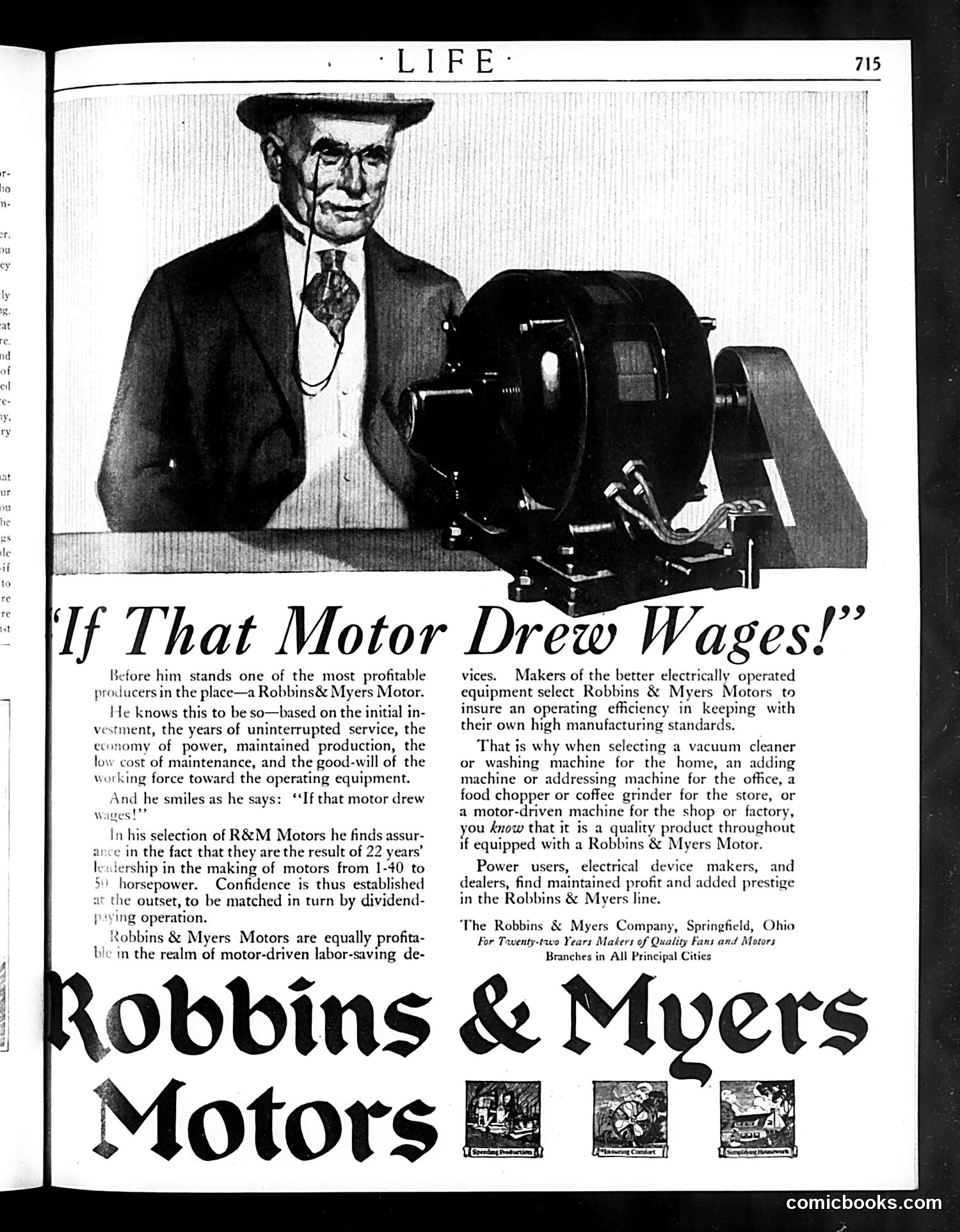
This is primarily a **product advertisement**, not political satire. It promotes Robbins & Myers Motors, manufactured in Springfield, Ohio. The image shows a businessman in formal attire standing beside an industrial electric motor. The headline "If That Motor Drew Wages!" is a playful joke: the businessman suggests the motor is so profitable and reliable that if it *drew a salary*, it would still pay for itself through increased efficiency and reduced maintenance costs. The advertisement emphasizes the motor's 22-year track record and positions it as a profitable investment for manufacturers. It claims the motors are used in home appliances (vacuum cleaners, washing machines) and industrial equipment (factory machinery, office machines). **For modern readers:** This reflects early-20th-century industrial marketing, celebrating mechanization and automation as profit-enhancers. There's implicit humor in the notion of rewarding reliable machinery—anticipating anxieties about automation replacing human labor, though presented here as beneficial cost-saving.
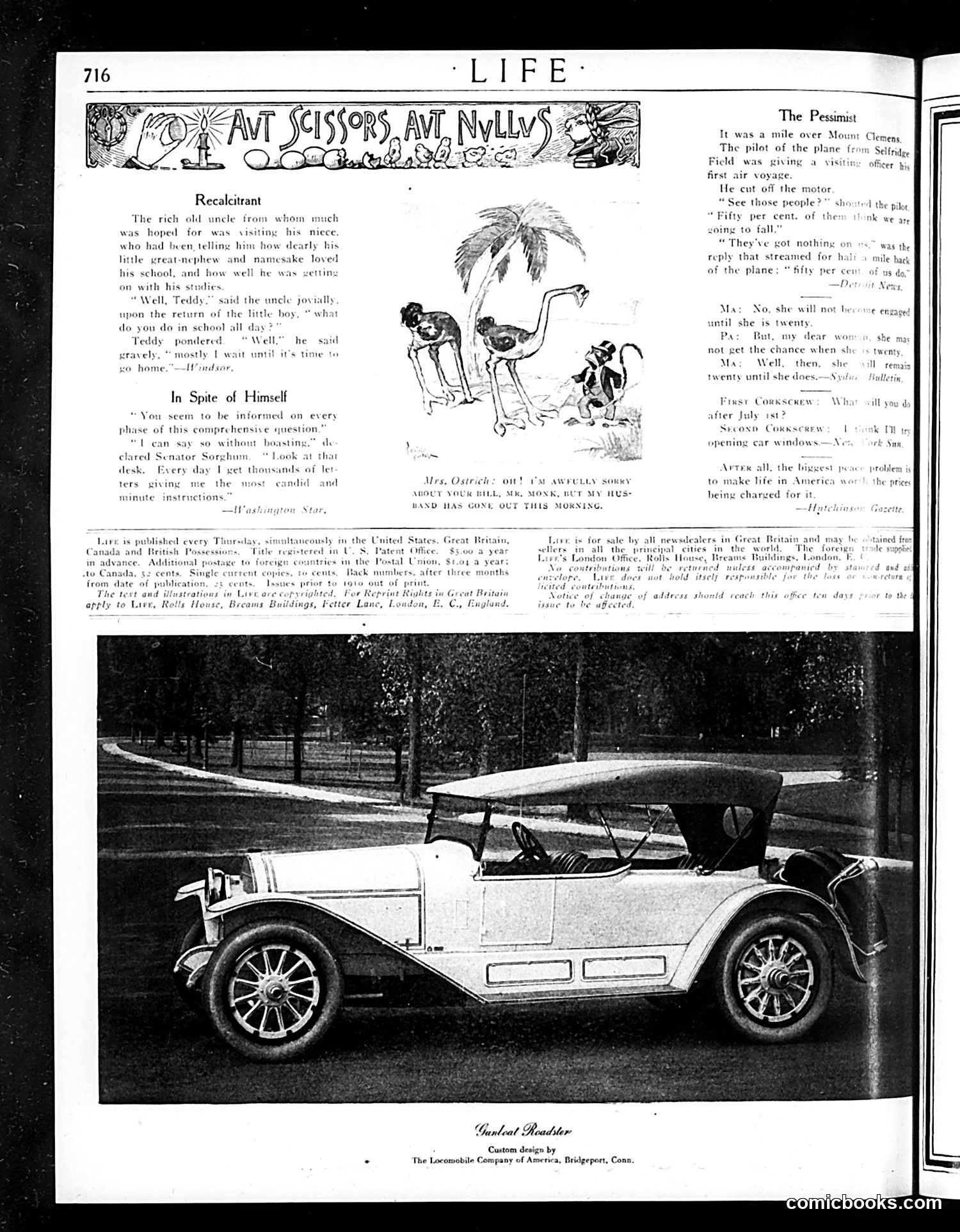
This page contains three separate humor pieces typical of Life's satirical content: 1. **"The Recalcitrant"**: A joke about a boy named Teddy whose rich uncle visits. When asked what he does at school, Teddy admits he mostly "waits until it's time to go home"—mocking students who are disengaged from education. 2. **"In Spite of Himself"**: Senator Sorgh claims he's uninformed, yet admits receiving thousands of letters daily giving him "candid and minute instructions." The satire targets politicians who claim ignorance while clearly being well-informed by lobbyists or constituents. 3. **"The Pessimist"**: A brief exchange about an airplane passenger seeing people below who "will fall," exemplifying defeatist attitudes. 4. **Animal cartoon**: An ostrich apologizes about a lost bill, with corkscrews discussing opening car windows—likely absurdist humor. The page concludes with an advertisement for a **Ganleat Roadster** automobile by Locomobile Company, featuring a period touring car.
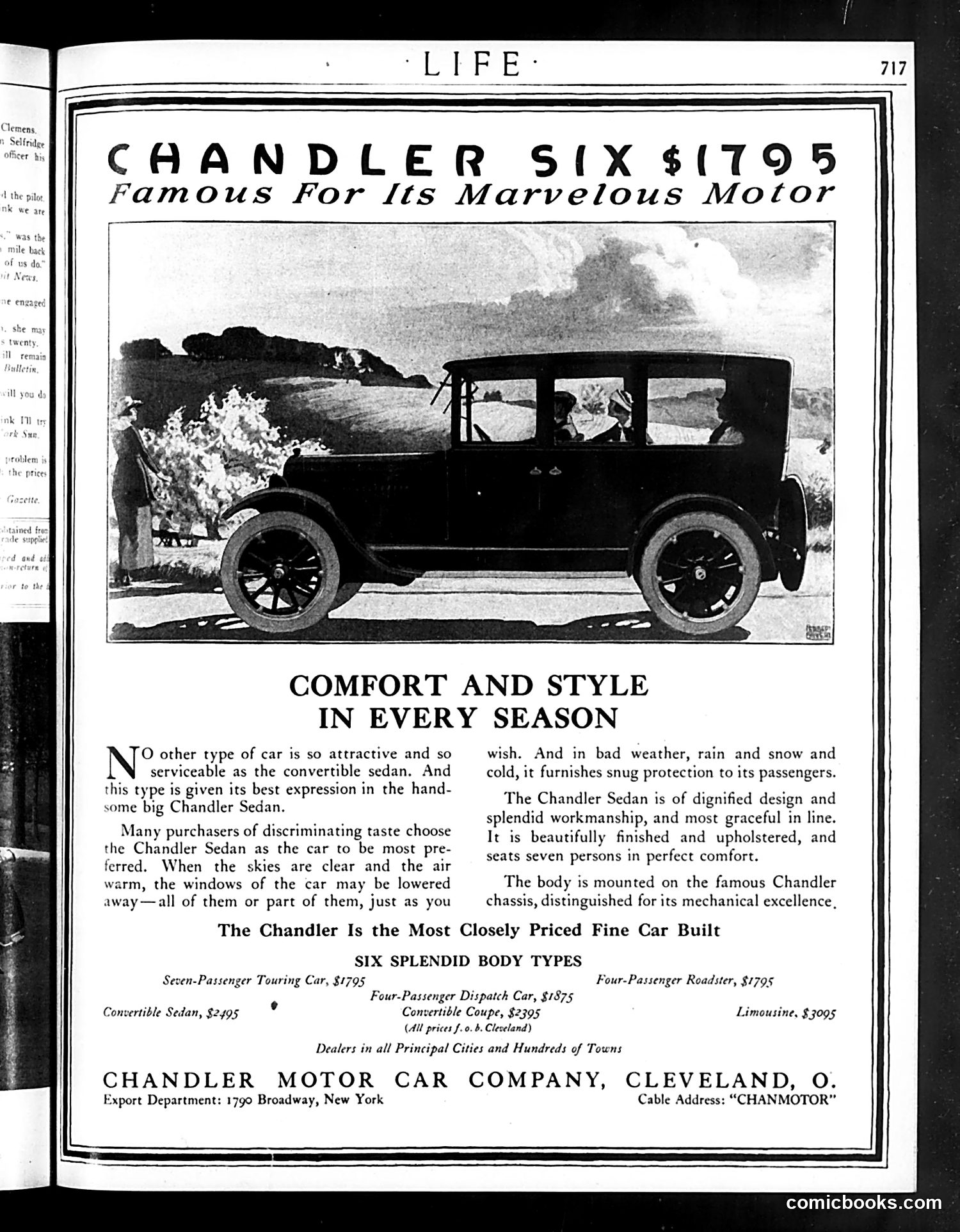
This page is **not a cartoon or satire**—it is a straightforward automobile advertisement from *Life* magazine (page 717). The Chandler Motor Car Company advertised their "Six" model sedan, priced at $1,795, emphasizing its convertible design with lowerable windows for year-round comfort. The ad highlights the car's "dignified design," craftsmanship, and spacious seven-person seating. The image shows a side-profile photograph of the sedan in a rural landscape. Six body types are listed with prices ranging from $1,795 to $3,095, with dealers available across the United States. This represents early 20th-century automotive marketing—targeting "discriminating taste" buyers and promoting mechanical reliability as a premium feature. The Chandler company was based in Cleveland, Ohio, with an export office in New York.
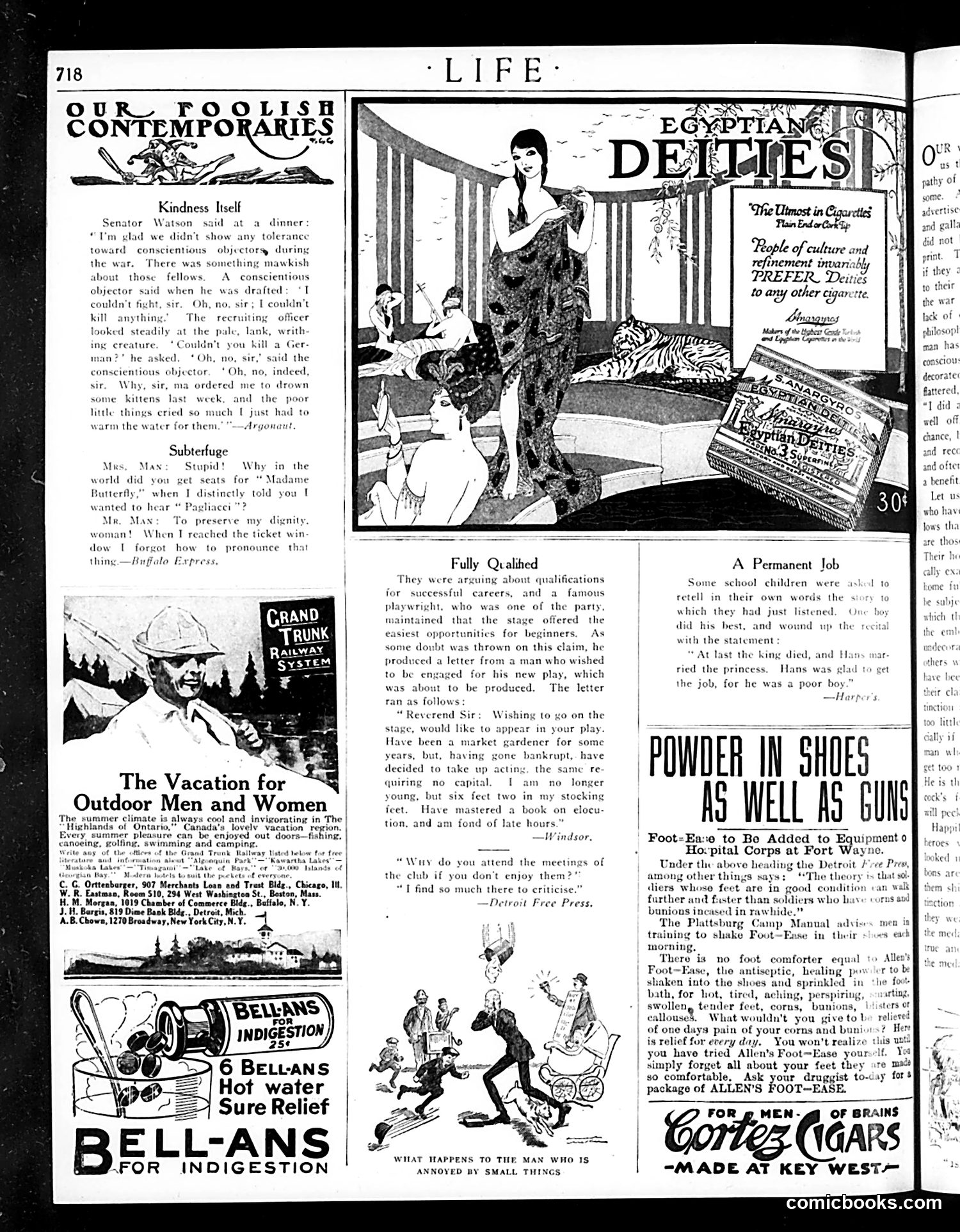
This page from *Life* magazine contains primarily **humorous anecdotes and advertisements** rather than political cartoons requiring historical context. The main text features three brief jokes: 1. **"Kindness Itself"**: A satirical anecdote about a conscientious objector drafted during WWI who claims he cannot kill, yet had no qualms drowning kittens—mocking the perceived hypocrisy of pacifist objectors. 2. **"Subterfuge"**: A domestic comedy about a man attending the "wrong" opera to avoid pronouncing "Pagliacci" correctly—a mild joke about class anxieties. 3. **"Fully Qualified"**: An anecdote where a failed market gardener seeks stage work, highlighting absurdity in theatrical hiring. The page is **heavily advertisement-focused**, featuring promotions for Bell-Ans antacid, Grand Trunk Railway, Allen's Foot-Ease powder, and Egyptian Deities cigarettes. These ads reflect early 20th-century consumer products and marketing approaches rather than conveying satirical commentary themselves.
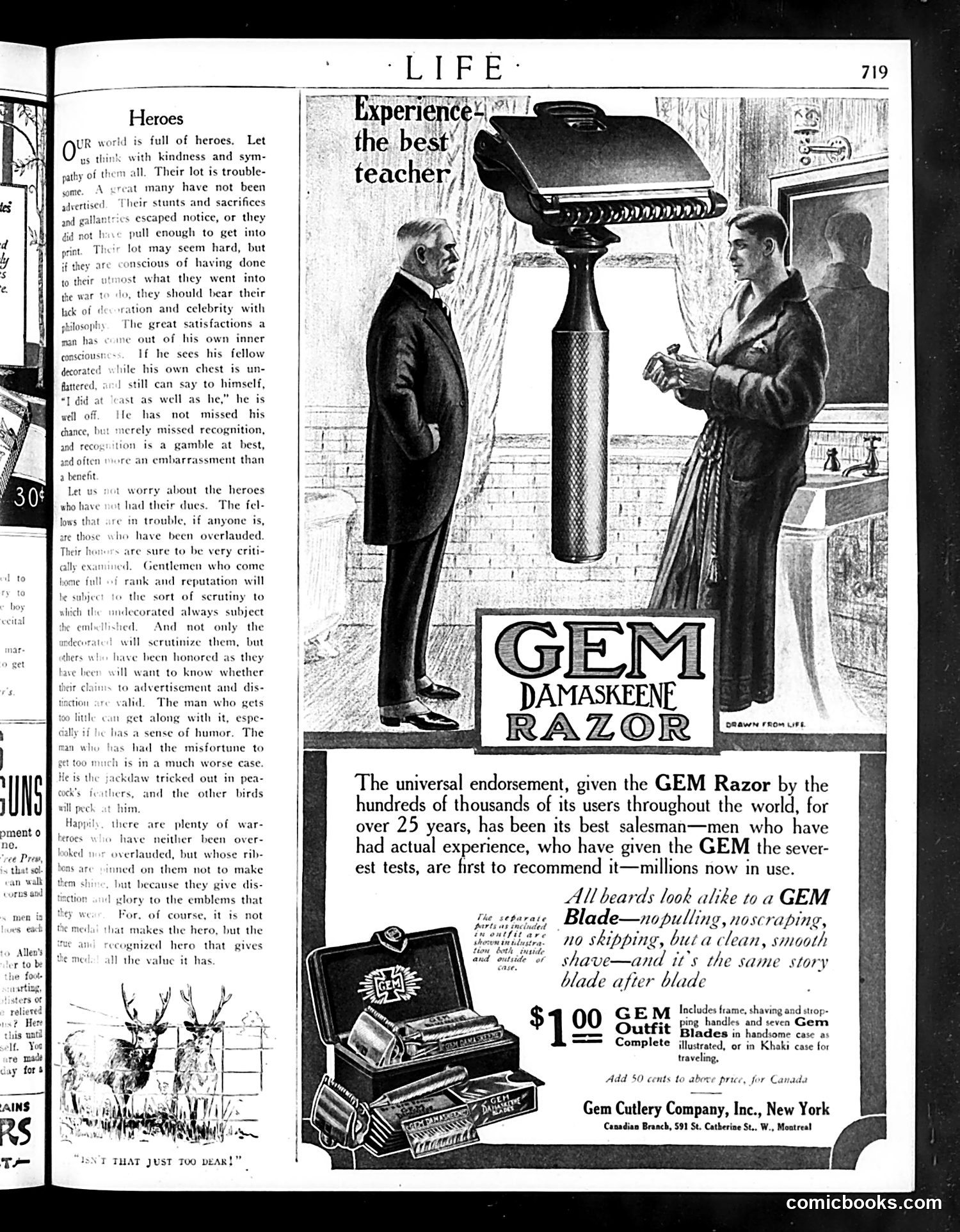
This page combines editorial content with advertising. The left column presents an essay titled "Heroes," arguing that true heroism lies in quiet inner satisfaction rather than public recognition or medals. The author suggests that celebrated heroes often face unfair scrutiny, while unrecognized heroes deserve sympathy—though he counsels against worrying excessively about either group. The right side features a **GEM Damascene Razor advertisement**. The illustration shows two men examining the product in what appears to be a bathroom or barbershop setting. The ad emphasizes that the razor's "universal endorsement" comes from actual users with 25+ years of experience, positioning consumer testimonials as superior to claims. The pitch highlights the blade's consistency and quality. The juxtaposition is likely intentional: both texts appeal to authenticity and earned reputation over flashy promotion—a sales strategy dressed in philosophical language about what truly matters.
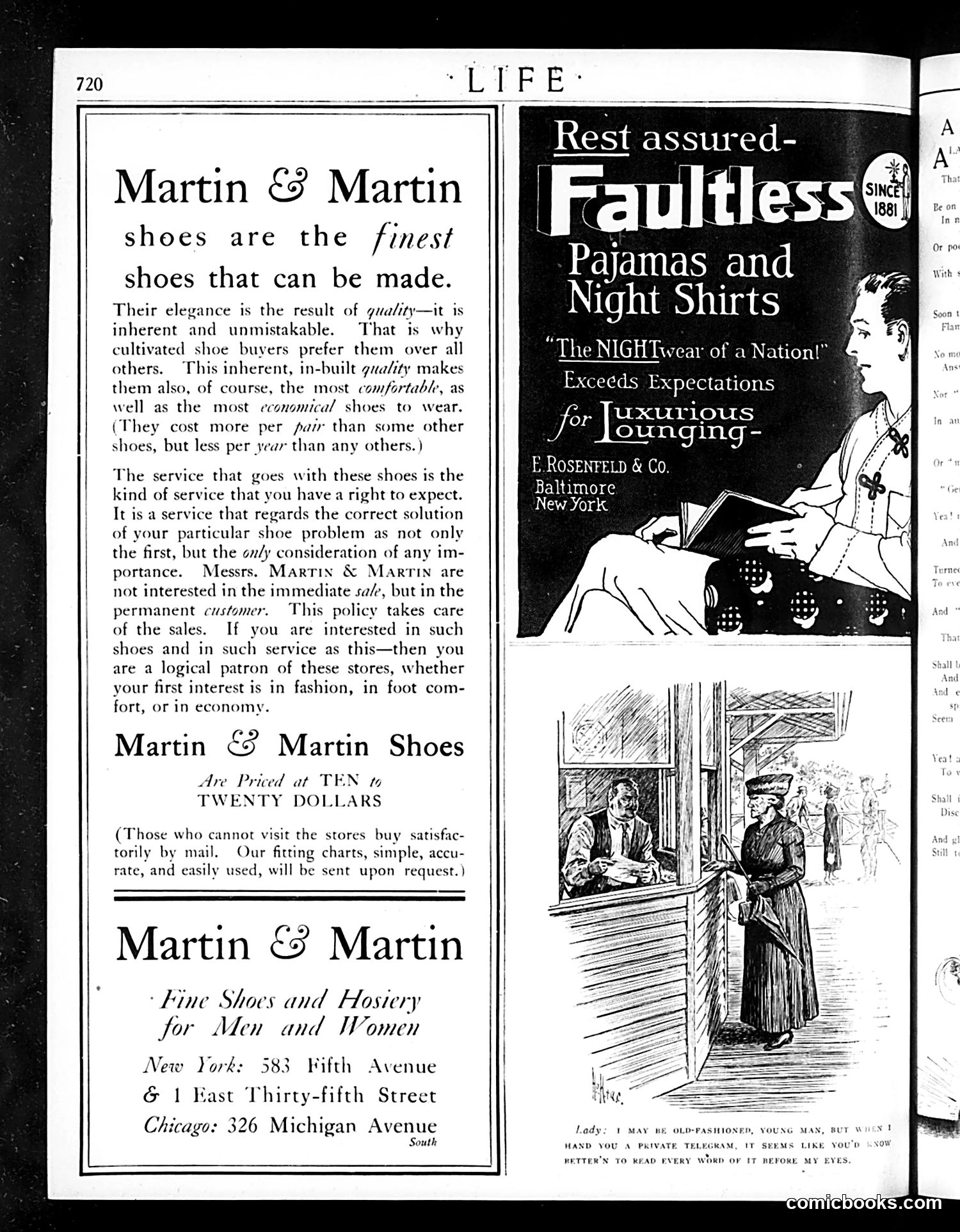
This page is primarily **advertising**, not political satire. It contains two large commercial advertisements with one small illustration. The **Martin & Martin shoes ad** (left) is a straightforward luxury product pitch emphasizing quality, comfort, and customer service. The company positions itself as premium but economical over time. The **Faultless pajamas ad** (right) features an illustration of a man in nightwear and includes a small cartoon below. The cartoon shows a woman handing a telegram to a young man, with her caption suggesting he should read it privately rather than in front of her—likely a joke about romantic or embarrassing correspondence. The humor appears to relate to 1920s social propriety around intimate matters. The page reflects typical early-20th-century magazine advertising: luxury goods marketed to cultivated consumers, emphasis on quality and service, and light domestic humor. No political commentary is evident.
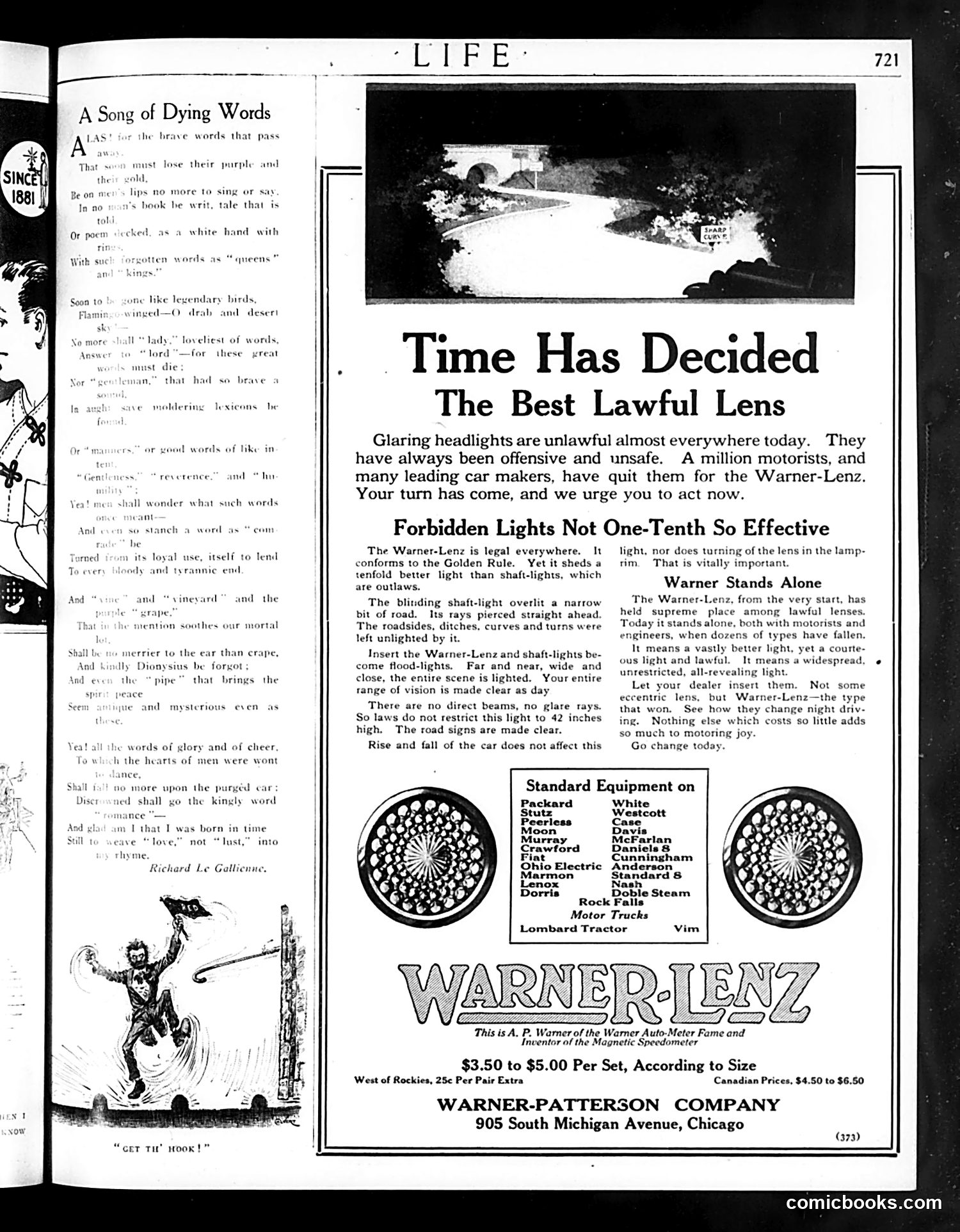
This page contains minimal political satire. The left side features "A Song of Dying Words," a literary poem by Richard Le Gallienne lamenting obsolete vocabulary—words that have lost their "purple and gold" and will die unused. The illustration shows a figure in classical dress, likely representing poetic tradition or the muse. The right side is primarily **advertising**, not satire. Warner-Lenz promotes automobile headlights as superior to "glaring headlights" (shaft-lights) that are "unlawful almost everywhere today." The ad emphasizes the product's legality, brightness, and adoption by major car manufacturers and engineers. There is no identifiable political cartoon or satirical content targeting specific figures or events. The page juxtaposes highbrow literary content with early-20th-century consumer marketing—a typical Life magazine layout—but contains no apparent commentary on politics or social issues beyond promoting traffic safety through better lighting technology.
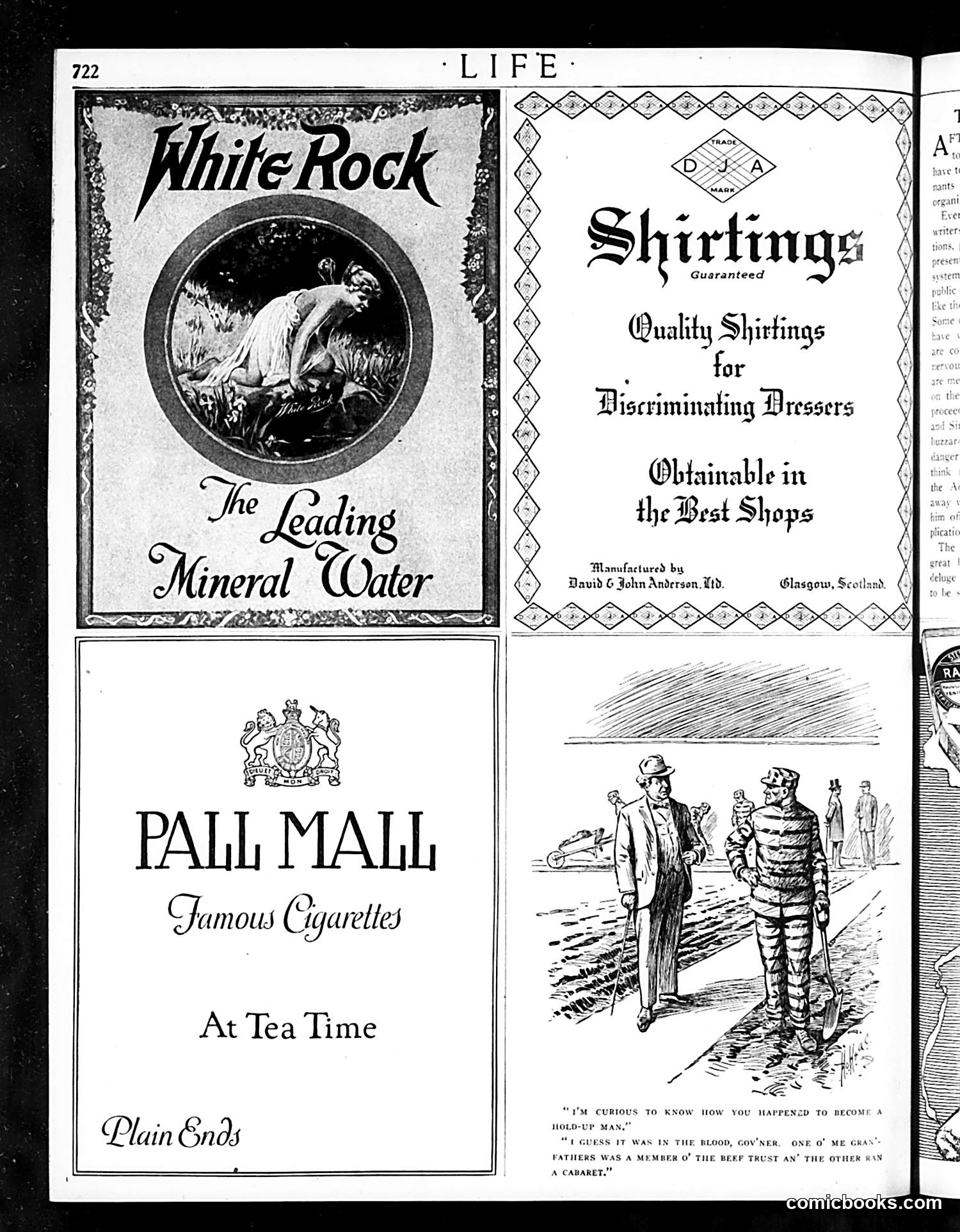
This page is primarily **advertising content** from Life magazine, not political satire. It contains four commercial advertisements: 1. **White Rock** mineral water (top left) — emphasizing its status as "the leading mineral water" 2. **D.A. Shirtings** (top right) — quality dress shirts for "discriminating dressers," manufactured in Glasgow 3. **Pall Mall cigarettes** (bottom left) — marketed as "famous cigarettes" suitable for "tea time" 4. An **unlabeled illustration** (bottom right) showing two men in conversation, with dialogue about becoming a "hold-up man," appearing to reference cabaret entertainment The page reflects early 20th-century consumer culture and advertising strategies. The small illustration uses humor (a crude joke about crime) to capture attention, typical of period magazine advertising. There is no significant political commentary visible.
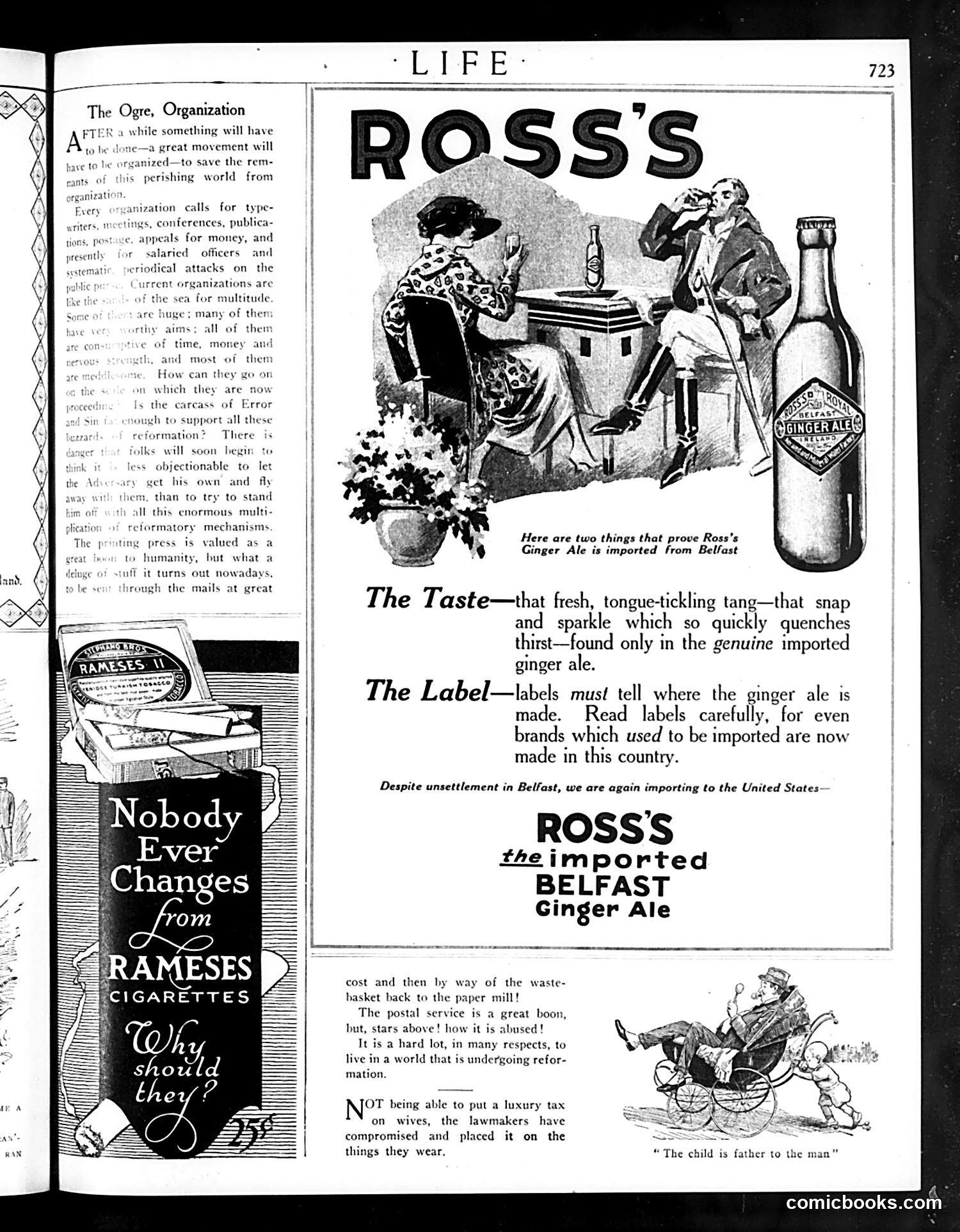
This page contains two distinct elements: **Left side:** A satirical essay titled "The Ogre, Organization" criticizing reform movements. The text argues that contemporary organizations calling for change (conferences, fundraising, salaried officers) are inefficient and wasteful—mail circulates uselessly through postal systems and wastepaper baskets. The piece expresses frustration with the machinery of reform itself, suggesting reformers create bureaucratic overhead that undermines their stated goals. **Right side:** A Ross's Ginger Ale advertisement emphasizing that their product is "imported from Belfast" despite "unsettlement in Belfast"—likely referring to Irish political unrest. The ad tells consumers to check labels carefully, warning that some formerly-imported brands are now domestically manufactured. Below this is an unrelated advertisement for Rameses Cigarettes and a small cartoon showing a child in a carriage with the caption "The child is father to the man" (a Wordsworth reference, here applied to consumer habits). The page primarily serves as advertising, with the essay as filler content.
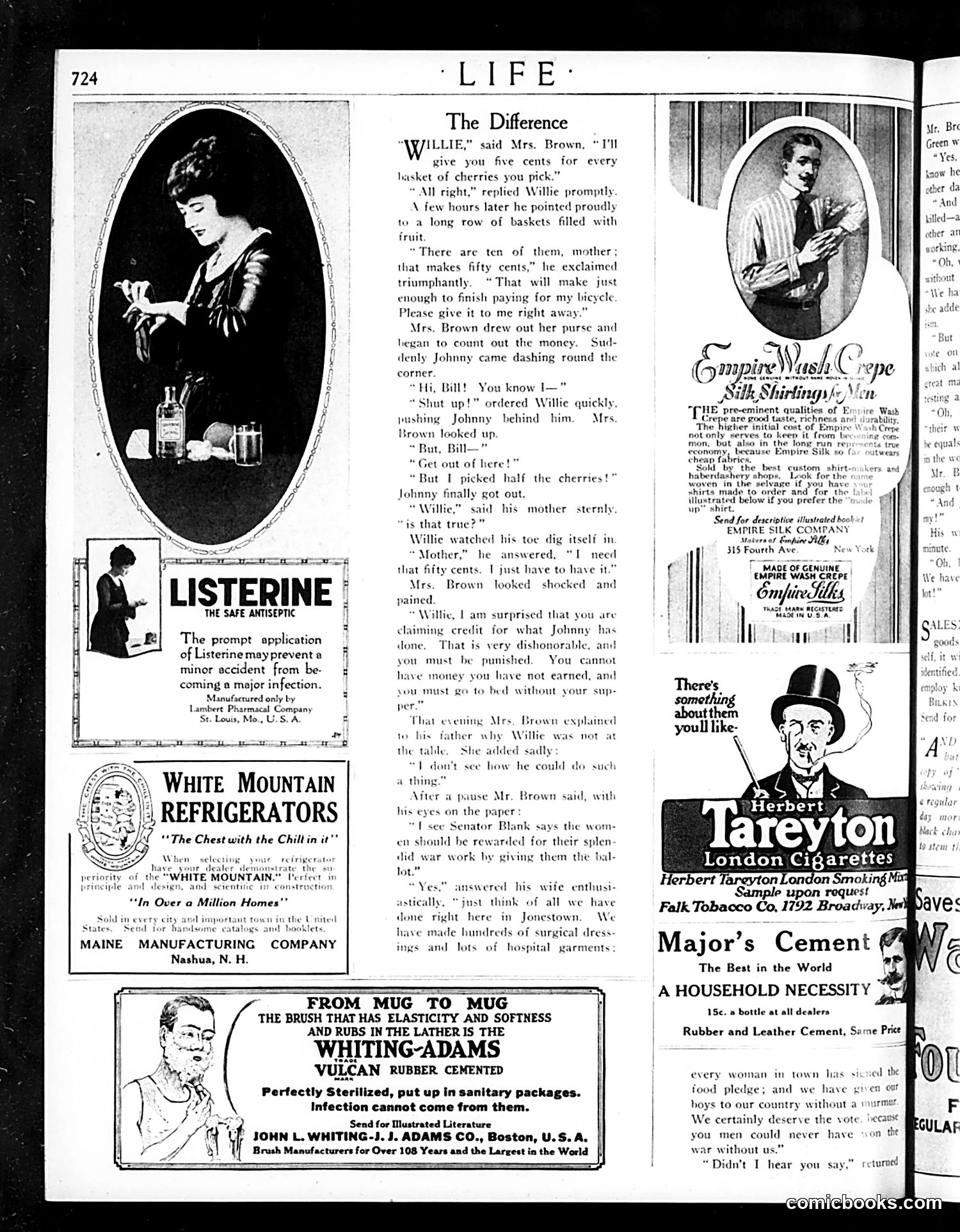
This story-cartoon satirizes hypocrisy about women's wartime contributions and voting rights. Willie cheats his younger brother Johnny out of credit for cherry-picking to earn bicycle money. When his mother punishes him for dishonesty, Willie's father responds by reading a newspaper article praising women's war work and suggesting they deserve the vote ("the ballot"). The satire's point: The father advocates rewarding women for their contributions while his own wife—who notes their substantial wartime efforts (surgical dressings, hospital garments)—sits before him having just disciplined their son for the exact dishonesty he implicitly endorses in politics. The implication is that men demand honesty from children but practice and accept it in public policy. This appears to mock both the hypocrisy of male voters and, possibly, the basis for granting women's suffrage.
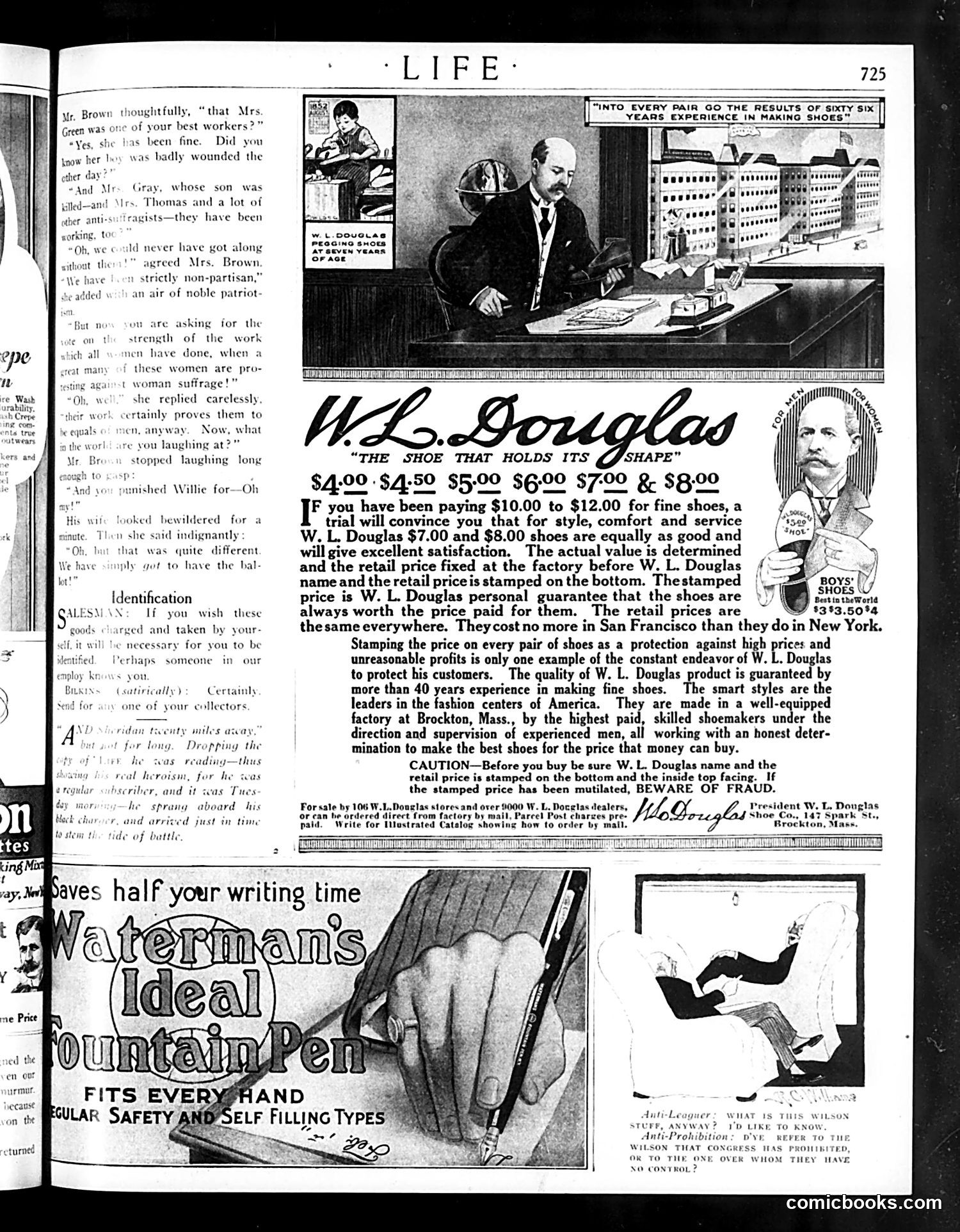
This page is primarily **advertising**, not political satire. The dominant content is a W.L. Douglas shoe advertisement (taking up roughly half the page) promoting shoes at $4–$8, positioning them as superior value against competitors charging $10–$12. The small dialogue fragment at top left appears to reference **women's war work and suffrage**—characters discuss female workers who've contributed during wartime (mentioning wounded husbands, casualties), suggesting the contemporary argument that women's labor entitlement warranted voting rights. One character insists their organization remained "strictly non-partisan," reflecting how suffrage advocates framed their cause. At bottom right, a tiny cartoon labeled "Anti-Leaguer" versus "Anti-Prohibition" presents two opposing figures arguing over which "Wilson" they oppose—likely referencing **President Wilson's League of Nations** versus **Prohibition legislation**, both contentious post-WWI issues. The joke plays on ambiguous reference to "Wilson." The Waterman's fountain pen ad occupies the lower left quarter. **Overall**: This is primarily a commercial advertising page with minimal satirical content.
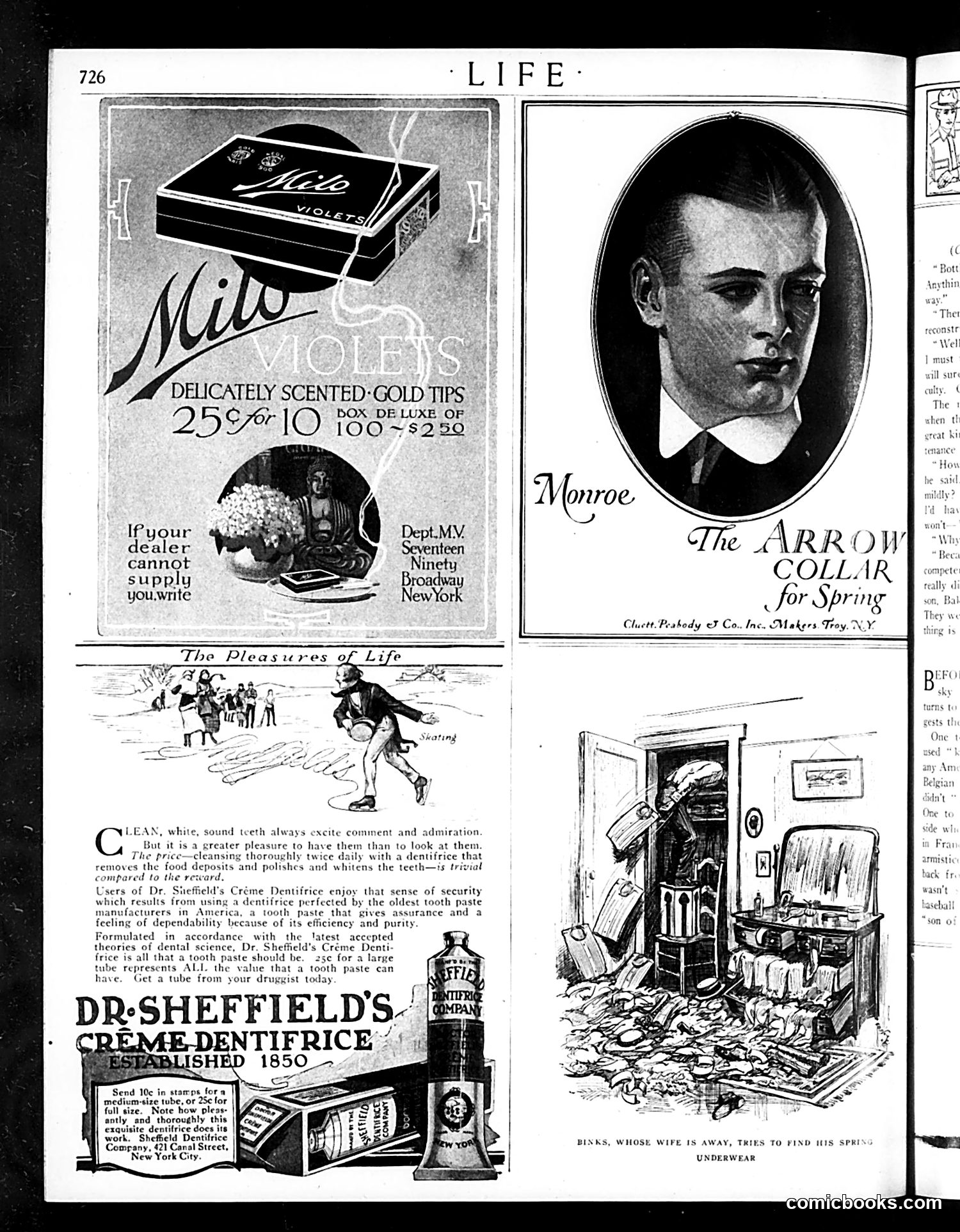
This page contains vintage advertisements and one cartoon. The **"Arrow Collar" ad** features a stylized portrait of a man—likely a celebrity or model of the era—advertising spring collars, a standard men's fashion item of the period. The **cartoon at bottom right**, titled "Binks, Whose Wife Is Away, Tries to Find His Spring Underwear," shows humorous domestic chaos: a man surrounded by scattered clothing and household items, apparently unable to locate his underwear without his wife's help. This reflects early 20th-century gender norms—the joke being that men were incompetent at household management and dependent on wives for basic domestic tasks. The remaining ads promote **Milo Violets cigarettes** (with gold tips) and **Dr. Sheffield's Crème Dentifrice** toothpaste, emphasizing quality and established reputation. The page is primarily **advertising-driven**, typical of Life magazine's revenue model during this period.
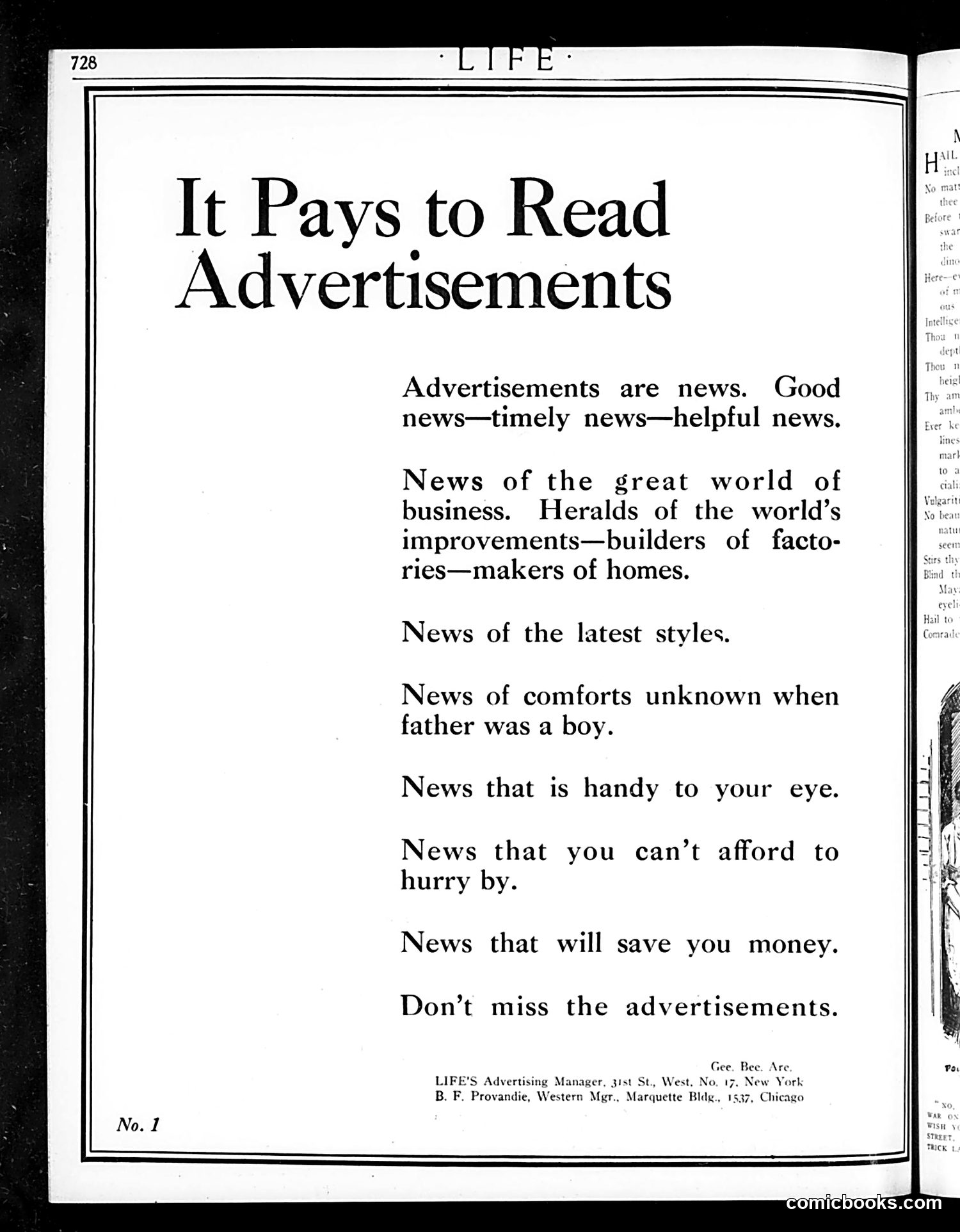
This is a full-page advertisement, not a cartoon. It's a meta-advertisement—Life magazine promoting the value of reading advertisements themselves. The piece argues that advertisements constitute important "news" rather than mere sales pitches. It makes claims typical of early 20th-century advertising rhetoric: that ads inform readers about business, industrial progress, fashion, modern conveniences, and consumer savings. The pitch reflects the era's optimism about consumer capitalism and mass production ("builders of factories—makers of homes"). The nostalgic reference to "comforts unknown when father was a boy" appeals to progress-minded readers by contrasting modern abundance with their parents' scarcity. For modern readers, this is striking because it explicitly frames advertising as journalism and public service—a claim that would seem laughable or cynical today. It reveals how advertisers once positioned themselves as informational rather than manipulative, and how magazines like Life depended on advertising revenue to justify editorial space.
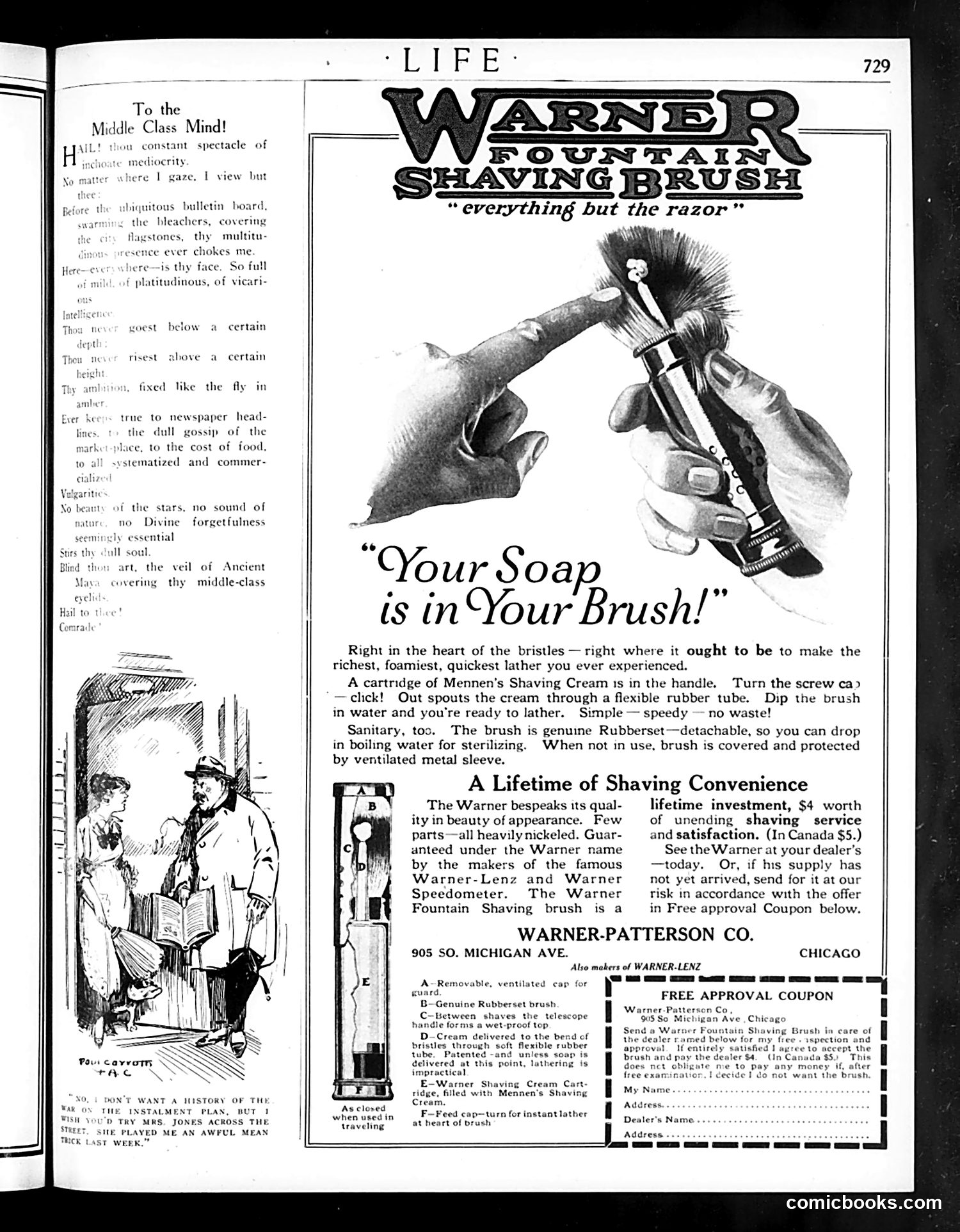
This page is **primarily an advertisement**, not satire or editorial content. The main image shows a hand holding the Warner Fountain Shaving Brush with integrated Mennen's Shaving Cream cartridge—a product innovation allowing soap dispensing directly into the brush bristles. The small cartoon at left (by Paul Carvooth) depicts two figures and appears to be unrelated editorial content mocking installment-plan financing, with one character refusing a payment scheme. The advertisement emphasizes the brush's modern convenience features: detachable rubber bristles, sterilizable components, and a self-contained cream cartridge. The phrase "Your Soap is in Your Brush!" highlights the novelty of integrated product design. A free approval coupon appears at bottom, typical of early 20th-century direct marketing. This is commercial content targeting middle-class male consumers interested in modern grooming technology.
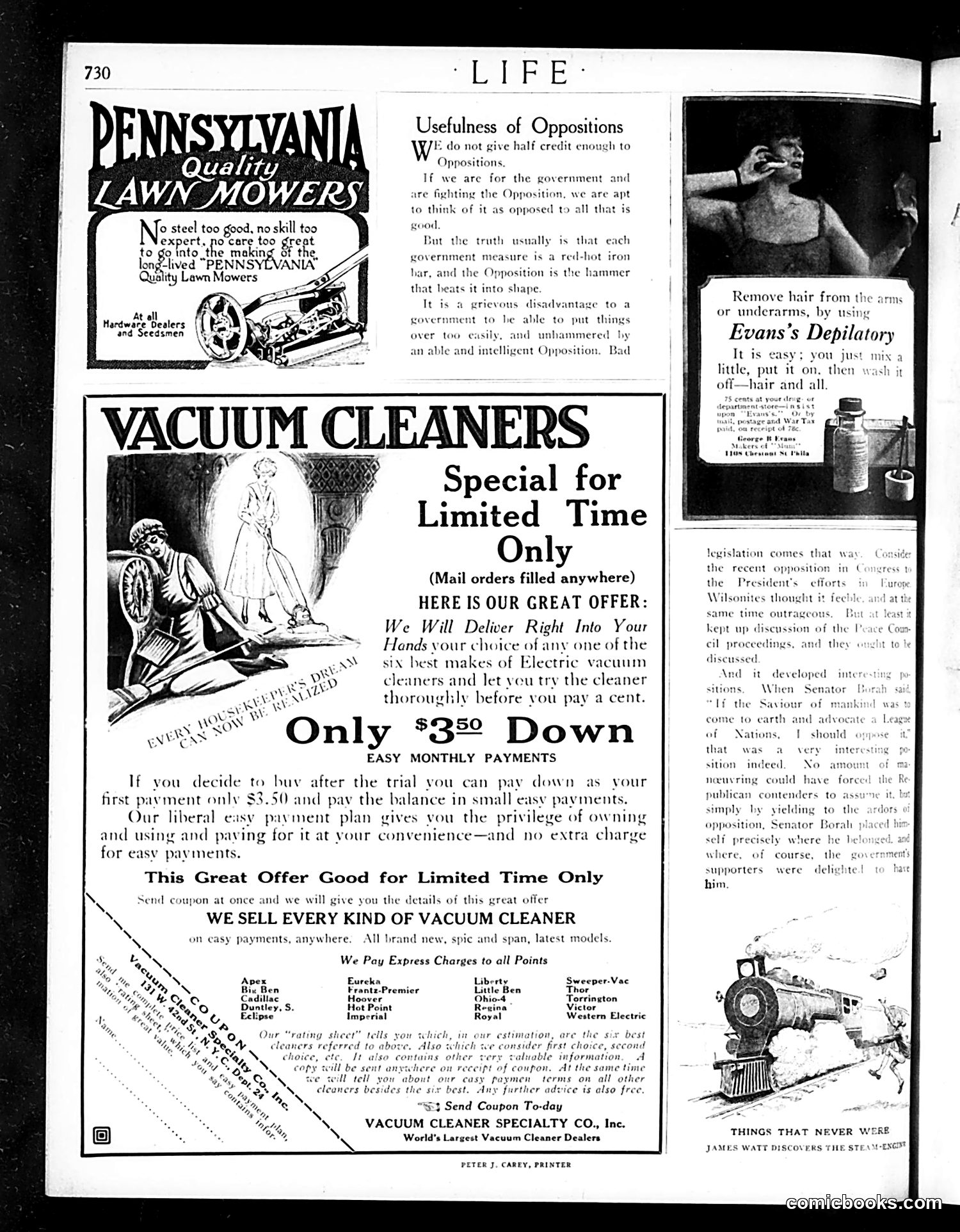
This page is primarily **advertisements**, not political satire. The upper-right text discusses "Usefulness of Oppositions," appearing to praise how government opposition acts as a constructive counterbalance. The passage references "the President's efforts" and "Wilsonites," suggesting this addresses Wilson-era politics, where opposition criticism is characterized as beneficial—like a hammer shaping hot iron. The ads dominate: Pennsylvania Quality Lawn Mowers, Evans's Depilatory hair removal, and a large vacuum cleaner promotion offering $3.50 down with easy monthly payments. The only visual humor appears bottom-right: a small illustration labeled "Things That Never Were" showing James Watt discovering steam, a light joke about historical inevitability unrelated to page content. This is primarily a commercial page with political commentary as filler.