
Life, 1919-04-24 · page 22 of 46
Life — April 24, 1919 — page 22: what you’re looking at
What you’re looking at
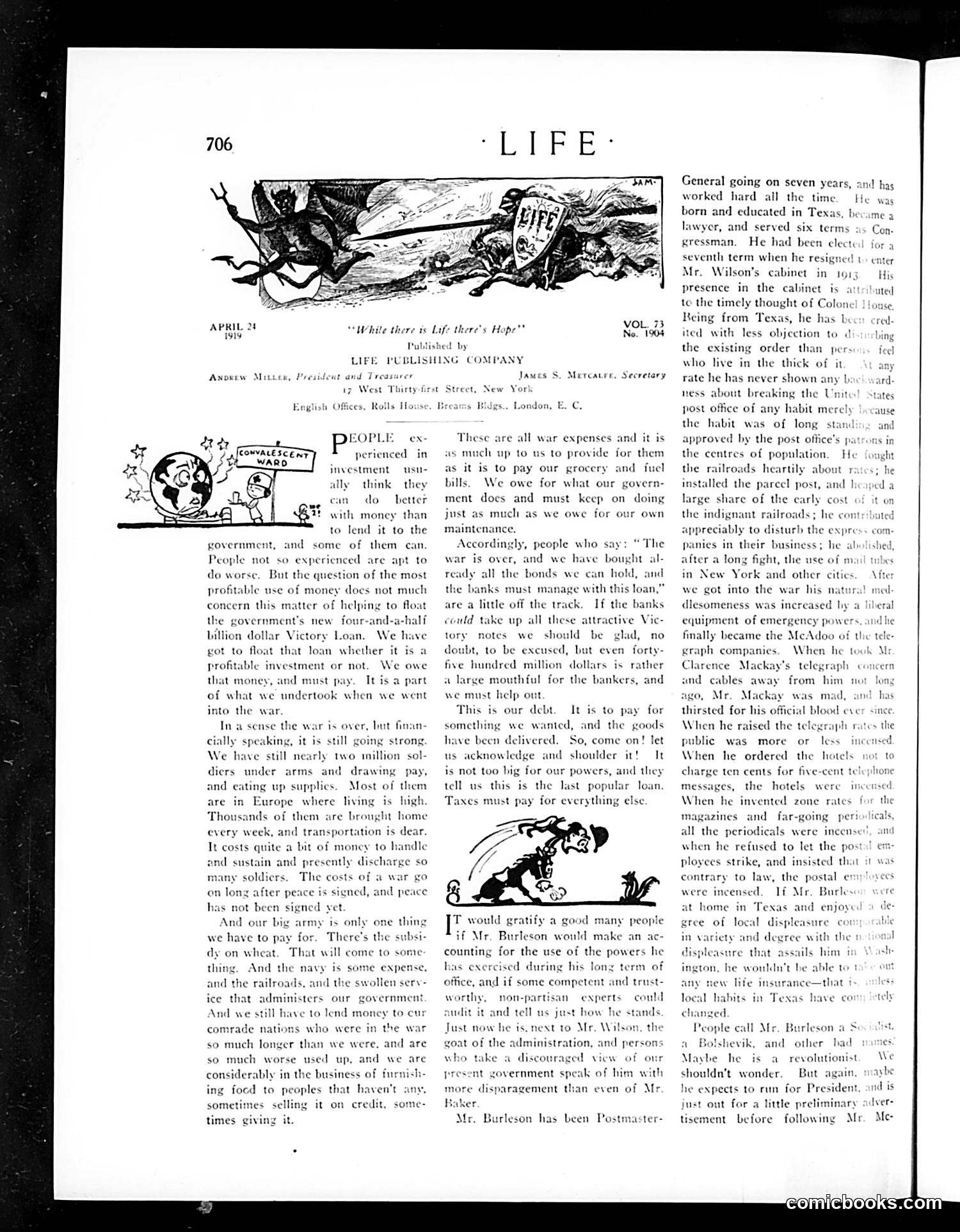
This page discusses post-WWI financial obligations, particularly a proposed "Victory Loan" (likely the Fourth Liberty Loan). The main article argues that Americans must acknowledge the government's massive war debts and help float this loan, rather than claiming "the war is over." The piece critiques Albert Sidney Burleson, Postmaster General under Wilson since 1913. While acknowledging his hard work, the author suggests Burleson has become a scapegoat for government mismanagement. The cartoon (left) appears to show a figure labeled "Convalescing" struggling with financial weight—likely satirizing the strain of post-war economic burden on citizens. The text argues that citizens must accept responsibility for war expenses through taxation and loans, as this is the cost of their government's decisions. The commentary is relatively patriotic rather than anti-government, accepting war debt as inevitable while calling for transparency in how resources were used.
📄 Transcribed text from this page (OCR, searchable)
Machine-transcribed from the original scan — historical spelling and the odd misread are preserved.
APRIL “While there ts Life there's Hope” Niaered Pu hed by LIFE PUBLISHING COMPANY Anorew oR, id dreasurer James S. Mercatre 7 West Thirty-first Street, New York English Offices, Rolls House. E s Bldgs.. London, E. C ZOPLE ex- These are all war expenses and it is perienced in as much up to us to provide for them investment usu- as it is to pay our grocery and fuel ily think they — bills. We owe for what our govern- can do better ment docs and must keep on doing with money than to lend it to the government, and some of them can. People not so experienced are to But the question of the most le use of money does not much do worse. concern this matter of helping to float the government’s new four-and-a-half billion dollar Vi Loan. We have got to float that loan whether it is a profitable investment or not ory We owe that money, and must Tt is a part of what we undertook when we went into the war In a sense the war is over, but finan cially speaking, it is still going strong. We have still nearly two illic diers and eating up supplies are in Europe where living is high Thousands of them are brought home ‘ sol- under arms and drawing pay, Most of them every week, and transportation is dear. It costs quite a bit of moncy to handle and sustain and presently dischars a) sold on long after peace is signed, and peace has not been signed yet ¢ thing And our big army is only on we have to pay for. There's the subsi- dy on wheat. That will come to some And the navy is som expense, swollen serv- ¢ railroads, and th ice that administers our government And we still have to lend money to cur ms who were in the war and are d we comrade na so much longer than we we! so much worse used up, are considerably in the business of furni< ing focd to peoples that haven't any, selling it on credit, some- somet times nes giving it. much as we owe for our own just 2 maintenance. Accordingly, people who say: “The war is over, a bought al- all the bonds we can hold, and the banks must manage with this loan,” are a little off the track. If the banks could take up all these attractive Vie- should be no but nd we have ready glad, forty- lory notes we doubt, to be excused, but eve five hundred million dollars is rather a large mouthful for the bankers, and we must help ont This is our debt It is to pay for something we wanted, and the nods have been delivered. So, come on! let us acknowledge and shoulder it! It is not too hig for our powers, and they tell us this is the t popular loan. Taxes must pay for everything else T would gratify a go: if Mr. Burleson would make an ac- peo} counting for the use of the powers he nr of has exercised during his long te office, and if some competent and trust worthy, non-partisan experts could audit it and tell us just how he stands Just now he is, next to Mr. Wilson, the goat of the administration, and person who take a discouraged view of our present government speak of him with more disparagement than even of Mr. Mr, Burleson has been Postmaster- General going on seven years, and has worked hard all the time. He born and educated in T lawyer, and served six terms essman. He had been clecti 1S, mea seventh term when he resigned 1 Mr, Wilson’s cabinet in 19 presence in the cabinet is uted to the timely thought of Colonel ! louse Reing from Texas, he has bee) cred ited with less objection to disierbing the existing order than pers feel who live in the thick of it any rate he has never shown any | rd: ness about breaking the Unit tates post office of any habit merely | ocause the habit was of long. stand and approved by the post office's patrons in the centres of population. He fought the railroads heartily about + installed the parcel post, and heaped a large share of the carly cost of it on the indignant railroads; he contr:buted th ssj he abolish appreciably to distu panies in their bus’ after a long fight, the use of mail tubes expre in New York and other cities. \fter we got into the war his natura! med: dlesomeness was increased by a liberal equipment of emergency powers, and he finally became the McAdoo of the tele- graph companies. When he took Mr Clarence Mackay’s telegraph concern nd cables away from him not long go, Mr. Mackay was mad, and has thirsted for his official blood ever since When he raised the telegraph rates the public was more or less incensed When he ordered the hotels not to charge ten cents for five-cent telephon messages, the hotels were incensed When he invented zone rates for the magazines and far-going perivilicals, all the periodicals were incens when he refused to let the po: e ployees strike, and insisted that it was contrary to law, the postal er ees. were incensed. 1f Mr. Burles re home in Texas and enjoye de. gree of local displeasure cor in variety and degree with the 1 Jispl ails him i that as: easure rance—that $5 life in ew eal habits in Texas have com) letely changed People call Mr Burleson aS a Bolshevik, and other bad es. Maybe he is a revolutionist We shouldn't wonder. But again, maybe he expects to rim for President, and is just out for a little prelimi Iver- tisement before following Mr. Me-