
Life, 1919-04-24 · page 13 of 46
Life — April 24, 1919 — page 13: what you’re looking at
What you’re looking at
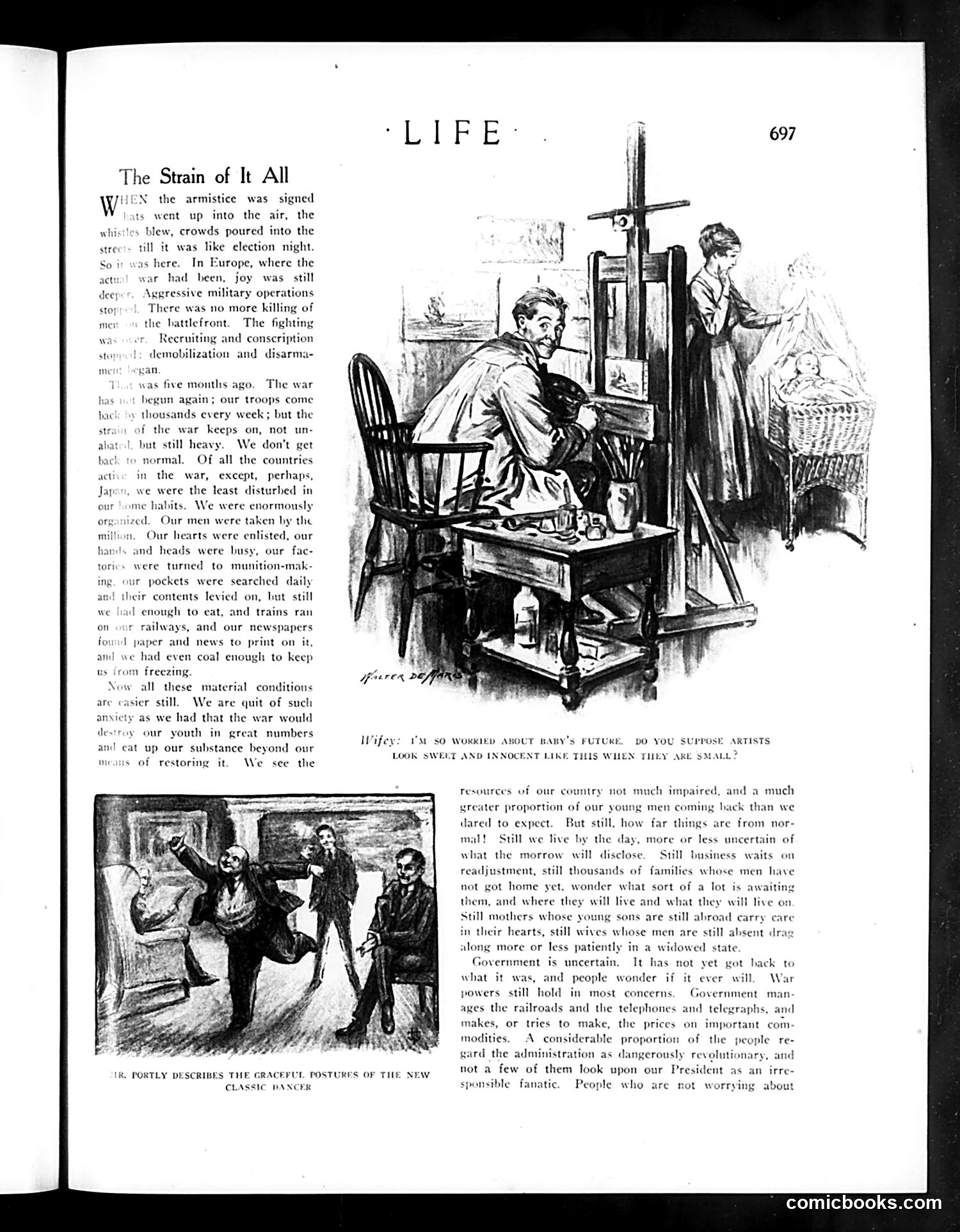
This page addresses post-WWI American anxiety. The main illustration shows a worried man at a desk, apparently handling correspondence or paperwork—likely representing the burden of wartime administrative and social strain. The caption beneath the lower cartoon reads: "Wife: I'm so worried about baby's future. Do you suppose artists look sweet and innocent like this when they are small?"—a dark joke about whether artistic temperament emerges early. The text discusses how the armistice brought relief but not normalcy. Americans face uncertainty: troops returning slowly, family separations continuing, economic strain persisting, and government inefficiency causing frustration. The satire targets the lingering psychological and administrative exhaustion following WWI's conclusion, when citizens expected immediate return to peace but instead faced prolonged hardship and bureaucratic confusion.
📄 Transcribed text from this page (OCR, searchable)
Machine-transcribed from the original scan — historical spelling and the odd misread are preserved.
The Strain of It All Wi N the armistice was signed ts went up into the » the whistles blew, crowds poured into the stree's till it was like election night. So iy was here. In Europe, where the actus! war had been, joy was. still deey Aggressive military operations sto} There was no more killing of mer the battlefront. The fighting wa er. Reeruiting and conscription demobilization and disarma- gan was five months ago. The war begun again; our troops come thousands every week; but the f the war keeps on, not un- but still heavy. We don’t get normal. Of all the countries in the war, except, perhaps, we were the least disturbed in our Some habits. We were enormously orgenized. Our men were taken by the million. Our hearts were enlisted, our hands and heads were busy, our fac- were turned to munition-mak- our pockets were searched daily their contents levied on, but. still i enough to eat, and trains ran r railways, and our newspapers | paper and news to print on it, d even coal enough to keep freezing. all these material conditions sier still We are quit of such as we had that the war would ‘y our youth in great numbers cat up our substance beyond our s of restoring it. We see the Wifey: 1M so WoRRIED ABOUT BABY’S FUTURE. DO YOU SUPPOSE ARTISTS LOOK SWEET AND INNOCENT LIKE THIS WHEN THEY AKE SMALL? resources of our country not much impaired, and a much greater proportion of our young men coming back than we dared to expect. But still, how far things are from nor- mal! Still we live by the day, more or less uncertain of what the morrow will disclose. Still business waits on readjustment, still thousands of families whose men have not got home yet, wonder what sort of a lot is awaiting them, and where they will live and what they will live on Still mothers whose young sons are still abroad carry care in their hearts, still wives whose men are still absent drag along more or less iently in a widowed state. Government is uncertain. It has not yet got back to what it was, and people wonder if it ever will, War powers still hold in most concerns. Government ma ages the railroads and the telephones and telegraphs. a mak or tries to make, the prices on important com- modities. A considerable proportion of the people re- gard the administration as dangerously revolutionary, and not a few of them look upon our President as an irre- IR. PORTLY DESCRIBES THE GRACEFUL POSTURFS OF THE NEW J rem I s CLASSIC DANCER sponsible fanatic. People who are not worrying about comicbooks.com