
A complete issue · 46 pages · 1919
Life — April 17, 1919
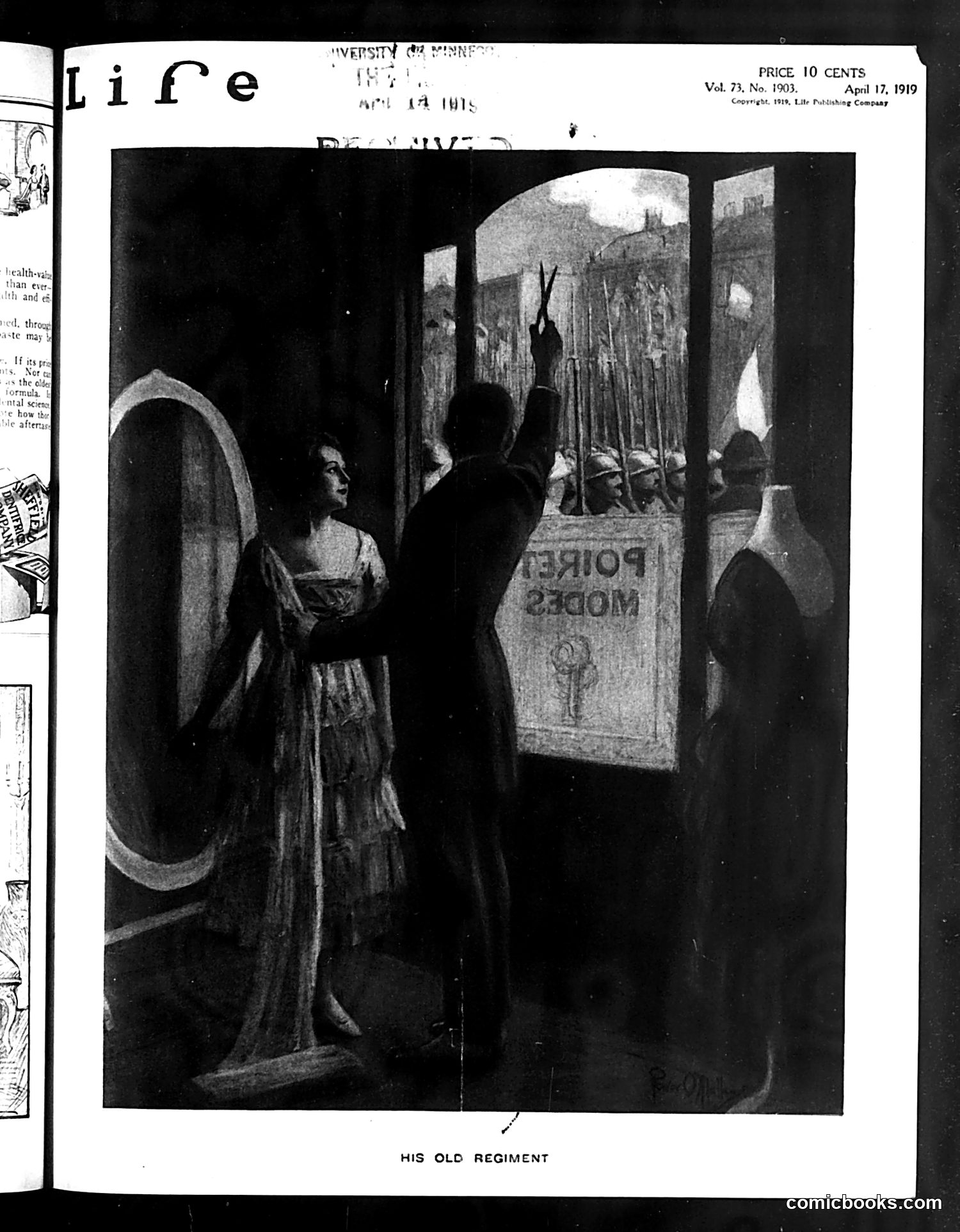
This 1919 *Life* magazine illustration depicts a dramatic scene titled "His Old Regiment." A woman in classical dress gazes at a military procession visible through windows, while a robed figure (appearing to represent Death or a skeletal specter) stands beside her with arms raised. The image likely comments on World War I's aftermath—specifically the loss of soldiers and the grief experienced by those left behind. The "old regiment" presumably refers to military units decimated by the war, which ended in November 1918. The classical female figure may represent a widow, mother, or bereaved nation. The supernatural figure suggests mortality's presence haunting post-war society. The satire critiques the human cost of military conflict and collective mourning.
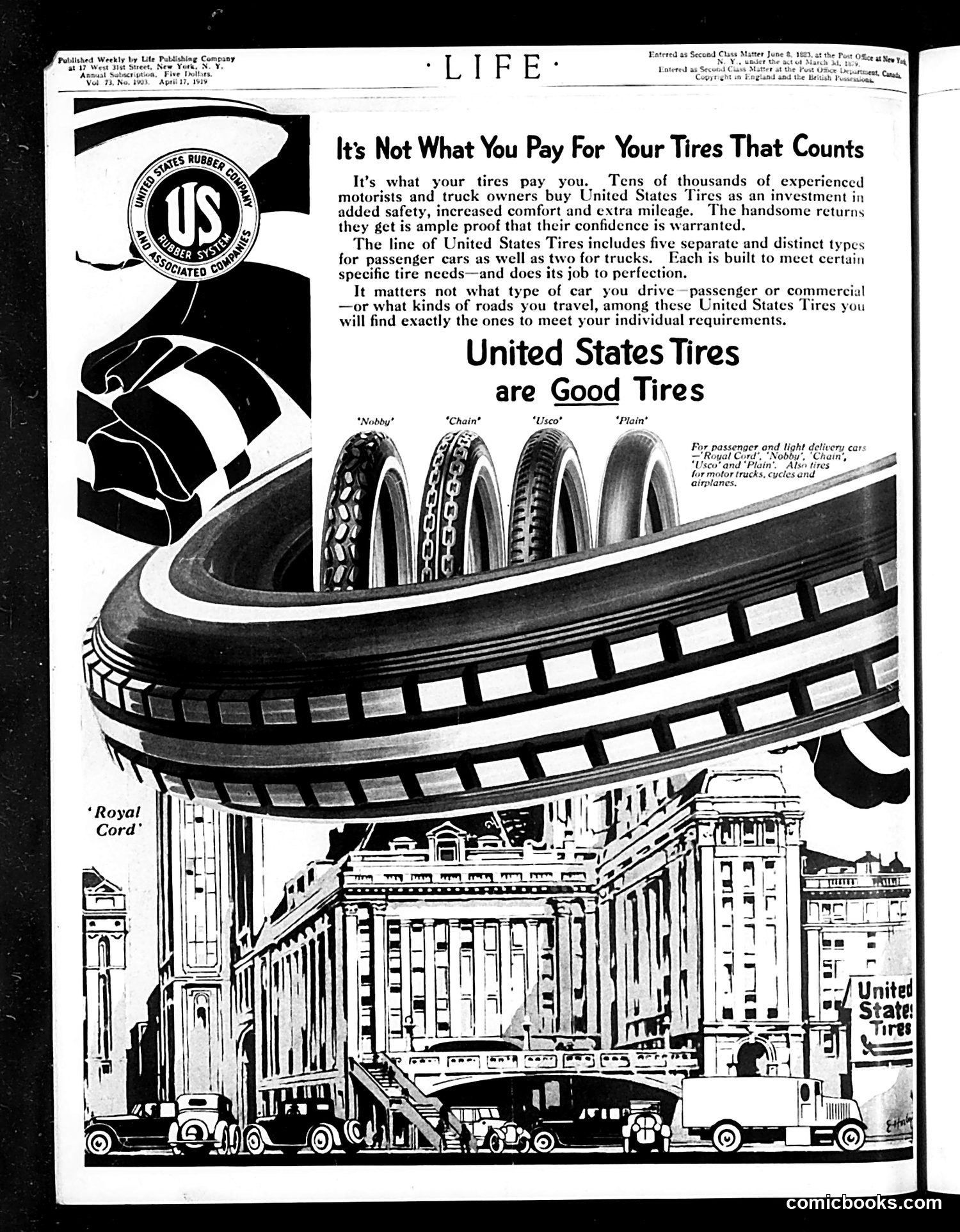
This is primarily a **product advertisement**, not satire or political commentary. The page promotes United States Tires, a major American tire manufacturer, emphasizing that tire quality matters more than price. The ad showcases four tire types—"Nobby," "Chain," "User," and "Plain"—each designed for specific road conditions and vehicles (passenger cars, trucks, commercial use). The elaborate visual composition, featuring tires suspended above an urban cityscape with various vehicles below, suggests reliability and broad application across American transportation. The slogan "United States Tires are Good Tires" is straightforward marketing. This appears to be from the 1920s era, when automobile ownership was expanding and tire quality was a significant consumer concern. No political message is evident.
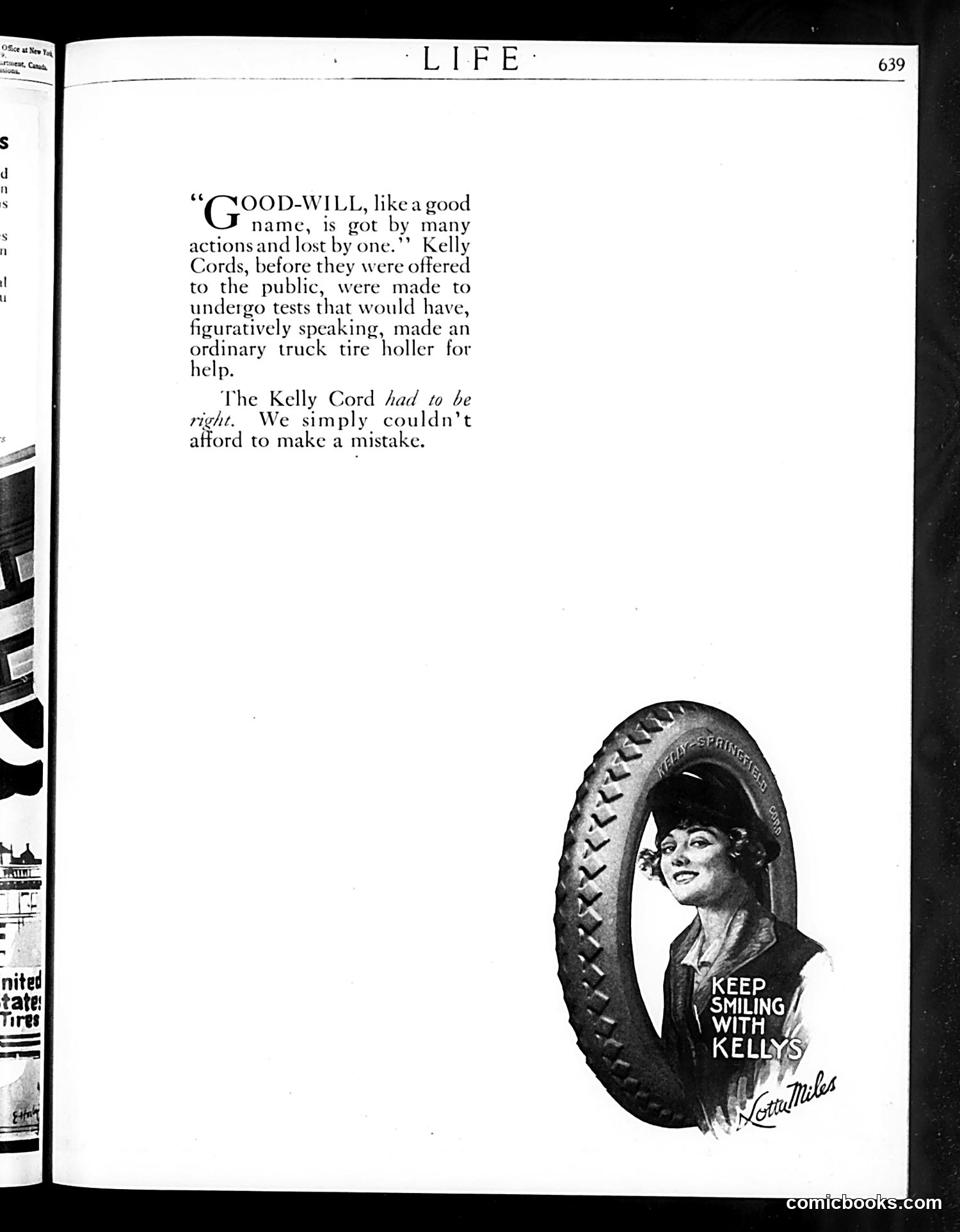
This is a **Kelly Cord tire advertisement**, not satire. The text uses a humorous metaphor comparing a good reputation ("good-will") to a product that must be rigorously tested before public release. The company emphasizes that Kelly Cords "had to be right" and they "simply couldn't afford to make a mistake." The advertisement features an illustration of a smiling woman posing with a truck tire, accompanied by the slogan "Keep Smiling with Kelly's." The imagery reflects 1920s marketing aesthetics, using an attractive female figure to promote automotive products—a common advertising convention of that era. This is straightforward commercial messaging emphasizing product reliability and quality control, not political commentary.
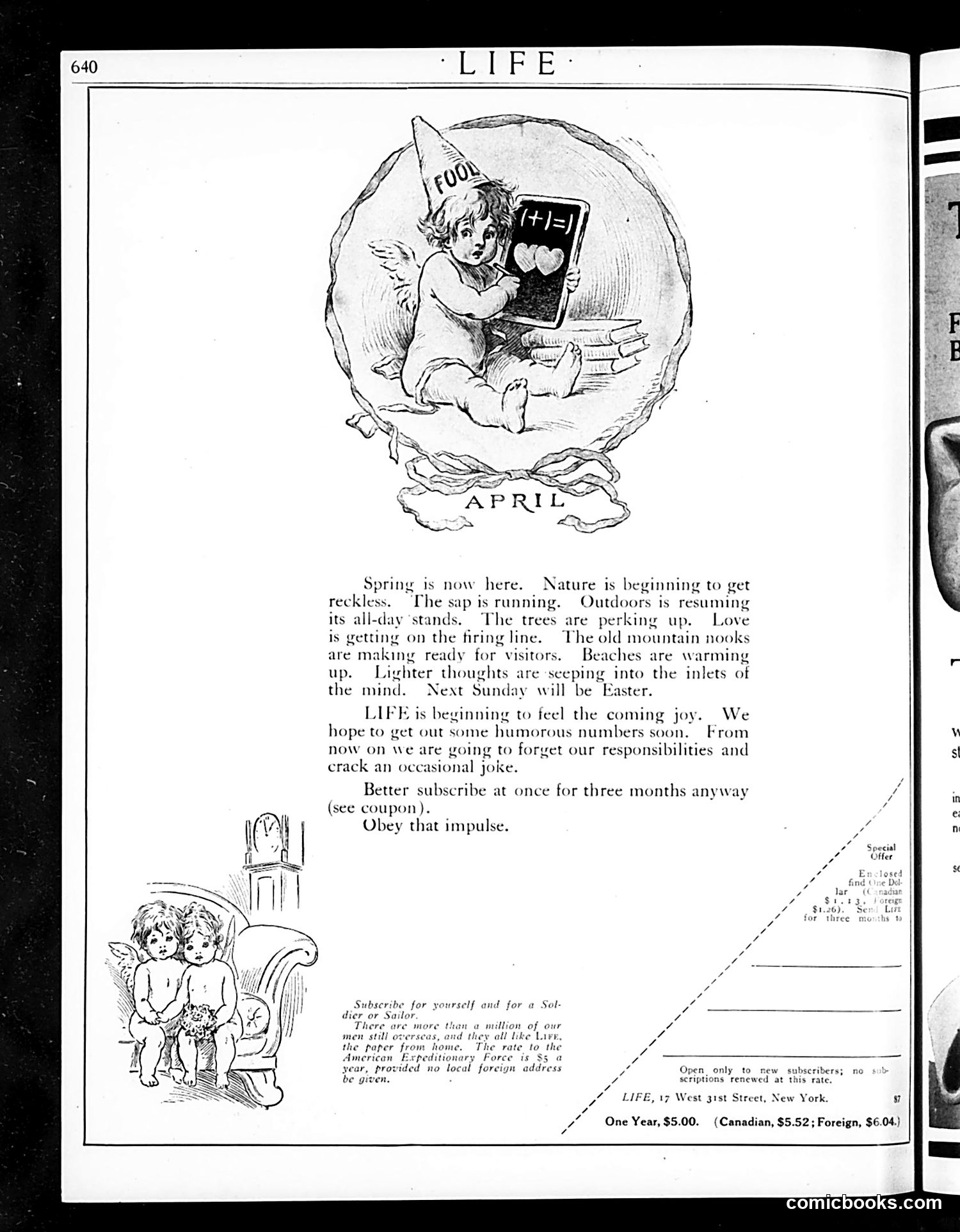
This is an April issue of Life magazine featuring April Fool's Day themed illustrations. The top circular vignette shows a cherub/cupid figure wearing a "Fool" cap, holding a slate with mathematical equations and hearts—a playful reference to April Fool's pranks and love/romance themes appropriate to spring. The accompanying editorial text discusses spring's arrival, nature awakening, and upcoming Easter, while announcing Life will soon publish "humorous numbers" and encouraging subscriptions. The lower illustration depicts two cherubs on furniture, likely part of the subscription promotion mentioned in the text. The overall page combines seasonal imagery with magazine promotion, typical of early 20th-century Life's satirical-humorous approach to holiday issues.
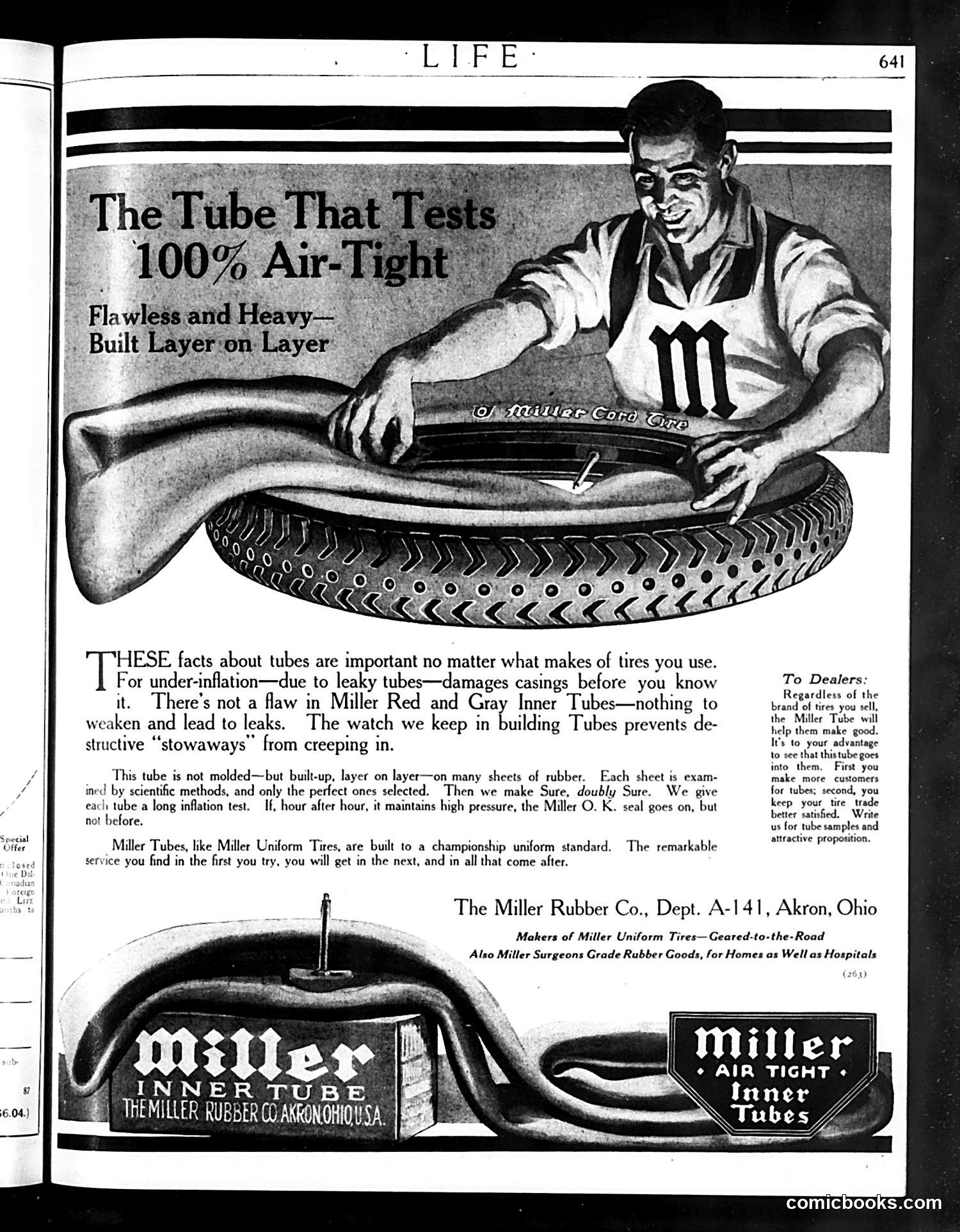
This is **not a political cartoon or satire page**—it's a straightforward **advertisement** for Miller inner tubes, published in *Life* magazine (page 641). The image shows a workman demonstrating Miller brand inner tubes, emphasizing their durability through "layer on layer" construction and "100% air-tight" design. The ad addresses a practical concern of the era: tire leaks causing damage before drivers noticed problems. The text distinguishes Miller tubes from competitors, claiming superior quality control and manufacturing standards. A note "To Dealers" encourages retailers to stock the product for customer satisfaction. The page includes product imagery (the tube and a cross-section) and company information: The Miller Rubber Co., Akron, Ohio. This represents typical early-to-mid-20th-century tire industry marketing in a major American magazine.
This page is **not a cartoon or satire** — it's a **straightforward automobile advertisement** for Packard Motor Car Company of Detroit, published in Life magazine around 1919. The ad announces Packard's "Price Insurance" policy: if production costs fall during 1919, buyers of Packard vehicles will receive refunds for the price difference. Conversely, if costs rise, new buyers pay only the current price — existing purchasers aren't retroactively charged more. The ornamental "P" logo is Packard's corporate emblem, not a caricature. The text emphasizes Packard's quality control, skilled labor, and the durability of their Twin Six passenger cars and trucks. The tagline "Ask the Man Who Owns One" was Packard's actual marketing slogan. This represents post-WWI commercial messaging, not political satire.
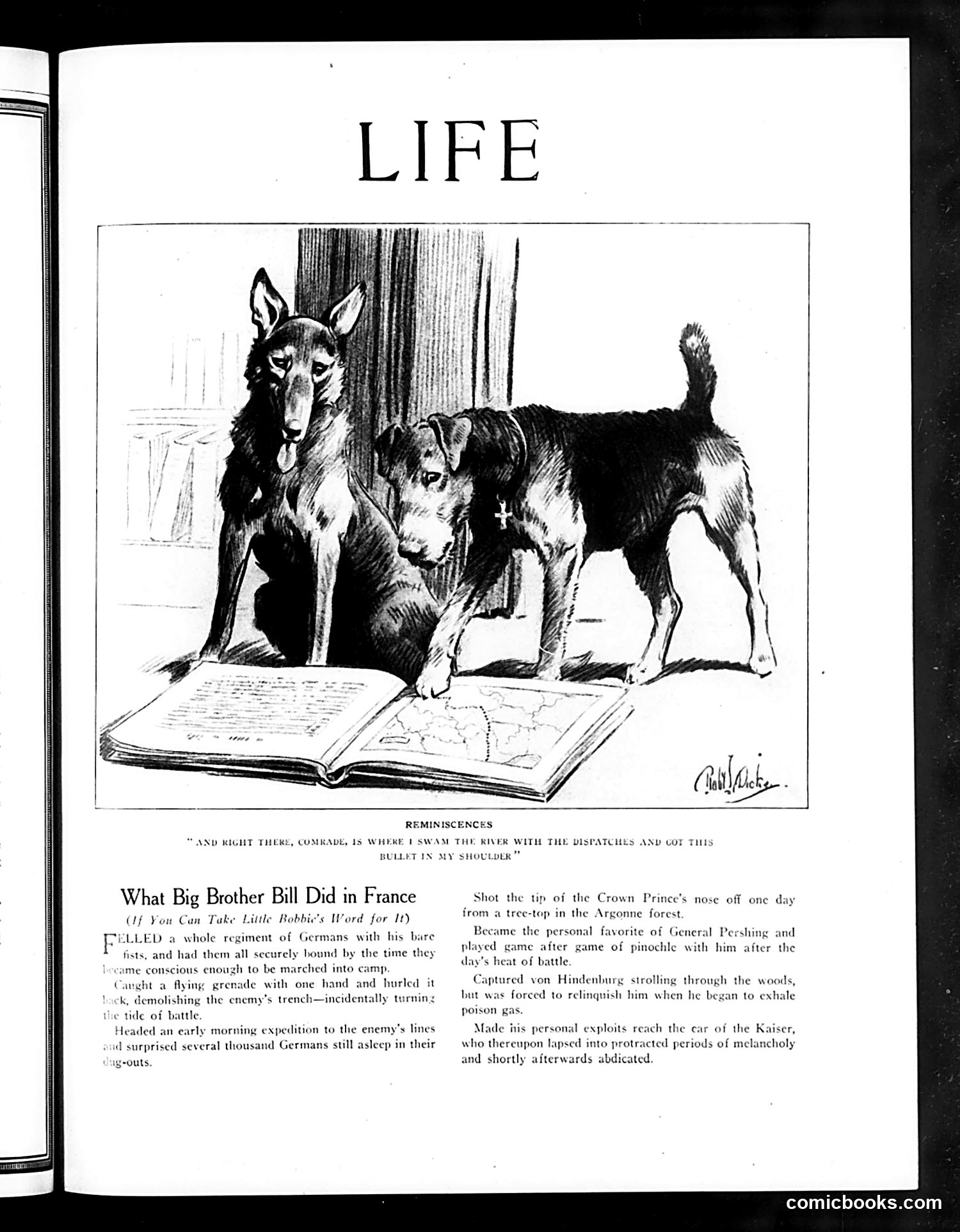
This page features an illustration of two dogs examining an open book or map, titled "Reminiscences." The accompanying article, "What Big Brother Bill Did in France," describes military exploits during World War I, including capturing a flying grenade, surprising sleeping Germans, and impressing General Pershing through pinochle games. The cartoon appears to be satirizing a soldier's wartime memoir or reminiscences. The dogs looking at the book suggest a humorous commentary on the subject matter—possibly mocking exaggerated war stories or suggesting the account is "dog-eared" from frequent telling. The specific identity of "Big Brother Bill" is unclear without additional context, but this was likely a recognizable military figure to contemporary readers.
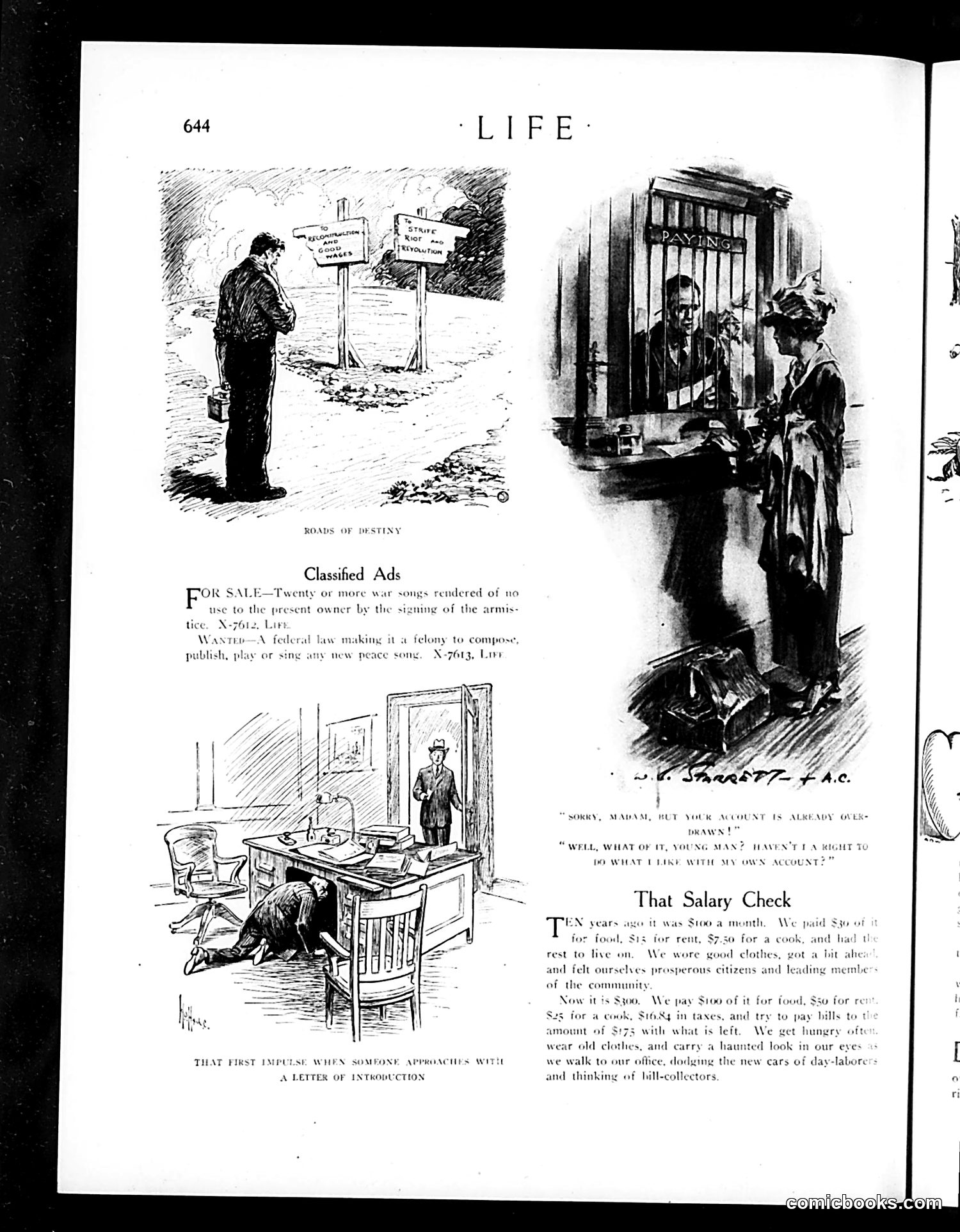
This page contains three unrelated items: a political cartoon titled "Roads of Destiny" showing a man at a crossroads; a classified ads section with wartime references (mentioning war songs and peace songs, with a federal law prohibition on composing new peace songs); and an office scene captioned "That First Impulse When Someone Approaches With a Letter of Introduction." The main article, "That Salary Check," satirizes post-WWI economic struggles. It describes earning $100/month a decade prior, now earning $300/month but barely surviving—paying $50 for rent, $25 for food, and $16.84 in taxes, leaving almost nothing. The piece mocks middle-class financial precarity and the gap between nominal wage increases and actual purchasing power, suggesting inflation and taxation made workers poorer despite higher nominal salaries.
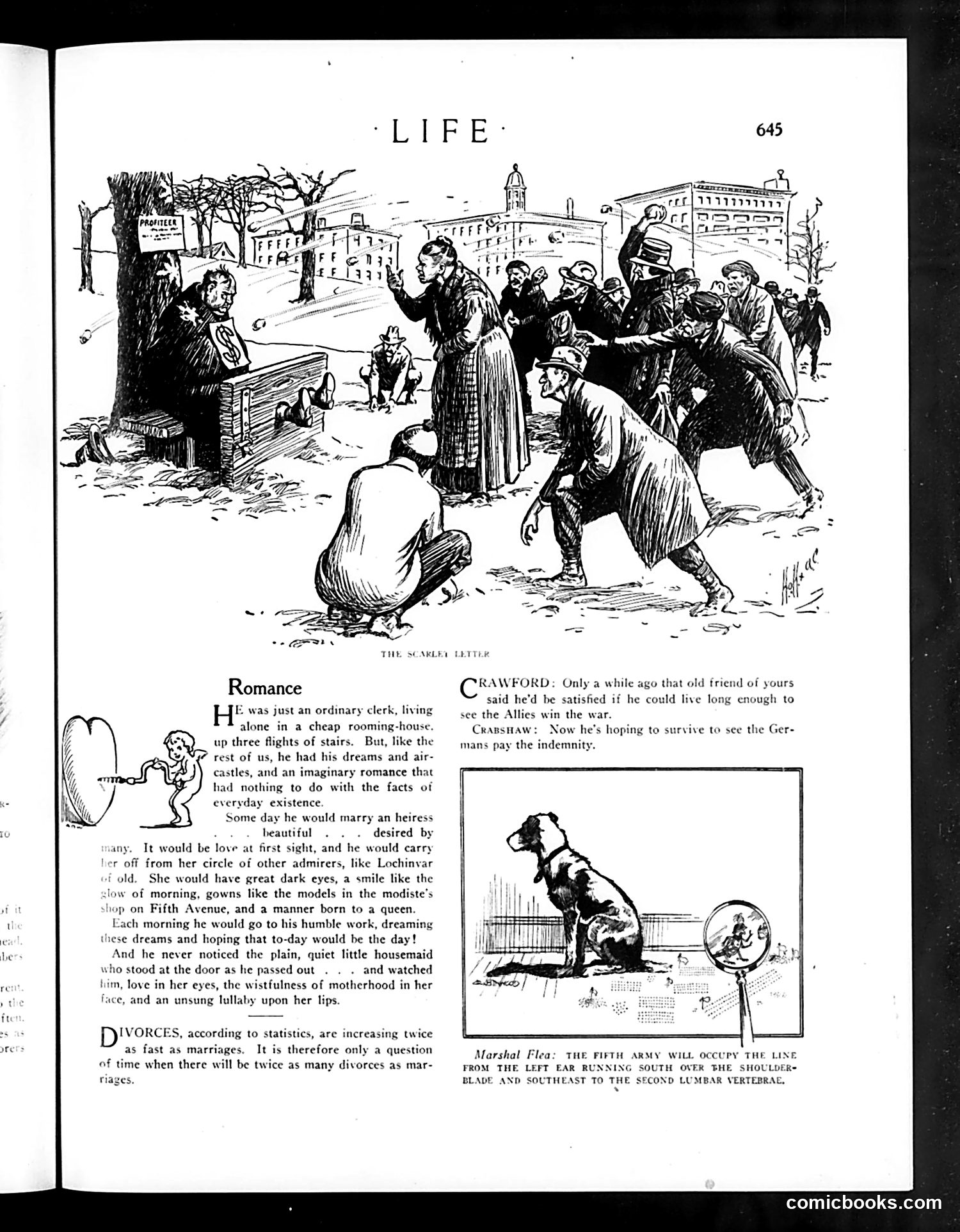
This page contains two distinct pieces: **"The Scribbler" (top illustration)**: A street scene showing a woman distributing what appears to be pamphlets or papers to a gathered crowd in an urban setting. The exact message is unclear, but the image satirizes public activism or propaganda distribution. **"Romance" (text section)**: A sentimental narrative about a lowly clerk with romantic fantasies of marrying a beautiful heiress—a commentary on class aspiration and daydreaming disconnected from reality. **"Marshal Flea" (bottom cartoon)**: A military dog with tactical diagram, satirizing military strategy and bureaucratic language through absurdist animal humor. The page reflects early-20th-century Life magazine's blend of social commentary, romantic satire, and humorous illustrations targeting middle-class anxieties about class mobility and wartime concerns.
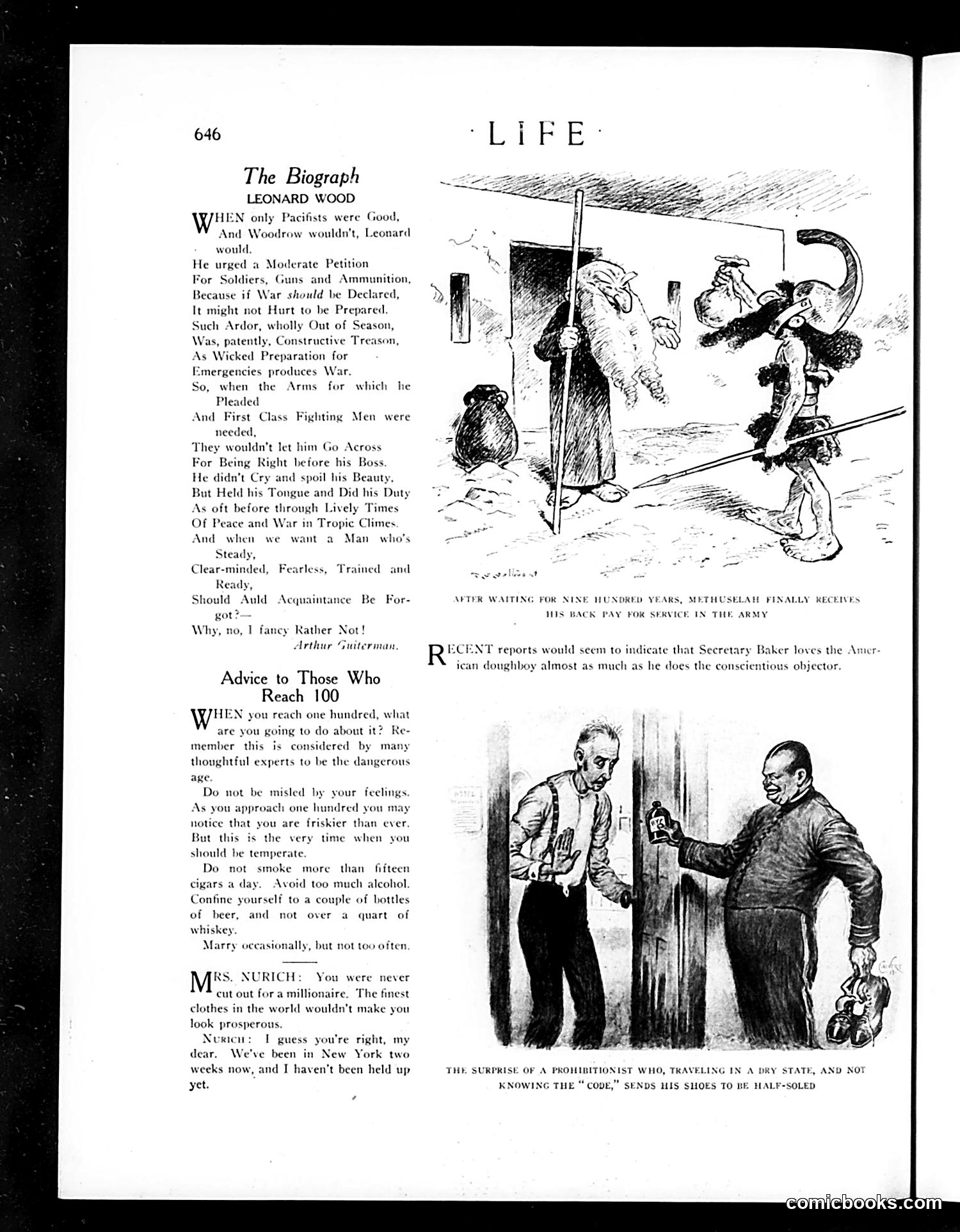
**Top Cartoon:** Shows a soldier receiving back pay after 900 years of waiting—satirizing the glacial pace of military bureaucracy and compensation delays. **"The Biograph" (Poem by Leonard Wood):** Advocates moderate military preparedness, criticizing both pacifists and excessive warmongering. Wood argues for measured defense without glorifying conflict. **"Advice to Those Who Reach 100":** Health guidance for centenarians, recommending temperance in smoking, alcohol, and diet—typical early 20th-century longevity advice. **Bottom Cartoon:** A prohibitionist traveling in a "dry state" is shocked to discover his shoes have been half-soled with alcohol-soaked leather—mocking prohibition's contradictions and unintended consequences. The page reflects Progressive-era debates about militarism, aging, and alcohol regulation.
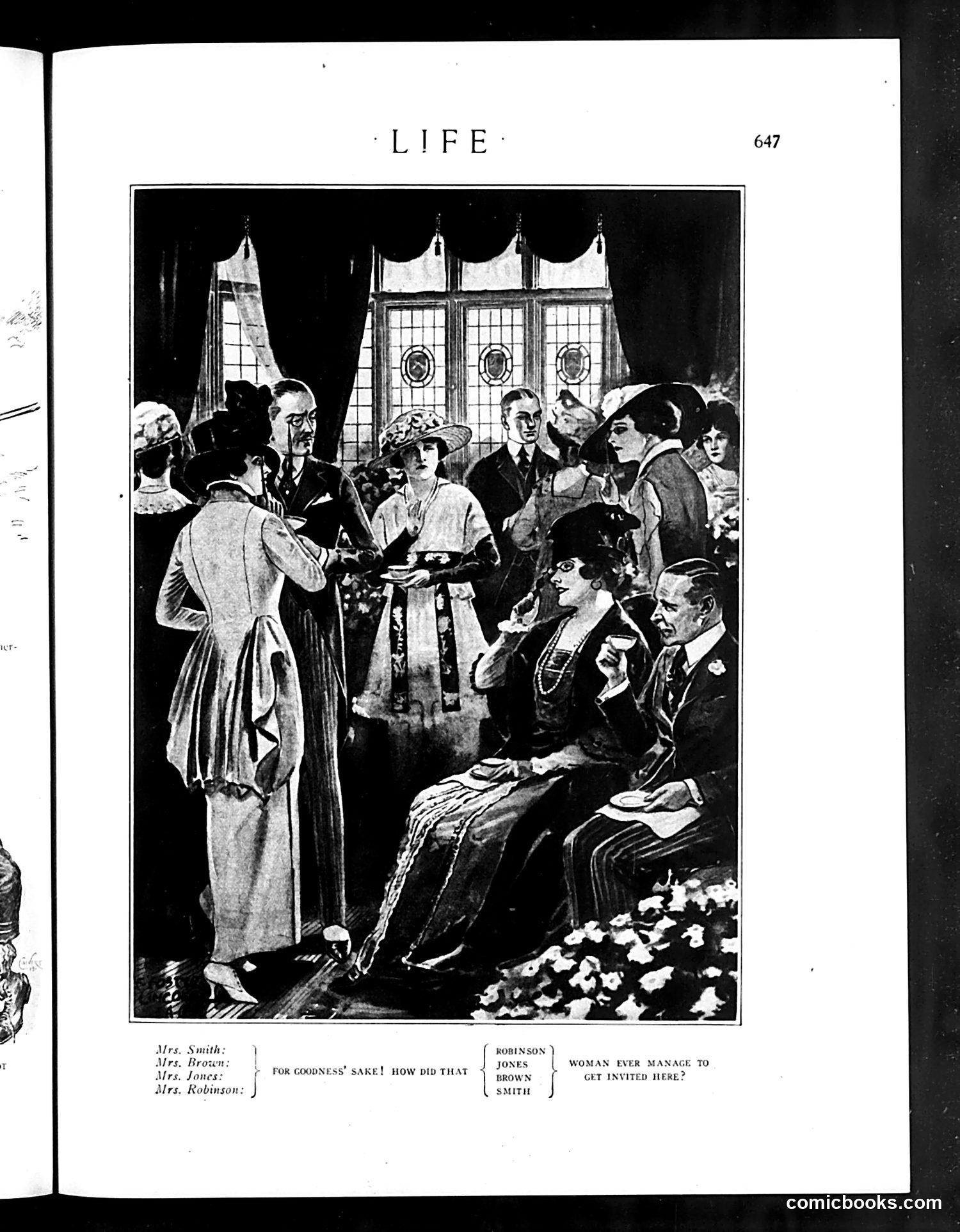
This is a single-panel cartoon from *Life* magazine (page 647) depicting a social gathering, likely from the early 20th century based on the clothing and art style. The caption reads: "FOR GOODNESS' SAKE! HOW DID THAT WOMAN EVER MANAGE TO GET INVITED HERE?" with character names listed as Robinson, Jones, Brown, and Smith—all generic surnames. The cartoon satirizes **social gatekeeping and class anxiety**. The shocked reaction to an uninvited woman's presence suggests she's considered socially undesirable or of lower standing than the gathering's expected guests. The joke likely mocks the pretentiousness of high-society women who fret about maintaining exclusive social circles. The generic names imply this represents typical middle-class social climbing and snobbery of the era.
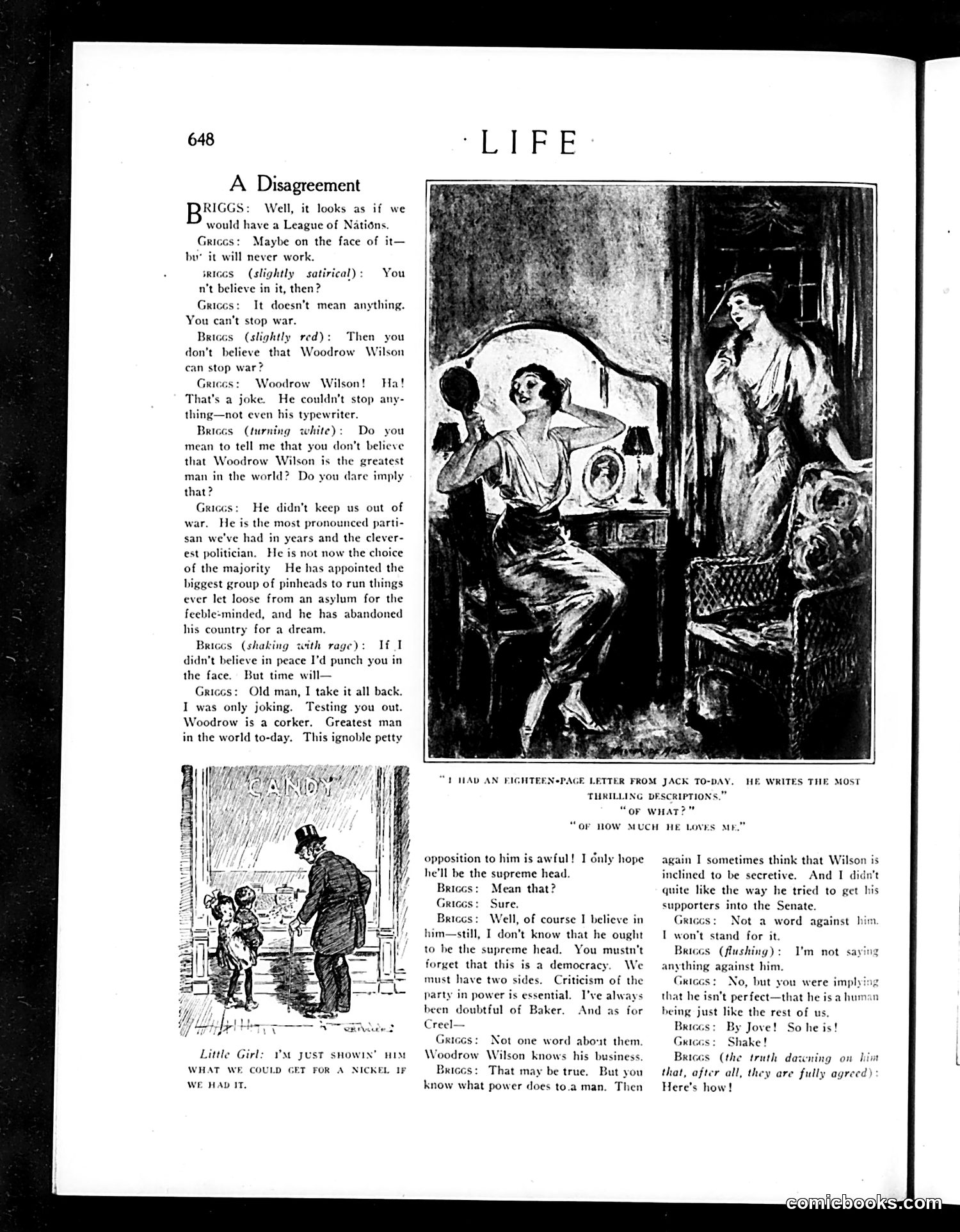
This page satirizes **Woodrow Wilson** (President during WWI and the League of Nations debate). Two figures—**Briggs** and **Griggs**—argue about Wilson's leadership. Briggs defends Wilson as "the greatest man in the world," praising his role keeping America out of war and his peacekeeping initiatives. Griggs counters that Wilson is divisive, has "appointed the biggest group of ignoramuses," and abandoned democratic principles by surrounding himself with loyalists. The debate reflects **real 1919-1920 tensions** over Wilson's League of Nations proposal and his perceived authoritarianism. The cartoon satirizes Americans' conflicting views on Wilson—simultaneously celebrated as a peacemaker and criticized as an autocratic ideologue. The accompanying cartoon of a child represents ordinary citizens caught in elite political disagreements.
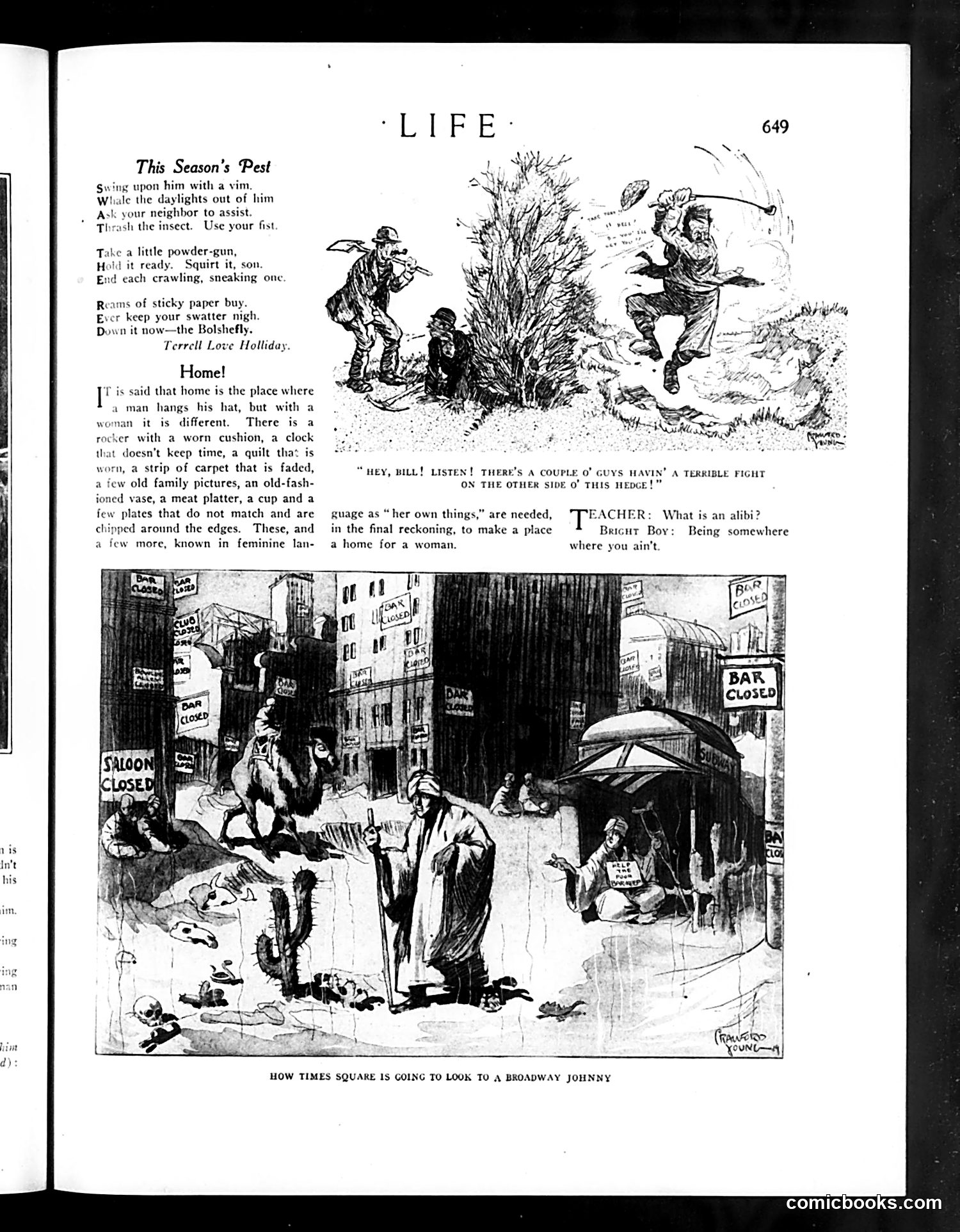
**Top Section:** "This Season's Pest" is a humorous poem offering comedic advice on dealing with insects—using powder guns, sticky paper, and physical force. It's lighthearted domestic humor typical of the era. **Middle Illustration:** Shows children playing outdoors near tall grass, captioned "Hey, Bill! Listen! There's a couple of guys havin' a terrible fight on the other side o' this hedge!" The joke reflects children's imaginative exaggeration of minor events. **"Home!" Section:** Discusses household items that define a woman's domestic space—worn cushions, faded carpets, family pictures—emphasizing feminine domesticity and household management as core to women's identity. **Bottom Cartoon:** "How Times Square is Going to Look to a Broadway Johnny" depicts urban Prohibition-era decay: closed saloons and bars, homeless figures, economic hardship. This satirizes the social consequences of Prohibition on entertainment districts and urban life.
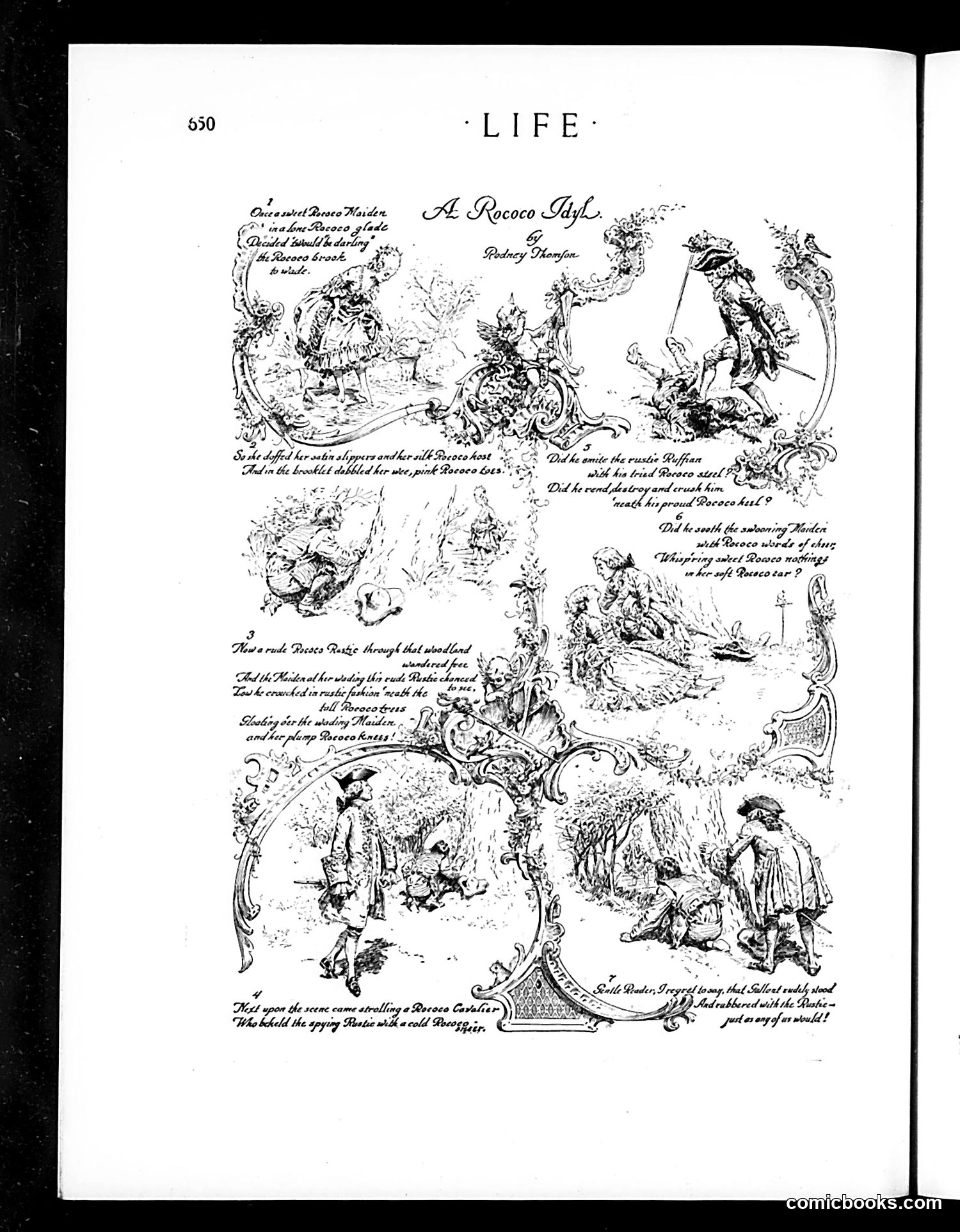
This is a satirical illustration series depicting a character named "Rococo" (likely a mocking reference to an ornate, excessive style). The vignettes show this figure in various comedic predicaments—falling from a horse, being chased or attacked, and encountering other characters in slapstick scenarios. The ornate decorative frames and scattered narrative captions suggest this is a humorous narrative sequence rather than political commentary. The style appears to be late 19th or early 20th-century visual comedy, emphasizing physical humor and exaggerated situations. Without clearer text legibility or additional context, the specific satirical target remains unclear, though the "Rococo" title suggests mockery of affectation or pretentious behavior. The work functions primarily as entertainment rather than pointed social criticism.
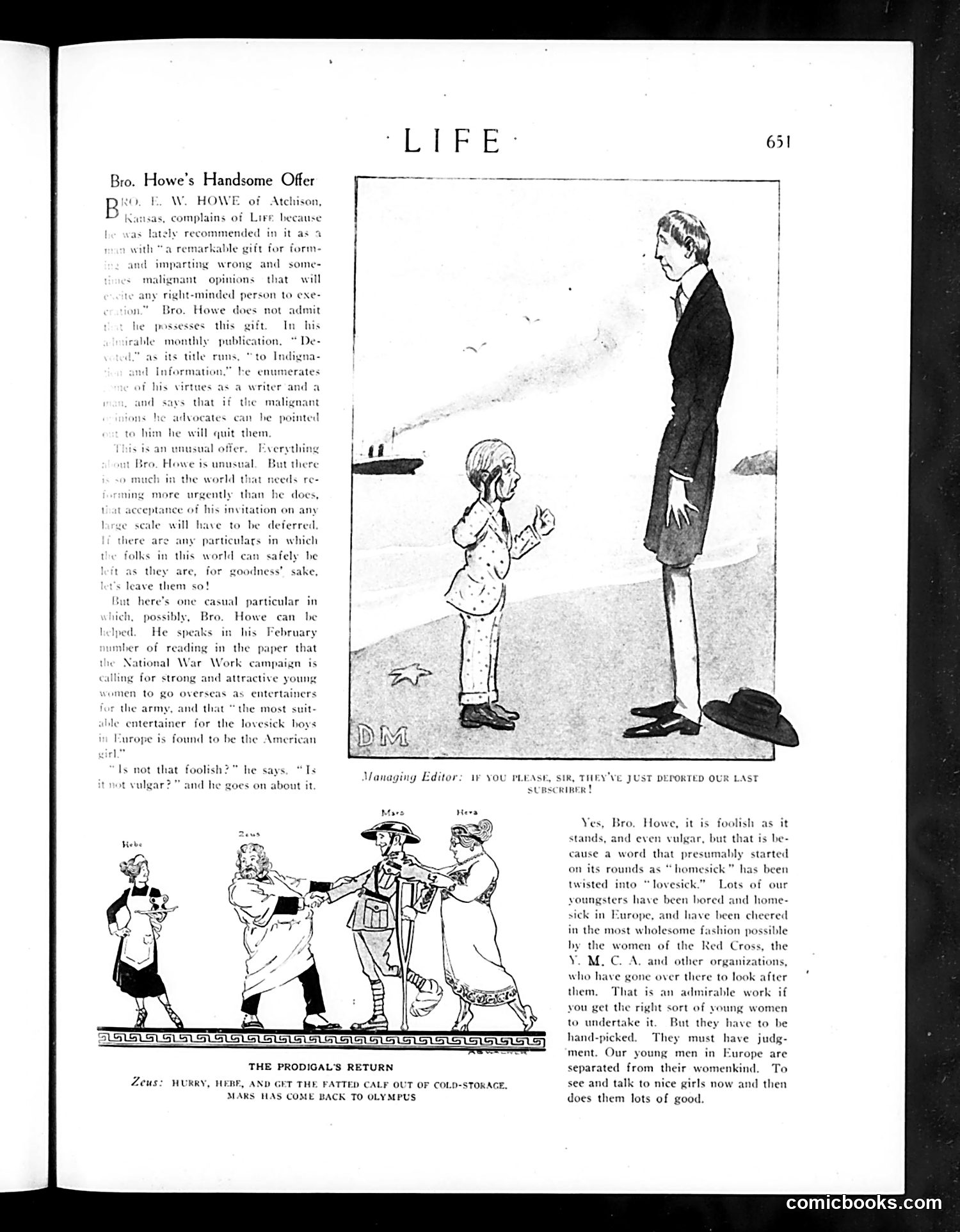
**Top Cartoon: "Managing Editor"** A tall man (representing a Life magazine editor) confronts a small boy who has just been hired as a subscriber. The editor says the boy has been "just deported our last subscriber," implying the magazine is losing readership. This satirizes Life's circulation problems and the editorial challenge of retaining audiences. **Bottom Cartoon: "The Prodigal's Return"** A classical Greek/Roman scene shows Zeus and other mythological figures retrieving "the fatted calf" from storage, suggesting Mars (the god of war) has returned to Olympus. This appears to mock post-WWI demilitarization, with mythological figures awkwardly welcoming back war itself. The article criticizes Bro. E.W. Howe's controversial opinions while praising his literary talent.
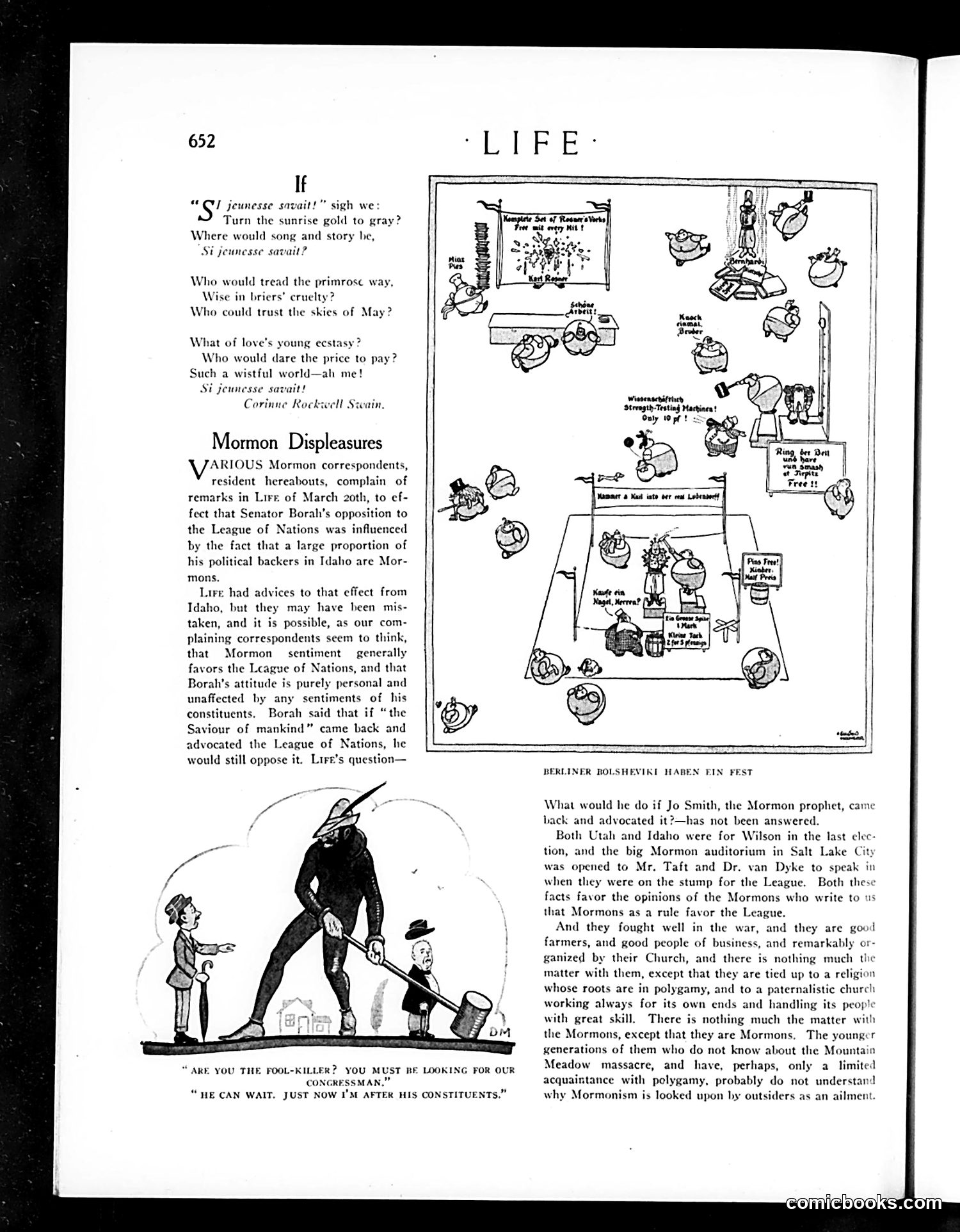
This page addresses Senator William Borah's opposition to the League of Nations. Life magazine had reported that Borah's Idaho political backers were predominantly Mormon, implying religious influence on his stance. Mormon readers protested, claiming the religion actually favored the League. The main cartoon (bottom left) shows a tall figure speaking to a small man labeled "congressman," with text about "fool-killer" and looking for a congressman—a jab at political absurdity. Life's response is skeptical but measured: Mormons fought in WWI, are good farmers and businesspeople, but remain tied to a problematic past (polygamy, the Mountain Meadow massacre). The article essentially argues Mormons are fine except they're "tied up to a religion" with troubling historical roots—a backhanded compliment layered with anti-Mormon prejudice typical of the 1920s era.
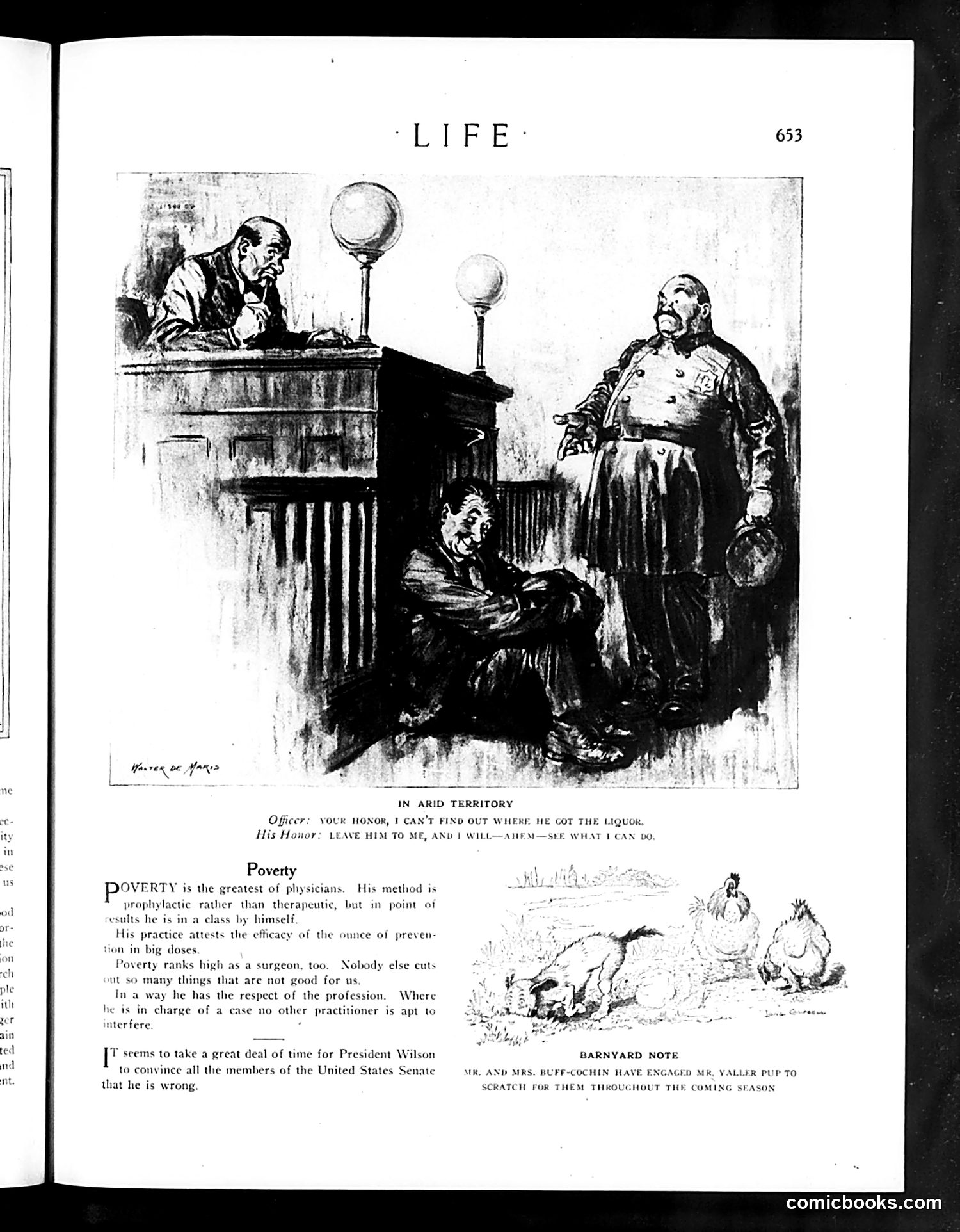
The top cartoon, "In Arid Territory," mocks Prohibition enforcement. An officer admits he cannot locate a suspect's liquor source, while the judge (His Honor) suggests he'll investigate—with a knowing "ahem"—implying the judge himself will help obtain illegal alcohol. The satire targets corruption among law enforcement and judiciary during Prohibition, suggesting officials tasked with enforcing the law were themselves complicit in its violation. The essay "Poverty" uses paradoxical language to ironically praise poverty as a "physician" and "surgeon," suggesting it prevents excess and removes harmful things. This appears sardonic commentary on social attitudes toward the poor. The brief "Barnyard Note" is a humorous animal anecdote unrelated to politics. The reference to President Wilson concerns his difficulty convincing the Senate—likely referencing League of Nations ratification debates of 1919-1920.
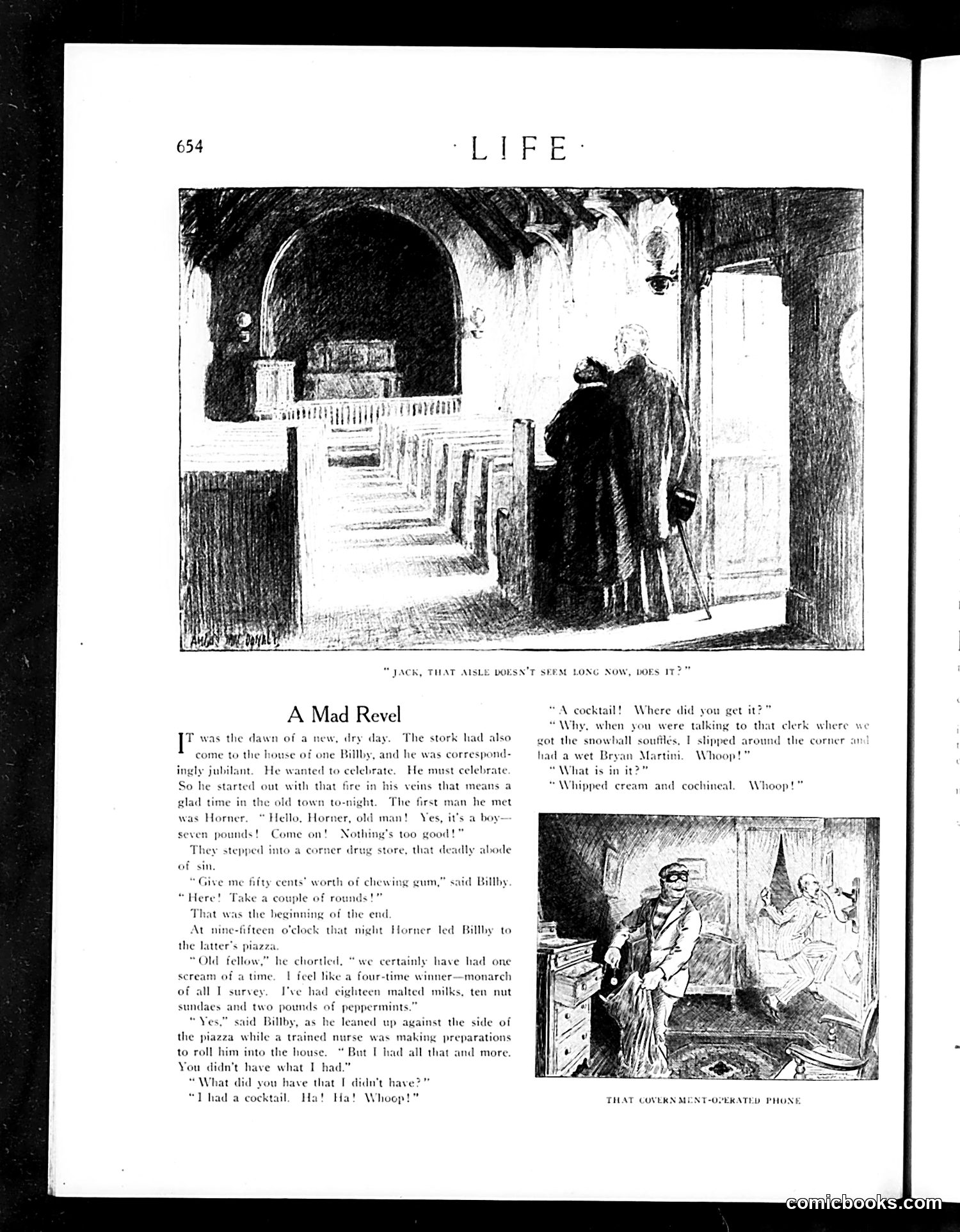
This story satirizes the absurdity of Prohibition (the ban on alcohol sales). Two men celebrate a birth by going on an elaborate food and drink spree. They consume eighteen malted milks, sundaes, and peppermints—all legal substitutes—while one character boasts of secretly obtaining a "cocktail" (illegal alcohol) containing "whipped cream and cochineal." The joke targets how Prohibition created ridiculous workarounds: people consumed enormous quantities of legal sweets as a cover for, or substitute for, banned alcohol. The reference to a "wet Bryan Martini" likely alludes to William Jennings Bryan, a prominent dry-law advocate—the irony being that even his name gets attached to a drink. The cartoon's setup shows figures in what appears to be a public space, possibly a speakeasy or establishment operating under Prohibition. The satire mocks both the law's ineffectiveness and the public's creative defiance of it.
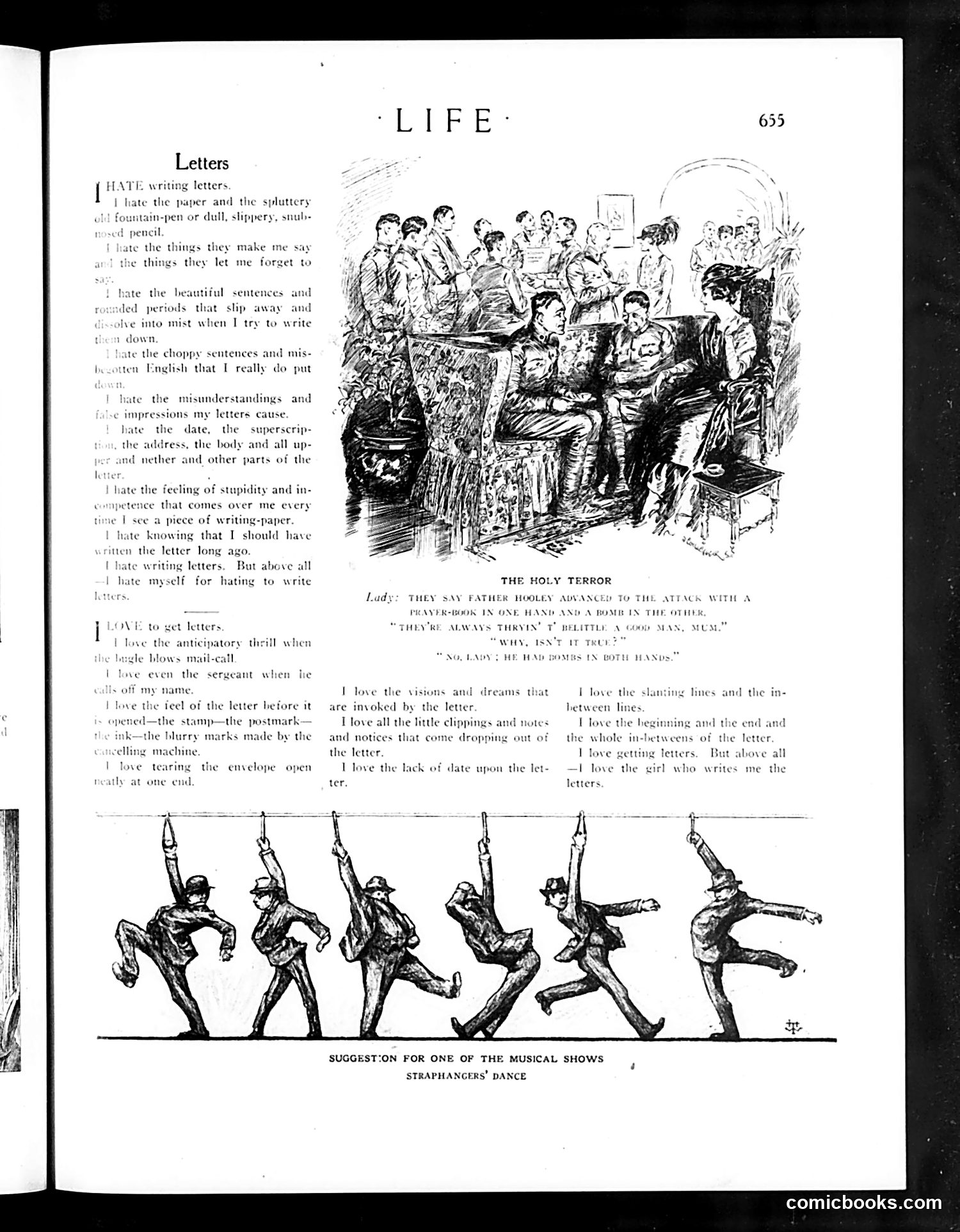
This page contains two distinct satirical pieces: **"Letters" Essay**: A humorous column contrasting the writer's hatred of *writing* letters (messy paper, forgotten thoughts, awkward phrasing) with their love of *receiving* them (the thrill of mail call, envelope textures, postmarks). It's relatable domestic satire about the letter-writing experience. **"The Holy Terror" Cartoon**: References Father Coughlin (a controversial radio priest of the 1930s-40s known for inflammatory rhetoric). The joke mocks exaggerated claims about his activism—ladies gossip that he carried both a prayer-book and bomb, then one claims he had bombs in *both* hands. It satirizes how public figures' reputations become distorted through rumor and hearsay. **"Straphangers' Dance"**: A final sketch showing six men in absurd, contorted poses holding onto overhead subway rails. It's titled as a "suggestion" for a musical number—visual comedy about the ungainly postures commuters adopt on crowded trains. All three pieces use gentle, observational humor about everyday American life and public figures.
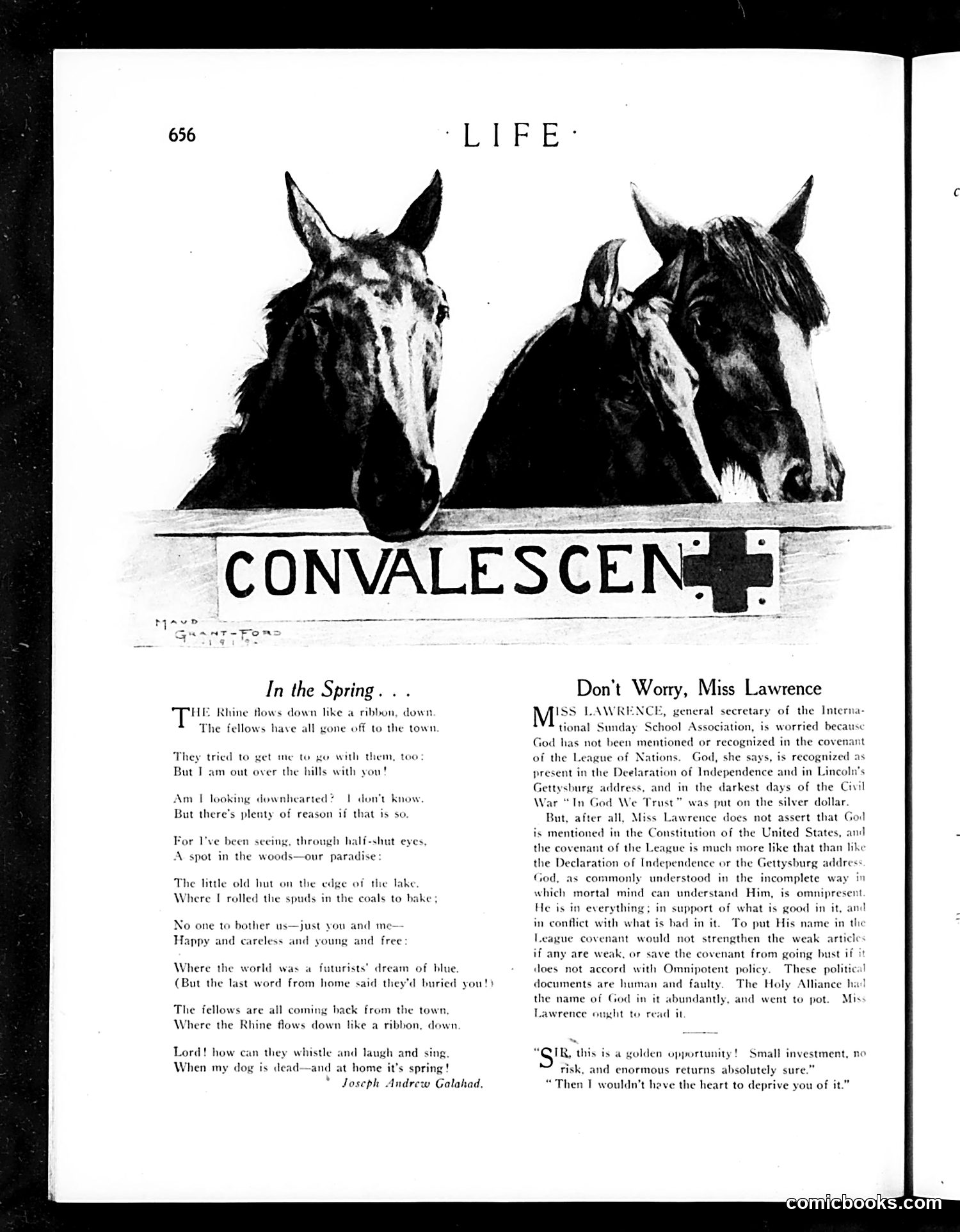
**The Poem "In the Spring"** (left): A WWI-era soldier's lament. The speaker recalls peaceful prewar moments with his dog by the Rhine River in what appears to be Germany or occupied territory. The tragic final line—"When my dog is dead—and at home it's spring!"—suggests the dog died while he was away at war, emphasizing the personal losses of combat beyond human casualties. The poem captures the disconnect between soldiers' suffering and those at home resuming normal life. **"Don't Worry, Miss Lawrence"** (right): A commentary on Miss Lawrence's concern that God isn't mentioned in the League of Nations covenant. The editorial defends the omission, arguing that God's presence doesn't require explicit naming in political documents. It notes the Constitution also omits God, and cites the "Holy Alliance" as a cautionary example of a religious-named document that "went to pot," suggesting religious language in treaties doesn't guarantee moral outcomes. The piece is gently mocking Lawrence's literalist position.
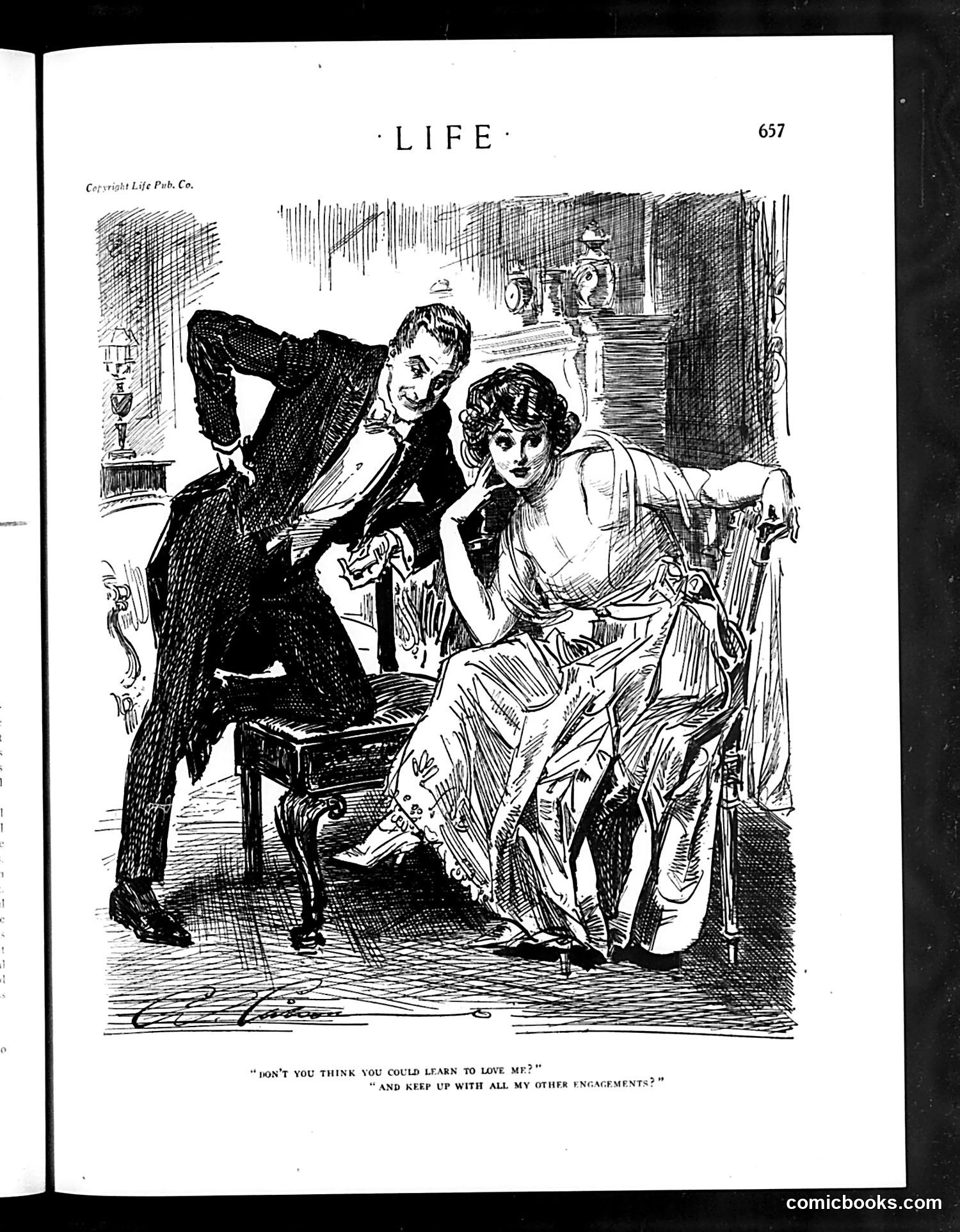
This is a romantic comedy sketch from Life magazine's satirical section. A well-dressed man in a suit leans casually against furniture, proposing to a woman seated in a chair. His relaxed posture and confident expression suggest he's a serial romantic. The woman's response—questioning whether he can "keep up with all my other engagements"—is the joke's reversal. Rather than being flattered or playing coy, she's essentially calling him out as a philanderer with multiple romantic interests. She suggests *she* is the one juggling multiple suitors, turning the power dynamic on its head. This satirizes early 20th-century courtship conventions and gender expectations, with the woman refusing the traditional passive role, instead implying she's equally (or more) romantically active.
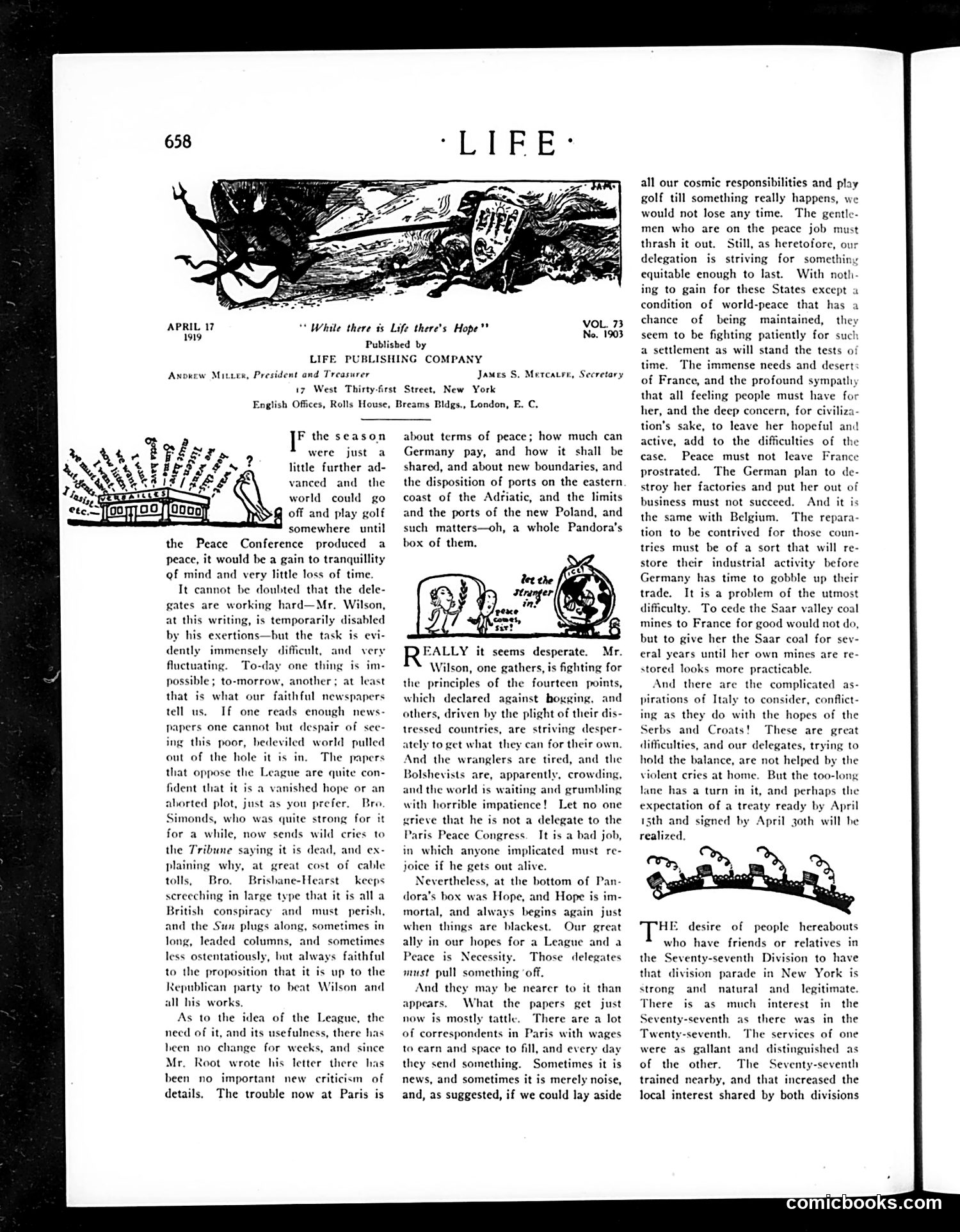
This page satirizes the Paris Peace Conference following World War I. The cartoon depicts negotiators as trapped in "Pandora's box"—a chaotic situation with endless complications: German reparations, new borders, Polish ports, Adriatic territories, and Bolshevik pressures. The article mocks both the delegates' exhaustion (Wilson was temporarily disabled) and the sensationalist press coverage. It critiques newspapers—particularly those aligned with William Randolph Hearst—for contradictory reporting: some oppose the League of Nations as a "British conspiracy," others defend it. The satire's main point: Americans should stop obsessing over peace-conference details and "play golf" until negotiators actually produce results. The title "While there is Life there's Hope" suggests that despite Pandora's box of problems, diplomatic necessity will force a settlement. The piece reflects public frustration with slow progress toward a League of Nations during the Treaty of Versailles negotiations.
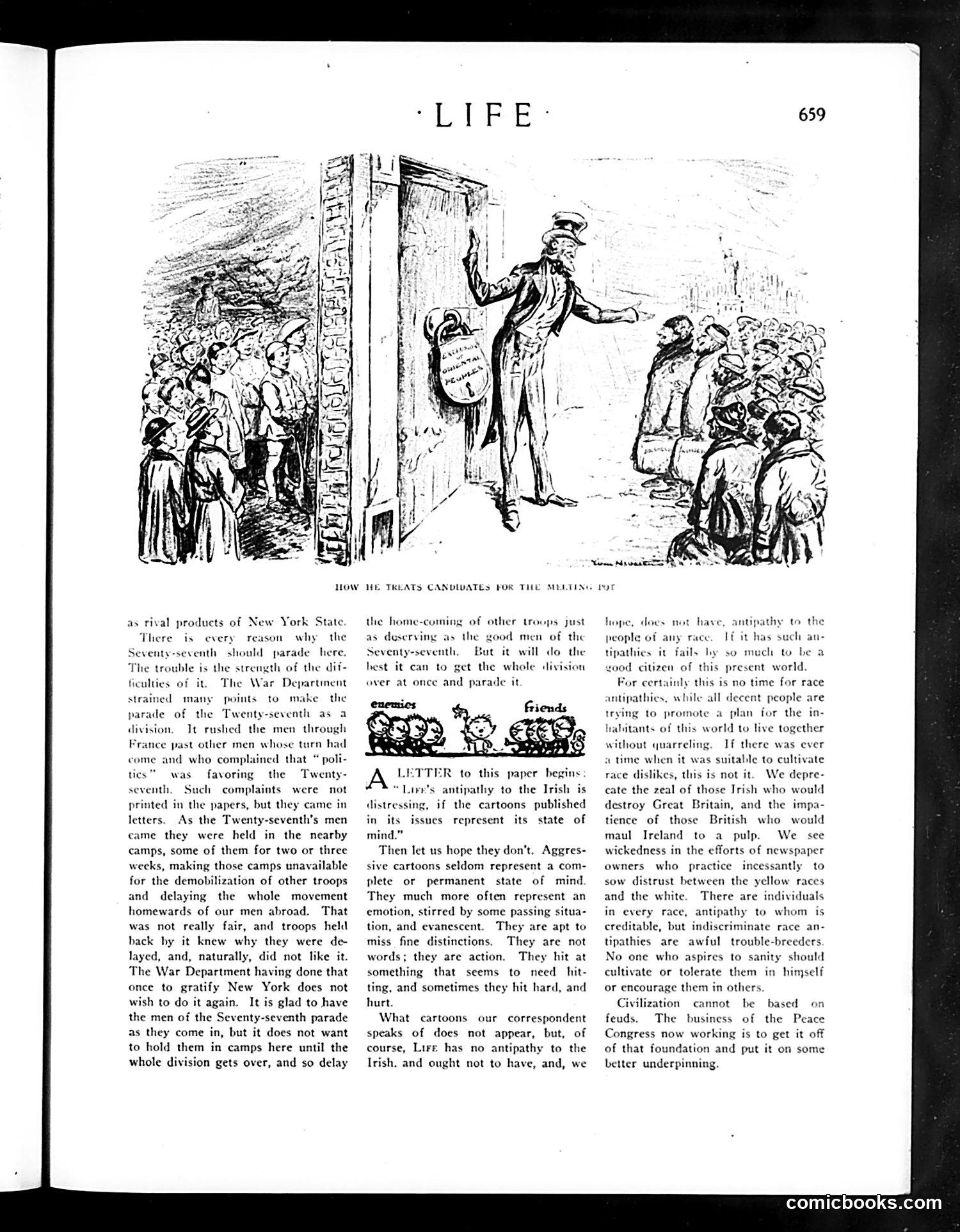
## Main Cartoon: "How He Treats Candidates for the Melting Pot" The illustration depicts a figure in formal dress (likely a politician or official) standing elevated between two groups of immigrants or citizens, gesturing expansively. The "melting pot" reference invokes the contemporary American ideal of assimilating diverse populations into a unified society. ## Context The accompanying text defends *Life* magazine against accusations of anti-Irish bias in its cartoons. A reader complained that *Life's* published cartoons revealed "antipathy to the Irish." The editors respond that cartoons represent momentary emotions and satirical targets, not permanent prejudices—they "hit at something that seems to need hitting." The article then pivots to a broader argument: in the post-WWI era, fostering racial and ethnic animosity is destructive. It criticizes both Irish hostility toward Britain and British toward Ireland, as well as newspaper owners who deliberately stoke racial divisions. The editors argue civilization cannot be "based on feuds" and support international peace efforts. The cartoon likely satirizes political manipulation of immigrant or ethnic groups for electoral gain.
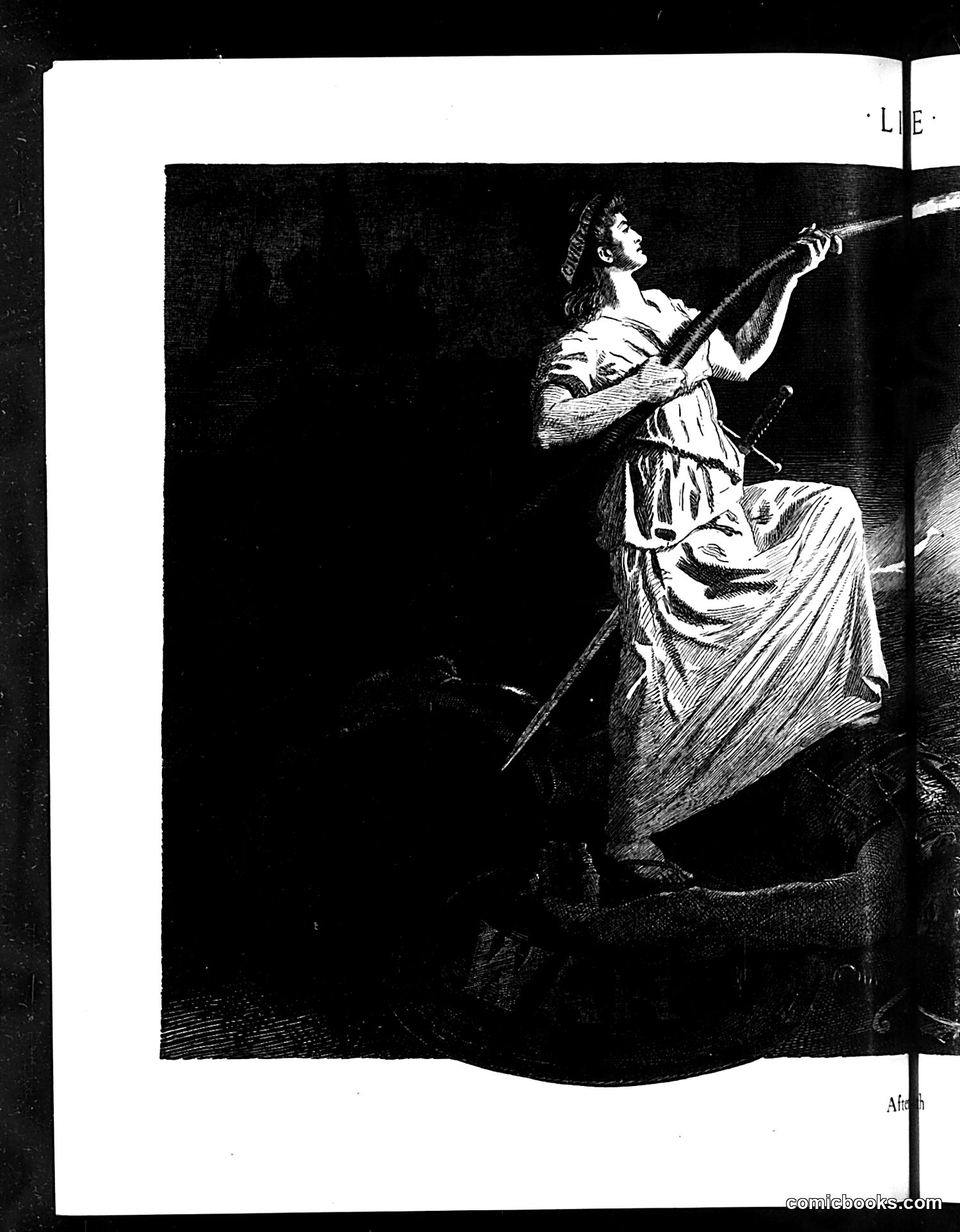
This engraving depicts a classical female allegorical figure—likely representing Liberty, Justice, or America itself—wielding a torch or staff while looking upward. She wears draped robes in the neoclassical style common to 19th-century American symbolism. Without visible text identifying the specific political moment, the precise satirical target remains unclear. However, the heroic pose and classical iconography suggest this may reference American democratic ideals, patriotic fervor, or national purpose during a particular political debate or crisis. The engraving style and Life magazine's satirical tradition indicate this critiques or comments on contemporary political events, but the OCR text provided contains no content explaining the cartoon's specific subject or intent. Additional context would be needed to identify the exact historical reference and satirical point.
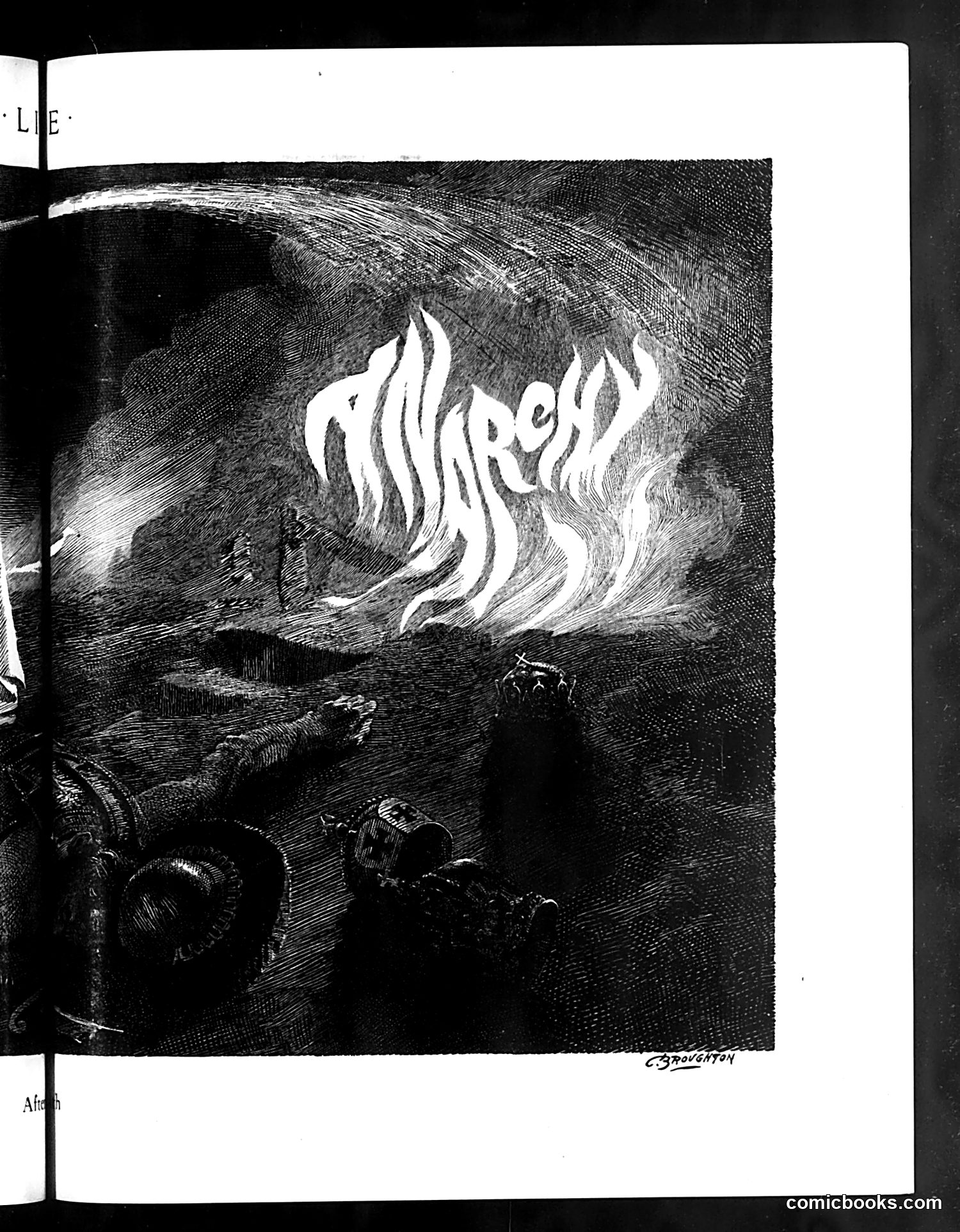
The OCR text is too corrupted to provide context. However, the image shows a dramatic engraving-style illustration of a large bonfire or burning pyre with white flames rising prominently in the center. Silhouetted figures stand in the foreground observing the fire, which appears to reference a public burning or execution scene. A cross is visible among the figures on the right. Without legible text to identify the specific political or social reference, I cannot definitively say what event or figures this satirizes. The style and imagery suggest it could reference religious persecution, witch trials, or another form of public violence, but the exact subject and satirical intent remain unclear from this page alone.
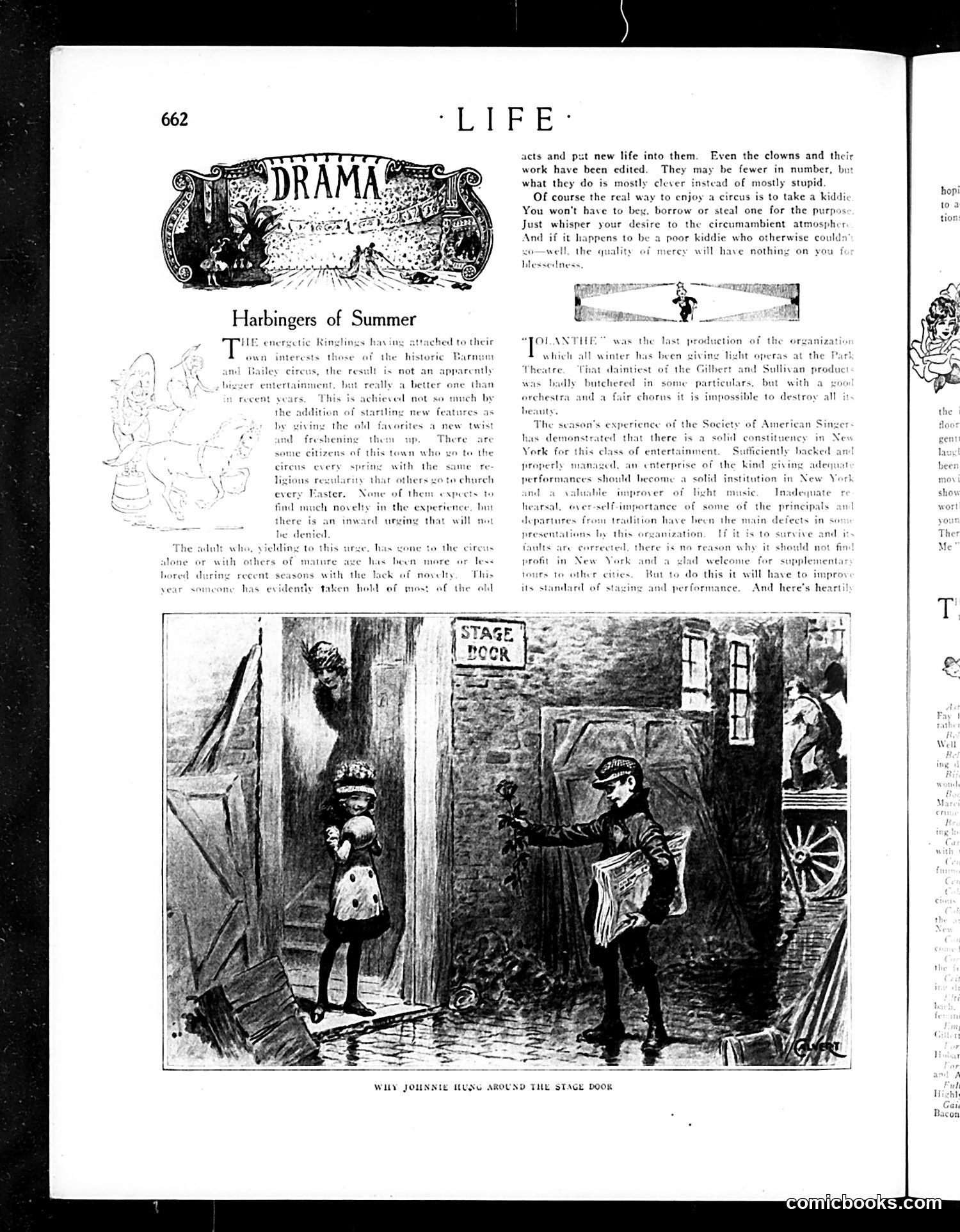
This page from *Life* magazine discusses circus entertainment and theatrical productions of the era. The main illustration, captioned "Why Johnnie Hung Around the Stage Door," depicts a young boy eagerly approaching the stage door of a circus or theater, while a circus performer (likely a clown or acrobat in period costume) gestures from the doorway. The satire plays on the timeless appeal of circus life to children—the article discusses how the Ringling Brothers circus has refreshed its acts, and how theatrical organizations like the Society of American Singers have attempted to create quality entertainment. The humor lies in showing a boy's unbridled enthusiasm for backstage access, capturing the romanticized allure circuses held for youth before modern entertainment options existed. The broader editorial content criticizes theatrical productions for lapses in quality and excessive self-importance among performers, arguing such institutions could thrive if standards improved.
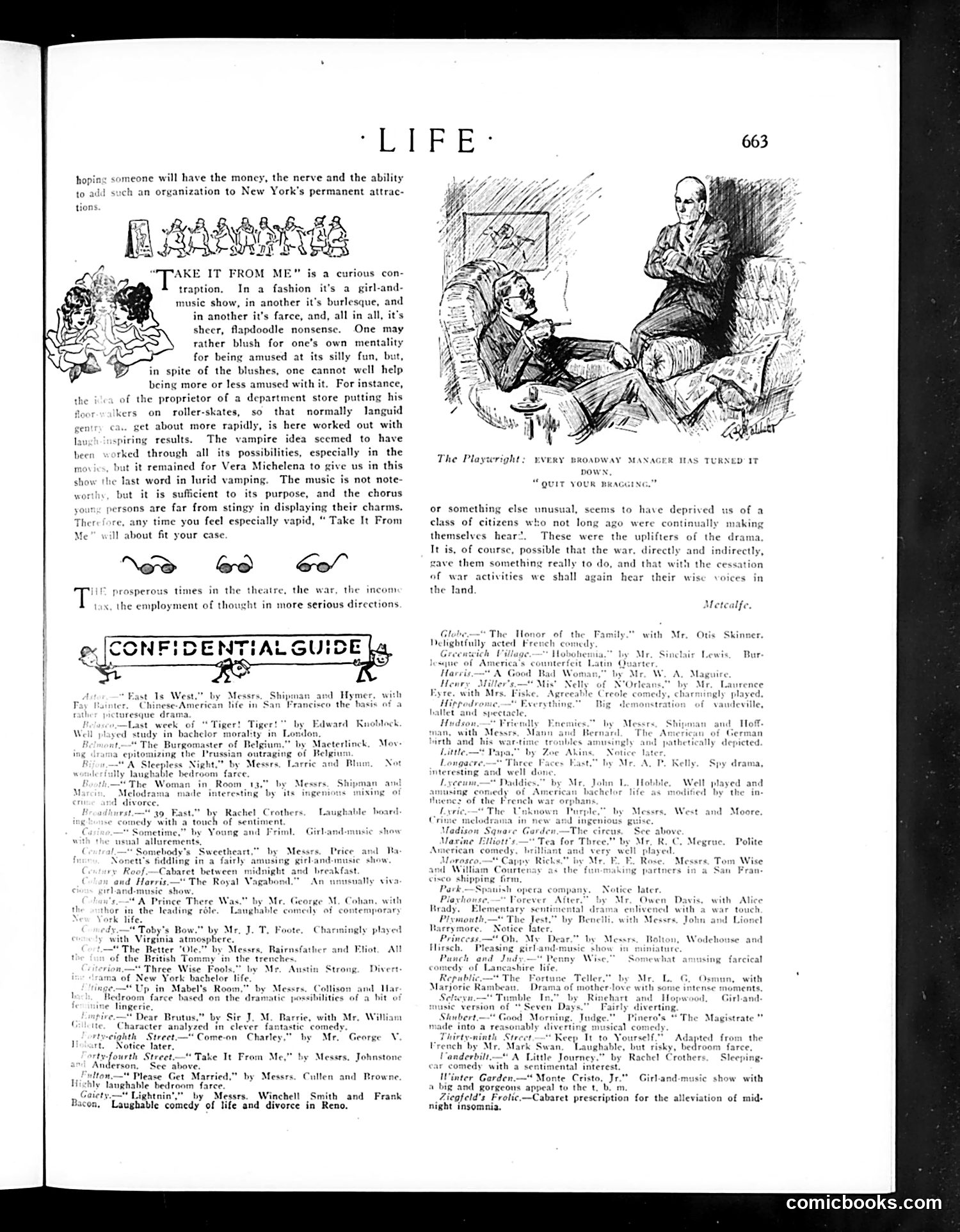
This page reviews Broadway theater while satirizing playwrights' pretensions. The central cartoon shows a playwright being rejected by a theater manager with the caption "Every Broadway manager has turned it down—'Quit your bragging.'" The accompanying text argues that war has stripped playwrights of their self-importance. Previously, they positioned themselves as "uplifters of the drama"—moral reformers. But the war has given audiences "something really to do" beyond theatrical moralizing. With wartime concerns dominating public consciousness, playwrights' earnest social commentary now seems irrelevant. The joke: Broadway's serious dramatists are humbled by events beyond their control. Their grand artistic ambitions about social improvement ring hollow when actual war demands real sacrifice. The theater reviews below suggest the era's lighter fare—farces, comedies, and romantic shows—may better suit audiences preoccupied with genuine crises than preachy "uplift" drama.
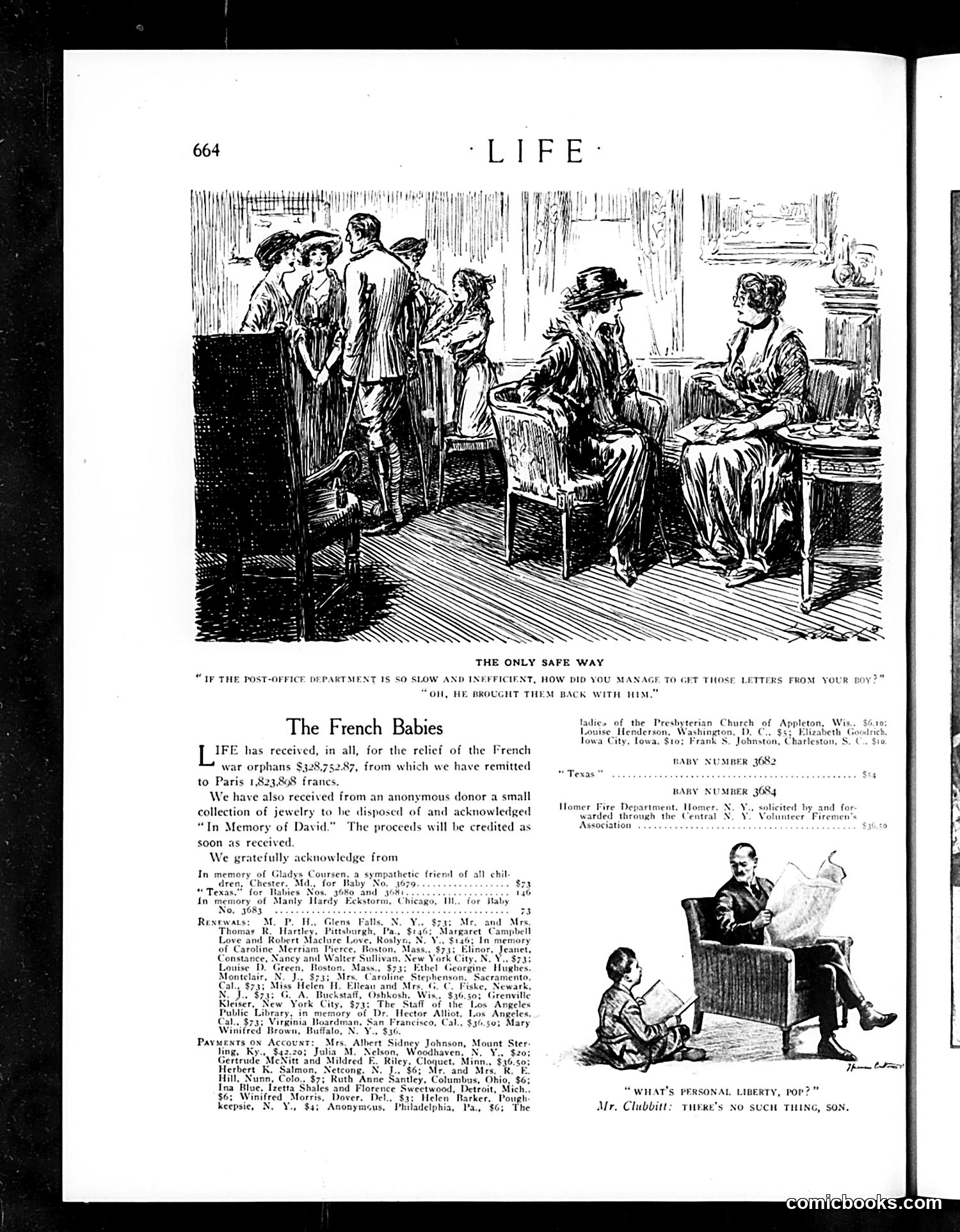
This page contains two distinct items: **Top cartoon ("The Only Safe Way"):** A satire on U.S. Post Office inefficiency. A woman asks how someone managed to receive letters from "her boy" (apparently overseas, likely a soldier) when the postal service is so slow. The answer: the boy brought the letters back in person. The joke mocks the Post Office Department's notorious delays during this period by suggesting personal delivery is faster than mail. **Bottom section ("The French Babies"):** A charitable appeal for French war orphans, listing donations received. This reflects American philanthropic efforts during or after World War I to aid French civilians. The accompanying life-advice cartoon shows a father telling his son there's "no such thing" as personal liberty—likely social commentary on wartime restrictions or simply cynical parenting advice. The page demonstrates *Life* magazine's mix of political satire and charitable fundraising typical of early 20th-century American periodicals.
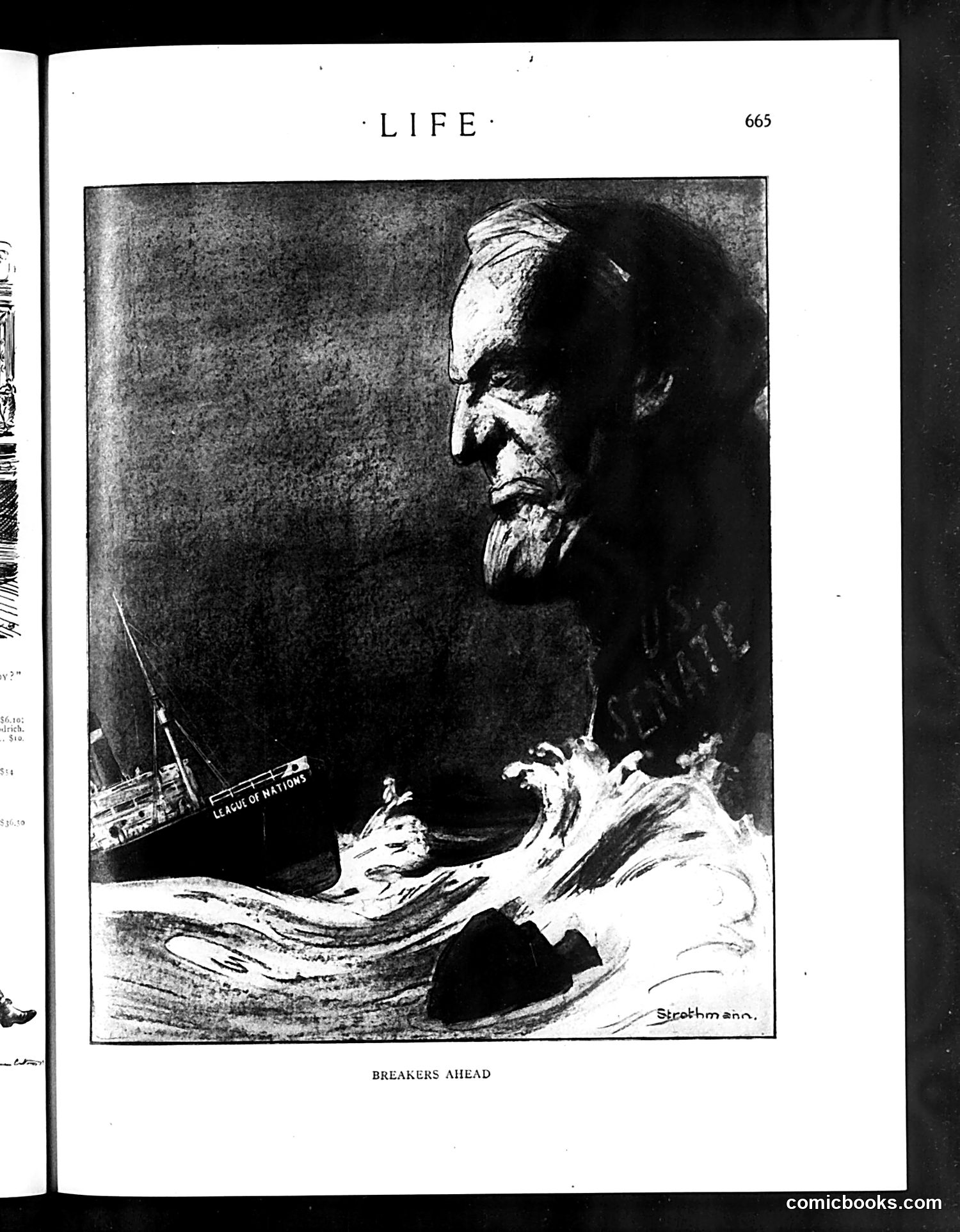
This political cartoon, signed by Strothmann, depicts a stern, bearded man (appearing to be a political or historical figure) gazing ahead with concern. He holds what looks like a ship's wheel or steering mechanism. In the background, a small ship labeled "LEAGUE OF NATIONS" appears to be in distress on rough waters. The cartoon's title "Breakers Ahead" uses nautical metaphor to warn of danger. The League of Nations ship appears threatened, suggesting the cartoon critiques the League's vulnerability or poor leadership under this figure's watch. The work likely comments on international political instability during the League's troubled period, warning of impending crisis or failure in global governance.
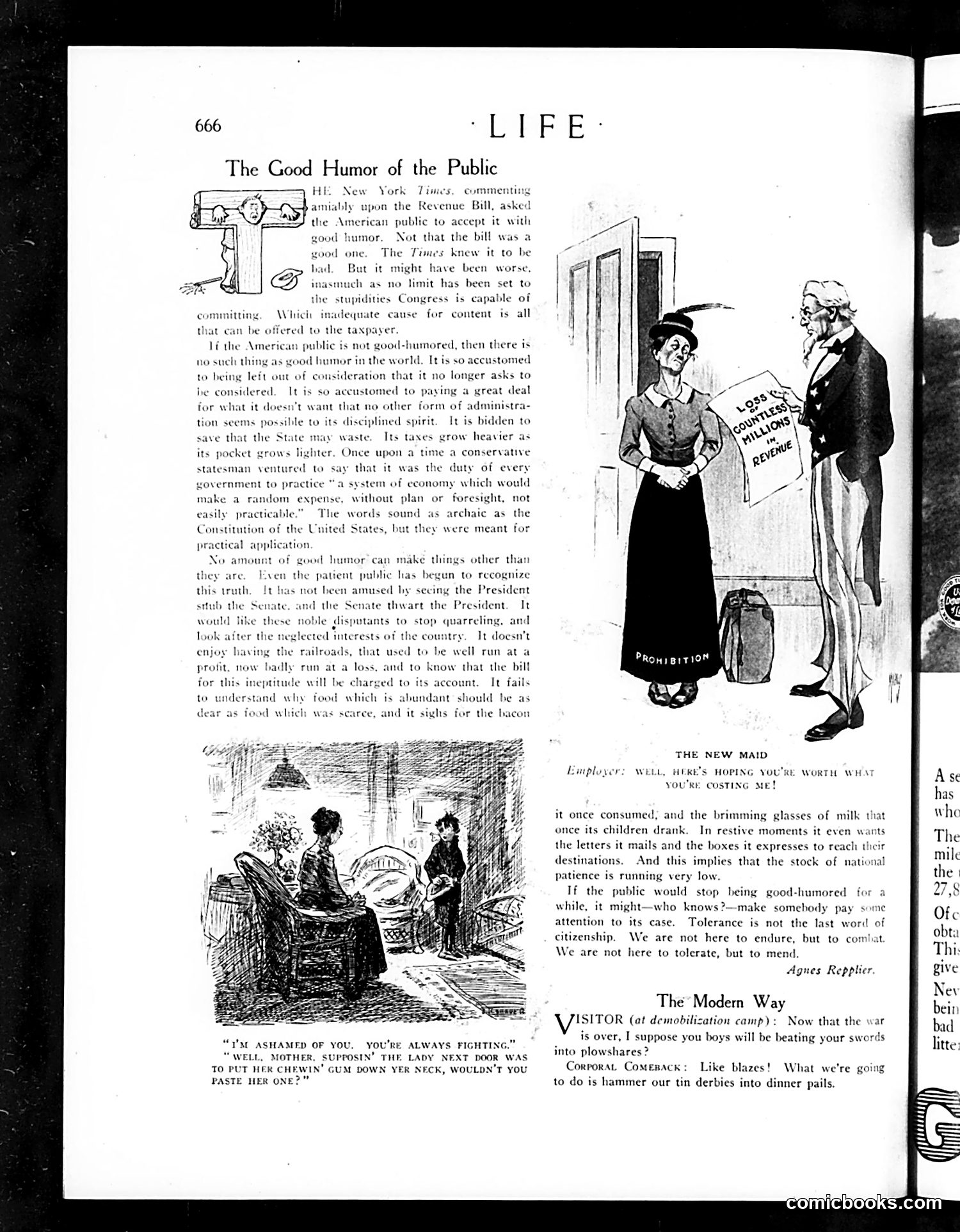
This page contains commentary on public patience with government taxation and inefficiency. The main article criticizes the Revenue Bill, noting Americans accept bad legislation with resigned humor rather than protest. **Key cartoons:** 1. **Top right ("The New Maid")**: An employer interviews a new maid while Prohibition looms in the background. The joke plays on labor costs during Prohibition—servants were expensive, and the caption sardonically hopes she's "worth what you're costing." 2. **Bottom ("The Modern Way")**: A post-WWI demobilization scene. A visitor naively expects soldiers to "beat swords into plowshares" (biblical peace imagery). The soldier's reply—converting military caps into dinner pails—cynically suggests veterans will return to struggling, low-wage labor rather than prosperity. **Overall theme**: The page satirizes American public docility toward economic hardship, unfair taxation, and post-war unemployment. Citizens endure injustice passively rather than demanding reform.
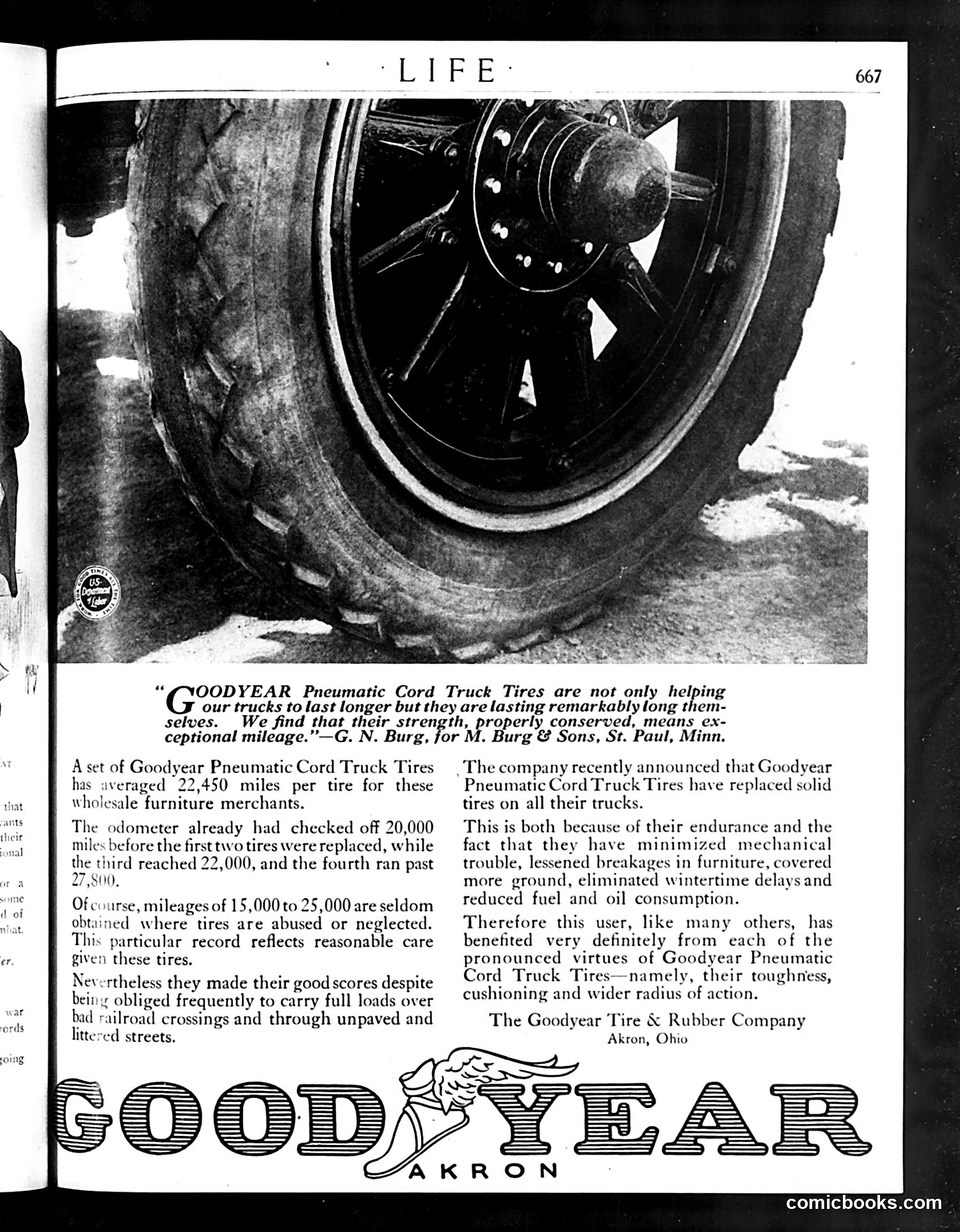
This is **not a cartoon or satire**—it's a straightforward advertisement for Goodyear Pneumatic Cord Truck Tires, likely from the 1920s. The page features a testimonial from G. N. Burg of M. Burg & Sons (a furniture merchant in St. Paul, Minnesota) praising tire durability. A photograph shows a truck tire on its rim, illustrating the product. The ad's main claim: Goodyear's pneumatic (air-filled) cord tires outlast solid tires, averaging 22,450 miles while reducing mechanical problems, fuel consumption, and delivery delays. The text emphasizes the tires' "toughness, cushioning and wider radius of action." This represents early automotive advertising using real-customer testimonials to build credibility—a marketing technique still common today. There is no satirical commentary; it's commercial promotion in a magazine known for humor elsewhere.
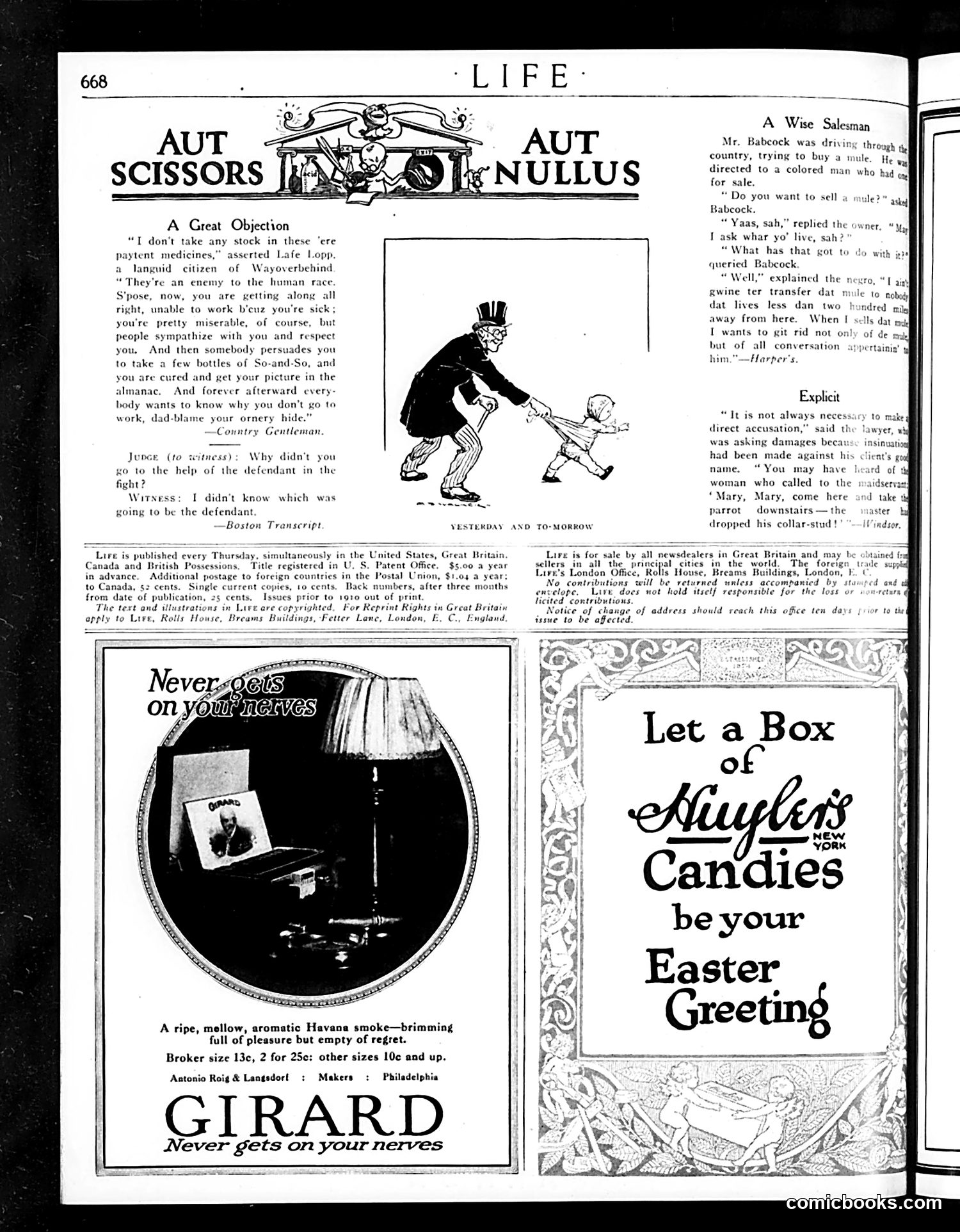
This page from *Life* contains three brief satirical pieces typical of early 20th-century American humor: **"A Great Objection"** mocks patent medicines by presenting a skeptical rural character (Lafe Lopp) who argues that taking patent remedies "cures" people and thus ruins them socially—they lose the sympathy and respect they'd enjoyed while sick, making them unwilling to work. **"A Wise Salesman"** presents a mule-selling transaction where a white buyer (Mr. Babcock) asks a Black man where he lives, planning to move the mule away to prevent the owner from bothering him about its faults. The humor relies on the buyer's dishonest scheme. **"Explicit"** concerns indirect insults in legal contexts, using an anecdote about a woman calling her parrot downstairs—implying the parrot (not the man) dropped his collar-stud, thus avoiding direct accusation while conveying insult. The page also contains period advertisements for cigars and candy. The satire reflects common early 1900s anxieties about patent medicines and social propriety.
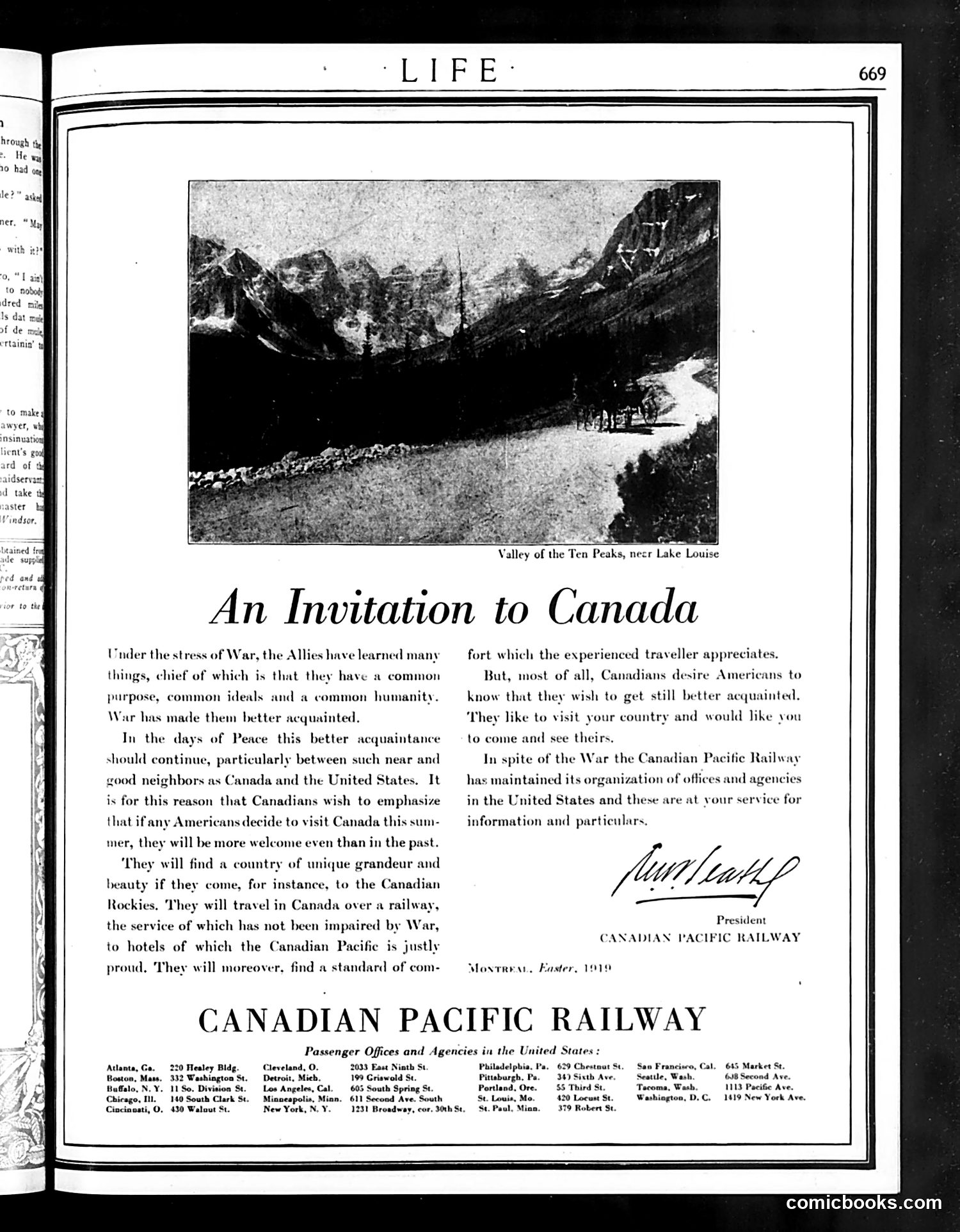
This is primarily an **advertisement**, not a political cartoon. It's a post-WWI promotional piece from the Canadian Pacific Railway (Easter 1919, shortly after the war ended). The content appeals to American readers by framing Canada as a friendly neighbor worth visiting. The text emphasizes that war has strengthened U.S.-Canadian bonds through shared purpose and ideals, and suggests Americans should reciprocate Canadian hospitality by visiting. The accompanying photograph shows the scenic "Valley of the Ten Peaks, near Lake Louise"—a famous Rocky Mountain destination—to entice American tourists. A signed message from the Canadian Pacific Railway's president reinforces that despite wartime disruptions, the railway maintained U.S. operations and welcomes American visitors. The bottom section lists passenger offices across American cities, facilitating bookings. This reflects post-war efforts to rebuild tourism and strengthen international goodwill through commercial enterprise rather than political satire.
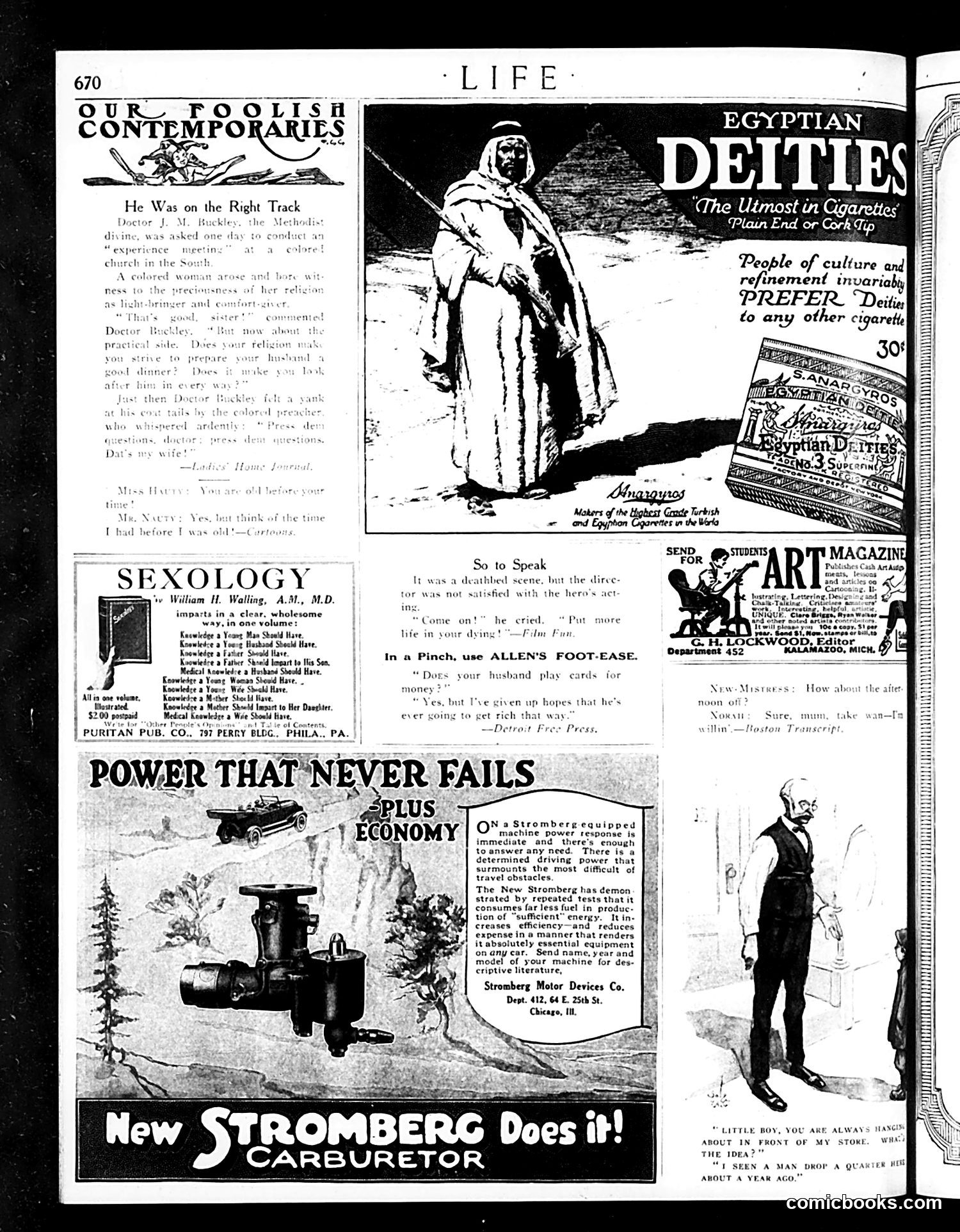
This page is primarily **advertising and light humor**, not political satire. The content includes: **"He Was on the Right Track"**: A brief anecdote about Doctor J.M. Buckley (Methodist divine) who advised a sister on religion and practical matters. The humor lies in her deadpan response about using religion to prepare good dinners—subverting his earnest counsel with domestic practicality. **Advertisements dominate**: "Sexology" (sex education book), Stromberg carburetors, Egyptian Deities cigarettes, and Allen's Foot-Ease. These reflect early 20th-century consumer culture. **"So to Speak"**: A film industry joke about a director frustrated with an actor's dying scene performance. **"In a Pinch, use ALLEN'S FOOT-EASE"**: Domestic humor about a wife accepting her husband won't get rich. **Bottom cartoon**: A child explains seeing a man drop a quarter—innocent observational humor with no political content. The page reflects *Life* magazine's era: mixing genteel advice, consumer products, and gentle domestic comedy with no apparent satirical target.
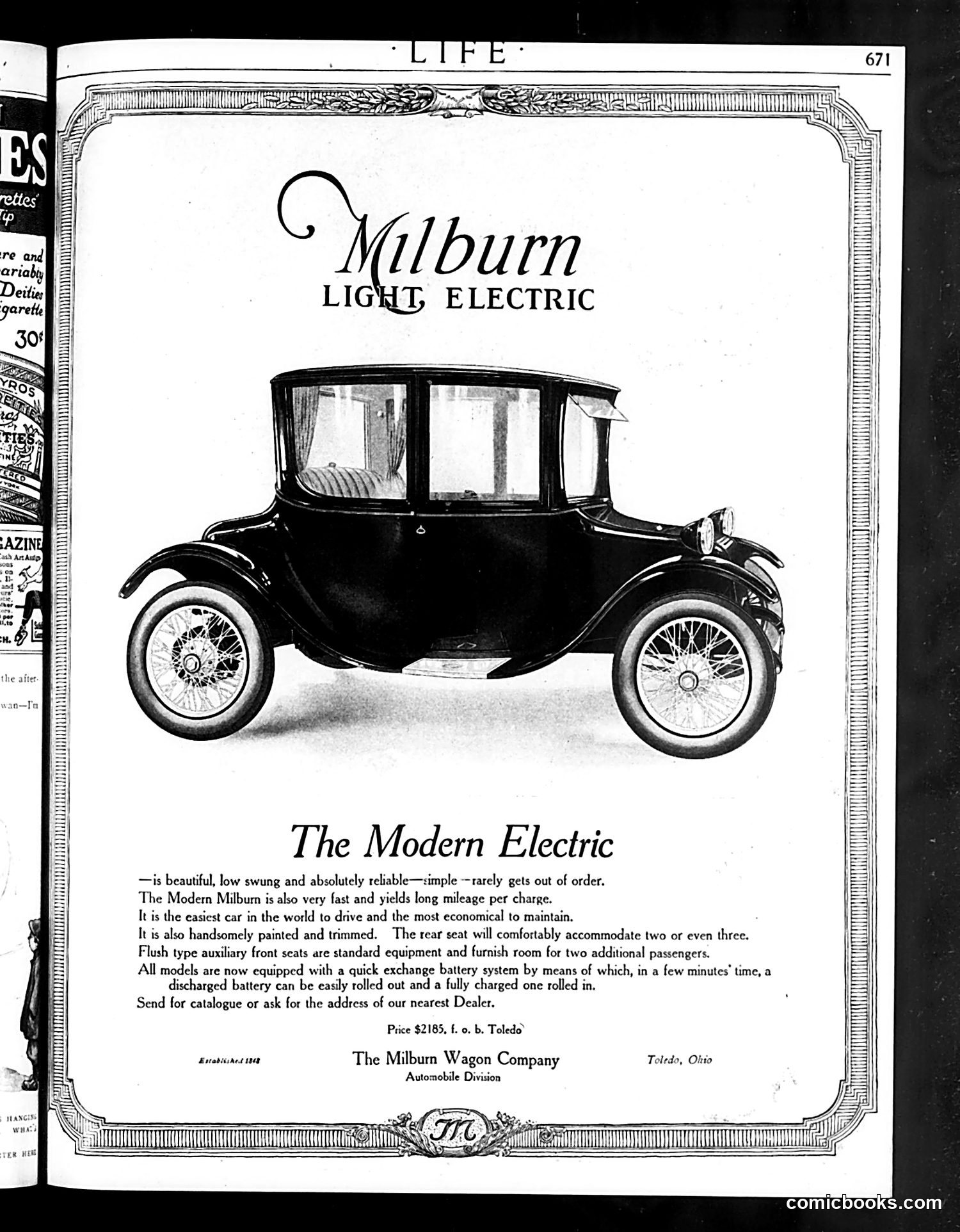
This is **not a cartoon or satire**, but rather a straightforward advertisement for the Milburn Light Electric automobile, published in *Life* magazine (page 671). The ad promotes an electric car manufactured by the Milburn Wagon Company in Toledo, Ohio. It emphasizes practical features appealing to early 20th-century consumers: reliability, ease of operation, low maintenance costs, and extended range per battery charge. The quick-exchange battery system—allowing drivers to swap a depleted battery for a charged one in minutes—addresses a key limitation of electric vehicles of this era. Priced at $2,185 (circa 1910s), this represents a luxury vehicle. The advertisement reflects the period when electric cars were serious competitors to gasoline automobiles, particularly for urban middle-class buyers. The emphasis on beauty, comfort, and economy indicates the target market was likely affluent women and families seeking an alternative to the more temperamental gasoline-powered vehicles.
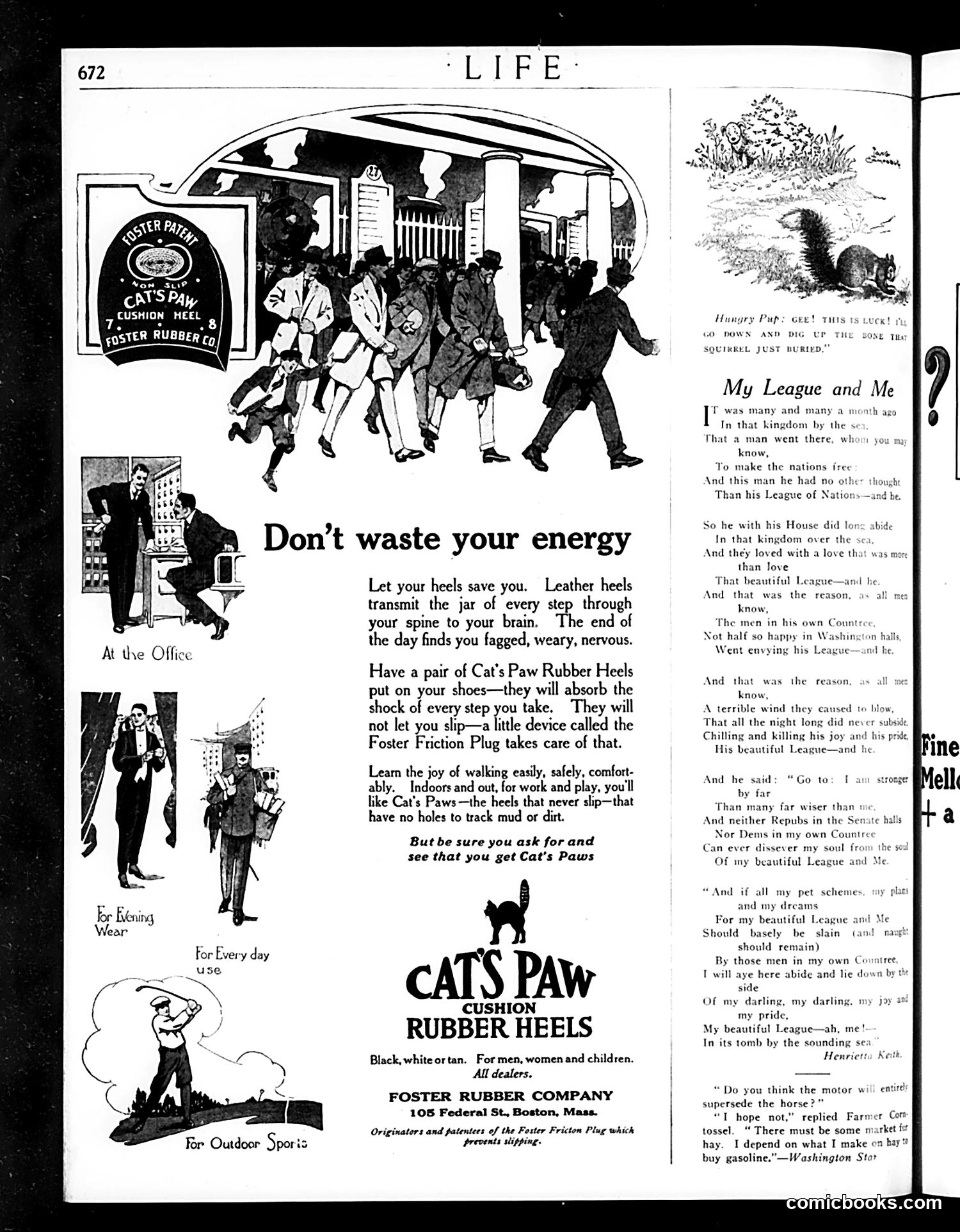
This page is primarily **advertising** for Cat's Paw rubber heels, using early 20th-century ergonomic claims (shock absorption reduces fatigue and nervousness). The product appears aimed at office workers and athletes. The **right side contains political satire** in the poem "My League and Me"—a parody of Edgar Allan Poe's "Annabel Lee." It references **President Woodrow Wilson's League of Nations**, which Congress opposed and ultimately rejected. The poem mocks Wilson's romantic attachment to his League while the Senate (Republicans and Democrats) actively undermined it. The "beautiful League" drowns in the "sounding sea"—a metaphor for the League's failure. The small cartoon jokes include a humorous squirrel burial and a farmer's quip about needing hay sales to fund gasoline purchases—commentary on agricultural economics amid motorization. The satire targets Wilson's idealism as naive against congressional realpolitik.
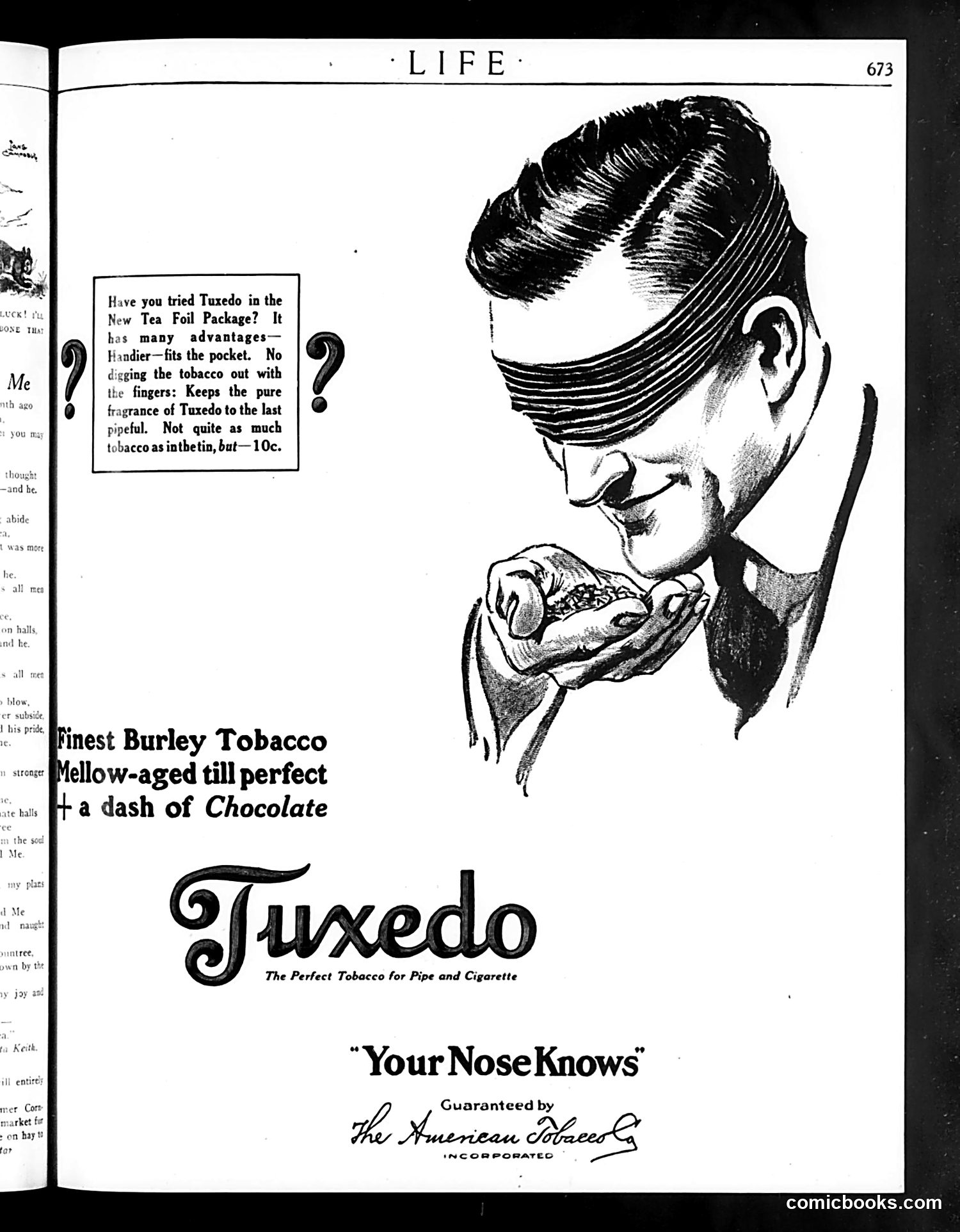
This page is primarily a **tobacco advertisement**, not political satire. It promotes "Tuxedo" brand tobacco, marketed as "The Perfect Tobacco for Pipe and Cigarette." The illustration shows a man with a blindfold sampling tobacco, supporting the slogan **"Your Nose Knows"**—emphasizing that the product's quality is recognizable by smell alone, even without seeing it. The ad highlights a new **foil package** innovation, claiming advantages: portability, freshness preservation, and lower cost (10 cents) compared to tin containers, though with slightly less tobacco. The tagline references "Finest Burley Tobacco / Mellow-aged till perfect / a dash of Chocolate," suggesting flavor notes appealing to pipe and cigarette smokers. **For modern readers:** This reflects an era when tobacco advertising was mainstream in general-interest magazines, before widespread health warnings. The emphasis on sensory appeal and convenient packaging was typical mid-twentieth-century marketing strategy.
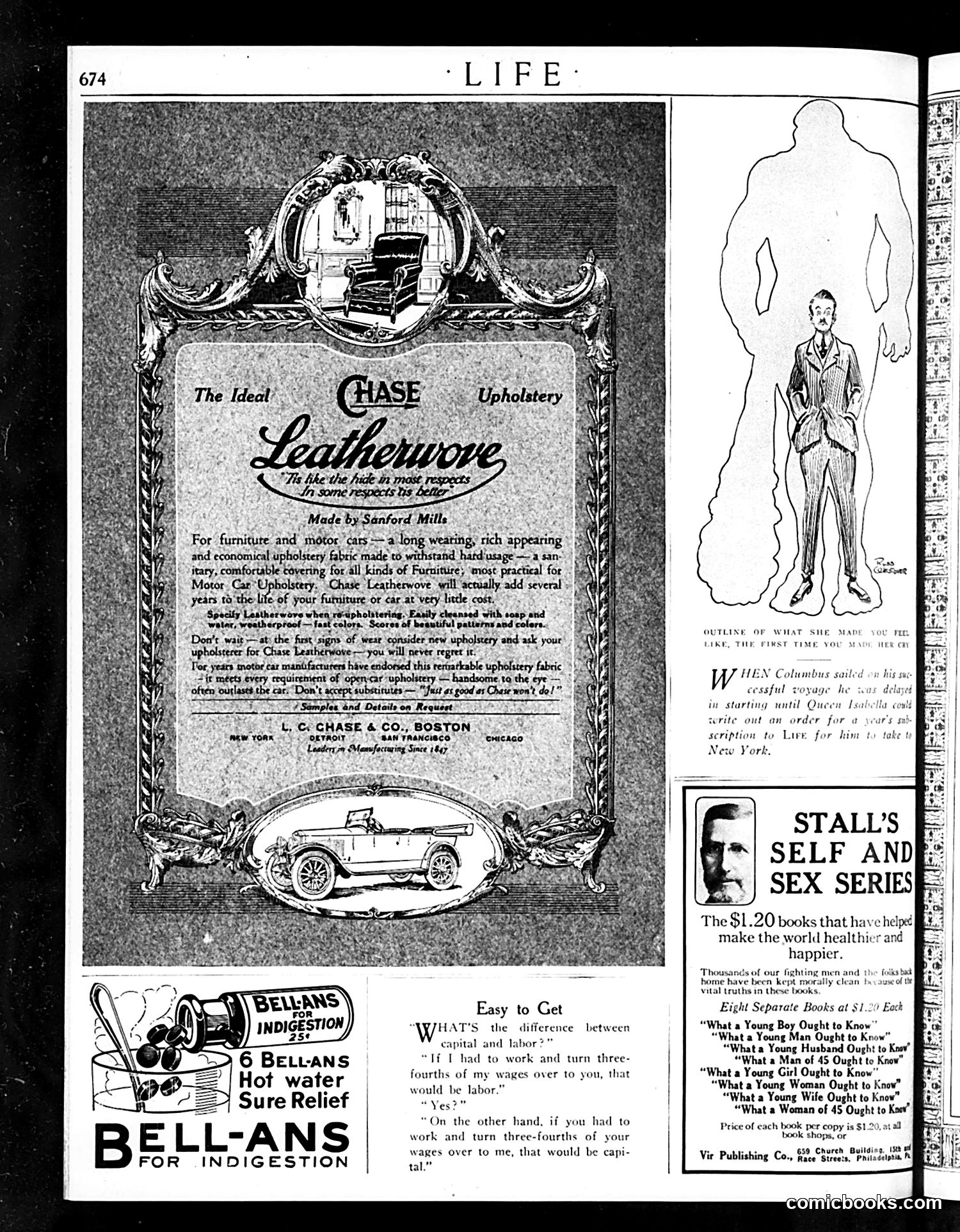
This page is primarily **advertising**, not editorial satire. The dominant feature is a large ornate advertisement for Chase Leatherware upholstery fabric, targeting furniture and automotive use. The only substantial satirical content is a brief dialogue titled "Easy to Get" that presents a **joke about capital versus labor**. A worker and capitalist debate definitions: the worker argues that giving three-fourths of wages to an employer would be "labor," while the capitalist reframes it as "capital" when reversed. The satire mocks capitalist logic by exposing its self-serving contradiction—suggesting capitalists define terms to justify their own profit while characterizing workers' contributions as mere "labor." The page also includes advertisements for **Bell-Ans indigestion relief** and **Stall's Self and Sex Series** books ($1.20 each), educational guides on sexuality marketed to young people and newlyweds—typical of early 20th-century "hygiene" publishing.
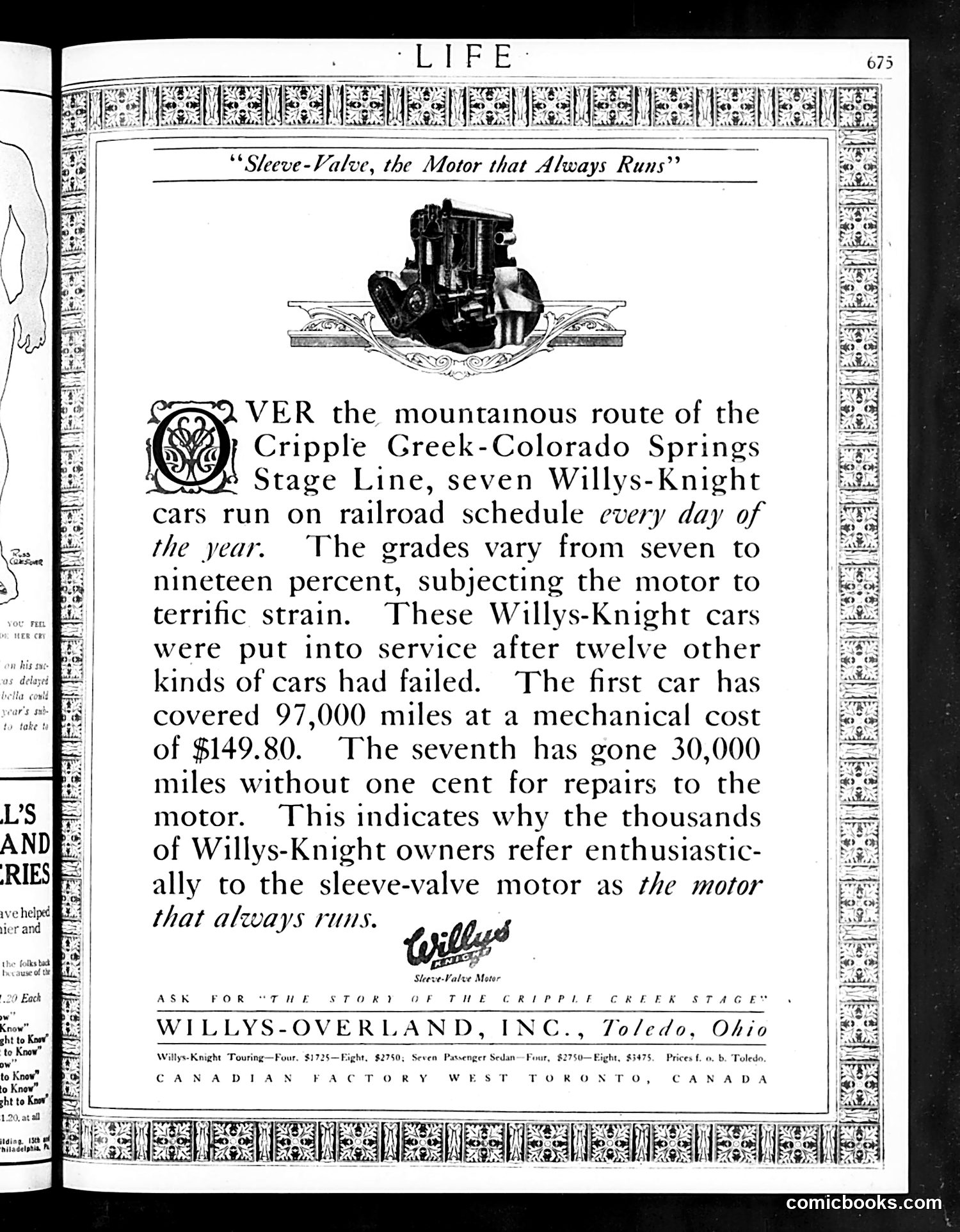
This is **not a cartoon or satire**, but a straightforward **automobile advertisement** for Willys-Knight vehicles, appearing in *Life* magazine (page 673). The ad promotes the Willys-Knight's "sleeve-valve motor" by highlighting its reliability on the Cripple Creek-Colorado Springs stage line route—a mountainous terrain with steep grades (7-19%) that tested competing vehicles, all of which failed before Willys-Knight cars succeeded. The appeal is practical, not satirical: the ad cites performance data (97,000 miles, $149.80 repair cost; another car going 30,000 miles with zero motor repairs) to establish engineering superiority. The phrase "the motor that always runs" is the advertising slogan. This represents early 20th-century *Life* magazine's mix of satirical content with premium advertising for luxury goods aimed at affluent readers.
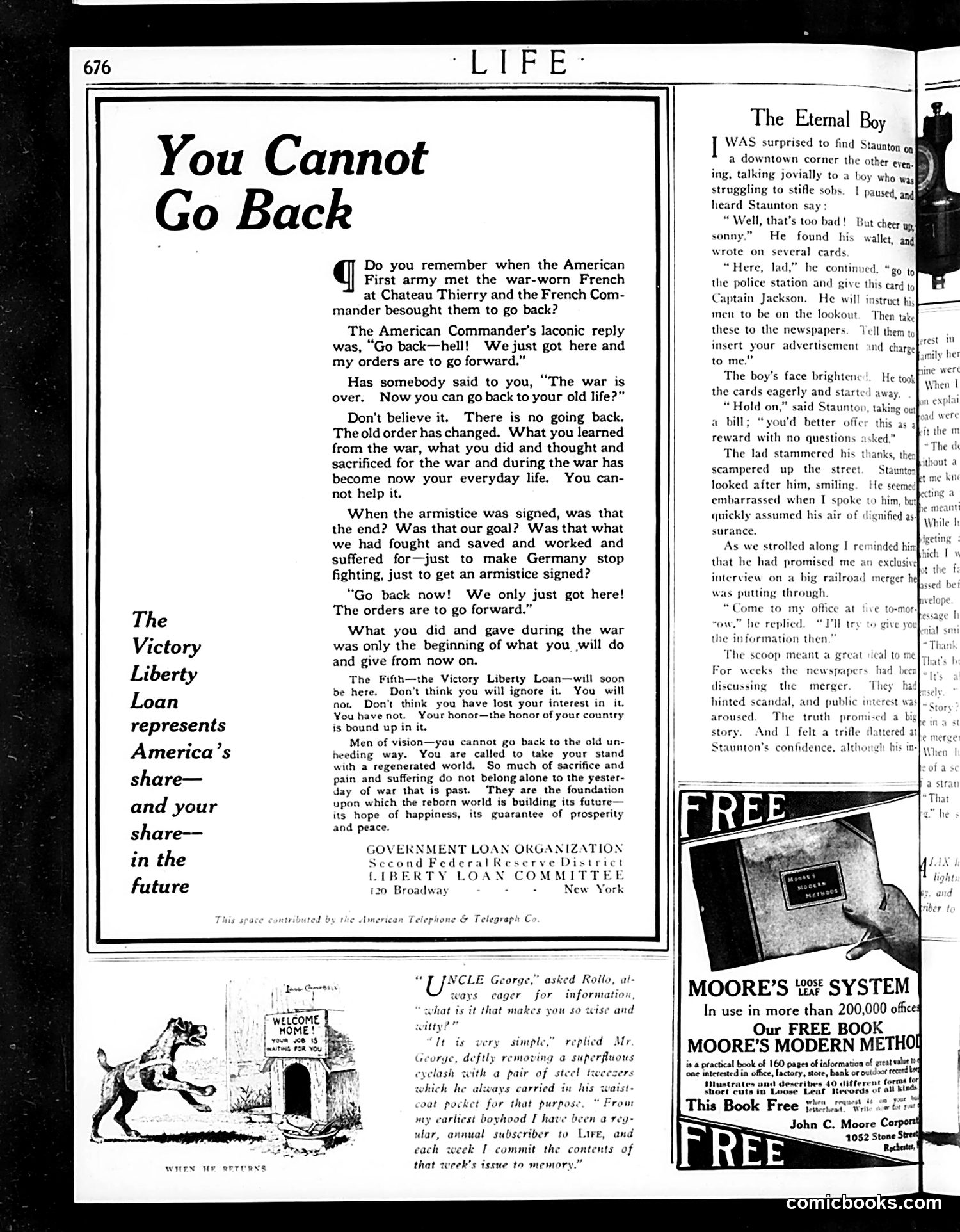
This Life magazine page (page 676) contains a pro-war Liberty Loan advertisement disguised as editorial content. The main article, "You Cannot Go Back," argues that Americans cannot return to pre-war normalcy after WWI—the war has fundamentally changed society, and citizens must continue sacrifice through financial support. The sidebar story, "The Eternal Boy," depicts a wealthy businessman named Staunton helping a crying street boy by offering newspaper advertising space and promising a railroad interview—portraying the wealthy as benevolent post-war leaders. At bottom left, a cartoon shows a dog at a "Welcome Home" sign, commenting on soldiers' return. The page's rhetorical strategy: normalize continued American sacrifice and spending (via the Victory Liberty Loan) by claiming the war's lessons are permanent and binding. The advertisements and stories work together to encourage loan purchases as patriotic duty, not optional investment.
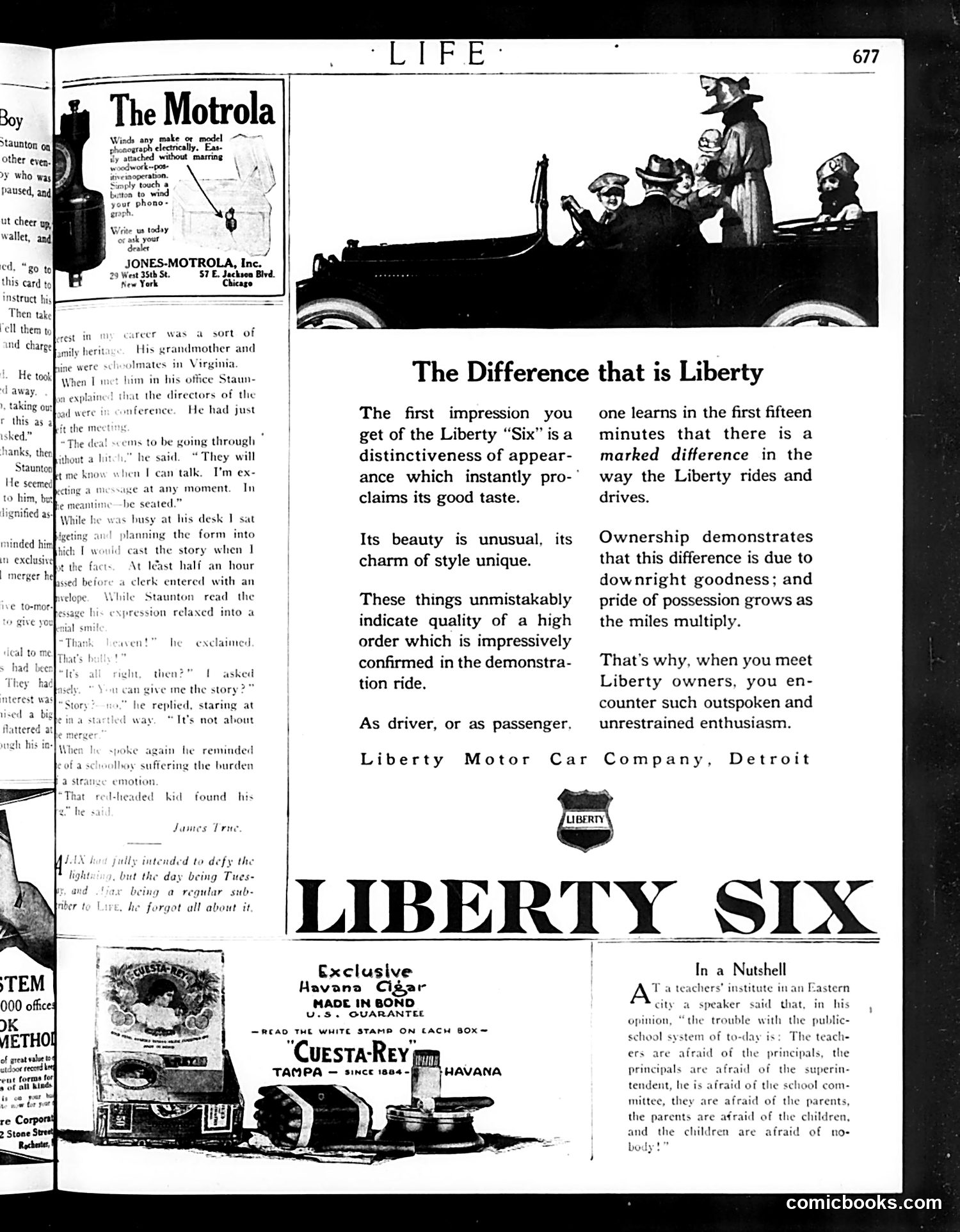
This page is primarily **advertising**, not political satire. The main content is a Liberty automobile advertisement ("The Difference that is Liberty") featuring a car with well-dressed passengers. The ad emphasizes the car's distinctive appearance, quality, and the enthusiasm of its owners—typical early automotive marketing rhetoric. The left side contains a Motrola (early telephone) ad and partial text from what appears to be a serialized story. The bottom includes a Cuesta-Rey cigar advertisement and a brief humorous piece titled "In a Nutshell" satirizing institutional fear: teachers fear principals, principals fear superintendents, superintendents fear school committees, parents fear children, and children fear nobody—a commentary on authority hierarchies and discipline breakdown in schools. This is not a political cartoon but rather a typical Life magazine page mixing narrative content with consumer advertising from the 1920s era.
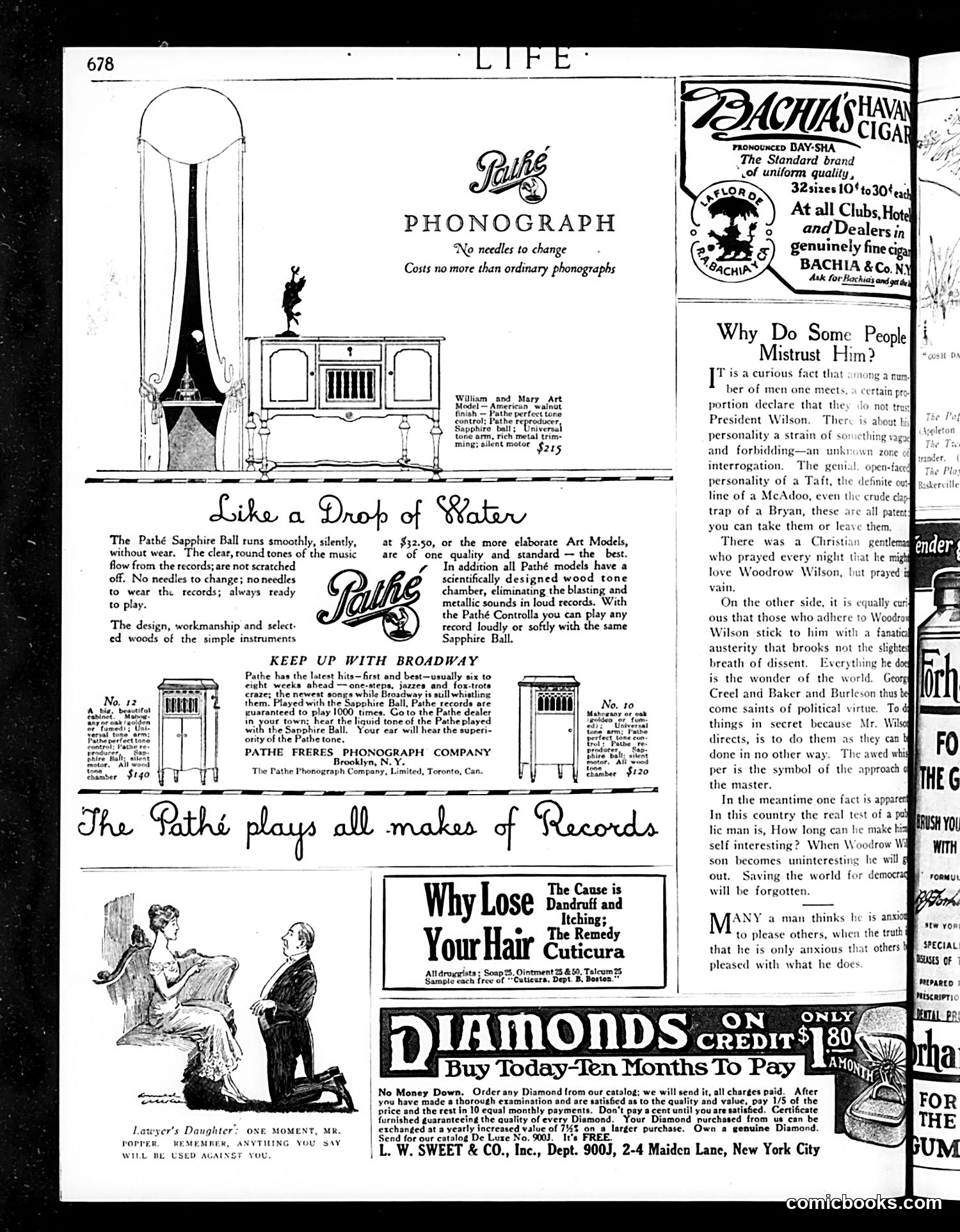
This page is primarily **advertising and opinion content**, not political satire. The main substantive piece is an essay titled "Why Do Some People Mistrust Him?" discussing President **Woodrow Wilson**. The author observes a curious paradox: some people find Wilson's personality forbidding and aloof (contrasting him unfavorably with Taft and Bryan), while his devoted supporters regard him with almost religious fervor. The piece suggests Wilson's political durability depends on remaining "interesting"—once he becomes uninteresting, public support will fade, and his legacy (saving the world for democracy) will be forgotten. The essay also notes Wilson's supporters engage in questionable activities "in secret" justified as serving his vision. The rest of the page consists of **product advertisements**: Pathé phonographs (emphasizing needle-free operation and Broadway hits), Bachia cigars, Cuticura hair treatment, and a diamond credit purchase scheme. The small cartoon ("Lawyer's Daughter") is unrelated political humor about legal testimony.
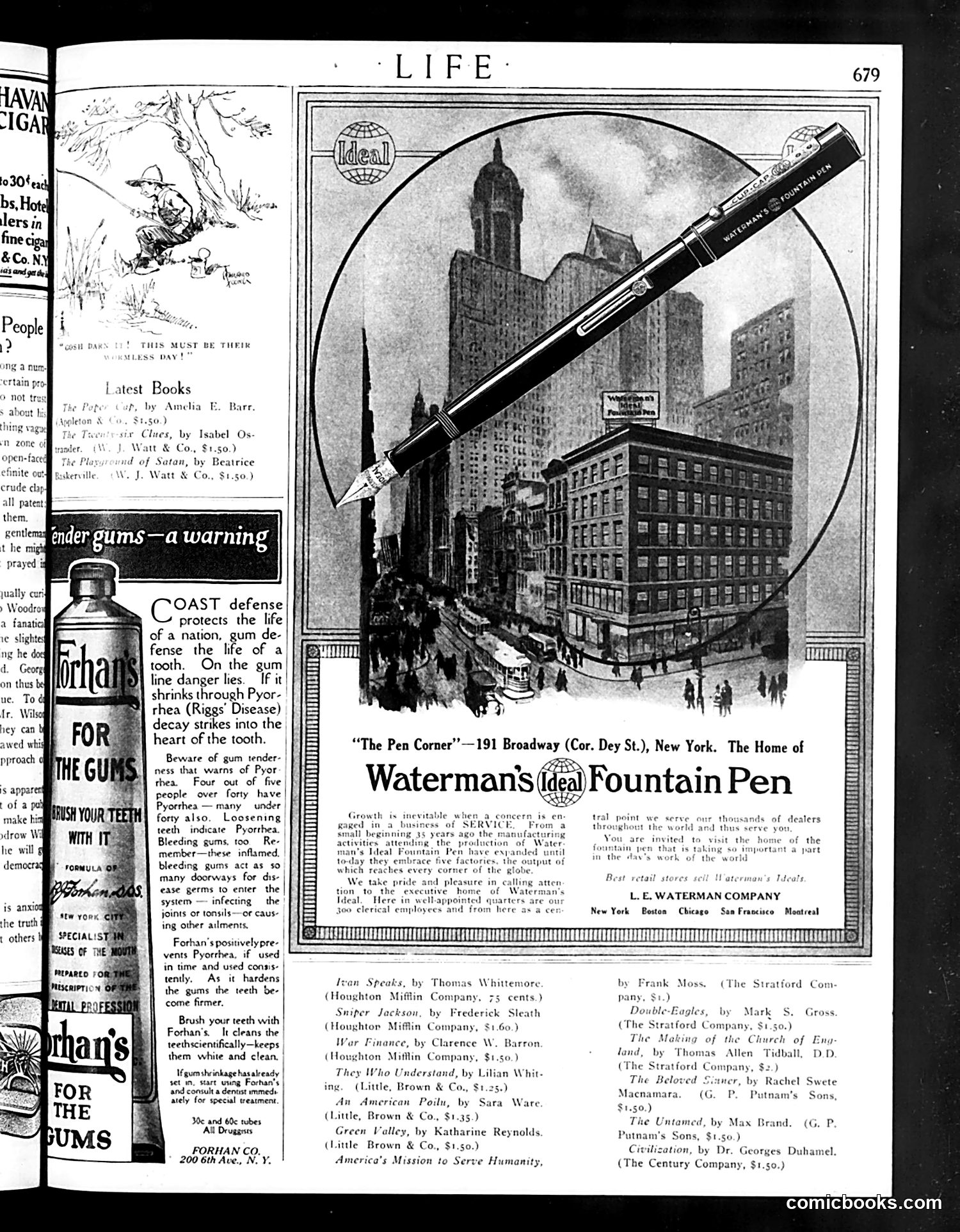
This page is primarily **commercial advertising** rather than satirical content. The main feature is a full-page advertisement for **Waterman's Ideal Fountain Pen**, showcasing the product overlaid on a cityscape illustration of lower Manhattan (specifically "The Pen Corner" at 191 Broadway). The ad emphasizes the pen's importance to business and global commerce. The left column contains a **dental health advertisement for Forhan's toothpaste**, warning against pyorrhea (gum disease) with medical claims typical of early 20th-century advertising. It uses fear-based marketing, suggesting gum disease leads to systemic infection. Below these ads is a **book review section** listing contemporary literature, including war-related titles ("War Finance," "Sniper Jackson," "An American Poilu"), suggesting this issue dates to or shortly after World War I. There is **no political cartoon or satirical content** visible on this page—it functions as a commercial and literary review section of the magazine.
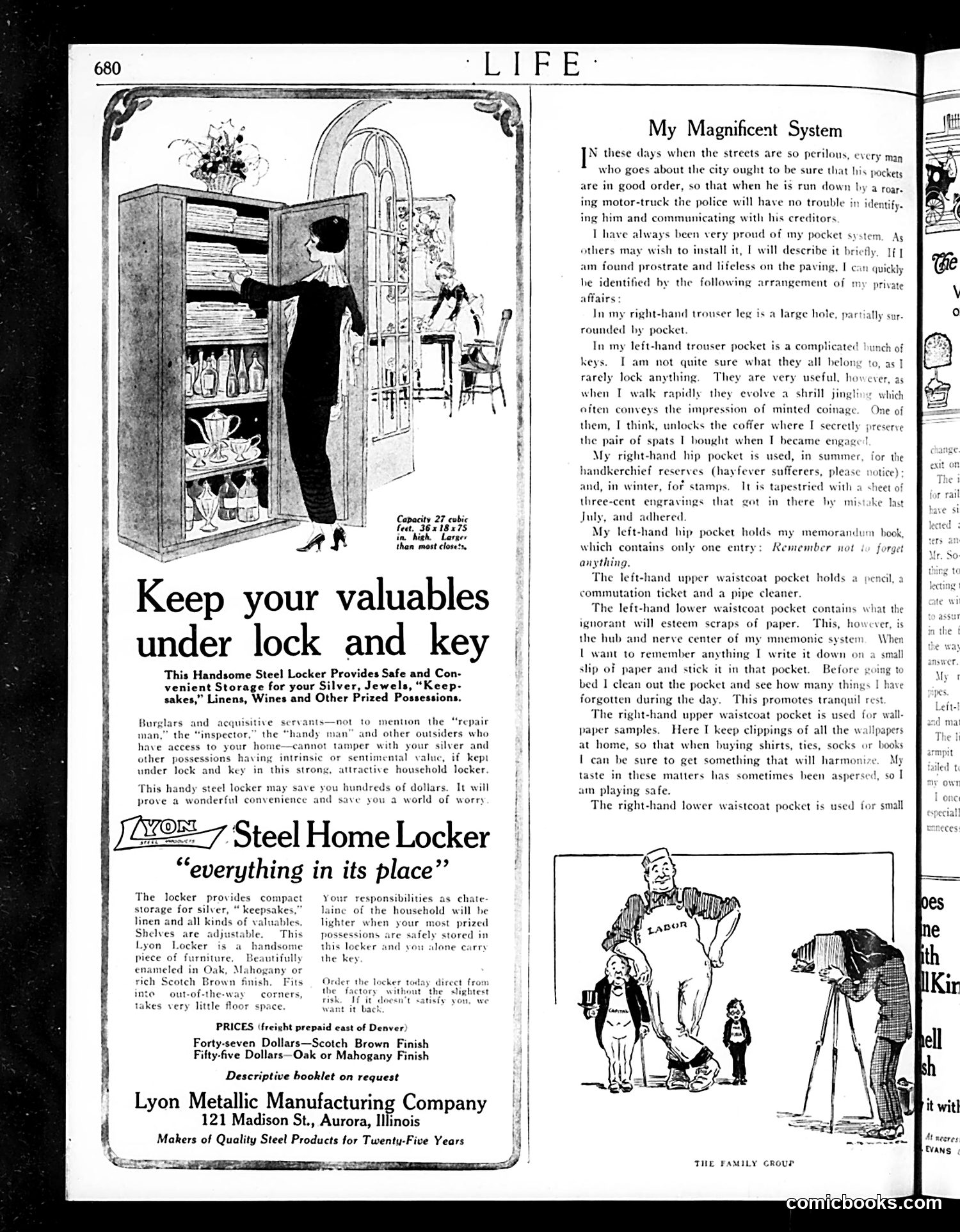
This page combines a **steel home locker advertisement** with a humorous **satirical essay** about modern urban anxieties. The essay mocks the disorder of contemporary life through exaggerated detail about a man's pockets—each stuffed with contradictory items: keys to forgotten locks, jangling coins, handkerchief reserves for hay fever, stamps, scraps of paper serving as a memory system, and wallpaper samples for coordinating purchases. The narrator presents this chaotic arrangement as a "system," though it's clearly dysfunctional (one pocket holds only the note "Remember not...anything"). The satire targets: - **Urban anxiety**: Opening with concern about being hit by motor-trucks and needing identification - **Modern life's complexity**: The accumulation of objects required for daily survival - **Self-delusion**: Calling obvious chaos an organized "system" The advertisement below plays into this anxiety, offering the steel locker as a solution to household disorder and security fears about servants and strangers having access to valuables—reflecting early 20th-century middle-class concerns. Together, they satirize both modern urban vulnerability and consumer culture's promise of order through products.
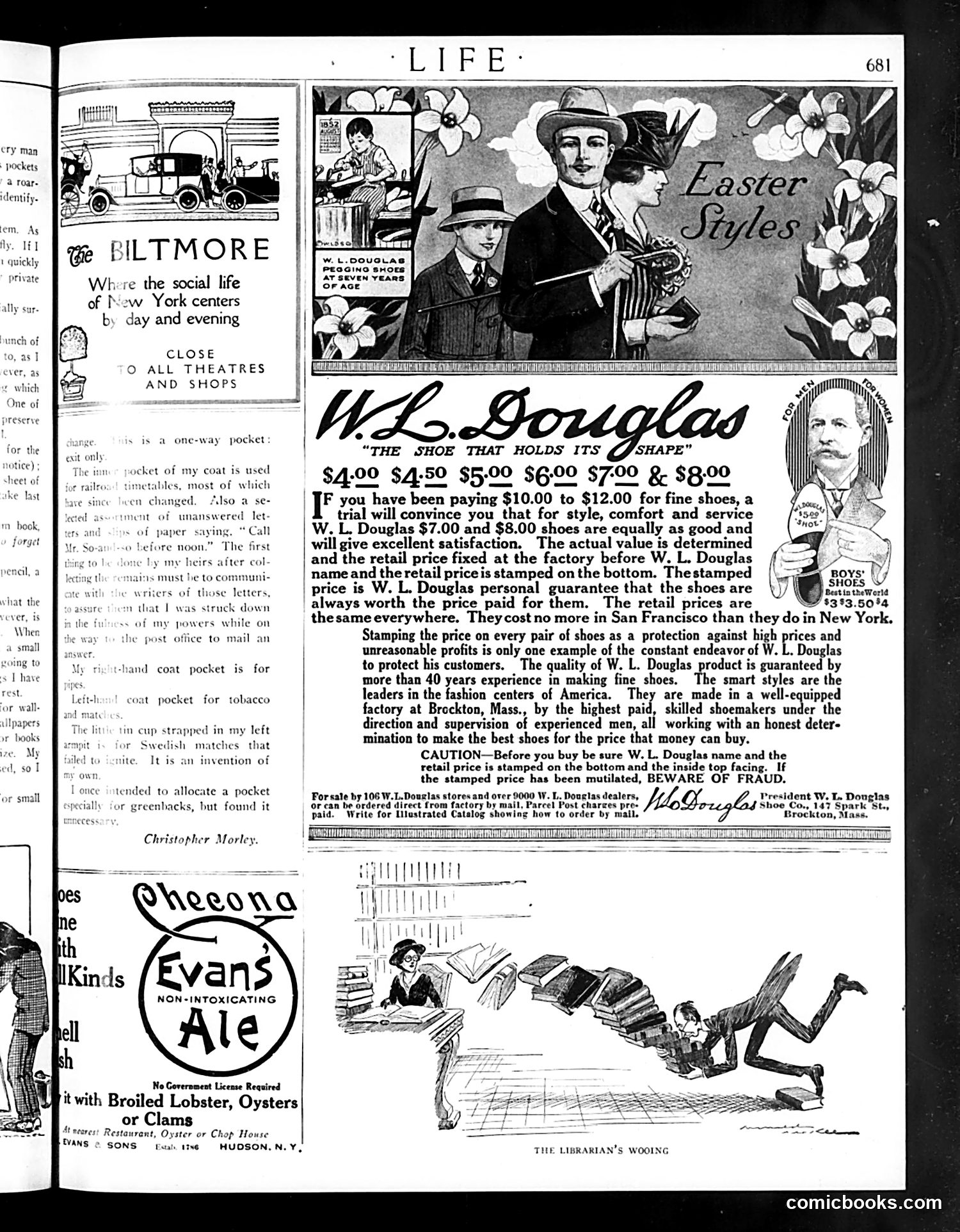
This page is primarily **advertising**, not editorial content or satire. The dominant feature is a large W.L. Douglas shoe advertisement, prominently displaying their "$4.00-$8.00" price range and emphasizing value. The copy argues that Douglas shoes are equal in quality to more expensive competitors ($10-12), highlighting their factory-direct pricing model and stamped retail prices as protection against fraud and inflated markups. This reflects early 20th-century consumer concerns about fair pricing and product authenticity. Lesser ads include the Biltmore Hotel (promoting New York's social scene), Pheona Evans Ale (non-intoxicating), and a small cartoon titled "The Librarian's Wooing" at bottom right, which appears to show slapstick comedy involving scattered books. The page also features an excerpt from Christopher Morley's essay about coat pockets—a humorous, nostalgic piece about everyday objects—typical of Life's literary content. The overall page reflects 1920s consumer culture and middle-class concerns about value and authenticity.
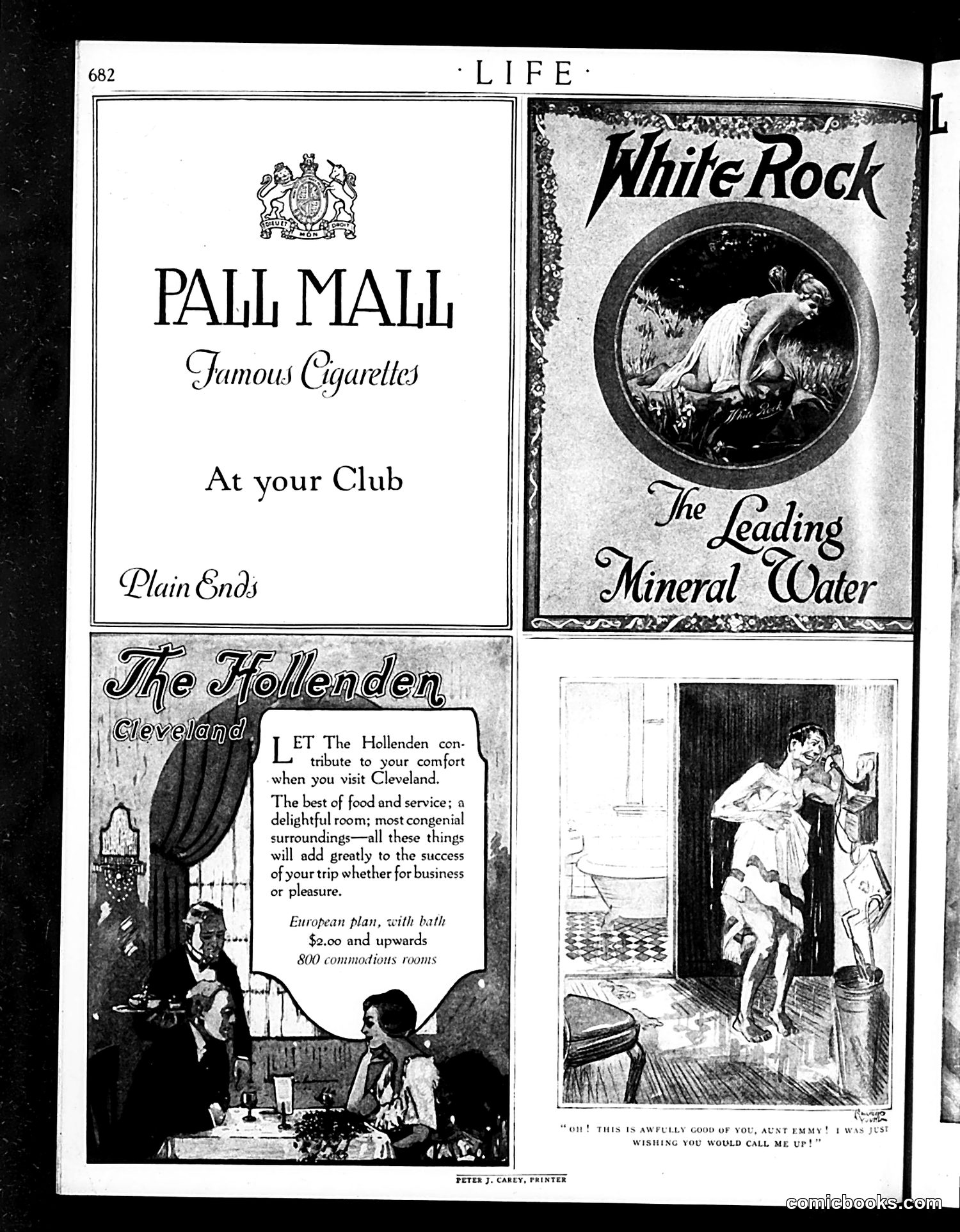
This is primarily an **advertising page** rather than satirical content. It contains three commercial advertisements: 1. **Pall Mall cigarettes** — promoting their "Famous Cigarettes" with "Plain Ends" 2. **White Rock mineral water** — featuring their trademark classical imagery and "Leading Mineral Water" branding 3. **The Hollenden hotel in Cleveland** — advertising European-plan accommodations at $2.00+ with 800 rooms The only narrative element is a small domestic scene accompanying The Hollenden ad, showing what appears to be a social visit, with dialogue about calling someone. This vignette illustrates the hotel's appeal as a comfortable destination for business or leisure travel. The page reflects early 20th-century advertising conventions, emphasizing comfort, service, and social respectability to appeal to middle-class travelers and consumers.