
Life, 1919-04-17 · page 23 of 46
Life — April 17, 1919 — page 23: what you’re looking at
What you’re looking at
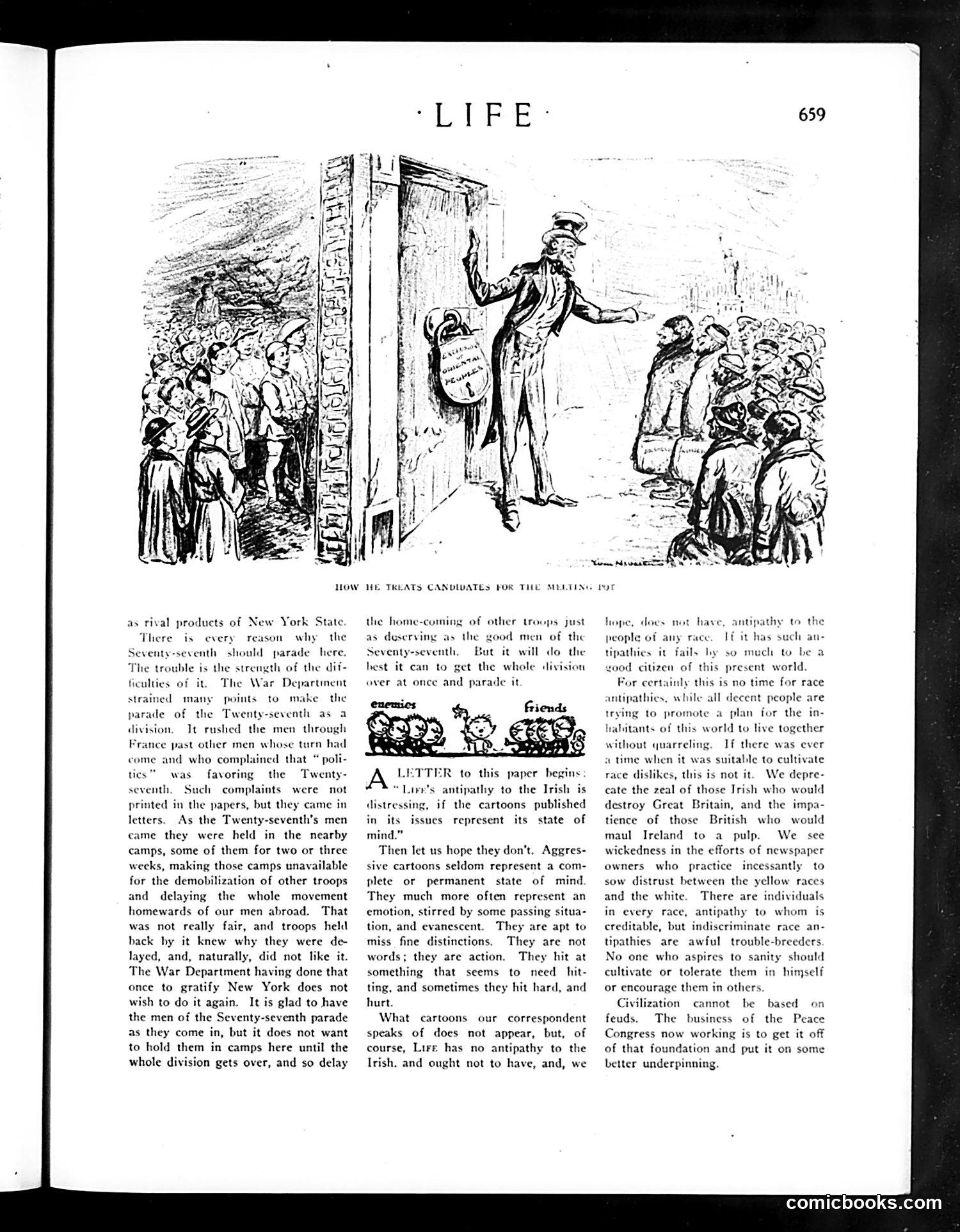
## Main Cartoon: "How He Treats Candidates for the Melting Pot" The illustration depicts a figure in formal dress (likely a politician or official) standing elevated between two groups of immigrants or citizens, gesturing expansively. The "melting pot" reference invokes the contemporary American ideal of assimilating diverse populations into a unified society. ## Context The accompanying text defends *Life* magazine against accusations of anti-Irish bias in its cartoons. A reader complained that *Life's* published cartoons revealed "antipathy to the Irish." The editors respond that cartoons represent momentary emotions and satirical targets, not permanent prejudices—they "hit at something that seems to need hitting." The article then pivots to a broader argument: in the post-WWI era, fostering racial and ethnic animosity is destructive. It criticizes both Irish hostility toward Britain and British toward Ireland, as well as newspaper owners who deliberately stoke racial divisions. The editors argue civilization cannot be "based on feuds" and support international peace efforts. The cartoon likely satirizes political manipulation of immigrant or ethnic groups for electoral gain.
📄 Transcribed text from this page (OCR, searchable)
Machine-transcribed from the original scan — historical spelling and the odd misread are preserved.
low as rival products of New York State. There is every reason why the Seventy-seventh should parade here The trouble is the strength of the dif- ficulties of it. The War Department strained many points to make the parade of the Twenty-seventh as a division. It rushed the men through France past other men whose turn had come and who complained that “ poli- ties” favoring the Twenty- Such complaints not printed in the papers, but they came in letters. As the Twenty-seventh’s men came they were held in the nearby camps, some of them for two or three weeks, making those camps unavailable for the demobilization of other troops and delaying the whole movement homewards of our men abroad. That was not really fair, and troops held back by it knew why they were de layed, and, naturally, did not like it. The War Department having done that once to gratify New York does not wish to do it again. It is glad to have the men of the Seventy-seventh parade as they come in, but it does not want to hold them in camps here until the whole division gets over, and so delay was seventh were HE TREATS CANDIVATES POR THE MELTING the home-coming of other troops just as deserving as the good men of the But it: will the hest it can to get the whole division over at once and parade it Seventy-seventh. do LETTER to this paper begins Lirv’s antipathy to. the Irish is A distressing, if the cartoons published its issues its state of mind.” Then let us hope they don’t. Aggres- sive cartoons seldom represent a com- plete or permanent state of mind They much more often represent an emotion, stirred by some passing situa- tion, and evanescent. They are apt to miss fine distinctions. They are not words; they are action. They hit at something that seems to need hit- ting, and sometimes they hit hard, and hurt. What cartoons our correspondent speaks of does not appear, but, of course, Lire has no antipathy to the Irish. and ought not to have, and, we in represent tor antipathy the If it es not have, to sof any race as such an- tipathies it fails hy so much to be a { citizen of this present world. certainly this is no time for race antipathies, while all decent people are trying to promote a plan for the in- habitants of this world to live together without quarreling. If there was ever a time when it was suitable to cultivate race dislikes, this is not it. We depre- cate the zeal of those Jrish who would destroy Great Britain, and the impa- tience of those British would maul Ireland to a pulp. We wickedness in the efforts of newspaper to who see owners who practice incessantly sow distrust between the yellow races and the white. There are individuals in every race, antipathy to whom is creditable, but indiscriminate race an- tipathies are awful trouble-breeders No one who aspires to sanity should cultivate or tolerate them in himself or encourage them in others. ivilization cannot based feuds. The the Peace Congress now working is to get it off of that foundation and put it on some better underpinning. be on business of comicbooks.com