
Life, 1919-04-17 · page 6 of 46
Life — April 17, 1919 — page 6: what you’re looking at
What you’re looking at
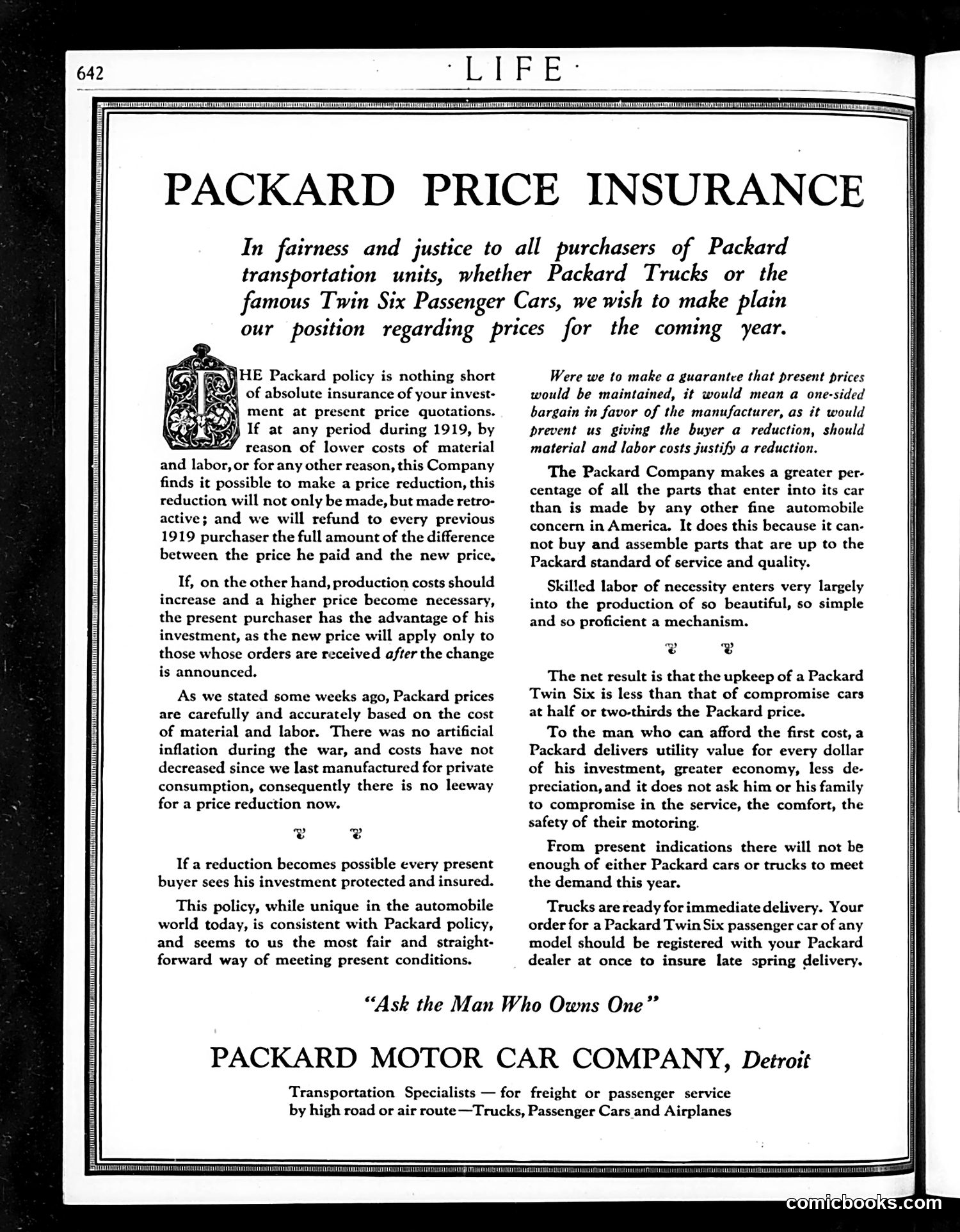
This page is **not a cartoon or satire** — it's a **straightforward automobile advertisement** for Packard Motor Car Company of Detroit, published in Life magazine around 1919. The ad announces Packard's "Price Insurance" policy: if production costs fall during 1919, buyers of Packard vehicles will receive refunds for the price difference. Conversely, if costs rise, new buyers pay only the current price — existing purchasers aren't retroactively charged more. The ornamental "P" logo is Packard's corporate emblem, not a caricature. The text emphasizes Packard's quality control, skilled labor, and the durability of their Twin Six passenger cars and trucks. The tagline "Ask the Man Who Owns One" was Packard's actual marketing slogan. This represents post-WWI commercial messaging, not political satire.
📄 Transcribed text from this page (OCR, searchable)
Machine-transcribed from the original scan — historical spelling and the odd misread are preserved.
| | ATT TA TT TT TT TTT TPT ee en TA LET PACKARD PRICE INSURANCE In fairness and justice to all purchasers of Packard transportation units, whether Packard Trucks or the famous Twin Six Passenger Cars, we wish to make plain our position regarding prices for the coming year. SWHE Packard policy is nothing short =fq of absolute insurance of your invest- ment at present price quotations. Ate, If at any period during 1919, by “<4” reason of lower costs of material and labor, or for any other reason, this Company finds it possible to make a price reduction, this reduction will not only be made, but made retro- active; and we will refund to every previous 1919 purchaser the full amount of the difference between the price he paid and the new price, If, on the other hand, production costs should increase and a higher price become necessary, the present purchaser has the advantage of his investment, as the new price will apply only to those whose orders are received after the change is announced. As we stated some weeks ago, Packard prices are carefully and accurately based on the cost of material and labor. There was no artificial inflation during the war, and costs have not decreased since we last manufactured for private consumption, consequently there is no leeway for a price reduction now. z @ If a reduction becomes possible every present buyer sees his investment protected and insured. This policy, while unique in the automobile world today, is consistent with Packard policy, and seems to us the most fair and straight- forward way of meeting present conditions. Were we to make a guarantee that present prices would be maintained, it would mean a one-sided bargain in favor of the manufacturer, as it would prevent us giving the buyer a reduction, should material and labor costs justify a reduction. The Packard Company makes a greater per- centage of all the parts that enter into its car than is made by any other fine automobile concern in America. It does this because it can- not buy and assemble parts that are up to the Packard standard of service and quality. Skilled labor of necessity enters very largely into the production of so beautiful, so simple and so proficient a mechanism. @ z The net result is that the upkeep of a Packard Twin Six is less than that of compromise cars at half or two-thirds the Packard price. To the man who can afford the first cost, a Packard delivers utility value for every dollar of his investment, greater economy, less de- preciation, and it does not ask him or his family to compromise in the service, the comfort, the safety of their motoring. From present indications there will not be enough of either Packard cars or trucks to meet the demand this year. Trucks are ready for immediate delivery. Your order for a Packard Twin Six passenger car of any model should be registered with your Packard dealer at once to insure late spring delivery. “Ask the Man Who Owns One” PACKARD MOTOR CAR COMPANY, Detroit Transportation Specialists — for freight or passenger service by high road or air route—Trucks, Passenger Cars and Airplanes HATA CTT TTT ATTA NTH