
Life, 1919-04-17 · page 16 of 46
Life — April 17, 1919 — page 16: what you’re looking at
What you’re looking at
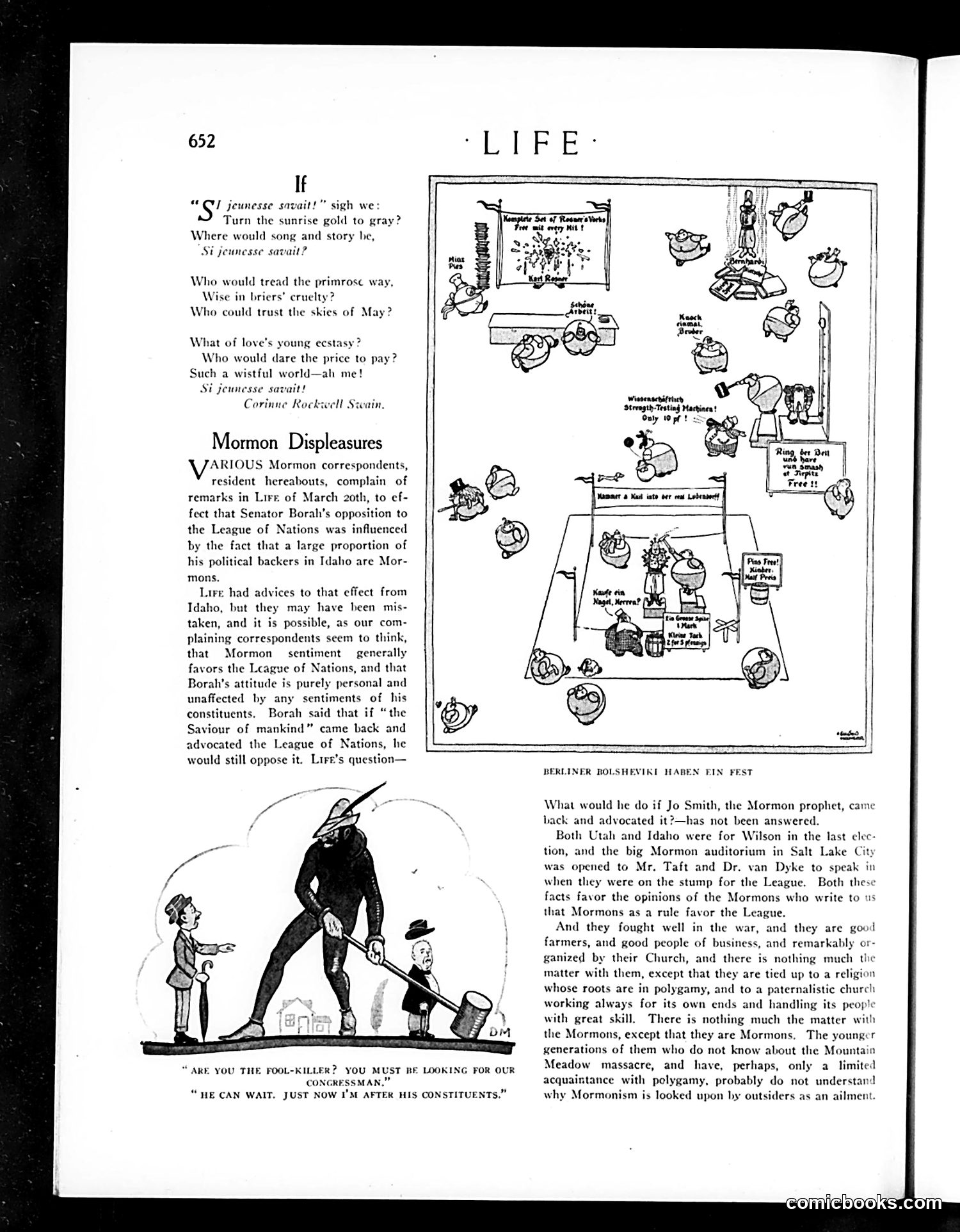
This page addresses Senator William Borah's opposition to the League of Nations. Life magazine had reported that Borah's Idaho political backers were predominantly Mormon, implying religious influence on his stance. Mormon readers protested, claiming the religion actually favored the League. The main cartoon (bottom left) shows a tall figure speaking to a small man labeled "congressman," with text about "fool-killer" and looking for a congressman—a jab at political absurdity. Life's response is skeptical but measured: Mormons fought in WWI, are good farmers and businesspeople, but remain tied to a problematic past (polygamy, the Mountain Meadow massacre). The article essentially argues Mormons are fine except they're "tied up to a religion" with troubling historical roots—a backhanded compliment layered with anti-Mormon prejudice typical of the 1920s era.
📄 Transcribed text from this page (OCR, searchable)
Machine-transcribed from the original scan — historical spelling and the odd misread are preserved.
652 If “QI jeunesse savait! sigh we: Turn the sunrise gold to g Where would song and story be, Si jeunesse savait? Who would tread the primrose way, Wise in briers’ cruelty? Who could trust the skies of May? What of love's young ecstasy? Who would dare the price to pay? Such a wistful world—ah me! Corinne Rockwell Swain, Mormon Displeasures \ARious Mormon correspondents, resident hereabouts, complain of remarks in Lire of March 2oth, to ef- fect that Senator Borah’s opposition to the League of Nations was influenced by the fact that a large proportion of his political backers in Idaho are Mor- mons. Lire had advices to that effect from Idaho, but they may have heen mis- taken, and it is possible, as our com- plaining correspondents seem to think, that Mormon sentiment — generally favors the League of Nations, and that Borah’s attitude is purely personal and unaffected by any sentiments of his constituents. Borah said that if “the Saviour of mankind” came back and advocated the League of Nations, he would still oppose it. Lrre’s question— BERLINER BOLSHEVIKE HABEN EIN FEST What would he do if Jo Smith, the Mormon prophet, came lack and advocated it?—has not been answered. Both Utah and Idaho were for Wilson in the last clec- tion, and the big Mormon auditorium in Salt Lake City was opened to Mr. Taft and Dr. van Dyke to speak in when they were on the stump for the League. Both these facts favor the opinions of the Mormons who write to us that Mormons as a rule favor the League. And they fought well in the war, and they are good farmers, and good people of business, and remarkably or- ganized by their Church, and there is nothing much the matter with them, except that they are tied up to a religion whose roots are in polygamy, and to a paternalistic churcl: working always for its own ends and handling its people with great skill. There is nothing much the matter with the Mormons, except that they are Mormons. The younger generations of them who do not know about the Mountain Meadow massacre, and have, perhaps, only a limited acquaintance with polygamy, probably do not understand why Mormonism is looked upon by outsiders as an ailment.