
A complete issue · 34 pages · 1918
Life — August 22, 1918
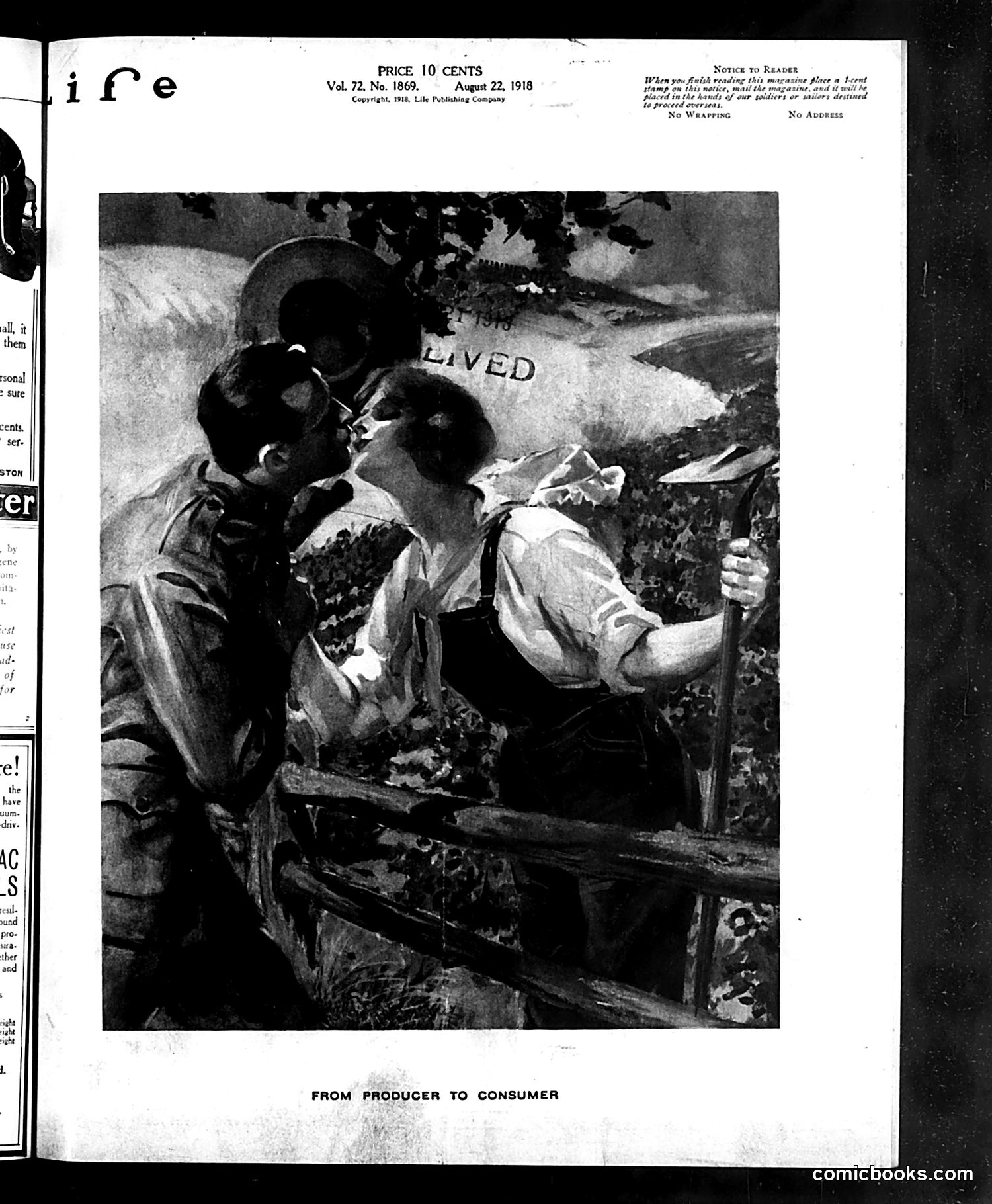
This page features a photograph titled "FROM PRODUCER TO CONSUMER" showing two people in what appears to be a garden or agricultural setting, with one figure holding produce. The image illustrates the concept of food distribution during World War I, when American agricultural production was critical to the war effort and domestic supply. The caption references the direct path from farm producer to consumer—likely commentary on food supply chains during wartime rationing and production demands. The photograph appears to document actual agricultural work rather than serve as political satire. Given the 1918 date, this reflects broader public interest in food production and conservation efforts supporting the American war effort.
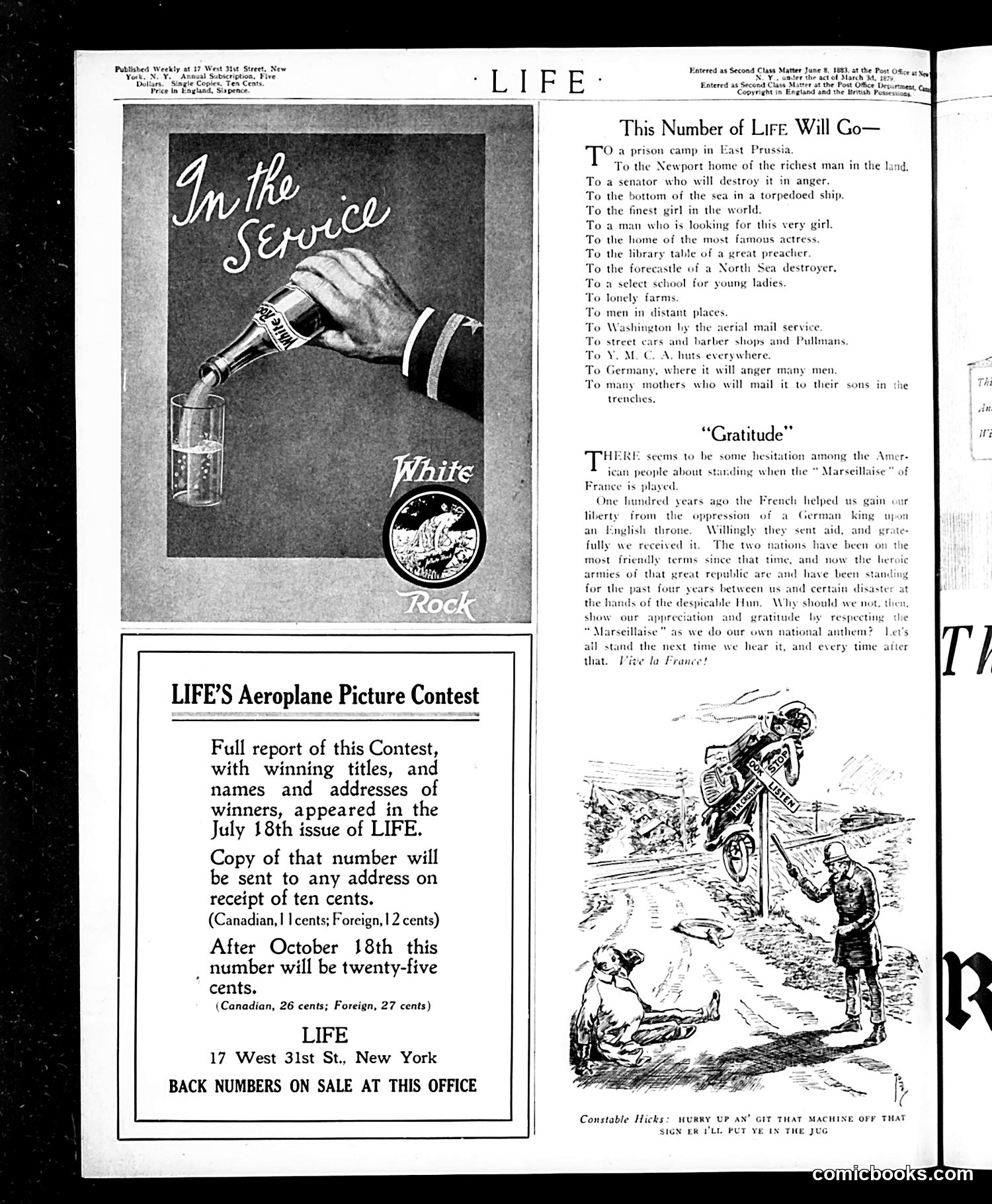
This page mixes advertising with WWI-era patriotic content. The prominent **White Rock whiskey advertisement** ("In the Service") shows a bottle being poured, using military service as a marketing angle—likely appealing to soldiers or those supporting the war effort. The right column lists destinations for "This Number of LIFE" circulation, including war-related locations: a prison camp in East Prussia, a senator's home, a torpedoed ship, and notably "To many mothers who will mail it to their sons in the trenches." The "Gratitude" essay discusses France's "Marseillaise" anthem, encouraging Americans to show appreciation for French alliance and military cooperation during WWI. The bottom cartoon depicts an aviator crash-landing, using military aviation—a new technology—for humorous effect.
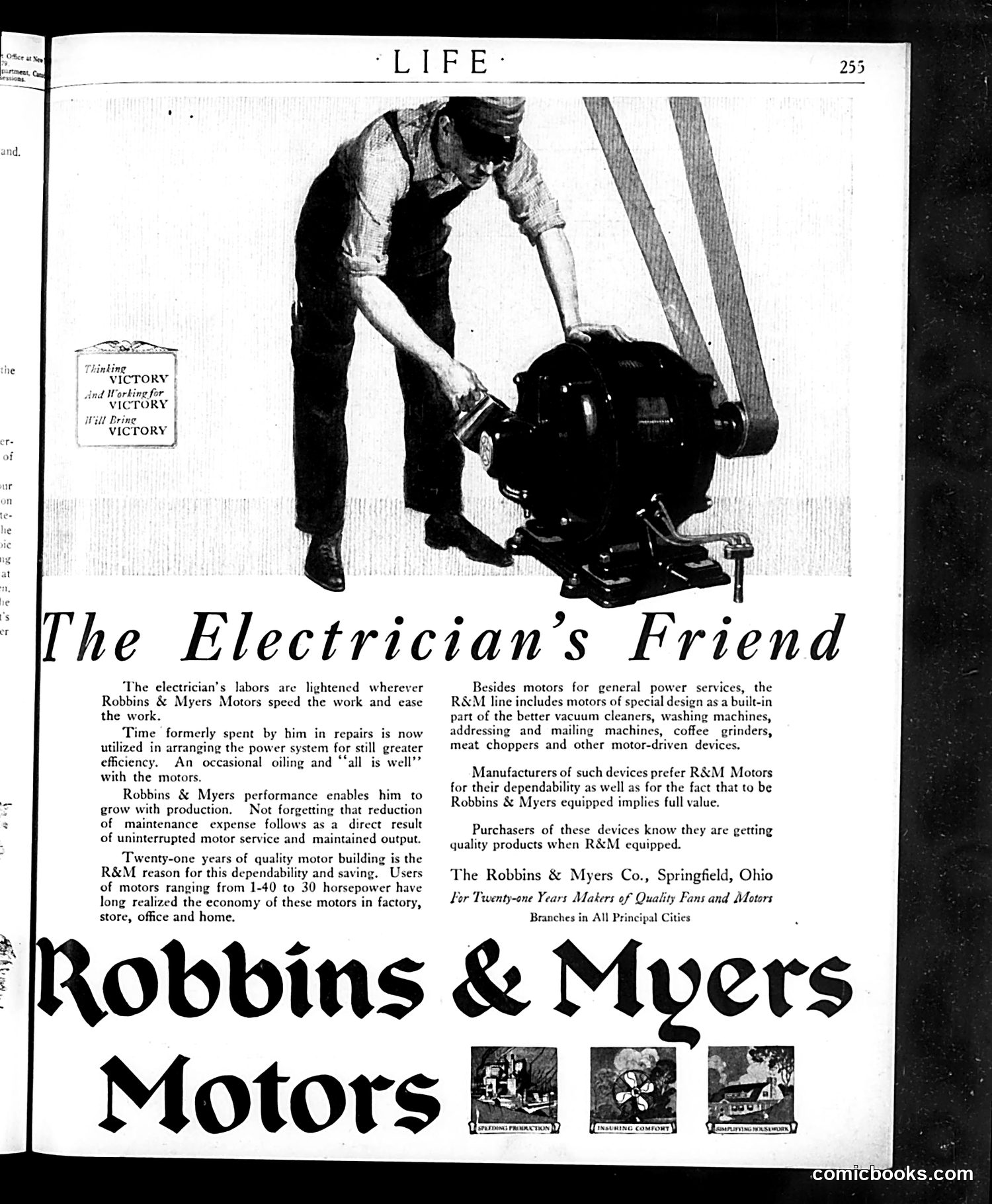
This is primarily a **Robbins & Myers Motors advertisement**, not satire or political commentary. The page is numbered 253 from *Life* magazine and consists almost entirely of promotional content. The illustration shows a man servicing or working on an electric motor, with the headline "The Electrician's Friend." The ad emphasizes that R&M motors reduce labor time, require minimal maintenance ("occasional oiling"), and improve efficiency for industrial applications—vacuum cleaners, coffee grinders, meat choppers, and similar devices. The company claims 21 years of quality manufacturing and positions their motors as reliable, economical products for factories, stores, and homes. Three small photographs at the bottom illustrate different applications. This is straightforward commercial advertising with no apparent satirical intent.
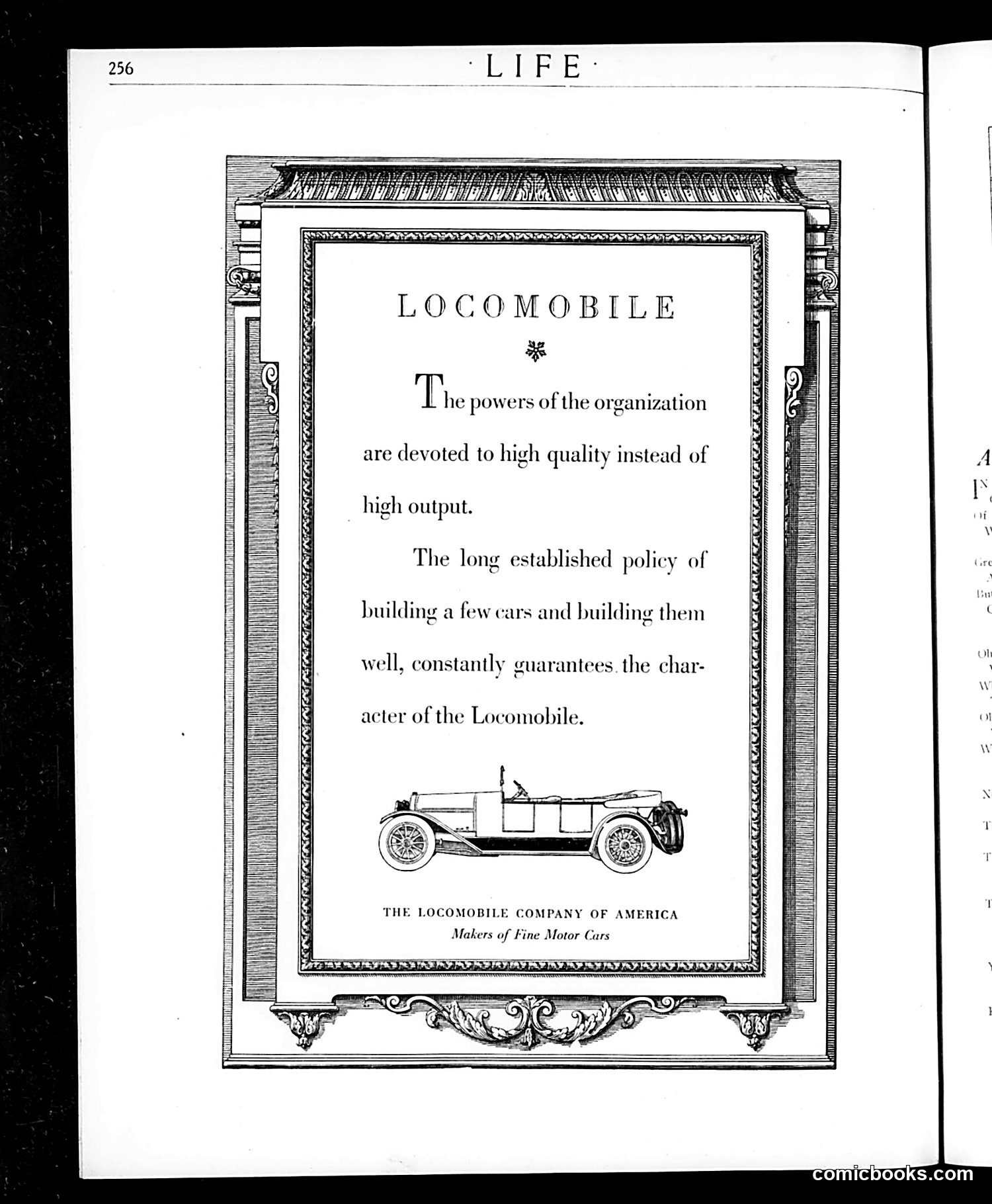
This is a **straightforward advertisement**, not satire or political commentary. The Locomobile Company of America uses this full-page LIFE magazine placement to market their automobiles by emphasizing their business philosophy. The ad's central claim is that Locomobile prioritizes **quality over quantity**—they build fewer cars but build them exceptionally well. This positioning strategy was common among luxury automakers competing against mass-production rivals like Ford. The decorative border and formal typography reflect early 20th-century advertising aesthetics. The small illustration shows a touring car typical of the era. There is no political cartoon or satire present—this is purely commercial messaging appealing to affluent LIFE readers who valued craftsmanship and exclusivity.
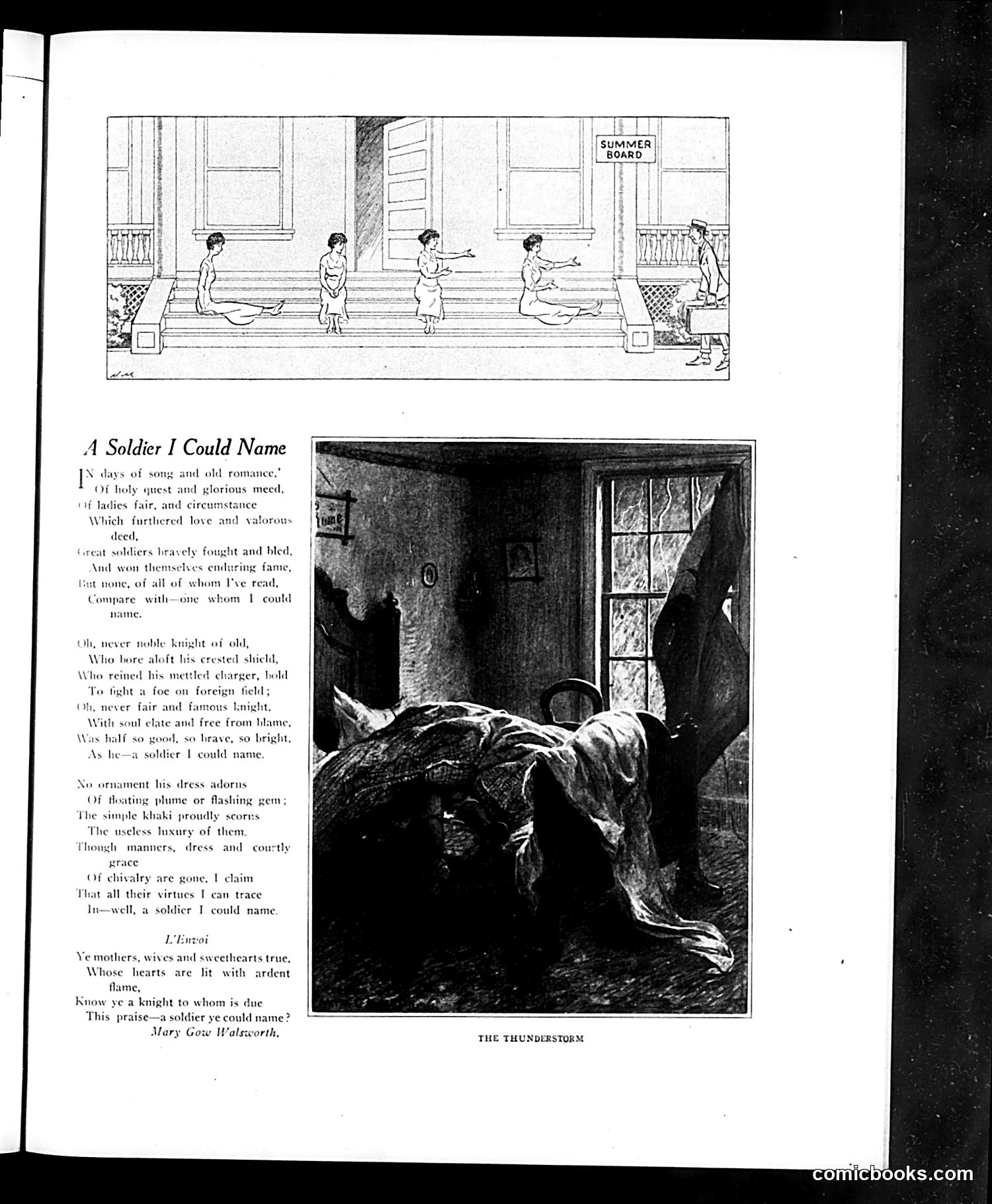
This page contains two distinct elements: **Top illustration**: A line drawing depicting children playing jump rope on what appears to be a summer porch or veranda, labeled "SUMMER BOARD." This is a lighthearted domestic scene with no obvious satirical intent. **Main content**: A poem titled "A Soldier I Could Name" by L'Envoi and attributed to Mary Goss Walsworth. The poem praises an unnamed soldier's virtues—his courage, humility, and moral character—contrasting his simple khaki uniform favorably against ornamental dress and aristocratic pretense. **Accompanying illustration**: "THE THUNDERSTORM," a dramatic dark image showing a wounded or dying soldier in a room during a storm, viewed through a window. Together, these elements appear to be a sentimental, patriotic piece honoring soldiers' sacrifice and virtue during wartime (likely WWI given the context). The satire, if present, is gentle—mocking excessive ornamentation rather than attacking specific figures.
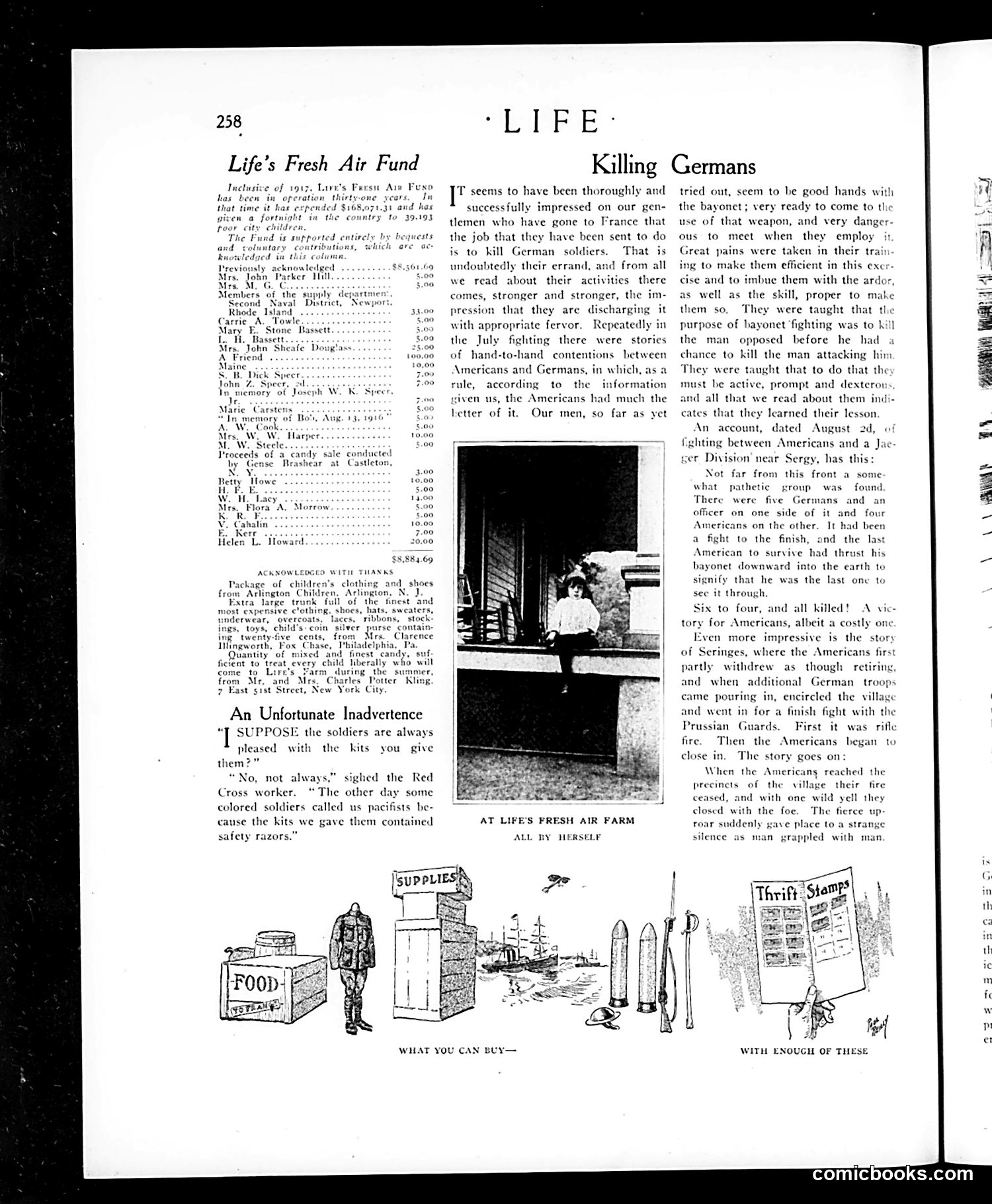
This page contains two distinct sections: **"Life's Fresh Air Fund"** (left): A charitable donation list supporting children's fresh air experiences, with various contributors and amounts listed. **"Killing Germans"** (right): A wartime account describing combat between American and German forces in France, detailing a specific August 2nd engagement near Sergy where Americans defeated Germans in close combat. The narrative emphasizes American military effectiveness and includes dramatic details of bayonet charges and village fighting. **Bottom imagery**: Propaganda-style illustrations showing supplies—food, uniforms, ammunition, stamps—available through war bonds or thrift stamps, with the caption "What you can buy... with enough of these," directly linking civilian financial support to military capability. The page reflects WWI-era American patriotic messaging combining charitable work, military heroism narratives, and financial mobilization for war efforts.
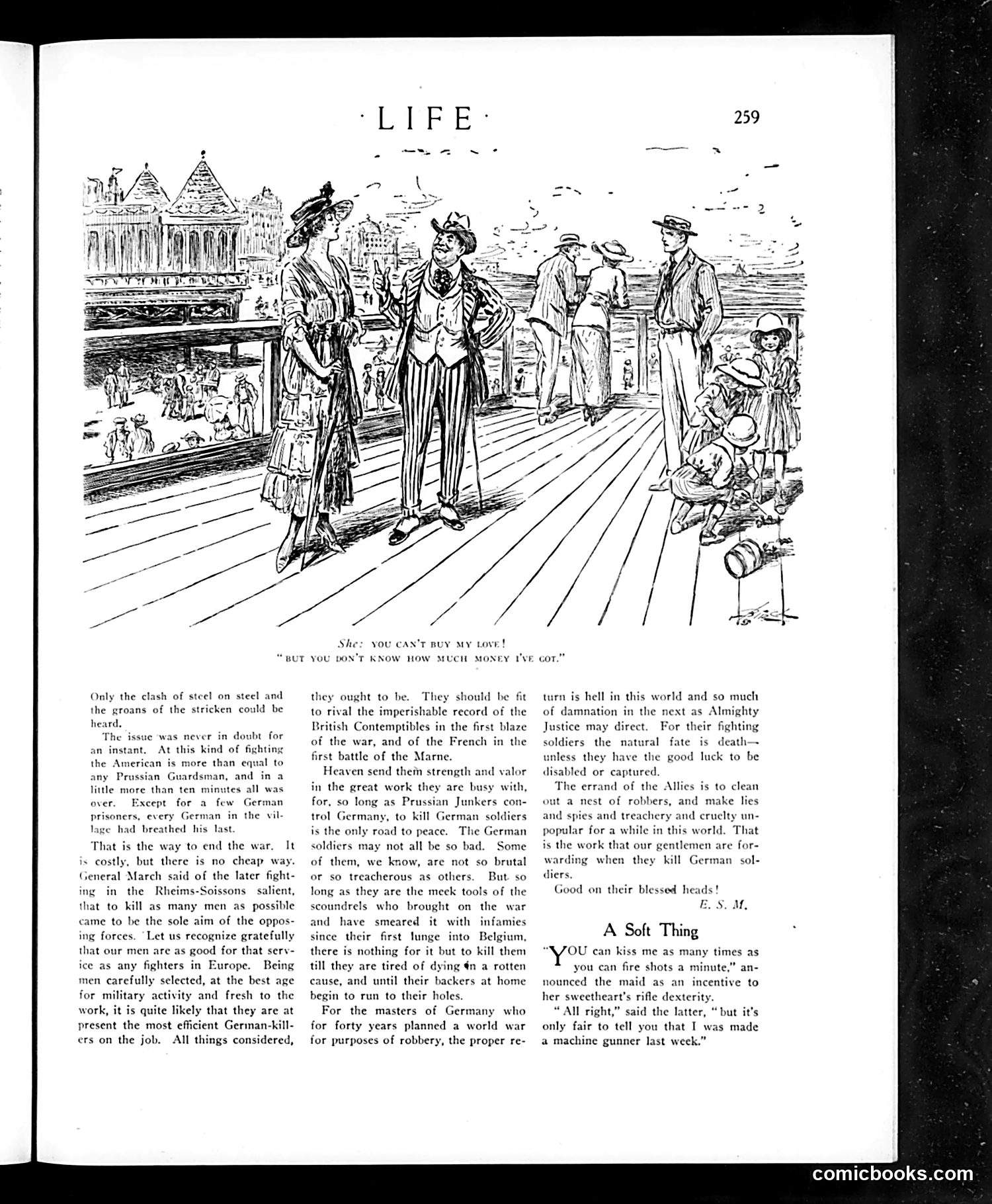
This page contains two distinct pieces: **The Illustration (top):** A seaside pier scene depicting well-dressed Edwardian-era figures. The caption reads: "She: 'YOU CAN'T BUY MY LOVE!' He: 'BUT YOU DON'T KNOW HOW MUCH MONEY I'VE GOT.'" The satire mocks wealthy men attempting to use money to seduce women, suggesting that even declarations of romantic principle yield to displays of wealth. **"A Soft Thing" (bottom):** A brief dialogue about a woman rejecting a suitor because he was "made a machine gunner last week." The humor derives from contrasting romantic devotion with military service—the woman prioritizes her sweetheart's safety over romantic sentiment. Both pieces satirize relationship dynamics and social values of the period, using humor to critique materialism and wartime concerns.
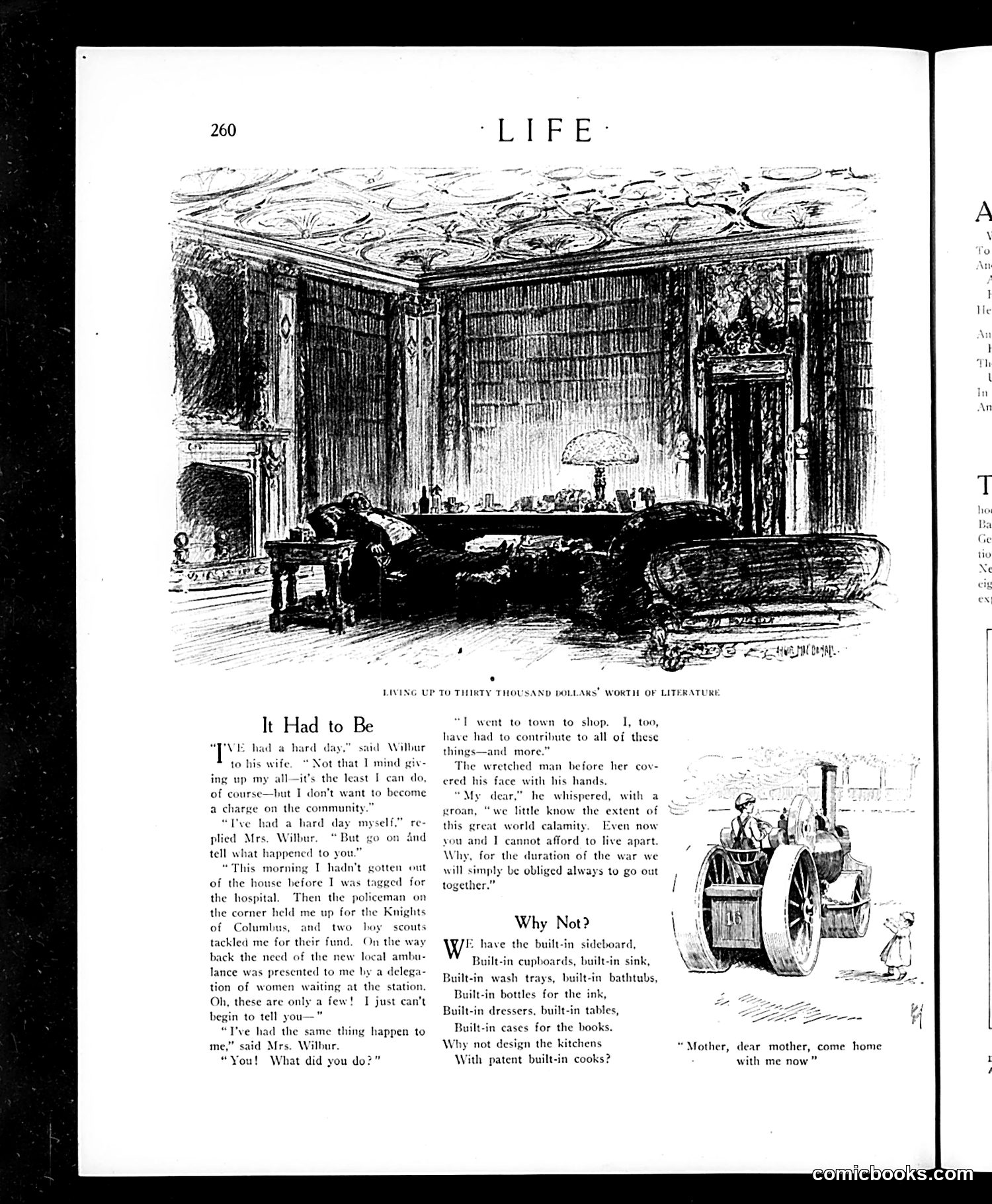
This page contains two satirical pieces about wartime domestic life, likely from WWI era based on references to "the duration of the war." **"It Had to Be"** depicts a husband and wife negotiating household economies. The husband complains about contributing to war relief efforts while his wife insists they must sacrifice together. The satire targets the tension between maintaining middle-class comfort and patriotic duty during wartime. **"Why Not?"** is a humorous list proposing "built-in" kitchen conveniences (built-in stoves, sinks, bathtubs, etc.), culminating in a joke about "patent built-in cooks"—mocking the era's enthusiasm for labor-saving domestic innovations. The accompanying illustration shows a child asking their mother to come home, likely commenting on women's expanded wartime responsibilities outside the home.
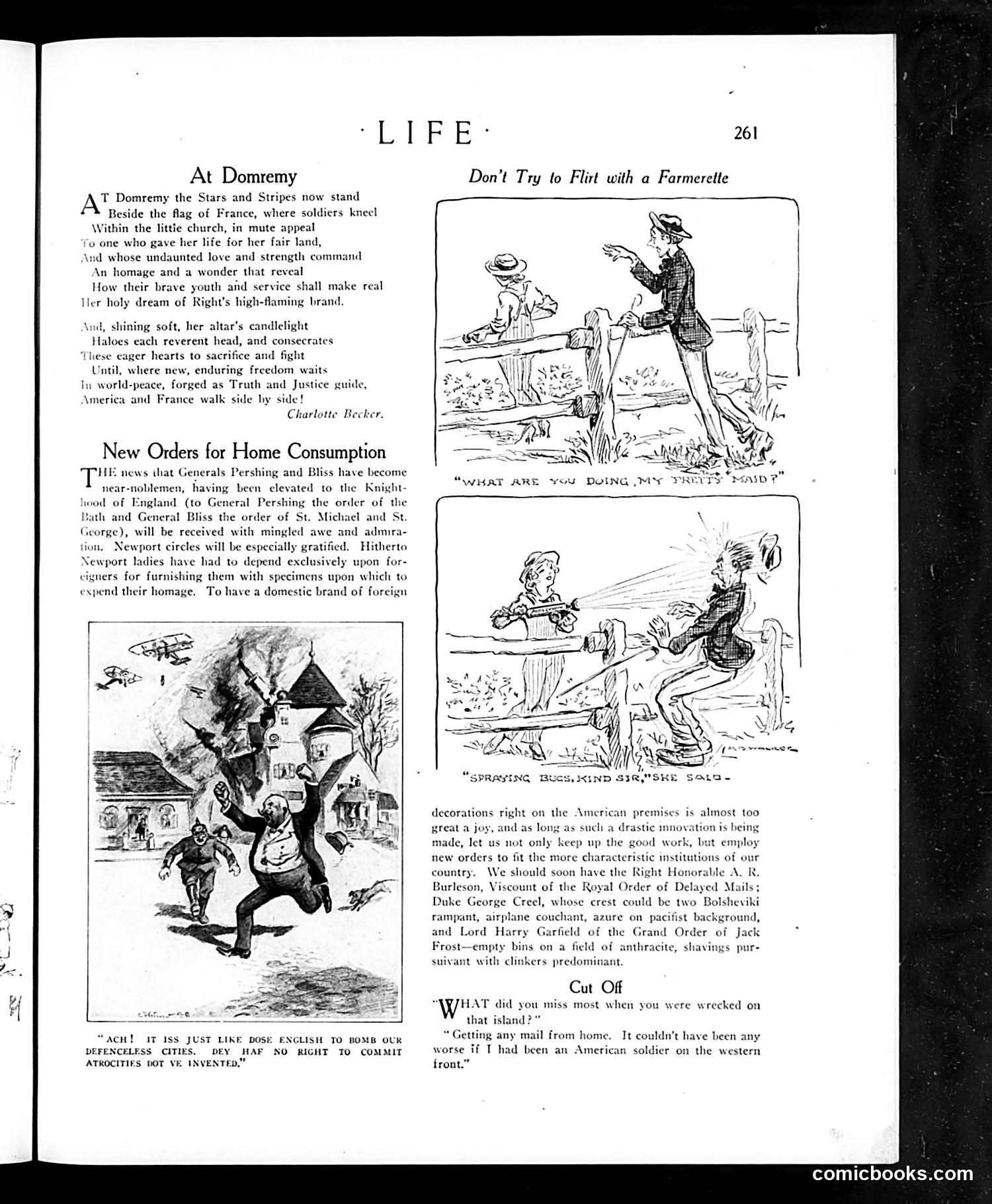
This page contains satirical content about post-WWI social changes. "At Domremy" is a patriotic poem by Charlotte Becker honoring French sacrifice. "New Orders for Home Consumption" mocks British aristocratic pretension. The cartoon shows a figure fleeing a chaotic haunted house labeled with bombs, satirizing how English nobility who previously depended on foreign luxuries must now accept domestic alternatives due to wartime disruption. "Don't Try to Flirt with a Farmerette" depicts two rural women rejecting a man's advances—likely commentary on women's wartime independence and changed social dynamics as women took agricultural work during the war. "Cut Off" presents a brief dialogue about isolation during wartime, with someone mentioning missing mail and preferring American soldiers to isolation. The overall theme: post-war social disruption and shifting class/gender expectations.
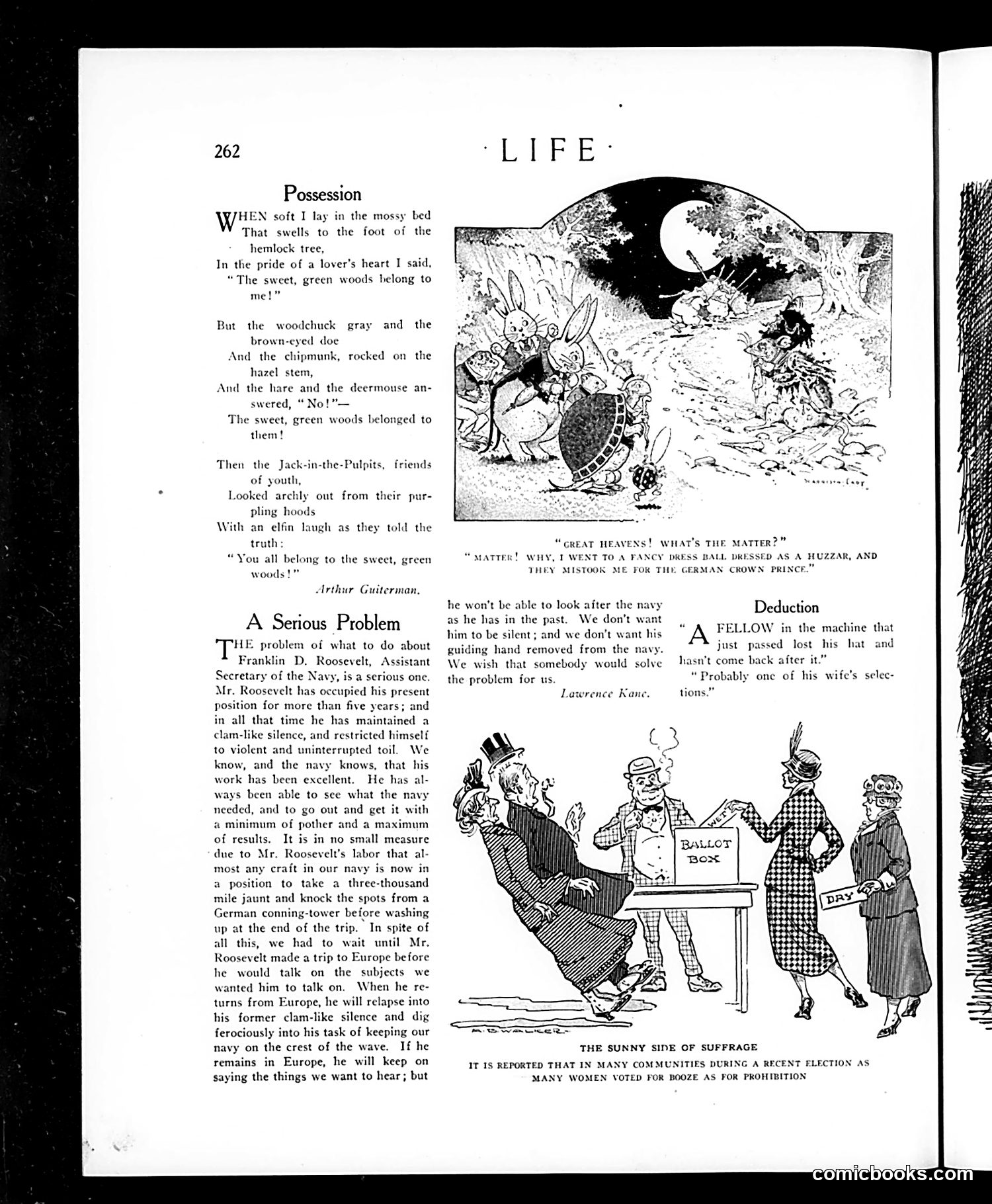
This page contains three distinct pieces: 1. **"Possession"** (poem by Arthur Guiterman): A romantic poem about woodland ownership, with an accompanying illustration of woodland creatures rejecting human claims to "their" forest. 2. **"A Serious Problem"** (by Lawrence Kane): Discusses Franklin D. Roosevelt's Assistant Secretary of the Navy and a personnel issue. The text suggests Roosevelt has been silent on a navy matter and hopes to resolve it before returning from Europe, implying political tension over naval administration during this period. 3. **"Deduction"** (cartoon): Shows people at a voting booth labeled "BALLOT BOX" with a caption about women voting for booze during a recent election, satirizing the seeming contradiction between prohibition enforcement and women's voting behavior. The page reflects early 20th-century American politics and social debates around prohibition and women's suffrage.
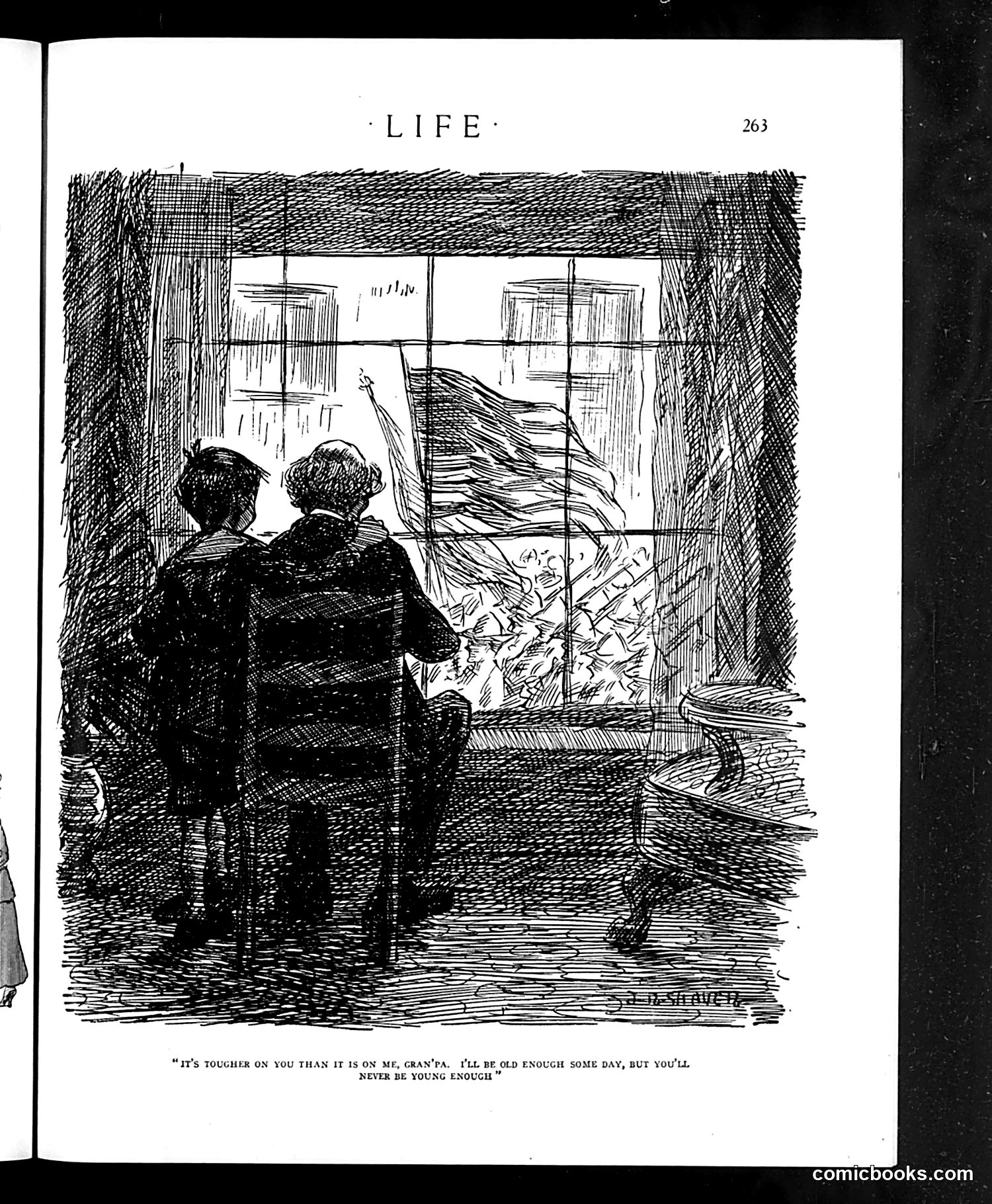
This page features a single sketch showing two figures seated indoors, looking out a window at a waving flag. The caption reads: "It's tougher on you than it is on me, gran'pa. I'll be old enough some day, but you'll never be young enough." The cartoon appears to satirize generational differences regarding a contemporary issue—likely military service or war, given the flag. The younger person (possibly a grandson) suggests he will eventually reach the age for whatever obligation the flag represents, while the grandfather will never regain his youth to participate or avoid it as he might wish. Without knowing Life magazine's publication date, the specific historical context remains unclear, though the sentiment suggests commentary on age-based policy impacts or wartime sacrifice across generations.
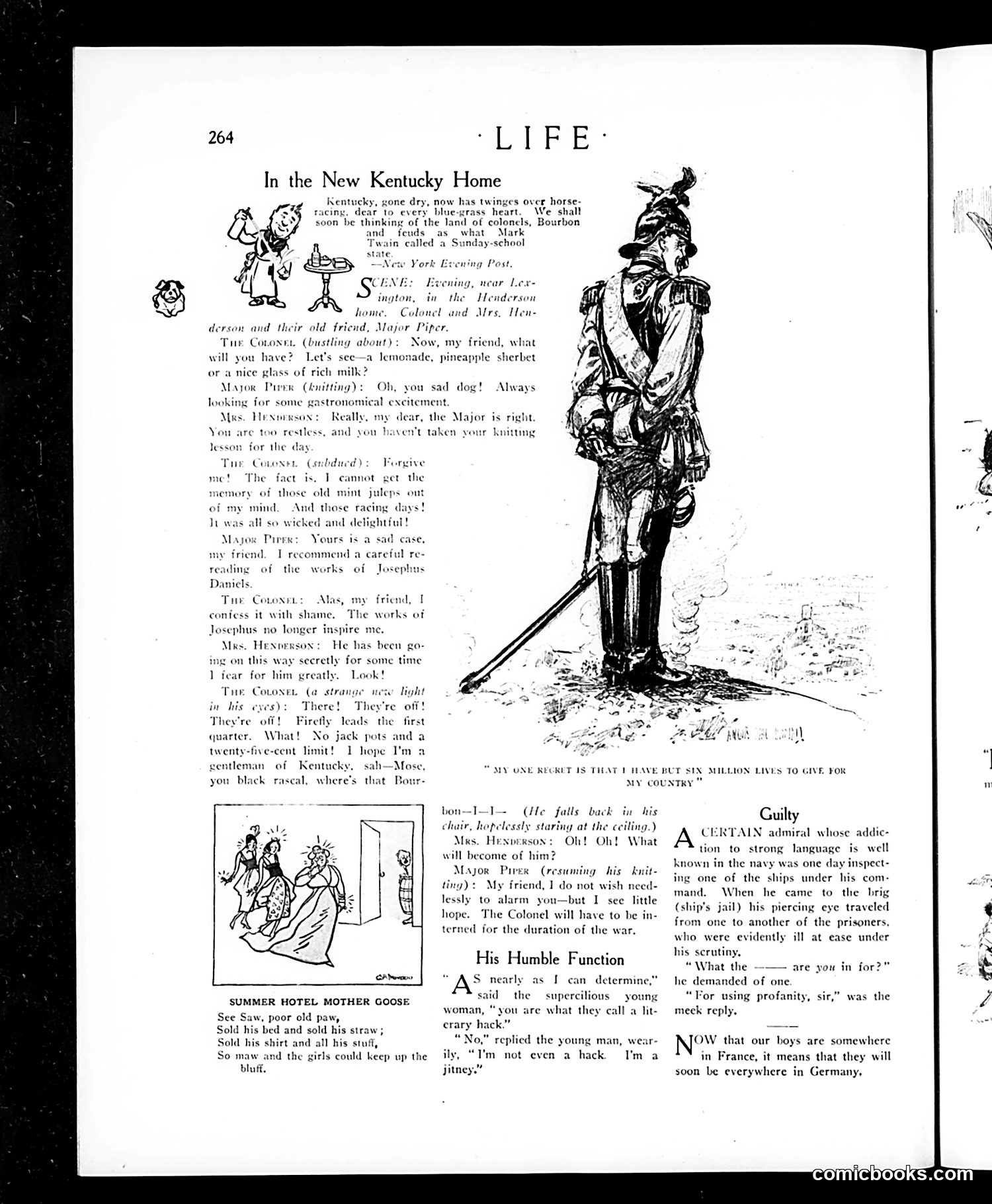
This page contains two distinct pieces: **"In the New Kentucky Home"** is a dialogue satirizing post-Civil War Kentucky social life. The Colonel and Major Piper discuss refreshments and nostalgic memories of ante-bellum "racing days," while Mrs. Henderson worries about the Colonel's fate during wartime. The humor targets the Old South's romanticization of its past even as the war devastates present circumstances. **"Summer Hotel Mother Goose"** is a comic verse parody, shown with an illustration of a woman and child. It's a lighthearted play on traditional nursery rhymes, likely poking fun at summer hotel life and social pretensions. The bottom section begins a story titled "Guilty" about naval discipline and wartime conscription, depicting a young sailor's interaction with an admiral.
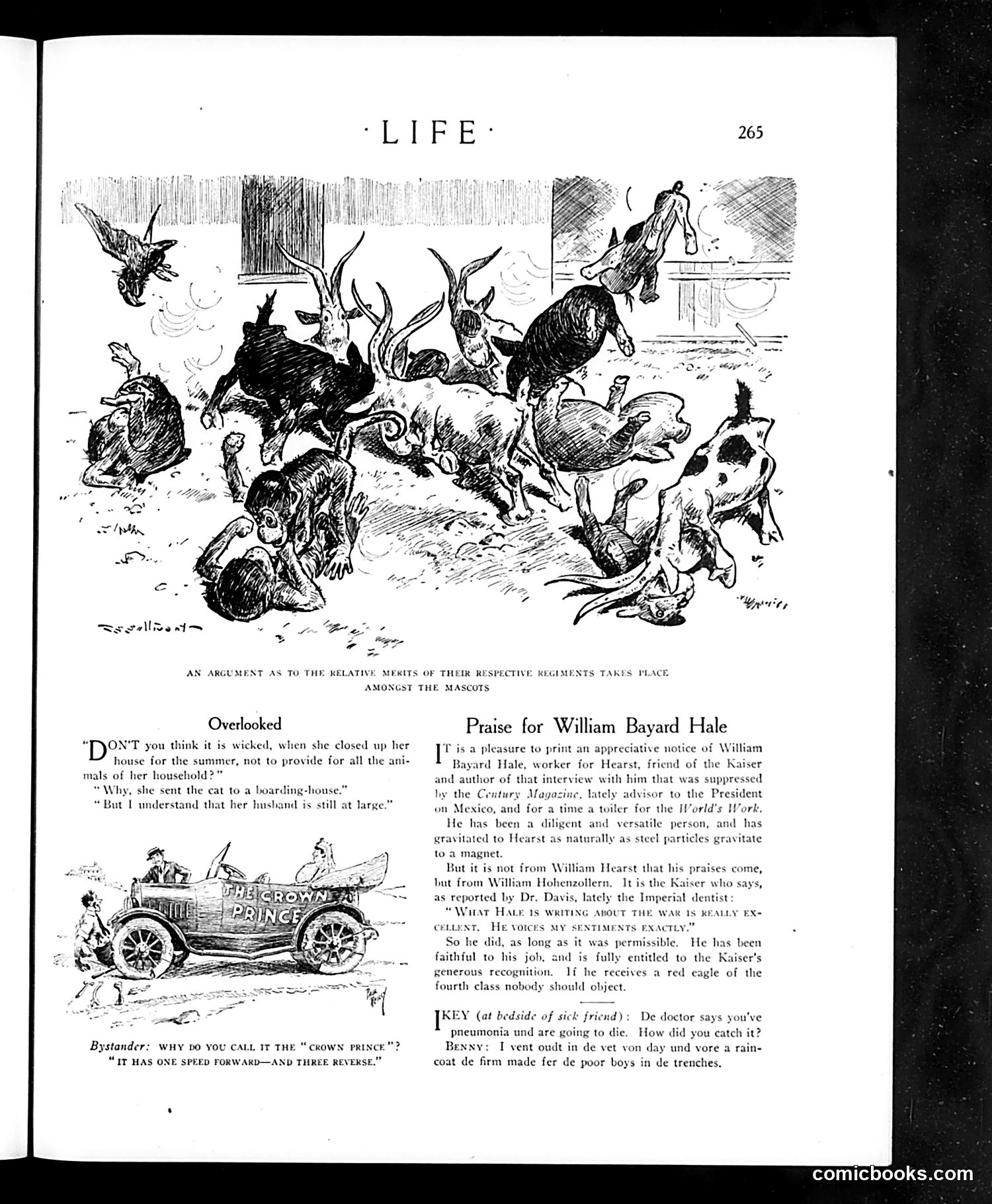
**Top Cartoon:** An absurdist scene depicting various animals (goats, dogs, cats, and creatures with horns) engaged in heated debate. The caption reads: "AN ARGUMENT AS TO THE RELATIVE MERITS OF THEIR RESPECTIVE REGIMENTS TAKES PLACE AMONGST THE MASCOTS." This satirizes military unit mascots arguing about their regiments' superiority—a commentary on institutional pride or competing factions, likely during WWI era when mascots were common military symbols. **Lower Sections:** Include two unrelated humorous pieces: "Overlooked" (a domestic joke about a wife closing her house for summer without provisions) and a car gag about the "Crown Prince" with one speed forward and three in reverse. **"Praise for William Bayard Hale":** A brief tribute to Hale, a journalist and Kaiser-friendly figure, praising his writing and loyalty.
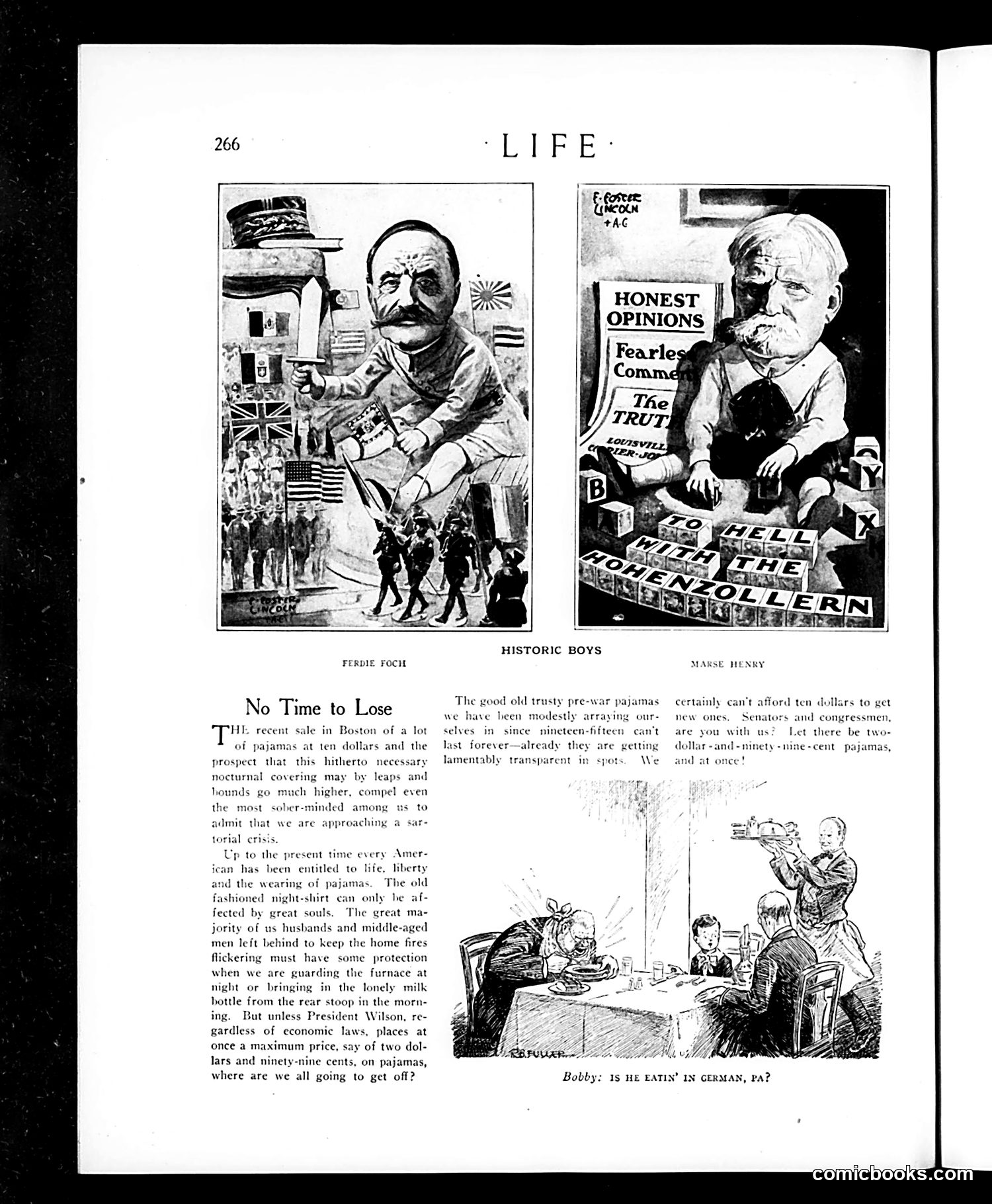
This page presents two caricatured historical figures labeled "Historic Boys." The left cartoon shows **Ferdie Foch** (likely Ferdinand Foch, French WWI military leader), depicted as a militaristic figure surrounded by weapons and national symbols. The right shows **Masse Henry** (unclear reference), portrayed as an elderly man with books titled "Honest Opinions," "Fearless Comment," and "The Truth." The main article, "No Time to Lose," satirizes President Wilson's economic policies restricting pajama prices to $2.99, arguing this price ceiling is ineffective and absurd. The cartoon below depicts a family dinner scene with the caption "Bobby: is he eatin' in German, pa?"—likely mocking German cuisine or wartime food rationing concerns. The satire targets post-WWI economic management and attitudes toward foreign matters.
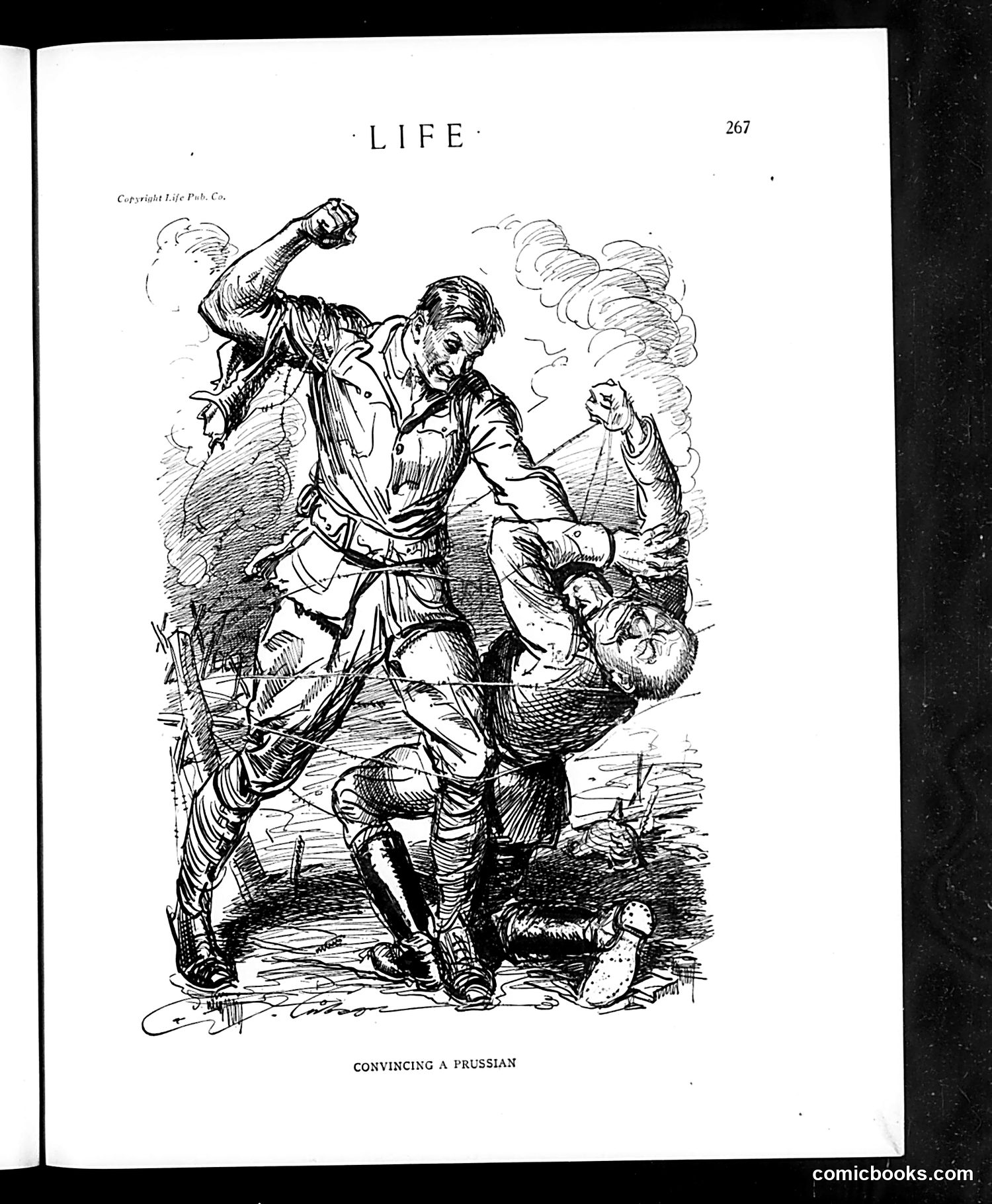
This cartoon depicts a soldier (likely American or Allied) physically overpowering and striking a Prussian soldier with his fist raised triumphantly. The caption "Convincing a Prussian" suggests the satire: that Prussians could only be persuaded through brute force rather than reason or diplomacy. This reflects anti-German sentiment from World War I era (Life published this during or shortly after WWI). The cartoon mocks Prussian militarism and suggests that German aggression required violent military response rather than negotiation. The exaggerated, aggressive posture of the victor emphasizes the superiority of the opposing force and the futility of Prussian aggression against Allied strength.
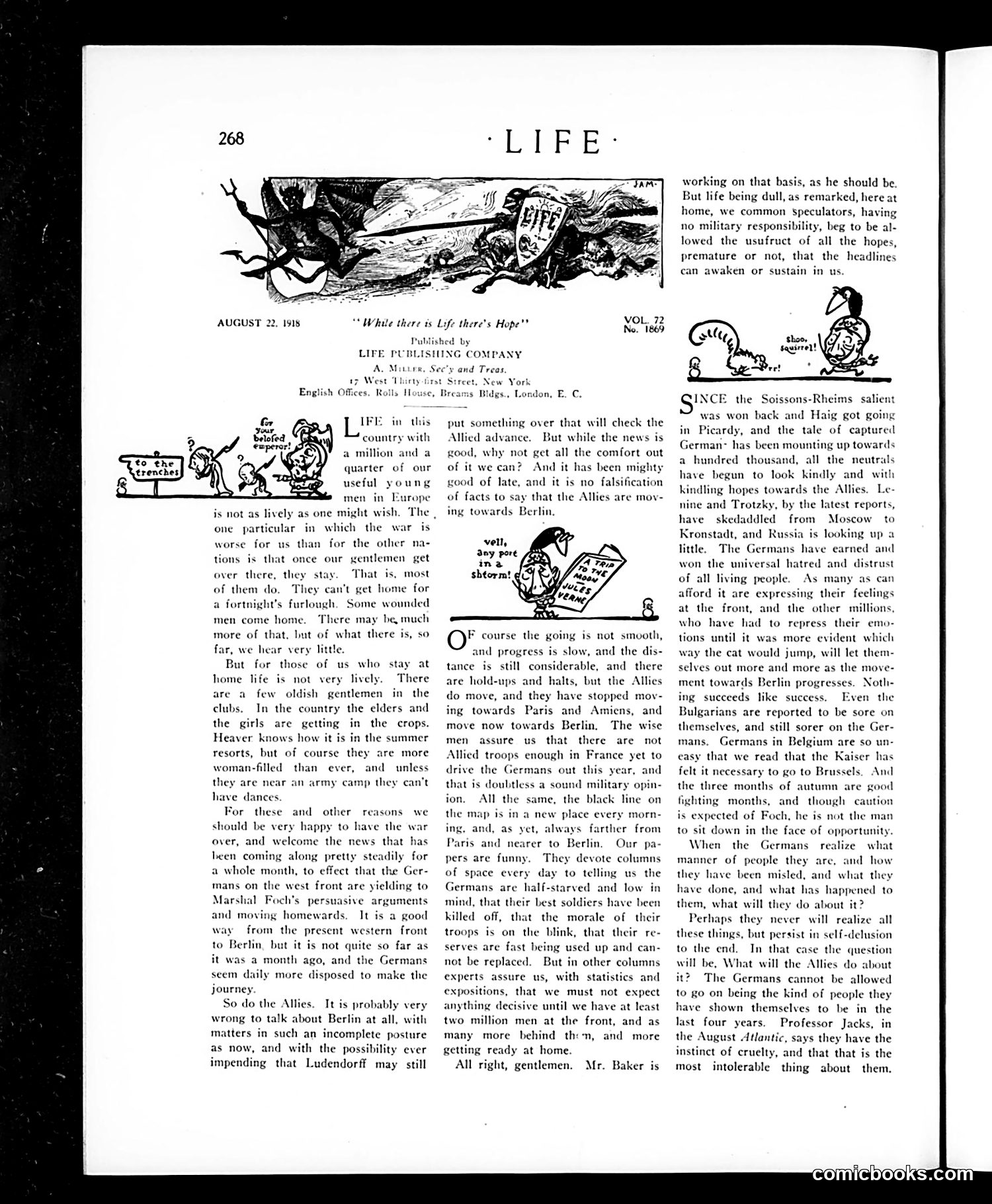
This page addresses American home-front morale during World War I's final months. The main editorial discusses the dullness of American civilian life—with a quarter-million young men in Europe and unable to take furloughs, social activities have stalled. Clubs lack older gentlemen; country estates need harvesting; resorts and dances are depleted. The piece pivots to cautious optimism about Allied military progress. The Germans are retreating toward Berlin rather than advancing toward Paris and Amiens—a significant psychological shift. The editorial references **Marshal Foch** (French commander), **General Ludendorff** (German commander), **Secretary Baker** (U.S. War Secretary), and notes that **Lenin and Trotsky** have begun viewing the Allies favorably as German defeat appears likely. The cartoons (appearing top and sides) use humor to reinforce these themes about wartime American life and hope for victory. The satirical tone suggests civilians should permit themselves optimism about the war's conclusion, even amid official caution about needing more troops.
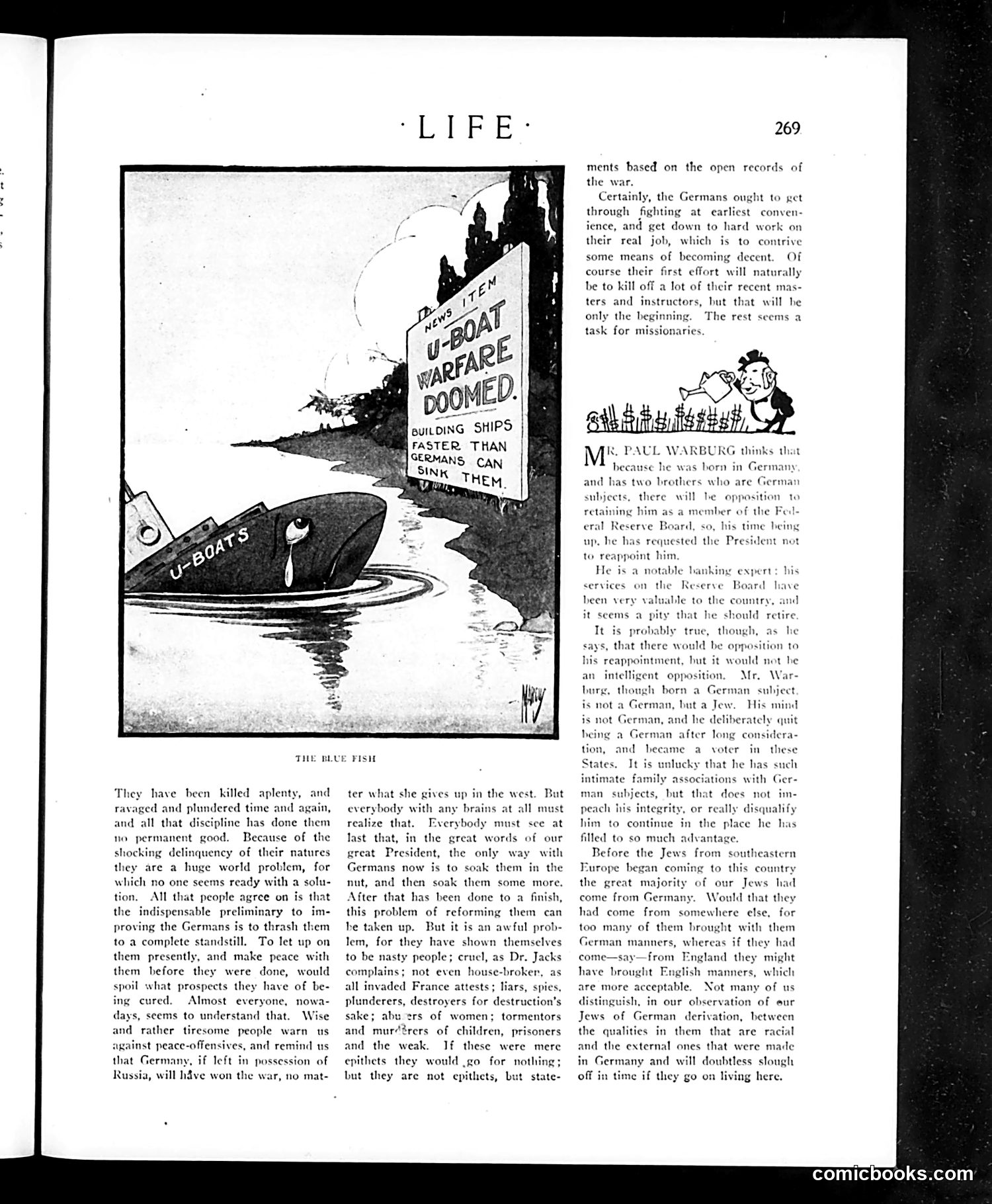
This page contains a political cartoon and commentary from World War I era. **The Cartoon**: "The Blue Fish" depicts a sinking U-boat labeled with a sign reading "U-BOAT WARFARE DOOMED" and "BUILDING SHIPS FASTER THAN GERMANS CAN SINK THEM." The image mocks German submarine warfare as a failed strategy. **The Text**: The right-hand article discusses Paul Warburg, a banking expert and Federal Reserve Board member who was born in Germany. Though respected for his financial expertise, Warburg requested not to be reappointed due to anticipated political opposition stemming from his German birth and having German brothers. The author argues this opposition is unintelligent, noting Warburg is Jewish (not ethnically German) and became a U.S. citizen. However, the piece includes problematic commentary suggesting German Jews brought undesirable "German manners" to America—reflecting the period's casual xenophobia and anti-German sentiment during wartime.
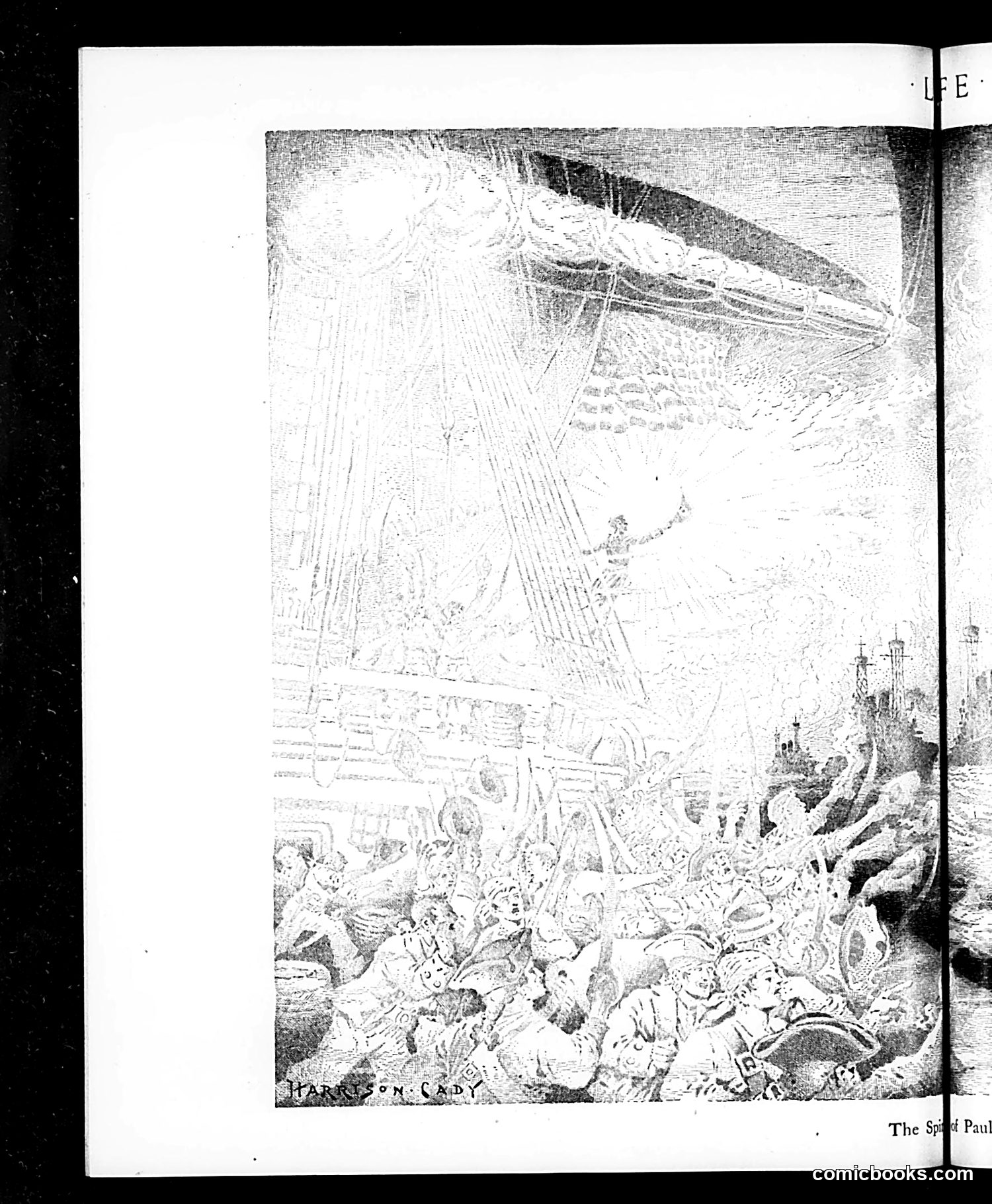
This appears to be a political cartoon by Harris on Cady depicting a biblical or classical scene. The image shows a figure with outstretched arms at the top (possibly representing divine intervention or a spiritual force) overlooking a chaotic scene below filled with numerous figures engaged in battle or conflict. The title "The Speed Paul" is unclear without additional context, though it may reference a historical or religious figure. The composition suggests commentary on religious fervor, divine judgment, or mass conflict. The dramatic rendering with radiating lines from above conveys supernatural or overwhelming force descending upon the scene below. Without the specific historical context of this Life magazine issue, the precise satirical target remains uncertain, though the imagery suggests social or religious commentary typical of early 20th-century American satire.
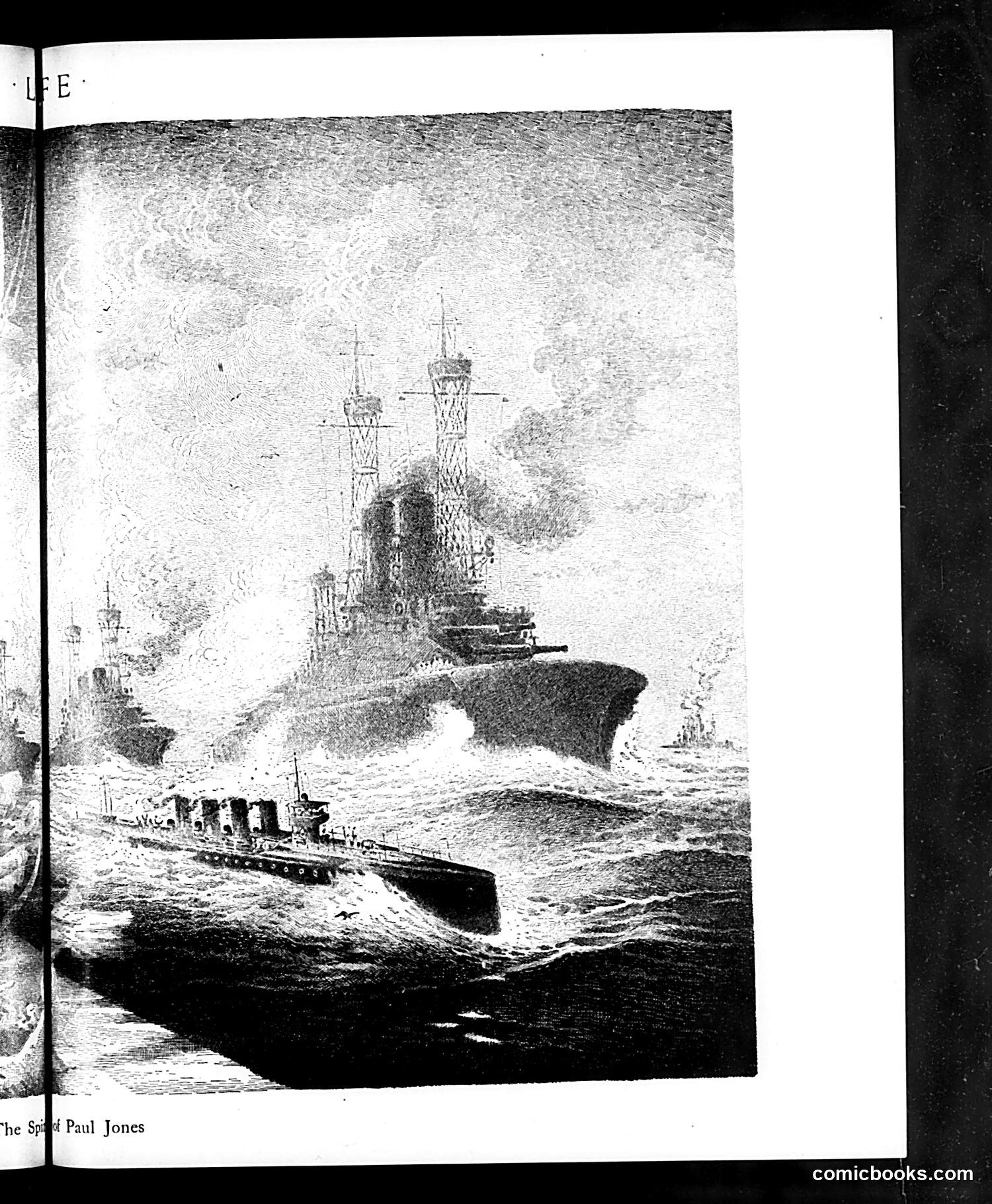
This is a World War I-era naval warfare illustration. The image shows what appears to be a German dreadnought battleship (center, with distinctive twin smokestacks and tall gun turrets) engaged with smaller Allied vessels in rough seas. The detailed rendering emphasizes the scale disparity between the massive German warship and the smaller opposing craft. The caption reads "The Spi... Paul Jones," likely referencing the Revolutionary War naval commander John Paul Jones, known for attacking British vessels. This comparison suggests the image illustrates contemporary naval combat strategy—smaller, faster ships engaging a larger battleship, mirroring historical tactics. The illustration serves as wartime propaganda or reportage, depicting naval action during WWI's ongoing maritime conflict between German and Allied forces.
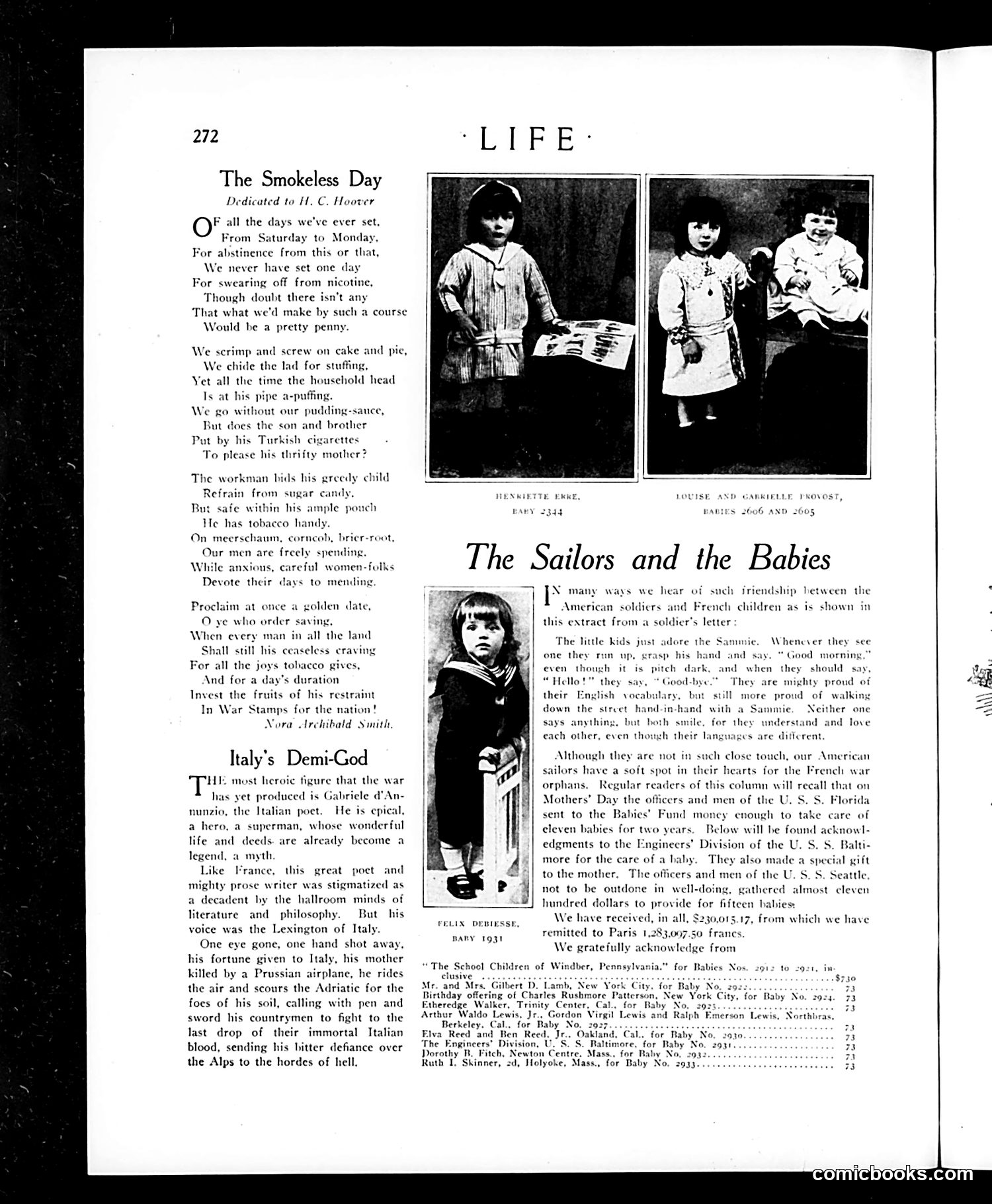
This Life magazine page from WWI era contains patriotic appeals disguised as satire. **"The Smokeless Day"** (dedicated to H.C. Hoover, then Food Administrator) ironically critiques male hypocrisy: families sacrifice luxuries like desserts to conserve resources for the war effort, yet men freely spend on tobacco and cigarettes. The poem proposes a "Smokeless Day" where men would forgo tobacco and donate savings to War Stamps—a fundraising appeal wrapped in gentle mockery of gender double standards. **"Italy's Demi-God"** praises Gabriele d'Annunzio, the Italian poet-aviator, as an inspirational wartime hero despite his disabilities (lost eye and hand), positioning him as a symbol of Italian resistance. **"The Sailors and the Babies"** documents American servicemen's charitable donations to French war orphans, framed as heartwarming evidence of soldier humanity and international solidarity during WWI. Together, these pieces promote patriotic sacrifice and favorable views of Allied soldiers.
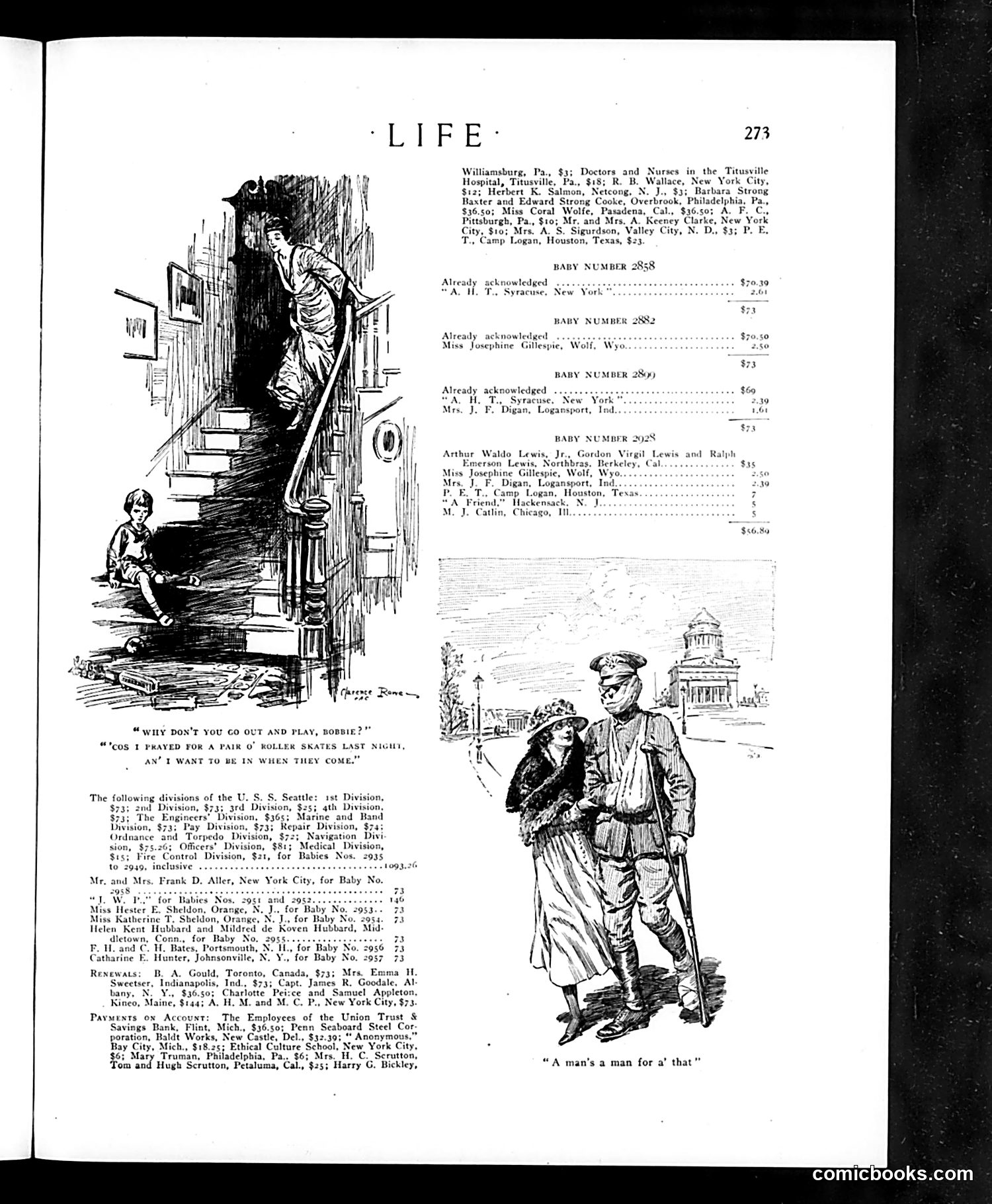
**Main Cartoon Caption:** "Why don't you go out and play, Bobbie?" / "Cos I prayed for a pair o' roller skates last night, an' I want to be in when they come." This is a gentle domestic humor piece about childhood materialism and delayed gratification. A child refuses outdoor play because they're waiting for a gift they requested—roller skates they prayed for. The satire targets children's consumer expectations and impatience, a common theme in early 20th-century Life magazine. **Page Content:** The remainder consists of financial acknowledgments for "Baby" numbered donations (apparently charity fundraising efforts), listing contributors and amounts. The second illustration shows a soldier and woman in period dress with the caption "A man's a man for a' that"—likely referencing Robert Burns's poem about human equality, though the military context suggests WWI-era sentiment about soldiers' valor. The page is primarily administrative/fundraising documentation with satirical illustrations as breaks in the text.
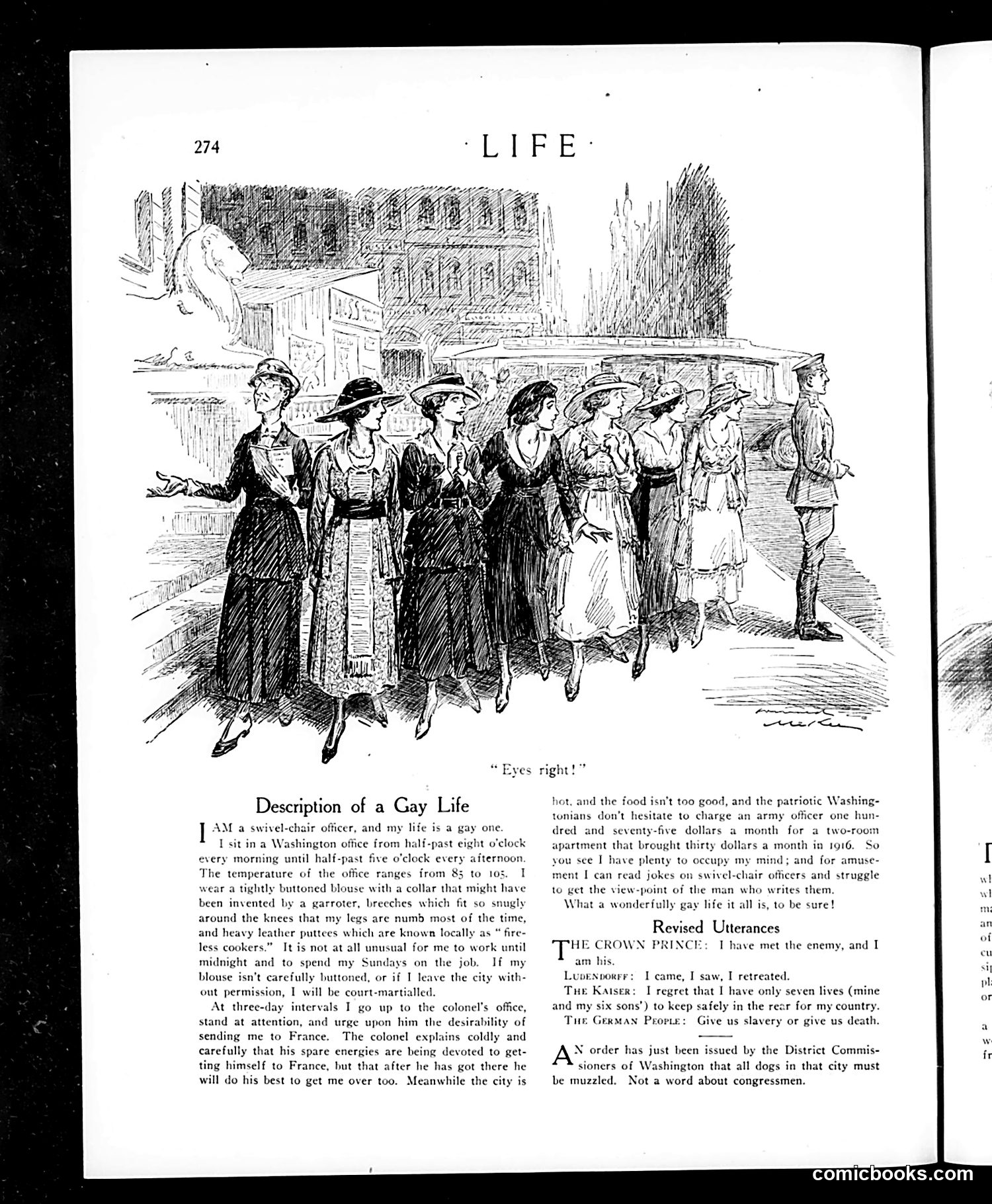
This page contains satirical commentary on American military life during World War I (circa 1916-1918, based on references to sending officers to France). **Main article ("Description of a Gay Life"):** A female Army officer sarcastically describes her "gay" (meaning cheerful) existence: she works in a sweltering Washington office in restrictive military uniform, cannot leave without permission, repeatedly requests deployment to France but is ignored, and pays inflated wartime rent. The satire mocks both the discomfort of stateside military bureaucracy and the profiteering by landlords exploiting patriotic officers. **"Revised Utterances" section:** Three short joke-quips mock enemy leaders—the German Crown Prince (cowardly), Kaiser Wilhelm (prioritizing his sons' safety over his people), and Germans generally (preferring slavery to death)—typical WWI Allied propaganda humor. **"Eyes right!" cartoon caption:** Refers to a military command, accompanying the illustration of women in uniform, likely satirizing female military service or civilian participation in war efforts. The overall tone critiques both military inefficiency and wartime profiteering while supporting the war effort through enemy ridicule.
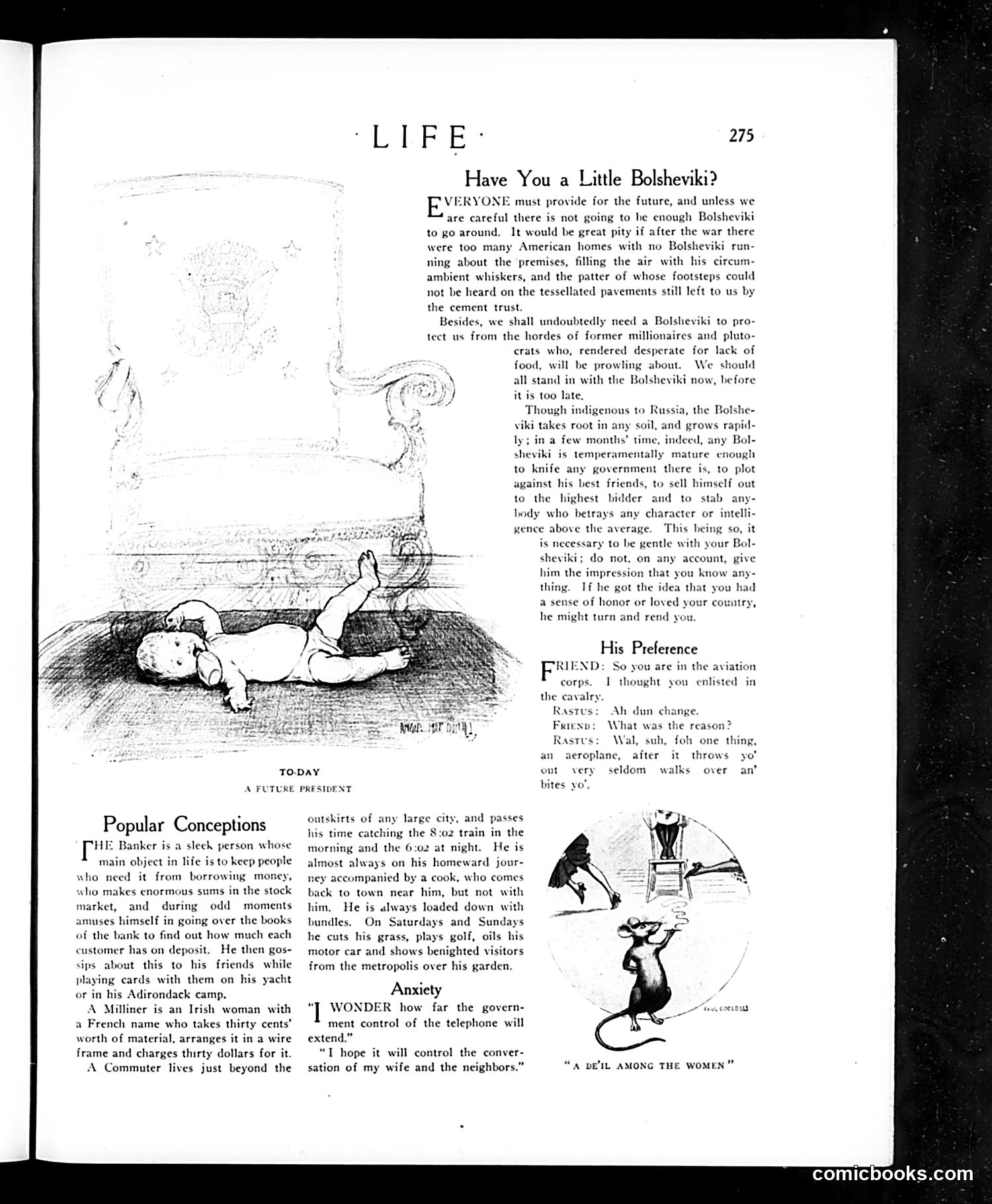
This satirical page mocks post-World War I American anxieties about Bolshevism (Soviet communism). The main article, "Have You a Little Bolsheviki?", uses darkly ironic humor to portray Bolsheviks as dangerous infiltrators who will inevitably spread through American society like a disease. The text warns readers must "provide" Bolsheviki to protect against desperate former wealthy people—a backhanded way of expressing paranoia about communist revolution. The secondary cartoon "His Preference" uses a racist caricature (labeled "Rastus," a dehumanizing stereotype) to make a joke about preferring airplane service to cavalry because planes don't bite—trivializing serious military concerns with crude humor typical of the era. The "Popular Conceptions" section satirizes American stereotypes (bankers, milliners, commuters) with exaggerated descriptions of their actual behavior and motivations. The page reflects 1920s Red Scare hysteria—the widespread fear that Bolshevism would destroy American capitalism and values.
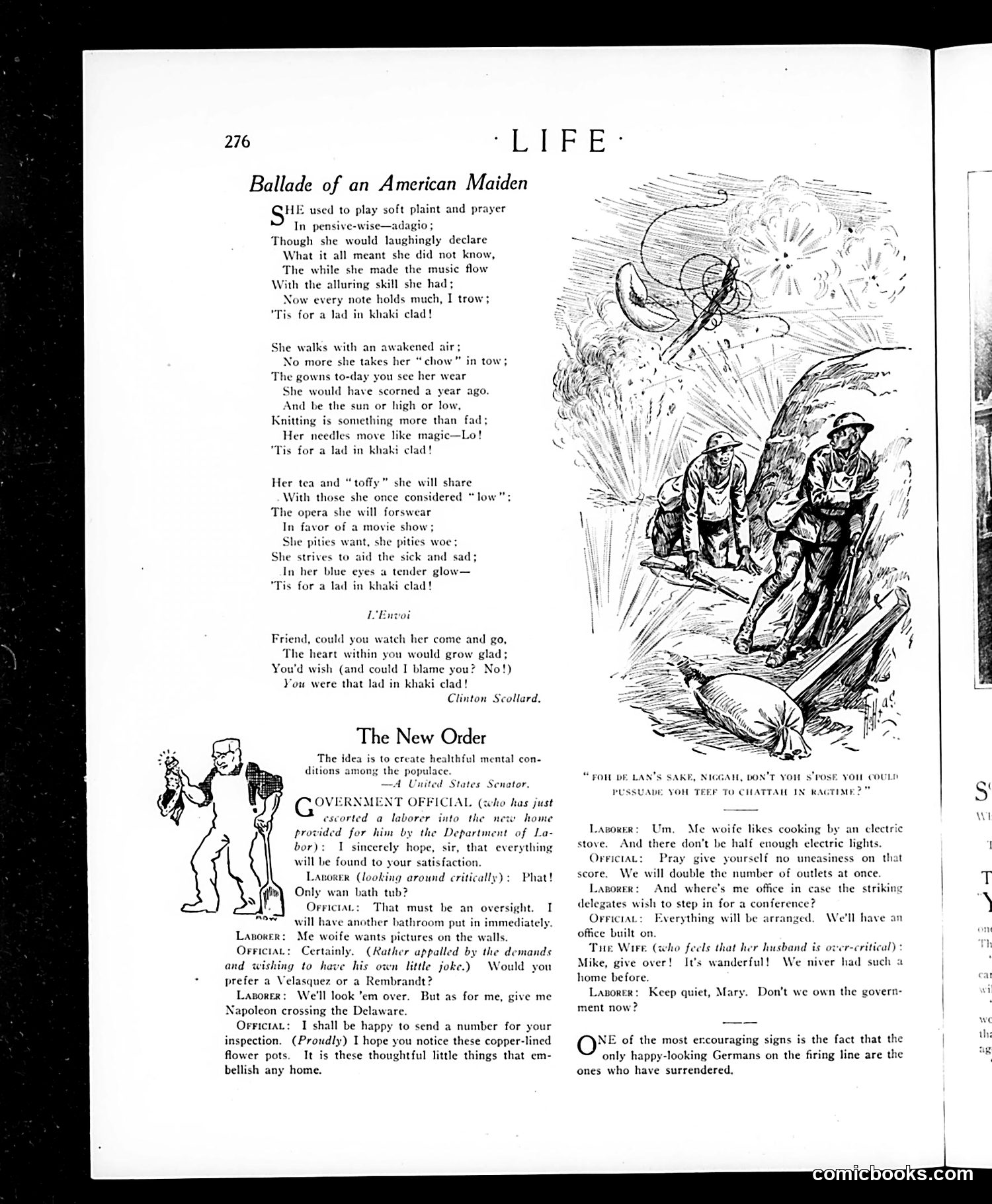
**"Ballade of an American Maiden"** is a patriotic poem celebrating how American women have been transformed by World War I. The poem describes a young woman who previously lived a frivolous life (soft music, opera, ignoring the poor) but now devotes herself to serious pursuits—knitting for soldiers, charity work, and sacrifice—all motivated by love for "a lad in khaki clad" (a soldier). **"The New Order"** is a satirical cartoon mocking government housing programs for laborers. A government official provides a worker with luxurious accommodations, but the worker becomes absurdly demanding—insisting on multiple bathrooms, wall art (requesting Napoleon crossing the Delaware), and even an office for worker delegates. The joke satirizes both workers' unrealistic entitlements and government overreach. The wife's character provides additional humor, as she's satisfied while her husband greedily exploits the situation, suggesting working-class ingratitude toward government assistance. Both pieces reflect WWI-era American attitudes: idealized female patriotism and skepticism toward social welfare programs.
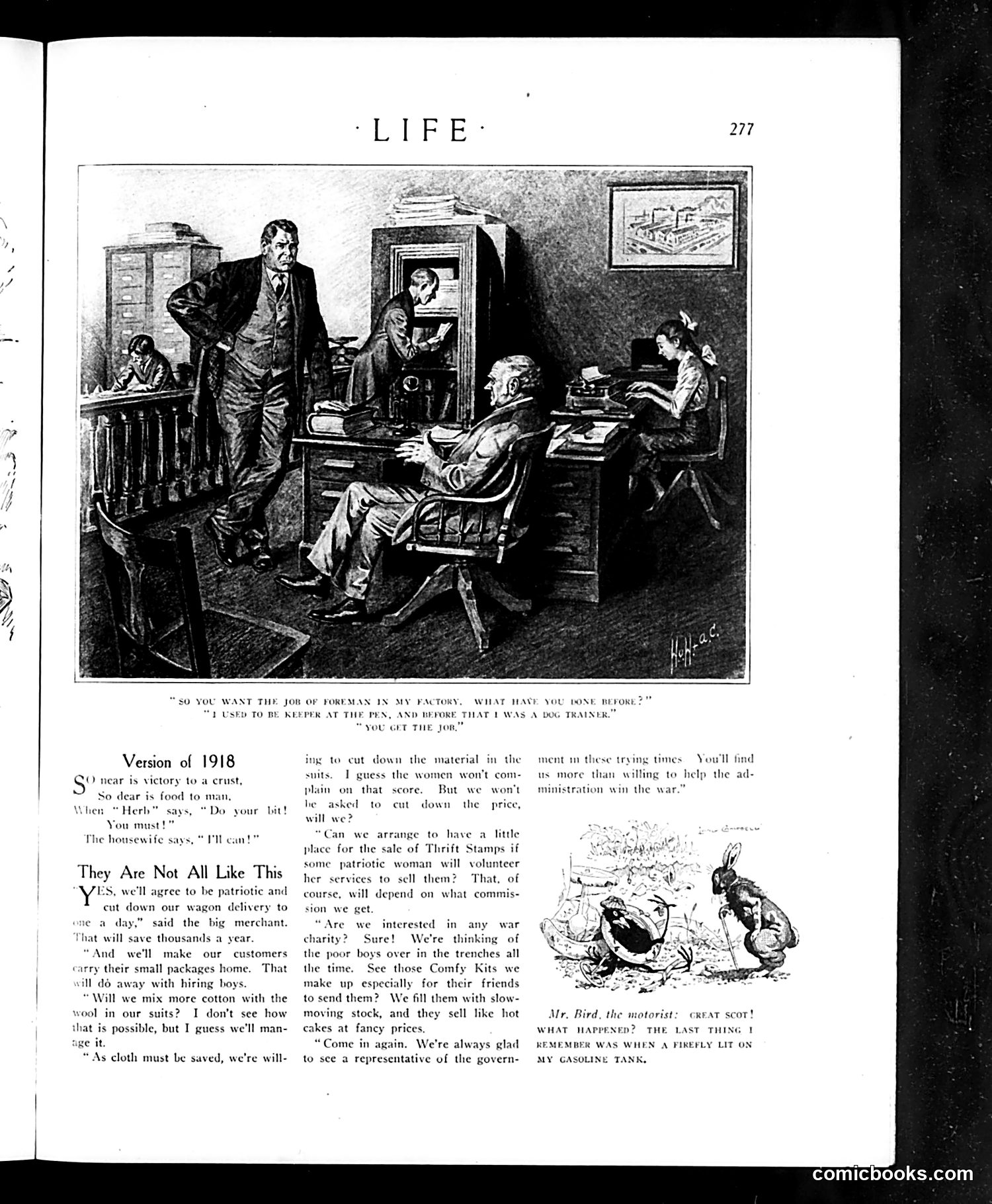
This 1918 Life magazine page satirizes wartime profiteering and hollow patriotism during World War I. **The main cartoon** shows a factory owner speaking to a government official. The owner claims patriotic support for the war effort—cutting delivery routes, reducing cloth in suits, promoting Thrift Stamps and "Comfy Kits" for soldiers. However, his actual motivation is transparent: saving money while maintaining profits. He cuts materials but won't lower prices; he fills soldier care packages with slow-moving inventory that sells at inflated prices. **The satire's point**: Merchants wrapped greed in patriotic language. They made wartime sacrifices sound noble while exploiting scarcity and public support for soldiers to boost earnings. **The smaller cartoon** about "Mr. Bird the motorist" is a separate joke: a firefly igniting a gasoline tank—referencing fuel rationing and the danger of gasoline during wartime. The poem "Version of 1918" at top reinforces the theme: civilians claimed sacrifice was necessary, but the page exposes self-interest masquerading as patriotism.
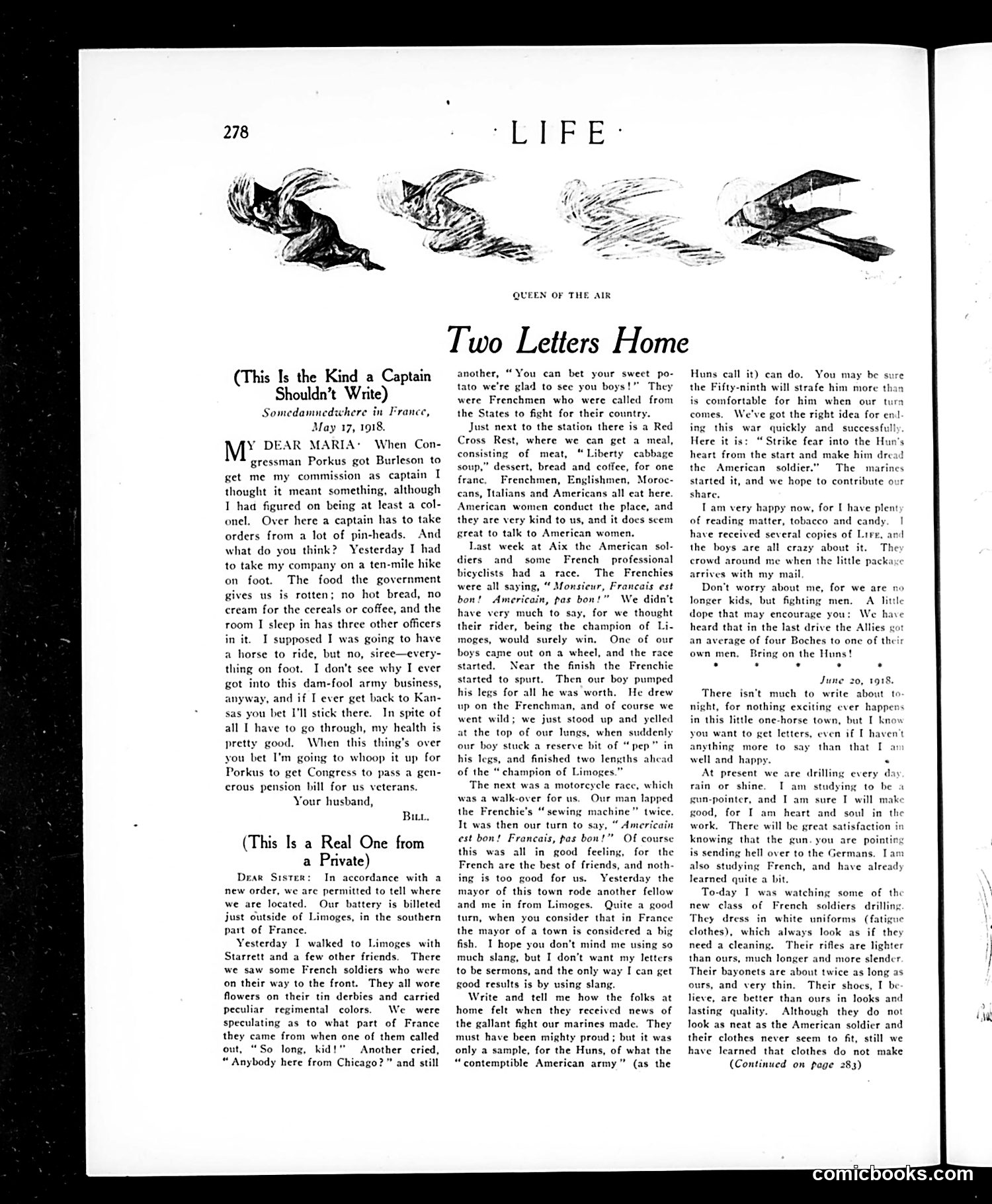
This page presents two letters from American soldiers in France (May 1918), deliberately contrasted to satirize different military ranks and attitudes. The first letter, from a Captain, complains bitterly about commissioned life—inadequate food, forced marches on foot, lack of privileges. He credits his commission to political patronage ("Congressman Porkus" and Postmaster General Burleson) and plans to seek veteran's pensions upon return. The header notes this is "the kind a captain shouldn't write"—suggesting unprofessional, entitled griping. The second letter, from an enlisted Private, describes genuine camaraderie with Allied soldiers, friendly athletic competitions with French cyclists and motorcyclists, and gratitude for kindness from French civilians and American Red Cross workers. His tone is cheerful and humble despite hardship. The satire criticizes officer privilege and ingratitude while celebrating enlisted men's morale and democratic spirit. The contrast exposes how political connections produce ungracious leaders while ordinary soldiers maintain dignity and purpose.
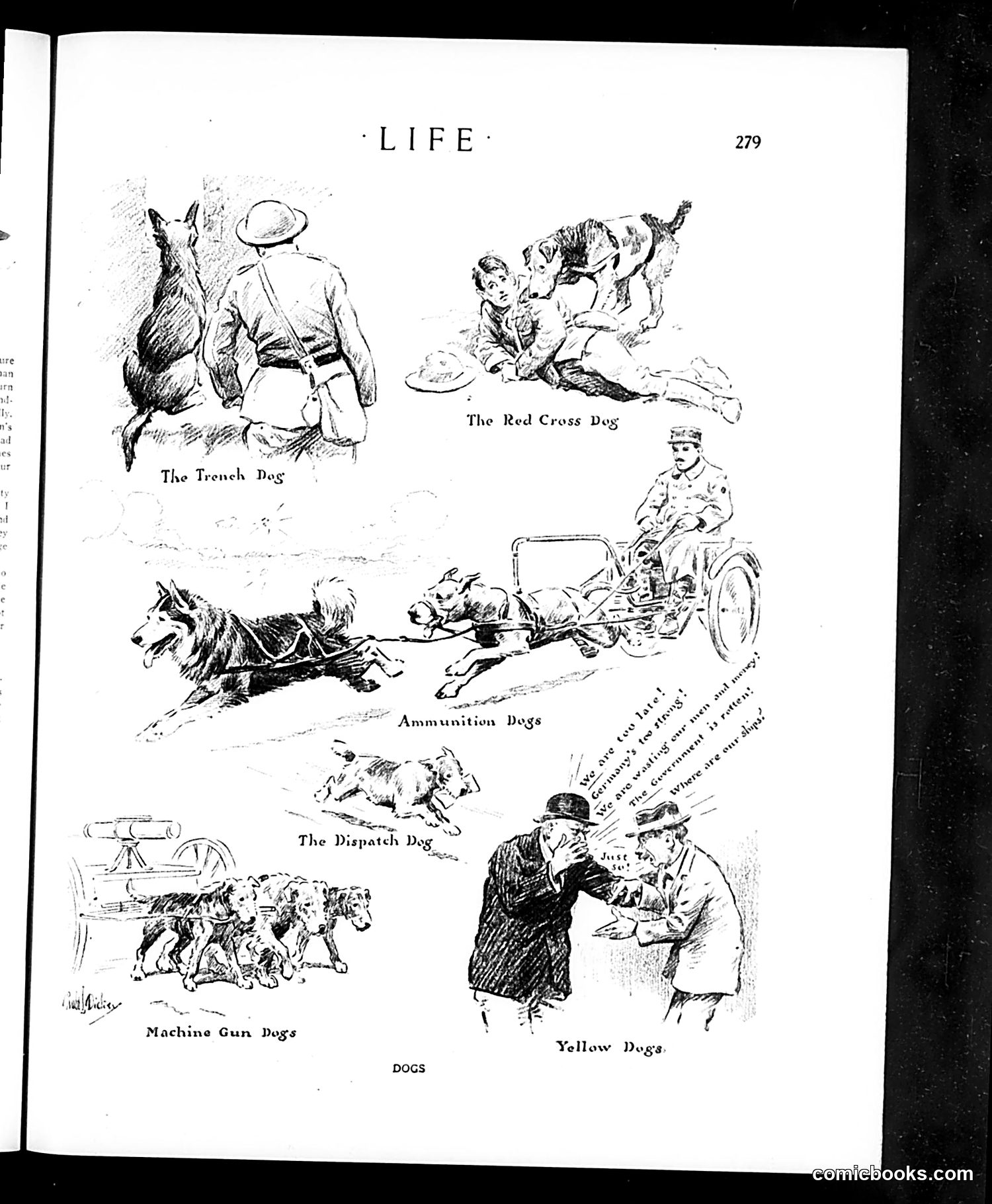
This page illustrates various military roles dogs played during World War I. Each labeled illustration shows a specific function: - **Trench Dog**: Accompanied soldiers in trenches - **Red Cross Dog**: Carried medical supplies to wounded soldiers - **Ammunition Dogs**: Hauled ammunition carts - **Dispatch Dog**: Carried messages between positions - **Machine Gun Dogs**: Pulled equipment wagons - **Yellow Dogs**: Appears to reference dogs used for liaison or supply purposes (the accompanying soldiers suggest administrative/command roles) The "Yellow Dogs" label likely carries additional satirical meaning—a period phrase for cowards or traitors—suggesting these were less combat-critical roles. The overall page celebrates canine contributions to the war effort while gently satirizing military hierarchy and role assignments.
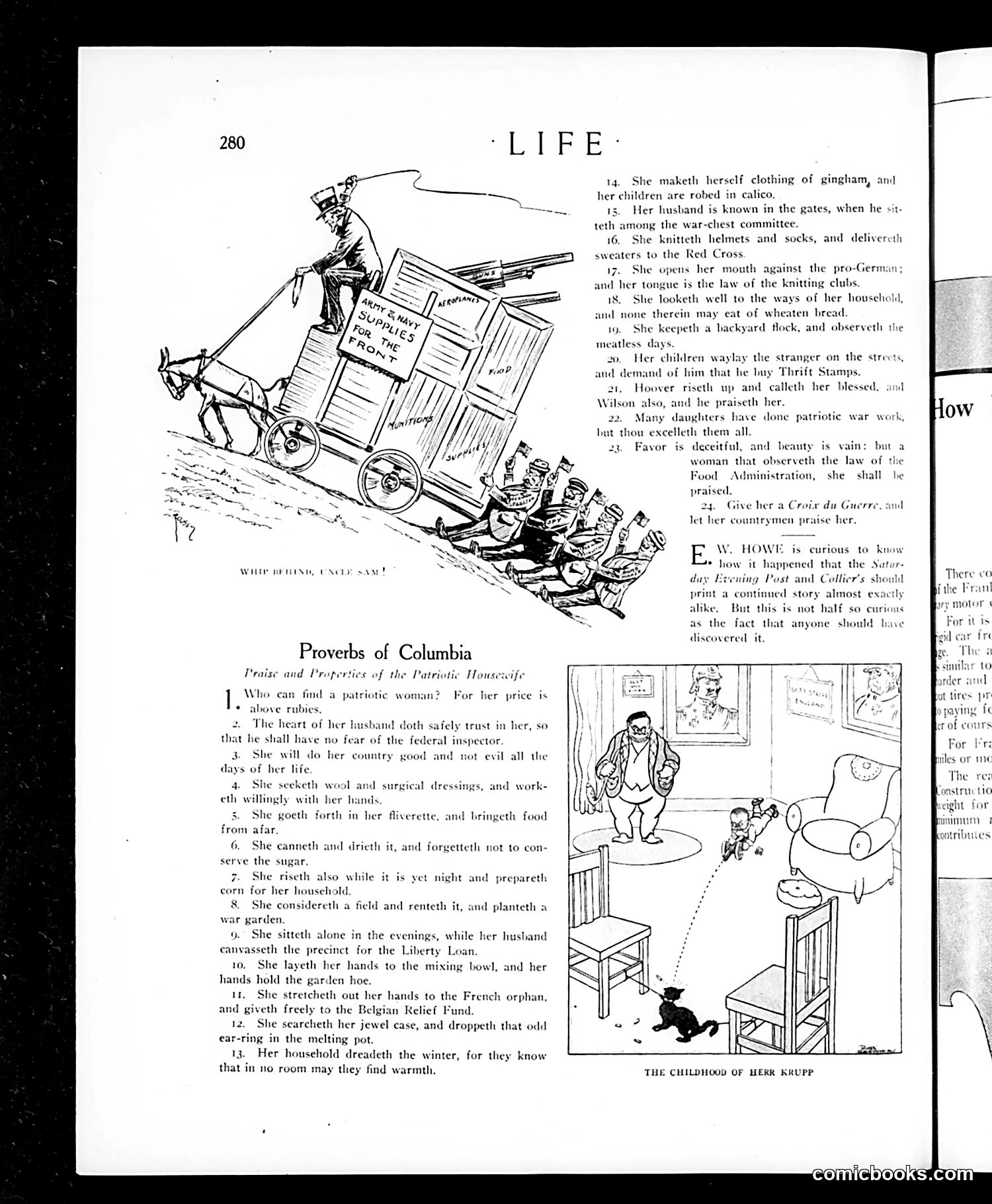
This page satirizes the idealized "patriotic housewife" during World War I. The text, written in mock-biblical style ("Proverbs"), celebrates women's wartime sacrifices: knitting for the Red Cross, observing meatless days, planting victory gardens, melting down jewelry for munitions, and pressuring neighbors to buy Thrift Stamps. The top cartoon shows Uncle Sam driving a heavily laden cart—labeled with supplies for the "Front"—pulled by a straining horse and pushed by struggling soldiers. The satire here suggests that the burden of war support falls disproportionately on those at home and fighting, while the caption "Whip Behind, Uncle Sam!" implies inadequate effort from civilians. The reference to Hoover and Wilson (U.S. Food Administrator and President) reflects actual government rationing programs. The overall point: while women's contributions are genuinely necessary and praiseworthy, the text's exaggerated reverence ("excelleth them all," "Croix du Guerre") gently mocks both the propaganda and the impossible standards placed on the home front.
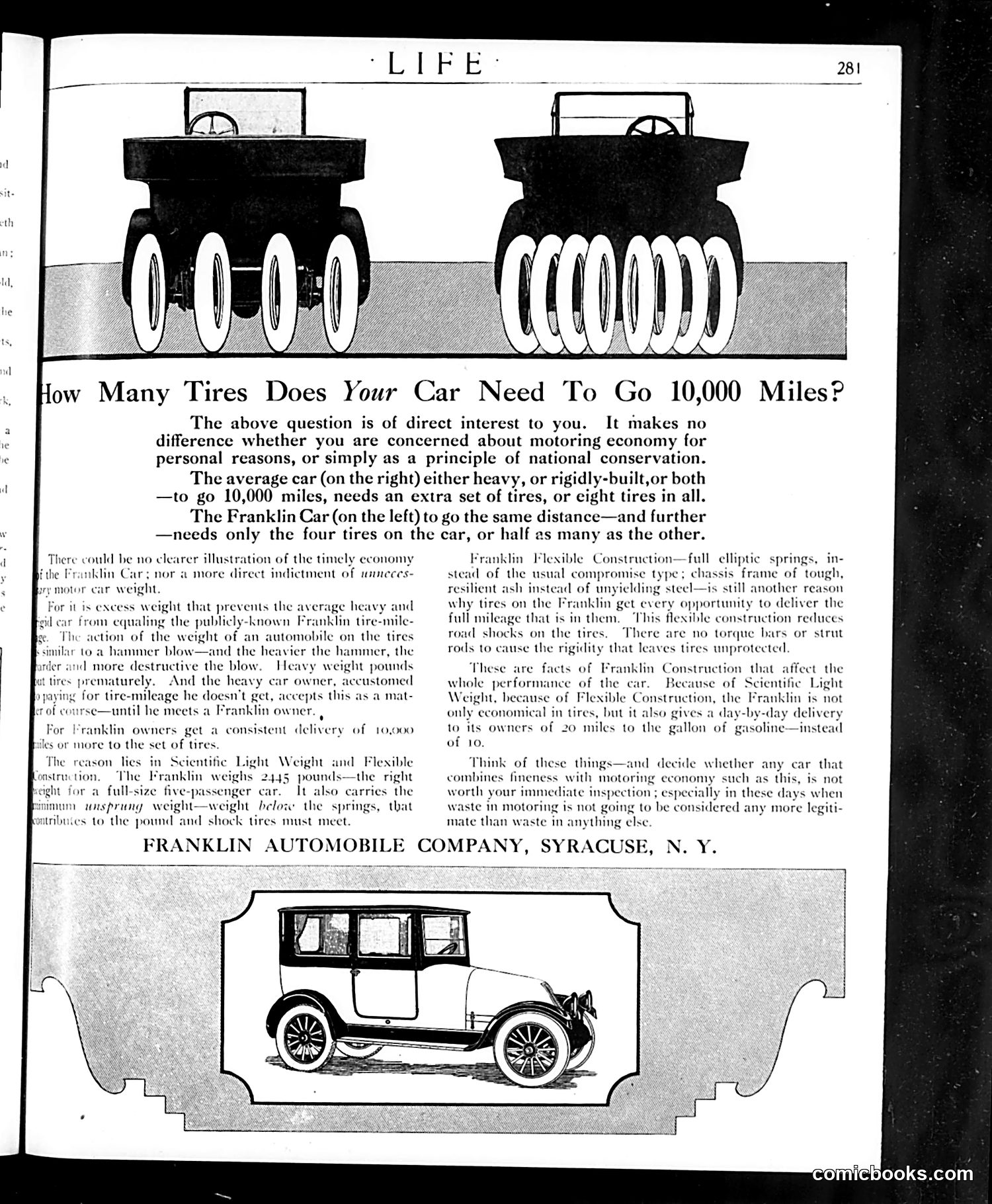
This is a Franklin Automobile advertisement disguised as editorial content. It compares two cars' tire durability over 10,000 miles: a heavy, rigid competitor requiring eight tires total versus the Franklin, which needs only four. The "satire" here is that Franklin claims superior engineering—specifically "Scientific Light Weight" and "Flexible Construction"—allows their car to achieve double the tire mileage. The comparison uses visual humor: the competitor's cart is burdened with eight enormous tires while Franklin's has four. The appeal to "national conservation" reflects post-WWI efficiency concerns. The ad also boasts 20 miles-per-gallon fuel economy versus 10 for competitors. This represents early automotive marketing: technical claims (lighter weight, better suspension design) are presented as objective facts to justify premium purchasing decisions. The page is essentially advertising masquerading as consumer guidance—a common Life magazine format of this era.
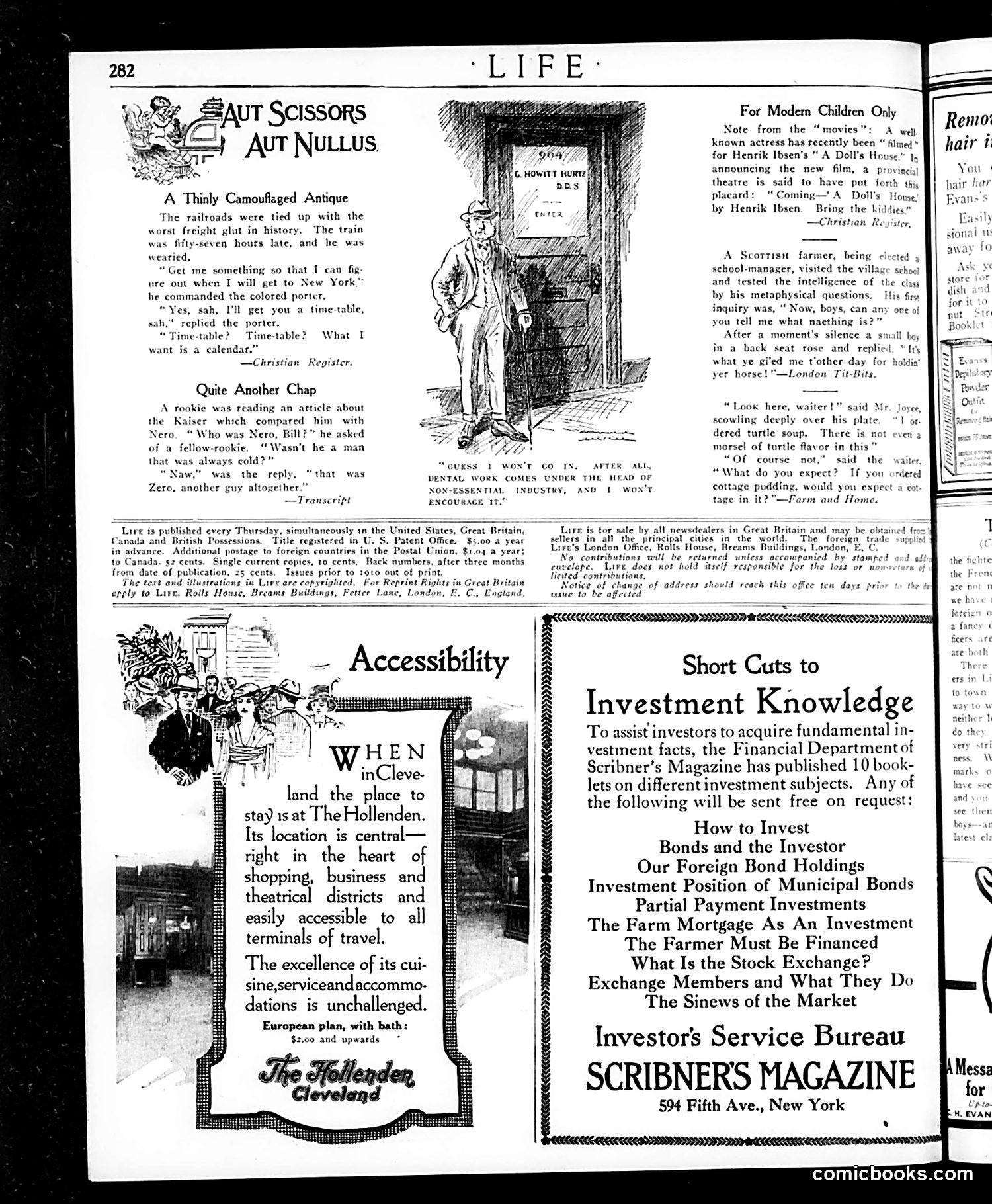
This page contains three short humorous anecdotes typical of early 20th-century Life magazine's "Aut Scissors, Aut Nullus" humor column: 1. **"A Thinly Camouflaged Antique"**: A porter mishears "time-table" as "calendar" during a railroad delay—a simple wordplay joke about miscommunication. 2. **"Quite Another Chap"**: A rookie soldier confuses the Roman emperor Nero with someone who is "always cold," conflating the historical figure with the word "naw" (no). The punchline references the Kaiser, playing on wartime anxieties. 3. **"Guess I Won't Go In"**: A diner complains about turtle soup lacking turtle flavor; the waiter sarcastically argues that ordering cottage pudding shouldn't guarantee cottage flavor—absurdist restaurant humor. The page also includes advertisements for The Hollenden hotel and Scribner's Magazine's investment guides. These are light, observational jokes reflecting early-1900s American life, class relations, and wartime concerns, with no deep political satire—simply entertainment for the magazine's readers.
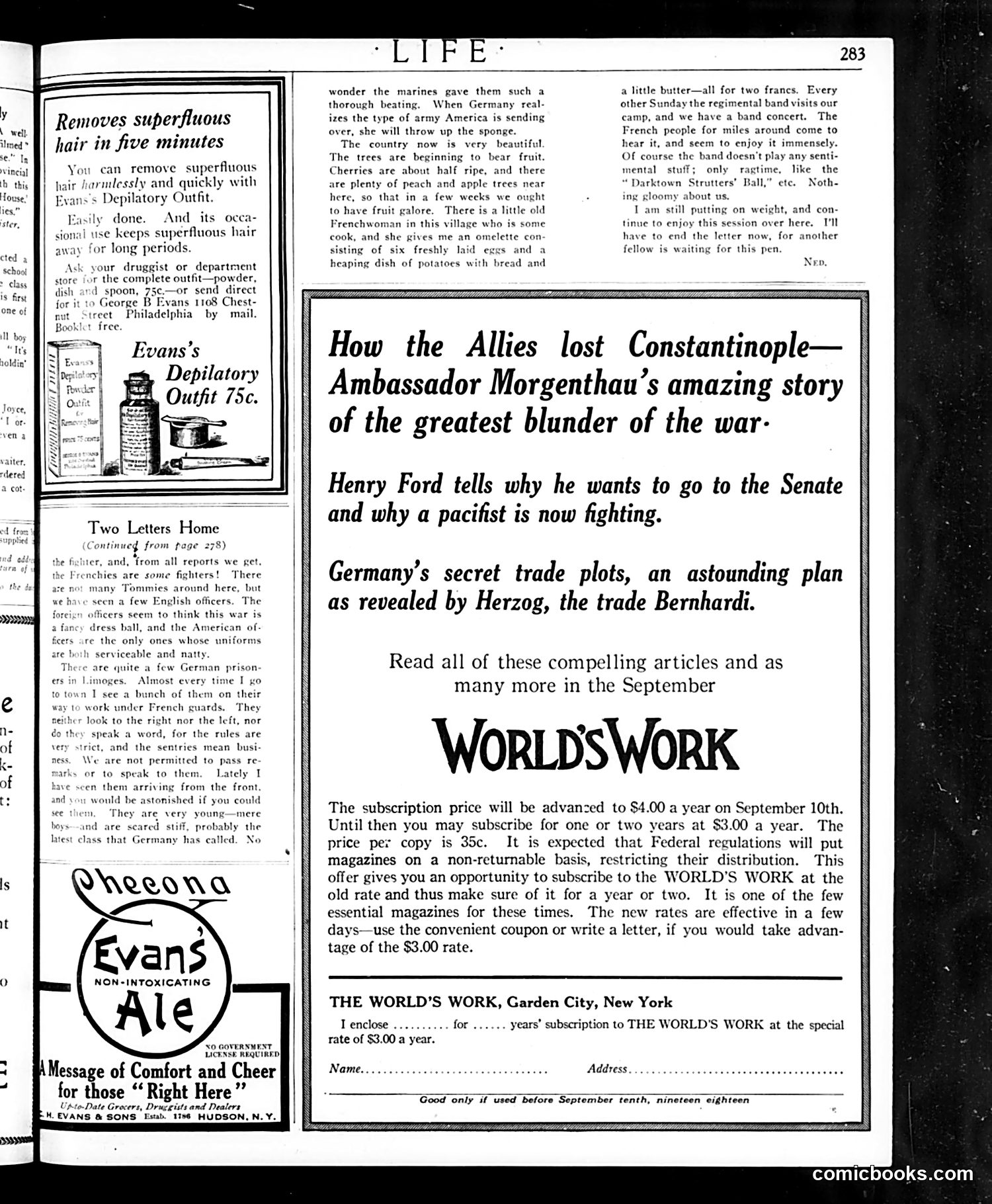
This page is primarily **advertising and promotional content**, not satirical cartoons. The main elements are: **Left side:** Product advertisements for Evans's Depilatory hair removal (75¢) and Oheona Ale, plus a personal letter from a soldier describing WWI trench life—noting young German prisoners and peaceful French village life with food and band concerts. **Right side:** A large advertisement for *World's Work* magazine promoting upcoming September articles, including pieces by Ambassador Morgenthau on the loss of Constantinople, Henry Ford on entering the Senate, and revelations about German trade plots. The ad emphasizes a price increase to $4/year after September 10th, urging immediate subscription at the old $3/year rate. **Context:** This appears to be from WWI-era America (likely 1917-1918). The content reflects wartime concerns: military matters, German espionage fears, and prominent public figures' political positions. The subscription urgency likely exploits wartime uncertainty about magazine distribution under "Federal regulations." The page contains **no political cartoons**—it's a mix of personal correspondence and commercial promotion.
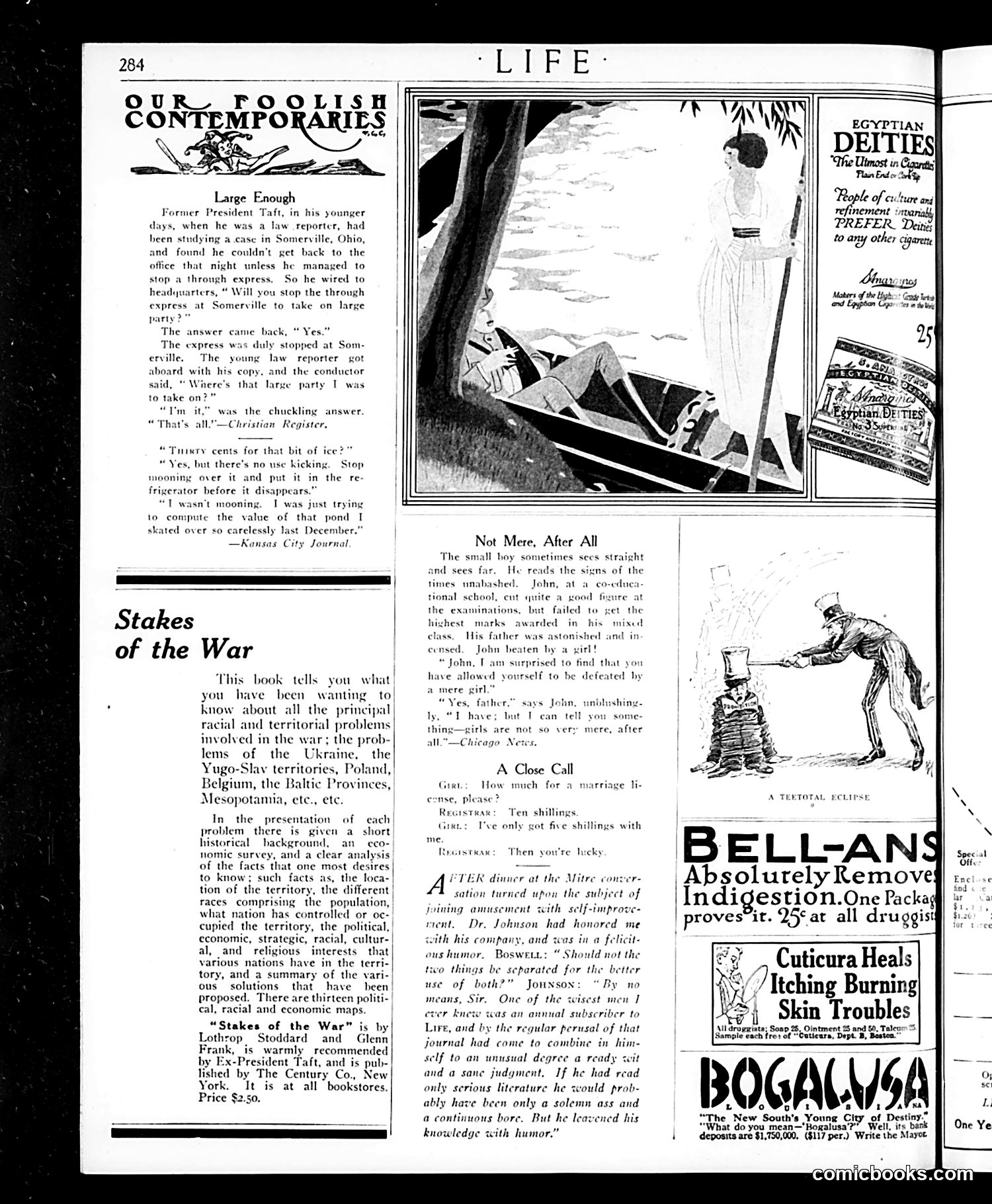
This page combines humor pieces with advertising. The main satirical content includes: **"Large Enough"** anecdote: A joke about former President Taft, exploiting his well-known obesity. As a young law reporter, Taft allegedly wired a railroad to stop an express train, claiming he needed space for a "large party"—the punchline being that he *himself* constituted the party. The humor relies on Taft's physical size being understood as comically enormous. **"Not Mere, After All"** and **"A Close Call"**: Brief humorous dialogues about gender relations and marriage negotiations, reflecting early 20th-century social attitudes. **"Stakes of the War"** advertisement: Promotes a book about World War I territorial disputes, endorsed by ex-President Taft. The page is primarily **advertising-driven**, featuring cigarette and patent medicine ads (Bell-Ans, Cuticura, Bogalusa). The satirical content is minimal—mostly wordplay and personality-based humor rather than political commentary.
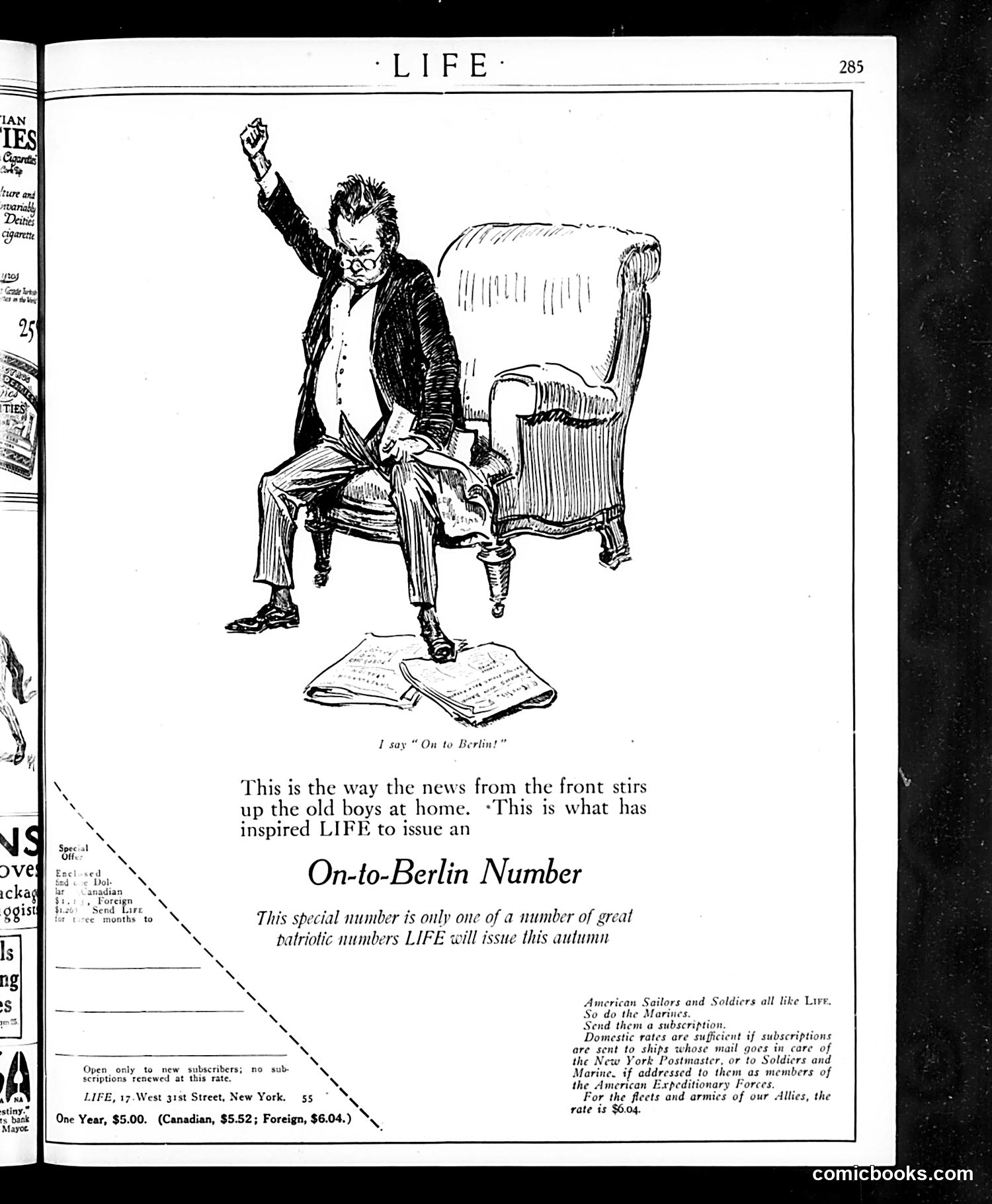
This page promotes a special patriotic issue of Life magazine themed around "On to Berlin!"—a rallying cry from World War I. The cartoon shows an excited older man (representing civilians at home) sitting in an armchair, fist raised, declaring support for the military offensive against Germany. Papers scattered at his feet suggest news from the front. The satire gently mocks how wartime enthusiasm at home ("the old boys") is stirred by headlines of military action, while the magazine capitalizes on patriotic fervor by issuing special war-themed issues. The subscription pitch below encourages readers to send Life to American soldiers, sailors, and Marines serving in World War I and the American Expeditionary Forces, with domestic and foreign rates listed. The advertisement frames subscriptions as patriotic support for troops.
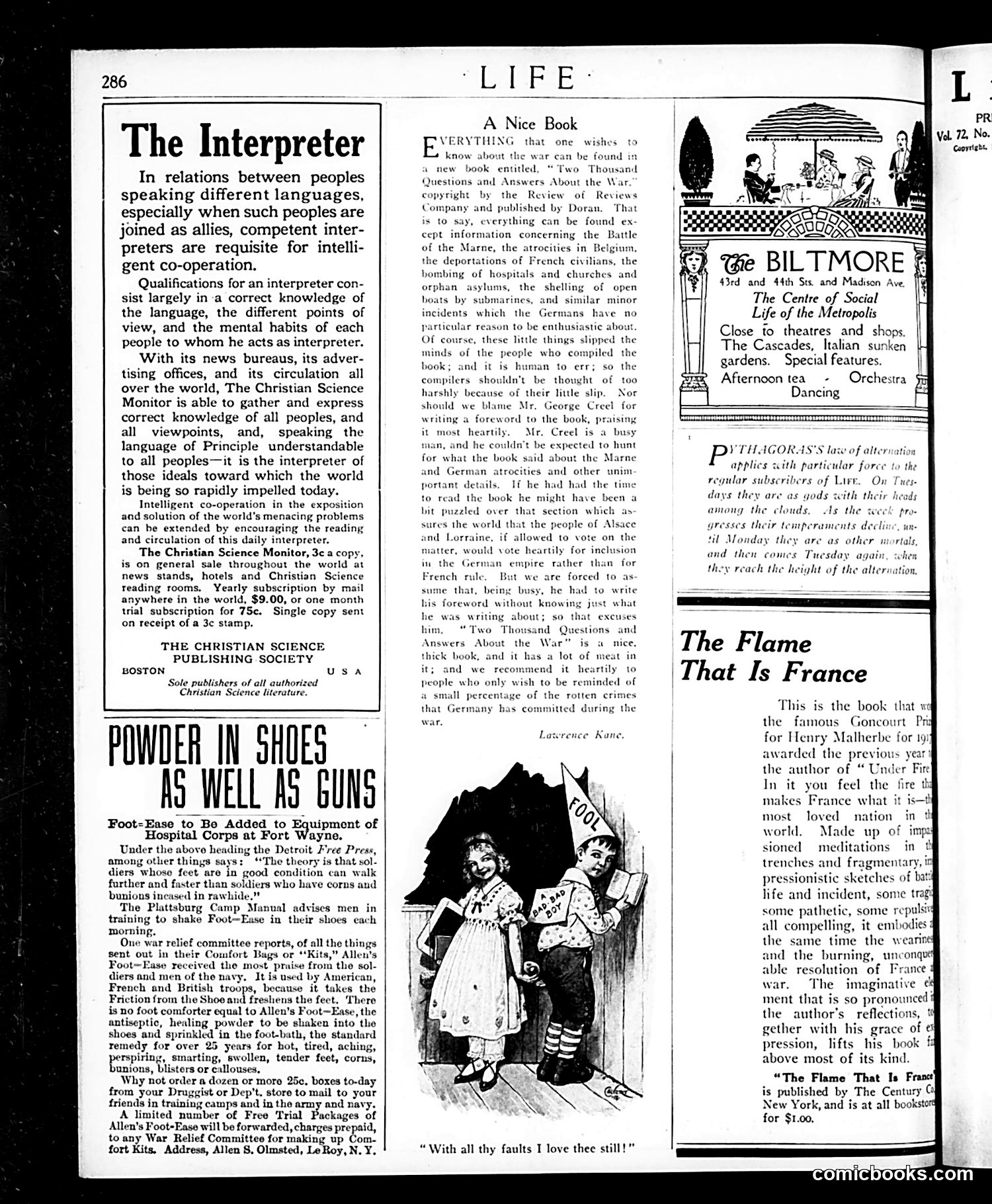
This page contains **satirical commentary on American WWI propaganda**, particularly targeting government information control. **"A Nice Book" section**: The satire mocks a published book titled "Two Thousand Questions and Answers About the War." The joke is brutal: the book claims to contain "everything" about the war, yet conveniently omits major German atrocities—the Battle of the Marne, Belgian atrocities, deportations of French civilians, bombing of hospitals/churches, and submarine attacks on civilian boats. The author sarcastically suggests these omissions are innocent errors, not deliberate censorship. The reference to **George Creel**—head of the Committee on Public Information, America's WWI propaganda bureau—implies the government was sanitizing war information. **Context**: This reflects real tension during WWI between official narratives and actual combat realities. Life's satire criticizes how American authorities managed public perception of the conflict, questioning whether citizens received truthful information about German conduct or American involvement. The page also contains standard advertising (foot powder, Christian Science Monitor), typical of period magazines.