
Life, 1918-08-22 · page 26 of 34
Life — August 22, 1918 — page 26: what you’re looking at
What you’re looking at
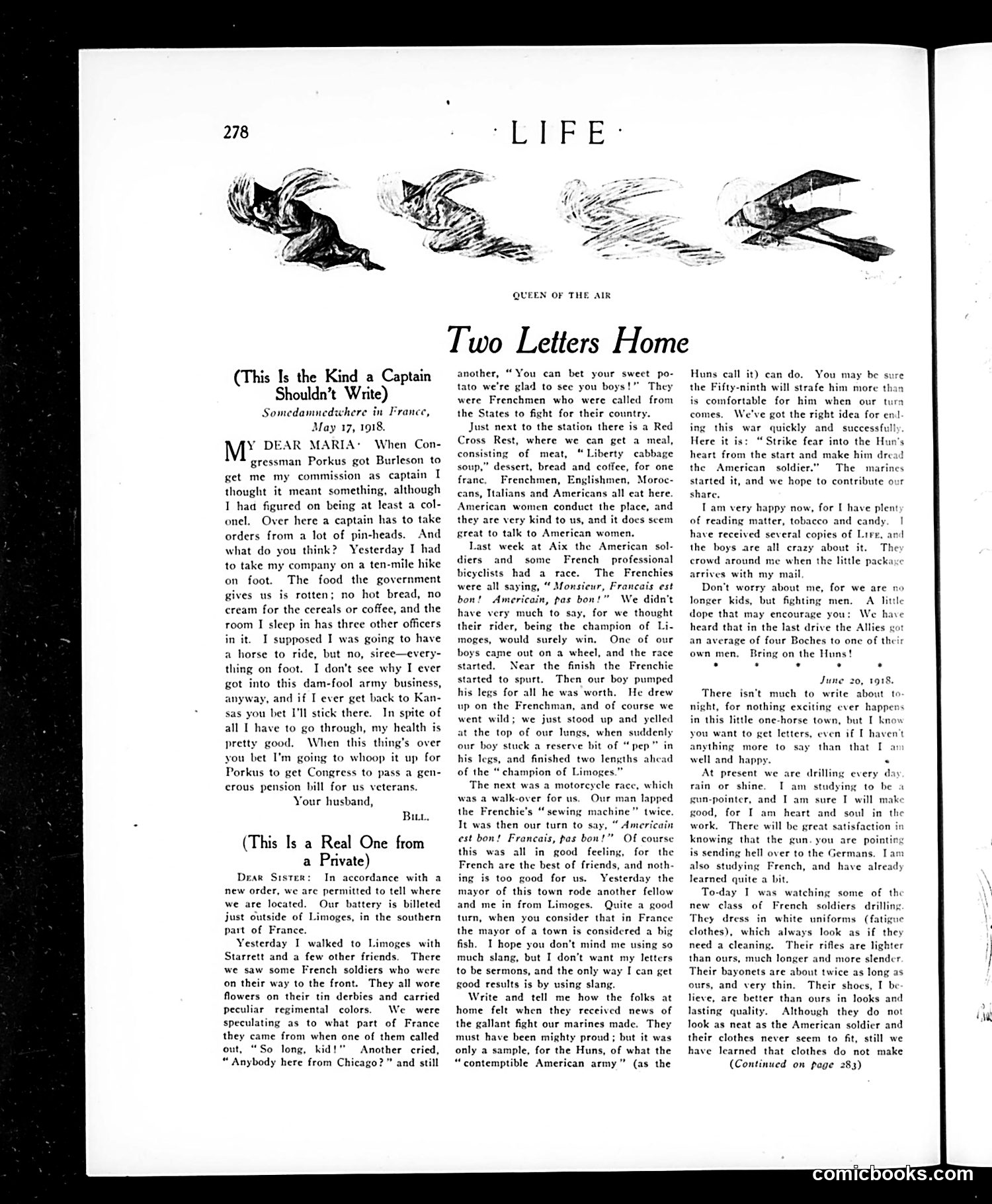
This page presents two letters from American soldiers in France (May 1918), deliberately contrasted to satirize different military ranks and attitudes. The first letter, from a Captain, complains bitterly about commissioned life—inadequate food, forced marches on foot, lack of privileges. He credits his commission to political patronage ("Congressman Porkus" and Postmaster General Burleson) and plans to seek veteran's pensions upon return. The header notes this is "the kind a captain shouldn't write"—suggesting unprofessional, entitled griping. The second letter, from an enlisted Private, describes genuine camaraderie with Allied soldiers, friendly athletic competitions with French cyclists and motorcyclists, and gratitude for kindness from French civilians and American Red Cross workers. His tone is cheerful and humble despite hardship. The satire criticizes officer privilege and ingratitude while celebrating enlisted men's morale and democratic spirit. The contrast exposes how political connections produce ungracious leaders while ordinary soldiers maintain dignity and purpose.
📄 Transcribed text from this page (OCR, searchable)
Machine-transcribed from the original scan — historical spelling and the odd misread are preserved.
(This Is the Kind a Captain Shouldn’t Write) Somedamnedwhere in France, May 17, 1918. ’ DEAR MARIA* When Con- gressman Porkus got Burleson to get me my commission as captain I thought it meant something, although I haa figured on being at least a col- onel. Over here a captain has to take orders from a lot of pin-heads. And what do you think? Yesterday I had to take my company on a ten-mile hike on foot. The food the government gives us is rotten; no hot bread, no cream for the cereals or coffee, and the room I sleep in has three other officers in it. I supposed I was going to have a horse to ride, but no, siree—every- thing on foot. I don't see why I ever got into this dam-fool army business, anyway, and if T ever get back to Kan- sas you bet I'll stick there. In spite of all I have to go through, my health is pretty good. When this thing's over you bet I'm going to whoop it up for Porkus to get Congress to pass a gen- crous pension bill for us veterans. Your husband, Bu. (This Is a Real One from a Private) Drak Sister: In accordance with a new order, we are permitted to tell where we are located. Our battery is billeted just outside of Limoges, in the southern part of France. Yesterday I walked to Limoges with Starrett and a few other friends. There we saw some French soldiers who were on their way to the front. They all wore flowers on their tin derbies and carried peculiar regimental colors. We were speculating as to what part of France they came from when one of them called out, “So long, kid!" Another cried, “ Anybody here from Chicago?” and still QUEEN OF THE AIR Two Letters Home another, “You can bet your sweet po- tato we're glad to see you boys!” They were Frenchmen who were called from the States to fight for their country Just next to the station there is a Red Cross Rest, where we can get a meal, of meat, “Liberty cabbage dessert, bread and coffee, for one Frenchmen, Englishmen, Moroc- cans, Italians and Americans all eat here. American women conduct the place, and they are very kind to us, and it does scem great to talk to American women, Last week at Aix the American sol- diers and some French professional bicyclists had a race. The Frenchies were all saying, “ Monsieur, Francais est bon! Americain, pas bon! We didn’t have very much to say, for we thought their rider, being the champion of Li- moges, would surely win, One of our boys came out on a wheel, and the race started. Near the finish the Frenchie started to spurt. Then our boy pumped his legs for all he was worth. He drew up on the Frenchman, and of course we went wild; we just stood up and yelled at the top of our lungs, when suddenly our boy stuck a reserve bit of “pep” in his legs, and finished two lengths ahead of the “champion of Limoges.” The next was a motorcycle race, which was a walk-over for us. Our man lapped the Frenchie's “ sewing machine” twice. Tt was then our turn to “ Americain est bon! Francais, pas bon!” Of course this was all in good feeling, for the French are the best of friends, and noth- ing is too good for us. Yesterday the mayor of this town rode another fellow and me in from Limoges. Quite a good turn, when you consider that in France the mayor of a town is considered a big fish. I hope you don’t mind me using so much slang, but I don’t want my letters to be sermons, and the only way I can get good results is by using slang. Write and tell me how the folks at home felt when they received news of the gallant fight our marines made. They must have been mighty proud ; but it was only a sample, for the Huns, of what the contemptible American army” (as the consisting soup, franc, Huns call it) ean do. You may be s the Fifty-ninth will strafe him more than is comfortable for him when our turn comes. We've got the right idea for end ing this war quickly and successfull Here it is: “Strike fear into the Hun’s heart from the start and make him dread the American soldier.” The marines started it, and we hope to contribute our share, Tam very happy now, for I have plent of reading matter, tobacco and candy. | have received several copies of Lire, andl the boys are all crazy about it. The crowd around me when the little pac arrives with my mail Don't worry about me, for we are longer kids, but fighting men. A little dope that may encourage you: We have heard that in the last drive the Allies got an average of four Boches to one of their own men, Bring on the Huns! June 20, 1918. There isn't much to write about night, for nothing exciting ever in this little one-horse town, but I know you want to get letters, even if I haven't that Tay well and happy. * anything more to say than At present we are drilling every day rain or shine. Tam studying to be gun-pointer, and Tam sure T will make good, for I am heart in the work. There will be great satisfaction knowing that the gun. you are pointing is sending hell over to the Germans, Tam also studying French, and learned quite a bit. To-day I watching some of the new class of French soldiers drilling They dress in white uniforms (fatigue and soul have already was clothes), which always look as if they need a cleaning. Their rifles are lighter than ours, much longer and more slender Their bayonets are about twice as long as ours, and very thin. Their shocs, I be lieve, are better than ours in looks and lasting qual Although they do not look as neat as the American soldier and their clothes never seem to fit, still we have learned that clothes do not make (Continued on page 283) Ccomicbooks.com