
Life, 1918-08-22 · page 20 of 34
Life — August 22, 1918 — page 20: what you’re looking at
What you’re looking at
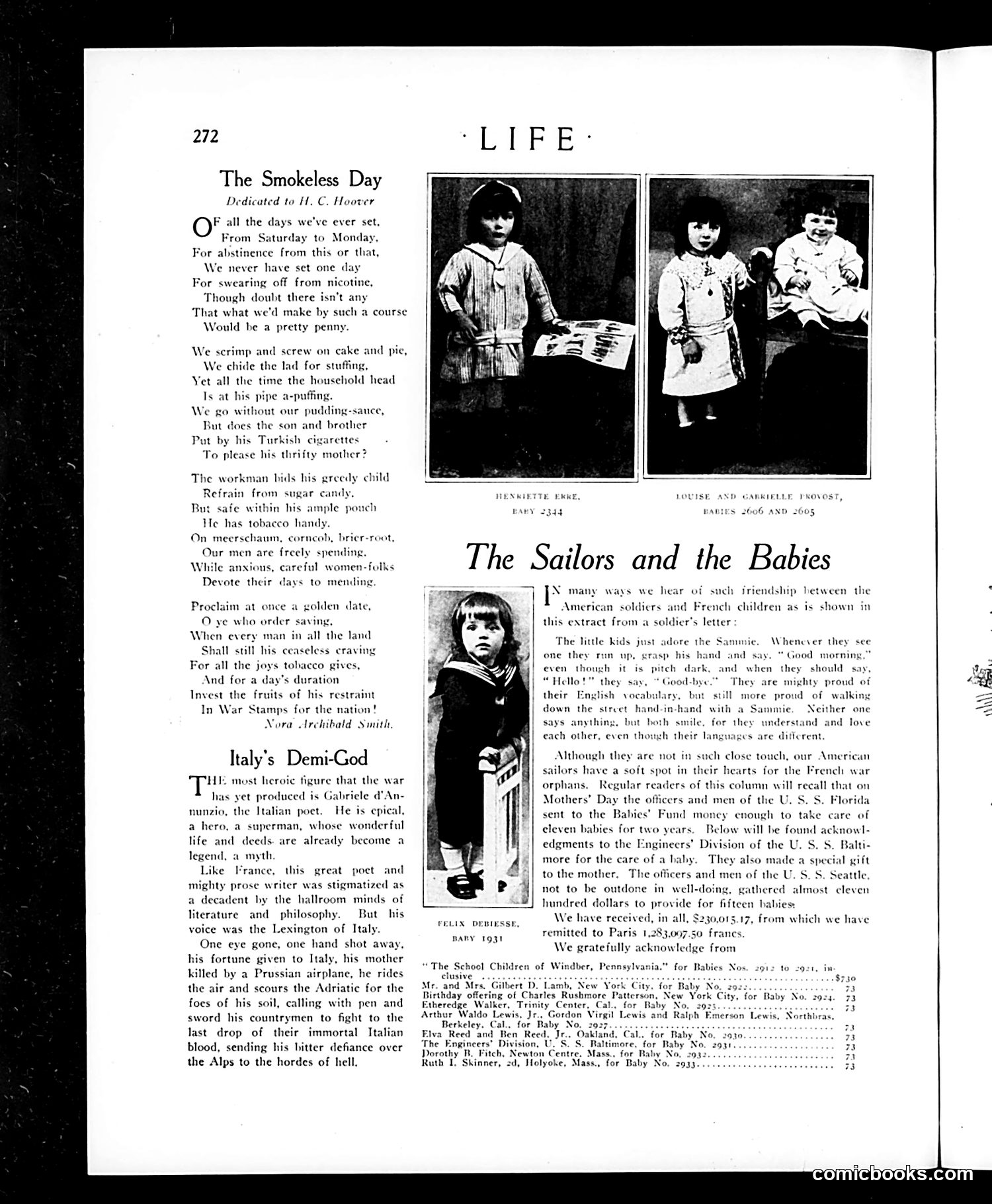
This Life magazine page from WWI era contains patriotic appeals disguised as satire. **"The Smokeless Day"** (dedicated to H.C. Hoover, then Food Administrator) ironically critiques male hypocrisy: families sacrifice luxuries like desserts to conserve resources for the war effort, yet men freely spend on tobacco and cigarettes. The poem proposes a "Smokeless Day" where men would forgo tobacco and donate savings to War Stamps—a fundraising appeal wrapped in gentle mockery of gender double standards. **"Italy's Demi-God"** praises Gabriele d'Annunzio, the Italian poet-aviator, as an inspirational wartime hero despite his disabilities (lost eye and hand), positioning him as a symbol of Italian resistance. **"The Sailors and the Babies"** documents American servicemen's charitable donations to French war orphans, framed as heartwarming evidence of soldier humanity and international solidarity during WWI. Together, these pieces promote patriotic sacrifice and favorable views of Allied soldiers.
📄 Transcribed text from this page (OCR, searchable)
Machine-transcribed from the original scan — historical spelling and the odd misread are preserved.
272 The Smokeless Day Dedicated to H. C. Hoover Or all the days we've ever set, From Saturday to Monda: For abstinence from this or that, We never have set one day For swearing off from nicotine, Though doubt there isn't any That what we'd make by such a course Would he a pretty penny. We scrimp and screw on cake and pic, We chide the lad for stuffing, Yet all the time the household head Is at his pipe a-puffing. We go without our pudding-sauce, But does the son and brother Put by his Turkish cigarettes To please his thrifty mother? The workman bids his greedy child Refrain from sugar candy, But safe within his ample pouch He has tobacco handy. On meerschaum, cornceb, brier-root, Our men are freely spending While anxious, careful women- Devote their ¢ ys to mending, Proclaim at once a golden date, O ye who order saving, When every man in all the land Shall still his ceasel For all the joys toh: ess craving © gives, And for a day's duration Invest the fruits of his restraint In War Stamps for the nation! Nora Archibald Smith: Italy's Demi-God TT iit most heroic figure that the war has yet produced is Gabriele d’An- nunzio, the Italian poet. He is epical, a hero, a superman, whose wonderful life and deeds. are already become a legend, a myth Like France, this great poet and mighty prose writer was stigmatized as a decadent by the hallroom minds of literature and philosophy. But his voice was the Lexington of Italy. One eye gone, one hand shot away, fortune given to Italy, his mother killed by a Prussian airplane, he rides the air and scours the Adriatic for the foes of his soil, calling with pen and sword his countrymen to fight to the last drop of their immortal Italian blood, sending his bitter defiance over the Alps to the hordes of hell. HENRIETTE ERKE LOUISE AND GARKIELLE PKOvOST, BABY 2344 BABIES 2606 AND 2605 The Sailors and the Babies T] JX many ways we hear of such friendship 1 tween the American soldiers and French children as is shown in this extract from a soldier's letter The little kids just adore the Sammie, Whenever they see one they run up, grasp his hand and say. “Good morning,” even though it is pitch dark, and when they should say, Hello!” they say, “Good-bye.” They are mighty proud of their English vocabulary, but still more proud of walking down the street hand-in-hand with a Sammie. Neither one says anything, but both smile, for they understand and love other, even though their languages are dif Mthough they are not in such close touch, our American sailors have a soft spot in their hearts for the French war orphans. Regular readers of this column will recall that on Mothers’ Day the officers and men of the U. S. S. Florida sent to the Babies’ Fund money enough to take care of eleven babies for two years. Below will be found acknow!l- edgments to the Engineers’ Division of the U. S. S. Balti- more for the care of a haby. They also made a special gift to the mother. The officers and men of the U.S. S. Seattle, not to be outdone in well-doi gathered almost cleven hundred dollars to provide for fifteen babies: We have received, in all, $230,015.17, from which we have remitted to Paris 1,2! We gratefully FELIX DEBIESSE BARY 1931 3,007.50 frances. knowledge from * The School Children of Windber, Pennsylva: Mr. and Mrs. Gilbert D. Lamb, New York City, for Baby No. Birthday offering of Charles Rushmore Patterson, New York Cit =theredge Walker, Trinity Center, Cal., for Raby No, 2925 : . Arthur Waldo Lewis, Jr.. Gordon Virgil Lewis and Ralph Emerson Lewis, Northl Berkeley. Cal., for Baby No. oe ates . « . Elva Reed and Ren Reed. Jr.. Oakland, Cal. for Raby The Engineers’ Division, U.S. S. Raltimore, for Raby Ni Dorothy RB. Fitch, Newton Centre, Mass.. for Raby No, 2932..... eres 7 Ruth I. Skinner, 2d, Holyoke, Mass, for Baby No. 2933. ; for Rabies Nos. 2912 to 2o2t, ‘or Raby No. 2924.