
Life, 1918-08-22 · page 16 of 34
Life — August 22, 1918 — page 16: what you’re looking at
What you’re looking at
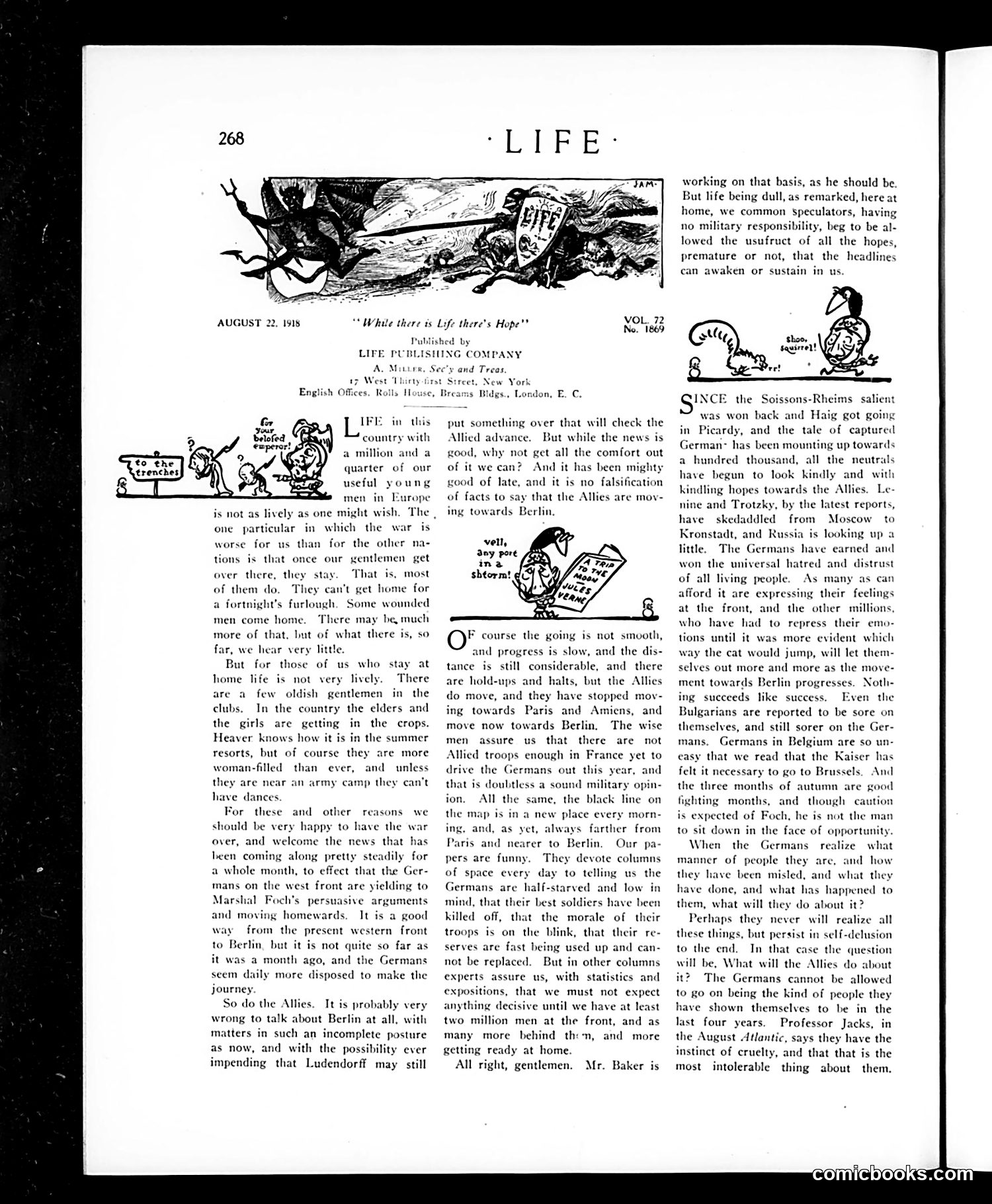
This page addresses American home-front morale during World War I's final months. The main editorial discusses the dullness of American civilian life—with a quarter-million young men in Europe and unable to take furloughs, social activities have stalled. Clubs lack older gentlemen; country estates need harvesting; resorts and dances are depleted. The piece pivots to cautious optimism about Allied military progress. The Germans are retreating toward Berlin rather than advancing toward Paris and Amiens—a significant psychological shift. The editorial references **Marshal Foch** (French commander), **General Ludendorff** (German commander), **Secretary Baker** (U.S. War Secretary), and notes that **Lenin and Trotsky** have begun viewing the Allies favorably as German defeat appears likely. The cartoons (appearing top and sides) use humor to reinforce these themes about wartime American life and hope for victory. The satirical tone suggests civilians should permit themselves optimism about the war's conclusion, even amid official caution about needing more troops.
📄 Transcribed text from this page (OCR, searchable)
Machine-transcribed from the original scan — historical spelling and the odd misread are preserved.
AUGUST 22, 1918 “Whale there ts Life there's Hope’* ished by LIFE PUBLISHING COMPANY A, Mut tz West 1 English Offices, Rolls Hou IFE in country with a million and a quarter of our useful young men in Europe is not as lively as one might wish. The one particular in which the war is worse for us than for the other na- tions is that once our gentlemen get over there, they stay. That is, of them do. They can't get home for a fortnight’s furlough. Some wounded men come home. There may be, much more of that, but of what there is, so far, we hear very little. But for those of us home life is not very lively. There few oldish gentlemen in the clubs. In the country the elders and the girls are getting in the crops. Heaver knows how it is in the summer resorts, but of course they are more than and unless most who stay at are a woman-filled they are near an army camp they can’t ever, have dances For these and other reasons should be very happy to have the war we over, and welcome the news that has heen coming along pretty steadily for a whole month, to effect that the Ger- mans on the west front are yielding to Marshal Foch’s persuasive arguments and moving homewards. It is a good way from the present western front to Berlin, but it is not quite so far as it was a month ago, and the Germans seem daily more disposed to make the journey, So do the Allies. It is probably very wrong to talk about Berlin at all, with matters in such an incomplete posture as now, and with the possibility ever impending that Ludendorff may. still re, 8) fy sirst Stre cc’y and Treas, New York Bldgs., London, E. C. put something over that will check the Allied advance. But while the news is good, why not get all the comfort out of it we can? And it has been mighty good of late, and it is no falsification of facts to say that the Allies are mov- ing towards Berlin, vell, course the going is not smooth, and progress is slow, and the dis- tance is still considerable, and there are hold-ups and halts, but the Allies do move, and they have stopped mov- ing towards Paris and Amiens, and move now towards Berlin, The wise men assure us that there are not Allied troops enough in France yet to drive the Germans out this year, and that is doubtless a sound military opin- All the same, the black line on the map is in a new place every morn- ing, and, as yet, always farther from Our pa- ion. ‘aris and nearer to Berlin. pers are funny. They devote columns of space every day to telling us the Germans are half-starved and low in mind, that their best soldiers have been killed off, that the morale of their troops is on the blink, that their re- serves are fast being used up and can- not be replaced. But in other columns experts assure us, with statistics and expositions, that we must not expect anything decisive until we have at least two million men at the front, and as many more behind then, and more getting ready at home. All right, gentlemen. Mr. Baker is working on that basis, as he should be. But life being dull, as remarked, here at home, we common speculators, having no military responsibility, beg to be al- lowed the usufruct of all the hopes, premature or not, that the headlines can awaken or sustain in us. INCE the Soissons-Rheims. salient was won back and Haig got going in Picardy, and the tale of captured German- has been mounting up towards a hundred thousand, all the neutrals have begun to look kindly and with kindling hopes towards the Allies. Le- nine and Trotzky, by the latest reports, have skedaddled from Moscow to Kronstadt, and Russia is looking up a little. The Germans have earned and won the universal hatred and distrust of all living people. As many afford it are expressing their feelings at the front, and the other millions, who have had to repress their emo- Ss can tions until it was more evident which way the cat would jump, will let them- selves out more and more as the move- ment towards Berlin progresses. Noth- ing succeeds like success. Even the Bulgarians are reported to be sore on themselves, and still sorer on the Ger- mans. Germans in Belgium are so un- easy that we read that the Kaiser has felt it necessary to go to Brussels, And the three months of autumn are good fighting months, and though ca is expected of Foch, he is not the man to sit down in the face of opportunity When the Germans realize what manner of people they are, and how they have been misled, and what they ition have done, and what has happened to them, what will they do about it? Perhaps they never will realize all these things, but persist in self-delusion to the end. In that case the question will be, What will the Allies do about i The Germans cannot be allowed to go on being the kind of people they have shown themselves to be in the last four years. Professor Jacks, in the August Atlantic, says they have the instinct of cruelty, and that that is the most intolerable thing about them.