
Life, 1918-08-22 · page 29 of 34
Life — August 22, 1918 — page 29: what you’re looking at
What you’re looking at
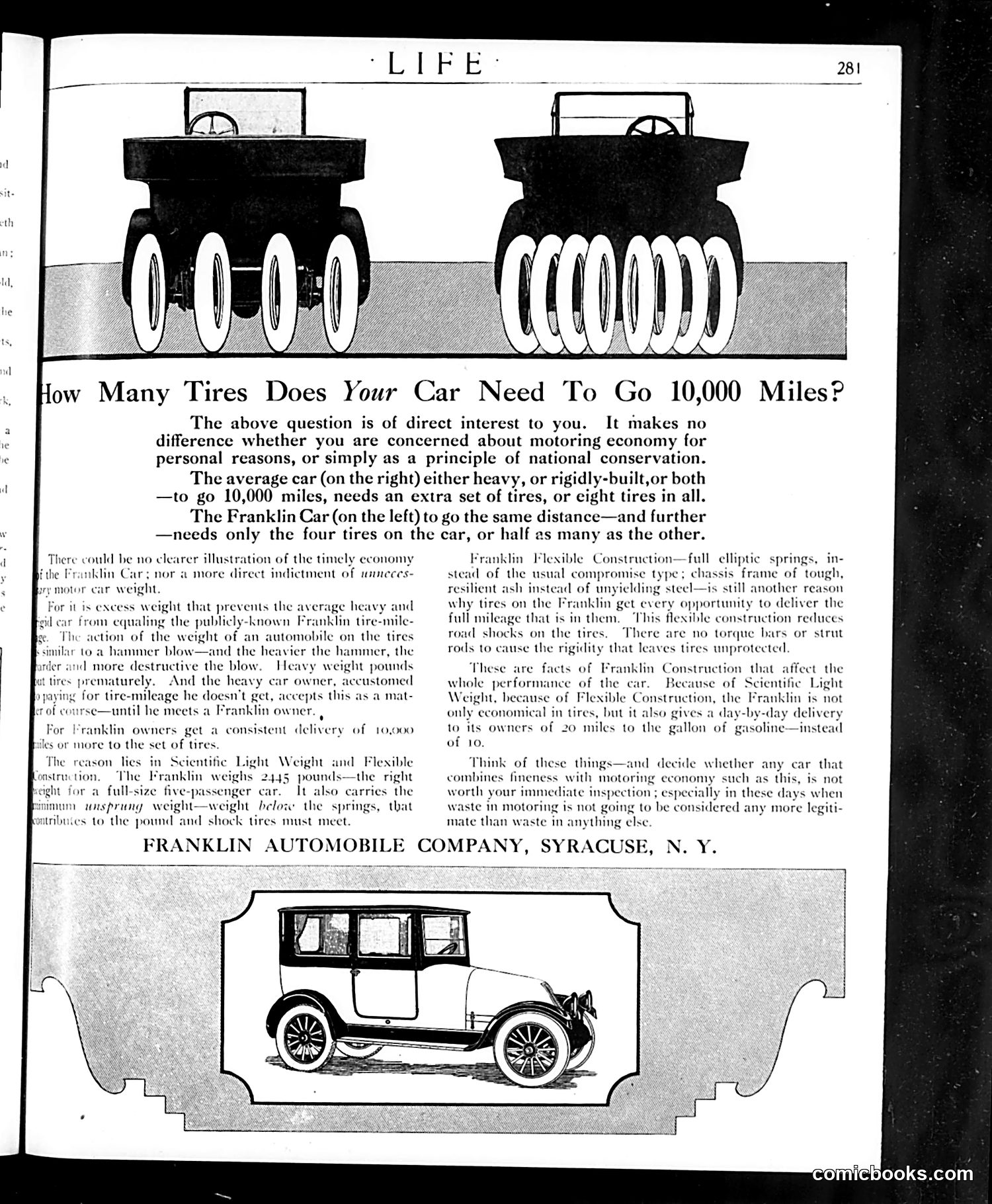
This is a Franklin Automobile advertisement disguised as editorial content. It compares two cars' tire durability over 10,000 miles: a heavy, rigid competitor requiring eight tires total versus the Franklin, which needs only four. The "satire" here is that Franklin claims superior engineering—specifically "Scientific Light Weight" and "Flexible Construction"—allows their car to achieve double the tire mileage. The comparison uses visual humor: the competitor's cart is burdened with eight enormous tires while Franklin's has four. The appeal to "national conservation" reflects post-WWI efficiency concerns. The ad also boasts 20 miles-per-gallon fuel economy versus 10 for competitors. This represents early automotive marketing: technical claims (lighter weight, better suspension design) are presented as objective facts to justify premium purchasing decisions. The page is essentially advertising masquerading as consumer guidance—a common Life magazine format of this era.
📄 Transcribed text from this page (OCR, searchable)
Machine-transcribed from the original scan — historical spelling and the odd misread are preserved.
ow Many Tires Does Your Car Need To Go 10,000 Miles? The above question is of direct interest to you. It makes no difference whether you are concerned about motoring economy for personal reasons, or simply as a principle of national conservation. The average car (on the right) either heavy, or rigidly-built,or both —to go 10,000 miles, needs an extra set of tires, or eight tires in all. The Franklin Car (on the left) to go the same distance—and further —needs only the four tires on the car, or half as many as the other. no clearer illustration of the timely economy Franklin Flexible Construction—full elliptic springs, in- nor a more direct indictment of wineces- stead of the usual compromise type; chassis frame of tough, resilient ash instead of unyielding stecl—is still another reason why tires on the Franklin get every opportunity to deliver the full mileage that is in them his flexible construction reduces road shocks on the tires. There are no torque bars or strut rods to cause the rigidity that leaves tires unprotected, There could fthe Franklin € motor car weight. it is excess weight that prevents the average heavy and id car from equaling the publicly-known Franklin tire-mile- ge. The action of the weight of an automobile on the tires } similar to a hammer blow—and the heavier the hammer, the Jer and more destructive the blow. Heavy weight pounds These are facts of Franklin Construction that affect the ematurely, And the heavy car owner, accustomed whole performance of the car. Because of Scientific Light for tire-mileage he doesn’t get, accepts this as a mat- Weight, because of Flexible Construction, the Franklin is not se—until he meets a Franklin owner. , Franklin owners get a consistent delivery of 10,000 les or more to the set of tires The reason lies in Scientific Light Weight and Flexible The nklin weighs 2445 pounds—the right for a full-size five-passenger car. It also carries the imum unsprung weight—weight below the springs, that atribuics to the pound and shock tires must meet FRANKLIN AUTOMOBILE struction, only economical in tires, but it also gives a day-by-day delivery to its owners of 20 miles to the gallon of gasoline—instead of 10. Think of these things—and decide whether any car that combines fineness with motoring economy such as this, is not worth your immediate inspection ; especia when waste In motoring is not going to be considered any more legiti- mate than waste in anything else COMPANY, SYRACUSE, N. Y. ee ie cbooks.com ‘omy