
A complete issue · 37 pages · 1918
Life — June 27, 1918
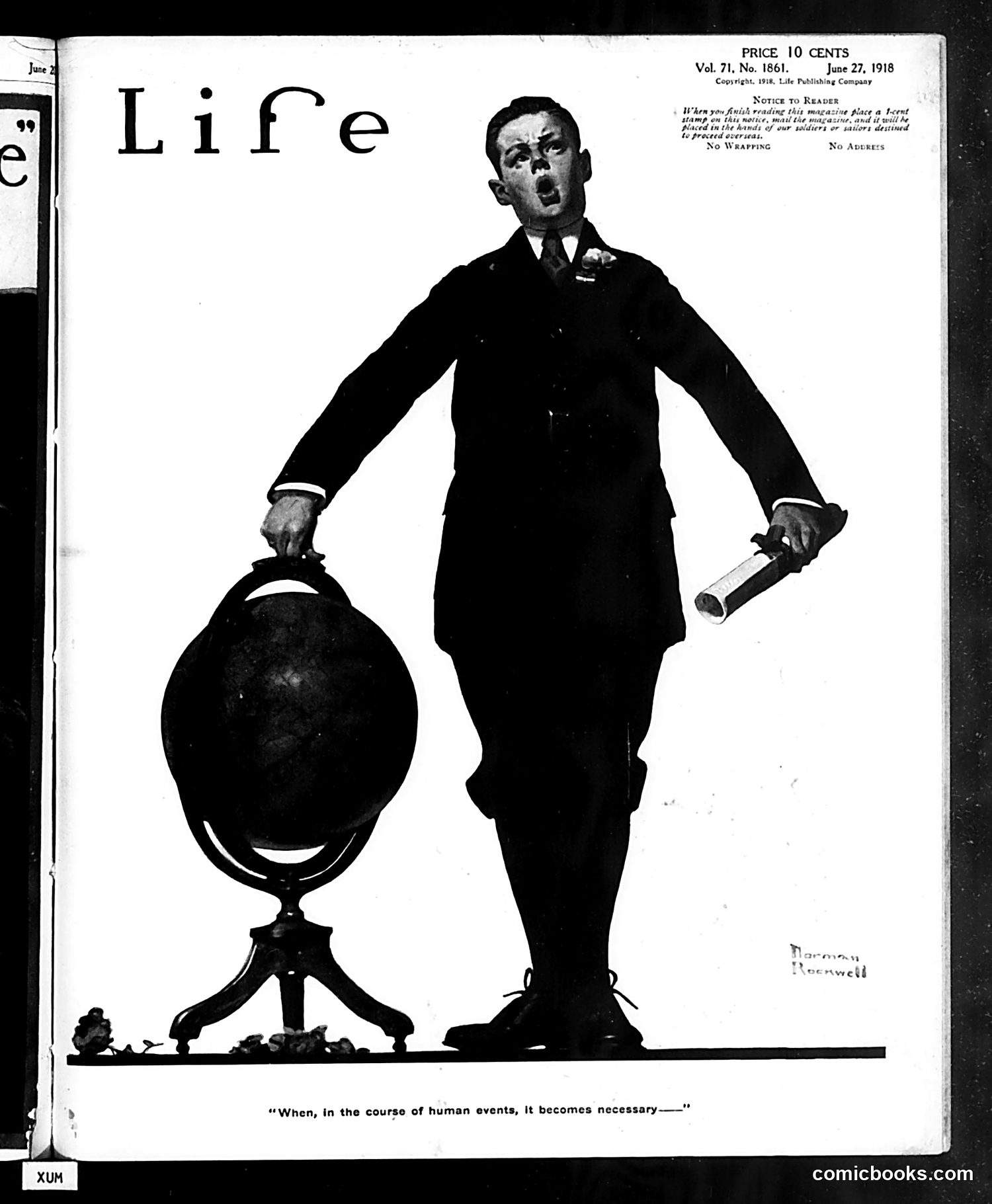
This Norman Rockwell illustration depicts a man in formal attire holding a globe in one hand and a scroll or document in the other, with an expression of grave determination. The caption reads: "When, in the course of human events, it becomes necessary——" This appears to reference the Declaration of Independence opening ("When, in the course of human events, it becomes necessary..."), suggesting the figure represents a statesman or leader confronting a critical moment. Published during World War I (note the military insignia on his collar), the image likely comments on wartime decision-making and American responsibility regarding global events. The globe symbolizes international stakes; the scroll suggests official authority or proclamation. The satirical point concerns serious governmental action during wartime.
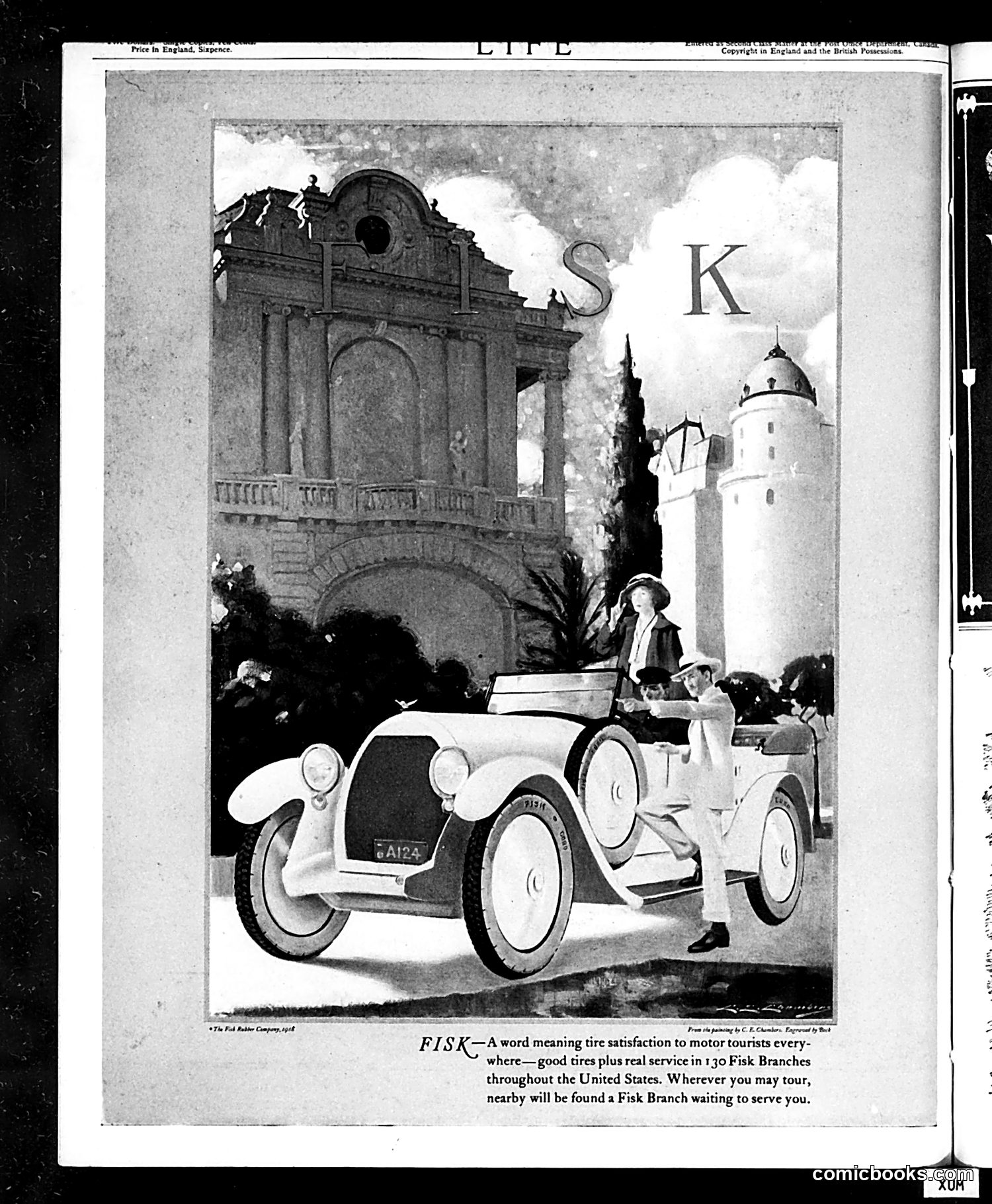
This page is primarily **advertising rather than satire**. The large image depicts a vintage automobile (with license plate visible) positioned in front of an ornate European-style building with a minaret or tower. Two well-dressed figures stand beside the car. The ad promotes **Fisk tires**, using the tagline "FISK—A word meaning tire satisfaction to motor tourists everywhere." The copy emphasizes Fisk's service network across 130 branches throughout the United States, promising tire service availability wherever travelers venture. The European architectural setting suggests this advertisement targets affluent motorists undertaking leisure travel, positioning Fisk as the reliable choice for touring automobiles. The "S K" letters overlay the sky, likely part of the Fisk branding.
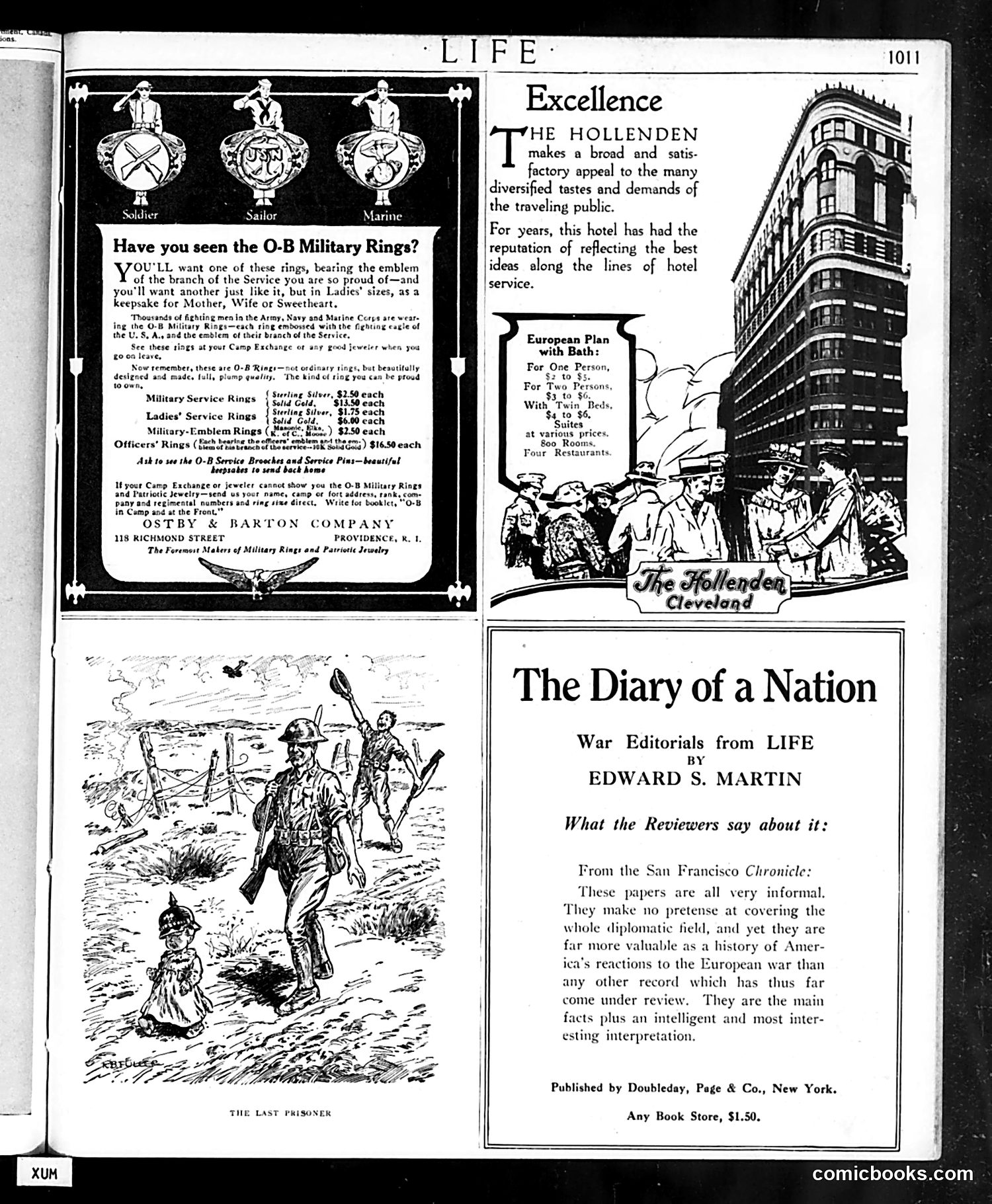
This page contains primarily **advertisements and book promotion**, not political satire. The left side advertises **O-B Military Rings** from the Ostby & Barton Company—service rings for Army, Navy, and Marine personnel. The rings feature emblems of each branch and are marketed to military servicemen as keepsakes. Below is an illustration titled "The Last Prisoner," depicting a soldier confronting what appears to be a German soldier or officer, likely referencing **World War I combat scenes**. The right side promotes **The Hollenden Hotel** in Cleveland and advertises **"The Diary of a Nation,"** a collection of war editorials by Edward S. Martin, published by Doubleday, Page & Co. for $1.50. The page reflects early 20th-century American military and wartime commerce.
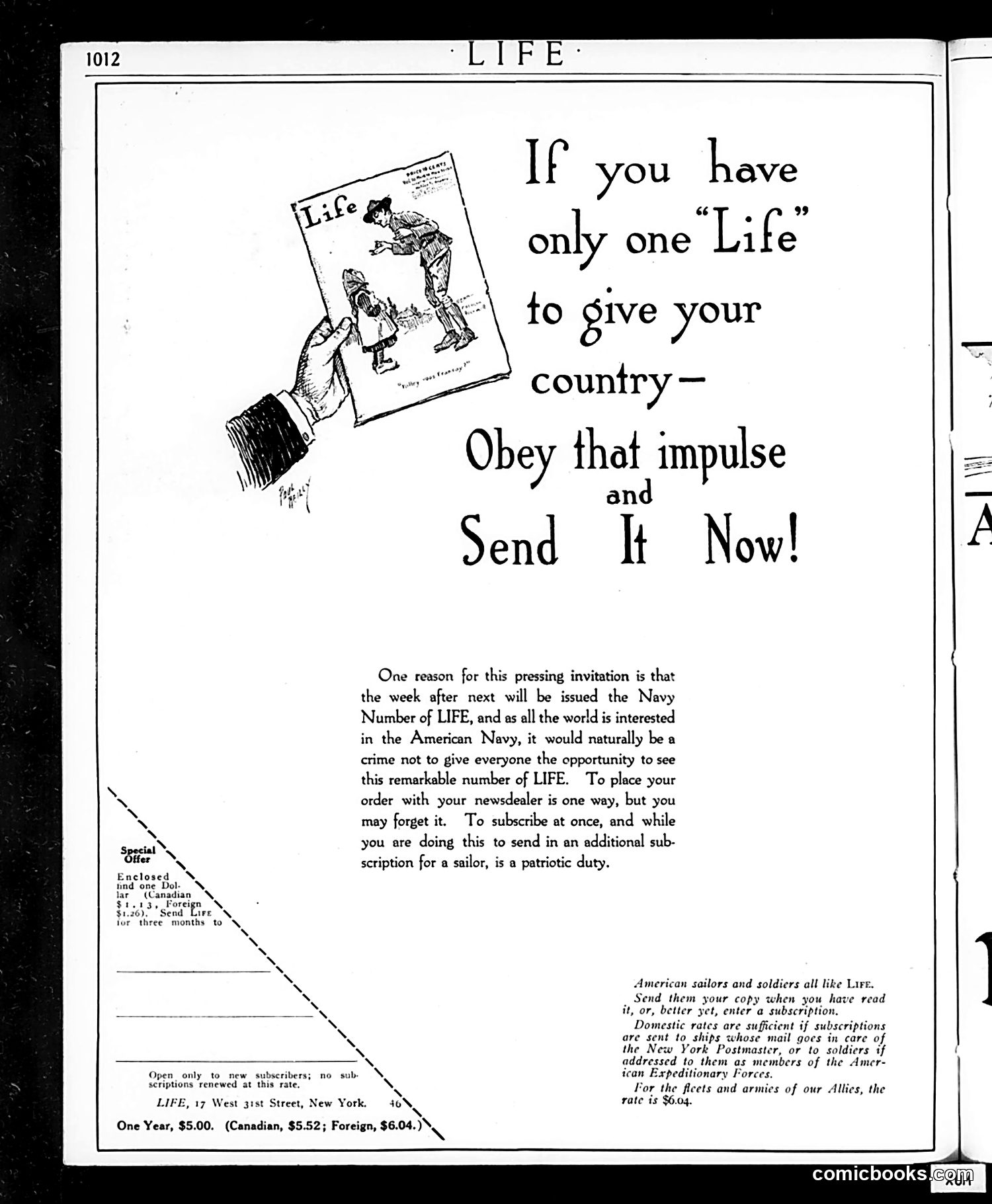
This is primarily a **wartime recruitment advertisement** rather than satirical content. Published during World War I (based on references to "American Navy" and "sailors and soldiers"), the ad uses patriotic appeals to encourage LIFE magazine subscriptions. The central image shows a hand holding a LIFE magazine featuring military figures. The text urges readers to subscribe, framing it as a patriotic duty—particularly noting that the upcoming "Navy Number" would be in high demand worldwide, making it almost unpatriotic not to obtain it. The appeal emphasizes that subscribing also enables sending LIFE to soldiers and sailors overseas, positioning magazine consumption as civic obligation during wartime. This reflects early-20th-century American war propaganda strategies that conflated consumer behavior with patriotism.
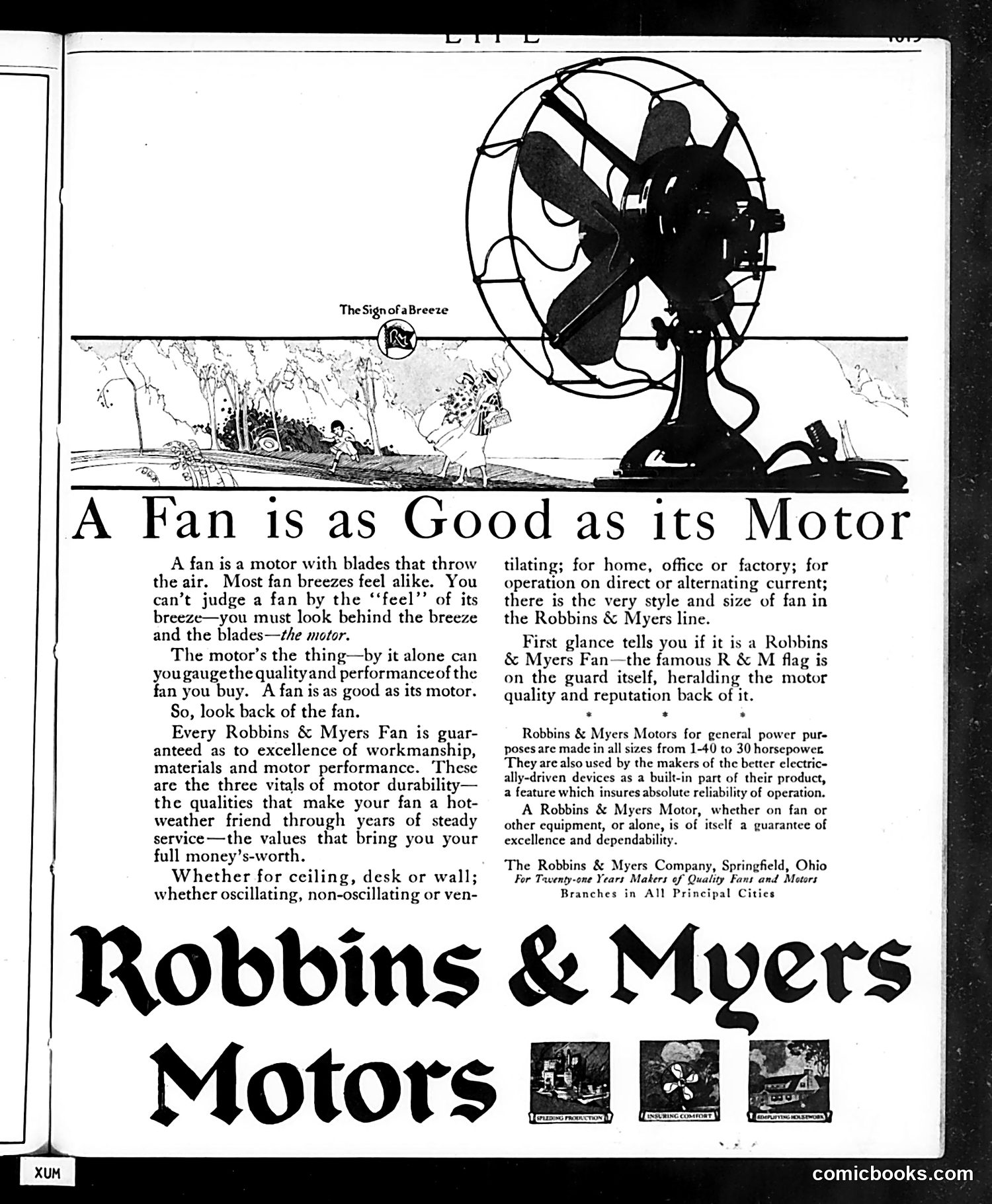
This page is primarily **advertising, not satire or political commentary**. It's a Robbins & Myers Motors advertisement promoting electric fans. The headline "A Fan is as Good as its Motor" is a straightforward sales pitch emphasizing that fan quality depends on motor quality. The illustration shows a pastoral scene with a woman and child, paired with a large electric fan—this juxtaposition was common in early 20th-century advertising to associate modern technology with domestic comfort and leisure. The text argues consumers should examine the motor ("look behind the breeze and the blades") to judge a fan's quality. The R&M logo on the guard ("the famous R & M flag") serves as a brand identifier and quality marker. There is **no political satire** present here—this is pure product advertisement from the early 1900s, emphasizing durability and motor excellence.
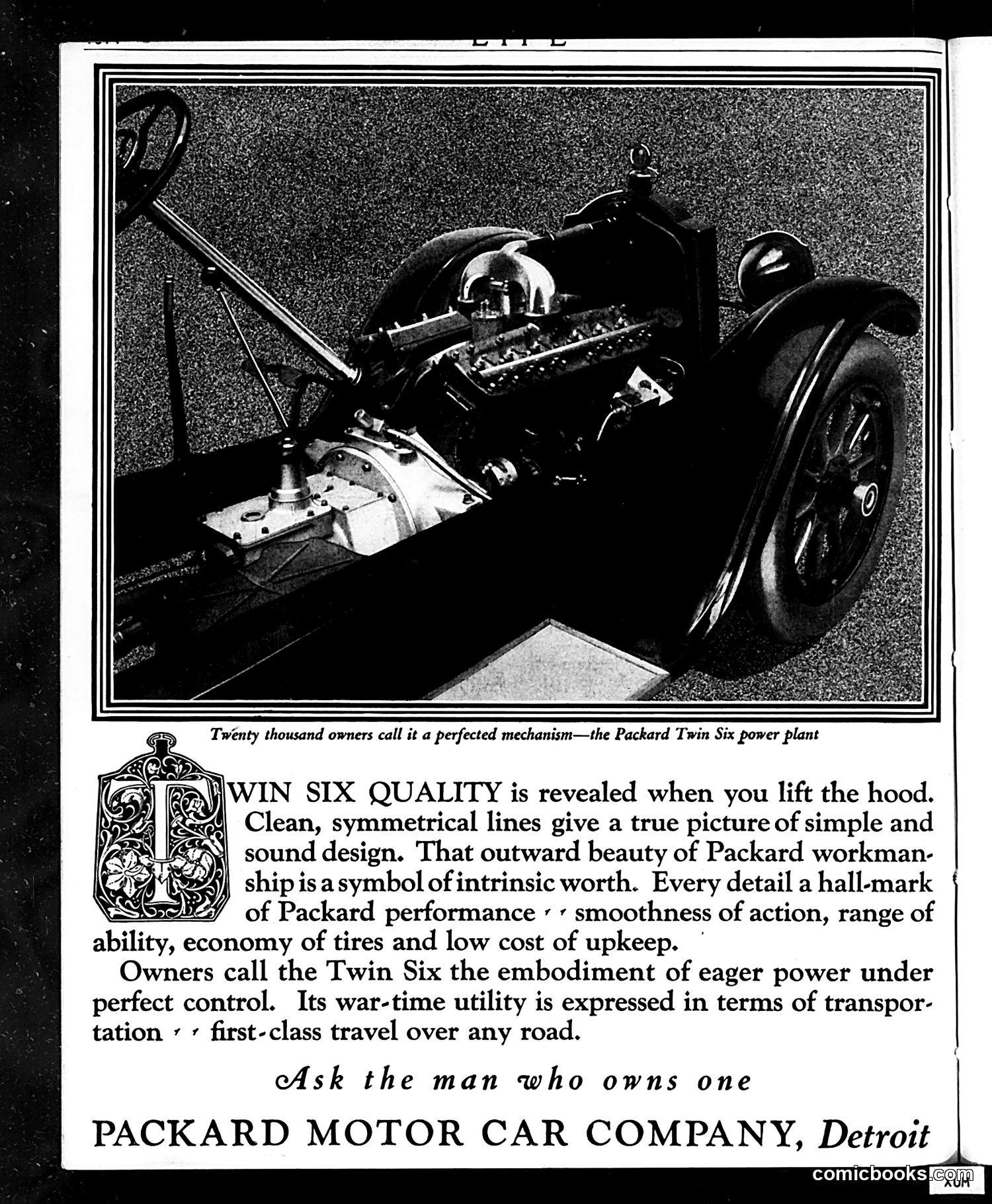
This is **not a satirical cartoon** but rather a **vintage automobile advertisement** from Life magazine. The image shows an overhead view of a Packard Twin Six automobile with its engine exposed, highlighting the mechanical components. The advertisement emphasizes quality engineering and design aesthetics. Key selling points highlighted include: - Clean, symmetrical mechanical design as evidence of superior craftsmanship - Reliability and smooth performance - Fuel economy and low maintenance costs - Powerful yet controlled engine performance - Wartime utility for transportation The ornate initial "T" and formal typography reflect early 20th-century advertising style. The phrase "Ask the man who owns one" was Packard's actual advertising slogan. This appears to be promoting the luxury automobile market during or shortly after World War I, when such vehicles represented significant personal investment and status.
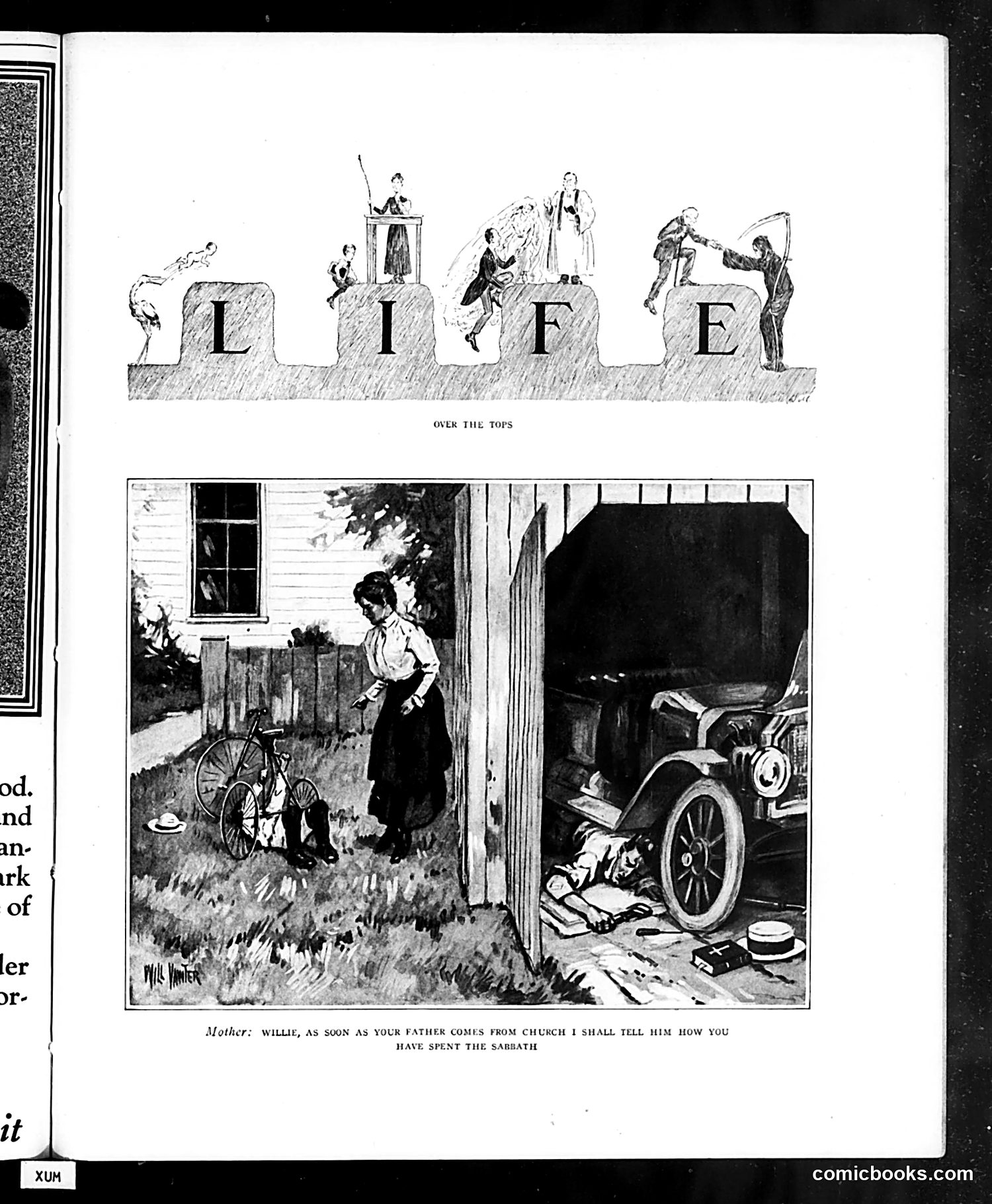
This page contains two satirical illustrations about leisure and the Sabbath. The top cartoon titled "OVER THE TOPS" uses the letters L-I-F-E as stepping stones, with figures climbing and struggling over them—likely satirizing the difficulty of achieving a good life or the obstacles people face in pursuing leisure. The bottom illustration depicts a mother threatening to report to the father how their son Willie spent the Sabbath (Sunday). The scene shows Willie working on an automobile in a garage rather than observing religious rest. The humor comes from the social expectation that Sundays were sacred, non-working days, yet modern life (represented by the automobile) was encroaching on this tradition. This satirizes the tension between traditional religious observance and emerging industrial/mechanized society in early 20th-century America.
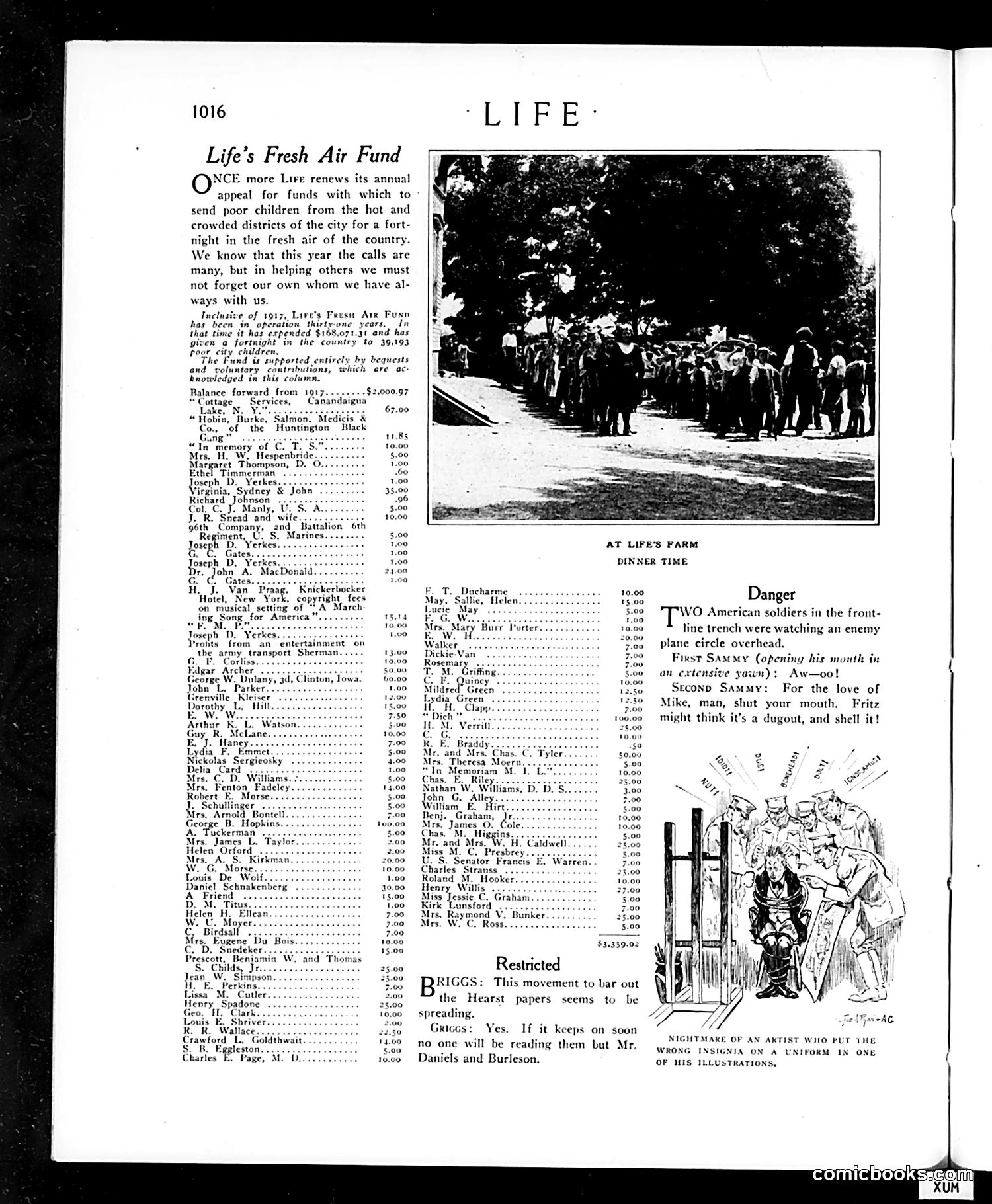
This page contains **Life's Fresh Air Fund** announcement—a real charitable initiative sending poor urban children to the countryside for overnight stays. The page lists donor names and contributions. The cartoon titled **"Danger"** depicts two American soldiers in a front-line trench observing an enemy plane overhead. One soldier (Fritz, identified by name) warns another to keep quiet, fearing the plane will spot them. The other soldier responds that he's "shut [his] mouth" and won't speak, joking that "a dugout" is preferable to the plane's threat. The bottom illustration shows an artist displaying wrong insignia on a uniform—labeled "Nightmare of an Artist Who Put the Wrong Insignia on a Uniform in One of His Illustrations." Both cartoons appear WWI-era commentary on military life and the consequences of careless mistakes.
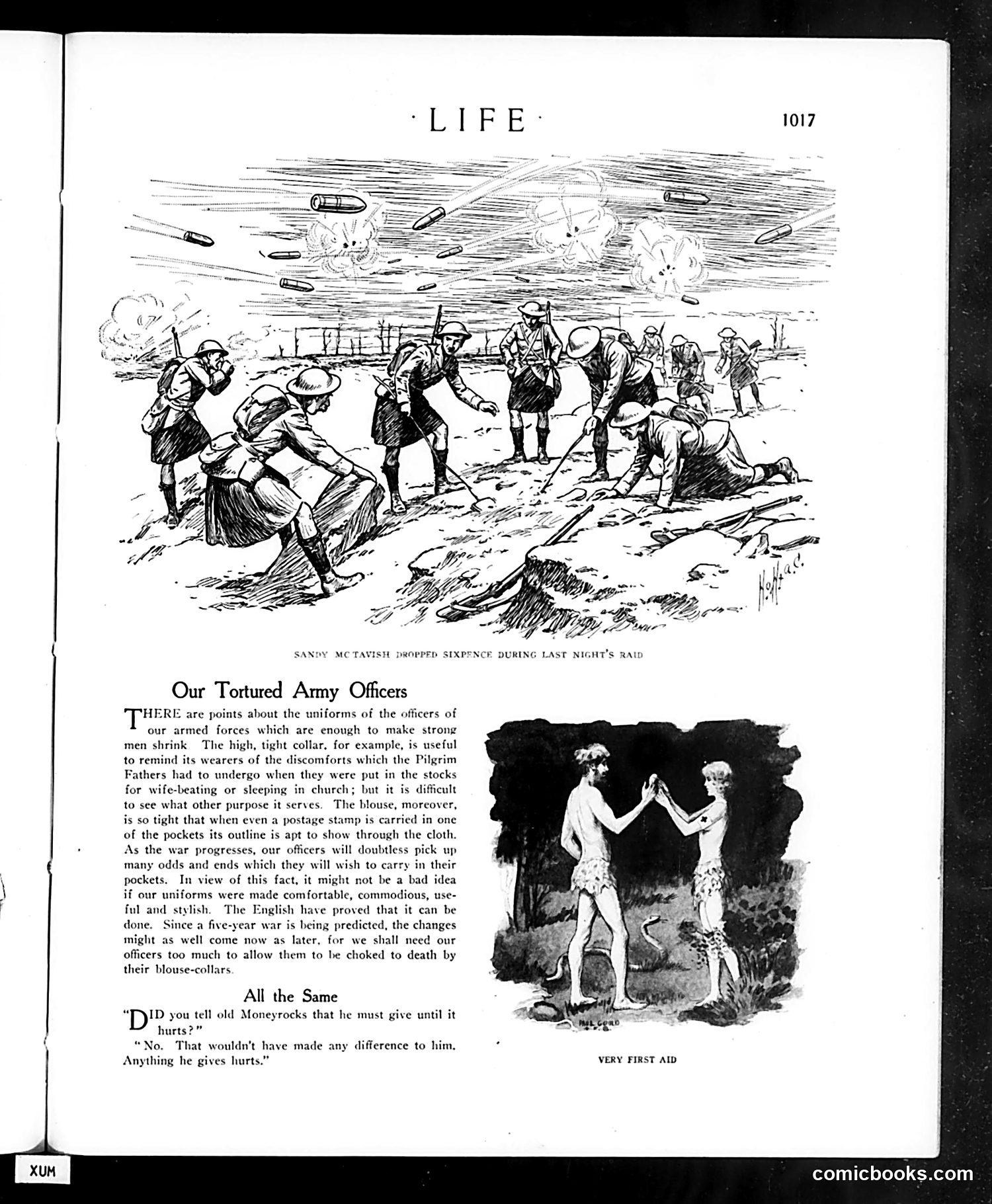
This page contains WWI-era satirical content. The top illustration depicts soldiers in a trench raid with explosions and casualties—captioned "Sandy McTavish Dropped Sixpence During Last Night's Raid," a dark joke about wartime losses. The main article, "Our Tortured Army Officers," criticizes the military uniform's high, tight collar, comparing it to historical punishments like stocks used on Pilgrims. The satire argues that as warfare intensifies, uncomfortable uniforms become impractical and potentially dangerous—officers shouldn't be "choked to death by their house-collars." The small joke "All the Same" features a character named Moneyrocks, playing on miserliness: when told he must give money "until it hurts," he responds that anything he gives hurts him anyway—a commentary on wartime sacrifice expectations.
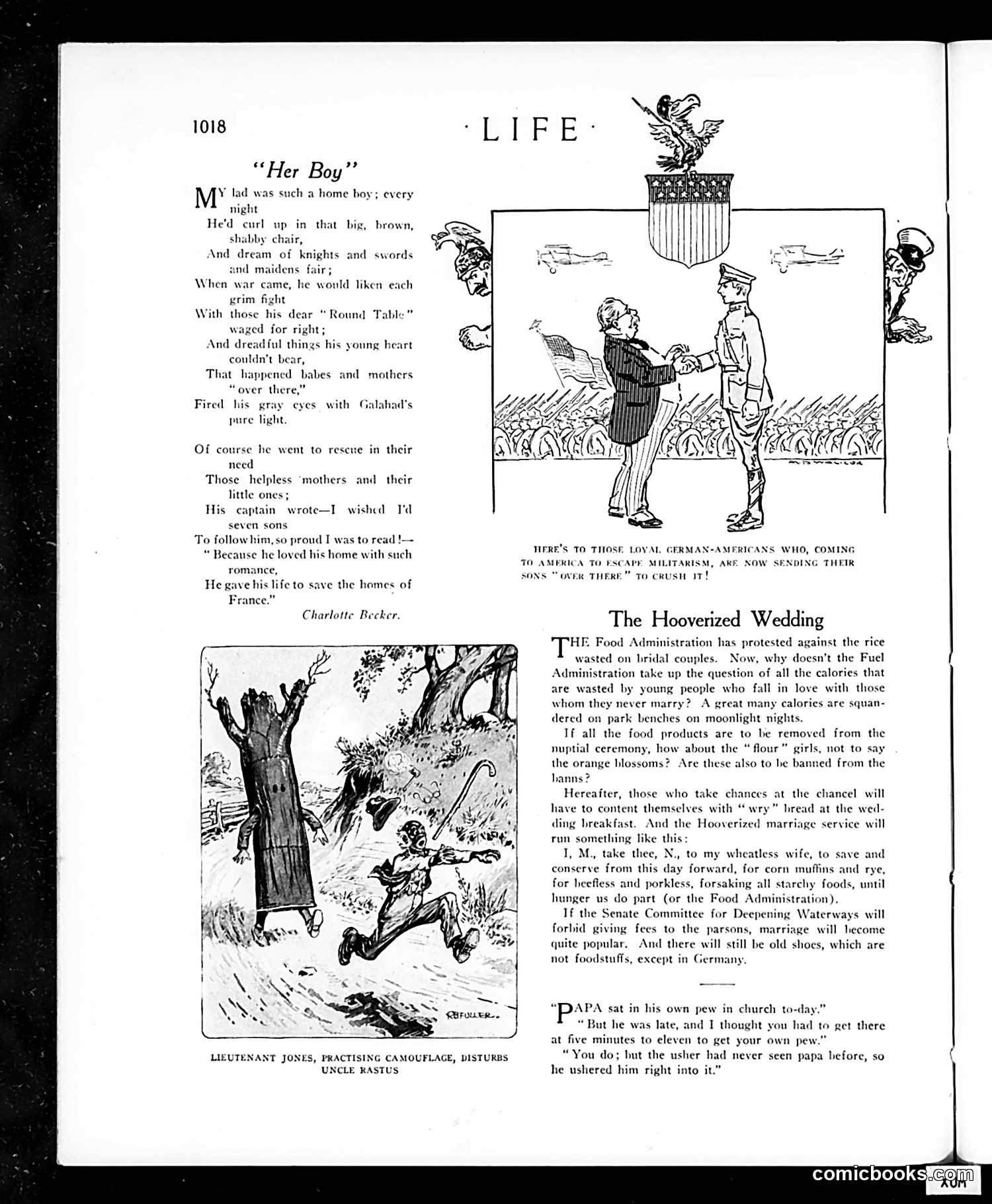
This page contains three distinct pieces of satirical content from WWI-era Life magazine: 1. **"Her Boy"** (poem by Charlotte Becker): A sentimental patriotic poem about a mother's son who dreams of heroic warfare, ultimately dies saving French homes, written to inspire pride in military sacrifice. 2. **The main cartoon**: Shows two men exchanging an American flag, captioned as addressing "loyal German-Americans" who oppose militarism and are sending their sons "over there" to crush it—satirizing German-American patriotism during U.S. involvement in WWI. 3. **"The Hooverized Wedding"**: A satirical piece mocking Food Administration wartime rationing by imagining weddings stripped of celebratory foods—corn muffins and rye replacing traditional fare—absurdly extending rationing into ceremonial life. The page reflects American WWI patriotism and domestic wartime sacrifice messaging.
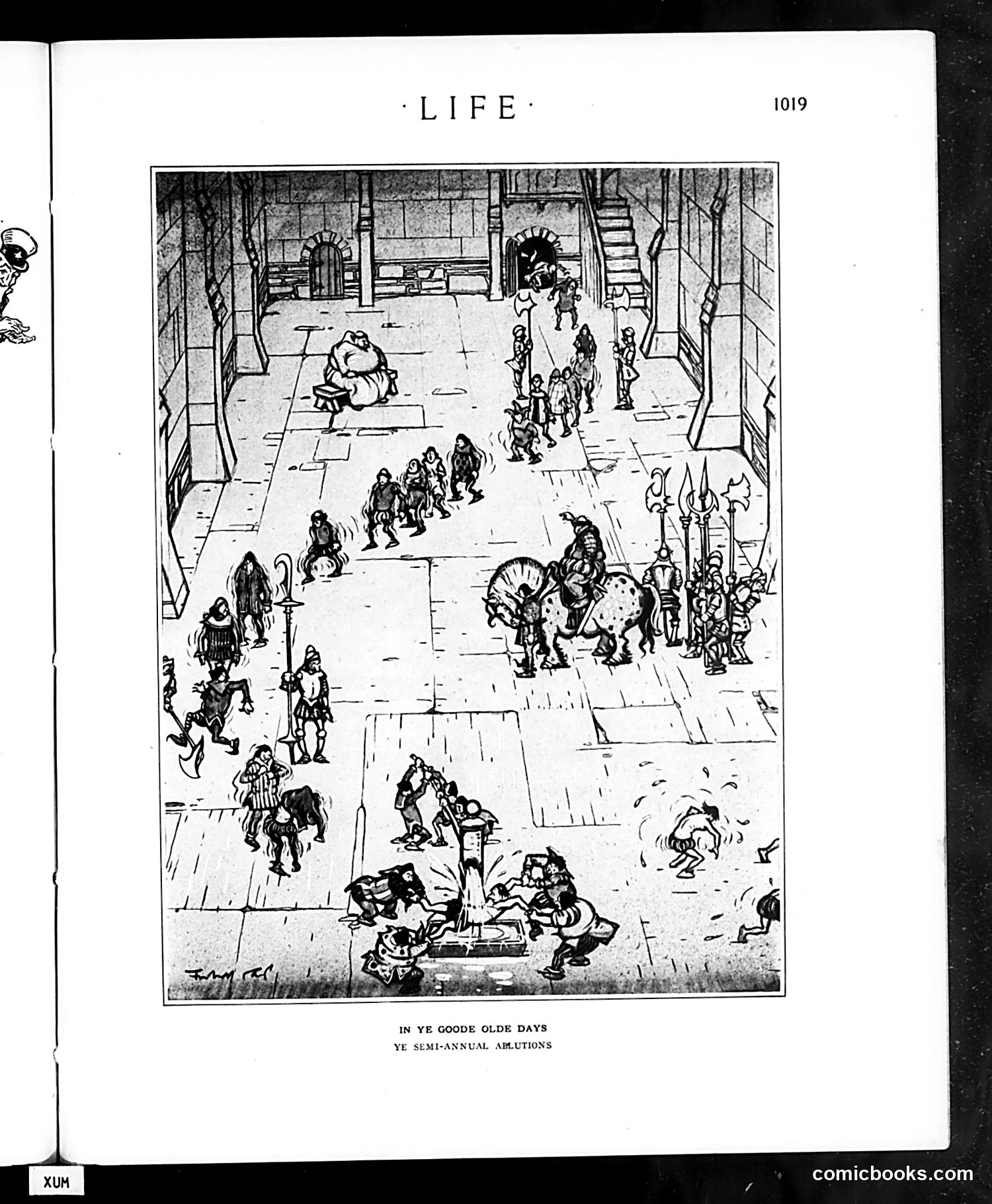
This satirical illustration depicts a medieval town square scene centered on what appears to be a slave auction or human sale, with figures being displayed and traded. The "good old days" title suggests ironic nostalgia for historical practices. The satire likely comments on contemporary auctions or markets—possibly labor exploitation, human trafficking, or economic systems that treated people as commodities. The medieval setting allows the artist to distance critique while making a pointed social commentary about modern practices. The chaotic crowd, varied figures, and architectural details suggest a busy marketplace where human dignity is reduced to commercial transaction. Without additional context from the publication date and surrounding pages, the specific target remains somewhat unclear, though the satirical intent is evident.
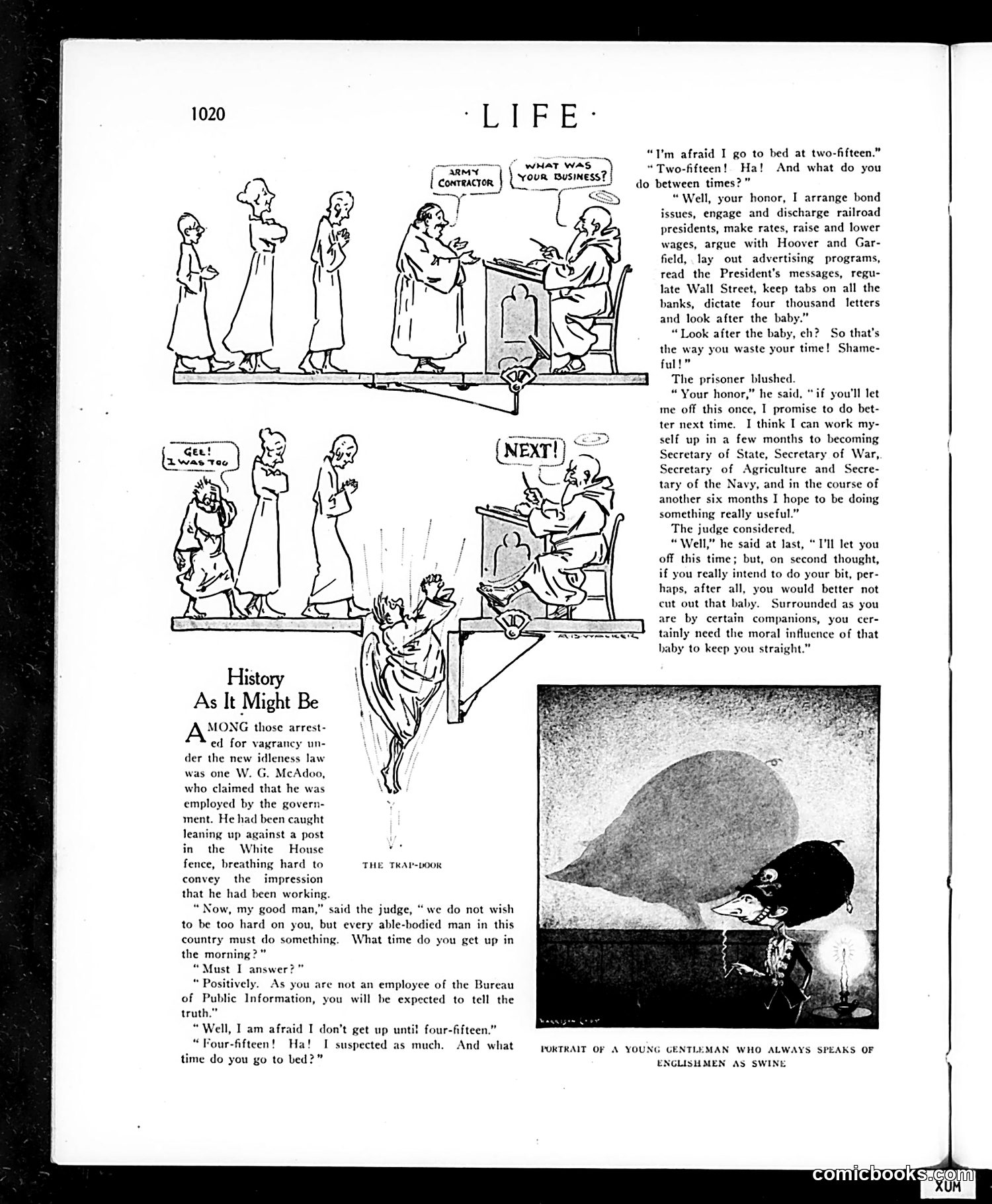
The top cartoon satirizes **wartime government inefficiency**. An "Army Contractor" is questioned about their business. The figure's response—juggling bond issues, railroad presidents, Wall Street dealings, and caring for a baby—mocks how government contractors claim to be simultaneously managing vast financial and industrial operations while maintaining personal life. The joke is their absurd overcommitment; the punchline suggests such a person lacks time for anything properly. The bottom section, "History As It Might Be," presents a humorous court scene involving **W.G. McAdoo**, who was caught loitering at the White House fence during the "idleness law" period. The judge's interrogation about what time he gets up satirizes **vagrancy laws** and their application to government officials, contrasting bureaucratic productivity claims with reality. The accompanying photograph appears unrelated to the main content.
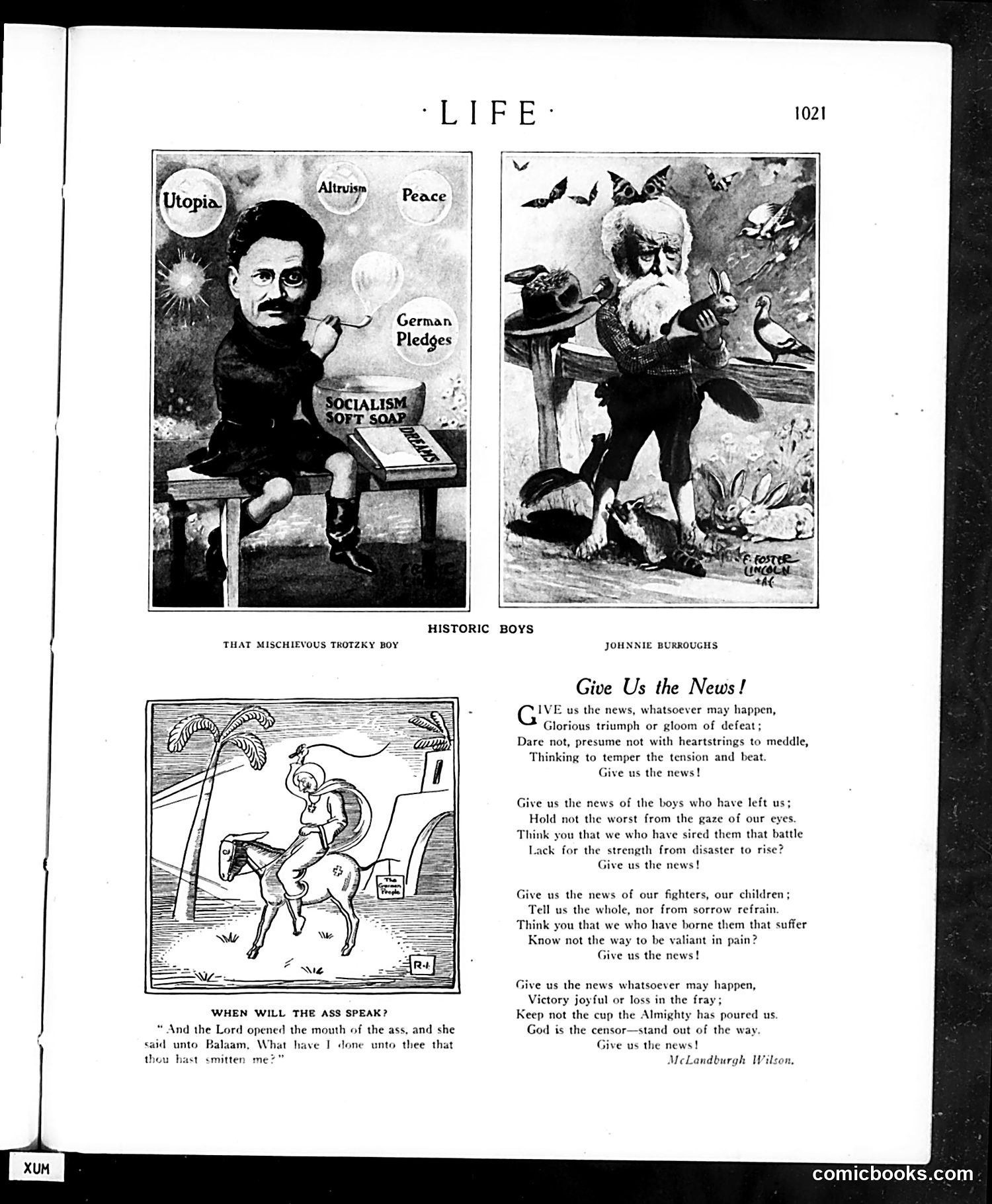
This page contains two editorial cartoons labeled "Historic Boys": **Left cartoon**: Depicts a caricatured figure (labeled "That Mischievous Trotsky Boy") sitting with bubbles containing "Utopia," "Altruism," and "Peace," while holding "Socialism Soft Soap" and making "German Pledges." This satirizes Leon Trotsky, the Soviet revolutionary, mocking his idealistic promises as empty propaganda—comparing socialism to soap that won't deliver real results. **Right cartoon**: Shows "Johnnie Burroughs" (likely a fictional character representing youthful naiveté) surrounded by birds and nature. The accompanying poem "Give Us the News!" urges honest reporting about war casualties and military losses, rejecting censorship or sugar-coated accounts. Together, these pieces critique both communist ideology and wartime information control, advocating for truthful journalism during what appears to be World War I-era publication.
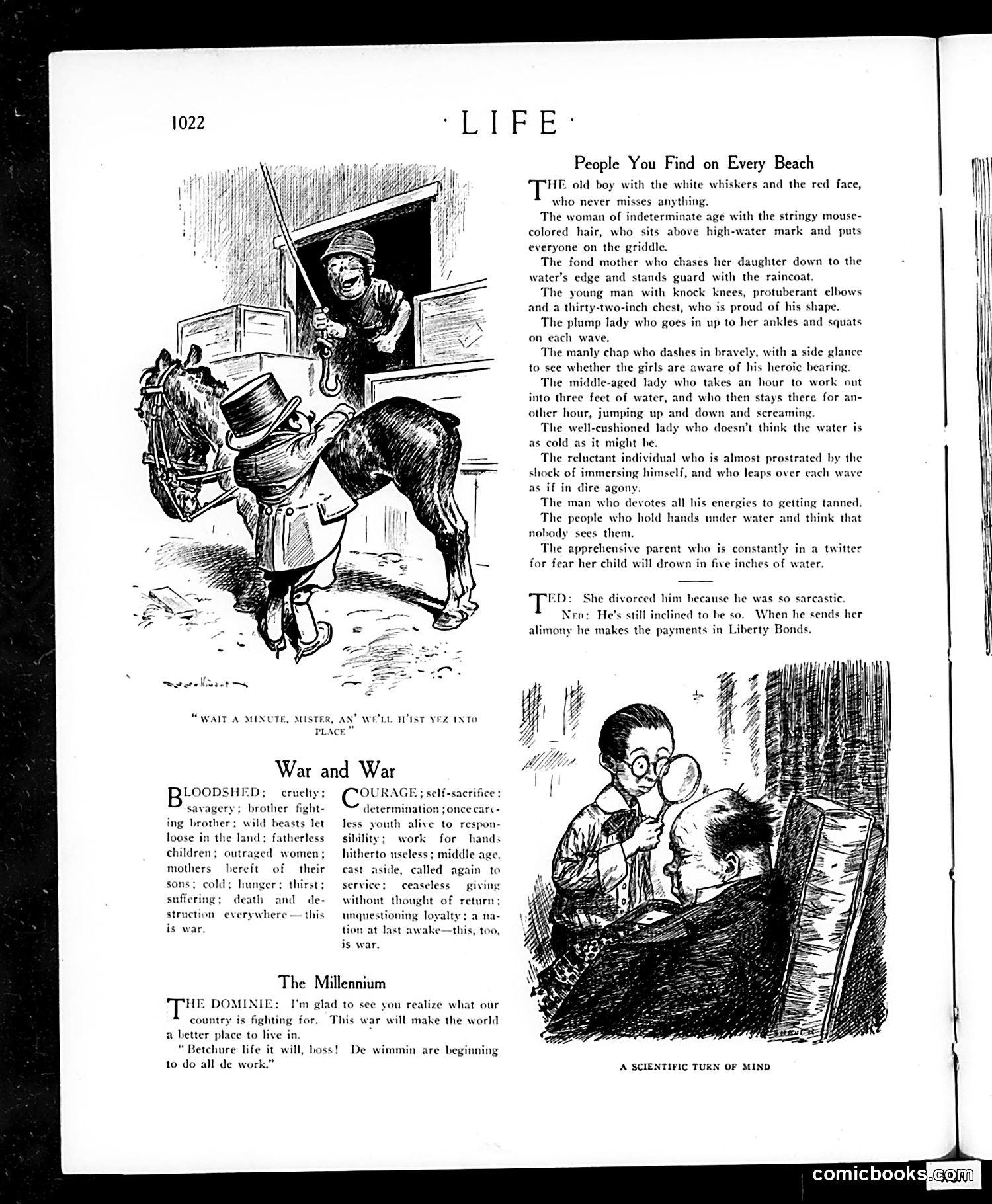
**Top Section - "People You Find on Every Beach":** This is satirical social commentary listing stereotypical beach-goers: the vain old man, the aggressive woman, the protective mother, the boastful young man, etc. The accompanying cartoon shows a vendor hawking his wares to beachgoers, satirizing commercial exploitation at popular leisure destinations. **"War and War" Section:** This appears to reference World War I's devastation—listing bloodshed, destroyed families, suffering, and death. It contrasts war's horrors with concepts like "courage" and "loyalty." **"The Millennium" Section:** A brief comment suggesting the current war will improve society ("make the world a better place to live in"), with a de Winnin quote about women entering the workforce—likely referencing WWI's opening of employment opportunities to women as men enlisted. The bottom cartoon titled "A Scientific Turn of Mind" remains unclear without additional context.
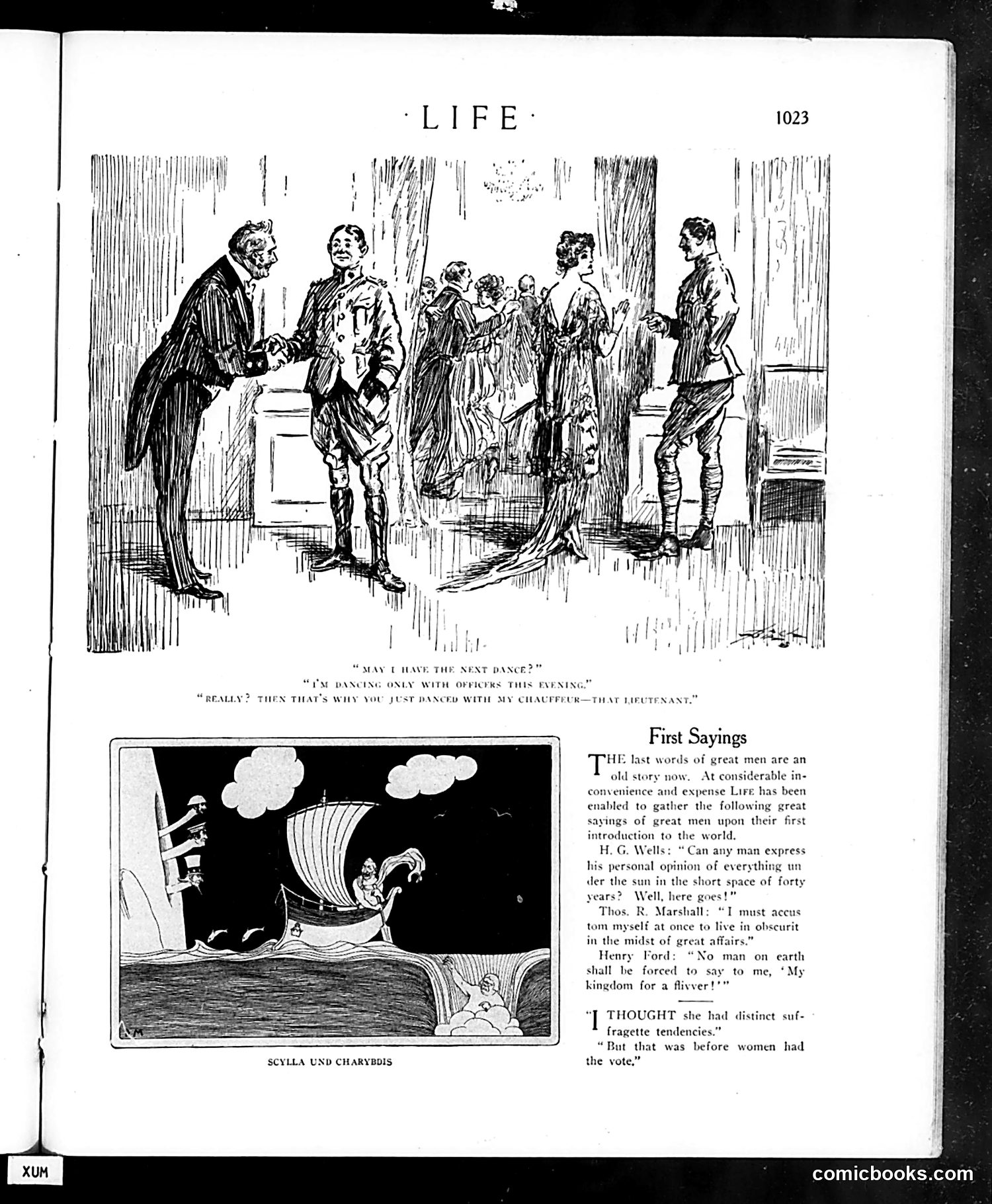
**Top Cartoon:** A social scene showing men and women at what appears to be a formal dance or gathering. The dialogue reveals the joke: a woman says she's "dancing only with officers this evening," and a man responds that she just danced with his chauffeur who holds the rank of lieutenant. The satire targets social pretension—specifically, women who use military rank as a status marker for dating/dancing partners, apparently unable to distinguish actual officers from servants with military titles. **Bottom Section:** "First Sayings" collects famous quotes from notable men (H.G. Wells, Thomas Marshall, Henry Ford). The accompanying illustration labeled "Scylla and Charybdis" depicts classical mythology. The brief text reference mentioning women gaining voting rights suggests this page was published during or shortly after the women's suffrage era.
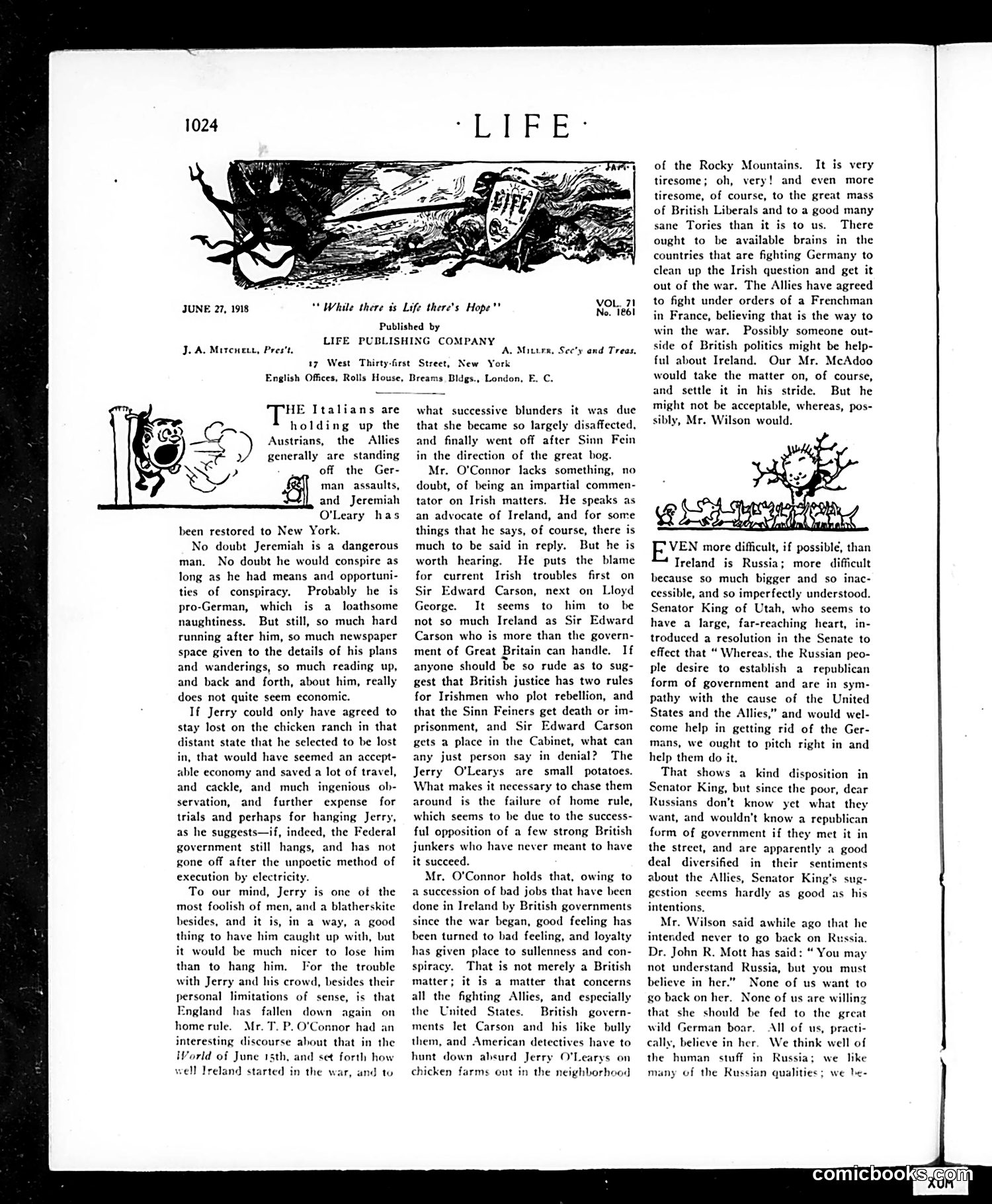
This editorial page critiques American resources wasted pursuing **Jeremiah O'Leary**, an Irish-American pro-German agitator recently captured and returned to New York. The cartoon (top left) depicts O'Leary as a foolish, blustering figure—a "blatherskite." The satire's point: O'Leary is a symptom, not the disease. The real problem is **British mishandling of Irish home rule**, which radicalized Ireland toward Sinn Féin rebellion. The editorial argues that Sir Edward Carson and Lloyd George's failures created Irish disloyalty, forcing Americans to hunt down minor conspirators in distant chicken ranches—an absurd waste during wartime. The deeper criticism: Britain's harsh treatment of Irish rebels versus political leniency toward Carson (a unionist politician) reveals hypocrisy in "British justice." This alienates a crucial ally—the United States—which must expend resources on Irish-American subversion rather than focus on defeating Germany. The piece urges Britain to finally grant home rule, eliminating the grievances fueling such conspiracies.
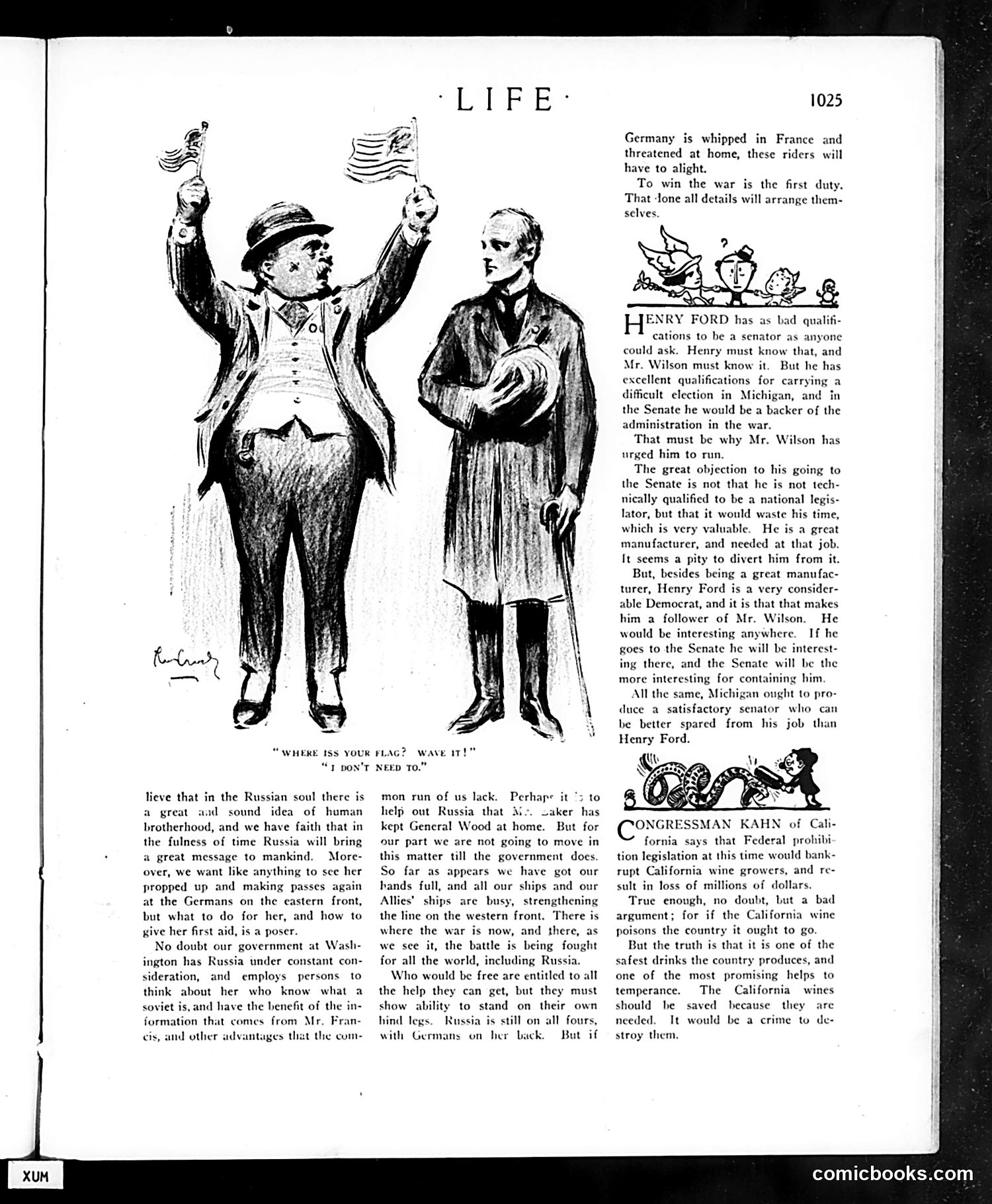
The main cartoon depicts a confrontation between two figures over patriotic display. One man enthusiastically waves American flags while the other refuses, stating "I don't need to." The caption suggests this satirizes debates over patriotic demonstration during WWI—the implication being that some Americans questioned whether flag-waving was necessary to prove loyalty. The text discusses Henry Ford's potential Senate candidacy, noting his poor qualifications as a legislator but excellent ability to win Michigan's election. The author argues Ford should remain a manufacturer rather than waste his talents in the Senate, though acknowledges his Democratic loyalty to Wilson makes him valuable politically. Additional commentary addresses Russian support during WWI, suggesting America should focus on winning in France before dispersing resources elsewhere. A final section debates California wine prohibition, arguing wines should be preserved for their temperance benefits rather than destroyed.
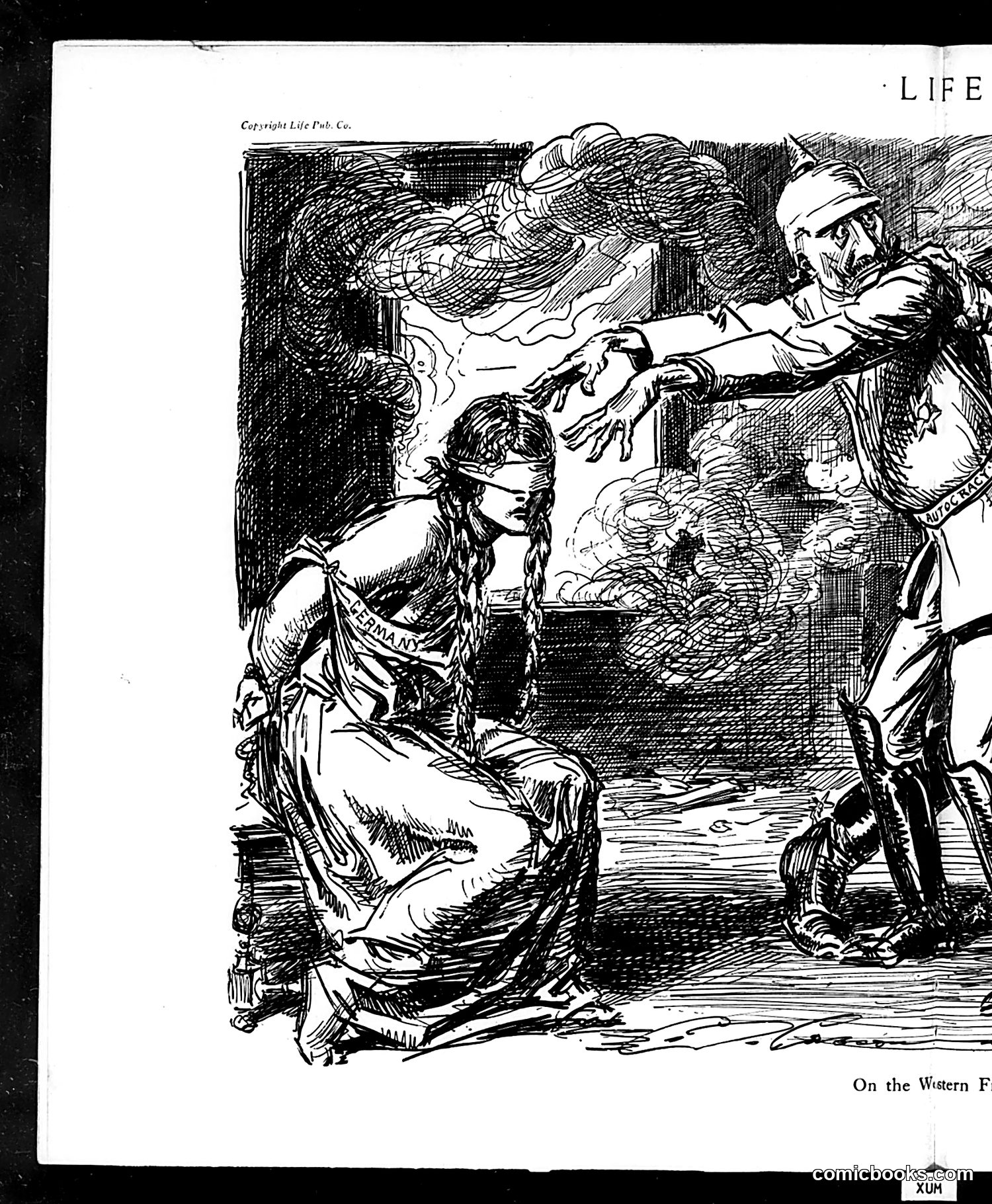
This appears to be a political cartoon from *Life* magazine depicting a scene "On the Western F[ront]" — likely referencing World War I combat. The central figure is **Germania** (personified Germany), depicted as a blindfolded female figure wearing a headband labeled "GERMANY." She's surrounded by soldiers in military attire. One soldier points accusingly at her while others gesture around her. The satire appears to critique Germany's role in WWI, suggesting German leadership was "blind" to reality or consequences. The blindfold is the key visual metaphor — Germany proceeded with military aggression without seeing (or ignoring) the destructive outcomes unfolding on the Western Front. The allegorical approach was common in wartime propaganda, using classical female personifications to represent nations and their moral or strategic failings.
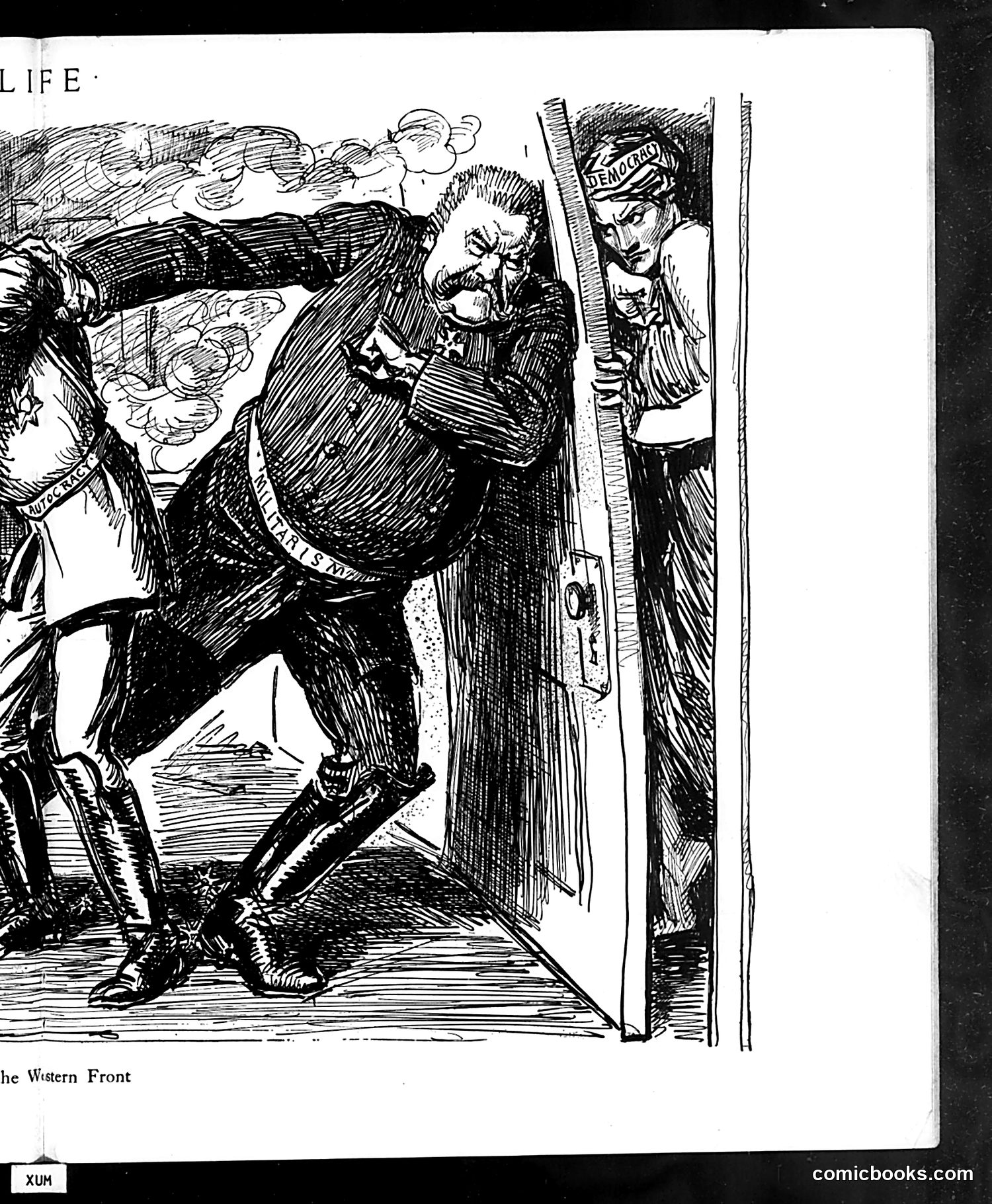
This appears to be a World War I-era satirical cartoon from *Life* magazine. The central figure is a military officer with distinctive facial features and medals, depicted in an exaggerated, unflattering style typical of wartime propaganda art. On the right stands a figure labeled "DEMOCRACY," appearing to peek around a door or barrier. The cartoon likely satirizes military leadership during WWI, suggesting tension between authoritarian military command and democratic values. The officer's aggressive posture and the way "Democracy" hesitantly observes from behind suggests criticism of how military interests may override democratic principles during wartime. Without clearer identification of the specific officer caricatured, the precise satirical target remains uncertain, though the commentary on war leadership versus democracy is clear.
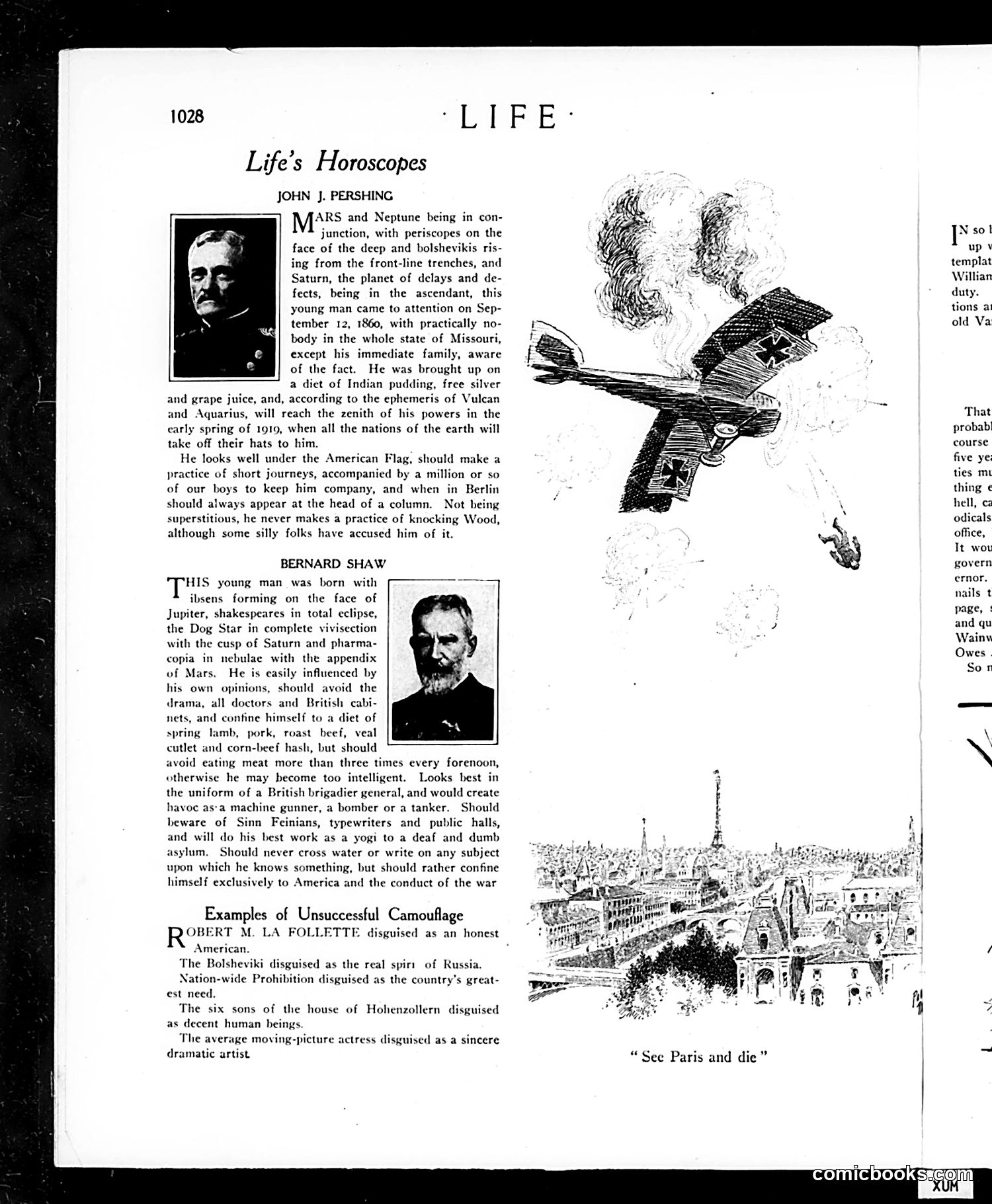
This page mocks prominent public figures through fake "horoscopes"—astrological parodies that reveal character flaws through absurdist humor. **John J. Pershing** (U.S. General commanding WWI forces): The horoscope sarcastically predicts his power will "reach zenith" in spring 1919, accompanied by "a million or so of our boys"—mocking both his prominence and the human cost of war. **Bernard Shaw** (Irish playwright): Ridiculed for contradictory advice (eat meat but not too much; avoid writing on subjects he knows about), satirizing his reputation for verbose opinions on everything. The bottom section lists "Unsuccessful Camouflage"—things pretending to be what they're not: La Follette as honest, Bolsheviks as Russia's true spirit, Prohibition as genuine reform, and German royalty as decent humans. These mock wartime propaganda and progressive claims. The cartoon's point: prominent figures and national movements present false facades; astrology is as reliable as their credibility.
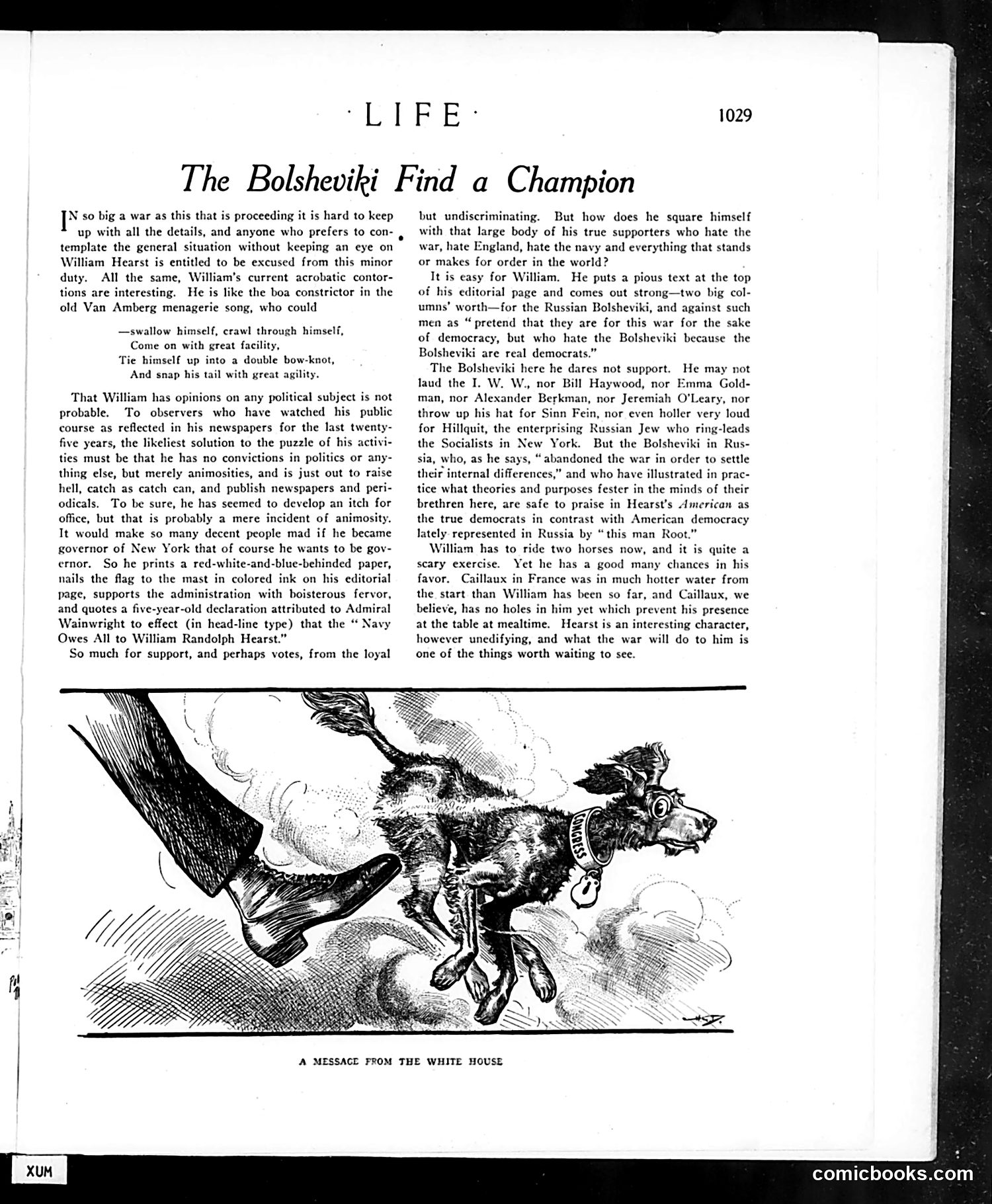
This satirical article attacks newspaper magnate **William Randolph Hearst** for political hypocrisy during World War I. The text accuses Hearst of having no genuine convictions, only "animosities," and of opportunistically shifting positions to inflame his audience. The specific charge: Hearst publicly supports America's war effort and the military in his papers (the "red-white-and-blue-behinded paper"), yet simultaneously champions Russia's Bolsheviks—who had abandoned the war and represented everything his anti-war supporters despise. The article calls this attempting to "ride two horses." The accompanying cartoon (captioned "A Message From the White House") depicts a dog being kicked—likely representing Hearst receiving disapproval from the Wilson administration for his contradictory stances. The author notes Hearst cannot openly praise American radical figures (Emma Goldman, Bill Haywood, the IWW) but safely praises distant Russian Bolsheviks, cynically exploiting both pro-war and anti-war factions simultaneously.
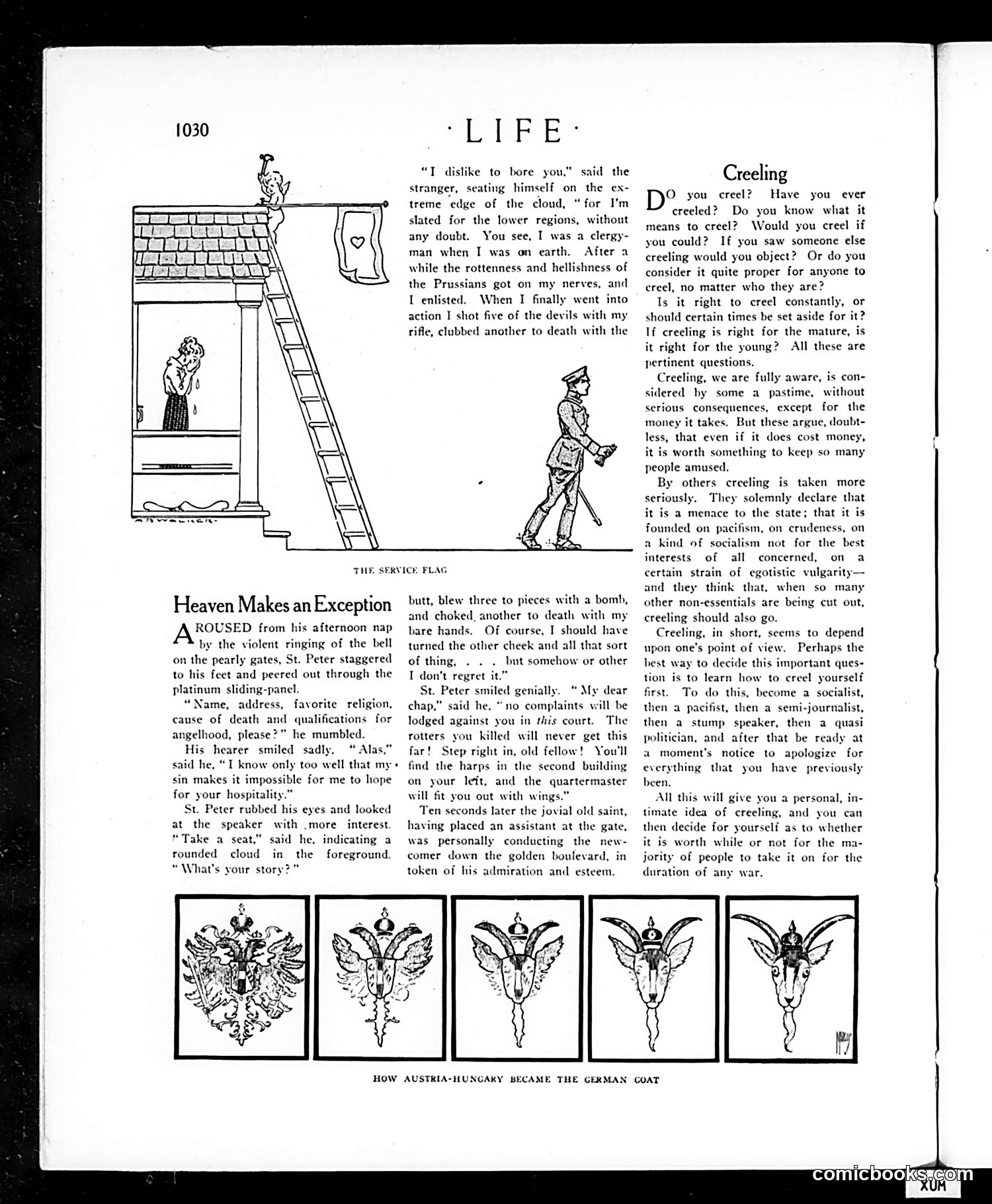
**"Heaven Makes an Exception"** satirizes wartime moral compromise. A clergyman arrives at St. Peter's gate confessing he violated Christian pacifism by enlisting and killing five Prussian soldiers in combat. Rather than condemn him, St. Peter immediately welcomes him—the joke being that killing Germans during World War I (the context of "Prussians") overrides religious doctrine. The cartoon critiques how warfare suspends ordinary moral standards, even for clergy. **"Creeling"** appears to be satirical mockery of abstract debate. The essay playfully defines "creeling" in circular, meaningless language while discussing whether it's patriotic, socialist, or dangerous—likely parodying overwrought wartime rhetoric and moral panic about civilian behavior. The vagueness suggests contemporary arguments about social conduct during wartime were equally nonsensical. **Bottom panel**: "How Austria-Hungary Became the German Goat" shows heraldic coat-of-arms evolution, likely satirizing Austria-Hungary's subordination to Germany during the war alliance.
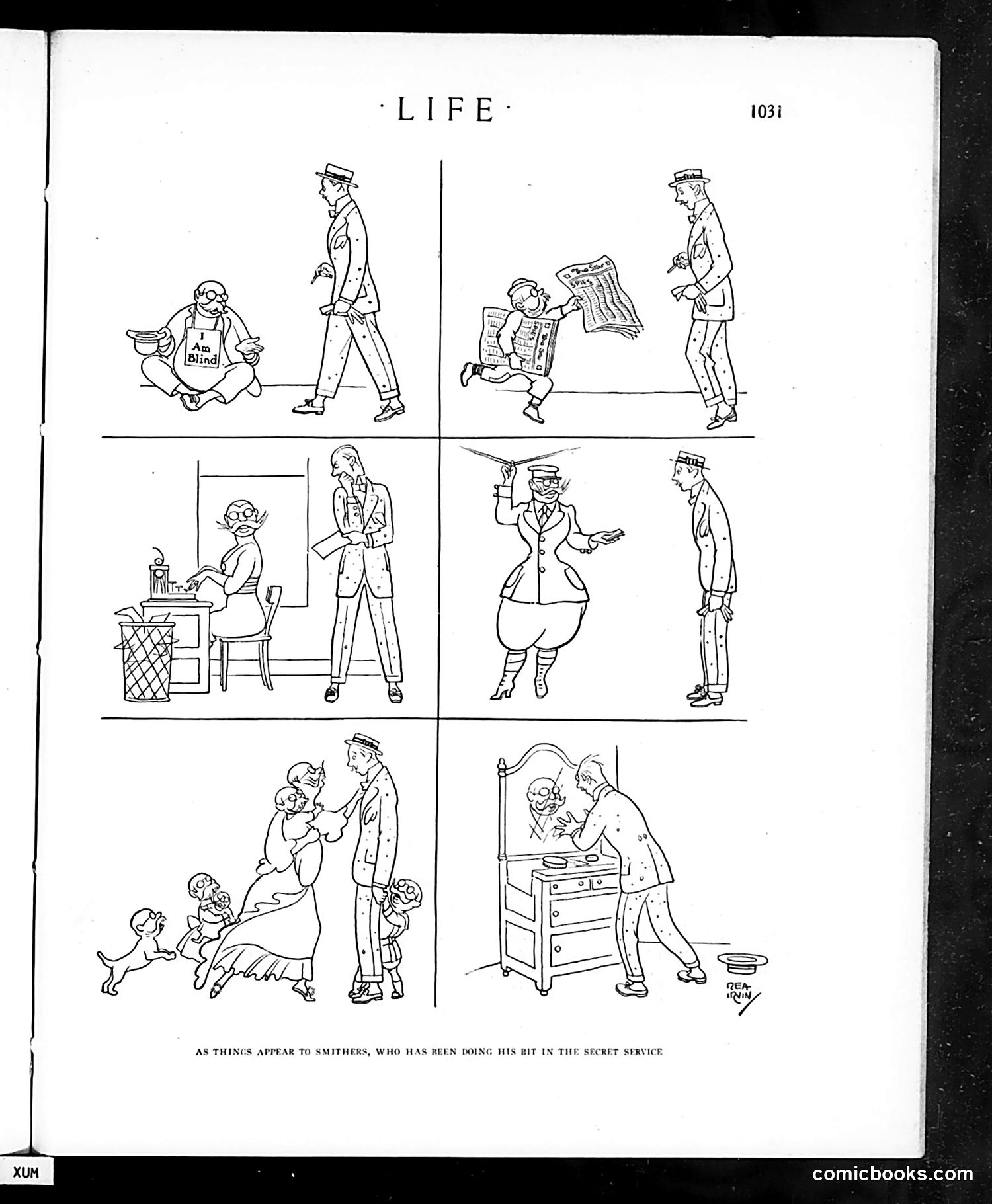
This page from *Life* magazine satirizes **Smithers**, described in the caption as "doing his bit in the secret service." The six comic panels depict domestic scenes where Smithers appears to be a bumbling spy or government agent conducting surveillance or operations within his own household. The humor derives from the contrast between serious spy work and mundane home life: Smithers clumsily attempts espionage-like activities (managing children, dealing with domestic staff, handling household tasks) as though they were covert operations. The satire likely mocks either wartime security paranoia or bureaucratic overreach by showing how absurd such "secret service" devotion appears in ordinary domestic contexts. The specific historical moment remains unclear without publication date confirmation.
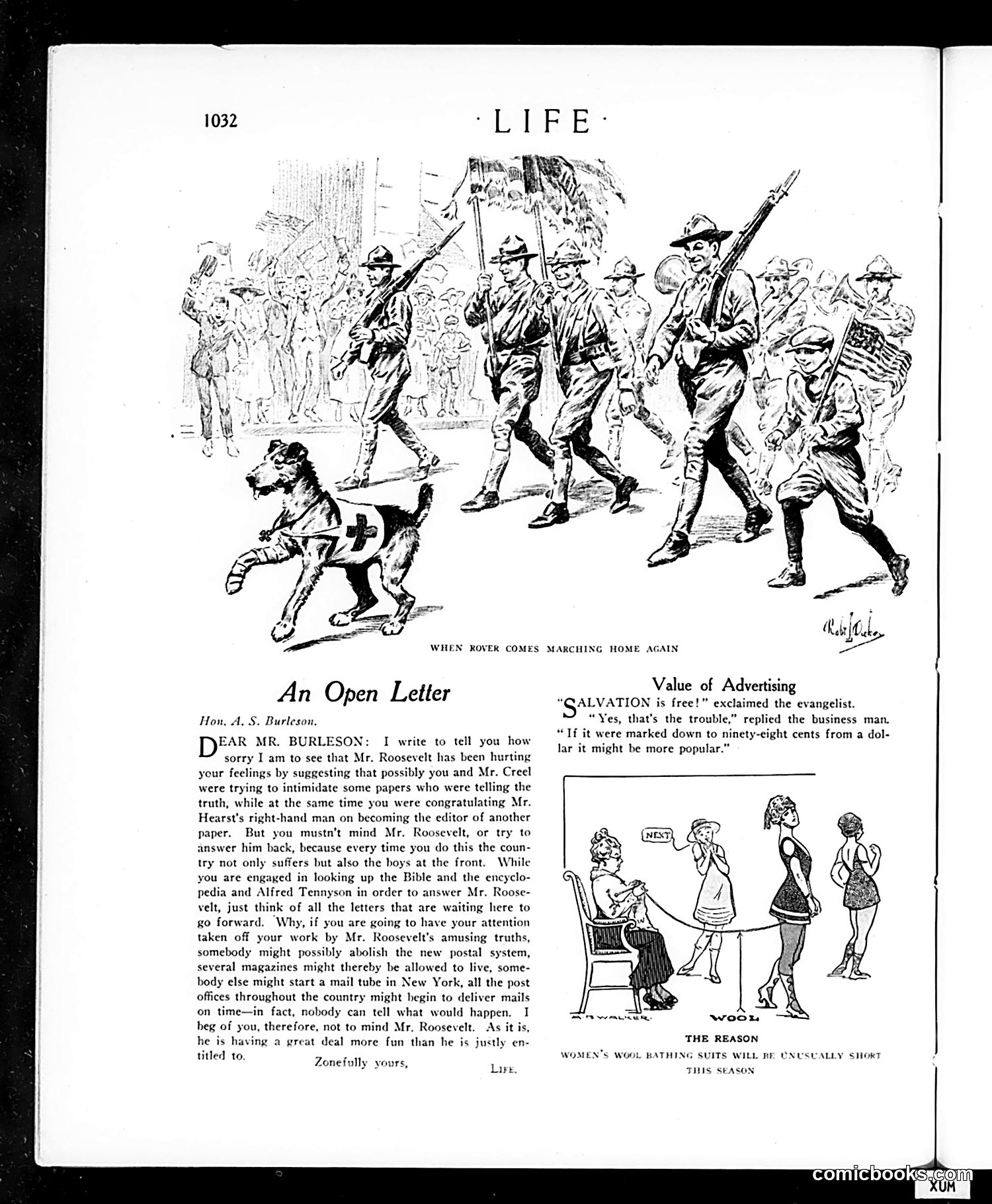
The main cartoon depicts soldiers marching home from World War I, with a dog wearing a Red Cross symbol leading them—a joyful homecoming scene titled "When Rover Comes Marching Home Again." The "Open Letter" is satirical commentary on Postmaster General A. S. Burleson, whom Theodore Roosevelt had criticized for allegedly intimidating newspapers and suppressing truthful reporting during WWI. Life's letter mockingly urges Burleson *not* to respond to Roosevelt, sarcastically suggesting that if Burleson stops working, the entire postal system might collapse—implying his actual work is trivial and his censorship efforts are the real problem. The secondary cartoon about advertising mocks commercialism: an evangelist's message of free salvation is deemed unpopular by a businessman unless discounted to 98 cents, satirizing how marketing logic reduces spiritual values to commodities. The final item jokes that women's wool bathing suits will be unusually short that season—likely alluding to post-war fabric shortages or changing fashion norms.
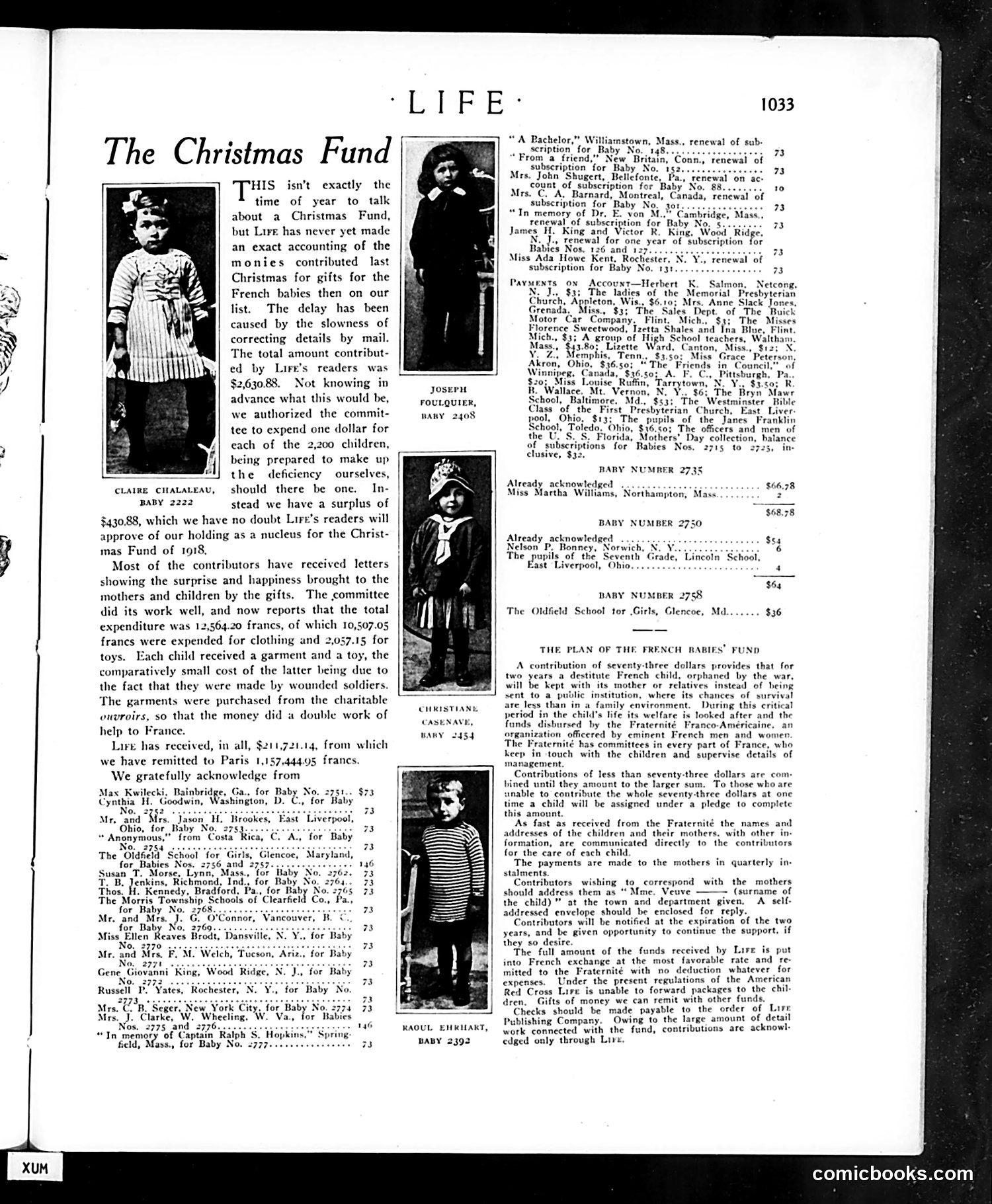
This page reports on Life magazine's charitable collection for French war orphans from the previous Christmas (1916). The publication raised $2,630.88 from readers to purchase gifts—clothing and toys made by wounded soldiers—for approximately 2,200 French children affected by World War I. The photographs show three of the beneficiary children: Claire Chalaleau, Christiane Casenave, and Raoul Erkhardt, identified by baby numbers. The text details the fund's accounting: total expenditures of 12,564.20 francs, with most spent on garments from charitable workshops (ouvroirs), thus supporting both children and struggling French workers. The remainder documents individual and organizational donors. This reflects Life's role as both satirical magazine and serious charitable advocate during the war.
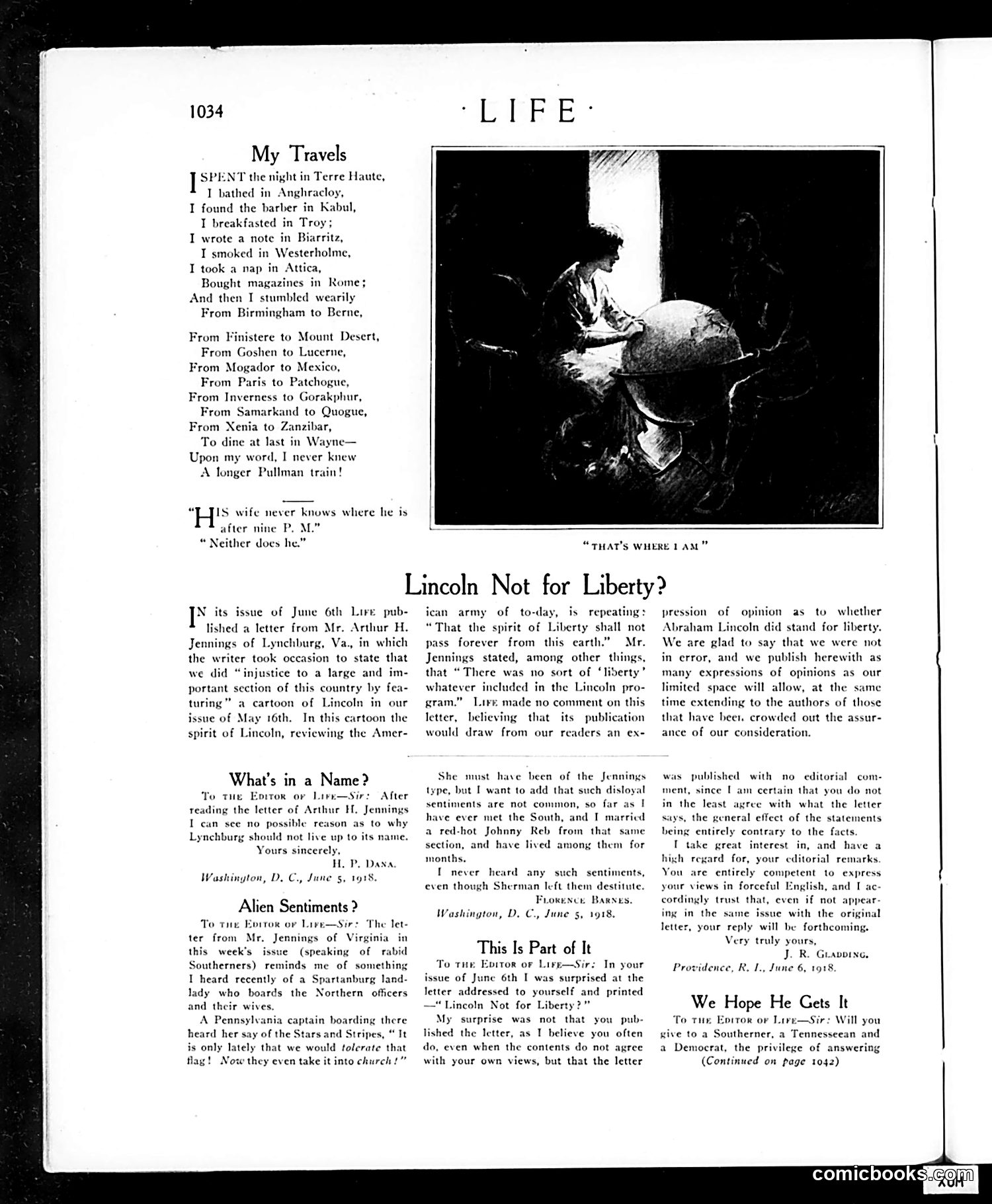
This page contains a humorous poem "My Travels" paired with a cartoon showing a man examining a globe, captioned "THAT'S WHERE I AM." The joke satirizes a well-traveled man who visits countless places so frequently he loses track of his actual location—a gentle mockery of excessive travel and restlessness. The bulk of the page features reader letters debating whether Life magazine wrongly portrayed Abraham Lincoln. A Virginia reader (Jennings) objected to a May cartoon suggesting Lincoln stood for liberty, claiming the Lincoln program contained no such "liberty." Life published multiple responses defending Lincoln and criticizing Jennings's "disloyal sentiments," particularly offensive given the 1918 wartime context (America was fighting Germany). One letter sarcastically suggests Lynchburg, Virginia should "live up to its name" (implying disloyalty). The editorial exchange reveals post-Civil War sectional tensions still simmering, with Northern contributors viewing Southern criticism of Lincoln as unpatriotic during WWI.
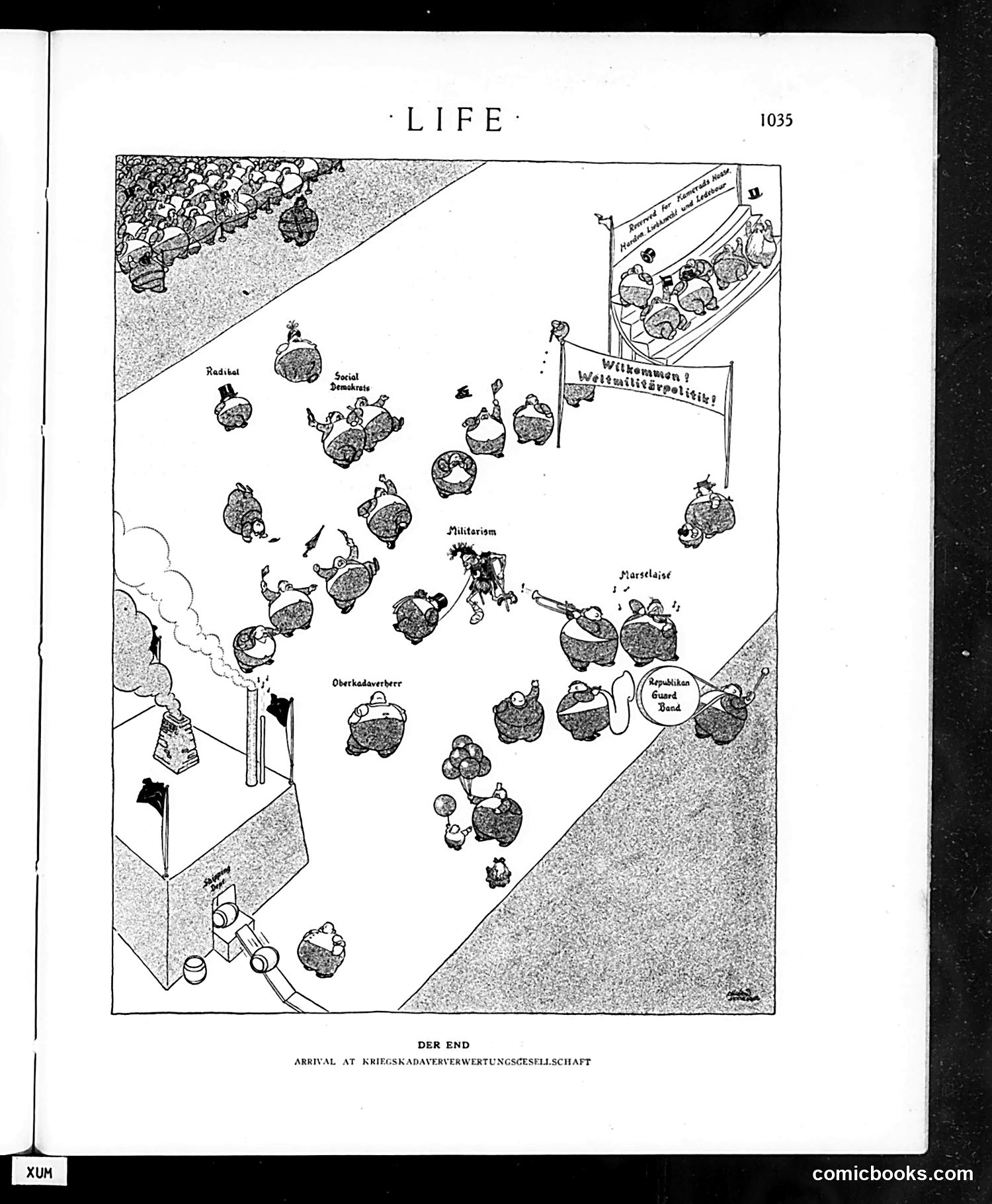
This is a German-language political cartoon satirizing the end of World War I. Titled "Der End" ("The End"), it depicts the "Arrival at Kriegskadaververwertungsgesellschaft" (War Corpse Utilization Company) — a darkly satirical reference to processing the war dead. The cartoon shows numerous spherical figures (representing fallen soldiers or casualties) being herded toward various processing stations and facilities. Labels identify different groups: "Radikalist," "Social Democrat," "Philisterian," "Obersdaverberer," and others — suggesting different political factions among the casualties. A boat or vessel in the upper right appears to be receiving new arrivals. The satire critiques how different political groups were treated or exploited in the war's aftermath, with grim humor about bureaucratic processing of human suffering. The cartoon expresses anti-war sentiment through grotesque imagery of mechanized death.
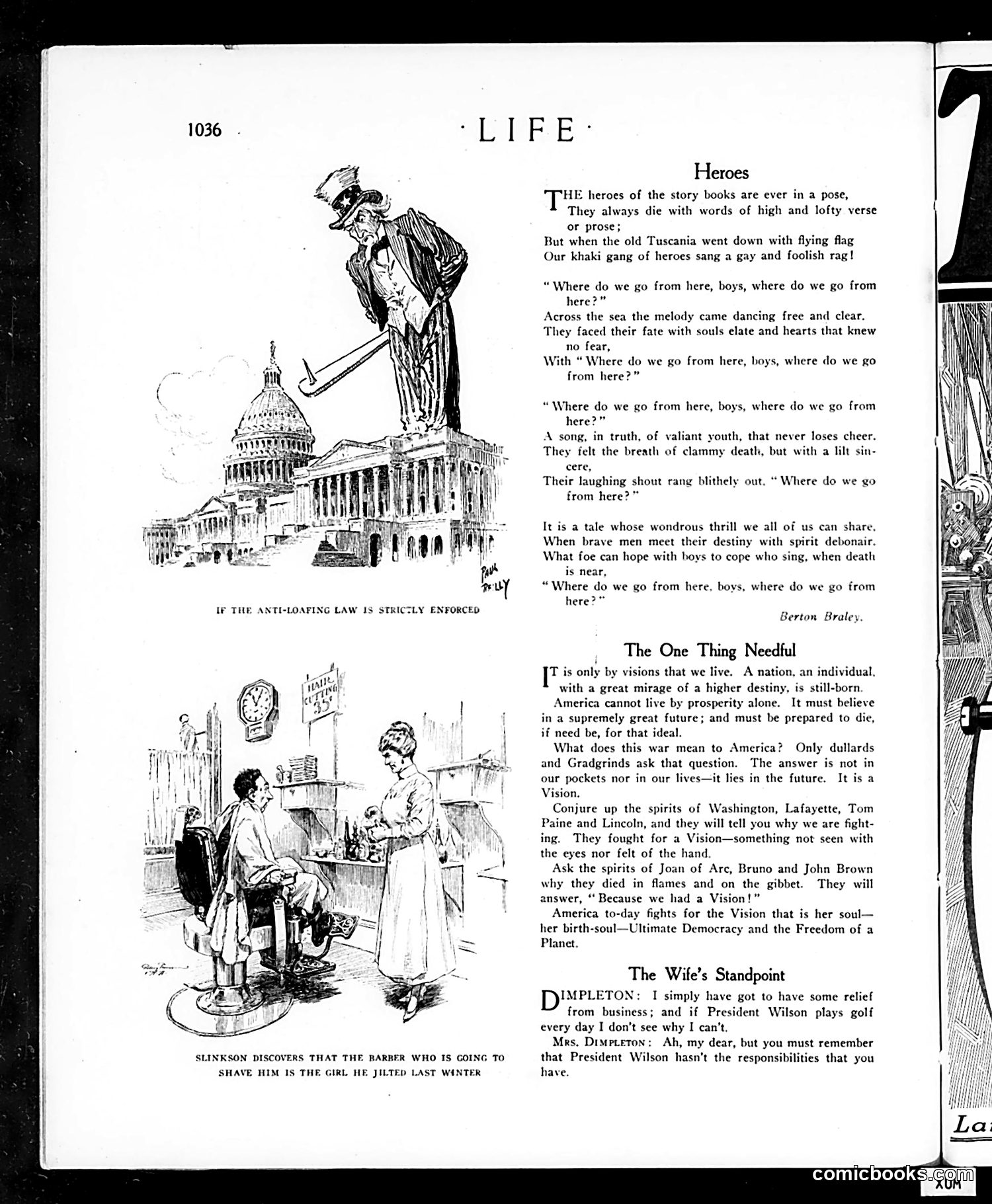
**Top Cartoon**: "If the Anti-Loafing Law is Strictly Enforced" depicts Uncle Sam as a stern figure wielding a large sword over the Capitol Building, threatening to enforce laws against idleness. This satirizes wartime labor conscription and government enforcement of work obligations during World War I. **"Heroes"** (poem by Berton Braley): Celebrates soldiers aboard the *Tuscania* (a ship sunk in 1918) who faced death with humor and courage, singing "Where do we go from here?" The satire contrasts sentimental literary heroes with real soldiers' irreverent, "foolish" response to mortality—their gaiety in the face of death undercuts heroic pretense. **"The One Thing Needful"**: Argues America fights WWI not for material gain but idealistic "Vision"—Ultimate Democracy and planetary freedom. It invokes Washington, Lincoln, Joan of Arc as visionaries willing to die for ideals. **Bottom Cartoon**: A humorous domestic scene where a man discovers his barber is a woman he previously jilted, creating awkward irony. **"Wife's Standpoint"**: Satirizes a businessman claiming he deserves golf breaks like President Wilson, while his wife points out Wilson carries greater responsibilities—mocking men's excuses for leisure during wartime.
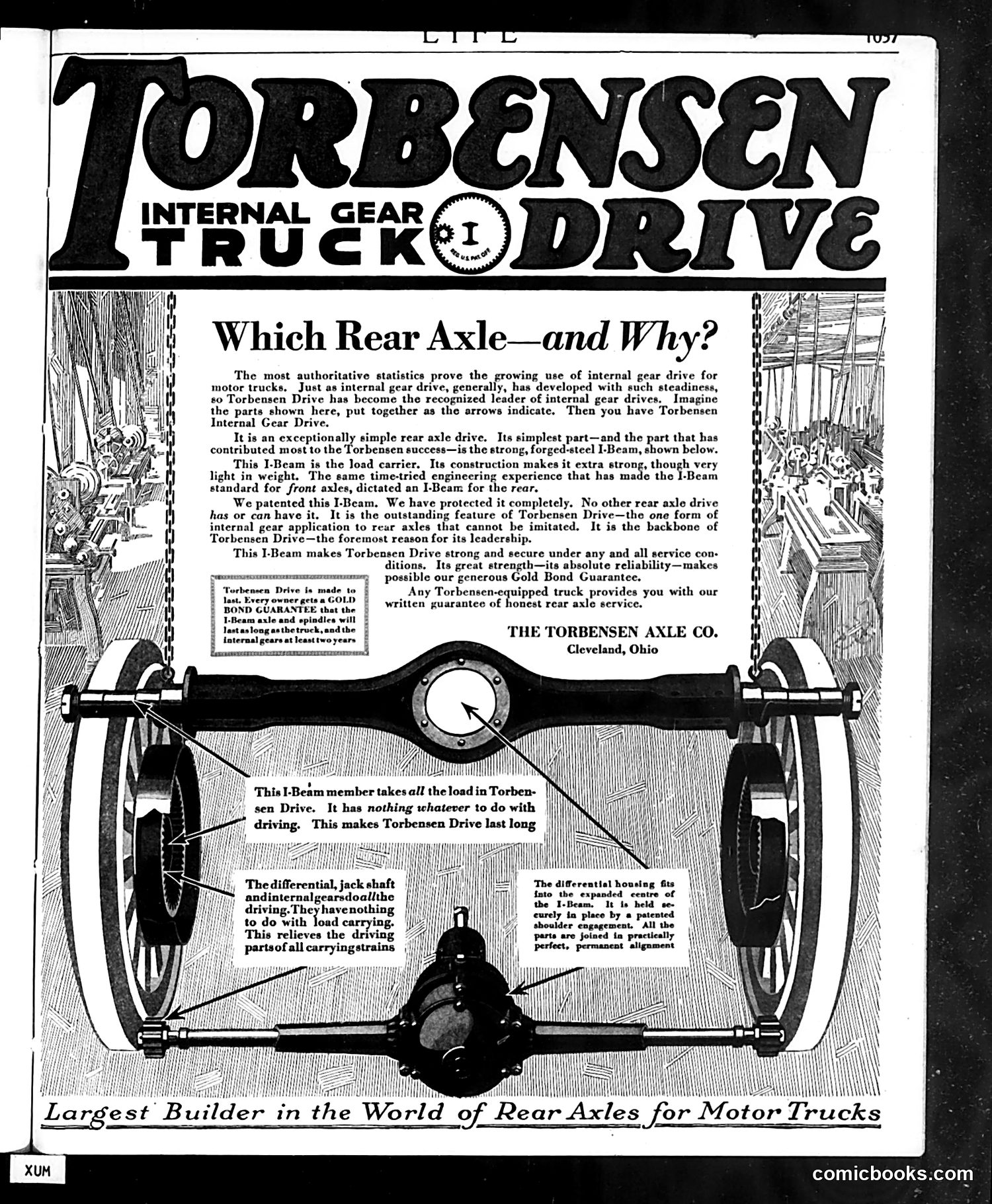
This is **not a cartoon or satire**—it's a straightforward **advertisement** for the Torbensen Axle Company of Cleveland, Ohio. The page promotes the Torbensen Internal Gear Drive, a rear axle system for motor trucks. The company claims superiority based on a patented I-Beam design that serves as the load-carrying component. The advertisement includes technical diagrams showing how the differential, jack shaft, and internal gears work together, with labels explaining each part's function. The sales pitch emphasizes the I-Beam's strength, lightweight construction, and reliability—backed by a "Gold Bond Guarantee." The copy argues this design cannot be imitated because the I-Beam is patented. This represents early-20th-century industrial marketing in *Life* magazine, targeting commercial truck buyers with technical specifications and competitive claims rather than humor or satire.
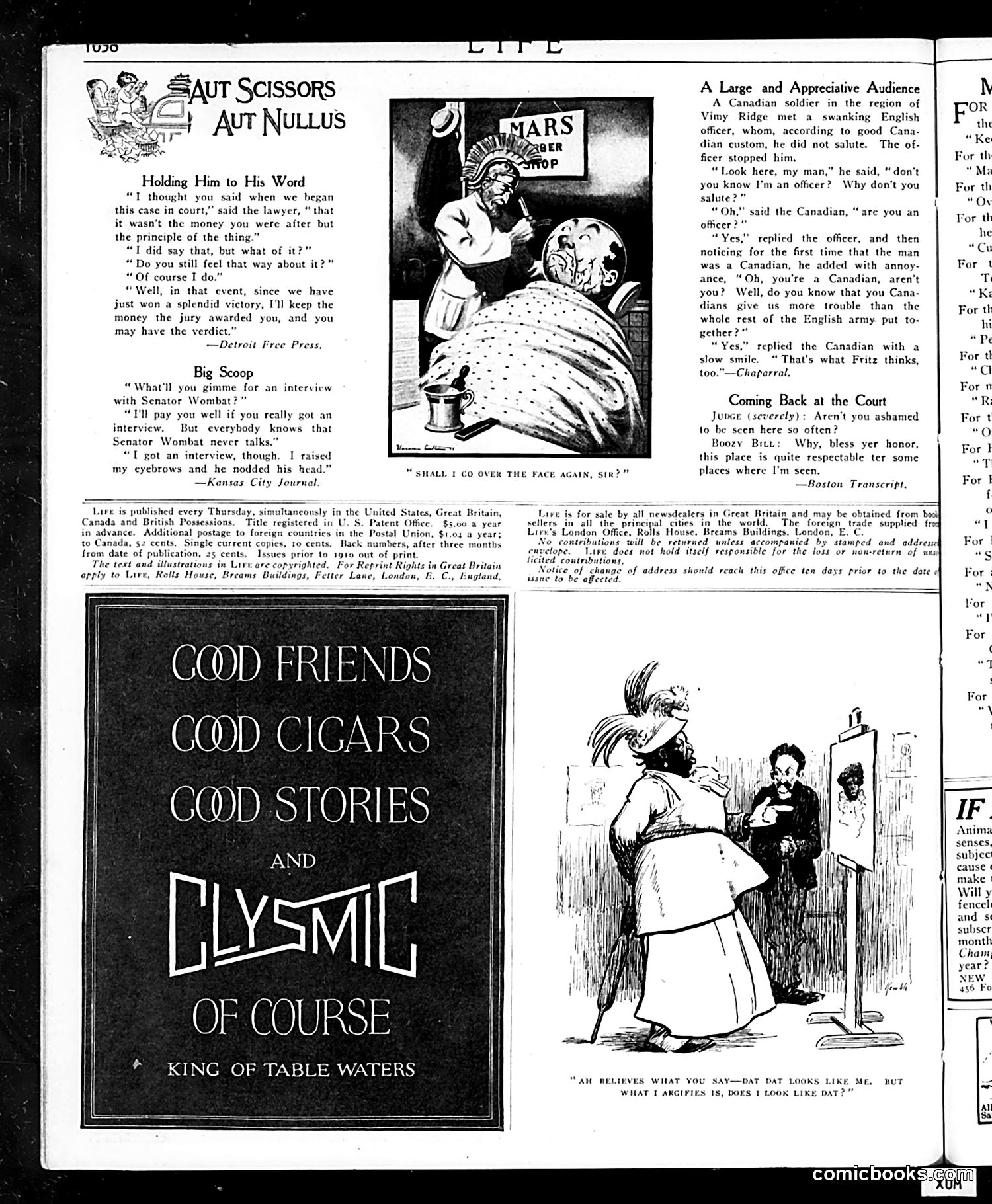
This page contains three satirical cartoons plus advertisements, all reflecting World War I-era attitudes. **Top cartoon ("Mars"):** Depicts a wounded soldier in a hospital bed being examined by a doctor. The accompanying text contrasts English and Canadian military customs—a Canadian soldier at Vimy Ridge refuses to salute a British officer, explaining that Canadians cause the English army more trouble than the enemy ("Fritz") does. The joke mocks inter-Allied tensions and Canadian military independence. **Middle cartoon ("Coming Back at the Court"):** Shows a disheveled drunk repeatedly appearing before a judge. The humor derives from the drunk's casual familiarity with the courtroom—he considers it "quite respectable" compared to other places he frequents. **Bottom cartoon:** A caricatured Black man disputes whether he resembles someone, using dialect-heavy speech. This reflects the racist humor typical of early 20th-century American publications. The page also advertises Clysmic water and includes anecdotes about legal and journalistic shenanigans. The content reflects period attitudes toward war, courts, and race.
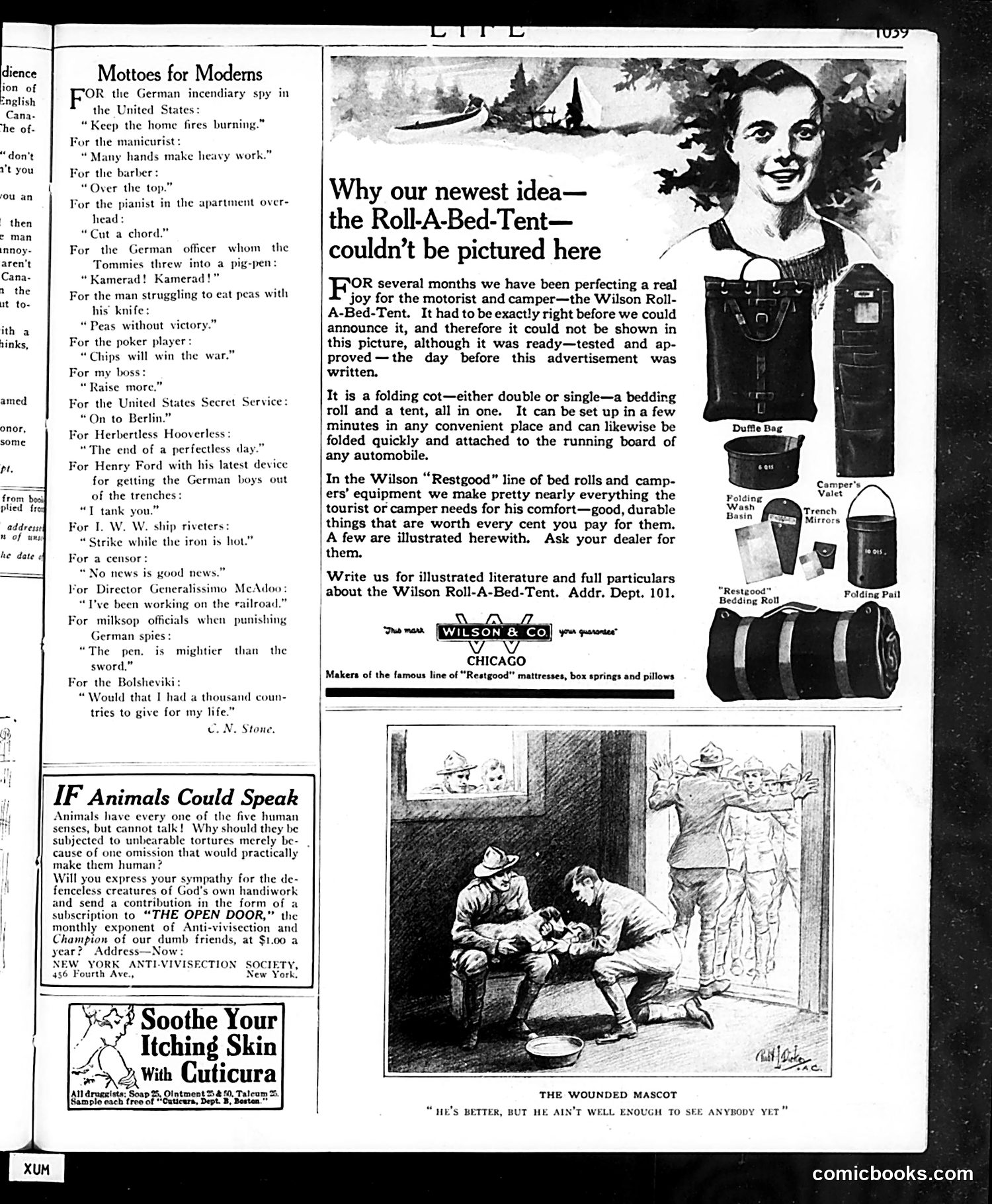
This page combines wartime satire with period advertising. The **"Mottoes for Moderns"** section offers topical wordplay mocking WWI figures and events—German spies, Director McAdoo (Wilson administration official), IWW labor organizers, and Bolsheviks. Each motto twists familiar phrases for satirical effect (e.g., "Peas without victory" references the no-victory slogan). The cartoon **"The Wounded Mascot"** depicts soldiers visiting an injured animal mascot—likely a dog or similar creature common in military units. The joke: the mascot is too wounded for public viewing, a dark humor comment on war casualties. The remaining content is primarily **advertising**: the Wilson Roll-A-Bed-Tent camping product (with claim it couldn't be photographed in time), Cuticura skin treatment, and an anti-vivisection subscription plea. This reflects Life's mixed editorial-commercial format typical of early 20th-century magazines.
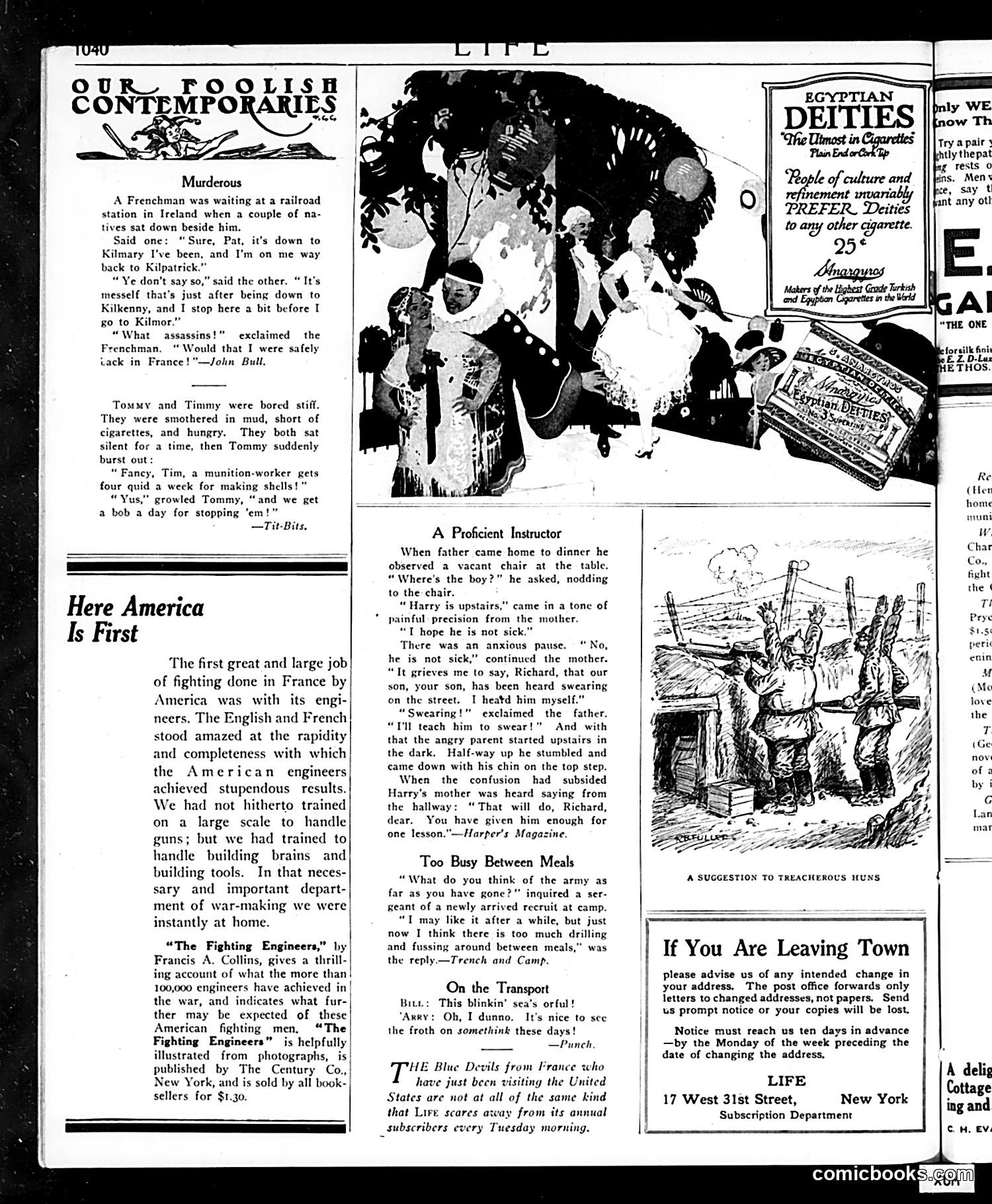
This page contains several brief satirical pieces typical of Life's "Our Foolish Contemporaries" humor section, plus a serious article and advertisements. The cartoons mock everyday absurdities: Irish place names confusing a Frenchman; soldiers complaining that munitions workers earn more than combat troops; a father accidentally injuring himself while rushing upstairs to punish his son for swearing, teaching the boy a lesson unintentionally. There's also a recruit's complaint about excessive drilling with insufficient meal breaks, and a soldier finding beauty in sea-foam during transport. The central article praises American engineers' rapid, efficient work in France during World War I—contrasting American industrial capability with the surprise of English and French allies. It advertises Francis Collins' book "The Fighting Engineers," celebrating American contributions to the war effort. The page reflects WWI-era concerns: soldier morale, class tensions between combat troops and war workers, and American pride in industrial/engineering superiority.
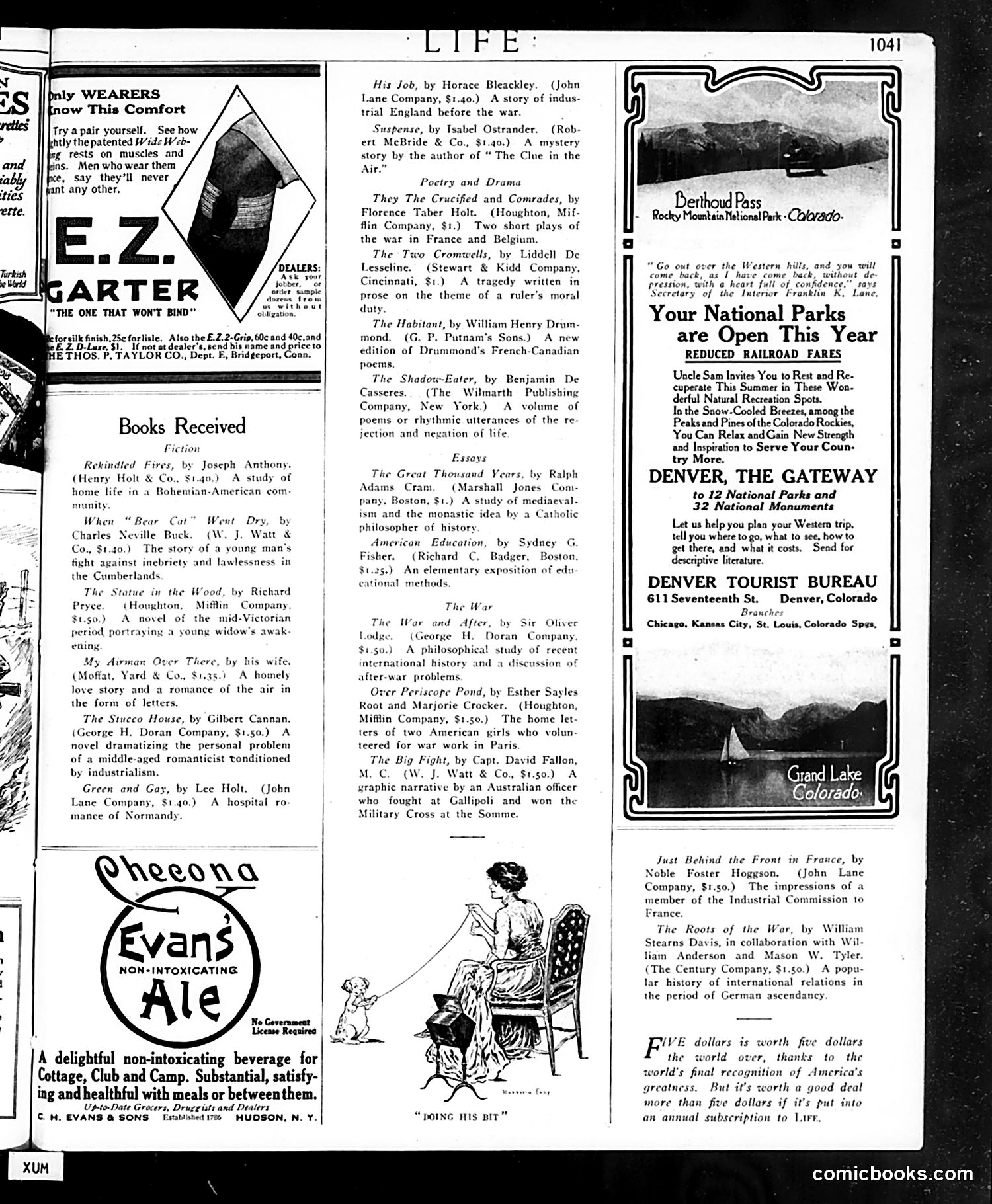
This page is primarily a **book review and advertising section** from Life magazine (page 1041), likely from the WWI era based on content. The small **cartoon titled "Doing His Bit"** shows a woman seated while a small child plays at her feet—a domestic scene illustrating home-front life during wartime. The caption's phrase "doing his bit" was contemporary WWI slang meaning contributing to the war effort. The **book reviews** prominently feature war-related titles (*They The Crucified and Comrades*, *Over Periscope Pond*, *The Big Fight*), reflecting Americans' intense interest in the conflict. **Advertisements** include E.Z. Garter (men's clothing), Cheeona Evans Non-Intoxicating Ale, and a **Colorado tourism ad** promoting national parks as summer recreation—encouraging civilians to visit while positioned as patriotic rest before/after war contributions. The page captures wartime American culture: literary interest in the war, commercial normalcy, and promotion of leisure as a form of national service.
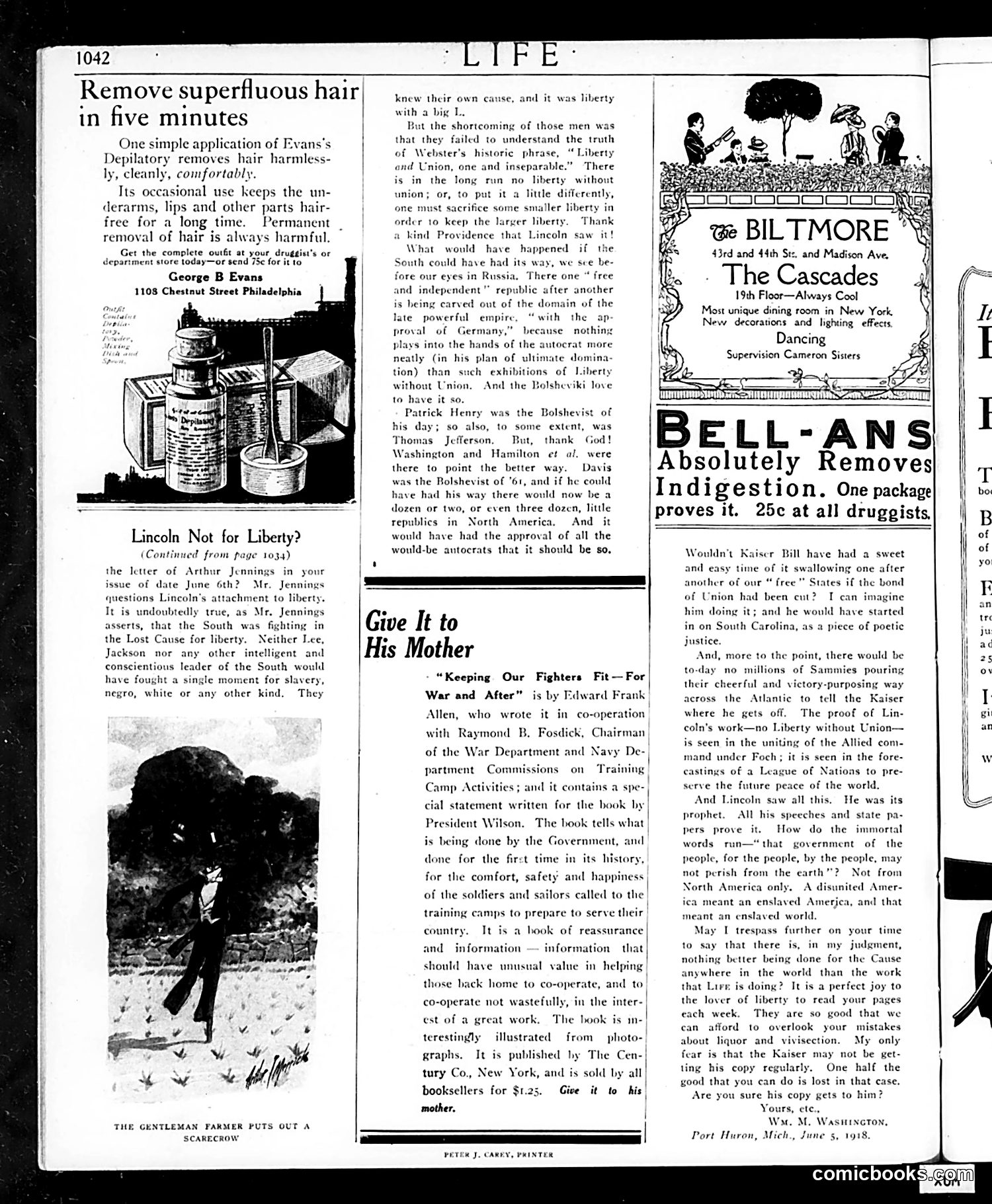
The main article "Lincoln Not for Liberty?" defends Lincoln against accusations that he betrayed Southern liberty. The author argues the South fought for "liberty" during the Civil War, but misunderstood that "Liberty and Union" are inseparable—you cannot have true liberty without union. The piece makes a sharp contemporary analogy: it compares Confederate President Jefferson Davis to the Russian Bolsheviks and Kaiser Bill, suggesting that Southern secession (like current Russian fragmentation and German autocracy) would have led to chaos and autocratic domination. The author suggests that without Lincoln's preservation of the Union, America would have fractured into "a dozen or two, or even three dozen, little republics." This June 1918 article uses the Civil War as a lens to argue that national unity—not fragmentation—protects liberty. It's essentially pro-Union, anti-secession propaganda, aimed at readers during World War I. The cartoons and advertisements are separate commercial content.
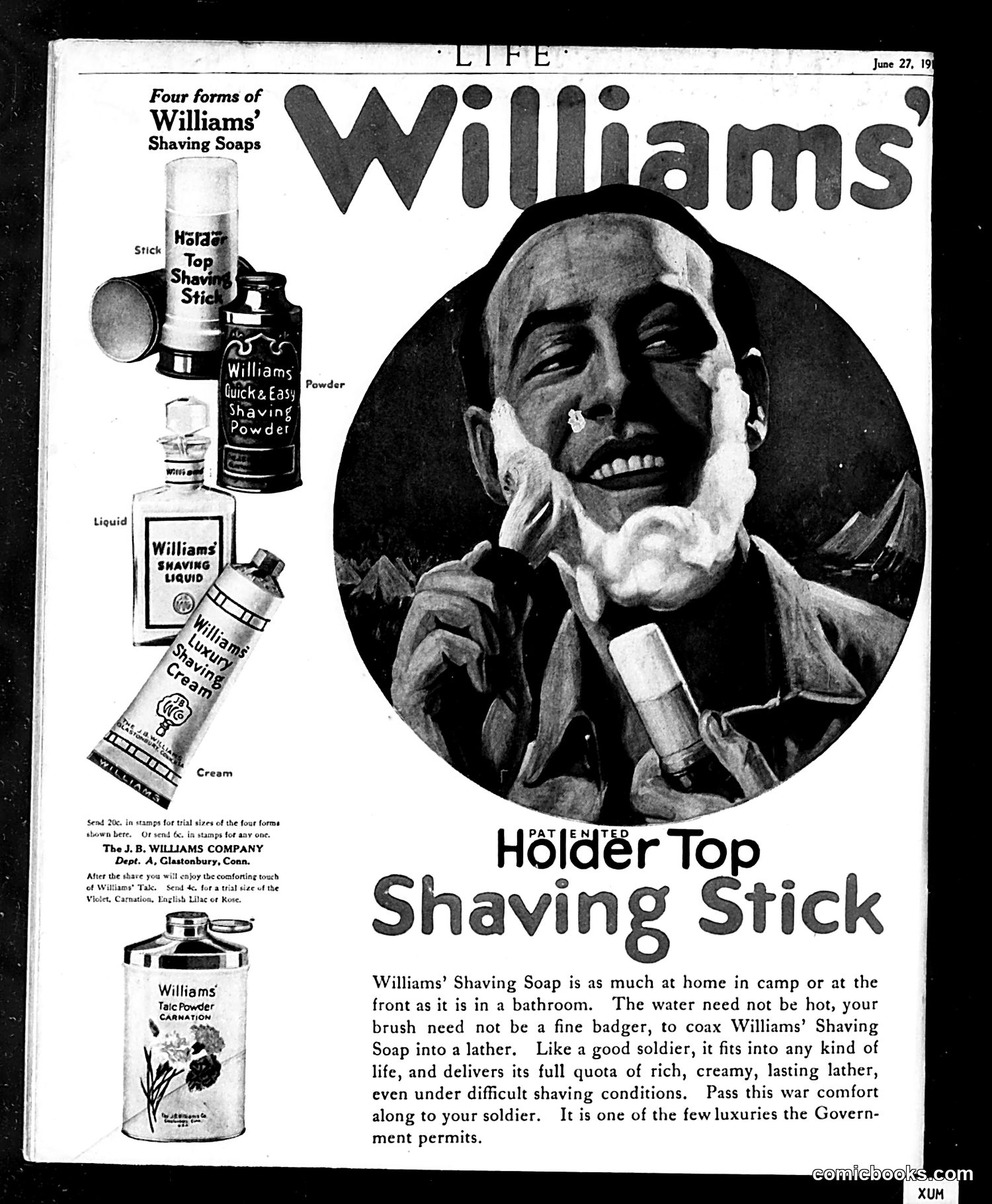
This is a World War I-era advertisement (dated June 27, likely 1917-1918) for Williams' shaving products. The large circular image shows a soldier applying shaving cream, smiling despite difficult conditions—his face is partially wrapped, suggesting he's in a military camp or field setting. The ad appeals to American civilians to send Williams' products to soldiers overseas as a "war comfort." The text emphasizes the product's practicality for military life: it works with cold water, doesn't require fine brushes, and functions "even under difficult shaving conditions." The phrase "Like a good soldier, it fits into any kind of life" personifies the soap as patriotic and reliable. This reflects WWI-era marketing that encouraged home front support for troops through consumer goods. The ad notes it's "one of the few luxuries the Government permits," acknowledging wartime rationing while positioning the product as patriotic to purchase and send.
I can see this is a black and white page from Life magazine, but the image is too dark and degraded for me to make out specific cartoon details, figures, or text clearly enough to provide accurate historical analysis. The page appears to contain content, but I cannot reliably identify: - Specific caricatures or figures depicted - The political or social references intended - The satirical point being made - Any accompanying text or captions To properly explain this cartoon's meaning to a modern reader, I would need either a clearer image or additional context about the publication date and subject matter. Without being able to see these details, I cannot responsibly identify what is being satirized.