
Life, 1918-06-27 · page 32 of 37
Life — June 27, 1918 — page 32: what you’re looking at
What you’re looking at
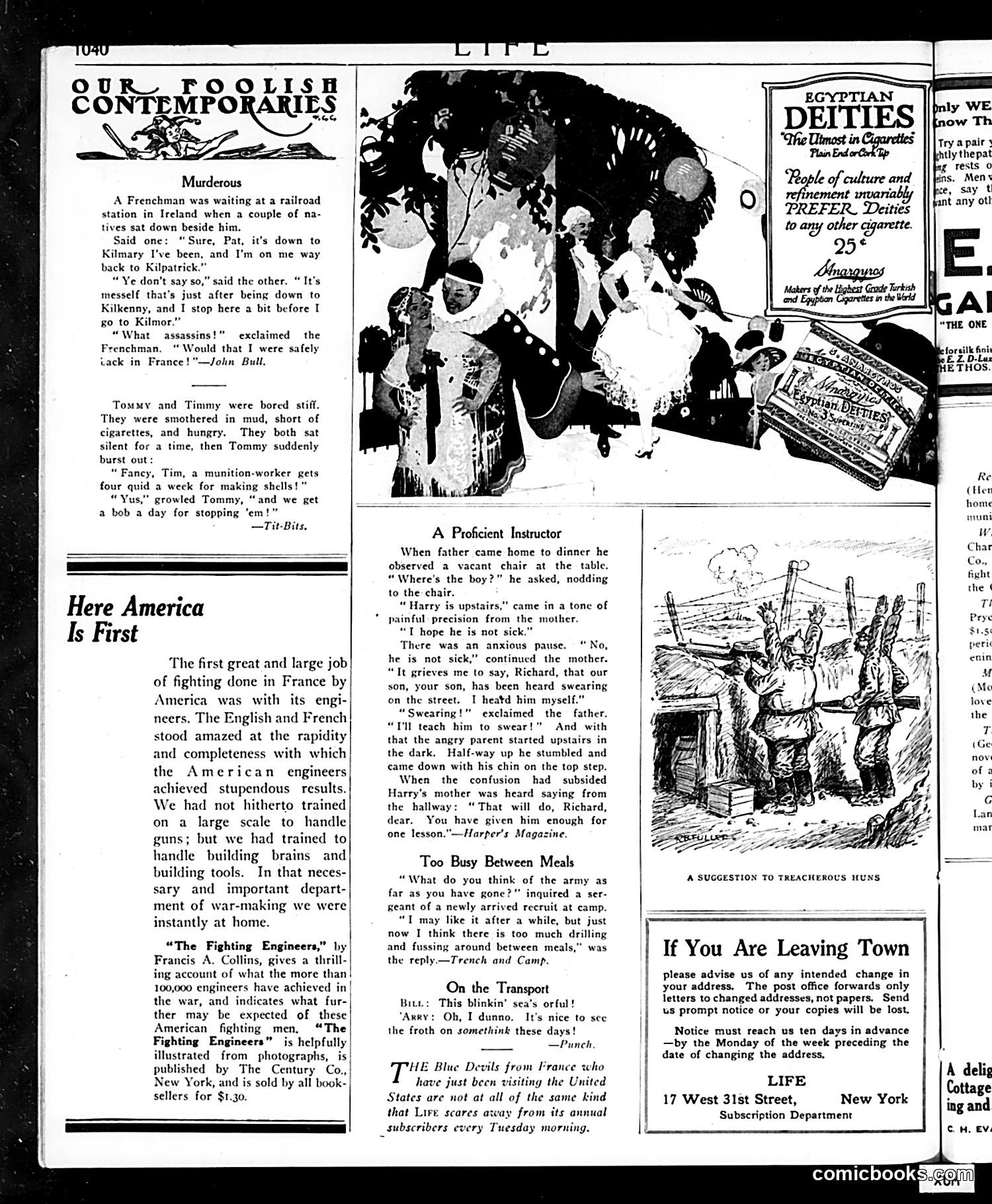
This page contains several brief satirical pieces typical of Life's "Our Foolish Contemporaries" humor section, plus a serious article and advertisements. The cartoons mock everyday absurdities: Irish place names confusing a Frenchman; soldiers complaining that munitions workers earn more than combat troops; a father accidentally injuring himself while rushing upstairs to punish his son for swearing, teaching the boy a lesson unintentionally. There's also a recruit's complaint about excessive drilling with insufficient meal breaks, and a soldier finding beauty in sea-foam during transport. The central article praises American engineers' rapid, efficient work in France during World War I—contrasting American industrial capability with the surprise of English and French allies. It advertises Francis Collins' book "The Fighting Engineers," celebrating American contributions to the war effort. The page reflects WWI-era concerns: soldier morale, class tensions between combat troops and war workers, and American pride in industrial/engineering superiority.
📄 Transcribed text from this page (OCR, searchable)
Machine-transcribed from the original scan — historical spelling and the odd misread are preserved.
USU OURS FOOLISH CONTEMPORARIES Murderous A Frenchman was waiting at a railroad station in Ireland when a couple of na- tives sat down beside him. Said one: “Sure, Pat, it's down to Kilmary I've been, and I'm on me way back to Kilpatrick.” “Ye don't say so,” said the other. “ It’s mesself that’s just after being down to Kilkenny, and I stop here a bit before I go to Kilmor.” “What assassi exclaimed the é Frenchman. “ Would that I were safely iack in France!"—John Bull, Tomsy and Timmy were bored stiff. They were smothered in mud, short of cigarettes, and hungry. They both sat silent for a time, then Tommy suddenly burst out: “Fancy, Tim, a munition-worker gets four quid a week for making shells!” “Yus,” growled Tommy, “and we get a bob a day for stopping 'em!” —Tit-Bits, Here America Is First The first great and large job of fighting done in France by America was with its engi- neers. The English and French stood amazed at the rapidity and completeness with which] the American engineers) achieved stupendous results. We had not hitherto trained on a large scale to handle guns; but we had trained to handle building brains and building tools. In that neces- sary and important depart- ment of war-making we were) instantly at home. “The Fighting Engineers,” by| Francis A. Collins, gives a thrill- ing account of what the more than) 100,000 engineers have achieved in| the war, and indicates what fur- ther may be expected of these American fighting men, “The Fighting Engineers” jis helpfully illustrated from photographs, is} ! published by The Century Co.,} | New York, and is sold by all book- || sellers for $1.30. A Proficient Instructor When father came home to dinner he observed a vacant chair at the table, “Where's the boy?” he asked, nodding to the chair. “ Harry is upstairs,” came in a tone of painful: precision from the mother. “T hope he is not sick.” There was an anxious pause. “No, he is not sick,” continued the mother. “It grieves me to say, Richard, that our son, your son, has been heard swearing on the street. I heatd him myself.” “Swearing!” exclaimed the father. “Tl teach him to swear!” And with that the angry parent started upstairs in the dark, Half-way up he stumbled and came down with his chin on the top step. When the confusion had subsided Harry’s mother was heard saying from the hallway: “That will do, Richard, dear. You have given him enough for one lesson."—Harper’s Magazine, Too Busy Between Meals “What do you think of the army as far as you have gone?” inquired a ser- geant of a newly arrived recruit at camp. “T may like it after a while, but just now I think there is too much drilling and fussing around between meals,” was the reply.—Trench and Camp. On the Transport This blinkin’ sea’s orful! Oh, I dunno. It’s nice to see the froth on somethink these days! —Punch. HE Blue Devils from France who have just been visiting the United States are not at all of the same kind that Lire scares away from its annual subscribers every Tuesday morning. EGYPTIAN Laly WE ow Th Try apair ntly thepat ig Tests 0 Men‘ ce, say t t any ot! “The Utmost Plain End orCork Tp Rople of culture and nement wvarial PREFER. Deities to any other qyarette. Re (Hen home muni enin M (Me love the T (Ge novi of a by G Lan mar If You Are Leaving Town please advise us of any intended change in your address. The post office forwards only letters to changed addresses, not papers. Send Notice must reach us ten days in advance —by the Monday of the week preceding the date of changing the address. A delig Cottage ing and cH. Ev. LIFE 17 West 31st Street, New York Subscription Department ] | us prompt notice or your copies will be lost. | comicbookSieom