
Life, 1918-06-27 · page 16 of 37
Life — June 27, 1918 — page 16: what you’re looking at
What you’re looking at
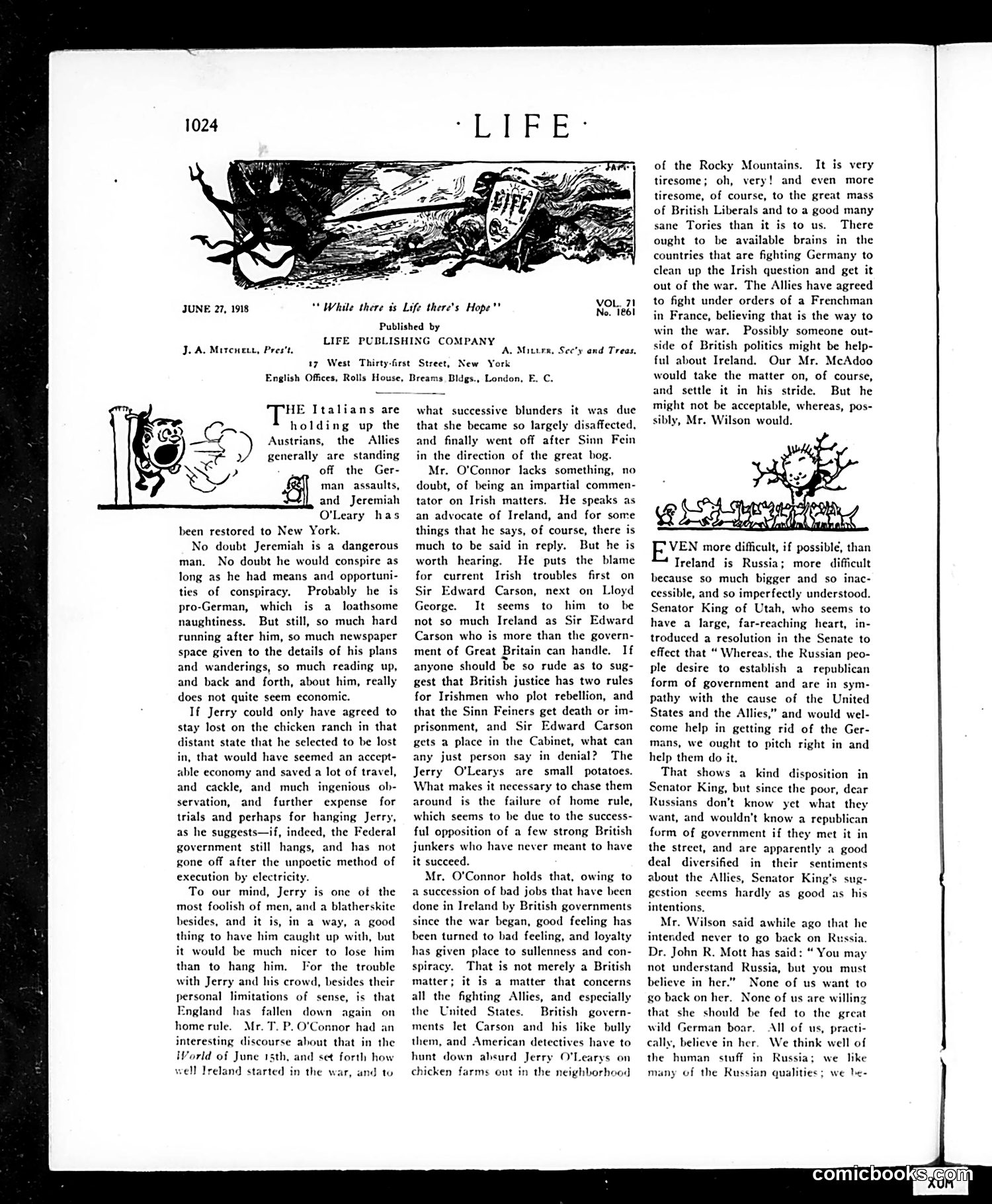
This editorial page critiques American resources wasted pursuing **Jeremiah O'Leary**, an Irish-American pro-German agitator recently captured and returned to New York. The cartoon (top left) depicts O'Leary as a foolish, blustering figure—a "blatherskite." The satire's point: O'Leary is a symptom, not the disease. The real problem is **British mishandling of Irish home rule**, which radicalized Ireland toward Sinn Féin rebellion. The editorial argues that Sir Edward Carson and Lloyd George's failures created Irish disloyalty, forcing Americans to hunt down minor conspirators in distant chicken ranches—an absurd waste during wartime. The deeper criticism: Britain's harsh treatment of Irish rebels versus political leniency toward Carson (a unionist politician) reveals hypocrisy in "British justice." This alienates a crucial ally—the United States—which must expend resources on Irish-American subversion rather than focus on defeating Germany. The piece urges Britain to finally grant home rule, eliminating the grievances fueling such conspiracies.
📄 Transcribed text from this page (OCR, searchable)
Machine-transcribed from the original scan — historical spelling and the odd misread are preserved.
JUNE 27, 1918 “While there is VOL.71 Life there's Hope"’ No. 1861 Published by LIFE PUBLISHING COMPANY J. A. Mitenent, Pres’t. 17 West. Thirty-fir English Offices, Rolls House, HE Italians are holding up the Austrians, the Allies generally are standing off the Ger- man_ assaults, and Jeremiah O'Leary has been restored to New York. No doubt Jeremiah is a dangerous man. No doubt he would conspire as long as he had means and opportuni- ties of conspiracy, Probably he is pro-German, which is a loathsome naughtiness. But still, so much hard running after him, so much newspaper space given to the details of his plans and wanderings, so much reading up, and back and forth, about him, really does not quite seem economic. If Jerry could only have agreed to stay lost on the chicken ranch in that distant state that he selected to be lost in, that would have seemed an accept- able economy and saved a lot of travel, and cackle, and much ingenious ob- servation, and further expense for trials and perhaps for hanging Jerry, as he suggests—if, indeed, the Federal government still hangs, and has not gone off after the unpoetic method of execution by electricity. To our mind, Jerry is one of the most foolish of men, and a blatherskite besides, and it is, in a way, a good thing to have him caught up with, but it would be much nicer to lose him than to hang him. For the trouble with Jerry and his crowd, besides their personal limitations of sense, is that England has len down again on home rule. Mr. T. P. O'Connor had an interesting discourse about that in the World of June 15th, and set forth how well Ireland started in the war, and to A. Miturs, Sec’y and Treas. st Street, New York . Breams Bldgs., London, E. C. what successive blunders it was due that she became so largely disaffected, and finally went off after Sinn Fein in the direction of the great bog. Mr. O'Connor lacks something, no doubt, of being an impartial commen- tator on Irish matters. He speaks as an advocate of Ireland, and for some things that he says, of course, there is much to be said in reply. But he is worth hearing. He puts the blame for current Irish troubles first on Sir Edward Carson, next on Lloyd George. It seems to him to be not so much Ireland as Sir Edward Carson who is more than the govern- ment of Great Britain can handle. If anyone should be so rude as to sug- gest that British justice has two rules for Irishmen who plot rebellion, and that the Sinn Feiners get death or im- prisonment, and Sir Edward Carson gets a place in the Cabinet, what can any just person say in denial? The Jerry O'’Learys are small potatoes. What makes it necessary to chase them around is the failure of home rule, which seems to be due to the success- ful opposition of a few strong British junkers who have never meant to have it succeed. Mr. O'Connor holds that, owing to a succession of bad jobs that have been done in Ireland by British governments since the war began, good feeling has been turned to bad feeling, and loyalty has given place to sullenness and con- spi That is not merely a British matter; it is a matter that concerns all the fighting Allies, and especially the United States. British govern- ments let Carson and his like bully them, and American detectives have to hunt down absurd Jerry O'Learys on chicken farms out in the neighborhood of the Rocky Mountains. It is very tiresome; oh, very! and even more tiresome, of course, to the great mass of British Liberals and to a good many sane Tories than it is to us. There ought to be available brains in the countries that are fighting Germany to clean up the Irish question and get it out of the war. The Allies have agreed to fight under orders of a Frenchman in France, believing that is the way to win the war. Possibly someone out- side of British politics might be help- ful about Ireland. Our Mr. McAdoo would take the matter on, of course, and settle it in his stride. But he might not be acceptable, whereas, pos- sibly, Mr. Wilson would. VEN more difficult, if possible, than Treland is Russia; more difficult because so much bigger and so inac- cessible, and so imperfectly understood. Senator King of Utah, who seems to have a large, far-reaching heart, in- troduced a resolution in the Senate to effect that “ Whereas, the Russian peo- ple desire to establish a republican form of government and are in sym- pathy with the cause of the United States and the Allies,” and would wel- come help in getting rid of the Ger- mans, we ought to pitch right in and help them do it, That shows a kind disposition in Senator King, but since the poor, dear Russians don’t know yet what they want, and wouldn't know a republican form of government if they met it in the street, and are apparently a good deal diversified in their sentiments about the Allies, Senator King's sug- gestion seems hardly as good as his intentions, Mr. Wilson said awhile ago that he intended never to go back on Russia. Dr. John R. Mott has said: “ You may not understand Russia, but you must believe in her.” None of us it to go back on her. None of us are willing that she should be fed to the great wild German boar. All of us, practi- cally, believe in her. We think well of the human stuff in Russia; we like many of the Russian qualities; we be- comicboo!