
Life, 1918-06-27 · page 26 of 37
Life — June 27, 1918 — page 26: what you’re looking at
What you’re looking at
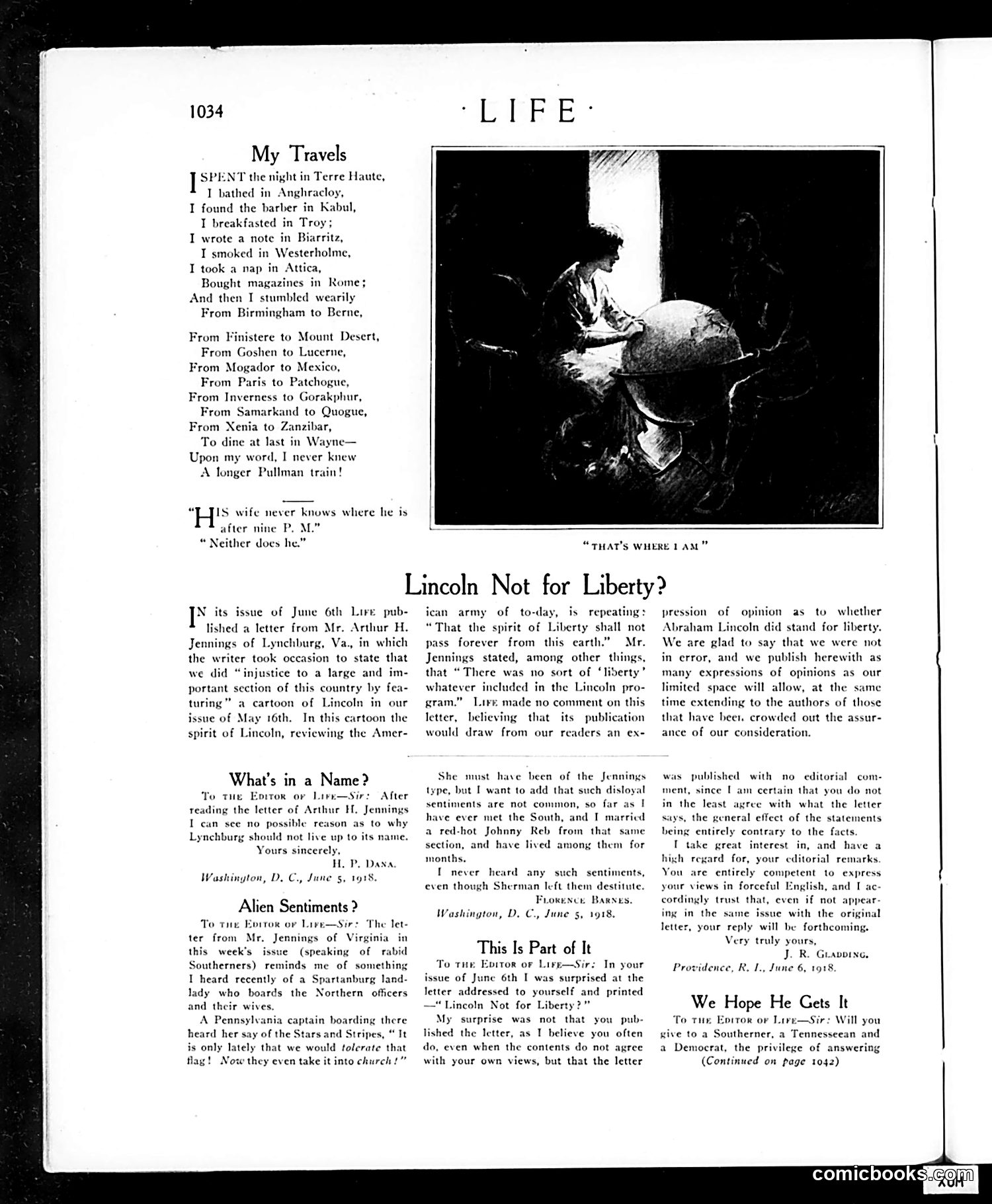
This page contains a humorous poem "My Travels" paired with a cartoon showing a man examining a globe, captioned "THAT'S WHERE I AM." The joke satirizes a well-traveled man who visits countless places so frequently he loses track of his actual location—a gentle mockery of excessive travel and restlessness. The bulk of the page features reader letters debating whether Life magazine wrongly portrayed Abraham Lincoln. A Virginia reader (Jennings) objected to a May cartoon suggesting Lincoln stood for liberty, claiming the Lincoln program contained no such "liberty." Life published multiple responses defending Lincoln and criticizing Jennings's "disloyal sentiments," particularly offensive given the 1918 wartime context (America was fighting Germany). One letter sarcastically suggests Lynchburg, Virginia should "live up to its name" (implying disloyalty). The editorial exchange reveals post-Civil War sectional tensions still simmering, with Northern contributors viewing Southern criticism of Lincoln as unpatriotic during WWI.
📄 Transcribed text from this page (OCR, searchable)
Machine-transcribed from the original scan — historical spelling and the odd misread are preserved.
1034 My Travels Sk T the night in Terre Haute, I bathed in Anghracloy, I found the barber in Kabul, I breakfasted in Troy; I wrote a note in Biarritz, I smoked in Westerholme, I took a nap in Attica, Bought magazines in Rome; And then I stumbled wearily From Birmingham to Berne, From Finistere to Mount Desert, From Goshen to Lucerne, From Mogador to Mexico, From Paris to Patchogue, From Inverness to Gorakphur, From Samarkand to Quogue, rom Xenia to Zanzibar, To dine at last in Ws Upon my word, I never knew A longer Pullman train! ne IS wife never knows where he is after nine P.M.” Neither docs he.” Is its issue of June 6th Lire pub- lished a letter from Mr. Arthur H. Jennings of Lynchburg, Va., in which the writer took occasion to state that we did “injustice to a large and im- portant section of this country by fea- turing” a cartoon of Lincoln in our issue of May 16th. In this cartoon the spirit of Lincoln, reviewing the Amer- What's in a Name? To tue Epitor or After reading the letter of Arthur H, Jennings I can see no possible reason as to why Lare—Sir: Lynchburg should not live up to its name. Yours sincerely, HL. P. Dawa Washington, D. C., June 5, 198. Alien Sentiments > To Te Evitox or Live—Sir: The let- ter from Mr. Jennings of Virginia in this week's (speaking of Southerners) reminds me of something T heard recently of a Spartanburg land- lady who boards the Northern officers and their wives. A Pennsylvania captain boarding there heard her say of the Stars and Stripes, “It is only lately that we would tolerate that flag! Now they even take it into church!” issue rabid “THAT'S WHERE 1AM" ican army of to-day, is repeating: “That the spirit of Liberty shall not pass forever from this earth.” Mr. Jennings stated, among other thing: that “There was no sort of ‘liberty’ whatever included in the Lincoln pro- gram.” Lire made no comment on this letter, that its would draw from our readers an ex- believing publication She must have been of the Jennings type, but I want to add that such disloyal sentiments are not common, so far as f have ever met the South, and I married a red-hot Johnny Reb from that section, and have lived among them for same months. I never heard even though Sherman left them destitute. Froxence Barnes, Washington, D. C., June 5, 1918. This Is Part of It To tHe Evitor of Lire—Sir: In your issue of Junc 6th I was surprised at the letter addressed to yourself and printed —" Lincoln Not for Liberty?” My. surpi lished the letter, as T believe you often do, even when the contents do not agree with your own views, but that the letter any such sentiments, ¢ was not that you pub- Lincoln Not for Liberty? whether Abraham Lincoln did stand for liberty. pression of opinion as to We are glad to say that we were not in error, and we publish herewith as many expressions of opinions as our limited space will allow, at the same time extending to the authors of those that have beer crowded out the assur- ance of our consideration. was published with no editorial ment, since [am certain that you do not in the least agree with what the letter siys, the general effect of the statements being entirely contrary to the facts. I take great interest in, and have a high regard for, your editorial remarks. You are entirely competent to express pur views in forceful cordingly com: lish, and [ ac- trust that, even if not ing in the same issue with the original letter, your reply will be forthcoming. Very truly yours, J. R. Guavoixe. R. 1., June 6, 1918. ppear: Providence, We Hope He Gets It To tue Eprrox ov Live—Sir: Will you give to a Southerner, a Tennesseean and a Democrat, the privilege of answering (Continued on page 1042) comicbookseqr]