
Life, 1918-06-27 · page 21 of 37
Life — June 27, 1918 — page 21: what you’re looking at
What you’re looking at
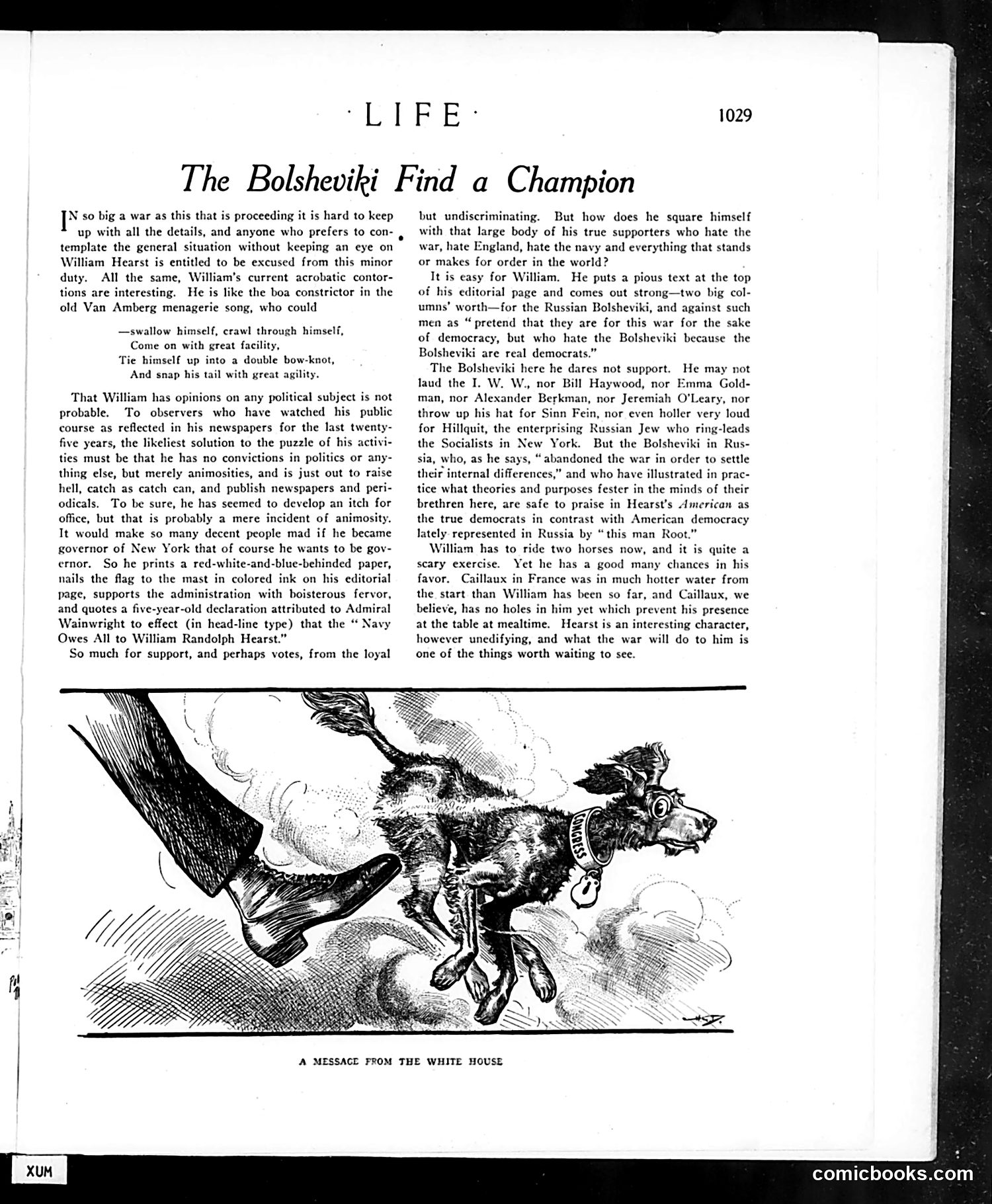
This satirical article attacks newspaper magnate **William Randolph Hearst** for political hypocrisy during World War I. The text accuses Hearst of having no genuine convictions, only "animosities," and of opportunistically shifting positions to inflame his audience. The specific charge: Hearst publicly supports America's war effort and the military in his papers (the "red-white-and-blue-behinded paper"), yet simultaneously champions Russia's Bolsheviks—who had abandoned the war and represented everything his anti-war supporters despise. The article calls this attempting to "ride two horses." The accompanying cartoon (captioned "A Message From the White House") depicts a dog being kicked—likely representing Hearst receiving disapproval from the Wilson administration for his contradictory stances. The author notes Hearst cannot openly praise American radical figures (Emma Goldman, Bill Haywood, the IWW) but safely praises distant Russian Bolsheviks, cynically exploiting both pro-war and anti-war factions simultaneously.
📄 Transcribed text from this page (OCR, searchable)
Machine-transcribed from the original scan — historical spelling and the odd misread are preserved.
“LIFE 1029 The Bolsheviki N so big a war as this that is proceeding it is hard to keep up with all the details, and anyone who prefers to con- , template the general situation without keeping an eye on William Hearst is entitled to be excused from this minor duty. All the same, William’s current acrobatic contor- tions are interesting. He is like the boa constrictor in the old Van Amberg menagerie song, who could —swallow himself, crawl through himself, Come on with great facility, ie himself up into a double bow-knot, And snap his tail with great agili That William has opinions on any political subject is not probable. To observers who have watched his public course as reflected in his newspapers for the last twenty- five years, the likeliest solution to the puzzle of his activi- ties must be that he has no convictions in politics or any- thing else, but merely animosities, and is just out to raise hell, catch as catch can, and publish newspapers and peri- odicals. To be sure, he has seemed to develop an itch for office, but that is probably a mere incident of animosity. It would make so many decent people mad if he became governor of New York that of course he wants to be gov- ernor. So he prints a red-white-and-blue-behinded paper, nails the flag to the mast in colored ink on his editorial page, supports the administration with boisterous fervor, and quotes a five-year-old declaration attributed to Admiral Wainwright to effect (in head-line type) that the “ Navy Owes All to William Randolph Hearst.” So much for support, and perhaps votes, from the loyal Find a Champion but undiscriminating. But how does he square himself with that large body of his true supporters who hate the war, hate England, hate the navy and everything that stands or makes for order in the world? It is easy for William. He puts a pious text at the top of his editorial page and comes out strong—two big col- umns’ worth—for the Russian Bolsheviki, and against such men as “pretend that they are for this war for the sake of democracy, but who hate the Bolsheviki because the Bolsheviki are real democrats.” The Bolsheviki here he dares not support. He may not laud the I. W. W., nor Bill Haywood, nor Emma Gold- man, nor Alexander Berkman, nor Jeremiah O'Leary, nor throw up his hat for Sinn Fein, nor even holler very loud for Hillquit, the enterprising Russian Jew who ring-leads the Socialists in New York. But the Bolsheviki in Rus- sia, who, as he says, “ abandoned the war in order to settle their internal differences,” and who have illustrated in prac- tice what theories and purposes fester in the minds of their brethren here, are safe to praise in Hearst’s American as the true democrats in contrast with American democracy lately. represented in Russia by “this man Root.” William has to ride two horses now, and it is quite a scary exercise. Yet he has a good many chances in his favor. Caillaux in France was in much hotter water from the start than William has been so far, and Caillaux, we believe, has no holes in him yet which prevent his presence at the table at mealtime. Hearst is an interesting character, however unedifying, and what the war will do to him is one of the things worth waiting to see. A MESSACE FROM THE WHITE HOUSE comicbooks.com