
Life, 1918-06-27 · page 12 of 37
Life — June 27, 1918 — page 12: what you’re looking at
What you’re looking at
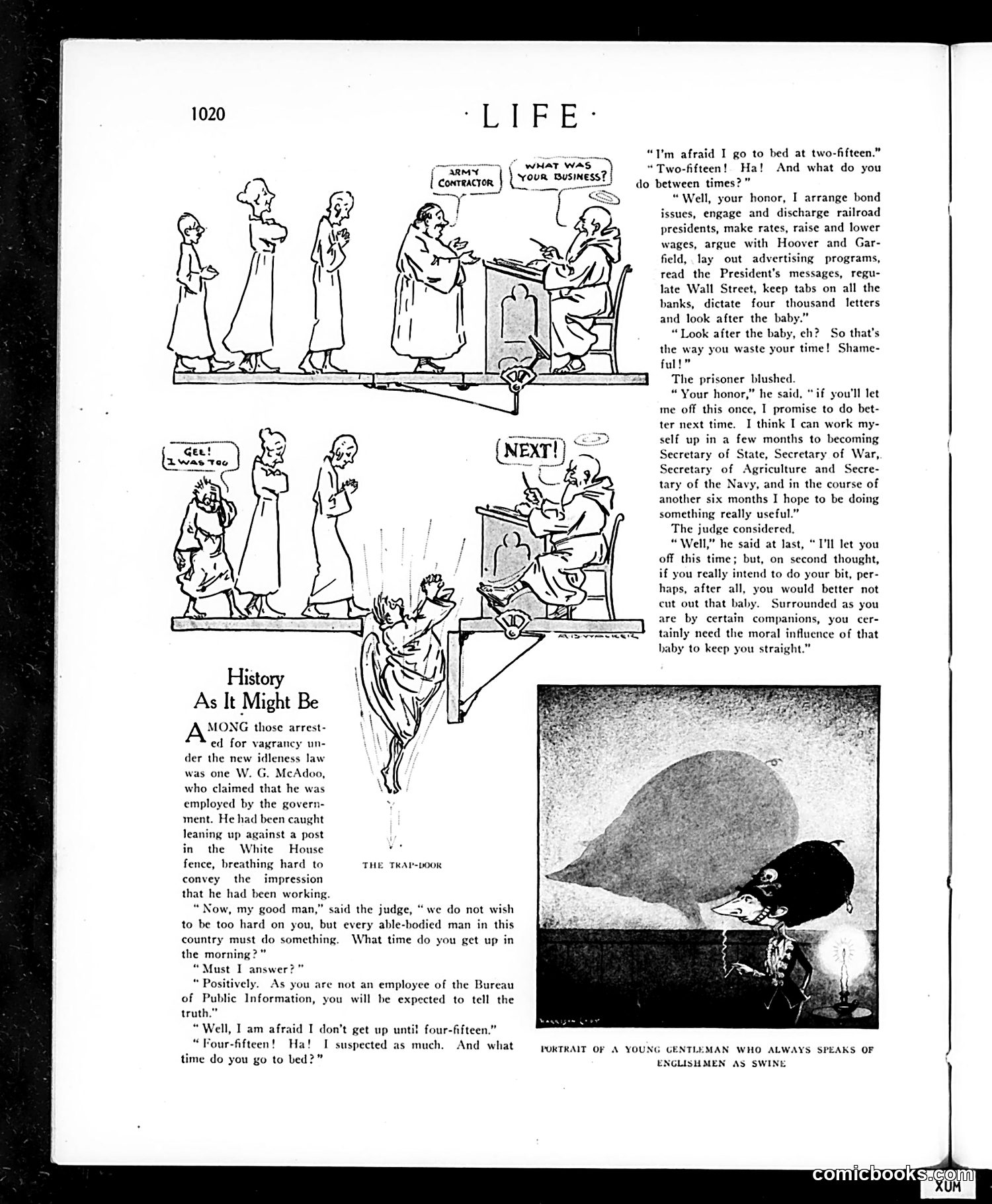
The top cartoon satirizes **wartime government inefficiency**. An "Army Contractor" is questioned about their business. The figure's response—juggling bond issues, railroad presidents, Wall Street dealings, and caring for a baby—mocks how government contractors claim to be simultaneously managing vast financial and industrial operations while maintaining personal life. The joke is their absurd overcommitment; the punchline suggests such a person lacks time for anything properly. The bottom section, "History As It Might Be," presents a humorous court scene involving **W.G. McAdoo**, who was caught loitering at the White House fence during the "idleness law" period. The judge's interrogation about what time he gets up satirizes **vagrancy laws** and their application to government officials, contrasting bureaucratic productivity claims with reality. The accompanying photograph appears unrelated to the main content.
📄 Transcribed text from this page (OCR, searchable)
Machine-transcribed from the original scan — historical spelling and the odd misread are preserved.
LIFE “I'm afraid I go to bed at two-fifteen.” Ee aR ren | {ett i) “Two-fifteen! Ha! And what do you celdpnia do between times? “Well, your honor, I arrange bond issues, engage and discharge railroad presidents, make rates, raise and lower wages, argue with Hoover and Gar- field, lay out advertising programs, read the President's messages, regu- late Wall Street, keep tabs on all the banks, dictate four thousand letters and look after the baby.” “Look after the baby, ch? So that’s the way you waste your time! Shame- ful!” The prisoner blushed. “Your honor,” he said, “if you'll let me off this once, I promise to do bet- ter next time. I think I can work my- self up in a few months to becoming Secretary of State, Secretary of War, Secretary of Agriculture and Secre- tary of the Navy, and in the course of another six months I hope to be doing something really useful.” The judge considered, “Well,” he said at last, “I'll let you off this time; but, on second thought, if you really intend to do your bit, per- haps, after all, you would better not cut out that baby. Surrounded as you are by certain companions, you cer- tainly need the moral influence of that baby to keep you straight.” History As It Might Be MONG those arrest- ed for vagrancy un- der the new idleness law was one W. G. McAdoo, who claimed that he was employed by the govern- ment. He had been caught leaning up against a post in the White House fence, breathing hard to THE TRAP-DOOR convey the impression that he had been working. “ Now, my good man,” said the judge, “we do not wish to be too hard on you, but every able-bodied man in this country must do something. What time do you get up in the morning?” “Must I answer? " Positively. As you are not an employce of the Bureau of Public Information, you will be expected to tell the truth,” “Well, I am afraid I don’t get up unti! four-fifteen.” “Four-fifteen! Ha! I suspected as much. And what purtratr oF A YOUNG GENTLEMAN WHO ALWAYS SPEAKS OF time do you go to bed?” ENGLISHMEN AS SWINE (