
A complete issue · 36 pages · 1918
Life — June 20, 1918
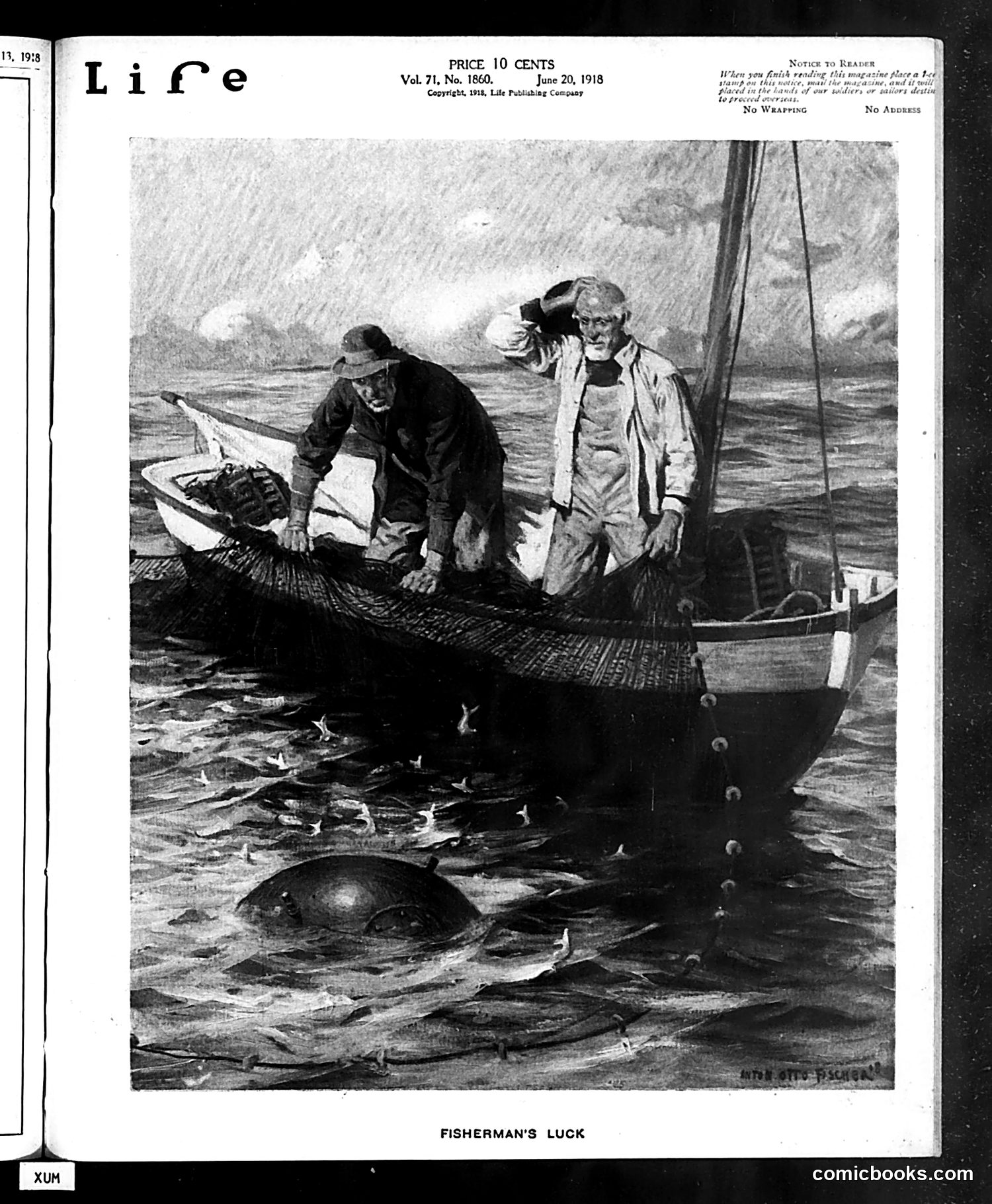
This 1918 *Life* magazine illustration depicts two fishermen hauling in an enormous catch. The title "Fisherman's Luck" suggests unexpected good fortune. Given the June 1918 date, this likely contains wartime commentary. The massive haul could represent American military or industrial success during World War I's final months. The fishermen's expressions—one focused on the work, the other gesturing in amazement—emphasize the scale of their unexpected bounty. The exaggerated size of the catch relative to the small boat creates comic contrast. Without additional context or captions identifying specific figures, the exact satirical target remains unclear, though the "luck" reference suggests commentary on either American advantages or fortunate circumstances during the war's conclusion.
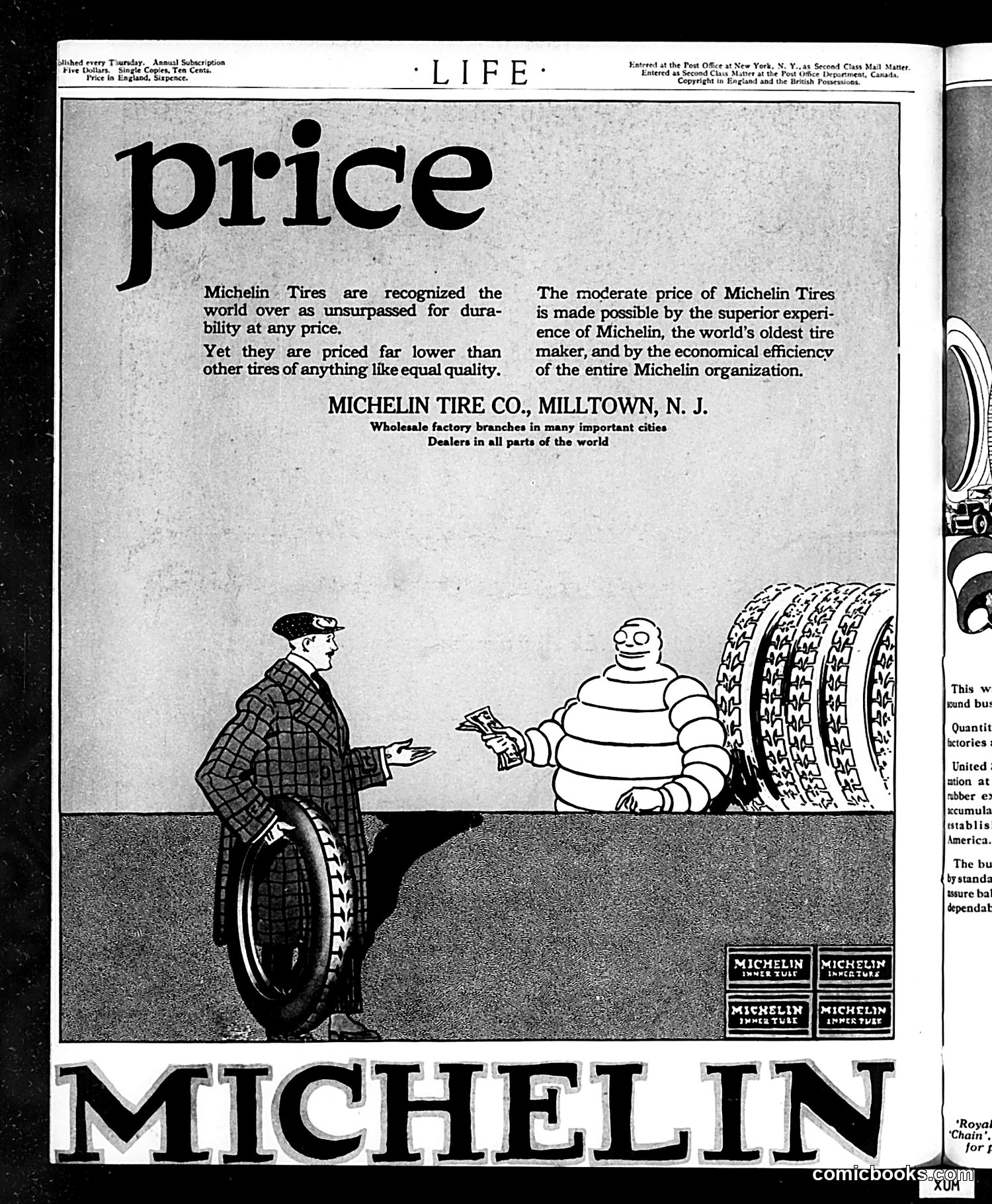
This is primarily a **Michelin Tire advertisement**, not political satire. The page features the famous "Michelin Man" (Bibendum) character—the rotund, tire-bodied mascot recognizable by his segmented appearance. The advertisement's central message plays on **price versus quality**: Michelin tires are claimed to be simultaneously superior in durability *and* moderately priced compared to competitors. The cartoon shows a customer (left) apparently surprised or pleased by the pricing proposition offered by the Michelin Man (center), who gestures toward stacked tires. The visual joke relies on the Michelin Man's distinctive appearance itself—his tire-constructed body literally embodies the product being sold. This is straightforward commercial messaging rather than political or social commentary.
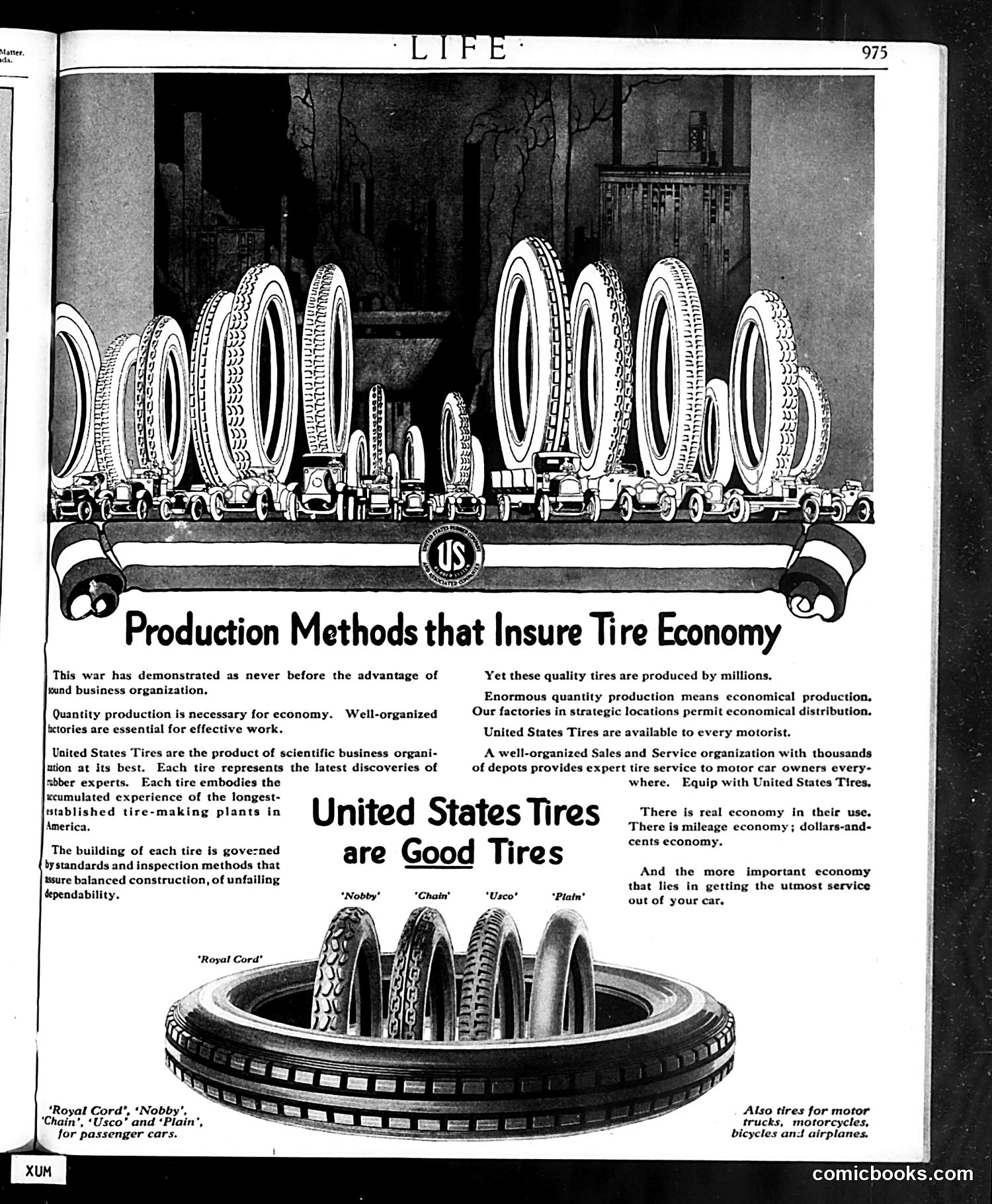
This is **not a political cartoon or satire**—it's a straightforward **advertisement for United States Tires**. The page uses a striking visual metaphor: an illustration of tiny cars arranged beneath oversized tire treads, emphasizing mass production and scale. The text celebrates efficient factory organization and scientific manufacturing methods. The advertisement highlights five tire models ("Royal Cord," "Nobby," "Chain," "Usco," "Plain") for different vehicle types. It stresses that quantity production enables economy, quality control ensures reliability, and organized distribution networks provide widespread availability and service. The reference to "this war" (likely World War I) frames mass organization as a patriotic virtue—demonstrating American industrial superiority. The core message: United States Tires combines economy with dependability through scientific production methods.
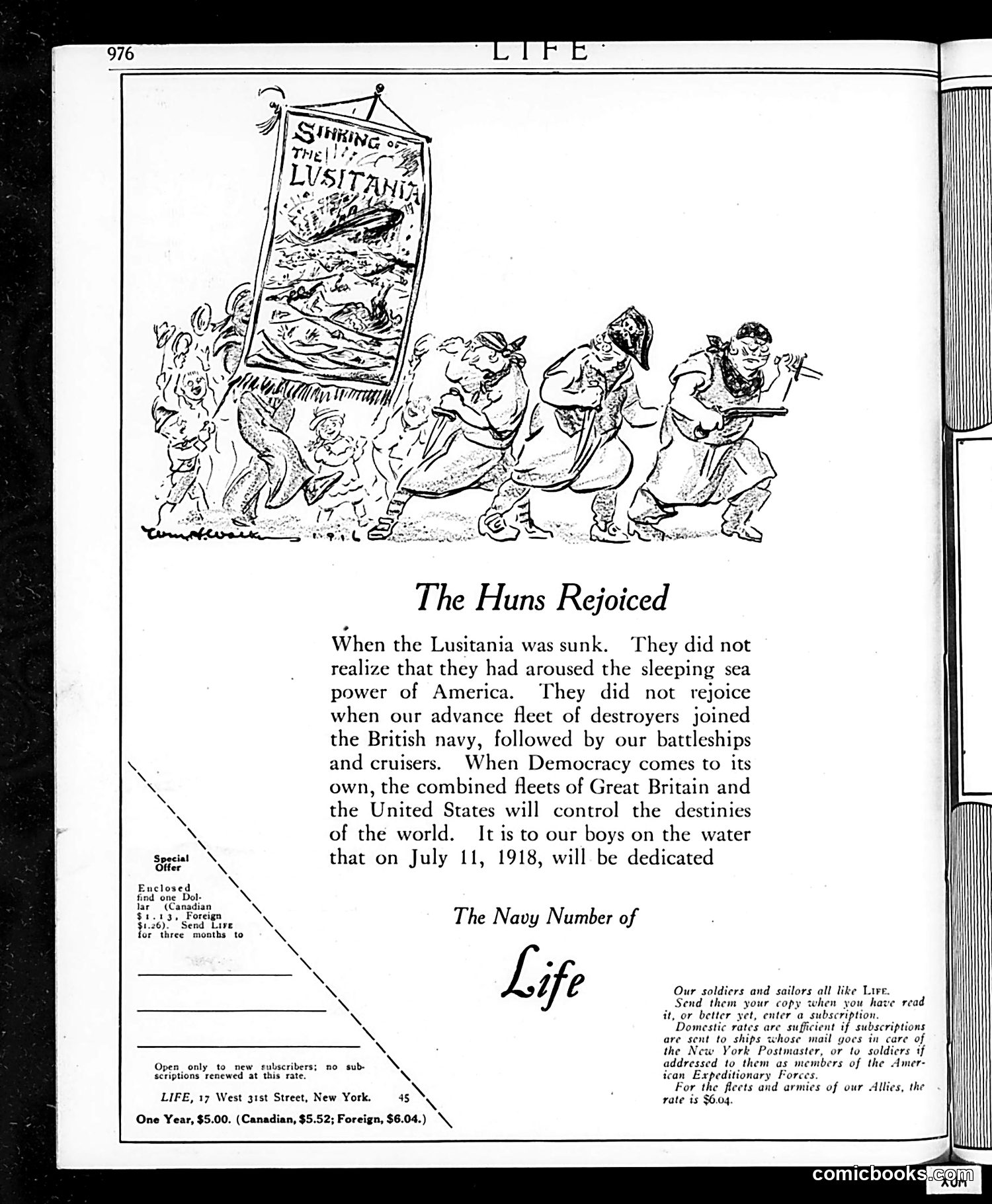
This page combines propaganda and advertising from World War I (the text references July 11, 1918). The cartoon depicts caricatured German soldiers ("the Huns") celebrating the sinking of the RMS Lusitania—a British passenger ship torpedoed in 1915, killing nearly 1,200 people, including many Americans. The accompanying text argues that Germany miscalculated: this attack actually "aroused the sleeping sea power of America," eventually bringing U.S. naval forces to support Britain. The satire suggests German rejoicing was premature and foolish. The page uses this emotionally charged historical event to promote *Life* magazine subscriptions, appealing to American patriotic sentiment during WWI. The subscription box advertises rates for domestic and foreign subscribers.
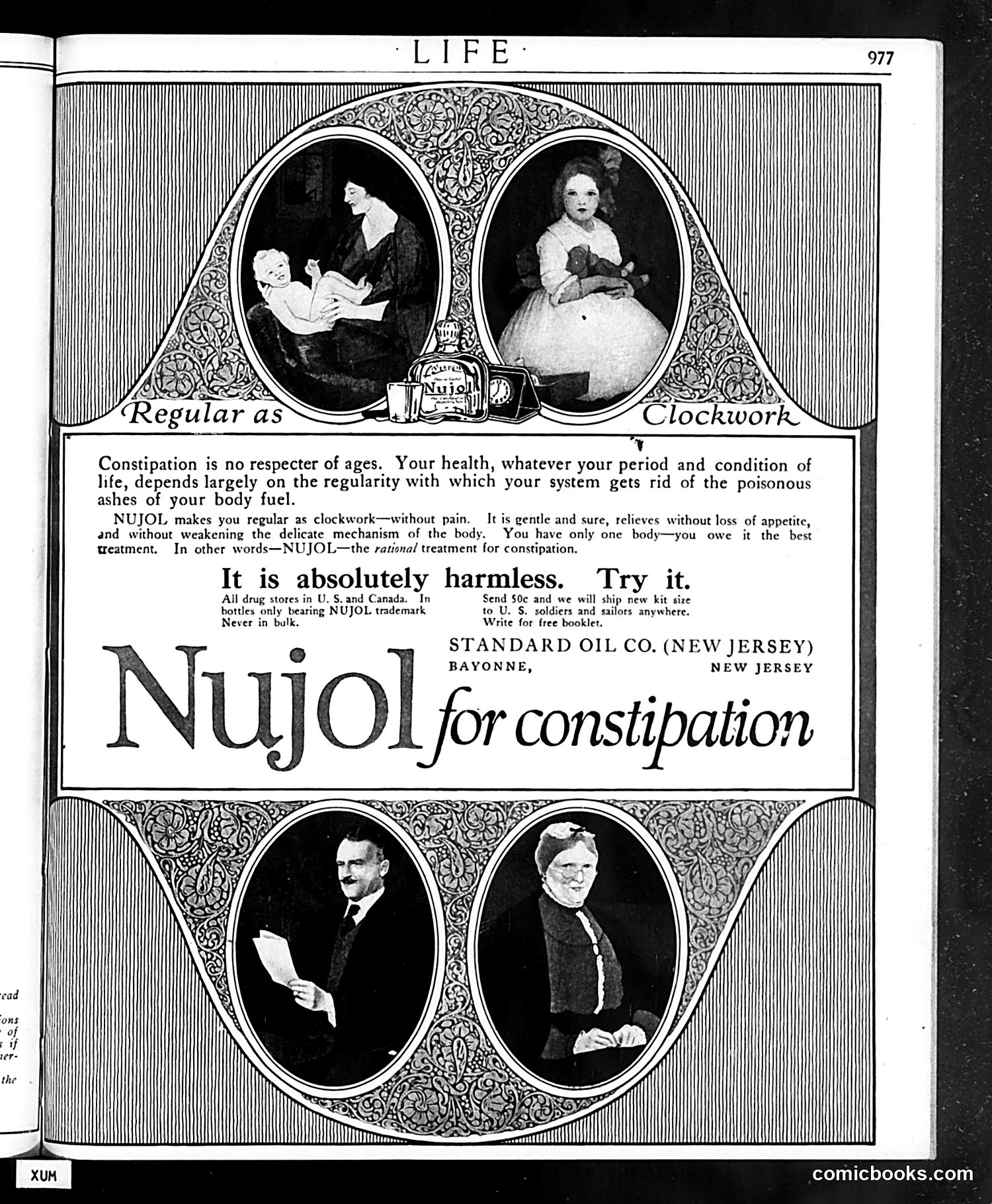
This is primarily a **product advertisement**, not political satire. It promotes Nujol, a laxative made by Standard Oil Company (New Jersey), for treating constipation. The page's imagery and copy are straightforward marketing. The four oval portraits appear to be testimonial photographs of satisfied customers across different demographics (young woman, older woman, man, elderly woman), a common advertising convention of the era. The "Regular as Clockwork" headline uses a pun about regularity—both bodily function and timekeeping precision. The text emphasizes the product is "absolutely harmless" and "gentle and sure," addressing contemporary medical anxieties. There is no political commentary or satirical intent visible. This represents early 20th-century pharmaceutical advertising in a mainstream magazine.
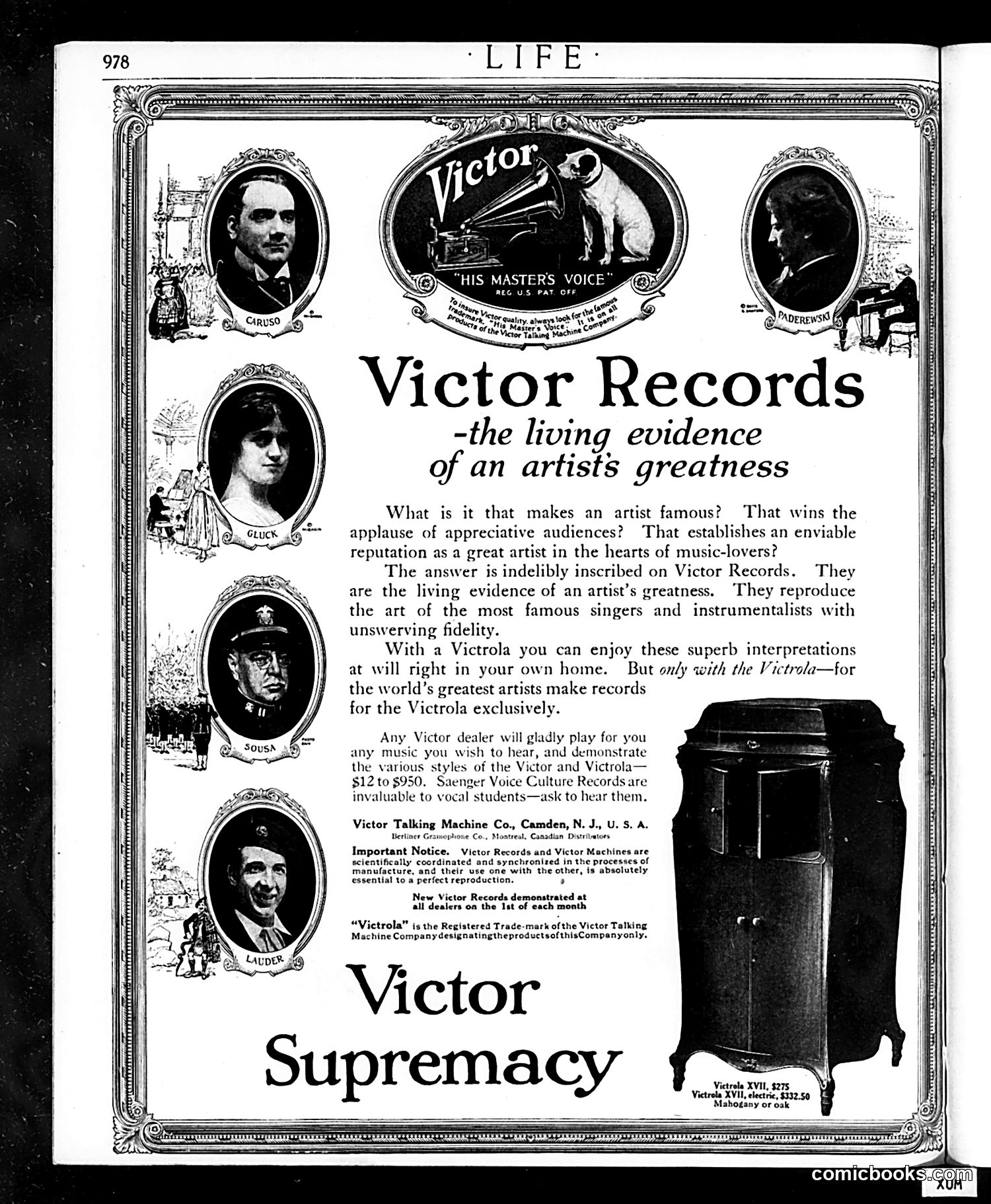
This page is primarily a **Victor Records advertisement**, not satire or political content. It features portraits of famous opera singers and classical musicians of the era, labeled with names including Caruso, Gluck, Calve, Sousa, and Lauder. The ad emphasizes that Victor Records capture "the living evidence of an artist's greatness" and claims superiority over competitors—only the Victrola phonograph player can properly reproduce these recordings. The accompanying product images show the Victrola XVII model at different price points ($275-$332.50). This is straightforward commercial marketing promoting both recorded music and the phonograph technology needed to play it, capitalizing on early 20th-century fascination with capturing and reproducing live performance.
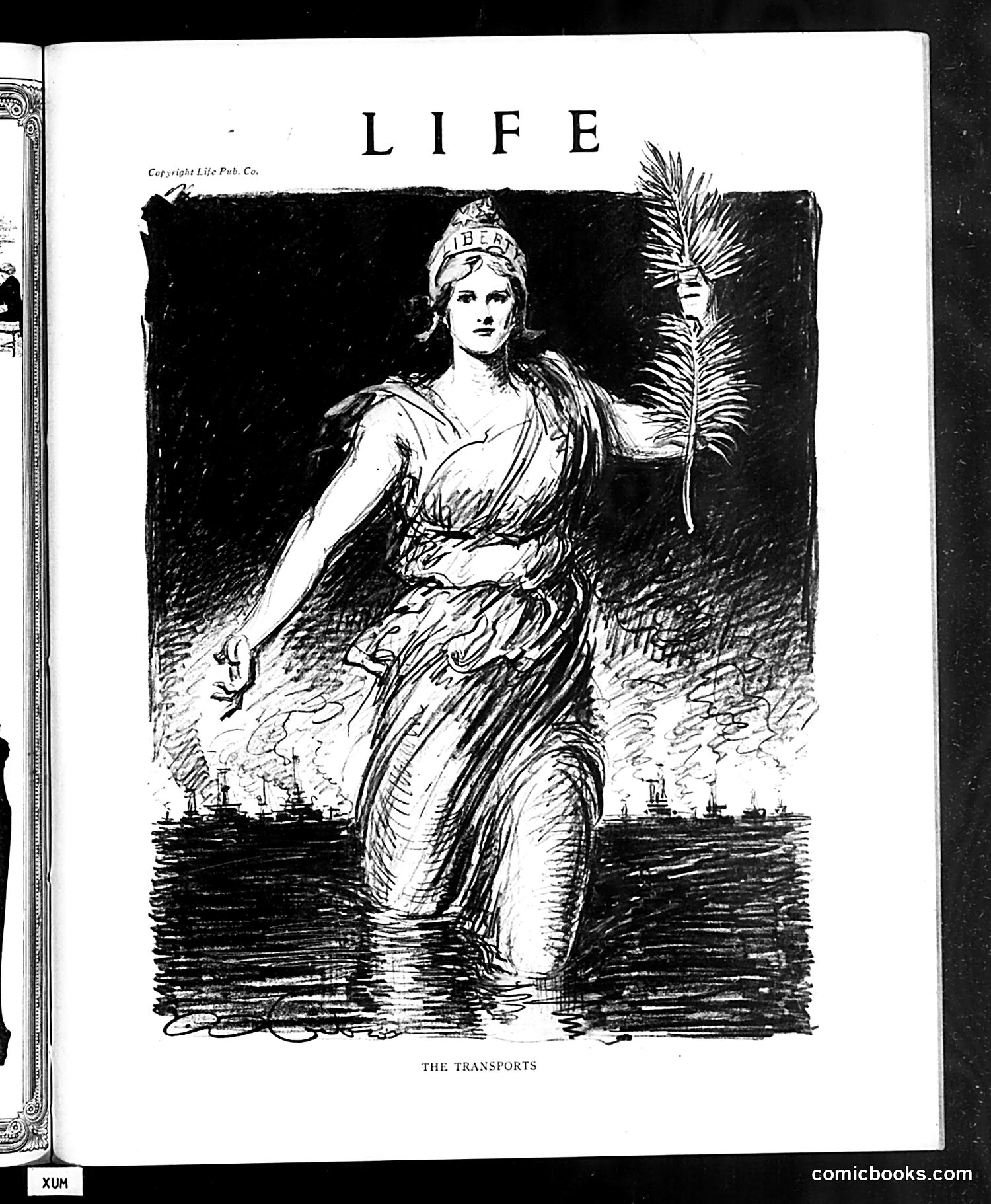
This is a cover illustration titled "The Transports" depicting Lady Liberty (identifiable by her crown labeled "Liberty" and torch) standing in shallow water. She appears distressed or weary, wading among military transport ships visible in the background. The satire likely references America's role in World War I, specifically the transport of troops overseas. The image suggests anxiety about the human cost of war—Liberty herself seems troubled by the military vessels and the war effort. The juxtaposition of America's founding symbol with scenes of military transport conveys skepticism or concern about American military involvement and the fate of soldiers being shipped to war. The copyright indicates this is from Life Publishing Company.
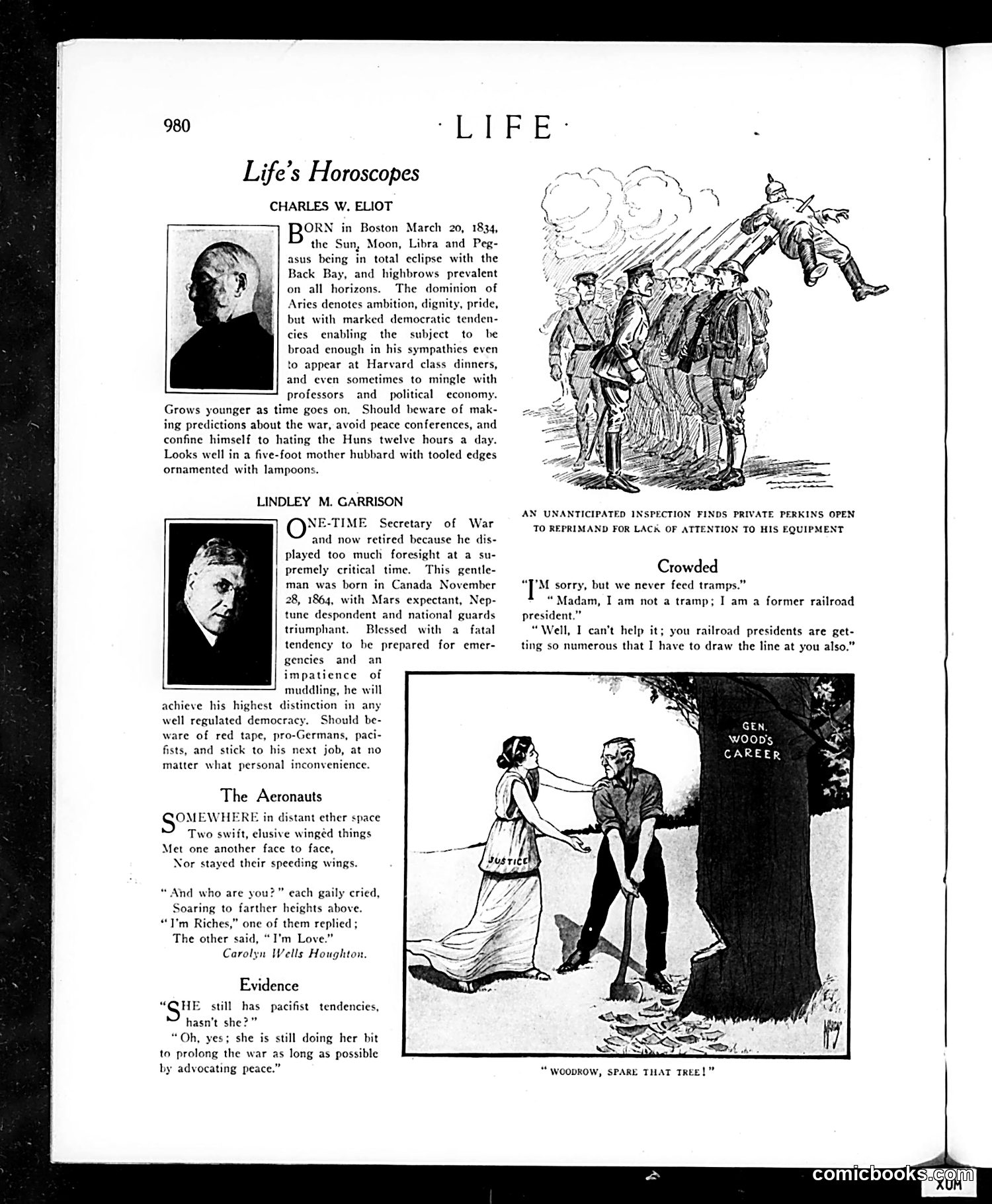
This page contains horoscopes and satirical cartoons from an early 20th-century Life magazine. The top illustration depicts a military inspection where a commanding officer notes a soldier's lack of proper equipment attention—a commentary on military readiness or discipline. The lower cartoon, captioned "Woodrow, Spare That Tree!," shows a woman labeled "Justice" attempting to prevent a man (presumably representing Woodrow Wilson) from cutting down a tree marked "Woods' Career." This appears to reference Wilson's presidency and a specific political figure or appointment decision regarding someone named Woods. The satire criticizes Wilson's action as unjust or damaging to someone's career prospects. The surrounding text includes biographical horoscopes and poetry, typical of Life's mixed editorial content from this era.
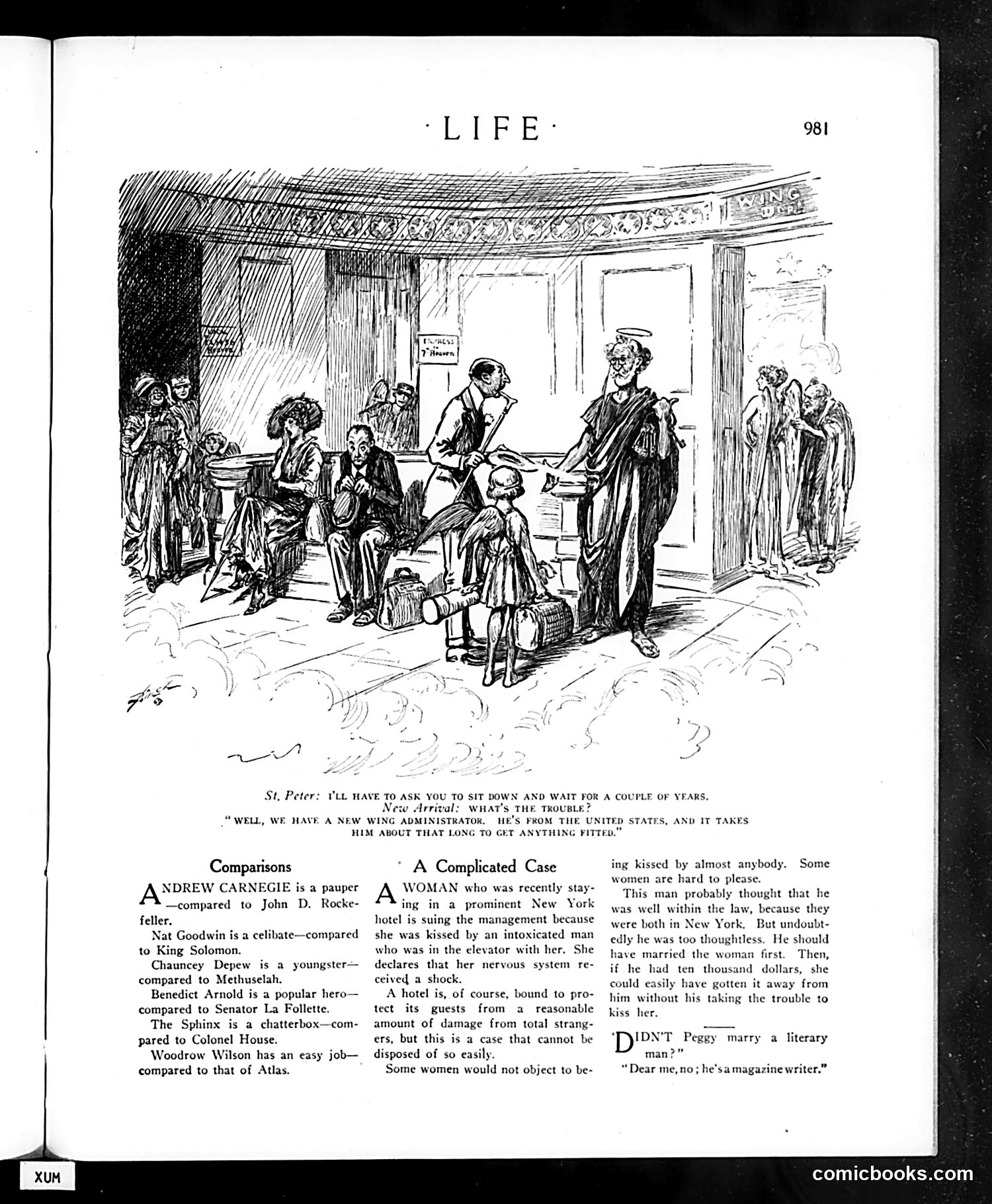
The main cartoon depicts St. Peter at heaven's gates dealing with a new arrival—a heavenly bureaucrat problem. St. Peter must tell someone they'll wait "a couple of years" because there's a "new wing administrator" from the United States who moves slowly on administrative matters. This satirizes American bureaucratic inefficiency and red tape, suggesting that even heaven cannot escape American administrative slowness. The joke implies that American management styles are so notoriously cumbersome that they've infected even the afterlife. The page also contains brief humorous comparison pieces ("Comparisons") and a short story titled "A Complicated Case" about a woman in a New York hotel kissed by an intoxicated man in an elevator, exploring social propriety and masculine thoughtlessness.
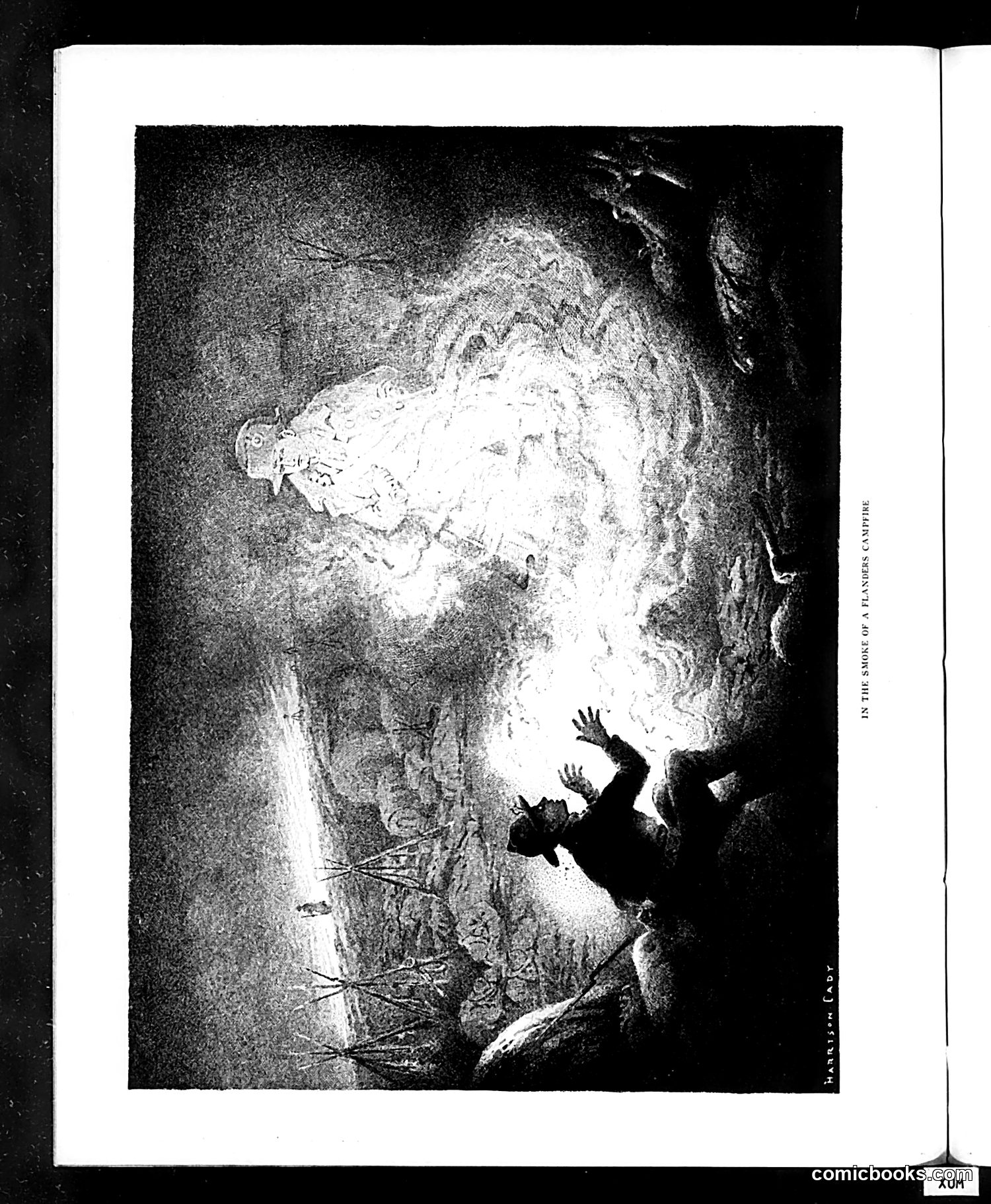
I can see this is a black and white illustration, but the image quality and contrast make it difficult to discern specific details clearly. The caption text on the right appears to read "IN THE GLOW OF A BANISHED CULTURE" (or similar), suggesting this is political or social satire commentary. The illustration appears to show figures in a dramatic scene with strong light and shadow contrast, possibly depicting some kind of historical or contemporary event being criticized. However, without being able to read the caption with complete certainty or identify the specific figures with confidence, I cannot reliably explain what political figures or events this cartoon references or what its satirical point was intended to be. To provide an accurate historical explanation, I would need either a clearer image or confirmation of the publication date and caption text.
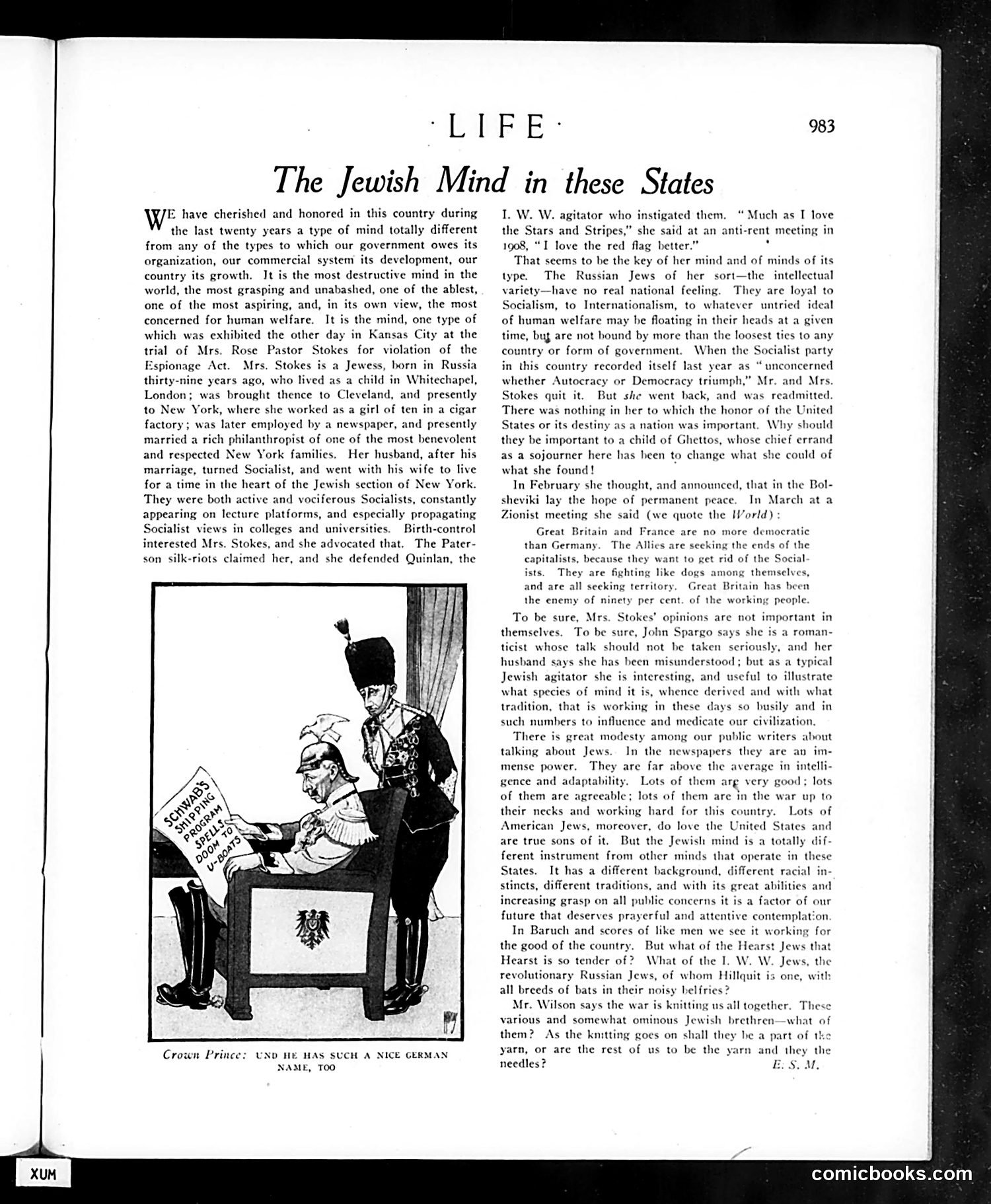
This article discusses Mrs. Rose Pastor Stokes, a Russian-born Jewish woman and socialist activist who lived in New York. The accompanying cartoon depicts a German military figure (identifiable by the Prussian uniform and spiked helmet) sitting contentedly while a Jewish figure, labeled with Yiddish text, appears to be serving him. The satire targets what the author calls Stokes' pro-socialist, internationalist views. The cartoon suggests that Jewish socialists' loyalty to internationalism and their criticism of nationalism makes them effectively serve German (enemy) interests. This reflects wartime anxieties about Jewish Americans' political allegiances during or after World War I, playing on antisemitic stereotypes about Jews being insufficiently patriotic to America.
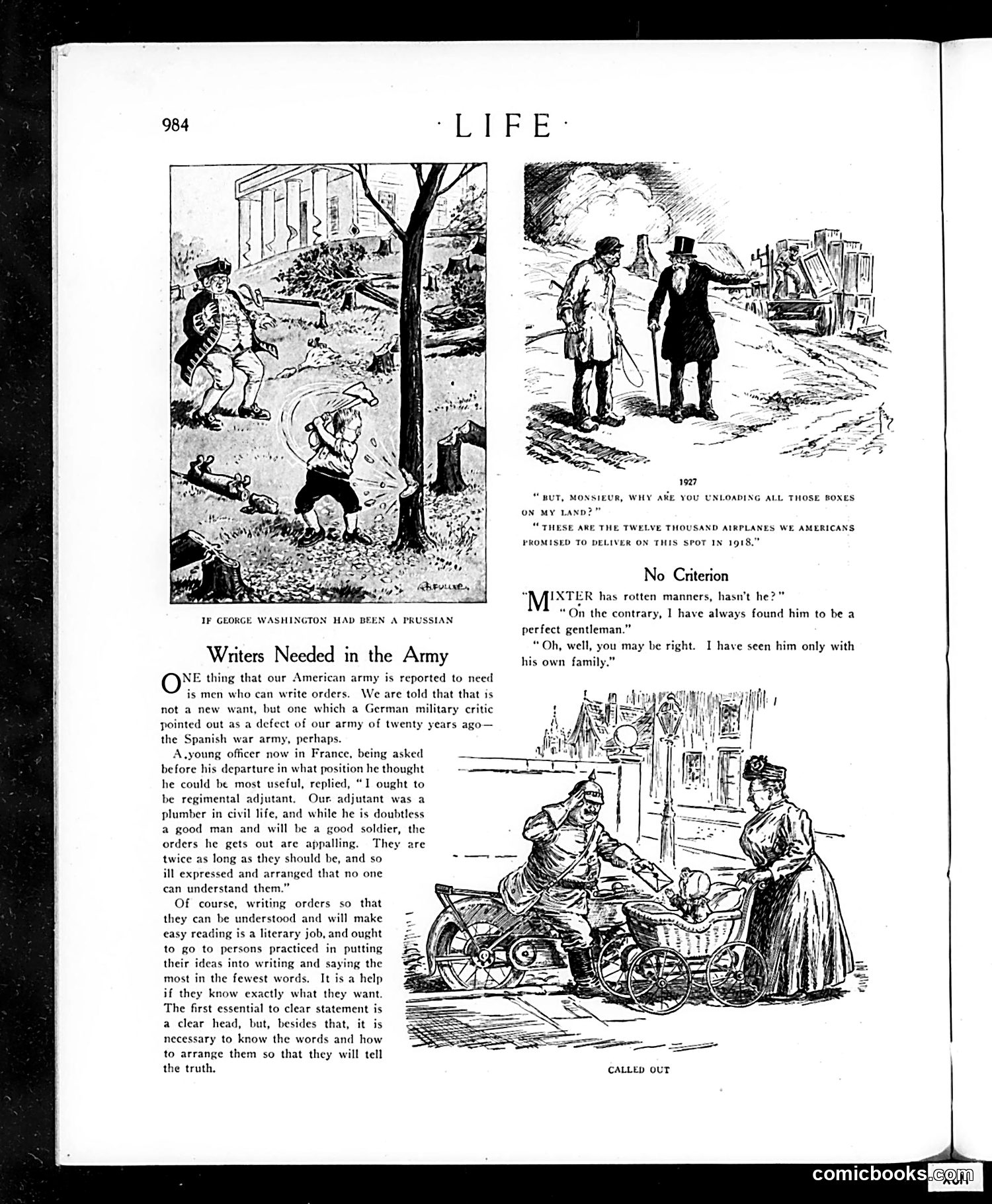
**Top left cartoon**: "If George Washington Had Been a Prussian" depicts a Prussian military officer aggressively ordering around common laborers, contrasting with American democratic values. The satire suggests Prussian militarism is the opposite of Washington's gentlemanly leadership. **Top right cartoon** (1917): Shows a French landowner confronting an American officer about boxes on his property. The caption references "twelve thousand airplanes we Americans promised to deliver on this spot in 1918"—satirizing America's unfulfilled military promises during WWI. **Main article**: "Writers Needed in the Army" argues military orders must be clearly written by educated personnel so soldiers understand instructions. The bottom cartoon "Called Out" illustrates confusion from poorly communicated orders. The page criticizes military communication failures during World War I.
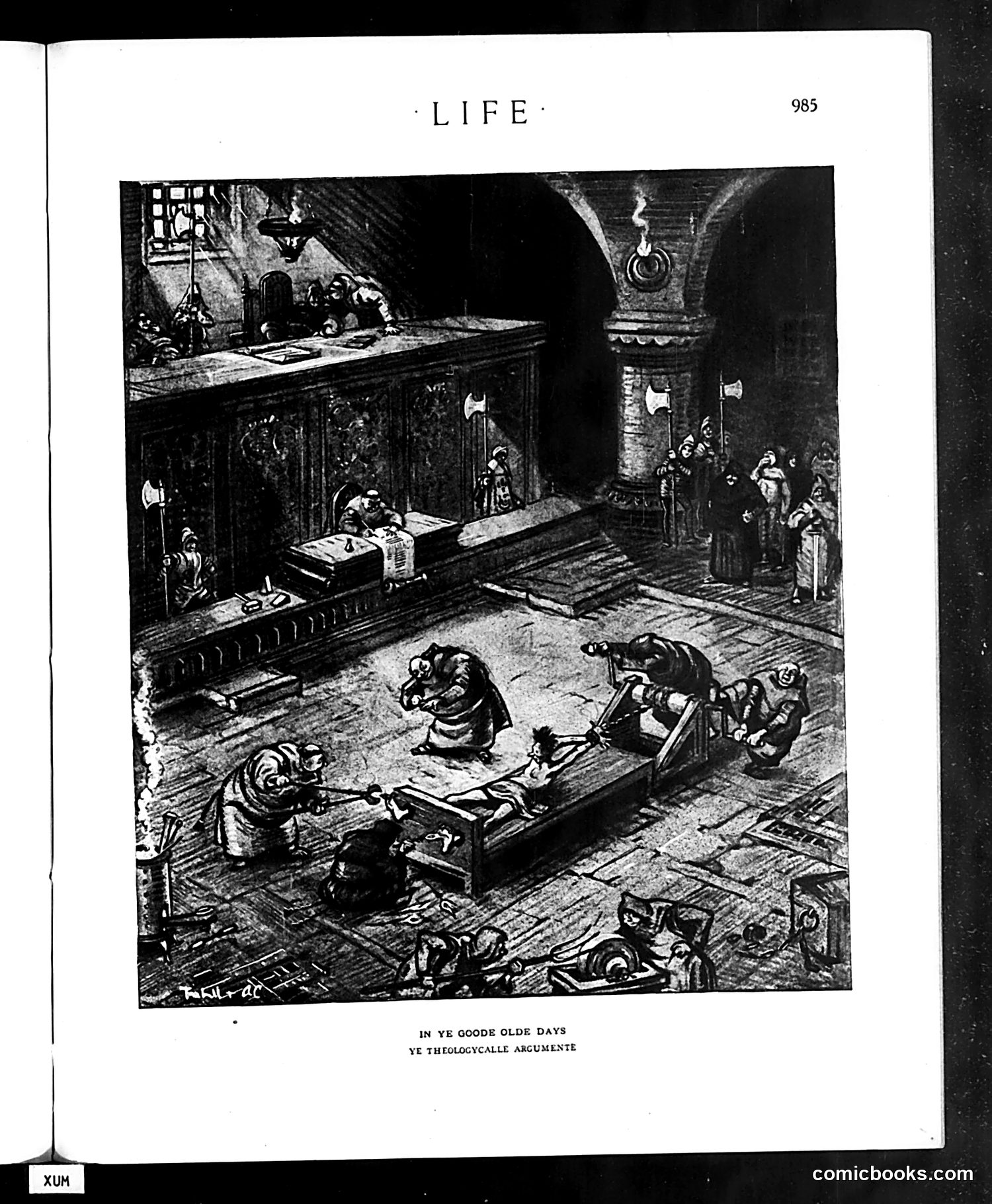
This is a medieval-themed satirical illustration titled "In Ye Goodr Olde Days / Ye Theologycalle Argumente" (appearing to mock theological disputes through historical pastiche). The scene depicts what appears to be a formal debate or argument in a medieval hall, with figures in period dress positioned around a central figure on what looks like a bench or table. Armed guards with axes and flags stand nearby, suggesting authority or enforcement. The satire appears to target theological or academic arguments—the subtitle's deliberate misspelling ("Goodr," "Theologycalle") signals mockery. By setting an abstract intellectual debate in a violent medieval context complete with armed enforcers, the cartoonist suggests that theological arguments, despite their intellectual pretense, ultimately rely on force or authority rather than reason. This likely critiques contemporary religious or academic disputes as fundamentally authoritarian.
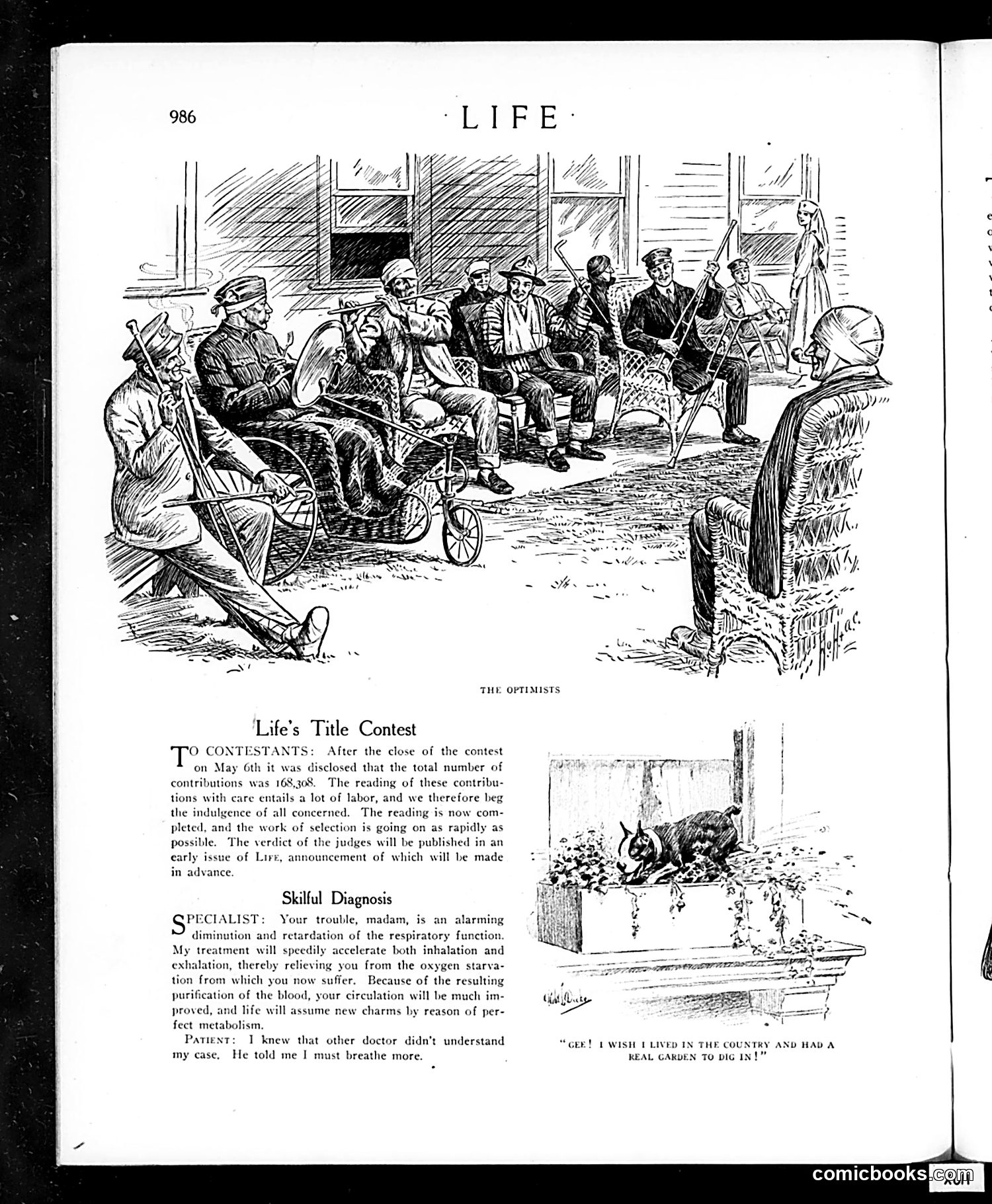
The main cartoon depicts a group of men gathered in what appears to be a workshop or industrial setting, titled "The Optimists." The illustration satirizes overly optimistic individuals, likely referencing early 20th-century business or labor contexts. Below, a section titled "Life's Title Contest" announces results from a reader competition with 168,308 contributions, acknowledging the labor required to judge them. The lower cartoon, captioned "Gee! I wish I lived in the country and had a real garden to dig in!", depicts a rabbit in an urban garden—likely satirizing romanticized notions of rural life versus harsh urban reality. The "Skillful Diagnosis" dialogue between a specialist and patient mocks quack medical practitioners, a common Life target. The specialist uses pseudo-scientific jargon while the patient expresses skepticism about the diagnosis.
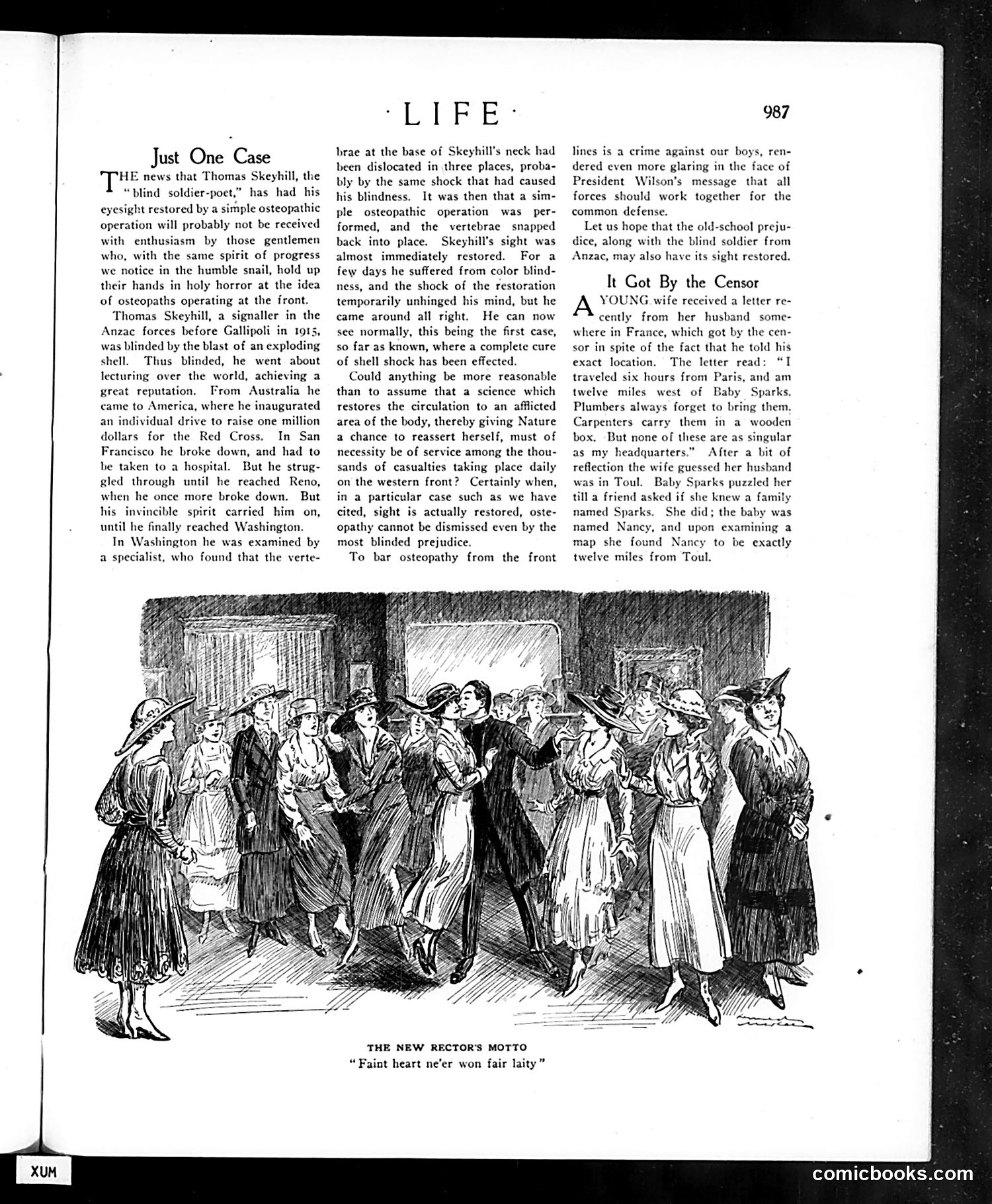
This page contains two separate articles and one illustration. The main article "Just One Case" discusses Thomas Skyhill, a blind soldier who underwent osteopathic surgery that restored his sight after being blinded by shell shock during World War I at Gallipoli. The piece advocates for osteopathy as a legitimate medical treatment. The second article, "It Got By the Censor," recounts a letter from a woman in France describing her husband's location near Baby Sparks, which censors apparently missed. The illustration labeled "THE NEW RECTOR'S MOTTO" depicts a social gathering with the caption "Faint heart ne'er won fair laity"—a pun on the famous phrase "faint heart ne'er won fair lady," satirizing a new clergyman's romantic success among female parishioners.
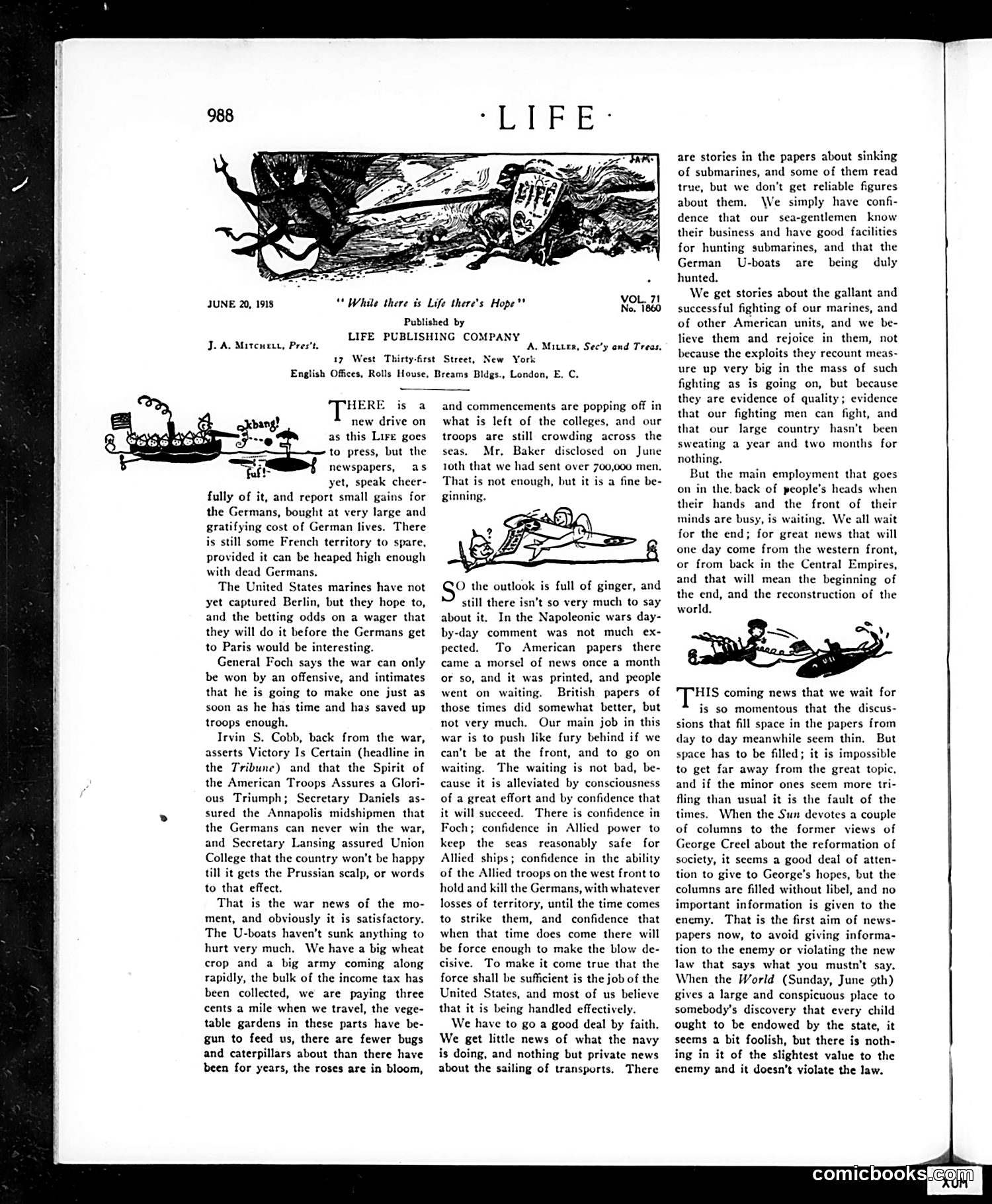
This page contains editorial commentary on World War I, not political cartoons. The small illustrations (submarine, airplane, soldier) are decorative vignettes accompanying the text. The editorial addresses American optimism about the war's trajectory. It reports favorably on recent military developments: U.S. troops deploying (700,000 sent overseas), successful marine operations, and confident statements from military leaders (Secretary Daniels, General Foch, Secretary Lansing). The tone is cautiously upbeat but realistic—acknowledging that while news is scarce and requires "faith," there's confidence in Allied strategy and American industrial capacity (wheat crops, income tax collection, home gardens). The piece reflects June 1918 WWI context: Germany's spring offensive had stalled, American forces were arriving in large numbers, and the eventual Allied victory appeared increasingly likely, though fighting continued.
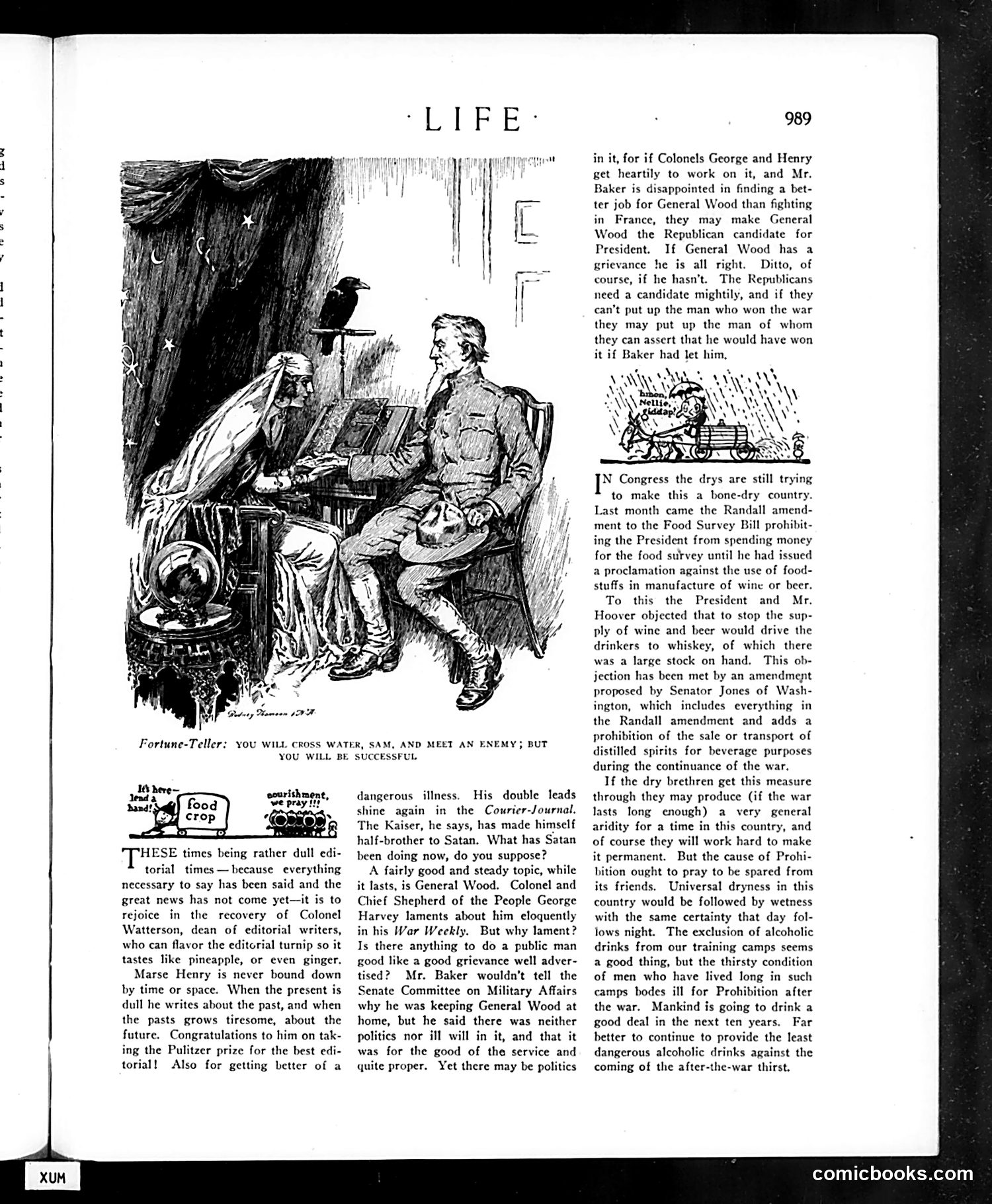
**The Cartoon:** A fortune-teller reads Sam's palm, predicting he'll "cross water" and "meet an enemy" but succeed. This appears to reference a soldier's fate in World War I, with "crossing water" meaning deployment to France. **The Editorial Context:** The page discusses Colonel George Wood, a military figure kept stateside by Secretary Baker rather than sent to fight in France. The satire suggests Republicans might weaponize Wood's absence as a grievance, potentially making him a presidential candidate by claiming he *would have* won the war if Baker had allowed it. This is political opportunism masquerading as patriotism. **Secondary Topic:** The page also satirizes Congressional "dry" (Prohibition) advocates trying to ban alcohol during wartime, arguing such restrictions will backfire post-war, driving soldiers to harder drinking. The overall tone mocks both Republican political calculation and zealous Prohibitionist overreach during WWI.
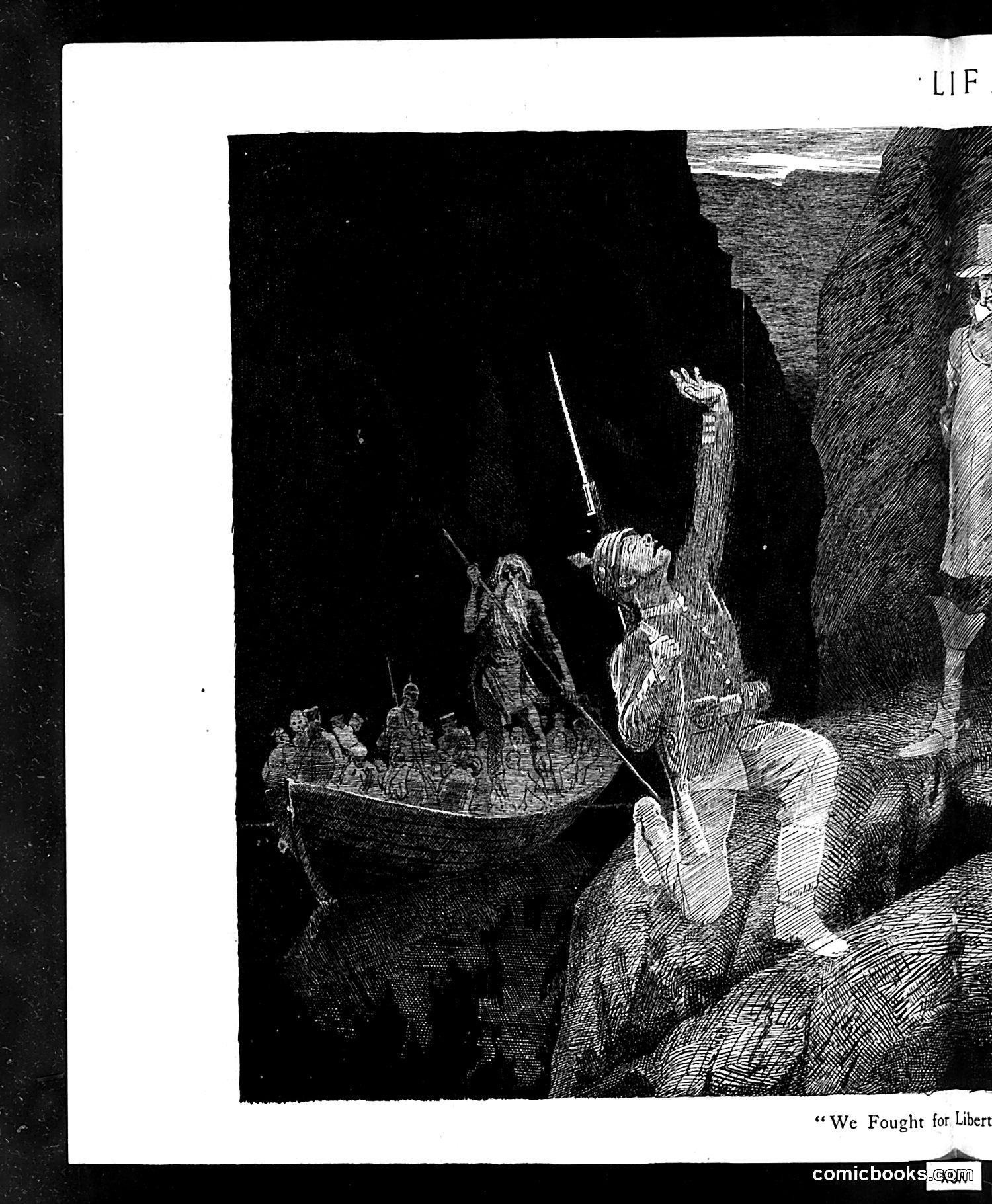
This appears to be a political cartoon from Life magazine depicting a dramatic naval scene. A figure stands on a rocky shore or fortification, wielding a sword and gesturing toward an approaching boat filled with armed soldiers. The incomplete caption "We Fought for Libert[y]" suggests a revolutionary or independence-themed narrative. The cartoon likely references American Revolutionary War imagery or a similar conflict involving liberation struggles. The composition—with the solitary defender confronting invading forces—suggests themes of resistance against perceived tyranny or foreign aggression. Without the complete caption or publication date visible, the exact satirical target remains unclear, though it appears to critique either military aggression or failed revolutionary ideals. The engraving style indicates 19th-century publication.
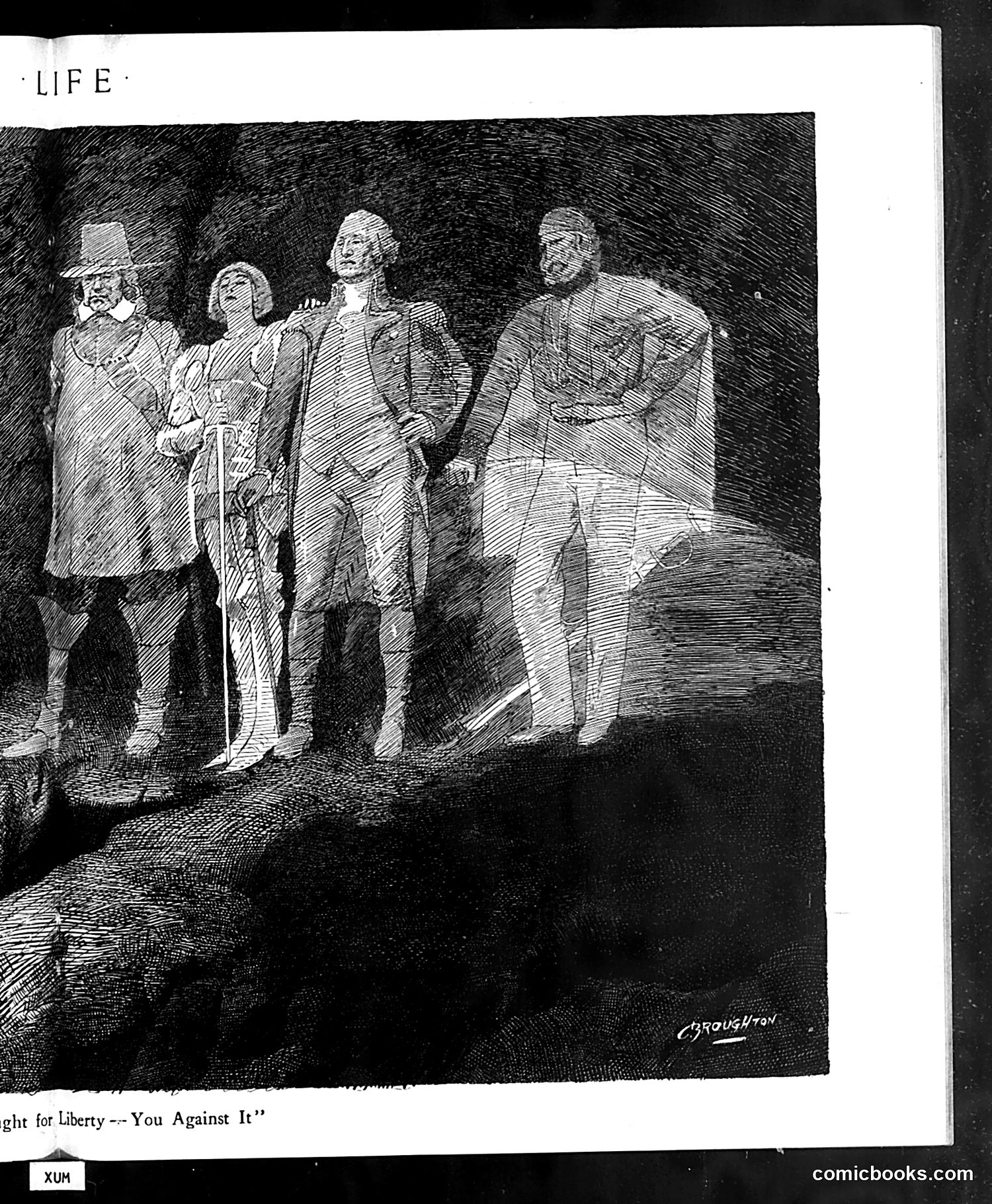
This page from *Life* magazine shows a political cartoon titled "Fight for Liberty—You Against It" (partially visible in the OCR text). The image depicts five figures in formal 19th-century dress standing in dramatic shadows. Based on the composition and title, this appears to be satirizing opposition to liberty or democratic principles. The cartoon likely references a specific historical debate about civil liberties, possibly involving government power or restrictive policies. The figures' formal attire and solemn poses suggest they represent authorities or establishment figures. The artist's signature "Broughton" appears in the lower right. Without additional context about the specific publication date and political events, I cannot definitively identify which figures or controversy is depicted, though the theatrical staging suggests this was a prominent public debate of its era.
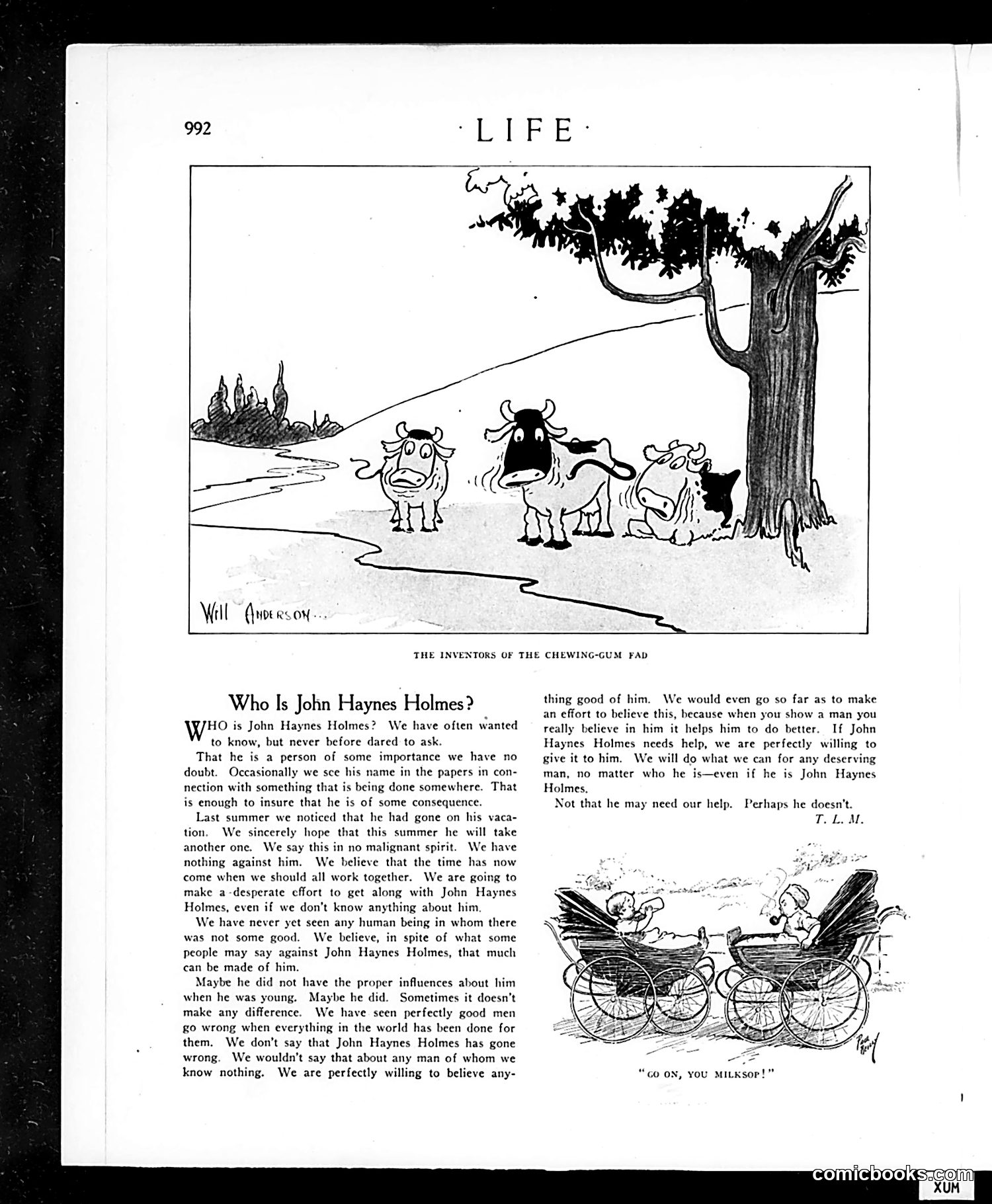
This page contains two satirical pieces from *Life* magazine mocking early 20th-century fads and a public figure. **Top cartoon**: "The Inventors of the Chewing-Gum Pad" shows cows that appear distressed, with the caption implying they're the source of a chewing-gum trend. The satire targets the absurdity of commercial fads. **Main article**: A backhanded attack on John Haynes Holmes (a real minister and social activist of the era). The piece feigns diplomatic praise while repeatedly stating they know nothing about him—the entire essay is ironic. By saying "we are perfectly willing to believe anything good of him," the author actually suggests Holmes is unknown or undeserving of attention. The phrase "milksop" (bottom cartoon) reinforces the mockery, implying weakness. The satire exploits Holmes's relative obscurity to a *Life* readership, suggesting his importance is overstated. The tone is patronizing, offering "help" while implying he doesn't merit serious consideration.
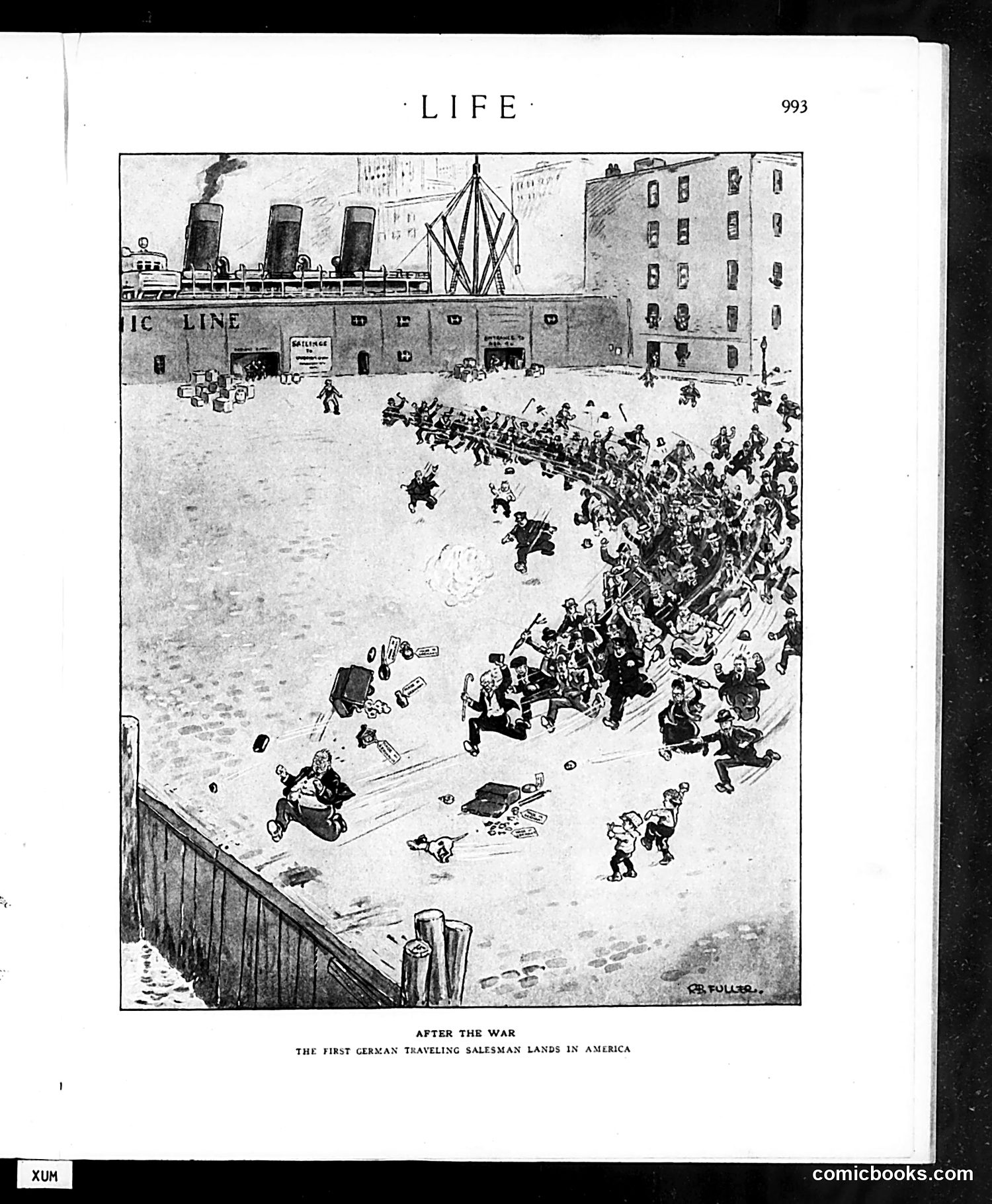
This is a satirical cartoon from Life magazine depicting a chaotic dock scene where a German businessman (the "traveling salesman") has arrived in America after World War I. The cartoon shows masses of people crowding around the ship's dock in apparent pandemonium—some fighting, people scattered chaotically, belongings strewn about. The satire appears to mock either: - American enthusiasm/desperation to resume trade with Germany despite recent war hostilities, shown as an undignified scramble - German commercial ambitions returning to the U.S. market - American post-war disorder and competition The visual chaos emphasizes the absurdity of normalizing commercial relations immediately after the war's conclusion. The teeming, disorganized crowd suggests both American eagerness and the complications of post-war commerce resuming between former enemies.
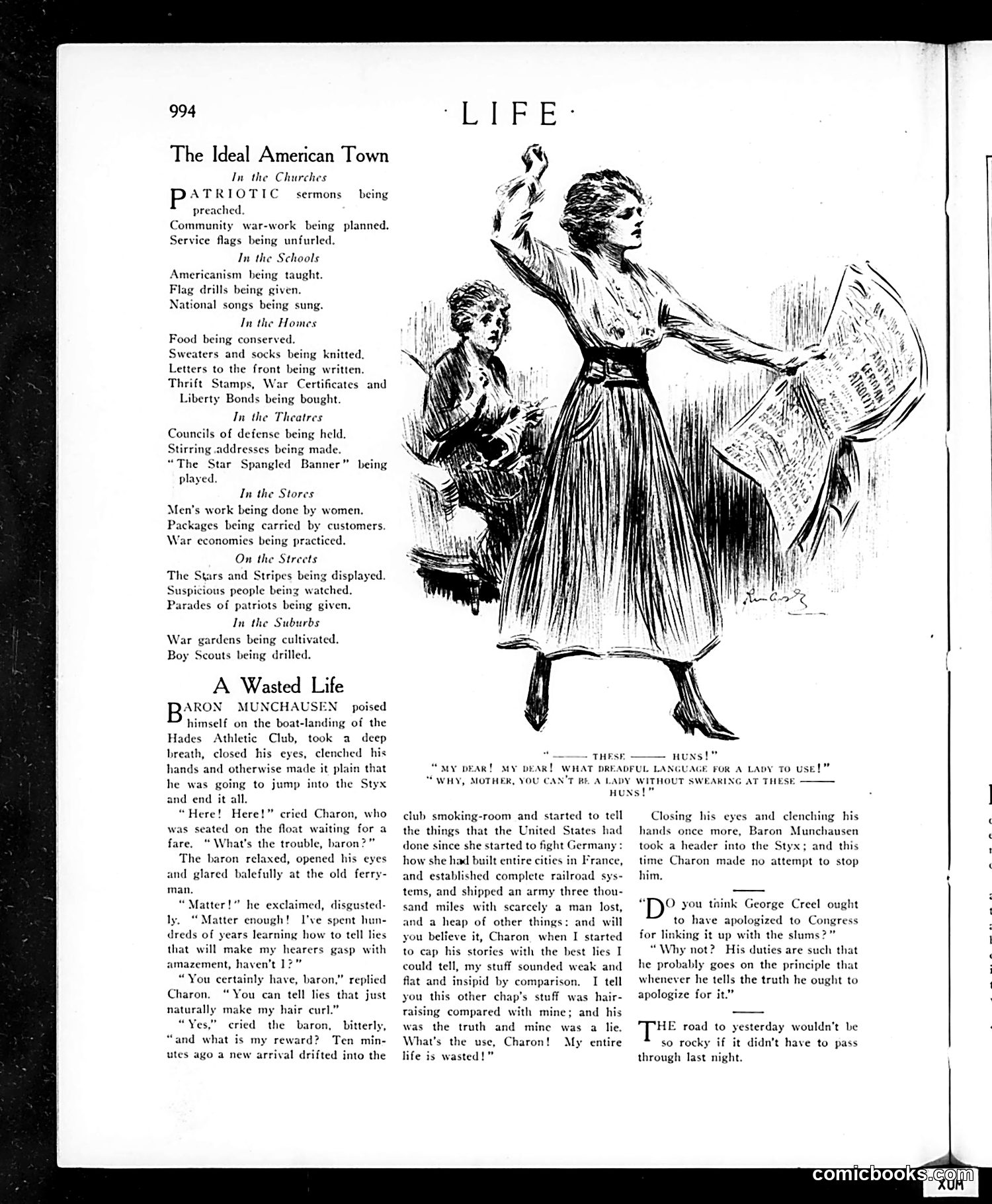
This page contains two satirical pieces from WWI-era Life magazine. **Top section** lists activities in an idealized American town during wartime—patriotic sermons, flag drills, food conservation, Liberty Bond purchases, war gardens, suspicious surveillance of citizens. The satire targets the total mobilization of civilian life during WWI, suggesting America's thorough (and perhaps excessive) commitment to the war effort. **"A Wasted Life"** mocks the famous Baron Munchausen, a legendary liar. The joke: he commits suicide because his lies now seem pedestrian compared to actual American war achievements—building cities in France, establishing railroads, shipping armies with minimal losses. Reality has outdone his fiction. This satirizes wartime propaganda's exaggeration of American military accomplishments, suggesting official accounts rival tall tales in their incredibility. The cartoon inset depicts a woman swearing at "Huns" (Germans), mocking both wartime hysteria and the contradiction of ladies abandoning propriety in the name of patriotism.
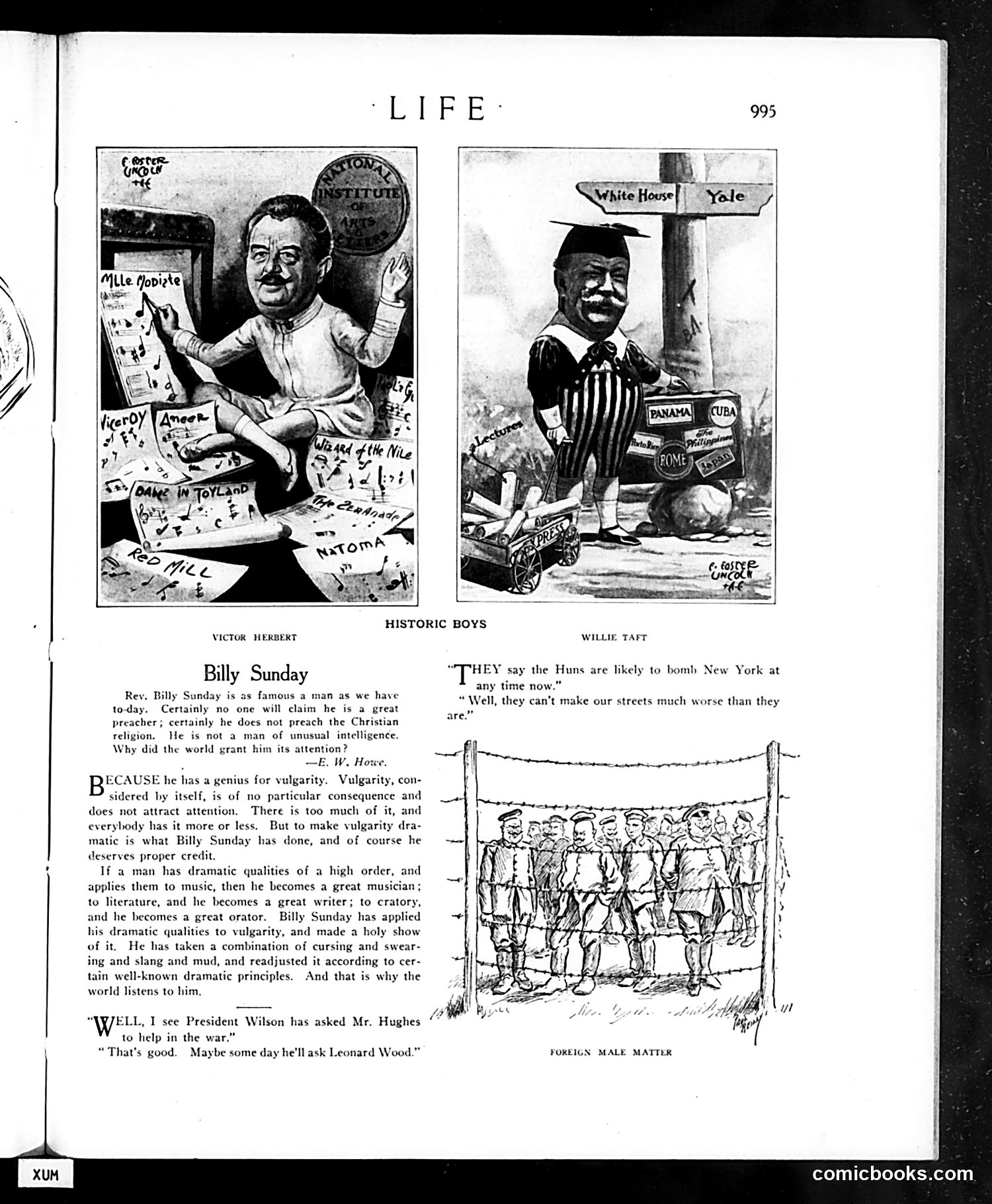
This page satirizes prominent American figures of the WWI era. The "Historic Boys" section features caricatures of **Victor Herbert** (composer) and **Willie Taft** (former President William Howard Taft), depicted as cartoonish characters with exaggerated features and labeled with their accomplishments and travels. The main text critiques **Rev. Billy Sunday**, a famous evangelist preacher. The author argues Sunday lacks genuine intelligence or religious authenticity but succeeds through theatrical, vulgar dramatics—applying showmanship to crude language and behavior rather than substantive preaching. The "Foreign Male Matter" cartoon appears to mock German military threat, with characters discussing potential bombing of New York while complaining about street conditions—suggesting casual dismissal of serious danger. The closing dialogue jokes about President Wilson seeking help from military/political figures, sarcastically suggesting he might eventually recruit Leonard Wood (a general and political figure), implying these men are predictable choices.
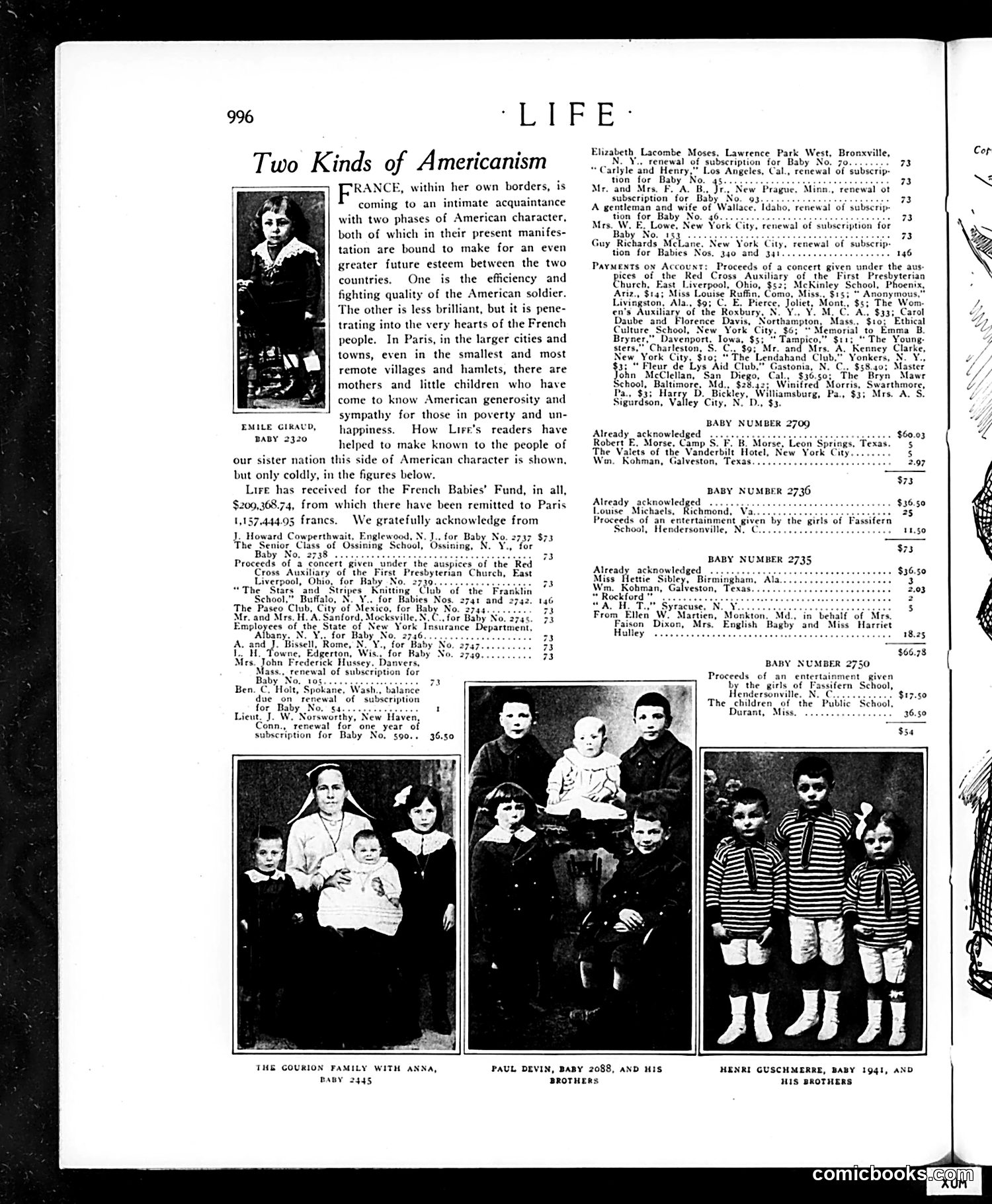
This page celebrates American charitable giving to French children during World War I. The article distinguishes between two American qualities: military efficiency and humanitarian generosity. The "French Babies' Fund" solicitation reports donations totaling over $200,000 collected by Life magazine readers to support impoverished French children. The text emphasizes how American kindness—through mothers and children helping "those in poverty and unhappiness"—is winning French hearts alongside American soldiers' battlefield prowess. The three photographs show recipient French families with their children, while the extensive list documents contributions from American schools, civic groups, and individuals. This represents Life's wartime humanitarian campaign, positioning American benevolence as a defining national characteristic that strengthens Franco-American relations beyond military alliance alone.
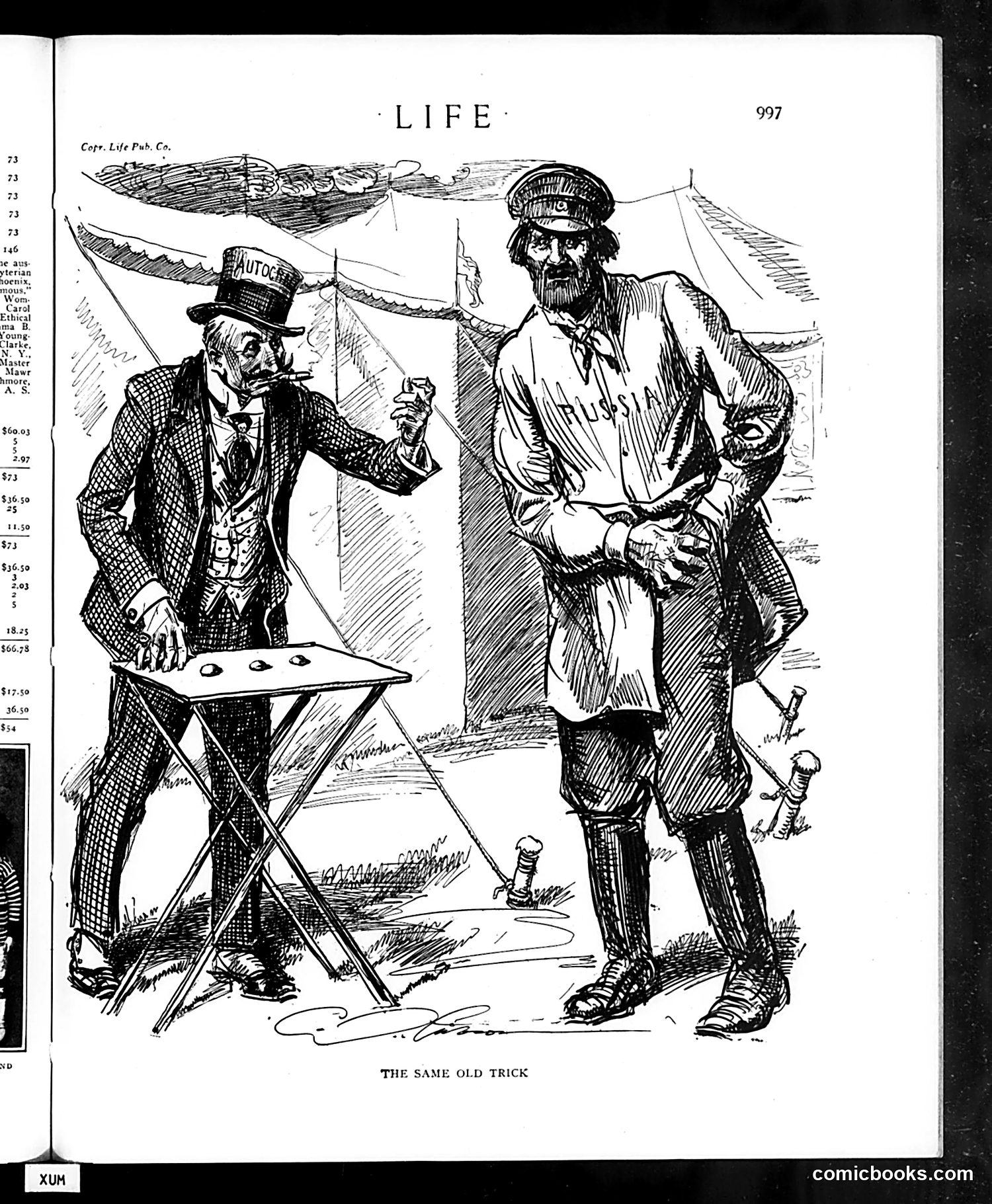
This political cartoon depicts two men in what appears to be a carnival or fairground setting. The figure on the left, wearing a top hat labeled "AUTOCRAT" (suggesting an authoritarian leader), operates a shell game or con game on a folding table—a classic street scam. The figure on the right, dressed as a working-class man or sailor, appears to be the mark or victim of this deception. The satire suggests that autocratic or authoritarian government uses the same old confidence tricks to deceive the public—implying that propaganda, misdirection, and false promises are recurring tactics of dictatorial rule. The "trick" persists because people continue to fall for it, despite it being the same deceptive method repeated throughout history.
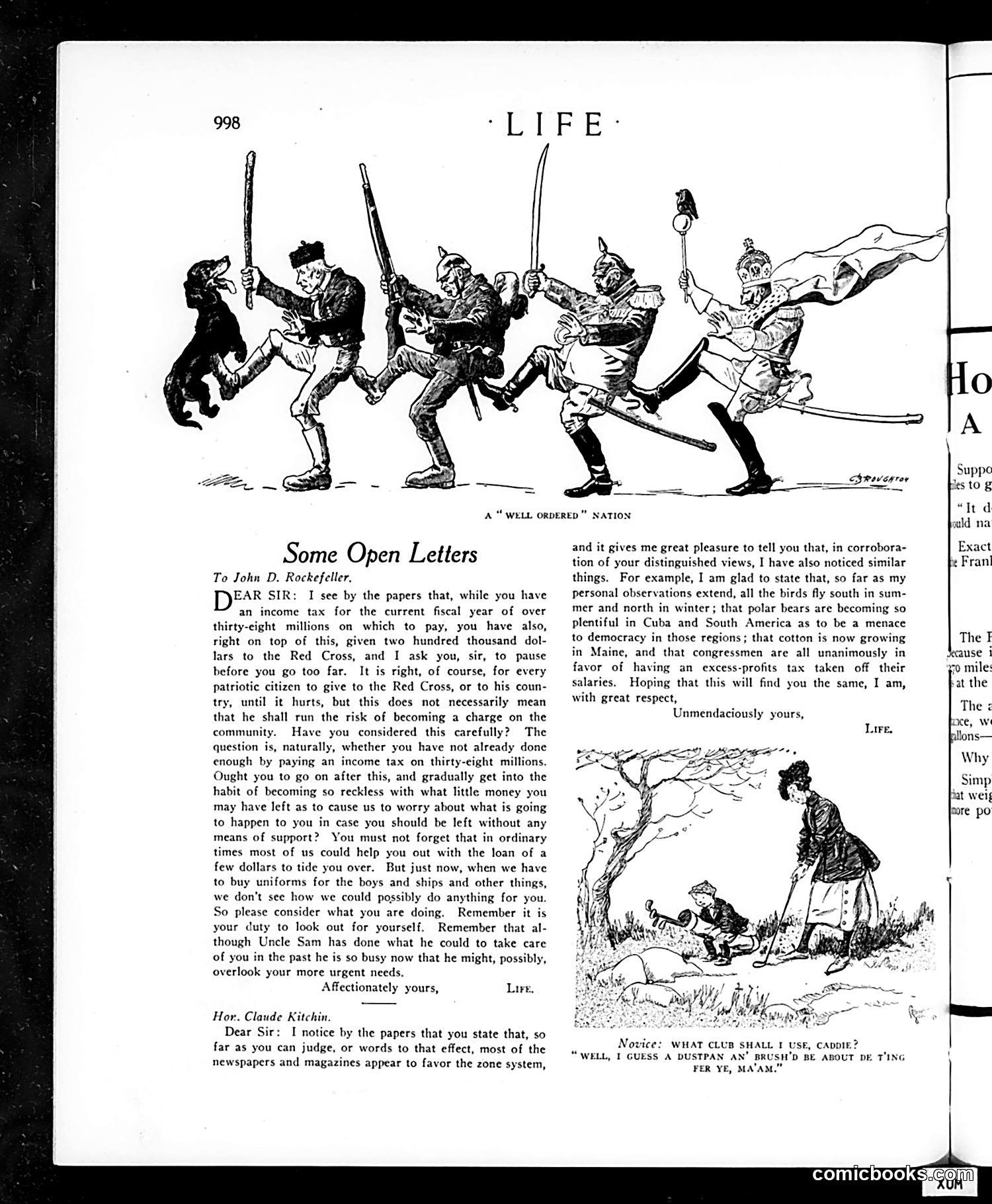
The top cartoon depicts a "well-ordered nation"—figures in military/formal dress wielding weapons and implements of war, satirizing militarism and government authority. The "Open Letters" mock wealthy industrialist John D. Rockefeller's charitable donations during wartime. The first letter, attributed to Life magazine, sarcastically warns Rockefeller against *over-giving* to the Red Cross, feigning concern he'll become a public burden—absurdist humor critiquing extreme wealth inequality. The second letter (apparently from Hon. Claude Kitchin, a congressman) uses obvious falsehoods (polar bears in Cuba, cotton in Maine) to mock Rockefeller's public statements favoring certain tax policies, suggesting his claims are equally ridiculous. The bottom cartoon shows a wealthy woman and caddie at golf; she asks which club to use, and he sarcastically suggests a dustpan and brush—mocking the frivolity of the wealthy playing golf while the nation mobilizes for war ("the boys" needing uniforms and ships, per the text). The overall theme: wartime criticism of wealth, privilege, and the disconnect between the rich and national sacrifice.
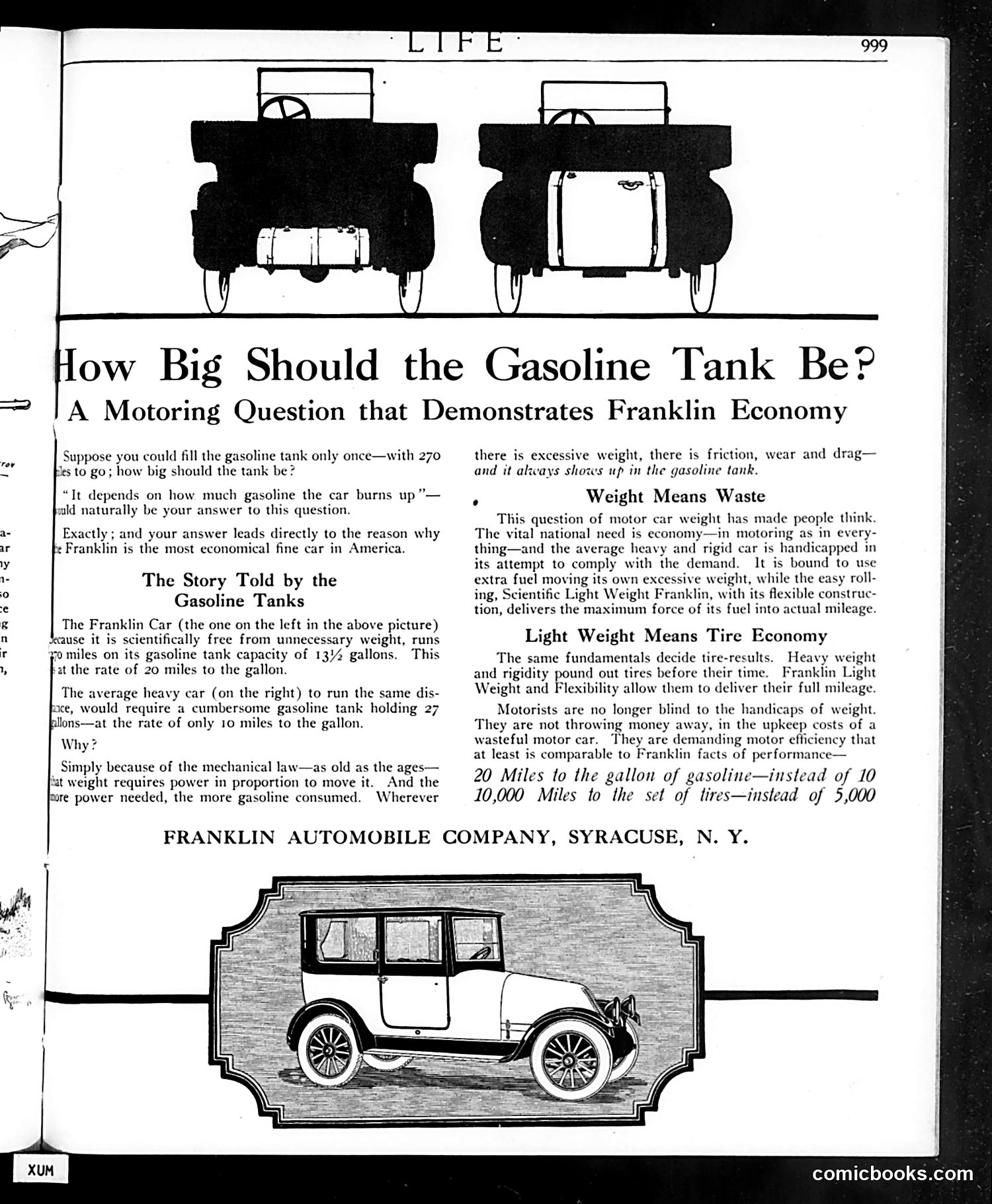
This is a **Franklin automobile advertisement** disguised as educational content about automotive economics. The "satire" is the framing device: the ad poses a question about gasoline tank size to appear like a logical puzzle, then uses the answer to promote Franklin cars as superior. **The Comparison:** Two cars are shown—a Franklin (left) versus an unnamed "average heavy car" (right). The Franklin runs 770 miles on 13.5 gallons (20 mpg), while the competitor needs a 27-gallon tank for the same distance (10 mpg). **The Argument:** Franklin emphasizes "light weight" and "flexibility" as engineering principles that reduce fuel consumption, tire wear, and overall waste. This appeals to post-WWI American values of efficiency and thrift. **Modern Context:** This reflects early automotive competition when fuel economy was a major selling point (unlike mid-century American cars). The "scientific" framing was typical 1920s marketing—using pseudo-logical puzzles to make product claims seem inevitable rather than promotional.
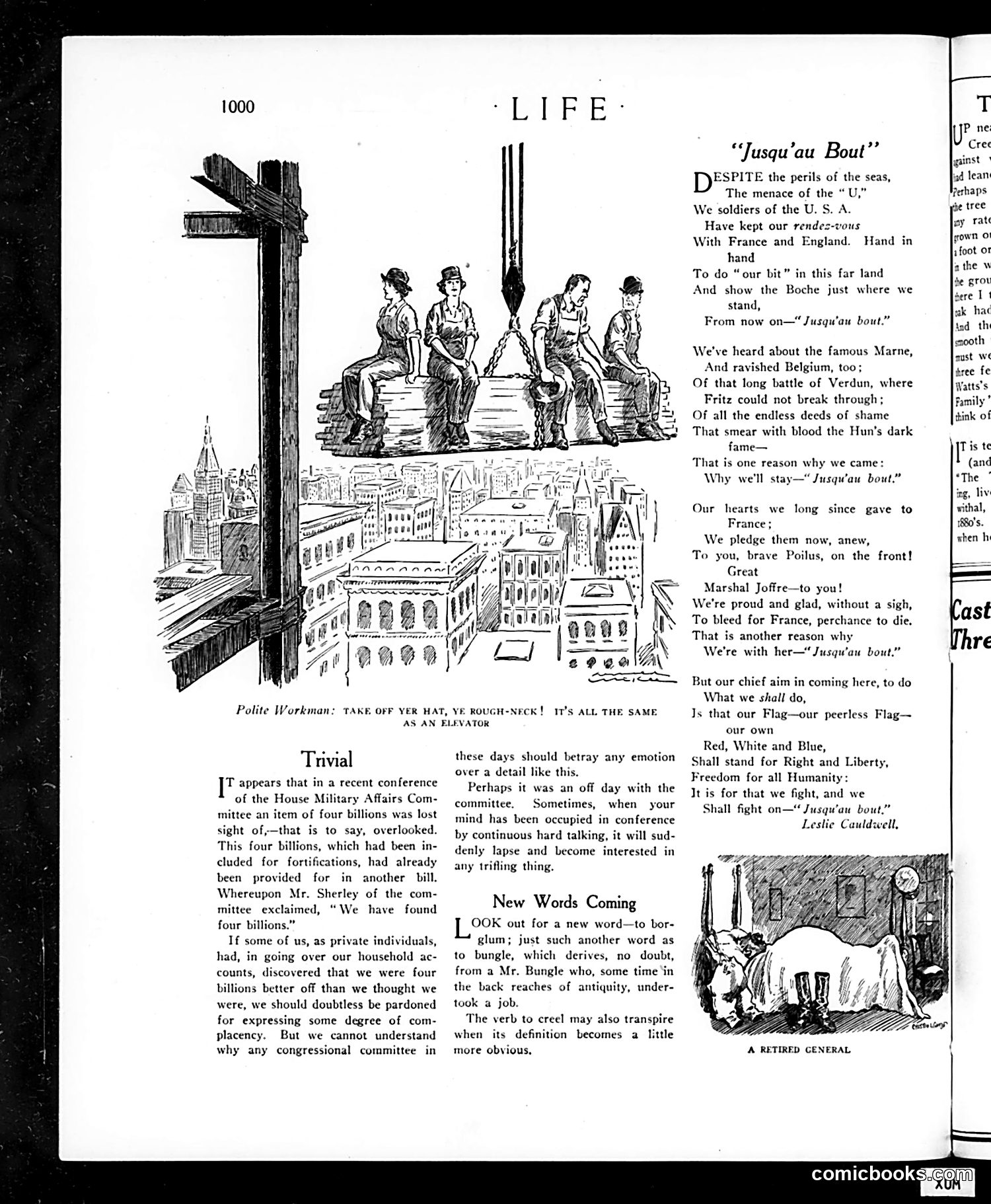
**"Polite Workman" Cartoon**: This depicts an exchange between a working-class man ("rough-neck") and presumably a more refined person in an elevator. The joke plays on class distinctions—the workman is told to remove his hat as if in a formal setting, but the response treats elevators as equivalently ordinary to everyday spaces, mocking pretentious etiquette. **"Trivia" Section**: Satirizes congressional incompetence during WWI. A House Military Affairs Committee "lost sight of" four billion dollars allocated for fortifications, then celebrated "finding" it—the same money already budgeted elsewhere. The author ridicules their treating this embarrassing accounting error as noteworthy, suggesting wartime committees are distracted and inefficient. **"Jusqu'au Bout" Poem**: A patriotic verse by Leslie Cauldwell explaining American soldiers' commitment to fight alongside France and Britain through the war's end ("jusqu'au bout" = "to the very end"). References famous WWI battles (Marne, Verdun) and pledges American support for French soldiers ("Poilus") and Marshal Joffre, emphasizing fighting for democracy and freedom.
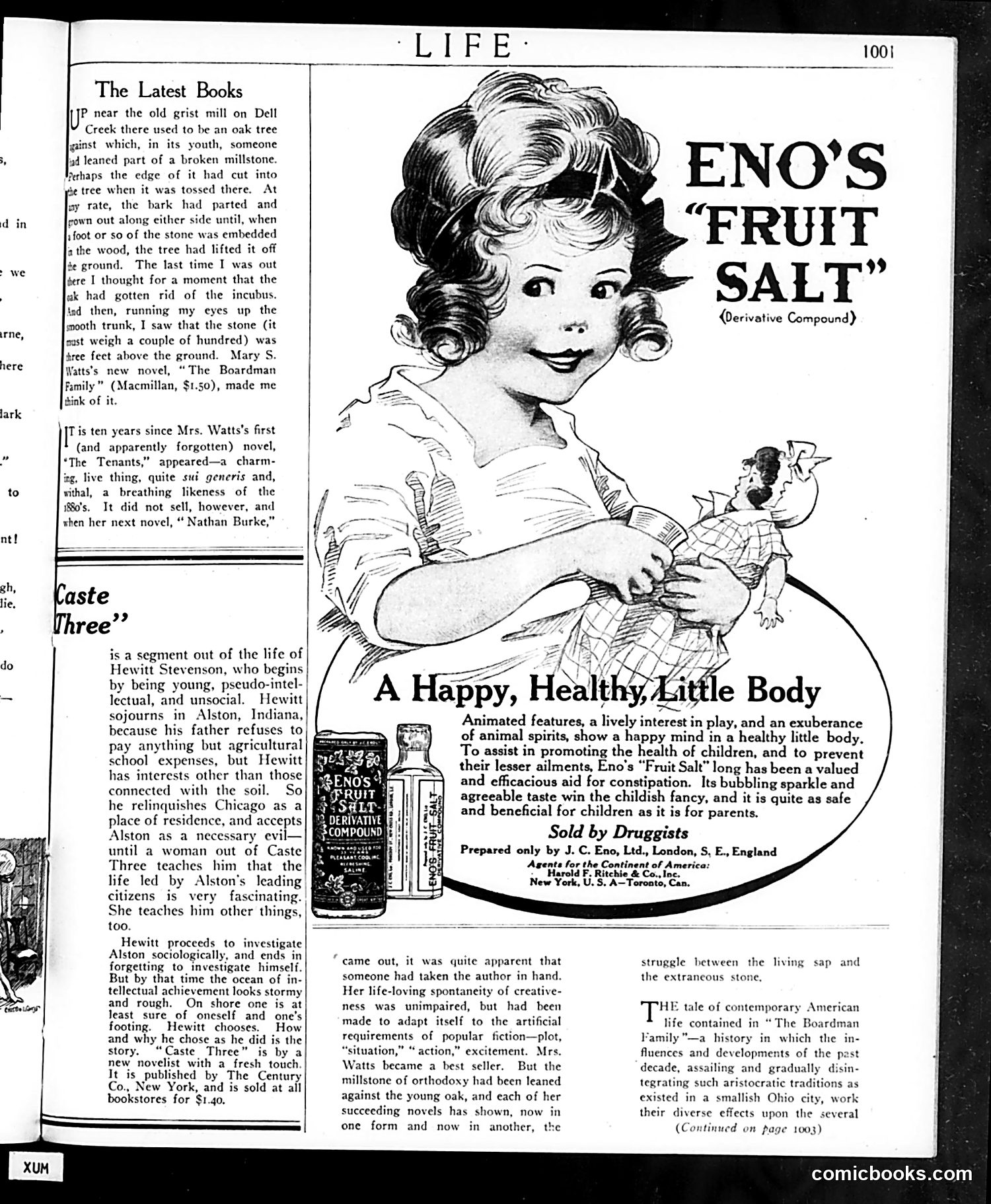
This page is primarily a **book review** and **advertisement**, not political satire. The left column discusses novels by Mrs. Mary S. Watts, particularly "Caste Three," a story about an intellectual young man (Hewitt Stevenson) in small-town Indiana who must choose between intellectual pursuits and practical life. The reviewer uses an extended metaphor about a tree and embedded millstone to describe how Watts's work captures conflicting forces. The right side is a **commercial advertisement** for "Eno's Fruit Salt," a laxative marketed as beneficial for children's digestive health. The cheerful illustrated woman and child represent the product's promised effects—a "happy, healthy little body." This type of patent medicine ad was common in early 20th-century magazines. There is no political cartoon or satire here. The page represents typical *Life* magazine content from an era when literary criticism and commercial advertising coexisted on the same pages.
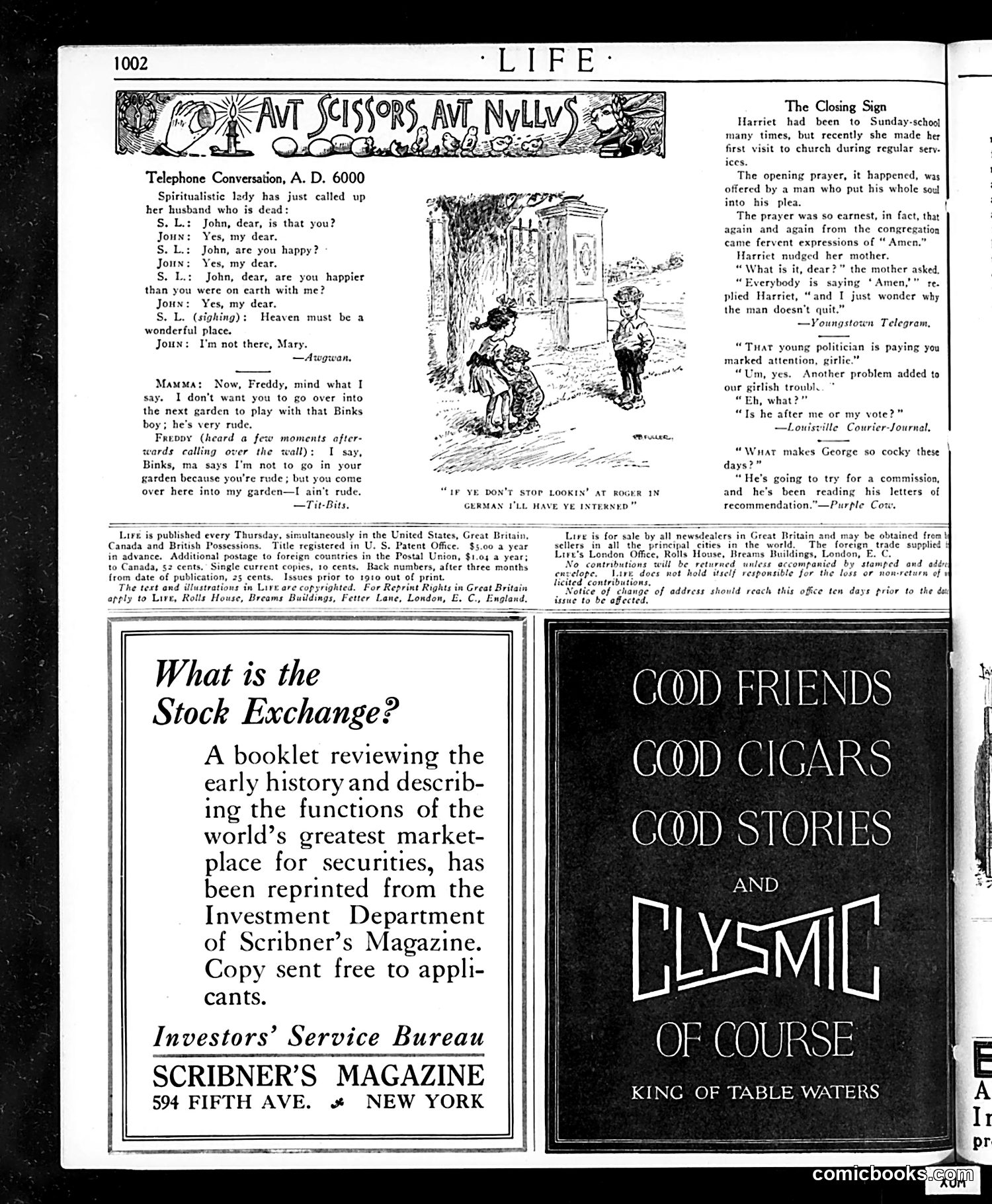
This page contains multiple satirical short jokes typical of Life's humor: **"Telephone Conversation, A.D. 6000"** presents a spiritualist premise: a widow contacts her deceased husband via telephone, asking if he's happier in heaven than on earth. The joke's twist—he admits he's *not* in heaven—suggests he's in hell, darkly implying marital discord outlasts death itself. **"The Closing Sign"** jokes about a child's literalism: at church, when congregants repeatedly say "Amen," young Harriet assumes the man leading prayer should stop, misunderstanding the responsive refrain as a signal to conclude. **The garden scene** shows a child cleverly circumventing his mother's rule by inverting her logic—she forbade him visiting a neighbor's rude child, so he invites that child to *his* garden instead, claiming his own space isn't rude. The remaining snippets mock romantic politics and social climbing. The page is primarily **advertising and humor content** rather than editorial commentary—characteristic of Life's satirical miscellany format during the early 20th century.
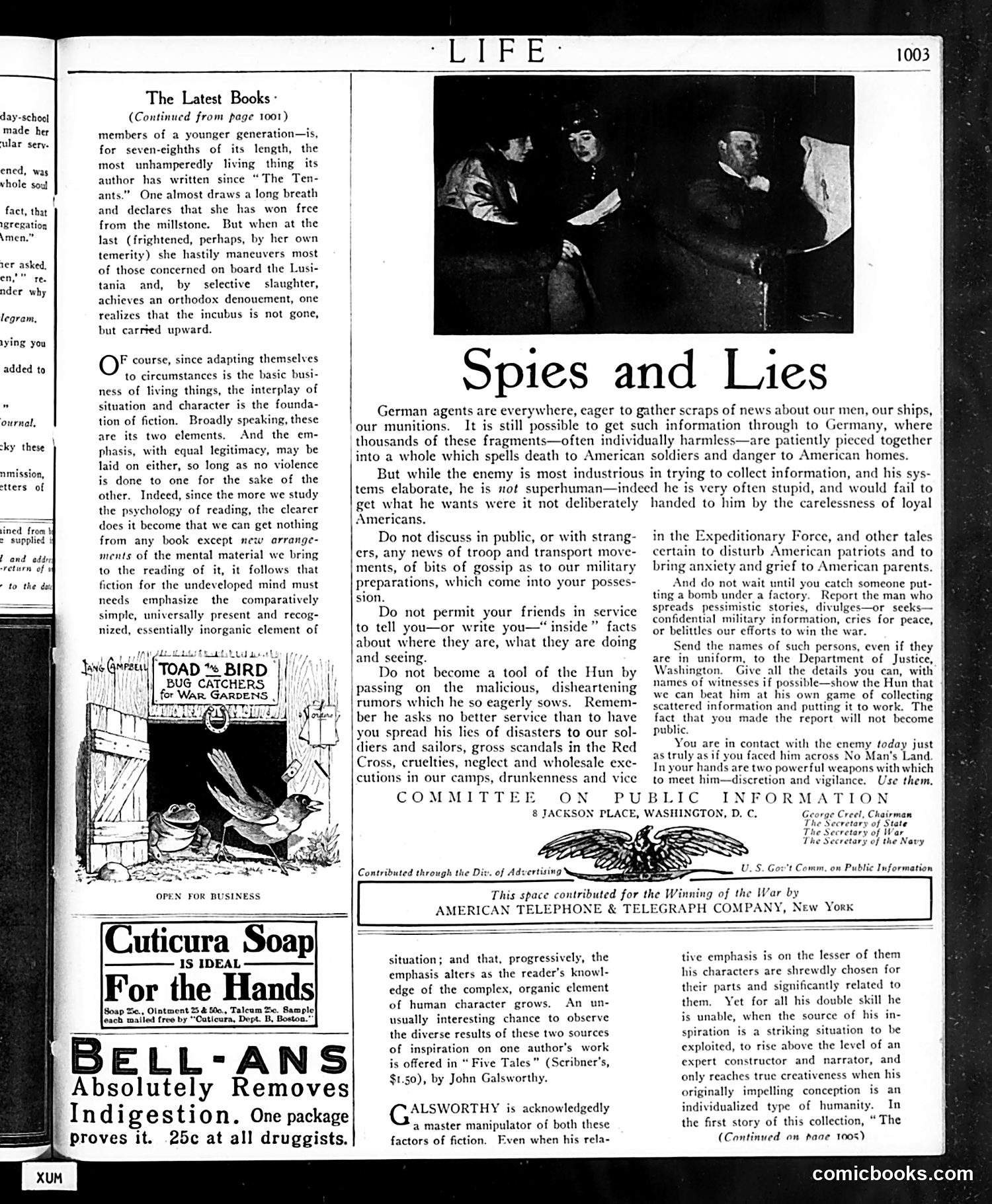
This is a U.S. government propaganda poster from World War I, issued by the Committee on Public Information. The main message warns Americans against careless talk that could aid Germany. The poster depicts German intelligence agents as omnipresent threats, explaining how seemingly trivial information—troop movements, military gossip, rumors—gets "patiently pieced together" by enemies into actionable intelligence that endangers American soldiers. The government demands citizens: - Avoid public discussion of military matters - Prevent servicemen from sharing "inside" details - Reject defeatist rumors (portrayed as deliberate Hun propaganda) - **Report suspected spies and defeatists to the Department of Justice**, naming witnesses This reflects WWI-era paranoia about German espionage and the government's aggressive domestic surveillance campaign, conflating loose talk with treason and encouraging citizens to become informants against neighbors and even uniformed soldiers spreading "pessimistic stories."
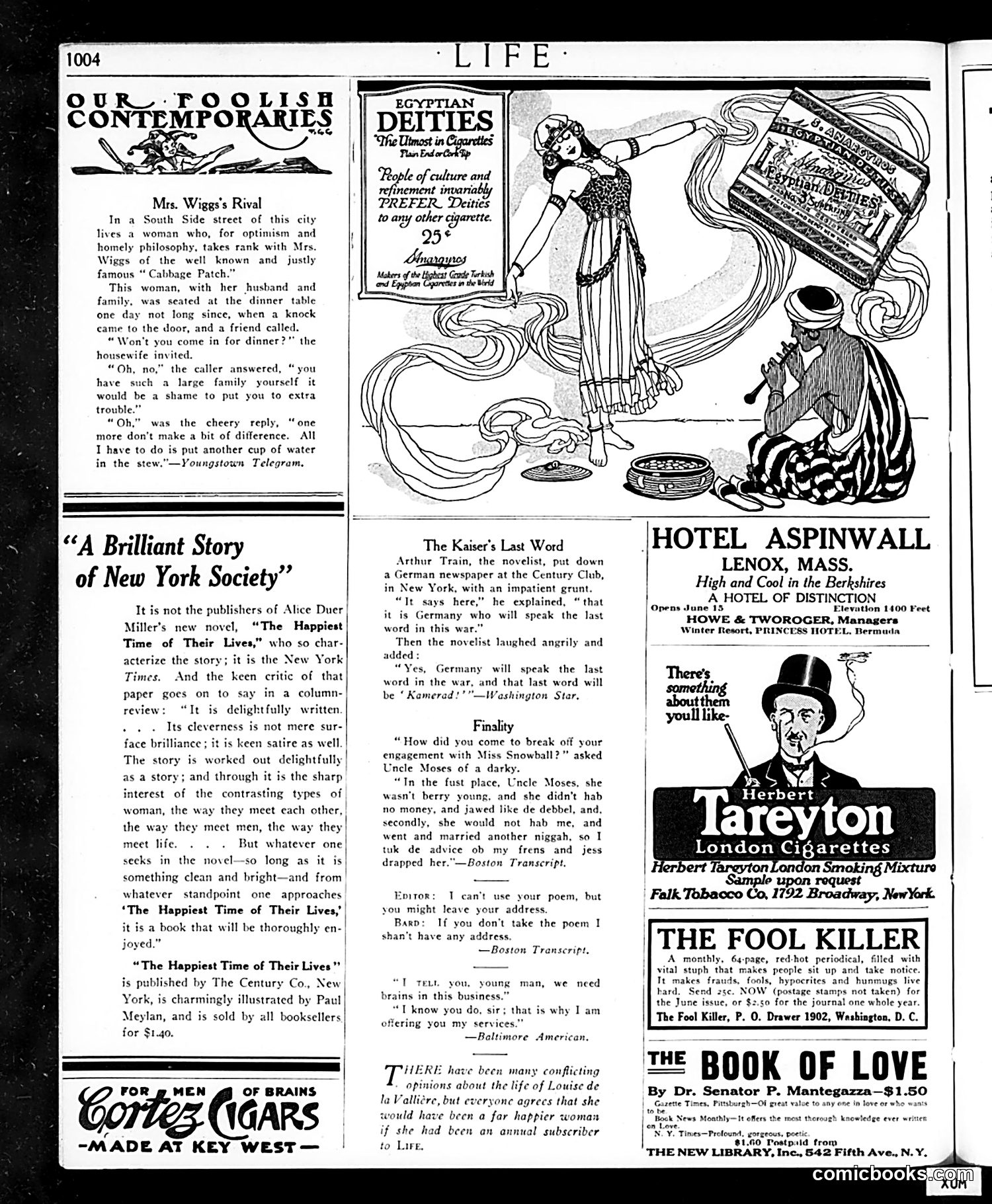
This page from *Life* (a satirical American magazine) consists primarily of **humorous anecdotes and advertisements** rather than political cartoons. The "Our Foolish Contemporaries" section contains three brief jokes mocking human behavior: a South Side woman's frugal logic ("adding water to stew"), a darky's comically elaborate justification for breaking an engagement, and a job applicant's circular reasoning about lacking brains. The only substantive political reference is "The Kaiser's Last Word," which satirizes German confidence during World War I. Novelist Arthur Train mocks a German newspaper's claim that Germany will "speak the last word" in the war by predicting Germany's final word will be "Kamerad!" (German for "surrender/comrade")—a joke about anticipated German defeat. The page is dominated by **period advertisements**: Egyptian Deities cigarettes, Tareyton London Cigarettes, Hotel Aspinwall, and various other products. The satire is mild and social rather than sharp political commentary.
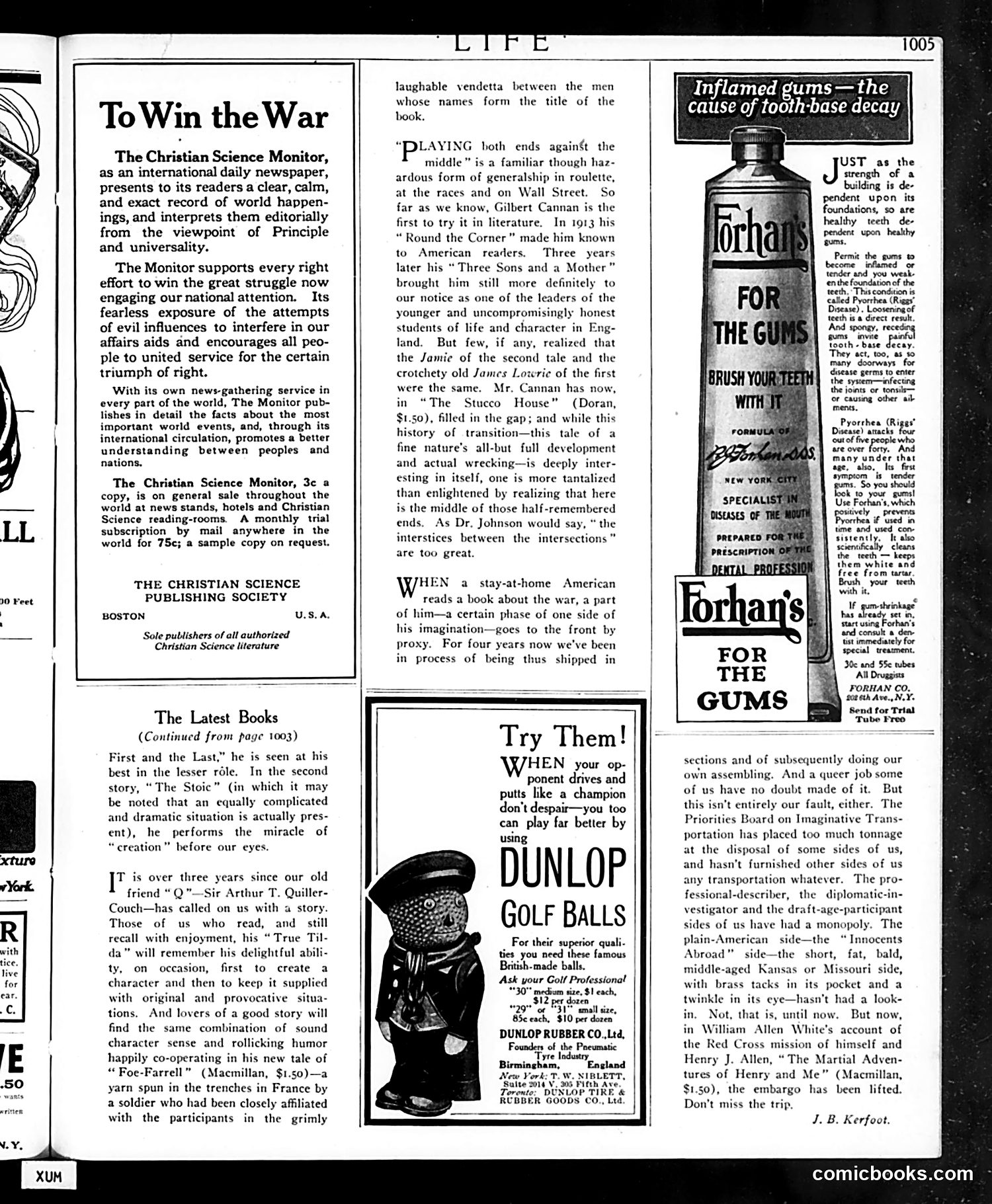
This page combines war-related editorial content with advertising and book reviews, typical of Life magazine circa 1917-1918. **Main Content:** The left column is a Christian Science Monitor advertisement positioning the newspaper as supporting America's war effort with "fearless exposure" of "evil influences"—likely referring to German propaganda or pacifist opposition during World War I. **Book Reviews:** The page discusses recent literary works, including mentions of Gilbert Cannan's novels exploring character development and a war story called "Foe-Farrell" set in the French trenches, reflecting the period's fascination with WWI narratives. **Advertisements:** Two prominent ads appear: Forhan's toothpaste (claiming to prevent gum decay, a health concern of the era) and Dunlop Golf Balls, promoting leisure activities during wartime. **The Satire:** The juxtaposition itself is mildly satirical—earnest wartime patriotism placed alongside commercial advertisements and leisurely golf equipment, subtly commenting on American civilian life during the war.
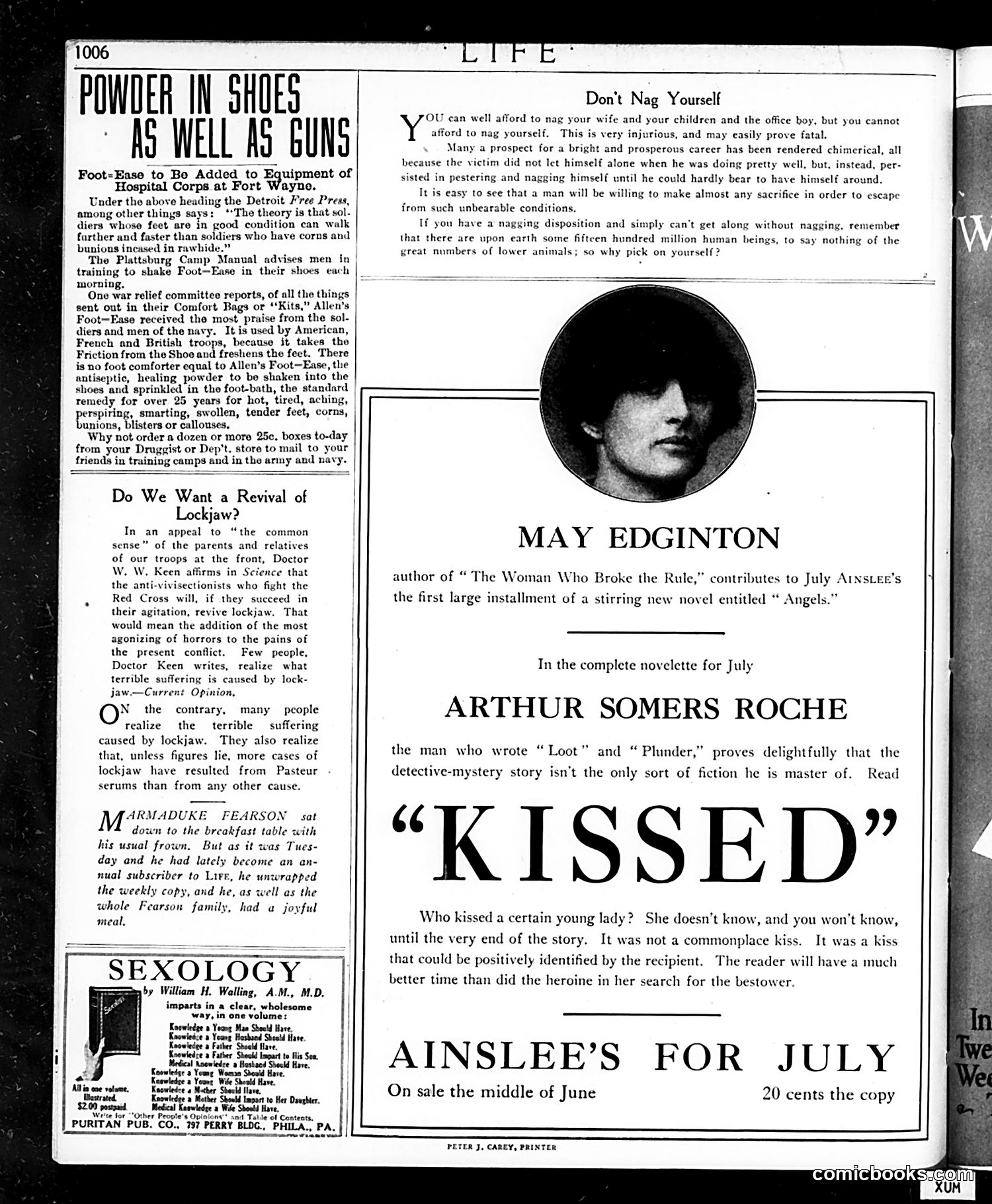
This page primarily features **advertisements and literary promotions** rather than political cartoons. The content reflects early 20th-century concerns: **Left Column:** Advertises "Foot-Ease" powder for soldiers' feet during WWI, citing its use in training camps and the military. Below this is a debate about **lockjaw (tetanus) prevention**—anti-vivisectionists opposed animal testing for vaccines, while Dr. W.W. Keen argued such opposition endangered troops. A brief humorous anecdote about "Armaduke Fearson" suggests that reading *Life* magazine brings joy to families. **Right Column:** Promotes upcoming *Ainslee's Magazine* fiction featuring authors May Edginton and Arthur Somers Roche, with a teasing description of a mystery story titled "Kissed." **Main Point:** The page reflects WWI-era practical concerns (soldier welfare, medical safety) alongside typical magazine promotion. The lockjaw debate shows contemporary tensions between animal-rights activists and military/medical establishment needs.
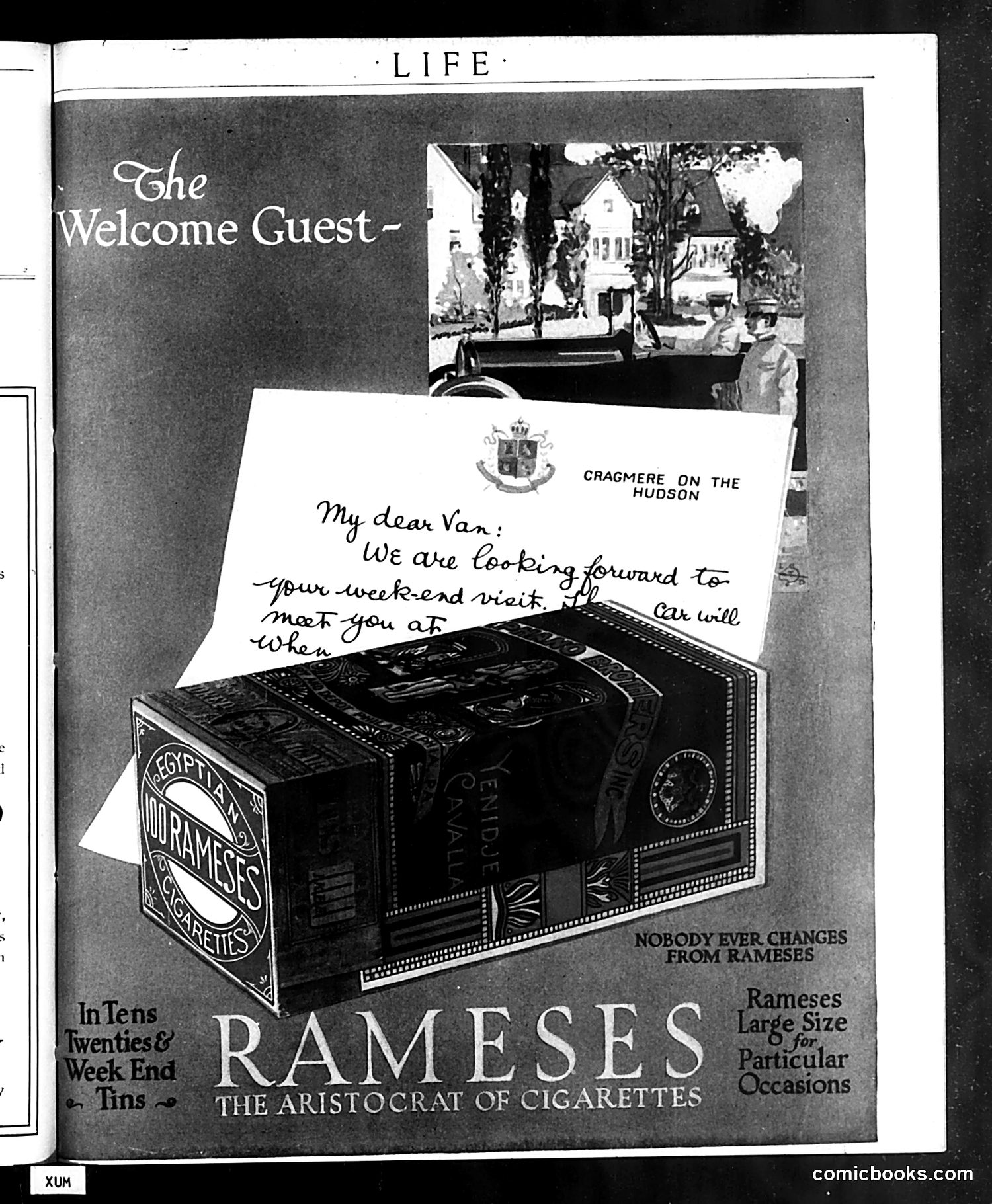
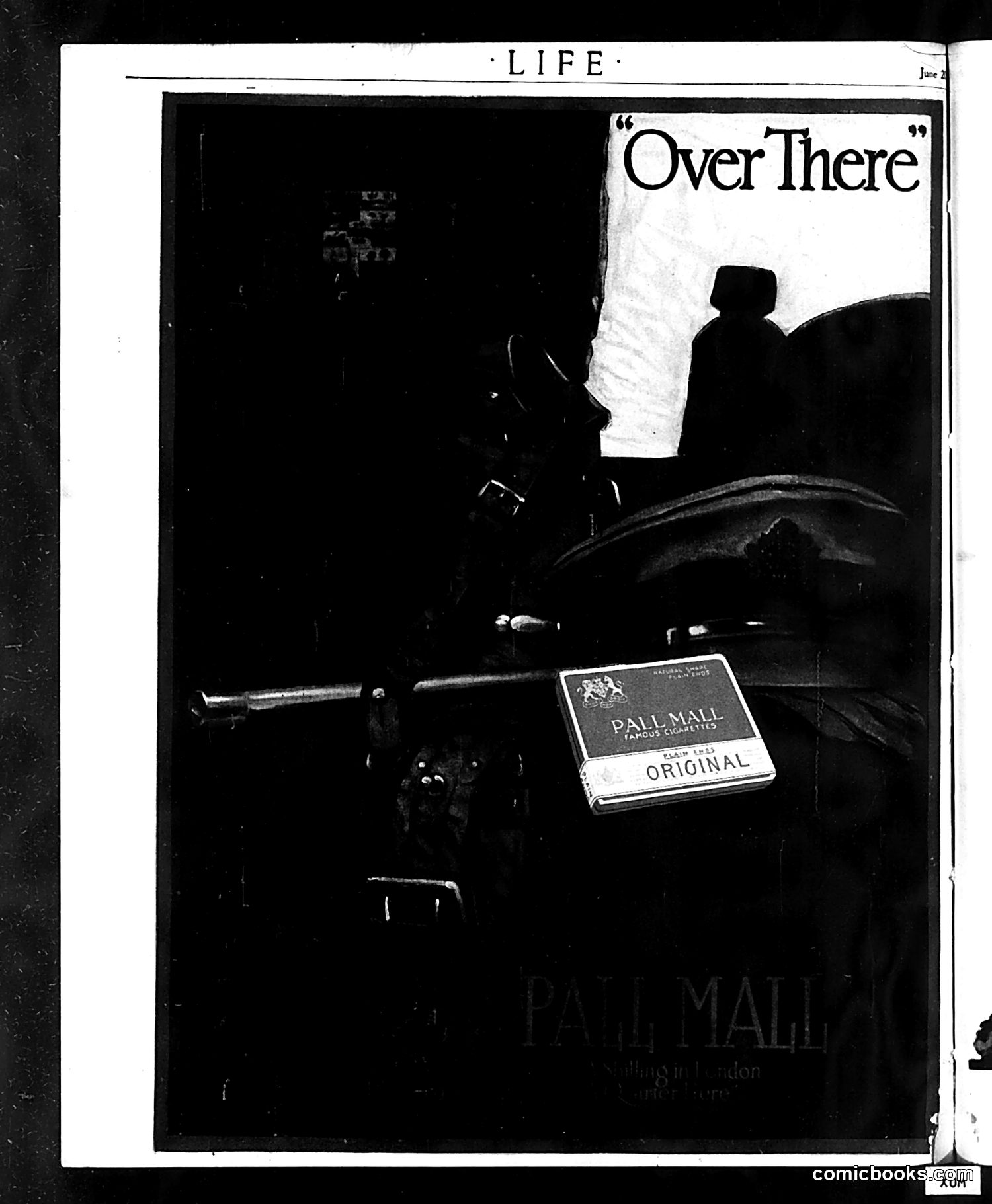
This is a Life magazine advertisement for Pall Mall cigarettes, titled "Over There"—a phrase referencing World War I (the famous George M. Cohan song). The image shows silhouetted figures in what appears to be a trench or military setting, with one soldier visible against a bright background (possibly an explosion or dawn). A Pall Mall cigarette package is prominently displayed in the foreground. The ad uses patriotic WWI imagery to market cigarettes to soldiers, suggesting Pall Mall cigarettes as a companion product for servicemen abroad. This exploits wartime sentiment and soldier culture to sell cigarettes—a marketing approach that would be considered deeply unethical today, given tobacco's health dangers. The silhouettes and dramatic lighting create a serious, heroic tone meant to associate the brand with military valor.