
Life, 1918-06-20 · page 27 of 36
Life — June 20, 1918 — page 27: what you’re looking at
What you’re looking at
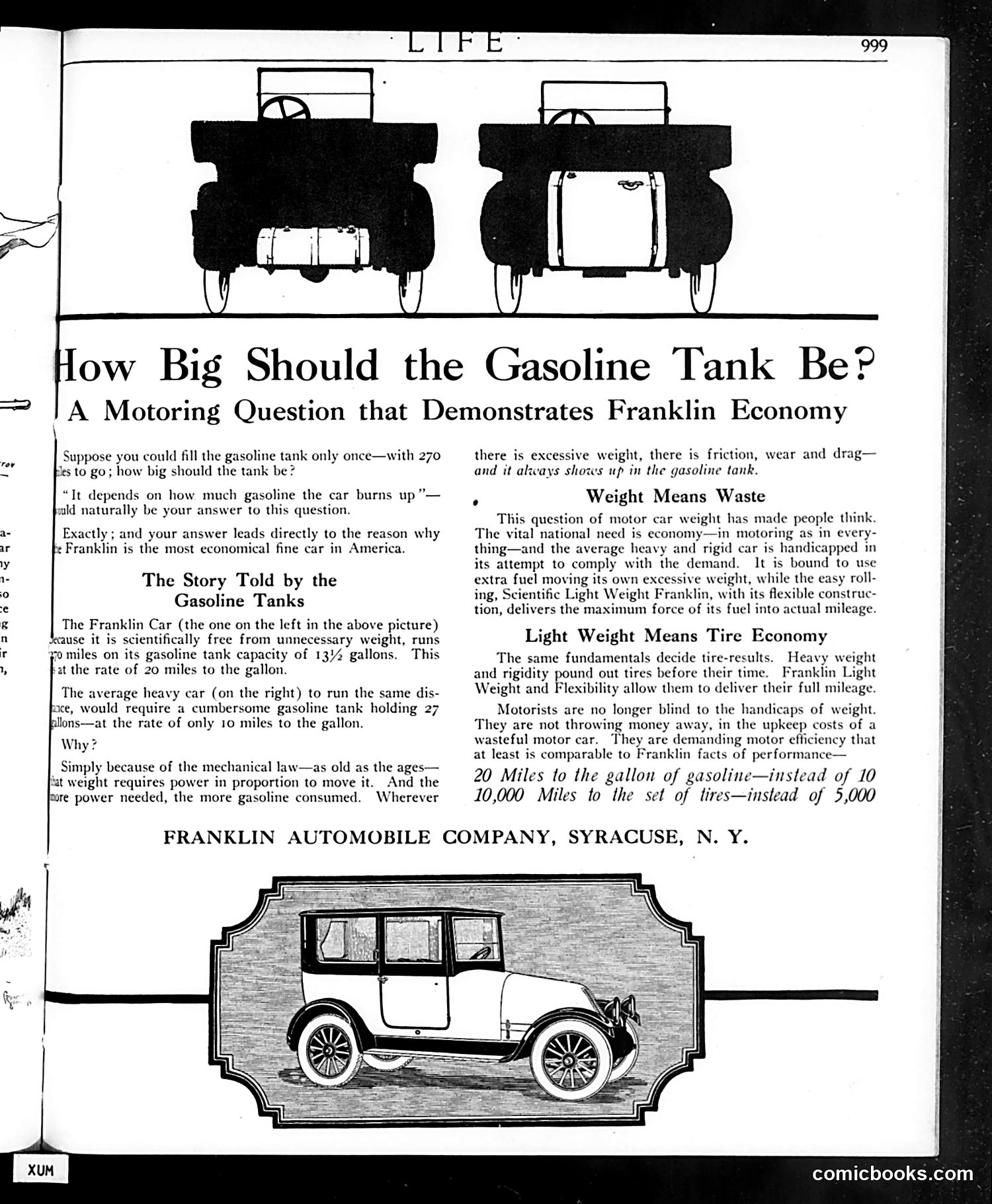
This is a **Franklin automobile advertisement** disguised as educational content about automotive economics. The "satire" is the framing device: the ad poses a question about gasoline tank size to appear like a logical puzzle, then uses the answer to promote Franklin cars as superior. **The Comparison:** Two cars are shown—a Franklin (left) versus an unnamed "average heavy car" (right). The Franklin runs 770 miles on 13.5 gallons (20 mpg), while the competitor needs a 27-gallon tank for the same distance (10 mpg). **The Argument:** Franklin emphasizes "light weight" and "flexibility" as engineering principles that reduce fuel consumption, tire wear, and overall waste. This appeals to post-WWI American values of efficiency and thrift. **Modern Context:** This reflects early automotive competition when fuel economy was a major selling point (unlike mid-century American cars). The "scientific" framing was typical 1920s marketing—using pseudo-logical puzzles to make product claims seem inevitable rather than promotional.
📄 Transcribed text from this page (OCR, searchable)
Machine-transcribed from the original scan — historical spelling and the odd misread are preserved.
yl Yow PY ow Big Should the Gasoline Tank Be? — 1A Motoring Question that Demonstrates Franklin Economy Suppose you could fill the gasoline tank only once—with 270 es to go; how big should the tank be? “It depends on how. much gasoline the car burns up "— wld naturally be your answer to this question. Exactly ; and your answer leads directly to the reason why Franklin is the most economical fine car in America. The Story Told by the Gasoline Tanks The Franklin Car (the one on the left in the above picture) xcause it is scientifically free from unnecessary weight, runs 770 miles on its gasoline tank capacity of 13% gallons. This kat the rate of 20 miles to the gallon. The average heavy car (on the right) to run the same dis- hace, would require a cumbersome gasoline tank holding 27 allons—at the rate of only 10 miles to the gallon. Why? Simply because of the mechanical law—as old as the ages— hat weight requires power in proportion to move it. And the fore power needed, the more gasoline consumed. Wherever there is excessive weight, there is friction, wear and drag— and it always shows up in the gasoline tank. Weight Means Waste This question of motor car weight has made people think. The vital national need is economy—in motoring as in every- thing—and the average heavy and rigid car is handicapped in its attempt to comply with the demand. It is bound to use extra fuel moving its own excessive weight, while the easy roll- ing, Scientific Light Weight Franklin, with its flexible construc- tion, delivers the maximum force of its fuel into actual mileage. Light Weight Means Tire Economy The same fundamentals decide tire-results. Heavy weight and rigidity pound out tires before their time. Franklin Light Weight and Flexibility allow them to deliver their full mileage. Motorists are no longer blind to the handicaps of weight. They are not throwing money away, in the upkeep costs of a wasteful motor car. They are demanding motor efficiency that at least is comparable to Franklin facts of performance— 20 Miles to the gallon of gasoline—instead of 10 10,000 Miles to the set of tires—instead of 5,000 FRANKLIN AUTOMOBILE COMPANY, SYRACUSE, N. Y. comicbooks.com