
Life, 1918-06-20 · page 17 of 36
Life — June 20, 1918 — page 17: what you’re looking at
What you’re looking at
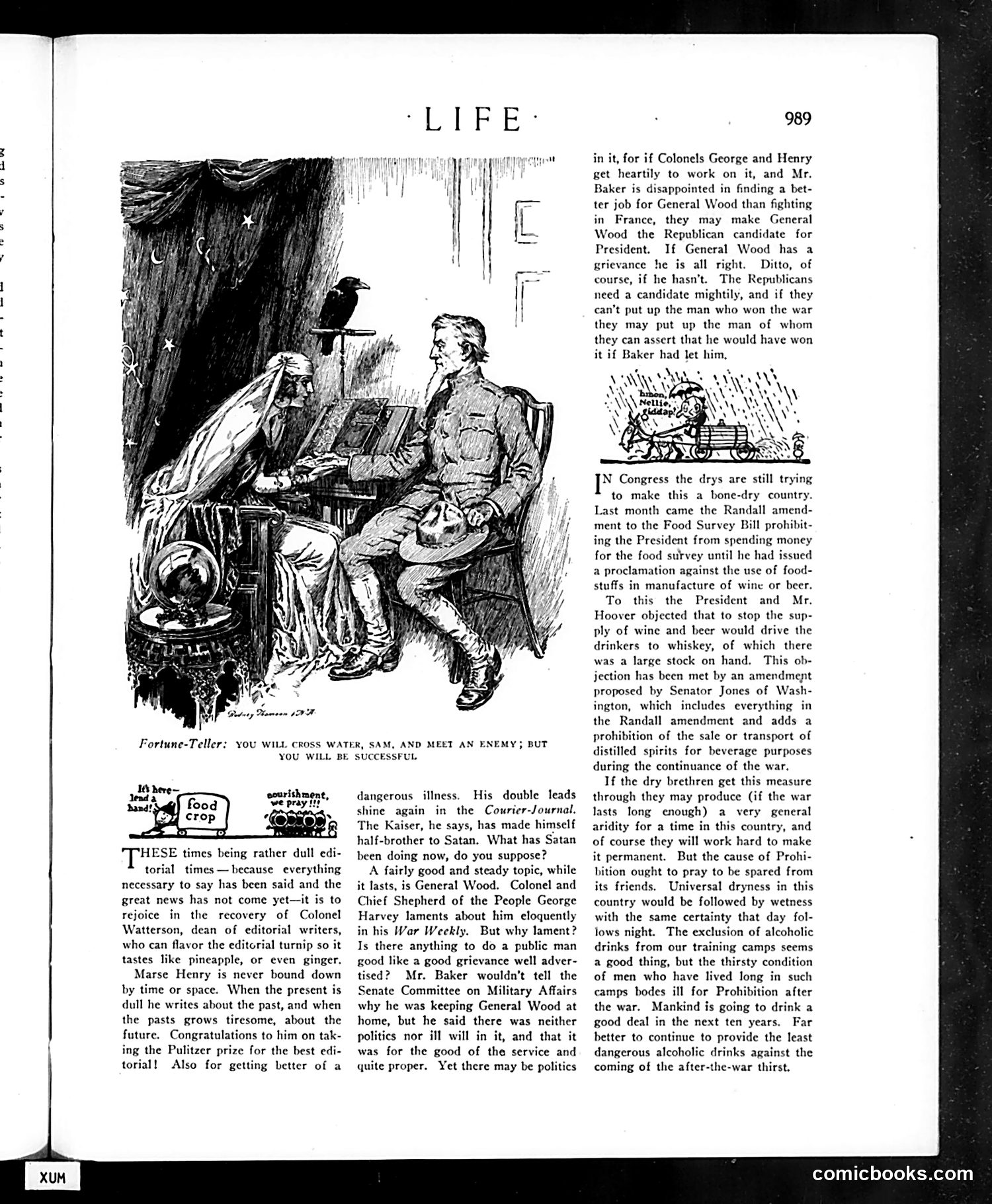
**The Cartoon:** A fortune-teller reads Sam's palm, predicting he'll "cross water" and "meet an enemy" but succeed. This appears to reference a soldier's fate in World War I, with "crossing water" meaning deployment to France. **The Editorial Context:** The page discusses Colonel George Wood, a military figure kept stateside by Secretary Baker rather than sent to fight in France. The satire suggests Republicans might weaponize Wood's absence as a grievance, potentially making him a presidential candidate by claiming he *would have* won the war if Baker had allowed it. This is political opportunism masquerading as patriotism. **Secondary Topic:** The page also satirizes Congressional "dry" (Prohibition) advocates trying to ban alcohol during wartime, arguing such restrictions will backfire post-war, driving soldiers to harder drinking. The overall tone mocks both Republican political calculation and zealous Prohibitionist overreach during WWI.
📄 Transcribed text from this page (OCR, searchable)
Machine-transcribed from the original scan — historical spelling and the odd misread are preserved.
a Fortune-Teller: you WILL CROSS WATER, SAM, AND MEET AN ENEMY; BUT YOU WILL BE SUCCESSFUL 'HESE times being rather dull edi- torial times — because everything necessary to say has been said and the great news has not come yet—it is to rejoice in the recovery of Colonel Watterson, dean of editorial writers, who can flavor the editorial turnip so it tastes like pineapple, or even ginger. Marse Henry is never bound down by time or space. When the present is dull he writes about the past, and when the pasts grows tiresome, about the future. Congratulations to him on tak- ing the Pulitzer prize for the best edi- torial! Also for getting better of a dangerous illness. His double leads shine again in the Courier-Journal. The Kaiser, he says, has made himself half-brother to Satan. What has Satan been doing now, do you suppose? A fairly good and steady topic, while it lasts, is General Wood. Colonel and Chief Shepherd of the People George Harvey laments about him eloquently in his War Weekly. But why lament? Is there anything to do a public man good like a good grievance well adver- tised? Mr. Baker wouldn't tell the Senate Committee on Military Affairs why he was keeping General Wood at home, but he said there was neither politics nor ill will in it, and that it was for the good of the service and quite proper. Yet there may be politics 989 in it, for if Colonels George and Henry get heartily to work on it, and Mr. Baker is disappointed in finding a bet- ter job for General Wood than fighting in France, they may make General Wood the Republican candidate for President. If General Wood has a grievance he is all right. Ditto, of course, if he hasn't. The Republicans need a candidate mightily, and if they can’t put up the man who won the war they may put up the man of whom they can assert that he would have won it if Baker had let him, IX Congress the drys are still trying to make this a bone-dry country. Last month came the Randall amend- ment to the Food Survey Bill prohibit- ing the President from spending money for the food survey until he had issued a proclamation against the use of food- stuffs in manufacture of wine or beer. To this the President and Mr. Hoover objected that to stop the sup- ply of wine and beer would drive the drinkers to whiskey, of which there was a large stock on hand. This ob- jection has been met by an amendment proposed by Senator Jones of Wash- ington, which includes everything in the Randall amendment and adds a prohibition of the sale or transport of distilled spirits for beverage purposes during the continuance of the war. If the dry brethren get this measure through they may produce (if the war lasts long enough) a very general aridity for a time in this country, and of course they will work hard to make it permanent. But the cause of Prohi- hition ought to pray to be spared from its friends. Universal dryness in this country would be followed by wetness with the same certainty that day fol- lows night. The exclusion of alcoholic drinks from our training camps seems a good thing, but the thirsty condition of men who have lived long in such camps bodes ill for Prohibition after the war. Mankind is going to drink a good deal in the next ten years. Far better to continue to provide the least dangerous alcoholic drinks against the coming of the after-the-war thirst. comicbooks.com