
Life, 1918-06-20 · page 28 of 36
Life — June 20, 1918 — page 28: what you’re looking at
What you’re looking at
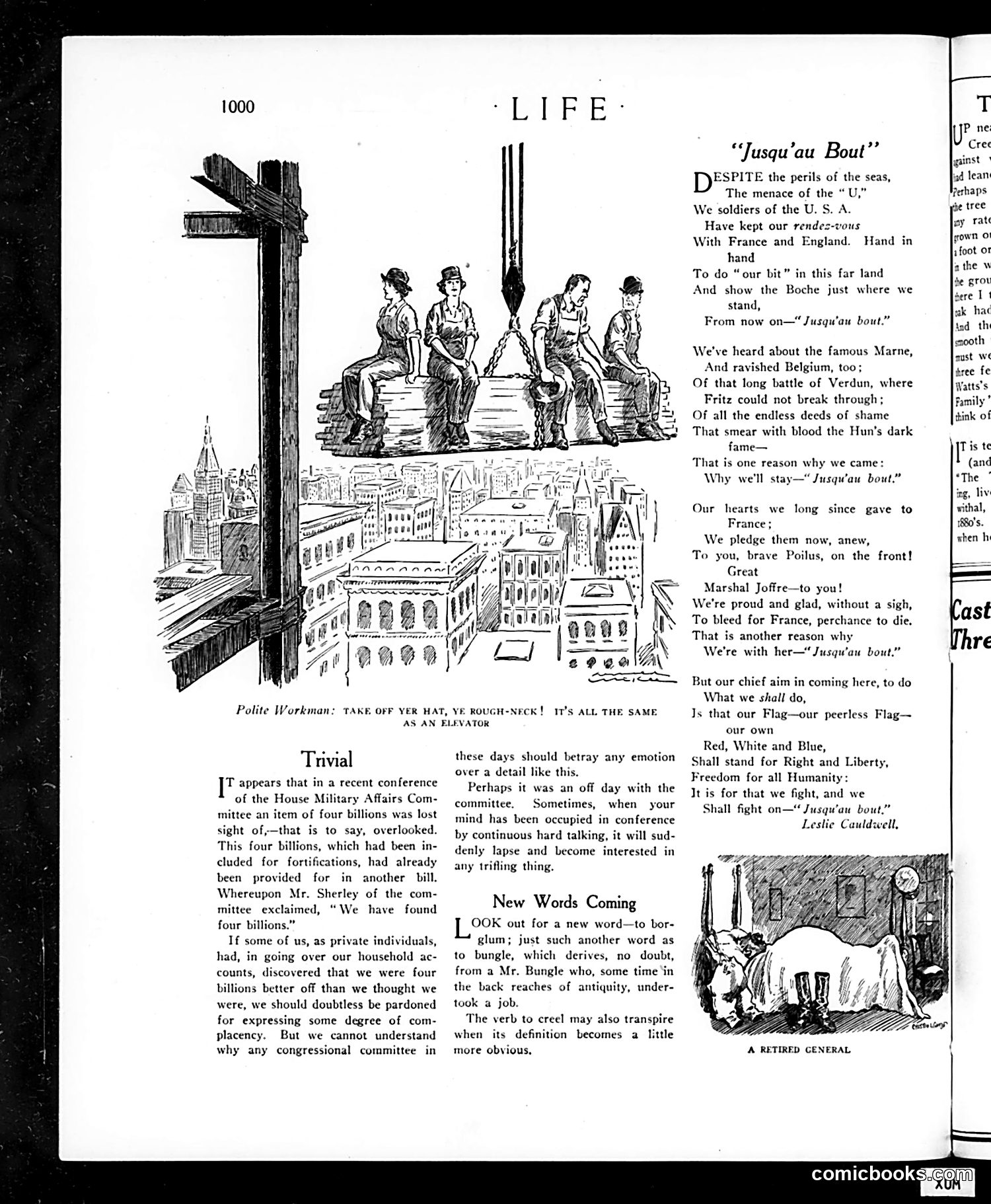
**"Polite Workman" Cartoon**: This depicts an exchange between a working-class man ("rough-neck") and presumably a more refined person in an elevator. The joke plays on class distinctions—the workman is told to remove his hat as if in a formal setting, but the response treats elevators as equivalently ordinary to everyday spaces, mocking pretentious etiquette. **"Trivia" Section**: Satirizes congressional incompetence during WWI. A House Military Affairs Committee "lost sight of" four billion dollars allocated for fortifications, then celebrated "finding" it—the same money already budgeted elsewhere. The author ridicules their treating this embarrassing accounting error as noteworthy, suggesting wartime committees are distracted and inefficient. **"Jusqu'au Bout" Poem**: A patriotic verse by Leslie Cauldwell explaining American soldiers' commitment to fight alongside France and Britain through the war's end ("jusqu'au bout" = "to the very end"). References famous WWI battles (Marne, Verdun) and pledges American support for French soldiers ("Poilus") and Marshal Joffre, emphasizing fighting for democracy and freedom.
📄 Transcribed text from this page (OCR, searchable)
Machine-transcribed from the original scan — historical spelling and the odd misread are preserved.
"gg cidaniaadaandanneae? ROR Polite Workman: TAKE OFF YER HAT, YE ROUGH-NECK ! 11's ALL THE SAME AS AN ELEVATOR Trivia I" appears that in a recent conference of the House Military Affairs Com- mittee an item of four billions was lost sight of,—that is to say, overlooked. This four billions, which had been in- cluded for fortifications, had already been provided for in another bill. Whereupon Mr. Sherley of the com- mittee exclaimed, “We have found four billions.” If some of us, as private individuals, had, in going over our household ac- counts, discovered that we were four billions better off than we thought we were, we should doubtless be pardoned for expressing some degree of com- placency. But we cannot understand why any congressional committee in these days should betray any emotion over a detail like this. Perhaps it was an off day with the committee. Sometimes, when your mind has been occupied in conference by continuous hard talking, it will sud- denly lapse and Lecome interested in any trifling thing. New Words Coming OOK out for a new word—to bor- glum; just such another word as to bungle, which derives, no doubt, from a Mr. Bungle who, some time ‘in the back reaches of antiquity, under- took a job. The verb to creel may also transpire when its definition becomes a little more obvious, “Jusqu’au Bout’’ ESPITE the perils of the seas, The menace of the “U,” erhaps We soldiers of the U. S. A. se tree Have kept our rendes-vons ley rate With France and England. Hand in own o} hand foot oF athe To do “our bit” in this far land ame And show the Boche just where we rae stand, ak ba From now on—Jusqu’au bout.” We've heard about the famous Marne, And ravished Belgium, too; Of that long battle of Verdun, where Fritz could not break through; Of all the endless deeds of shame That smear with blood the Hun’s dark fame— ‘That is one reason why we came: Why we'll stay—“Jusquau bout.” Our hearts we long since gave to France ; We pledge them now, anew, To you, brave Poilus, on the front! Great Marshal Joffre—to you! We're proud and glad, without a sigh, To bleed for France, perchance to die. That is another reason why We're with her—“‘Jusqu’au bout.” ( But our chief aim in coming here, to do What we shall do, Js that our Flag—our peerless Flag— our own Red, White and Blue, Shall stand for Right and Liberty, Freedom for all Humanity: It is for that we fight, and we Shall fight on—“ Jusqu’au bout” Leslie Cauldwell, A RETIRED GENERAL comicbookseer